




Abstract
Research in culturally responsive instruction (CRI) to improve literacy learning was explored through study of Hawaiian-focused charter schools. Building on work by Au, an indigenous framework reflecting the work of these schools was developed, highlighting five elements: (a) literacy in indigenous languages; (b) community connections; (c) a shared vision that encompasses culture, academic proficiency, and community; (d) authentic assessment; and (e) teaching grounded in culture and higher level thinking. Schools implemented CRI in an outward-looking, action-oriented manner and literacy was viewed as a means of serving community, not as an end in itself. Schools emphasized CRI as content, in contrast to earlier research with Native Hawaiian students that viewed CRI as process. CRI centered on exploration of cultural identity as the basis for gaining cultural knowledge of one’s ancestors, as well as Western academic knowledge for the purpose of contributing to the well-being of family, community, and nation.
Keywords
Guiding students of diverse cultural and linguistic backgrounds to high levels of literacy remains an ongoing challenge for researchers and educators concerned about equity in schooling opportunities and outcomes. In efforts to meet this challenge, culturally responsive instruction has been recognized as a tantalizing and logical approach (Au, 2007). In the United States, while research on culturally responsive instruction has been conducted primarily with two groups, African Americans and Native Hawaiians (Gay, 2010), additional research focused on literacy acquisition of African American, Latina/o, Indigenous American, Asian American, and Pacific Islander students (Paris, 2012). Our purpose in this article is to update theory, research, and practice in culturally responsive instruction based on work under way in a network of charter schools focused on equitable education for Native Hawaiian students. This work is the latest chapter in the tale of research on culturally responsive instruction with Native Hawaiian students, begun over four decades ago at the Kamehameha Elementary Education Program (KEEP). Now, as in the past, this research can inform the efforts of those seeking to improve the literacy learning of students of diverse backgrounds.
In operation from 1971 to 1995, KEEP was the nation’s longest running educational research and development project dedicated to the school success of students from a particular cultural group (Tharp & Gallimore, 1991). KEEP focused specifically on the literacy learning of Native Hawaiian students, on the assumption that this focus would promote students’ success in all school subjects. KEEP’s goal was to find useful approaches for teachers in public elementary schools, serving a high proportion of Native Hawaiian students. An early discovery was that Native Hawaiian primary-grade children achieved at higher levels as readers when instruction focused on comprehension and higher level thinking, as opposed to phonics and lower level skills (Tharp, 1982).
Research conducted at KEEP prior to 1989, including studies of culturally responsive instruction, followed a strategy of least change. The idea was to depart from conventional practices only in the specific ways needed to boost reading achievement, to make the approaches discovered practical for public school teachers. Within the emphasis on reading comprehension, KEEP teachers had students read basal reader stories during small group lessons. They did not use texts with Hawaiian cultural content to a greater extent than in typical Hawaiʻi public school classrooms.
Thus, given the strategy of least change, KEEP research on culturally responsive instruction focused on the process of instruction rather than departures from mainstream curriculum content. KEEP research in classrooms with many Native Hawaiian students identified three culturally responsive features that had the potential to support learning to read. First, teachers “smile with teeth” by establishing themselves as caring authority figures who treat every student with respect while tolerating no misbehavior in the classroom (D’Amato, 1988). Second, teachers make liberal use of peer work groups (two to six members) that allow students to support one another’s learning, mirroring family patterns of sibling caretaking, informal teaching and learning, and collaboration in household routines (Jordan, 1985). Finally, teachers use talk story-like participation structures when conducting small-group discussions of text, in a manner consistent with forms of co-narration seen in community speech events (Au & Mason, 1981).
During KEEP’s second phase of research, from 1989 to 1995, the focus shifted to the effects of progressive approaches on the literacy learning of Native Hawaiian students: literature-based instruction and the readers’ workshop, and the process approach to writing and writers’ workshops (Au & Asam, 1997). KEEP educators made the decision to emphasize research on workshop approaches when it became clear that the approach could readily incorporate KEEP’s major findings, those related both to culturally responsive instruction and to higher level thinking. Workshop approaches offered the opportunity to involve students in high-interest activities, such as publishing books on topics of their own choosing. High-interest, immediately rewarding activities were judged important in giving students a rationale for cooperating with teachers and engaging in academic learning (D’Amato, 1988). Assessment moved toward performance tasks, with written responses to literature and students’ published pieces as the main forms of evidence, and implementation of a portfolio assessment system (Au, 1994). Portfolio assessment yielded results showing the efficacy of the process approach to writing for Native Hawaiian students (Au & Carroll, 1997).
In an article published in this journal, Au (1998) proposed a conceptual framework for improving the school literacy learning of students of diverse cultural and linguistic background, built from research at KEEP. Extending ideas proposed by Cummins (1986), Au applied principles of social constructivism to arrive at a diverse constructivist framework for improving school literacy. She theorized that the school literacy learning of students of diverse backgrounds would improve as educators followed recommendations for seven elements.
In this article, we bring the tale of culturally responsive instruction into the present with findings from a network of charter schools dedicated to Native Hawaiian students and revitalization of the Hawaiian language and culture (for one school’s story, see Goodyear-Kaʻōpua, 2013). Specifically, we used Au’s (1998) earlier thinking as a springboard for developing an indigenous framework for improving literacy learning that reflects the beliefs and practices of network schools. In developing the indigenous framework, described in detail below, we reduced the number of elements from seven to five, creating a new category to combine instructional context and content. As we defined the five elements, we found that they needed to be reordered and moved language to the top of the list. The indigenous framework is structured around the following five elements: (a) role of the indigenous language, (b) connections to the community, (c) goal of instruction, (d) authentic assessment, and (e) instructional content and context.
We verified the beliefs and practices underlying the five elements in the indigenous framework through a range of evidence. Field notes taken during classroom observations, faculty meetings, and similar school events constituted the major source of evidence, with other sources including semistructured interviews with leaders and teachers, student performances and products, and curriculum documents, such as vision statements for the excellent writer.
Several caveats are in order. We brought an insider perspective to development of the 2018 framework, having served as teacher educators, curriculum developers, and mentors in network schools; one of us formerly headed a network school. While we back this particular network, we take no position on charter schools in general. We are unable to answer the question of whether noncharter schools serving Native Hawaiian students are engaging, or could engage, in the practices described here. We have chosen to illustrate the propositions in the indigenous framework with examples of practices in network schools. Finally, we have attempted to convey the essence of work that is evolving even as we write.
In short, the indigenous framework, and the school examples that support it, is presented in the spirit of radical imagination, as advocated by Khasnabish and Haiven (2017) and recognized by the editorial team of this journal (Sailors, Martinez, Davis, Goatley, & Willis, 2017). We aim to advance discussions of culturally responsive instruction by highlighting what appear to be valuable new approaches to excellence in the literacy education of Native Hawaiian students. In the next section, we present a brief history of literacy and the schooling of Native Hawaiians, which helps to explain the motivations and concerns of the Native Hawaiian educators who lead network schools.
Historical Context
For centuries, prior to contact with the West in 1778, Native Hawaiians engaged in sophisticated uses of language, believing that language held the power of life and death. Many forms of ʻōlelo or oral language were recognized in traditional times, including haʻi ʻōlelo (rhetoric), moʻolelo (history, legends, and stories), and ʻōlelo noʻeau (proverbs and poetical sayings). Knowledge was often passed on to the next generation through oli or chants. A well-known example is the Kumulipo, a story of creation composed in the 17th century, which is over 2,000 lines in its modern-day printed version (Beckwith, 1972).
In 1824 Kauikeaouli, the 12-year-old king of Hawai’i, issued a proclamation declaring, “My kingdom shall be a kingdom of learning.” The passing of the General School Laws in 1840 was one of the highlights of Kauikeaouli’s 30-year reign. Under these laws, the government assumed responsibility for supporting the common schools, which had previously been run as proselytizing efforts of Protestant and Catholic missionaries. The General School Laws (Kingdom of Hawai’i, 1842) required that every community with 15 or more school-age children establish a school and support a teacher, with mandatory attendance for both girls and boys.
The establishment of the common schools enabled Native Hawaiian teachers to spread literacy in the Hawaiian language throughout the Kingdom, furthering a larger scale an effort begun by Protestant missionaries who had turned Hawaiian into a written language in 1822. The missionaries’ efforts were consistent with practices followed since the Reformation of giving believers direct access to the Bible as the word of God. Literacy in the Hawaiian language was seen as an efficient strategy for converting Hawaiians to Christianity, as the handful of missionaries faced an audience of potential students numbering in the tens of thousands. The missionaries reasoned that the conversion process would be lengthy and uncertain if it required training an adequate number of Native Hawaiians to teach reading and writing in English.
Thus, from the time the Kingdom’s school system was established in 1841, until its closing with the overthrow of the monarchy in 1893, all teachers in the common schools were Native Hawaiian and taught in the Hawaiian language. In 1854, the minister of public instruction estimated that three fourths of Native Hawaiians above the age of 16 years could read in their own language (Kingdom of Hawai’i, 1842). Through the common schools, Native Hawaiian teachers enabled Native Hawaiians to become one of the most literate populations in the world.
The broad spread of literacy in the Hawaiian language through the common schools, by Native Hawaiian teachers, appears even more impressive when seen against the backdrop of the harsh and relentless contemporaneous effects of colonialism and Westernization. From an estimated 800,000 at contact (Stannard, 1989), the Native Hawaiian population was reduced to about 40,000 by the 1880s. This tragic loss has been attributed both to the introduction of Western diseases, to which Native Hawaiians had no immunity, and to efforts to destroy the foundations of their way of life, including systems of governance and land tenure (Kame’eleihiwa, 1992).
For Native Hawaiians in the 19th century, literacy was a double-edged sword (Au & Kaomea, 2009). While Westerners used literacy to portray Native Hawaiians as heathens and to denigrate all things Hawaiian, including the language, in contrast, Native Hawaiians learned to use literacy to turn the tables and present their own points of view. For nearly 40 years, missionaries and other Westerners controlled publications in the Hawaiian language. This situation changed in 1861 with the appearance of Ka Hoku o ka Pakipika (The Star of the Pacific), a Hawaiian-language newspaper with a nationalist point of view, backed by the future king, David Kalākaua. The warm reception of this newspaper by Native Hawaiian readers encouraged the publication of approximately 60 other newspapers providing a Hawaiian perspective and addressing a wide range of topics. Some articles addressed political topics, arguing against laws restricting Hawaiian cultural practices such as the hula (dance), or describing news from other countries withheld by missionary-controlled outlets.
A notable example of Native Hawaiians using literacy for political purposes is seen in the 1897 anti-annexation petition to protest the illegal overthrow of the Hawaiian monarchy and the annexation of the islands by the United States. Collectively known today as the Kūʻē Petitions, they are three separate petitions that contain over 38,000 signatures of Native Hawaiian adults and sympathizers, indicating widespread resistance to annexation. For obvious reasons, the anti-annexation petition, presented in the Hawaiian language, was ignored by Hawai’i’s Western political establishment and quickly faded into obscurity. Western historians, working exclusively from English language sources, remained unaware of the petition and concluded that Native Hawaiians had provided little resistance to annexation. Native Hawaiian historian Noenoe Silva (2004) created a stir when she called attention to this long-suppressed petition. She criticized historians for disregarding Hawaiian language sources and misrepresenting Native Hawaiians’ strongly anti-annexation sentiments. As a result of her work and that of other Native Hawaiian scholars, some believe that Hawai’i is illegally occupied by the United States.
Network of Hawaiian-Focused Charter Schools
Against this historical backdrop, we turn to current theory and practice in 17 Hawaiian-focused public charter schools; the first schools opened in 2000. We use the term network schools to denote these schools as group. Network schools can be seen as the 21st-century descendants of the common schools of the Kingdom, in which Native Hawaiian teachers taught Native Hawaiian students. The educators who founded these schools sought to “reclaim public K-12 education as a form of Hawaiian self-determination and sovereignty practice” (Goodyear-Kaʻōpua, p. 5). Leaders of network schools are building on past efforts in which (a) Native Hawaiian teachers were responsible for the literacy learning of Native Hawaiian students and (b) Native Hawaiians used literacy in empowering ways to present their own points of view and to perpetuate their language, culture, and values. Network school leaders recognize culturally responsive instruction as a pathway for improving Native Hawaiian well-being and sovereignty.
Located on four islands, network schools collectively serve more than 4,000 students, 81% of whom are part Native Hawaiian in ethnicity. Although each school is a reflection of its unique community, all network schools build on the concept of culturally responsive instruction, with cultural identity as the foundation for student success in learning literacy and other subjects.
Indigenous Framework
The indigenous framework for describing culturally responsive instruction as implemented in network schools is structured around the following five elements:
Role of the indigenous language
Connections to the community
Goal of instruction
Authentic assessment
Instructional content and context
These following examples of practices at network schools serve as existence proofs that the culturally responsive education of Native Hawaiian students is both possible and advantageous, especially in terms of benefits beyond those assessed by typical large-scale measures of academic achievement.
Element 1: Role of the Indigenous Language
Once colonialism took hold, a gradual and determined suppression of Hawaiian language and culture followed. The last decades of the 19th century saw the fading away of common schools and of Hawaiian as the language of instruction. Government English schools came into favor with Native Hawaiian parents, who recognized the value of English to their children’s future. Initially, teachers in these schools were Westerners who earned 10 times the salary of the Native Hawaiian teachers in the common schools (Au, 2000). By the time of the overthrow of the monarchy in 1893, the only common school remaining was on the remote island of Niʻihau. Although English had already become the language of instruction, the newly organized Republic of Hawai’i passed a law in 1894 forbidding the speaking of Hawaiian in school.
By the 1970s, while still practiced in ceremonies, music, and dance, the Hawaiian language was in danger of being lost as a means of everyday communication. The shocking loss of nationhood, accompanied by laws that suppressed Hawaiian language and cultural practices, contributed to a steady decline in the number of children who grew up speaking Hawaiian. By 1983, perhaps only 50 children were growing up as fluent speakers of the Hawaiian language (Wilson & Kamanā, 2006). The tragedy of the either-or situation Native Hawaiian families felt they faced is captured in these lines of poetry composed by a network school student (Mia Sarsona, 2017):
I am from choices made to protect a family The sacrifice of a language for their future Unheard voices and lost mo
Scholars have recognized that restoring everyday use of the Hawaiian language is critical to strengthening the cultural identity of Native Hawaiians. As Trask (1999) writes, English
cannot begin to encompass the physical beauty of the islands in the unparalleled detail of the Hawaiian language. Nor can English reveal how we knew animals to be our family; how we harnessed the ocean’s rhythms, creating massive fishponds; how we came to know the migrations of deep-ocean fish and golden plovers from the Arctic; how we sailed from hemisphere to hemisphere with nothing but the stars to guide us. (p. 60)
The language contains the collective wisdom of the poʻe kahiko (people of old)—the values, history, and practices of Native Hawaiians—and therefore holds the key to cultural identity.
Language revitalization efforts were led by Native Hawaiian activists, in keeping with similar movements during the 1960s and 1970s by African American, Latino, and Native American groups across the continental United States. In 1978, activists succeeded in changing state laws to allow classrooms where Hawaiian would be the language of instruction. Today, an estimated 2,000 students from preschool to Grade 12 are being educated in immersion classrooms where Hawaiian, rather than English, is the main language of instruction. Twenty-one public schools in Hawaii offer immersion programs, and six of these are network schools. Thus, the proposition for this element reflects the intention to revitalize an indigenous language that has not been a common means of everyday communication for several generations.
Revitalization of the Hawaiian language is supported in network schools even when English is the language of instruction. All network schools incorporate cultural practices and protocols that necessarily entail extensive use of the language. For example, as the school day begins, students chant in Hawaiian to signal their readiness for learning, asking permission to enter their classrooms.
Teachers conduct classroom discourse in a manner that incorporates many Hawaiian words and phrases, some for concepts with no English equivalent. An example is seen in a middle school science lesson at Kanu o ka ʻĀina, founded in 2000, where English is the language of instruction. In the lesson, students were learning terms related to the star compass as part of their study of traditional wayfinding (noninstrument navigation). The concept of the star compass is the basis for the Polynesian art of wayfinding and involves dividing the visual horizon into 32 hale (houses), marked by the rising and setting of the sun, moon, stars, and planets. The teacher explained navigational and geographic terms in both English and Hawaiian. For example, a navigator faces west, toward the entering horizon, or komohana, with back turned to the east, or arriving horizon, called hikina.
As this example illustrates, all students enrolled in network schools gain considerable proficiency in the Hawaiian language in terms of understanding the cultural context and social conventions for its use. The example also provides an indication of why the Hawaiian language was chosen as the starting point for the indigenous framework presented here.
Element 2: Connections to the Community
The high historical literacy rates among Native Hawaiians in their own language stand in sharp contrast to the generally poor performance of today’s Native Hawaiian students, as a group, on national and state reading tests (Watkins-Victorino, 2016). These differing results raise the question of how common school teachers accomplished the feat of bringing large numbers of Native Hawaiians at least to basic levels of literacy. Many of these teachers received little or no training, and they had few books or other teaching materials (Schutz, in press). What these Native Hawaiian teachers apparently did have was a deep understanding of the cultural backgrounds and values of their students, and a commitment to the communities they served.
Decreases in the literacy accomplishments of Native Hawaiian students, relative to the achievement of students in other groups, parallel the decline in the political and economic standing of Native Hawaiians after the annexation of Hawai’i to the United States. In education, this decline was seen in drastic reductions in the percentage of Native Hawaiian teachers (Au, 2000). Today, the percentage of Native Hawaiian teachers (9.9%) remains far from parity when considering the percentage of Native Hawaiian students enrolled in public schools (26%; Hawaiʻi State Department of Education, 2015).
Women head 15 of the 17 network schools (Keehne, 2017). Thus, to explore issues of effective leadership in network schools, Marci Sarsona (2017) conducted interviews with three respected female educators serving as principals and heads of their schools; participants’ names are used with their permission. As with teachers in the common schools of the Kingdom, these educators are thoroughly grounded in Hawaiian language, culture, and communities. In addition, they have pursued advanced degrees, contributing to a high level of sophistication about educational, social, and political issues.
The leaders interviewed maintained close connections to the community and supported culturally responsive instruction by following three practices: (a) promoting revitalization of the language, (b) extending the values of ʻohana (extended family) to the development of a strong school, and (c) visualizing the school as part of a larger commitment to community.
Revitalizing the Hawaiian language is well illustrated in the leadership of Kauanoe Kamanā, the poʻo kula (head of school) for Ke Kula ʻO Nāwahīokalaniʻōpuʻu (Nāwahī for short), a P-12 Hawaiian immersion school enrolling 426 students. In 1983, inspired by the Maori language preschools, Kamanā and her colleagues established the ‘Aha Punana Leo (Language Nest Corporation). Nāwahī was founded later to carry on instruction in the Hawaiian language beyond preschool. Kamanā’s leadership involves revitalization of the natural environment as well as the language. The 10-acre Nāwahī campus has gardens with Hawaiian food crops such as taro, sweet potato, and breadfruit, supporting culturally responsive curricula encompassing traditional Native Hawaiian concepts and Western academics.
Kamanā’s leadership emphasizes the school as an ʻohana (extended family). As in the ʻohana, everyone should work in unity toward the same vision, with roles that are distinct and not competitive. The school ʻohana includes students and their families, as well as teachers and other school staff. At the core is a shared understanding that the school’s vision guides decision making and without that “you will rubber band right back. . . to the status quo American mainstream education framework” (Marci Sarsona, 2017, p. 16).
Kamanā spoke in her interview about the Hawaiian value of wiwo, which she was raised to understand as “having a combination of respect and fear for older members of her ʻohana, especially her parents” and having a sense of “self-regulation” of behavior (Marci Sarsona, 2017, p. 11). This applies to the entire school ʻohana as a value of responsibility and accountability of roles and responsibilities. For example, faculty and students understand that their performance reflects upon the entire school family.
In her interview, Mahinapoepoe Paishon-Duarte, high school principal for Kanu o Ka ʻĀina, emphasized that her perspective as a Hawaiian cultural practitioner drives her as a school leader (Marci Sarsona, 2017).
I consider myself a student of waʻa (canoe), fishponds and hula (dance). Those three systems, I consider them the most influential in the way I perceive and construct leadership and the way that I carry out my work and kuleana (responsibilities). (Marci Sarsona, 2017, p. 30)
Paishon-Duarte is recognized as one of the founders of Paepae ‘O Heʻeia, a nonprofit that restored a historic 88-acre fishpond. She has extensive knowledge of Native Hawaiian waʻa culture, having sailed on the voyaging canoe Makaliʻi from Hawaiʻi to Micronesia. Both fishponds and canoe culture are central content in the culturally responsive curriculum at her school.
All three leaders interviewed by Sarsona support culturally responsive curricula that put a sense of place (Meyer, 1998), including traditional local knowledge, at the heart of learning. An example of this stance is seen in the work of Ivy Meahilahila Kelling, the school leader of Ke Kula ʻo Samuel M. Kamakau (Kamakau for short). Founded in 2000 as a Hawaiian immersion school, Kamakau is located at the base of the Ko’olau Mountains in Kāne’ohe on the island of Oʻahu. It enrolls 127 students from preschool to Grade 12.
Although she did not grow up in a Hawaiian family, Kelling studied hula beginning at the age of 4. Her love of hula evolved into an interest in Hawaiian language, which led to her pursuing a bachelor’s degree in this subject, and to becoming a preschool teacher for the ʻAha Punana Leo for 5 years. From there she became a teacher at Kamakau, then a brand-new school, where she gradually took on increasingly responsible leadership roles. Kelling’s philosophy, refined over time through her work in Native Hawaiian education, centers on service and leadership with a focus on the community where Kamakau is located, the ahupuaʻa (land division) of Heʻeia.
In traditional times, an ahupuaʻa was typically a wedge of land that extended from the mountains to the sea. All those living within the ahupuaʻa contributed to the common good through the resources available to them, for example, with those living in the wetlands raising taro to be exchanged for fish caught by those living along the ocean. Heʻeia received abundant water from two valleys, which created a rich marshland where large amounts of taro were grown. Starting in the mid-1800s, however, imported crops, such as sugarcane, and cattle were introduced, initiating disputes over water rights and an ecological disaster. Today, thanks to the determined efforts of community members, nonprofit organizations (such as the one Paishon-Duarte helped to found) are overseeing the restoration efforts that return inland and shore areas to traditional, environmentally healthy uses.
Kamakau collaborates with several nonprofits, including Paepae O Heʻeia, on restoration projects and cultural programs that provide its students with hands-on learning experiences. Kelling believes one measure of success is the extent to which Kamakau builds relationships with other organizations within the ahupuaʻa of Heʻeia and collaborates effectively to restore environmentally healthy uses of the land: “We really are connected by one wai, one stream” (Marci Sarsona, 2017, p. 21).
These three leaders are advocates of schools’ participation in restoring the natural environment, thereby strengthening cultural identity and rebuilding the lāhui (Hawaiian nation). Paishon-Duarte makes these connections clear by using fishponds as an example. In traditional times, fishponds, taro patches, and other sites for food-producing activities provided spaces within the ahupuaʻa where Native Hawaiian elders could transmit the cultural knowledge needed to sustain the local community. In efforts such as the restoration of the Heʻeia fishpond, network school leaders seek to create locations for the reengagement of families and the building of cultural identity, with schools playing a key role.
Most importantly, Paishon-Duarte and other leaders see cultural sites, such as fishponds, as places where Native Hawaiian communities and their allies can learn to manage complex projects. The skills involved include those of gathering input from community members, strategic and financial planning, coordinating with government agencies, and understanding both the traditional knowledge and Western science relevant to the project. In building the lāhui (Hawaiian nation), Paishon-Duarte argues, communities with prior experience managing complex projects will be positioned to assume responsibility as opportunities arise for the restoration and development of other sites. Network school leaders hope that their students will be among those well prepared to lead and contribute to such nation-building projects.
These leaders have a broad view of community-based, culturally responsive curricula that provide opportunities for applied learning to develop the literacy strategies and skills required to implement complex and innovative projects. The question of how culturally responsive literacy instruction can and should be carried out in network schools is explored in the next three propositions.
Element 3: Goal of Instruction
As made abundantly clear in this proposition and the discussion above, network school educators tend to focus on literacy as a means to an end, not as an end in itself (Brock, Goatley, Raphael, Trost-Shahata, & Weber, 2014). While mainstream literacy educators might emphasize students’ achievement without reference to a specific cultural context, network school educators generally see literacy and other academic areas in terms of their role in enabling students to grow in their knowledge of Hawaiian values and culture and to contribute to the improvement of society. For example, here is the mission statement of Nāwahī, the K to 12th-grade school headed by Kamanā:
Students of Ke Kula ʻO Nāwahīokalaniʻōpuʻu are educated upon a culturally Hawaiian foundation. The foundation is the basis upon which students are impelled to:
Bring honor to ancestors
Seek and attain knowledge to sustain family
Contribute to the well-being and flourishing of the Hawaiian language and culture; and
Contribute to the quality of life in Hawai’i. (Ke Kula ‘o Nāwahīokalani’ōpu’u Iki, n.d.)
As this mission statement suggests, the view of literacy held by network school educators is consistent with what Street (1995) has called ideological literacy, as literacy practices are understood to be embedded in a cultural context and shaped by the power relations between Native Hawaiians and other groups.
Further evidence for an ideological perspective of literacy is seen in the shared vision of the graduate developed by network schools (Hakipuʻu Learning Center et al., 2013). The process of arriving at this shared vision involved leaders and teachers in detailed discussions of three domains of student achievement: (a) cultural identity, (b) academic proficiency, and (c) community advocacy. Discussions centered on how each school was addressing these domains as well as plans for future endeavors. Leaders understood that having a shared vision would focus the exchange of ideas for educational improvement. These politically savvy leaders realized that applying a shared vision to assessment results could help them build a convincing, evidence-based case for the benefits to students of a network school education (Keehne, 2017). Thus, in the network’s long-term plan, the shared vision of the graduate served as a starting point for developing evaluation criteria that permit the aggregation of student learning results (to be discussed under Element 4, assessment).
After incorporating ideas from all schools, the network’s statement of the vision of the graduate read as follows:
Demonstrate, understand, apply Hawaiian values, respect and honor genealogy, recognize and accept leadership roles to manifest cultural knowledge, know a place (history, resources) as a piko [navel or starting point] and a foundation for making larger connections, understand importance of reciprocal relationships and responsibilities in a cultural context. Communicate effectively (verbal, oral, technologies), a lifelong learner for future competence, able to plan to attain current and future goals, provide adequately for self and family (p. 3).
The school builds on the resources of the community—its people, natural environment, traditions, and history—in seeking to prepare students with the will and expertise to strengthen that community. Students must understand their cultural identity, gain academic knowledge, and advocate for their communities for graduates to fulfill “responsibilities in a cultural context.”
Network educators recognize that students need to attain high levels of literacy to fulfill these responsibilities properly. As a consequence, individual schools have drawn on the shared vision to create their own descriptions of literate students, with adaptations to their school’s particular cultural and geographic setting. Consider the vision of the writer developed at Kawaikini, a network K-12 school in Līhuʻe on the island of Kauaʻi. Kawaikini is a Hawaiian language immersion school enrolling 136 students from preschool to Grade 12. Kauaʻi Manokalanipō, the phrase in the first line of the vision statement, is a traditional poetic reference to the island and one of its great chiefs; it carries the echo of many chants and songs and imparts an unmistakable sense of place.
Kawaikini writers will be culturally grounded in Kauaʻi Manokalanipō. They will use the writing process to write with proficiency in ʻōlelo Hawaiʻi [Hawaiian language] and English and maintain a Hawaiian perspective when providing translations. Writing will be used effectively to express original manaʻo [thoughts]. Haumāna [students] will utilize appropriate technology to convey a clear purpose in multiple writing genres (p. 1).
To demonstrate that they had met this vision of the writer, as well as other criteria for graduation, two Kawaikini high school seniors presented capstone projects addressing an essential question of importance to their community, “What native plants are fruiting and flowering in Miloliʻi [a remote valley on their island]?” Students experienced ownership because they had formulated the question, understood its significance to their community’s environment, and worked hard to find answers.
The students presented the information gathered before a panel of experts including their school administrator, three teachers (elementary, middle school, and Hawaiian language), a parent, and a community partner from the state’s Division of Forestry and Wildlife–Natural Area Reserves Systems, which oversees the secluded valley. The students gave their presentation in the Hawaiian language and included hula (dance) and mele (song) they composed and choreographed (Figure 1). Haliʻa Ku’u Aloha A ʻO Miloliʻi (Asquith et al., 2017), the song the students composed, conveys their proficiency in ʻōlelo Hawaiʻi (Hawaiian language) and deep respect for the land and its culturally significant features, including the wind (Kuʻehukai), native plants (maile lauliʻiliʻi, lehua, koki’o), and place names (Mahanaloa, Paʻaiki, ʻAnaki).
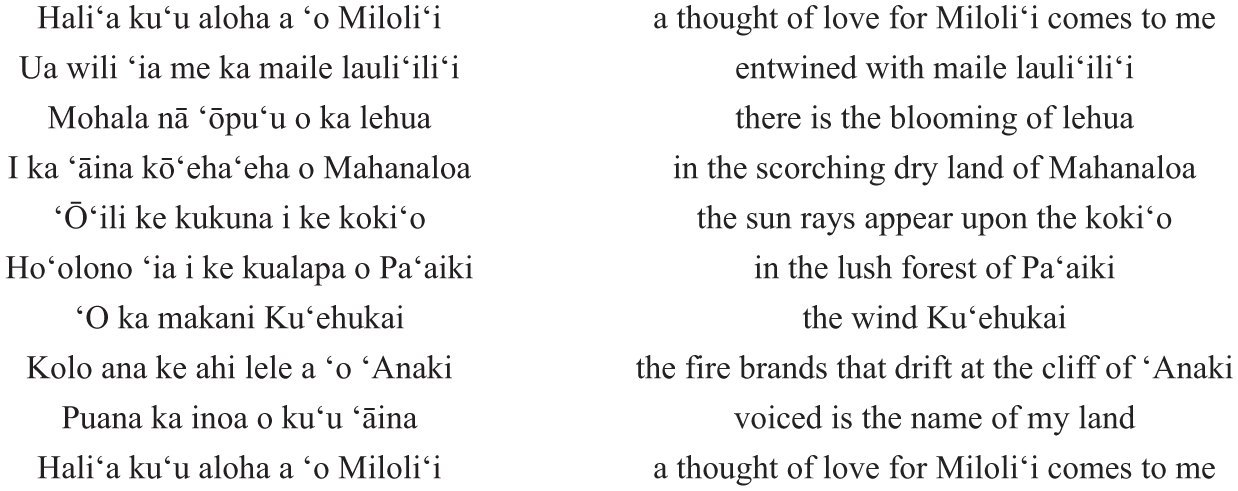
Haliʻa Ku’u Aloha A ʻO Miloliʻi.
The students provided results from their study of the fruiting and flowering cycles of native plants, in which they had applied mapping technology, and they discussed the impact of these cycles on gathering natural resources for cultural practices.
In keeping with Kawaikini’s vision of the writer, students demonstrated that they could read with comprehension and integrate information from both Hawaiian and English language sources; write in both traditional and modern scientific genres, from chants to research reports; and incorporate technology (mapping software). Furthermore, the students’ presentation was in line with the network’s shared vision of the graduate, providing evidence of students’ proficiency in the domains of cultural identity, academic competence, and community advocacy. As will be seen in our discussion of assessment, the capabilities demonstrated by these two Kawaikini seniors are typical for graduation capstone projects at network schools.
Element 4: Authentic Assessment
The performance assessments of network schools are at the heart of this proposition. These efforts demonstrate the strong commitment of network educators to rigorous measures of accountability. As public schools, network schools are subject to the accountability system of the Hawai’i State Department of Education. Daunting situations have arisen at times because of the mismatch between the network schools’ student learning goals and the state’s accountability measures. State accountability tests evaluate some of the academic proficiencies valued by network schools, but they do not address the competencies of cultural knowledge, literacy in the Hawaiian language, and service to community.
Kamakau, the pre-K to 12 school headed by Kelling and Kamehaʻililani Waiau, decided to tackle gaps in the state accountability system in a strategic manner, by offering a viable means of measuring students’ comprehension of Hawaiian language texts. At the time, Kamakau teachers had worked for 7 years with a research-based model of teacher-developed curriculum and assessment (Au, 2005; Raphael, Au, & Goldman, 2009). Teachers at all grade levels had developed and vetted reading comprehension assessments in the Hawaiian language, and they had learned to use the results to monitor and improve student performance.
In their appeal to the charter school commission, Kamakau leaders asked to have the results of these reading assessments included in the state’s calculation of their school’s index score. A commission staff member supported Kamakau’s request, citing years of evidence that the assessments served as rigorous measures of reading growth in the Hawaiian language, aligned with standards, and linked directly to the school’s mission and vision (State of Hawai’i, Public Charter School Commission, 2014b). The staff member recommended that Kamakau’s own assessments be given a weight of 25% in calculations of their index score for the next 5 years. The motion to approve Kamakau’s request passed unanimously (State of Hawai’i, Public Charter School Commission, 2014a); it was the first time the commission had approved a request for changes in a school’s index calculation.
As this example suggests, network schools understand the positive impact of providing viable alternatives to external accountability measures. Their alternatives center on hōʻike. The verb hōʻike means to show or exhibit, in other words, to display proficiency or demonstrate what one knows and has learned. Native Hawaiians have always used hōʻike to demonstrate readiness for the next level of education or training. Historians describe an array of hōʻike used to communicate proficiency in leadership, hula (dance), medicine, and international policy (Chun, 2011; Emerson, 1906; Kamakau, 1961). Missionary accounts dating back to the 1820s describe hōʻike during which hundreds of Native Hawaiian adults and children demonstrated rudimentary skills of reading and writing in the Hawaiian language (Schutz, in press). As presently used by network schools, the term hōʻike refers to Hawaiian culture-based performance assessments.
Network educators see hōʻike as having far greater value than large-scale tests in fostering student learning and in judging the effectiveness of instruction. The following quotation shows a network student’s recognition of the vast differences between preparing for a hōʻike versus a standardized test:
Less learning is shared on tests than hōʻike which incorporates interviews, online research, and book research. If SAT was the only way to demonstrate my learning that would’ve been a big struggle and I would’ve just studied for the test and afterwards forgot. (Keehne, 2017, p. 71)
Students in network schools are often required to communicate their learning in research papers to meet expectations stated in project rubrics developed at the school level. While some Hawaiian-focused charter schools are in the process of developing their performance assessment plans, others have already laid out detailed, rigorous maps. Hakipuʻu Learning Center, located on the windward side of Oʻahu, serves 63 students in Grades 4 through 12. Table 1 is an outline for the school’s Alapiʻi (Ladder) Project. Performance assessments are scaffolded to ensure students are well prepared for the senior capstone project hōʻike (Keehne, 2017).
Hakipuʻu Learning Center Alapiʻi Project Guidelines.
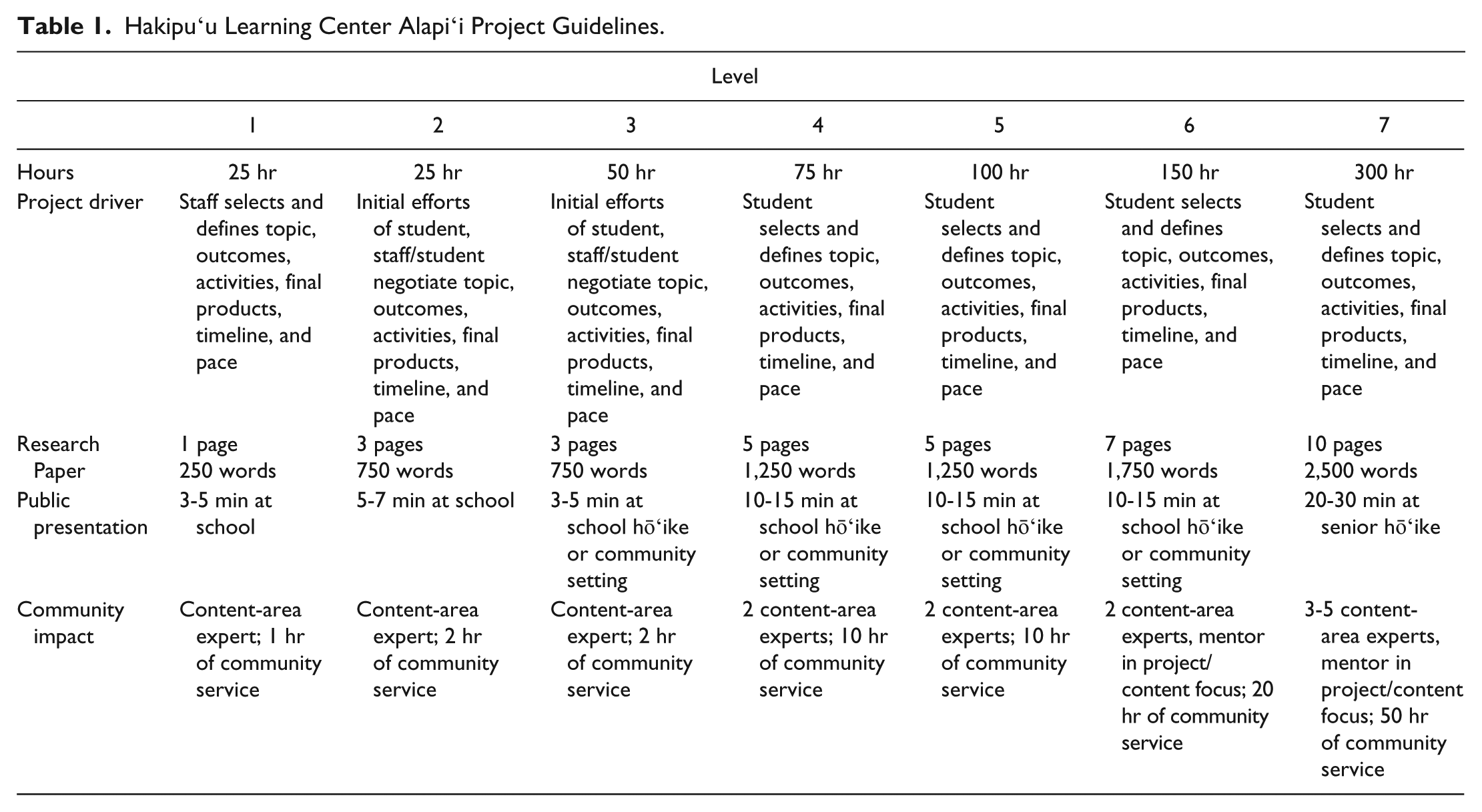
During students’ senior year, capstone project hōʻike and graduation hōʻike provide final opportunities to demonstrate their accomplishments (Keehne, 2017). Student performances must address all three components of the network schools’ vision of the graduate (i.e., cultural knowledge, academic proficiency, and service to community). The criteria for judging hōʻike performances and projects are that they (a) encompass a range of knowledge and skills, (b) demonstrate meaningful application and understanding of the material, and (c) are culturally purposeful, in serving the community and perpetuating Hawaiian values, language, and practices (Kana’iaupuni, Ledward, & Jensen, 2010).
To demonstrate their proficiency in literacy, students synthesize academic knowledge by engaging in the inquiry process, synthesizing and critiquing multiple texts, creating a written product, and delivering an oral presentation. Students work closely with teachers and staff to develop research questions and gather a variety of resources to explore answers. The range of texts analyzed by students for their graduation hōʻike typically includes historical Native Hawaiian newspaper articles, oli (chants), and mele (songs), all of which are usually written in the Hawaiian language. Because oral traditions are an important part of Hawaiian culture, moʻolelo (oral histories) from kupuna (elders) or other community members are viewed as highly credible sources that elevate student projects.
Students’ selection of their own research topics, reflecting their passions and career interests, is foundational to senior capstone project hōʻike. Self-selection opens the door to a tremendous variety of topics, with actual student projects addressing everything from fishpond mapping to college financial planning. Pursuit of their chosen topics often requires students to show perseverance and ingenuity, including seeking knowledge from those outside the school.
A hōʻike coordinator cited the following example of a student’s deep commitment to a topic that resonated strongly within his family:
His project is about ʻai pono [healthy eating] which his grandfather helped to spearhead [as a service to the community]. . . and his whole idea was, How does ʻai pono help my family and our community health overall? As one of the grandchildren, what was his responsibility in carrying on this tradition? He felt such a strong responsibility in helping to ensure that this way of taking care of your body and eating healthy and right from the land continued. For him that was [such] a huge responsibility that it was almost overwhelming to him because he wasn’t sure he could live up to it. I was just really impressed that at such a young age he felt that responsibility. (Keehne, 2017, p. 82)
Hōʻike coordinators noted that students are motivated to demonstrate cultural and academic proficiency because audiences are composed of family, community members, and content experts. As one coordinator stated, “It’s about the students, not about us and when they’re up there performing or presenting, it’s all about them so they better be ready” (Keehne, 2017, p. 94).
Some network schools preserve the unique traditions of their communities by including these practices in students’ hōʻike. Kua o ka Lā, a network school serving 200 students from preschool to Grade 12, is located on an ancient Hawaiian fishpond surrounded by coconut trees in Pualaʻa on the island of Hawaiʻi. Staff and students who investigated the wahipana (place-based history) of the area were told by kupuna (elders) that residents created kīʻoʻe (coconut shell spoons) used to eat uala wai niu (a mixture of sweet potato and coconut milk). Students learn to create this cultural and place-based artifact for their graduation hōʻike, in this manner carrying forward a tradition that might otherwise have been lost.
Element 5: Instructional Content and Context
As noted, network schools may begin the literacy improvement process with a vision of successful readers and writers. One school’s namesake, Samuel Mānaiakalani Kamakau (1815-1876), was a renowned historian, scholar, and leader whose writings still serve as valuable resources about Hawaiian politics, cultural practices, lifestyle, and language from a precarious time of transition (Kamakau, Barrère, & Pukui, 1964). In drafting their school’s visions of the reader and writer, the faculty discussed ways they might use the writings and accomplishments of prominent historical figures, such as Kamakau, as an inspiration to students.
Here is the vision of the reader and writer for Kamakau.
The excellent Kamakau reader will be able to read for information, articulate and reflect on reading, and comprehend at a deep level in both English and Hawaiian.
The graduate of Kamakau will be an excellent writer who is able to write in both Hawaiian and English with self-awareness and purpose, fluency, eloquence, and clarity in a variety of genres to perpetuate the treasured repository (of knowledge) that our ancestors bequeathed to us and to emulate the literary legacy of our namesake, Samuel M. Kamakau.
The history and traditions of this school provide a powerful context for literacy learning that shows the blending of cultural values and orientation toward higher level thinking advocated in the proposition.
Teachers then followed through with lessons in their classrooms. The high school teacher of social studies and Hawaiian language chose to inspire students’ literacy learning through the writings of Joseph Kahoʻoluhi Nāwahīokalaniʻōpuʻu (1842-1896). An accomplished lawyer and newspaper publisher, Nāwahīokalaniʻōpuʻu was a political leader with staunchly nationalist views who strongly opposed the overthrow of the monarchy and the annexation of Hawaiʻi by the United States.
In English class, the teacher shared her personal literacy portfolio as evidence of the authentic purposes served by reading and writing in her life, demonstrating that literacy was just as important now as during Kamakau’s lifetime. Students could see their teacher’s cultural identity, literacy proficiency, and passion for community reflected in examples of her daily reading and writing. The teacher then gave students the assignment of gathering evidence of their own literacy accomplishments in both Hawaiian and English, from their daily routines. These examples illustrate how instruction in network schools can simultaneously be grounded in cultural values and oriented toward higher level thinking.
Students are often encouraged to learn in the time-honored ways of their ancestors. As Kelly (1991) wrote, “Hawaiian tradition teaches that a child should observe, listen, and imitate” (p. 9), asking questions only when the lesson is over and permission is given by the teacher. While this formula is no longer strictly observed, its overall flow is often reflected in lessons.
In the Kamakau example just presented, the two teachers began by providing examples of proficient reading and writing. Students could observe and study the texts by reading Nāwahīokalaniʻōpuʻu’s writing and reviewing the teacher’s literacy portfolio. Students could listen to their teachers’ verbal explanations to gain background about the texts. Finally, students could apply what they had learned. In the case of Nāwahīokalaniʻōpuʻu’s writings, they could analyze the content and purpose of the piece and identify the ways they might emulate the author’s practices. Similarly, with the teacher’s literacy portfolio, students could identify the ways they were following or departing from her practices as a reader and writer.
Much of the struggle for self-determination in the Hawaiian community has centered on recurring challenges to land and water rights and access to sites for traditional gathering (such as of medicinal plants) and cultural practices. As shown in earlier examples, the curricula of network schools address community issues such as access to ancestral lands, restoration of water rights, and preservation of ecosystems. In these highly contextualized curriculum units, teachers and students work with an essential question that drives the course of study.
An essential question is often grounded in data collection in the local community, while engaging students with issues of wide applicability. An elementary-level example of this is seen in the essential question for a second-grade unit at Kawaikini: How do we demonstrate aloha ʻāina (love of the land) from Keālia to Waialua on Kauaʻi? Keālia and Waialua are towns on the east coast of the island, not far from the school. The unit focused on the health of the area’s ecosystem as judged from the study of ʻoʻopu (goby fish), an indicator species for the water quality of streams. Students were provided with opportunities to gather data on field trips to mountain streams, where they identified various species of ʻoʻopu and studied their life cycle. They learned mele (songs) and ʻōlelo noʻeau (traditional Hawaiian proverbs) related to the characteristics and environments of the ʻoʻopu, and they engaged in discussions with a local author who had written a book about ʻo’opu with the text in both Hawaiian and English. Students utilized thinking maps to compose three-paragraph essays about the life cycle and environment of the ʻoʻopu.
One thematic unit may not make a profound impact on students, but an accumulation of such units across the grades certainly should. This impact should be evident in the senior capstone hōʻike. As a network school educator stated, “Our seniors should be able to think about everything that happened, from kindergarten up to graduation, and be able to use all of their cultural experiences to build their hōʻike” (Keehne, 2017, p. 62). For their senior capstone project, students at Kamakau learn the Native Hawaiian oratory art of haʻi ʻōlelo. Students are required to accurately utilize the nuances and metaphors of Hawaiian language to craft speeches that convey the depth of thinking and sophistication of oral language practiced by their ancestors (Keehne, 2017). The Kamakau capstone performance imparts to students a genuine sense of responsibility, in this case for revitalizing oral traditions through a form of community service that expresses caring relationships and ethical citizenship (Weissbourd et al., 2016). As part of their hōʻike, seniors return to their preschool and elementary classrooms to present the haʻi ʻōlelo to the teachers who introduced them to the Hawaiian language. Their speeches are often written to encourage younger students to continue their journey in Hawaiian education.
Conclusion
The indigenous framework highlights five elements of culturally responsive instruction that promote literacy learning and build cultural identity: (a) literacy in the indigenous and dominant languages; (b) community connections; (c) a shared vision that encompasses cultural knowledge, academic proficiency, and community service; (d) authentic assessment; and (e) teaching grounded in cultural knowledge and aimed at higher level thinking and advocacy.
As this framework shows, network schools illustrate culturally responsive instruction as an indirect, pluralist path to school success for students of diverse cultural and linguistic backgrounds (Au, 2007). In an indirect approach, educators begin by affirming and reinforcing students’ cultural identity. Working from the basis of cultural identity, educators give students access to mainstream academic content and strategies. In contrast, in a direct or assimilationist approach, educators expect students to jump into mainstream academics from the start, and little or no attention is paid to cultural identity.
Insights about culturally responsive instructions gained from the indigenous framework, and school observations may be clustered in three categories: (a) outward orientation, (b) connections to community, and (c) curriculum content. First and foremost, culturally responsive instruction in these schools is outward-looking and action-oriented. Leaders and teachers see their schools as part of larger efforts to uplift the community, looking beyond the four walls of the classroom. Too often, families and residents see schools as bureaucratic institutions that stand apart from the life of the community. In contrast, network schools engage in collaborative projects to elevate their community. This aspect of their approach to culturally responsive instruction is overtly political and positions leaders, teachers, students, families, and supporters as advocates for communities. Community is understood in two ways; reference may be to the community of Native Hawaiians as an ethnic or cultural group, or to the geographic area surrounding the school.
In the first sense of community, issues of sovereignty, self-determination, and nationhood form the political backdrop for network schools’ outward-looking approach to culturally responsive instruction. Network schools, by their very existence, stand at the center of the continuing debate about these issues. These educators understand the importance of calling students’ attention to the ways Native Hawaiians of the past resisted the forces of colonialism. Taking the next logical step, educators guide students to recognize the need for continued resistance to rebuild the Hawaiian nation and achieve social justice for Native Hawaiians.
In the second sense of community, educators impart to students a strong sense of place based on the schools’ location and responsibility for helping to elevate the community. This outward-looking, action-oriented approach to culturally responsive instruction is utilized whether or not students reside in the immediate neighborhood, as network schools enroll many students from outside their geographic area. As part of their outward-looking approach, schools collaborate with nonprofit organizations. Collaborations might focus on music, art in public places, and community college coursework, to name a few; the exact focus depends on the opportunities afforded by a particular location. This outward-looking approach resonates with place-based, problem-based, and project-based learning (Blumenfeld et al., 1991; Gruenewald, 2003; Hmelo-Silver, 2004), which all offer numerous opportunities for literacy learning.
For network schools, collaborations with other organizations have the higher purpose of teaching students about their responsibility for contributing to the well-being of their families and the community, defined in both senses. As evident in Marci Sarsona’s (2017) interviews with leaders, these schools are educating students, in literacy and other areas, to prepare them to fulfill this responsibility. Proficiency in literacy is not seen as an end in itself but as a means of meeting obligations. This is a compelling view, worthy of discussion by researchers and educators in all schools engaged in discussions of culturally responsive instruction.
Second, we highlight insights about culturally responsive instruction centered on educators’ deep connections to community, again defined in both senses. Educators with these strong connections are central to network schools’ ability to maintain an outward-looking, action-oriented focus. Research shows that teachers successful in using culturally responsive instruction, and in building close ties to the community, do not have to be of the same ethnicity as their students (Au, 1993; Ladson-Billings, 1994). Connections may be built because educators reside in the community, were raised there, or have family ties. In other cases, educators may be outsiders in geographic terms but win acceptance by virtue of fluency in the language, engagement with cultural practices, and commitment to worthy causes, as seen with the three leaders described earlier. Outward-looking, action-oriented culturally responsive instruction, of the kind observed in network schools, flourishes when leaders and teachers are accepted by the community and viewed as knowledgeable insiders who bring expertise as well as enthusiasm to collaborative projects. Educators’ deep connections to community, in both senses, are an important consideration in all schools working with culturally responsive instruction.
As readily apparent from our school and classroom examples, culturally responsive instruction requires educators with a high degree of knowledge and expertise. Connections to the community are a necessary but not sufficient condition for success. Leaders and teachers must be extraordinarily well prepared through a combination of university programs, consistent engagement with cultural practices, and hands-on experience in schools and communities. There are marked benefits when teacher preparation initiatives are located in diverse communities and recruit prospective teachers there (Au, 2000). In any event, culturally responsive instruction that brings students to high levels of literacy (in some cases, in two languages) cannot take hold in schools staffed by the least experienced, least prepared leaders and teachers. In all settings, students of diverse backgrounds benefit when their schools invest in the professional development of leaders and teachers, building their expertise and encouraging their long-term commitment.
Third, we discuss insights related to the role of curriculum content. In contrast to KEEP, network schools pay relatively little attention to details of culturally responsive instruction as process. Instead, these schools tend to focus on culturally responsive instruction as content, organized by thematic units. Thematic units and essential questions have long been used to organize both the conceptual understandings and literacy strategies to be taught (Au, 1994; Valencia & Lipson, 1998; Wiggins & McTighe, 2005). Educators developed compelling thematic units because of their strong beliefs about the value of the content. Time and again, thematic units were found to center on revitalization—of the language, culture, and environment. All thematic units described here reflected revitalization, whether the focus was food production within a traditional Hawaiian land division or fish as indicators of water quality. In many cases, thematic units had elements of community service, for example, when students participated in the restoration of a fishpond, illustrating what Banks (1995) has called a social action approach. In thematic units for older students, revitalization extended to remembering and learning from history, for example, through units on ancient chants or the writings of Native Hawaiian leaders during the time of the overthrow. The work of network schools resonates with culturally sustaining pedagogy (Paris & Alim, 2014), which endorses the fostering of pluralism in language, literacy, and culture and sees present and future value in the practices of diverse communities. In keeping with culturally sustaining pedagogy, network educators encourage students to explore issues of cultural identity in a rapidly changing, globalized society. However, during these explorations, educators remind students to seek inspiration from, and ground themselves in, Native Hawaiian cultural practices, history, and ancestral wisdom.
Choosing content for the purposes of revitalizing and remembering is an approach to the development of culturally responsive thematic units appropriate to all schools serving students of diverse backgrounds. The school’s community and its history can readily become the focus of thematic units. By taking a long view, students can understand changes that have taken place over time in the natural environment and patterns of human settlement. As in network schools, students can interview community residents, including their own relatives, an especially valuable activity if stories come from an oral tradition.
What happens to culturally responsive instruction in settings where students are from many different cultural and linguistic backgrounds? Issues of diversity in students’ backgrounds arise in network schools as well. Whereas most students are part Hawaiian in ancestry, they are also descendants of the many different groups that immigrated to Hawaiʻi during the 19th and 20th centuries. Furthermore, about 20% of students in network schools are not of Native Hawaiian ethnicity. Network school teachers face the dilemma encountered in other diverse schools, where it is seldom possible to have a deep understanding of every culture and language reflected in students’ backgrounds. This concern arises for network school educators as they consider ways for students to explore their connections to ethnic groups other than Native Hawaiians.
In these situations, teachers can find success by inviting students to introduce cultural knowledge from their families into the classroom (Moll, 1992). Teachers do not have to be know-it-alls when they frame thematic units, lessons, and assessment activities in open-ended ways that position students as purveyors of knowledge. Teachers might conduct a unit on family stories in which students give presentations centered on artifacts brought from home (Raphael et al., 2001), or they might have students create literacy portfolios to answer the question, Who am I as a reader and writer? (Hansen, 1992).
We close with the description of culturally responsive instruction that grows from our indigenous framework for improving students’ literacy learning. For any given student, it is the exploration of cultural identity as the basis for gaining knowledge—the cultural knowledge and history of one’s ancestors, as well as the academic knowledge of the wider world—for purposes of contributing to the well-being of one’s family, community, and lāhui (people or nation). Lines from a Kamakau student’s poem capture this description well (Mia Sarsona, 2017):
I am revitalization I am heard voices I am the future of my lāhui Hoping to inspire Generations and Generations of Change I am from inherited resilience Not inherited trauma (p. 1)
Footnotes
Acknowledgements
The authors gratefully acknowledge Antoinette Konia Freitas for her guidance in Hawaiian language and culture and Taffy E. Raphael for suggestions that improved the organization and clarity of this article. They also thank the network of Hawaiian-focused charter schools for their inspiration and steadfast stewardship of the Hawaiian culture.
Declaration of Conflicting Interests
The author(s) declared no potential conflicts of interest with respect to the research, authorship, and/or publication of this article.
Funding
The author(s) received no financial support for the research, authorship, and/or publication of this article.

References
Supplementary Material
Please find the following supplemental material available below.
For Open Access articles published under a Creative Commons License, all supplemental material carries the same license as the article it is associated with.
For non-Open Access articles published, all supplemental material carries a non-exclusive license, and permission requests for re-use of supplemental material or any part of supplemental material shall be sent directly to the copyright owner as specified in the copyright notice associated with the article.
