




Abstract
Many students of color who are also identified as “struggling” readers are likely to have negative experiences in school. In this article, I discuss the findings of a case study examining how reader identities emerged in and through language for such students. The discourse data analyzed here concern an interactional pattern in which the focal students and their teacher collaborated in disrupting identities of deficiency, and instead constructed literate identities within whole-group discussions of text. These findings highlight moments of agency from students marginalized in schools and point toward ways that teachers and students can collaboratively create space for students’ literate voices to be heard.
Schools are organized in ways that highlight the failures of some students, individually and in groups (McDermott, Goldman, & Varenne, 2006). Such groups, McDermott et al. (2006) argued, “consist of kinds of person by race, gender, or class, and/or by kinds of minds described through contrasts such as smart/dumb or gifted/disabled” (p. 15). This kind of labeling is a discursive practice (Leonardo & Broderick, 2011), a way of using written and spoken language, that can negatively affect particular groups of students (Harry & Klingner, 2007). These effects can include higher rates of suspension, dropout, and incarceration (Annamma, 2014; Farmer, 2010; Laura, 2014; Smith, 2015). Students of color also labeled as “learning disabled” (LD) or “struggling” learners are particularly vulnerable to this insidious form of identification because they can experience marginalization along axes of both race and ability. This article focuses on these twice-marginalized students.
As a justice-oriented educational researcher and former teacher, I believe that it is necessary to examine how discourses that marginalize students of color also seen as “struggling” in schools are disrupted in everyday classroom interactions. One way to accomplish that is to look at moments in general education literacy classrooms where these students’ voices are included and they are positioned as literate. The purpose of this article is to examine the discursive mechanisms (Bucholtz & Hall, 2005) by which three “struggling” readers of color and their teacher co-constructed interactional spaces in which the students asserted literate identities. I put the terms struggling and LD in quotation marks to highlight the social construction of these concepts with a focus on how they can institutionally position students. The focal students in this research were identified as “struggling” readers based on their performance on high-stakes tests (HST) or receipt of special education services for students with “LD.” The aim of this analysis is to disrupt the marginalization and stigmatization that can result from such labeling. Hence, the following research question guided this inquiry: How are literate identities co-constructed by focal students and their teacher in text-based discussions?
Review of Literature
I situate this research in the literature examining identities of academic “struggle” as socially constructed and deconstructed. Scholars in the sociocultural tradition argue that students’ identities exist in interactions and are mediated by learning contexts (Bucholtz, Barnwell, Skapoulli, & Lee, 2012; Dudley-Marling, 2004; McDermott, 1993; McDermott, Raley, & Seyer-Ochi, 2009). Below, I outline findings related to how identities of academic “struggle” are socially constructed. Then, I review literature examining the disruption of school-based identities of “struggle.”
Research suggests that contexts, on various levels, mediate when and how students are perceived as “struggling.” Students’ academic strengths can be obscured when teachers view them through discourses and ideologies of deficit that circulate in broader social and cultural contexts (Dyson, 2015). Dyson (2015), Leonardo and Broderick (2011), and others argue that socially constructed terms such as at risk serve to link “demographic qualities of children and their families to perceived oral and written language deficits” (Dyson, 2015, p. 199), which are subsequently linked to potential school failure. In this broad sense of context, normalization processes and imagined ideals around what students should be able to do position a disproportionate number of working-class students of color as deficient. Consequently, Dyson (2015), like McDermott et al. (2006), suggested that “assumed deficits of whole groups of children become taken for granted and, simultaneously, resources and strengths are ‘erased’” (Dyson, 2015, p. 199).
In line with Dyson’s assertions, Anderson (2009) and Collins (2012) identified some of the deficit ideologies that can mask marginalized students’ academic engagement and strengths from teachers. Stereotypes of family structure sometimes seemed to obscure teachers’ acknowledgment of student strengths (Collins, 2012), and other times it seemed that teachers assumed deficits because of students’ special education designation (Anderson, 2009), even when focal students performed academically like their peers (Anderson, 2009; Collins, 2012). These studies suggest that the erasure (Dyson, 2015; Irvine & Gal, 2000) of students’ strengths was at least partially informed by deficit discourses, a sort of unconscious confirmation bias rooted in tacit ideologies that circulate within the social and cultural contexts around schools (Dyson, 2015).
Time (Bucholtz et al., 2012; Wortham, 2004) and school-based spaces (McDermott, 1993; Triplett, 2007; Varenne & McDermott, 1998) have likewise been implicated as contributing contextual factors in constructing identities of “struggle.” Wortham (2004) and Bucholtz et al. (2012) documented how, across time, various interlocutors repeatedly positioned focal students as “struggling” academically until these deficit “discourse trajectories harden[ed] into itineraries of identity, or well-worn ideological routes along which socially positioned subjects may be compelled to travel” (p. 157). McDermott and Varenne (McDermott, 1993; Varenne & McDermott, 1998) examined “struggle” along the axis of space. They found that in spaces where focal students could draw on resources such as collaborating with friends, and where tasks were related to life experiences, focal students did not appear to “struggle.” These studies suggest that students do not become “struggling” on their own, but need others to help organize contexts where challenges are recognized, are documented, and have social consequences. Given these understandings of how layers of context, such as ideology, time, and space, mediate identities of “struggle,” the question arises as to how these identities might be disrupted.
Researchers have explored a variety of ways to disrupt these identities in school-based contexts. For instance, when teachers and researchers “purposefully disrupted [focal students’] negative stories and supported them in building positive learning and social identities” (Worthy, Consalvo, Bogard, & Russell, 2012, p. 586), they were able to facilitate a shift in how self-identified poor readers and writers saw themselves and how they engaged with literacy tasks (Goodman, Martens, & Flurkey, 2016; Worthy et al., 2012). Other methods used to support students’ literate identities include providing students access to the text through recordings or reading partners, supporting their contributions to discussions, and explicitly teaching focal students conversational norms (Maloch, 2005; Möller, 2004). In addition, dialogic contexts, or interactional spaces where students and teachers build understandings about text together, have provided opportunities to disrupt identities of “struggle” (Aukerman & Schuldt, 2015; Dudley-Marling, 2004; Triplett, 2007). This is in contrast to monologic spaces, described as teacher-controlled, “guess what I’m thinking” (Dudley-Marling, 2004, p. 486) interactions, or Initiation-Response-Evaluation (IRE) type exchanges (Aukerman & Schuldt, 2015), which have the potential to reify positions of “struggle.”
Taken together, these studies demonstrate that contexts—broad and more local—are implicated in both constructing and disrupting identities of “struggle.” What the present article aims to contribute is a microanalytic examination of how readers of color, also identified as “struggling,” and their teacher began to disrupt identities of reading deficit. To achieve this, I draw on Bucholtz and Hall’s (2005) analytic framework for examining identity in interaction, as well as a relatively new conceptual framework exploring the intersection of race and ability, Dis/ability Critical Race Studies (DisCrit; Annamma, Connor, & Ferri, 2013).
Theoretical Framing
Identity and Interaction
In their theoretical framework for analyzing identities in interaction, Bucholtz and Hall (2005) defined identity as “the social positioning of the self and others” (Bucholtz & Hall, 2005, p. 586). Employing their broad definition of identity allows me to examine identities as dynamic, discursively co-constructed, and context-specific, rather than as individual achievements or self-perceptions. Drawing on positioning theory (Davies & Harré, 1990), Bucholtz and Hall provided five principles for the microlinguistic analysis of identity in interaction as a continually emergent interactional phenomenon. These principles will be introduced in the discussion of data analysis. In addition, to consider how identities achieve some modicum of consistency across time, I draw on Bucholtz et al.’s (2012) concept of itineraries of identity mentioned above. Bucholtz et al. (2012) drew on Lemke (2000) and others to argue that identity trajectories emerge in individual moments and accumulate social meaning across occurrences where students are similarly positioned. Understood from this perspective, identities of “struggle” might emerge (repeatedly) in interactions within literacy events or activities where children are expected to engage with text in particular ways. Such a conceptualization of identity and interaction allows me to examine how literate identities were discursively co-constructed by and for focal students across literacy events.
DisCrit
In addition, to examine the experiences of students of color also identified as “struggling” or “LD,” I employ a relatively new theoretical lens that recognizes the simultaneous impact of race and ability on individual experiences. This is essential because for students of color also identified as “struggling” or “LD,” “race does not exist outside of ability and ability does not exist outside of race” (Annamma et al., 2013, p. 6), meaning that where both are present, they are mutually constitutive and inseparable. DisCrit (Annamma et al., 2013), the branch of critical race studies including disability, allows me to engage with an intersectional conceptualization of these social positions without privileging one over the other.
Many researchers have asserted that there is a nefarious relationship between race and disability (Artiles, 2011; Blanchett, 2010; Sleeter, 2010; Waitoller & King Thorius, 2016). Thus, a lens allowing for the conceptualization of both better honors the complex intersectional experiences of this group of students. Annamma et al. (2013) stated that one aim of DisCrit is to disrupt binaries of identification because, as Leonardo and Broderick (2011) argued, “the category, White, cannot exist without its denigrated other . . . [and] constructs such as smartness only function by disparaging in both discursive and material ways their complement” (p. 2208). To this end, Annamma et al. (2013) outlined seven tenets of DisCrit, of which the following are relevant to this analysis: Researchers must value multidimensional identities, recognize race and disability as social constructs with material consequences in people’s lives, and privilege the voices of those often marginalized in ways that recognize resistance. I apply these tenets to examine the “distributed agency” (Bucholtz & Hall, 2005, p. 606) of students of color labeled “struggling” or “LD” and their teacher as they disrupted the binary of reading competence/incompetence.
DisCrit provides a lens for viewing race and disability as socially constructed and materially relevant in the lives of students and privileges students’ voices. Bucholtz and colleagues provided a means of considering identities as discursively constructed in interaction (Bucholtz & Hall, 2005) and across time (Bucholtz et al., 2012; Lemke, 2000). Together, these lenses allow me to examine how the focal students in my study, who were all students of color institutionally identified as “struggling” or “LD” readers, and their teacher actively positioned them during everyday literacy events.
Method
This is a case study of one fifth-grade classroom informed by the tradition of ethnography (Emerson, Fretz, & Shaw, 1995; Thomas, 2011). During the spring semester of the 2013–2014 school year, I spent at least 3 days a week in the focal classroom during literacy instruction to examine the construction of reading identities for “struggling” readers. I used two criteria to identify focal readers. First, I included students with institutional biographies (Collins, 2012; McDermott, 1993) of “struggle,” or the story told about students as captured in institutional records such as cumulative folders, report cards, HST scores, office referral forms, and Individualized Education Plans (IEPs) and/or 504 plans, which accompany students across their K–12 experience. The second criterion related to how the students experienced reading instruction. Specifically, I included students who were pulled out for instruction by a reading specialist outside of the general education classroom.
Context
The school
The focal students were in the same fifth-grade class at Huerta Elementary School (all names are pseudonyms), which was located in a large urban district in central Texas. At the time of the study, the neighborhood was predominantly Latinx, 1 and about two thirds of the population spoke Spanish. Huerta served almost 800 students in grades pre-kindergarten through fifth, making it one of the largest elementary schools in the district. The district reported 90% of Huerta’s students as Hispanic/Latina/o, 6.5% as African American, and 1.5% as Caucasian. In addition, 96.6% were considered economically disadvantaged, 58.8% were classified as English language learners, and 8% carried special education labels.
The teacher
Mr. Peterson self-identified as a “tall White guy.” He was alternatively certified as a special educator and had been teaching for 11 years. He previously taught special education, including 2 years of pullout resource and 2 years of inclusion support, and for 1 year he was a literacy coach. He had taught 6 years of general education and was in his fifth year at Huerta. The year of study, Mr. Peterson taught a self-contained, general education class that was designated as both an English as a Second Language (ESL) classroom and the inclusion classroom for the grade. The ESL designation meant that while instruction was in English, Mr. Peterson was expected to support bilingual/multilingual students’ English language development. The inclusion designation meant that all students identified as “LD” in fifth grade participated in his classroom for most of the day, including the majority of the literacy instructional block. Mr. Peterson knew of my interest in readers considered “struggling,” and he felt that my systematic inquiry provided an opportunity to improve his practice, as it allowed him to see it through another’s eyes.
The students
I knew about half of Mr. Peterson’s class prior to the study because I had regularly interacted with them while observing preservice teachers in their classrooms in the two previous years. Although I took more of an observer role in Mr. Peterson’s classroom, the students shared their work and asked me questions if they needed help.
In this article, I focus on three students whose institutional biographies of “struggle” were entextualized in collections of HST scores and IEPs and embodied by pullout reading instruction. Two, Raymond and Jay, were formally included in special education as students with “LD.” They were scheduled to receive 45 min of special education reading instruction daily, usually during Mr. Peterson’s independent reading time, and they took an alternate version of the state HST. The timing of the pullout instruction was such that they were often present in Mr. Peterson’s room for the read-aloud and reading minilesson.
The third student, Camilo, received general education reading support through pullout instruction by a reading specialist because of his previous performance on HST, although I did not see this happen consistently. Camilo took the general education version of the test, but the campus Response to Intervention team recommended he take it in a small group, outside the general education classroom, so that portions of the test could be read aloud. Mr. Peterson felt that Camilo might qualify for special education services; however, because he was frequently absent, he was ineligible for diagnostic testing.
Because each of the boys received pullout reading instruction from a teacher identified as a specialist, “blurring the boundaries between general and special education” (Artiles, 2011, p. 431), I consider their experiences together. Each boy was institutionally identified as an English speaker and had received English-medium instruction throughout his schooling. At the same time, each seemed to know several varieties of English and occasionally used Spanish words, although none self-identified or were institutionally identified as bilingual.
It is noteworthy that each focal student was male and a student of color. Camilo and Jay were institutionally identified as Hispanic and Raymond as African American. In Mr. Peterson’s class, only male students had previously failed HST in reading or were identified as “LD.” This is consistent with research suggesting that students of color, especially boys, are more likely to be identified as “struggling” and are more likely to receive special education labels with subjective diagnostic criteria (Blanchett, 2006; Laura, 2014), such as “LD.” As mentioned, scholars have elucidated the entanglement of race and disability as a means of maintaining the privilege of certain groups (Annamma et al., 2013; Artiles, 2011; Blanchett, 2010; McDermott et al., 2009; Sleeter, 2010). Race and disability categories serve to normalize White, ableist ontologies, while pathologizing others in ways that can have long-term deleterious material effects (Artiles, 2013; Blanchett, 2010). In recognition of these negative outcomes, it is important to consider how to disrupt identities of academic “struggle” for students of color.
Researcher positionality
My position within this research is complex and multilayered. Below, I consider myself as a student, a teacher, and a researcher.
I grew up and taught in communities similar to the one around Huerta, working-class communities of color, predominantly Latinx, with large Latin American immigrant populations. I feel comfortable in classrooms like those at Huerta. Like the focal students, I had a hard time learning to read, not able to access assigned texts independently until high school. However, as a female student of color, there are many ways that I cannot understand the experiences of males of color. One important divergence is that I am often read as Asian, despite being mixed-race Japanese-Chicana. Consequently, my silence was likely perceived as respect and docility (Chang & Au, 2007), not disengagement or resistance. Another noteworthy divergence is that I grew up before HST. I believe this gave me more time to engage with reading without the anxiety or pressure to perform on demand, a privilege the focal students were not granted. As a teacher, however, I felt the acute pressures of HST, and many of the test-prep pedagogies at Huerta were familiar to me. My identities and experiences as a student and teacher informed how I interpreted the everyday interactions I observed. I deliberately worked to make the familiar strange to question what I took for granted as “natural.” For example, my role as observer gave me the opportunity to critically examine practices that I had not considered problematic as a teacher.
Also relevant is my position as a researcher. As a mixed-race woman who speaks neither of my parents’ first languages, I do not feel that I can claim full group membership in their racial or cultural groups. I also cannot claim membership in the racial groups of my research participants. I am not a racially “native” ethnographer (Villenas, 1996) of any group. I recognize how, as a mixed-race researcher, “the literature has created a ‘we’ that does not include my experiences in the field” (p. 729). However, the ways I am privileged are numerous (including racially, educationally, by sexual orientation, by cis-gender identification, by ability identification, as researcher with access to an audience). Acknowledging these, I recognize that “ethnographers cannot escape their complicity in exploiting the ‘researched,’” (Villenas, 1996, p. 729), so storytelling rights concern me. I ask myself often, “Who has the right to tell this story?” The honest answer is that it’s not my story to tell, which stands in tension with the privilege that provides me access to this audience. I acknowledge that I unavoidably exploit the people whose experiences I share here. In an attempt to mitigate that, I aim to point to where they open spaces for counter-possibilities (Martínez, 2017) regarding how the focal students were institutionally positioned.
Data Collection
I spent the spring semester, from mid-January to early June, collecting data during Mr. Peterson’s literacy instructional block. Depending on the HST schedule, literacy instruction lasted between 90 min and 3 hr. Although I collected notes and recordings of classroom interactions broadly, I framed the focal students as much as possible.
Fieldnotes
I was a participant-observer for 57 days. I collected jottings in my notebook, which I transcribed into field notes (Emerson et al., 1995) within 48 hr of collection. These totaled more than 200 pages. I attended to the interactions with and around the focal students when text was central. I also attended to when the focal students were absent but were mentioned related to literacy.
Video and audio recordings
I collected more than 70 hr of video and audio recordings in a variety of everyday instructional groupings. During whole-group interactions, I framed the video so the focal students were included. During small-group interactions, I placed audio and/or video recorders with the groups including focal students whenever possible. I reviewed and logged all recordings, noting the participants and their activities, and included these in the corpus of data.
Student interviews
I conducted individual semistructured interviews with 13 students, including two of the focal students, for whom parents gave interview consent. All interviews were recorded and transcribed. I interviewed students in late May for approximately 30 min. I began each interview by asking students about their feelings regarding reading practices such as read-aloud discussions and independent reading. I used these questions as entries into conversations about how students positioned themselves and others as readers. Questions eliciting this kind of positioning included what they found easy or hard about reading, who they viewed as good or bad readers, and with whom they liked or disliked to read.
Teacher interview
The teacher interview, which was recorded and transcribed, lasted about 2 hr and was conducted in June. We discussed Mr. Peterson’s pedagogies and specific students as readers. I also asked him to reflect on moments from the data, including the participation frameworks examined here.
Data Analysis
Data analysis began through an inductive process similar to those suggested by Glaser and Strauss (1967) and Thomas (2011). Through repeated readings of the entire corpus of the data informed by the frameworks of Bucholtz and Hall (2005) and DisCrit (Annamma et al., 2013), I developed a view of the whole. As I noticed interactional patterns where the focal students participated or were named, I made notes in the margins of my field notes, logs, and transcripts. These marginalia became preliminary codes. With each subsequent reading, I read for examples and counterexamples of these codes to test their consistency and validity against the corpus.
The phenomenon examined here is a discrepant pattern of interaction, which I have called holding space. There were 12 instances of holding space within the corpus, nine of which involved a focal student. The other three instances involved bilingual students in their first year in an English-medium classroom. Although this pattern was not common, I believe it is worth careful examination precisely because of its infrequency and because, in line with the tenets of DisCrit, these moments privileged the voices of students who were often absent from conversations, and as such demonstrated their resistance to marginalization.
The concept of holding space is a metaphor drawn from yoga. In yoga, the teacher’s task is to hold space for students by providing structure to the class. Although it may seem that the teacher holds the power in this interaction, by providing structure, the teacher is actually a tool in service of the students. Free from planning, the students can focus on meditating. Here, I apply the metaphor of holding space to literacy education by considering how it is informed by the theories of DisCrit (Annamma et al., 2013) and Identity in Interaction (Bucholtz & Hall, 2005). The metaphor helps us imagine classroom contexts for students of color identified as “struggling” or “LD” differently (Blommaert, 2007).
As mentioned, Bucholtz and Hall (2005) provided five overlapping principles for the microlinguistic analysis of identity in interaction. The principles particularly relevant here are emergence, positionality, indexicality, and relationality. The emergence principle argues that identities are not fixed or within the individual; rather, they continually emerge in and through interaction. The positionality principle states that identities include both macro- and micro-level categories (e.g., race and friend, respectively) and that in interaction interlocutors continually position themselves and others within these categories. The indexicality principle states that through overt mention and implication, participants evaluate and orient themselves within the ongoing talk. The relationality principle involves several relational processes, emphasizing “identity as a relational phenomenon” (p. 598), including oppositions like similarity/difference and authority/delegitimacy. I drew on these principles to examine how focal students’ identities emerged during everyday interactions around text.
Findings
McDermott et al. (2006) suggested that “in real classrooms LD children have to spend their time avoiding getting caught not knowing,” giving them the double job of doing school tasks while “arranging to not look incompetent” (p. 14). In Mr. Peterson’s class, however, the focal students sometimes actively positioned themselves as literate by voluntarily contributing to whole-group discussions. After such contributions, the teacher often served as a collaborator by reorganizing the participation framework to hold space for them. Within that space, the focal students restated and often built on their assertions, thereby ratifying their identities as knowledgeable readers with valued and valid textual interpretations. These moments disrupted focal students’ institutional biographies as “struggling” readers of color, at least temporarily.
Essential to the analysis of the holding space pattern is an understanding of the typical participation framework in this classroom for discussing texts, which I called the “Tumult” (Figure 1). While observing, I noted that the tumult felt foreign and chaotic to me because many students talked at once. During analysis, I recognized that this framework seemed to have four phases: Read-Prompt-Tumult-Revoice. During the “Read” phase, Mr. Peterson shared a text, often by reading aloud from a book or test-prep worksheet. Then he provided a prompt that initiated the “Tumult” phase, where students simultaneously shouted out answers. In the final phase, the teacher revoiced (O’Connor & Michaels, 1996) answers that aligned with “what I want to hear” (teacher interview) without marking the original speaker. When asked about this participation pattern, Mr. Peterson said that he preferred the tumult to students raising their hands because “if they’re all talking, at least they’re processing; they’re telling their thinking.”
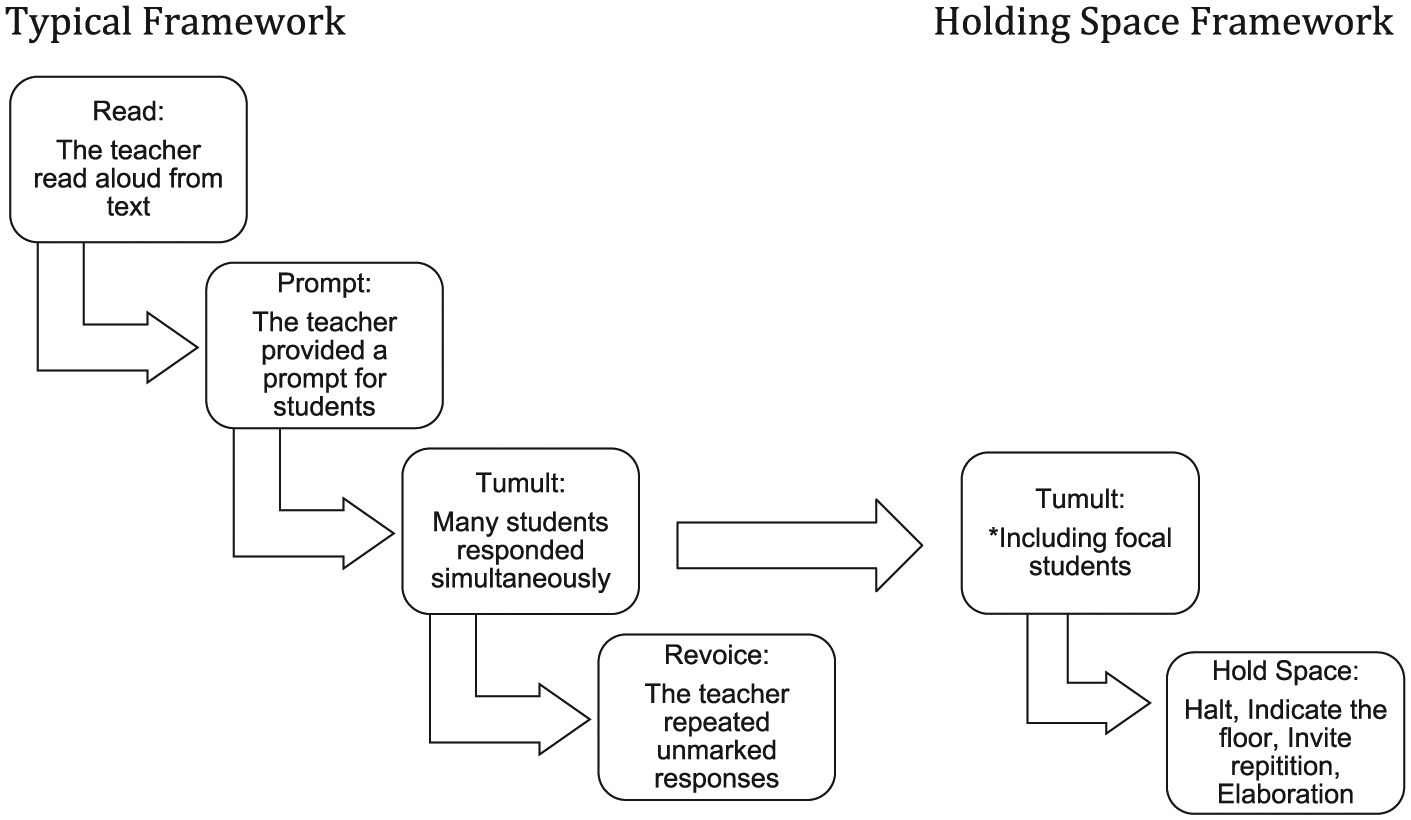
Participation frameworks.
The discrepant pattern, then, involved moments where the focal students contributed to the tumult and the teacher seemed to reorganize the participation framework. These moments had a different pattern (see Figure 1) that also seemed to have four phases. The first three phases were the same as above, but the fourth diverged, resulting in Read-Prompt-Tumult-Hold Space. I identified five discursive mechanisms within the holding space pattern. (a) The focal students’ contribution seemed to initiate the framework change. (b) The teacher then halted the tumult, often through the use of an imperative. (c) He indicated that the interactional floor belonged to the focal student by gesturing and/or saying the focal student’s name and by defending the turn of talk from “turn sharks” (Erickson, 2004), or students ready to jump into the conversation if the speaker seemed unsure. (d) The teacher then invited the focal student to repeat his or her assertion. (e) Either the teacher or the focal student elaborated on the original assertion. Within this pattern, two DisCrit tenets were enacted. First, the students’ participation resisted marginal institutional positioning as “struggling” readers of color. Second, by holding space for them, the teacher privileged their voices.
To further explore the implications for focal students’ identity development in these moments of holding space, I employed discourse analytic methods to examine how the discursive moves functioned within these interactions. Bucholtz and Hall’s (2005) framework allowed me to examine how the talk was organized to interactionally co-construct students’ identities as readers.
Each day I observed, the class discussed at least two texts, and of these many interactions, there were nine instances of holding space involving the focal students. I cannot say how many of such interactions would be needed to significantly change the academic trajectories of Raymond, Jay, and Camilo. However, social positionings collect meaning with each “momentaneous” (Bucholtz et al., 2012) repetition (Wortham & Reyes, 2015), and it seemed that each repetition of the holding space pattern contributed to alternative itineraries of identity (Bucholtz et al., 2012) for these students—pathways toward identities as knowledgeable readers. Below, I examine three exemplary transcripts, highlighting the relevant discursive mechanisms, to illustrate how Mr. Peterson held space for the focal students to build on their literate identities.
“It’s Like Figurative Language”
In the first example, Mr. Peterson read Teammates (Golenbock, 1992), a book about the desegregation of baseball and the players Jackie Robinson and Pee Wee Reese. The interaction began as was typical. Mr. Peterson read from a text, prompted students to respond, and many students began to talk. In this instance, he asked about the author’s use of figurative language. Within the multitude of voices, Jay, one of the focal students, participated, which initiated Mr. Peterson’s subsequent move to change the participation pattern. (S/Ss refers to student/students.)
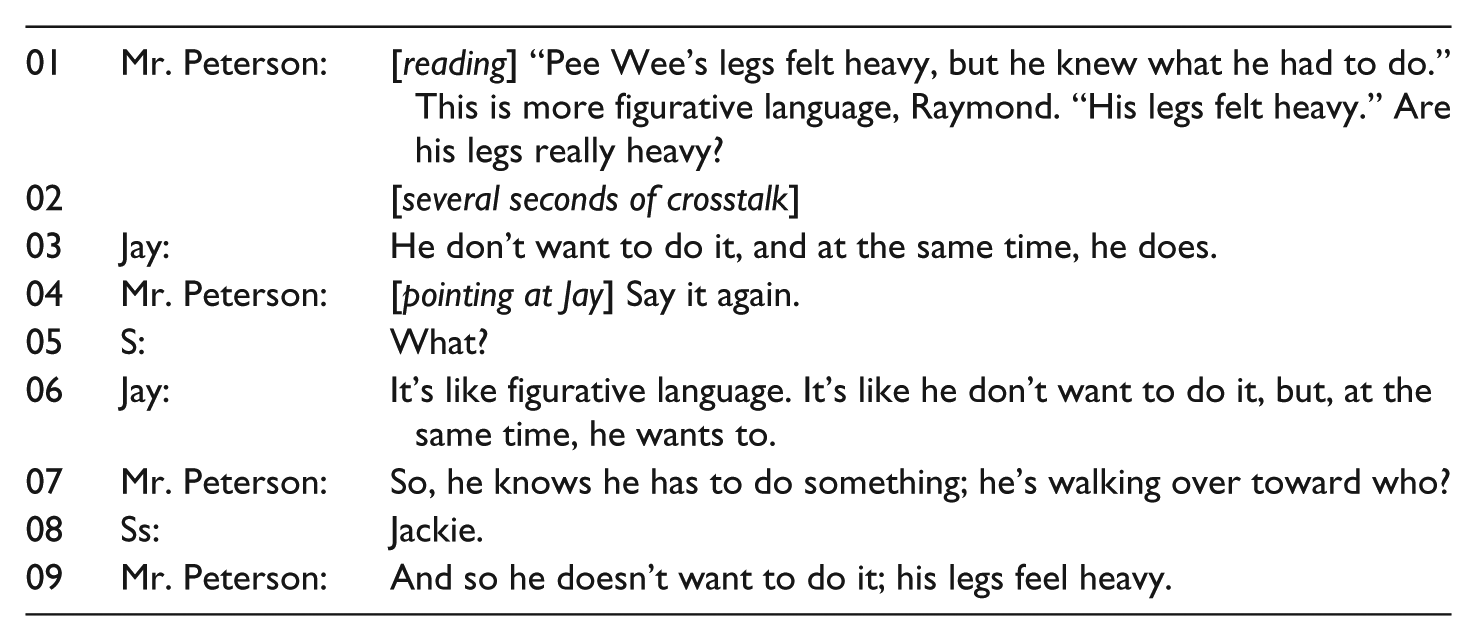
After Mr. Peterson’s prompt, Jay asserted an interpretation of the figurative phrase (line 03) into the tumultuous crosstalk, which was the Initiating discursive mechanism for the reorganization of the participation framework. Bucholtz and Hall’s (2005) positionality principle provides a useful lens for interpreting this interaction because it allows us to analyze the temporary roles Jay took up related to reading. By participating in the conversation, Jay took the stance of a reader with something relevant to say about the text, and he put himself on even footing with the other students who participated. Mr. Peterson heard Jay’s interpretation and pointed at him (Indicating), halting the tumult, asking him to say it again (Inviting). The gesture seemed to signal to others that something important had been said. This emphasis was acknowledged, recognized, and made relevant, when another student inquired into what had been said (line 05). Mr. Peterson’s gesture (Indicating) and imperative “say it again” (Inviting), gave the floor to Jay, silencing the crosstalk and holding the interactional space for Jay to repeat his assertion. In line 06, Jay took the opportunity to use the academic vocabulary that Mr. Peterson introduced in line 01, adding, “It’s like figurative language” to his original utterance. He also repaired the ending from “at the same time, he does,” to “at the same time, he wants to.” This subtle, self-initiated repair, in conjunction with the addition of “it’s like figurative language,” made the utterance sound arguably more academic. In these ways, Jay asserted a literate identity as one who used academic language to interpret text. In line 07, Mr. Peterson expanded on Jay’s interpretation (Elaborating), and then, in line 09, he revoiced Jay’s translation of the figurative language and included the phrase from the text. By building on and revoicing Jay’s utterance, Mr. Peterson ratified the readerly position Jay initiated.
Jay’s literate identity was “constituted through social action” (Bucholtz & Hall, 2005, p. 588) by discursive mechanisms initiated by Jay and in collaboration with Mr. Peterson. Important here is Jay’s initiative to enter the discussion. It is an instance where he disrupted and resisted the marginal narrative that was institutionally told about him. Building on Jay’s initiative, Mr. Peterson recognized Jay’s move and used his authority (Bucholtz & Hall, 2005) as the teacher to reorganize the participation framework to hold space for Jay’s public display of literary competence. In other words, from a DisCrit perspective, Mr. Peterson honored Jay’s resistance to marginalization, and Jay and Mr. Peterson collaboratively constructed Jay’s identity as a competent reader who interpreted figurative language.
“It Got So Interesting”
In another interaction where each mechanism was employed, Raymond took the initiative. Here, the class read an excerpt from Crazy Loco (Rice, 2001), a book by a Latino author set in the Texas Rio Grande Valley. At the book’s end, students responded spontaneously instead of waiting for a prompt. Two of Raymond’s classmates, Marley and Mikki, began.
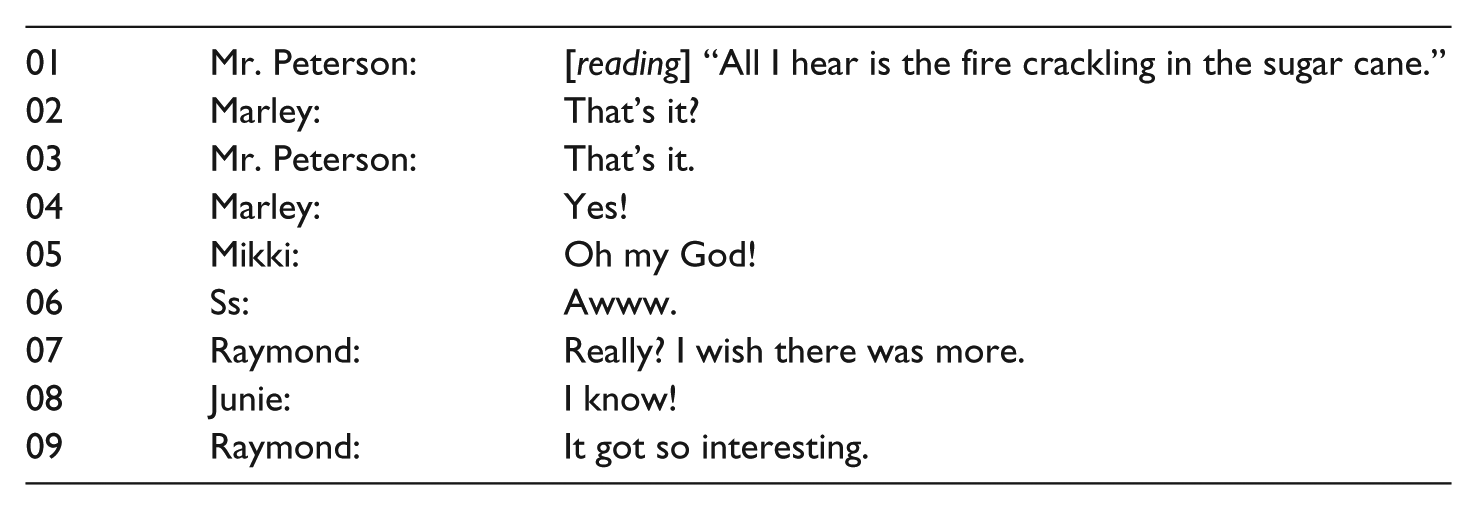
Marley and Mikki, who were often positioned as competent readers, opened this exchange by spontaneously responding to the text. Raymond then also spontaneously responded in line 07 (Initiating). Raymond’s utterance, “Really? I wish there was more,” functioned in several ways. First, it relationally aligned him with the strong readers, Marley and Mikki, by orienting him within the ongoing talk (Bucholtz & Hall, 2005) as a reader moved by text. In addition, by stating that he wished there were more, he displayed an affinity for books and reading, positioning him as an engaged reader. Then, in line 08, Junie evaluated (Bucholtz & Hall, 2005) and affirmed Raymond’s assertion, saying “I know!” aligning herself with him and ratifying his proposed engaged reader identity. In line 09, Raymond described the text as “interesting,” an arguably academic-sounding word that positioned him as engaging with the story academically. It also positioned him as a reader with the knowledge and authority to judge text as interesting.
Several seconds passed with others contributing to the conversation. Then, Mr. Peterson circled back to Raymond, lifting Raymond’s utterance up and holding space for him, much like he did with Jay.
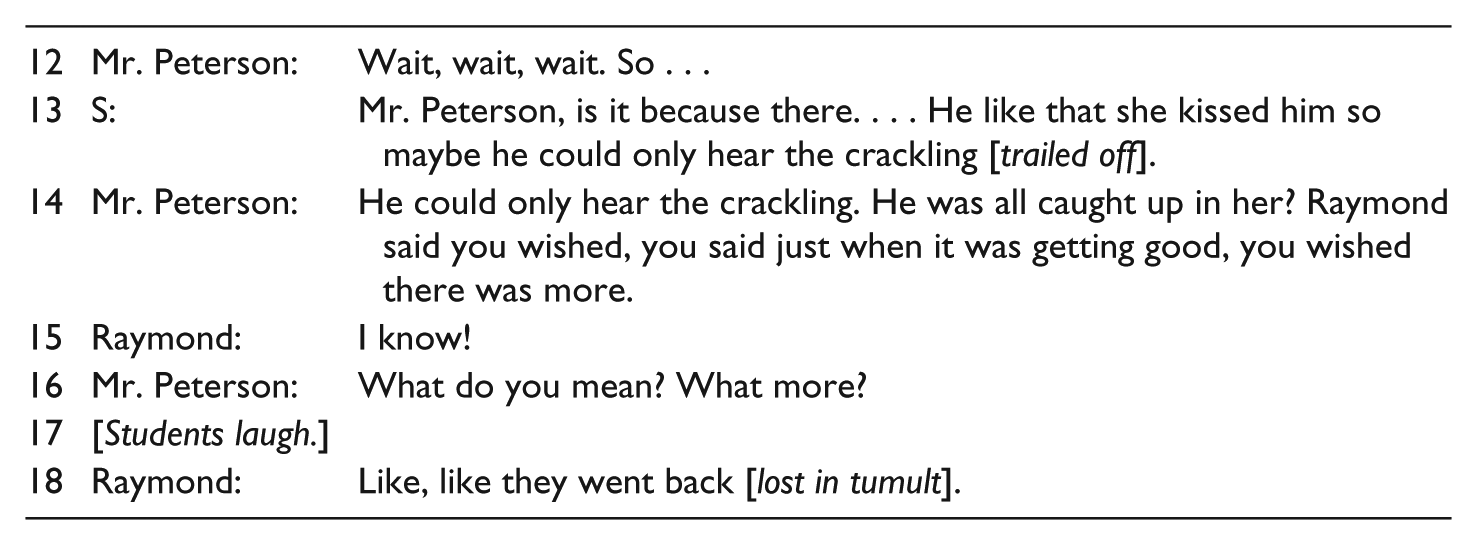
Like in the interaction with Jay, Mr. Peterson used an imperative (line 12), “Wait, wait, wait,” to stop the crosstalk and to momentarily gain the floor (Halting). However, another student spoke into that space. In line 14, Mr. Peterson then named Raymond directly, inviting him to elaborate on the statement that he wished there were more to the story. As Raymond began, the turn sharks claimed the interactional floor. Mr. Peterson again drew on his authority to reorganize the participation framework, holding space for Raymond. This time, Mr. Peterson explicitly stated that the expectation was that the students listen to a single peer. In line with the tenets of DisCrit, Mr. Peterson privileged the voice of a student who was often marginalized.
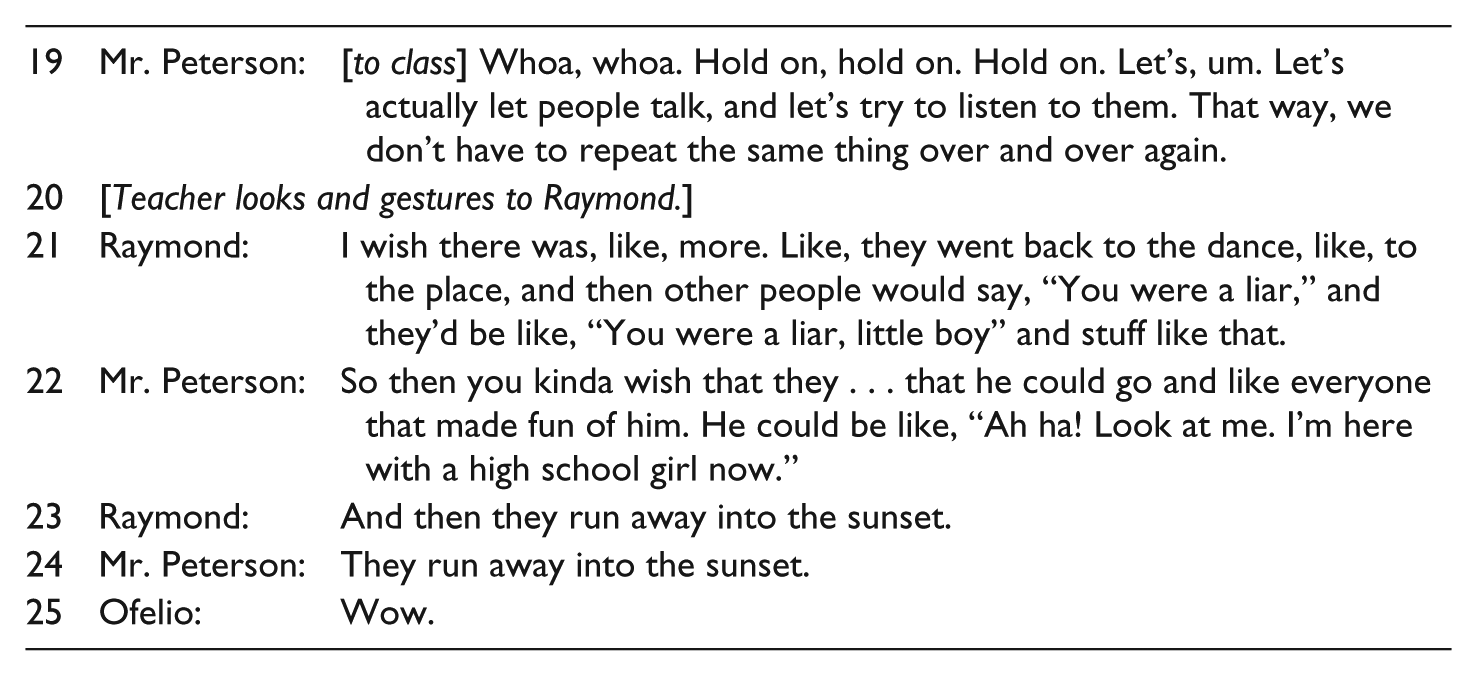
In line 19, Mr. Peterson used the imperative “Hold on” to gain the floor (Halting) and then laid out new participation norms using the first-person plural pronoun we, positioning himself with his students. In this way, he implicitly signaled that the students were not in trouble for talking over Raymond, but at that moment, the expectation was different. Then, much like he had done with Jay, Mr. Peterson gestured toward Raymond to give him the floor (Indicating). In line 21, Raymond elaborated on his wish that there were more to the story by composing an alternate ending (Elaborating). In doing so, Raymond identified himself as a reader with the authority to disagree with the author’s ending and with the literary knowledge to write an alternative. Mr. Peterson took up Raymond’s composition (line 22) by synthesizing it and weaving it more tightly into the narrative of the story (Elaborating). This ratified Raymond’s authority to rewrite the ending. In his last utterance here (line 23), Raymond made an intertextual move (Bloome & Egan-Robertson, 1993), demonstrating his knowledge of other literary texts and of the literary genre by positioning another text alongside the one they read, saying that the characters “run away into the sunset.” Bloome and Egan-Robertson argue that for intertextuality to be established, the move must be “recognized, be acknowledged, and have social significance” (p. 330). Thus, Mr. Peterson’s final utterance in line 24 is crucial. By recognizing and restating Raymond’s intertextual move, Mr. Peterson ratified the authoritative readerly stance that Raymond took in that move. Ofelio punctuated the social significance of Raymond and Mr. Peterson’s collective work with his only utterance in this exchange, “Wow.”
“Camilo Is Right on the Money”
The final interaction examined follows a pattern similar to those above. Here, Camilo initiated the reorganization of the participation framework by participating in the tumult. Like in the other examples, Mr. Peterson held the interactional space for Camilo to publicly assert his literate self. Here, Mr. Peterson read a selection titled “Cathy, Queen of Cats” from House on Mango Street (Cisneros, 1991), a book capturing an urban Latina experience as told by a Latina author. Interpreting this story seemed challenging for the students, so after reading it once, Mr. Peterson had students discuss it with a partner. As they did, he listened into Camilo’s conversation with his partner, giving him insight into Camilo’s analysis of the story, on which he drew later. Then, Mr. Peterson read the story to the class again, and they interpreted a few lines at a time.
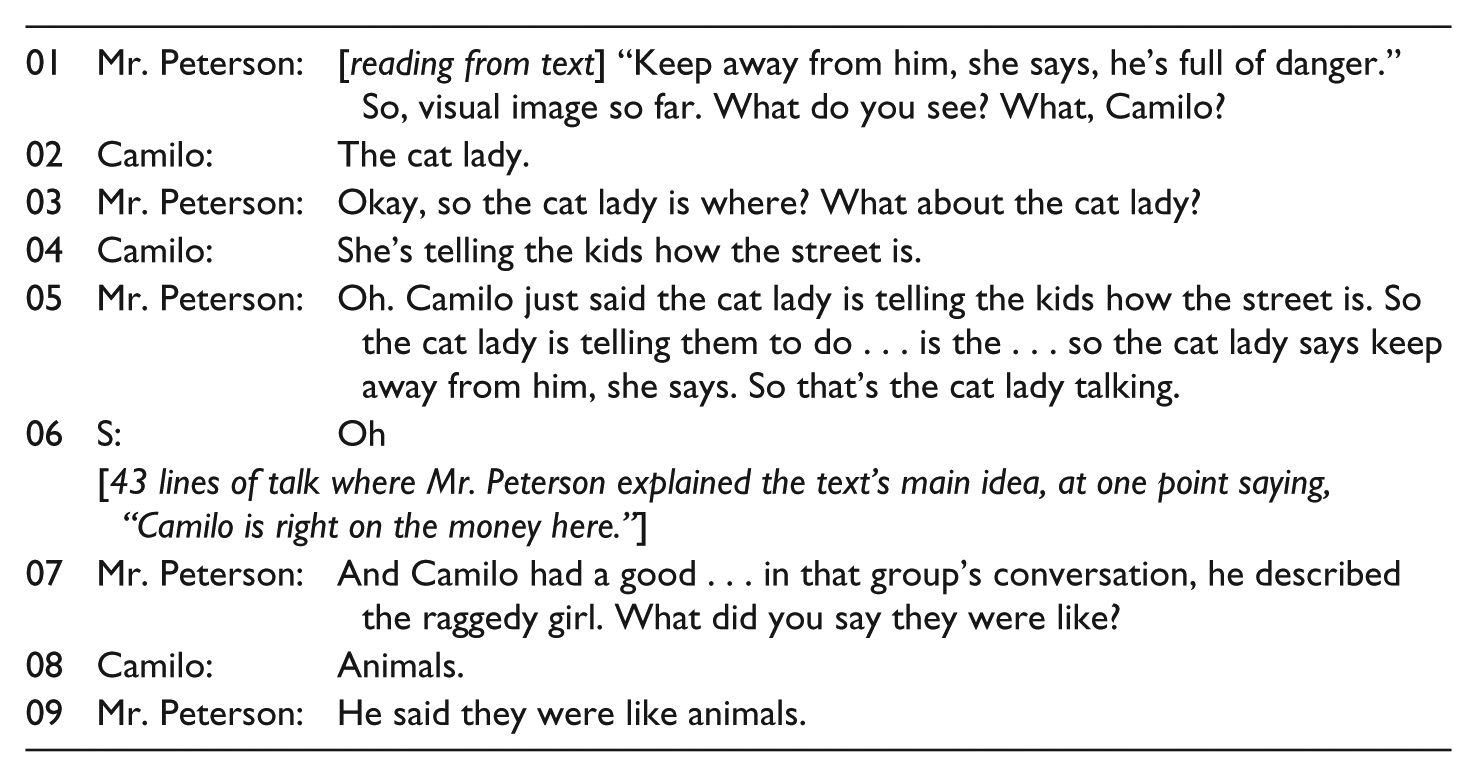
As in the other examples, Mr. Peterson took up Camilo’s contribution (Initiating) and held space for him to repeat that assertion (line 01; Halting and Indicating). Then, in line 03, he asked Camilo to elaborate on his contribution to the visualization of the story (Inviting and Elaborating). Mr. Peterson’s response in line 05 (Elaborating) to Camilo’s contribution seemed to be mirrored by the student’s comment in line 06. In this way, both Mr. Peterson and the student in line 06 ratified Camilo’s position as a knowledgeable reader with insight into this challenging text. In line 07, Mr. Peterson circled back to Camilo (Indicating and Inviting) after 43 lines of interceding talk. This suggests that Mr. Peterson held onto Camilo’s interpretation and deliberately returned to him, privileging his participation. Mr. Peterson drew on the knowledge gained from listening in on the earlier talk between Camilo and his partner to first evaluate Camilo’s interpretation as “good,” and then to invite Camilo to continue to interpret the text (Elaborating). This reopened the opportunity for Camilo, in collaboration with Mr. Peterson, to position himself as knowledgeable and literate.
I asked Mr. Peterson about the typical participation pattern, wondering how he had come to the “Tumult” practice. As the conversation evolved, we also explored the holding space pattern. Below is part of our conversation following the prompt, “Talk to me a little bit about your style of participation in those discussions [of text].”
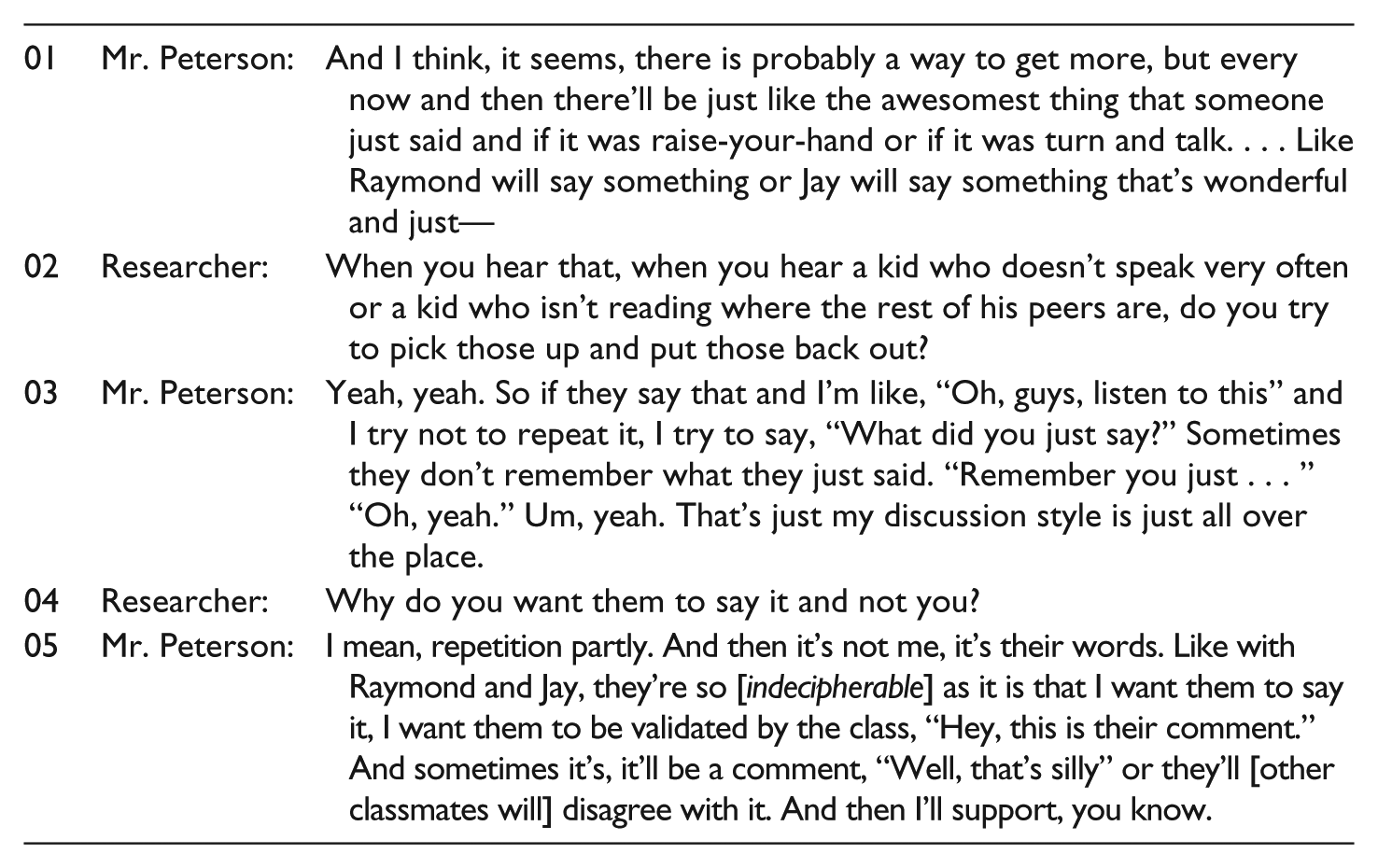
In line 03, Mr. Peterson states that when a student like Raymond or Jay contributes, he “tries not to repeat it.” Mr. Peterson wanted them to be validated by their classmates and he recognized his role to not give the focal students voice, but to let them speak for themselves (Annamma et al., 2013), and to support their assertions if needed. This suggests a premeditated, intentional, public repositioning of students who had been positioned as “struggling” readers. Although he did not explicitly name Camilo when discussing such students, I imagine Mr. Peterson also wanted him to be seen as literate based on the instances where Mr. Peterson held space for him. I want to note Mr. Peterson’s awareness of my interest in readers considered “struggling,” which likely informed his interactions with them. I also want to note that there were two other focal students in the larger study around whom this pattern did not emerge, and instances where this pattern emerged around bilingual students in their first year in an English-medium class. So, while my presence and interest obviously mediated these interactions, it did not always seem to dictate them.
Discussion
Students of color who do not perform as expected in schools can find themselves marginalized in both ideological and material ways. These students experience higher unemployment rates and a greater chance of involvement with the justice system (Farmer, 2010; Laura, 2014; Smith, 2015). Students cannot be “struggling” on their own; only in and through interactions are “struggles” constructed and made relevant. There are a variety of contextual factors influencing the appearance of struggle, many of which involve how students are positioned over time and in relation to each other and school-based tasks. Because struggle is a relational phenomenon, there are opportunities to reframe how students are positioned. I argue that holding space is one way to do that.
As in yoga, here holding space is a metaphor for an interactional process where the teacher serves the students. In this case, the students engaged in social practices related to literacy and identity. Bucholtz and Hall (2005) argued that agency is “productively viewed as the accomplishment of social action” and that “identity is one kind of social action agency can accomplish” (p. 606). The social action in which these students engaged disrupted identities of “struggle,” even if only temporarily, by positioning themselves as literate in everyday classroom interactions. It is also noteworthy that the focal students voluntarily initiated the creation of space for themselves within the construct of holding space. They were responding to marginalization, “not through passive acceptance, but through tactics such as strategic maneuvering” (Annamma et al., 2013, p. 13) and publicly asserted literate competence. The teacher supported the focal students’ actions by holding the interactional space open for them as they did this work. I also want to note briefly that each of the texts involved here was written by and/or featured people of color. All nine instances of holding space involving these three students included texts like these. Of the 12 instances in the data total, all but one were around a text by or about the experiences of people of color. Mr. Peterson stated that he purposefully selected these texts in the hope his students would connect to these stories, and that could have potentially supported the focal students’ initiating assertions.
To be sure, there are many ways the exchanges in this classroom reflected the teacher-centric IRE pattern (Cazden, 2001; Mehan, 1979). The characteristic volley of turns was evident in most exchanges, with the teacher taking every other turn, and evaluating answers based on his conception of “rightness.” From a DisCrit perspective, it is fundamentally problematic that White teachers control and evaluate Black and Brown bodies in ways that position students of color as “struggling” and/or “disabled.” This kind of control can be exacerbated in schools like Huerta where HST looms large (Au, 2011; Crocco & Costigan, 2007). In contexts like these, teachers can feel pressured toward standardization, which contributes to the teacher-controlled pedagogies (Au, 2016) like those observed in Mr. Peterson’s room.
Although not perfect, what these findings suggest is that even in situations where students have begun to move down marginalized trajectories of identity, it is possible for (White) teachers to contribute to the deliberate disruption of such identities, even if only momentarily. Mr. Peterson collaborated with focal students to construct counter-stories by supporting them through what can be described as distributed agency, or intersubjective agency “distributed among several social actors” (Bucholtz & Hall, 2005, p. 606). When holding space, Mr. Peterson demonstrated his belief in the focal students’ competence. Leonardo and Broderick (2011) argued that “if one cannot imagine capacity in a child, one is unlikely to endeavor to educate that child. In this very basic sense, then, a presumption-of-competence stance may be understood as a necessary precondition for educating all children” (p. 2213). Mr. Peterson presumed students’ competence. He listened for the counter-narratives that these students told and he held space for them to continue to tell “stories against the grain of master narratives” (Annamma et al., 2013, p. 13). He believed in their capacity, and I believe in his.
In this research, I have aimed to take a teacher solidarity stance (Philip, Martinez, Lopez, & Garcia, 2014). I have worked to hold space for the participants to share their collective work by pointing to places where I see hope, even amid the flaws. I do not want this read as an “uplifting story” (Harris, 2013, p. 36) that ignores the structural and institutional constraints that challenge students like these. Nor do I want this to be read as an example of how “struggling” students of color perform Whiteness and smartness (Leonardo & Broderick, 2011), but rather as an example of how they are worthy in their own right, and how they assert their own literate identities within certain contexts. I hope these findings offer a concrete example of small interactional moves that (White) teachers, committed to doing right by students of color identified as “struggling,” can take alongside their students.
Conclusion and Implications
This analysis contributes to the literature around the social construction of identity by explicitly demonstrating how focal students and their teacher collaboratively disrupted institutionally imposed identities based on a “narrow image of the ‘ideal’ child” (Dyson, 2015, p. 206). Like the teacher in Worthy et al.’s (2012) study, instead of “‘fixing’ children” (Dyson, 2015, p. 205), Mr. Peterson leveraged his authority to try to “fix” the interactional protocol to value focal students’ contributions, which allowed focal students to tell literate identity narratives about themselves. This study adds to the concept of restorying (Worthy et al., 2012) by conceptualizing holding space as another way to disrupt and reconstruct itineraries of identity (Bucholtz et al., 2012).
As educational researchers, I believe we have a responsibility to focus on making education more just. Noddings (1995) suggested that schools organize around themes of care, which “implies a continuous search for competence” and demonstrates “respect for the full range of human talents” (p. 676). Given that students like Raymond, Jay, and Camilo find themselves in positions associated with poor educational outcomes (Artiles, 2013; Blanchett, 2006), considering ways to build positive experiences and agency around school-based tasks is essential. Creating this kind of educational context requires teachers to understand how language mediates learning. One way of using language that seems to promote positive reader self-identification is dialogic teaching, which, as Aukerman and Schuldt (2015) demonstrated, can profoundly influence how students see themselves as readers. This highlights the importance of emphasizing social theories of learning, and the centrality of language within those theories, in teacher education.
Dyson (2015) stated that we must protect students from “the excluding harm of destructive discourses of deficits” and that we, as teachers and teacher educators, may reify these in our talk despite our desire to value all children. A microanalytic focus on language allows us to build on the foundation of (re)valuing students laid by other scholars in this area (e.g., Dudley-Marling, 2004; Dyson, 2015; Goodman et al., 2016; Ladson-Billings, 1995; Noddings, 1995; Paris, 2012; Waitoller & King Thorius, 2016; Worthy et al., 2012).
Although the interactions shared here are fleeting, they point to where we can focus our gaze to inform and affirm what is going right in classrooms. It is the collection of these tiny interactional moments that creates educational experiences of success or “struggle” (Bucholtz et al., 2012; Lemke, 2000; Wortham, 2004). The real-life implications for people marginalized along axes of both race and disability have recently surfaced in the public consciousness. Tamir Rice, Keith Lamont Scott, Magdiel Sanchez, and Charles Kinsey, and his client of color with autism each experienced the devastating consequences of being read as dangerous because of ideologies around race. In addition to issues of race, each of these cases was also about what Erevelles and Minear (2010) called “socially sanctioned fears of the mentally ill” and the “devaluation of . . . disabled bodies of color” (p. 128). 2 Precisely because of how perceptions of race and disability intersect, it is a moral imperative to see students like Raymond, Jay, and Camilo as knowledgeable, perhaps especially in general education classrooms. It is my hope that Mr. Peterson, Raymond, Jay, and Camilo have shown us one possibility for moving in that direction.
Footnotes
Declaration of Conflicting Interests
The author(s) declared no potential conflicts of interest with respect to the research, authorship, and/or publication of this article.
Funding
The author(s) received no financial support for the research, authorship, and/or publication of this article.

Notes
References
Supplementary Material
Please find the following supplemental material available below.
For Open Access articles published under a Creative Commons License, all supplemental material carries the same license as the article it is associated with.
For non-Open Access articles published, all supplemental material carries a non-exclusive license, and permission requests for re-use of supplemental material or any part of supplemental material shall be sent directly to the copyright owner as specified in the copyright notice associated with the article.
