




Abstract
In this study, the researchers examined how first-grade students initially positioned as struggling readers took up literacy practices to reposition themselves as capable competent readers and part of a literate community of practice over an academic year. Using positive discourse analysis and case study methodology, the researchers documented and analyzed the identity work of two students, an English monolingual and a Spanish-English emerging bilingual, who worked to reposition themselves in their classroom community. The participants were part of a diverse, urban, first-grade dialogic inquiry-based classroom in the Southwest. The yearlong study documented students taking up inclusive literacy practices, practices that invited the participation of all students regardless of literacy level or language background, to negotiate positive identities in the literate community. The in-depth qualitative analysis utilized both positive and critical discourse analysis lenses to provide research that not only deconstructs power but also identifies positive ways in which students make room for themselves within academic settings. The use of both lenses led to findings on identity negotiations that provide insight into possibilities for power to be redistributed in positive ways for young children.
Keywords
The purpose of this study was to examine how the construction of literacy practices mediated the identity development of two first-grade students with diverse linguistic backgrounds, Lesley and Ariana, in a Title I, dialogic inquiry–based classroom over an academic year. Identity development plays an influential role within classroom communities of practice (Guccione, 2011; Moses, 2013) because learners’ identities contribute to what they can or cannot do (Hall, 2009) and how they participate in the classroom literate community (Hall, 2012). We explored ways in which positive identities were signaled and negotiated for beginning readers who were initially positioned as “struggling readers.” Taking into consideration the diverse linguistic backgrounds and the effect that that may have on the identity of students in classrooms, we selected case studies representative of the research demographics with home languages of Spanish and English.
As with other identity researchers (Möller, 2004), our use of the word struggling is not meant to reify this designation. Within the context of a microethnography, we used insider language (the literacy specialist used this language to describe the students) to identify and select our case studies as “struggling readers.” As a pushback against the label, we began with a critical discourse analysis (CDA) to examine how institutional forces positioned some students as “struggling” based on their emerging decoding abilities with little focus on their meaning-making strengths. We then applied positive discourse analysis (PDA) to illustrate ways students redefined themselves as readers beyond the limits of the label. We viewed identity as the ways in which children perceived themselves and were recognized by others. By positive identity development, we refer to children viewing themselves and being viewed by others as competent literate members able to fully participate in classroom literacy events.
The juxtaposition of literate identity development between young people who are emerging bilingual and monolingual speakers is of interest because teachers increasingly must meet the needs of both populations simultaneously (Kena et al., 2014). Thus, it is important to study how students who speak multiple languages make a place for themselves in the literate community of practice through appropriating the tools and language of that community, as this does not always naturally occur in classrooms (DaSilva Iddings, 2005). This study contributes to the need for studying language learners’ appropriation of practices within the literate community and the identity positions available to these learners within their contexts (Norton & Toohey, 2002).
There is also a need for exploration of classrooms where young people with emerging decoding skills find opportunities to develop positive literate identities. In addition to language status, researchers have underscored the importance of identity research as it intersects with literacy instruction. Identity can be used to stereotype, marginalize, or privilege (Moje, Luke, Davies, & Street, 2009). In primary classrooms, strong decoding skills are often privileged over comprehension in constructing positive literate identities. As literacy education inherently involves the transmission of stated and unstated values, it affects students’ identities in a variety of ways (Ferdman, 1990). Identity research plays an important role in understanding schools and society (Gee, 2001b) and makes it possible for educators to gain insight into the holistic experiences of young children.
The following research question guided the study:
Theoretical Framework
To understand classroom experiences, community practices, and identity, we approached the data using three theoretical frames from the sociocultural tradition: communities of practice (Lave & Wenger, 1991; Wenger, 1998), cultural tools (Wertsch, 1998), and identity (Moje et al., 2009).
Communities of Practice
Lave and Wenger (1991) criticized limited definitions of learning, claiming the notion of situated learning spans learning as cognitive process and learning as social process. They asserted that learning is not merely situated in practice but also involves the individual’s social, cultural, and historical context. Within every community of practice, which has common accepted practices (or cultural tools), members develop identities based on their abilities to participate in those practices (Lave & Wenger, 1991). They argue that learning involves the relation not just to activities but to communities, with implications of becoming a full participant that involves a type of being or identity. This membership and identity evolves and changes over time: “Learning as a legitimate peripheral participation means that learning is not merely a condition for membership but is itself an evolving form of membership” (p. 53). Legitimate peripheral participation is a central tenet of situated activity because learners participate in communities where the mastery of knowledge and cultural tools moves newcomers toward full participation in the sociocultural practices of the community (Lave & Wenger, 1991).
Cultural Tools
Wertsch’s (1998) work on cultural tools complements Lave and Wenger’s theories about communities of practice, participation, and identity by providing an additional theoretical lens to support their reference to mastery of knowledge and skills as participation-shifting opportunities. Wertsch (1998) explored the mastery and appropriation of cultural tools used by people to participate in mediated action in a community of practice. He described cultural tools as being used in conjunction with social interaction to facilitate development by changing the physical or social environment. Cultural tools are often created for purposes other than mediated action with an end goal, but they are “subject to all sort of contingent events, many of which have major implications for how development occurs” (Wertsch, 1998, p. 36). In a classroom setting, this could include literacy practices (originally introduced for academic purposes) that are taken up and appropriated as tools that signal competent identities.
Wertsch (1998) argued that a change in cultural tools could be more powerful than improvement of an individual’s skills. An educational example is that a change in cultural tools used in a traditional, phonics-based early literacy environment (e.g., flashcards, memorization, decoding focus) to a social learning theory environment (e.g., discussion, collaboration, and meaning making) could be more powerful in helping students develop literacy and positive identity than improvement in their individual reading skills acquisition. Instructional approach and classroom interactions greatly influence the construction of community and student identity (McCarthey, 2002; Triplett, 2007). Students’ developing identities as learners and competent members of a community shape and are shaped by engagement, growing mastery, and appropriation of cultural tools (Wertsch, 1998). Simultaneously, students engage in discursive practices that become cultural tools for developing identities as learners and members of the community (Putney, 2007).
Identity
Researchers adopting an identity lens typically hold some cross-cutting assumptions about identity, viewing it as socially constructed and multifaceted (Moje et al., 2009). Gee (2001b) affirmed these assumptions and defined identity as “being recognized as a certain ‘kind of person,’ in a given context” (p. 99). He elaborated, “If I work to achieve a certain identity . . . I need others to recognize me in this way” (p. 112).
Researchers have applied different metaphors to the study of identity. Moje et al. (2009) identified prominent lenses of identity as difference, sense of self, mind or consciousness, narrative, or position. Within the framework of identity as position, researchers use the metaphor of lamination, that identity “thickens” over time as an individual repeatedly experiences being positioned or positioning himself or herself in a certain way. This creates a need for research about how students are positioned institutionally and how they redefine these positions through their use of cultural tools.
As students move through their school experiences, they find different identities cast as available to or pushed on them. Some students “come to construct their senses of self in relation to these persona” (Holland & Leander, 2004, p. 129). Students may find themselves positioned as readers who need support, readers who are thriving, or somewhere in between. As Holland and Leander explained, students may accept these identity positions: “Positioning . . . involves socially producing particular individuals and groups as culturally imagined types such that others and, even the person herself, at least temporarily, treat her as though she were such a person” (p. 130).
The classroom dynamic, literacy expectations, curriculum, and relationships influence students’ identity development. Teachers and students are continually negotiating their identities in classrooms, and literacy practices are essential tools for developing a positive literate identity (McCarthey, 2001). The use of literacy practices to develop positive literate identities and participate in communities of practice in educational settings becomes more complex when involving young children who are fortunate enough to speak more than one language.
Supporting Literature
The multidimensional and intersectional natures of identity negotiations of young children often involve literacy practices (Compton-Lilly, Papoi, Venegas, Hamman, & Schwabenbauer, 2017) that reflect the values of individuals or the community (Street, 1995). Carbone and Orellana (2010) emphasize the need for identifying strategies to support students’ emergent academic identities to support academic achievement. Teachers can support this type of positive identity development in educational settings by recognizing children’s prior knowledge and incorporating this into classroom learning (Cummins, 2001). Building on students’ background knowledge, Carbone and Orellana (2010) found that giving students choice on topics of interest that were personally relevant and providing an authentic audience supported the positive identity negotiations with accepted literacy practices. Compton-Lilly et al. (2017) suggest that teachers and researchers can support young children’s identity negotiations by making a wide range of texts available, challenging and discussing educational norms and privilege, and creating opportunities for children to negotiate identity through texts, talk, and multimodal representations.
Identity negotiation is complex as children learn literacy in a second language. Language learners must learn not just a linguistic code but “a diverse set of sociocultural practices” (Norton & Toohey, 2002, p. 115) and a “relational activity that occurs between specific speakers situated in specific sociocultural contexts” (p. 119). Language is a mode of communication intimately connected to one’s history (personal and cultural) and sense of self (Wilson, Chavez, & Anders, 2012). A primary purpose of language is to facilitate affiliation in social groups and “to know a particular social language is . . . to be able to ‘do’ a particular identity” (Gee, 2013, p. 142). Young children from families who have immigrated take up a wide range of literacy practices as they negotiate and enact various identities (Compton-Lilly, 2014; Souto-Manning, 2013). It is essential that adults not only support young children in these identity negotiations but also view children as competent, capable, and invested individuals who have agency and contribute to their own development (Compton-Lilly et al., 2017).
Method
We approached this study using a microethnographic approach while collecting data weekly over an academic year. Microethnographies “usually focus on specific behavioral interactions in specific institutional settings, and do not attempt to describe a whole way of life” (Moll, Diaz, Estrada, & Lopes, 1992, p. 341). We focused on mediated action by examining how students used literacy practices to enact identities within the classroom community of practice. Drawing on our theoretical framework, we conceptualized literacy events as a bounded series of actions and reactions in which children created meaning and significance (Bloome, Carter, Christian, Otto, & Shuart-Faris, 2005). This qualitative exploration was specific to literate identities situated only within the classroom.
We focused on specific interactions related to literacy (reading, writing, speaking, listening, viewing, and visually representing). We used a descriptive case study methodology (Merriam, 1998) within the context of the larger formative study (Reinking & Bradley, 2008) focused on developing a love of reading and increasing the amount of interpretive talk. Descriptive case studies “illustrate the complexities of a situation—the fact that not one but many factors contributed to it” (Merriam, 1998, p. 30). This approach facilitated an in-depth examination of identity negotiations.
Setting and Participants
The first-grade classroom consisted of 28 students with a range of cultural, linguistic, literacy, and socioeconomic backgrounds. First languages included Russian, Arabic, Spanish, and English. It was the first year in a general education classroom for four of the students. All classroom instruction occurred in English; in the study context, bilingual education and English as a second language (ESL) support were not available (Kelly, 2016).
The first-grade teacher, Meridith, was an eight-year veteran finishing her MA in literacy education. She adopted a dialogic and literature-based approach to reading instruction where she provided a brief mini-lesson followed by independent reading and partner reading while she conferred or met with small groups. She provided daily opportunities for whole-class discussions related to students’ reading and application of strategies during independent and partner reading. The researchers included one university literacy faculty member and one doctoral student.
We selected Lesley and Ariana for case studies. Both students scored lower than their class average on their beginning year reading assessments (school-based benchmarks and Developmental Reading Assessment, second edition [DRA-2]) and were identified by the literacy specialist as “struggling readers” who needed additional attention and reading interventions. We also used qualitative data from the research journal, classroom transcripts, and teacher interviews to identify students who, in our analysis, were initially positioned in a negative way to analyze their identity development over the year.
Ariana began the year as a student who rarely volunteered to talk, except with her closest friend. She loved spending time browsing in the classroom library. She was fluent in speaking and listening in Spanish but reported not knowing how to read or write in Spanish. She spent kindergarten in a state-mandated sheltered English classroom. By the end of the year, she regularly volunteered to share her thinking and engage with peers. Ariana lived in an apartment with her parents and siblings.
Lesley was an outgoing student whose home language was English. She regularly contributed to class discussions and was eager to socialize. She frequently demonstrated high levels of frustration (refusing to participate, sighing, putting her head down) when unsuccessfully attempting to decode. Lesley was an only child and lived in an apartment with her mother. Both students qualified for free and reduced-price lunches.
Data Collection
Drawing on our theoretical framework related to communities of practice (Lave & Wenger, 1991), cultural tools (Wertsch, 1998), and identity (Moje et al., 2009), we collected extensive amounts of video data to analyze interactions and development over time. We used camcorders to capture the literacy block weekly for an academic year. During recordings, we documented whole-group and small-group instruction, partner reading, independent reading, teacher conferences, discussion groups, and researcher-led conferring. We kept field notes, observational checklists, and researcher journals. We recorded 10- to 20-minute interviews with students about their perspectives on literacy and their literate identity at the beginning, middle, and end of the year. Recorded planning sessions were conducted with the teacher biweekly. We utilized Voxer, a voice-messaging app, to replace written teacher reflections and create open and immediate communication. We collected student artifacts such as reading responses, writing, graphic organizers, comprehension activities, and informative/inquiry posters. We took photographs to capture the changing environment, student work, and students reading and responding together and independently. Researcher journals, teacher reflections, and video recordings of the literacy block and interviews became focal data points.
Data Analysis
Data analysis took on two forms throughout the course of the study. The initial layer involved the ongoing analysis of the weekly data collection with a specific focus on the transcriptions of video recordings. As sociocultural researchers, we believe interaction beyond the text level is essential to understanding and analyzing literacy events, so we created transcriptions with time stamps, message units (verbal), and descriptions of the nonverbal discourse that accompanied the talk. We tentatively identified ways the students were being positioned and positioning themselves. The coresearchers documented this initial thinking in analytic memos and weekly research meetings.
The next layer of analysis took place at the completion of the data collection. We used open coding (Strauss & Corbin, 1998) to document and discover meaning related to identity and positionality during analysis of the 1,500 pages of transcriptions, researcher journals, and teacher reflections. After completing open coding as a way of summarizing segments of data, we used pattern coding as “a way of grouping those summaries into a smaller number of sets, themes or constructs” (Miles & Huberman, 1994, p. 69). We generated pattern codes with a separate code for data related to each documented literacy practice in HyperResearch. See the appendix in the online repository for codebook.
The code of Literacy Practices included the following subcategories: comprehension strategies (such as documenting inferences, new learning, questioning, and connections), decoding strategies, literature discussions, partner coaching, language frames for participation, approximated reading, interpretive talk, and literal talk. The next layer of pattern coding for literacy practices included specific identification of observed reoccurring practices that served as cultural tools to enact literate identities. Similar to Rogers and Mosley’s (2008) initial interpretation of the talk used in critical discourse with idea units, we generated analytic notes about the theme of the cultural tools, the function of the cultural tools, and the ways the case studies positioned themselves in relation to the cultural tools.
We selected videos and transcriptions for each case study from the beginning, middle, and end of the year to provide a representative sampling of identity development
We began by identifying and documenting the readers’ positionality using a CDA lens where we “expose power as it naturalizes itself in discourse and thus feeling in some sense part of the struggle against it” (Martin, 2004, p. 183). We critically deconstructed the ways Lesley and Ariana were positioned because of their emerging decoding status. However, we agreed with Kress’s (1996) idea of taking a transformative position moving from deconstructive to productive activity. He noted, “Critical language projects have remained just that: critiques of texts and of the social practices implied by or realized in those texts, uncovering, revealing, inequitable, dehumanizing, and deleterious state of affairs” (pp. 15–16). Martin suggested, “The lack of PDA cripples our understanding of how change happens, for the better, across a range of sites” (p. 184). Building on this, we shifted to examining the literacy practices of the classroom community that mediated positive identity with an analytical lens grounded in PDA by integrating a “focus on community, taking into account how people get together and make room for themselves in the world in ways that redistribute power without necessarily struggling against it” (Martin, 2004, p. 183). In these instances (Tables 2–5), we used the same tools guided by our theoretical framework used with the initial CDA, but looked for evidence of positive positioning or discourse we admired (Macgilchrist, 2007). We made the shift to PDA to clearly understand what was happening in the classroom as we observed an instructional shift away from decoding toward comprehending.
By using both CDA initially and PDA ultimately, we followed the tradition of other researchers (Rogers & Wetzel, 2013) who also use both methods in analysis of the same project. These researchers explained that PDA is “not a new approach, but a shift in analytic focus” (p. 62). The “positive turn” (p. 62) allows researchers to explore “moments of hope, agency, and liberation” (p. 88). Thus, we leaned on CDA to show how students were initially negatively positioned by institutional forces, and we used PDA to show how these students used cultural tools available in the classroom to reposition themselves as competent readers.
Our analysis was guided by three concepts related to the impact of the community of practice on the case studies’ use of literacy practices: signaled identity development/positionality, identification of patterned ways of interacting/supporting evidence, and identification of literacy practices used as cultural tools. This analysis builds on and extends the initial analysis of constant comparison by taking up discourse analysis tools to examine identity. Building on our theoretical framework, we draw on CDA tools from Gee (2011) by using his tools of inquiry: situated meanings, social languages, and figured worlds. We specifically use his Identity Building Tool (Gee, 2011) to ask the following questions: What socially recognizable identity or identities is the speaker trying to enact or get others to recognize? How does the speaker’s language treat other people’s identities? What sorts of identities does the speaker recognize for others in the relationship to his or her own? How does the speaker position others? What identities does the speaker “invite” them to take up?
To answer these CDA questions, we included a column for transcription (verbal and nonverbal), positionality (identity), supporting evidence for claims (addressing the situated meaning of “how meanings are built and transformed over time” [Rogers, 2011, p. 11] with language), and tool(s) used for positionality to support and make transparent our claims for identity. The representation of our data includes supporting evidence for the analysis and accompanies our narrative representation in the findings.
Claims of young children’s identities and positionality are complex and require substantial contextualization and supporting evidence. The children provided reflection on their identity as readers in interviews, referenced in the introduction to each case study findings. However, because interviewing young children provides limited insight into their thinking and identities, we studied identity through enactment and positionality. Identity is a fluid and constantly negotiated concept, so we analyzed two instances of negative identity positioning (one for each student) and multiple instances of positive identity development for each student.
Researcher Positionality
The classroom teacher was a former graduate student of the lead researcher. The lead researcher periodically took on the role of teacher when running small groups and conferring with students. All interactions were recorded, transcribed, and coded by the lead researcher and doctoral student. The research team met regularly and engaged in reflective conversations about data and our roles and influence in the study. Nevertheless, we know our roles as researchers and former professor of the teacher influenced what the teacher and children chose to say or not say. In an attempt to control for positionality and bias, we explicitly and collaboratively reflected on this with the teacher, requested member checks, kept reflective journals, and used multiple data points and sources to triangulate claims.
Limitations
We were unable to research the students’ out-of-school and first-language practices because of the scope of the study and state policies. We did not collect data about student experiences before or after the study. Studies on identity and young children involve a great deal of researcher interpretation because of the brief and inconsistent responses during interviews. A cross-case comparison with more students possessing different language backgrounds, literacy proficiency levels, and instructional experiences could provide a broader representation of ways students negotiate identities and make space for themselves in a classroom community of practice.
Findings
Lesley and Ariana each used literacy practices to construct meaning with text and develop a positive identity as a member of the reading community. We found the following literacy practices served as cultural tools for participation and positioning: language frames, comprehension strategy documentation, decoding strategies, partner reading/coaching, and discussion group practices. Language frames provided expectations for sharing thinking, reading with peers, and participating in discussion groups. These patterned ways of interacting and talking about texts provided opportunities for students to share knowledge and move from peripheral to full participation in the community of readers regardless of language proficiency or decoding skills. Comprehension strategy documentation contributed to constructing meaning by supporting metacognitive strategy use. Comprehension documentation became a tool for discussion with peers to deepen understanding of what it means to be a reader. Decoding strategies provided access to written text, metacognition about reading processes, coaching opportunities during partner reading, and a source of pride for sharing with the class how students navigated the text. Although the case studies represented below-average reading proficiency levels at the beginning of first grade, both developed positive literate identities by appropriating literacy practices to construct meaning as a member of a classroom community where reading, making meaning, and discussing reading were valued.
Lesley
In the initial interview, when asked what good readers do, Lesley replied, “They keep on reading, and if anyone distracts you, you say, ‘hey!’” When asked what she did during reading, she said, “I think about what I’m reading to try to get better at reading.” Her initial vision of reading included an independent and autonomous view of reading without distraction and a focus on becoming “better” at reading. As the year progressed, her perception of reading expanded to include a focus on meaning making and discussion with peers.
Throughout the course of the year, Lesley’s identity shifted from a reader who was frustrated and needed support to a valued member of literature discussion groups and partner reading. She was initially positioned negatively because of challenges with decoding, but her appropriation of partner reading, persistent use of comprehension strategies, and participation in discussion groups demonstrated the ways she positively positioned herself as a full participant.
Beginning of the year: Frustrated reader who needs support
This initial analysis used CDA to explore positioning. Lesley was a beginning reader who relied heavily on “sounding out.” In kindergarten, she learned to tap a sound for every letter. This strategy regularly resulted in laborious attempts at decoding words, many of which could not be sounded out. She frequently demonstrated signs of frustration such as refusing to read, sighing, slumping over the book she was reading, and saying the book was too hard. She relied heavily on auditory comprehension, engaging with text using the pictures, and asking others to assist in reading words.
The teacher, Meridith, asked Lesley to get a book so they could try the decoding strategy of combining picture cues with letter cues when having difficulty sounding out a word. Lesley grabbed No, David! (Shannon, 1998) and was quickly unable to decode a word.
Look at the picture when you get stuck.
(looks at the picture, but still cannot figure out the words)
It looks like he’s running away. What would your mother say if you were running away? Look at the first sound. /c/
Can’t run.
Okay, let’s try it. Could that be “run?” (pointing to “back”)
(shakes head no)
Let’s try the first sound.
/b/ /a/ /k/, back. (She rereads the sentence and miscues “back” again.)
You said this was “back.”
(slumps, frustrated)
Come back. (reads words for her)
Lesley finished reading the page and continued in a similar manner until Meridith reminded her to use the pictures and check the letters. When Lesley said, “Can’t run,” it was a reasonable guess that David’s mother might be telling him that he cannot run away from her. This representative miscue shows how Lesley’s errors made sense in the narrative and with the pictures. However, Meridith used a question to reinforce her previous suggestion of telling her to look at the first letter. This sequence is typical of the Initiate Response Evaluate model found between teacher and student, but she used a question as an evaluative response.
When considering the situated meanings and context of the classroom, Lesley is positioned as a strategic reader in that the teacher recognized decoding strategies she was attempting to use. Unfortunately, these decoding strategies were unsuccessful, and she was repeatedly positioned as needing prompting and decoding strategies when her attempts at sounding out and guessing did not work. The teacher attempted to provide additional suggestions as she corrected and continually reminded Lesley of decoding strategies.
Following the previous conference, Meridith introduced the importance of partners coaching instead of telling. She explained that a partner should assist with reading and decoding strategies, not just tell the partner the word. She said, “When we’re reading with our friends, we don’t want to tell them the word right away. We want to be a coach.” In Table 1, we use our CDA tool of identity building (Gee, 2011) by examining positionality, evidence, and cultural tools to explain the positioning of one of the first graders, Orin, as a successful coach and reader in juxtaposition to Lesley, who is positioned as needing his coaching.
Lesley’s Initial Positioning as a Struggling Reader.
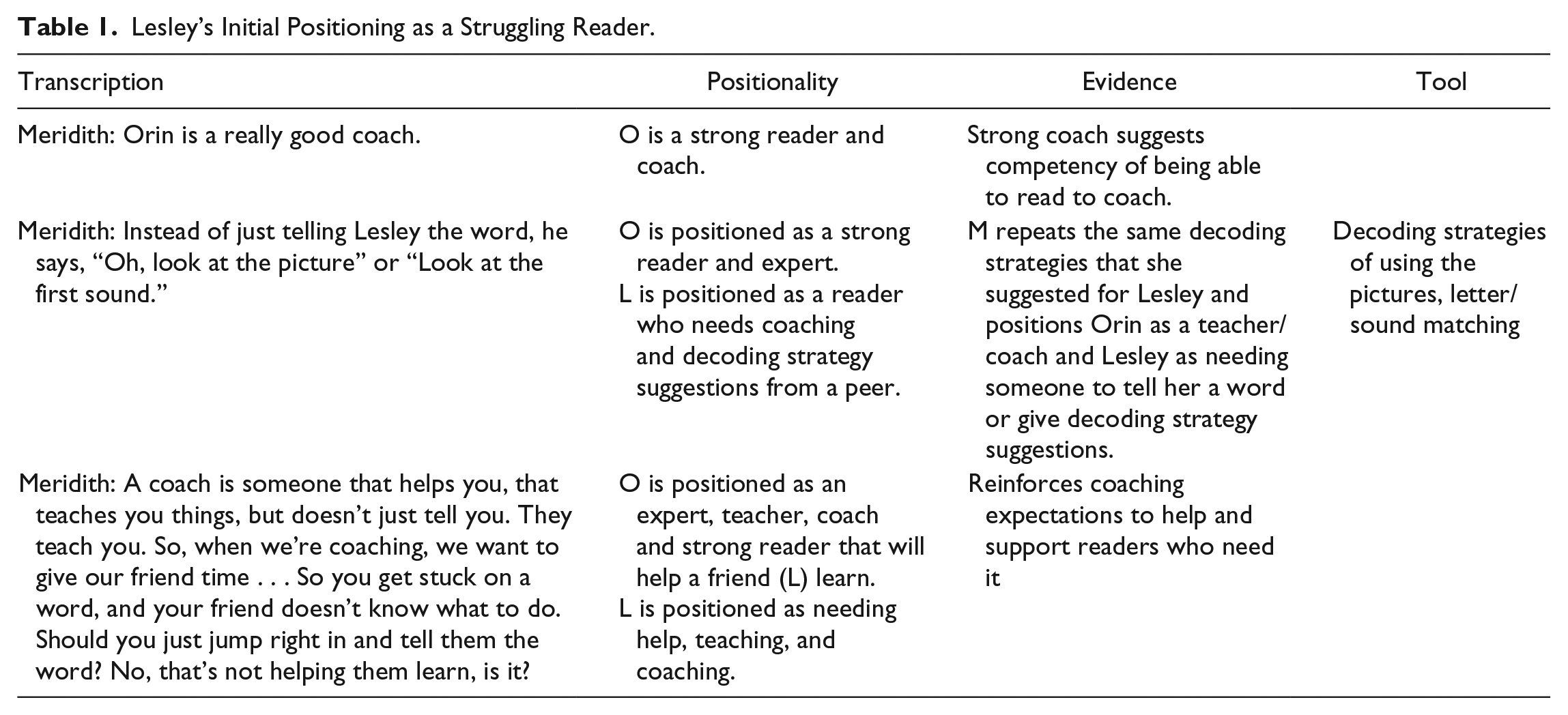
The classroom community of practice regularly celebrated and discussed problem-solving techniques (decoding strategies) “good” readers use when they come to unfamiliar words. These strategies and talk around strategies became cultural tools and part of the social and accepted language of the class. While language was positive about Orin’s coaching, the language and conversations, while not stated so explicitly, continually positioned Lesley as needing help. Meridith used the adjective good to describe Orin’s coaching, with an explanation of his use of the cultural tools of decoding strategies to make socially recognizable Orin’s identity as coach to Lesley. Her use of this language signaled Lesley’s identity as needing coaching, in contrast to a “good” coach. These signaled identities were substantiated by Lesley’s perceived need for experts (the teacher and Orin) to remind her of introduced and commonly used literacy practices.
Conversations and interactions regularly positioned Lesley in similar ways as related to her decoding. Two weeks later, Lesley came to the literature discussion group and shared that she was having trouble with tricky words, but Orin helped coach her by reminding her that she could not sound them out, but needed to think if it was a word she already knew. Then, during a subsequent partner reading, she held Orin’s finger and asked him to point to the words as he read them so she could follow along. In these instances, Lesley positioned herself as needing coaching and Orin as an expert coach and strategic reader.
Middle of the year: Strategic and developing reader
Throughout the year, Lesley continued to attempt literacy practices that were introduced and taken up by the classroom community. She became more confident in using decoding strategies and began reading conventionally with greater ease. Lesley also readily took up the comprehension strategies the teacher introduced (connections, new learning, questions, and author’s message) to document her thinking on sticky notes. These were placed in books and brought to literature discussion to share. They allowed Lesley to participate meaningfully in the discussion regardless of her ability to decode.
In one lesson, the children gathered on the carpet after independent reading as Meridith placed a poem chart on the easel. She began the mini-lesson by praising Lesley for practicing reading the poem and using her decoding strategies during independent reading. Meridith asked the students to practice reading the poem twice with a partner. This was followed by a choral reading of the poem while Meridith tracked the print. The transcript and analysis in Table 2 includes the remainder of the mini-lesson and positive positioning of Lesley as a competent reader who is celebrated by her peers. We used the same analytical framework and CDA tools but shifted from a critical lens to a PDA (Martin, 2004) lens to examine ways in which Lesley, the classroom community of readers, and the teacher made space for successful participation of an emerging reader.
Lesley as a Competent Reader Meriting Celebration.
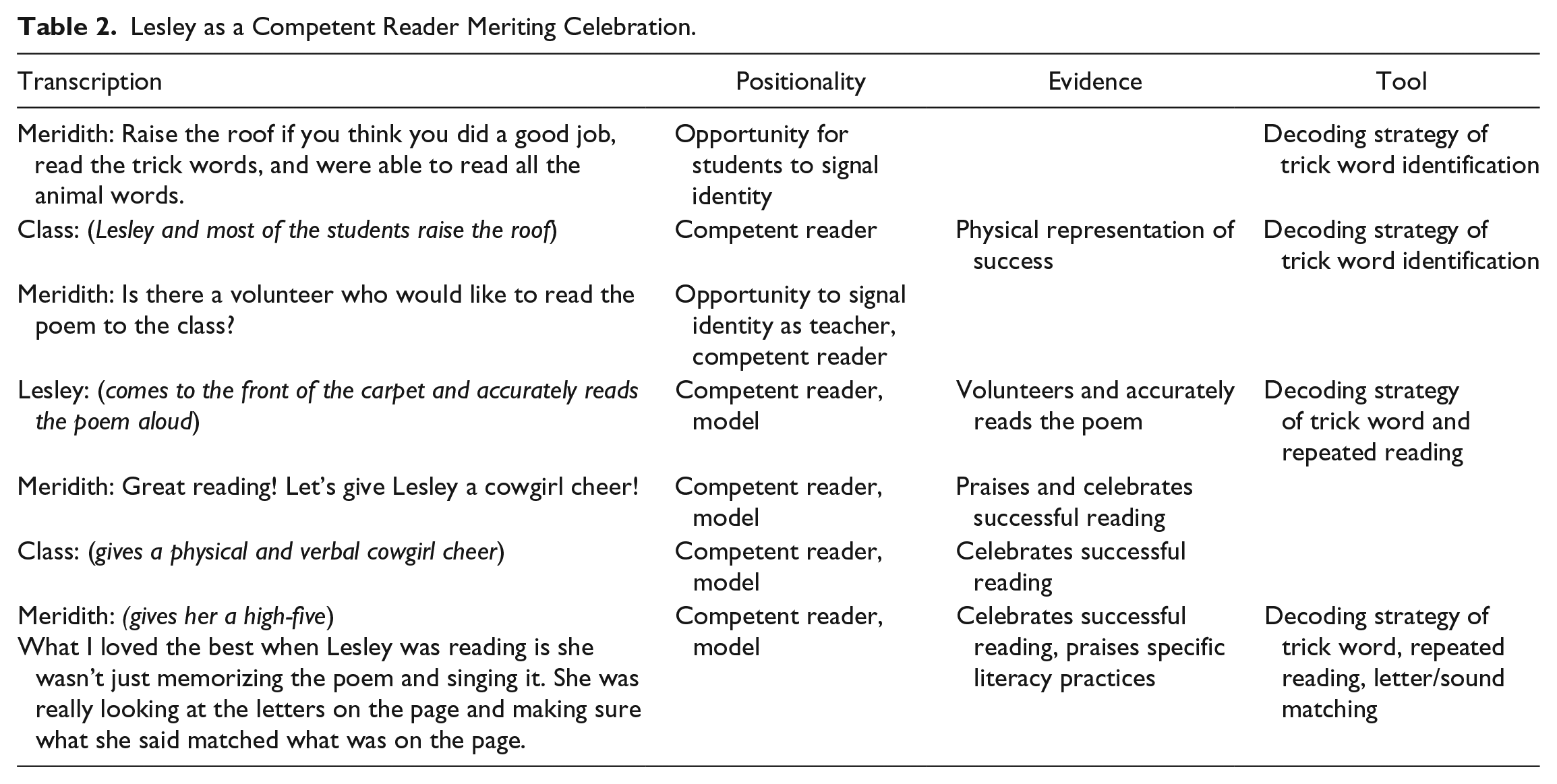
When Meridith asked students to raise the roof if they did a “good job” using the decoding strategies, she provided an invitation for students to signal positive identity as readers. Her use of the adjective good implied value on the literacy practices mentioned. Lesley used the physical representation of raising the roof to signal socially recognizable positive identity to Meridith and her peers by confirming she had taken up the cultural tools (decoding strategies) in accepted ways. By volunteering to model the reading and strategy use in front of the class, the very decoding strategies that originally positioned Lesley as needing help now served as a positive and mediating tool for reading and signaling her identity as a competent reader and model for her peers. As she took up decoding strategies and appropriated them to serve her needs of accessing and sharing text, she was able to shift and renegotiate her identity. These opportunities facilitated full, successful participation in the reading community. The classroom practices and encouraging discourse (and cheers) further reinforced acceptance and support among a community of developing readers.
Children were regularly supported with encouragement and praise by peers when they attempted to use accepted literacy practices (decoding strategies in this instance and comprehension documentation in other group conversations). This encouragement took multiple forms, ranging from verbal encouragement in partner reading, sharing and praising in literature discussions, classroom cheers, and “sending brainwaves.” Sending brainwaves was a physical representation students did when they knew a word or idea the student speaking did not. For example, on multiple occasions Lesley volunteered to read aloud and would pause when coming to a word she did not know. While she used decoding strategies to figure it out, other students would put their hands on top of their heads and wiggle their fingers in an attempt to send her positive “brainwaves” to help with the word or concept they knew. This type of positive discourse and encouragement with supportive literacy practices created opportunities for students who might be negatively positioned to be repositioned as strategic readers supported by the community.
End of year: Expert and full participant
Lesley’s reading progressed substantially over the course of the year, ultimately moving from what her school considered below average to “benchmark” and ready for second grade. She continually took up and approximated the classroom literacy practices that allowed her to position herself as an expert and full participant in the reading community. She continued to use decoding strategies to access text, but the largest shift came when she began to use comprehension strategies and language frames for participation and participated in literature discussion groups. As Martin (2004) suggested, she made room for herself in the world (in this case, the classroom community of readers) in ways that redistributed power without struggling against it.
By the end of the year, Lesley was still receiving encouraging discourse (brainwaves, etc.), as were most of the students. However, she was now also distributing it. As her knowledge and confidence grew, she was often observed silently mouthing words or answers to peers with brainwaves when they were stuck. For example, Connor volunteered to read the morning message, but became stuck on the words can’t and believe. As he paused to try to figure them out, Lesley sent brainwaves as soon as she identified the words. This opportunity to be a supportive and encouraging expert reader added to her positive identity development.
The transcript and analysis in Table 3 is from a small discussion group on I Want My Hat Back (Klassen, 2011), a book in which a bear loses his hat and suspects a bunny of taking it. At the end of the story, students must infer what happened to the bunny because he disappears and the bear has his hat back. In this transcript, Lesley participated as a full member and co-constructor of knowledge with her discussion group members by using language frames for participation and the comprehension strategy of inferring with textual evidence. These literacy practices became tools she used to reposition herself within the community of readers. This positioning and participation is a significant departure from her beginning-of-the-year coaching experiences.
Lesley as Full Member of Discussion Group.
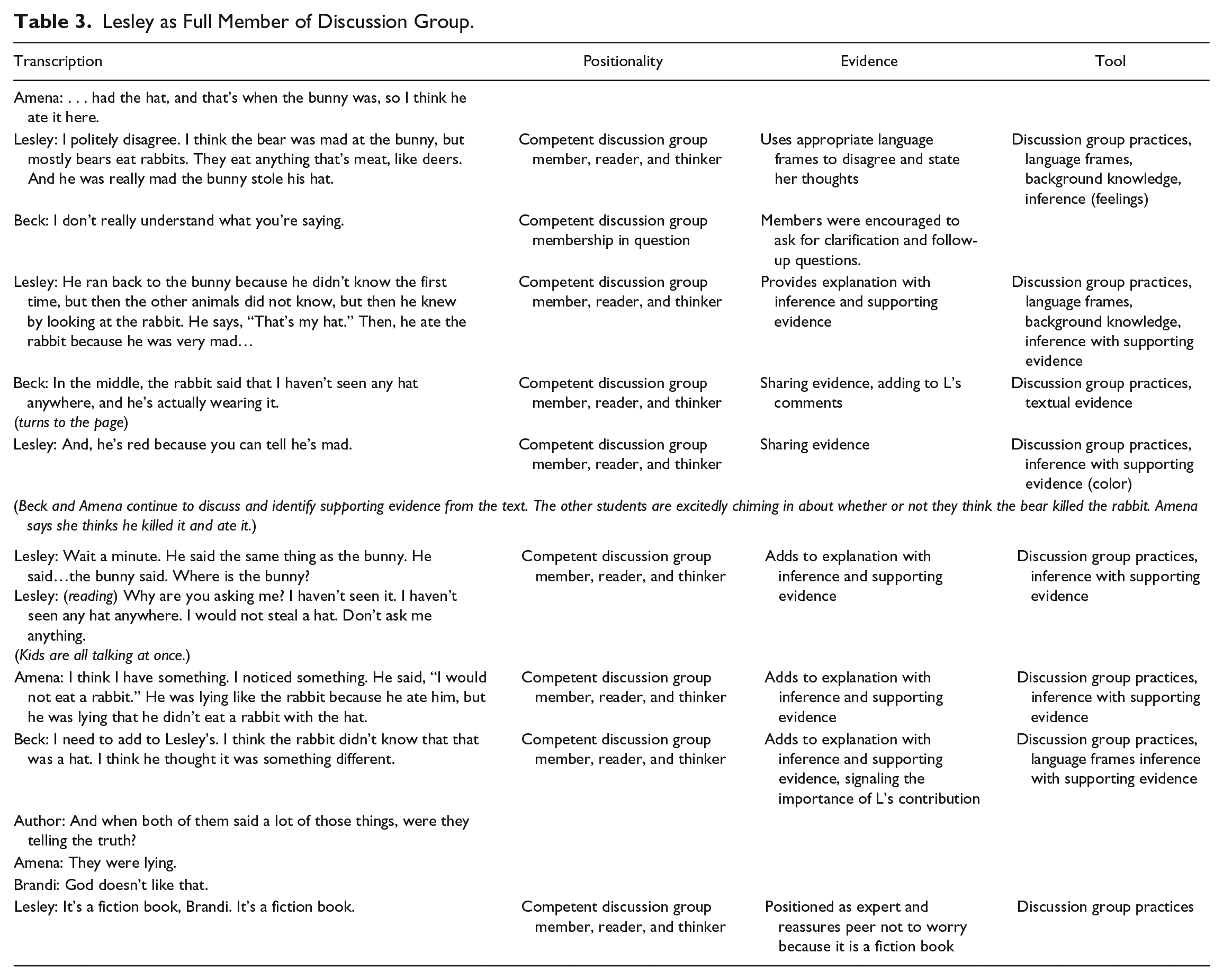
Lesley and her discussion group members had an in-depth discussion that required inferential thinking and supporting arguments with textual evidence (a comprehension strategy and literacy practice previously introduced). The students used the discussion group practices of introducing, discussing, revisiting, and sharing thinking about a text to participate in the conversation. They additionally used common language frames introduced for student-led conversations such as “I politely disagree,” “I think . . . ,” “Can you tell me more?” and “I don’t understand what you are saying.” These were introduced with the hope that, together, they would participate in shared responsibility while discussing text.
The shifted focus to comprehension and discussion groups in the second half of the year created opportunities for new and appropriated uses of literacy practices. Lesley used the language frame “I politely disagree” as a cultural tool to position herself as a full participant in the accepted discussion group practices. By using this contrasting statement, she stated her claim with background knowledge as supporting evidence. She used the adverb mostly to qualify her background knowledge as not being information found directly in the text. After being questioned and challenged by Beck (a commonly accepted and encouraged practice in discussion groups), she reaffirmed her positionality as a competent discussion group member, reader, and thinker by taking up the literacy practice of providing supporting evidence from the text for inferential claims. Her quoting of the text signaled her positive literate identity with her use of accepted practices while refuting Beck’s claim of not understanding her.
While this initially positioned Beck as needing clarification or support, it was immediately renegotiated as he provided additional supporting evidence from the text. Lesley began her response with the conjunction and to signal acceptance and adding to his claim. They worked together to share expertise and thinking by taking up and approximating the valued classroom literacy practices of discussion group practices, language frames, and comprehension strategies as they continued to revisit the text to provide supporting evidence. When Brandi claimed, “God doesn’t like it when people lie,” Lesley used repetition (“It’s a fiction book, Brandi. It’s a fiction book”) to position Brandi as needing support and herself as being an expert. These types of discourse opportunities facilitated the positive identity negotiations of beginning readers within a classroom context.
Ariana
In the initial interview, Ariana explained during reading time, “I read quietly.” At the beginning of the year, Ariana understood good readers as students who worked quietly and independently and complied with behavioral expectations. By the end of the year, Ariana’s conception of a good reader showed considerable growth. Ariana referred to herself as a good reader, a claim she supported by explaining that she figured out words, selected good books, and recorded connections, new learning, questions, and the author’s message on sticky notes as she read.
Ariana repositioned herself from a reader who needed support to a competent reader throughout the school year despite initial challenges with decoding and fluency. Her appropriation of partner reading, persistent use of comprehension strategies, and participation in discussions demonstrate how she forged a place for herself as a language learner who could fully participate as a valued member of the literate community.
Beginning of the year: Reader who needed support
Several factors contributed to Ariana’s institutional position as a reader who needed support. First, she was in her first year in a mainstream class, having just exited the all-day state-mandated sheltered English classes for students learning English. Second, her school-based benchmark assessments and DRA-2 scores were lower than average for her class and peers who spoke an additional language. Furthermore, Ariana’s reading behavior contributed to her negative literate identity positionality. She read in a slow, halted style, often skipping words and looking to the pictures for cues. These reading challenges do not represent a typical experience for all students emerging as bilinguals (Gersten et al., 2007), and we do not wish to suggest these students usually struggle in literacy; rather, we include these details to illustrate factors contributing to Ariana’s initial positionality within the institution of school. We used the aforementioned CDA tools to analyze initial negative positioning.
In an early incident, Meridith pulled Ariana for a decoding fix-up strategy group with three students who were also identified by the reading specialist as needing reading interventions. Two of them, like Ariana, spoke more than one language. In this strategy group, Meridith retaught the fix-up strategy of “back-up and read it again smoothly.” She wanted students to recognize their miscues and self-correct to fluent reading after they figured out a word.
The strategy group was notable because it repeated the whole-group lesson Meridith had completed 5 min earlier with the entire class. The rest of the class worked independently during this time; only students who needed additional modifications were pulled for a small group. Thus, Ariana’s inclusion in this group signaled her early positionality as a reader who needed additional support. Right before dismissing Ariana from the group, Meridith stated to the group members: I saw Ariana kind of repeated some words, and then she went back and read it again smoothly all on her own without me even saying anything, right? That was pretty good, wasn’t it?
Meridith uses “kind of” in an attempt to minimize that she is bringing Ariana’s challenges to the group’s attention. Ariana is positioned as a student who needs decoding strategies, but she is then repositioned when Meridith adds that Ariana went on to use them well independently. Meridith provided quality instruction by using flexible small groups to meet students’ needs and provide additional reinforcement of new concepts for language learners, and we do not wish to suggest this instruction was inappropriate. We include it as an example to show that Ariana, at the beginning of the year, was positioned as a student who experienced challenges with reading and needed extra support.
Middle of the year: Partner reading and persistent use of comprehension strategies
Using the same CDA tools from the beginning of the year, we shifted our analytical lens to PDA to better understand how learners made space for themselves. During partner reading, the teacher expected students to sit side by side with a book between them and take turns reading aloud and talking about the text. Ariana frequently used partner reading as an opportunity to position herself as a capable reader, competent enough to offer coaching and support to her partner. The following transcription (from the research journal) recounts Ariana’s partner reading with Teresa, who also spoke Spanish at home.
Ariana and Teresa were reading Little Blue and Little Yellow (Lionni, 1995). Teresa reads, and Ariana tells her, “You said it right the first time.” They alternate page by page. Teresa gets stuck on “climbed.” Ariana looks at the picture and says, “What are they doing?” After a long pause, Ariana says, “This is a mountain, and what are they doing on the mountain?” Teresa says, “Climbing.” Ariana affirms, “Mmmhmm. Just change the -ing.”
Ariana took on a teacher role, positioning herself as a capable reader. She recognized when Teresa read correctly and affirmed Teresa’s reading. Like a teacher, she had multiple decoding strategies for supporting Teresa as she figured out the word climbed. As a fellow language learner, Ariana recognized Teresa’s need for time and allowed her a long pause. As students who speak multiple languages often do, she used background knowledge to connect mountain with climb and offered that cue to Teresa. She offered picture cues, context cues, and finally, when Teresa understood the word family involved, Ariana recognized the -ing morpheme in what Teresa said and told her that part was all she needed to change. Throughout this session, Ariana relied on a rich combination of sociocultural, background, and linguistic knowledge to support her partner. This coaching session with Teresa allowed Ariana to confirm her identity as a capable reader and user of strategies in a second language with something to contribute to the community of practice.
Ariana readily took up comprehension strategies her teacher introduced. In this classroom, students documented personal and textual connections, new learning, and “wonders” or questions on sticky notes. Ariana embraced the opportunity to use sticky notes to document her thinking. When her oral reading became challenged, she would often stop reading and announce, “I have a connection!” or make use of another comprehension strategy, indicating her understanding despite apparent disfluency.
In Table 4, Ariana read Goldilocks and the Three Dinosaurs (Willems, 2012), a spoof on the well-known three bears story in which the bears are recast as dinosaurs. She encountered challenges with print and vocabulary but made ample use of comprehension strategies to demonstrate her understanding of and interest in the text.
Ariana Appropriates Comprehension Strategies Despite Miscues.
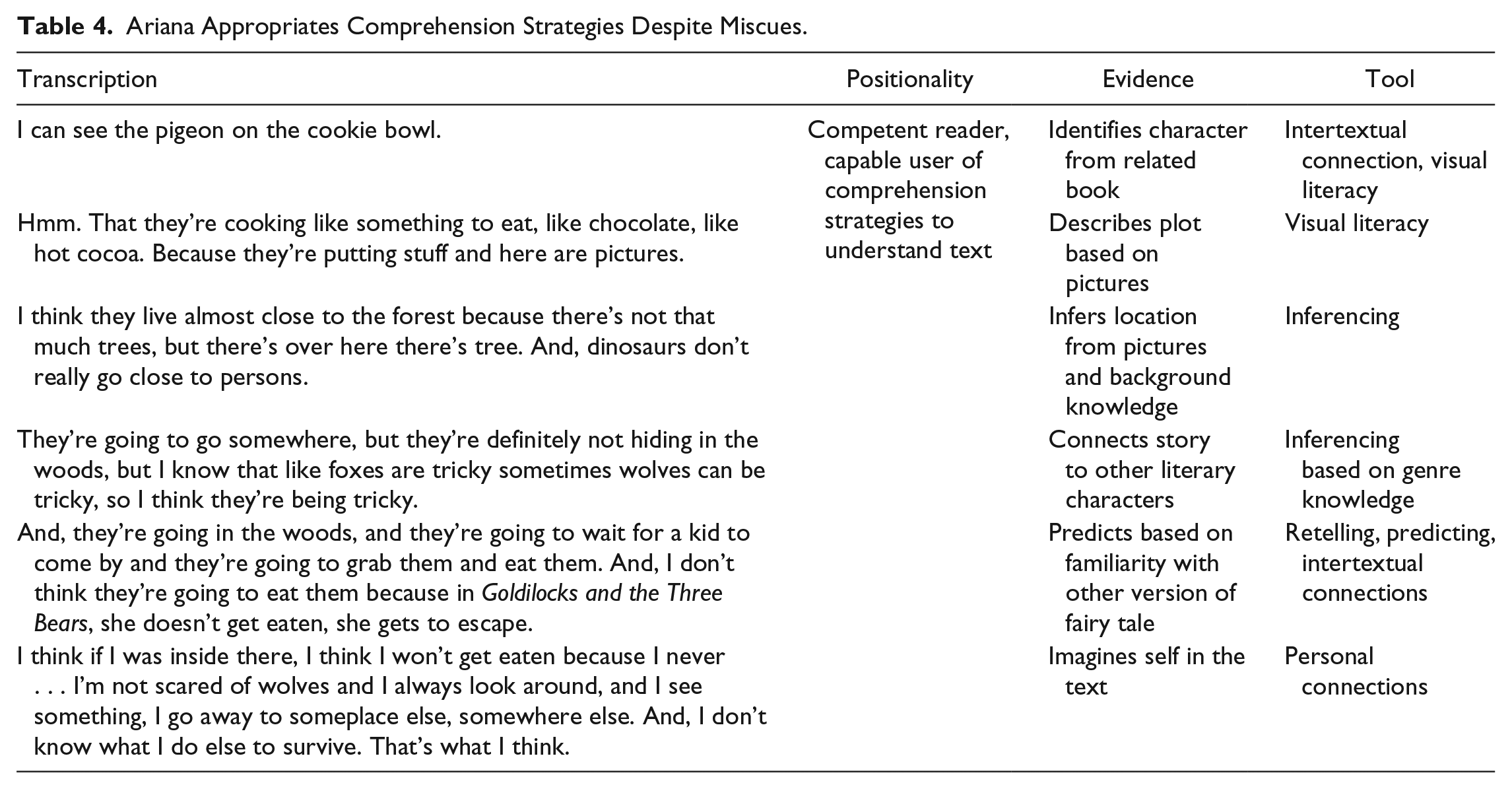
In the full transcript of this reading event, Ariana made 16 miscues, most of which had a significant effect on the meaning at the sentence level. However, she used comprehension strategies to demonstrate she could dialogue with the text despite its technical difficulty for her. At the beginning of Table 4, she uses the modal can to demonstrate what she is capable of doing, using an accepted literacy practice of intertextual connections to Mo Willems’s other work (the Pigeon books; Willems, 2003) and visual literacy to position herself as a competent reader and capable user of comprehension strategies. A few pages later, Ariana made an inference about the location of the dinosaurs’ home based on the picture cues in the book (“there’s not that much trees”) and background knowledge (“dinosaurs don’t really go close to persons”). While she used approximated language and cultural tools to position herself positively, she also appeared to recognize the positioning of the researcher, and that it might help her positioning by referencing these practices.
After three miscues on the same page, the researcher asked Ariana what was going on, and she provided a brief summary but extended it with her knowledge about literary genres. She explained she knew from her other reading that foxes and wolves can be “tricky,” so she wondered if the dinosaurs were in this same category of tricky literary figures. She continued her summary and made another intertextual connection with her prediction that Goldilocks would not get eaten in this story since she did not get eaten in the original story.
Ariana made personal connections when she said she would not get eaten because she pays attention to her environment and is not scared. She explained that she looks around and would go somewhere safe. Finally, Ariana inferred that the “wind” in the story was perhaps the dinosaur taunting Goldilocks. In this literacy event, Ariana relied on a variety of complex comprehension strategies (connections to other literary texts, knowledge of genre) to identify herself as a competent reader who could make sense of a text even with substantial decoding challenges. She employed visual literacy, inferencing, summarizing, connections to other texts, connections to self, and predictions to establish herself as having a firm command of the text. The interaction raises questions about the role of fluency and basic decoding skills for Ariana, a student learning an additional language, in comprehension. Often, teachers assume young students cannot comprehend texts that pose as much decoding difficulty as this text did for Ariana. However, she demonstrated abundant use of comprehension strategies, suggesting that, as Lesaux and Geva (2006) note, language learners can develop tools for making sense of text even when reading fluently proves difficult.
End of the year: Full participation in discussion
By the end of the year, Ariana had made substantial progress as a reader, both as a decoder and as someone who comprehended and discussed text. She achieved benchmark levels her school considered ready for second grade. She staked her claim in small-group literary discussions by using patterned language frames to participate in the discussion and by asserting herself as someone with something to say. In Table 5, Ariana and Teresa almost took over a discussion group being led by the researcher. In I Don’t Want to Be a Frog (Petty, 2015), a frog complains about the negative aspects of being a frog and wants to be a different animal; by the end of the story, he comes to understand that he is best off being a frog.
Ariana as Full Discussion Group Member.
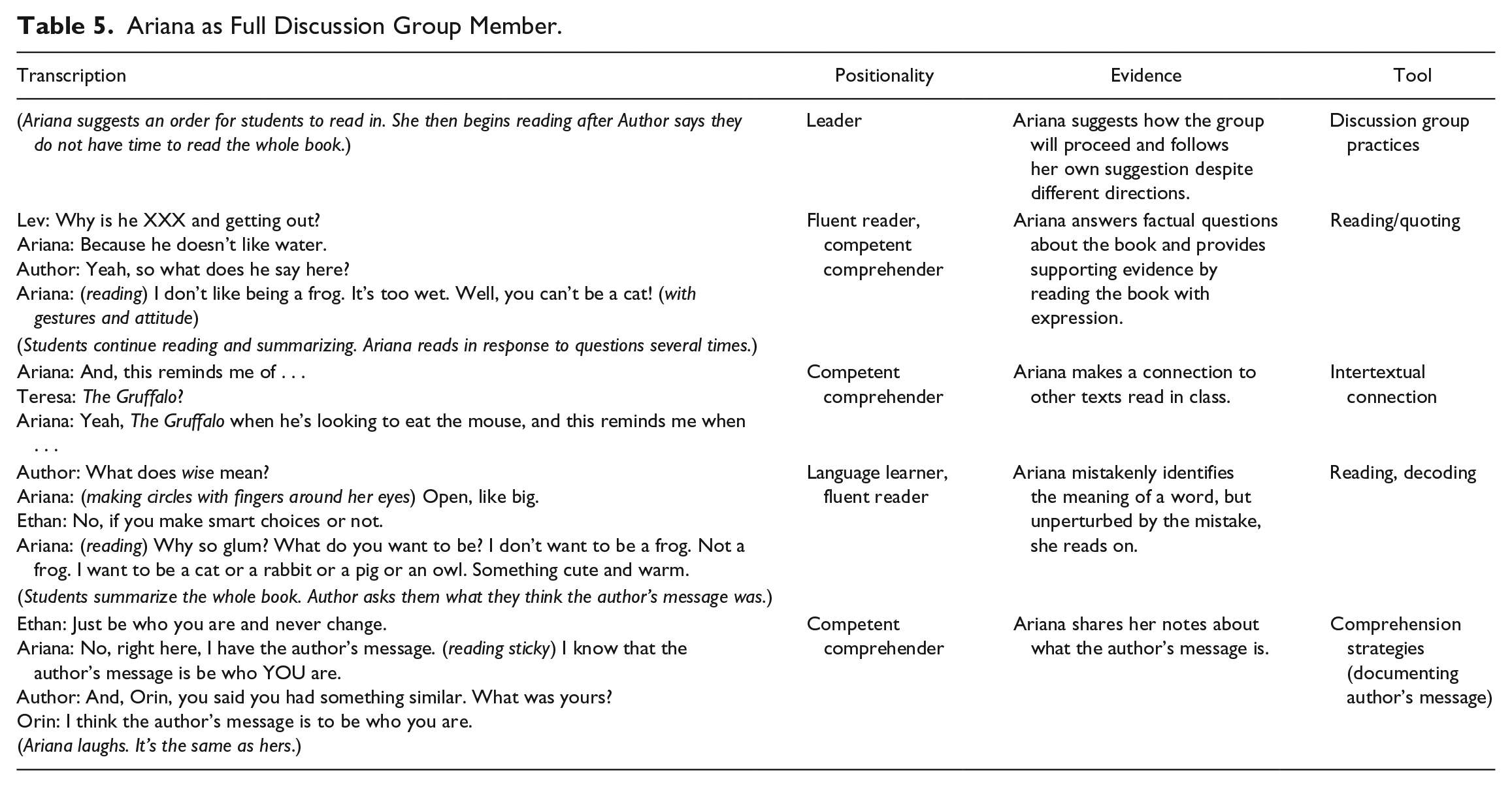
Ariana used her familiarity and fluency with the text to position herself as a capable reader. Whereas her previous practices involved supporting others and making meaning, she positioned herself as a competent reader by dominating this discussion mostly through displays of fluent reading. As a language learner, this strategy of fluent reading allowed her to participate fully in the discussion without needing to generate the language to participate. She selected contributions from the text itself and used these words to make her place in the discussion.
Initially, Ariana took on a teacher/leader role, explaining to the researcher how they should proceed reading the book. When the researcher reminded her their purpose was discussion (since they had already read the book independently), Ariana dismissed the researcher’s request and positioned herself as the leader when she began to read anyway. As the discussion proceeded, Ariana continued reading (sometimes over other students) as a way of contributing to the discussion by answering questions the researcher or others raised and as a way of moving the discussion forward when she deemed it time to move on to a new page.
Instead of summarizing or discussing the book, Ariana relied on reading the book to answer questions and participate. This practice demonstrated to everyone in the group her position not only as a fluent reader who could read the text but also as a capable comprehender who understood which lines in the text corresponded to the discussion at hand. Using the language of the text allowed her access to language with the vocabulary and grammar already provided; it reduced the cognitive load on her as a language learner who wanted to interject ideas into the conversation. She also employed several comprehension strategies. She offered, with Teresa’s support, a connection to The Gruffalo (Donaldson, 2006). Here, she used an intertextual connection to continue to position herself as a competent comprehender who collaborated with peers and used accepted literacy practices. She used the accepted language frame “This reminds me of . . .” and then added to Teresa’s comment by using “yeah” to confirm and expand on Teresa’s suggestion.
Ariana mistakenly explained that wise meant making wide eyes. Ethan refuted her claim with the exclamation “no” and corrected her by explaining the definition. Initially, Ethan positioned himself as expert and Ariana as needing support or correction. However, Ariana immediately repositioned herself as a leader when she moved on to reading without continuing the discussion. She shifted her positioning from a language learner who made a mistake in understanding vocabulary to a competent and fluent reader by not acknowledging it and moving on to reading aloud.
The researcher closed this discussion by asking the students to share their interpretation of the author’s message. Most students coalesced around the theme of “be yourself.” Ariana agreed with this message but did not recognize her interpretation was the same as other students’ until she read her own sticky note. Only after she read her note did she begin to listen to the other students and notice Orin identified the same message.
This discussion group, which occurred near the end of the year, is significant as it demonstrated Ariana’s growth as a reader. It showed how Ariana used fluent reading to position herself as a capable reader. This strategy differed from earlier tools, such as coaching during partner reading or stopping to talk about text as she encountered challenges with decoding. In this transcript, she showed simultaneous mastery of the skills needed for both meaning making and decoding.
Ariana developed across the year significantly in language acquisition and reading. As her English oral proficiency grew, so did her oral participation in literacy events and evidence of reading comprehension. She continually adopted decoding, comprehension, discussion, and coaching strategies introduced by the teacher and used them to fully participate in the community of practice. She adapted these practices to meet her needs and draw on her strengths as a student who was learning another language. She learned to combine her background, linguistic, and cultural knowledge to make sense of text and offer support to others. She provided evidence of comprehension despite technical difficulty of the text and used discussion as a way of making her place. She drew scaffolding from the text itself and used the language of the text to support her contributions. These accomplishments are especially noteworthy since Ariana developed them in a classroom not specifically designed to provide support for language acquisition.
Cross-Case Analysis
We agree with Bloome et al. (2005) that “how one engages in reading and writing, when, where and with whom, as well as how one engages in learning to read and write, both reflects and constructs one’s identity” (p. xvii). Because of this, we identified practices that supported young people with diverse backgrounds learning to read and the ways students adapted these practices to capitalize on their own background knowledge and linguistic strengths. Through tracing identities over a year with different discourse analysis tools, we identified the following literacy practices to be supportive of positive identity negotiation: language frames for participation, comprehension strategy documentation, decoding fix-up strategies, partner coaching, and discussion group participation. We did observe, though this was not our focus, that the case studies who adopted these practices grew from the lower end of their class average DRA-2 scores (independent—Lesley: 2; Ariana: 3) at the beginning of the year to on-level scores (both: 18) at the end of the year.
Lesley and Ariana followed similar trajectories throughout the year. They both began positioned as readers who needed support, reflected in their identification for needing reading interventions based on lower assessment scores and their inclusion in small groups for additional support. However, both girls adopted literacy practices (the cultural tools of their classroom community) to reposition themselves as competent. Lesley relied heavily on support from partners and growing mastery of decoding strategies as she negotiated her way out of the “needing to be coached” designation. She demonstrated her newfound identity through encouraging others, using comprehension strategies, and fully participating in literature discussions. Ariana relied heavily on comprehension strategies as she worked with familiar texts. She documented her thinking on sticky notes and used background knowledge to construct meaning. She forged her identity as a competent reader through supporting peers, fluently reading, and participating in discussion. Both girls benefited from and offered peer support as they redefined their literate identities. They also established their place in the community through participation in discussion. As a student who spoke an additional language, Ariana appropriated more tools related to meaning construction (nearly 1.5 times as many as Lesley). Lesley spent more effort in appropriating decoding strategies.
Discussion
The significance of this study lay in its attempt to understand how students with diverse linguistic backgrounds used literacy practices to construct meaning and how they negotiated identity by using accepted literacy practices as cultural tools to participate in a community of readers. To truly understand how students construct meaning, we must consider the classroom community of practice that shapes and is shaped by identity constructions, and in turn influences how students construct meaning. It is only through an understanding of the holistic experience that the individual components of academic development can be understood. This study explores how a classroom provided access, knowledge, and participation for students with multiple home languages. The potential implications for this study in the current political climate include providing teachers, researchers, and policy makers with an understanding of how and with what supports we can create educational spaces that support and celebrate early literate identity development among all children.
The findings are important because they demonstrate ways classroom communities can afford cultural tools that enable all students to experience a sense of belonging to the literacy community. For students acquiring English, a shift from a skills- and rote-focused instructional model to a dialogic, inquiry-based model has the potential to positively affect both academic and identity development. To make this shift, teachers need instructional strategies and literacy practices that are inclusive and supportive of all learners, regardless of their first language or decoding abilities. The literacy practices introduced in this supportive classroom community facilitated opportunities for positive identity negotiations. Teachers can support learners with a greater focus on inclusive classroom literacy communities and supportive literacy practices, like the ones identified in this study.
The findings reflect and add to those of other researchers who have traced the identity development of students from diverse linguistic backgrounds (Moje et al., 2009). Previous research documented that instructional approaches and classroom interactions greatly influence the construction of community and student identity development (Triplett, 2007). Our findings support Möller’s (2004) conclusion that “educators can create supportive learning environments that provide the tools needed to encourage displays of competence” (p. 422). As in Möller’s study, our findings highlight the significance of these “tools needed to encourage displays of competence” particularly for historically marginalized readers in the process of redefining themselves as competent members of the literate community.
At a methodological level, this study contributes to the current body of knowledge by combining methods and drawing on lenses of both CDA and PDA to explore ways in which classroom literacy practices can both marginalize and support identity negotiations. As such, we argue there is a continued need for more research that not only deconstructs power but also identifies positive ways in which students make room for themselves within academic settings. It is through the use of both lenses that we believe researchers can analyze and report findings on identity negotiations that provide insight into ways power might be redistributed in positive ways for young children. As Martin (2004) and Kress (1996) have noted, there is a need for more research using discourse analysis with a positive lens to examine, analyze, and report practices that are supportive and successful.
We also advocate for additional research documenting the development of positive identities for readers who are negatively positioned, especially those who speak additional languages. Research has not systematically described such positive identity development, and more work, particularly with practical implications for classroom teachers wanting to support emerging readers, is desperately needed. The list of practices supporting identity development identified in this classroom context is not exhaustive and was specific to this community of readers. Additional research is needed on supportive literacy practices for positive identity development to provide more extensive implications for classroom application.
Footnotes
Appendix
Data Analysis Codebook.
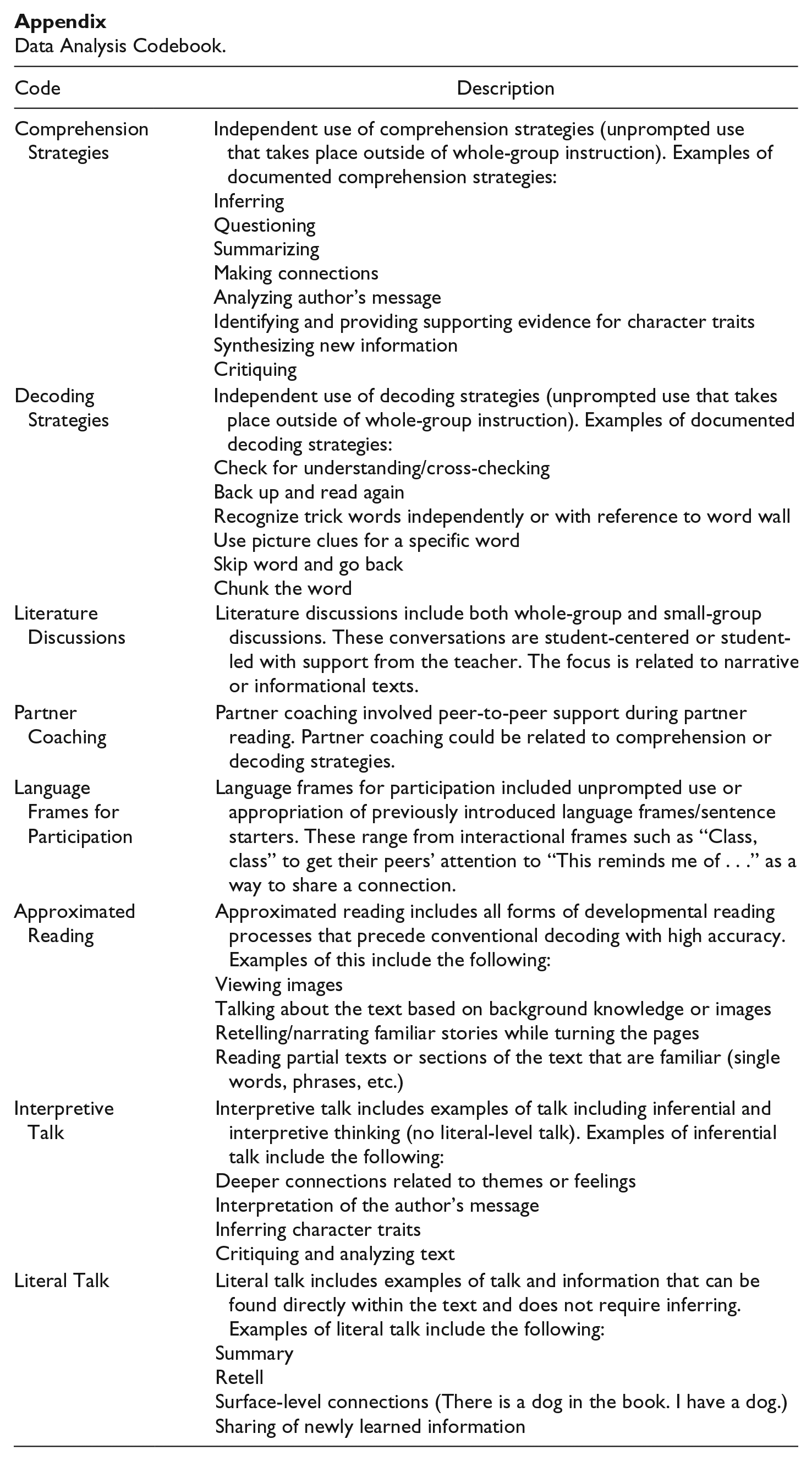
| Code | Description |
|---|---|
| Comprehension Strategies | Independent use of comprehension strategies (unprompted use that takes place outside of whole-group instruction). Examples of documented comprehension strategies: Inferring Questioning Summarizing Making connections Analyzing author’s message Identifying and providing supporting evidence for character traits Synthesizing new information Critiquing |
| Decoding Strategies | Independent use of decoding strategies (unprompted use that takes place outside of whole-group instruction). Examples of documented decoding strategies: Check for understanding/cross-checking Back up and read again Recognize trick words independently or with reference to word wall Use picture clues for a specific word Skip word and go back Chunk the word |
| Literature Discussions | Literature discussions include both whole-group and small-group discussions. These conversations are student-centered or student-led with support from the teacher. The focus is related to narrative or informational texts. |
| Partner Coaching | Partner coaching involved peer-to-peer support during partner reading. Partner coaching could be related to comprehension or decoding strategies. |
| Language Frames for Participation | Language frames for participation included unprompted use or appropriation of previously introduced language frames/sentence starters. These range from interactional frames such as “Class, class” to get their peers’ attention to “This reminds me of . . .” as a way to share a connection. |
| Approximated Reading | Approximated reading includes all forms of developmental reading processes that precede conventional decoding with high accuracy. Examples of this include the following: Viewing images Talking about the text based on background knowledge or images Retelling/narrating familiar stories while turning the pages Reading partial texts or sections of the text that are familiar (single words, phrases, etc.) |
| Interpretive Talk | Interpretive talk includes examples of talk including inferential and interpretive thinking (no literal-level talk). Examples of inferential talk include the following: Deeper connections related to themes or feelings Interpretation of the author’s message Inferring character traits Critiquing and analyzing text |
| Literal Talk | Literal talk includes examples of talk and information that can be found directly within the text and does not require inferring. Examples of literal talk include the following: Summary Retell Surface-level connections (There is a dog in the book. I have a dog.) Sharing of newly learned information |
Declaration of Conflicting Interests
The author(s) declared no potential conflicts of interest with respect to the research, authorship, and/or publication of this article.
Funding
The author(s) received no financial support for the research, authorship, and/or publication of this article.
