




Abstract
The words ‘children’ (Danish: ’børn’) and ‘young people’ (Danish: ’unge’) are so often combined that they almost have the character of idiomatic expressions. But what differences in the use of the words can be found? This article seeks to study the prevalent, dominant discourses about children and young people. In particular, it endeavours to answer the following question: What is thematized, and how are the thematizations created and maintained? The study is theoretically inspired by Foucault’s discourse analysis. The methodological approach is that of a multiple case study. Thus, it provides examples of how children are typically referred to in positive terms such as innocent, imaginative, cheerful, spontaneous, creative and competent (a surplus discourse), while young people are typically referred to in negative terms such as irresponsible, rootless, violent, dysfunctional, hedonistic and unaccountable (a deficit discourse).
Introduction
If a search is done in Danish for the equivalent of the text string ‘children and young people’, Google generates almost 3 million hits, and the specific collocation of these two words is ubiquitous: In Denmark, the Ministry of Social Affairs has ‘Special endeavours in the field of children and young people’, the Ministry of Culture highlights the theme of ‘Cultural experiences for children and young people’ and virtually all local authorities in Denmark have a special ‘Local-government action on vulnerable children and young people’; there is a Media Council for Children and Young People, special interest organizations that, for example, support ‘children and young people in distress’ and journals entitled ‘Børn&Unge’; the Danish Health and Medicines Authority has ‘Special recommendations for children and young people’, the National Institute of Social Research (SFI) has drawn up research overviews of ‘Children and young people in care’, the Egmont Foundation awarded more than ‘DKK 70 million in aid of children and young people’ in 2014, the Cancer Society has brochures aimed at ‘Children and young people with cancer’, you can do a ‘Master’s in vulnerable children and young people’ and so on.
The particular collocation of children and young people is more or less fixed. But what does it express? How can it be understood? What is the relationship between these two expressions, children and young people?
With almost 14,000 employees, the biggest municipal department in the Municipality of Aarhus is called ‘Children and young people’. Yet, the standfirst on the department’s webpage says ‘Every day we take care of 64,000 children in daytime and leisure facilities, schools and special schools, as well as in healthcare and dental care’ (my italics).
The word that attracts the greatest semantic attention is neither ‘children’ nor ‘young people’, but actually the conjunction ‘and’. For what does this ‘and’ signal? Is it a kind of adversative (contrasting) connective, expressing the fact that there are both children and young people, and hence a signal that there are essential epistemological differences between the two words, or is it a kind of additive copulative, expressing correlations between the two words, thus signalling an elimination of potential differences?
In this article, I wish to pursue this question. I want to investigate some of the discourses that dominate when children and young people are thematized and what notions about them are prevalent. The article’s research questions can be summarized as follows: What differences between children and young people can be identified when children and young people are verbalized? The point is in no way to penetrate behind the discourses in an endeavour to identify an underlying truth about children and young people, but to analyse the patterns that can be observed in empirical material. My knowledge interest is not, therefore, to define ontologically what children and young people are, but to examine epistemologically which differences are verbalized. In the article, I show through three different case analyses that children are often verbalized in positive, surplus turns of phrase, while young people are often verbalized in negative, deficit turns of phrase. I analyse these verbalizations as, respectively, a surplus discourse and a deficit discourse.
Finally, in the article, I conclude that these verbalizations are not as innocent as they may first appear because they entail a risk of construing ‘grand narratives’ that ignore or trivialize the differences that exist within the individual groups (Johansen, 2015: 19–34).
Theoretical framework
I regard my investigation as a poststructurally inspired discourse analysis. In this context, poststructuralist – to use Michael Peters’ and Nicholas Burbules’ (2004) words – means a ‘mode of thinking’ (p. 17), in which I adopt an enquiring and experimental approach with a view to a kind of dislocation of sedimented truisms. In the awareness that poststructuralism is not one cohesive theory, it is summarized here as a critical approach to structuring concepts, normative notions and constructional conditions governing structures.
The primary theoretical source of inspiration is Michel Foucault’s discourse analyses. Using analyses of discursive formations’ dispersion and distribution, Foucault shows how language not merely produces meaning but also constructs a discursive framework, singling out what is accepted and approved as being meaningful and in that way defines a framework for understanding (Foucault, 2005, 2008, 2009). A discourse (or discursive formation) is a collection of words and utterances in which an overall pattern is observable when they are interrelated with one another in different ways (Raffnsøe et al., 2009: 184). In The Archaeology of Knowledge, Foucault (2005) writes, ‘Whenever, between objects, one can define a regularity (an order, correlations, positions and functionings, and transformations), types of statement, concepts, or thematic choices, we will say […] that we are dealing with a discursive formation’ (pp. 119–120). Discourses shape our understandings and views and can appear to be so patently obvious that we forget their contingency. Against that backdrop, Foucault shows how discourses are bound together into an episteme, a term denoting the general thinking framework or code of a particular age – a principle of order that determines what can and cannot be spoken about (Foucault, 2008). The episteme, thus, makes up the framework around what is regarded as normal and abnormal in a particular culture at a particular point in time.
In terms of my investigation, it means that the instant particular people are verbalized as ‘children’ or ‘young people’, and the definitional power of language has simultaneously been used to install a social relevance and existence that compels a specific understanding as a ‘discursive fact’ (Foucault, 2011: 24, 43). The words connected with children and young people, therefore, plant a particular semantic framework, indicating the way in which they are to be understood, and in addition discreetly and silently construct social control and power relations in something otherwise thought of as our altogether direct treatment of these concepts (Nielsen, 2001: 3). It is this semantic framework which is analysed below.
Method
In my examination of the discursive formations, I use three different, separate cases, where I understand ‘case’ to mean ‘a strategy for doing research which involves an empirical investigation of a particular contemporary phenomenon within its real life context using multiple sources of evidence’ (Robson, 2002: 178). I use a triangulating multiple case design, which enables me to generate broad-based empirical material for the purpose of investigating the discursive formations from several different angles using several different approaches.
In the first case, I base myself on the two research centres that exist in Denmark to deal with children and young people and have this enshrined in the names of their centre, having the declared aim of conducting research to benefit children and young people, respectively. I have included the first five projects listed on the centres’ websites at the time I started the investigation. I have examined these five projects with a view to identifying any patterns in vocabulary and thematics. By way of conclusion, I have analysed the centres’ mission statements with an eye to examining how they present the object of their research.
In the second case, I have examined children’s and young people’s (youth) literature as a cultural product. I have examined, first, how the research literature discusses children’s and young people’s literature, respectively; what sorts of words and themes dominate? Then I have examined extract lists of the most loaned-out children’s and young people’s books at the Aarhus Main Library in 2014. Which five children’s books are most borrowed, and which five young people’s books? I subsequently conducted a semi-structured interview (Robson, 2002: 278–301) with one of the library’s librarians with a view to gaining insight into the librarian’s verbalization of the books’ themes.
In the third case, I have undertaken a systematic search of the literature in three phases: (1) preparation of search protocol, (2) literature search and (3) selection and critical review and analysis of the literature. In the literature search, I have compiled a search protocol with a view to clarifying and structuring the process that has been necessary to gather relevant information within my field and has led to the literature I have included (Odense Universitetshospital (OUH), 2007). That way, the search protocol mapped out the logical sequence for the steps in my literature searching process and simultaneously formed the basis for the potential repeatability of my search. The protocol contained a search strategy with choice of database (idunn.no), search words (freetext search on truncated barn* and ung* (child* and young*)), search period (2004–2014) and linguistic delimitation (Danish, Norwegian and Swedish), stating the criteria for exclusion and inclusion (only where the words appear in ‘Title, summary and keyword’). This gave me a total of 538 articles (334 for child* and 204 for young*). I then read through ‘titles, summaries and keywords’ for these articles and evaluated them in relation to repeated quotations. I deselected those taking both children and young people as their theme since it is precisely the verbalization of each individually which I am interested in investigating. Finally, I drew up a collocation analysis of the total text of title, summary and keyword with a view to identifying patterns in the choice of vocabulary and thematics (a collocation analysis analyses connections between words to work out which words frequently appear together (Evert, 2009).
In selecting cases, I have endeavoured to examine three different discursive logics. Case 1 analyses institutional discourses; case 2, literary discourses; and case 3, research discourses in the humanities, health science, social studies, economics and natural sciences. Thus, the intention has been to achieve a polyphony of empirical material, but at the same time it must be pointed out that my investigation over-represents discourses sourced from a tradition predominantly rooted in the humanities. Therefore, it might have been interesting to include a fourth case, examining the way children are verbalized in, for example, legal documents or to have gone into more detail of discourses within the healthcare sector.
Case 1: comparison of two research centres
The VIA University College’s Centre for the Study of Childhood and Youth Culture works with children in daycare facilities or attending Danish elementary schools. At the University of Aarhus’ Centre for Youth Research (CeFu), work is being done with young people who have completed elementary school. Reading through the centres’ project descriptions, you can identify a most distinct difference in the project themes analysed by the two centres.
The first five projects being presented at the Centre for the Study of Childhood and Youth Culture are called (1) ‘Spaces that get children moving – sensory experiences’, (2) ‘The room of the living narrative’, (3) ‘The aesthetic and educational potential of the picture book’, (4) ‘Non-formal learning processes in children’s everyday culture’ and (5) ‘Musical games and improvisation’. These, then, are projects that contain words like ‘living’, ‘narrative’, ‘sensory’, ‘experiences’, ‘potential’, ‘non-formal’, ‘game(s)’ and ‘improvisation’. According to the project description, the first project is about sporting facilities having been built and fitted out in accordance with a ‘logic which is often far from or in direct opposition to children’s spontaneity and creative kinesic development’, in which ‘a prominent role is played precisely by joy and play’.
They are projects and words which have an entirely different value from the words expressed in the Centre for Youth Research’s projects. Here, the first five projects are called (1) ‘Young people on the edge of society’, (2) ‘Young people without a job and an education’, (3) ‘When it’s hard to be young in Denmark’, (4) ‘Young hearing-impaired people after their schooldays at Frijsenborg Efterskole’ and (5) ‘The borderliners doing vocational training courses’. The first project is all about the existence of ‘a growing group of young people who have not been positively integrated into either the educational system, labour market, club and leisure life, or society in the broader sense’ and who ‘live on the edge of society’. These, then, are people who are isolated from the rest of society. In addition, there are projects on, for example, compulsive gambling and combating absenteeism. Under the centre’s auspices, there are also projects with highly nuanced examinations of, for example, the relationship between body and youth, and an analysis of the learning environment at the technical upper-secondary schools, which concludes that more than 90% of students enjoy attending schools. So the overall picture of this centre’s projects is not as clear-cut as that of the first one. In a theme issue about the last 10 years of youth research, however, the head of the Centre for Youth Research talks about what is regarded as the centre’s seminal tasks:
The number of young people who are malnourished, have eating disorders or are overweight and have similar problems is rising sharply. How can this be countered? And how do we counter the far too excessive consumption of alcohol and other euphoriants among the young? In many other places, the experience is also one of an increase in mental ill-being, and the young people themselves report stress, self-worth issues, rootlessness and other symptoms indicating the seemingly insurmountable difficulty of integrating into adult society. CeFU’s central mission is to make its contribution and shed light on these very issues. (Katznelson, 2010: 5)
Hence, it is part of the centre’s self-knowledge and apparently the most essential part of the centre’s task to elucidate, analyse and comment on issues linked to young people whenever young people are in trouble. In this way, being young is regarded as being associated with failing to thrive, with ill-being. So projects portraying young people as, for example, dynamic and hard-working, showing initiative and a zest for life are presumably absent? At the Centre for the Study of Childhood and Youth Culture, the starting point is different. Here to a greater extent, it is about creating and developing cultural forms of expression. Their mission statement declares,
The centre is broadly aimed at children and young people’s cultural activities and is tasked with studying and developing children and young people’s cultural forms of expression. This includes both culture created by children and young people, for children and young people, and with children and young people.
Thus, here the perspective is directly on both children and young people, but reading through all the centre’s project descriptions it transpires that the target field is exclusively children in daycare facilities and school – and regarded exclusively as those who are competent, creative, happy, playful and so on. Projects about children and, for example, eating disorders, violence and general failure to thrive are absent.
There is no inherent attribution of value inherent in the above classifications, but an interest in seeing how two knowledge centres – both of which have the conduct of agenda-setting interdisciplinary and problem-oriented research as their declared aim – are relevant to society and are intended to benefit children and young people, respectively, who represent the object of their research. As the projects and the self-knowledge at the two centres are represented, being a child is typically associated with being competent, happy and creative, whereas being young is typically associated with failure to thrive, problems and crises.
Case 2: children’s and young people’s literature
In the second case, which contains both a theoretical and an empirical perspective, I will analyse how children’s literature and young people’s literature, respectively, are verbalized as a field of research, going on to discuss the five children’s books and the five young people’s books that were most loaned out at the Main Library in Aarhus in 2014, and analyse the themes, as they are played out according to a librarian at the library.
Children’s and young people’s literature is, as the German professor of literature Hans-Heino Ewers says, not a good medium for exploring children and young people, but on the contrary a good medium precisely for exploring representations of them (Ewers, 2004: 43–44).
Theoretical perspective
In the research literature on children’s literature, the child is often portrayed as innocent, spontaneous, natural, privileged, happy to be alive, imaginative and full of hope and faith in all that is good (see for example, Rose, 1993). It is expressed in children’s literary classics, such as the Alfie Atkins books, The Little Prince, Momo for example, in which the child and the child’s universe are represented as a special space for joy and innocence. This view of children is crystallized in the literature for children in such a way that, according to researchers in children’s literature, authors of children’s literary works often aspire to simplicity, recognisability and repetition, making children’s literature look ‘straightforward in style’ (Nodelman, 1988: 33) and with ‘repetition in a variety of ways’ (McGillis, 2009: 256) – it is ‘The Urge to Sameness’ which has appropriated the composition, plot and characters (Nodelman, 2000: 38–43).
Children’s books must be uplifting and allow children to keep their innocence and spontaneity (Nodelman, 2000) – so you cannot write a children’s book that ends in despondency, debasement and dejection. It must be conceded, of course, that there is a good deal of the so-called more recent and complex children’s literature that is boundary-challenging and in which the happy ending is absent (Nikolajeva, 1996: 10–11). But there is still much which, for the sake of the child, is not discussed in children’s books ‘either because children are considered not to understand it or because it is felt that children ought not to know anything about it’, as the Danish professor of children’s literature Weinreich puts it (2008: 13). Furthermore, the starting point for this type of challenging literature is precisely that the child is both resilient and competent and can therefore be challenged.
Looking at young people’s literature or the young adult novel genre, on the other hand, it typically has to ‘focus on the challenges of youth’ (Lamb, 2001: 24), and it is characteristic that young people’s literature is often referred to as ‘problem novels’ (Nelms et al., 1985: 92). The writing of young people’s literature typically revolves around the content having to be relevant to young people: ‘The content should deal with contemporary issues and experiences with characters adolescents can relate [to?]’ (Bucher and Manning, 2006: 9–10). The aim striven for is thus an adaptation that is selective about its subject-matter (Weinreich, 2008: 13), the themes and motifs of the text tying in with young people’s experiential world, catering for their presumed interests. So, what sort of themes must young people’s literature contain when dealing with lived experiences and learned experience which interest young people and to which they can relate? Many answers to this are given in the theoretical literature. However, these answers are variations on words that have a cognate semantic content or which at any rate fall within the same understanding of what it means to be young: peer pressure, drug abuse, alcohol abuse, gangs, crime, violence, sexuality, incest, female/male rape, depression, suicide, family struggles and bullying (Bilz, 2004; Hughes-Hassell and Guild, 2002; Nelms et al., 1985: 92). Thus, young people’s literature will typically thematize rootlessness and restlessness, identity crisis and loss of innocence, as is usually seen in what is normally classed as youth novels: J.D. Salinger’s The Catcher in the Rye, Susan Hinton’s The Outsiders, William Golding’s Lord of the Flies, Anthony Burgess’ A Clockwork Orange, Laurie Halse Anderson’s Speak, Beatrice Sparks’ Go Ask Alice, Stephen Chbosky’s The Perks of Being a Wallflower and Lois Lowry’s The Giver.
Empirical aim
At the Aarhus Main Library, books are divided into children’s literature and young people’s literature, respectively. With a view to gaining insight into which books are most loaned out, I requested the library’s lending lists:
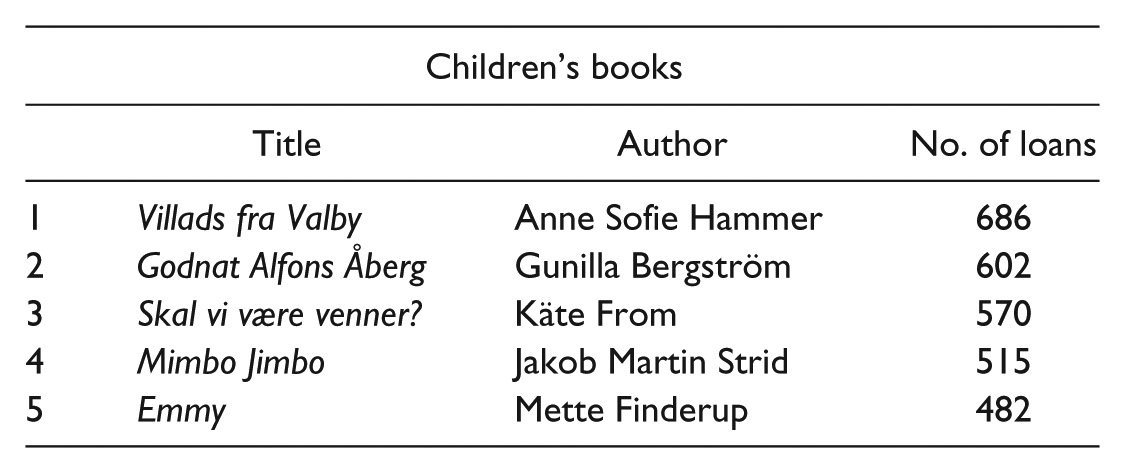
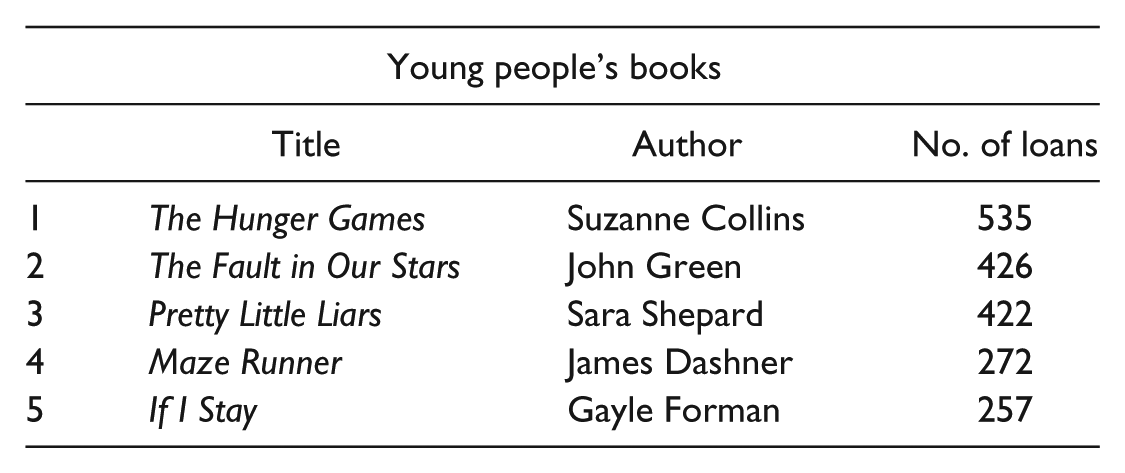
The figures are based on the lending year 2014 and should be taken with the qualification that, according to the librarian, many children’s families do not make use of reservations but ‘just take whatever is in the library’ and that a popular title such as John Green’s The Fault in Our Stars, despite the 116 copies purchased, still has 928 reservations.
In connection with the case, I interviewed one of the librarians at the library and asked among other things which main themes they thought were prevalent in the books. The answers given by the librarian are not necessarily an expression of a general or universally applicable assessment, purely those of this librarian. Yet, they give us an insight by someone who has expertise in this area. In the process, I gained insight into both the way the librarian categorizes the works and the way he talks about them to the borrowers. According to the librarian, the themes are ‘play’ in Villads fra Valby, ‘humour’ in Godnat Alfons Åberg and Mimbo Jimbo, ‘social skills’ in Skal vi være venner? and ‘girlfriends’ in Emmy. These themes can be regarded as having predominantly positive connotations. In the young people’s books, a ‘fight to the death on live TV’ is the theme of The Hunger Games, ‘cancer’ is the focus of The Fault in Our Stars, ‘blackmail and power’ are the basis in Pretty Little Liars, ‘survival’ is key in Maze Runner and ‘death, sorrow and unhappiness’ prevail in If I Stay. Hence, the themes while dealing with many life issues are concerned predominantly with aspects of life that are not particularly happy. Of course, it can be said, for example, The Fault in Our Stars also highlights love and that the young people’s book Pretty Little Liars emphasises the powerful relationships that girlfriends have. Yet, the main focus seems to be on the more negative aspect of relationships and the topics are more gloomy or melancholic.
On the whole, a discourse can be identified in which young people’s lives are characterized by more painful themes. Childhood seems to be characterized as a land of innocence, and on leaving this, innocence is left and replaced with a futile gloominess expressed in themes such as death, sorrow and ill fortune. As the protagonist in the youth novel Sirene says, ‘the door to childhood has slammed shut now [and] I cannot return; and here in the other world, on the mainland, I am without a chance’ (Kaaberbøl et al., 2009: 12).
Case 3: systematic literature search
In the third case, an explicit and systematic literature search for scientific and academic specialist literature in the Nordic journal database idunn.no was conducted. This is a database housed at the publisher’s Universitetsforlaget in Norway and includes articles from 49 Nordic e-journals with peer-reviewed specialist articles in the fields of ‘Health and social studies’, ‘Arts subjects’, ‘Law’, ‘Natural sciences’, ‘Education theory’, ‘Social studies’ and ‘Economics’.
Free text searches on truncated child* resulted in 334 articles and on truncated young* 204 articles. As mentioned in the methodologies section, I then drew up a collocation analysis (Evert, 2009) to work out which words occur together frequently, and thus identify which words appear together with child* and which with young*. It resulted in the following results:
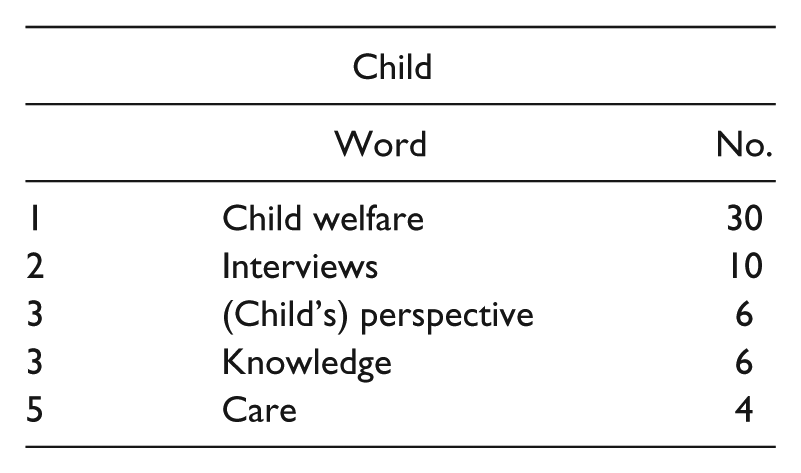
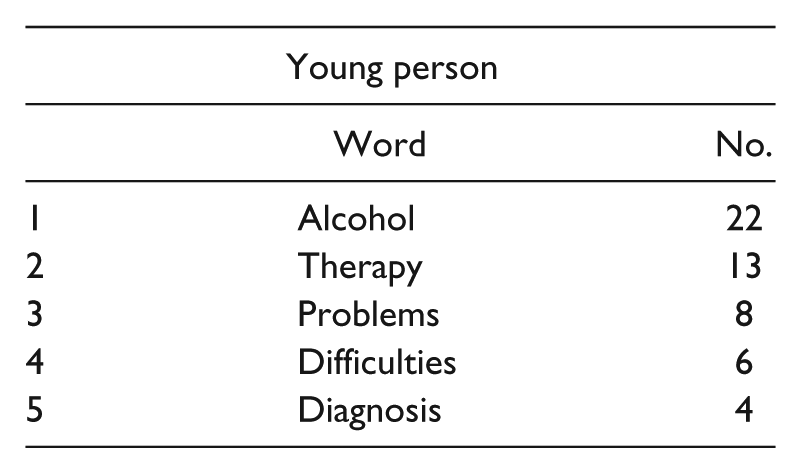
The words that come just afterwards in the child category are ‘secure’, ‘participation’ and ‘development’ (all 3), while the words that come just afterwards in the young category are ‘diagnosis’, ‘failure’ and ‘assault’ (all 3).
Addressing some of the words that are linked with both the ‘child’ and the ‘young’ category, there proves to be a tendency for the words in the young category to often denote something self-inflicted (difficulties, problems, diagnoses, for example, due to alcohol as abuse), whereas in the child category it is something exercised upon children by others (care, knowledge and well-being). What is more, it is remarkable that the two words featuring second in both categories (therapy with young people, interviews with children) denote the same content on the face of it, but with the word used nevertheless connote something ultimately quintessentially different: Therapy is a form of treatment designed to ‘remedy physical or mental disorders’ (DDO, 2003), whereas conversations are ‘talking together with someone, usually spontaneously and informally’ (DDO, 2003). The difference in choice of words signals a pathologizing of young people set to be treated for disorders in an asymmetrical therapist–client relationship, while children take part in a conversation that seems to subscribe to a far more symmetrical relationship.
The words that most often appear together with the word ‘young’ are words that have predominantly negative connotations, whereas those that appear together with the word child have predominantly positive connotations. On that basis, a pattern emerges of young people as people in distress and ill-being, having problems and difficulties. Young people are, thus, discussed in a discourse expressing something predominantly censurable and dysfunctional. That does not mean, however, that the picture is hermetically unambivalent. For example, the word ‘alcohol’ might conceivably also thematize young people’s relationship with partying and the joy of socializing with other young people. Those words attached to the child category are not clear-cut either. It is debatable, for instance, what the words ‘child welfare’ signal: Is it something positive only, or can it also reflect the fact of protecting the child from itself – for example, its own destructive behaviour or that of others? Yet, a pattern nevertheless emerges in which words with positive connotations appear most distinctly. Children are innocent and vulnerable and must have a caring and secure environment, and – unlike the young category, where it is exclusively adults’ perspectives on them that are documented – it is also interesting that various articles take the child’s perspective as their point of departure. It is a point of departure that enjoys great interest in the research (Sheridan and Samuelsson, 2001; Sommer, 2010), and that is about children being given the possibility of expressing their own lived experiences, understandings and learned experience of their life-worlds. Any such perspective is absent from the articles about young people.
Cross-case analysis: by way of conclusion and amplification
In the following section, a cross-case analysis (Stake, 2006) is compiled. The starting point is Foucault’s idea that language not merely produces meaning but also constructs a discursive framework which designates what is accepted and approved as meaningful (Foucault, 2008). It is thus a matter of the overall pattern that can be identified when that sequence of words, utterances and themes linked to children and young people is placed in relation to one another.
In the first case, a pattern emerged in which, according to the project and baseline descriptions, young people are portrayed as people who found it ‘insurmountably difficult to integrate into adult society’, who failed to prosper in life, had abuse problems and eating disorders, and altogether lived ‘a life on the edge’. Children, by contrast, were portrayed as competent, creative, spontaneous and improvisatory, with ‘joy and play playing a particularly prominent role’. In the second case, a pattern emerged in which children in the children’s literature were portrayed as innocent, spontaneous, natural, glad to be alive and imaginative, and childhood was described as a special space for joy and innocence. It turned out that a lot of children’s literature set out to refrain from depicting, for example, violence, suicide and crime because it would ‘infect the child with hopelessness’. There was apparently no such worry in relation to young people. Here the focus was on young people’s problems, and the theme sets were typically rootlessness and restlessness, identity crisis and loss of innocence, abuse, violence and crime. In the third case, a pattern emerged in which the articles written about children were for the most part about creating a secure and caring environment for children, who predominantly came across as vulnerable, while conversely young people predominantly came across as people who were having problems for some reason or other.
Overall, then, a kind of binary oppositional discourse can be identified between children and young people, in which children are referred to as happy, competent and innocent, while young people are referred to as problematic, irresponsible and distressed. Children are discussed in positive terms, a surplus discourse, while young people are discussed in negative terms, a deficit discourse. This establishes a truistic categorization of childhood as a land of innocence and youth as the land of problem. This is corroborated by the themes which are operative when children and young people are taken as themes. In children’s books and in the research projects examined, the typical themes for children are humour, play, friendship, safety and security, recognisability and caring, while for young people the typical themes are alcohol, rape, suicide, prostitution, group pressure and violence.
Concluding remarks
The intention of this article was not to contend that there are no differences between children and young people. Nor, of course, is it to construct an inverse narrative, in which children live a life on the edge, full of alcohol and suicidal thoughts, while young people are a priori good and innocent. The intention is, on the other hand, a genuine attempt to display what understandings of children and young people are reflected in the various cases selected. Then, to display the patterns that can be identified in the materials as a whole.
A relatively consensual homogenization and equalization of the two categories can be seen in the material chosen. Children are verbalized as being happy and innocent (the surplus discourse), whereas in contrast, young people are regarded as being problematic and distressed (the deficit discourse). Childhood is the land of innocence, youth the land of problems.
But what does it mean if children and young people are verbalized in these ways? What does it mean with regard to our own views of them? Furthermore, what does it mean in terms of the types of research that is conducted regarding children’s and young people’s cultural activities or the policies forged in the child and youth domain? What does it mean for cultural, educational and pedagogical interventions? This is indeed touched upon by Kofoed (2004) in another connection (p. 22: et passim); the kind of generalizations or closures which discourses on children and young people can be considered to reflect are not innocent. They are fed into a game in progress and feed into a social order that already exists. This can give rise to considerations about the risk of creating, or perhaps of having already created, certain grand narratives (Kofoed, 2004: 22), in which children and young people are designated beforehand as innocent and problematic, respectively. Such a viewing will determine the analysis and conclusions formed about them. It opens up the risk of not regarding children and young people as children and young people, but as homogeneous, equal and monolithic groupings with pre-designated characteristics and distinctive features. Such a risk will apply both to those children who are already always regarded as innocent and those young people whose lives are already problematic. These – as the American UCLA professor Crenshaw (1991) has said – are categorizations that are set to exclude and marginalize (p. 1242) because they attach specific values to specific groupings which are viewed as homogeneous but are actually not. The problem, according to Crenshaw (1991), is precisely that such categorization ‘frequently conflates or ignores intra-group differences’ (p. 1242).
The concluding point is, thus, that the categorizations and understandings of children and young people are, of course, neither naturally nor culturally socially fixed but both changeable and flexible, and categorizations and understandings are continually open to negotiation and renegotiation.
Footnotes
Funding
The author(s) received no financial support for the research, authorship and/or publication of this article.