




Abstract
The purpose of this study was to examine how a White teacher (Gina) responded to African American Language (AAL) in ways that situated students as valuable members of a high school English classroom. This 5-month qualitative study in a 10th grade classroom drew from positioning theory and discourse analysis to make sense of classroom interactions with AAL. Findings show that although Gina was not fluent in AAL, she leveraged it in ways that positioned students as members of the literacy community by doing the following: (a) opening opportunities for students to use AAL in ways that contributed to the community, (b) not dismissing or ridiculing the use of AAL, and (c) maintaining a classroom of respect when AAL was used in ways that disrespected that community. Implications from the study suggest that teaching high school English is not only about knowledge of content or best practices but also about leveraging multiple languages in ways that position students as participants of a literacy community.
Keywords
Over the past decade, literacy research has illustrated the need for U.S. classrooms to develop a safe and inclusive learning community for culturally and linguistically diverse students (Rymes & Anderson, 2004). In particular, some teachers can be resistant to changing their perspectives about race and pedagogy, and they sometimes take a color-blind (gender-blind, class-blind) approach to equity (Cochran-Smith, 2004). With this approach, educators unintentionally ignore issues of race that need to be identified and examined and potentially devalue the background and community of students (Au & Raphael, 2000; Paley, 1979). Such deficit perspectives limit learning opportunities and lower expectations and achievement for students, specifically in relation to White teachers and students of color (Delpit, 2002; Valenzuela, 1999). For example, in Heath’s (1983) ethnography, she illuminated the socializing process of children through words and suggested that students who did not fit traditional ways of schooling or talking were left behind in literacy development. Thus, language and learning are tangled in issues of power, and how students learn through language is dependent on tools of the surrounding community (Gee, 1996; Mercer, 2000).
One way to create a classroom community that builds on tools and languages of the surrounding community is to base curriculum and practices on students’ cultures and backgrounds (Anyon, 1997; Sweetland, 2006). To do so, teachers have used elements of culturally relevant teaching, such as high expectations for students, resistance to the status quo, and valuing multiple perspectives (Ladson-Billings, 1994, 1995). Teachers in safe and inclusive classroom communities have also insisted on mastery of literacy skills, utilized an authoritative discipline style, practiced racial consciousness, and utilized students’ prior knowledge (Cooper, 2003).
The everyday “doing of language” in classrooms also plays a significant role in classrooms where students’ membership is affected by the languages they speak (Rymes & Anderson, 2004; Wortham, 2003). Teachers, then, have considerable power over classroom talk and how that talk potentially shapes access to learning communities (Gutierrez, Rymes, & Larson, 1995). Thus, part of a teacher’s job is to attempt to understand and respond to student interactions in ways that value rather than exclude them as members of the literacy classroom (Moll, Amanti, Neff, & Gonzalez, 1992). Such response to interactions involves a sophisticated awareness of students’ cultural and linguistic practices and an understanding of how to make links where differences exist (McIntyre, 1997; Nieto, 2002). Appropriately navigating interactions can be difficult, however, when teachers and students speak different languages. For example, in a study about navigating issues of race in high school literacy classrooms, Rex (2006) asked, how should White teachers who do not speak African American Language (AAL) respond when students engage in AAL as their preferred means of classroom engagement? Even when White teachers do know and value AAL speaking traditions, if they do not speak them, how are they to effectively engage?
More research is needed to address such questions about how teachers successfully navigate classroom interactions with students from different backgrounds than their own. The purpose of this article, then, is to investigate how one White teacher (Gina), who lacked fluency in AAL, leveraged it, particularly with regard to rhetoric and style, in her 11th grade classroom. Her goal was to situate students who utilized AAL as valued members of the classroom. The reason for this examination is to raise awareness about how teachers can become better at responding to students who are culturally different from them to engage students as valued members of a literacy community. Such research is needed in literacy classrooms, especially because language is the central focus on both content and form.
Theoretical Framework
This research relies on the theoretical concept that educators’ language ideologies shape the access and equity of English language arts instruction by defining what counts as acceptable uses of language in the classroom. In particular, AAL’s long history of oppression in classrooms has affected school experiences and classroom membership of youth who speak and value AAL (Rickford, Sweetland, & Rickford, 2004). To further examine the relationship between language ideologies and classroom membership, I use positioning theory to investigate how the navigation of AAL during moment-to-moment interactions positions students as members of a classroom (Wortham, 2003). To begin, I define AAL, situate that definition historically and pedagogically, and discuss elements of AAL relevant to the findings of this article. To close, I discuss positioning theory and how it has been used in educational research to investigate classroom interactions and membership.
African American Language
I use the term African American Language to refer to stylistic features, grammar, and pronunciation used by people whose social and cultural attributes align with U.S. residents of African descent, especially members of the working class living in urban neighborhoods or rural communities (Smitherman, 1977; Wassink & Curzan, 2004). Also known as African American English and Black English, AAL has specific traits that include distinctive vocabulary and verb tenses spoken by African American slave descendants in North America.
The origins of AAL are debated. One theory states that AAL was cultivated from a pidgin language (simplified meshing of two or more languages) because of the conditions of slave trade. Later, this language developed into Creole that is still spoken by inhabitants of the Carolina Sea Islands. Another theory holds that AAL developed from features of British English, specifically a divergence from mainstream varieties. Currently, U.S. society continues to debate about AAL’s status as a dialect or language. Although dialect is commonly used to describe AAL, the term implies that dialectical ways of speaking English are inferior to standard English (DeBose & Faraclas, 1993; Hopson, 2003). Regardless, more than 20 million African Americans in the United States who use AAL endow it with significant cultural and historical meaning (Green, 2002) and treat AAL as a symbol of African American identity (Baugh, 1999).
Elements of African American language
AAL has several distinct elements related to systems of sound (phonological), structure of words and relationships among words (morphological), sentence structure (syntactic), and structural organization of vocabulary patterns and other information (lexical; Green, 2002). For example, the use of the unconjugated form of the verb to be (i.e., habitual be) means a frequently occurring action, such as We be watching television (i.e., We watch television on a regular basis). Another common feature of AAL includes double negatives (i.e., We don’t know nothing bout nobody; Center for Applied Linguistics, 2005).
Distinctive elements of AAL also include several unique discourse patterns and modes of expression that are particularly relevant to this article. For example, one mode of discourse typical of AAL is signification, which is a “verbal art of insult” that is done out of humor or to make a point (Smitherman, 1977, p. 119). Because this mode of talk is humorous, the put-down is “easier to swallow and gives the recipient a socially acceptable way out” (p. 119). The better a person is at this verbal art, the more social status he or she is likely to gain.
Other AAL modes of expression relevant to this study include exaggeration, mimicry, tonal semantics, rhythm, and improvisation (Table 1). Tonal semantics refers to how intonation in a word or phrase can change its meaning. As an example, Smitherman (1977) discusses variations of the word police pronounced in the typical iambic pattern of English (poLICE) and pronounced with emphasis to the first syllable, the (POlice) to indicate a negative connotation. Tonal characteristics in each variation are chosen for particular sound effects related to situated meanings of the word.
Identification of African American Language Discourse Patterns.
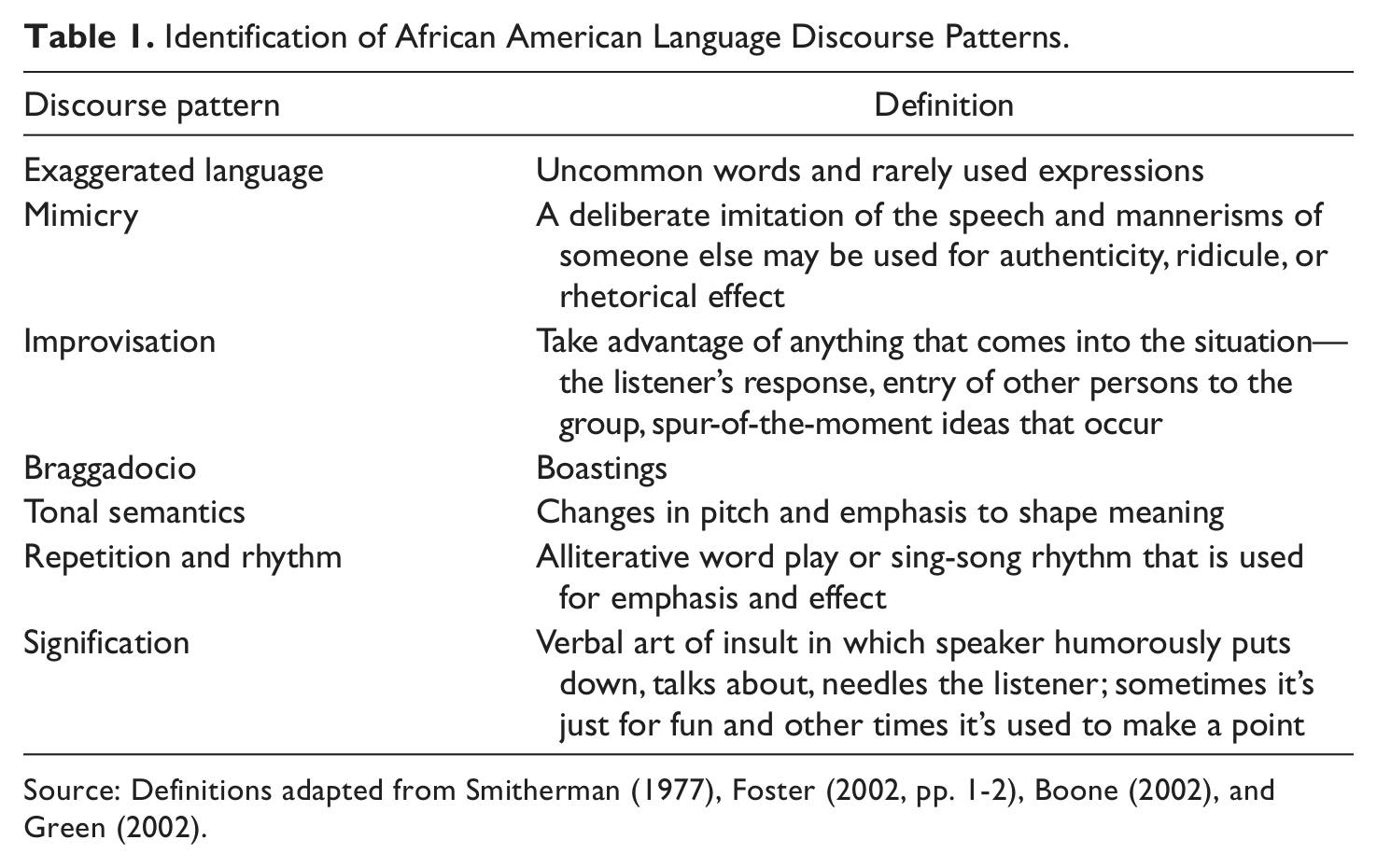
Exaggerated language is another mode of expression that uses uncommon words and expressions. For example, Martin Luther King, Jr. used the phrase “incandescently clear” in a speech to emphasize his belief that U.S. citizens should not ignore the Vietnam War (Smitherman, 1977). In this mode, many speakers use dramatic elements and verbal dexterity to enliven their speech (e.g., personification). For example, a man in Williams’s (2004) study said, “That rock jumped up and tripped me . . . fell flat on my face, yes I did! I tell ya, them rocks be trippin’!” Sometimes used with exaggeration, mimicry is the imitation of speech and mannerisms of someone else. Mimicry can ridicule the speaker, illustrate authenticity, energize communication, and invest the audience. For example, during a conversation, a female might complain to her friend about her man and imitate his speech (“Ima have it together pretty soon”; Smitherman, 1977).
Another mode of expression used frequently in AAL is braggadocio, defined as boasting to convey omnipotence (Smitherman, 1977). For example, Smokey Robinson sang, I’ll take the stars and count them And move mountains And if that won’t do I’ll try something new
Such wordplay is often used spontaneously with rhythm in which the speaker takes advantage of the moment and audience. All of these modes of expression stem from an oral tradition and expect skillful wordsmiths who understand how their use of language within a specific context will affect their audience.
AAL in education
AAL has a history of controversy in education. In a landmark case in 1979, a Michigan federal court ruled that African American students were denied equitable education because they did not take into account the language background of AAL speakers when providing educational accommodations. The outcome of the Ann Arbor decision required that educators understand AAL as a language, rather than broken English. This ruling has affected daily instruction in classrooms over the years. For example, teachers who view AAL as a language rather than dialect treat the language as a natural part of classroom life and as a tool for instruction (Duncan, 2004). Specifically, teachers have drawn on linguistic skills embedded in AAL, such as those related to signifying (i.e., interpretation of ironic, metaphorical, and symbolic statements), to teach literary analysis and raise literacy achievement (Lee, 1995). AAL has also been used as a resource to facilitate participation and engagement by focusing on its spontaneous dynamics (Foster, 1995; Smitherman, 1977), and as a valid stylistic strategy of written texts (Ball, 1995; Young, 2010). Smitherman warned, however, that teachers must maintain classroom expectations so that students are focused on learning rather than using language to gain social status. Currently, students and teachers are finding ways that AAL and standard English can be used together, such as the various language mixings of Fisher’s (2007) urban youth termed “Bronxonics” and the code meshing of Young’s (2004) college student in his composition course.
Despite findings about benefits of using AAL to foster learning, some teachers continue to underestimate the academic potential and linguistic abilities of students who speak it (Cazden, 1999; Smitherman, 1977). Such views stigmatize those varieties as deficits and negatively shape the academic success of AAL-speaking students (Blake & Cutler, 2003; Cross, DeVaney, & Jones, 2001). Specifically, urban K-12 teachers tend not to consider AAL appropriate for classrooms (Carpenter & Minnici, 2006), or they view students’ use of the language as an inability to code switch, therefore something to combat through teaching standard English (Alim, 2005; Godley, Sweetland, Wheeler, Minnici, & Carpenter, 2006). For example, Stan, a high school English teacher in Rex’s (2006) study about race and classroom interactions, inadvertently devalued his students’ home language by sending a student to the hallway for what he deemed to be inappropriate language. Rex argued that the students’ interactions were actually elements of AAL and that the student used them to develop relationships between her and her classmates. By admonishing this student, the teacher positioned her outside the community by indirectly telling her that her language was not a valued part of the classroom. Such deficit views of AAL contribute to African American students’ oppositional stance toward school and play a part in the achievement gap (Fordham & Ogbu, 1986). More research needs to examine how White teachers respond to AAL in the classroom in ways that situate students as valuable members.
Positioning Theory
To address that need, I use positioning theory as a framework for investigating how language use (i.e., AAL) situates students as valued participants of a classroom. In particular, researchers have used this theory to examine how people position themselves and are positioned by others as members or nonmembers of a community (Wortham, 2003). This theory stems from a belief that, to learn, students must enact particular behaviors, dress, and language that afford them membership within a classroom (Gee, 1996; Lave & Wenger, 1991). A classroom, then, can be viewed as a community of practice (Wenger, 1998) in which students attempt to acquire sociocultural practices of the community. Developing a strong classroom community is essential if students are to construct learning environments in which development is extended. Membership, however, can be complicated for students because institutions tend to ostracize those who do not fit into standard notions of “good student.” Teachers can help facilitate that membership by negotiating norms of behavior with their students, which later affects their engagement in literacy practices (Reeves, 2009; Vetter, 2010).
According to Davies and Harré (1990), positioning is “the discursive process whereby selves are located in conversations as observably and subjectively coherent participants in jointly produced story lines” (p. 91). A position, then, is what is developed through dialogue “as the speakers and hearers take themselves up as persons” (p. 105). They proposed an analysis of talk that examined how people position themselves (reflexive positioning), position others, and are positioned by others (interactive positioning) through talk. By extracting the story lines (i.e., a narrative thread that pertains to the world view of the participants), one can identify how people conceive themselves and others through their positionings. Story lines are often taken from a “cultural repertoire or can be invented” (van Langenhove & Harré, 1999, p. 30), and they must be jointly constructed if an interaction is to be meaningful. If participants draw on different story lines, the same words can be understood differently and marginalized story lines can be evoked. For example, Gina entered her classroom with a story line about what it means to be a “good” student and attempted to position students in that way to negotiate parameters of membership.
In particular, teachers’ talk is a powerful tool for positioning students according to a specific story line for classroom membership. For example, in research about an elementary-school classroom, the teacher used discourse patterns, such as the use of “We” and “Any other opinions?” to foster participation and inclusiveness and to broaden the story line of what it meant to be a valued member of a classroom (Johnston, 2004). In a study about the construction of literacy identities in a high school, a teacher situated students as capable readers and writers by inviting and expecting students to co-construct the structure and content of literacy events based on their needs and interests and build an agentive narrative about accomplishing literacy tasks (Vetter, 2010).
Teachers also position students as nonmembers of a classroom according to limited story lines. For example, one high school teacher in a research study refused to accommodate for the cultural and linguistic differences of his English language learner (ELL) students based on his belief that all students should be treated the same (Reeves, 2009). As a result, he positioned his ELL students as nonparticipants. Teachers also affect student membership based on their beliefs about what it means to be a “good student” (i.e., agree with teacher, stay on topic). In another study about literacy classrooms, a teacher silenced a student in her classroom because she “misbehaved” (Wortham, 2003). Accordingly, the teacher and her classmates consistently positioned her as an outcast of the community.
Thus, this article utilizes positioning theory to provide insight into how one teacher used students’ home languages (i.e., AAL) during moment-to-moment interactions in ways that situated them as members of a literacy community. To define member, I draw from Wenger’s (1998) concept of community of practice that suggests a member of a community engages in joint activities and discussions, shares information, builds relationships to learn, and develops a set of shared practices. To facilitate such membership, teachers must use language in ways that open possibilities for students to be engaged participants committed to learning. Specifically, I chose the verb leverage, a word traditionally used in the financial world that means “to use for maximum advantage,” to explore how Gina attempted to use students’ language as a tool to gain respectful members of a literacy classroom (“Leverage,” 2012).
Method
This study explores the following question: How did one White teacher leverage AAL in her high school English classroom in ways that positioned students as members of a literacy community? I used discourse analysis framed around positioning theory (Davies & Harré, 1990; Gee, 1996) to interpret classroom interactions from three episodes that occurred across 5 months in Gina’s sixth-period class.
Context
School
Rushmore High School (Grades 9-12) was located in the most culturally and ethnically diverse section of a southwestern city in the United States. In 2007, the majority of students at Rushmore were Latinos/as (64%) and African American (33%), with 3% White and 1% Asian/Pacific Islander, American Indian, and Alaskan Native. Several students spoke English as a second language (31%), and many were labeled economically disadvantaged (78%). Historically, RHS was an all-Black school that recently grew more diverse with the integration of the Latino/a population in the area. Students and faculty noticed that people tended to segregate themselves based on ethnicity in the cafeteria, hallway, and classrooms. A dedicated group of teachers and students worked hard to create programs that fostered equity, tolerance, and reduced the achievement gap, despite high turnover rates for administration and faculty.
Participants
In this 11th grade classroom, all 25 students agreed to be part of this study. The diversity of the classroom represented the diversity of the school, with 16 Latino/a students and 9 African American students (12 female and 12 male); 8 of the students spoke English as a second language, and all 9 African American students used AAL in Gina’s classroom regularly. Of those students, 3 (2 African American and 1 Latina) received special education services and 2 were repeating 11th grade (1 African American and 1 Latino). Several students had known each other since middle school and were comfortable sharing personal experiences in connection with literature. After introducing myself to all of Gina’s classes, we decided to focus on this period because of their interest in the study and constant use of humorous interactions. Gina was a third-year teacher who was alternatively certified in English after being a technical writer for a few years. I spent several months working in her classroom after being introduced to her by a colleague during a National Writing Project Teacher Research Group in 2006. I describe her teaching practices in the findings section.
The Researcher
Researching classroom experiences of underrepresented and marginalized groups presents a significant challenge for researchers who are not members of those groups and who want to be credible in their representation (Appleman, 2003; Larson, 2003). As a White female researcher with a strong interest in the lived experiences of minority youth in high school classrooms, I address my own role in the research process in the paragraphs below to illustrate factors that shaped interpretations.
I am a middle-class researcher who grew up in the South. I attended public school during my secondary years in schools that were approximately 52% White, 43% African American, 3% Latino, and 2% Asian. After graduating college, I taught high school English in a suburban school in a large city in the Southwest where students were 62% White, 16% Latino, and 11% African American. I have limited experience teaching in classrooms in which AAL is the common language. As a teacher at Maverick High School, I first became involved in issues of diversity when our school demographics changed rapidly with an increase of ELL students in the surrounding population. To discuss how teachers could foster learning for culturally and linguistically diverse students, I was part of a diversity group who met monthly. After returning to graduate school, this issue became more important to me as I worked with teachers who were fearful of entering schools with students of different backgrounds than their own.
In graduate school, I met Gina, who opened her classroom to my observations with intents of learning more about how teachers can be successful at teaching students from different cultures than their own. Originally, I came to this classroom to examine how a 10th grade English teacher positioned her students as readers and writers through talk and instructional strategies. After several observations, I noted a trend of humorous classroom interactions that seemed to both build and break down the classroom community. Because several of Gina’s students used AAL consistently in class, many interactions were shaped by this variety of English in which neither of us was fluent. In fact, students were not afraid to point out these interactional differences. For example, one student, Shane, stated that Gina needed to “get some laugh bones” after misunderstanding his joke. Since then, I have continued to reflect on that phrase because for me, it implied, sometimes, you just don’t get it. The idea that not getting it could shape how students situate themselves in a learning community motivated me to examine these interactions.
Because both of us are nonnative speakers of AAL, we did not understand the complex meanings of students’ interpretations. Rather, we made sense of them through our lenses that carry limitations. To broaden these blind spots (hooks, 1994) or partial views (Haraway, 1988), I checked all interpretations of data with Gina, as is explained in the findings section. Although we came from similar backgrounds, she provided context and information about students’ learning and familial backgrounds that shaped analysis. At the same time, my outsider status provided a broad perspective because I was not as immersed in the school experiences of students as Gina.
I also shared analysis of the same transcript with students in individual and small group interviews. Their insight was valuable to interpretations in this article because they helped me understand multiple meanings of their interactions. For example, students provided at least three different perspectives about what a student meant by the phrase “shut up,” which helped me understand that many interactions were about gaining solidarity with classmates. At the same time, I recognize that although students shared their writing, thoughts, and conversations by being participants in this study, my position as a university researcher shaped what students did and did not say to me. I do, however, believe that my consistent presence in the classroom and constant engagement in questions about learning and identity built trust between us, especially as time progressed and students became more comfortable with my presence (Eisenhart & Howe, 1992; Erickson, 1986). For example, one student had frequent individual conversations with me about how her sexuality shaped how she engaged in the classroom. Another student, Lucy, requested that she not be recorded because she was a nonnative English speaker, but she frequently shared her thoughts with me in writing.
In addition, I asked several colleagues who were experts in this topic to read my analysis and offer multiple perspectives. In particular, colleagues posed questions about how I interpreted Gina’s intentions and recommended integrating a more critical lens with multiple interpretations. To provide a richer picture of the data, I triangulated data sources by examining interviews, artifacts, transcripts, and field notes. To portray that data, I included several excerpts of teacher and student comments from interviews and transcripts throughout the article to “show rather than tell” their perspective and school experiences (Appleman, 2003, p. 83). These transcripts also add to the little research that examines how White teachers leverage AAL in their classrooms by showing examples of interactions in ways that attempt to honor students’ languages.
Data Collection
Over 5 months, I collected data in the form of expanded field notes, video- and audiotaped classroom interactions, and interviews with the teacher and students. Using thick description, I took notes of classroom observations from 3 to 5 days weekly (for one 50-minute class) and video- and audiotaped 63 of those classes, beginning in late February. After easing participants (all agreed to participate) into the process, I placed audio recorders on tables (students sat in roundtables) to hear small group interactions and placed a video camera on a tripod to film nonverbal interactions of the class. Because classroom interactions were my main focus, field notes focused on how Gina leveraged AAL that contributed and conflicted with the literacy community in ways that situated students as members of the classroom.
I formally interviewed (all audiotaped) students in small groups during March, and conducted individual follow-up interviews with three case study students in April. I informally interviewed all students throughout the 5 months. In these conversations I asked students about their school and literacy experiences. I also asked students to help me interpret a few transcribed conversations, especially those that involved AAL. Three times (beginning, middle, and end) in the 5-month study, I interviewed (all audiotaped) Gina about her pedagogical beliefs, her relationships with students, and her thoughts about how she leveraged classroom interactions. We also discussed transcripts and analytic memos based on my field notes. Informal conversations (recorded in field notes) happened frequently throughout my visits, and all formal interviews resulted in a conversation based on our mutual interest in the topic.
Data Analysis
Data analysis began by reviewing all field notes and audio- or videotaped interactions that included elements of AAL. For analysis, I used the following characteristics of AAL related to rhetoric and style to identify such events: exaggerated language, mimicry, humorous improvisation, braggadocio, tonal semantics, and signification (Boone, 2002; Green, 2002; Smitherman, 1977). Explanations for how I defined these discourse patterns are described in Table 1. For example, I identified Shane’s comment (“Miss, you need some laugh bones.”) as exaggerated language because of the use of uncommon words and a rarely used expression. When Ricky told Sam, “He can’t read, that’s why he is saying that,” I identified the interaction as signification because of its verbal insult that humorously needled the listener (Sam). Because the teacher and some students were not fluent in AAL, most interactions were spontaneous. Out of 63 audio- and videotaped 50-minute classes, 47 included identified interactions with AAL discourse patterns. Within those 47 interactions, 32 included the teacher and the remaining 15 were between students in small group interactions. During one 50-minute recorded class, multiple interactions occurred. I defined an interaction by a shift in topic and/or structure. For example, if the structure of the classroom shifted from whole class interaction to small group work or from a think aloud on reflective writing to a conversation about Fallen Angels, I chunked them into separate interactions to allow me to work with smaller stretches of discourse.
In the primary stages of analysis, I produced common patterns and themes across these interactions to understand how they occurred naturally within the classroom. First, I identified interactions that appeared to contribute or conflict with the academic interaction. By contribute, I mean interactions in which student comments were connected with content and/or building classroom community (32 interactions). By conflict, I mean interactions in which students used language that was disrespectful to one another and appeared to break down the classroom community (15 interactions). I describe these data in Table 2 to illustrate evidence and meaning of these trends (Smagorinsky, 2008). I chose three interactions to highlight how Gina attempted to leverage AAL in ways that situated students as members of the classroom when they appeared to either contribute or conflict with her classroom expectations over time. These episodes were chosen because they included several different members of the classroom and illustrated typical discourse patterns between Gina and students.
Analysis of Moment-to-Moment Positionings.
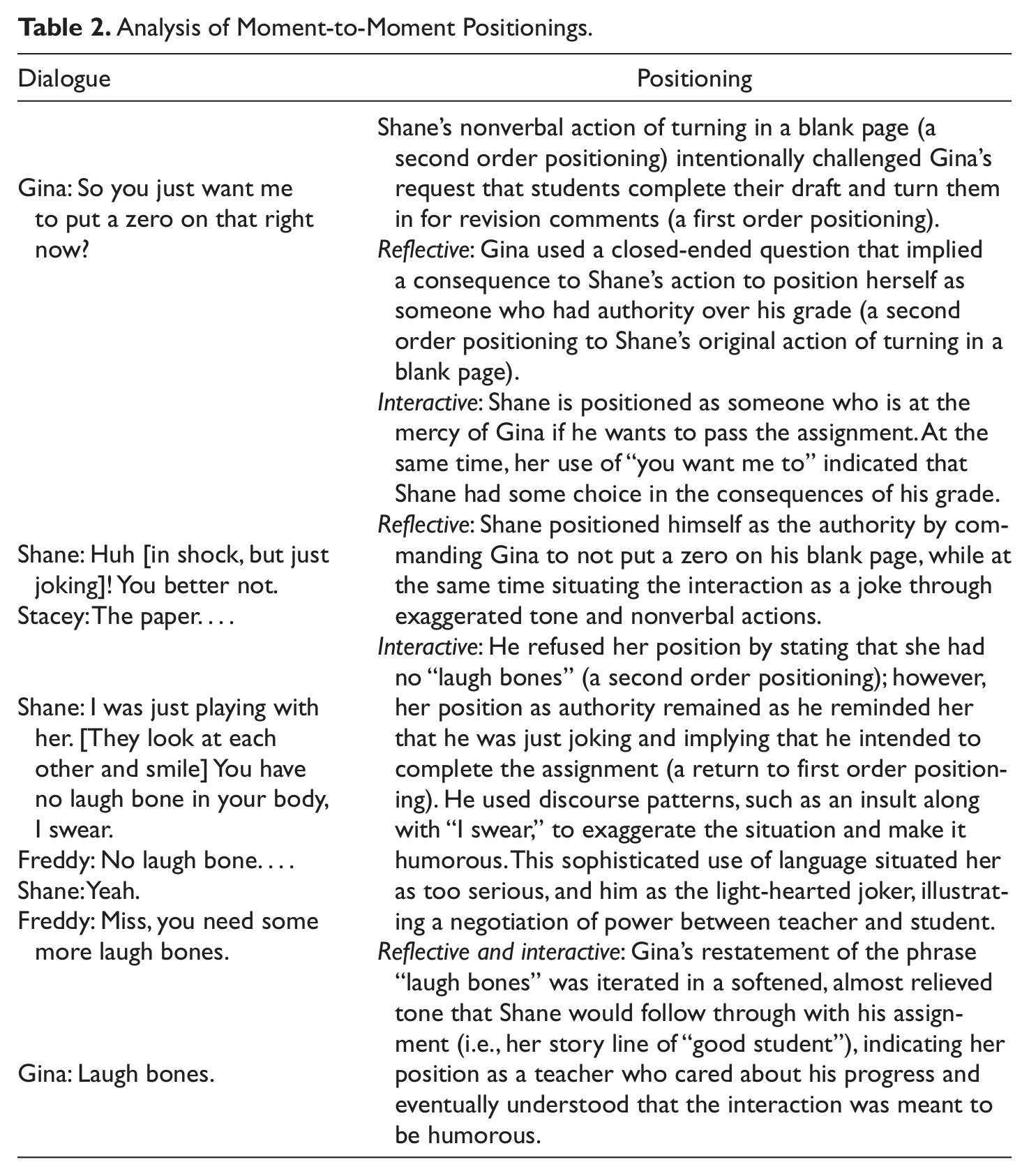
To better understand how these interactions were leveraged or used as a tool to situate students as members of the classroom community, I developed categories based on reflective and interactive positionings of Gina and her students (Davies & Harré, 1990). To organize data, I developed Table 2 with transcriptions and notes about how the speakers positioned themselves, positioned others, and were positioned by others. Specifically, I used van Langenhove and Harré’s (1999) description of first and second order positioning that occurs during an interaction to better understand moment-moment interactions. First order positioning refers to how people position themselves and others within categories usually understood by discourse participants. Whenever a person positions herself or himself, there is always an implied positioning of the person being addressed. Second order positioning is always intentional because the person is consciously challenging the first order positioning. First and second order positioning are helpful in understanding issues of power and entitlement that occur within an interaction. As a result, such analysis also accounted for disconfirming data that illustrated moments when Gina unintentionally positioned students as nonmembers or outcasts in her attempts to leverage AAL (Table 2).
For example, after Shane attempted to turn in a blank page, Gina said, “So you just want me to put a zero on this right now?” Both Gina and Shane are positioned by the question. First, Shane jokingly made a jab at Gina when he turned in a blank page. She then positioned herself as someone who had authority over Shane’s grade, a second order positioning because she intentionally challenged his first action by using linguistic features, such as a closed-ended question, authoritative tone, and use of the pronoun you to indicate that this was his decision, not hers. Shane was positioned as someone who was at the mercy of Gina if he wanted to pass the assignment. Shane had a few options: He could take back the assignment and turn in one that was complete. In this case, there would be no questioning of the first order positioning. Or he could refuse Gina’s positioning by replying, “I don’t care. Give me a zero.” If he chose the latter response, a second order positioning would have occurred because the positioning of Gina as authority was questioned or refused. However, in this example, he refused her position by stating that she needed “laugh bones,” although her position as authority remained as he reminded her that he was joking and intended to complete the assignment. He used discourse patterns, such as an insult along with “I swear,” to exaggerate the situation and make it humorous. This sophisticated use of language situated her as too serious and him as the light-hearted joker, illustrating a negotiation of power between teacher and student and a typical discourse pattern of the classroom in which Gina took a serious business-like stance while students consistently reminded her that they also needed to have fun. Gina iterated the restatement of the phrase “laugh bones” in a tone illustrating relief that Shane would finish his assignment, indicating her position as a concerned teacher.
For this article, I organize the findings based on two categories. First, I examine how Gina leveraged AAL in ways that contributed to her expectations for the literacy community. Second, I investigate how Gina leveraged AAL that appeared to conflict with her expectations for the literacy community, such as disruptive or disrespectful comments. In each section, I discuss how she attempted to situate students as valued members, regardless of the contribution or conflict. I focus on how Gina leveraged AAL to situate students as members of a literacy community rather than on learning specific literacy practices because evidence from data illustrated the former. Thus, these data contribute to scholars who suggest that membership in a classroom community is linked with learning (Lave & Wenger, 1991; Wenger, 1998). Such theories of learning state that people learn by being active participants “in the practices of social communities and constructing identities in relation to these communities” (Wenger, 1998, p. 4). When discussing these episodes, I include all focal students present in class, but tend to focus on students who shaped structures of these interactions more frequently, such as Detrek.
Findings
Gina described her classroom as nontraditional in the sense that students were not expected to sit down in rows and work quietly. She felt that a less formal atmosphere was more natural and helped students feel “comfortable and confident.” In interviews, Gina expressed a teaching philosophy that focused on creating spaces for students to make sense out of themselves and the world around them through reading and writing. Her practices drew from elements of critical pedagogy in that she challenged her students to question sociocultural issues, invite multiple perspectives, challenge commonplace assumptions, and take action (Lewison, Flint, & Van Sluys, 2002). She was concerned about the community of Rushmore High School, and her main goal that year was to create opportunities for students to make changes in their school. In an interview, she stated their school had endured a high principal turnover rate and often received bad press about academics and/or misconduct. To work toward a more positive school community, Gina challenged her students to solve the concerns. They began by brainstorming school issues on chart paper that they later turned into formal proposals of change. Gina’s students wrote proposals about several topics, including issues of segregation in the school, and proposed a “diversity day” in which students had silent conversations about issues of racism in the school with people from various cultures and backgrounds. These proposals were sent to individuals who had power to facilitate the proposed changes.
Gina was also aware that her race shaped how students viewed her and as a result shaped the classroom community. In an interview, she stated, Because I’m White, I come with a stereotype. They think that I’m rich. When I share that I was born in Colombia and lived in Loredo and know Spanish . . . when they realize that I know something about hip-hop and that I understand some slang, they trust me a little more. If I don’t share my background this stereotype becomes a barrier. We respect where we come from and the way we speak.
Gina did not believe in a color-blind approach and oftentimes engaged in conversations about issues of race, class, and gender with students stemming from literature and personal reflections. Despite this approach, she recognized that linguistic differences sometimes created conflicts. In interviews, she talked about difficulties in understanding student’s humorous interactions. Her belief in humor as a classroom resource was part of the tone of the room and part of accepting students’ home language. Over the past three years, she attempted to readjust her understandings of the “right” way to talk and tried to understand students from their cultural point of view. She said, “What is normal to me, is not normal to them, so I don’t force my culture on them.”
She struggled, however, to find a balance between home and academic language because she wanted to ensure that her students could succeed in several discourse communities. She used humor and “social language” to build relationships and create a relaxed environment, while also teaching students about various “registers of language” through explicit lessons about different uses of vocabulary. She said, “They don’t need to change themselves, but it’s important to learn the academic discourse.”
Gina illustrated a desire for her students to be fluent in multiple dialects of English to ensure their success within various contexts in the future. Gina, however, did not pretend that this was an easy task and often struggled to understand her students’ interactions. To deal with her lack of knowledge about AAL, she attempted to listen to students and use their home language as a tool to situate students as members of the literacy community. In graduate school, Gina engaged in scholarly conversations about the importance of valuing diverse languages and learners, but she was not learning specifically about AAL and its unique qualities. Thus, utilizing AAL as a tool for literacy instruction, such as understanding literary analysis, was an abstract notion that remained at the surface. In addition, as an early-career teacher, Gina was still forming an identity and skill set as a teacher. Not only was she figuring out ways to deal with issues mentioned above, but she was also learning how to manage her classroom and fulfill curriculum requirements.
Utilizing Laugh Bones: Leveraging AAL to Build a Literacy Community
Gina’s classroom was typically full of lively talk and movement between each other and the teacher. Most conversations in the classroom involved and encouraged students’ participation with Gina taking on a leadership position. She typically started with a mini-lesson to gain interest, modeled lessons for students, and then asked students to practice concepts either in pairs or individually. During mini-lessons, patterns of discourse typically took on a recitation model in which Gina asked questions and students answered (Nystrand, Gamoran, Kachur, & Prendergast, 1997). Less frequently, Gina attempted to ask questions that invited student opinions and responses related to their lives, which she took up and extended. As a new teacher, Gina had not yet perfected student-centered discussions celebrated by Nystrand and colleagues (1997), and she struggled to develop her authority and responsibility to engage students in the community without dominating interactions. She recognized that this kind of interaction had potential to shape how students used language, and the ways in which they participated as members of classroom. As Juzwik (2006) stated in a study about how a teacher established authority through narrative discourses, Gina was learning how to shape discourses of the classroom to persuade “students to trust, respect, and learn from one’s voice” (p. 490). She was also concerned about recognizing and valuing students’ home languages during daily interactions and was in process of learning how to do so. For example, when students engaged in elements of AAL, such as signifying, she did not shut them down but attempted to understand and integrate students’ comments into the classroom interaction or moved on if it was irrelevant (i.e., 29 interactions).
One student, Detrek, was especially skillful at playing with language and did so frequently to gain social status. In many videos (35 episodes) he could be found using elements of AAL, such as signification or mimicry, to gain laughter and social capital. For this episode, I focus on Detrek because of his sophisticated and consistent use of AAL. In interviews, Gina stated that she realized Detrek’s humor and playful banter was an important part of situating him as a valued member, as long as he was respectful. She often talked about responding to his comments in ways that did not shut him down and contributed to the literacy community. She said, “He needs to learn how to control his humor. Sometimes he does it at inappropriate times. I can’t say, ‘Don’t be funny,’ but I can help him understand when it is inappropriate.”
In the following excerpt, Gina attempted to leverage Detrek’s interactions in ways that positioned him as a member of the classroom community. In other words, she used his humorous language as a tool to add to academic conversations, even though that was not always Detrek’s intention. As a result of her consistent positioning, Detrek eventually positioned himself as a part of the academic conversation, and Gina gained a contributing member of the classroom. For this lesson, Gina introduced multigenre research papers to her students. Romano (2000) defined multigenre research as “composed of many genres and subgenres, each piece self-contained, making a point of its own, yet connected by theme or topic and sometimes by language, images and content” (x-xi). Students were expected to choose a topic, research it, and write about it in multiple genres. Gina chose this assignment because she wanted students to draw from prior knowledge (i.e., a topic of their choice and multiple genres) and develop research and composition skills. The point of the classroom discussion about genres was to help students understand that they were surrounded by genres in their everyday lives and that in some way they were writers. Students were comfortable with this kind of interaction and called out responses without hands being raised, as Gina expected.
Prior to this interaction, Gina read aloud an encyclopedia entry about Count Macey. She then read a poem about Count Macey to show how different genres cover the same topic in different ways.
Is it more than three lines because I ain’t gonna hear it. No, I’m just jokin’.
[Gina reads the poem aloud.]
So . . . .
That wasn’t dry.
It wasn’t dry at all. So, again this is a different type of genre, a poem. What is the purpose of a poem? Why does someone write a poem?
To get you to. . . .
To think. . . .
To express themselves right? Someone else said that poetry makes you think. So poetry will probably make you think deeper than an encyclopedia entry.
Yes [mock-serious].
So you see how different genres not only have different form, but have different purposes. Does that make sense?
Yeah. Alright [mock-serious].
So how do genres differ, you tell me [to Detrek]?
Um.
How is a poem different from an encyclopedia entry?
One don’t make no sense.
No limits.
Okay, so one has limits and one doesn’t.
Purpose.
Okay, so purpose, the intent. Each genre is different in purpose. What else?
One makes sense and the other gives you information. I mean, one doesn’t make sense and the other one gives you information [to Gina].
Well, it might make sense to someone else. All of our brains are different, right? So some of us are right brained and some of us are left brained. Some are more artistic, like poetry would make more sense than a biography that would be just straight facts.
My brain don’t work like that.
This interaction followed a recitation pattern that led students in a particular direction and opened some opportunities for students to make contributions related to their opinions. Such a pattern situated Gina as the authority and students as contributors of an academic conversation about genre. Detrek interrupted this pattern by using several elements of AAL, such as exaggeration (“Is it more than three lines because I ain’t gonna hear it”), mimicry of an academic tone (“Yes” and “Yeah. Alright”), tonal semantics (mocking tone), and humorous improvisation (“I’m just jokin’”) as a second order positioning to gain him social status as a comedian.
In the first line, Detrek used exaggeration with a humorous tone to indicate his dislike of poetry. Immediately following his statement of disengagement, Detrek used a self-repair (“I’m just jokin’”) to indicate that he understood he was interrupting the academic story line and repositioned himself as a student who intended to listen. Gina did not respond to his comment and read the poem aloud. Her lack of response could be interpreted in multiple ways. One interpretation is that Detrek gave Gina permission to not take it up by stating it was a joke and not a relevant comment to the conversation. At the same time, her lack of response had potential to position Detrek as a distraction with a meritless response. As an early-career teacher, Gina was still figuring out the best ways to manage her classroom, and her lack of response could be interpreted as her not knowing or wanting to confront “disruptive” comments. Perhaps Gina was simply accepting students’ language in an attempt to move on with her agenda or survive a dilemma in which Detrek was having fun at her expense.
To complicate those interpretations, it is important to consider that participants’ interactions are situated within the social, cultural, and political context, including lived histories they bring with them into the classroom (Holland, Skinner, Lachicotte, & Cain, 1998). With knowledge of Gina and Detrek’s typical discourse patterns, interactional positionings, and overall relationship, I interpreted her lack of response to his joke as a way to allow him to situate himself as comedian in the classroom without sacrificing his position as a participant. Rather than merely surviving the interaction, Gina recognized that Detrek’s use of AAL gained him power and status with his classmates, and shutting that down through reprimands could potentially stop his participation in the future (Davies & Harré, 1990; Wortham, 2003). With this interpretation, Gina did not treat Detrek’s language as a liability or disruption but instead attempted to leverage it in ways that gained rather than lost a member of the classroom.
The interaction progressed with Gina asking both closed- and open-ended questions and with Jay and Omar shouting out answers. Gina expanded Jay’s comment to elaborate on the differences of the two genres. Her use of the pronoun you made a personal connection to comments being shared and positioned students as valued members. During this academic interaction, Detrek commented “yes, yeah, alright” in a mock-serious tone (meant to be funny), a second order positioning. Gina rephrased her question and directly asked Detrek to explain how genres differ, a first order positioning that invited Detrek to be a participant in the academic conversation. Her use of a command at the end of the sentence (“you tell me”) situated herself as the authority and challenged Detrek to take a serious stance. At first, Detrek hesitated and Gina restated her question to be more specific. Both Detrek and Omar responded, but Gina only repeated and elaborated on Omar’s response (“No limits”). Next, Shane responded and she elaborated. Detrek repeated his statement in a way that stated that one made sense and gave him information in a more serious tone.
One way to interpret this interaction is that Detrek positioned himself as an active participant who shared a contradictory perspective to poetry. Another interpretation is that Detrek’s comment was an attempt at disrupting the academic conversation. Despite the intent, Gina took up that comment, used it to elaborate on another perspective, and validated his thoughts by saying that different genres speak to people in different ways. She used “our” rather than “your” to indicate that Detrek was not the only one who felt that way and that he was still part of a literacy community even if he found poetry difficult to understand. Johnston (2004) found that teachers used pronouns like “we” as an invitation to join the classroom community and as an expression of solidarity of affinity. Gina used this collective pronoun to support and foster his participation.
Classroom interactions with Detrek typically took this rhythm in which Gina initiated responses about literacy and Detrek resisted with humorous responses. Potentially, these resistances positioned him as independent from adult authority and allowed him opportunities to gain social status as the class comedian. Students use language for social organization (Goodwin, 1990; Shuman, 2006), and Detrek was especially good at using words to include (classmates) and exclude (teacher) those who did not fit into that social world. Despite his efforts to exclude her, Gina attempted to view Detrek’s playful language as possible contributions rather than distractions and leveraged his use of AAL by using it as an advantage point to position him as a member of the classroom and add other perspectives to the conversation about genre. Gina struggled at times to figure out how to manage this humor; but at the end of the interaction it is clear that Detrek contributed with an authentic opinion about poetry, and Gina was able to figure out how to elaborate its significance.
What Gina did not do in this interaction is help Detrek transfer his sophisticated use of AAL into understanding concepts of genre, such as comedy (Lee, 1995). Her lack of knowledge about AAL could have kept her from utilizing his home language into literacy lessons. Interactions were also teacher directed and resulted in less student talk. When students did talk, some of it was through humorous language that could be viewed as a coping strategy for a teacher-centered agenda and an attempt to negotiate classroom norms. Students would likely benefit from Gina integrating more humorous interactions into her everyday talk as a way to build a more democratic classroom and help students understand the value of linguistic play, in both everyday talk and complex literature (Ladson-Billings, 1995).
As class continued, the conversation structure shifted to a brainstorming session of various genres. Students were invited to spontaneously respond to Gina’s statements verbally and nonverbally. All were expected to respond in some way. This particular classroom interaction connected the speaker and audience and emphasized community. Some students affirmed or agreed with Gina and offered multiple perspectives. Such a routine expected that the audience participate and draw on their backgrounds and prior knowledge. This was a time when students used their home language by sharing genres from their everyday lives in the whole-group interaction.
The conversation structure continued in the same manner with more responses from other students, including a personal connection made by Stephan.
What about shoes?
Hmm, shoes. Is there a lot of text on a shoe?
Yes. [Freddy puts shoe on desk.]
It has a logo. [Detrek puts shoes on desk.]
Detrek: I just got these shoes yesterday. Do you like them?
You did not just get those.
It’s got spree wheels, but they fell off.
Jewelry. The bling. The kind that spells out names.
TV shows. Billboards.
We have ads.
We have road signs, but not billboards.
Anything else?
[Detrek sings lines from “Booty Butt Cheeks,” a song sung by Thugnificent from the television show The Boondocks, an American animated series.]
Are we out of genres? A eulogy? Do you know what a eulogy is?
Yes.
So for example, when someone dies, you give a eulogy at their funeral.
What is a eulogy?
I’m telling you. When someone dies. . . .
Dog tags.
When someone dies they might ask you to write a eulogy for that person.
No, not at my funeral. They say come up here and say a few words, maybe two minutes. And then your aunties and your uncles, they talk all day.
When Detrek put his shoes on his desk and asked Gina if she liked his new shoes (a second order positioning), Gina commented that she knew his shoes were not new. Although the newness of his shoes was not relevant to the classroom conversation, Gina negated his declaration and responded in a way that continued to connect Detrek to the classroom talk in an attempt, perhaps, to avoid losing him. She also seemed to tell him, I know you well enough to know those aren’t your shoes. I pay attention. He continued to shout out improvised humorous responses (“It’s got spree wheels, but they fell off”) to gain status from his classmates. After Stephanie contributed to the academic conversation (“Jewelry”), Detrek then positioned himself as a participant by shouting out responses (“TV shows”). Although ads was already on the list, Gina recognized his contribution by stating they already had ads on the list. In the middle of other student contributions, Detrek sang a song and tapped on his desk, a second order positioning. In particular, Detrek mimicked “Booty Butt Cheeks” by Thugnificent, a character on The Boondocks, with exaggerated expressions and nonverbal movements. This was a regular behavior for Detrek who frequently played with language through song to incite laughter and gain social and economic status (e.g., access to new shoes affords him economic status). As he sang, Gina asked students if they were out of genres and attempted to extend the conversation with her contribution of eulogy. Even though Jay said he understood eulogy, Gina began to define it. In the middle of her explanation, Detrek asked, “What is a eulogy?” She used the pronoun “I” and a present-tense verb “telling” to sternly state that she was explaining it at that moment and implied that he needed to listen and reposition himself as a participant of the academic conversation. Detrek stopped singing and looked toward Gina, positioning himself as a student rather than comedian (a first order positioning).
In these episodes Detrek continued to use features of AAL that situated him as a comedian and as a participant of the classroom conversation, positions that often contradicted each other. Such interactions can be intimidating for teachers who might interpret Detrek’s constant resistance to the classroom conversation as disrespectful. In fact, one interpretation could be that Gina struggled to manage behavior as an early-career teacher and that she quickly used students’ language to move on with her lesson. In addition, Detrek built community among his classmates through laughter while also situating Gina outside of that community, especially since she did not know the song. Although students commonly exclude authorities to situate themselves as independent and to gain status from peers, such exclusions could have negative implications for the classroom community (e.g., a habit of disrespectful communications).
Gina seemed to recognize, however, that Detrek’s humor was his way of contributing to the classroom, and she attempted to leverage his language in ways that gained him as a member of the literacy community, which he accepted in some, not all, of the episodes. They had a positive relationship, which he illustrated by introducing Gina to his mother when she returned from duty in Iraq. Detrek also appeared to understand that there were certain boundaries of comedy in the classroom, and he quickly situated himself as a classroom participant when Gina indicated he had crossed that boundary. Unlike Wortham’s (2003) Tyisha, whom the teacher positioned as an outsider, Gina and Detrek negotiated what it meant for him to be a participant in this classroom. Based on interviews with Gina, however, she reflected on what the “normal” classroom should look like and attempted to accept students’ linguistic play as a desired aspect of this particular community. In this class, she came to understand that her students thrived in a lively atmosphere in which they could move around and interject playful comments that were meant to build solidarity and community.
Overall, Gina leveraged other students’ use of AAL by using it as a tool to gain participants in a literacy discussion. There was a rhythm to the conversation in which students, not just Detrek, were able to express opinions and knowledge from their lives outside of school (Foster, 1995). Students made a range of contributions, although similar to recitation patterns, that expanded traditional notions of genres, rather than “guesses” at the right answer. As the conversation continued, students became more comfortable shouting out answers, and Stephen elaborated with a personal story about how eulogies were handled in his family. The episodes highlight the importance of paying attention to both content and format of interactions to foster participation.
Unlike Lee (1995), Gina did not intentionally use AAL in her classroom for a specific literary lesson. More could have been done to link students’ use of AAL, perhaps through specific examples, with deeper understandings about how genres serve communicative purposes, how they come to have typical forms that serve those purposes, or how precisely literary genres relate to everyday genres students are bringing to the conversation (Ranker, 2009; Whitney, Ridgeman, & Masquelier, 2011). Again, this might be a result of her lack of knowledge about AAL and students’ pop culture, along with tensions of not wanting to force her culture on students. In particular, if Gina had known the origin of the song “Booty Butt Cheeks,” she could have linked it to the popular comic strip and animated series that uses humor in sophisticated ways to highlight issues of race and class.
Resisting Laugh Bones: Leveraging Students’ Use of AAL When It Conflicts With Classroom Expectations
As in the above description, Gina’s classroom was often full of playful banter that she attempted to use as a resource for building community. Gina did, however, intervene when she believed that students were disrespectful of the classroom community (7 interactions out of 15). In other words, Gina used students’ language as a tool to gain respectful participants of a literacy community. These interactions were identified by discourse patterns that were disrespectful to one another and/or disrupted the classroom community and learning, such as derogatory language. In the following episode, Gina introduced The Color of Water: A Black Man’s Tribute to his White Mother by James McBride as a possible book for students to read in literature circles. She explained that the story is about a biracial family struggling to live the American dream, despite sociocultural obstacles. Gina intervened when one boundary was breached:
Color of Water is a recent book. It was on the best-seller’s list for two years in a row and so that . . . made me want to read it. . . .
What is it about?
This book is written from two points of view. . . .
That’s my relative. I’m related to him!
Okay, so when you see a chapter in italics. . . .
No you ain’t [to Chana].
How would you know?
That is from his mother’s point of view
’Cause I know
[Shane pulls Chana’s hood. Chana turns around and grabs Shane’s arm.]
Shut up!
The next chapter . . . Chana! [says her name in a tone that deems comment inappropriate] . . . the next chapter is from his point of the view, the son’s. . . .
In this excerpt, Shane used a question to establish a first order positioning of him as student and Gina as the teacher with the content knowledge. As Gina attempted to take up that position and summarize the book, Chana interrupted with a comment about having a name similar to the author’s. Chana’s comment can be viewed as a first order positioning because it attempted to make a contribution that connected with Gina’s description. Gina, however, did not respond, perhaps to keep the conversation focused, and she continued with her explanation using literary language, such as point of view and italics. Shane recognized an opportunity to joke with Chana (“No you ain’t”) and took up a second order positioning through the use of signification. Shane’s tone indicated that he meant it as a put-down to say that Chana would never be related to an author, and that she was lying. Gina continued to describe the book as Shane and Chana both tried to win their argument through verbal jabs. Chana retorted, “How would you know?” and Shane quickly stated with braggadocio, “Because I know,” followed by a chuckle. When words did not work, Chana stepped out of her seat, grabbed Shane’s hood, and said “Shut up!” From the smiles on their faces, it was clear that this entire interaction was not taken seriously by either party and was meant for fun. Both Shane and Chana used elements of signifying, such as exaggerated language (“That’s my relative”), spontaneity and improvisation (“No you ain’t”), and braggadocio (“That’s my relative”) to resist the first order positioning of listening to the summary of the book, even though Shane initiated the conversation. As a result, Shane and Chana positioned themselves as outsiders to the academic conversation, disruptors of the lesson, and uninterested.
At this point Gina stepped in and exclaimed “Chana!” in an authoritative, teacher-like tone that implied that Chana was being disruptive. The use of her name in the middle of her description indicated to Chana and Shane that they needed to return immediately back to the original point of the conversation. Chana and Shane took up Gina’s positioning of them as participants in the book conversation through nonverbal behavior such as sitting in their seats and listening to Gina finish the book description, a first order positioning. Through that one word, “Chana!” Gina gained authority and advantage in the interaction by reminding them about respect in the classroom. Both students used language to gain social status at the expense of the community, and Gina shifted it back without missing a beat.
Gina chose not to have any “laugh bones” because she did not view this interaction as a contribution. Chana and Shane’s shift away from the academic interaction was common in the class. Students often engaged in conversations during instructional activity to negotiate social status, sometimes at the expense of the lesson. These interactions often became signifying performances that escalated into a verbal battle for social status. Participants put the instruction on hold when Shane and Chana stopped listening to the book description and focused on their interaction. It was not until Gina stopped the interaction that both were redirected back to participation in the conversation. Gina leveraged students’ disrespectful language in a way that gained respectful members of a literacy community by confronting an interaction that was potentially harmful to community members. Specifically, she halted Shane and Chana’s talk in a way that reminded them of how to “be” members of the community, rather than casting them as outsiders (e.g., sending them outside) to merely cope with misbehavior.
At the same time, it was moments like this when Gina questioned if she understood students’ intent, especially as a new teacher. It is important to know that Gina spent a considerable amount of time talking to Chana about appropriate uses of language. At the beginning of the school year, Chana frequently used curse words in the classroom. Gina and Chana talked about context and language and made a plan for Chana. They agreed that when Chana wanted to curse, she should write her curse words in the back of her journal. By March, Chana rarely cursed aloud. The phrase “Shut up!” however had debatable appropriateness, and Gina had a hard time deciding if it was appropriate or inappropriate. Similarly, Rex (2006) described an interaction between a White teacher and an African American student about that same phrase. She found the teacher did not allow any put-downs in his class, which he had clearly defined to his students, including the phrase shut up. What the teacher referred to as put-downs was actually signifying. Thus, what seemed inappropriate to the teacher was actually a typical and appropriate way of acting for his students. In an interview with Gina, she discussed this dilemma:
I have said, we don’t say shut up in here, we say be quiet, but I think that be quiet is so foreign to them. I think that it is cultural. If I ever said shut up, my mother . . . it would have been bad, but it’s not a bad word to them. What is normal to me may not be normal to them, so I try not to force my culture on them.
Although Gina did not rebuke Chana for saying “shut up,” she did redirect her behavior because it was disruptive to the lesson. This interaction, however, is not just about managing behavior but also about leveraging students’ home languages to situate them as classroom members, while also maintaining a community in which learning can occur. Positions are taken up according to an unfolding narrative. In this case it was a narrative of school and how to act in Gina’s classroom (Davies & Harré, 1990). Both students repositioned themselves as serious students after the episode, positions that they maintained throughout the school year. That does not mean, however, that they did not engage in these episodes in the future, nor does this example mean that all AAL was used in a disruptive manner. The point is that Chana and Shane were able to shift in and out of serious student and playful classmate without being alienated from the classroom; and students challenged Gina to think about how to respond to signification when it disengaged students from participation in the literacy community.
Despite this close analysis, Gina and I realized that we were unable to fully understand the complexity of the interaction. Thus, in an attempt to better understand how this playful language shaped students membership in the literacy community, I asked students in interviews without Gina. We watched this particular episode and read the transcripts together. Students agreed that Gina redirected Chana because her behavior was disruptive, not because the phrase was inappropriate. David described the interaction as horseplay and said that if a teacher did not interject during disruptions, then the classroom was chaotic. He said, “You can’t get nothing done when people are talking all the time. You can’t hear the teacher.” Freddy used the phrase “humor gone wrong” to describe the scenario because he believed that Shane and Chana were joking around and unintentionally disrupted class. Jay and Omar provided more insight after answering why they thought Shane and Chana engaged in this interaction. Jay stated that people “have to make a joke about everything,” and Omar commented that the reason students joked in class is to “get respect or have friends. They know they are funny. They make people laugh everyday.”
Both Chana and Shane commented that they enjoyed Gina’s classroom because they could engage in these interactions, even though she made them “write a lot” and “made them work.” When I asked Chana about the phrase “shut up,” she said “that’s how we talk to each other. It’s an everyday thing. If Stacey or June told me to shut up, I would just say it right back.” When I asked if it would be taken differently if Gina told her shut up, she said, “Not if it was said in a joking way.” When I asked Shane about the episode, he said that saying shut up did not matter. He said, “My whole family says that.” He said that the interaction was more of an issue because it was a distraction from the lesson. Students agreed that “laugh bones” were subjective and related to the context of the interaction. For Gina, she had to be careful about judging such playful language as “bad” to honor the languages and cultures of her students, while at the same time negotiating a respectful community that did not lessen expectations.
During the same lesson, students engaged in talk that included a racial and sexist slur. Unlike “shut up,” Gina evaluated these words as disrespectful to the classroom community and directly reminded students of her expectation of respect. Gina continued to summarize the book when another episode occurred that caused her to intervene again.
Now this is from him growing up in Brooklyn in the projects in the 1950s and he had eleven brothers and sisters. And he they were all mixed because he had a White Jewish Orthodox mother and his mother married a Black man.
[Detrek gets up and walks to the trash can.]
Dang, he was a mutt.
Excuse you. I’m right here.
He said you a ’ho [directed at Detrek].
Who said that? [Raul repeated louder.]
Ya’ll, if you can’t respect my classroom, I don’t need you in here.
[Detrek sat back in his seat.]
I’m sorry.
And so, this is about growing up in the 1950s in the projects and him realizing that his mother being this White Jewish Orthodox woman was like no one he’d ever seen before. And so, it’s called the color of water because he asked her one day . . . What race am I? What race are you? What race is God? What color is God? And she responds, God is the color of water.
Ooh, that’s deep.
It really is.
Miss, can I read it?
As Gina described the book, Detrek walked to the other end of the room. The class had established the rule that they could stand up and move around the room during interactions, as long as it was not disruptive. Students in this interaction used several elements of AAL, such as exaggeration (“Dang, he was a mutt”), spontaneous response (“He said you a ’ho”), and tonal semantics (“DANG, he was mutt.” “Excuse YOU. I’M right here”). In response to Gina’s description of the book, Detrek used a verbal insult to the character’s biracial status, a second order positioning. Stacey responded and resisted his positioning with “Excuse you. I’m right here” in a joking manner. Stacey, who self-identified as African American and Puerto Rican, responded jokingly as if she knew Detrek did not intend to put down her biracial status. At the same time, she used a personal pronoun to remind him that his “joke” related to her personally, not just the character in the book. Raul added fuel to the fire by repeating what another student next to him mumbled, with “He said you a ’ho,” directed at Detrek. Through these verbal jabs, students attempted to one-up each other, similar to characteristics of signifying talk.
At this point, Gina refused to utilize laugh bones in the classroom because it threatened the community and its members. Although Gina did not fully understand the meaning behind students’ interactions, she read Detrek and Raul’s comments as crossing the boundary of social play because of the words “mutt” and “ho” and told them both, “Ya’ll, if you can’t respect my classroom, I don’t need you in here.” She did not talk directly about the connotations of those words, but instead Gina used authoritative language (e.g., I and my) to take control of the conversation, a first order positioning. Rather than casting students outside the community for their behavior, she used the word respect to remind them of the story line of how they should talk to one another as members of the classroom. By disputing the “disrespectfulness” of the talk, Gina reminded students of the boundaries of signifying talk within the context of a classroom, without ostracizing them from future interactions. All students were engaged in interactions that established social status, and all were willing to place themselves outside the social game and gain academic status by returning to the instruction. Through this redirection, Gina attempted to position students as respectful members of a literacy community by disrupting their interactions. At this point students were willing to take up that position by later engaging in the academic conversation in which Stacey and Shane participated. Thus, Gina gained respectful members of literacy community.
Other factors besides linguistic differences play a part in these interactions. For example, males typically use language, particularly arguments, in ways that discuss grievances face-to-face (Goodwin, 1990). In an instant, Detrek transformed the social order of the moment by invoking a different speech activity. This interaction is significant because it reflects the social order of their school and neighborhood, and how students use language to create that kind of social organization within the classroom. By defining what it meant to be a respectful member of a literacy classroom, Gina also pushed back against issues of power and status that existed within the community. To better understand this interaction, I asked students to comment on the transcript during interviews. Stacey stated that Raul made the interaction worse when he said “ho” because it was inappropriate to say in class. She was not hurt by Detrek’s comment and said that she would have said something to him if that were the case. Freddy stated that he thought Raul restated the comment to get under Detrek’s skin. Jay commented that Raul said “ho” to disrespect Detrek and “one-up him.” All interviewed students viewed the interaction as a disruption, and agreed that Gina needed to redirect students back to the lesson. They agreed that it could have been taken in the “wrong way” and that there was opportunity to students to be offended. Behavior and membership in a classroom community is a negotiation and by talking with students it was clear that they agreed with Gina about how to be respectful. With frequent conversations about segregation and racism at their school, students understood why using language such as “ho” and “mutt” were not conducive to building community within this diverse classroom. Students, however, could have benefitted from more explicit discussion about the complexity of this kind of interaction and how it might affect the membership of a community that strives to honor the students’ cultural and linguistic lives.
Like Marita in Rex’s (2006) study, Gina seemed to set boundaries for signifying talk. Typically, she either let it run its course or tried to integrate it into the lesson, but when necessary, she drew the line when she believed it kept students from learning. In other words, she refused to have any laugh bones when she considered them to be disrespectful for persons regardless of race or gender. It is important to return to scholars, like Smitherman (1977), who argue that there is a balance between integrating AAL in instruction and also maintaining an academic environment. Successful teachers of students of color often use a language of caring authority or control in their classes that makes it clear to students they are there to learn, while also showing students they value their cultures (Cooper, 2003; Foster, 1995). As a new teacher figuring out her style of classroom management, Gina attempted to position herself as a caring authority in her classroom when she redirected the above behavior.
Discussion
Data from this study illustrated that Gina, a White teacher who attempted to value and understand AAL, leveraged AAL during interactions that attempted to position students as members of a literacy community. At the same time, the term leverage specifically implies that Gina did not just react to students but also used language as a tool to influence, shape, and persuade membership in the classroom. This kind of leveraging, however, raises many questions about how teachers can best utilize students’ languages in honorable ways to develop a safe and inclusive community. Thus, in this discussion, I examine how Gina leveraged AAL in the following ways: (a) to open opportunities for students to use AAL in ways that contributed to the literacy community, (b) to not dismiss or ridicule the use of AAL, and (c) to maintain a classroom of respect when AAL was used in ways that disrespected that community.
Although many interactions followed a recitation pattern, Gina attempted to open opportunities for students to participate with their opinions or contributions from their home lives. She did this in the genre conversation by starting with familiar content and asking students about genres they used in their life (e.g., Stephan’s personal example about eulogies; Detrek’s admittance that he has difficulty understanding poetry; and Omar and Jay’s multiple genre contributions). Students, however, could have benefited from more student-led instruction, and despite her intention to appreciate students’ language, more could have been done to celebrate the sophisticated use of AAL to make links to literary analysis as in Lee’s (1995) study. Gina’s attempts to situate students as members are first steps at valuing students’ multiple languages. Because Gina was not fluent in AAL, her interactions did not naturally engage students in the rhythm of AAL, nor was she able to flow in and out of signification when appropriate to lessons. For example, Shane’s phrase “laugh bones” and Detrek’s playful manipulation of language could have been fostered to better understand symbolism, rhythm, and imagery. By not explicitly exploring power dynamics associated with standard English, Gina unintentionally maintained the status quo. As Christensen (2009) argued, it is not enough to “tell students to use their home language” (p. 209); instead, students would benefit from teachers who use student languages as “critical resources in learning” (Paris, 2009, p. 444). The teaching of writing, then, might focus more on how to read and write in multiple dialects simultaneously (i.e., code meshing) and from various cultural perspectives, rather than on how to write in a scripted format (Young, 2010).
By not dismissing or ridiculing the use of AAL in the classroom, Gina attempted to situate her students as valued members of the classroom, rather than ostracizing them as outsiders. Specifically, this relates to how Gina and Detrek negotiated boundaries of talk for him to gain both social and classroom status. Davies and Harré (1990) suggested that when students resist positions in school, those resistances are typically destructive because they situate themselves outside of what a teacher might recognize as a “good student.” As a result, students develop discursive practices that afford them social status and self-respect that do not always coincide with academic status, as Tyisha discovered in Wortham’s (2003) research. Detrek brought with him abilities to play with language, a linguistic capital not typically accepted as a contribution in school. Unlike Tyisha’s experience, Gina attempted to help Detrek situate himself as both a comedian and student by leveraging his use of AAL in ways that positioned him as a participant, a position he took up in some, not all, of the episodes. Although Gina recognized and accepted the importance of Detrek’s linguistic play, she continued to take a serious, business-like stance that created a barrier between the teacher and student. This raises questions about how Gina unintentionally forced her expectations for the literacy community on students in spite of their attempts to negotiate those norms with humor. What might have happened if Gina integrated more of her own linguistic play into interactions? Perhaps this could have provided more avenues for Gina to honor students’ languages and build a more democratic literacy community that was negotiated by students and teacher.
Similar to Foster’s (1995) teacher who used a language of control and Cooper’s (2003) teacher who used a position of authority to help students succeed, Gina sanctioned or encouraged behavior as it related to disrupting or building a classroom community. For example, Gina positioned several students as members of the classroom by redirecting AAL that conflicted with classroom expectations without shutting down students’ use of home languages. She recognized that the content and structure of the words used in the classroom, including her own ideologies, influenced the construction and breakdown of the classroom community. Gina attempted to create a classroom that situated them as assets by leveraging interactions in ways that “increased self-respect and group membership for the sake of both individual and group development” (Cooper, 2003, p. 421). Issues of power and status affected the formation of a respectful community, however. Students in this study used language in ways that gained them social status, sometimes at the expense of the academic order. Such discourse moves become especially significant when interactions imitate a social order that does not practice respect, and they require educators to critically think about what it means to maintain and negotiate a respectful literacy community with students.
Overall, Gina’s leveraging of student language has implications for the role language and positioning have for teachers and students within various social and cultural contexts. Conclusions from this study illustrate how a teacher attempted to leverage AAL in ways that gained respectful members of a literacy community and critically examine the impact of those efforts. These snapshots from an urban high school contribute to the literature about how teachers can become better responders of interactions by opening dialogue about how teachers include and exclude students through language, especially when they are not fluent in it. Such research opens opportunities for educators to further illustrate what it means for teachers to treat AAL as a critical resource rather than a liability (Kirkland & Jackson, 2009; Paris, 2009).
Limitations
Although a micro-analytic approach provides significant insights to classroom interactions, there are limitations to this kind of analysis. First, it is important to note historical dangers of misrepresentation and misuse of power and abuse associated with White researchers making claims about cultural groups in which they are not members (Valencia, 1997). In particular, with each level of discourse analysis there is increasing possibility for oversights and misrepresentations that are associated with representing marginalized groups. Because of these obstacles and the significance of the study, careful attention was used to prevent such misrepresentations. Second, the word leverage has its limitations. Although useful in illustrating how Gina attempted to use students’ language as a tool to gain engaged and respectful participants of a literacy community, it is not without power differentials. The idea of leveraging could include a notion of colonizing student discourses, unintentionally imposing one way of speaking in the classroom to gain participants.
Implications
Using stigmatized dialects as a resource rather than a deficit in a literacy classroom is an important aspect of developing a literacy community (Heath, 1983). Despite standards by the National Council of Teachers of English and International Research Association (IRA) that support student engagement in multiple literacy communities, many English teachers are expected to focus on student success in mastering mainstream English (Fecho, 1998). One way to approach this dilemma is through curriculum that asks students to engage in language awareness (Wolfram, Adger, & Christian, 1999), a concept that challenges students to explore their own speech data and seeks to incorporate linguistic variations into school curricula. This kind of work reconceptualizes literacy pedagogy to not only be inclusive of multiple languages in classrooms but also value those languages so that they contribute to students’ understandings of what it means to be readers/writers. Educators would benefit from more research about how standard English and other varieties of English are used in ways that work together rather than against each other.
One place to begin this work is in teacher education programs with coursework on the history of nonstandard languages and with internships in which preservice teachers work with mentors who are knowledgeable about how to leverage nonstandard English in a literacy classroom (Lee, 1995). Preservice teachers would also benefit from studying case studies that model how teachers successfully navigate these interactions. Using transcribed videotaped lessons to analyze how language is used to position students as members of a community and examine how race, class, gender, and sexuality shape interactions with students could open conversations about how to integrate students’ home language in ways that foster valued participants.
Godley et al. (2006) suggested incorporating dialect diversity as professional development with the following three focus areas: (a) anticipating and overcoming resistance to dialect diversity; (b) addressing issues of language, identity, and power; and (c) emphasizing practical, pedagogical applications of research on language variation. Ideal professional development would help teachers revise their pedagogies with hands-on, applicable tools and implement specific practices by creating lessons or units that discuss the value of various dialects (Alim, 2005) and understand and use AAL as an asset rather than a liability (Kirkland & Jackson, 2009).
Student input was essential to me as a White researcher examining how a White teacher leveraged AAL in her classroom. Student responses illustrated that no matter how much educators want to understand languages and interactions of each other, that desire does not outweigh the reality. One way to begin these critical conversations is through research using discourse analysis of classroom interactions. Although some scholarship has focused on how White teachers integrate culturally relevant practices into their classrooms (Fecho, 1998; Ladson-Billings, 1995), more research is needed to study face-to-face interactions to better understand how teachers and students use language as a tool to position themselves as participants of a classroom and how that participation affects literacy learning. A critical discourse analysis approach (Fairclough, 1995) could potentially display how power and language are linked in classroom interactions. For educators, such research could provide opportunities to discuss differences between utilizing students’ language as a critical resource rather than a liability.
Footnotes
Declaration of Conflicting Interests
The author declared no potential conflicts of interest with respect to the research, authorship, and/or publication of this article.
Funding
The author received no financial support for the research, authorship, and/or publication of this article.
Author Biography
References
Supplementary Material
Please find the following supplemental material available below.
For Open Access articles published under a Creative Commons License, all supplemental material carries the same license as the article it is associated with.
For non-Open Access articles published, all supplemental material carries a non-exclusive license, and permission requests for re-use of supplemental material or any part of supplemental material shall be sent directly to the copyright owner as specified in the copyright notice associated with the article.
