




Abstract
Through a qualitative analysis of data collected over four years of design-based research on the implementation of a reform-oriented mathematics curriculum, this study describes two sixth-grade teachers’ changing views of the role and place of reading in mathematics instruction. The findings reveal the evolution of the teachers’ perspective on mathematics instruction from one that did not include reading toward one in which reading was viewed as integral to students’ mathematics learning. The teachers’ views on reading in mathematics at the end of the project lend empirical support to theoretical propositions for a disciplinary literacy approach to mathematics instruction. At the same time, their views nuance such propositions by highlighting differences between the reading demands of school mathematics texts and those of disciplinary texts.
A core assumption of the National Council of Teachers of Mathematics (NCTM, 1989, 2000) standards documents is that learning mathematics occurs when students participate in mathematical practices, as it is through such participation that they develop conceptual understanding. The Common Core State Standards for Mathematics reinforce the NCTM standards’ emphasis on students’ engaging in mathematical practices as critical to the learning of mathematics. Furthermore, the NCTM standards emphasize that, to participate in mathematical practices, students need to learn to communicate mathematically. One consequence of this emphasis on communication was that curricula were developed to support an inquiry-based approach to mathematics instruction, which required that students engage with and produce a variety of oral and written mathematical texts. Soon after, research began to document the classroom implementation of such curricula, highlighting changes in teachers’ instructional practices that aimed to develop students’ abilities to speak mathematically (e.g., Herbel-Eisenmann, 2002; Pirie, 1998; Rittenhouse, 1998). Considerably less research has documented the integration of writing within mathematics instruction (see, however, Morgan, 1998; Morgan & Watson, 2002; Pugalee, 2004), and, according to Moje and colleagues (Moje, Stockdill, Kim, & Kim, 2011), even less has focused on reading in the teaching of mathematics (e.g., Borasi, Siegel, Fonzi, & Smith, 1998; Draper & Siebert, 2004; Shepherd, Selden, & Selden, 2012; Siegel & Fonzi, 1995). The need for greater attention to reading in mathematics instruction is of concern as several studies have suggested that mathematics learning in general and performance on mathematics word problems in particular are related to performance in reading comprehension (Lager, 2006; Pape, 2004; Rutherford-Becker & Vanderwood, 2009; Vilenius-Tuohimaa, Aunola, & Nurmi, 2008).
Given the Common Core Standards’ emphasis on college readiness for secondary students, findings revealing that college freshmen with high ACT mathematics and reading comprehension scores encounter substantial difficulties in reading their mathematics textbooks (Shepherd et al., 2012) are also of concern. Yet, as Hillman (2014) points out in her literature review of disciplinary literacy in mathematics, little attention has been paid to the ways in which teachers recognize the literacy demands of their subject.
The present article attempts to begin to fill this gap by tracing the evolution of two sixth-grade teachers’ perspectives on the role of reading in mathematics instruction from one that did not include reading to one in which the ability to read mathematics texts was viewed as critical to students’ mathematics learning. This evolution included a developing awareness of the fact that mathematics texts are different from texts in other subjects and that, therefore, they must be read for purposes and with strategies specific to mathematics—insights that resonate with tenets of disciplinary literacy.
Disciplinary Perspectives on Reading in Mathematics
Since the 1990s, voices in the field of mathematics education have argued that learning mathematics involves learning to produce and consume oral and written texts that use language in ways specific to the discipline (e.g., Burton & Morgan, 2000; Chapman, 1997; Draper & Siebert, 2004; Morgan, 1996, 1998; Sfard, 2000, 2001, 2007; Sfard, Nesher, Streefland, Cobb, & Mason, 1998). As similar arguments were being made regarding the learning of history (e.g., Coffin, 1997) and science (e.g., Halliday & Martin, 1993; Lemke, 1990), content-area literacy educators were prompted to reconsider the texts to be read in the classroom, the purposes for reading in the subject areas, and the strategies for developing what began to be called disciplinary literacy (Moje, 2008).
The term disciplinary literacy encapsulates a view of literacy instruction that differentially addresses the literacy demands specific to each discipline. As Fang and Coatoam (2013) explain, such a view
is grounded in the beliefs that (a) school subjects are disciplinary discourses recontextualized for educational purposes; (b) disciplines differ not just in content but also in the ways this content is produced, communicated, evaluated, and renovated; (c) disciplinary practices such as reading and writing are best learned and taught within each discipline; and (d) being literate in a discipline means understanding of both disciplinary content and disciplinary habits of mind (i.e., ways of reading, writing, viewing, speaking, thinking, reasoning, and critiquing). (p. 628)
One manifestation of the disciplinary turn in the field of literacy was an increased preoccupation with identifying and describing the characteristics of texts in the disciplines; another was a focus on the reading practices of disciplinary experts. The rationale for both was that understanding how disciplinary texts are constructed and understanding how texts are read by experts may enable educators to design instruction that will support students’ learning to consume and produce such texts. We summarize the insights yielded by each line of research separately, focusing on findings relevant to mathematics.
Mathematics Texts
Analyses of mathematics texts have highlighted different aspects of such texts, depending on the authors’ analytical/theoretical perspective. Descriptions of mathematics texts made from a linguistic perspective focused on identifying characteristics of the mathematics register (the distinct ways of using language and other symbol systems to construct mathematical meanings), analyses carried out from an equity perspective focused on how the content and language of mathematics textbooks may support or deny students’ access to disciplinary knowledge, and analyses informed by the NCTM standards for school mathematics attempted to determine the extent to which secondary textbooks were aligned with these standards.
Descriptions of the mathematics register highlighted features of mathematics texts such as their multimodal nature,in that they communicate information through linguistic, symbolic, and visual representations; their use of technical vocabulary; their grammatical patterning, which consists of specialized vocabulary packed densely into long noun phrases and complex sentences; and their frequent use of the passive voice (Fang, 2012; Fang & Schleppegrell, 2010; Morgan, 1998; O’Halloran, 2005; Schleppegrell, 2004, 2007). Morgan (1998) questioned, however, the notion of a single mathematics register, arguing that the characteristics of mathematics texts differ with the text’s genre (e.g., academic research paper or school textbook) and audience (e.g., experts or students of varied ages).
Studies of secondary school mathematics textbooks substantiate Morgan’s (1998) caveat, pointing to differences in register caused by such variables, as well as to additional differences between school and academic mathematics texts. For example, Brantlinger’s (2011) textual analysis of three secondary geometry texts illustrates how the intended audience and the philosophical and pedagogical assumptions undergirding each text affected the mathematics register. One of the texts (“specialist”) was written for suburban students in an academically selective program, the second was a reform-oriented text, and the third was a text written for low-income urban students of color in a non-selective school program. The specialist text differed markedly from the other two in the content presented (mathematical principles), in the way information was presented (formal definitions, theorems, and proofs), in students’ tasks (proving theorems), and in its use of abstract figures and diagrams, compressed mathematical notation, and technical vocabulary. By contrast, in the other two texts, the content was largely non-mathematical (real-world contexts and problems, concrete objects); mathematics principles were often expressed in informal terms; students’ tasks were to “explore,” “create,” “discover,” “construct”; and the language was significantly less technical overall. Brantlinger (2011) concluded that these features of the latter texts undermined their stated goal of providing access to the future study of mathematics to all students.
Studies aimed at determining whether secondary curricula supported students’ learning of reasoning and proof—processes that the NCTM standards highlight as fundamental to learning mathematics—concluded that textbooks provided limited opportunities for students to read proofs and to engage in proof-related reasoning (Davis, 2012; Stylianides, 2009; Thompson, Senk, & Johnson, 2012). For example, in their analysis of 20 textbooks from six textbook series, Thompson and colleagues (2012) found that properties of logarithms were often presented with no rationale for why they may make sense, and that proof-related reasoning was required by less than 6% of the exercises and tasks.
A pedagogical implication of studies of the mathematics register is that, as part of learning mathematics, students should learn to consume and produce texts that use language in accordance with the norms of the discipline. Yet, findings such as these suggest that school mathematics texts may differ significantly from disciplinary texts.
Disciplinary Reading
Studies of expert reading reveal that the reading practices of disciplinary experts are discipline specific (Burton & Morgan, 2000; Johnson & Watson, 2011; Mejia-Ramos & Weber, 2014; T. Shanahan & Shanahan, 2008; C. Shanahan, Shanahan, & Misischia, 2011; Weber & Mejia-Ramos, 2011). For example, in a study that examined the reading behaviors of experts from mathematics, chemistry, and history, T. Shanahan and Shanahan (2008) concluded that experts in different disciplines read their respective texts with different strategies and for different purposes. When reading journal articles, the mathematicians in the study reported using rereading and close reading as their prevalent strategies. They explained that, in such texts, understanding the precise meaning of each word and symbol is crucial to understanding a proof and to determining whether the solution is correct—which were their stated purposes for reading. In a subsequent study of experts from the same three disciplines, the researchers (C. Shanahan et al., 2011) found that in addition to rereading and close reading, mathematicians used text structure to support comprehension, and consistently weighed the new information against their prior knowledge in an attempt to reconcile the two and thus ensure accurate understanding.
Weber and Mejia-Ramos’s studies of mathematicians’ purposes and strategies for reading proofs (Mejia-Ramos & Weber, 2014; Weber & Mejia-Ramos, 2011) corroborated many of the findings of Shanahan and colleagues. The mathematicians’ purposes for reading included understanding a proof, evaluating it for correctness, and learning from it. The reading strategies identified were skimming a proof first to understand its main idea and overarching methods, followed by line-by-line (close) reading to comprehend each inference; checking the logic with examples or by constructing diagrams; and organizing the proof in sections to understand how it was structured.
The obvious instructional implication of studies of experts’ reading practices is that reading instruction in the secondary classroom should be reconceptualized and retailored to emphasize reading practices specific to each discipline, thereby moving away from the content-area literacy model of infusing generic reading strategies into the subject areas. Research on efforts to promote content-area literacy in secondary classrooms revealed that these efforts met with resistance on the part of teachers (Alvermann & Moore, 1991; O’Brien, Stewart, & Moje, 1995), who perceived reading strategy instruction as representing pedagogy outside the disciplines (Dillon, O’Brien, Sato, & Kelly, 2011; Draper, Broomhead, Jensen, Nokes, & Siebert, 2010). Disciplinary literacy promises to resolve this “literacy-content dualism” (Draper, Smith, Hall, & Siebert, 2005) by replacing the teaching of generic reading strategies with that of discipline-specific strategies.
A major concern regarding the successful implementation of disciplinary literacy instruction is that reading specialists may not understand the content of the disciplines well enough, whereas subject area teachers may have limited and mostly implicit knowledge of the language and literacy of their discipline (Fang & Coatoam, 2013; C. Shanahan, 2013). The proposed solution is collaboration between reading teachers and subject area teachers, such that the two parties learn from each other and, together, plan instruction that supports students’ access to the texts of the discipline by letting those texts dictate what literate practices are taught (Fang & Coatoam, 2013; C. Shanahan, 2013; Siebert & Draper, 2012). Brozo and his colleagues (Brozo, Moorman, Meyer, & Stewart, 2013) further propose that such collaboration should focus on exploring “how to overlay adaptable generic content and discipline-dependent literacy practices” (p. 356). Recent studies provide empirical support for such collaboration (Conley, 2012; Massey & Riley, 2013).
Our study aims to add to this body of knowledge by tracing the evolution of two sixth-grade teachers’ understandings of the role of reading in mathematics learning over the four years of a project in which they worked collaboratively with other teachers and with a team of mathematics and literacy education experts. The purpose of our analysis is to show how the teachers gradually developed awareness of various features of mathematics texts that distinguished them from texts in other subjects, and how such awareness led them to identify specific purposes and strategies for students’ reading in mathematics. We believe that our findings support and at the same time help to nuance the proposition that school mathematics texts should be read the way expert mathematicians read the texts of their discipline.
The overarching question that guided our research was, “How did the teachers’ understandings of reading in mathematics develop over time?” To answer this question, we set out to identify (a) how the teachers’ understandings of the reading demands of mathematics texts developed, and (b) how their understandings of the purposes and strategies that students should use when reading such texts developed. Our investigation started from the twofold premise that meaningful changes in teaching practice are brought about by changes in one’s conceptualization of one’s own domain of practice, and that such reconceptualizations occur in the very act of practice. To capture the mutually constitutive relationship between enacting and conceptualizing practice, we used the theoretical framework of multiliteracies (Cope & Kalantzis, 2000; New London Group, 1996).
Theoretical Orientation
Around the turn of the millennium, the New London Group described a “pedagogy of multiliteracies”—a literacy pedagogy adjusted to match the increasing diversity and global connectedness of a rapidly changing world, as well as the increasingly multimodal nature of texts. “Design” is a key concept of the pedagogy of multiliteracies—one that allows us to view any meaning-making activity as an active and dynamic process of designing new meanings through combinations of available designs (existing meaning resources). Designing involves both reproducing and transforming available designs to create redesigned meanings that, in turn, become available designs to be drawn on in subsequent designing activities. From such a perspective, teachers are designers of learning processes who continually redesign their understandings of their domain of practice (the pedagogy of their discipline) using the meaning resources previously available to them as well as new resources that become available (e.g., theoretical constructs, values, beliefs, curriculum materials, and students’ responses to instruction).
The theoretical lens afforded by the concept of “design” allowed us to view the work of the teachers and researchers in our project as a designing activity in which all the participants drew on one another’s, and one’s own, available meaning resources (e.g., disciplinary and pedagogical knowledge, teaching experience) as they made sense of new resources (e.g., curriculum materials, epistemological assumptions, pedagogical approaches, student responses). Through this lens, we examined the evolution in the perspectives and practice of the two teachers featured in our study as they continually redesigned their understandings of the reading demands of the curriculum, and used them to inform their subsequent practice. This theoretical lens allowed us to view the teachers’ understandings at the end of the project as a recombination and recontextualization of meaning resources they had brought to the project, as well as of resources that had become available to them through collaboration with the other participants in the project. The methodological tools that we used to capture the teachers’ perspectives and practices are described below.
Design and Method
This study was part of a larger, fouryear research project carried out by a team of university-based researchers in mathematics and literacy education, working in concert with mathematics teachers in a mid-sized urban district that had adopted the Connected Mathematics Project (CMP) curriculum (Lappan, Fey, Fitzgerald, Friel, & Phillips, 1998) the year before the project began (Chandler-Olcott, Doerr, Hinchman, & Masingila, 2016). Both the researchers and the teachers recognized that the new curriculum materials represented a significant shift from traditional materials, in that they were organized around extended problem texts (organized as mathematics investigations to support students’ inquiry) that needed to be read and required written responses (see Appendix A). To address this shift, the researchers and teachers collaborated in a design-based research project to develop instructional approaches to reading and writing in the mathematics classroom.
Design-based research has been used across a wide range of educational settings to create innovative learning environments, to study the development of students’ learning, to develop curriculum, and to foster teachers’ professional development (Brown, 1992; Design-Based Research Collective, 2003; McKenney, Nieveen, & van den Akker, 2006). Zawojewski and colleagues (Zawojewski, Chamberlin, Hjalmarson, & Lewis, 2008) argue that when using design-based research to study teachers’ professional development, the research should address problems that teachers want to solve and engage them in designing solutions to those problems. Our participating teachers were concerned that the CMP curriculum posed a barrier for their students’ mathematical learning because of the amount and perceived level of difficulty of the reading and writing required. The researchers positioned themselves as supporters for the teachers in redesigning their practices to address these concerns, and positioned the teachers as the principal designers of their practice. We fully expected the teachers to be selective and creative when implementing researchers’ suggestions and to come up with original solutions as they drew on a variety of meaning resources, especially their extensive experience in teaching both reading and mathematics. Based on the teachers’ initial concerns, during the first three years of the project, the teachers and the researchers focused primarily on supporting the students in becoming better mathematical writers (Doerr & Chandler-Olcott, 2009; Doerr & Lerman, 2010). In the fourth year, the teachers shifted their attention to the need to support students as readers of mathematical texts.
The term design experiment is often used to indicate that a tangible product, process, or theory is being designed by the research team in close collaboration with the teachers, who are seen as designers and redesigners of their practices (Barab & Squire, 2004; Gravemeijer & van Eerde, 2009). The designing is an iterative process, taking place in the classroom, as the teachers work with their students and make adaptations based on student responses to their instruction. The products that the teachers in our study designed were reading plans that included texts for students to read in the mathematics classroom, instructional approaches to reading those texts, and rationales for those approaches (see Appendix B). The teachers also designed a specific set of reading strategies (named “3PAS,” Purpose, Picture-It, Pause-and-Check, Answer, and Sense) that they found to be particularly effective for students’ reading in mathematics. These products were the outcome of the teachers’ continually redesigning their understandings of the role of reading in learning mathematics, of the reading demands of the curriculum texts, and of the purposes and strategies needed for reading the texts. The teachers’ design of the reading plans was influenced by their earlier design and implementation of writing plans (Doerr & Chandler-Olcott, 2009; Doerr & Lerman, 2010), which thus served as an available design.
The theoretical premises that drove our project were derived largely from discourse studies that reconceptualized knowledge as discourse, and learning as acquiring disciplinary discourses/literacies (e.g., Halliday & Martin, 1993; Lemke, 1990), that is, learning to read, write, and speak in accordance with the discursive norms of the disciplines. The researchers shared and discussed these premises with the participating teachers during the project meetings, examining how the NCTM standards’ emphasis on communication and the literacy demands of the CMP curriculum espoused a view of mathematics learning that involved a change in students’ discourse (Sfard, 2000, 2001), and proposing that teachers should attend to literacy development in ways that would support students’ mathematics learning.
Participants and Setting
The results reported here are drawn from the work at one of the four schools that participated in the project. The five teachers who participated in the study were all but one of the mathematics teachers in Grades Six through Eight. They had all participated in school-sponsored professional development on the implementation of CMP prior to the beginning of the project. The student population at the Belmont (pseudonym) K-8 school was culturally diverse, with approximately 20% of the students being English language learners, and academically diverse, with about 25% of the students identified as having special needs. About 80% of the students qualified for free or reduced lunch.
From the beginning of the project, the first author and the teachers worked together to find effective ways of using the CMP materials (Doerr & Chandler-Olcott, 2005, 2009). Throughout the project, the collaborative work with the teachers consisted primarily of four ongoing activities: (a) three-week-long summer work sessions led by the first author (a mathematics educator), which included work with the literacy researchers (including the second author) for the purposes of sharing theoretical and pedagogical ideas; (b) quarterly project meetings with teams from other project schools, which provided opportunities for the sharing of additional ideas and practices; (c) bi-weekly team meetings, led by the first author, in which the teachers examined and interpreted the CMP materials and shared insights derived from their classroom practices; and (d) lesson cycles for the joint planning, implementation, and debriefing of lessons.
Each teacher participated in approximately six lesson cycles throughout the school year. These lesson cycles were a site for designing and redesigning as the teachers collaborated with a member of the research team in planning a lesson that addressed the mathematical goals of the CMP investigation and which included writing and reading activities to support these goals. In the planning portion of the lesson cycles, the researcher (first author, mathematics educator) generally focused on the mathematics of the investigation, while the teachers tended to focus on how to approach the writing and reading strategies within the lesson. The debriefing meeting focused on the reflections of the teacher on the implementation of the lesson and on the observations by the researcher. This often resulted in redesigned strategies for subsequent lessons and for sharing with the other teachers.
At the beginning of the project, all of the researchers (including the literacy experts) operated from a content-area literacy perspective, that is, under the assumption that generic reading strategies would work for reading mathematical texts. However, as we engaged in the lesson cycles with the teachers, and as we read and shared more studies of mathematics as discourse with the teachers during the summer workshops, we ourselves became more aware of the specificity of mathematics texts and of the purposes for reading in mathematics. This led us, as researchers, to begin to reconsider the effectiveness of generic strategies for students’ mathematics learning. Hence, the collaborative work with the teachers was a learning experience for the researchers as their perspectives also evolved.
In this article, we report on our work with the two sixth-grade teachers, Sara and Tracy, each with over 25 years of teaching experience. We chose to focus on these two teachers because both of them had been trained to teach and taught reading as well as mathematics (unlike the seventh- and eighth-grade teachers, who only taught mathematics). Consistent with our theoretical framework, we conjectured that their literacy knowledge and experience teaching reading were resources on which they would draw throughout the project, and we wanted to determine the ways in which they used these and other meaning resources to redesign their mathematics instruction and their understandings about reading in mathematics. We were also interested in determining whether and how their dual background, as reading and mathematics teachers, might allow them to circumvent the epistemological disconnect between literacy specialists and subject area teachers.
The CMP curriculum materials
The CMP curriculum materials (Lappan et al., 1998, 2006a) were organized in booklets, each consisting of a unit of instruction that addressed a mathematical concept that students were to learn through a sequence of investigations. The investigations were intended to engage students in the mathematical practices of reasoning, explaining, and justifying, thus translating the NCTM standards into school mathematics that aligned with the practices of the discipline. Each booklet contained approximately six investigations. Each investigation contained (a) an “introduction,” which set a context for the investigation; (b) “problems,” that is, directions and questions that guided students’ exploration of aspects of a real-world problem situation and their gradual construction of the mathematical concept; (c) “applications” consisting of practice problems that students were expected to solve using the new concept; (d) “connections,” that is, problems requiring that students connect the new concept to previously learned concepts; (e) “extensions,” which were more challenging problems; and (f) “mathematical reflections” consisting of questions designed to help students summarize and create written records of their learning. Each booklet was accompanied by a “Teacher’s Guide” that provided rich and detailed advice on using the materials to develop students’ mathematical understandings. This was, as our teachers noted, in sharp contrast to the limited advice on how to support students’ reading of the texts. For some investigations, such as that shown in Appendix A, the teacher’s guide suggested that the teacher “tell them the story” (Lappan, Fey, Fitzgerald, Friel, & Phillips, 2006b, p. 17). For other investigations, the teacher was advised to “talk through this introductory information” (Lappan et al., 2006b, p. 113), and in still other investigations to “read through the problem with your class” (Lappan, Fey, Fitzgerald, Friel, & Phillips, 2006c, p. 60). For most investigations, the teacher’s guide simply did not address how to support students in reading the texts.
Data Collection and Analysis
The following data sources were used: (a) transcriptions of an interview before the beginning of the project and of four end-of-year interviews with each teacher; (b) reading plans produced during the third summer work session and implemented by the teachers during the following (fourth) year of the project; (c) lesson cycle data collected during the fourth year of the project (first author–written memos, transcripts of the planning and debriefing of five of Tracy’s lessons and of four of Sara’s lessons, and field notes of the implementation of the lessons); (d) weekly reflections the teachers wrote during the summer work sessions; and (e) curriculum texts used by the teachers in the lessons we observed.
The first two interviews for each teacher were coded independently by each researcher, using two broad categories—“teachers’ perspectives on literacy and mathematics learning,” and “reading.” The second category, “reading,” was refined, based on the three themes that emerged from the literature review, to include the following codes: “texts,” “purposes for reading,” and “reading strategies.” The codes were subsequently used to analyze the remaining interview transcripts as well as the other data sources. Each researcher wrote a memo for each of the data sources. The memos were exchanged, read, and then discussed by the two researchers, so that occasional discrepancies in coding and interpretation could be resolved. Such discrepancies arose because of the researchers’ different backgrounds (with the first researcher being a mathematics educator and the second researcher having a background in literacy and linguistics), which led them to use different lenses to make sense of the data. For example, an excerpt from a lesson in which Sara had the students read a table and then asked them why all the perimeters were the same but the areas were not was coded as “purpose for reading” by the first researcher, and as “reading strategy” by the second researcher. The first researcher had noticed the potential of the activity for students’ mathematics learning, and thus the purpose for reading (understanding and learning from text), whereas the second researcher had been fascinated with Sara’s engaging the students in close reading of the table. As they discussed their different codes and the different interpretations they had given to this episode in their respective memos, the researchers agreed that both codes were applicable to the data.
The texts that the teachers used in the lessons we observed were CMP “introductions” and “problems,” which we considered “macro-genres” (Martin, 1992), and which we analyzed in terms of their purpose, structure, and grammar to determine their “elemental genres” (Martin, 1992). “Elemental genres” are broad rhetorical patterns such as narratives, descriptions, directions, or explanations, which can be distinguished by their social purpose, their staged structure, and their significant language features, and which combine to form more complex “macro genres” (Hyland, 2007; Martin, 1992). For example, an elemental genre such as a description may be found in a macro-genre such as a word problem.
Our analysis revealed that the “introduction” texts served one or several of the following purposes: providing a real-life context for the investigation; explaining how the new investigation connected to, and/or would extend students’ prior learning; and explaining the usefulness of the new concept in real life. Depending on their purpose/s, the introductions included one or several of the following elemental genres: narrative, description, definition, and explanation, often with shifts in genre from one paragraph to the next or even within the same paragraph. Many of the texts in these elemental genres were multimodal, that is, they included symbolic and/or visual information, expressed in the form of tables, charts, diagrams, or illustrations.
Some of the CMP problem texts had the underlying structure of typical mathematics word problems: a set-up component (whose purpose is to establish a meaningful, real-life context for the problem by introducing characters and a location for a putative narrative), an information component (which provides the information needed to solve the problem), and a question component (Gerofsky, 1996). However, many of the CMP problems diverged from this structure in several ways. For example, the set-up component served at times to establish a context in the form of a narrative; at other times, though, it was an explanation of a mathematical concept, such as the equivalency between fractions and decimals. The information component and the question component were often merged, and included directions interspersed with explanations, definitions, or questions, with information frequently presented in tables, charts, diagrams, and visual illustrations. The directions asked students to conduct experiments using information presented in all these genres and modalities, and thus to create their own information component, based on which they had to answer questions. Unlike those of typical word problems, the questions did not necessarily have one correct answer; instead, they often asked students to explain and justify their own answers, or to critique and evaluate possible answers. A sample CMP investigation is included in Appendix A.
Results
To capture the evolution in the teachers’ understandings of reading in mathematics, the results of our analysis are presented chronologically. We begin by reporting the teachers’ perspectives after working with the CMP curriculum for one year prior to the beginning of our project. This provides a baseline analysis from which we elaborate the teachers’ developing understandings, gained over the first three years of the project, when their attention was primarily and explicitly focused on supporting their students in becoming proficient as mathematical writers (Doerr & Chandler-Olcott, 2009), with developing students’ reading ability being a constant, albeit somewhat marginal, concern (Doerr & Lerman, 2010). Finally, we present the teachers’ perspectives on reading in mathematics during and after the fourth year of the project, when they explicitly focused on implementing the plans they had created for including reading in their mathematics instruction. Because our findings suggest that the evolution of the teachers’ perspectives included a reconceptualization of the relationship between literacy and mathematics learning, we preface each subsection with a description of the teachers’ views on this relationship, after which we summarize their understandings of the characteristics of the mathematics curriculum texts, of students’ purposes for reading the texts, and of reading strategies.
As the Project Began
At the end of their first year of working with the new curriculum materials (CMP), and before the start of our research project, Sara and Tracy viewed mathematics learning primarily as the mastery of computational skills. Consequently, both teachers pre-taught the skills needed for students to solve the problems in the CMP investigations: “I almost always taught them the basics before we got into the investigation. . . . If they have the skills, good strong computational skills, then they can make these other generalizations” (Sara, Interview, pre-project). Sara’s assumption that once the skills were mastered, conceptual understanding would occur was shared by Tracy, and was based on the two teachers’ experience as mathematics learners, which Tracy described as having been “all rote” (Interview, pre-project), as well as on their extensive experience teaching mathematics.
Even though both teachers had been trained to teach and taught reading, their available designs for learning mathematics did not include learning to read mathematics texts. On the contrary, both teachers found that the amount of reading required by the CMP curriculum got in the way of mathematics learning. Sara’s solution was to bypass the reading altogether and tell students what they needed to know to solve the CMP problems: “I looked at all that reading and I thought, I’ll cut it down to the nitty-gritty. What do you have to know? What do we have to do? Here it is” (Interview, pre-project). Tracy did have her students read the problems aloud or read them aloud herself, after which she “broke them down” for the class, because, as she explained, the students “got lost in the verbiage” (Interview, pre-project).
Mathematics texts
Tracy was nevertheless intrigued by her students’ inability to read the problems independently, and, drawing on her expertise as a reading teacher and on her knowledge of her students’ ability to read in other classes, she attempted to identify the characteristics of the CMP problems that made them challenging for her students:
It’s interesting to try to figure out what makes them [the problems] so hard. . . . Is it that they [the students] don’t have the skills behind it or is it that they just don’t understand the language. . . . You need to have a vocabulary and you really need to focus on individual words, but I’m not always sure that it’s the individual words that are hurting them. I think it’s the putting it together and packaging that is the actual reason why [they struggle]. . . . If my better students struggle, well, this isn’t just a reading level problem. There’s something else going on. (Interview, pre-project)
Tracy’s comments point to two features of the CMP texts that she was beginning to see as distinguishing them from texts in other subjects: their use of technical vocabulary and their “putting it together and packaging,” which may have referred to the sentence structure, or to the text structure, or to both.
The structure of the CMP problems was clearly identified by Tracy as causing reading comprehension difficulties:
When they are reading more of a literature-based text . . . they can sort of expect a pretty standard story line. . . . You have no idea what to expect here . . . except that there is going to be a question. There’s going to be a situation that you must come up with what they are asking. But I don’t think that it’s predictable. (Interview, pre-project)
The unpredictability that Tracy detected in the CMP problems may have been due to the shifts in elemental genres that often occurred within the problems, and which caused their structure to deviate both from that of typical word problems and from that of narratives (“literature-based texts”), both of which have a story line, and both of which the students were familiar with.
Purposes for reading
The purposes for which the CMP texts were meant to be read created additional difficulties for students:
Processing and understanding at a higher level, which Connected Math requires . . . being able to figure out what exactly the problem is asking for, that’s really challenging even for the better readers. It’s a different kind of reading. (Tracy, Interview, pre-project)
Tracy’s assessment of the purposes for reading the CMP texts—interpreting the information in the texts mathematically and understanding “exactly” what the text says—as “challenging even for the better readers” seems to be based on an implicit comparison between her students’ reading in mathematics and their reading in her other classes. Thus, though her last comment (“it’s a different kind of reading”) may be seen as referring to reading the CMP texts being different from reading other mathematics texts, it is more likely that it referred more broadly to reading mathematics texts being different from reading texts in other subject areas.
Reading strategies
Reflecting on her own processes when reading the CMP problems, Tracy identified rereading as a strategy critical to comprehending them:
You gotta go back and read it three or four times. And then in the middle of the problem, you have to go back and read it again. . . . You have to keep clarifying what you know and that it fits in with what the steps are. (Interview, pre-project)
However, she did not suggest, nor did the classroom data show, that she had tried to teach her students how to use this strategy.
To sum up, in the year before the project began, the amount of reading that Sara and Tracy included in their mathematics teaching was rather limited. Based on their available designs (their own experience of learning and teaching mathematics, their perceived disconnect between mathematics and literacy, and their understanding of mathematics learning as the mastery of computational skills, with conceptual understanding being a delayed outcome of rote skill practice), they viewed the reading required by the CMP curriculum as an obstacle to, rather than as a support for students’ mathematics learning. Consequently, whether they had students read the curriculum texts, both teachers resorted to a pedagogy of extracting what students “needed to know” from the texts and substituting their own explanations for students’ reading or interpreting the texts. The difficulties Tracy’s students encountered in reading the CMP texts led Tracy to begin to redesign her understanding of reading in mathematics as different from reading in other subject areas because of the characteristics of mathematics texts and because of the purposes and strategies required for reading those texts.
The Middle Three Years of the Project
In the first three years of the project, as the teachers developed familiarity with the CMP curriculum and its underlying philosophy and pedagogy, the teachers’ view of what constitutes mathematics learning changed to incorporate, besides mastery of computational skills, the development of conceptual knowledge, critical to which, the teachers said, was the ability to communicate mathematical understandings: “If you can’t say it and if you can’t write it. . . . I don’t think you’ve got a real handle on the concept” (Sara, Interview, Year 1). Tracy explained that she had shifted her perspective from “not really seeing a literacy connection” to being now “100% committed to it because [of] the benefit that it gives to the kids in terms of mastery [of the concepts]” (Interview, Year 3). This redesigned understanding of mathematics learning led to a major shift in the teachers’ practices, away from pre-teaching new skills and toward concept construction through inquiry, with the latter being the pedagogy promoted by CMP. Tracy clearly attributed this shift to her having understood how mathematics can be learned through inquiry:
I used to do all this pre-teaching, and now I like get it. No, no! You’re not supposed to do any of the pre-teaching . . . you have to go into the inquiry and then build [the concept] from the inquiry, and add onto it. . . . Within the inquiry, you can develop the skills that are, are lacking. (Interview, Year 2)
This newly available meaning resource—literacy as supporting mathematics learning—prompted both teachers to redesign their practice to include opportunities for developing students’ writing in mathematics. They collaborated on this during the summer work session after the first year of the project, when they created plans for incorporating writing in their instruction. During the following two years, they implemented and revised those plans. Part of the implementation consisted of having students write, revise, and edit texts that included explanations, definitions, justifications, tables, and graphs (Doerr & Chandler-Olcott, 2009).
The teachers also began to include opportunities for students to read in the classroom, independently or with partners, “instead of just me taking a look at it and saying, okay well, what they’re really doing here is this” (Sara, Interview, Year 1). Because the students struggled with the reading, Sara, who had initially by-passed the reading, joined Tracy in scrutinizing the curriculum texts to detect the challenges they posed for students’ comprehension and to find ways to cope with those challenges.
Mathematics texts
The major source of difficulty for students’ reading the CMP texts that Sara identified was their “unnecessary wordiness” (Interview, Year 1), that is, the large amount of mathematically irrelevant information they contained. Tracy added another item to the list of challenges—the multimodal nature of the texts, whose comprehension required the ability to operate with multiple systems of representation in an integrated manner:
Yeah, this is the lesson that like, okay, “Look back at that data and label the initials for the first points,” so we’ll do that. “If you know how long, can you say anything about the distance from school, use the graph to answer, and write a justification.” See, there’s no way they can do this by themselves. This is very complex. (Planning transcript, October, Year 1)
Both the non-mathematical (real-world) information and the multimodality of the CMP texts were consistent with the curriculum’s intent to engage students in concept construction through inquiry, which the teachers had learned to appreciate. At the same time, though, such features posed problems for students’ reading that the teachers were still struggling to solve.
Purposes for reading
The major purpose that both teachers set for students’ reading was to understand the directions and the questions in the problems, because, as Tracy explained, “If you can’t figure out what you’re being asked to do, it doesn’t matter how well you multiply fractions or how well you divide” (Interview, Year 1). Tracy’s comment is indicative of her shift away from viewing mathematics learning as the mastery of computational skills and toward an inquiry-based approach to developing mathematical concepts, with reading supporting students’ engagement in inquiry. An additional purpose for students’ reading, consistent with the teachers’ understanding of the CMP problems as containing irrelevant material, was locating information in the text that was important for students’ concept construction.
Reading strategies
The strategies the teachers reported having students use to read for these purposes were those with which they were familiar from teaching reading. Tracy explained that the same strategies could be used in all the subject areas: “A lot of things I’ve always done in English language arts and the content areas have an application to math” (Interview, Year 1). Sara expressed the same belief: “So it’s kind of nice to be using the same types of strategies when you are reading anywhere. Reading in math, or reading for literature, or reading for science or social studies” (Interview, Year 2). Thus, the teachers used guided notes, rereading, and drawing pictures and diagrams to help the students understand the directions and the questions in the problems, and they had students highlight the text to locate important information.
As Sara experimented with general purpose strategies, she came to the conclusion that rereading was particularly effective for understanding mathematics texts:
When you read complicated material, you take it in little bitty pieces. . . . I’ll teach the kids, read it two times, read it three times. If it is still difficult, read it a fourth time. Every time you read it, your brain releases some of the stuff that is now familiar and focuses on some of the stuff that is still difficult. And each time you read it, you get a little closer to starting to understand. (Interview, Year 3)
Sara’s explanation of how rereading works implies that, because mathematics texts are dense, they need to be read not only repeatedly, but also closely to be understood.
In summary, during the middle years of the project the two teachers redesigned their understanding of mathematics learning as a process of concept construction by the students through inquiry, a process that required that students develop the ability to understand and produce mathematics texts. Although their primary focus during this time was on supporting students in becoming better mathematical writers (Doerr & Chandler-Olcott, 2009), they increasingly engaged their students in reading the CMP problems for the purposes of understanding directions, answering questions, and locating important information in the text. The perceived challenges for students’ reading had expanded to include the presence of extraneous information and the multimodal nature of the texts.
Although the teachers had identified several features of the curriculum texts that clearly distinguished them from texts in other subject areas, they attempted to use general purpose strategies (resources available to them as reading teachers) during the first two years of the project. It was only in the third year that Sara came to see rereading and close reading as more effective for reading in mathematics than other general purpose strategies. Her developing this insight sheds light on the nature of the designing process, pointing to ways in which available meaning resources are continually (re)combined with new resources that become available in the act of practice until a particular understanding (in this case, the effectiveness of reading strategies in mathematics) is redesigned.
The Fourth Year of the Project
The teachers’ commitment to an inquiry-based approach to mathematics instruction, their concern with students’ difficulty reading the CMP texts independently, and the insights they had developed regarding the challenges of the curriculum texts and the relative effectiveness of various reading strategies prompted them to address reading in Year Four of the project. The teachers decided to spend the summer work session after Year Three creating reading plans. These plans were modeled on the design of the writing plans developed during the middle years of the project, which thus served as an available resource for the designing of the reading plans. Sara and Tracy designed these plans together, framing how they would purposefully include reading instruction within their mathematics teaching. The reading plans included texts selected for students to read, strategies to be taught or practiced with each text, rationales for the selection of the texts and strategies, and instructional approaches. A sample reading plan for one of the CMP books is included in Appendix B.
Mathematics texts
As they implemented their reading plans throughout the fourth year, Sara reiterated and elaborated one of Tracy’s emerging insights at the beginning of the project, that reading in mathematics is different from reading in other subjects because of the characteristics of mathematics texts. As Sara explained, “we read math differently than regular reading,” and we read different mathematics texts differently, depending on the type of text. For example, “an introduction can be read fast, while directions need to be read slowly, numbering, circling, and underlining” (Interview, Year 4). Sara also reiterated Tracy’s idea that the multimodal nature of mathematics texts distinguishes them from other types of text and added that the multimodality requires that they be read differently. She explained that some mathematics texts include
tables and graphs, and other representations to be read and interpreted. These are a type of text that requires us to read vertically as well as horizontally, and possibly diagonally, to read titles and headings, and to read the data displays related to a chart or visual display. It may require reading right to left as well as left to right . . . [It’s] another genre of reading. (Reflection, Year 4)
Sara’s comments describe the variety of genres in and the multimodal nature of the CMP texts, both of which she and Tracy had identified as challenging for students throughout the project; at the same time, unlike in the previous years, they describe ways that they had found to cope with those challenges.
Purposes for reading
The texts that the teachers reported having students read during the last year of the project included curriculum texts as well as student-produced texts, with the latter being read for different purposes than the former. For example, in a lesson on probability (Observation, May, Year 4), Tracy asked her students to conduct an experiment, record their data in a table, and then create graphs based on their tables. Several students showed their graphs on the overhead projector, and the class was invited to compare the graphs and discuss why they were similar or different. This involved students in reading their peers’ graphs closely for the purpose of evaluating the correctness of the representations, which is similar to that of mathematicians reading disciplinary texts to evaluate them for correctness (Mejia-Ramos & Weber, 2014; T. Shanahan & Shanahan, 2008; C. Shanahan et al., 2011).
The CMP texts that students read included introductions, problems, and applications, with the teachers setting purposes for students’ reading that varied with the type of text and were determined by the teachers’ objectives for students’ mathematical learning. For example, when she taught the investigation included in Appendix A, Sara’s major objective for the lesson was for students to learn how to express fractional quantities. To that end, she had the students read the introductory paragraph, and then the introduction to the first problem to determine the gist. Then, she had them read the problem closely to understand the visual representation (the thermometer) and the statements in Question A, so they could evaluate the truth value of those statements (Observation, November, Year 4).
As the students worked on the problem, Sara had them go back and forth between the verbal text and the visual representation, closely and repeatedly reading both as they converted verbal and visual information into symbolic representations (fractions). At the end of the lesson, she had the students read the paragraph that followed the problem (an explanation of the terms numerator and denominator) so that they would learn the mathematical terms needed to describe fractions:
Let’s be clear about what our words are, so that when we’re talking about [fractions] we’re not just saying “this number” or “that number.” We can say “numerator” and “denominator.” So let’s be clear. . . . We’re reading this just to have the language and the vocabulary. (Observation, November, Year 4)
Although understanding the directions and the questions in the CMP problems remained major purposes for reading, learning from the text had become an equally important purpose for students’ reading in Sara’s classroom. In this particular lesson, the students learned to express fractional quantities by reading the multimodal text of the problem and converting the verbal and visual information in it into symbolic representations. They also learned two technical terms, which, as Sara explained to them, was the purpose for their reading the explanation at the end of the text. Additional purposes included getting the gist and evaluating the statements in the problem, with the former purpose being set by Sara, and the latter being set by the problem text itself.
Separating relevant from irrelevant information was yet another purpose for reading the CMP texts, which we observed Tracy set for her students. She engaged the class in a close reading of the introduction to a problem (see Appendix C), with the students reading aloud one sentence at a time, and the class discussing whether the information should be placed in the “Relevant” or “Irrelevant” column of a T-chart. Some relevant information the students identified was that the land was divided into sections 1 mile on each side, that 1 square mile equals 640 acres, and, after a teacher-led discussion of the word adjacent, that the sections were adjacent. Irrelevant information identified by the students included the name of the village, the picture of a field, and the fact that each section was a square mile of land (because, as one student explained, “they already told you that it was one mile on each side”). After the reading of the problem text, Tracy gave the students about 20 minutes to “find a fractional name for each piece of land” and to write number sentences to show the relationships between the parts (Observation, April, Year 4).
Reading strategies
As they designed and implemented their reading plans, the teachers developed a set of strategies that they had found effective in mathematics and coined an acronym for it, “3PAS,” which stood for Purpose, Picture-It, Pause-and-Check, Answer, and Sense. Sara described Purpose as follows:
Just looking at it, what kind of reading is this going to be. . . . Are we going to read this fast or slow. . . . Are we going to be highlighting or thinking? Do we need clear information or is this going to be a quick read? (Interview, Year 4)
Thus, Purpose was a strategy that consisted of skimming and scanning the text (“just looking at it”) to identify its genre (“What kind of text is this going to be?”), the purpose for reading it (“Do we need clear information?”), and the reading strategy to be used (“Are we going to read this fast or slow?” and “Are we going to be highlighting or thinking?”).
Sara explained that Pause-and-Check was a strategy required when the purpose for reading was to understand exactly what the texts said: “How do we read directions? Oh. Very slowly and carefully, . . . [Are you] going to list, reread, give an example, and underline what you’re going to do?” (Interview, Year 4). The Pause-and Check strategy therefore required close reading, rereading, and checking one’s understanding with examples. According to Sara, Pause-and-Check could be used in conjunction with Picture-It: “Part of the Pause-and-Check may be . . . drawing a quick little diagram. . . . You pause and make a little picture” (Planning transcript, November, Year 4). Pause-and-Check could also be used in conjunction with Answer and Sense to double check that the question had been understood correctly as well as to check if the answer made sense:
And another thing to me that Pause-and-Check is, is identifying the question. . . . Now I’m going to check what really is the actual question. . . . When you get the answer, go right back to your problem. . . . Does this make sense? (Planning transcript, November, Year 4)
Sara’s description of 3PAS suggests that these strategies should be used flexibly. Purpose (skimming and scanning) could be used with any text in order to determine its genre. Once the genre has been identified, the reader would set a purpose for reading it and determine whether, and which of, the other 3PAS strategies are necessary.
The difference between the two teachers’ use of reading strategies at this point in the project and their use of reading strategies in the previous years was that instead of being integrated within mathematics teaching to assist students’ reading in mathematics in general, as they had been in the past, the 3PAS strategies were purposefully selected to support students’ learning of mathematics from, and with text, based on the teachers’ redesigned understandings of the reading demands of the curriculum texts and of the purposes for reading those texts.
Some of the insights regarding reading in mathematics that Sara expressed in the fourth year of the project had already been voiced to some extent by Tracy at the beginning of the project. We conjecture that the fact that Sara revoiced them and elaborated on them four years later was an outcome of the two teachers’ collaborative work throughout the project. For example, Sara explained that she and Tracy had identified the 3PAS strategies as the most effective for reading mathematics texts as they worked together on their reading plans, reflecting on the processes in which they themselves engaged while reading the curriculum texts: “[It] forced us to observe and evaluate what it is we do when we read math” (Reflection, Year 4). She also stressed the importance of their continued collaboration with the researcher (first author) not only while designing, but also while implementing the reading plans:
Working together [to] discuss and analyze progress and plan the next step [was] crucial. . . . Teachers . . . need to go through [this] process to develop their own solutions and strategies or plans to deal with a problem. (Reflection, Year 4)
The fact that she saw the reading plans as the teachers’ “own solutions” suggests that the collaboration with the researcher, though crucial, had nevertheless allowed the teachers to affirm their expertise and to take charge of the decisions they made about their instruction—which Sara confirmed when she described how the researcher had positioned them: “We were told over and over that WE were the experts, as we were in the classrooms dealing with the students and materials daily” (Reflection, Year 4).
In reflecting on her work with Tracy on the reading plans, Sara underscored the importance of their assessing the effectiveness of the reading plans in the classroom: “Testing our product with our students . . . allowed us to adapt, adjust, and amplify our plans. . . . Actually seeing it work or not work was a real learning experience” (Reflection, Year 4). Her comments confirm that the understandings of reading in mathematics that the teachers expressed at the end of the project were the outcome of a (re)designing process that had largely taken place in the classroom, as the teachers worked with their students and continually made adaptations to their instruction based on students’ responses, and that the collaboration made possible by the research project had supported their (re)designing work through the opportunities for reflection that it had created.
Tracy’s comments to the researcher about the collaborative work in the project highlight the role of the researcher in the redesigning process:
In the very beginning, I didn’t understand the book and I was so caught up in my own thinking. . . . If you [the researcher] hadn’t helped me work through where the book was trying to go, I don’t think I would have gotten that on my own. . . . If you had said please try to put more reading and writing in your program, I would have tried, and then I would have moved on and did the other 59 things I have to do. But you came in and really helped me . . . figure out how I could do it . . . I never thought I didn’t get stuff, but I wasn’t getting it. (Debriefing transcript, Year 4)
Tracy is acknowledging the limitations of the available designs she had brought to the project, and giving the researcher credit for helping her to (a) redesign her understanding of mathematics learning as a process of inquiry (the epistemology of the CMP curriculum), and (b) redesign her classroom practice to include literacy development (the implied pedagogy of the CMP curriculum). This is particularly significant given that, at the beginning of the project, Tracy seemed to have carefully considered the opportunities for learning made available by the CMP curriculum—unlike Sara, who had simply dismissed them as not relevant to mathematics learning. Yet, Tracy’s comments at the end of the project suggest that, in spite of the insights she had derived from such consideration, her understanding of the curriculum’s epistemology and pedagogy had been incomplete, and that she would not have drawn on those available designs to redesign her practice without the collaborative support of the researcher.
Discussion
Through the analysis of data collected over the four years of a research project focused on the implementation of a reform-oriented mathematics curriculum, our study documents two middle-grade teachers’ evolving perspectives on mathematics instruction from one that did not include reading to one in which developing the ability to read mathematics texts was viewed as integral to students’ mathematics learning. The concept of design (New London Group, 1996), which we used to provide a theoretical framework to our study and to answer our overarching research question (“How did the teachers’ understandings of reading in mathematics develop over time?”), allowed us to view the evolution of the teachers’ perspectives as a process in the course of which, as they became increasingly committed to an inquiry-based approach to mathematics instruction, the teachers continually redesigned their practice to support students’ reading of mathematics texts. The teachers drew on their knowledge and experience as reading teachers (an available design), as well as on other meaning resources that became available to them during the project, to scrutinize the curriculum texts, to reflect on their own strategies for reading those texts, to plan and implement mathematics instruction that included reading, to reflect on its effectiveness, and to redesign it based on their students’ response to it. The designing work in which the teachers engaged led them to conclude that, because of their characteristics, mathematics texts must be read differently than other texts, in that they require specific reading purposes and strategies.
In the following three subsections, we summarize the understandings that the teachers gathered over the course of the project regarding the characteristics of the curriculum texts, and of the purposes and strategies required to read those texts, highlighting similarities and differences between the teachers’ perspectives and disciplinary perspectives on reading in mathematics.
Mathematics Texts
Some characteristics of the curriculum (CMP) texts that the teachers identified as specific to mathematics and as challenging to students’ reading included the use of technical vocabulary and the multimodal nature of the texts (their use of linguistic, symbolic, and visual representations to convey information)—features of mathematics texts that have also been described by studies of the mathematics register (e.g., Fang, 2012; Fang & Schleppegrell, 2010; Morgan, 1998; O’Halloran, 2005; Schleppegrell, 2004, 2007). Although some of the teachers’ early comments suggested that they might have found the grammatical patterning (the structure of phrases and sentences) of the texts to be challenging, this concern was not reiterated throughout the project. Neither did the teachers mention other characteristics of mathematics texts that descriptions of the mathematics register include, such as the frequent use of the passive voice, or the absence of references to the author. It is possible that these features were not as salient in the CMP texts as they are in academic mathematics texts.
Two characteristics of the curriculum texts that the teachers noted, but which are not mentioned in descriptions of the mathematics register, were the presence of mathematically irrelevant material (real-world contexts in which the mathematically relevant information was embedded) and the “unpredictable” structure of the texts (with shifts in elemental genres within the same macro-genre). Both features are justified by the epistemological assumptions and the pedagogical approach espoused by the CMP curriculum, in that they were meant to support students’ inquiry; yet the teachers viewed them as additional challenges for students’ reading. The mathematicians in Shanahan’s study (C. Shanahan et al., 2011) also noticed the presence of extraneous material when they read a high school mathematics text, and they, too, objected to it, arguing that it complicated, instead of helping, the understanding of mathematical concepts.
The teachers’ descriptions of the CMP texts confirm that school mathematics texts differ from texts in other subject areas in that they use language and other systems of representation in ways that are specific to the discipline. At the same time, they strengthen the implication of studies such as those of Brantlinger (2011) and Thompson and colleagues (2012), that secondary mathematics textbooks, while sharing certain features with disciplinary texts, may also differ from the latter in the content they present, in the way information is organized, in their use of language, as well as in the mathematical processes in which they engage readers. Although textbooks may not be the only texts to which students are exposed in school, they are nevertheless likely to affect teachers’ choice of the strategies and purposes they set for students’ reading, which consequently may approximate more or less closely those of disciplinary experts reading disciplinary texts.
Purposes for Reading
The purposes that our teachers set for their students’ reading in mathematics matched their understanding of the characteristics of the curriculum texts as well as their disciplinary goals for students’ reading. Some of these purposes (understanding, evaluating for correctness, and learning from texts) were similar to those of mathematicians reading disciplinary texts (T. Shanahan & Shanahan, 2008; C. Shanahan et al., 2011; Weber & Mejia-Ramos, 2011). Other purposes for reading that mathematicians did not report, but which the teachers set for their students were getting the gist, separating relevant from irrelevant information, and understanding directions and questions. As the teachers explained, getting the gist of a text was useful for determining its genre and, based on the identified genre, the purpose and strategy for reading it, as not all the texts required in-depth understanding. Separating relevant from irrelevant information was a useful purpose for reading as well, as it helped students to focus on mathematical ideas. Finally, understanding the directions and the questions in the CMP investigations was key to students’ engaging in inquiry and constructing mathematical concepts. These purposes were required by features of the curriculum texts that academic mathematics texts do not have (extraneous information, directions, and questions for the readers to follow or answer).
Reading Strategies
Based on their understanding of the characteristics of the curriculum texts and of the purposes for students’ reading of those texts, the two teachers determined that some effective strategies for reading mathematics texts were skimming a text, close reading, rereading, and checking one’s comprehension of the text by providing examples or by constructing visual representations. These strategies were also reported by mathematicians reading disciplinary texts (Mejia-Ramos & Weber, 2014; T. Shanahan & Shanahan, 2008; C. Shanahan et al., 2011; Weber & Mejia-Ramos, 2011). However, the set of strategies that our teachers found effective for reading the curriculum texts also included answering the questions and checking that the answers make sense. These are strategies that mathematicians do not report using when reading disciplinary texts, the obvious reason being that such texts do not require the reader to answer questions.
It is important to note as well that some of the expert strategies that the teachers included in their 3PAS set sometimes served purposes that differed from those of mathematicians reading academic mathematics texts. For example, the mathematicians in Mejia-Ramos and Weber’s (2014) study reported skimming a proof to understand its main idea and overarching methods before they read it closely; the teachers found skimming and scanning useful for determining a text’s genre and, thereby, why and how the text should be read, as, unlike the proofs read by mathematicians, not all the curriculum texts required close reading. Mathematicians used close reading and rereading to understand and to learn from texts, explaining that in mathematics, “every word matters” (T. Shanahan & Shanahan, 2008, p. 51). Although these were purposes that our teachers also set for students’ close reading and rereading of the curriculum texts, they also had students use these strategies to separate relevant from irrelevant information in those texts.
Implications of the Study and Directions for Future Research
Some of our teachers’ understandings of the purposes and strategies required for reading mathematics texts resonate with disciplinary literacy perspectives. This lends empirical support to recent calls for content-area literacy to redirect its efforts away from the teaching of general purpose reading strategies and toward discipline-specific strategies, congruent with those of disciplinary experts (Fang & Coatoam, 2013; Moje, 2008; C. Shanahan, 2013; T. Shanahan & Shanahan, 2008; C. Shanahan et al., 2011). However, some of the teachers’ insights regarding mathematics reading highlight characteristics of school mathematics texts that distinguish them from disciplinary texts, and which may require reading purposes and strategies that disciplinary experts do not use. We believe therefore that attempts to implement a disciplinary approach to reading in mathematics must take into account such differences, and acknowledge that apprenticing students to disciplinary reading practices may involve including purposes and strategies for reading that, though different from those of experts, can be nevertheless useful for reading school mathematics texts.
One finding of our study that nuances proposals for disciplinary literacy instruction is that even though the teachers redesigned their instruction as they became increasingly aware of the fact that reading the mathematics curriculum texts was different from reading texts in other subject areas, their redesigning did not involve inventing new reading strategies. Rather, it consisted primarily of the teachers’ selecting strategies already in their repertoire as reading teachers, and recontextualizing them to match mathematics texts and to support mathematics learning. This finding substantiates the argument made by Brozo and colleagues (2013) that the disciplinary turn we are witnessing need not entail a break with what we have learned about content-area literacy, but rather a reconsideration of that knowledge based on our growing understanding of disciplinary learning and of the literacy practices of disciplinary experts. The same finding also supports C. Shanahan’s (2013) suggestion that general purpose strategies can be useful in disciplinary literacy instruction if they are selected and used to support clear disciplinary goals for students’ reading.
C. Shanahan’s (2013) proposal is particularly relevant to our study, as our teachers’ eventual selection of the 3PAS strategies as the most effective for reading mathematics texts was informed by their understanding of reading as supporting students’ mathematics learning. The teachers developed this understanding gradually, as they became increasingly committed to the inquiry-based approach espoused by a reform-oriented curriculum, whose implementation required that students read the curriculum texts. It is up to future research to determine how mathematics teachers who are using more traditional curricula can be persuaded that reading supports mathematics learning.
Collaboration between mathematics teachers and literacy teachers has been proposed as a way to develop such awareness (Brozo et al., 2013; Fang & Coatoam, 2013; C. Shanahan, 2013; Siebert & Draper, 2012). Our findings provide some support for this proposition, but suggest some caution. The teachers in our study did have literacy knowledge and expertise; yet, prior to our research project, they did not see the relevance of reading for learning mathematics. This suggests that having reading expertise as an available resource may not be enough for mathematics teachers to develop a view of reading as necessary for mathematics learning as long as such a view conflicts with their prior experiences and beliefs about learning mathematics.
We believe that our teachers’ redesigning their understanding of learning mathematics as including reading was due to the kind of collaboration that our project fostered. Consistent with the principles of design-based research, throughout the project, the teachers were constantly positioned as the ultimate experts and the principal designers of their own instruction, with the literacy and mathematics education researchers deliberately positioning themselves as supporters of the teachers’ designing work. Our study confirms the potential of such positioning for supporting mathematics teachers’ reconceptualizing their domain of practice.
Footnotes
Appendix
CMP 2 Bits and Pieces I Reading Plan
6th grade.
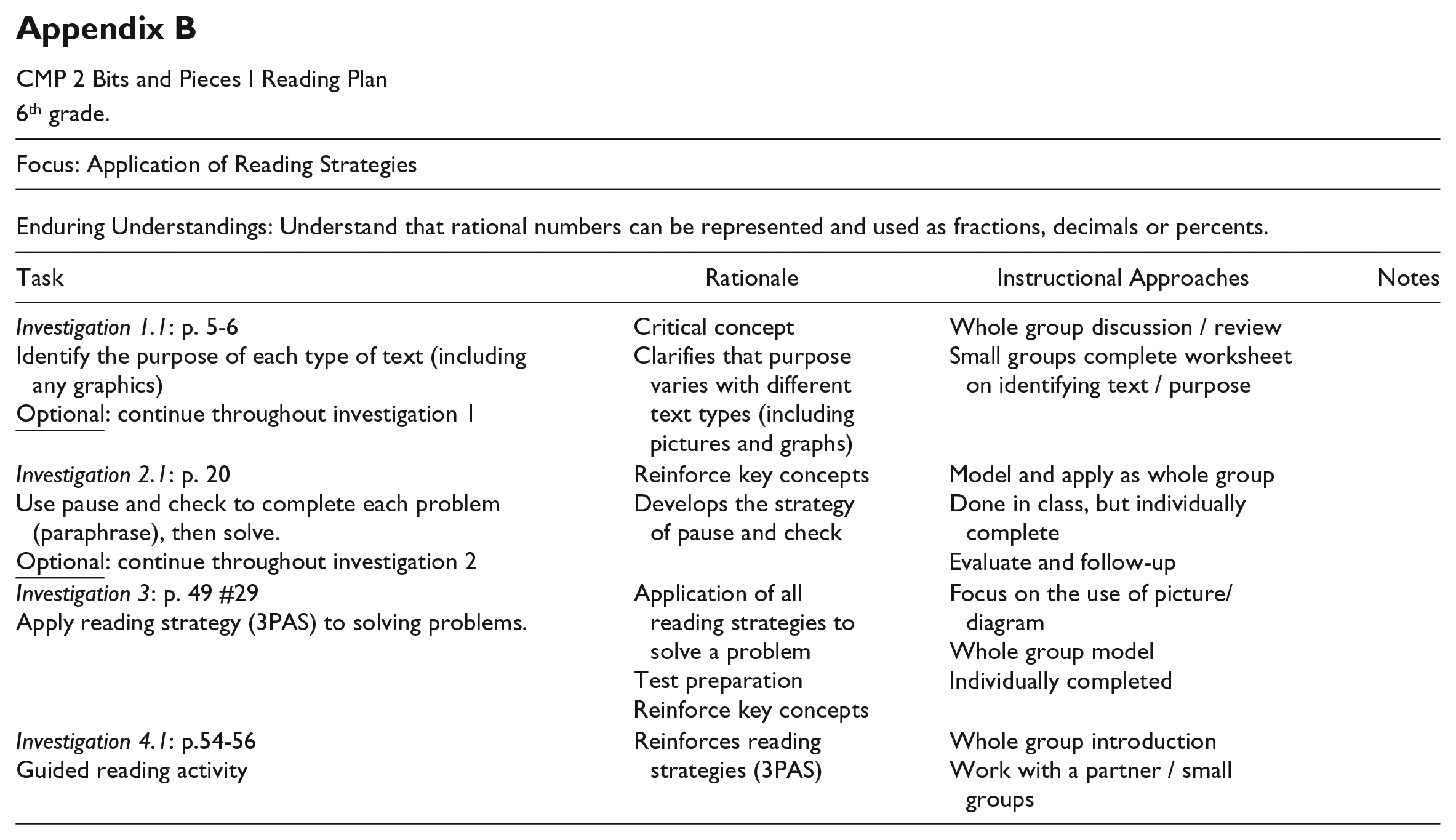
| Focus: Application of Reading Strategies |
|||
|---|---|---|---|
| Enduring Understandings: Understand that rational numbers can be represented and used as fractions, decimals or percents. |
|||
| Task | Rationale | Instructional Approaches | Notes |
| Investigation 1.1: p. 5-6 Identify the purpose of each type of text (including any graphics) |
Critical concept Clarifies that purpose varies with different text types (including pictures and graphs) |
Whole group discussion / review Small groups complete worksheet on identifying text / purpose |
|
| Investigation 2.1: p. 20 |
Reinforce key concepts |
Model and apply as whole group |
|
| Investigation 3: p. 49 #29 |
Application of all reading strategies to solve a problem |
Focus on the use of picture/diagram |
|
| Investigation 4.1: p.54-56 |
Reinforces reading strategies (3PAS) | Whole group introduction |
|
Declaration of Conflicting Interests
The author(s) declared no potential conflicts of interest with respect to the research, authorship, and/or publication of this article.
Funding
The author(s) disclosed receipt of the following financial support for the research, authorship, and/or publication of this article: This material is based upon work supported by the National Science Foundation under Grant Number 0231807. Any opinions, findings, conclusions, or recommendations expressed in this material are those of the authors and do not necessarily reflect the views of the NSF.