




Abstract
This article reviews and synthesizes empirical literature on critical literacies in English language teaching (ELT), gathering perspectives from international scholarship. Across a range of global contexts, the consistency with which English learning is touted as access to power while acting to marginalize those still learning the language demonstrates the need for critical approaches to ELT. In addition to reviewing the literature, this article develops a framework to analyze critical literacies in ELT. This multilanguage, multipurpose framework highlights language learning and critical engagement as foundational to the field’s endeavors. Analyzed through this framework, studies were found to coalesce around five key topics: teacher beliefs, learner beliefs, course design, specific practices, and language-emphatic designs. By exploring how current research conceptualizes and operationalizes critical literacies in ELT, this review outlines the current state of the field while illustrating impactful pedagogical approaches. In addition, the review challenges the ways in which multilingual learners are positioned within research, advocating practices that frame language learning and critical engagement as mutually reinforcing endeavors toward critical praxis.
Keywords
Through broadening literacy research frameworks, the literacy field increasingly recognizes the social and political dynamics of texts and their production. In an age of what some have called “post-truth politics” (Higgins, 2016; Sambrook, 2012), the ability to interrogate social, historical, and political contestations of literacy is a pivotal educational mandate. One school of thought that has historically emphasized the emancipatory role of literacy is the field of critical literacies (Freire & Macedo, 1987; Janks, 2014; Luke, 2012). Foregrounding the inherently political nature of text, critical literacies position teachers and learners as co-constructors of knowledge, analyzing and producing texts toward exposing, deconstructing, and disrupting systems of oppression (Comber, 2015; Giroux, 2005).
The practices realized through critical literacies, however, are often denied to the growing number of students who are learning English as a second or additional language (henceforth multilingual learners). This practice is often justified by asserting that critical engagement is beyond the capacities of those still in the process of learning a new language (Park, 2011). In reality, the power dynamics highlighted through critical literacies are fundamentally entwined with English learning. In English-dominant countries, multilingual learners face intersecting forms of academic, linguistic, and racial discrimination (Alim, Rickford, & Ball, 2016; Cummins, 2009; Flores & Rosa, 2015; García & Kleifgen, 2010). Even in countries where English is not widely spoken, the snowballing global dominance of English has pushed many other languages—and arguably their speakers—toward similar marginalization (Canagarajah, 2007; Jenkins, 2013; Mackenzie, 2013; Phillipson, 2009).
Through this literature review and synthesis, I bring these contexts together under the umbrella of English language teaching (ELT), a broad field united by foundational questions of how, why, and in whose interest English is taught. I approach this work as an ELT practitioner and scholar of critical literacies. I conceptualized this project throughout my early career as an ELT practitioner in the United States, Morocco, and South Korea, and in my current role as a U.S.-based teacher educator, primarily among teachers of multilingual learners. Across this range of educational contexts, the consistency with which English learning is touted as access to power while acting to marginalize those still learning the language demonstrates the need for critical approaches to ELT. These realities led me to seek frameworks for research and pedagogy specific to engaging in critical literacies with multilingual learners. The scarcity of such frameworks led to this project, with the goal of deriving a critical literacies framework for ELT from empirical research in the field.
Although ELT is an inherently political and ideological endeavor, there remains relatively little research on critical literacies in ELT (Huang, 2011). Therefore, this review seeks to bring together global conversations about the theories, pedagogies, and challenges that characterize the field. In addition to exploring the current state of research, I also put forth a framework for critical literacies in ELT. This multilanguage, multipurpose (MLMP) framework is iteratively developed throughout this review and highlights key considerations of language learning and critical engagement as foundational to critical literacies in ELT. In synthesizing this body of work, this review also calls for a renewed emphasis on integrating theory and action, or critical praxis (Freire, 1970), in literacy education and research, as laid out in the theoretical frameworks introduced below.
Theoretical Framework: Critical Perspectives in Pedagogy, Literacy, and ELT
As the studies under review share similar theoretical underpinnings, I present a brief overview of critical pedagogy, critical literacy, and critical approaches to ELT. Far from a comprehensive history of this work, this glimpse into the vast landscape of critical scholarship serves to situate this review in a specific theoretical lineage and also to further establish the alignments between critical pedagogy, critical literacy, and ELT.
Critical Pedagogy
This is a great discovery, education is politics! When a teacher discovers that he or she is a politician, too, the teacher has to ask, What kind of politics am I doing in the classroom? That is, in favor of whom am I being a teacher? (Shor & Freire, 1987, p. 46)
The idea that education is politics, and questions such as those posed above, lies at the heart of critical pedagogy. Drawing from a broad range of critical traditions, including Marxist, feminist, poststructuralist, and postcolonial criticism (Foley, Morris, Gounari, & Agostinone-Wilson, 2015; Tyson, 2006), critical pedagogy applies these theories to education, particularly for the purpose of working toward justice for historically marginalized populations (Darder, Torres, & Baltodano, 2017; Duncan-Andrade & Morrell, 2008; hooks, 1994). Critical pedagogy takes a constructivist epistemological stance toward a more inclusive, democratic form of pedagogy (Lather, 1998; Tarlau, 2015). Often drawing on the seminal work of Paulo Freire’s (1970) Pedagogy of the Oppressed, critical pedagogy theorists advocate the development of critical consciousness toward education’s role in reproducing or disrupting social power hierarchies (McLaren, 2015; Shor, 1992). Recent scholarship has pushed the boundaries of critical pedagogy toward a more explicit critique of neoliberal capitalism and the global standardization movement (Giroux, 2016; Gorlewski, Porfilio, & Gorlewski, 2012; Monzó & Morales, 2016). In addition, the field has moved toward contextual specificity in recognizing particular forms of marginalization inflicted upon individual populations, particularly in terms of colonial histories (Asher, 2009; Grande, 2015; Morrell, 2008; Patel, 2015), regional specificities (Zembylas, 2015), and complexified understandings of oppressor-oppressed dynamics (Allen & Rossatto, 2009; Bacon, 2015).
Critical Literacy
Critical pedagogies encourage researchers and educators “to become courageous in our commitment to defend subordinated student populations . . . and equip them with critical transformative tools” (Bartolomé, 2004, p. 120). For many scholars, this critical transformative tool is literacy. Critical literacy theorists rally around the oft-quoted conceptualization of literacy as reading the word and the world (Freire & Macedo, 1987). Rather than viewing texts as fixed or value-neutral, practitioners of critical literacy have long argued that decoding and reproducing printed symbols constitute only a part of what it means to be literate (Luke & Freebody, 1997; Rogers, Winters, Perry, & LaMonde, 2014). Instead, critical literacy builds upon these competencies toward critical analysis of texts, authors, and contexts, understanding literacy as a vehicle for social change (Comber, 2015; Goodman & Cocca, 2014; Janks, 2000). As summarized by Luke (2012),
The term critical literacy refers to use of the technologies of print and other media of communication to analyze, critique, and transform the norms, rule systems, and practices governing the social fields of everyday life . . . [with] an explicit aim of the critique and transformation of dominant ideologies, cultures and economies, and institutions and political systems. (p. 5)
Although its practitioners conceptualize critical literacy in a variety of ways, Lewison, Flint, and Van Sluys (2002) synthesized a range of definitions in the field to include four broad dimensions: disrupting the commonplace, interrogating multiple viewpoints, focusing on sociopolitical issues, and taking action to promote social justice. In this way, critical literacy approaches generally emphasize the potential of literacy as a vehicle for political engagement and combating injustice. Recent work in critical literacy has moved the field toward more multimodal understandings of literacy, or literacies (Cope & Kalantzis, 2009; Gee, 2014; Scherff, 2012; Vila & Pandya, 2012), as well as toward increasingly participatory, community-based approaches (Fine, 2016) and global perspectives (Pandya & Ávila, 2013; Yoon, 2016).
Critical Approaches to ELT
Although Macedo (2003) argued that literacy can be used to “disempower those who, through an accident of birth, are not part of a class structure where literacy is a fundamental cultural capital” (p. 12), this “accident of birth” is compounded for those whose literacy capital falls within a nondominant language. Thus, the principles of critical literacy fundamentally relate to the teaching and learning of English, particularly in contexts where English acts as a language of power, prestige, or basic educational access (Norton & Toohey, 2004; Patel Stevens, 2011). As with critical literacy overall, those who apply critical approaches to ELT object to the idea that education can be apolitical, specifically the idea that language educators “teach students only language skills [or] train them only in communicative ability” (Ko & Wang, 2013, p. 221). Rather, critical approaches underscore the political dynamics inherent to learning a new language (Clark, 2013; Pennycook, 2016; Reagan, 2006), particularly languages such as English that have historically played a key role in colonization and social disenfranchisement (Graddol, 2006; Song, 2011; Spring, 2016; Valenzuela, 2010). Through such approaches, ELT and critical literacy become mutually reinforcing endeavors to broaden the ways in which students read both the word (languages) and the world (critical literacy).
As noted by Luke and Dooley (2011), “there are contending and multiple versions of ‘critical literacy’ at play in the fields of second language education” (p. 863). To address these issues, my proposed framework maps out these contending practices as they continue to disseminate and differentiate across an increasingly global and multimodal landscape of literacy practices. Situated at the intersections of critical pedagogy, critical literacies, and ELT outlined above, this review synthesizes an international body of work demonstrating the connections between critical literacies and English learning. Illustrating the variety of ways in which educators and learners take up critical literacies in ELT, this body of work and the pedagogical possibilities it represents were gathered and analyzed through the methods outlined below.
Methodological Approach
This review draws on the methodology of qualitative metasynthesis, an inductive approach to synthesizing research through summarizing findings from empirical studies, while also viewing the reviewed literature as a structure, or cultural artifact, by which to offer interpretations about the field (Sandelowski & Barroso, 2006; Thorne, Jensen, Kearney, Noblit, & Sandelowski, 2004). This review characterizes research on critical literacies in ELT across a range of settings in which it is practiced, with studies selected both from countries in which English is widely spoken as well as countries where English is learned as a “foreign” or secondary language. Although there are important distinctions between these contexts, to explore how critical literacies are practiced across the variety of spaces in which they are applied, restrictions were not placed on studies based on their country of origin or the language(s) spoken by their participants. Similarly, restrictions were not placed on learner age groups or English-ability levels. Although there are important pedagogical differences for teaching and learning across developmental stages, this review was designed to be inclusive of broad age ranges and English competencies. This decision facilitated a wider range of pedagogical perspectives and allowed me to examine the extent to which learners’ differing English abilities or proficiencies in languages other than English are considered in the reviewed approaches.
To allow for such broad inclusion while maintaining consistency in the selection criteria, the search was limited to peer-reviewed scholarly journal articles. This review should be read through the lens of this limitation, and not as an attempt to comprise the entirety of valuable work published in critical literacies and ELT—work disseminated across diverse venues including books, chapters, dissertations, online periodicals, and especially among practitioners operating outside the realm of institutionalized academic publishing. Although such work was drawn upon for conceptual research, theoretical framing, and the development of an analytical framework, studies for the review itself were obtained through the process outlined below.
To gather this body of work, I entered variations of the phrases critical literacy and critical literacies into the academic search engines, such as Educational Resources Information Center (ERIC), Education Research Complete (ERC), and PsycINFO, for empirical studies published in English in peer-reviewed scholarly journals. I included multiple secondary search terms in attempts to obtain as expansive a body of ELT work as possible, including the full names and abbreviations of English as a Second Language (ESL), English as a Foreign Language (EFL), English Language Teaching (ELT), English as an Additional Language or Dialect (EAL/D), Teaching English as a Foreign Language (TEFL), Teaching English as a Second Language (TESL), Teaching English to Speakers of Other Languages (TESOL), English Language Learners (ELL), and Dual Language Learners (DLL) as well as derivations of the words bilingual and multilingual. No date restrictions were set, but these search criteria generated no results earlier than 1993, with most studies having been conducted in the last decade. I then narrowed the search results to studies in which (a) multilingual learners were the primary research population, (b) literacy was the principal pedagogical focus, and (c) the researchers had explicitly identified their theoretical approach as aligning with the overall field of critical literacy/ies. These criteria produced 68 empirical studies conducted in 18 countries across a variety of contexts and age groups (see online supplemental appendix for a complete list of studies, countries, and age groups). Notably, this review is limited by its selection of work published in English and by the restrictions of scholarly databases, which inevitably privilege certain institutionalized norms of knowledge production in the academe. It is those norms, however, that this review aims to highlight, explore, and interrogate.
Analytical Framework: The MLMP Framework for Critical Literacies in ELT
Practitioners of critical literacies in ELT often highlight the tensions involved in balancing critical approaches to literacy with students’ learning of a new language—a tension reflected in the reviewed empirical work. Finding no specific framework in the literature by which to analyze this tension, I took an inductive approach to creating such a framework, iteratively derived from the body of reviewed work. Following the taxonomic analysis approach to qualitative metasynthesis laid out by Onwuegbuzie, Leech, and Collins (2012), I first established domains, or “larger units of cultural knowledge” (p. 17), by which to interpret the literature. Informed by the theoretical frameworks underlying critical literacies in ELT, I constructed these domains around language learning and critical engagement, both broadly defined. These two domains are consistent with constitutive components of critical literacies in ELT: Language learning is what differentiates critical literacies in ELT from the field of critical literacies overall, while critical engagement with literacy differentiates this body of work within ELT as a whole.
Second, in reading the research, I constructed a preliminary taxonomy by which to analyze empirically grounded relationships among the domains (Spradley, 1979, 1997). This process involved analyzing the relationships between language learning and critical engagement in each study and recording researchers’ definitions, operationalizations, and underlying assumptions about both domains, particularly in terms of the findings or outcomes reported in each study. I organized these findings into an initial analytical taxonomy of relationships between (a) assumptions underlying teacher/researcher conceptualizations of language learning and critical engagement, (b) how the studies defined and observed these processes in research and practice, and (c) the outcomes cited as evidence for language learning or critical engagement as well as the degree to which both domains were balanced within the studies. The initial framework served as a tentative taxonomy, with relatively broad preliminary categories that would allow for further expansion throughout the analysis (Onwuegbuzie et al., 2012). This analysis, expanded upon in the “Discussion: The Expanded MLMP Framework” section, allowed the review to move beyond summarizing empirical findings toward theory development (Sandelowski & Barroso, 2006).
This taxonomy, henceforth referred to as the MLMP framework for critical literacies (see Figure 1), serves as the analytical framework for this review. Multilanguage gives credence to the emergent multilingualism of those learning an additional language, while acknowledging their preexisting linguistic competencies in a language, or languages, other than English. This framing informs the choice to refer to learners throughout this review as multilingual learners, as opposed to designations more often used in the literature such as English language learners (ELLs), learners of English as an additional language or dialect (EAL/D), or even bilingual learners, as many multilingual learners speak three or more languages, codes, or dialects. This designation serves to highlight the considerations inherent to teaching multilingual learners, while maintaining the recognition of multilingualism as an asset, even when such framing is lacking in the literature itself. As such, the language learning portion of the MLMP framework highlights the ways in which the studies under review conceptualize, emphasize, or assess language learning within critical literacy approaches.
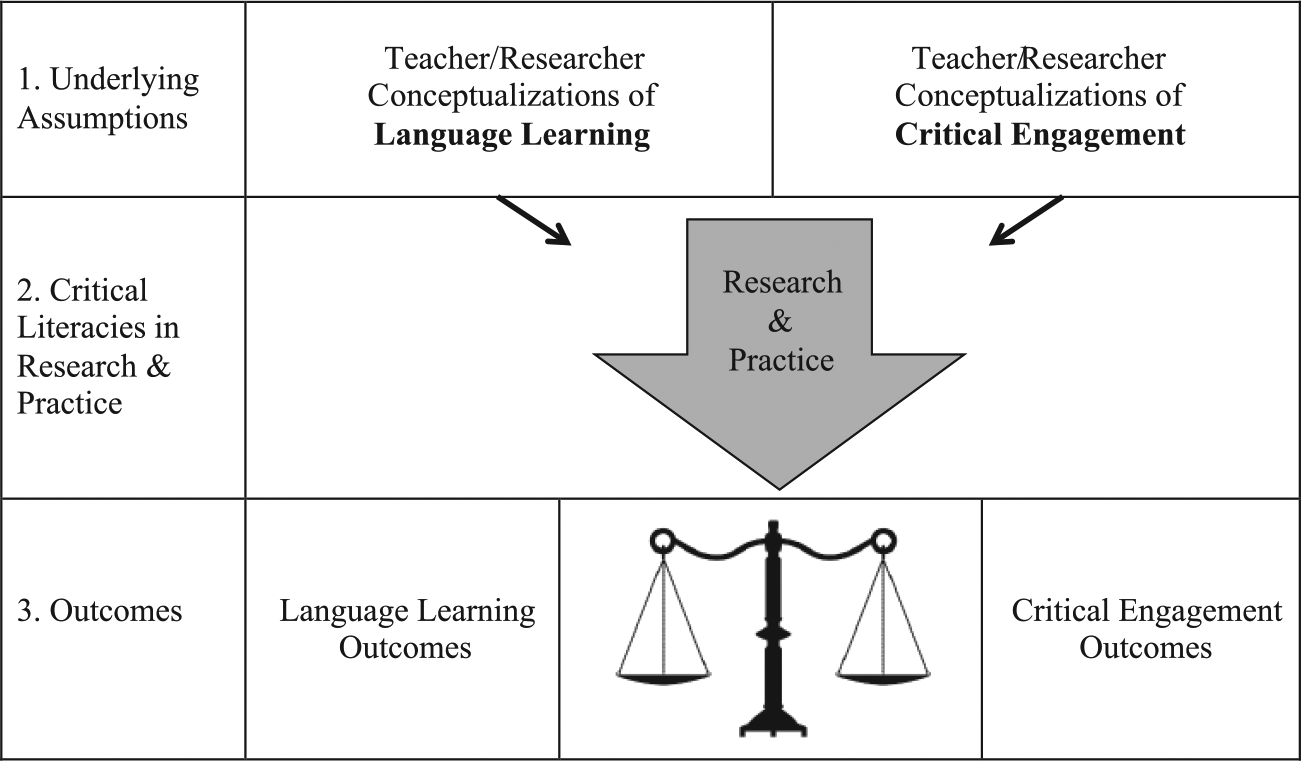
The MLMP framework for critical literacies.
The second component of the framework, multipurpose, draws attention to the multiform applications of critical literacies in ELT toward the goal of critical engagement. Critical engagement emphasizes the field’s commitment to disrupting the commonplace, interrogating social hierarchies, and promoting emancipatory praxis through literacy (Lewison et al., 2002; McLaren, 2015). There are, however, a variety of interpretations in the field as to what constitutes critical engagement in action. As Benesch (2001) noted,
I have heard everything from “Critical teaching is getting students to march in the streets” to “Critical teaching is the imposition of the teacher’s political agenda,” to “Critical teaching is letting students choose their own topics,” indicating that for some it is political indoctrination while for others it is simply student-centered-teaching. (pp. 131-132)
As this review will demonstrate, Benesch’s critique of critical pedagogy also applies to research on critical literacies in ELT. The critical engagement component of the MLMP framework, therefore, allows studies to be analyzed in terms of what practices researchers and practitioners characterize as the intended outcomes of critical literacy approaches.
In this review, I utilize the MLMP framework to demonstrate that language learning and critical engagement are emphasized to widely varying degrees across the reviewed studies. Throughout the analysis, the MLMP framework highlights the ways in which underlying assumptions about language learning and critical engagement informed the questions researchers asked, their methodological approaches, and the resulting conclusions that could or could not be drawn from these studies. The MLMP framework is further developed at the end of the review to demonstrate how future research might increase alignment between language learning and critical engagement toward mutual reinforcement and critical praxis.
Findings
To facilitate the taxonomic analysis, I organized studies into broad thematic groups based on their research questions and findings (see Figure 2). One group of studies (Group A) focused principally on beliefs, or transformation of beliefs, about critical literacies. These belief-based studies were further subdivided into those that focused on teachers, broadly defined as facilitators of critical approaches (Group A-1), and studies that focused on learners (Group A-2). The second group (Group B) examined pedagogical approaches to critical literacies. These studies were further broken down into three subgroups: overall course or policy design (Group B-1), specific practices or activities (Group B-2), and language-emphatic research designs (Group B-3). Although this organization represents only one possible way to present the literature, and some studies may overlap into multiple groups, efforts were made to organize the studies to best represent their primary emphases for analysis through the MLMP framework to offer insight into how critical literacies are conceptualized, studied, and practiced in ELT. The studies are presented below with representative examples described within each subgroup.
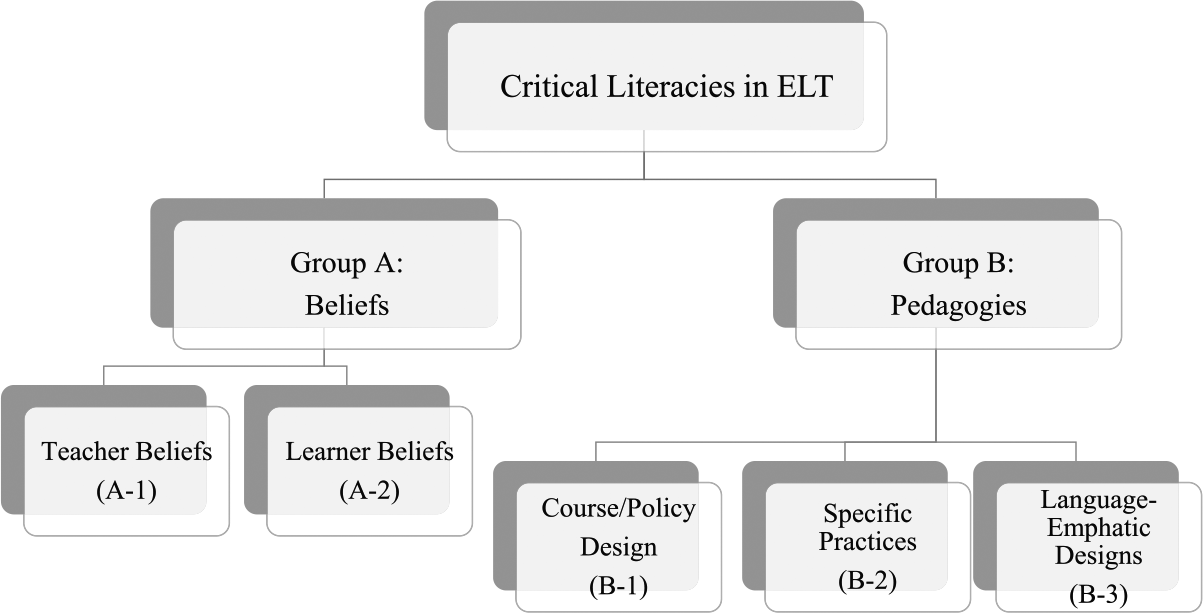
Organization of studies by thematic groups of research questions and findings.
Group A: Beliefs
Group A-1: Teacher beliefs
Much of the research on critical literacies in ELT emphasized the importance of teachers. As critical literacy approaches are rarely mandated, a teacher’s choice to enact critical literacy becomes pivotal. As such, the studies in Group A-1 asked, “What experiences or beliefs inform teachers’ decision to engage in critical literacies?” This framing necessitated research designs by which to explore teachers’ beliefs and background experiences. The studies in this group, therefore, drew heavily on interviews, positioning teachers’ reported beliefs as the primary source of data.
Some studies (Albers & Frederick, 2013; Alford, 2014; Curdt-Christiansen, 2010; Lipman & Gutstein, 2001; Priven, 2010; Rodriguez & Cho, 2011) focused on the beliefs of teachers who practiced critical literacies. Albers and Frederick (2013), for example, conducted a 1-year ethnographic study of two Latino educators working in a U.S. secondary school. Thematically coding transcripts from interviews and classroom observations, Albers and Frederick found that familial, educational, and professional experiences informed participants’ choices to engage in critical literacies—particularly experiences of racial and economic marginalization that reflected the experiences of their students. Drawing upon similar methods, other studies in this group reiterated the key role of particular beliefs in teachers’ choice to enact critical literacies, particularly the belief that multilingual learners can practice critical literacies while learning a new language (Alford, 2014); that literacy encompasses more than decoding, comprehension, and test taking (Curdt-Christiansen, 2010; Lipman & Gutstein, 2001); and that education should be grounded in students’ lived experiences (Rodriguez & Cho, 2011) or home language practices (Priven, 2010).
Other studies in Group A-1 (Assaf, 2005; Cho, 2015; Ko, 2013a; Ko & Wang, 2009; Kukner, 2013; Lee & Runyan, 2011; Mackie, 2003; Mora, 2014; Porto, 2010) examined changes in teachers’ beliefs as they engaged with critical literacies, often for the first time. These studies explored individual transformations in detail, with most focused on only one to three participants. Studies in this group generally began by outlining participants’ baseline experience with critical literacies, and then described how certain participants broadened their knowledge and appreciation of the practice. Lee and Runyan (2011), for example, worked with a group of U.S. teachers who were “unfamiliar with and skeptical about critical literacy” (p. 89). The teachers were particularly doubtful that their students who were relatively new to English learning would be able to participate in such linguistically demanding practices. The researchers analyzed one teacher’s reflective journal to demonstrate how her beliefs changed as she saw her multilingual learners across English levels participating in—and increasingly motivated by—critical literacy practices. Other studies in this group explored similar journeys from apprehension, to exploration, to appreciation for the possibilities of critical literacies in ELT.
Group A-2: Learner beliefs
Although studies in Group A-1 emphasized teacher beliefs, Group A-2 explored learners’ perceptions of critical literacies. These studies (Ajayi, 2015; Huang, 2011; Izadinia & Abednia, 2010; Ko & Wang, 2013; Martínez, 2013; Rodriguez-Brown & Mulhern, 1993) discussed the need for greater insight into learners’ beliefs, asking, “How do learners conceptualize critical literacy and its impact on their own learning?” Since this framing prioritized learner beliefs, researchers typically chose interviews, written questionnaires, or analysis of student writing as the primary data sources. In this way, researchers placed emphasis on what learners believed about critical literacies and their own learning, while data sources such as assessments or teacher perspectives were generally not included.
Within this group, researchers problematized assumptions about learners’ cultures, English abilities, or language ideologies. According to Huang (2011), some researchers argue critical literacies pose unique challenges within cultures that discourage questioning authority. Noting the prevalence of such assumptions about students in Taiwan, Huang thematically coded pre- and postcourse writing reflections from her students in a critical literacy-based English course at a Taiwanese university. Countering popular presumptions, Huang’s students discussed their eagerness to engage in critical literacies, describing the practices as beneficial to their political consciousness and academic pursuits. Ko and Wang (2013), also at a Taiwanese university, interviewed students and analyzed their writing through critical discourse analysis (Fairclough, 1992), demonstrating that students were able to engage with, and find value in, critical approaches to English learning across varying levels of English proficiency. Taking a different approach, Martínez (2013) applied a multilingual lens to explore learners’ language ideologies in a sixth-grade U.S. classroom. Interviewing students about their concurrent use of Spanish and English, or Spanglish, Martínez documented both deficit- and asset-based ideologies among students toward bilingual practices. Through such findings, Martínez joined other studies from this group in advocating the potential of critical literacies to challenge “the hegemonic influence of dominant language ideologies” (p. 286), particularly in terms of learners’ beliefs about literacy and language use in schools and society.
Group B: Pedagogy
Group B-1: Pedagogy—Course/policy design
Although Group A studies explored beliefs about critical literacies in ELT, Group B researchers asked how these beliefs were enacted in practice. Therefore, while interviews were still a key form of data collection, these studies typically prioritized classroom observations and analysis of student work. The studies composing Group B-1 (Alford & Jetnikoff, 2011; Arce, 2000; Cummins, 2015; Dixon & Peake, 2008; Flores-Dueñas, 2005; Fredricks, 2012; Haworth, 2011; Henry, 1998; Kramer-Dahl, 2001; McLaughlin, 1994; Morgan, 2009; Roy, 2016; Sepúlveda, 2011) had a shared focus in recommending critical literacy as a foundation for courses, units, or overall educational policies. In general, these researchers asked, “How can critical literacies serve as a foundation for designing a policy or pedagogical approach?” and “How do such approaches impact multilingual learners and their critical engagement?” Such questions necessitated a clear operant definition of critical engagement and methods by which to highlight whether classroom practices aligned with this definition. To provide evidence for these conclusions, researchers generally chose to thematically code student work, class discussions, or policy documents.
Kramer-Dahl (2001) designed a writing course informed by previous research on critical literacies at a university in Singapore. Analyzing students’ writing samples throughout the course, Kramer-Dahl outlined students’ reflections on the writing process and the ways in which they began to question the institutionalized norms of writing in their university. As one participant stated of the course,
I was suddenly thrown into a world where I had to think about why I wrote the way I did . . . Up to this point my writing styles had been adopted almost unconsciously—I wrote in a particular subject the particular way I did because: (a) the teacher told me to do so; (b) I copied the style from model essays; (c) the writing had always been this way . . . In other words, I only understood how, but not why. (p. 30)
Key studies in this group also explored critical literacy approaches that capitalized on learners’ multilingual competencies. Observing a first-grade bilingual classroom in the United States, Flores-Dueñas (2005) asked how students’ use of both Spanish and English in the classroom could be leveraged to broaden learners’ engagement in critical literacies while concurrently affirming students’ bilingual identities. During a yearlong study, the classroom teacher selected culturally and socially relevant texts while engaging learners in critical questioning through both English and Spanish. Although stopping short of drawing a causal relationship between critical literacies and reading gains, Flores-Dueñas reported substantial improvement in students’ reading levels in both languages. Other authors framed their research toward multilingual advocacy on a policy level. Cummins (2015), Dixon and Peake (2008), Haworth (2011), and McLaughlin (1994) all outlined the benefits of multilingual approaches to critical literacies, particularly in counteracting the detrimental impact of English-emphatic educational policies on speakers of minoritized languages, both in terms of academic achievement and cultural disenfranchisement.
Group B-2: Pedagogy—Specific practices
The largest group in this review encompassed studies of specific practices, projects, or activities for critical literacies in ELT. Such studies generally asked, “How might certain practices facilitate critical literacies for multilingual learners in a given context?” As with Group B-1, classroom observations and student work were the main data sources, many studies were conducted in researchers’ own classrooms, and researchers’ individual definitions of critical engagement determined how outcomes were evaluated. However, in focusing on particular practices, these studies were often conducted over shorter time periods than the studies in Group B-1, including some studies of single class sessions.
Some studies explored how critical engagement could be facilitated through exposure to culturally and politically relevant texts (Chun, 2009; Fain, 2008; Hayik, 2011, 2015, 2016; Kim, 2016; Kuo, 2009, 2013; Park, 2011; Waterhouse, 2012). Primarily through thematic coding of student discussions or writing samples, these studies demonstrated that multilingual learners exhibit “acute awareness about [critical] social issues” (Fain, 2008, p. 207), even at young ages. However, the studies showed that mobilizing this awareness was contingent upon how instructors encouraged critical engagement with texts. In other words, the researchers did not argue that certain texts were inherently more “critical” than others, but that pedagogies explicitly geared toward interrogating texts, questioning authors, and making connections to current events helped to animate students’ critical engagement.
Other studies explored specific practices or activities in further depth, inclusive of a variety of modalities. These practices or activities included applying critical literacies through writing (Ghahremani-Ghajar & Mirhosseini, 2005; Wolfe, 1996), discussion and storytelling (Enciso, 2011; López-Robertson, 2012; Nussbaum, 2002; Peterson & Chamberlain, 2015), multimodal composition (Burke & Hardware, 2015; Gallo, 2002; Giampapa, 2010), drama (K. Hammond, 2006; Medina & Campano, 2006; Medina & Weltsek, 2013), and community engagement (Chern & Dooley, 2014; Pacheco, 2009; Walker & Romero, 2008). These studies demonstrated the flexibility of critical approaches across a range of literacy practices. As a result of this multimodal variation, researchers within this group took up a variety of methodological approaches. Ghahremani-Ghajar and Mirhosseini (2005), for example, were unique in their attempts to quantify students’ use of critical themes. In an Iranian secondary school, the researchers established a system for tracking critical themes in students’ dialogical journals. Through written feedback, the instructor posed questions designed to elicit responses along a four-level schema of critical engagement: descriptive, personal-interpretive, critical, and creative (Ada, 1988). Ghahremani-Ghajar and Mirhosseini found that “[in] the first quarter of the year, 70% of the entries were either descriptive or personal,” but by the fourth quarter, “more than 80% of the entries . . . were either critical or creative” (p. 294), suggesting increased depth of critical engagement in students’ writing through targeted dialogical questioning.
Hayik (2011) provides a second example of the methodological diversity characteristic of this group. Although most of these studies reported on critical engagement among teachers and learners exclusively, Hayik explored the ways in which critical literacies might impact broader communities. In this study, Israeli-Arab middle schoolers drew sketches symbolizing the connections between an allegorical war story and their own lived realities. After analyzing students’ artwork through visual narrative analysis, Hayik (2011) described a community viewing in which students “walked [parents and local politicians] around the room and explained the stories behind the creation of each piece . . . [bringing] their messages of justice and democracy out into the surrounding world” (p. 115). In this way, this study not only exemplified the flexibility of methodology and modality that characterized this group but also demonstrated the potential for the impact of critical literacies beyond the walls of the classroom.
Group B-3: Pedagogy—Language-emphatic designs
Thus far, studies in Group B have primarily emphasized critical engagement. However, through the lens of the MLMP framework, two particularly salient questions remain largely unasked about critical literacies in ELT: “Do critical literacy practices support language learning?” and “How do critical literacy approaches to ELT take multilingual learners’ linguistic backgrounds into account?” As Huang (2011) argued, most studies of critical literacy in ELT “focus on development of critical literacy without explicit attention to development of language skills” (p. 145), a concern echoed throughout the studies in Group B-3 (Allison, 2011; Dooley, 2009; Dooley & Thangaperumal, 2011; J. Hammond & Macken-Horarik, 1999; Huang, 2011, 2012; Huh, 2016; Ko, 2013b; Lau, 2012, 2013). As a result, these studies explored linguistic considerations that might inhibit or facilitate multilingual learners’ engagement with critical literacies. Notably, the researchers reaffirmed the importance of critical literacies in general, but some questioned whether certain approaches to critical literacies in ELT placed sufficient emphasis on language learning considerations.
This group demonstrated key methodological differences from studies previously reviewed, including studies that sought to assess students’ use of English. Two of these studies (Allison, 2011; J. Hammond & Macken-Horarik, 1999) included comparisons between the work of multilingual learners and students described as native English speakers (NESs). Allison (2011) assessed the linguistic complexity of students’ writing samples through topical structure analysis (Lautamatti, 1987) in an Australian secondary English classroom. Allison suggested that when compared with their NES peers, the multilingual learners’ writing samples “lacked comparable knowledge and understanding of the salient content and concepts . . . [and] did not have the facility to link material in such a way as to present a convincing topical hierarchy” (p. 192). Emphasizing the importance of English learning within ELT, Allison argued that critical literacy approaches that “diminish the value placed on the correct, formal use of English” (p. 183) did not genuinely meet the needs of multilingual learners in educational settings.
Similarly, J. Hammond and Macken-Horarik (1999) argued that students’ success with critical literacies in a secondary science classroom were not only predicated on English proficiency but also dependent upon students’ awareness of “the mainstream literacy requirements” (p. 539) of the particular discipline at hand. Comparing the written work of multilingual learners and those designated NESs in an Australian secondary classroom, this study sought to analyze both language use and critical engagement concurrently. The researchers determined that writing samples from NESs demonstrated more adept critical analysis than those written by multilingual learners. J. Hammond and Macken-Horarik attributed these differences, in part, to English abilities, but also to the importance of science-specific background knowledge, arguing that “without a firm foundation in discipline-specific knowledge and its necessary epistemological and cultural resources, these students would not have been able to engage in any serious way with critical perspectives” (p. 540).
Both studies above argued for approaches that prioritize language learning before moving toward critical engagement. However, other researchers in this group (Dooley, 2009; Dooley & Thangaperumal, 2011; Huang, 2012; Huh, 2016; Ko, 2013b; Lau, 2012, 2013) maintained that critical engagement and language learning could, and even should, be implemented concurrently. Although acknowledging the difficulty of critically engaging within a language one is still learning in her classroom of multilingual middle schoolers in Australia, Dooley (2009) asserted that “there is no hierarchy amongst literacy resources: critical analytic skills can be developed alongside [basic decoding] skills” (p. 8). In fact, Dooley observed that the multilingual learners in her study, who had come to Australia as refugees, were quick to engage with critical literacies. This led Dooley to propose that many multilingual learners may be particularly adept at critical literacies due to experiences of marginalization and their awareness that they rarely represent “the reader assumed” by many school texts (p. 15). Dooley further suggested that critical literacy approaches to ELT involved reconceptualizing the role of all educators to be “teacher[s] not only of language, as ESL teachers have long argued, but also of literacy—a new task for many ESL and high school subject area teachers” (p. 16).
The reaffirmation of the pivotal role played by teachers completes the cycle of this reviewed body of work. This assertion echoes the findings of Group A about the importance of teacher and learner beliefs in the choice to enact critical literacies in ELT classrooms, as well as the findings across Group B as to how these beliefs are enacted across various policies, practices, and pedagogies. These overarching themes—the connections, balances, and recurrent tensions between language learning and critical engagement highlighted within the MLMP framework—set the foundation for the discussion of this body of work as a whole and for the expansion of the MLMP framework outlined below.
Discussion: The Expanded MLMP Framework
As a whole, the studies reviewed have made valuable contributions to the field by exploring critical literacies in ELT across multiple age groups, countries, and cultural contexts. Primarily through interviews, classroom observations, and thematic coding of student work, the studies under review explored the beliefs of teachers (Group A-1) and learners (Group A-2) while also examining how these beliefs can be put into practice through course/policy design (Group B-1), specific practices (Group B-2), and language-emphatic designs (Group B-3).
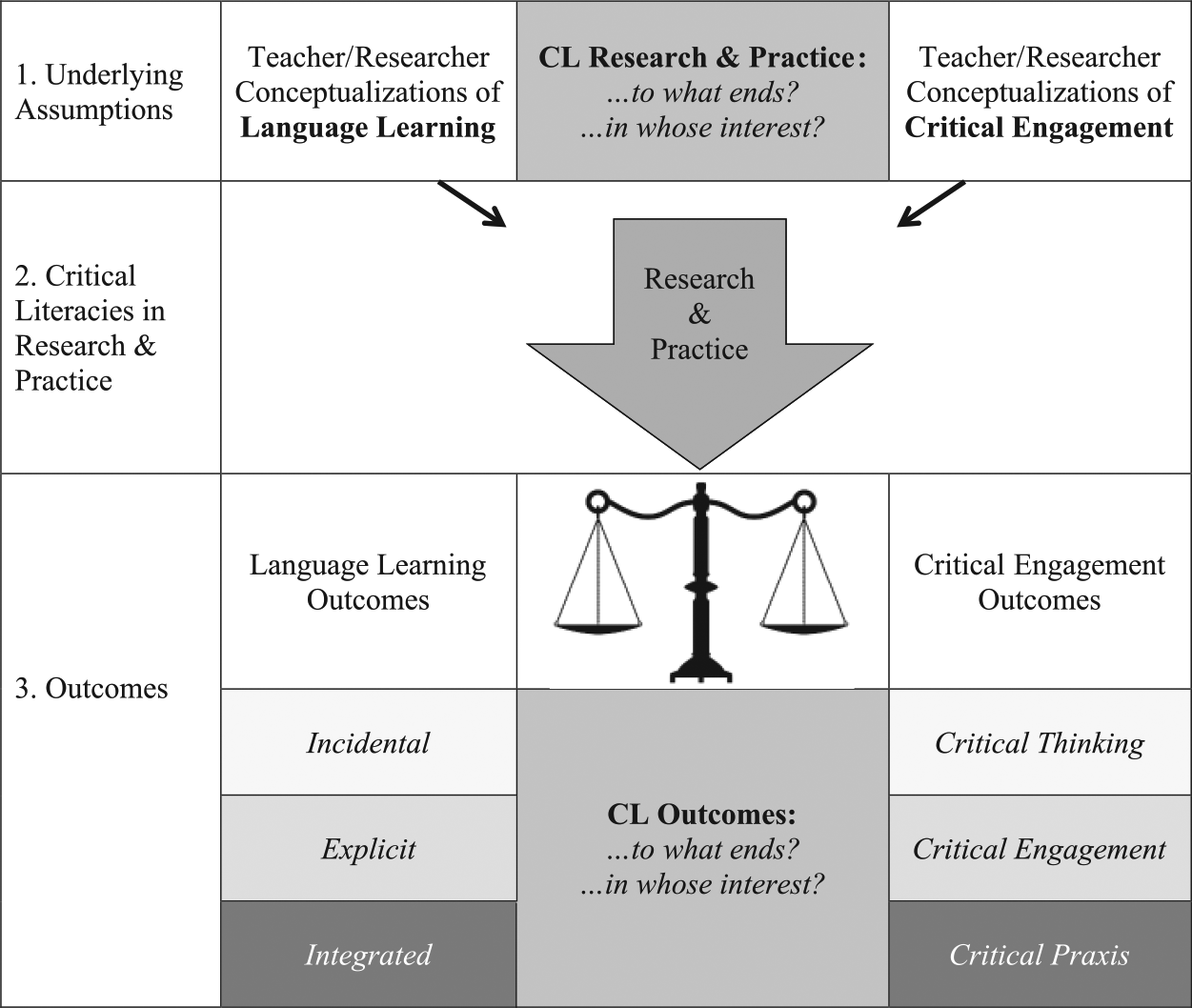
Thus far, this review has been structured around questions asked by researchers. However, one key affordance of a qualitative metasynthesis is the identification of “gaps” in a body of research—answers to questions “called for theoretically by the findings,” but “not empirically present in the findings” (Sandelowski & Barroso, 2006, p. 200). The next section, therefore, is organized around questions that remain largely unanswered, even unasked, in the reviewed work. Although the MLMP framework provided a basis for the analysis of individual studies, viewing this body of work in its entirety necessitates an expanded version of the MLMP framework, or a completed taxonomy (Onwuegbuzie et al., 2012). This expanded framework (see Figure 3) serves three interrelated purposes. First, it demonstrates the potential affordances of conceptualizing language learning and critical engagement, not as singular categories, but as a spectrum of practices exhibited across the reviewed studies. Second, this framework emphasizes specificity as to how language learning and critical engagement are operationalized toward mutual reinforcement through critical literacies. Finally, the expanded MLMP framework highlights the necessity of recentering critical questions about to what ends and in whose interest critical literacies are practiced in ELT to build upon the transformative, emancipatory goals foundational to critical literacies (Freire, 1970; Janks, 2014; Luke, 2012). I outline these expansions below, followed by a discussion of key affordances and limitations of this framework as applied to critical literacies in ELT.
The expanded MLMP framework for critical literacies.
Expansion 1: Language Learning
A key question left largely unanswered within this body of reviewed work is, “Do critical literacies facilitate language learning?” Although measures of academic achievement are by no means the ultimate goal of critical literacies, few studies in this review have drawn a clear connection between critical literacies and the facilitation of language learning. Although numerous studies, particularly in Group A, suggested that teachers and students believed critical literacies were beneficial to overall literacy development, studies did not generally set out to demonstrate the linguistic benefits of multilingual learners’ engagement in critical literacies. Considering ELT’s core prerogative of teaching the English language, little attention is given in this body of work to whether or not students are, in fact, learning English. Therefore, viewing this work through the MLMP framework demonstrates that studies of critical literacies in ELT are often designed to explore how learners develop critical consciousness in relation to literacy (critical engagement), but do not generally explore whether or not students’ linguistic competencies are broadened through participation in critical literacies (language learning).
Because this potential imbalance was a recurrent concern among researchers and practitioners throughout this review, the field will benefit from further research that explores how language learning is leveraged across a variety of critical literacy approaches to ELT. Therefore, to account for the variation in how language learning is understood and integrated across critical literacies in ELT, the expanded MLMP framework demonstrates a way to conceptualize language learning across three overlapping approaches:
Incidental language learning: In this approach, multilingual learners engage in critical literacies with the underlying assumption that language learning will implicitly, or incidentally, develop as a result. Studies built on this assumption generally do not set out to assess student language learning within these practices.
Explicit language learning: This approach frames language learning as necessary for multilingual learners’ critical engagement and specifies the ways in which language is learned throughout the process. Instruction generally includes some form of explicit language instruction (through a broad range of pedagogies), and studies typically incorporate methods by which to assess language learning outcomes (inclusive of diverse methodologies).
Integrated language learning: This approach asks not only how critical engagement can facilitate language learning but also how language learning can contribute to critical engagement. By asking what kinds of language or metalanguage learners use to engage in critical literacies, instruction is geared specifically toward such language and the ways in which it shifts across a broad range of genres, contexts, or academic content areas. Studies incorporating this approach, therefore, will foreground the mutually reinforcing interplay between language learning and critical engagement.
Applying these approaches to the reviewed body of work, it becomes clear that a majority of the studies are grounded in incidental language learning approaches. Although this is certainly not an argument that observable language gains should become the primary concern within critical literacies, learners’ literacy competencies are by no means unimportant to the process of critical engagement. Critical literacy, after all, emphasizes reading the word and the world, not a choice between one or the other. As the integrated language learning categorization of the MLMP framework demonstrates, language learning and critical engagement can be mutually reinforcing, concurrent undertakings. Studies designed around such an approach will be able to further explore the nature of this mutual reinforcement. Demonstrating this connection between language learning and critical engagement will also encourage adoption of critical literacy approaches within ELT, particularly as studies throughout this review reported initial hesitancy among practitioners about applying critical literacies in ELT, often due to concerns that it would come at the expense of language learning.
However, critical scholars and practitioners of ELT must remain vigilant. In an atmosphere of local, national, and international pressure to demonstrate rapid, measurable English language gains for multilingual learners, there will be attempts to appropriate critical literacies toward prioritizing “the mechanical learning of reading and writing” (Macedo, 2003, p. 12) at the expense of critical engagement. Therefore, assuring a continued balance between language learning and critical engagement necessitates emphatic articulation of the purpose of critical engagement within the MLMP framework.
Expansion 2: Critical Engagement
As this review has demonstrated, there is considerable divergence as to how educators and researchers conceptualize critical literacies in practice. Ko and Wang’s (2009) interviewees, for example, voiced three disparate definitions: One teacher believed critical engagement consisted of students having “their own ideas when reading”; another emphasized the importance of “read[ing] the extended meaning behind [the text] because language is never neutral”; and a third asserted that “critical literacy is about revealing social inequalities and bringing about social justice” (p. 180). Clearly, each of these beliefs would lead to broadly different outcomes in practice, as confirmed by studies that included classroom observations. Beliefs about critical engagement manifested into actions that ranged from promoting higher level questioning (Ko, 2013a), advocating for multilingual learners’ educational rights (Lipman & Gutstein, 2001), involving students in a letter writing campaign (Lee & Runyan, 2011), and designing a bilingual youth radio production (Walker & Romero, 2008). Among such variation, one must ask, “What does it truly mean to put the word ‘critical’ in front of ‘literacies’?”
These interpretations of critical engagement represent a dilemma of practice as well as research. As it stands, most of the studies under review conceptualized critical literacy as having observed students or teachers engaging in critical thinking about literacy. However, as Pennycook (1999) argued,
Critical approaches to [ELT] should not be conflated with notions such as critical thinking . . . Critical thinking is generally an apolitical approach to developing a sort of questioning attitude in students; critical approaches to [ELT] have to do with a political understanding of the location of pedagogy and the development of a way of teaching aimed at transformation. (p. 341)
Similarly, Freire described critical thinking as a first, but not final, step toward “the dynamism between critical thought and critical action” (Shor, 1993, p. 32). Viewing this body of work alongside such unequivocal emphases on transformative action, it becomes clear that a singular category of critical engagement does not fully capture the range of interpretations as to what constitutes a “critical” approach to literacies in ELT. To more specifically outline the ways in which critical researchers and educators conceptualize the outcomes of critical practices, the second iteration of the MLMP framework offers three expansions that demonstrate the broad approaches to critical engagement within critical literacies in ELT.
Critical thinking: Critical thinking casts a wide net around practices that include engaging with texts, their development, and their impact on society in ways that go beyond the face value of a text. These practices might include questioning a text, situating it within its historical context, or examining factors such as purpose, theme, or intended audience. However, the term “critical thinking” has become popular within a broad range of educational approaches that do not necessarily align themselves with the overtly political and emancipatory goals of critical pedagogy. Studies taking this approach generally observe the way students interact with and answer questions about texts.
Critical engagement: As the phrase used to discuss the critical practices in studies throughout this review, critical engagement necessitates critical thinking, but operationalizes these competencies toward practices more overtly geared toward the emancipatory ideologies of critical pedagogy. Although critical thinking can be accomplished by an individual in isolation, critical engagement necessitates interaction and dialogue to address social issues relevant to students, their communities, or broader global injustices. Studies within this approach, like the majority of studies in this review, typically examine the ways critical engagement adds meaning to texts through learners’ unique viewpoints, broadened understandings, or the production of new texts through a range of modalities—but generally as observed within the walls of the classroom.
Critical praxis: Although critical thinking and critical engagement approaches often operate under the assumption that critical literacies within the classroom can make learners more likely to engage in critical action outside of the classroom, critical praxis holds these actions as fundamental to critical literacies. Although predicated on both critical thinking and critical engagement, critical praxis explicitly aims to embody these practices through observable socially or politically transformative action, which generally occurs or extends its impact beyond the classroom. Studies involving this approach, therefore, tend to observe critical practices in a variety of contexts and aim to specify how critical literacies can be leveraged toward materially transformative outcomes. In this way, critical praxis approaches maintain the importance of questioning texts and discussing social issues, but do so toward a synthesis of theory and action, or praxis (Freire, 1970).
Limitations and Affordances of the Expanded MLMP Framework
Four points underscore the limitations of the language learning and critical engagement expansions of the MLMP framework. First, these categorizations are not meant to be mutually exclusive, and practices will certainly overlap to varying degrees. Second, the categories above should not be understood as a way to “rank” studies or pedagogical approaches, but rather as a way to more specifically articulate the underlying assumptions and goals of critical literacies in ELT across a range of practices. Third, as with any framework for educational research and practice, one must consider what important components may not be highlighted within the lens of a particular framework. There is much that goes on within a study or a classroom that is not highlighted through the MLMP framework, such as methodological rigor, scholarly ethics, students’ learning of subject-specific content knowledge, or considerations of learners’ socioemotional well-being. Finally, the primary goals of this framework are balance and mutual reinforcement. As such, the framework should not be used to privilege one approach over another, or to emphasize one component at the expense of the other. In this way, the MLMP framework aligns with foundational scholarship in critical literacies by maintaining that language learning and critical engagement are interdependent for critical literacies in ELT (Luke & Dooley, 2011). With these limitations in mind, this review concludes by offering four potential affordances of the MLMP framework for further research and practice to align with, and build upon, the foundational goals of critical approaches to pedagogy, literacy, and ELT.
Reinforcement between language learning and critical engagement
Although some researchers voiced concern about the difficulties multilingual learners may face when applying critical literacies while still learning English, few identified which specific language features limited or facilitated learners’ critical engagement. Pinpointing the specific approach a study or pedagogical practice takes to language learning within the MLMP framework will help to identify linguistic scaffolds by which to further multilingual learners’ critical engagement. As this review demonstrates, there is a lack of consensus around what kinds of language or language awareness facilitate critical engagement. The field must ask, to borrow from J. Hammond and Macken-Horarik’s (1999) discussion of content-specific language competencies, do critical literacies constitute a “discipline” with its own “mainstream literacy requirements”? (p. 539). If so, identifying targeted language features such as text structures, genre characteristics, or even specific vocabulary words used within critical literacies will help practitioners scaffold multilingual learners’ engagement in critical practices. Similarly, the framework can also inform the ways in which particular texts or pedagogical approaches can be scaffolded toward different levels of critical engagement. Although individual educators and their learners are best poised to determine how such processes should be specifically enacted in their particular contexts, the framework can help provide the impetus for moving toward the transformative, emancipatory goals of critical pedagogies (Duncan-Andrade & Morrell, 2008; Shor, 1992) while concurrently prioritizing the identification of specific language and literacy competencies to facilitate these endeavors.
Language learning and critical engagement as related, but distinct, competencies
Although language learning and critical engagement are foundationally interdependent, the MLMP framework demonstrates that they are also distinct competencies. This distinction is of pivotal importance in ELT as studies conducted among multilingual learners, including many in this review, often focus exclusively on learners’ use of English as the basis for assessing critical engagement or overall academic performance (García & Kleifgen, 2010). Through such a methodology, it becomes impossible to make distinctions between the ability to critically engage with texts and the ability to critically engage with texts in English. Although key studies in this review argued for approaches to critical literacies that capitalize on students’ multilingual competencies, the vast majority of studies drew data solely from multilingual learners’ use of English. The degree to which students could read or write in languages other than English was generally unreported, particularly in terms of their abilities to read or write critically in a language other than English. Would multilingual learners in Allison’s (2011) study, for example, have written with more topical coherence, or could J. Hammond and Macken-Horarik’s (1999) participants have demonstrated a broader depth of content knowledge while writing in the language of their choosing? Would students designated as native English speakers in such studies be able to maintain their advantageous degree of critical engagement when asked to write in a language they were still learning?
This is not an argument that ELT cease its focus on students’ English learning entirely. However, the field should question the methodological soundness of making claims about students’ critical engagement—or any other academic competency—exclusively through observations made through a language they are still acquiring. It is also cause to question the frequency with which such claims are made in educational research more broadly. As the oft-cited mantra of reading the word and the world (Freire & Macedo, 1987) does not specify a particular language in which the world should be read, there is reason for the field to broaden its recognition of multilinguistic modalities of literacy. Research too often frames students’ capacities in a language other than English as implicitly irrelevant to their critical engagement when, in reality, such capacities enable multilingual learners to access an even broader range of texts than those accessible to monolingual English speakers. In this way, while the MLMP framework highlights the relationship between language learning and critical engagement, it also maintains the distinctions between these competencies.
Acknowledging multilingual learners’ capacity and diversity
The articulation of specific approaches to language learning and critical engagement through the MLMP framework necessitates more targeted knowledge about the learners who engage in critical literacies. In identifying these approaches, researchers and practitioners must take learners’ individual abilities and identities into account. As stated in the search criteria for this review, restrictions were not placed on studies based on participants’ age groups or English proficiencies in hopes that this would reveal distinct approaches to critical literacies for learners at various instructional levels. However, with limited exceptions, this body of work generally placed little emphasis on discussing the heterogeneity of participants. Participants’ individual English abilities, proficiencies in other languages, and the overall within-group diversity of observed classrooms often went unreported, making it difficult to draw conclusions about pedagogical approaches for learners at a variety of instructional levels.
Although the tendency to homogenize multilingual learners is a critique that can be made of the ELT field overall, critical literacies have a unique potential to interrogate and unseat the normalization of such practices through the field’s prerogative for disrupting the commonplace (Lewison et al., 2002). In maintaining the transformative potential of language (Janks, 2010; Macedo, 2003), critical literacies must extend this disruption to problematize the practice of essentializing individuals through English-ability categorizations. Far more practical and pedagogical knowledge can be gained through acknowledging the vastly diverse learning community encompassed by such labels. In other words, by refusing to collapse heterogeneous student populations into generic labeling systems, critical literacies can be used to critique the very way the field conceptualizes learners themselves and literacies overall.
Asking to what ends and in whose interest critical literacies are practiced in ELT
This body of work was brought together due to its shared theoretical underpinnings within the critical paradigm, holding the “explicit aim of the critique and transformation of dominant ideologies” (Luke, 2012, p. 5). However, the ideologies surrounding the growing global enterprise of English language learning remain largely unproblematized within critical literacies in ELT. Although scholars in the broader field of ELT have questioned the histories and purposes behind the global spread of English and the power structures reinforced through ELT, few studies in this review of critical literacies can be said to have probingly questioned the institutionalized process of English language learning as anything other than a given necessity, or a “neutral tool” (Clark, 2013, p. 9). This omission is particularly problematic considering ELT’s role in advancing English as a globally hegemonic “lingua franca” with clear political consequences (Chiti-Batelli, 2003; Jenkins, 2013; Mackenzie, 2013; Phillipson, 2009). As the spread of English progressively endangers local languages, forms of literacy, and heritage knowledge, critical approaches to ELT must necessarily address the tensions between promoting English learning as facilitating “access” to power, while time reestablishing the very hierarchy by which English is kept powerful.
As such, the expanded MLMP framework highlights questions of to what ends and in whose interest critical literacies are applied in ELT, in terms of both the underlying assumptions and the intended outcomes of research and practice. By foregrounding such questions, critical literacies in ELT can further interrogate the political, economic, and colonial histories that engineer systems in which learners must learn an additional language to have basic educational or institutional access. In addition, the field must consider factors that continue to underwrite the global demand for ELT, such as forced displacement, disproportionate concentrations of global capital, and the substantial profits derived from privatized ELT instruction and assessment internationally. In the absence of such analysis, recentering fundamental questions of why and in whose interests English is taught can maintain the critical dynamic of critical literacies in ELT, a feature integral to the field’s foundational goals (Macedo, 2003; Pennycook, 1999, 2016; Shor & Freire, 1987)
Conclusion
As Giroux (2005) argued, “to be literate is not to be free, it is to be present and active in the struggle for reclaiming one’s voice, history, and future” (p. 155). The notion of reclaiming one’s voice becomes explicitly literal in contexts where students are made to learn a language they do not yet speak to have full access to education and social mobility. In this way, the body of work synthesized throughout this review builds upon the foundational goals of critical literacies toward education that is both transformative and emancipatory (Freire & Macedo, 1987; Janks, 2014; Luke, 2012). In contexts where the literacies that seem to count most are those expressed through English, these studies stand as a testament to the resiliency of multilingual learners, many of whom endure the pedagogical oddity of being expected to learn academic content in a language they are still in the process of learning. Their engagement with critical literacies in such contexts not only demonstrates multilingual learners’ already robust linguistic competencies but also underscores how critical pedagogies that work toward dismantling oppressive structures, both through and within education (Darder et al., 2017; hooks, 1994; McLaren, 2015), resonate deeply with issues in ELT.
The spread of English as an increasingly dominant global presence demands that scholars, educators, and learners continue asking to what ends and in whose interest ELT is practiced and maintained. This review constitutes only one way to gather, organize, and review the substantive literature on critical literacies in ELT and is notably limited in its own complicity through privileging scholarship written in English. The field will benefit from further research that examines and adds to this body of work from a variety of theoretical and analytical perspectives, particularly through incorporating work published in a much broader variety of languages and regional contexts. As it stands, the body of work synthesized throughout this review has made valuable contributions to the field in demonstrating the adeptness with which multilingual learners can engage in critical literacies, even while learning an additional language. Furthermore, it has demonstrated that critical literacies, enacted through a variety of pedagogies and techniques, can motivate and inspire critical engagement among teachers and learners alike across a vast array of age groups, cultures, and pedagogical contexts. Still, questions remain as to how to operationalize language learning and critical engagement toward mutual reinforcement and, ultimately, toward transformative critical praxis (Freire, 1970). The expanded MLMP framework developed throughout this review demonstrates possibilities for exploring these questions, but it is only in recognizing the range of languages and modalities through which multilingual learners reveal their critical engagement with literacies—multiple languages toward multiple purposes—that the word and the world can be read, critiqued, and rewritten.
Footnotes
Acknowledgements
The author would like to thank Marilyn Cochran-Smith and Katherine Frankel for feedback on earlier versions of this piece, as well as the Journal of Literacy Research (JLR) editorial team and anonymous reviewers for their contributions to this work.
Declaration of Conflicting Interests
The author(s) declared no potential conflicts of interest with respect to the research, authorship, and/or publication of this article.
Funding
The author(s) received no financial support for the research, authorship, and/or publication of this article.
Supplemental Material

Author Biography
References
Supplementary Material
Please find the following supplemental material available below.
For Open Access articles published under a Creative Commons License, all supplemental material carries the same license as the article it is associated with.
For non-Open Access articles published, all supplemental material carries a non-exclusive license, and permission requests for re-use of supplemental material or any part of supplemental material shall be sent directly to the copyright owner as specified in the copyright notice associated with the article.
