



Abstract
This mixed-methods study analyzed how elementary-school children translated while reading Spanish-English dual-language books (DLBs). Specifically, it investigated the types of strategies students used to translate words in DLBs, strategies’ success, and differences in strategy use based on grade, home language(s), and oral reading accuracy. Sixty-three Spanish-English biliterate third and fifth graders participated in the study. Verbal protocols/think-alouds explaining their translation strategies were analyzed qualitatively using discourse analysis and quantitatively to establish trends. Findings suggest that strategies used most frequently by third graders and/or students with lower oral reading accuracies focused on textual features, whereas strategies used most frequently by fifth graders and/or students with higher accuracies were informed by linguistic knowledge. Results discuss how strategies reflect developing metalinguistic knowledge, linguistic assumptions, and ways that participants drew upon their linguistic repertoires to translate and engage in translanguaging. Also discussed are instructional implications for supporting biliteracy development and for dual-language programs.
Keywords
Children’s development of biliteracy, or the ability to read and write in two or more languages (Hornberger, 1990), has gained increased attention in U.S. schooling, as seen in the growing popularity of dual-language bilingual education programs that aim to develop bilingualism and biliteracy (American Councils Research Center, 2021). Biliteracy instructional frameworks promote helping students compare and contrast languages to develop their metalinguistic knowledge (or an understanding of how languages work) (e.g., Beeman & Urow, 2012; Escamilla et al., 2014). As one way to do so, Escamilla et al. (2014) recommended using books written entirely in two languages, that is, dual-language books (DLBs). Scholars have argued that the close placement of languages in DLBs facilitates comparison and thereby students’ development of vocabulary and metalinguistic awareness (Semingson et al., 2015). However, very little is known about how children engage with DLBs and whether or not the ways in which they use one language help them read another. This study contributes to understandings of children’s engagement with DLBs and biliteracy development in Spanish and English, which informs recommendations for dual-language bilingual education programs.
DLBs have many names. The phrase “bilingual books” encompasses books that include a few words of a second language, that alternate sentences between languages, and that print the entire text in two languages (Ernst-Slavit & Mulhern, 2003). To clarify that this study’s books had the entire text printed in two languages in proximity, I use the term “dual-language books,” aligned with Zaidi’s research (e.g., Naqvi et al., 2010; Zaidi, 2020). However, the use of this term is not to encourage viewing bilingualism as dual monolingualism. Instead, the term denotes a specific type of bilingual book, and the study focused on bilingual children’s fluid language practices when reading these texts.
This mixed-methods study utilized structured verbal protocols (Cho, 2021; Hilden & Pressley, 2011; Israel, 2015; Pressley & Afflerbach, 1995) from Spanish–English bilingual third and fifth graders with the goals of describing bilingual children’s translation strategies while reading DLBs and of determining conditions during which children were more likely to use these strategies.
Theoretical Framework
Translating specific words while reading involves both cognitive linguistic knowledge and pragmatic or social knowledge of word use in contexts (Malakoff & Hakuta, 1991). Further, understanding how children leverage multilingual knowledge when reading requires consideration of cognition and larger social contexts of language use and instruction. Therefore, the following theories and frameworks that situate cognition within social contexts informed data collection and analysis: translanguaging and the RAND Model of Reading Comprehension (RAND Reading Study Group, 2002).
Translation Through a Translanguaging Lens
This study explored translation, based not on grammar-translation methods of language instruction, but instead on the work of Jiménez et al. (e.g., Jiménez et al., 2015), Escamilla et al. (2014), and others who view translation as an everyday, nuanced activity of communication and meaning-making innate to bilinguals (e.g., Hall et al., 2011; Malakoff & Hakuta, 1991). Studies have found that translation does not merely convert one bounded language directly into another, but instead involves selecting and employing knowledge of semantics, pragmatics, syntax, and more across languages to communicate meaning (Jiménez et al., 2015; Malakoff & Hakuta, 1991; Orellana et al., 2003). These decisions employ everything bilinguals know about language and communication—that is, bilinguals flexibly draw upon a unitary knowledge of languages and sign systems to make sense of a multilingual world, a process known as translanguaging (García & Li, 2014).
However, translation and translanguaging are not interchangeable. García, Aponte, et al. (2020) emphasized that translation alone does not disrupt power differentials between languages or language practices, as translanguaging does. However, when conceptualized as a complex, nuanced practice of integrating varied knowledge to communicate, translation is one way to engage in aspects of translanguaging. García and Li (2014) listed translation as a translanguaging practice/strategy (p. 120), and García and Kleifgen (2020) described it as a way to build metalinguistic awareness within a “translanguaging literacies approach” (p. 565). Hartmann and Hélot (2020) defined translation as “a translingual activity” that is also a “powerful pedagogical strategy to foster integrated and translingual learning, as well as the development of biliteracy and metalinguistic awareness” (p. 96). Viewing translation as a nuanced “translingual” practice embedded in translanguaging that integrates varied sources of linguistic, semiotic, and social knowledge to communicate and make meaning has informed recent research (e.g., Bauer et al., 2017; Pacheco et al., 2019) and grounds this study.
RAND Model of Reading Comprehension
Although this study did not measure reading comprehension as an outcome, when reading, the ultimate goal is meaning-making—which translation supports. Studies of bilingual children’s reading strategies have found that they mentally translate texts to comprehend them (e.g., García & Godina, 2017; Hardin, 2001; Jiménez et al., 1996; Song & Cho, 2021). Translation has also been tied to reading comprehension in studies where bilingual children and adolescents who actively translated for their families had higher English language arts standardized test scores, including reading comprehension scores, compared with children who did not actively translate (e.g., Borrero, 2011; Dorner et al., 2007). Further, as Hartmann and Hélot (2020) stated, translation involves and supports metalinguistic awareness, which has been strongly and positively correlated with reading comprehension (e.g., Gottardo & Mueller, 2009; Jeon & Yamashita, 2014). Because translation ultimately supports comprehension and because this study analyzed the interactions between readers, texts, and their educational contexts when engaging in translation while reading, the RAND Model of Reading Comprehension (RAND Reading Study Group, 2002) was another useful frame.
The RAND Model (RAND Reading Study Group, 2002) views reading comprehension as an interaction between a reader and text through an activity, all nested within a sociocultural context. Analyzing the “reader,” “text,” “activity,” and “sociocultural context” considers the linguistic knowledge of syntax and words’ meanings needed for translation and the knowledge of how context influences language use. Analyzing the aforementioned components provided insights into how bilingual children used their knowledge and experiences and DLBs’ information to translate words and the conditions under which they used certain translation strategies—thereby addressing the study’s two research goals.
Specifically, the RAND Model led me to consider reader characteristics such as how their home languages, ages, and length of time in dual-language programs might influence their translation strategies and the likelihood strategies resulted in accurate translations. Likewise, I considered text characteristics such as the locations of words and punctuation since those aspects could influence how students located translations. And, I considered the sociocultural, or more specifically the sociopolitical, context of the dual-language programs students attended, which directly impacted their biliteracy development and could influence the ways and success with which students translated. Finally, the focus of this study was on students’ “activity” of reading DLBs and translating words. Although DLBs physically separate languages, readers drew upon unified linguistic repertoires, their experiences, and DLBs’ linguistic and semiotic resources to translate. Focusing on readers’ flexible actions aligned with a “translanguaging literacies approach” (García & Kleifgen, 2020, p. 568).
Research on Bilingual Reading
Studies of bilingual children’s reading have found that their knowledge of literacy components or skills in one language support, or correlate with scores of, their literacy skills in another language (e.g., Goldenberg, 2011; Proctor et al., 2010). Researchers have asserted that bilingual elementary students draw upon knowledge of sounds, words, and spelling as they read across languages (e.g., Durgunoğlu et al., 1993; Genesee et al., 2008; Proctor et al., 2010). However, in his review of research, Goldenberg (2011) cautioned that children did not seem to spontaneously make connections between languages to support reading. Consequently, he called for more research to determine how to support children in these efforts. DLBs, with the entire text printed in two languages in proximity, have been theorized to support children in comparing languages (Semingson et al., 2015), but the question becomes the extent to and ways in which readers do so—a gap this study addressed.
More research is also needed to understand how bilinguals draw upon their linguistic repertoires when reading complete texts (e.g., García & Kleifgen, 2020; Jared, 2015). Studies have found that bilinguals use all of their linguistic knowledge to comprehend texts, regardless of the language in which the text is written, as evident when conversations about their reading employ languages not used in the text (e.g., Hopewell, 2013; Kabuto, 2018; López-Velásquez & García, 2017). Further, studies analyzing bilingual children’s reading, namely their comprehension strategies for monolingual texts (i.e., texts written in only one language), found that students used similar reading strategies in Spanish and English, such as hypothesizing/predicting and asking questions, as well as strategies specific to bilinguals, such as translating texts and looking for cognates (i.e., words in different languages with similar spellings and meanings) (García & Godina, 2017; Hardin, 2001; Jiménez et al., 1996). Similarly, Song and Cho (2021) found that Korean–English bilingual students also relied on translation to support online reading comprehension. In each aforementioned study, readers described mentally translating information to support comprehension—a strategy specific to bilinguals as it had not been reported in prior verbal protocol studies of readers’ comprehension strategies (e.g., Pressley & Afflerbach, 1995). Although the current study did not measure reading comprehension, knowing how bilingual children engage in translation while reading is important to further understand their reading processes.
The Promise of DLBs to Support Translation and Biliteracy
As previously stated, languages’ close placement in DLBs has led to theories that DLBs may support children’s cross-linguistic connections to develop metalinguistic awareness (e.g., Semingson et al., 2015). Escamilla et al. (2014) stated that DLBs “are commonly used around the world as a way of developing cross-language connections and metalanguage” and described DLBs’ use as “essential” to their biliteracy framework (p. 70). Strategic translation is one practice used in their framework to develop cross-language connections. Cummins (2007) also reported that writing DLBs allowed bilingual children to build vocabulary and notice structural differences as they translated across languages. Therefore, DLBs have great potential to support translation and biliteracy development; however, little is known empirically about how bilingual children use the two languages in DLBs while reading independently.
Interviews of primary school teachers and children in the United Kingdom briefly noted that while reading DLBs, bilingual children hypothesized that translations and word order matched word for word in both languages (Multilingual Resources for Children Project, 1995), but the report did not indicate these hypotheses’ prevalence or the ages at which children held them. The few studies about reading DLBs provide some evidence for assumptions that DLBs can support bilingual children’s language and literacy learning, as well as their linguistic and cultural awareness; however, these studies did not usually detail specific ways that bilingual children used one text language to support their reading of the other. In Naqvi et al.’s (2010) study, teachers read aloud DLBs or English-only texts to kindergarteners and later first graders from four Canadian schools. The authors noted participants’ significant gains in English letter recognition compared with children in the English-only program. They also observed that children began developing metalinguistic awareness, such as spontaneously translating the texts they heard, recognizing cognates, and distinguishing between languages without teacher prompting. In addition, researchers described how teachers valued and allowed students to use their linguistic capital to make meaning when responding to DLBs. Recently, Zaidi (2020) found that when Canadian fifth graders listened to DLBs read aloud and responded to prompts, they enhanced their linguistic and intercultural awareness, as well as their own language identities.
Similarly, Sneddon’s (2009) multiple-case study of six children in the United Kingdom, ages 6 to 9, provided evidence that DLBs support language and literacy learning. Sneddon described how a French–English bilingual 9-year-old used the English text to check the meanings of French words. Ma (2008) observed a mother and her 7-year-old daughter reading an English–Chinese DLB in the United Kingdom. The daughter clarified English vocabulary for her mother, and her mother read Chinese translations of unknown English words and provided cultural knowledge to support her daughter’s biliteracy development. Finally, Thibeault and Matheson’s (2020) study of 16 third and fourth graders in a Canadian French dual-language program found that children frequently referenced the DLB’s other language to support comprehension, but these references encompassed a variety of information, such as recognizing that the two languages meant the same thing or using words’ placement in each translated passage to define them. The present study aimed to increase the field’s understanding of specific ways bilingual children make connections across DLBs’ languages when reading independently—that is, the ways in which they use their knowledge and DLBs to support translation.
Method
This mixed-methods study employed structured verbal protocols (Cho, 2021; Hilden & Pressley, 2011; Israel, 2015; Pressley & Afflerbach, 1995), similar to prompted think-alouds, for which children reported their processes when asked to translate specific words while reading DLBs. The study aimed to answer the following questions:
What strategies did bilingual children use to translate while reading DLBs, and how successful were these strategies (i.e., likely to result in accurate translations)? How did translation strategy use vary according to children’s grades, home language(s), and oral reading accuracy?
Understanding how children translated using the information in DLBs, as well as their existing linguistic and sociocultural knowledge of words, necessitated verbal protocols to illuminate their translation processes. Because “verbal protocol analysis requires a process of inference making” (Cho, 2021, p. 395), I used discourse analysis (Gee, 2014) to qualitatively analyze children’s actions, what they said, and how they said it to infer their translation strategies (Research Question 1). However, Research Question 2 required identifying and comparing trends in strategy use, which is Chi’s (1997) rationale for “quantifying qualitative analyses of verbal data” (p. 271). Therefore, I quantitatively analyzed code frequencies to determine trends. Both quantitative and qualitative methods have been used with verbal protocols (Israel, 2015). Mixed methods, employed in other verbal protocol studies (e.g., Cho et al., 2018), allowed me to qualitatively describe how children leveraged their knowledge and experiences and text information for translation and to quantitatively determine strategy prevalence and trends in use.
Context and Participants
Children in the study attended Spanish–English dual-language bilingual education programs at one of two schools in a Midwestern state: Waterside Elementary (all names are pseudonyms), in a large suburban school district, with 41% of the school’s population classified in state-reported public data as economically disadvantaged; or Armstrong Elementary, part of a large urban district, with 61% of the school’s population classified as economically disadvantaged. Both schools had student populations of 300 to 400, with one strand of a dual-language Spanish–English program at every grade. Waterside had a 50:50 model with instructional time evenly divided between languages throughout the grades and Spanish literacy instruction beginning in second grade. Armstrong had a 90:10 model with 90% of instruction per day in Spanish in early grades, decreasing to 50% usually around fourth grade, and English literacy instruction beginning in second grade (although many children described learning to read English in preschool). Waterside largely enrolled children from English monolingual homes in their dual-language program, whereas Armstrong enrolled a higher percentage of children from Spanish-speaking homes. Although programs differed, results indicated no significant differences in children’s strategy use by school.
Participants were 63 Spanish–English bilingual elementary students—31 third graders (15 at Waterside, 16 at Armstrong) and 32 fifth graders (18 at Waterside, 14 at Armstrong). (See Appendix A in the online, supplementary archive.) I included two grade levels to determine if there were differences in how children read DLBs by age, thereby reflecting varied general linguistic abilities and development. I chose third and fifth grades because Waterside third graders had received one year of formal Spanish literacy instruction, while Armstrong third graders had received one year of formal English literacy instruction. Furthermore, the field of verbal protocol studies has expressed some concerns about children younger than second grade being able to verbalize mental processes and reading strategies (Hilden & Pressley, 2011).
Nine third graders (one at Waterside, eight at Armstrong) and 10 fifth graders (four at Waterside, six at Armstrong) spoke some Spanish at home. Of these students, two fifth graders at Waterside were not part of the dual-language program, but had received Spanish literacy instruction in other states or countries. Per child interviews, no children described speaking languages other than Spanish and English to family members. Other than asking children to describe their home language use, I did not collect demographic information due to increased sensitivity around immigration status and racial/ethnic backgrounds during data collection (2017–2018).
Regarding my positionality, I am a White educator who began learning Spanish in high school. I have been a bilingual educator in various contexts—in migrant education and as a Spanish dual-language elementary teacher. I taught dual language at one school years prior to data collection, and I had been volunteering in the other school’s dual-language program.
Data Sources and Procedures
Texts
Children read aloud two fictional DLBs, each relating how young characters made new items out of recycled materials: Francisco’s Kites/Las cometas de Francisco (Klepeis, 2015) and Rainbow Weaver/Tejedora del arcoíris (Marshall, 2016). Based on a pilot study, I modified the original texts by reducing word counts to approximately 300 words per language for third graders and 500 per language for fifth graders to shorten reading times. I also decreased syllable counts and simplified sentences and ideas to create texts in English and Spanish below third- and fifth-grade levels of readability, as determined using Flesch-Kincaid and Fernández Huerta (1959) formulas for English and Spanish. When simplifying the text, especially for third graders, I replaced some Spanish words with synonyms such as “tela” for “tejido” to maintain meaning while using potentially more familiar vocabulary. (See Appendix B in the online, supplementary archive.) These manipulations allowed both third and fifth graders to read the entire text (to support comprehension, although not measured in this study) and to read the same titles at their grade levels. I maintained illustrations and general page layouts from the original texts, with one language at the top, an illustration in the middle, and the other language at the bottom.
I counterbalanced texts by title, attempting to ensure that children with varying reading and language abilities were in each condition (i.e., reading both titles but in different orders). I determined reading and language abilities in consultation with children’s teachers and from my own observations while children practiced verbal protocol procedures prior to collecting data.
Initial interviews
To familiarize children with verbal protocols and gain more insight into their reading abilities, I first provided a set of DLB practice texts from which children selected and read. Afterward, I conducted open-ended, individual interviews, asking each child the following questions:
What languages do you speak at home? With whom? (Potential clarifying questions: What languages do your parents speak? Do they speak Spanish?) What language do you speak most at home? When did you learn to read English or Spanish? Have you read books written in two languages before? (Responses overwhelmingly indicated very little, if any, experience with DLBs.)
I asked each question in English and Spanish and encouraged children to flexibly draw on their linguistic repertoires in their responses, thereby creating a space for translanguaging. Answers provided background information about the “reader” part of the RAND Model, which influenced the analysis of translation strategies.
Structured verbal protocols and running records
During structured verbal protocols, which were audio and video recorded, each child read aloud both languages of the DLBs page by page. Before orally reading the next page, they verbally answered questions to translate a word on that page and explain how they determined the translation. Rather than asking students to describe their overall thoughts and processes while reading, as in traditional verbal protocols (Hilden & Pressley, 2011) that would probe general comprehension strategies and whether students spontaneously translated, I wanted to know how children used their knowledge and experiences and DLBs’ information when asked to translate (due to assumptions that DLBs support translation and metalinguistic awareness). Therefore, I only asked students to translate specific words and to describe how they determined the translations. I preselected words for translation to obtain similar data across students to determine trends in strategy use (Research Question 2).
Further, past verbal protocols employed with bilingual children involved silent reading and indicated that reading strategies depended on children’s bilingual language proficiencies (e.g., García & Godina, 2017; Jiménez et al., 1995, 1996). Because I did not have consistent, standardized data on children’s reading or language proficiency for all students across both schools and districts, students read the DLBs aloud, and I conducted running records (Clay, 1985) to calculate students’ oral reading accuracy.
For the structured protocol, children translated four Spanish and four English words per DLB. I strategically selected words to enhance opportunities for revealing how children may use their linguistic repertoires while reading. Drawing on a pilot study, I selected words that children were not likely to know in at least one language or words that revealed translation subtleties—for example, “muebles,” “scraps,” and “calcomanías” for Francisco’s Kites and “grueso,” “beamed,” and “strips” for Rainbow Weaver. (See Appendix C in the online, supplementary archive for a complete list.) Of the eight words per DLB, three appeared in phrases with inverted word orders across languages (e.g., translating “grueso” from “hilo grueso” into “thick” from “thick yarn”). Three words did not have one-to-one correspondence (e.g., translating “maybe” into “tal vez”), and two words had similar word orders and one-to-one correspondence across languages (e.g., “muebles” translated to “furniture” from “comprando muebles, comida y ropa”/“buying furniture, food, and clothes”). Because translation is not a literal conversion, the aforementioned situations required students to consider more than that single word and to draw upon syntactic and morphological knowledge including word orders, parts, and meanings—all of which provided insights into their metalinguistic knowledge.
After students read one page of Spanish text, I asked “¿Cómo se dice ‘alambre’ en inglés?/How do you say ‘alambre’ in English?” and then “¿Cómo te diste cuenta de eso?/How did you figure that out?” or “Muéstrame cómo encontraste esta palabra./Show me how you found this word [the word in question].” (If students already knew a word’s translation, they told me so and often shared stories of how they knew and used the words, thus relaying both linguistic and sociocultural knowledge.) To avoid giving power or prestige to one language, I asked questions in the language students had just read followed by a translation of the question.
Analytic Strategies
Qualitative discourse analysis
To determine the strategies students used when asked to translate words (Research Question 1), I used discourse analysis to consider both what children said and how children gave responses (Gee, 2014). Therefore, I transcribed not only children’s responses to translation requests and follow-up questions describing how they found translations but also filler words, rising intonation, or long pauses, which can suggest uncertainty. In addition, I transcribed children’s gestures, such as head movements indicating where they looked and what they pointed to, because discourse analysis can be used with body language and gestures (Gee, 2014; Kress, 2011), in this case to further illuminate children’s strategies.
Observations during the verbal protocols (during a pilot and the current study) led to initial codes describing children’s strategies. For example, some children counted across the page one word at a time in both languages to find the translation, which I coded as “one-to-one correspondence.” I also observed children translate words without hesitation, leading to the code “existing knowledge.” To further develop and refine these codes, I compared DLBs’ text with what children said, how they said it, and their actions. To facilitate analysis, I converted transcripts into tables (see Appendix D in the online, supplementary archive), with the first column containing images of DLB pages that I digitally annotated to show words’ location relative to their translations and nearby punctuation marks—strategies I observed during structured verbal protocols. Then, I created separate columns for children’s actions (e.g., where they pointed or looked), their verbal responses to my request for translation and their descriptions of how they determined translations, and the codes. Each translation request had its own row, as it was a separate unit of analysis. Columns allowed me to align data with elements of the RAND Model (RAND Reading Study Group, 2002) so that I could use information from “text” characteristics (such as words’ positions) and “reader” actions and characteristics to better understand students’ verbalizations of their strategies.
To create a codebook, I used Gee’s (2014) Fill in Tool because all communication (but especially children’s verbal protocols) assumes shared knowledge that must be inferred. Further, the goal of verbal protocol analysis is “to make inferences about their [participants’] thoughts, processes, and responses” (Cho, 2021, p. 391). Gee (2014) recommended that when analyzing discourse using the Fill In Tool, one should question the message, considering “what needs to be filled in here to achieve clarity,” and then make sense of the message “based on what was said and what you know or can surmise about the context” (p. 14). Gee’s questions for the Fill-in Tool operationalize inferential processes to understand a message.
Children’s descriptions of their translation strategies were not always clear. Therefore, I answered Gee’s (2014) questions using the RAND Model (RAND Reading Study Group, 2002), considering the reader (e.g., language backgrounds and prior verbal protocol responses), texts (e.g., words’ placement on a page), activities (i.e., the questions I asked), and the sociopolitical context of their dual-language programs (drawing from my experiences as a former teacher and volunteer). This allowed me to “fill in” the gaps between what children did and did not tell or show me about their translation strategies.
Quantitative analysis
To answer the second part of Research Question 1 and Research Question 2, I analyzed codes quantitatively to determine the strategies’ success (i.e., whether they resulted in accurate translations) and the conditions under which children seemed more likely to use certain strategies. I first calculated descriptive statistics to determine the overall frequencies of codes or strategies. Using SPSS, I calculated nonparametric chi-squares to determine the likelihood that children’s strategies resulted in accurate translations. Then I calculated Mann–Whitney U tests comparing medians of strategy frequencies by grade level and home language(s).
To compare children’s strategy use by oral reading accuracy, I calculated Pearson correlations between accuracy percentages when reading in English and in Spanish as compared to the most-used translation strategies. Then, to group data similarly across languages, I divided children’s English and Spanish accuracies into quartiles. I calculated Mann–Whitney U tests comparing medians of strategy frequencies to determine differences in strategy use when children had low (Q1) and high (Q4) oral reading accuracy.
To determine inter-rater reliability for strategy codes, a bilingual research assistant, who was a former Spanish dual-language teacher, and I independently coded 20% of the data. We had 83.0% agreement, Cohen’s kappa 0.74 indicating “substantial” to “almost perfect” (Landis & Koch, 1977, p. 165) or “good” to “very good” agreement (Mahmud, 2010, p. 188). We came to a consensus on discrepancies, and I recoded the remaining data to reflect our decisions.
Findings
Research Question 1: Strategies Used to Translate
Children used a variety of strategies to translate (Table 1), often employing more than one. Children used the following three strategies almost 60% of the time: knowledge of surrounding words in each language (not using cognates), the word’s page location (such as proximity to margins or alignment with the translation), and proximity to punctuation marks. As an example of “knowledge of surrounding words,” when third-grader Kelsie (all names are pseudonyms) translated “muebles” from “comprar muebles, comida y ropa” (Klepeis, 2015), she said, “I knew ‘food’ is ‘comida.’ And ‘clothes’ is ‘ropa.’ So I was guessing like, oh, that [‘muebles’] must be ‘furniture.’” Further, Kelsie used the words’ page location because she also said, “It’s like, in kind of the same spot”—and upon analyzing the page, “furniture” in the English text lined up directly with “muebles” in the Spanish text below. When children relied on alignment or page location, they often drew a line between words with their fingers showing how the words “matched up.” To exemplify using words’ proximity to punctuation marks, fifth-grader Nico mistranslated “gruesa” from “una hebra larga y gruesa” as “yarn” from “a long, thick strand of yarn” (Marshall, 2016) because he said that both “gruesa” and “yarn” were “right at the end of the sentence.” Nico prioritized proximity to punctuation marks over syntactic knowledge that nouns usually precede adjectives in Spanish.
Translation Codes and Strategies’ Success.
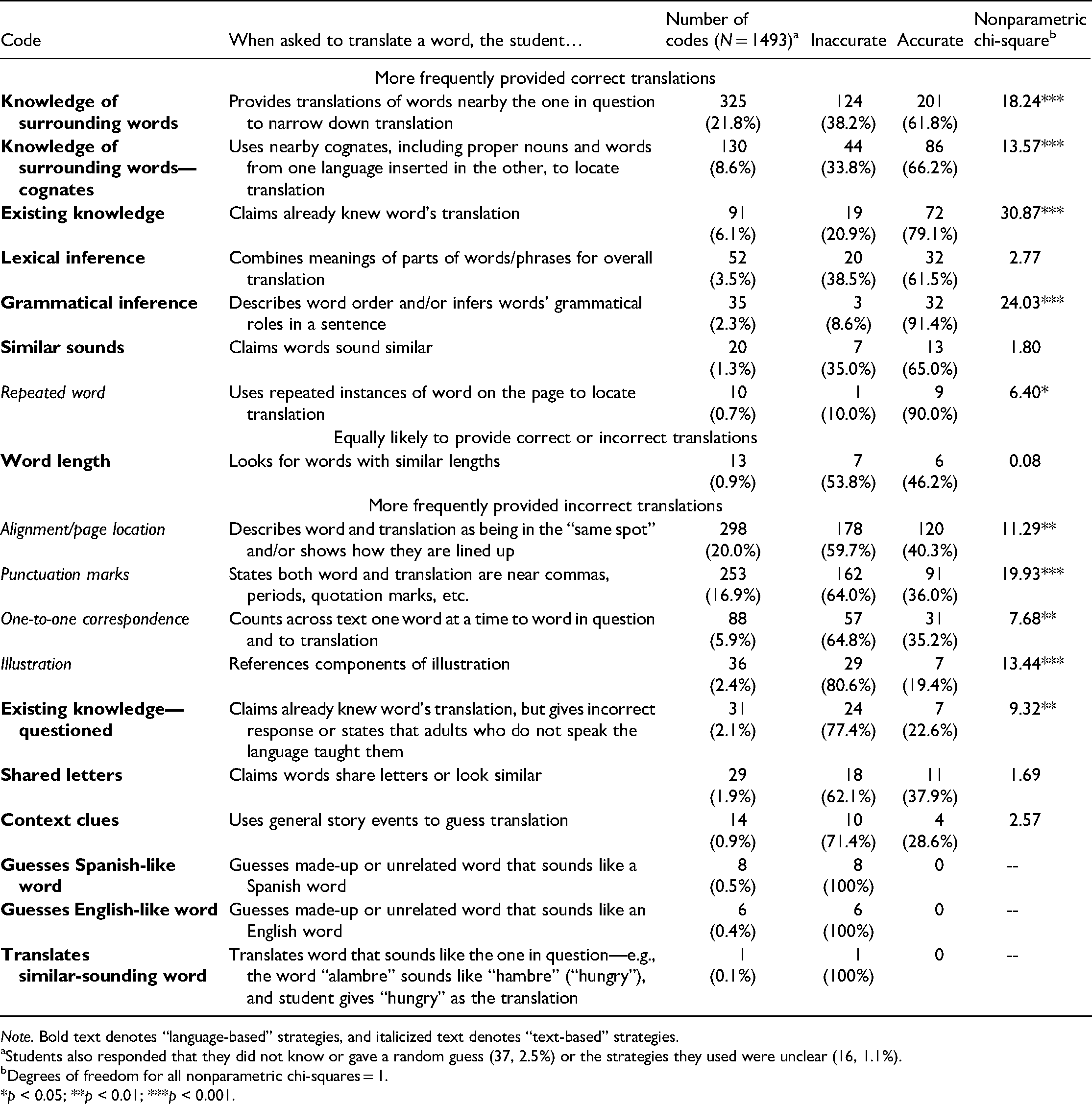
Note. Bold text denotes “language-based” strategies, and italicized text denotes “text-based” strategies.
Students also responded that they did not know or gave a random guess (37, 2.5%) or the strategies they used were unclear (16, 1.1%).
Degrees of freedom for all nonparametric chi-squares = 1.
*p < 0.05; **p < 0.01; ***p < 0.001.
The next three strategies accounted for 20% of the strategies: knowledge of surrounding words specifically using cognates, existing knowledge of the translation, and one-to-one correspondence. When children used one-to-one correspondence, they sometimes counted the words preceding or following the word they were asked to translate and then counted that same number of words in the other language to find the translation. They made one-to-one matches of words across languages, like third-grader Elijah, by saying and pointing to one word in each language at a time when he mistranslated “maybe” as “cometa”: Si Mamá no puede comprar una cometa
If Mamá can’t buy a kite maybe
(Klepeis, 2015). As children used this strategy, they did not recognize that one word may translate into multiple. In the example above, “can’t” translates to “no puede” and “maybe” to “tal vez.”
Less frequently, children made lexical inferences, accurately recognizing that words are not always translated literally. For example, fifth-grader Imelda translated “villagers” not solely as “gente” or “pueblo,” but as the full phrase “la gente del pueblo” because she said, “Village es pueblo. Luego villagers es como gente del pueblo” (“Village is pueblo. Then villagers is like people of the village/pueblo”). In addition, children occasionally relied on DLBs’ illustrations; on word characteristics such as letters, length, and sounds; and on their knowledge of story events or context clues. Children infrequently guessed unrelated Spanish/English words or invented Spanish-/English-sounding words.
When children relied on DLBs’ visual information to translate words, they used strategies that could be described as “text-based”—for example, strategies coded as alignment and punctuation marks (which together made up 37% of strategies), one-to-one correspondence, illustration, and repeated words. The remaining strategies suggested that children relied on their linguistic knowledge and could be termed “language-based.” For example, children relied on knowledge of surrounding words (the most frequently used, almost 22%), existing knowledge of words’ translations, and lexical inference. Children’s use of both text-based and language-based strategies illustrates how they drew upon their linguistic and semiotic repertoires, which reveals emerging assumptions of how languages work that in some cases were inaccurate.
As shown in Table 1, some language-based strategies were more effective than others. These strategies, such as making grammatical inferences and relying on existing knowledge of the word or of surrounding words, were statistically more likely to result in correct translations. When children relied on text-based strategies such as illustrations or visual properties of the text (e.g., general page location and punctuation marks), they more frequently provided inaccurate translations, often at statistically significant levels. Although text-based strategies could be helpful to home in on the text to translate, at times children relied on page location or punctuation marks over linguistic knowledge, such as when translating “thread” from the phrase “and there is no extra thread”/“y no hay hilo extra” (Marshall, 2016). Five of 31 third graders (16%) mistranslated “thread” as “extra” because it directly preceded the period, even though “extra” is a cognate with identical spelling in both languages. Similarly, 23 third and seven fifth graders (48% of children) translated “chido” from “¡qué proyecto más chido!”/“what a cool project!” (Klepeis, 2015) as “project” because both ended the sentence, thereby ignoring the cognate “proyecto”/“project.”
Research Question 2: Differences by Grade, Home Language(s), and Reading Accuracy
Grade level
Table 2 summarizes the statistically significant differences between third and fifth graders when asked to translate the target words. Although responding “I don’t know” is not a translation strategy, third graders were statistically more likely to provide this response. Third graders were also statistically more likely to rely on page location and one-to-one correspondence (two text-based strategies), as well as more superficial language-based strategies such as word length and claims of similar sounds. As previously illustrated in Table 1, these strategies (other than similar sounds) were more likely to result in inaccurate translations. In contrast, fifth graders were statistically more likely to rely on knowledge of surrounding words’ translations, word meanings, and story events (all language-based strategies) (see Table 2). These strategies, with the exception of context clues, were more likely to correspond with accurate translations (see Table 1).
Statistically Significant Differences in Translation Codes by Grade Level.
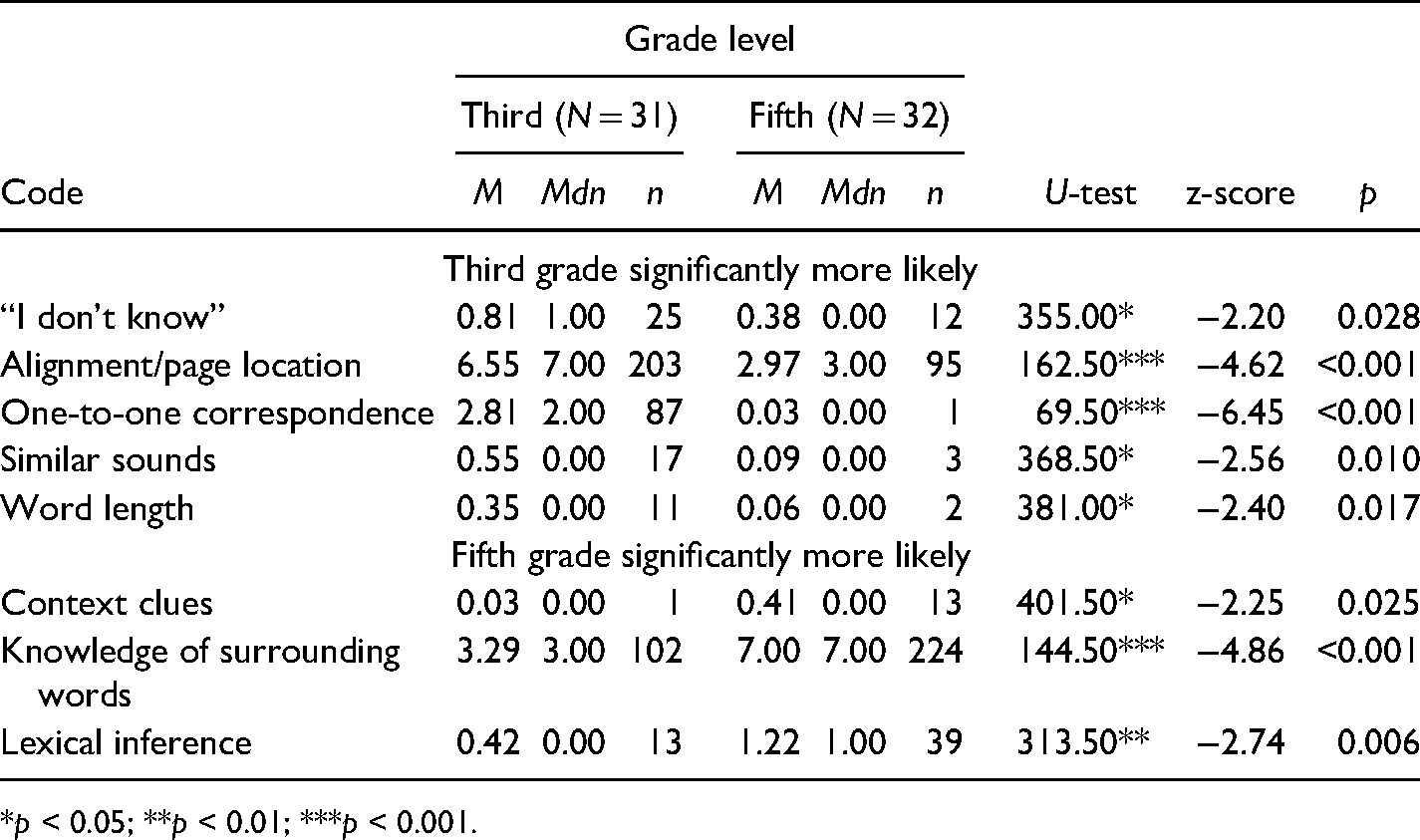
*p < 0.05; **p < 0.01; ***p < 0.001.
Home language(s)
Statistically significant differences in strategy use depending on home language(s) were fewer than those by grade level, possibly due to the relatively low number of participants speaking some Spanish at home (19 out of 63 students) and the fact that in interviews, no students described coming from Spanish monolingual homes. Unsurprisingly, it was statistically significant that children from homes with at least some Spanish spoken (M = 3.16, Mdn = 2.00) were more likely to rely on existing knowledge of translations than children from English monolingual homes (M = 0.70, Mdn = 1.00), U = 177.50, z-score = −3.81, p < 0.001.
In contrast, children from English-only homes (M = 4.48, Mdn = 4.50) were statistically more likely to use nearby punctuation marks than children from homes with some Spanish spoken (M = 2.95, Mdn = 3.00), U = 283.50, z-score = −2.03, p = 0.043. This finding suggests that children from English monolingual households may have relied more on punctuation to compensate for less practice with or exposure to Spanish.
Oral reading accuracy
To analyze differences by oral reading accuracy, I first correlated the percentage of times children used the seven most common translation strategies with children’s oral reading accuracy percentages for English and Spanish. As shown in Table 3, the majority of correlations were statistically significant but accounted for relatively little of the variance. However, the negative correlations illustrate that as oral reading accuracy in each language increased, children tended to rely less on alignment or page location, punctuation marks, and one-to-one correspondence, which were text-based strategies. They tended to rely more on knowledge of surrounding words (including cognates) and lexical inferences, which were language-based strategies.
Translation Codes and Oral Reading Accuracy: Correlations and Differences in Codes by Oral Reading Accuracy Scores in the First and Fourth Quartiles.
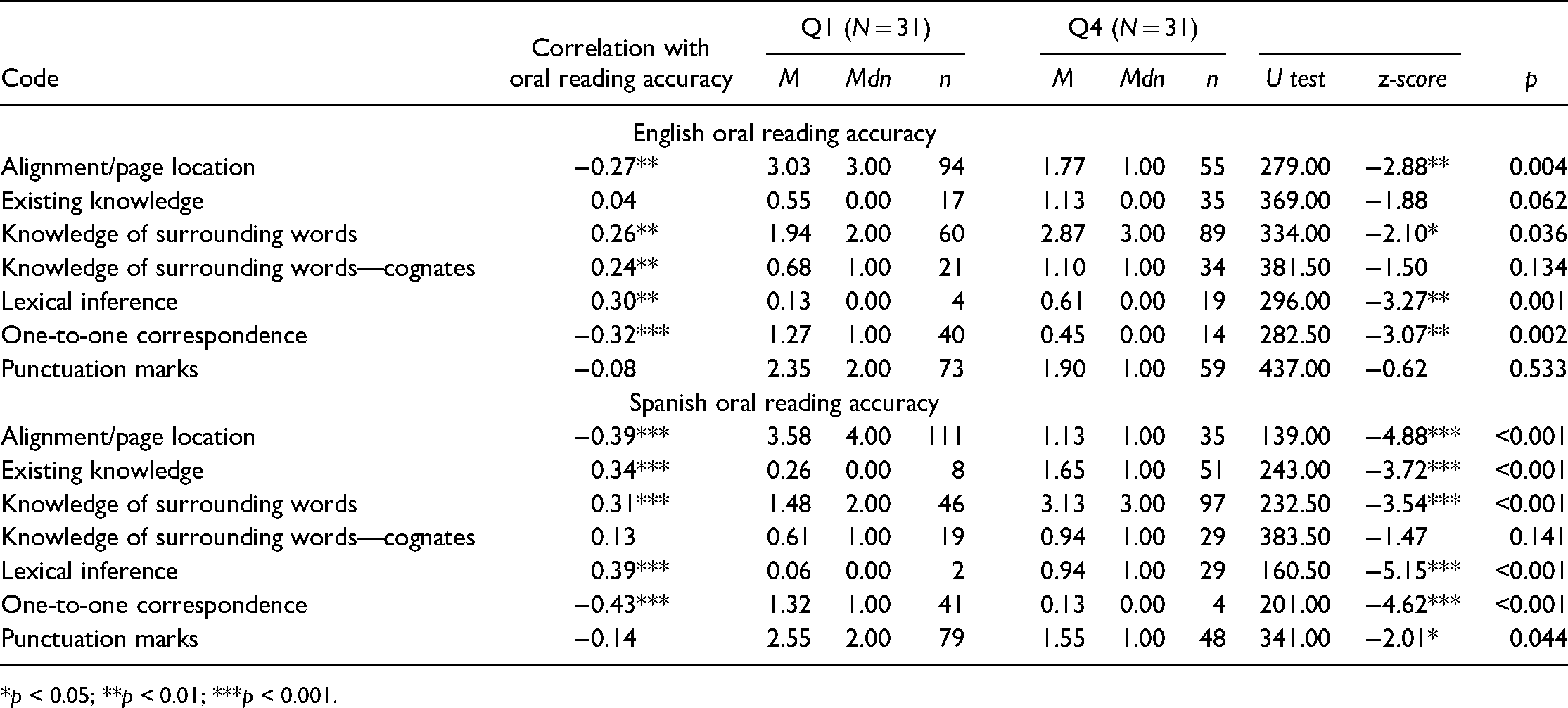
*p < 0.05; **p < 0.01; ***p < 0.001.
Second, I compared differences in the frequency of the seven most common translation strategies between children whose accuracy scores in each language were in the lowest quartile (Q1) versus the highest (Q4). Mann–Whitney U tests, also in Table 3, indicated multiple statistically significant differences in how frequently children used these translation strategies depending on oral reading accuracy. Differences in the frequency of using nearby cognates were not significant for accuracy in either language, and there was not a significant difference between whether children with low or high English oral reading accuracy used existing knowledge or punctuation marks. However, these two strategies had statistically significant differences for Spanish accuracy. Overall, the presence of many statistically significant differences indicates that children seemed to rely on different strategies depending on their oral reading accuracy. Children with lower accuracy scores (Q1) tended to rely on strategies that were text-based, whereas children with higher accuracy scores (Q4) tended to rely on strategies that were language-based.
These findings relate to those describing translation strategies by grade level. The majority of readings with oral reading accuracy scores in Q1 were by third graders (28 for English and 30 for Spanish). Conversely, most readings in Q4 were by fifth graders (20 for English and 26 for Spanish). Therefore, unsurprisingly, these findings seem to reinforce existing relationships between age and reading proficiency.
Discussion
Answering Research Question 1 and consistent with translanguaging theory (García & Li, 2014), this study found that bilingual third and fifth graders strategically used their linguistic repertoires—that is, they infrequently guessed random words—when translating. Instead, they mainly used strategies informed by developing knowledge of languages and semiotic textual features. For example, children used their knowledge of surrounding words’ translations (and of the word itself), made inferences about translations based on individual words’ meanings, and hypothesized that Spanish and English words may have similar sounds. In these and other instances, children relied on developing assumptions about how languages work and relate. Even when children inaccurately professed to know a translation or guessed an English-/Spanish-like word, they drew upon their idiolects, a central component of linguistic repertoires (Otheguy et al., 2015). This study’s findings contribute to the understanding of children’s developing Spanish–English metalinguistic knowledge in their idiolects.
Reflecting observations voiced by some U.K. primary teachers in prior scholarship (Multilingual Resources for Children Project, 1995), many readers in the current study assumed that translations were word-for-word replications. When they used text-based strategies such as one-to-one correspondence, alignment or page location, and punctuation marks, children were statistically more likely to provide inaccurate translations. Knowing specifically how children translate, as well as their linguistic assumptions, expands existing research that has established the existence of translation as a bilingual reading strategy (e.g., García & Godina, 2017; Jiménez et al., 1996). This study also adds to existing research (e.g., Thibeault & Matheson, 2020) by showing specifically how children refer to the translated language in DLBs when reading, and it provides insights into children’s development of metalinguistic knowledge with instructional implications.
Answering Research Question 2, this study found that the strategies third graders and those with lower oral reading accuracy used tended to be text-based. In contrast, fifth graders and those with higher oral reading accuracy tended to use strategies that were language-based. Group differences might be due to differences in reading or language proficiency and development. Prior studies (e.g., García & Godina, 2017; Jiménez et al., 1996) found that stronger readers more frequently used cognates and their bilingual linguistic knowledge when reading. The current study reinforced this conclusion and also showed that DLBs’ side-by-side positioning of translations did not seem to automatically trigger readers to compare and contrast languages. Instead, it seems children would benefit from instruction to develop and apply metalinguistic knowledge in multilingual contexts.
Considering the sociopolitical context of the RAND Model (RAND Reading Study Group, 2002), in this case, the two dual-language programs and their instruction, is important. Student interviews indicated very little or no experience reading DLBs at both schools, and informal conversations with teachers indicated that although they may have a DLB or two in their classroom libraries, they were rarely used. A limitation is that I did not conduct formal observations of classroom instruction. However, from my experiences with both programs, instruction was largely monolingual, other than spontaneous moments where teachers may make a connection across languages. Further, both programs provided supplemental English reading instruction for all students outside of the designated classroom English literacy block, but limited to no additional Spanish literacy support. Accountability pressures for high scores on English language state assessments affected instructional and programmatic decisions (e.g., Waterside’s decision to have a 50:50 versus a 90:10 program). These conditions could explain students’ higher oral reading accuracy scores in English and their emergent Spanish metalinguistic understandings.
Implications
The current study supplements existing studies of bilingual reading to illuminate how children specifically leverage their linguistic repertoires and semiotic knowledge while reading parallel texts in two languages. Further, in comparing how bilingual children of different ages and levels of oral reading accuracy translate while reading DLBs, this study begins to suggest a developmental trajectory for translation and biliteracy, which has been identified as a research need (e.g., Hopewell & Escamilla, 2014). Such a developmental trajectory has potential pedagogical implications to help teachers guide instructional practice. For example, knowing that younger children and those with low oral reading accuracy tend to rely on words’ general page locations, which often results in inaccurate translations, means teachers may want to focus instruction on comprehension, specifically guiding children to find and use known words to translate when reading DLBs, to draw on existing knowledge of topics, and to employ knowledge of how texts and languages work.
Findings from this study also reinforce scholarship rejecting monolingual mindsets that promote strict language separation within dual-language education (e.g., Cummins, 2007; Palmer et al., 2014). The current study found that even when presented with sentences containing cognates (including identical cognates), many children, especially third graders, relied on text features rather than linguistic knowledge, and they usually provided inaccurate translations. This reinforces previous findings that identifying cognates is not an innate bilingual ability and instead depends on age and reading proficiency (e.g., García & Godina, 2017; Genesee et al., 2008; Jiménez et al., 1996; Nagy et al., 1993). Because children benefit from cognate instruction (e.g., García, Sacco, et al., 2020), the current study and previous work highlight the need for dual-language programs to devote instructional time to developing cross-language connections and bilingual metalinguistic awareness.
One way to do this is for children to compare DLBs’ translations and discuss translators’ decisions. Children could also translate passages from a DLB and compare their translations with the text. Escamilla et al. (2014) emphasized that DLBs provide an opportunity for teachers “to show children explicitly how to make use of both their languages to comprehend and create texts” (p. 70). Jiménez et al. (e.g., Goodwin & Jiménez, 2016; Jiménez et al., 2015) found that exercises similar to the aforementioned built children’s metalinguistic awareness by drawing attention to word-order differences, cognates, and the nuanced nature of translation. These linguistic understandings can also support reading comprehension (e.g., Gottardo & Mueller, 2009; Jeon & Yamashita, 2014). Although DLBs are recommended to help children develop biliteracy, children seem to need instruction or support to make the most meaning from them.
Limitations
As previously noted, one study limitation is the lack of formal observations of classroom instruction to understand the extent of translingual strategy instruction, although informal experiences indicated generally monolingual instruction. Future research could investigate the effect of explicit translingual strategy instruction on students’ metalinguistic development and translation skills.
Another limitation is the unavailability of consistent language proficiency scores. Both schools used different measures to determine children’s reading levels in each language, and they did not use a measure of overall Spanish or English language proficiency. (For example, not all participants completed WIDA ACCESS testing, and third graders did not take state-mandated English reading assessments until spring, after data collection was complete.) Further, children did not complete a pre-assessment of the topic or vocabulary knowledge related to the words they were asked to translate. However, during verbal protocols, children could indicate whether translations were based on prior knowledge and experiences. Future studies might correlate language proficiency data or measures of background knowledge and topic interest with translation strategies.
In addition, although most DLB pages had one language directly above the other, a few pages spread the languages across two pages, and observations suggested that children often struggled locating translations in such cases. Further analyses should be conducted to determine the potential impacts of page layout on children’s translations when reading DLBs.
Finally, caution is warranted when interpreting the oral reading accuracy results. Although there were no statistically significant differences in the frequency of translation strategies between the schools and their differing dual-language programs, children at Armstrong, including those from English-speaking homes, had significantly higher Spanish oral reading fluency scores than similar children at Waterside—likely because they had received 2 additional years of Spanish reading instruction. However, programmatic differences reflect the range of dual-language program models across the country. In addition, all children’s oral reading accuracy scores were much higher in English than Spanish, with three-quarters of English accuracy scores but less than one-quarter of Spanish scores above 95%. Marked differences in oral reading accuracy between languages limit interpretation of how that factor relates to translation strategies and should be accounted for in future studies. Furthermore, differences in ranges of English and Spanish accuracies made it difficult to capture oral reading accuracy in more holistic terms consistent with translanguaging theory. Attempts to create bilingual oral reading accuracy categories yielded low group membership (n < 13), which made statistical analysis tenuous. Therefore, considering translation strategies in terms of bilingual oral reading accuracy could be a direction for future studies.
Final Considerations
This study found that as children age and develop stronger literacy skills, they tend to more frequently use translation strategies that are language-based and usually more accurate. However, children still seem to need explicit instruction to develop metalinguistic awareness and to more effectively use their linguistic knowledge when reading. Just asking children to read a DLB does not ensure they will accurately use the page’s languages to build bilingual vocabulary through translation. Instead, DLBs seem to offer excellent opportunities for teachers to provide explicit instruction in analyzing and comparing and contrasting how languages work and ideas are translated.
However, there is much to be done in this field as little is still known about how bilingual children comprehend connected texts (Jared, 2015). Therefore, it will be important to understand how children’s translation strategies correlate with overall story comprehension, as well as how children engage with DLBs when given full autonomy. Furthermore, the translation strategies in this study may not apply to languages more orthographically distant than English and Spanish. Bilinguals rely on varied information to decode depending on their home language’s orthography, and differences between languages’ orthographies account for differential rates of metalinguistic awareness (Koda, 2005)—making understanding how bilingual children translate while reading other languages important.
Finally, although translation is a natural way of making meaning and communicating, with more developed metalinguistic awareness, children seem to utilize their linguistic repertoires more accurately. Therefore, it will be important to investigate specific pedagogical strategies teachers can use to support children as they translate and read DLBs because as children’s metalinguistic knowledge grows, their biliteracy is likely to develop more. Strategic engagement with DLBs may play a role in achieving the benefits of being biliterate.
Supplemental Material
sj-docx-1-jlr-10.1177_1086296X221116854 - Supplemental material for Children Translating When Reading Dual-Language Books
Supplemental material, sj-docx-1-jlr-10.1177_1086296X221116854 for Children Translating When Reading Dual-Language Books by Lisa M. Domke in Journal of Literacy Research
Supplemental Material
sj-docx-2-jlr-10.1177_1086296X221116854 - Supplemental material for Children Translating When Reading Dual-Language Books
Supplemental material, sj-docx-2-jlr-10.1177_1086296X221116854 for Children Translating When Reading Dual-Language Books by Lisa M. Domke in Journal of Literacy Research
Supplemental Material
sj-docx-3-jlr-10.1177_1086296X221116854 - Supplemental material for Children Translating When Reading Dual-Language Books
Supplemental material, sj-docx-3-jlr-10.1177_1086296X221116854 for Children Translating When Reading Dual-Language Books by Lisa M. Domke in Journal of Literacy Research
Supplemental Material
sj-docx-4-jlr-10.1177_1086296X221116854 - Supplemental material for Children Translating When Reading Dual-Language Books
Supplemental material, sj-docx-4-jlr-10.1177_1086296X221116854 for Children Translating When Reading Dual-Language Books by Lisa M. Domke in Journal of Literacy Research
Supplemental Material
sj-docx-5-jlr-10.1177_1086296X221116854 - Supplemental material for Children Translating When Reading Dual-Language Books
Supplemental material, sj-docx-5-jlr-10.1177_1086296X221116854 for Children Translating When Reading Dual-Language Books by Lisa M. Domke in Journal of Literacy Research
Supplemental Material
sj-docx-6-jlr-10.1177_1086296X221116854 - Supplemental material for Children Translating When Reading Dual-Language Books
Supplemental material, sj-docx-6-jlr-10.1177_1086296X221116854 for Children Translating When Reading Dual-Language Books by Lisa M. Domke in Journal of Literacy Research
Supplemental Material
sj-docx-7-jlr-10.1177_1086296X221116854 - Supplemental material for Children Translating When Reading Dual-Language Books
Supplemental material, sj-docx-7-jlr-10.1177_1086296X221116854 for Children Translating When Reading Dual-Language Books by Lisa M. Domke in Journal of Literacy Research
Supplemental Material
sj-docx-8-jlr-10.1177_1086296X221116854 - Supplemental material for Children Translating When Reading Dual-Language Books
Supplemental material, sj-docx-8-jlr-10.1177_1086296X221116854 for Children Translating When Reading Dual-Language Books by Lisa M. Domke in Journal of Literacy Research
Supplemental Material
sj-docx-9-jlr-10.1177_1086296X221116854 - Supplemental material for Children Translating When Reading Dual-Language Books
Supplemental material, sj-docx-9-jlr-10.1177_1086296X221116854 for Children Translating When Reading Dual-Language Books by Lisa M. Domke in Journal of Literacy Research
Footnotes
Acknowledgments
I wish to thank Drs. Tanya Wright, Georgia García, and David Reinking for their time and feedback on multiple iterations of drafts. And I thank Dr. Eurydice Bauer for her help and Dr. Bong Gee Jang, the editors, anonymous reviewers, and my committee members for their feedback. All have made this work better. Any errors are my own.
Declaration of Conflicting Interests
The author declared no potential conflicts of interest with respect to the research, authorship, and/or publication of this article.
Funding
The author disclosed receipt of the following financial support for the research, authorship, and/or publication of this article. This work was supported by the Michigan State University Department of Teacher Education Research Dissertation Development Fellowship.

References
Supplementary Material
Please find the following supplemental material available below.
For Open Access articles published under a Creative Commons License, all supplemental material carries the same license as the article it is associated with.
For non-Open Access articles published, all supplemental material carries a non-exclusive license, and permission requests for re-use of supplemental material or any part of supplemental material shall be sent directly to the copyright owner as specified in the copyright notice associated with the article.
