




Abstract
A majority of U.S. states have established a “Seal of Biliteracy” (SoBL) to recognize students’ multilingualism. Primarily under the purview of bilingual and world language education, the field of literacy research has remained largely silent on these seals. Yet, the authority these seals grant to state institutions for credentialing literacy has substantial implications for literacy research. This study analyzes 23 states that established a SoBL through legislative action. Informed by the study of seals as an ancient literacy practice, we draw on policy and visual discourse analysis to analyze state laws alongside the visual seals themselves. Incorporating theories of whiteness as property, we examine dynamics of racial, linguistic, and educational privilege to put forth a framework of biliteracy as property. Although we laud the growing popularity of the SoBL, we also caution against ceding authority to the state to assess, award, and “authenticate” biliteracy as a form of property.
Recent years have seen a spike in states awarding a Seal of Biliteracy (henceforth SoBL). These seals, currently awarded in 39 U.S. states and Washington, DC, recognize students who demonstrate literacy in multiple languages upon graduation (Seal of Biliteracy, n.d.). Building off scholarship that has firmly established the myriad benefits of biliteracy (Bauer & Gort, 2012; Hopewell & Escamilla, 2014) as well as sustained advocacy from bilingual communities and educators, there has been a growing interest in establishing SoBL programming across the United States (Heineke & Davin, 2020). However, recent research suggests that students do not have equal access to the SoBL or its benefits, with white, English-dominant students of the upper and middle classes deriving disproportionate advantage in many contexts (Snyder, 2020; Subtirelu et al., 2019).
Thus, we argue that further examination is necessary to explain how such a hard-won victory as the SoBL can end up reinforcing existing power hierarchies and educational inequities. There is growing discussion around these seals in the fields of linguistics, modern languages, and bilingual education (e.g., Heineke & Davin, 2020; Schwedhelm & King, 2020; Subtirelu et al., 2019). Yet, the field of literacy research has been largely silent on the SoBL, even as the field becomes more and more characterized by the multilingualism increasingly present in classrooms. What's more, many SoBL policies cede significant authority to governmental entities to determine, award, and ultimately define what counts as literacy. Thus, the SoBL represents a seismic, yet underexplored shift with significant implications for literacy research.
We assert that this shift in authority is comparable to the state's historical role in the regulation of property. Through this piece, we introduce a framework of biliteracy as property. To develop this framework, we rely on two distinct but well-established fields of study. First, we draw on the historical study of sealing practices to examine seals themselves as one of the earliest forms of literacy. Research in this field documents the use of seals to designate property, ownership, and institutional authority across millennia (New, 2010). Second, we employ the critical race legal scholarship of Harris (1993) and her framework of whiteness as property. This seminal framework has been utilized in both legal and educational research to demonstrate how a seemingly intangible entity (such as racial privilege or the notion of literacy) can become established as property (Ladson-Billings & Tate, 1995; Prendergast, 2002).
To illustrate this framework, we examine laws from 23 states that have established the SoBL statewide through legislative action. We also analyze the depictions of the seals themselves through visual discourse analysis (Albers, 2007, 2014). Our inquiry was guided by the following research questions:
What legal criteria have states established for credentialing biliteracy through SoBL legislation? Due to the centrality of seals within such legislation, how is biliteracy represented in the visual depiction of the seals themselves?
Importantly, our purpose is not to undermine the significant gains the SoBL represents in regard to the recognition of biliteracy as an asset. Nor is our goal to document the specific implementation of the seals in individual state, district, or school contexts, as has already been done in a range of studies (e.g., Heineke & Davin, 2020; Schwedhelm & King, 2020; Snyder, 2020; Subtirelu et al., 2019). Instead, this article takes a step back from the specific implementation of the SoBL to analyze the legal and ideological foundations of the policies through which the seal has been established. This analysis demonstrates how ceding authority to the government to, quite literally, authenticate biliteracy must be approached with caution. We argue that the field of literacy research must ask what is gained and what is lost by ceding authority to the state to credential biliteracy—and by extension, literacy itself. It is our hope that a framework of biliteracy as property will help the field to productively engage with the growing popularization of the SoBL and broader bilingual approaches in literacy research.
Literature Review
U.S. Language Policy and Bilingualism
Throughout the history of U.S. education, there have been numerous attempts to regulate language use in schools and curricula. Yet, the majority of these policies have been geared toward the use and acquisition of English. Most educational histories point to the Bilingual Education Act of 1968 as the beginning of modern bilingual education as we understand it today. This act allocated federal funds for bilingual programming for students learning English as an additional language. However, later amendments and reauthorizations of this act reflected political opposition to the use of federal funds for preserving languages other than English (Crawford, 1999). These amendments framed the goal of bilingual education as transitional in that students should eventually be moved into English-only educational programming. A 1988 amendment, for example, limited participation in bilingual education programming to three years, and the 1994 reauthorization did include grant funding for programs that emphasized bilingualism, though these grants still prioritized programs focused on “develop[ing] proficiency in English,” with other languages emphasized only “to the extent possible” (Wiese & García, 1998, p. 9).
The federal No Child Left Behind Act (NCLB) of 2002 left states and local education agencies with the authority to choose whether to implement bilingual education programming. However, NCLB mandated standardized testing in English as the main, high-stakes evaluation criteria for students and schools. This policy (which remains under the present-day Every Student Succeeds Act, or ESSA) has posed significant barriers to bilingual education, linking designations of educational success or failure to English-only tests that do not account for students’ bilingual and biliterate competencies (García & Kleifgen, 2018).
As such, U.S. language policy has historically positioned English acquisition as the primary goal of education and the means through which students can demonstrate educational attainment. Through sustained advocacy by multilingual communities and the popularization of research demonstrating the myriad benefits of bilingualism (e.g., Bialystok, 2001), there are indications that this trend may be shifting, as evidenced by the growing demand for multilingual programs such as dual-language education (Thomas & Collier, 2019). Yet, in all this history of language regulation—and pendulum swings between promoting and restricting bilingualism—the introduction of the SoBL represents one of the first widespread attempts to specifically credential and regulate biliteracy in U.S. educational programming (Heineke & Davin, 2020).
Development of the SoBL
The SoBL began as a grassroots effort led by educators and language advocates to recognize the assets of bilingual students (Heineke et al., 2018). Although California passed the first SoBL legislation in 2012, the seal's history is rooted in the Chicano student walkouts of the 1970s and the Chacon-Moscone Bilingual-Bicultural Education Act of 1976, which proclaimed bilingual education as a right and required districts to provide broader educational opportunities for linguistically minoritized students. Bilingual education advocates continued to push back against anti-immigrant and English-only educational policies established across California, including voters’ passage of Proposition 227 in 1998, an English-only education policy that effectively banned bilingual education programming (McField, 2014).
Soon after Proposition 227 took effect, Californians Together, a statewide advocacy coalition, was formed to promote bilingual education policy. The coalition emphasized educational rigor with a focus on biliteracy, underscoring the benefits of two languages for all students (Olsen, 2020). After two failed attempts to pass SoBL legislation, California AB 815 was signed into law in 2011, positioning California as the first state to formally recognize biliteracy in 2012. Notably, however, California's English-only education policy (Proposition 227) remained in place through 2016. This set up a paradox in terms of who could actually qualify for the seal, since Proposition 227 had all but eliminated bilingual education programming for nearly two decades.
After the approval of California's SoBL, similar legislation spread rapidly throughout the 2010s. Many states modeled their SoBL policies directly after California's law (sometimes word for word). Thus, there began a shift from the SoBL's original development through grassroots advocacy to a more top-down model of transposing policy from one state to another. Although securing the passage of these laws still required a concerted effort from advocates and individual legislators, the process of legislating similar policies across multiple states meant that policy documents themselves came to exert increased influence as model legislation (see Uniform Law Commission, n.d.).
The Present State of the SoBL and Equity Concerns
As of 2020, 39 states and the District of Columbia had adopted the SoBL (Seal of Biliteracy, n.d.), representing an impressively expedient adoption across the majority of U.S. states in less than a decade. The growing popularity of SoBL programming has been positioned as a hopeful development, particularly in U.S. contexts where monolingual, English-only schooling has historically influenced education policies (Chang-Bacon, 2021). However, researchers have begun to more closely examine who has access to and who benefits from the seal. This research has led to questions about whether the SoBL is benefitting students as originally intended. Specifically, there is growing concern that SoBL laws and policies, which often include strategic framing to encourage their passage by lawmakers (e.g., emphasizing economic incentives, marketing for “all students”), may position English-dominant students as the award's primary beneficiaries. Approximately two-thirds of state SoBL policies do not specifically mention English learners in describing the purpose of the award (Heineke et al., 2018). Moreover, SoBL assessment policies also often require a higher bar for demonstrating proficiency in English than in the partner language, with students in some states able to fulfill partner language requirements by simply passing world-language courses, whereas official standardized tests are required to demonstrate English proficiency (see Schwedhelm & King, 2020; Subtirelu et al., 2019). Even when a standardized assessment of the partner language is required, Schwedhelm and King (2020) observed that these tests are often geared toward “the curricular content and context references experiences of English speakers learning the language through classroom study and study abroad” (p. 21), with some assessments even consisting primarily of questions and response items in English.
Additional research has begun to document the disproportionate availability of programs that prepare students to earn a SoBL in wealthier, majority-white districts. Subtirelu et al. (2019), for example, documented how California's SoBL policies diverged from their original intent to recognize the linguistic assets of multilingual students in immigrant communities toward promoting world-language education in English-dominant contexts instead. The authors further demonstrated that schools with high populations of students of color are less likely to have access to SoBL-oriented programming. Chávez-Moreno (2021) and Snyder (2020) researched these dynamics—both also drawing on the lens of whiteness as property—to demonstrate how various iterations of language-education policies reinforce and privilege whiteness through policy and programmatic discourse. In our own research (see Colomer & Chang-Bacon, 2020), we documented students’ keen awareness of these racialized dynamics. In interviews with SoBL graduates, both white students and Latinx students of color recognized the racialized dynamics of the opportunities derived from the seal, noting that white students received more societal recognition for bilingualism that was simply “expected” of Latinx students.
Such dynamics reflect a trend presently researched in the broader field of bilingual and dual-language education, which Valdez et al. (2016) have articulated as “gentrification,” wherein access to multilingual education programming is disproportionately afforded to more privileged groups of students (e.g., through dual-language or International Baccalaureate programming) than to the minoritized student populations for whom such programming was originally envisioned (also see Cervantes-Soon et al., 2017). Kelly (2018) and Morales and Maravilla (2019) have applied the concept of interest convergence, drawn from the field of critical race theory, to describe the growing popularity of dual-language and other forms of bilingual education. These scholars posit that the interests of bilingual immigrant communities advocating for heritage language education have intersected with those of a privileged, largely white, English-monolingual population seeking the increasingly documented benefits of bilingualism. The theory of interest convergence, however, posits that eventually the interests of these separate groups will again diverge, leaving power relations largely unchanged as the privileged status of the more powerful group continues to advance. As demonstrated by the studies reviewed above, research on the SoBL is beginning to show the results of these divergences, and the consequences for minoritized students.
Overall, while the SoBL represents a promising innovation for bilingual education, the reviewed research suggests that a closer look is warranted. In particular, the SoBL provides a generative context through which to examine the commodification and propertization of biliteracy, and by extension, literacy itself. Although previous research has been productive in documenting inequalities that may arise around SoBL programming, we argue that further theoretical examination is necessary to explore the underlying dynamics of literacy, power, and propertization that inform these outcomes. The SoBL has been a long-sought victory for bilingual education advocates. As such, the field needs to further interrogate how such well-intentioned policies are so often appropriated to reinforce existing power hierarchies. We explore these dynamics through the theoretical lens of biliteracy as property, which we outline below.
Theoretical Framework: Biliteracy as Property
Seals, Literacy, and Property
Given the historical relationship between literacy, power, and sealing practices, the very notion of a “seal” becomes an object of analysis. Seals, in fact, represent one of the earliest forms of literacy (New, 2010). Before widespread literacy, seals also served as a bridge between literate and nonliterate individuals, as a “harbinger of literacy” (Clanchy, 1993, p. 317) to facilitate document authentication and contract negotiation. The field of sigillography, the study of seals, has documented the historical use of seals to authenticate records, validate imperial decrees, or identify family or group affiliations since ancient times (McEwan, 2018; Nesbitt, 2008). However, in addition to mere purposes of identification, intricate labor went into designing and crafting seals with elaborate designs to communicate particular messages. Thus “reading” a seal is not simply a matter of matching a symbol with its owner, but also invoking inferences about the influence, power, and authority of the individual or institution signified through the seal.
The use of seals continues today, from the authentication of credentials to branding through corporate logos (even the term “branding” etymologically derives from “burning” a seal into an object to denote ownership). Across these cases, the seal is used to designate purchase, value, or right of use for a traded commodity. As in ancient times, the act of sealing communicates an elevated level of authority or authenticity to a document or object (Tymoczko, 2004). The receiver of such an item enters into a power relationship with the awarding entity in which the receiver acknowledges its authority and is thus able to wield some degree of that entity's authority through possession of the seal. This relationship is exemplified in a literal way through the use of currency, wherein a seal authorizes a piece of paper or metal to be used in state-sanctioned exchange for material goods or services. A similar relationship exists through credentialing—an authenticated diploma, certificate, or transcript allowing access to particular professions or higher wages.
In addition, and most importantly for this study, seals have been used to establish and authenticate the ownership of property. Since ancient times, seals have marked goods as property of individuals or institutions and are even thought to have played a significant role in establishing the notion of private property in formerly communal societies (Duistermaat, 2010). Before widespread literacy, individuals used personal or family seals to legitimize the sale of property in a variety of cultural contexts (Shiraishi, 1957). Although the use of a personal seal has largely been replaced by signatures today (Tymoczko, 2004), the use of seals to denote personal, corporate, or government property continues to exert significant influence in the modern era (Prucha, 2000). In particular, we note the function of seals in the process of propertization—the means by which an entity becomes objectified as having material, transferrable value. Propertization, in this regard, has played a key role in promoting Western notions of ownership through the continued project of settler colonialism (see Tuck & Yang, 2012). It is essential, therefore, to regard sealing practices in their potential not only to denote or establish notions of possession but also to be wielded for the purposes of exploitation or dispossession. This continued relationship between sealing practices as a form of literacy and the invocation of power and property informs our use of property frameworks as the theoretical foundation of this study.
Whiteness as Property
Although the notion of property is often understood to represent tangible material entities such as land or traded goods, scholars in recent decades have begun to take a broader view of property. In particular, this article recognizes the seminal contribution of Harris's (1993) framework of whiteness as property. Harris's (1993) framing of whiteness as property laid out specific functions of whiteness as property, which include:
rights of disposition that render property as alienable (i.e., transferrable); rights to use and enjoyment, which entitle individuals to utilize and to profit from property in both tangible and intangible ways; reputation and status property, which allow legal standing in cases of libel or slander where reputation or status are presumably damaged; and the absolute right to exclude, which includes the legal standing to “define” who has, or has access to, a specific form of property—particularly through the racialization of certain bodies as othered to thereby exclude them from the legal affordances of whiteness.
We argue that, like whiteness, biliteracy can be rendered as property through laws, policies, and ideologies. Furthermore, the racialized privilege documented in the reviewed literature on the SoBL compels us to use an explicitly race-intentional framework. Still, it remains important to acknowledge that Harris's framework was designed to examine the foundations of anti-Blackness and whiteness, specifically. Thus, we cannot claim that this study represents a precise “application” of Harris's framework, nor is our intention to draw a false equivalence between biliteracy and whiteness. We do, however, wish to recognize Harris's pioneering scholarship on the notion of propertization and to acknowledge its intellectual influence on our framework.
Biliteracy as Property
Educational scholars have previously applied Harris's (1993) notion of racialized property to literacy and to education more broadly. Prendergast (2002) explored the notion of literacy as property in Supreme Court desegregation cases, theorizing an “economy of literacy” (p. 206) that fueled the devaluation of public education after court-mandated desegregation. “In the economy of literacy as White property,” Prendergast (2002) argued, “once previously segregated racialized groups were granted [access to] one literacy environment, that environment was denigrated to lower its value” (p. 211). Ladson-Billings (2003) also applied the notion of literacy as property to racialized histories of access and ownership in education. “Literacy represents a form of property,” Ladson-Billings (2003) wrote. “It is a property that traditionally was ‘owned’ and ‘used’ by whites in the society” (p. ix).
Although such scholarship has been foundational to the introduction of property frameworks into educational and literacy research, we note a key difference between previous uses of literacy as property and our present framing of biliteracy as property: In contrast to both Prendergast's and Ladson-Billings's framing of literacy, bilingualism and biliteracy are not traditionally associated with whiteness, white use, or white ownership. In U.S. contexts, bilingualism has been historically othered, indexed as “foreign,” and associated with minoritized communities of color (Flores & Rosa, 2019; Katznelson & Bernstein, 2017; Ladson-Billings & Tate, 1995). Thus, we argue that biliteracy as property facilitates a different form of propertization: not the hoarding of property, as has traditionally been the case with literacy and education in general, but the transfer of property—from bilingual practices traditionally associated with minoritized spaces to biliteracy as an elite resource. In other words, rather than a preservation of existing privilege—as with previous frameworks of property—the SoBL provides a pathway for the transference of biliteracy as property from marginalized to more privileged social locations. Since curricular standards and high-stakes testing requirements are often understood as means by which an elite knowledge base is reproduced and reaffirmed (Schiro, 2013), the directionality of this transfer through the SoBL (from marginalized to privileged spaces rather than vice versa) demonstrates a distinction between biliteracy as property and other credentials awarded by state or private entities (e.g., diplomas, collegiate entrance exam rankings).
Although we certainly do not argue that the neoliberal commodification of education is necessarily “new” (see Apple, 2018), we do contend that the SoBL provides a unique case in the directionality of this commodification from marginalized to elite spaces. Furthermore, the present and somewhat rapid spread of SoBL offers an opportunity to document how this commodification occurs in real time. This is, we believe, an opportune moment for the field to examine more closely the process by which a previously community-oriented resource becomes established as property in real time. The purpose of our analysis is not to make definitive claims on whether this regulation is “good” or “bad.” We instead focus on documenting the process by which this propertization is occurring, discussing both what is gained and what may be lost by establishing biliteracy as property. The SoBL may still hold potential for its original intent of affirming the linguistic practices of minoritized bilingual youth. Yet, the realization of this vision will require vigilance toward the racialized dynamics of biliteracy as property, which we explore through the following methods.
Methods
Our analytical approach was informed by Altheide and Schneider's (2013) qualitative media analysis. We selected Altheide and Schneider's method for its systematic approach to collecting and analyzing policy documents with special attention to discursive and thematic framing—notions that aligned with our research questions and theoretical frame. This approach involved analyzing how policies were framed (i.e., what problem does the policy address and how), themes common across multiple policy documents (i.e., recurring topics), and discourses within the policy itself that described how the policy is to be implemented. In addition, although the SoBL policies themselves vary state to state, they are all organized around the central notion of a “seal.” We therefore analyzed how biliteracy was visually framed and depicted through the seals themselves to complement our policy analysis through visual discourse analysis (Albers, 2007, 2014). This combined analysis offered multiple angles through which to explore the dynamics of biliteracy as property. Below, we offer a detailed outline of our data collection and analysis procedures.
Data Collection
In order to focus our analysis on the relationship between the SoBL and the legal authority of the state, we limited our study to states that established the SoBL through official statewide legislation (n = 23). In these cases, SoBL legislation and awardance criteria were voted on and approved by elected state legislators (see Table 1). We did not include states in which the SoBL was established by individual districts or state boards of education, nor did we include states with legislation that simply directed the board of education to establish the seal (i.e., in which the legislation did not include actual awardance criteria). From each state in our sample, we obtained two data sources from publicly available online state archives and national biliteracy resources (e.g., sealofbiliteracy.org): (a) the relevant state law establishing the SoBL and (b) a visual depiction of each state's SoBL.
State Seals of Biliteracy by Date of Establishment.
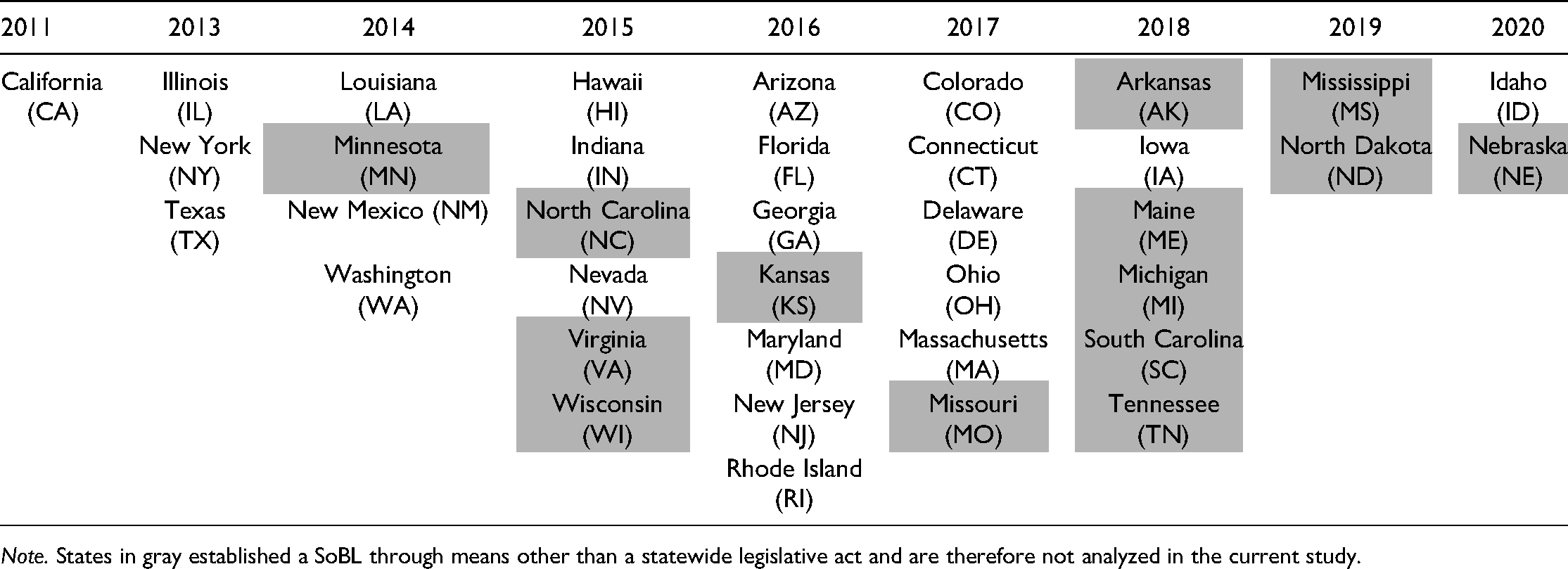
Note. States in gray established a SoBL through means other than a statewide legislative act and are therefore not analyzed in the current study.
Data Analysis
Part 1: Legal document analysis
Our operationalization of Altheide and Schneider's (2013) approach involved the following steps. First, we organized laws by state. Then, in order to delineate themes that were salient to our theoretical framework and research questions, we tracked specific statements from each law related to four categories: (a) definition of the seal (e.g., “The seal of biliteracy is…”); (b) stated purpose of the seal (e.g., “The purpose of the seal is to…”); (c) eligibility criteria (i.e., requirements to earn the seal); and (d) any specific definition of bilingualism, biliteracy, or multilingualism that may have been included. The second stage of analysis called for an inductive approach to coding where we tracked specific frames, themes, and discourses within each of these four categories (Altheide & Schneider, 2013). Frames denoted broad conceptual categories (e.g., biliteracy as economically beneficial, standardized assessments as reliable indicators of biliteracy), themes encapsulated particular topics addressed (e.g., stated benefits of biliteracy, steps to obtain the seal), and discourses represented the specific terminology or phrasing used within the policy (e.g., describing languages other than English as “foreign”). Through this process, we were able to highlight similarities and differences in how these state laws framed the SoBL and the metaphors they used to describe and operationalize biliteracy as an awardable form of property.
Part 2: Visual discourse analysis
Visual discourse analysis addresses the use of imagery within the seals themselves. Critical perspectives are a key component of visual discourse analysis, allowing analysts to identify various power dynamics that are instantiated through visual representation (Hodge & Kress, 1988). Moreover, visual texts illustrate “the visual text maker's beliefs about who has and to what extent someone has power by what they include or do not include, how objects in the visual text are structured, and what social meaning objects have taken on” (Albers, 2007, p. 86). To conduct this analysis, we applied Albers's (2014) visual discourse analysis approach to the seals themselves. We documented the different types of objects and images included within the seals from each state in our sample (e.g., flags, books, state outlines). We then typified recurrent symbols and visual metaphors that were present across multiple state seals (e.g., objects denoting literacy, replication of state symbols, maps denoting global or national presence). Reading these visual metaphors through our theoretical lens of biliteracy as property, we tracked how these visual metaphors reinforced or contrasted findings from the legal analysis in Part 1. In comparing the findings of the visual analysis with the policy findings, we juxtaposed themes prioritized within the SoBL laws with recurrences in the symbolism used on seals themselves. This juxtaposition informed our analysis of how the SoBL supports and upholds the notion of biliteracy as property, which we illustrate in detail through our findings below. We begin by reporting our analysis of state SoBL laws in Part 1, then discuss the visual analysis in Part 2. In the discussion section, we explore further the implications of biliteracy as property, describing both the promises and the perils of a state-awarded SoBL for the fields of bilingual education and literacy research writ large.
Visual Seal Analysis.
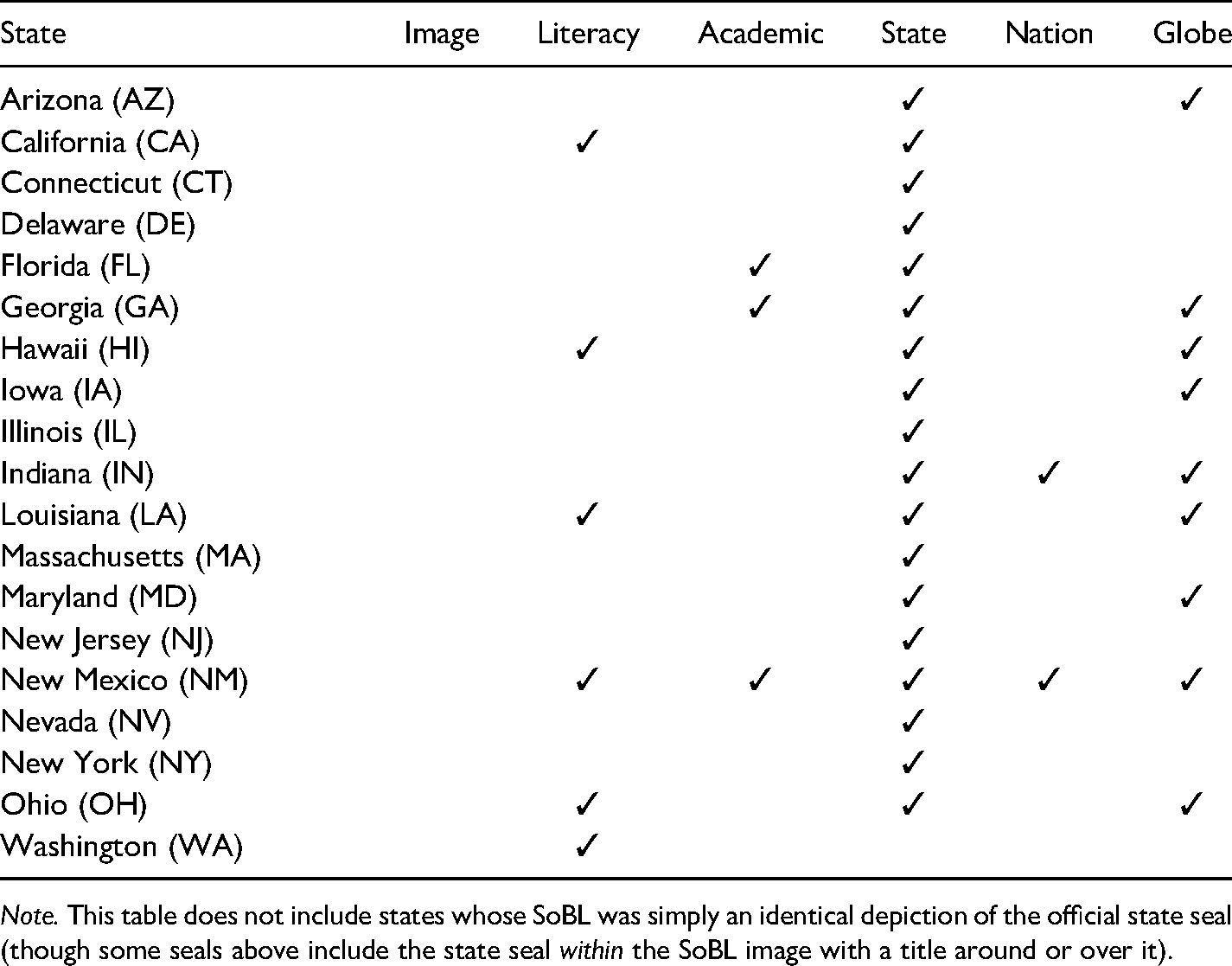
Note. This table does not include states whose SoBL was simply an identical depiction of the official state seal (though some seals above include the state seal within the SoBL image with a title around or over it).
Findings
Part 1: The Legal Construction of Biliteracy (Policy Discourse Analysis)
In this section, we address our first research question: What legal criteria have states established for credentialing biliteracy through SoBL legislation? To document the framing of biliteracy as property within these laws, we specifically analyzed the purpose and awarding criteria for the SoBL as described within each piece of legislation. Based on this analysis, we highlight three themes: property valuation, property procurement, and property assessment.
Property valuation
A key feature of propertization is that an entity must come to be perceived as having objectified value, monetary or otherwise (Tuck & Yang, 2012). The state biliteracy laws we analyzed often began with a preamble stating the purpose and valuation of biliteracy in this regard. For example, the preamble of the original California biliteracy law established a key purpose of the SoBL as “[to] affirm the value of diversity, honor multiple cultures and foreign languages, and strengthen the relationships between multiple cultures in a community” (CA, 2011; see Appendix for all legal document references). A number of states have since incorporated this exact wording into their own biliteracy laws, with many states adopting a nearly identical preamble, establishing the same valuation of diversity, culture, foreign language, and community core to the SoBL.
After these initial statements, state preambles generally shifted to articulating the value of the SoBL in regard to local business and economic activity. Preambles often included similar language around hiring practices, asserting the SoBL would function to “provide employers with a method of identifying an individual with biliteracy skills who is seeking employment,” (CA, 2011). As such, the SoBL was framed as a credential by which to aid employers in the search for properly credentialed workers.
In other cases, the economic valuation of the SoBL was applied beyond specific employers, positioned as a value to the state economy as a whole. Delaware, for example, justified its SoBL law as follows: Proficiency in world languages is crucial for the state to maintain and strengthen its domestic economy and that its graduates who have advanced level language skills have an economic edge in the multilingual and multicultural workforce of the 21st century. (DE, 2017; emphasis added)
As exemplified above, biliteracy is positioned as having value specific to the economic advancement of the state. It is acknowledged that biliteracy will be economically advantageous for graduates themselves through their employment, but this value is subsequently linked back to befitting the state workforce.
SoBL laws in Louisiana (2014), Washington (2014), and New Jersey (2016) all elevated this valuation to a national scale, identically asserting that “the study of foreign languages…should be encouraged because it contributes to a student's cognitive development and to the national economy and security.” Here, the student benefits of language study are acknowledged (as cognitive development), then immediately tied back to the national economy. Also notable within such examples are specific references to national security. These references link the value of the SoBL to encouraging “foreign” language study, which has long been positioned as a matter of military necessity in U.S. educational policy (Pavlenko, 2003). Although the national security value of the SoBL was not emphasized in legislation to the same degree as economic value, it is noteworthy that the laws themselves set up a key tension within the valuation of the seal: the aspirational goals of “strengthen[ing] the relationships between multiple cultures” (CA, 2011) coexisting with the framing of the seal as a matter of “national security” in regard to “foreign” entities.
Property procurement
A second theme in the legal discourse around the SoBL is bilingualism as an attainable commodity that can be procured—primarily through schooling. The original California law established the purpose of the SoBL as “certif[ying] attainment of a high level of proficiency by a graduating high school pupil in one or more languages, in addition to English” (CA, 2011; emphasis added). One result of this framing is to position the SoBL as an award for a presumably monolingual audience. The very notion of attainment frames bilingualism as an addition to existing monolingual language practices (Colomer & Chang-Bacon, 2020). This is most notable in the states that specify one purpose of the SoBL being to “encourage students to study foreign languages” (CA, 2011; emphasis added). The need to encourage the “study” of these languages suggests the envisioned awardees may not necessarily engage with languages other than English outside of school. This frames biliteracy as primarily school-attained, overlooking prior lived experience of bilingualism and biliteracy outside of formal schooling (Gort, 2012). Such discourse is coupled with the recurring denotation of languages other than English as “foreign,” which further excludes heritage learning of languages commonly spoken across the United States or the use of languages indigenous to North America.
The second result of this procurement-oriented framing is the legal establishment of biliteracy as an objectified commodity that can be possessed in the first place. Terms such as “attainment” in relation to biliteracy not only foreclose the existence of students who may already know these languages, they also frame biliteracy as an individual “achievement” (LA, 2014). Far from mere happenstance, this objectification is necessary for constructing biliteracy as an awardable commodity to be earned, and thus regulated by the state as tangible, alienable property (Tuck & Yang, 2012).
Although the framing of biliteracy as procurement was common in SoBL policies, it was not ubiquitous. New Mexico's SoBL law, for example, contained a subtle discursive shift that allowed for the preexistence of bilingual competencies, stating that “the SoBL certifies that the recipient is proficient for meaningful use in college, a career or to meet a local community language need in a world language other than English” (NM, 2014; emphasis added). The notion that a student may be (rather than become) proficient in multiple languages allows for the possibility of a student arriving in school with this proficiency. This framing positions biliteracy not solely as a school-based skill to be attained through study but instead acknowledges the possibility of students’ existing biliteracy. Such knowledge may, of course, be extended through study. However, recognizing the possibility of preexisting biliteracy upholds the notion that bilingualism and biliteracy can and do exist beyond the purview of schools and SoBL credentials. Such a discursive shift, though minor, demonstrates that the property procurement logics commonly used in SoBL policies can indeed be avoided for a more inclusive policy.
Property assessment
A third aspect of the legal documentation of biliteracy as property involves assessing value. The notion of property assessment is common in law through the evaluation of property for buying, selling, or tax purposes (Duistermaat, 2010; Tymoczko, 2004). Thus, putting forth a set of standards by which to assess biliteracy is a key aspect of its propertization.
In all existing state laws establishing a SoBL, the seal could (and in many cases could only) be awarded “as evidenced by [students’] performance on a state board approved assessment” (AZ, 2016). Oftentimes, state laws even detailed a specific score on a particular assessment, such as “passing the California Standards Test in English language arts administered in grade 11 at the proficient level or above” (CA, 2011). Although many laws permit districts or education boards to choose a particular assessment, all still mandate that an assessment is given. These laws necessitate assessments for both the partner language as well as English, though, as previously discussed, the standards demonstrating English proficiency are often higher than those of the partner language (see Schwedhelm & King, 2020; Subtirelu et al., 2019). Such discrepancies put English-dominant students at an advantage for receiving the SoBL, but also send a message about the assessed valuation of the partner language in relation to English—the partner language being property that is, quite literally, assessed at a lower value than English.
Within the general logic of property assessment, property that is not assessable cannot hold awardable value. Thus, in some cases, SoBL laws that mandate tests have increased the demand for language assessments. Standardized tests are widely available for a number of languages more commonly taught in U.S. schools (e.g., Spanish, French, Mandarin). However, to provide access to the seal for students who speak or are learning languages taught less often (e.g., Czech, Lithuanian, Tagalog), some jurisdictions have been compelled to hastily establish or procure standardized tests for these languages (see Borowczyk, 2020). In this way, existing state SoBL laws establish a symbiotic relationship between the SoBL and standardized language assessments: For a student to receive the SoBL, a standardized test must be developed and made available, often through purchase from an established assessment provider. Paradoxically, at a time of global pushback against standardized testing (Apple, 2018; McNeil, 2000), SoBL laws compel advocates to campaign for the additional standardized testing to allow students to receive the SoBL for less commonly assessed languages.
Legal analysis summary
Our analysis underscores three key ways that SoBL laws further biliteracy as property:
Biliteracy is ascribed an economic value, particularly in relation to the state economy and national security. Biliteracy is constructed as an objectified commodity that can be attained or procured (primarily geared toward a monolingual audience). Biliteracy as property is legally bound to assessment.
Importantly, the SoBL certainly does not represent the first attempt to legislatively regulate student language use or the education of bilingual learners in U.S. contexts (see McField, 2014; Wiley, 2017), but again, these regulations have historically focused primarily on monitoring the acquisition and use of English. Our analysis, therefore, illustrates a related, yet distinct, trend in education whereby bilingualism and biliteracy are becoming increasingly regulated. Below, we explore the furtherance of such notions within the visual representation of the seals themselves.
Part 2: The Symbolic Construction of Biliteracy (Visual Discourse Analysis)
In this section, we turn to our second research question: How is biliteracy represented in the visual depiction of the seals themselves? Crucially, we do not argue that a causal relationship necessarily exists between a visual depiction and how a law is implemented. However, our methodological framework of visual discourse analysis underscores the importance of the messages communicated through visual semiotics (Albers, 2007, 2014; Hodge & Kress, 1988). Moreover, as research has established in the field of sigillography, seals have historically been designed specifically to convey particular messages around power and authority (Clanchy, 1993; New, 2010). We therefore augment our legal analysis above with a “reading” of seals from the states whose SoBL laws were analyzed for this study. We examine both written words and visual imagery depicted on states’ biliteracy seals, emphasizing how the images are structured to bring particular emphasis to certain objects or themes (see Table 2). In the following section, we highlight three themes that address how biliteracy was signified within the seals themselves: language deemphasized, centrality of the state, and global preeminence.
Language deemphasized
Since the SoBL is described primarily as an award credentialing students’ linguistic abilities (Seal of Biliteracy, n.d.), we tracked both wording and imagery representing literacy or language on the seals themselves. Such representations included the wording and titling of seals, as well as symbolism that depicted language, literacy, or academic study. In regard to wording, the only words present on the seals were usually the titling of the seal or state itself (e.g., “Seal of Biliteracy,” “State of…,” “Dept. of Education”). There were minor exceptions to this trend: The Washington seal included the word “Literacy” and the Indiana seal contained both “Language” and “Literacy.” The general scarcity of wording on the seals is consistent with sealing practices, which generally prioritize imagery over text (Nesbitt, 2008). Nevertheless, it became notable that nearly all seals were titled exclusively in English. Some seals that replicated the official seal of the state included a state motto in Latin. However, Hawaii's SoBL, which included titling in both English and Hawaiian, was the sole instance of a seal that depicted a contemporary language other than English. (It is also noteworthy that Hawaii's was the only policy we analyzed where students could demonstrate proficiency in either of the state's two official languages, English and Hawaiian, plus an additional language to receive the SoBL.)
From our analysis of imagery, somewhat surprisingly, very few seals included any symbolism related to language or literacy at all. Images reflecting language or literacy (e.g., reading/writing, listening/speaking, digital literacies) appeared in only five seals (CA, HI, LA, NM, OH). Where New Mexico portrayed biliteracy skills with three speaking multiracial silhouettes, all other languages and literacy skills were represented with static images (i.e., book, pencil, speaking bubble). The Ohio SoBL alone had a symbol of digital literacy (a computer). Three other seals included graduation caps (GA, FL, NM), a likely reference to the seals’ affixation to diplomas upon graduation. All other seals we analyzed were devoid of any representation of literacy, academics, or language in use. The paucity of actual language use depicted on seals that ostensibly credential such languaging was noteworthy in its symbolic decentering of literacy and language within SoBL imagery. Far more common, as we explore below, were symbols representative of the state, nation, or global preeminence.
State centrality
All but one of the seals we analyzed (WA) included imagery or wording representative of their respective state. Nearly half of the seals analyzed (n = 10) included an outline of the state territory (a quite literal depiction of property), with the remaining seals containing some form of imagery or text related to the state, including official state seals, or icons/mottos derived from the state flag. The size and positioning of these images varied across seals; in some cases, more than one state symbol was visible on an individual SoBL. Nevada included the phrase “Battle Born,” borrowed from the state's flag. Georgia adapted the letter “G” in the title of the state to signify a peach, the official state fruit. In multiple cases, state SoBLs mirrored their respective state seals, as they were visually one and the same, with the term “biliteracy” (e.g., IL, NY) or “multiliteracy” (i.e., DE) being the only differential feature. Five of the states analyzed did not appear to have designed a unique statewide seal for the SoBL (CO, ID, NY, RI, TX) and instead either had local districts create their own seals or simply used the official seal of the state (note that we do not depict these non-SoBL-specific seals in Table 2). As such, the visual centrality of the state generally overshadowed or wholly supplanted imagery related to language or literacy across most state seals.
Global preeminence
In addition to state iconography, seals also drew on global symbols, such as globes, world maps, or latitude and longitude lines. These symbols were combined to suggest the preeminence of the state in relation to the broader globe. Iowa, for example, emblazoned a silhouette of the state across a globe latticed by a grid of navigational lines. Louisiana's seal depicts a globe “rising” out of an open book—biliteracy paired with an “opening up” of access to the world. Maryland showed the colors and symbols of its state flag spreading across the land masses of the western hemisphere, in an image reminiscent of global conquest. Similarly, Arizona depicted an outline of the state and its flag imagery over the continent of North America. Indiana appears to be syphoning “language” and “literacy” from across the western hemisphere into an enlarged outline of the state's territory on a U.S. map. Hawaii took a different approach by nestling a globe and a book next to the silhouette of the state, ostensibly “gathering” a worldly presence into the state through biliteracy.
Striking across these images is recurrent symbolism of the SoBL granting various forms of global access for the state. The centrality of global imagery and states dominating or spreading across these cartographies visually suggests a growing global recognition of, and power for, the state in question—suggesting a form of “manifest destiny” through language. In this way, the seals depicted not only actual property (e.g., state territory lines) but also access to additional property (e.g., biliteracy “opening up” the globe) for the state.
Visual analysis summary
Notable across the visual analysis was the consistency with which property, state centrality, and global preeminence were represented across the seals. This recurrence becomes particularly salient when juxtaposed with the scarcity of imagery related to language, literacy, or any form of academic study. This imbalance of symbolism suggests additional messages about the purpose, definition, and signification of biliteracy within and across SoBL policies. In this way, the visual representations of the seals extend the findings of the analysis of SoBL policies in Part 1—biliteracy and language use itself are downplayed, while benefits to the state, as well as state authority itself, are reinforced. Below, we explore the implications of our findings from both policy and visual representations in regard to the SoBL and its future implementation.
Discussion
In studying the history of contract law, Tymoczko (2004) documented the declining use of seals to facilitate property exchange in recent centuries. As increasing access to literacy resulted in personal signatures replacing seals as authoritative markings, exchanges of property between two individuals (i.e., those unsanctioned by the state) became less legally binding. As Tymoczko (2004) explained, The disappearance of the [family] legal seal brought with it a change in the law restricting the ability of an individual to create a binding personal legal obligation. The inability to freely create such a legal obligation also resulted in the inability to freely transfer property…. Unlike the classical seal, the modern legal requirements [for property exchange] are therefore inaccessible to the majority of the population. (pp. 236–243)
In this transfer of authority from community to state, we see parallels to the SoBL. Both shifts were driven by positive developments—widespread literacy on the one hand and increased recognition of bilingualism on the other. However, both developments also resulted in communities ceding significant authority to the state, whether to facilitate property exchange or to credential biliteracy. In both cases, what was once negotiable within communities became increasingly regulated by state authorities, and as a result, “inaccessible to the majority of the population” (Tymoczko, 2004, p. 243).
In this discussion, we delve deeper into both practical and theoretical implications of biliteracy as property. First, we tie our legal and visual analysis together to underscore the subtle discursive shifts from community-oriented bilingualism to state-assessable biliteracy. We then explore questions of what is gained and what is lost by ceding authority to the state to credential biliteracy. Finally, we describe the implications of these dynamics for the SoBL, bilingual education, and literacy research writ large.
From Bilingualism to Biliteracy
As our findings demonstrate, subtle but impactful discursive shifts from bilingualism to biliteracy have taken place through SoBL laws and policies. Through this shift, bilingualism becomes positioned as informal, linked to the community and family-based language practices that bilingual students often arrive at school already knowing. Even the term “bilingual education” has come to be discursively associated with programming geared toward urban, immigrant communities of color (Ladson-Billings & Tate, 1995). “Biliteracy,” on the other hand, becomes rebranded through the SoBL to reference language practices that are assessable, awardable, and attainable primarily through schooling. Linking to Harris's (1993) notion of a reputation as a status property, these discursive shifts create a reputational difference that elevates the status of one form of programming over the other (Katznelson & Bernstein, 2017). Importantly, the practices institutionally recognized as biliteracy must be written/read rather than spoken/heard and are therefore rendered assessable via objectified, standardized forms of assessment (see Valdés, 2020). This process establishes an absolute right to exclude (Harris, 1993) in regard to whose bilingualism can become legitimized, recognized, and authenticated by the state.
As a result of this propertization, biliteracy is rendered regulatable, and therefore commodifiable (Tuck & Yang, 2012). Although previous research exists on the commodification of language (e.g., Heller, 2010), less research has documented how this commodification evolves. Our analysis of biliteracy as property demonstrates how an abstract entity such as language comes to be standardized, assessed for value, and regulated by the state as a tangible commodity. This series of legal and discursive policy shifts is upheld through the visual representations of this commodity (the seals themselves) to send impactful messages about the seals’ authenticity and worth, while reinforcing settler colonial notions of ownership (Tuck & Yang, 2012). The process of propertization, therefore, is not mere happenstance, but a series of traceable steps that, in this case, enable the transfer of the desired asset (bilingualism/biliteracy) from marginalized to more elite spaces.
What Is Gained, What Is Lost
Still, in all the possible pitfalls of ceding authority to the state to regulate biliteracy as property, it remains important to recognize the impactful and well-intentioned advocacy that took place to establish this award. The SoBL originated not as a top-down power grab from state agencies, but as a bottom-up effort by those advocating for bilingual students (Olsen, 2020). As the seal was first established in California while the state was under an English-only education mandate (1998–2016), schools under such a policy were simply not permitted to affirm students’ bilingual resources in a bottom-up fashion. Even in the absence of explicit English-only laws, U.S. schools have historically been designed around English-only instruction (Chang-Bacon, 2021; Wiley, 2017), and thus have often been complicit in this marginalization of bilingualism. In the absence of school-based support for bilingualism, the SoBL provided an avenue toward compelling the state itself to institutionally recognize competencies that schools and education departments had not historically legitimized. In other words, the SoBL represents a pragmatic, strategic, and even subversive move to advance the institutional recognition of bilingual students through the power of the state.
However, as this strategy continues to play out, and the SoBL gains widespread implementation across the United States, some downsides of state-credentialed biliteracy are beginning to emerge. In this way, a framework of biliteracy as property has the potential to highlight what is both gained and lost through policies that make language and literacy practices awardable and transferable (rights of disposition; see Harris, 1993). As with any form of property—be it educational, territorial, or racialized privilege—individuals with disproportionate access to existing forms of property are often those with the most access to accumulating more of it. Through existing rights to use and enjoyment (Harris, 1993), property is accessed most easily by those who reside along with existing axes of advantage. Thus, as the SoBL becomes a desirable commodity, it becomes relatively unsurprising that programs that prepare students to receive the seal (e.g., dual-language programs and International Baccalaureate programs) are growing most rapidly in areas of privilege (Subtirelu et al., 2019; Valdez et al., 2016), while the minoritized students for whom the seal was originally intended often face additional barriers to accessing them (Chávez-Moreno, 2021; Snyder, 2020). These dynamics necessitate further analysis of the racialized dynamics of access to the SoBL and to language education more broadly (also see Flores & Rosa, 2019).
Implications, Limitations, and Moving Forward
Grappling with the power dynamics surrounding the SoBL enlivens possibilities for care and caution around its implementation. The question thus arises whether the issues we have described throughout this piece arise from the nature of the seal itself or from its implementation. It would be an oversimplification to answer this in an either/or fashion. The ways in which SoBL policies are interpreted and applied in local contexts most certainly influence who is able to receive and benefit from the seal. Our study must be read through its limitations of intentionally focusing less on these implementational dynamics, which have been documented in a number of robust case studies and policy analyses (see Heineke & Davin, 2020), than on the notion of propertization itself. On the other hand, our focus on the fundamental processes of propertization that are advanced through the SoBL demonstrates that there are key consequences of allowing the state to propertize biliteracy in the first place. With myriad historical examples of propertization reinforcing inequitable hierarchies, it would be disingenuous to solely “blame” districts and teachers for how they have implemented a policy predicated on this propertization. Thus, there are no quick “fixes” for the cession of biliteracy as property. However, our findings should not be understood to mean that the SoBL has no merit. With awareness of the dynamics analyzed throughout this piece, there may be ways to mitigate some of the more predictable inequities that may manifest around the SoBL. We therefore raise the following points for discussion on SoBL policy and implementation.
First, SoBL policies and implementation must deemphasize standardized testing. Such assessments have been vigorously critiqued in regard to educational equity for decades (see McNeil, 2000), and there is little reason to believe that an expansion of this testing through the SoBL would mitigate rather than exacerbate these issues. In addition, there are well-documented psychometric difficulties in accurately capturing bilingualism and biliteracy through standardized language assessments, as assessing two languages separately does not necessarily result in an accurate measure of bilingual competencies (Thordardottir et al., 2006). Alternatives to the current, near-exclusive emphasis on testing for earning the seal include options piloted in New Mexico, where SoBL policies provide multiple options for students to demonstrate their bilingual competencies, including course credits, district-designed portfolios, and local tribal certification (New Mexico Public Education Department, n.d.).
Second, it is necessary to further examine who takes charge of SoBL implementation. Since its introduction by bilingual education advocates in California, the administration of the seal has increasingly been managed through world-language departments and implementational recommendations written by world-language associations (e.g., ACTFL). These departments and organizations do important work, but they may not approach the seal with a lens specific to bilingualism among more marginalized populations or bilingual immigrant communities. Therefore, there must be a concerted effort to assure balanced representation between world language and bilingual/ESL-education departments and practitioners at the SoBL table. This representation should further extend to community members and organizations representing local bilingual populations to bring further awareness of linguistic equity at the community level (see Valdés, 2020).
Third, we encourage teachers to discuss the full history of the SoBL (see Olsen, 2020) with students who are working toward a SoBL as part of their language curriculum and with parents during SoBL information sessions. Discussions could connect the SoBL with language-education justice movements and address issues of access (see Colomer & Chang-Bacon, 2020). Considering the power of visual imagery and seals discussed throughout this piece, teachers might consider asking learners to draw their own SoBL or leverage digital literacies to create seal images—empowering them to define and represent what biliteracy means to them. We also suggest expanding the use of SoBL capstone projects where students are asked to describe their own language use across contexts, define biliteracy, detail how biliteracy makes them feel in different environments, share personal and community benefits of being bilingual, and explain why a SoBL matters to them. We suggest sharing these illustrations and explanations with family and community members (e.g., create a collective [digital] book for posterity and to share with students, parents, educators, and policy makers during graduation or parent nights). Ongoing conversations that capture the history of the SoBL and the impact of being bilingual and biliterate hold the potential for communities to reclaim biliteracy and push back against its commodification in the process.
Finally, we recommend more detailed documentation of who obtains the SoBL and longitudinal research around how recipients end up using and benefitting from the seal. This would allow for more extensive analyses of recipients’ linguistic, racial, and socioeconomic backgrounds, painting a more detailed picture of access to educational programming that prepares students to receive the seal. Such information could enable states and districts to revise strategies to ensure more equitable access to the seal and its benefits. In regard to these benefits, we have found few longitudinal studies that explore how SoBL graduates actually use the seal. The field could learn much from graduates’ reflections on the impact of the award on their lives or career trajectories. All of this information would shed more light on who benefits from the seal, how they benefit, and how to address disparities in the distributions of these benefits.
Conclusion
Clearly, there is value in recognizing the benefits of bilingualism and biliteracy. But the field must question whether state regulation is indeed the best vehicle by which to achieve that recognition. The SoBL has been a hard-won victory for those seeking to acknowledge the assets of bilingual classrooms and communities. Nevertheless, adoption and implementation of the SoBL that does not critically engage with notions of equity, racism, and propertization will likely fall short of this important goal. Although we laud the momentum behind the SoBL, our analysis of biliteracy as property holds important implications for the future of bilingual education and literacy research writ large—a future that will be increasingly characterized by multilingualism. As states rush to implement this popular seal, the fields of literacy research and bilingual education must play a role in advising, influencing, and even disrupting movements toward state regulation of biliteracy. As demonstrated by the long history of seals as an ancient form of literacy, the full impact of sealing practices may not be fully recognized for generations. Taking this historical view, the SoBL is still quite new. As the seals and the laws that establish them are still in their nascence, we believe there is ample opportunity for researchers, policy makers, and practitioners to shape the trajectory of the SoBL and its use.
Supplemental Material
sj-docx-6-jlr-10.1177_1086296X221096676 - Supplemental material for Biliteracy as Property: Promises and Perils of the Seal of Biliteracy
Supplemental material, sj-docx-6-jlr-10.1177_1086296X221096676 for Biliteracy as Property: Promises and Perils of the Seal of Biliteracy by Chris K. Chang-Bacon and Soria E. Colomer in Journal of Literacy Research
Footnotes
Declaration of Conflicting Interests
The author(s) declared no potential conflicts of interest with respect to the research, authorship, and/or publication of this article.
Funding
The author(s) received no financial support for the research, authorship, and/or publication of this article.

References
Supplementary Material
Please find the following supplemental material available below.
For Open Access articles published under a Creative Commons License, all supplemental material carries the same license as the article it is associated with.
For non-Open Access articles published, all supplemental material carries a non-exclusive license, and permission requests for re-use of supplemental material or any part of supplemental material shall be sent directly to the copyright owner as specified in the copyright notice associated with the article.
