




Abstract
Although identified as a critical component of proficient reading in the primary grades, reading fluency (word recognition accuracy, automaticity, and prosody) is often viewed as less important beyond the early stages of reading acquisition. In the present study, 108 ninth-grade students were assessed to explore the relationships among word recognition accuracy, automaticity, prosody, and vocabulary with silent reading comprehension. Results found large correlations among the variables while regression analysis revealed that accuracy, prosody, and vocabulary explained from 50.1% to 52.7% of the variance in silent reading comprehension. Of note were the findings that word recognition automaticity did not contribute to silent reading comprehension although prosody was found to act as a partial mediator between automaticity and comprehension. Accuracy, automaticity, and prosody were found to form a highly reliable scale reflecting oral reading fluency. These findings contribute to the growing body of evidence suggesting that secondary students exhibiting appropriate prosody experience advantages in comprehension processing. The tandem theory of reading is introduced to explain the relationship between automaticity and comprehension.
Keywords
Using longitudinal data from the National Assessment of Educational Progress (NAEP), Lee (2010) studied reading outcomes for student cohorts across almost three decades of data. In a comparison of NAEP cohorts from 1984 to 2004, Lee demonstrated that literacy attainment for today’s 9-year-olds is about 3 months ahead of those from three decades ago. At the same time, middle school students showed no progress while high school students actually lost 1 year’s growth in reading proficiency. Moreover, the most recent NAEP (National Center for Education Statistics, 2013) report shows that 64% of eighth graders perform at or below what is considered by NAEP to be proficient for grade-level reading. These reports continue to suggest a need for re-examination of adolescent literacy instruction (Biancarosa & Snow, 2006; Jacobs, 2008; Moore, Bean, Birdyshaw, & Rycik, 1999; Snow, 2002). One area in need of further exploration in such an examination is adolescent reading fluency, and specifically the indicator of prosody (reading with expression; Benjamin & Schwanenflugel, 2010; Schreiber, 1980) that is often overlooked by both researchers and practitioners beyond the primary grades (Paige, Rasinski, & Magpuri-Lavell, 2012; Rasinski, 2006; Rasinski, Homan, & Biggs, 2009; Samuels, 2007). The present study explores the contribution of prosody, alongside other foundational reading competencies of word recognition accuracy, automaticity, and vocabulary in relation to silent reading comprehension among secondary students.
The Importance of Oral Reading Fluency
In 1990, Hoover and Gough proposed the notion that reading is composed of the components of decoding and comprehension. By their use of the term decoding, Hoover and Gough (1990) were not limiting the role of reading to a strict interpretation of phonological decoding, but rather, stated that it included the broader skills of “parsing, bridging, and discourse building” (p. 128). This notion is now more akin to the conceptualization of prosody, or reading with expression, as an indicator of reading fluency (Paige et al., 2012; Schreiber, 1980; Zutell & Rasinski, 1991). Ten years after the seminal article by Hoover and Gough, the report of the National Reading Panel (NRP; 2000) clearly positioned the role of fluency (word recognition accuracy, automaticity, and prosody) as an important pillar of effective elementary literacy practice (Pikulski & Chard, 2005; Riedel, 2007; Samuels & Farstrup, 2006; Schilling, Carlisle, Scott, & Zeng, 2007), a position reflective of the corpus of studies linking it to the successful comprehension of text (L. S. Fuchs, Fuchs, Hosp, & Jenkins, 2001; Jenkins, Fuchs, Espin, van den Broek, & Deno, 2003a, 2003b; Kuhn & Stahl, 2003; Paige, 2011; Pinnell et al., 1995; Schatschneider et al., 2004; Stecker, Roser, & Martinez, 1998; Young, Bowers, & MacKinnon, 1996). Moving forward to the present, a consensus is emerging within the literature around the three indicators of word recognition accuracy, word recognition automaticity, and prosody as composing the construct of oral reading fluency (Hudson, Pullen, Lane, & Torgesen, 2009; Paige, 2011). In addition, the fluency–comprehension relationship is important as the understanding of text has been shown to be vital to successful academic outcomes (Miller & Schwanenflugel, 2006; Paige, 2011).
Models of reading development posit reading fluency as a competency that is developed in the primary grades during the early stages of reading development (Chall, 1983). A number of large-scale and classroom-based studies at the elementary grade level over the past three decades have demonstrated that instruction in reading fluency yields improvements in fluency, comprehension, and overall reading proficiency levels (Dowhower, 1987; Herman, 1985; Kuhn & Schwanenflugel, 2009; Kuhn et al., 2006; Rasinski, 1994, 2004; Rasinski & Stevenson, 2005; Reutzel, Fawson, & Smith, 2008; Reutzel & Hollingsworth, 1993; Samuels, 1979). Although acknowledged to be important in the elementary grades, research into the nature and role of fluency in the secondary grades, especially among students who struggle, is limited but needed (Paige & Magpuri-Lavell, 2011).
Word-Level Fluency
Word recognition accuracy and automaticity are the foundation for fluency. Word recognition accuracy refers to the ability to decode the written form of words into their oral forms (Samuels, 2006). Word recognition automaticity reflects the ability to read words in texts not only accurately but also with minimal cognitive effort (Kuhn, Schwanenflugel, & Meisinger, 2010; Logan, 1988, 1997; Posner & Snyder, 1975; Schneider, 1985). Automaticity is normally associated with and measured by a reader’s speed or rate of reading. Slower reading generally indicates that a reader has to enlist a greater amount of cognitive resources to recognize words; faster reading indicates that the reader is able to recognize words in text with less cognitive effort (LaBerge & Samuels, 1974; Perfetti, 1985, 1988). Both automaticity theory and the verbal efficiency hypothesis suggest that as readers become increasingly automatic at identifying words, attention to decoding processes decreases, leaving more capacity for comprehension of text (LaBerge & Samuels, 1974; Perfetti, 1985, 1988). Automaticity requires that readers possess the phonological skills necessary to unlock low-frequency words (Compton, Appleton, & Hosp, 2004; Vellutino et al., 1996). The development of automatic word retrieval results in part from the combining or collapsing of multiple sequential decoding steps into a single-step process. This unitization of word processing means that it becomes unnecessary for the reader to consciously apply phonological decoding principles, thus preserving limited cognitive resources (Anderson, 1980, 1990; Cunningham, Healy, Kanengiser, Chizzick, & Willitts, 1988; Hitch, 1978; Logan, 1988; McCormick & Samuels, 1979; Oakhill, Cain, & Yuill, 1998; Yuill, Oakhill, & Parkin, 1989). For this reason, automaticity in word recognition is important to reading development (Carver, 1991; Cirino, Israelian, Morris, & Morris, 2005; Kirby, Parrila, & Pfeiffer, 2003; Meyer, Wood, Hart, & Felton, 1998; Spring & Davis, 1988).
Although research has demonstrated the importance of accuracy and automaticity in the elementary grades, little research has been done that explores the role of automaticity in the secondary grades (Paige & Magpuri-Lavell, 2011; Rasinski & Padak, 2005).
The Role of Prosody in Fluency and Comprehension
Allington (1983) suggested that reading with prosody approximates “normal speech” (p. 559). Other authors have adopted a similar definition where prosody is referred to as “the ability to make oral reading sound like authentic oral speech” (Rasinski, Reutzel, Chard, & Linan-Thompson, 2011, p. 293). A finer grained conception of prosody identifies the expressive phrasing of text as a mechanism that allows the reader to maintain comprehension (Cowie, Douglas-Cowie, & Wichmann, 2002; Erekson, 2010; Miller & Schwanenflugel, 2006; Schreiber, 1980, 1991; Schwanenflugel, Hamilton, Kuhn, Wisenbaker, & Stahl, 2004). It has been argued that reading prosody is an indicator of the emergence of word automaticity as readers shift attention from word recognition to text comprehension (Schwanenflugel et al., 2004).
What does prosody contribute to the reading of text? Although some aspects of prosody are obligatory, others are a matter of speaker preference (Frazier, Carlton, & Clifton, 2006). In either regard, Schreiber (1980, 1987, 1991) suggested that due to the general absence of overt graphic signals in text, the beginning of prosodic interpretation of a text is the reader’s attempt to compensate by making written text sound like speech. In other words, the reader is transferring prosodic knowledge from the aural to the written form. Dowhower (1991) proposed six characteristics that distinguish prosodic reading including (a) pitch, (b) stress, (c) length of phrasing, (d) appropriateness of phrasing, (e) pausal intrusions, and (f) final phrase lengthening. More recently, Kuhn et al. (2010) suggested that pitch, duration, stress, and pausing constitute the essential elements of prosody. The use of these various prosodic features allows the reader to incorporate syntactic and semantic bracketing of text into reading for improved comprehension (Kuhn & Stahl, 2003; Miller & Schwanenflugel, 2006; Rasinski, 1985).
Generating Prosodic Reading
Reading with expression occurs when readers apply the characteristics of prosodic reading in their oral (and silent) reading. One such characteristic, stress, is seen when a specific syllable is made more prominent by the reader than others surrounding it (Himmelmann & Ladd, 2008). The ability to appropriately apply stress has been found to indicate the development of skilled reading (Goswami et al., 2002; Whalley & Hansen, 2006; Wood, 2006). Readers who display prosodic reading also recognize informational units within the text and bracket them appropriately into phrases, providing a sort of cognitive architecture of the text in working memory (Frazier et al., 2006; Goldman, Meyerson, & Cote, 2006; Koriat, Greenberg, & Kreiner, 2002; Kuhn et al., 2010; Swets, Desmet, Hambrick, & Ferreira, 2007). By bracketing text, the reader arranges it utilizing familiar boundaries that mimic oral language, thus increasing its interpretation (Sanderman & Collier, 1997). Prosodic boundaries are important as they assist in the parsing of text into comprehensible syntactic units such as phrases and sentences (Cutler, Dahan, & van Donselaar, 1997). Rasinski (1985) found that in average third- and fifth-grade readers, the bracketing of text into meaningful phrases mediates the relationship between word recognition and fluency. The ability to phrase and bracket text is activated while reading, suggesting that it is an automatic skill that is learned and is evidence of normal reading development (Guitérrez-Palma & Palma-Reyes, 2008). The bracketing of text plays an important role in providing a rhythmic quality to speech. Although poor readers have been found to be less sensitive to the rhythm of speech, it has been suggested that such sensitivity may contribute to the development of word-level reading skills (Goswami et al., 2002; Richardson, Thomson, Scott, & Goswami, 2004).
Prosody in Silent Reading
Although prosody is typically associated with oral reading, evidence from eye movement studies suggests that prosodic information is obtained by the reader in both oral and silent reading situations and that it is done on an implicit basis (Ashby, 2006; Fodor, 1998). Readers who exhibit prosodic reading are theoretically utilizing a number of cognitive processes beyond simply reading a text with accuracy and automaticity (Kuhn & Stahl, 2003; LaBerge & Samuels, 1974; Torgesen, Rashotte, & Alexander, 2001). For example, prosodic readers must integrate information at the word, phrase, and sentence level into a coherent model of comprehension, a process requiring significant cognitive resources (Kintsch, 1988, 1998; Young & Bowers, 1995). It has also been shown that it is important to readers that semantic information and implicit prosody be integrated into reading and to accomplish this, readers will often pause at the end of a clause and sentence (Hirotani, Frazier, & Raynor, 2006; Raynor, Kambe, & Duffy, 2000; Raynor, Sereno, Morris, Schmauder, & Clifton, 1989). This evidence suggests that prosody is important for comprehension whether reading text aloud or silently (Daane, Campbell, Grigg, Goodman, & Oranje, 2005; Pinnell et al., 1995).
Prosody at the Passage Level
The process of prosodic reading has been shown to extend beyond words, phrases, and sentences to the passage level (Klauda & Guthrie, 2008). Within the framework of the construction-integration model of text comprehension, Kintsch (1998, 2004) discussed the importance of an overall coherence at both the sentence and macrostructure levels. In other words, effective comprehension is enhanced through maintenance of overall coherence when the reader is successful at creating an increasingly detailed model of the text beyond the word, phrase, and sentence level. It is reasonable then to expect that a reader who exhibits prosody at the syntactic level may gain a comprehension advantage if this continues over an entire passage. Klauda and Guthrie (2008) tested this idea and found that fifth-grade students who demonstrated prosodic reading at the phrase and sentence level, and then maintained such reading over the course of an entire passage, exhibited greater comprehension.
Prosody and Comprehension
A number of authors have found a significant relationship between prosody and comprehension in elementary students. In a study of 76 first-grade students, Breznitz (1990) measured the pause frequency and length of vocalizations and found that prosody was related to reading comprehension with significant correlations of r = −.51 and .66, respectively. Large-scale studies by both Pinnell et al. (1995) and Daane et al. (2005) found significant relationships between oral reading prosody and comprehension in fourth-grade students. In an analysis of the results for 120 third-, seventh-, and tenth-grade students involving measures of word reading efficiency, prosody, and reading comprehension, prosody was found to correlate strongly and positively with word reading (Schatschneider et al., 2004). However, prosody was not found to contribute any unique variance to comprehension. In a study of 81 fourth graders, Whalley and Hansen (2006) found that prosody contributed an additional 5% of unique variance to text comprehension in a study of 81 fourth-grade children. Miller and Schwanenflugel (2006) measured word reading, fluency, and prosody in 80 third graders and compared the results with 29 adult readers. The authors concluded that children exhibiting greater prosody also had greater reading comprehension. Rasinski, Rikli, and Johnston (2009) found moderately strong and consistent correlations between prosody and silent reading comprehension in a study of third-, fifth-, and seventh-grade students. Valencia et al. (2010) studied automaticity, accuracy, and prosody in second-, fourth-, and sixth-grade students. Results show that prosody accounted for significant and unique variance to reading comprehension at all three grade levels. Finally, Klauda and Guthrie (2008) found that passage-level prosody contributed unique variance to reading comprehension in fifth-grade students.
These studies suggest that prosody does indeed play a role in oral and silent text comprehension. However, the present corpus of research is limited primarily to elementary students. The role played by fluency in general, and prosody in particular, in students beyond the elementary grades is largely unknown.
Adolescent Prosody
Evidence suggests that some high school adolescents do not read with adequate fluency, adversely affecting comprehension processing and thus potential academic achievement (Paige & Magpuri-Lavell, 2011; Paige et al., 2012; Rasinski & Padak, 2005; Rasinski et al., 2005). Unfortunately, although many authors continue to repeatedly call for the inclusion of fluency instruction for adolescents, little evidence exists that this is taking place in secondary classrooms (Magpuri-Lavell & Paige, 2013; Paige & Magpuri-Lavell, 2011; Rasinski, 2006; Rasinski et al., 2009). Moreover, when fluency instruction is provided, it has become synonymous with improving reading rate (Rasinski, 2006; Samuels, 2007).
Paris, Carpenter, Paris, and Hamilton (2005) suggested that due to the shared processes responsible for text comprehension (vocabulary and background knowledge), fluency is insufficient as a sole foundation for text understanding. Paris and Hamilton (2009) have proposed the achievement of minimum “thresholds” (p. 46) of the various skill components associated with the fluent reading of text as necessary for a reader to construct a text microstructure that would support minimum comprehension. For most students, such fluency thresholds are achieved in the elementary grades and hence, are not generally viewed as germane for reading proficiency at the secondary school level. At the same time, research has emerged suggesting that fluency development continues into the middle and secondary school levels (Paige, 2011; Rasinski & Padak, 2005; Rasinski et al., 2005).
The goals of the present study seek to extend the knowledge base of fluency, including prosody, and its relationship with silent reading comprehension, within a secondary school context of students who struggle with literacy. As such, we investigate relationships involving word accuracy, automaticity, prosody, vocabulary, and silent reading comprehension in a ninth-grade population. We also seek to specify the relationships among automaticity, accuracy, and prosody within a construct representing oral reading fluency.
Research Questions
With these goals in mind, this study addresses the following research questions:
From these three questions, we hypothesize that prosody is a significant predictor of comprehension. We also hypothesize that automaticity and comprehension work in tandem with each other to result in reading comprehension. When automaticity exceeds the rate at which adequate comprehension occurs, the attentive reader reduces automaticity to promote comprehension. As such, additional automaticity will not contribute to greater comprehension.
Method
Subject Selection Procedure
Sample size
Miles and Shevlin (2001) suggested that effect size is the primary consideration in determining a sample size that will provide adequate power for detecting significant results when conducting hierarchical regression analysis. Previous research has found moderate to large effects between oral reading fluency and comprehension with the larger effects occurring in samples of struggling readers (Kuhn & Stahl, 2003). Using these findings as guidance, we adopted a conservative approach and planned for a sample size anticipating a moderate effect of .2. To calculate the a priori sample size, we used G*Power 3 (Faul, Erdfelder, Lang, & Buchner, 2007) specifying a regression design utilizing four predictors, power equal to .80, an alpha level equal to .0125 to account for experimenter-wise error, and a small effect size of .20 with results suggesting a total sample size of n = 51. Both Stevens (2009) and Hair, Black, Babin, Anderson, and Tatham (2006) suggested that adequate samples of 15 to 20 for each predictor variable result in power equal to .80. For the present study, this would suggest a sample size of n = 80 or better. Our final participant sample size equaled 108 students.
Study site selection
The particular study school was selected for several reasons. First, the school is situated within one of the nation’s 18 trial large urban school districts as identified by NAEP (National Center for Education Statistics, 2010). When compared with the rest of the nation, 79% of eighth-grade students within these 18 districts scored at the basic level or below in reading compared with 69% for the rest of the nation (National Center for Education Statistics, 2010). This suggests the degree to which students in urban districts struggle as a group and the need for new insights that may improve their literacy outcomes. Second, the study school had recently been identified by the state within which it resides as a persistently low-performing school as evidenced by several measures, one of which was chronically low reading achievement scores. This suggested the possibility that a study could potentially provide rich data and perhaps new insights into the relationship between fluency indicators and comprehension of secondary students who struggle with literacy achievement. Third, the study school contained a roughly equal proportion of African American and Caucasian students who come from backgrounds of poverty, allowing results to reflect a diverse ethnicity of participants.
Participant selection
The Institutional Review Board overseeing this study required that informed parental consent be obtained for each participant. Our previous experience of working in urban, secondary school settings has resulted in approximately one fourth of students returning informed parental consent. As this would yield a sample short of our goal of 90, we devised a two-pronged approach for obtaining participants. The first step entailed the participation of the researchers in a summer parental orientation session hosted by the study school for the parents of incoming freshmen. Of the 282 students comprising the freshman class, parents of 74 students attended the orientation session that was held about 6 weeks before the start of school. Of these parents, informed parental consent was obtained for 52 (70.3%) students. The second step involved meeting with each of the freshman homeroom classes shortly after the start of school to explain the study to students including its benefits and risks. These students were then asked to discuss the study with parents and to return the informed parental consent form signed by their parent(s) if they wished to participate. No incentive of any kind was provided for participating students. Of the remaining 208 students (282 − 74) whose parents had not attended the parent orientation session, a total of 56 (26.9%) provided informed consent resulting in a total sample of 108 participants.
Participant description
The neighborhoods in which students participating in this study reside are largely characterized by high poverty, low parental educational attainment, and little parental involvement in education. Average participant age at the time of the study was 14 years 6 months, and of the 108 students participating in the study, 95 (88.0%) received free- or reduced-priced lunch, and 84 (77.8%) resided in a one-parent household. The participant sample includes 46 (42.6%) females and 62 (57.4%) males of whom 46 were of Caucasian ethnicity (42.6%), 53 (49.1) of African American ethnicity, and 9 (8.3%) of either Hispanic or Asian ethnicity. Fifteen participants (13.9%) were receiving services for mild to moderate learning disabilities. In addition, 23 (19.3%) participants were enrolled in a reading remediation class that focused heavily on fluency, vocabulary, and comprehension strategy instruction. This class included all 15 students with mild/moderate learning disabilities plus an additional 8 students not diagnosed with a reading disability. An examination of student schedules found that 19 (17.5%) students participated in one or more honors classes. Enrollment in an honors class at the study school required a minimum grade point average of 3.0 on a 4.0-point scale and a teacher recommendation.
Measures
Silent reading comprehension
To assess silent reading comprehension, the Test of Reading Comprehension–Fourth Edition (TORC-4; Brown, Hammill, & Wiederholt, 2009) was group administered to all participants. The TORC comprehension reading index (COMP) is a composite score made up of five subtests. In relational vocabulary, students are provided a group of three words that are related in some way. Students then identify two words from among a group of four that are related to the group of three. The sentence completion subtest provides the reader with a series of 52 increasingly complex sentences that are missing two words. From a list of five word-pairs for each sentence, the reader chooses the pair that best completes the sentence. In the paragraph construction subtest, each of the 13 items requires the reader to order a list of 3 to 5 sentences into a logical chronological sequence in the absence of a title or other aid. The text comprehension subtest consists of 12 story passages that increase in word length (from 32 words for Passage 1 to 339 for Passage 12) and conceptual difficulty. After reading a passage, the reader answers five questions of either a factual or inferential nature. To insure that students read for comprehension, directions to students recommended by the test authors and followed during administration include telling students to “Mark the letter (A, B, C, or D) that best answers that question” (Brown et al., 2009, p. 12). For example, all stories ask the reader to both identify the best name for the story and a sentence that could not be in the story. For the final subtest, contextual fluency, students are given 3 min to read a series of 13 passages that become increasingly difficult in terms of grammar, vocabulary, and story content. Passages are written in uppercase letters with no punctuation or spacing between letters. Students are asked to correctly insert vertical lines between words, thus demonstrating their knowledge of words within context. Subtest scores for the TORC are based on a mean of 10 with a standard deviation of 3 whereas the TORC composite is based on a mean of 100 and a standard deviation of 15. Coefficient alphas reported by the test authors for the age group assessed in this study are .89 for relational vocabulary, .93 for sentence completion, .98 for paragraph construction, .97 for text comprehension, and .98 for the composite. The test authors report that the format of the contextual fluency subtest does not allow for the computation of coefficient alpha. Test–retest reliabilities for the subtests are r = .86 for relational vocabulary, r = .86 for sentence completion, r = .82 for paragraph construction, r = .86 for text comprehension, and r = .95 for contextual fluency. The test–retest reliability for the TORC composite is r = .95.
Oral reading fluency
The Gray Oral Reading Test–Fourth Edition, Form A (GORT-4; Wiederholt & Bryant, 2001) assesses the oral reading proficiency of connected text through a series of increasingly difficult narrative reading passages. To complete this assessment, students read aloud each passage while being monitored for automaticity and word identification accuracy. The GORT provides subtest scores for automaticity (AUTO) and word accuracy (ACC). A third subscale, fluency (GORT-FL), combines the AUTO and ACC subscales into one measure of fluency. All three subscale scores are based on a mean of 10 and a standard deviation of 3. The GORT subscale for comprehension was not utilized as this study is focused on silent reading comprehension. Internal consistency reliabilities reported by the test authors for the age groups assessed in the present study are .92 for automaticity and .93 for both word identification accuracy and fluency, while test–retest reliabilities are equal to .95, .92, and .93 for automaticity, accuracy, and fluency respectively.
Grade-level narrative fluency
After consultation with the ninth-grade English teachers at the study school, a 408-word narrative passage (NAR) from the story The Arabian Nights (public domain text) was selected as being representative of the literature that ninth-grade students are expected to read. The passage graded at 9.5 on the Flesch–Kincaid scale (Flesch, 1951) as measured by the Coh-Metrix online tool (Graesser, McNamara, Louwerse, & Cai, 2004). In an evaluation of multiple tools for measuring the text level, the Flesch–Kincaid scale was found to be an acceptable measure of text difficulty (Nelson, Perfetti, Liben, & Liben, 2012). Measures for automaticity (NARAUTO), word accuracy (NARACC), and fluency (NAR-FL) were collected over the first 2 min of the reading (Valencia et al., 2010). Automaticity consisted of the total number of words read by the student during the 2-min reading while accuracy (or miscues) consisted of the number of word insertions, deletions, and incorrect pronunciations. Reader self-corrections were not considered miscues when calculating accuracy. Narrative fluency (NAR-FL) was calculated by subtracting accuracy (miscues) from automaticity (total words read) and then converting it into a per-minute metric reflecting the number of correct words per minute (CWPM).
Grade-level expository fluency
To assess the ability of students to read a grade-level expository text (EXP), a passage was chosen in consultation with the ninth-grade social studies faculty at the school from a book about Oliver Cromwell (public domain). The passage consisted of 418 words and was at the 9.23 grade level on the Flesch–Kincaid scale (Flesch, 1951), again using the Coh-Metrix online tool (Graesser et al., 2004). Measures for automaticity (EXPAUTO), word accuracy (EXPACC), and expository fluency (EXP-FL) were calculated from a 2-min reading by subtracting word accuracy (miscues) from automaticity and then converting it to a per-minute metric reflecting the CWPM. Miscues were calculated using the same criteria as for the narrative text.
Prosody
To assess prosodic reading (PROS), a digital recording was made of each student while reading aloud the grade-level narrative passage for 1 min based on results by Valencia et al. (2010) who found no significant differences between 1- and 3-min measures of prosody. From the recording, each reader was assessed for prosody using the Multi-Dimensional Fluency Scale (MDFS; Zutell & Rasinski, 1991). Miller and Schwanenflugel (2006) suggested that rating scales are a valid method for assessing prosody in reading. With the MDFS, the reader is graded on four attributes of prosodic reading that include the ability to apply proper expression and volume, phrasing, smoothness, and conversational pacing. These four indicators are summed to form one overall rating of prosody with possible scores ranging from 4 to 16. The MDFS has been shown to be a valid and reliable assessment of prosody with the inter-rater reliability ranging from .86 to .98 (Moser, Sudweeks, Morrison, & Wilcox, 2014; Rasinski, 1985; Rasinski et al., 2009).
The study authors had been previously trained on the scoring of oral readings using the MDFS. Previous training consisted of analyzing sample recorded readings for the recognition of prosodic features as indicated in the MDFS scoring guide. Training was complete when ratings concurred with expert scoring on a trial of 15 readings to a standard of 90% agreement.
To insure inter-rater reliability for the present study, the authors calibrated their scoring procedure by first co-scoring 12 of the recorded readings of the narrative text. Cohen’s kappa on these 12 resulted in a statistic equal to .901. Where disagreements arose, scores were discussed until agreement was reached. The remaining 96 readings (108 − 12) were then independently scored by two authors in a condition blind to the other. After all readings had been scored by each author, Cohen’s kappa was calculated to assess the inter-rater reliability resulting in a statistic equal to .826, suggesting very good inter-rater agreement (Cohen, 1960; Fleiss, Levin, & Paik, 2003). In all instances where raters did not concur, the disagreement was within one point. In each of these cases, further discussion resulted in concurrence of the final score.
Vocabulary
Receptive vocabulary knowledge (VOC) was assessed using the Peabody Picture Vocabulary Test–Fourth Edition (PPVT; L. M. Dunn & Dunn, 2006). The PPVT is a norm-referenced measure of receptive vocabulary utilizing 228 items of increasing difficulty. To complete this assessment, the examinee is told a word aloud by the examiner. The examinee then indicates by pointing or saying aloud the correct number identifying one of four pictures representing the stimulus word. Split-half and alpha reliabilities as reported by the test authors range from .93 to 96 for the assessed sample whereas test–retest reliabilities (r) range from r = .92 to .94.
Procedure
Students were group administered the TORC-4 in the fall under the supervision of school administrative personnel and the study authors. Students were individually assessed during the fall on the measures of oral reading fluency, grade-level narrative and expository text, and vocabulary in a quiet room with the order of the assessments being rotated to avoid potential bias due to administration order. Two administration sessions were held per student lasting about 20 to 25 min each to avoid assessment fatigue on the part of the student. During administration of the grade-level narrative passage, students were digitally recorded while reading the first 1-min of the passage.
Results
Research Question 1
Means and standard deviations of the study variables are shown in Table 1 while bivariate correlations are given in Table 2. An examination of the means suggests that, as a group, these students struggle with literacy attainment. Normative mean scores of 87.0 (comprehension), 7.2 (fluency), and 89.7 (vocabulary) reflect attainment at approximately the 20th, 16th, and 25th percentiles, respectively. Narrative and expository automaticity rates of 100.9 and 93.7 suggest that this group attains well below the CWPM rate of 151 for eighth-grade students achieving at the 50th percentile when reading the narrative text (Hasbrouck & Tindal, 2006). These scores are in fact comparable with the 10th percentile for eighth-grade readers. Although no valid and reliable measures exist for fluent reading of the expository text at the secondary level, the implication is that the CWPM rate of 93.7 reflects attainment well below the grade level. The prosody mean of 11.1 suggests that these students exhibit developing prosody with the narrative text.
Means and Standard Deviations of the Measured Variables.
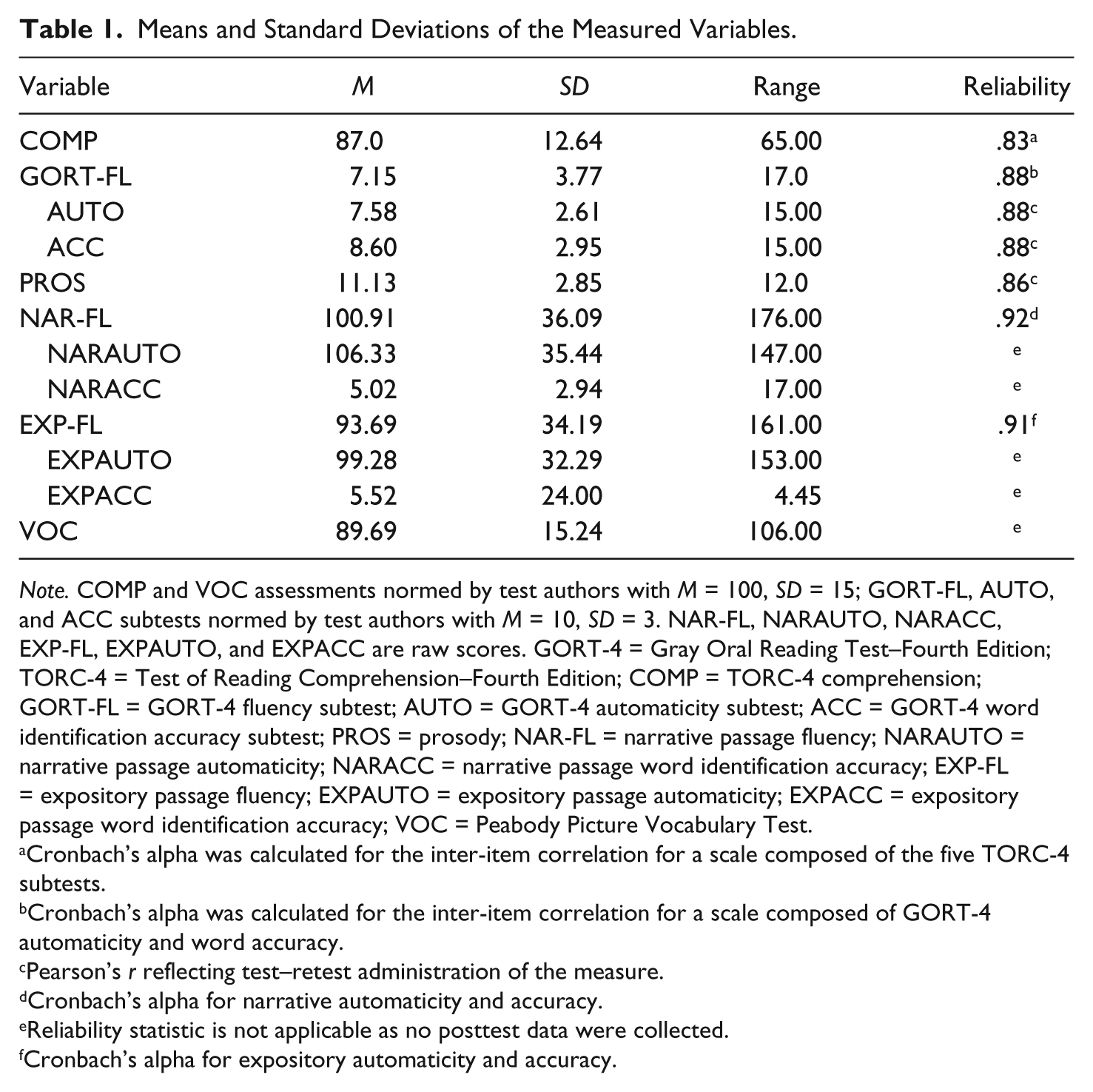
Note. COMP and VOC assessments normed by test authors with M = 100, SD = 15; GORT-FL, AUTO, and ACC subtests normed by test authors with M = 10, SD = 3. NAR-FL, NARAUTO, NARACC, EXP-FL, EXPAUTO, and EXPACC are raw scores. GORT-4 = Gray Oral Reading Test–Fourth Edition; TORC-4 = Test of Reading Comprehension–Fourth Edition; COMP = TORC-4 comprehension; GORT-FL = GORT-4 fluency subtest; AUTO = GORT-4 automaticity subtest; ACC = GORT-4 word identification accuracy subtest; PROS = prosody; NAR-FL = narrative passage fluency; NARAUTO = narrative passage automaticity; NARACC = narrative passage word identification accuracy; EXP-FL = expository passage fluency; EXPAUTO = expository passage automaticity; EXPACC = expository passage word identification accuracy; VOC = Peabody Picture Vocabulary Test.
Cronbach’s alpha was calculated for the inter-item correlation for a scale composed of the five TORC-4 subtests.
Cronbach’s alpha was calculated for the inter-item correlation for a scale composed of GORT-4 automaticity and word accuracy.
Pearson’s r reflecting test–retest administration of the measure.
Cronbach’s alpha for narrative automaticity and accuracy.
Reliability statistic is not applicable as no posttest data were collected.
Cronbach’s alpha for expository automaticity and accuracy.
Bivariate Correlations of the Measured Variables.
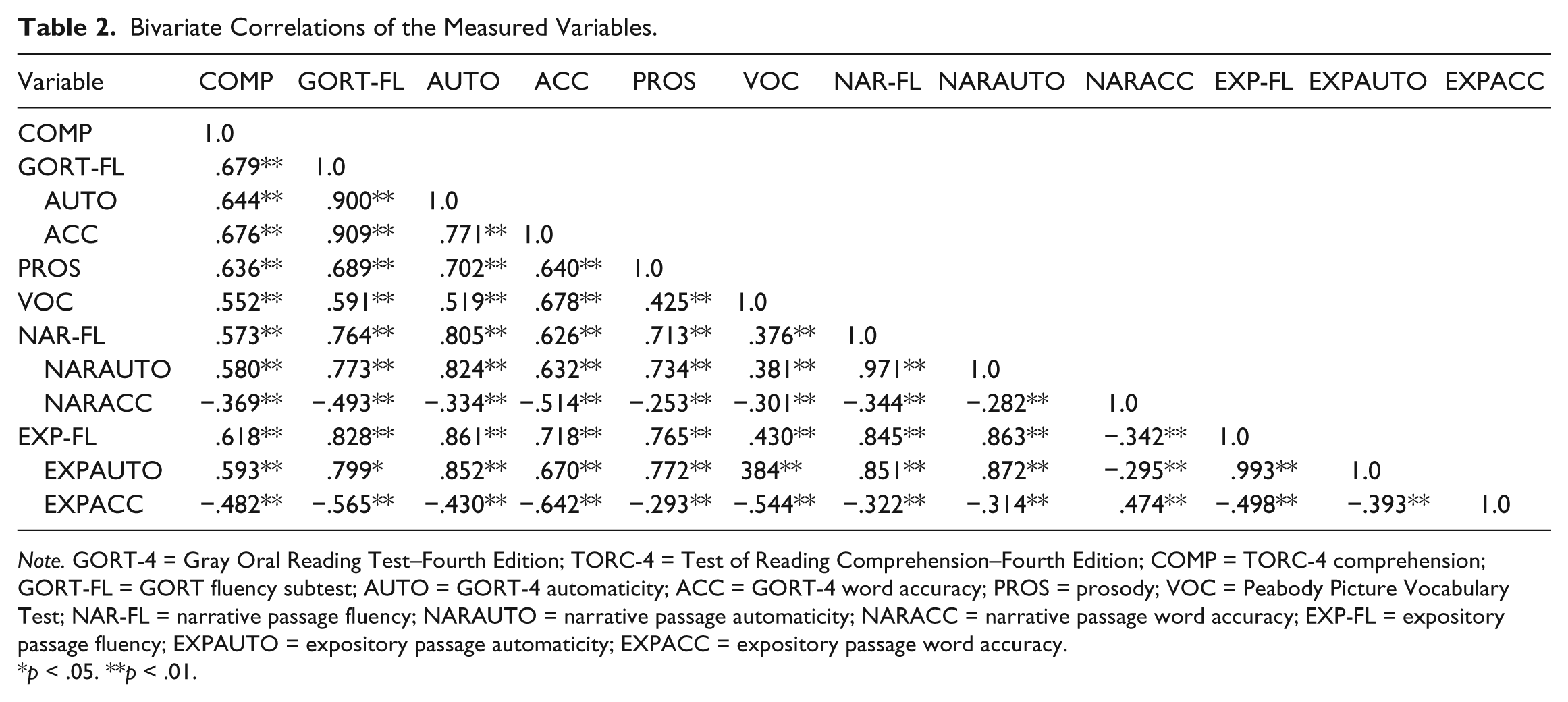
Note. GORT-4 = Gray Oral Reading Test–Fourth Edition; TORC-4 = Test of Reading Comprehension–Fourth Edition; COMP = TORC-4 comprehension; GORT-FL = GORT fluency subtest; AUTO = GORT-4 automaticity; ACC = GORT-4 word accuracy; PROS = prosody; VOC = Peabody Picture Vocabulary Test; NAR-FL = narrative passage fluency; NARAUTO = narrative passage automaticity; NARACC = narrative passage word accuracy; EXP-FL = expository passage fluency; EXPAUTO = expository passage automaticity; EXPACC = expository passage word accuracy.
p < .05. **p < .01.
To further understand the relationships among the study variables, bivariate correlations were analyzed. To interpret these relationships, we utilize Hopkins’ (2006) interpretation of effect magnitudes. With the exception of narrative and expository accuracy, all variables share a large relationship with comprehension with the strongest being with GORT fluency (r = .679), GORT automaticity (r = .644), GORT accuracy (r = .676), and prosody (r = .636). Correlations between comprehension and both narrative accuracy (NARACC, r = −.369) and expository accuracy (EXPACC, r = −.482) share a moderate negative relationship, suggesting that having fewer miscues enhances comprehension. Word identification accuracy is also important to fluent reading as evidenced by moderate-sized correlations between narrative fluency (NAR-FL) and narrative word accuracy (NARACC) (r = −.344), and between expository fluency (EXP-FL) and expository word accuracy (EXPACC) where r = −.498. Both measures of narrative (NARAUTO) and expository automaticity (EXPAUTO) share a large relationship with comprehension where the correlations are .580 and .593, respectively. When considering prosody, the relationships with both narrative and expository automaticity (NARAUTO and EXPAUTO) are very large (r = .734 and r = .772, respectively). The three measures of oral reading fluency share very large relationships among each other where correlations between GORT fluency (GORT-FL) and narrative fluency (NAR-FL) and expository fluency (EXP-FL) are r = .764 and r = .828, respectively, while r = .845 between narrative fluency (NAR-FL) and expository fluency (EXP-FL).
Although not the focus of the study, posttest measures were collected allowing for a test–retest measure of reliability for each of the GORT indicators (rate, accuracy, and fluency). Pearson’s r equaled .87 for automaticity, .91 for word accuracy, and .89 for fluency. Posttest measures were not obtained for any other variables.
Research Question 2
We next examined the extent to which the indicators of automaticity, accuracy, and prosody form a reliable scale of oral reading fluency using results from the GORT. To confirm these results, we conducted two replication analyses by retaining the prosody measure and substituting the automaticity and accuracy measures from the narrative and expository passages for those from the GORT. We began by conducting a principal component analysis (PCA) for all three sets of variables. The Kaiser–Meyer–Olkin (KMO) measure verified the sampling adequacy for the analysis, with the KMO value being .72, .71, and .69 for the GORT, narrative, and expository passages, respectively (“good” according to Hutcheson & Sofroniou, 1999). All KMO values for the individual items for both assessments were >.61, well above the acceptable limit of .5 (Kaiser, 1974). Bartlett’s test of sphericity, χ2(3) = 171.23, p < .001, for the GORT indicators; χ2(3) = 600.75, p < .001, for the narrative passage variables; and χ2(3) = 361.34, p < .001, for the expository passage, indicated that correlations between items were sufficiently large for PCA. Eigenvalues revealed a single component in excess of Kaiser’s criterion of 1 that explained 80.32% of the variance in the GORT indicators, 88.82% of the variance in the narrative passage indicators, and 88.17% in the expository indicators (see Table 3). We next assessed the reliability of the fluency scales with the first analysis using prosody along with automaticity and accuracy from the GORT. This scale resulted in Cronbach’s α = .88, for the GORT measures. The second analysis again used prosody along with automaticity and accuracy from the narrative passage indicators with Cronbach’s α = .94. The third analysis utilized automaticity and accuracy indicators from the expository passage results, along with prosody, and resulted in a Cronbach’s α = .93. All three fluency scales suggest that the indicators of prosody, automaticity, and accuracy form a construct that exhibits high internal reliability (Nunnally, 1978; Nunnally & Bernstein, 1994).
Factor Loadings and Communality for Principal Components Analysis for Fluency Scales Composed of Automaticity, Accuracy, and Prosody by Assessment: Eigenvalues and Percentage of Variance.
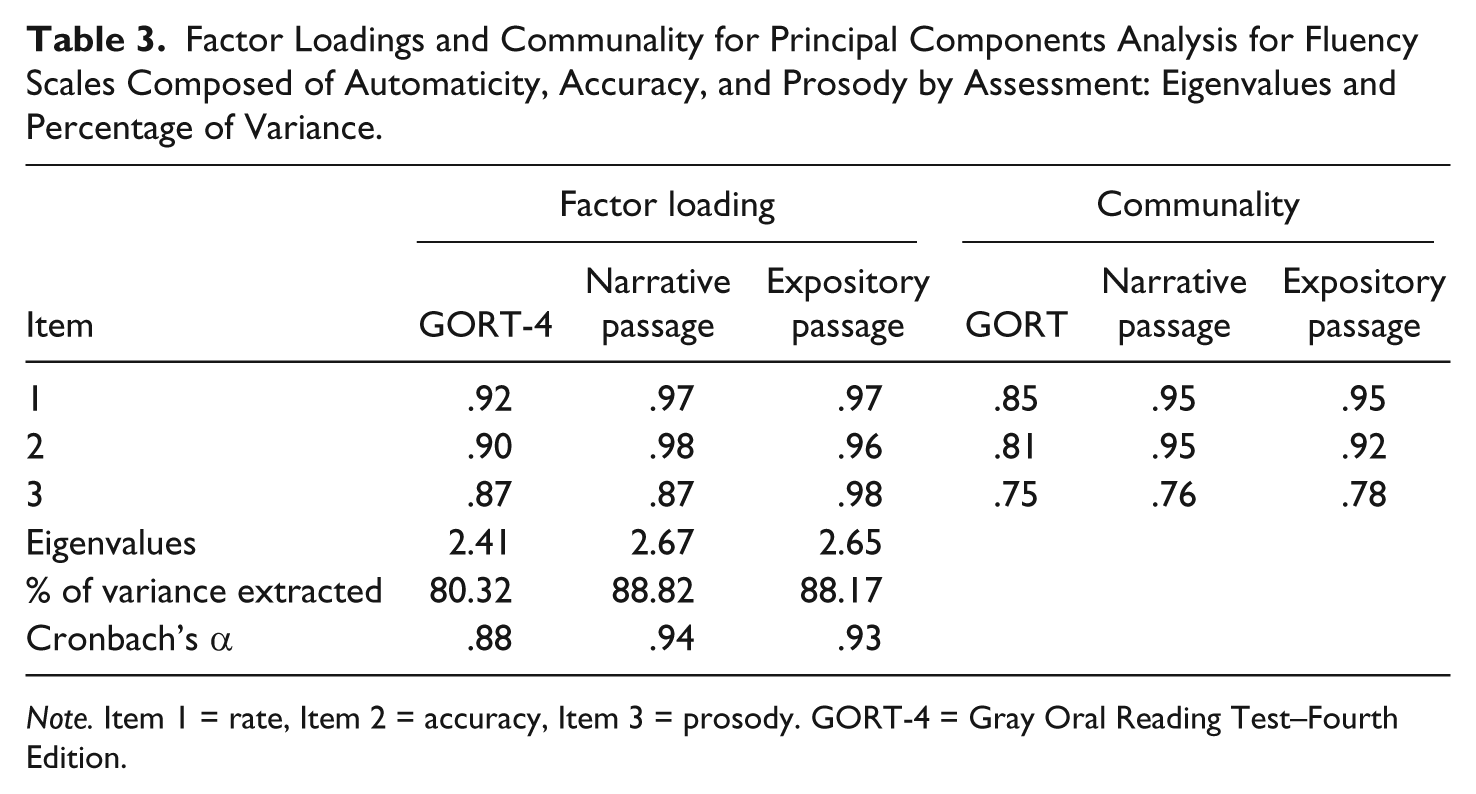
Note. Item 1 = rate, Item 2 = accuracy, Item 3 = prosody. GORT-4 = Gray Oral Reading Test–Fourth Edition.
Research Question 3
To answer this question, we modeled three sets of variables using hierarchical regression analyses to determine the amount of variance in silent reading comprehension that could be explained by the oral reading fluency indicators of automaticity, accuracy, and prosody, along with the variable for vocabulary. Before beginning the process, all variables were examined and found to exhibit normality with no multicollinearity detected. No influential outlying variables were found to exist and no heteroscedasticity was present in the data.
For the first analysis, the predictor variables of automaticity and accuracy from the GORT-4, along with prosody and vocabulary, were regressed onto the criterion variable of silent reading comprehension based on the strength of their correlations with comprehension. Results for the model can be found in Table 4. Automaticity was found to contribute no significant variance to silent reading comprehension and was dropped from the model. Accuracy (ACC), prosody (PROS), and vocabulary (VOC) were initially significant predictors; however, after applying a Bonferroni adjustment to the t-test values to adjust for family-wise errors, vocabulary (VOC) was no longer a significant predictor. The remaining predictors of accuracy and prosody explained 52.7% of the variance in silent reading comprehension. Individually, accuracy predicted 45.7% of the variance, while prosody explained an additional 7.0%. Standardized beta coefficients of .456 and .344 were found for accuracy and prosody, respectively. To confirm our results, we re-ran the model without dictating the order of entry for the four predictor variables. Results still revealed prosody and accuracy to be significant predictors with the same resulting standardized beta coefficients for each.
Final Regression Model for Silent Reading Comprehension Using Predictor of GORT Accuracy and Prosody.
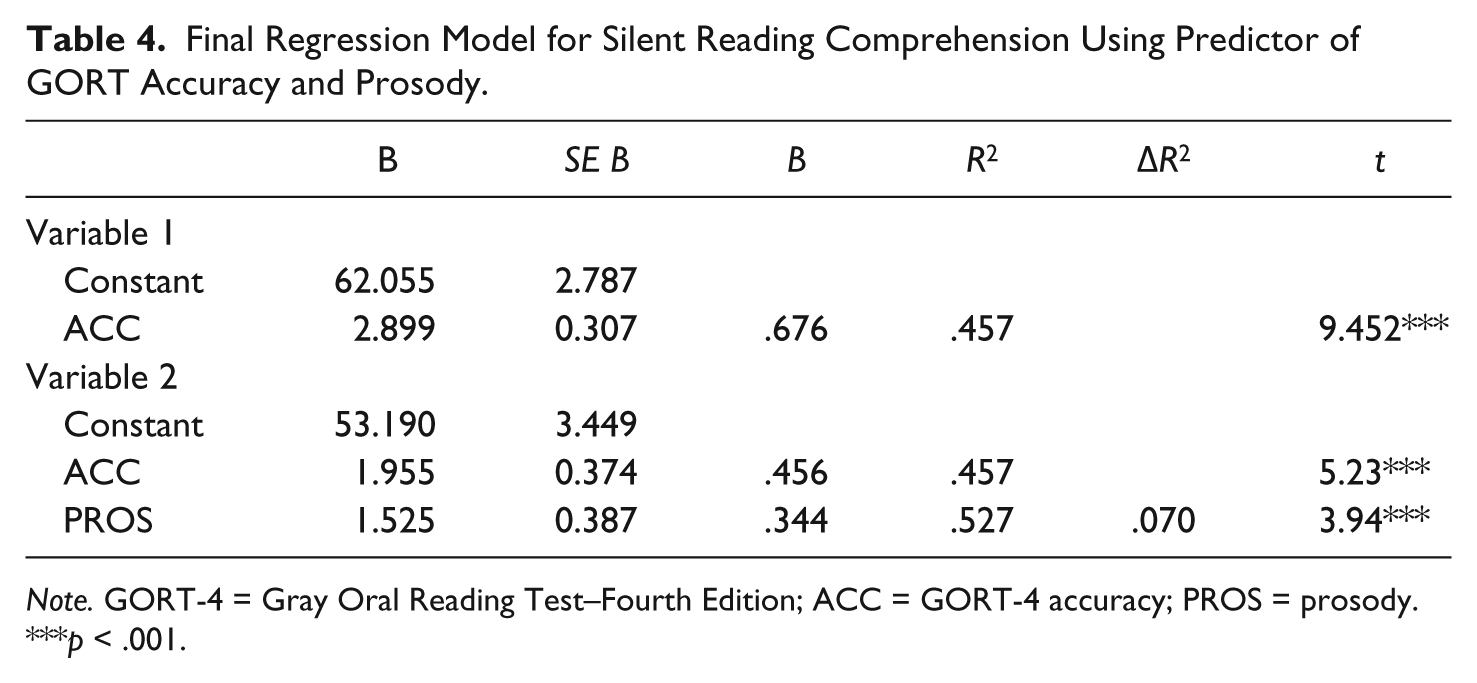
Note. GORT-4 = Gray Oral Reading Test–Fourth Edition; ACC = GORT-4 accuracy; PROS = prosody.
p < .001.
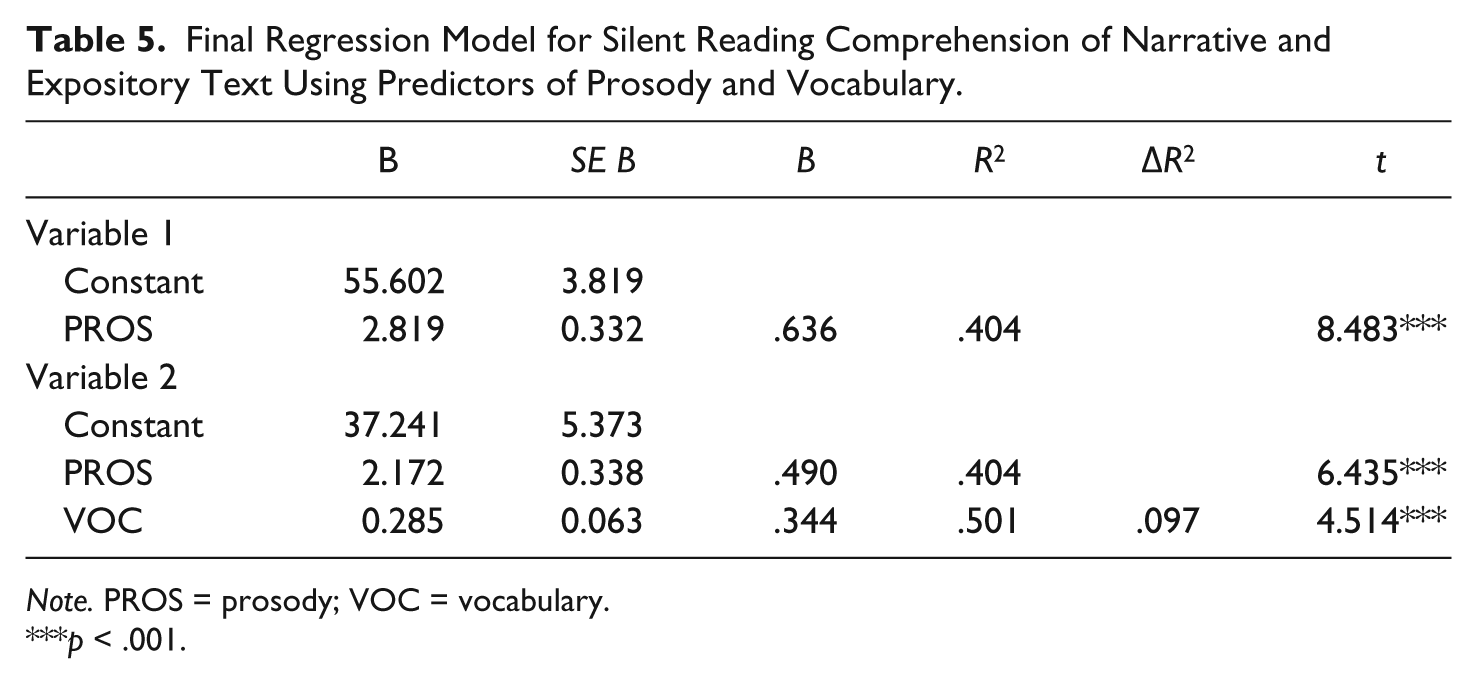
To determine if the relationships among automaticity, accuracy, prosody, vocabulary, and comprehension found in the previous model would replicate, we conducted two additional analyses utilizing the variables of automaticity (NARAUTO) and word identification accuracy (NARACC) obtained from the 2-min reading of the grade-level narrative passage, along with the variables of automaticity (EXPAUTO) and accuracy (EXPACC) from the grade-level expository passage. For this analysis, we again entered the predictor variables based on the strength of their correlation with comprehension. This resulted in prosody being entered first, followed by automaticity, vocabulary, and finally accuracy for both text types. The significance of t-test values was interpreted using a Bonferroni adjustment. Neither automaticity nor accuracy predicted additional variance in the models for both narrative and expository texts and so were dropped from the analysis. Final model results for narrative text in Table 5 show that prosody and vocabulary explained 50.1% of the variance in narrative text comprehension. Prosody predicted 40.4% of the variance in silent reading comprehension while vocabulary predicted an additional 9.7%. Standardized beta coefficients were .490 for prosody and .344 for vocabulary. For the analysis of expository text, again neither automaticity nor accuracy was a significant predictor of silent reading comprehension. This resulted in the same two-predictor model (see Table 6) where prosody and vocabulary explained 50.1% of the variance in silent reading comprehension with variances explained by prosody and vocabulary of 40.4% and 9.7%, respectively, and standardized beta coefficients of .490 for prosody and .344 for vocabulary. For both text types, we re-ran the analysis without dictating the order of variable entry and the exact results were found.
Final Regression Model for Silent Reading Comprehension of Narrative and Expository Text Using Predictors of Prosody and Vocabulary.
Note. PROS = prosody; VOC = vocabulary.
p < .001.
Regression Results for the Mediation of the Effect of Automaticity on Comprehension by Prosody.
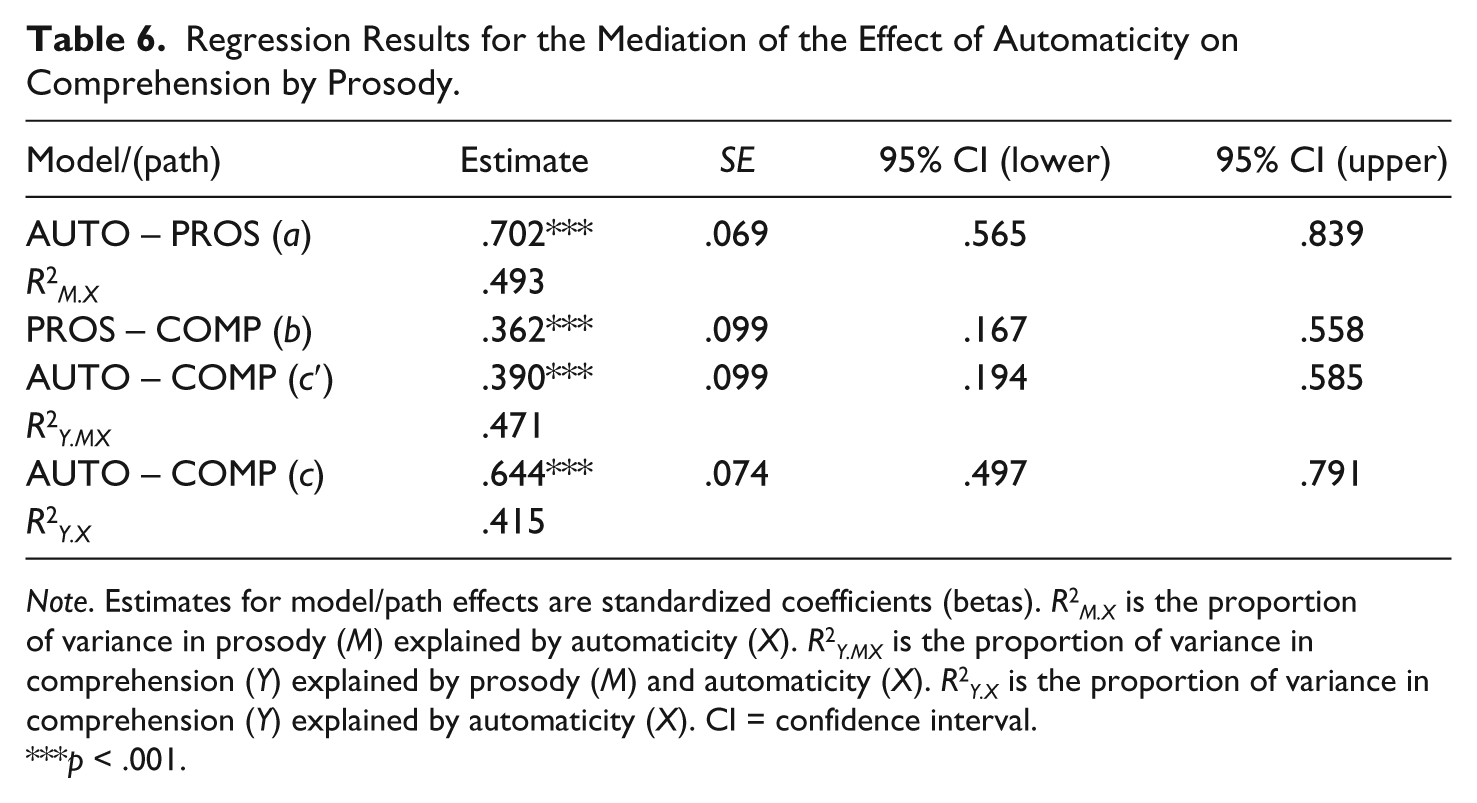
Note. Estimates for model/path effects are standardized coefficients (betas). R2 M.X is the proportion of variance in prosody (M) explained by automaticity (X). R2 Y.MX is the proportion of variance in comprehension (Y) explained by prosody (M) and automaticity (X). R2 Y.X is the proportion of variance in comprehension (Y) explained by automaticity (X). CI = confidence interval.
p < .001.
Mediation Analysis
A variable can be considered a mediator when it accounts for the relationship between a predictor and criterion variable (Hair et al., 2006). As the measurement instrument for prosody accounts for reading at a conversational pace, or automaticity, the possibility exists that prosody may mediate the effects between automaticity and reading comprehension. Baron and Kenny (1986) suggested a three-step analysis to determine if a variable is acting as a mediator. In following their analysis, we first regressed the criterion variable comprehension onto automaticity to determine the total effect. Next prosody, the suspected mediation variable, was regressed onto automaticity to determine a portion of the indirect effect. Finally, comprehension was regressed on both prosody and automaticity. The final multiple regression provides estimates of the direct effect of automaticity on comprehension while controlling for prosody as well as estimating the other component of the indirect effect, prosody on comprehension.
The path model defining the relationship among automaticity, prosody, and comprehension is depicted in Figure 1. The results of the regression analysis meet the criteria established by Baron and Kenny to conclude that prosody asserts a partial mediating effect on the relationship between automaticity and comprehension. These criteria include the following: X (automaticity) must be correlated with Y (comprehension), X (automaticity) must be correlated with M (prosody), M (prosody) must be correlated with Y (comprehension) while controlling for X (automaticity), and finally the direct effect of X (automaticity) on Y (comprehension) must be reduced when Y (comprehension) is regressed on M (prosody) and X (automaticity). The standardized beta coefficients associated with each of these conditions are included in Table 6 and all are statistically significant with p values < .001. The effect of automaticity on comprehension is reduced from .644 to .390 when prosody is added to the equation, while the effect for prosody equals .25. The effect of automaticity is reduced but not eliminated, which is consistent with Baron and Kenny’s partial mediation designation.
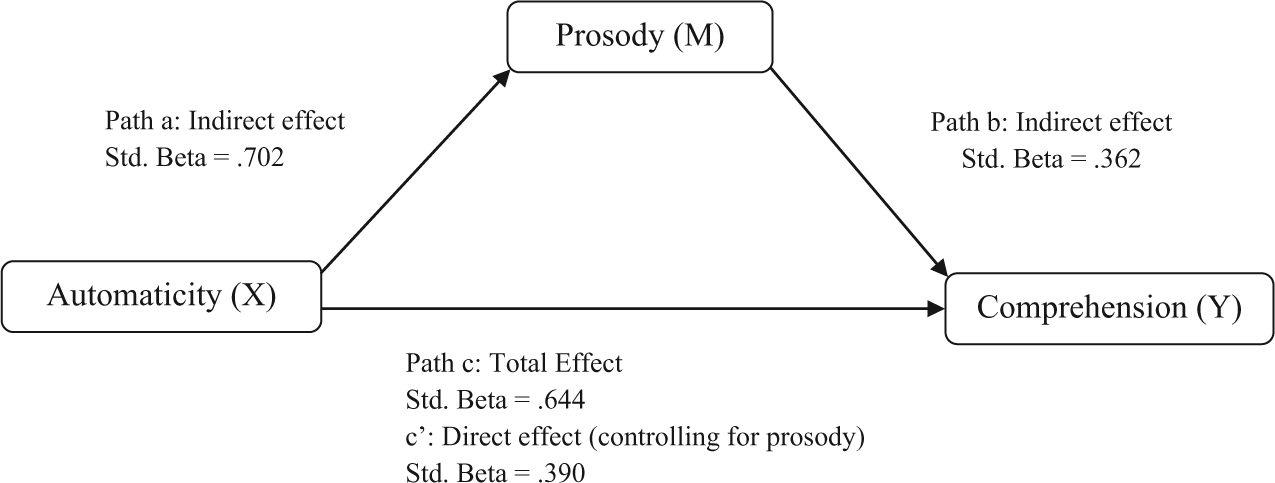
Pathway of mediation analysis.
Preacher and Hayes (2004) and Preacher and Kelley (2011) have identified potential weaknesses in the estimation method established by Baron and Kenny. In particular, the stability of estimates derived from smaller sample sizes has been called into question. One alternative they advocate is bootstrapping, a resampling approach that provides increased stability to parameter estimates derived from small samples. Table 7 presents the 95% confidence intervals derived through SPSS’s bias corrected bootstrap for the total, direct, and indirect effects of the mediation model. Because the confidence intervals do not include 0, it may be concluded that all effects are significant considering a null hypothesis of b = 0. The indirect effect (ab) was tested for significance using the normal theory test for indirect effect and is available as an SPSS/SAS custom dialogue add-on developed by Hayes (2013). The results of both the traditional approach of Baron and Kenny (1986) and the more robust bootstrap estimation indicate that prosody has a significant mediating effect on the relationship between automaticity and comprehension.
Bootstrap Mediation Effects of Prosody on the Relationship Between Automaticity and Comprehension.
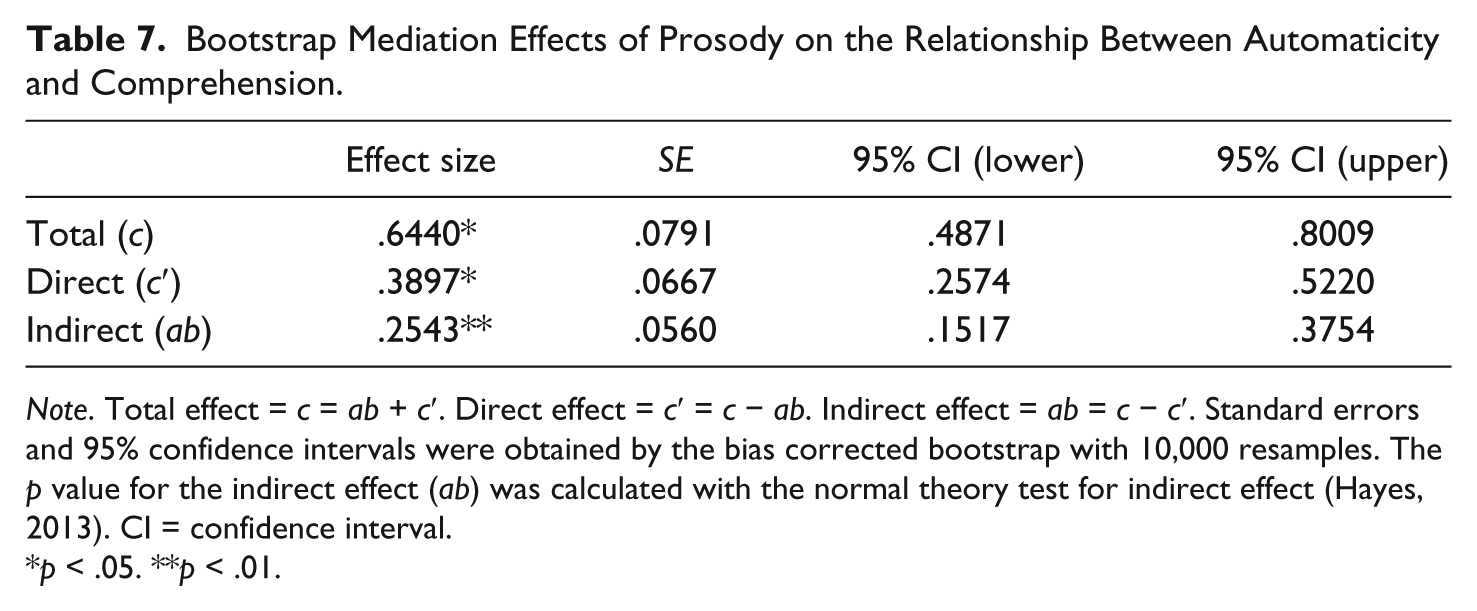
Note. Total effect = c = ab + c′. Direct effect = c′ = c − ab. Indirect effect = ab = c − c′. Standard errors and 95% confidence intervals were obtained by the bias corrected bootstrap with 10,000 resamples. The p value for the indirect effect (ab) was calculated with the normal theory test for indirect effect (Hayes, 2013). CI = confidence interval.
p < .05. **p < .01.
Discussion
In the present study, we sought to examine three questions involving automaticity, word identification accuracy, prosody, and receptive vocabulary knowledge, and their relationship with silent reading comprehension in a sample of 108 ninth-grade students. From a theoretical perspective, we explored whether empirical evidence would support a construct suggesting three distinct indicators of oral reading fluency. From a developmental reading perspective, we were interested in exploring the extent to which fluency indicators predicted silent reading comprehension in secondary school students who struggled with reading.
Although correlations among the three fluency indicators (automaticity, accuracy, and prosody) are large, this does not ensure that they will form a highly reliable scale. Results of three models utilizing indicators from three different measurement instruments found in each case that automaticity, word identification accuracy, and prosody form a highly reliable scale reflecting the construct of oral reading fluency. We suggest this finding to be an important starting point as this three-indicator construct for fluency forms the theoretical foundation for our further analyses. Three subsequent hierarchical regression models each found prosody to be a significant predictor of silent reading comprehension in ninth-grade readers. In two of the three models, vocabulary knowledge was also a predictor of silent reading comprehension whereas word identification accuracy was significant in one of the models. A finding supporting our hypothesis was that automaticity did not predict additional variance in comprehension beyond that of prosody. Overall variance in comprehension predicted by prosody, and either vocabulary or word accuracy varied from 50.1% to 52.7%. The finding that prosody contributes from 7% to 40% of unique variance to comprehension suggests its importance to overall reading proficiency in this sample of secondary students. As we continue this discussion, we will address these and other results in further detail and conclude with the offer of a theoretical perspective within which to view our findings.
Using Hopkins’ (2006) interpretation of coefficients, very large, positive correlations were found between automaticity and fluency as measured by the GORT, as well as the narrative and expository passages (r = .90, .81, and .86, respectively), all suggesting that automaticity plays an important role in fluent reading. When relationships between prosody and fluency were examined, we found slightly smaller, but still large to very large positive correlations of r = .69 (GORT-FL), r = .71 (narrative fluency), and r = .77 (expository fluency) that are particularly striking given the restricted range of the prosody rubric (12 points). The relationships found between prosody and comprehension (r = .636), though slightly smaller in our ninth-grade sample, are similar to those found by Rasinski (1985) for third- (r = .74) and fifth-grade (r = .73) students, and very similar for those found by Rasinski et al. (2009) for third- (r = .67), fifth- (r = .66), and seventh-grade students (r = .57). The present study extends the relationship between prosody and silent reading comprehension across a continuum ranging from third through seventh grades to one that now includes the ninth grade.
The role of vocabulary in aiding comprehension was investigated using a measure of receptive vocabulary. Although limited empirical evidence suggesting a causal effect for vocabulary exists (Baumann, Kame’enui, & Ash, 2003), Nagy (2005) has nonetheless suggested vocabulary as a significant predictor of comprehension. A study by Ricketts, Nation, and Bishop (2007) that found in a sample of 8- to 10-year-olds that expressive vocabulary knowledge accounted for 17.8% of the variance in reading comprehension provides support for Nagy’s assertion. In the present study, the finding that vocabulary is a significant predictor of silent reading comprehension in ninth-grade students supports Nagy’s suggestion and the “conventional wisdom” (Baumann, 2009, p. 323) around its importance. Pikulski and Chard (2005) have suggested that automaticity and accuracy may likely become less related to reading comprehension, only to be replaced by vocabulary as children matriculate through later grades. Our results partially support their hypothesis. It should be pointed out that the PPVT is a measure of receptive vocabulary that is more distal to reading comprehension than a productive measure. Our finding that receptive vocabulary predicted variance in comprehension may indeed have been stronger had a productive measure been used. Although the Nagy (2005) study cited earlier used an expressive vocabulary measure, the participants were significantly younger with assumingly smaller productive vocabularies than would be expected in ninth-grade students. At the same time, our results suggest the positive role of receptive vocabulary in predicting silent reading comprehension in ninth-grade students.
Although the indicators of automaticity, accuracy, and prosody are widely accepted as reflective of reading fluency, the three have not been shown in the literature to compose a unitary scale representing the construct. We tested three scales with the first utilizing automaticity and accuracy as measured by the GORT, while the second and third used automaticity and accuracy measures obtained from grade-level narrative and expository passages. All scales included the same prosody measure. These results provide empirical support for a theoretical model suggesting that prosody, accuracy, and automaticity form a reliable construct of oral reading fluency in secondary students who struggle with literacy achievement.
One indicator of prosody within the Multi-Dimensional Fluency Scale (Zutell & Rasinski, 1991) is the reading of text at a conversational pace. A conversational pace reflects the idea that there is acceptable variance in automaticity within fluent readers, while acknowledging that pacing, which is either slow and labored, or very rapid and rushed, is not conversational. As automaticity was not found to predict comprehension, this led us to explore the degree to which automaticity may be mediated by prosody, in other words, to unbundle the relationship between the two. Our analysis found prosody to be a significant, partial mediator of automaticity. For every one-unit increase in automaticity, we found that comprehension increased by .39 of a unit due to the direct contribution of automaticity, while the effect of prosody added an additional .25 of a unit increase to the model. This finding suggests that the pacing indicator evaluated within the MDFS reflects automaticity. It also confirms that though prosody accounts for a significant portion of the effect of automaticity on comprehension, automaticity alone provides an incomplete picture as other attributes of prosody add to the explained variance in comprehension. Of course a different way of stating this is of the 64% of variance in comprehension that is explained by the model, 61% is attributable to automaticity while prosody accounts for 39%. We think that the salient emphasis within our mediation analysis is that first, automaticity is an important component of prosody as measured by the MDFS. Second, automaticity is useful to comprehension up to a point after which the ability to read a text with appropriate expression results in increased comprehension beyond that which is solely attributable to automaticity.
Explained variance within the three regression models varied between 7% in one model (see Table 4) to more than 40% in the other two (see Table 5). Although we acknowledge that this is a wide range, the comparative beta weights for prosody in both models (.344 and .490) suggest its importance to comprehension processing relative to the other predictors of accuracy and vocabulary. Nonetheless, we suggest that this represents newly explained variance in the relationship between reading fluency and comprehension in struggling secondary readers that holds practicality. And the practicality lies herein. If the goal of reading is meaning-making and the ability to read with expression provides a potential comprehension advantage to struggling readers beyond that of simple word calling, have students not moved closer to the goal of reading? We suggest that though there is much more to be learned regarding the role of prosody in reading and its contribution to comprehension, the practical value resides in the potential for improved reading outcomes for readers. Although clearly more research is needed, the present results suggest a role for prosody that may benefit readers beyond that of the more often investigated fluency indicators of automaticity and accuracy.
We also suggest that our findings may have potential implications for classroom practice. First, the question that must be raised is that if prosody explains additional variance in reading comprehension beyond that accounted for by automaticity in ninth-grade students, then is an assessment of automaticity and word identification accuracy without the consideration of prosody a sufficient evaluation of oral reading fluency? We would suggest that it is not as a reader who exhibits appropriate automaticity in reading may be missing the expressive component that our findings suggest contributes to additional understanding of text. We also suggest that if children are not taught to read with expression, then textual understanding may suffer. This then raises the corollary question that if a student is found to read with adequate prosody across appropriate grade-level texts, and if prosody reflects automaticity, is a stand-alone evaluation of automaticity and accuracy really necessary? Our results suggest that there is little reason to take the additional instructional time to conduct such an assessment as automaticity and word accuracy are accounted for within both the MDFS and NAEP rubrics that assess prosody. Next, if a child reads with appropriate prosody, is there any necessity in promoting increased automaticity, in other words, in pushing the student to read faster? Again, our results suggest that training students to read beyond their conversational limit may not yield additional understanding of the text.
In his review of the effectiveness of comprehension strategy instruction, Willingham (2007) argued that for such instruction to be effective, students need to have some degree of fluency over the texts they encounter. As a whole, the participants in this study meet the criterion of possessing some amount of fluency. At the same time, although the relationship between fluency and comprehension has been repeatedly shown to be reciprocal rather than causal (Fuchs et al., 2001; NRP, 2000; Paige, 2011), we nonetheless found it intriguing that automaticity, the fluency indicator showing the largest correlation with comprehension, did not predict comprehension in our study sample. Our results also found that automaticity is mediated by prosody, suggesting that part of prosody includes appropriate automaticity. Nevertheless, automaticity did fit nicely into a scale with accuracy and prosody reflecting the construct of oral reading fluency. So how can the role of automaticity in relation to comprehension be reconciled? We now offer a rationale.
A Tandem Theory
Paris and Hamilton (2009) suggested that minimum levels of fluency development or “skill thresholds” (p. 46) are necessary to support minimum comprehension processing. Results of the present study lend support to the notion of such thresholds as automaticity of 106.3 words per minute (WPM) closely approximates the minimum threshold of “100” (p. 47) WPM as suggested by Paris and Hamilton (2009). However, as we hypothesized, results from our study also show that exceeding a minimum automaticity threshold does not necessarily contribute to additional comprehension processing and that the utility of automaticity may well have reached an asymptote within our study sample. We think that the findings from this study suggest that the indicators of fluent reading work together with comprehension to create a unitary and coherent system of reading for the purpose of comprehending text. However, as our results also suggest, the strength of the relationships among the fluency indicators is not equally distributed across the system; in other words, the three do not always make equal contributions to comprehension.
We propose a tandem theory of reading to explain the relationship between automaticity and comprehension. The tandem theory is conceptualized with two assumptions that must be in place with the first being that the reader’s primary purpose for reading is to comprehend or make meaning from the text. Second, it is assumed that the reader possesses sufficient meta-cognitive skills to provide for the adequate monitoring of comprehension processing to identify and rectify breakdowns in understanding. With these two assumptions in place, we suggest that accuracy and prosody work on a maximization basis. We use the term maximize to refer to the idea that correctly identifying as many words as possible and reading with full prosody is advantageous to the reader as it encourages greater comprehension. Conversely, lower word accuracy and less than full prosody detracts from understanding. Although our data clearly suggest that increasing both of these indicators encourages comprehension, we acknowledge that ceiling effects exist for both where accuracy cannot be more than 100% and prosody can reach the point where only interpretational differences exist between readers.
In contrast to the first two indicators that work on a maximization basis, automaticity is optimized by the reader so as to maximize comprehension. By optimization, we are referring to the idea that automaticity can be increased or decreased by the reader in response to the efficiency of the reader’s perceived comprehension processing. This means that in some situations, it may be more advantageous to comprehension processing to decrease or slow down automaticity to gain maximum comprehension (Newkirk, 2011). In other instances when the reader recognizes that comprehension is easily occurring, automaticity may be intentionally increased to maximize the efficiency of comprehension and the entire reading process. Unlike accuracy and prosody, automaticity works on a bi-directional basis in tandem with, and for the purpose of, maximizing comprehension. When as a result of meta-cognitive monitoring of the comprehension process the reader perceives a breakdown in understanding, slower automaticity may be invoked as a strategy by the reader to improve comprehension. In such a scenario, we suggest that the reader’s perceived assessment of his or her comprehension functions as a sort of “governor” or “regulator” to consciously slow or increase automaticity for the purpose of reading with maximum comprehension.
In summary, all three fluency indicators work in partnership with comprehension to maximize understanding. Word identification accuracy and prosody function on a maximization basis to promote increased comprehension (up to the point where ceiling effects are reached). However, we suggest that automaticity is optimized as necessary on a bi-directional basis (increased or decreased) as regulated by the reader’s meta-cognitive assessment of his or her comprehension processing for the purpose of maximizing the understanding of text. The results of our study suggest that participants had reached the point where increasing automaticity did not further the goal of increased comprehension. And this leads again to the notion that optimizing automaticity and maximizing accuracy and prosody do not guarantee sufficient comprehension in readers as our results clearly show. Our data also suggest that in the study population, increasing automaticity did not result in increased comprehension.
Other theoretical support for a tandem theory of reading is provided by the immediacy and eye–mind assumptions (Just & Carpenter, 1980) which suggest that as readers encounter content words, they attempt to interpret them and remain fixated on them as long as the word is being processed. Support for a tandem theory also comes from the parallel distributed processing approach to the connectionist model of reading which hypothesizes that an interactive relationship exists between comprehension, orthographic, and phonological processors (Harm & Seidenberg, 2004; McClelland & Rumelhart, 1986; Seidenberg & McClelland, 1989). The connectionist models offer a systemic view of reading that supports the notion that when reading with a focus on comprehension, the reader will regulate automaticity to aid understanding. The tandem theory supports the notion that aside from the rarest of cases, comprehension occurs at all levels of fluency proficiency and that automaticity may increase in conjunction with improved comprehension. Finally, the tandem theory hypothesizes that fluency indicators reach asymptote on a text-specific basis. This perspective agrees with the thoughts of Paris (2005) and Paris and Hamilton (2009) who suggested an interaction between fluent reading and textual characteristics. The caveat that we offer is that proficiency with fluency indicators is text specific and continues to develop as readers advance through school and encounter a wide variety of both different and more difficult texts. Textual difficulty becomes a variable that may limit, albeit temporarily for those readers possessing normally developed fluency skills and longer for others who are less fluent, the degree to which fluency indicators are constrained.
Conclusion
Although prosody is considered an indicator of effective fluency (Rasinski et al., 2009; Samuels, 2007), the notion has suffered in both its lack of emphasis and evaluation by teachers, perhaps overshadowed by the traditional method of measuring oral reading fluency using reading automaticity and accuracy (Kuhn & Stahl, 2003; Samuels, 2007; Schwanenflugel et al., 2004; Torgesen et al., 2001). For example, the computational ease of subtracting oral reading miscues from total words read to arrive at a CWPM metric has often been used to assess oral reading fluency (Deno, 1985). However, this method excludes the role of prosody that requires the use of an additional assessment tool for its evaluation (Zutell & Rasinski, 1991). Although some classroom assessments, such as the Developmental Reading Assessment (Beaver & Carter, 2003), include prosody as part of their protocol, others such as the Dynamic Indicators of Basic Early Literacy Skills or DIBELS (Good et al., 2011) ignore it, leading to the often criticized notion adopted by some practitioners that faster reading is better reading (Goodman, 2006; Rasinski, 2006; Samuels, 2007). The practice of ignoring the role of prosody is unfortunate as it is a significant hallmark of appropriate reading development, is not easily learned by all children, and has been argued that along with automaticity, is critical for text comprehension (Coady & Baldwin, 1977; Hudson et al., 2009; Kuhn & Stahl, 2003; Rasinski et al., 2009). The results from this study provide support for the instruction and assessment of prosody, word accuracy, and vocabulary in struggling readers at the secondary level for the purpose of reading for comprehension. At the same time, we do not suggest that automaticity is not important as it operates and develops in tandem with comprehension within a coherent system that includes accuracy, prosody, and vocabulary knowledge, for the purpose of maximizing comprehension. From an instructional perspective, attempting to improve automaticity as an isolated component of reading does not appear in our results, to aid in the growth and development of a larger system where comprehension is the goal. We do think that automaticity is appropriately reflected within the notion of reading prosody. Finally, our results support the notion that prosody, and indeed the broader construct of reading fluency, cannot be assumed to magically emerge in readers during the elementary or middle school years without explicit instruction, support, and encouragement across grades and text genres from knowledgeable teachers who focus on appropriate and consistent practice.
Limitations
This study has several limitations that the reader must take into consideration when drawing conclusions from the results. The sample of 108 students was not randomly selected and so limits the generalizability of the results beyond the sample group. Also, a larger sample may have yielded different results. Second, the grade-level narrative and expository fluency passages have not been assessed for either validity or reliability. Third, the results are obtained from a population that struggles with literacy attainment and is not reflective of a broader population that would contain a larger percentage of proficient readers. If such a population had been obtained, the variance explained by the predictive variables could reasonably be expected to be smaller. The contribution of vocabulary to comprehension was measured using an assessment of receptive vocabulary, whereas a productive measure may have yielded different results. The field of vocabulary assessment is undergoing a re-evaluation and assessments such as the one used in the present study may eventually be replaced with more accurate tools (Pearson, Hiebert, & Kamil, 2007). The reader should also keep in mind that the assessment of comprehension processing was conducted using the TORC-4. Although this measure utilizes the traditional assessment format of paragraphs followed by the answering of factual and inferential questions, it also utilizes subtests that assess additional factors found to explain comprehension variance. As a result, the findings for the effect of fluency indicators on comprehension may have been different had a more traditional comprehension instrument been used. The instrument used to measure prosody (Multi-Dimensional Fluency Scale) utilizes four subscales that include expression and volume, smoothness, phrasing, and pace. The subscale of smoothness is reflective of word recognition accuracy and the subscale, pace, is reflective of the appropriate reading rate and so reflects the reader’s automaticity with the text. The possible correlation of the ratings of pace with reading rate may, as our results found, raise the possibility that reading automaticity is reflected within the prosody measurement leading to conflation between automaticity and prosody. Also, the prosody instrument used in the present study has a scoring range of 12 across four subscales that are combined to form a summative score reflecting prosodic reading. Although the study authors carefully controlled procedures for measurement reliability with the instrument, this may be more difficult in a classroom setting. In practice, teachers may find the 4-point instrument such as that used by NAEP (Pinnell et al., 1995) to be easier to use and control for measurement reliability.
Future Research
Reliable and valid fluency norms for secondary narrative and expository text do not exist. As such, results from this study leave unclear the appropriate minimum threshold values of fluency indicators for ninth-grade readers. The development of such values would be very helpful and have practical classroom application. The analysis of the construct of oral reading fluency would benefit from additional research utilizing other populations that vary both in age and reading ability. Also, additional research utilizing fluency indicators with normally attaining secondary students would assist in specifying the role of each in relation to comprehension. Additional measures indicating the ability of students to monitor comprehension could be valuable in determining the role of meta-cognition and fluency indicators, particularly prosody, in relation to comprehension. Finally, the contribution of vocabulary to comprehension, though hypothesized by multiple authors as being significant, is in need of further empirical demonstration (Baumann, 2009; Krashen, 1985; Mezynski, 1983).
Footnotes
Declaration of Conflicting Interests
The author(s) declared no potential conflicts of interest with respect to the research, authorship, and/or publication of this article.
Funding
The author(s) received no financial support for the research, authorship, and/or publication of this article.