




Abstract
In this article, we present one fourth grader’s unaided and illustration-aided retellings of The Other Side. Using a qualitative clinical case study approach, we examine comprehending activity in these retellings using microethnographic discourse analysis in conjunction with dialogic self theory and a transactional model of reading. Analysis indicates that illustration-aided retelling results in qualitatively different comprehending activity than unaided retelling. John’s illustration-aided retelling demonstrates relational involvement in the social world of the story and a more aesthetic stance characterized by movement between multiple character positions and their perspectives. John’s unaided retelling shows a nearly singular, outsider position and an efferent stance, characterized by summarizing and reporting. In addition, this study suggests that microethnographic analysis is a useful framework for noticing and understanding social and relational aspects of comprehending in illustration-aided retelling. Specifically, in illustration-aided retelling, the reader’s use of contextualization cues and dialogic activity of turn-taking were accompanied by social imagination and intersubjective relationships with characters. Other social and dialogic aspects of the illustration-aided retelling included intertextuality and narrative coherence both frequently involving polychronic activity. Implications of illustration-aided retellings as assessments of readers’ comprehending activity within picturebooks are discussed.
Retellings have been used as a means of assessing and promoting reading comprehension for decades (Brown & Cambourne, 1987; Gambrell, Koskinen, & Kapinus, 1991; Goodman, Watson, & Burke, 2005; Morrow, 1988). Typically, retellings are analyzed by noting the degree to which they accurately reflect texts read prior to retelling. In the case of narrative picturebook reading, retellings might be assessed in terms of plot sequencing, story structure, and related elements, such as characters, setting, problem, and solution. Thus, the analysis of retellings concerns whether children have grasped a predetermined set of elements and understandings related to authors’ intended meanings. These traditional uses of retellings, including retellings of narrative texts, reflect a content-oriented, efferent stance toward reading comprehension (Rosenblatt, 1982) that values what children “take away” from the reading as represented in their retelling. The actual activity of the reader during the retelling, including the nature of the reader-text transaction, however, has been largely left unexplored.
From a dialogic perspective, retellings are viewed differently, and are understood as active dialogues between readers and texts. Like other dialogic encounters, in which new meanings are created as interlocutors engage with others (Wertsch, 1998), readers have important roles in constructing new meanings as they engage with texts. Oral retellings are a particular kind of dialogue, one in which the activity of the reading self is foregrounded; the person who has read, and now retells, takes an authorial role in constructing personal meanings with text (Rosenblatt, 1986). In this way, retellings are important literacy events on par with the readings that preceded them, events in which the intricacies of the dialogue between reader and text are made evident. In considering retelling as a reading event, we use the term event to mean “a way to place emphasis on the dynamic and creative aspect of what people do and accomplish in interaction with each other” (Bloome, Carter, Christian, Otto, & Shuart-Faris, 2005, p. 5). Although this definition refers to events in actual social interactions, we use the term to describe the creative relational activity that occurs during reading when readers meet, respond to, and make sense with and of characters in the vicarious social context of narrative picturebooks.
Theoretically, then, retellings are literacy events that reflect particularized portraits of the dialogic transaction between reader and text (Rosenblatt, 1994) and provide useful information about how the reader–text transaction unfolds as a dynamic comprehending activity (Lysaker, Tonge, Gauson, & Miller, 2011). Empirically, however, we know little about what such a dialogic perspective on retelling could reveal or how important such revelations might be in theoretical and practical terms. Viewing retellings as portraits of the dialogic transaction between reader and text could shed light on the activity of reading comprehension. From a transactional perspective, this means exploring retelling as personal, social, and relational activity and foregrounding the activity of the reading self, which has been undervalued in earlier studies of retelling and largely overlooked in literature on reading (Ivey & Johnston, 2013).
Situating retelling this way requires an analytic approach that can account specifically for dialogic aspects of the reader–text transaction—the personal, social, and relational activity—rather than the transaction’s efferent elements. In this study, we investigate the potential of microethnographic discourse analysis as one such approach to account for the dialogic aspects of the reader–text transaction. We ask, “How can a dialogic transactional view of reading in conjunction with microethnographic analysis inform understandings of comprehending as social and relational activity as these understandings are made evident in picturebook retellings?”
Literature Review
Retelling
Since the mid-1970s, researchers have been interested in children’s oral retellings for a variety of purposes (Brown & Cambourne, 1987; Galda, 1983; Gambrell et al., 1991; Thorndyke, 1977). First, retellings have been used to assess comprehension of texts read to children or read independently by children (Bellinger & DiPerna, 2011; Johnston, 1983). Second, retellings have been studied as a practice that benefits aspects of children’s language and literacy development, particularly story comprehension (Gambrell et al., 1991; Morrow, 1985).
Although the purposes and research questions of the above studies differ, they share the general belief that retelling reflects and, thus, involves children’s comprehension of text and that comprehension is evidenced by a reader’s ability to remember and effectively restate aspects of the author’s text. Gambrell et al. (1991) evaluate retellings in terms of the degree to which propositions from the author’s text were found in the retellings as well as the degree to which these aspects of text were logically articulated. More recently, Reese, Sugate, Long, and Schaughency (2010) score retellings for story memory and predetermined aspects of “narrative quality.” In fact, remembering has been nearly equated with comprehension, particularly in earlier studies in which story recall was the primary focus of scoring retellings (Pearson, Raphael, Tepaske, & Hyser, 1981).
Kucer’s (2010) study of proficient fourth-grader readers is an exception to the use of retellings for determining how well they correspond to the author’s text. Taking a psycholinguistically influenced transactional perspective, Kucer examined aspects of retellings and found that retellings of narrative texts did not line up with the author’s text over a third of the time. Similarly, a match to the author’s text is not the focus of Pappas and Pettegrew (1991); rather, they regard retelling as a socially situated, personally constructed composition and analyze it in terms of communicative competence. In sum, with the noted exceptions, research on retelling has been dominated by purposes related to assessing and enhancing reading comprehension as defined by a match with an author’s text. This privileging of the author’s text results in little, if any, attention paid to readers’ contributions to meaning construction during retellings.
Understandings of comprehension, based on traditional retelling assessments that overvalue the author’s text, may lead to limited instruction that equates comprehending with remembering and reporting. These constraints of traditional retelling become particularly important in view of their common use in classroom reading assessment and in popular standardized reading assessment tools, such as Dynamic Indicators of Basic Early Literacy Skills (DIBELS; Good, Gruba, & Kaminski, 2001) and Informal Reading Inventories (Burns & Roe, 2007). Thus, reexamining the use of retellings to understand comprehending activity, particularly aspects beyond simple remembering and reporting, becomes important. The personal, social, and relational activities of comprehending are less often the focus of reading comprehension research and yet, importantly, are consistent with current theoretical views of reading that regard the reader as an active agent (Gee, 2001).
Reading as a Transactive Imaginative Activity
Rosenblatt’s (1978) transactional theory of reading is useful for examining retelling because it emphasizes the dynamic activity of the person who is reading. Rosenblatt (1994) asserts that the reader is not a passive recipient of an author’s intended meaning but, rather, actively engages the text in such a way that both the reader and the meaning of the text are changed. This transformation is accomplished when meanings that the reader brings to the reading event merge with meanings represented by the words of the author (Rosenblatt, 1994). From a dialogic perspective, this “co-penetration of reader and text” can be understood as a conversation between reader and text in which the person who is reading selects and responds to voices from a set of meaning potentials present in the text (Linell, 2009; Lysaker, 2014), creating a dialogic encounter with “otherness” represented in the text. Each reading is therefore different and potentially transformative. Even readings by the same reader differ because they occur at different points in time and, thus, draw upon new resources for meaning-making, as further experience changes these resources.
Green (2004) suggests that readers’ resources, including prior knowledge, afford “transportation, the process whereby readers are swept into places and times of the narrative and immersed in the narrative world” (p. 261). Investment of readers’ experience, knowledge, language resources, and imagination helps them to link stories with their lives, resulting in personal, varying interpretations of texts. The imaginative activity that readers engage in when working with story, and which leads to a sense of transportation into narrative worlds, includes social imagination. Social imagination is the activity of imagining the thoughts, feelings, and intentions of characters during reading (Johnston, 1993; Lysaker & Miller, 2013; Lysaker et al., 2011). Imagining inner worlds, the minds of characters, is, in part, what creates and constitutes the dialogue within the reader–text transaction, particularly in narrative reading. Bruner (1986) claims that narrative comprises two landscapes—the landscape of consciousness and the landscape of action. When readers use social imagination to build characters’ inner worlds, they are constructing the landscape of consciousness, critical to comprehending narrative. Making sense of the landscape of action also depends on social imagination because imagining the inner worlds of characters leads to a better understanding of their actions. Children’s capacity for social imagination has been linked to reading comprehension (Lysaker et al., 2011).
Imagining characters’ inner worlds—not only “feeling with” but also understanding those feelings as they are enacted in a narrative world—results in intersubjectivity between the reader and fictive others. The notion that social imagination can lead to intersubjective relationships during reading is consistent with the argument of Fuchs and De Jaegher (2009), who argue that the ability to understand the reality of others in social interactions leads to the construction of intersubjective relationships. Intersubjectivity between actual others is described by Rommetveit (as cited in Wertsch, 1998):
Once the other person accepts the invitation to listen and engage in a dialogue, he leaves behind whatever his pre-occupation might have been at the moment. . . . From that moment on, the two of them are jointly committed to a temporarily shared world established and continually modified by aspects of communication. (p. 10)
Intersubjectivity within reading occurs when the reader “accepts the invitation to listen and engage,” which leads to the sharing of the fictional social world with a set of vicarious others. Thus, intersubjective experience that results from the use of social imagination can account for the sense of being transported and involved in the narrative world described by Green (2004) and the lived experience described by Rosenblatt (1978), experience that is integral to deep comprehending of stories (Lysaker et al., 2011; Rosenblatt, 1978) and has the potential to be transformative as intersubjective encounters with others shape being and becoming (Fuchs & De Jaegher, 2009).
The second kind of imaginative activity that is important to reading comprehension is narrative imagination. We use the term “narrative imagination” to refer to readers imagining aspects of story not specifically represented in the actual text yet connected by the reader to an overall meaning. Instances of narrative imagining are unique creations by readers that do not necessarily reflect authors’ intended meanings. Both social and narrative imagination involve an agentive reader who constructs meaning beyond what is immediate and literal. In both of these ways, picturebooks function as dialogic objects that elicit imagination from readers (Wolfenbarger & Sipe, 2007).
Picturebooks as Dialogic Objects
Picturebooks, as one kind of dialogic object, offer a unique set of multimodal meaning potentials because they comprise image and linguistic text, the co-occurrence of which has the potential to evoke meanings beyond what each mode could signify by itself (Wolfenbarger & Sipe, 2007). The mediation of meaning by the reader across modes involves the generative construction of new meanings.
With picturebooks, readers must fill the gaps where neither the images nor words account for the whole meaning (Iser, 1978; Sipe, 2010). Nodelman (1988) suggests that successful picturebooks are those in which image and text are “noticeably fragmentary—whose differences from each other are a significant part of the effect and meaning of the whole” (p. 200). Due to the differences between text and image, part of the reader’s activity is to work across modes to construct a synergistic meaning (Sipe, 1998). Meaning gaps common to narrative (Iser, 1978) can be intensified by the gaps constructed by the author and illustrator. The multimodality of picturebooks creates a particular kind of addressivity, with the text effectively “turning to someone else” (Bakhtin, 1986, p. 99), the reader, expecting a response in the form of unifying meaning-making.
Thus, picturebooks are rich dialogic objects that ask the reader to select and respond to voices from the set of meaning potentials present in text and illustrations (Linell, 2009; Lysaker, 2014). That texts have voices is not a new idea. Bakhtin (as cited in Wertsch, 1998) suggests that the “dialogic function of text is grounded in multivoicedness” (p. 115). Although this refers to texts constructed in actual social interactions between people, we argue that this notion can be applied to picturebooks. Multivoicedness is particularly evident in narratives that directly reflect human experience, whereby authors create characters with histories and personalities and position them in situations from which they “speak.” Characters speak directly, as in dialogue, but also indirectly, through narrated thoughts and actions. In picturebooks, characters also speak through facial expression, body posture, and positioning, as created by illustrators.
In particular, picturebooks with ambiguous images and gaps between implicit meanings of image and text invite readers to engage imaginatively to make meaning. In this way, picturebooks are multimodal, dialogic objects characterized by the “exchange of voices and positions” (Bertau, 2007, p. 335) that occur within them and reflect a complex polyphonic dialogue. It follows that the reader–text transaction in picturebook reading can be thought of as a creative, dialogic, and relational event during which readers negotiate between words and images in light of their own histories and experiences to invent connections between them (Siegel, 1995), with the possibility of gaining new perspectives through dialogic encounters with fictive others in image and text (Leland & Harste, 1994).
Purpose of the Study
The purpose of this qualitative, clinical case study is to describe and theorize the reading event of retelling from a transactional, dialogic perspective as a means to further investigate the relational activity of comprehending that occurs when readers respond to, and make sense with and of, characters in the vicarious social context of a picturebook and, thereby, contribute to the literature on reading comprehension. To elucidate retelling as a social activity within text, we (a) analyze unaided and illustration-aided retellings of one picturebook by the same reader, (b) adapt microethnographic discourse analysis as an overarching framework for examining retelling as social activity, and (c) use dialogic and transactional theories to elucidate the activity of the person’s reading during comprehending activity as it happens during retelling.
Theoretical Perspective
This study is grounded in a set of sociocultural, psychologically oriented concepts that define and describe the uses of language, including reading, as complex human events in which the language user is an active agent. To describe the qualities of the human agent, we draw on dialogic self theory, which portrays the self as dynamic and relational (Hermans, 2001). The relational self is metaphorically represented as spatial as well as vocal and can take multiple positions that speak within and beyond the constraints of the body. During reading events in which readers make sense with semiotically represented others in vicarious social contexts, the reading self “moves” within and outside the story world, shifting positions at times: among the narrator, character, and reader who occupies actual, present physical space and time. In this way, the self and the activity of self can be seen as relational, imaginative, and polychronic, as movement between positions requires both imagining the other and going beyond the immediate (Bakhtin, 1981; Hermans, 1996). The activity of the dialogic self within a story, as a vicarious kind of social interaction, is potentially transformative for the reader (Bakhtin, 1981; Vygotsky, 1978). Furthermore, humans make meaning with others not only with language but also through gesture and image (Lipari, 2014).
In sum, the dialogic perspective that informs this study views the reader as an active human agent dialogically engaged in the complex vicarious narrative worlds encountered in picturebooks during reading and in retelling as another kind of transaction with the text. With this in mind, we chose to analyze the reading event of retelling using methods appropriate to social human interaction, specifically, microethnographic discourse analysis.
Method
This qualitative clinical case study examines one fourth grader’s unaided and illustration-aided retellings of The Other Side, written by Jacqueline Woodson (2001) 1 and illustrated by E. B. Lewis. In qualitative clinical studies, readers are asked to individually engage in specific literary tasks, such as miscue analysis or book handling, after which microanalysis of processes made apparent by the task occurs (Whitmore, Martens, Goodman, & Owocki, 2004). In this particular qualitative clinical study, retelling is the specific literacy task and includes an unaided retelling of The Other Side, followed by an illustration-aided retelling using a prepared wordless version of the story. The particular microanalysis used to examine the retellings is an appropriation of microethnographic discourse analysis. An informal reading interview is used to further contextualize the retellings.
Context
John (a pseudonym) was a student in the spring of his fourth-grade year when this retelling was generated. Earlier that year, he had studied the civil rights movement as part of the fourth-grade social studies curriculum. John is White and attended an elementary school in a rural Midwestern town in which approximately 96% of the students also were White. In a reading interview conducted at the outset of data collection, John reported that he enjoyed reading, particularly books that he could choose himself, and that although he had experienced periods in which he felt that he was not a good reader, he was beginning to feel competent.
John’s retelling of The Other Side was generated at the outset of a classroom-based picturebook project called Teaching Reading for Social Understanding, which was initiated by the researcher. Three classroom teachers were recommended by the principal, who supported the picturebook project as a way to expose students to people unlike themselves through picturebooks, in this rural, nearly all-White school. In this project, teachers used picturebook read-alouds to help students understand people different from themselves. In an initial meeting with teachers, the researcher provided approximately 35 picturebooks for teachers to browse, from which they each chose six to eight books to use over the 4-week project. A variety of racial, social, and physical types were portrayed in the set of picturebooks used by teachers.
In transcribing retellings from all third- and fourth-grade study participants (N = 27), we noted that John’s illustration-aided retelling stood out due to his active involvement with the story and the movement between characters that he conveyed. This led us to choose his illustration-aided retelling as a rich case with potential to illuminate relational aspects of comprehending activity in service of theory building (Yin, 1994).
It is important to note that the context of the retelling is social; the student and researcher are in a particular relationship. John knew that the researcher was from the local university and was coming to his school to read with students and to facilitate the classroom picturebook project. The asymmetrical relationship between John and the researcher may have put John in a more performative role than he would have otherwise assumed during in-school reading. In an effort to mediate this situation, and as a part of the research assent script, the researcher tried to alleviate evaluative concerns by telling John that she was interested in learning more about reading and how students his age made sense of stories. In addition, the researcher sat alongside John as he read and used the reading interview to build rapport. Unlike the case with other retelling protocols, such as DIBELS (Good et al., 2001), there were no imposed time limits or tightly scripted interactions. Rather, the social setting was informal, and the researcher demonstrated a genuine interest in John and his reading rather than in accuracy or speed of performance.
The Book
The Other Side is the story of two girls of different races. It is told from the perspective of Clover, a young African American girl, whose mother forbids her to cross to the other side of the fence because it is not safe. One day, Clover notices Annie, a White girl, by the fence and discovers that she is not allowed to cross to the other side, either. The story and their friendship unfold, with the fence playing a metaphoric role.
The Other Side was selected due to its richness as a dialogic object, with varied voices and positions both articulated and hinted at in image and text. The polyvocal nature of the text works in conjunction with other features, such as time gaps (Iser, 1978) and ambiguity (Lysaker & Miller, 2013), to invite the reader into dialogue with the text. For example, Lewis’s watercolor illustrations frequently show faces blurred or looking down or to the side, leaving the reader to imagine their inner worlds. The use of white space around characters suggests distance between characters, and the visual lines between them, or vectors, suggest relationships, prompting the reader to create details in relationships (Serafini, 2010). These invitations are enhanced by the minimalist quality of Woodson’s text, which leaves gaps in the plot and characters for readers to fill in. In dialogic terms, the poetic and artistic elements of the book emphasize its addressivity and heighten the anticipatory nature of the reader’s dialogic encounter with the text (Bakhtin, 1981).
Data Generation
Procedures
John’s retellings were generated in an individual session at his school during the regular school day. Procedures for the individual session were as follows. First, the researcher conducted a semi-structured reading interview for the purposes of gathering background information and establishing rapport. Second, John was asked to read The Other Side aloud and independently. Third, John was asked to retell the story as if telling it to a friend who had not read it. This prompt was used to provide John with a purpose and context for retelling. This first retelling was unaided; there was no prompting by the researcher, nor was the book provided as a reference. After the first retelling, the researcher asked John whether there was anything else that he wanted to say about the story.
In addition, the researcher asked four predetermined, specific follow-up questions, Questions 1 and 2, without the picturebook, and Questions 3 and 4, using specific pages of the book as reference: (a) What time of year did the story take place? (b) Where do the two main characters sit at the end of the story? (c) What do you think Clover is thinking or feeling, and what makes you think that? (d) What is going on in the interaction between characters on this page? John answered all questions quickly and with apparent ease, demonstrating both memory for the story and the ability to imagine the thoughts and feelings of characters at discrete points in the story. The responses to these questions are not used in the analysis because they purposefully used contextualization cues to prompt social imagination and, therefore, do not represent John’s spontaneous use of this tool during retelling. Immediately following John’s answering of the questions, the researcher asked John to retell the story again, using the prepared wordless version of the picturebook, and commented on how helpful using the illustrations seemed to him in answering the questions.
Rationale
I asked John to begin by reading aloud because oral reading is commonly used prior to retelling (Goodman et al., 2005; Morrow, 1988), and I wanted to get a sense of how accessible the picturebook would be for him. The first retelling was unaided as a means to gather data about John’s meaning-making without support from the text.
The second retelling was done with the prepared wordless version of the book. Although illustration-aided retelling is not commonly used, its use is consistent with procedures for retelling, in which retelling aids are used after the reader has retold from memory (Goodman & Burke, 1987). We used this particular prompt, a wordless version of the book, because we wanted to remove the possibility of John’s rereading the author’s text. We reasoned that despite efforts to keep the setting informal and nonevaluative, John might still be concerned with doing the retelling “right.” Such a stance might prompt him to reread, constraining authentic dialogue between the remembered text (and remembered interpretation) and images. In addition, the wordless version encouraged the reader toward an aesthetic stance (Rosenblatt, 1986), appropriate to engaging in and comprehending picturebooks.
In addition, because John had read the book with words, removing the words would provide an opportunity for him to continue his synergistic construction of meanings between text and image, using his memory of the text and the interpretations that he constructed between text and image during his reading. We chose not to engage in other open-ended prompts, as the purpose of the study was to examine retelling itself as a window on the comprehending process as it occurred in the transaction between the reader and text without further interaction between John and the researcher. Finally, because the purpose of the study was to examine the dialogic relational activity of comprehending during retelling, and not to check on understanding, John’s multiple experiences with the book were not considered problematic.
Analytic Procedures
Given our theoretical perspective, the unit of analysis is the reader in activity with the dialogic object: John engaged in retelling the picturebook. In the first, unaided retelling, John is not engaged directly with the book but with memories and representations that he has constructed from his reading. In the second, illustration-aided retelling, the book is physically present, and John engages with the materiality of the book and the images.
Theoretical tools of analysis
Retelling reflects the definition of a literacy event as articulated by Bloome et al. (2005), who defined it as “any event in which written language plays a non-trivial role” (p. 5). Although the presence of written language precedes the event of retelling, it nonetheless plays a nontrivial role in the event. Moreover, illustration-aided retelling reflects Bloome et al.’s broader definition of a literacy event as “a bounded series of actions and reactions that people make in response to each other at the face-to face level” (p. 6), as the reader responds to vicarious others at a face-to-face level during retelling. Consistent with this perspective, microethnographic discourse analysis is used to examine the ways in which people “act and react to each other” within a social context through language and related semiotic systems (Bloome et al., 2005). In using this framework to analyze retellings, we make the assumption that it is possible to analyze vicarious social interactions of a reading event with similar, though appropriated, tools.
Specifically, we appropriate the five tools of microethnographic discourse to understand what happens during a picturebook retelling: contextualization cues, boundary making, turn-taking, negotiating thematic coherence, and intertextuality. These tools, how we used them, and how they are linked to specific concepts in our theoretical framework are described in Table 1.
Use of Theoretical Tools in Analyses of Picturebook Retellings With Examples.
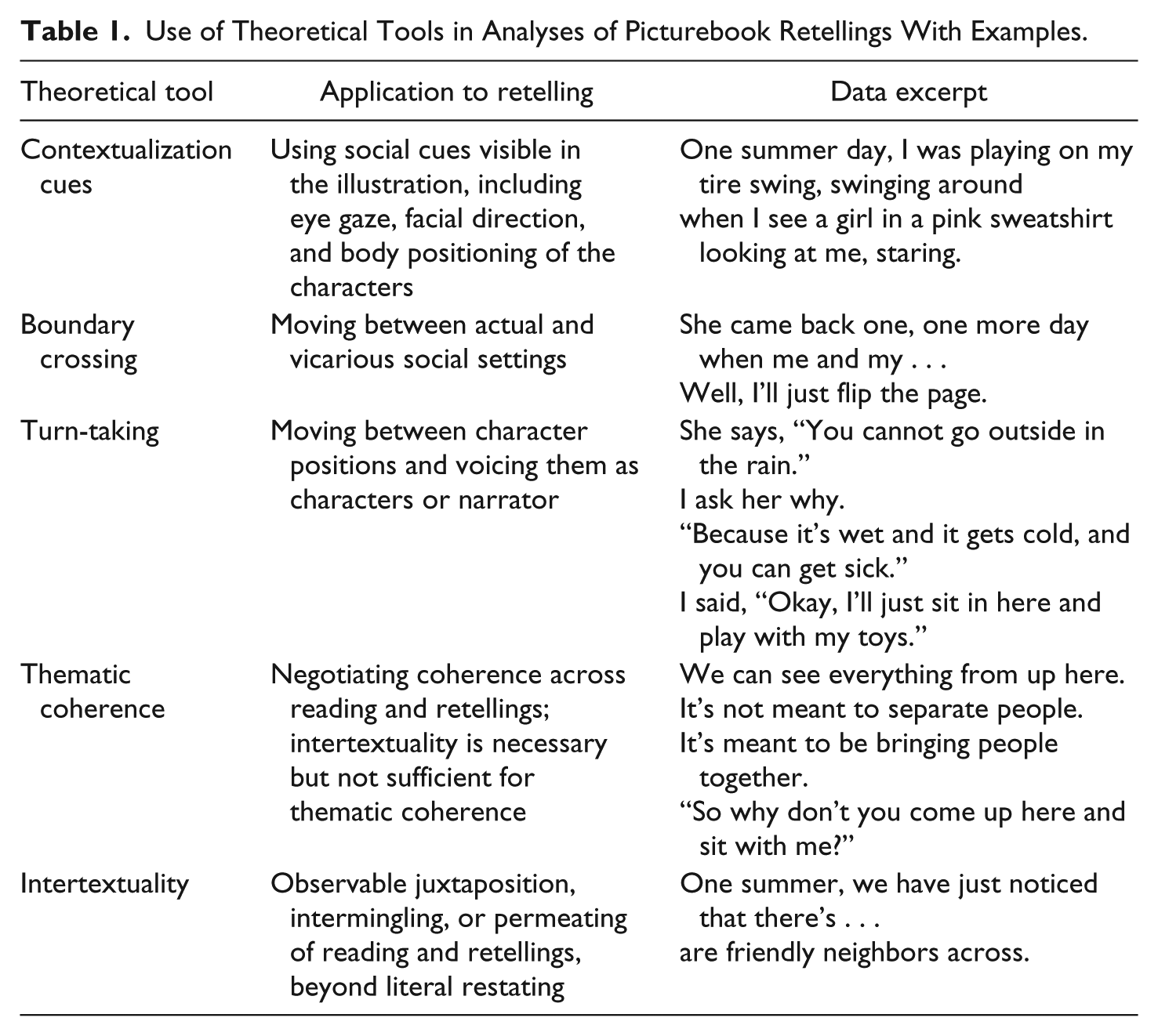
Contextualization cues are features of language use that come from and signal context. They include language characteristics, such as stresses, pauses, and intonation patterns, as well as paralinguistic features, such as gesture, gaze, posture, and positioning. In picturebooks, the contextualization cues of social interaction between characters are represented by visual modes, created by illustrators, and read by readers as they construct meaning in the vicarious social context of the picturebook. Contextualization cues, such as gaze, posture, and body positioning of characters, can lead the reader to form intersubjective relationships with characters and prompt the use of social imagination. Readers use contextualization cues continually as they read picturebooks. In our appropriation of this tool, we noted the reader’s use of contextualization cues only if they were evident in the discourse of the retelling.
The second theoretical tool, boundary making, refers to the edges of social contexts in which readers are participating. The notion of boundaries and the cueing of those boundaries allow us to note John’s movement in and out of the two primary social contexts, that of school and that of the picturebook, which we refer to as boundary crossing. Because these two contexts signal two different times—the narrative time of the story and the actual time of school—boundary crossing reflects the polychronicity of the retelling event. Boundary crossing was noted only when John’s language directly signaled his change of position.
The third tool, turn-taking, refers to the back-and-forth activity of voices as they engage in conversation. As in actual conversation, turn-taking implies both speaking and listening; by listening, one knows when it makes sense to “take a turn.” In picturebook retellings, the readers decide who speaks, who listens, and when and show this by how they position themselves in the narrative constructed during retelling. These behaviors reflect the notion of social imagination, as imagining the minds of characters prompts and shapes conversations between them. In this way, turn taking also involves the multiplicity of voices and positions of the self as well as the capacity of the self to move within the story world, taking up the positions and voices of vicarious others. Turn taking is visible through shifts in pronoun use and in use of dialogue.
Thematic coherence is defined as “the organization of a set of meanings in and through an event” (Bloome et al., 2005, p. 33). When applied to the retelling of a picturebook, it is similar to narrative coherence, which refers to how pieces of a story fit together (Nicolopoulou, 2008). During retelling, the reader negotiates coherence between his or her memory and interpretations of the reading with the story that is coming into being through retelling. The reader not only carries meaning across the story (Myers & O’Brien, 1998) but, in the case of retelling, must also carry meaning from reading into retelling. Thematic coherence as a characteristic of retelling may not be related to the thematic coherence of the author’s text, as retelling is a reflection of, and is nested in, meanings generated during the reading. As such, thematic coherence in retelling is polychronic, occurring over time. Thematic coherence is apparent when John comes back to ideas that play a central role in the narrative that he constructs in the retelling.
Finally, intertextuality, or “the juxtaposition of texts” (Bloome et al., 2005, p. 40), is applied to the event of retelling. We acknowledge that the intertextuality of a retelling event is complex and, in part, unknowable; the multiple texts of a reader’s experience are not fully apparent when listening to and making sense of retellings. However, like others, we use this construct to identify part of what readers do when they read (Cairney, 1990; Hartman, 1995), and we locate intertextuality not in the reader (Pearson & Tierney, 1984) but in the dialogic activity of retelling. That is, the reader constructs intertextuality as aspects of earlier texts are brought into conversation with the text during retelling and reflects the polychronic nature of retelling. In this study, we limit intertextuality to the observable reference to earlier texts in John’s retellings when they go beyond simple restatement.
In regard to levels of analytic units, consistent with microethnographic discourse analysis, we segmented the retellings into message units. Green and Wallet (as cited in Bloome et al., 2005) define the message unit as “the smallest unit of conversational meaning” (p. 19), the boundaries of which are determined by the contextualization cues used by speakers, including shifts in register, intonation stresses, and pauses, and are not predetermined by grammatical rules. Similarly, in analyzing retellings, we used message units to mark the smallest units of conversational meaning articulated by the reader during the retelling. Contextualization cues of intonation, stresses, and pauses were used to determine the boundaries of message units in John’s retellings.
Similar to Bloome et al. (2005), we combined message units into larger units. We designate these as “dialogic units,” rather than as Bloome et al.’s interactional units, for two reasons. First, Bloome et al.’s interactional units are bounded by the cues in actual social interaction. In picturebook reading, the dialogic unit is the vicarious interaction that occurs between reader and text, which is materially bounded by pages.
Procedures of analysis
We began with John’s second, illustration-aided retelling. After transcribing the audio recording, we listened to it individually, in tandem with the transcript, and made notes about our observations. After together discussing our notes, we created a PowerPoint document of the retelling, with scanned images of each illustration or page spread on a slide, with appropriate sections of John’s retelling beneath. This document helped us contextualize the retelling and further refine the analysis.
Once again, we individually moved through the retelling, this time with the PowerPoint format, with the ideas of dialogism, relationships, and social imagination in mind. We made notes and coded specifically for social imagination (Lysaker & Miller, 2013; Lysaker et al., 2011). We compared our individual analyses in light of our theoretical perspective using the PowerPoint of John’s retelling. Coding for social imagination revealed social aspects of John’s retelling and prompted us to explore Bloome et al.’s (2005) microethnographic analysis of social interaction as a framework to deepen the analysis. Using the tools of microethnographic analysis, we reanalyzed John’s reading individually, which prompted refining definitions for clarity. With refined definitions, we recoded retellings individually again, compared analyses, and, through discussion, resolved discrepancies in interpretations. Definitions with examples can be seen in Table 1. Finally, to further investigate the usefulness of microethnographic analysis, and to compare and contrast unaided and illustration-aided retellings, we analyzed John’s unaided retelling similarly, with the exception of procedures that used images.
In an effort to build trustworthiness, we moved between data and theory, both as separate individuals and in collaborative deliberations in an iterative fashion over several weeks. Our adaptation of microethnographic discourse analysis to retelling was challenged and refined as discrepancies in interpretations of theoretical tools were debated and resolved. In this way, triangulation of researchers contributed to trustworthiness of interpretations. In addition, we sought to achieve theoretical validity, as ongoing movement between data and theory demanded explicit, systematic engagement with theoretical constructs and their relationships. According to Auerbach and Silverstein (2003), theoretical validity is achieved with coherence—that is, “the theoretical constructs must fit together” (p. 85)—and is one way to build trustworthiness in qualitative work (Maxwell, 1992), particularly work whose purpose is theory building.
Findings and Discussion
John’s First Retelling: Unaided
In this section, we present analysis and discussion of John’s first, unaided retelling. The transcript is provided as a single dialogic unit, separated by message units; because the retelling was unaided, a match of message units to pages in the book is not possible.
The Other Side is clearly around Civil War times, I bet.
Where the civil rights wasn’t that big of a deal.
It was big for African Americans.
Where White people weren’t allowed to be with Black people.
They started playing together.
And it just wasn’t as they thought.
They weren’t so mean.
And they weren’t so pushy or greedy or anything like that.
They were nice.
And played together for a long time.
She got her other friends to play, too.
I bet now, they’re all friends just sitting around, playing, or jumping rope.
Now, African Americans are free.
And we can be with White people.
And Black people can be with White people.
In the first four message units of John’s unaided retelling, beginning with “The Other Side is clearly around Civil War times, I bet,” John takes a commenter role and interprets the historical position of the book as if trying to explain it to the researcher. Because we know that his fourth-grade class had studied the Civil War, it is likely that his reference to it comes from that experience and is evidence of intertextuality. Message Units 3 and 4 demonstrate thematic coherence, as the relationship between races is a central theme of The Other Side.
In Message Units 5 to 10, John leaves the commenter role. In the message unit “it just wasn’t as they thought,” John returns to the story world and imagines the thoughts of characters, which, in microethnographic terms, represents a boundary crossing. The word “just” signals this return, as John seems to revisit their expectations, which then are not met, increasing the feeling of disappointment that he has constructed as part of the characters’ inner worlds. This is also an instance of social imagination, as the sense of expectation and disappointment are thoughts and feelings of characters that are not made clear in the text itself but, rather, are constructed by John.
Message Units 7 and 8 also demonstrate John’s involvement in the story world. Although it is possible to see these statements as simple summaries from an outside position, the words “mean,” “pushy,” and “greedy” are indications that he is experiencing the story from a personal character position. He is using social imagination to imagine both Annie’s expectations of what it will be like playing with the Black girls and how these expectations are inaccurate. Neither Woodson’s (2001) text nor Lewis’s illustrations suggest that Annie thinks that the girls are pushy or greedy. Rather, John is constructing thoughts of Annie as he revisits the social world of the story.
John most often positions himself outside the story, however, and the retelling is largely summative and descriptive. For example, in Message Units 9 to 11, beginning with “They were nice,” John returns to describing the story from an outside position. In these message units, John is building thematic coherence by articulating the story theme of the girls’ coming together. Even in Message Units 12 and 13, when John is imagining the characters as real people who are living out the resolution of Woodson’s (2001) story, his use of the phrase “I bet now” positions him as outside the story. Finally, in Message Units 13 to 15, John offers a conclusion signaled by the word “Now.” Interestingly, in Message Unit 14, he uses the word “we,” including himself (a White person) as an African American, perhaps evidence of his having taken the position of Clover in his reading. He restates this in Message Unit 15, saying “and Black people can be with White people, as if correcting message unit 14.” John is actively working toward thematic coherence by invoking the racial themes.
In sum, in the first retelling, there is no evidence of the use of contextualization cues. This is, of course, because he was not using the images as a resource and, hence, could not respond to such behaviors as gaze or body positioning. There is also no evidence of turn taking, as he does not move between individual characters, instead relying on the more generic “they” to refer to characters as a group. There is also no evidence of John’s positioning and repositioning himself within the story. The only possible exception to this is the use of “we,” whereby he includes himself briefly as an African American but does not express much about that experience in the retelling.
Thematic coherence and intertextuality predominate in the three sections of this unaided retelling. John first links the story thematically to the Civil War and the civil rights movement, likely alluding to connections with texts encountered during his classroom study. In describing the story, he also stays with the theme of reconciliation between Blacks and Whites. In Message Units 5 to 8, John comes back to this theme. Him stating, “They started playing together and it just wasn’t as they thought. They weren’t so mean and they weren’t so pushy or greedy or anything like that,” suggests that John is returning to the theme of overcoming racial differences and noting that the assumed differences between races were not accurate.
John’s Second Retelling: Illustration Aided
In line with the approach to analysis described earlier, John’s illustration-aided retelling is presented in selected, chronologically ordered dialogic units and smaller message units. Dialogic units were selected for discussion because of their usefulness in informing understandings of comprehending as social and relational activity. However, analysis of all dialogic units can be seen in Table 2.
Instances of Theoretical Tools, Social Imagination, and Narrative Imagination in Unaided and Illustration-Aided Retelling.
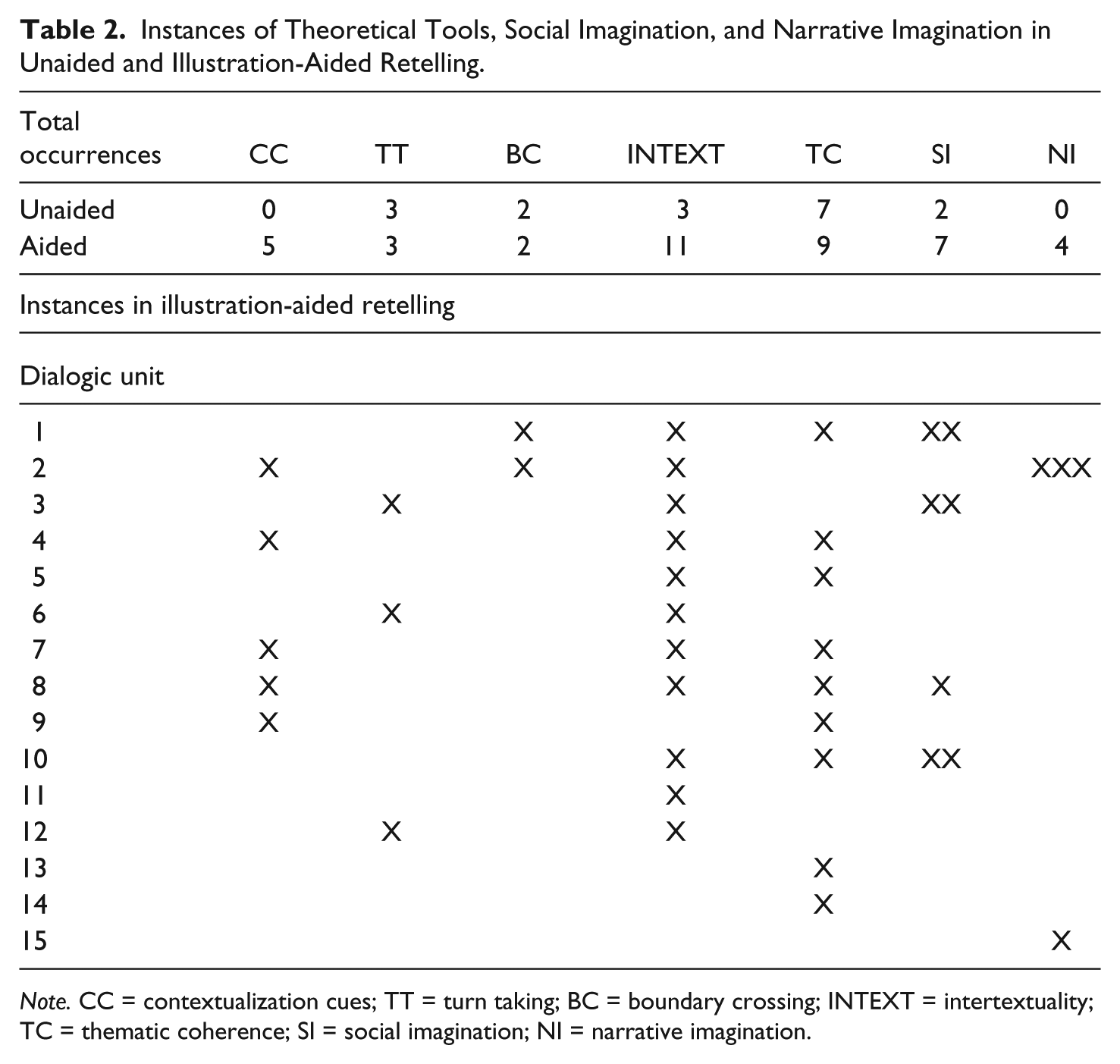
Note. CC = contextualization cues; TT = turn taking; BC = boundary crossing; INTEXT = intertextuality; TC = thematic coherence; SI = social imagination; NI = narrative imagination.
Because John’s retelling is illustration-aided, dialogic units are associated with specific pages and images. To accurately represent this for each dialogic unit, we first describe the images on the page that John is viewing as he retells. In addition, we also include a summary of Woodson’s (2001) text for each image as a means to better understand John’s comprehending activity in relation to the previously read text.
Dialogic Unit 1
On the first double-page spread of The Other Side, there is only a large yellow house and a white fence that stretches across a field on one side. Although no people are present in the illustrations, Woodson’s text has dialogue in which the character of the mother tells Clover, the narrator, not to climb over the fence because it is not safe.
John’s retelling:
One summer, we have just noticed that there’s . . .
Are friendly neighbors across.
Now, let me tell you about it.
John begins his retelling by immediately situating himself in the story as a first-person narrator. Although this may seem insignificant, as Woodson’s (2001) text is in first person, the decision to retell in first person is a choice to enter the story as a character. The use of the pronoun “we” in the first message unit demarcates John’s crossing of the boundary between being a student in school to being a character in the story. By using the plural “we,” John further situates himself within the family who is living in the house illustrated on the page. Moving into the narrative social world is achieved through the use of first-person pronouns as well as social imagination; he imagines the characters noticing their neighbors. John’s stating, “Now, let me tell you about it,” also suggests his dual positioning as character and narrator. It is important to remember that the family is not depicted in the illustration.
In Message Unit 2, still speaking from within the social boundaries of the narrative world, John tells us that there “are friendly neighbors across.” This is a revision of the story’s meaning at this point, as the text depicts the importance of separation between families by the fence as well as a sense of fear: The character of the mother tells her daughter Clover not to climb over the fence because it is not safe. In a traditional view of this retelling, John’s revision of the author’s text might be considered a deficit in understanding. Yet shifting to a dialogic, relational perspective, we see that John is in intimate dialogue with the text, positioning himself as a character and integrating his own perspective on the “neighbors” developed from his earlier reading into the character’s thinking, understood as a use of social imagination. This dialogic unit likely demonstrates intertextuality, as John appears to use his knowledge of the resolution between the girls at the end of Woodson’s (2001) story (the girls become friends) to frame the beginning of his retelling. The resolution of the story here also creates thematic coherence between his reading of Woodson’s text and his retelling.
In the opening dialogue of his retelling, John has invented and voiced a shared understanding among his imagined family about what some other family is like, based on his interpretation of reading the book aloud. John’s comprehending activity, including movement of position into the story world (boundary crossing) and the establishment of the intersubjectivity that accompanies it, demonstrates the dialogic relational aspects of John’s transaction with the text.
Dialogic Unit 2
On the next two-page spread, Lewis depicts Clover swinging on a tire swing, looking toward Annie, who is standing at a distance on the other side of the fence. Annie, the White girl who lives on the other side, is leaning forward on the fence, gazing in Clover’s direction. In Woodson’s text, the narrator tells readers that Annie climbs up on the fence every morning, sits there alone, and stares over at the other side. Clover says she sometimes stares back.
John’s retelling:
One summer day, I was playing on my tire swing, swinging around
when I see a girl in a pink sweatshirt looking at me, staring.
So I stared back a couple times.
She was still there . . . she was there when I went to bed.
She was walking home when I woke up.
She came back one, one more day when me and my . . .
Well, I’ll just flip the page.
John continues his first-person narration and uses contextualization cues to create an elaborated story. Contextualization cues present in the illustration include eye gaze, facial direction, and body positioning of the characters, all suggesting curiosity and a possible desire to meet one another. In addition, these contextualization cues prompt a sense of time. The gaze between the girls is clear, and the page is nearly empty except for the two characters separated by a field and a fence. John picks up on these cues, as evidenced by his reference to both an initial interaction of the two characters “seeing” each other and to the fact that Clover “stared back a couple times.” Although this message unit, “I stared back a couple times,” is nearly identical to Woodson’s (2001) text, the addition of “a couple times” adds a different sense of time, suggesting a sustained exchange.
In Message Units 4 and 5, John creates a new foreshadowing of the future relationship between Clover and Annie, as he articulates the simultaneity of their lives in time and space. By narrating, “She was still there . . . when I went to bed. She was walking home when I woke up,” John positions himself as Clover in relationship to Annie over time, representing both their developing and anticipated relationship. In dialogic terms, this is polychronic activity in which John is merging the understandings that he came to during the reading (he knows that they become friends) with the present retelling, an intertextual construction that is highly relational. In a more traditional view of retelling, this kind of intertextuality might be regarded as confusion on the part of the reader, as there is no reference in the story to Clover’s walking home or going to bed. From a relational perspective, however, this dialogic unit of John’s retelling demonstrates an involved personal dialogue with the meaning potentials made available by connecting his retelling to his understanding of the girl’s relationships, based on his reading. His response to these meaning potentials is to create new narrative elements, coded as narrative imagining.
Next, John briefly breaks his narration by saying, “I’ll just flip the page,” and repositions himself “outside” the narrative world. He crosses the social boundary of the picturebook and moves back to fourth grader seated at school, a polychronic move between time and space of the narrative world and the factual world. Although, on the face of it, such a polychronic move may seem common and unimportant, movement between actual and narrative worlds, while maintaining meaning in both, is an important accomplishment for any reader of stories.
Dialogic Unit 3
On the third page spread, the contextualization cues of gaze and body positioning are particularly salient. The illustration shows Annie leaning on the fence, face tilted at an angle, gazing at a group of girls, all of whom are Black. They look back at her. One girl, standing closest to Annie, has one hand on her hip, while the other hand is holding the jump rope. The posture and gesture of this character show that she is in a position of power in this social group. Woodson’s text reveals that Annie has asked the group if she could play but is refused by Sandra, one of Clover’s friends. Clover wonders what she would have said if Annie had asked her.
John’s retelling:
She came back one more day to ask if we . . .
If she could play with me and my other friends.
One of my other friends said “No” without even thinking about the question.
It was kind of [cruel]
But I didn’t have the guts to say anything.
This section of the retelling shows John fluidly using turn-taking and social imagination to articulate the feelings, thoughts, and intentions of the various characters. John begins with Annie’s perspective, then immediately shifts to the position of Sandra, who “said ‘No’ without even thinking about the question.” To do this, John first maintains his position as the character Clover as a means to imagine what her other friend was thinking when she said “No.” In Message Units 4 and 5, John has an empathetic response to Clover as someone not in power, and he imagines the thoughts and feelings of Clover, articulating this sense of powerlessness by stating, “I didn’t have the guts to say anything.”
This turn-taking illustrates flexibility of self, as John empathetically responds to and embodies the character Clover through social imagination. Once again, John adds to the story by saying, “without even thinking about the question,” which is subtly but importantly different from “without even asking us.” John has inserted an interpretation based on social imagination; he has imagined that Sandra did not even think about the question. This revision of the author’s text appears infused with a judgment on John’s part; not even thinking about the question dismisses its importance and could represent a moral lapse on the part of the character. John’s revision of Woodson’s (2001) text provides evidence of his dialogue with the text and intertextual construction. Thus, during retelling, turn-taking is not only the dialogic activity of moving between character positions through social imagination but also the transforming of the meaning of those dialogues during personal transaction with the text.
Dialogic Unit 6
On the sixth page spread, Clover is depicted as leaning on the ledge of her bedroom window, gazing outside toward the fence. The text tells us that Clover always looked for Annie and found her near the fence. There is a chair with a blue blanket and doll in the room. In this dialogue, we can trace John’s movement between the characters in his turn-taking as well as the probable use of personal background within this part of the reader-text transaction. Woodson’s text includes the mother’s side of a dialogue with Clover, in which she tells her she has to stay inside and play with her “rainy day toys.”
John’s retelling:
I talked to my mom.
She says, “Why can’t . . .” She says, “You cannot go outside in the rain.”
I ask her why.
“Because it’s wet and it gets cold, and you can get sick.”
I said, “Okay, I’ll just sit in here and play with my toys.”
John’s voiced embodiment of the character Clover in this dialogic unit is reflective of the discourse of a child describing to someone else how he talked with his mother. It is reasonable to think that the narrative conversation that John has constructed reflects past conversations that he has had or has overheard in a familial context. Although we note the potential intertextuality of John’s constructed conversation, we did not code it as such because our application of this concept included only references to written text. The conversation that John constructs is intertextual in another way, however, as it is a recontextualization of Woodson’s (2001) text; the ideas are nearly identical, but they are voiced differently.
Other social aspects of this dialogic unit include turn taking and flexibility of self. John moves between the character of Clover and Clover’s mother as he voices their spoken dialogue. Notably, although the mother speaks in Woodson’s (2001) text, there is no dialogue between the mother and child. John’s construction of the dialogue, made evident by turn taking and position changing, reflects the relationality of his comprehending activity.
Interestingly, John omits Woodson’s (2001) idea that Clover always looked for Annie and always found her near the fence. Of course, this omission could mean that John simply did not remember this part of the story or decided that it was not important enough to include. However, his invention of the child’s side of the conversation, not provided by Woodson, represents engaged dialogic activity with and within the narrative world, perhaps experienced by John as more immediate and, hence, compelling.
Dialogic Unit 8
The eighth page spread shows Clover on one side of the fence, smiling and looking at Annie, and Annie with her hand on the fence, smiling and looking at Clover. Woodson’s text includes a dialogue between Annie and Clover in which the girls introduce themselves to each other. The conversation is described as friendly, and Clover comments on Annie’s pretty smile.
John’s retelling:
I finally got up to the fence and talked to her.
She was nice.
She really didn’t mean anything to be harmful or mean.
I started talking to her.
The use of the word “finally” in Message Unit 1 is more evidence of John’s taking the position of Clover. His narration suggests that he is experiencing narrative time as Clover. The use of the word “finally” also is evidence of John’s experience of time in the story world and, thus, the cross-chronotope nature of his retelling. Message Unit 3 demonstrates John’s use of social imagination, prompted by the contextualization cues in the illustration. The girls look at each other through the planks of the fence, their gazes meet, and they are both smiling. He recontextualizes what he knows from his reading into the thinking of the character Clover: “She really didn’t mean anything to be harmful or mean.” This message unit demonstrates both thematic coherence and intertextuality, as John uses what he learned about the girls’ relationship in his reading of Woodson’s (2001) text to expand on the inner world of characters as he makes sense of this part of the story.
Dialogic Unit 9
On the next page spread, we see Clover with her hand touching the top of the fence, where Annie is sitting, looking down at Clover. Woodson’s text indicates that Clover smiled back at Annie. Annie tells Clover that the fence is for sitting on and that it is nice up on the fence.
John’s retelling:
She said, “This fence is a big fence.”
We can see everything from up here.
It’s not meant to separate people.
It’s meant to be bringing people together.
“So why don’t you come up here and sit with me?”
In this dialogic unit, John’s awareness of Woodson’s (2001) use of the fence as a boundary is evident as spoken through Annie in Message Unit 3. This instance of social imagination, in which John attributes a thought to a character, is also an intertextual connection; he is remembering the reconciliation of the girls as represented by their sitting together on the fence at the end of the story and brings it into his retelling. He turns this thought, which is left unsaid by Woodson, into dialogue and has Annie say it. In fact, Annie elaborates on this theme in Message Unit 4, when John has her say that it can bring “people together,” an example of thematic coherence.
Because this kind of dialogue did not occur in John’s first retelling, we can reason that it is the body language and facial expressions of the two characters that prompt John’s dialogue construction between the characters. Clover is reaching up toward the fence, and Annie is looking down toward Clover. These contextualization cues prompt John’s “feeling with” the characters and support his decision to have Annie voice the themes of the story. John uses social imagination to voice Annie’s thoughts, which are not articulated in Woodson’s (2001) text and which bring thematic coherence to his retelling. By giving Annie these lines in the dialogues, he brings in the racial theme of the story and interprets the fence as a place of possible reconciliation.
Dialogic Unit 10
The following illustration shows Clover reaching up and grabbing Annie’s hand, while Annie is sitting on top of the fence, reaching down to grab Clover’s hand. Clover and Annie have an exchange in which they both say their mamas do not want them to cross the fence. But Annie cleverly remarks that she has not been told not to sit on the fence, and Clover agrees that her mother also never told her not to sit on the fence, either.
I finally talked to her and
She said that you should come up.
I finally tried to climb up and I climbed all the way to the top, and she was right.
You could see a lot from up there.
We sat down there for a couple of hours.
In this dialogue, John once again uses social imagination, getting inside the minds of characters and constructing understandings of those minds to revoice the story’s meanings. Furthermore, by using the word “finally,” John suggests that Clover had waited a long time before approaching Annie. He has invented the passage of time within the social context of the picturebook. He continues within this invented time frame by saying they sat together for “a couple of hours.” These message units demonstrate John’s positioning within the narrative social world and his experience of narrative time as part of the reader–text transaction. The invention of the time frame, while consistent with the story, is not present in Woodson’s (2001) text. Creating this time frame makes sense, as John has positioned himself within the story, a polychronic move, and demonstrates narrative imagining that results from his “lived experience” of the text. This inventive revoicing represents John’s intertextual connections and his negotiation of thematic coherence.
Dialogic Unit 14
Near the end of the story, the illustration shows all six girls sitting on the fence together in a line. Woodson’s text consists of one sentence in which the narrator says they were all too tired to jump rope anymore, and so they sat on the fence together in a line.
John’s retelling:
That summer, we were all very fun.
And it was so late.
We were so tired.
We had jumped all day.
In Message Units 1, 3, and 4, we see John using the pronoun “we,” again reinforcing his position as one of the members of the group. In Message Units 1 and 4, we also can see John using narrative imagining by inventing a time frame of an entire summer, “That summer, we were all very fun,” as well as the time frame of an entire day, “We had jumped all day.” In framing the dialogue in this way, John emphasizes coherence between Woodson’s (2001) text and his retelling.
Dialogue 15
The final illustration of The Other Side shows the six girls together around the fence. Some are standing on the fence, while some are sitting on it. Woodson’s text has Annie telling Clover that she thinks someone will knock the fence down someday, and Clover agrees.
John’s retelling:
Someday this fence will be torn down.
Someday there should be a park built for all of us.
In Message Unit 1, John is using the future tense to suggest that there will one day be a park for all of them. In Message Unit 2, John uses a morally weighty statement, indicated by the word “should.” John might have used the word “will” but chooses “should” instead, infusing the character with his own personal set of values. This is a good example of the flexibility of self, as John voices a strong moral statement from the position of a character. Although the narrator could easily make these statements as abstract commentary, John voices them from the position of the main character, Clover. Moreover, John demonstrates narrative imagining as he invents the idea of a park being built for all the children, extending the interpretation of the fence as a place of reconciliation.
Comparing John’s Unaided and Illustration-Aided Retellings
John’s unaided and illustration-aided retellings of The Other Side demonstrate differences in his comprehending activity. In this section, we present and discuss these differences as they pertain to the purposes of the study: to describe and theorize retelling from a transactional, dialogic perspective as a means of investigating the activity of comprehending as well as to explore microethnographic discourse analysis as a framework for examining retelling as social activity.
Perhaps, unsurprisingly, the most apparent difference between the unaided and illustration-aided retellings is the number of message units in each retelling. John’s unaided retelling is measurably shorter, containing only 15 message units in comparison to the 65 message units of his illustration-aided retelling. The prepared wordless version of the picturebook as a retelling aid provided a sequenced, illustrated view of the story, logically leading to a longer, more elaborated retelling, with a dialogic unit for each page. From a dialogic perspective, the addressivity present in the illustrations invites response and leads to extended meaning making.
Examining John’s unaided and illustration-aided retellings through the framework of microethnographic discourse analysis reveals qualitative differences as well. The social and relational aspects of the reading event are nearly absent in the unaided retelling and are replaced by a summative, explanatory tone, despite the prompt to “tell it like you would to a friend.” Throughout the retelling, John remained “outside” the story, with the exception of the one-time use of “we,” as if indicating that he was taking the position of the Black girl, Clover. As can be seen in Table 2, microethnographic discourse analysis reveals very little social activity, with the exception of John’s ability to build thematic coherence and make intertextual references.
Because John was using only memory, and not images, there was no possibility of coding contextualization cues; he could not respond to the material presence of gaze, gesture, or body positioning. Without this vicarious connection to the characters through image, the use of social imagination was constrained, and intersubjective relationships with characters do not appear. Although John describes known emotional states of characters in a summative way, his retelling does not suggest that he imagines the thoughts, feelings, or intentions of characters as they occur in relation, or that he experiences a sense of sharedness with characters within the story world.
One possible exception is the use of the pronoun “we” in Message Unit 14, where John positions himself as part of the group of Black girls. The moment of shared reality hinted at in this message unit, however, is brief and undeveloped. Perhaps this constraint on sharing the realities of the narrative also would constrain narrative imagination. In John’s unaided retelling, he invents no new narrative elements. Finally, turn-taking is also absent, again likely constrained by the absence of images to prompt relational events between characters. As Table 2 shows, John’s illustration-aided retelling contextualization cues were coded for one third of the dialogic units, indicating places where John was observed actively regarding the illustrations during the retelling. Not surprisingly, John used social imagination (attributing thoughts, feelings, and intentions to characters) more often and positioned himself as one of the characters for nearly the entire retelling. Active participation in the vicarious social world of the characters resulted in more instances of turn-taking.
Beyond the elements of microethnographic analysis and the use of social imagination, John’s illustration-aided retelling demonstrates different experiences of time. Rather than standing “outside” the narrative and summarizing, John’s participation in the story world led to polychronic activity. His retelling demonstrates a sense of being in narrative time, while, of course, all the while experiencing actual time. An important part of experiencing narrative time is the use of narrative imagination. More than once, John positions himself as a character and invents plot elements from that perspective. Although this might be considered as detracting from comprehension in the traditional sense, from a dialogic perspective, experiencing narrative time demonstrates authentic dialogue with and within the narrative world. The sense of being transported into the story world is an often-reported aspect of narrative reading, and in this study, illustration-aided retelling provides evidence of this experience of narrative time as it is happening and its potential contribution to comprehending.
One way to account for the difference between the unaided and illustration-aided retellings is to consider how the reader is positioned. In the unaided retelling, John is physically “outside” the story. He has no material contact with the book and, hence, is positioned to talk “about” the story in explanatory terms. In addition, John knows that the researcher is not a naive listener and has heard the story, which may prompt a summative retelling (Golden & Pappas, 1990). In illustration-aided retelling, John is positioned as a reader in a material way, with the dialogic object of the book in his hands, and with the aid of book images, is prompted to enter the reader–text transaction again as a potentially lived dialogic experience. In this position, John may have been less concerned with providing an account to the researcher as listener.
Perhaps most striking in this illustration-aided retelling is John’s movement between character positions and his willingness to speak the thoughts and feelings of characters who differ from him in both race and gender. John takes up and tries out new self-positions, identities, and relationships with unlike others. His complex relational activity during comprehending is one in which he is actively building a multi-perspectival self. Such an assertion is consistent with Vygotskian and Bakhtinian thought, which emphasizes the constitutive function of dialogue and social interaction in the ongoing formation of the human person.
In this case study, the positioning of the reader in the unaided retelling appears to contribute to John’s predominantly efferent stance; he tells the researcher about the story. From this kind of retelling, as in traditional approaches, it is possible to gather information about what John has taken away from the reading. This efferent stance is evidenced by the prevalence of thematic coherence and intertextuality in the analysis. One could argue that this positioning—reporting about the story to the researcher—is engendered by the social setting in which the data were collected. As noted earlier, this was an individual setting between a researcher and student, which could be experienced as evaluative despite systematic efforts to counter this perception. In contrast, the illustration-aided retelling prompts a predominantly aesthetic stance, appropriate to narrative reading, in which the comprehending activity present in the reader–text transaction becomes visible as active dialogue, reflecting the lived experience of the vicarious social world of story. Furthermore, using the wordless version, and not simply isolated images, allowed John to experience the narrative again over narrative time and over actual time, providing extended opportunities for developing understandings.
Conclusion
The theoretical tools of microethnographic discourse analysis along with constructs from dialogic transactional reading theory make the relational and social movement of the “self within story” visible and, in this way, provide evidence of comprehending activity. In particular, several aspects of the dialogic reader–text transaction, which reflect comprehending activity specific to narrative and not addressed in the retelling literature, include (a) the use of contextualization cues and social imagination to establish intersubjectivity with characters, (b) the use of turn-taking to move between characters and to develop relationships and social understandings between characters, (c) the polychronic activity of moving across different space-times demanded by involvement in narrative worlds, (d) the layering and interweaving of texts across time and their use as resources for meaning-making, and (e) the selection and orchestration of meanings from a set of meaning potentials to construct a coherent narrative.
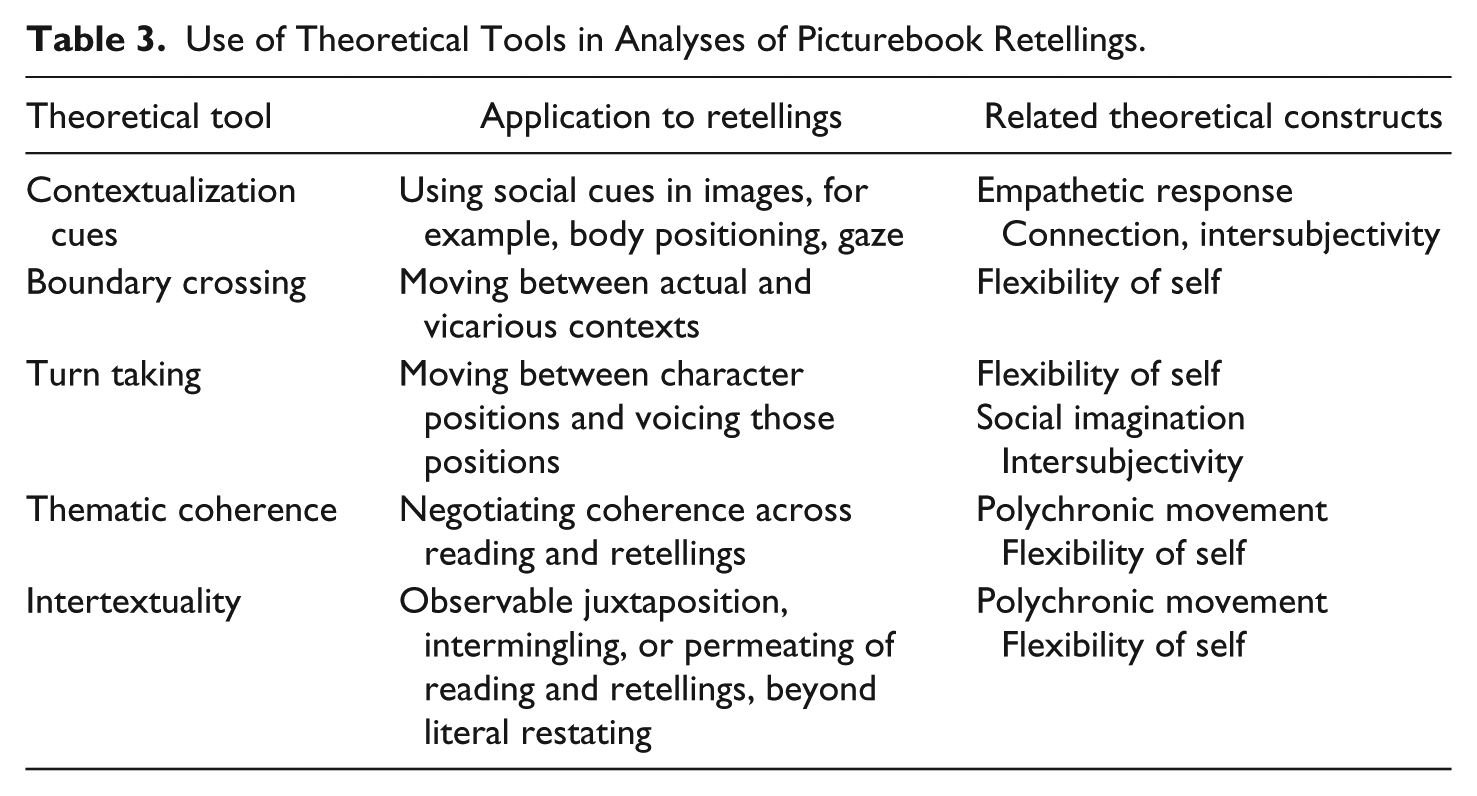
In addition, this analysis of John’s retelling has led to more distinct conceptual connections between microethnographic discourse analysis and dialogic self-theory, transactional theory, and the idea of social imagination, which can be seen in Table 3. For example, contextualization cues in picturebooks prompt empathetic responses, social imagination, and intersubjectivity. Turn-taking, or the movement between characters and their perspectives in the story world, is aided by social imagination as well as flexibility of a dialogic self. Making intertextual connections involves polychronic activity, as it necessitates moving across real and narrative times and space. In addition, because the intertextual connections of picturebook reading involve the evolution of readers’ understandings of characters, intertextuality often draws on social imagination to recontextualize prior understandings of the inner realities of characters in a “new” text. Such theoretical relationships, while in need of more study, have the potential to invigorate theories of reading comprehension.
Use of Theoretical Tools in Analyses of Picturebook Retellings.
There are several limitations to this study. First, although we conducted a reading interview with John, it did not reveal much about past texts that may have influenced this retelling, and this may have limited our understandings about intertextual connections made in his retellings. Second, we did not get to know John’s thinking about race and culture in an extended way. Both these aspects of John’s situatedness in regard to his retelling may have deepened the analysis. A third limitation may be in the video coding of contextualization cues. Thematic coherence and intertextuality predominate in both unaided and illustration-aided retellings. This finding was surprising, as we thought that the presence of illustrations would evoke nearly constant use of contextualization cues and lead to even more turn taking and use of social imagination. More precise video analyses, in which gaze can be systematically assessed moment by moment in terms of a reader’s uses of picturebook illustrations, may expand our understanding of this kind of comprehending activity in illustration-aided retelling.
Finally, more samples of John’s retelling of a range of texts would provide information about how the reader–text transaction unfolds for John across texts, perhaps leading to the identification of patterns of comprehending activity within his reading. The identification of such patterns could help further develop and refine reading theory and further investigate the usefulness of microethnographic discourse analysis as an analytic tool for understanding comprehending activity in illustration-aided retelling. In addition, because John’s retelling was chosen for its richness and, therefore, is not typical, exploring illustration-aided retellings with readers at various points in development and with a range of proficiencies is needed for further theory building.
These limitations notwithstanding, this study contributes to the literature on retelling and comprehension by using microethnographic discourse analysis to retheorize and articulate the specific ways in which one fourth-grade reader engaged in the social demands of picturebook reading, as they occur within the vicarious social world of narrative through illustration-aided retelling. Considering retelling as a dialogic, relational activity situated in the vicarious social context of the narrative world highlights the reading self as a relational being instead of as a consumer of information. When retelling is regarded in this way, a shift occurs in what counts as successful reading. The ability to remember and report predetermined aspects of an author’s text is replaced by the ability to engage flexibly, sensitively, and imaginatively with others in the social world of story and to dialogically work toward coherence across texts. In this way, retelling can be an opportunity, like reading, to encounter others unlike oneself, thus providing opportunities for imagining the realities of others, leading to the greater knowledge of self and others. This shift also has implications for reading assessment, particularly assessment of narrative reading. Future work is needed to explore how the social intricacies of comprehending activity can be adequately captured in a usable, valid assessment tool.
Finally, this study contributes to the literature on reading assessment through the introduction of illustration-aided retelling as an assessment method. Prompting retelling from a wordless version of the picturebook provides a fertile context for vicarious engagement in the story world. In illustration-aided retelling, readers’ encounters with representations of human experience reengage social imagination and the construction of intersubjective relationships with and between characters. Although Goodman et al.’s (2005) suggestions for conducting retellings may prompt readers to recall specific aspects of the inner worlds of characters from memory, what readers miss in this approach is the reengagement with the story world itself, through the multimodal and polychromic activity of using illustrations. When readers resituate their remembered and interpreted version of the author’s text within the illustrations of the wordless version of the picturebook during retelling, a complex multimodal set of new meaning potentials becomes available. This new set of meaning potentials invites readers to reenter the story world during retelling, not as reporters of another’s text, but as coauthors, constructing new meanings by shaping the complex dialogue between the present images and the meanings that they have constructed and remembered from the reading. This social and relational activity is at the heart of narrative comprehending and, thus, is critical to any assessment of story comprehending if such comprehending is to be fully understood.
Footnotes
Declaration of Conflicting Interests
The author(s) declared no potential conflicts of interest with respect to the research, authorship, and/or publication of this article.
Funding
The author(s) received financial support for the research, authorship, and/or publication of this articl: The research is funded by Purdue University, College of Education Seed Grant.

Notes
Author Biographies
References
Supplementary Material
Please find the following supplemental material available below.
For Open Access articles published under a Creative Commons License, all supplemental material carries the same license as the article it is associated with.
For non-Open Access articles published, all supplemental material carries a non-exclusive license, and permission requests for re-use of supplemental material or any part of supplemental material shall be sent directly to the copyright owner as specified in the copyright notice associated with the article.
