




Abstract
In 2006, The Wyoming state legislature allocated monies to fund Instructional Facilitators (IFs) in schools around the state. This interview study, developed through situational analysis, explores the roles and responsibilities of IFs in Wyoming secondary schools, and the contextual factors of those schools that impact the work of IFs, particularly those whose work is focused on literacy coaching. Findings from the study include descriptions of common work roles, individual coaching with teachers, providing staff development to groups of teachers, and collection, analysis, management, and interpretation of data. Contextual issues of teacher enrollment and embeddedness in school professional development structure are also presented as of great importance to IFs, and recommendations for IFs’ work in schools, as well as for future research are presented.
Keywords
In 2006, the Wyoming legislature allocated monies to fund the work of Instructional Facilitators (IFs) in schools across the state. These IFs, or instructional coaches, “would provide the critical ongoing instructional coaching and mentoring that the professional development literature shows is necessary for teachers to improve their instructional practice” (Picus et al., 2005, p. 40). The initial recommendations for the program emerged from the work of Picus and colleagues (2005), who indicated that the IF program had potential as a systematic and ongoing approach to school-based professional development. Picus and colleagues also recommended that IFs should be responsible for improving instructional programs and for providing instructional coaching and classroom-based modeling for teachers. Legislation was passed in 2006 to establish the program; it was reauthorized in 2009. Subsequent uptake of the program involved almost every school district in the state. During the 2009-2010 academic years, 411 IFs were working part-time or full-time in Wyoming public schools, with 214 at the elementary level, 94 in middle schools or junior high schools, and 103 in high schools (Balow, 2010).
According to the United States Census Bureau (2010), Wyoming population is the lowest in the United States. Wyoming population is largely White (about 94%), with the next highest population indicator being that of Hispanic or Latino origin (about 8%). Wyoming’s low population density and the preponderance of counties that are considered Frontier Counties, that is, counties with a population density of less than seven persons per square mile (United States Department of Agriculture/Economic Research Service, 2007) make it an overwhelmingly rural state, with unique professional development needs (Rush & Young, 2011). The IF program in Wyoming is one way in which schools attempt to meet their professional development needs.
The purpose of this manuscript is to present data and findings from a statewide interview study centering on Wyoming IFs who work as literacy coaches in middle schools, junior high schools, and high schools. Research questions for this project are as follows:
What are the roles and responsibilities of IFs at the secondary level who focus on literacy instruction in Wyoming?
What contextual factors play a role in the work of these IFs? What is the impact of such contextual factors on their work?
The study examines the roles and responsibilities of IFs in Wyoming who work as literacy coaches with teachers at middle and high school levels. Data collected in this study include interviews of 26 IFs who work in Wyoming junior high schools, middle schools, and high schools, as well as documents related to the roles and responsibilities of IFs, such as job descriptions and work logs.
Because this study examines literacy coaches’ roles and responsibilities in secondary settings on a statewide level, it stands poised to provide significant information that is lacking in the research literature on literacy coaching. Equally significant is a clear understanding of the contexts in which these secondary school literacy coaches work. Borko (2004) makes an argument for the examination of professional development through a situative perspective, one that conceptualizes “learning as changes in participation in socially organized activities, and individuals’ use of knowledge as an aspect of their participation in social practices” (p. 4). Such a situative perspective would study the participation of learners within multiple contexts, “taking into account both the individual teacher–learners and the social systems in which they are participants” (Borko, 2004, p. 4). I would argue that the work of literacy coaches can, similarly, be studied best by examining both the work of the coaches themselves and the contexts in which they are working. This study operates at the intersection of a situated perspective and the literature on professional development through coaching, illustrating the importance of understanding the interplay between contexts and the work of individual instructional coaches, with an eye toward the great potential impact of those contexts on the successes or failures of work toward improvement of teacher practice and student learning. A clear understanding of what secondary school literacy coaches do and how the contexts in which they work influence their success will be of great importance to a variety of audiences, including researchers in adolescent literacy, district- and school-level administrators, literacy coaches, and teachers.
Review of Related Literature
This research project is part of the currently growing area of research in literacy and/or instructional coaching as a form of professional development. Sturtevant and Linek (2007) reported on a literacy-focused teacher development program for secondary-level teacher leaders in Macedonian secondary schools, remarking that “adding a coaching component to the staff development model greatly increases the likelihood that teachers will implement new methods” (p. 241). Examination of a statewide professional development program that incorporates the work of literacy coaching assists the field of literacy education in answering questions about professional development programs and their impact on teacher learning (Borko, 2004). Neufeld and Roper (2003) present an overview of models through which coaching in schools has been developed, focusing particularly on what they call change coaches and content coaches. Change coaches work primarily with principals, focusing on improving school leadership as a path to school improvement; whereas content coaches work primarily with teachers, focusing on discipline-based instructional improvement. Using this model, Wyoming’s IFs would be considered content coaches, as their work is particularly focused on working with teachers to improve teacher instructional practices (Balow, 2010).
Literacy Coaching in Elementary Schools
Most research into the work of literacy coaches has been descriptive in nature and has been focused on the elementary level (see J. Allen, 2006; Walpole & McKenna, 2004) and on coaches working in and funded by the Reading First program (Barton & Lavrakas, 2006; Deussen, Nelsestuen, Autio, Scott, & Davis, 2007; Norton, 2007; Reed & Rettig, 2006). Walpole and McKenna’s (2004) work, which speaks to an audience of literacy coaches, describes successful in-service programs in literacy as those that provide both extensive and intensive interventions, along with implementation support. These programs also plan for systems of teacher feedback and involve all school personnel in the work of improving literacy instruction.
One well-known program that involves coaching for essential provision of professional development for teachers is the federally funded Reading First program. In an evaluation of the Reading First program for Washington (Deussen et al., 2007), the importance of the coach for the success program is clearly described: “The reading coach continued to be the primary vehicle for the delivery of professional development to teachers. This included helping with assessments, observing classrooms and providing feedback, and assisting with interventions” (p. 20). However, this evaluation report also described uneven coaching across schools, in terms of the number of times teachers were observed and the collaborative nature of that coaching.
Recent research on the work of literacy coaches in elementary schools also includes evaluation of the work of the Literacy Collaborative (LC) initiative, a comprehensive literacy professional development model involving coaching in elementary school settings (Atteberry, Bryk, Walker, & Biancarosa, 2008; G. Biancarosa, Bryk, & Dexter, 2010; Hough et al., 2008). G. Biancarosa and colleagues (2010) studied the effects of the LC program on the literacy learning of students, using a longitudinal 4-year design. They found significant improvement in students’ literacy learning in the 1st year of the implementation of the LC program; this effect grew for each subsequent year that it was measured. Atteberry et al. (2008) examined variations in the extent to which participants engaged in the professional development activities provided through LC and to what degree the amount of coaching participants received influenced their take-up of instructional practices advocated by the LC. They found a large degree of variability in both coaching activities and in the amount of coaching teachers received. They also found a considerable amount of agency—on the part of teachers and coaches—in how much coaching was done. Teachers, for example, who reported having “less prior training in early literacy, who proactively engage with their colleagues, and who report strong commitment to their school tend to receive a disproportionate amount of the coach’s time” (p. 42). Coaches who reported a strong level of commitment to their school and support from teachers and administrators, were “likely to conduct more coaching overall” (p. 43). Hough and colleagues (2008) examined changes in teacher practice within the schools implementing the LC program, finding that both teachers’ backgrounds and their dispositions influenced how they chose to implement the instructional techniques valued in the LC intervention. They also found that the amount of coaching appeared to be related to both the quality and the frequency of teachers’ implementation of these techniques. Although all three studies were specific to the LC program, they do indicate that literacy coaching can impact both teacher practice and student literacy learning. In addition, these studies highlight the importance of school context and the complications related to context that can influence the work of literacy coaches and the uptake of the professional development provided through coaching.
Research on the roles and work of reading coaches (Heineke, 2010) and reading specialists (Bean, Cassidy, Grumet, Shelton, & Wallis, 2002) also points at the need to know more about how their roles function, what they do, and how coaches provide support to teachers. Bean et al. (2002) surveyed school reading specialists on the type and extent of the work they do in schools. These researchers found that most reading specialists work at the primary level, with a few involved in instruction at the middle school and high school levels. The focus of the work of reading specialists is largely on teaching students directly, although almost all of the reading specialists indicated that they perform assessments, serve as a resource to teachers, and spend time performing administrative tasks. These reading specialists also reported that they were increasingly being asked to plan with teachers and to function as a resource to teachers.
In a study more directly related to the roles and responsibilities of literacy coaches, Heineke (2010) explored the interactions between elementary school reading coaches and teachers to see what kinds of support the coaches were providing to the teachers they worked with. Heineke found that coaches had numerous roles, only one of which was working one-on-one with teachers. In addition, the variety of roles played by coaches minimized time for one-on-one coaching with teachers, and some of the coaches’ roles conflicted with those of others, perhaps because of power and political issues. The author suggests that stakeholders in literacy coaching should emphasize the professional development role of coaches and minimize the administrative roles, or any roles that conflict with job-embedded professional development.
An examination of the research that has been carried out on the work of reading/literacy coaches in elementary school settings indicates that, although there is much promise for this mode of teacher professional development, variability in the amount and type of coaching can not only impact the uptake of instructional strategies by teacher but can also be connected to contextual issues in the schools in which the coaching takes place.
Literacy Coaching in Secondary Schools
Researchers have just begun to develop knowledge on the roles and responsibilities of literacy coaches in secondary schools. Development of the Standards for Middle and High School Literacy Coaches (International Reading Association [IRA], 2006) was an important step toward including both content area knowledge and knowledge of literacy teaching as requirements for literacy coaches at the secondary level. Blamey, Meyer, and Walpole (2009) surveyed secondary school literacy coaches on their roles as collaborators, coaches, and evaluators, finding that personal attributes play an important part in selecting literacy coaches, including their ability to listen, solve problems, and build relationships.
The authors of the IRA standards document (IRA, 2006) argue that the concept of professional development for teachers through coaching is in line with research on effective professional development; however, this review also points to a lack of existing research on models of literacy coaching in middle and high schools. According to Sturtevant (2003), the largest role adopted by literacy coaches is to assist content area instructors to incorporate literacy strategies in their content area instruction, with the goal of ensuring student success in both content area knowledge and literacy. Others have provided portraits of instructional coaches in high school settings (Schen, Rao, & Dobles, 2005) and have indicated the importance of clarity surrounding the role of the literacy coach (Poglinco et al., 2003).
Literacy coaching and the roles of literacy coaches in middle schools has been examined more recently by Smith (2007), who studied the roles of middle school literacy coaches in school settings and how the contextual factors of those settings impact the roles taken on by coaches. Smith collected data on the work of three middle school coaches and determined that they took on two general roles: a school-related role, which included professional development, administrative work, and other responsibilities designed to assist the school as a whole; and an instruction-related role, which included tasks related to instruction and classroom practice, such as planning with a teacher, co-teaching, or observing lessons. Smith also found that the roles taken on by coaches were influenced by school contexts, including “organizational factors, school and classroom climate, and principal and coach relationships” (p. 59). The coaches observed in this study were often hampered by school schedules, traveling to multiple school buildings, and negative school climates: “For all three coaches, initiating the coaching process was a struggle” (p. 60).
The roles of literacy coaches in secondary school settings has also emerged in two evaluation studies focusing on Florida middle schools (Marsh et al., 2005; Marsh et al., 2008). Marsh et al. (2005) carried out a formative assessment of three urban districts’ work as partners with the Institute for Learning, and found that teachers tended to prefer coaching that was specific to teachers’ needs and contexts, that teachers were concerned about sufficient time to meet with coaches and about clear definitions of roles. Evaluating Florida’s statewide middle school reading coach program, Marsh et al. (2008) found that reading coaches tended to spend less than half of their time working with teachers, and most of that time was spent working with reading teachers, as opposed to working with teachers in content areas, such as mathematics, science or English. Principals, reading teachers, and social studies teachers reported positive results in terms of teacher confidence and overall school climate; however, mixed results were found for impact on student achievement. In their research on literacy coaches at the middle school level, Taylor, Moxley, Chanter, and Boulware (2007) also noted the importance of a clear definition of the literacy coach’s roles and responsibilities.
Challenges faced by secondary-level literacy coaches include working with a large number of teachers in different departments, working with teachers who may not see literacy as a viable or important part of their teaching goals, and feelings of isolation due to lack of clarity regarding roles (Blamey et al., 2009; Snow, Ippolito, & Schwarz, 2006; Sturtevant, 2003); in addition, coaches in secondary school settings may be confronted by the prevalence of an inflexible curriculum and the common use of lecture as means to cover course content (Sturtevant, 2003). Coaches can face obstacles when trying to work with resistant teachers (D. Allen, Ort, & Schmidt, 2009; Blamey et al., 2009; Gross, 2010; Jetton, Cancienne, & Greever, 2008). Successful coaches can help relieve some of the resistance of teachers by considering the teachers’ ideas on what will work with students. Jetton et al. (2008) encourage collaboration in professional development among teachers and coaches; they also suggest that teachers conduct action research projects to see what is working for their students. D. Allen et al. (2009) suggest that coaches work to create nonthreatening environments for teachers by giving them tools that can help in their understanding of the concepts explained in professional development, as well as encouraging teachers to present results on their own class research. The isolation of literacy coaches can be amended by creating opportunities for networking or support groups with other coaches (Blamey et al., 2009).
We currently know very little about the impact of literacy coaches on secondary school teacher practice and on student achievement at the secondary level. Positive effects on sixth- and ninth-grade teachers’ efficacy after professional development in content literacy involving coaching have been found (Cantrell & Hughes, 2008); similarly, the work of peer coaches—teachers working as coaches for each other—has been shown to have potential for teachers’ professional development in literacy (Joyce & Showers, 2002; Young & Rush, 2008).
Thus, as with the studies that examine the work of literacy coaches in elementary school settings, we find that the contexts in which secondary school literacy coaches work can have substantial play in terms of those literacy coaches’ success with professional development.
Theoretical Framework
Data collection and analysis in this study have been conducted through the lens of a situational or situative perspective (Borko, 2004; Clarke, 2005; Richardson, 1990), focusing on individuals within school contexts as those individuals participate in contextual conflicts and structures. A situational perspective combines both social and individual practices and meaning making as requisite forms of learning, allowing the researcher to construct complex accounts of the relationships between micro-level practices and macro-level structures and communities. As suggested by Richardson (1990),
to understand teacher learning, we must study it within these multiple contexts, taking into account both the individual teacher-learners and the social systems in which they are participants. As in the case of student learning, situative perspectives provide a powerful research tool, enabling researchers to focus attention on individual teachers as learners and on their participation in professional learning communities. (p. 4)
Clarke’s (2005) presentation of situational analysis is as a method designed to push, or perhaps pull, grounded theory around the postmodern turn by recognizing the embodiment and situatedness of the production of knowledge, centering analysis on the situation of the research, and using a variety of situational and positional maps as tools for analysis. By acknowledging the situational nature of a research question, of data collection, of analysis, and ultimately of findings, this theoretical framework encourages a research process that is complex and grounded.
Clarke’s situational analysis methodology is rooted in grounded theory as it is traditionally understood (Strauss, 1995), but it shifts focus from examining the social process or action to examining the situation in which that action takes place, taking into account not only collective actors, but also individuals and discourses. In developing the tools for situational analysis, Clarke pulls heavily from early Chicago School studies (i.e., Blumer, 1958; Park, 1952) that focused on differing forms of communities, using a variety of forms of maps to do so. The maps made in these studies were designed to be examined within larger contexts and to be combined and compared with those from other studies.
By articulating Foucault’s work on power and agency (Foucault, 1972, 1973, 1975) with the Chicago School of sociology’s emphasis on local human geography (Baszanger & Dodier, 1997) and Strauss’ (1982) interest in how identities are produced through relations in social worlds, Clarke (2005) develops a focus for situational analysis:
My point is that Foucaultian forms of attention to power, to disciplining, to discourses as meso-level social forms that produce subjectivities—individual and collective—and to the ordering of things that produces how we can know those things are invaluable analytic tools. I am attempting to address these concerns through the relational practices of situational analysis. (p. 60)
To address our own subjectivities as research designers and analysts, Clarke also suggests that researchers must take important nonhuman elements in the research site explicitly into account, and that the situation of the action should be the focus of analysis.
What this focus on the situation means for this study is that the perhaps more typical mode of data analysis—coding and developing categories and themes—was supplemented and strengthened by the development of situational maps, “maps that lay out the major human, nonhuman, discursive, historical, symbolic, cultural, political, and other elements in the research situation of concern” (Clarke, 2005, p. xxxv) and positional maps, which “lay out the major positions taken, and not taken, in the data vis-a-vis particular axes of variation and difference, focus, and controversy found in the situation of concern” (Clarke, 2005, p. xxxvi).
Method
Situational analysis (Clarke, 2005) emphasizes interplay among the power, activity, and actions of individuals and the power, activity, and actions of the system within which those individuals are working. The data collection and analysis methods used in situational analysis are descriptive in nature and allow the researcher to examine the individual work of literacy coaches at the secondary level and the contexts within which those literacy coaches work.
Data collection began with semistructured interviews (Kvale, 1996) of 26 secondary-level IFs in Wyoming. Interviews focused on roles and responsibilities of participants, as well as their descriptions of the settings within which they work. I began by contacting, via email, all of the Wyoming IFs who worked in junior highs, middle schools, high schools, or Grades 7 to 12 settings (n = 197). The contact information for the IFs was obtained from the Wyoming Department of Education. All of the IFs who volunteered to participate in the study were interviewed. Interview questions used in all 26 interviews focused on eliciting IFs’ explanations of their job descriptions and roles, successes and problems they had encountered, and how they work with administrators and teachers (see the appendix for a complete list of the interview questions). Interviews were digitally recorded and transcribed.
In addition, interview participants were asked to provide documents relating to their roles and responsibilities, such as job descriptions and work logs. Although not all of the participants provided such documents, this request did secure five unique job descriptions, work logs for five of the participants, and a variety of other documents, including handouts, meeting minutes, evaluation tools, and lists of professional development topics that IFs could provide.
Analysis of interview data began with coding of the transcripts and documents in several rounds of reading and coding, using a process of inductive analysis, including reading and rereading of data (Bogdan & Biklen, 2006; Coffey & Atkinson, 1996; Merriam, 1998) and development of meaning categories and themes, followed by interpretive analysis (Kvale, 1996). This initial work of careful reading, coding, and categorizing, is recommended by Clarke (2005) as an important first step of situational analysis. I developed codes by carrying out multiple readings of interview data and documents, with my research questions in mind. To answer those research questions, I looked for words and phrases related to activities that IFs reported engaging in on a regular basis, structures within which IFs reported both success and frustration, relationships with teachers and administrators, and both internal and external forces that shaped the ways in which they worked. I provide some exemplars of the codes, definitions for those codes, and examples of data in Table 1. The set of code exemplars here cluster around the research questions, with the first set (data management, provider of professional development, working with teachers, and content area literacy) relating to the larger category of roles and responsibilities and the second set (structure, leadership, and district goals) relating to the larger category of contexts.
Coding Exemplars From Initial Analysis.
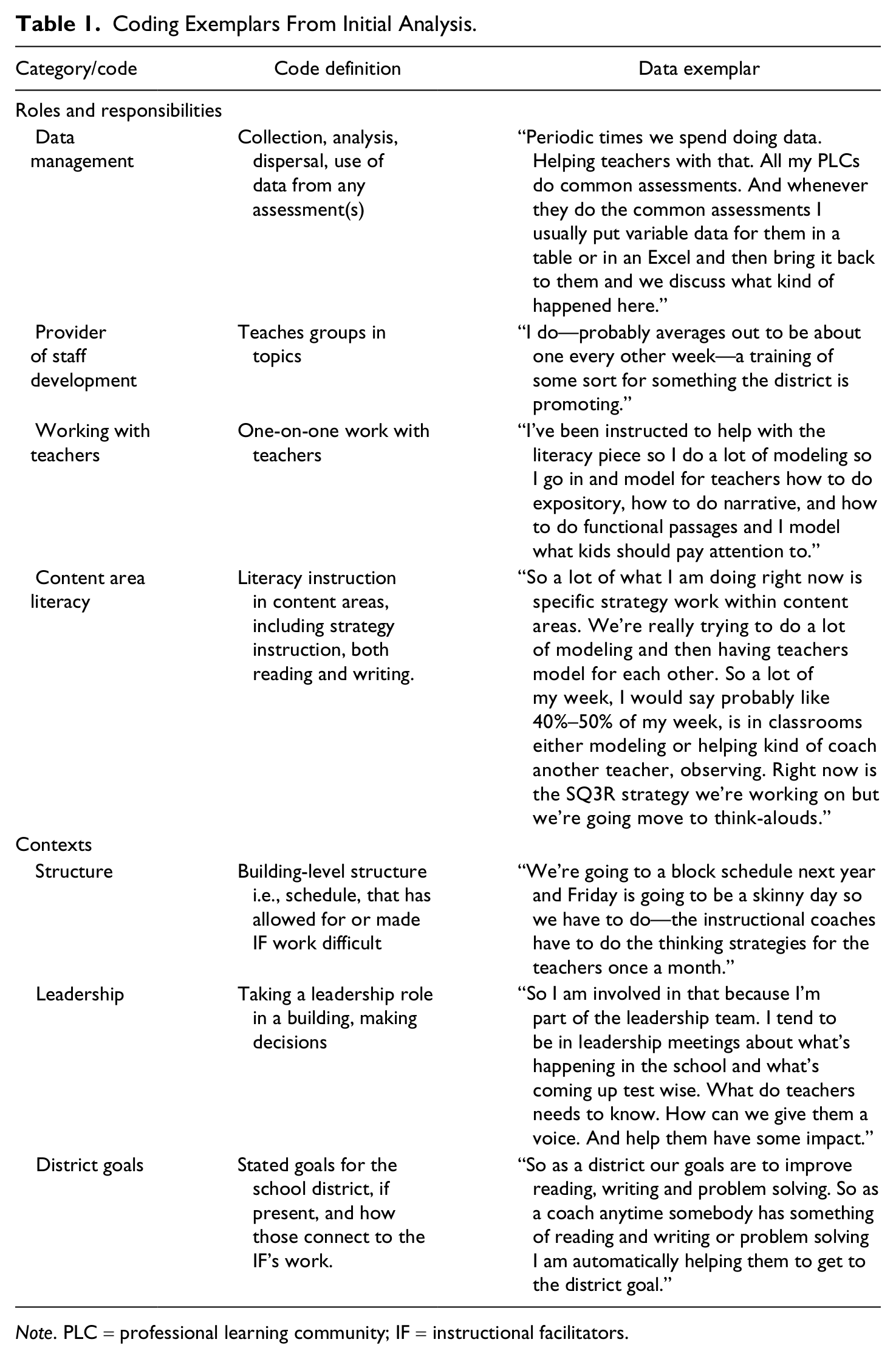
Note. PLC = professional learning community; IF = instructional facilitators.
Once the initial coding was completed, such that subsequent rounds of analysis produced no new codes, I narrowed the data by working only with transcripts from IFs who indicated that their work focuses on literacy at least 50% of the time (n = 18).
With this narrowed subset of data, I then moved into situational analysis (Clarke, 2005). To carry out a situational analysis, I began asking of the data, and of the worlds represented by the data, “Who and what are in the broader situation?” To answer this question, I created maps of data that were coded as “players” in my initial coding. The code “player” encompassed all human and nonhuman agents that were mentioned by participants. These included people (i.e., “district language arts coordinator,” “my principal,” “Jim Knight”), institutions (i.e., “Common Core State Standards,” “the Wyoming legislature,” “the district”), and outside agencies (i.e., “RTI,” “CRISS Strategies,” “PEBC”). I mapped these internal and external forces according to how they aligned with each other, were opposed to each other, or related in other ways, and wrote memos illustrating the positions that were occupied by these “players” in the data.
To more fully explore issues raised by IFs that were of importance to them, I next developed a positional map (Clarke, 2005). A positional map “lays out most of the major positions taken in the data on major discursive issues there—topics of focus, concern, and often but not always contestation” (Clarke, 2005, p. 126, emphasis in the original). By laying out all of the positions taken in the data on contested or important issues, the researcher can begin to see the larger, more situated positions of her participants. To create a positional map, I first selected categories from the data that seemed to be issues of contestation and import to the participants, and created a grid with those two issues laid out against each other. Both the categories that I created and used for positional mapping—embeddedness and enrollment—and the process of creating the positional map will be clearly explicated in the “Contextual Factors” section of the findings.
Findings
In this section, I present demographic information for the IFs who participated in the study, discuss the large categories of IFs’ job responsibilities, and then present conclusions related to contextual issues, specifically, how IFs recruit teachers to work with them (enrollment) and how much a part of the school professional development structure IFs are (embeddedness).
IF Roles and Responsibilities
Twenty-six IFs were interviewed for this study; the findings for IFs’ roles and responsibilities derive from analysis of this complete set of participants (see Table 2 for demographics).
Demographic Information for all IFs Interviewed.
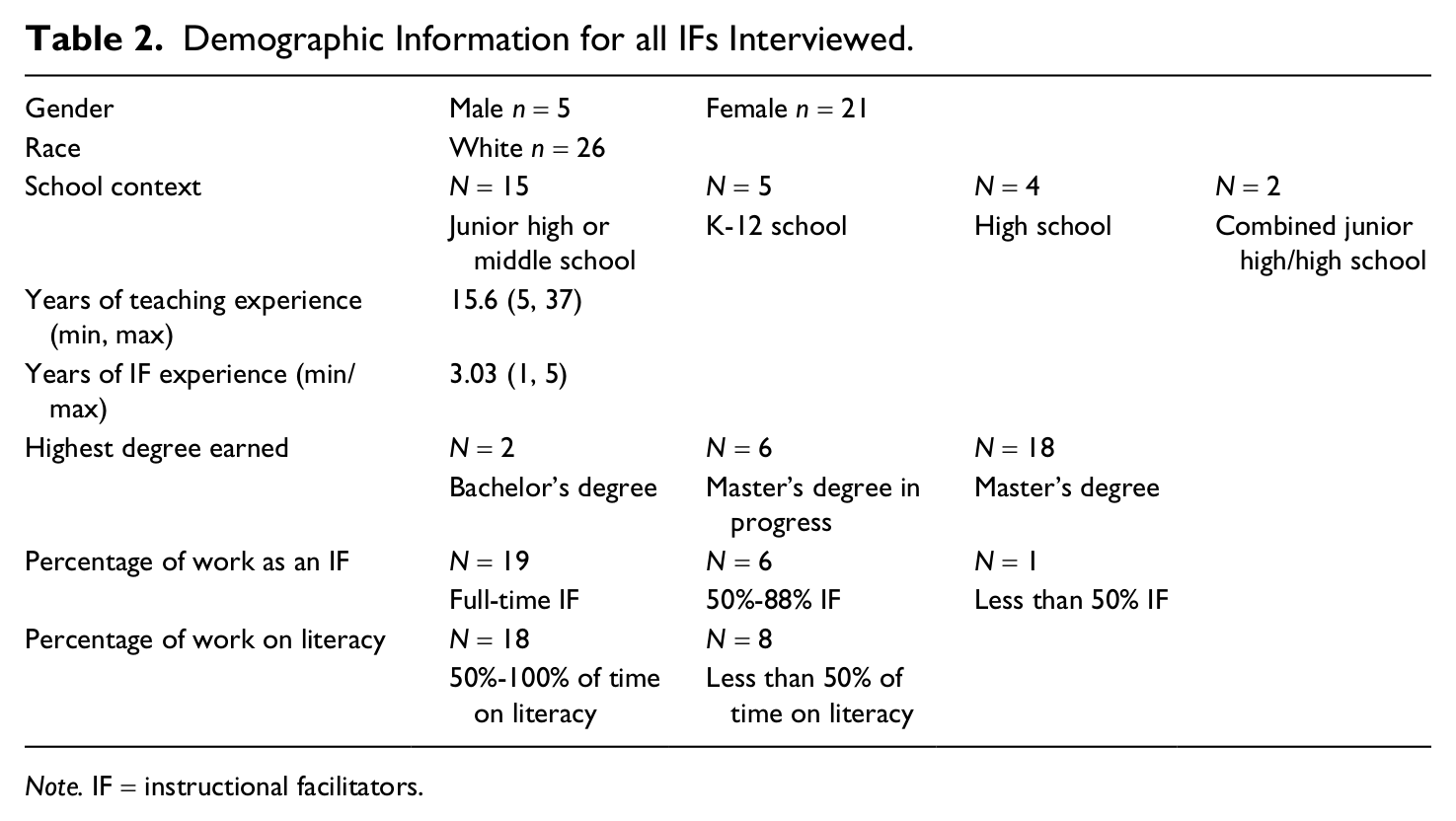
Note. IF = instructional facilitators.
Patterns in the data obtained from all 26 IFs indicate that their work in Wyoming secondary schools clusters around the following roles: coaching individual teachers, providing staff development to large groups of teachers, and collecting, analyzing, managing, and interpreting data. These findings echo those developed by the Wyoming Department of Education, through their analysis of district-level surveys (Balow, 2010). An examination of the job descriptions collected from the interview participants shows similar role categories.
Individual instructional coaching
The IFs interviewed for this study report that they spend much of their time working with individual teachers or small groups of teachers, modeling instruction, providing resources, and problem solving. This category of work is also seen in the job descriptions collected from IFs, in that supporting, mentoring, and collaborating with classroom teachers was mentioned as part of the purpose of the position in all of the collected job descriptions. This support, mentoring, and collaboration were directed toward implementing district and school standards, improvement of instructional practices, and implementation of professional development.
IFs themselves report working on many different topics with teachers in almost all content areas. The topics or problems that they reported working on included differentiated instruction, classroom management, test-taking strategies, unit and lesson planning, and other topics based on stated questions or problems from teachers. They reported working with new teachers, reading teachers, and with teachers in the following content areas: art, computer applications, English, family and consumer science, modern languages, industrial technology, mathematics, music, physical education, science, social studies, and vocational education.
When asked to talk about specific work around literacy with secondary school teachers, the IFs who were interviewed described instructional projects on which they had collaborated with teachers. This article is focused on just two content areas: science and physical education. These two content areas were chosen for focus because the participants provided the most detail about their work in these disciplines.
Science
Several IFs worked with science teachers on effective textbook use, teaching vocabulary and concepts, and writing instruction. The reported projects included teaching comprehension strategies and using graphic organizers, using vocabulary instruction as a venue to work on writing, developing a community of readers, concept mapping, and writing procedures for science fair materials. Alison described her typical work in a middle school science classroom:
Now in a science classroom on the other hand I will go in and there will be a textbook, so we have to break down those reading strategies to figure out, first what is our purpose in reading that textbook. What does the science teacher want them to get from that? Second what will be easy for them to get to and what will they need help getting to. So we break it down and figure out what the best strategy for it might be. Usually we tie some sort of a graphic organizer into it, so that the kids can see a way modeled for them to get to the meat of the text, so that they can then apply it the next time they come across something like that in their science textbook. Usually, once we get them introduced to a graphic organizer we move them into an independent way where they look at the text and they say, when I’m reading this, this is the kind of thing that I need to do. A t-chart will work perfect here. And we give them the autonomy once we’ve modeled several ways to go to the one that makes the most sense to them.
The technique provided by the IF in this case is an example of a long-standing content area literacy instructional tool: a graphic organizer. Alison makes clear in her description that she would like for the teacher to emphasize transfer of this strategy to independent work, and that this type of strategy (use of a t-chart) can be transferred to other content areas. In addition, she emphasizes how she works with the teacher to choose the best strategy for the text he is using.
Physical education
Several IFs reported success in working with both individual physical education teachers and departments of physical educators. Francine worked with physical education teachers on writing essays, beginning with the physical education department as a Professional Learning Community (PLC; Dufour & Eaker, 1998). She described using a graphic organizer with students, modeling for teachers how they could have students brainstorm and create a structure in response to a writing prompt. This work, which focused on the six traits of writing, was eventually carried on by the physical education teachers themselves, without assistance from the IF:
And the feedback from the teachers was that they were the best essays they’ve ever had, ever. And then at the very end, the last one we did, one of the PE teachers said, “you know, that second day when we had them re-write. What do you think if we do a little peer editing?” And I’m like, “ok, that’s just where I want to go.” You know it’s just a matter of leading people into it gradually, so that they’re comfortable with the process.
In addition to Francine’s work on writing and essay structure using graphic organizers, other coaches described working with physical education teachers on reading strategies for expository text, such as learning to analyze the author’s purpose and intent. In addition, several coaches worked with physical education teachers on a writing project used for accreditation assessment.
Organizing and providing large-group staff development
The second category of work around which much of the data clusters concerns the organization and provision of staff development for larger groups within their schools and districts. Several of the job descriptions submitted by participants included this aspect of IFs’ work, describing it as “providing professional development,” working with building administrators to review and develop staff development activities or “participate and/or lead professional development activities to build capacity and model professional behavior.” In interviews, IFs also reported that a significant portion of their job description involves organizing and providing staff development for large groups of teachers. The staff development focus they described may include book studies, implementing teacher work in PLCs, in-service professional development on incorporating technology in classroom instruction, or any number of other topics. The structure of the professional development offered to groups of teachers can vary widely. For example, Daphne works with middle school content area teachers who also teach one section of a required reading course. She assists them in implementing comprehension strategy instruction, vocabulary instruction, and other instructional techniques that should assist them in teaching reading. Instead of modeling instructional techniques herself, she asks content teachers to talk about their own strategies:
And so for instance our gifted and talented teacher did a presentation on a reading strategy that she uses in her class. It’s called a synonym ladder, but what she uses are paint strips that you can get from Lowes or Walmart with the different colors. So she has kids look at synonyms with varying degrees and which one she thinks is the closest. So for that, I didn’t do the staff development myself, but working with her, then we arranged for it to be done. And so we’ve got it where we’re kind of strong-arming every content teacher to give some sort of presentation.
Other IFs teach online or in-person professional development courses for recertification credit, some of which have a coaching component as a required aspect of the course. This form of staff development can have an additional benefit of ensuring that teachers will require individual coaching from IFs, as described by Ingrid, who works in a high school setting:
One of the things that I have done for enrolling teachers is that I write a syllabus to do follow-up from whatever our in-service or professional development was in August and then again in January, so that the teachers in my building can earn the additional credit. But also it kind of is a guaranteed audience and it creates that follow-through on whatever it was. It’s been very successful for me. The other big piece that I feel really good about is I really think we’ve developed some culture of coaching through offering classes are requiring them. Those in the class are required to do 3 hours a month with others, so they can go visit another teacher and model for them, or watch and see what they are doing. I’m really pleased with that.
Several schools in which the participants work have implemented a special schedule and a calendar that allots time during the school day on a regular basis to professional development. In these cases, teachers are required to attend from 45 min to 1 hr of professional development periodically (perhaps once a week or once a month), during their planning time, and coaches are responsible for organizing and presenting the material for that professional development. Kristen describes how the block schedule works with staff development in her junior high building:
On Tuesdays we have periods 1, 3, 5, and 7. So first hour those people who have planning give me 45 minutes of their time and then they still have 45 minutes of planning. So I plan staff development for that 45 minutes, and I’ve been able to get across a lot of really good information in those 45 minutes.
In addition, several of the IFs I interviewed reported being deeply involved in carrying out professional development related to programs that the school or district had contracted with, such as Literacy First, Continuous Improvement, and McREL’s Balanced Leadership Program. In these cases, coaches carried out the principles of the professional development program in addition to their other responsibilities.
Data management
All of the IFs interviewed reported that they were involved, to some extent, in collecting, analyzing, and managing data. Although this category of activity was unanimous among interview participants, it was only rarely mentioned in the job descriptions provided by IFs. Of the two job descriptions that mention working with data, one described one of the IFs’ roles as “Data Coach,” while another district asked IFs to log their work time in categories, with one of those categories being “Data.” In interviews, most of the IFs also reported working with individual teachers, or with core or department teams of teachers, to interpret data. Assessments from which data were collected included state-standardized assessments, building and district-level assessments, and assessments purchased by districts, such as Measurement of Academic Progress (MAP) and Scholastic Reading Inventory (SRI). IFs report that they typically assist teachers in interpretation of data, working particularly to assess areas in which students are making progress and those where more progress is needed. Francine describes how this process works, as she works with teachers in PLCs:
Periodic times we spend doing data, helping teachers with that. All my Professional Learning Communities do common assessments. And whenever they do the common assessments, I usually put variable data for them in a table or in an Excel chart and then bring it back to them and we discuss what happened here. Some of my PLCs totally get how that works. Some are all over the place and not together yet. So each one of them is in a different place and some of them are just “ok we don’t need you any more, we can do this ourselves,” which is good.
It was quite common, in the interview data, for IFs to describe how they helped teachers, either individually or in departments or other small groups, to examine the data, to discuss the data, and to plan directions for future instruction. Kristen describes her use of data to encourage teachers to work on literacy in the content areas:
I took the state assessment scores and I figured out who was proficient and I made a list for each grade in terms of reading and writing, and I force-fed that to every teacher in the building and I said, “Here, they can’t do your content because they are reading at a second grade level, so what are you going to do to make that better? It’s your responsibility, not theirs, because somewhere along the way we failed them. So I want to know how I can help you make the content more accessible to those kids.”
In addition, IFs in some districts are involved in collecting data in “walk-throughs,” short, focused observations in classrooms using rubrics based on professional development goals. Data collected from walk-throughs are aggregated and funneled back to teachers as feedback. Holly describes the difficulties that this type of data collection can present for the coaches, in their relationship with teachers:
[The teachers] were a little disgruntled, and some of them would argue with the data and that kind of thing. Well what we’ve found is now they’re saying, “When are we getting the data for this week?” Because they’re improving, and they can show it. We’ve gone through several discussions about just how to present that and what’s the easiest way, because we really are trying to not be evaluative as coaches. That’s part of our goal. So it’s really tricky when you’re trying to give feedback like that.
The IFs who described being part of walk-throughs were usually working as a team, with their administrators. The walk-throughs that they participated in were often dictated by professional development providers contracted by the school district.
Thus, we can see that IFs may be involved in a variety of activities, including coaching individual teachers, providing staff development for larger groups of teachers, and working with data. Threaded throughout the IFs’ descriptions of their roles and responsibilities were issues related to developing relationships with teachers, enrolling teachers for individual coaching, and the structure within which IFs carried out these roles. I now turn to the contextual factors that impact the work of those IFs who reported working at least 50% of the time on literacy-related instruction. To explore those concepts, I developed positional maps, providing more information and clarity on the contextual issues of enrollment and embeddedness.
Contextual Factors
When asked to provide a rough estimate of the percentage of their time worked (whether full-time or part-time) on issues related to literacy instruction, eight IFs reported spending less than 50% of their time working on literacy-related issues; 18 reported working from 50% to 100% of the time on literacy-related issues. Table 3 provides demographic information for this subset of the interview participants (n = 18).
Demographic Information for Subset of Participants Reporting 50% or More Work on Literacy-Related Topics (n = 18).
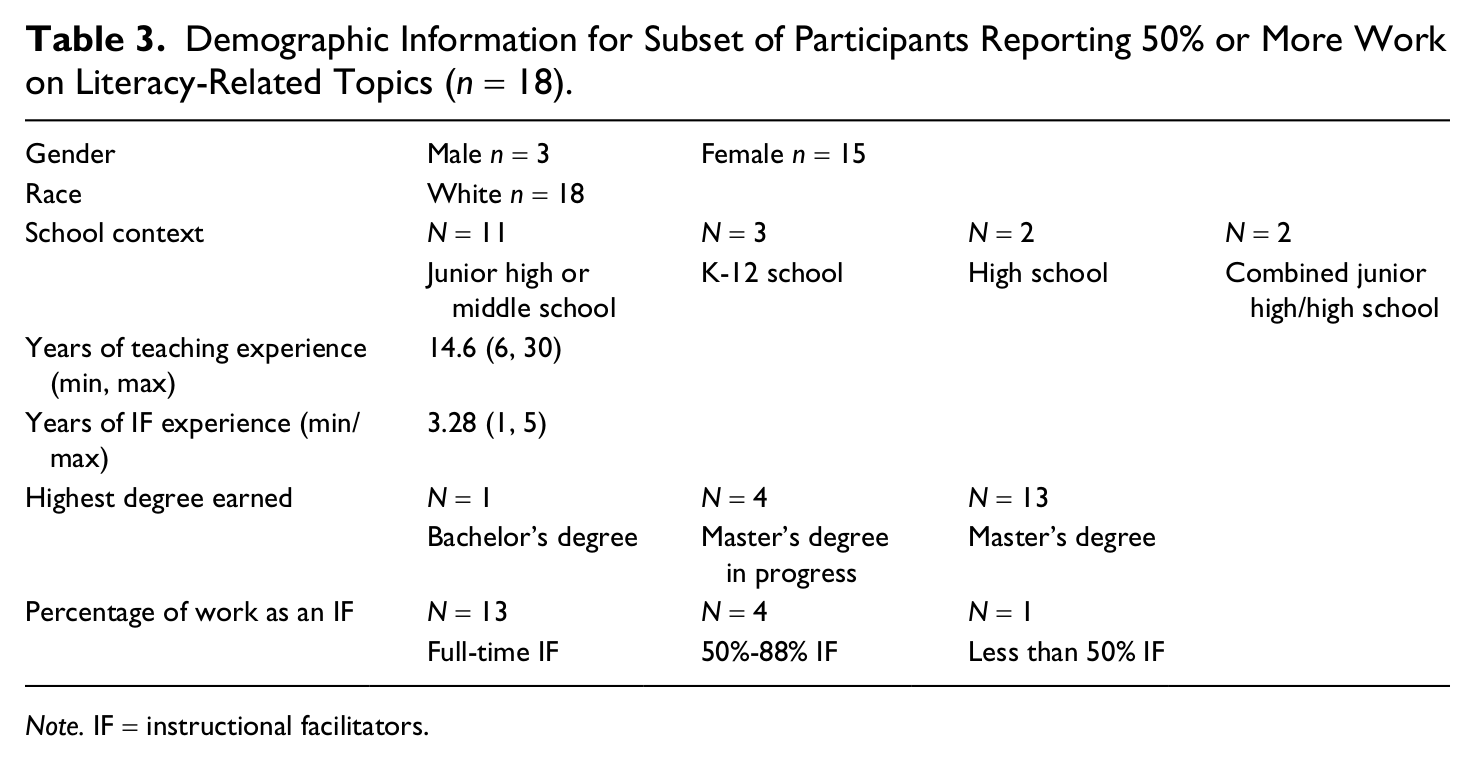
Note. IF = instructional facilitators.
To examine more closely the contextual factors influencing the work of IFs who focus on literacy instruction, I created a positional map (Clarke, 2005). The positional map centers on two axes: Enrollment and Embeddedness. Enrollment refers to IFs’ descriptions of their success or failure in gaining teachers’ permission to work with them. Embeddedness refers to IFs’ descriptions of the degree to which their work is embedded in the professional development structure of their school or district. Both of these categories of data were of great importance to the participants, in that without being asked any questions that directly related to either Enrollment or Embeddedness, all of the participants talked about these issues. In addition, prior research on the work of literacy coaches indicates that gaining access to teachers and the contexts in which coaches work can impact the amount and type of one-on-one coaching they are able to do (Atteberry et al., 2008; Heineke, 2010; Smith, 2007).
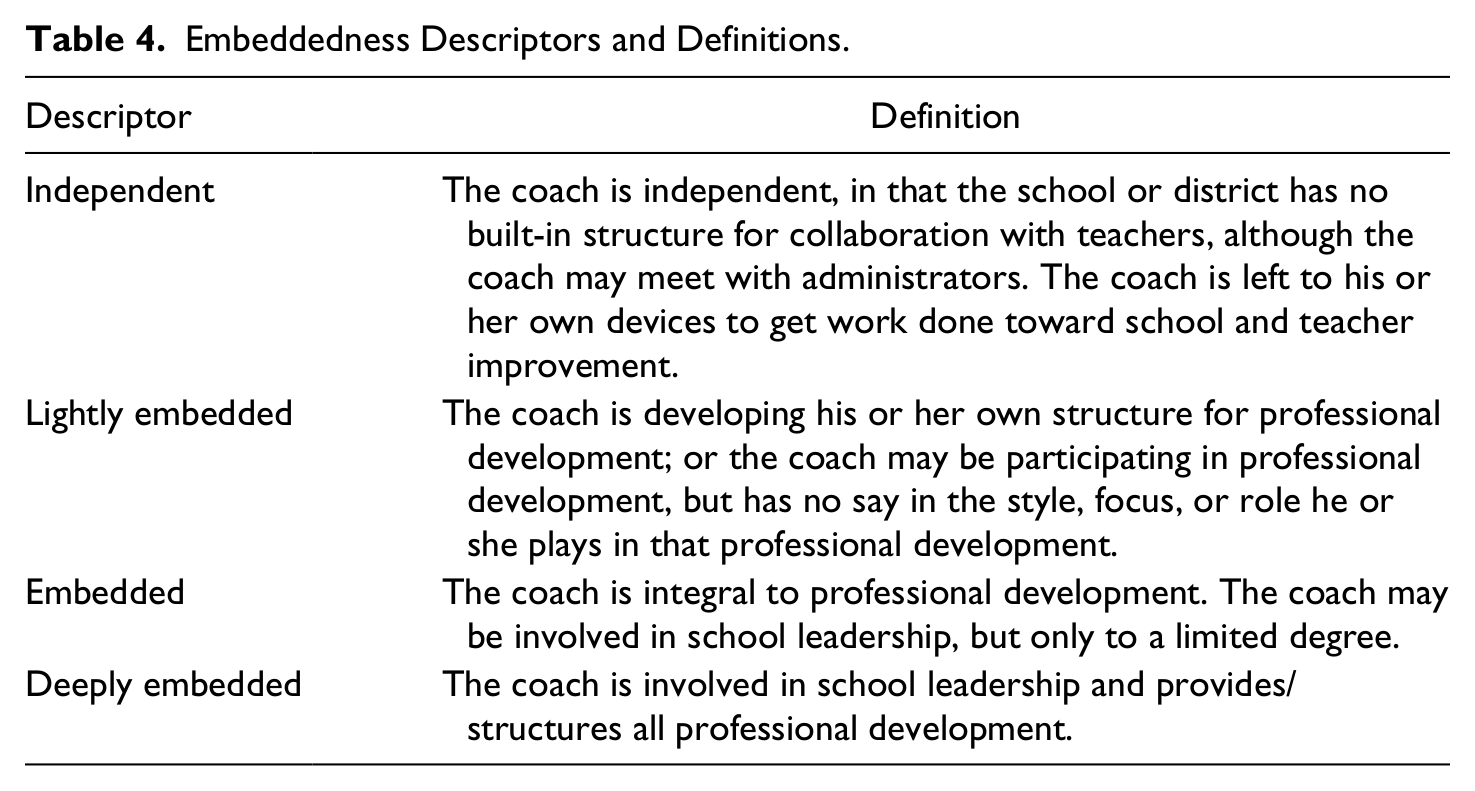
For each of the 18 secondary-level coaches who indicated that they focus on professional development in literacy for at least 50% of their jobs, I searched the data set for instances in which the participants discussed success or failure in gaining access to individual teachers (coded as enrollment) and for instances in which the participants discussed the contexts in which they worked (coded as embeddedness). I used these data to place the participants on the positional map, with their placement on the map representing the degree of enrollment and embeddedness they experience. Placement on such a map allowed me to seek patterns relative to these two constructs, and to see where silences took place within the data. I developed descriptors within the codes of enrollment and embeddedness based on the data to show the range of the data on both codes. In data coded as embeddedness, I developed four descriptors: Deeply Embedded, Embedded, Lightly Embedded, and Independent. Definitions for these descriptors can be seen in Table 4.
Embeddedness Descriptors and Definitions.
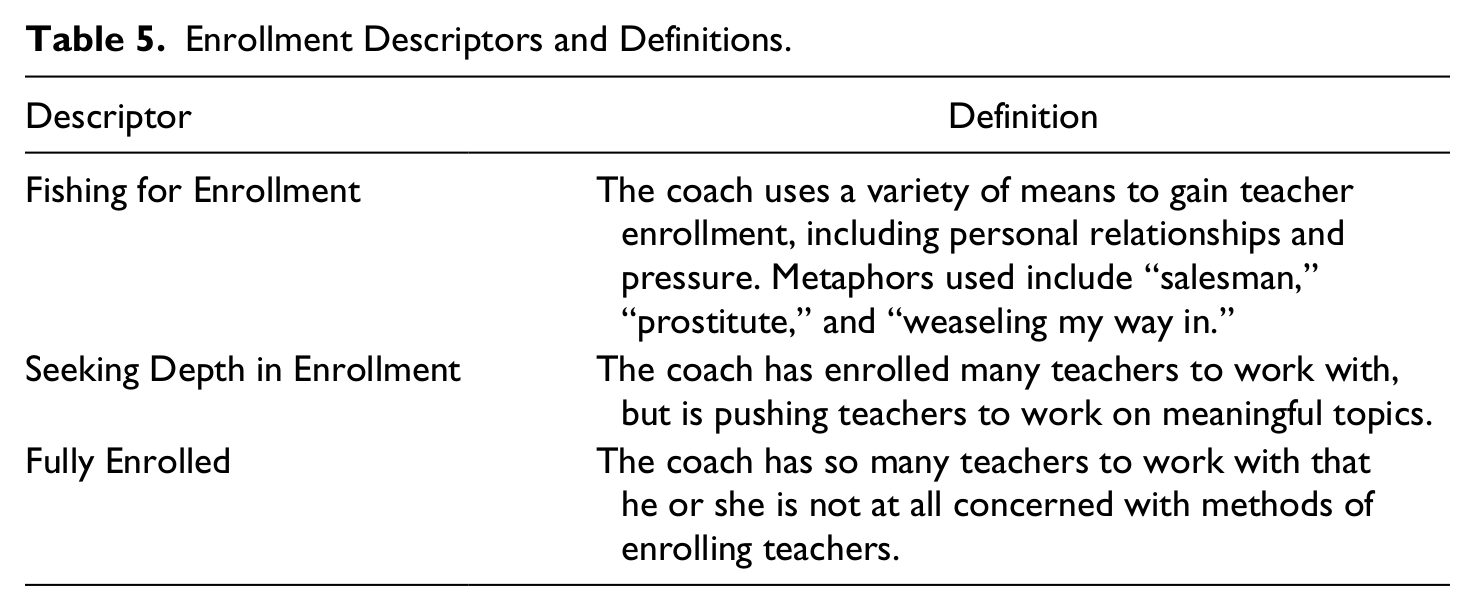
In data coded as enrollment, I developed three descriptors: Fully Enrolled, Seeking Depth in Enrollment, and Fishing for Enrollment. Definitions for these descriptors can be seen in Table 5.
Enrollment Descriptors and Definitions.
With these categories in place, I was able to set out the full positional map, as can be seen in Table 6.
Enrollment/Embeddedness Positional Map.
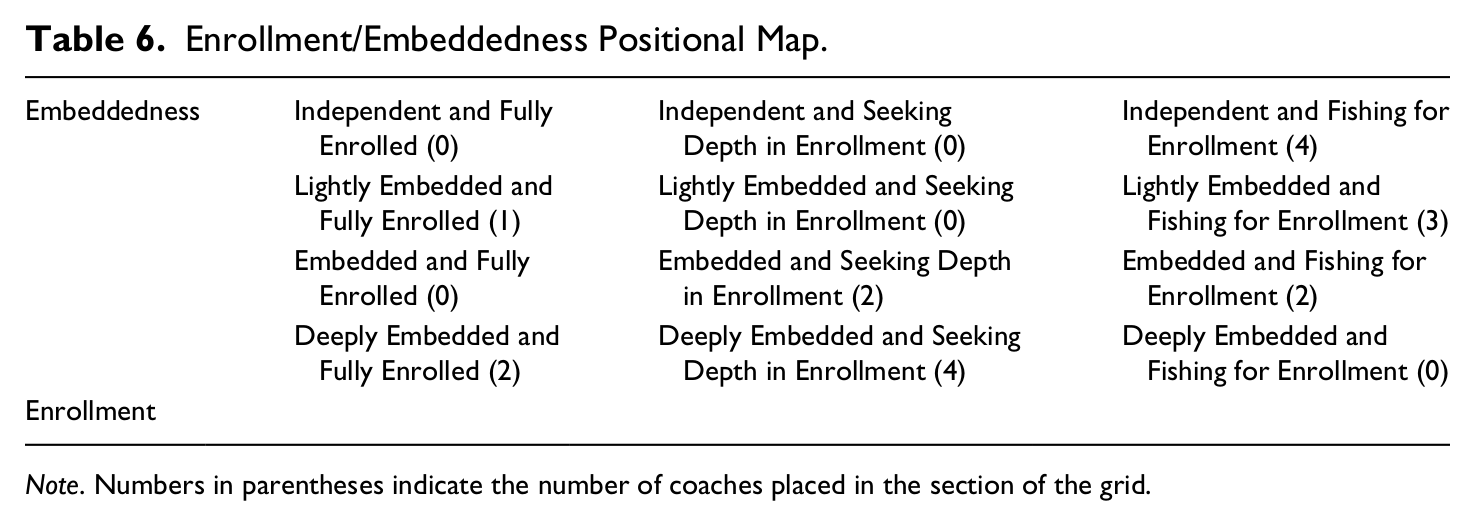
Note. Numbers in parentheses indicate the number of coaches placed in the section of the grid.
The big picture of enrollment and embeddedness
Looking at this positional map as a whole sheds some light on the contextual issues of enrollment and embeddedness, as well as on the potential interaction between these two important issues. First, we notice the relatively small number of coaches who could be considered fully enrolled (3), compared with the number who were seeking depth in enrollment (6) or fishing for enrollment (9). This disparity indicates the relative difficulty for these IFs in obtaining full enrollment. The large number of IFs (half of those who were included in this part of the data) who were placed in the category “Fishing for Enrollment” also indicates that much of the work of these IFs is dedicated to finding teachers who are willing to invest the time and effort necessary to improve their practice through working with a coach.
The silences in these data also provide some insight on the relationship between the IFs’ embeddedness within the structure of the school or district professional development work, and the IFs’ success at enrollment. The silence in the data for the northwest (Independent and Fully Enrolled) and southeast (Deeply Embedded and Fishing for Enrollment) corners of the positional map speaks of the need for IFs to work within a supportive structure to be highly successful at enrollment of teachers.
However, embeddedness may not be enough to ensure quality enrollment. Ten of the participants could be considered as Embedded or Deeply Embedded; of those, 2 were considered Fully Enrolled; 6 were Seeking for Depth in Enrollment, and 2 were Fishing for Enrollment. Clearly, more information is needed on the issues faced by these IFs, in terms of what it means to be successful in their one-on-one professional development work with teachers.
A closer look at two extremes
To gain clarity on these issues that were of importance to the participants, I next provide a closer look at those participants who occupy two opposing positions on the positional map: Jocelyn and David, who were considered Deeply Embedded and Fully Enrolled; and Hannah, Michael, Ingrid, and Ella, who were considered Independent Contractors who are Fishing for Enrollment. In my examination of these two sets of participants, I also describe the literacy professional development that they are involved in.
Deeply embedded and fully enrolled
The two IFs—Jocelyn and David—who were placed in this section of the grid have so many teachers to work with they do not seem concerned at all with enrollment. In addition, they are deeply involved in the leadership of the school and in the provision of professional development. They both report having a supportive administration that relies heavily on them for leadership and advice. Jocelyn, for example, develops—in collaboration with her principal—agendas for the school’s leadership team meetings. She also leads PLC meetings, and provides weekly staff development for all teachers as scheduled during the school day. In the last 6 months, she has become heavily involved in working with individual teachers who are in training to become modeling teachers for the rest of their colleagues. She reports that this shift in focus has brought with it a concomitant shift in the teachers she works with, and the intensity of this work:
Well I do feel like some of the teachers I have worked with before, I haven’t been able to have as much contact with. But . . . the work with them, it wasn’t as continuous. It was more scattered throughout the year, like “oh could you help me with this one thing here in March and come back again in May.” But it’s hard to find time for those people.
Jocelyn relates some element of her success in working with teachers to the administrative support provided by her principals over the last few years: “From the beginning, we have had a lot of administrative support. Even prior to [current principal] being here. And we are really informed. I mean there’s definite communication between administration and coaches here.”
David, who works in a small, rural district with one K-8 school and one high school, is a combined curriculum director, IF, and staff development coordinator. As such, he is uniquely positioned as both an administrator and an IF. David says, “the teachers know they can contact me for any reason, and they do.” Teachers have asked him to come into their classrooms to observe and give informal feedback on their instruction. David also describes having good support from his administrators, in that he can both influence and be influenced by the district superintendent on directions for professional development.
Literacy focus
These two IFs, Jocelyn and David, describe complementary sorts of literacy work going on in their schools, largely focused on content area literacy strategy instruction. Jocelyn describes her coaching work as almost completely focused on content area literacy: “All of the work is about literacy, all of our weekly staff developments, the thinking strategies, it’s all about content area literacy.” Jocelyn went on to describe her coaching experience with a mathematics teacher: “Because even the math teacher that I have been working with, he’s been thinking a lot about how kids really read mathematics. What processes are they going through when they are making meaning of a mathematics problem?”
In terms of literacy work, David also describes success with integrating reading instruction in the content areas:
The work that I would say we’ve really adopted or really dove into was, how do we implement some of these strategies not only in classes designed for targeted students that are struggling in reading, but how do we incorporate reading strategies in content areas? And that’s been the big thing with the high school staff. How do we get to have the PE teacher teach reading? And the best way to do that we know is to incorporate more reading strategies within the area of PE or in the area of welding or whatever, so that’s probably been the biggest push at first. Now we’re kind of stepping back from that. We feel that those are pretty well implemented in the classroom.
In his roles as curriculum coordinator and staff development coordinator for the district, David is integral to the high school’s accreditation work and its reading committee. In addition, he works with principals to educate them on evaluating literacy instruction and developing interventions for struggling readers at the secondary level.
That both of these IFs, who are integral to the professional development in their schools/districts, see their work as focusing so clearly on content area literacy, speaks to the potential for professional development in content area literacy, when it is supported and carried out by a literacy coach who is deeply embedded in the professional development structure—and even the leadership—of his or her school and district.
Independent contractors who are fishing for enrollment
In contrast to David and Jocelyn, who are so deeply embedded in the professional development work of their schools and districts that they have no difficulty finding teachers who are willing to work with them, is the group of IFs that I call “Independent Contractors.” These IFs have little or no administrative support and no built-in structures to assist them in gaining enrollment; as a result, these IFs are left to their own devices to get work done toward improvement of classroom practice. These coaches described using their relationships with teachers or even personal pressure to gain enrollment; they used metaphors such as “salesman,” “recruiter,” “prostitute,” and “weasel” to describe themselves and their attempts to gain enrollment. Hannah, Michael, Ingrid, and Ella all fall into this space on the grid.
All four of the IFs in this category see their roles in schools as falling outside of existing school structures, such as PLCs, departments, and study groups. However, all four of them attempt to use these existing structures to gain access to teachers. For example, Hannah, Michael, and Ingrid voluntarily teach professional development courses for teachers in their buildings—offered in online settings or after school—for either graduate or recertification credit. Hannah calls these courses, “a nice carrot to dangle in front of teachers to get them to work with you.” The IFs in Ingrid’s school attend department meetings, but their roles in those meetings are limited to observation, and the meetings themselves are often intermittent. Michael and Ella rely on personal relationships and even pressure to get access to teachers, but have yet to experience much success in this. About his ability to work with teachers at the secondary level, Michael said,
Teachers don’t like for you to come into their domain and tell them how to do things. They’re just not going to be hollering for you to come in and show them how. So you have to weasel your way. You have to weasel your way. I’m just in the weasel stage.
Ella’s situation was the most profoundly disturbing, as she described her feelings of isolation and abandonment: “I feel like I’m some wind-up toy and they set me free and forgot. You know, wind it up, let it go. I would love to have somebody else to talk to. Regularly. Not just when it’s an emergency.” In the face of this feeling of abandonment, Ella soldiers on, working with a study group, dropping by classrooms to hand out interesting articles and ideas, inviting new teachers to her home for dinner, pushing her building administrators for mid-range goals that would support her work with teachers, and listening when teachers are frustrated. As she describes this work: “I go out hooking, too. I say I prostitute myself. I go out and troll the streets.”
Literacy focus
Perhaps as result of the dispersed nature of their work, none of these coaches have a literacy focus that is clearly structured or articulated, although Ella indicated that 80% of her time was spent focusing on literacy, and Hannah, Ingrid, and Michael all indicated that 50% of their time was spent focusing on literacy. Hannah has worked with a welding teacher, a science teacher, two foreign language teachers, and the English department in her high school, but her description of the work indicated that it was largely short term. Ella has worked only with the teachers in her study group, and with the teachers in the language arts department, on content area literacy. When I asked Michael about his work on literacy, he described his conversations with students on what they are reading and writing, rather than with teachers. Of the four coaches in this category, Ingrid’s work has focused on content area literacy the most. She has created writing rubrics for teachers, helped with assessment preparation prior to the state-standardized testing, has done some work with vocabulary, and has worked with math, physical education, and art teachers on writing instruction.
Discussion
Recent legislative projects, such as the Striving Readers program, and calls to action (Biancarosa & Snow, 2006) stress the need to improve the literacy capabilities of students in middle school and high school settings. Although minimal research exists on the work of literacy coaches at the secondary level, there is general consensus that literacy coaching is a promising strategy for both students and teachers (Cantrell & Hughes, 2008). This study provides information related to the roles and responsibilities of literacy coaches in secondary schools, and also provides ground on which future researchers can stand to continue examination of how literacy coaching works at the middle school and high school levels.
The findings of this study on the roles and responsibilities of literacy coaches in secondary school settings both echo the descriptions of the difficulties of being an instructional coach in a secondary school (Blamey et al., 2009; Snow et al., 2006; Sturtevant, 2003), and point to the impact of contextual factors on coaches’ ability to be successful in improving teacher instructional practice. The IFs who participated in this study report working individually with a wide variety of teachers on a wide variety of topics. Certainly, these IFs report some success in implementing content area literacy instruction, but that success seems to be dispersed instead of focused. The self-report of these IFs on providing professional development to groups of teachers is similarly dispersed, with the topics of the professional development provided ranging widely. Even in this group professional development, contextual issues are present and having an impact: IFs are using the professional development opportunities as a means to gain enrollment of teachers for one-on-one coaching; special schedules have been developed in some schools to allow for continual group professional development; and IFs are sometimes serving as job-embedded assistants for the programs contracted by schools or districts. In their work with data management, there seems to be a mismatch between the job descriptions (which largely did not include any discussion of data) and the actual work of the IFs. In spite of this, all of the IFs who participated in this study reported using assessment data to assist with driving instruction change, in both individual and collective settings.
It should be apparent, from the findings of this study, that the school contexts within which secondary-level literacy coaches work, as well as the job descriptions they are provided with, can have a far-reaching impact on their success in enrolling teachers for individual coaching. This enrollment for individual work is a crucial beginning step, if coaches are to be successful in improving teaching practice and ultimately student achievement. The two literacy coaches who were classified in this study as “deeply embedded and fully enrolled” both report being involved in the leadership of their school, having full support from their administrations, and as a result are able to focus their attention on working with teachers in all content areas to improve the literacy instruction in their classrooms. On the other side of the grid, those many literacy coaches who were classified in this study as “independent contractors who are fishing for enrollment” find themselves outside of any administrative support or any school structure that would assist them in enrolling teachers. As a result, they report using sometimes quite ingenious and persuasive methods to pursue enrollment, but they are also often isolated from teachers and their ability to focus on literacy instruction in content area classrooms is limited.
It is possible that the spotty nature of the work on content area literacy achieved by IFs interviewed for this study can be traced back to the flexibility in their roles and responsibilities, a flexibility that is integral to the statewide funding model adopted by the state of Wyoming. In this model, districts choose how the IFs will function; thus, the aim of the IFs may not be solely on assisting teachers to embed literacy in their content area instruction, but may be divided among other worthwhile goals, including preparation for state assessments, developing teacher knowledge and practice in instructional technology, or instructional planning. Although this flexibility may be considered by some as a boon to school districts, which can allow for more focus by IFs on locally determined problem areas, in practice it seems to be allowing for the work of the IFs who participated in this study to become so widely varied that very little is actually accomplished.
Progress is being made in content area literacy (as in the instructional projects described for science and physical education); there is some reason to hope that coaches can be instrumental in assisting secondary content area teachers to integrate literacy instruction with content area instruction. IFs’ success in enrolling teachers to work on such projects, however, seems to be somewhat dependent on being embedded in the professional development work of the district or school, with clear expectations that teachers will work with IFs to improve their instructional practice. The examples of Jocelyn and David can be seen as instances that could become models for how best to embed coaches in school environments. Both Jocelyn and David occupy leadership positions in their schools/district. As a result, both are extremely influential on teachers and administrators, and both have seen success in implementing professional development in content area literacy. These examples show us that, at the very least, administrators should support and direct the work of coaches in their buildings. At the best, coaches’ involvement in school professional development should place them in a leadership position within the school.
On the other hand, the experiences recounted in the data from those coaches who are classified as Independent Contractors show the result of the lack of embeddedness in school/district professional development. These include isolation and often fruitless efforts to enroll teachers in substantive work on literacy-related professional development. The purpose of some of the large-group staff development seems to be split among a variety of objectives, including meeting teachers’ needs for recertification credit and coaches’ needs for teacher enrollment. That in some cases IFs are using the group professional development opportunities that they provide as a tool for teacher enrollment, indicates that the structure of the professional development program in which they are located is not sufficient to provide this. In the end, the lack of embeddedness of these coaches in their school and district professional development structures inhibits them from being as effective as they could be otherwise.
It seems likely that the state of Wyoming will continue to fund the IF program, and that instructional coaches will also be present in schools throughout the country, for at least some time into the future. Based on this study, some recommendations might be made for such programs. Administrators and hiring committees should begin by hiring knowledgeable instructional coaches who have not only teaching experience but also knowledge of literacy instruction and the ability to work with other adults. School districts should provide coaches with clearly outlined job descriptions that limit their administrative or noninstructional work and focus on one-on-one work with teachers to pursue improvement in literacy instruction. Administrators should also be aware of the impact of the contextual factors highlighted in this study, the importance of supporting literacy coaches, and the necessity for a staff development framework that encourages teachers to work with coaches. Involving coaches in the leadership of the school and making them instrumental partners in the professional development work of the building might also assist in helping them to enroll teachers for the most important aspect of their work: individual coaching.
With all of this in place, schools and districts must provide a focus for the work of the instructional coaches they employ. Aligning this focus with school and district goals would ensure that the work of coaches can have the best chance of impact on instructional practices and eventually on student achievement. Adoption of a goal to ensure that literacy instruction is occurring within disciplines (Lesley & Matthews, 2009; Moje, 2008) would be an excellent place to begin.
This study, because it took place within one state, and because of the ethnic homogeneity of the participants in the study, must be considered as limited by those factors. The state of Wyoming has at its heart a unique, rural nature, and this may have influenced the ways in which the state legislature set out the descriptions of the work of IFs, the way in which those descriptions were interpreted by school districts, and the ways in which the IFs in schools—as well as the teachers and principals with whom they work—play out their job descriptions daily. In addition, this study was designed to be qualitative in nature, relying largely on self-report. Taking these limitations into consideration, further research is necessary to understand how secondary school literacy coaches in urban, diverse settings may work differently from the participants in this Wyoming study.
Additional research on the work of literacy coaches in secondary schools is also needed to examine—through observation and the collection of numerical data—their day-to-day work, their impact on teacher practice, and their impact on student achievement. Building on this study and the work of Smith (2007), researchers could focus attention first on how to determine whether literacy coaches in secondary schools are successful in impacting teacher practice, particularly in terms of content area teachers’ implementation of literacy instruction in their disciplines. Once we understand what success in changing teacher practice is possible, researchers might then pursue the connections between implementation of literacy instruction by teachers and improvement in student learning, of content knowledge and processes and literacy skills. By leveraging a variety of lenses on the work of secondary school literacy coaches, first from the perspective of a district, then focusing in on a school, then focusing further on an individual coach or a coaching team, researchers could lend further insight into the success of the intervention of literacy coaching and the impact of coaching on teachers and students.
Footnotes
Appendix
Declaration of Conflicting Interests
The author(s) declared no potential conflicts of interest with respect to the research, authorship, and/or publication of this article.
Funding
The author(s) disclosed receipt of the following financial support for the research, authorship, and/or publication of this article: The research reported in this article was supported by the International Reading Association’s Elva Knight Grant.
Author Biography
References
Supplementary Material
Please find the following supplemental material available below.
For Open Access articles published under a Creative Commons License, all supplemental material carries the same license as the article it is associated with.
For non-Open Access articles published, all supplemental material carries a non-exclusive license, and permission requests for re-use of supplemental material or any part of supplemental material shall be sent directly to the copyright owner as specified in the copyright notice associated with the article.
