



Abstract
The circular economy constitutes a paradigm shift which has proven to be both engaging and unrealistic. While scholars and practitioners have started to advocate for a move toward the circular economy, promising a full reconfiguration of underlying practices and processes, many have become disillusioned about the lack of traction and progress. The circular economy transition has fallen between utopia and paralysis. This article discusses circular utopia and paralysis from a social-symbolic perspective, examining discursive, relational, and material inflators and impediments of the circular economy transition, and the business transformations that have been pursued to navigate within the pragmatic in-between state. We develop a Circular Economy Business Transformation Framework, which assesses how organizations can combat utopia or overcome paralysis and subsequently position the special issue papers within it. We conclude with an agenda for future research aimed at finding pragmatic and actionable, yet significant, business transformations toward the circular economy.
Introduction
The circular economy has become a key part of current thinking about the role of organizations in addressing sustainability challenges such as resource scarcity, environmental pollution, plastic waste, and climate change (Ellen MacArthur Foundation, 2012; Kirchherr et al., 2017; Salmivaara & Kibler, 2020). As a strategic framework, the circular economy has sparked people’s imagination as it lets organizations rethink how they can deal with waste, pollution, and emissions. Even though its foundations are rooted in prior work on pollution prevention, recycling, waste management, cradle-to-cradle principles, and natural resource management (Blomsma & Brennan, 2017; George et al., 2015), the idea of moving from a linear to a circular economy has proven attractive, leading to many new business initiatives to close, slow, narrow, and regenerate resource loops (Bocken et al., 2025; Bocken & Ritala, 2022). Organizations have been on a journey to transform their waste streams into a source of valuable new materials and products, and many now highlight how their products have been manufactured by repurposing plastic waste or other types of recycled or reused materials. In consumer electronics, for example, companies like Apple have programs to use recycled materials such as aluminum, copper, and cobalt in their phones and notebooks, whereas apparel companies like Adidas use plastic recovered from the oceans in their shoes and clothing.
Circular economy initiatives are highly visible in marketing communication, but this prominence might have created the misperception that organizations across industries have already fully transformed their production processes, supply chains, and business models from linear to circular (Geng et al., 2019; Lüdeke-Freund et al., 2019). Notwithstanding its appeal as a strategic framework, the circular economy has so far underdelivered on its promise to eradicate waste and emissions. The stark reality is that waste generation is worsening (Circularity Gap Report, 2024), and emerging circular business models and initiatives have not reversed this trend. We argue that one reason for the circular economy’s disappointing results in delivering sustainability outcomes is that the concept has become stuck between two narratives: “circular utopia” which sees the circular economy offering a near-complete solution to many sustainability challenges and “circular paralysis” which stresses the barriers preventing organizations to commit significant resources to circular economy initiatives.
The circular utopia narrative argues that with the right innovation and ambition, organizations can regenerate ecosystems, eliminate pollution, and drive sustainable development—all while maintaining profitability. By keeping materials in use and designing waste out of the system, a future can exist where conflicts between economic growth and environmental harm are minimized, thus decoupling prosperity from resource depletion. However, this narrative tends to overpromise what the circular economy can realistically be expected to achieve. While circular economy initiatives can play a part in reducing carbon emissions, for most organizations, getting to net zero requires more than moving to a circular business model alone.
Relatedly, the circular economy literature has been criticized for making assumptions about there always being a business case for circularity, which is often not the case, at least not in the short term (Dzhengiz et al., 2023). It remains unclear, too, how circular initiatives contribute to achieving broader sustainability goals such as the United Nations Sustainable Development Goals or the Kunming-Montreal Global Biodiversity Framework. Even the hope of zero waste is questionable because the link between circular innovations and their true impact on waste and pollution is often not measured (Das et al., 2022). Despite circularity commitments, plastic consumption has continued to rise, while recycling rates have stagnated or declined (Circularity Gap Report, 2024; Greenpeace, 2022). Even fewer products are reused, refurbished, or repaired (Lüdeke-Freund et al., 2019). With the expectations set so high, it seems inevitable that implementing circular economy initiatives leads to disappointing results for organizations in achieving their sustainability goals.
The circular paralysis narrative instead argues that there are simply too many barriers for a full transformation to circular business models. Without a supportive infrastructure, clear policy direction, and strong market signals, organizations are unlikely to fully transform their business models toward circularity. However, this narrative tends to see the many barriers as insurmountable, leading to expectations that circular economy initiatives will underdeliver on their promise in perpetuity. Indeed, organizations cannot make the circular economy a reality by operating in isolation; they require robust circular ecosystems, which often rely on a diversity of different actors, initiatives, and both private and public-sector involvement (Aarikka-Stenroos et al., 2021; Parida et al., 2019; Patala et al., 2022). While in some countries, like Finland, the government provides considerable institutional support for circular economy initiatives (Patala et al., 2022; Ranta et al., 2018), in most countries, widespread organizational adoption of circular business models is limited because governments delay investments, waiting for private-sector leadership. Consumer reluctance to pay premium prices for circular products remains a challenge, too (Pretner et al., 2021; Sarti et al., 2018). Consumers express growing concern about sustainability but balk at higher prices or changes in consumption habits, demonstrating the “attitude-behavior gap” (Park & Lin, 2020; Sarti et al., 2018). Meanwhile, the lack of consensus on how circular efforts align with global sustainability goals further clouds decision-making. In the face of all these seemingly insurmountable barriers, organizations often default to making incremental changes rather than the transformative shifts that a circular economy demands.
The dueling narratives of circular utopia and circular paralysis raise two important concerns. First, they divert critical attention away from the achievable transformations necessary to create meaningful impact within existing organizational, political, and market realities. The combination of overpromising and underdelivering leads to having expectations that are too high or seeing too many barriers. Moving beyond these narratives toward creating “real utopias” (Gümüsay & Reinecke, 2022) requires a clearer understanding of what keeps organizations—and scholarship—stuck at one of the two extremes.
Second, the dueling narratives obscure the practical pathways organizations can follow to move beyond theoretical frameworks and implement attainable circular strategies. Finding such pathways requires insight into how organizations can navigate the complexities of a circular transformation to drive meaningful progress toward circularity and, ultimately, broader sustainability goals. We argue for moving beyond these two extreme narratives to accelerate the business transformation to the circular economy and expand our understanding of achievable circular economy transformations that create meaningful sustainability impacts.
Drawing on a social-symbolic work perspective (Albareda & Branzei, 2024; Lawrence & Phillips, 2019), we develop a Circular Economy Business Transformation Framework that explains why organizations are tethered either to the circular utopia or paralysis narrative and how organizations can prevent getting stuck at either of the extremes. Next, we leverage the framework to showcase the contributions of the articles in this special issue to an accelerated business transformation to the circular economy. We conclude with an agenda for future research aimed at finding actionable, yet significant, business transformations toward the circular economy.
Circular Utopia and Paralysis: A Social-Symbolic Perspective
Why do organizations get stuck either in a state of circular utopia or in a state of circular paralysis? Believing in circular utopia is attractive because it envisages a perfect state of the circular economy which links the concept to myriad positive sustainability outcomes like natural resource use reductions, resolving climate change, reducing resource dependencies, and achieving future competitiveness in businesses and economic regions (Geissdoerfer et al., 2017; Kirchherr et al., 2017). Envisaging such an ideal type, with the help of a variety of narratives and “imaginaries” (Lambert, 2024), helps organizations create a goal on the horizon of an aspired state, which inspires action (Blomsma & Brennan, 2017). However, it can also lead to a false sense of achievement and an overreliance on the circular economy as a panacea that resolves multiple sustainability problems, all at once.
By contrast, being stuck in circular paralysis can be attractive to organizations, too. Highlighting institutional, strategic, and operational barriers can be used as a justification for inaction (Slawinski et al., 2017). Indeed, the inability of organizations to advance circular economy innovations is often justified by referring to the difficulties of building a business case, stressing the challenge to make financial gains in the short term (Busch et al., 2024). Seeing the circular economy as the ultimate solution to a wide range of sustainability issues or legitimizing a lack of initiative by stressing the near impossibility of implementing financially attractive circular economy initiatives leads to the same result of a lack of meaningful progress toward circularity.
To explain how organizations get stuck at one of the two extremes and can move beyond them by finding a middle ground, we draw on the social-symbolic work perspective (Albareda & Branzei, 2024; Lawrence & Phillips, 2019). We argue that the circular economy can be seen as an institutionalized social-symbolic object given how a shared understanding around circular economy is built via discourses, symbolic notions, and practical applications (Moreau et al., 2017; Ranta et al., 2018). Social-symbolic objects constitute commonly shared institutionalized objects, such as visions, strategies, ideals, and mental models, which have discursive, relational, and material elements that are embedded in social systems. Social-symbolic work refers to the “purposeful, reflexive efforts of individuals, collective actors, and networks of actors to shape social-symbolic objects” (Lawrence & Phillips, 2019, p. 5). Organizations use social-symbolic work practices either to reinforce or restrict the understanding and implementation of social-symbolic objects (Albareda & Branzei, 2024; Karakulak & Lawrence, 2024). We draw on this perspective to explain how organizations’ visions, strategies, and practices related to the circular economy act as social-symbolic objects that organizations and their decision-makers collectively build on. In our Circular Economy Business Transformation Framework, we examine how various discursive, relational, and material elements of social-symbolic work in organizations either act as an inflator or an impediment for a business transformation toward the circular economy via discursive, relational, and material dimensions (see Figure 1).
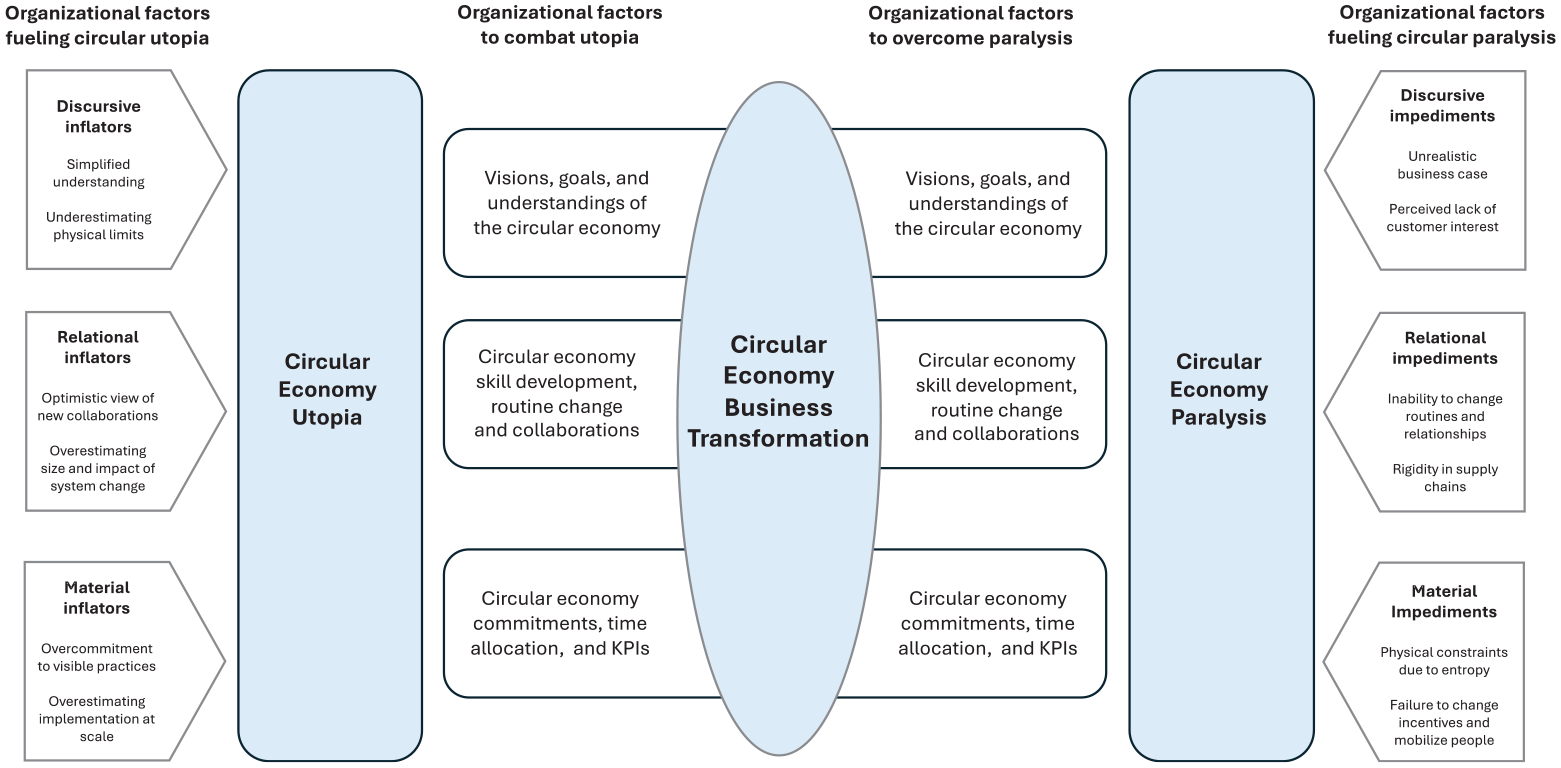
Circular Economy Business Transformation Framework.
The discursive dimension involves the use of language, texts, and other symbolic expressions to create and reshape social reality. For example, the concept of an “endangered species” emerged from environmental discourse (Lawrence & Phillips, 2019). Such discourses give meaning and legitimacy to certain categories and enable coordinated action and policy. On the organizational level, discourses enable creating visions, goals, and shared understandings over the circular economy transformation. However, discursive elements can have an inflating effect when some ideals and goals are not realistic or simply unattainable (Pinkse et al., 2023). An idealistic view of the circular economy can lead to a simplistic understanding of what is involved in making it a reality (Reuter et al., 2019). For example, concepts like upcycling sound attractive from a marketing perspective, but there are often significant physical limits to recycling or reusing practices that form the basis of upcycling. In addition, pursuing circular economy initiatives might be at odds with other sustainability goals, such as net zero, due to the energy needed for recovering, recycling, remanufacturing, or repairing products and materials (Goodall, 2024). Discursive elements can also act as impediments, for example, if there is a rhetoric about the necessity of a short-term business case for the circular economy, which is unrealistic (Dzhengiz et al., 2023). The discourse around creating circular business models assumes the ability of creating financial value for those involved, but achieving this goal can be challenging in practice (Linder & Williander, 2017), for example, when organizations perceive a lack of customer interest (Kirchherr et al., 2018).
The relational dimension focuses on how social-symbolic objects are embedded in and constructed through social relationships, such as via shaping or leveraging interpersonal or interorganizational ties. For instance, changing how a workplace rule is interpreted requires negotiation with coworkers and supervisors (Lawrence & Phillips, 2019). In a circular economy context, the relational dimension involves the development of skills and joint work practices in organizations (De los Rios & Charnley, 2017) as well as broader collaborations and coalitions in interorganizational settings (Patala et al., 2022). Creating a circular economy is a system transformation that involves new ways of collaboration between producers and users of waste for value creation. These relational elements, however, can create an inflationary effect for what is expected from the circular economy in terms of size and impact. Relational inflators involve an overoptimistic view of new collaborations and joint working practices when the possibility of creating opportunities for financial value creation is highly uncertain for those involved (Linder & Williander, 2017). Relational elements can also create impediments for the circular economy due to the inability of organizations to change their existing routines, value chains, and stakeholder relationships. Leaving the linear economy behind often involves breaking away from well-functioning supply chains for virgin materials, which incumbents are less likely to do (Corvellec et al., 2022).
The material dimension involves the physical embodiment of social-symbolic work practices through tools, environments, technologies, and concrete practices that are “visible” and “tangible” (Lawrence & Phillips, 2019). For instance, creating a circular economy involves scaling up the adoption of technologies to close, slow, narrow, or regenerate resource loops (Bocken & Ritala, 2022; Thakuri et al., 2024). While certain circular economy practices, such as recycling, have a long history of operating at scale, others, like refurbishing or remanufacturing, are only now emerging and still operate in niche markets. The unevenness between various circular economy practices in terms of their implementation at scale reflects an inflationary effect in the material elements of the circular economy as a social-symbolic objective. Material inflators, for example, involve an overcommitment to circular economy practices that appear very visible, such as recycling and their related key performance indicators (KPIs), but which, in isolation, do not contribute much to the overarching business transformation to the circular economy (Kirchherr et al., 2017). Material elements also create impediments due to the challenging task of fully transforming systems of production and consumption away from their reliance on virgin materials. Existing manufacturing processes, for example, have been designed to fit the linear economy paradigm and are very costly to change. Moreover, fully closing resource loops is simply not possible due to the second law of thermodynamics (entropy), as there will always be resource losses involved in circular economy practices like reusing, refurbishing, and recycling (Reuter et al., 2019). Other material impediments relate to the current use of KPIs and incentive structures in organizations that focus on short-termism over the long term; these organizational structures hinder the mobilization of staff members to engage in circular economy initiatives (Bocken & Geradts, 2020).
Organizational Transformations to Move Beyond Circular Utopia and Paralysis
In this section, we build on our social-symbolic work perspective as it relates to business transformation to the circular economy. We draw on the insights of the special issue articles to understand why organizations get stuck at one of the extremes and which mechanisms help them move beyond circular utopia and paralysis. We then organize the articles’ insights along the lines of the discursive, relational, and material dimensions. By doing so, we illustrate the unique challenges that are related to each dimension; why the social-symbolic object of the circular economy becomes an impediment or an inflator; and what type of social-symbolic work practices organizations have developed to move beyond these challenges.
Discursive Dimension
The special issue articles, discussed below, reveal that the debate about the meaning of the circular economy has not yet settled down and that it remains a discursively contested space. The articles show that while creating a unique and ambitious vision is an important element in the business transformation to the circular economy, this is also prone to leading to discursive inflation, which, in turn, can fuel opponents of an overly ambitious vision to put up discursive impediments.
In their study of the U.K. plastics sector, Adelekan and Sharmina (2025) investigate how organizations create legitimacy for their vision of a circular business model in an evolving institutional context. The vision—One Bin to Rule Them All—was based on using digital tagging technologies to have One Bin only for the collection of plastic waste. The authors found, however, that there was considerable disagreement among the project participants about the vision, and some considered it too idealistic. The proposed circular business model for One Bin was considered lacking in realism, which led the involved organizations to be in a state of “inconsistent propriety.” That is, they perceived the business model as being both proper and improper, simultaneously. As the organizations evaluated the proposed circular business model as being inconsistent in propriety, they responded by assuming a position of “dynamic vigilance,” which resulted in taking half-hearted action. Because the One Bin vision was too far removed from most organizations’ daily business reality, their response resulted in reinforcing circular paralysis rather than transformative action.
Stål et al. (2025), in their case study of a Swedish urban district that used public-private collaboration to create a model of circular economy practices, also show how discursive inflation can play out. Municipal planners described their vision as “the world’s most sustainable district,” connecting circularity to grand sustainability ideals. This aspirational language inflated expectations, though. It set the stage for utopian goals without alignment on feasibility. This ambitious framing fostered enthusiasm but obscured practical limitations, such as market readiness and user behavior. Private developers, in contrast, introduced a more grounded discourse, emphasizing economic viability and customer demand. This counter-narrative became a discursive impediment when it was used to justify delaying or diluting circular initiatives, particularly those lacking an immediate business case. The economic realism embedded in this narrative aligned with the circular paralysis framing, emphasizing constraints and inaction. Nevertheless, the actors managed to overcome circular paralysis by engaging in discursive reframing. Planners and developers began to co-create a shared lexicon around hybrid business models, pragmatically integrating linear and circular elements. Through iterative dialogue and mutual exposure to each other’s constraints, they revised the project’s goals, moving from visionary slogans to achievable benchmarks.
In Bojovic et al.’s (2025) case study of the creation of a circular ecosystem for waste valorization of human excreta, a similar discursive struggle about the vision played out between actors. The discourses over the value of human waste ranged from ultra-pragmatic discussions over economic resources only, to the contrary view of a civic responsibility to address the organic waste problems with communal solutions. Using an orders-of-worth framework, the study reveals how actors developed diverging views, representing an interesting situation of discursive inflators and impediments being at play at the same time. While some actors were considered to have too idealistic visions, others held too pragmatic visions instead. But rather than getting stuck in disagreement, the actors accommodated the tensions between the various waste-related discourses. Eventually, they found a solution where the economics-of-waste-oriented actor started a functional ecosystem of their own, whereas the civic-duty-focused actors formed an ecosystem labeled “House of Organic Matter,” which allowed all actors to rally around the joint vision.
Huikkola et al. (2025), in studying a waste-management ecosystem in Finland, observed a similar dynamic where organizations managed to overcome their discursive struggles to realize transformative action. The industry was perceived as conservative and uninspiring, and the involved organizations initially saw the discourse around waste-management ecosystems as discursive impediments. However, the authors found that the organizations managed to create new circular identities through framing, anchoring, sensemaking, and sensegiving practices. They transitioned their identity from traditional roles (e.g., “waste management company”) to identities aligned with circular economy principles (e.g., “material processor” or “platform for a circular economy”). This identity shift involved redefining missions, creating public discourses, and by so doing, fostering mutual understanding among stakeholders to reflect sustainability and innovation goals.
Finally, in their study of how asset managers perceive the circular economy as a new investment category, Gross et al. (2025) also highlight the role of sensemaking in dealing with discursive impediments to the circular economy. They found that diverging views around the meaning of the circular economy led to a split between asset managers. One type—trackers—merely saw discursive impediments, whereas the other—trailblazers—managed to overcome these. The study found that the key difference between both types of asset manager was the nature of their sensemaking process of the circular economy as a new investment category. While trackers limited their investments in the circular economy due to a confining sensemaking process, which failed to reduce the perceived uncertainty and ambiguity surrounding the circular economy, trailblazers used a more supportive sensemaking process that led to seeing novel directions and making long-term investments in the circular economy. The trailblazers’ sensemaking process to overcome discursive impediments could help move the financial sector forward on the circular economy by showcasing successes, experiments, and pilots, thus influencing the ecosystem of actors in the sector. However, the lack of discursive settlement between actors, as seen in some of the other studies, means there is a split in the industry, with the potential result that most asset managers remain stuck in a state of circular paralysis.
In sum, the special issue articles show a strong interaction between discursive inflators and impediments, initially holding back a business transformation to the circular economy. At the same time, though, there is evidence that organizations have effectively used social-symbolic work practices to reshape the meaning of institutional objects—in this case, the circular economy—through reflexive dialogue for discursive alignment (Lawrence & Phillips, 2019). These practices included co-developing a shared vocabulary that encompassed both sustainability values and financial imperatives (Stål et al., 2025), shifting identities to align with circular economy principles (Huikkola et al., 2025), and supportive sensemaking processes (Gross et al., 2025). However, discursive alignment was not achieved in all cases, which either led to organizations weighing their options on how to proceed (Adelekan & Sharmina, 2025) or each going their way (Gross et al., 2025).
Relational Dimension
Current thinking about the circular economy highlights the need to build novel relations and take an ecosystem perspective (Patala et al., 2022). There is a strong belief that new collaborations and joint working practices are possible. This positive outlook on the willingness of organizations to build new relations for the circular economy risks creating relational inflators, though, as it underplays the relational work required to realign stakeholder expectations, governance mechanisms, and accountability norms (De los Rios & Charnley, 2017). A general theme throughout the special issue articles is the prevalence of power asymmetries and tensions between actors and organizations, which create relational impediments. However, the articles also suggest mechanisms organizations can leverage to overcome these impediments.
In their study about the valorization of human waste, Bojovic et al. (2025) found that there are considerable relational inflators in terms of excessive initial expectations about synergies that were later realized as misaligned orders of worth among emerging waste management ecosystem actors. The relational expectations differed, leading to mutual disillusionment and disappointment where the ambitions of different actors did not meet each other. As mentioned above, though, an ecosystem reconfiguration and realignment phase ensued, which led to the formation of two new ecosystems that were relationally better aligned. In Stål et al.’s (2025) case of a Swedish urban district, the early public-private collaboration between planners and developers was marked by a sense of alignment and shared purpose, creating a sense of optimism. However, it ultimately became a relational inflator because critical institutional differences were overlooked, reinforcing a circular utopian view that assumed alignment would naturally translate into systemic change.
Most special issue articles observed various relational impediments blocking a business transformation to the circular economy, but, in some instances, they also identified how organizations managed to overcome these. In their study of the textiles and apparel industry, DiVito et al. (2025) found that a key relational impediment is that the actors involved in developing a circular economy ecosystem currently operate in largely disconnected innovation and entrepreneurial ecosystems, on one hand, and industrial ecosystems, on the other. While the start-ups developing the innovations to improve the circularity of products and materials operate in innovation and entrepreneurial ecosystems, these are not well connected to the industrial ecosystems of the large fashion brands and their suppliers, which were supposed to adopt these innovations. This relational disconnect means that industry incumbents failed to adopt the circular innovations at scale. This lack of adoption was not only due to unconnected ecosystems, though; the incumbents also used their position of power in the industrial ecosystem to actively resist the change needed to create more circularity. The study shows how ecosystem orchestration is essential to broker new relationships between disconnected ecosystems and actors. While their case suggests that an orchestrator can make a difference in overcoming this relational impediment, the authors conclude that the circular ecosystem remains a transitional ecosystem “in the making.” It represents a “real utopia” until it reaches scale.
Reim et al. (2025) also take an ecosystem perspective but focus on the role of SMEs within emerging and established circular ecosystems in the food processing industry. Their starting point is that the existing literature creates a utopian perspective of non-hierarchical relationships between actors. This can be considered a relational inflator because it underplays power differentials between actors, which emerge due to differences between each actor’s unique knowledge and resources. The authors argue that due to their more limited resources, SMEs could face relational impediments when being pushed into a role in circular ecosystems that is less advantageous in terms of value creation and capture. However, they found that whether SMEs indeed end up in such a position depends on their role in the ecosystem and the ecosystem’s stage of development. This study’s findings show that some SMEs are capable of positioning themselves in a leading role where they (partly) orchestrate the composition and development of the ecosystem. Although various SMEs found themselves in a role as complementors, they can have some influence on the ecosystem’s development when they have unique knowledge. Therefore, SMEs cannot be assumed to lack agency within circular ecosystems, but to have influence, they do need to have a deep understanding of their position in the ecosystem.
A recurring relational impediment in the articles is power asymmetry. In their study, Huikkola et al. (2025) note that existing waste-management organizations were protected by regulation, high entry barriers, and their core capabilities were kept in-house. Consequently, their position of power was initially reinforcing circular paralysis. However, the authors demonstrate how power dynamics became gradually more distributed, with organizations repositioning closer to consumers (e.g., recycling centers, biogas stations) and identifying ecosystem sweet spots, such as platform orchestration. While traditional power structures persisted, some actors, like system integrators, gained influence. The study also observed a further relational reconfiguration where the organizations adjusted boundaries by retaining core activities such as logistics in-house, while starting collaborations with knowledge-based services organizations, research institutions, and other actors. Stål et al. (2025) also observed a deep power asymmetry, which, in their case, played out between planners and developers. Planners operated under a regulatory privilege grounded in Sweden’s Planning and Building Law, which gave them formal authority to dictate land use and sustainability goals. Developers, in contrast, had economic authority, possessing expertise in market dynamics and business models. These asymmetries led to repeated cycles of conflict and retreat as rigid institutional roles reinforced the paralysis, making coordination seem infeasible. Yet, once these tensions surfaced, the need for deeper relationship-building became clear, and the actors engaged in relational restructuring. They created multiple forums—mobility groups and business model task forces—allowing parallel discussions that respected each side’s domain expertise. This deliberate partitioning of issues provided space for mutual learning and helped reduce relational friction. Over time, repeated interactions fostered trust and enabled relational compromise, such as shared ownership models for infrastructure.
In their study of two European meta-organizations aiming for circularity in the textile sector, Miller et al. (2025) demonstrate how relational impediments regarding existing competitive positions and established value chains were alleviated by meta-organizational brokering between existing industrial actors and across industries. For instance, forestry and energy companies that were both developing their own solutions toward textile fiber production and recycling realized that their technologies could be synergetic, providing opportunities to collaborate in building a new type of value chain together. Also, reconfiguring the role and interaction between brand owners (downstream) and material producers (upstream) was a necessary part of the new organizational logic toward circular value chains. The authors identified two activities that the meta-organizations engaged in to reconfigure value chains for circularity, which were specifically aimed at overcoming relational impediments. Both meta-organizations carefully curated membership by balancing membership openness and closedness, and actively brokered new relationships among members. A key feature of such relational orchestration was the development of cross-sectoral relations, linking private business with research and educational organizations.
In summary, the articles show how overoptimism about organizations developing novel relations for the sake of circularity can lead to relational inflators. Persistent relational impediments remain that need to be addressed through social-symbolic work practices, which reconfigure existing relations and help overcome power asymmetries (Lawrence & Phillips, 2019). These practices rely on organizations taking on the role of orchestrator (Miller et al., 2025; Reim et al., 2025), changing organizational boundaries (Huikkola et al., 2025), or creating forums for mutual learning (Stål et al., 2025). However, ecosystem orchestration is not a panacea either. There are limits to orchestrators’ ability to solve deeply rooted tensions and asymmetries (DiVito et al., 2025).
Material Dimension
The material dimension of the circular economy is reflected both in the physical affordances and constraints of circular innovations—that is, what is technologically feasible (Pinkse & Bohnsack, 2021)—and the institutional arrangements and organizational structures that enable or constrain implementing circular economy initiatives at scale. The special issue articles suggest that some organizations are inflating what is technologically feasible and underestimate the challenge of overcoming material impediments, which are deeply rooted within existing value chains and infrastructures, whereas others have found more realistic pathways for a business transformation.
The articles show how some of the innovations considered central to creating a circular economy were materially inflated. Adelekan and Sharmina (2025) found that a key problem for the One Bin project in scaling up was its digitally enabled business model of tagging and tracing plastics. Several project participants had reservations about the technical and economic feasibility of implementing the digital technologies within their existing infrastructure because it might involve a costly process of installing them across the many sites of their operations. In their case, this material inflator planted the seeds for those opposing the digital solution to stress the material impediments instead. Concerns about whether their existing infrastructure could accommodate the digital solution meant that the project got stuck in the business model design phase and failed to overcome circular paralysis.
Bojovic et al. (2025) also demonstrate how the initial expectations for waste valorization of human waste ecosystems relied on materially inflated expectations of what can be accomplished via circular business models. While these tensions were eventually resolved by different actors reconfiguring to different ecosystems, their study demonstrates how the business case for the circular economy is not necessarily as readily available as is ideally expected (Dzhengiz et al., 2023). In a similar vein, Huikkola et al. (2025) highlight the material impediments coming from highly routinized waste-management schemes. They found that transitioning to circularity involves high transaction costs for waste management organizations, at least initially, although these costs decreased considerably over time due to standardization, modularization, and digital platforms. While their findings demonstrate how the waste management incumbents started to open to new collaborations, they also show the ongoing difficulty of changing material practices once they have become embedded in institutional frameworks, and organizational and inter-organizational routines.
In Stål et al.’s (2025) study, the visibility and tangibility of mobility hubs as circular infrastructures were materially inflated as they were billed to symbolize deep transformation. Developers viewed it as a costly infrastructure experiment with uncertain revenue streams. Planners underestimated developers’ concerns, which led to months of stalled negotiations and implementation delays. While the planners materially inflated the mobility hub as the ultimate solution, for the developers, it represented a material impediment instead because they struggled with the lack of clear economic returns. The infrastructure for shared mobility was not only uncertain in terms of economic returns but also incompatible with established development timelines and investment logics. Eventually, organizational progress emerged through material co-design. Rather than abandoning the hub concept, actors developed a hybrid solution: the city would initially fund the facility, and ownership would later transfer to residents. This approach mitigated the risk burden on developers while preserving the symbolic and functional role of the hub. Moreover, both parties recalibrated their KPIs—from abstract indicators of sustainability to more concrete metrics tied to shared responsibilities.
In their study of asset managers’ perceptions of the circular economy as an investment category, Gross et al. (2025) identified a similar dynamic where the trackers considered circular economy investments incompatible with their current investment approaches due to the high uncertainty about financial returns, whereas the trailblazers managed to overcome such organizational barriers. The trailblazers developed new assessment tools and methods for investing in the circular economy and linked these to their existing KPIs. Rather than using incompatibility with existing organizational structures as a justification for inaction, the trailblazers changed their structures instead. The authors concluded, however, that the trailblazers were still only making modest progress in their business transformation to the circular economy and that their new investment frameworks can merely be considered a cautious first step toward a “real utopia” (Gümüsay & Reinecke, 2022).
The physical constraints of circular business models were most evident in the two articles studying the textile industry. As both DiVito et al. (2025) and Miller et al. (2025) highlight, the physical properties of textiles hamper recycling and reusing practices, which hinders replacing virgin textiles. So long as it is not clear which fibers garments are made of, they cannot be used in recycling processes. One way to overcome these physical constraints is the creation of labels and certifications, which become the physical embodiment of standardized knowledge about circularity. However, in their study of the Dutch textiles and apparel industry, DiVito et al. (2025) found that the difficulties to develop and implement standardized product information on labeling had become one of the key material impediments. The respondents in their study thus called for establishing certifications for the material requirements needed for circularity, especially for newly developed, innovative materials. By contrast, Miller et al.’s (2025) study provides a more positive outlook on overcoming such material impediments in the textile sector. They found that the two meta-organizations they studied both managed to help their members in overcoming such impediments through three social-symbolical work practices: setting material agendas, facilitating material-based platforms, and opening new material opportunities. Their study demonstrates how meta-organizing for the circular economy can be built around material practices; rather than seeing material aspects as impediments, they show how meta-organizing can be built around material opportunities, which can lead to a reconfiguration of global value chains. This view complements and joins the emerging conversation in the field of circular economy platforms, where their organizing is seen to build around opportunities of material value and resource brokering (Blackburn et al., 2023; Ciulli et al., 2020).
In sum, the articles show that, like the discursive dimension, there is a strong interaction between material inflators and impediments. Moreover, there is a notable dynamic between difficulties in overcoming the technological constraints emanating from the physical properties of materials and overcoming organizational and institutional constraints embodied by existing infrastructures, routines, and expectations about economic returns. This reflects Lawrence and Phillips’ (2019) view that material practices are not merely the outputs of social-symbolic work but active mediators of institutional change. The articles identified several practices related to the material dimension, including co-design of circular innovations (Stål et al., 2025), standardization and modularization of technologies (Huikkola et al., 2025), and digital platforms to create new material opportunities (Miller et al., 2025). Compared to the other two dimensions, though, evidence of organizations effectively addressing material inflators and impediments was less apparent. This might suggest that the material dimension of the business transformation to the circular economy is the most intractable, or the most obvious and thus given less critical focus, since the circular economy is constructed around improvements and optimization of material and resource circularity.
A Research Agenda for Accelerating Business Transformations Towards the Circular Economy
The transition to a circular economy remains mired in the dueling narratives between aspirational circular utopias and systematic circular paralysis. To advance beyond this dichotomy, we propose a research agenda that bridges visionary thinking with grounded action, informed by empirical insights and theoretical frameworks from the special issue and the broader literature on the circular economy.
From Circular Utopias to Grounded Impact
A critical gap persists between the circular economy’s visions (Lambert, 2024) and their translation into actionable strategies. As a starting point, our special issue demonstrates many linkages between the discursive practices and how those have supported or hindered relational and material reconfigurations. For instance, imaginaries (i.e., collective visions of sustainable futures) and other discursive artifacts act as catalysts for change but often lack pathways for materialization. Future research should examine how discursive practices (e.g., the framing of zero-waste cities or regenerative design) are operationalized through material interventions like modular product design and industrial symbiosis, as well as through relational reconfigurations including cross-sector coalitions. Future research could also expand on the role of incumbent organizations, including business, policy, and other sectors, that use persistent discourses to maintain the status quo by focusing on risks, uncertainties, and the impossibilities of a future circular economy. In this regard, it would be interesting to study how (and why) incumbents maintain legitimacy whereas such attempts hinder the transformation of sectors from finance to food and plastics that are in pressing need of transformation.
In addition, it is essential to explore how contextual factors, including policy frameworks and cultural norms, either enable or constrain the materialization of the circular economy visions in diverse urban and industrial settings. Comparative studies across sectors could clarify which discursive strategies most effectively translate aspirational visions into measurable outcomes while avoiding the pitfalls of fictional expectations (Bauwens et al., 2020; Farné Fratini et al., 2019; Lambert, 2024; Moreau et al., 2017). Further studies on organizations conducting institutional work for the circular economy (Adelekan & Sharmina, 2025; Bocken & Shirahada, 2025) could also help support the change of industries and ecosystems toward the circular economy in various countries and industry contexts.
Towards “Real Utopias”
We call for further research on “real utopias” (Gümüsay & Reinecke, 2022; Wright, 2010) in the context of organizational transformations for the circular economy to offer a pragmatic middle ground between circular economy idealism and paralysis. Real utopias are transformative yet attainable institutional designs that leverage existing organizational and institutional structures. Future research should analyze hybrid models (e.g., linear-circular supply chains) as transitional forms that balance profitability with experimental circular economy practices (Dzhengiz et al., 2023). Incremental scaling strategies, like piloting circular initiatives in niche markets such as luxury fashion or modular electronics, may provide effective pathways for mainstream adoption while mitigating financial risks (Bocken & Ritala, 2022). Institutional entrepreneurship is critical for redefining circular economy success metrics, such as shifting from valorizing waste streams to reducing virgin material use, and for aligning these metrics with broader sustainability goals (Das et al., 2022).
Studies should also investigate how societal and business actors can move from circularity visions and mission statements to actionable practices. This includes examining the synergies between discursive practices and their support for relational and material reconfigurations (Lambert, 2024). By promoting transformative visions that are “utopian” but still rooted in the actual and concrete potentials of the present, we can find the pragmatic “middle-way” that avoids the inflators and impediments that are typical of many circular economy initiatives.
Where to start? One way is to look at the current organizational and institutional structures, their challenges, but also at the potential embedded in the current practices. Similarly, there are ways to begin reconfiguring current capabilities, structures, and roles toward new circular value chains or ecosystem configurations (DiVito et al., 2025; Huikkola et al., 2025; Miller et al., 2025; Reim et al., 2025). Furthermore, finding the middle ground will require a pragmatic combination of both economic and prosocial incentives and structures when scaling up different circular economy initiatives (Ritala, 2024).
Bridging Asymmetries Through Polycentric Governance and Ecosystem Orchestration
The transition to the circular economy demands radical shifts in stakeholder relationships, particularly in ecosystems where power asymmetries and institutional legacies hinder collaboration (DiVito et al., 2025). Key challenges include resolving conflicting “orders of worth,” such as tensions between economic efficiency and civic responsibility in waste valorization projects (Bojovic et al., 2025). To resolve such differences, polycentric governance models suggest that mutual adjustment and shared resource structures can be leveraged to align disparate actors (Albareda et al., 2022; Villegas Pinuer et al., 2024).
Furthermore, prospective research should examine the brokerage mechanisms used by intermediaries (or transition brokers) to navigate power imbalances and build trust in circular economy ecosystems (DiVito et al., 2025; Reim et al., 2025). For example, the Dutch circular economy model highlights guiding principles such as phased implementation and joint business-case development as effective means for fostering collaboration (Cramer, 2020). Governance frameworks where public-sector leadership through policy incentives is complemented by private-sector innovation could be explored as templates to balance top-down and bottom-up input, as exemplified by the European Circular Economy Stakeholder Platform’s (ECESP, 2021) Coordination Group.
Materiality, Metrics, and Scalable Solutions
There is a pressing need to align utopian visions with the material realities of the circular economy. Current circular economy metrics, such as recycling rates, while useful for the directly intended purpose, fail to capture systemic impacts like rebound effects or equity outcomes (Das et al., 2023). The role of boundary objects, such as circularity certifications and life cycle analysis metrics, is particularly important for aligning stakeholder expectations and bridging the gap between vision and action (Stål et al., 2025). To what extent are they helpful, or do they exclude less resourceful organizations that cannot afford certifications or accreditations? Future research should assess the role of tools like dynamic material flow analysis and frameworks such as the Circular Rebound Tool (Das et al., 2023; Reuter et al., 2019) to offer a more nuanced approach by tracking material stocks and flows across product lifecycles as they represent advances but require institutional adoption.
Gaps persist, too, in aligning circular economy metrics with broader sustainability goals related to context-sensitive KPIs, entropy-aware design, and circular procurement policies to internalize material externalities. Prospective scholarship should develop context-sensitive KPIs that integrate equity (e.g., job creation in repair sectors) and biodiversity (e.g., regenerative agriculture impacts; Das et al., 2022). Research should also address entropy-aware design, examining how organizations reconcile material losses with circular ambitions, and how modular product design and industrial symbiosis can provide scalable solutions (Lambert, 2024; Reuter et al., 2019). Furthering our understanding would benefit from studies that explore how circular procurement policies and extended liability regimes can internalize material externalities, drawing on the experience of public-private “living labs” in Finland and elsewhere (Villegas Pinuer et al., 2024).
Towards Reflexive Circularity
Bridging circular utopia and paralysis could be achieved by integrating discursive, relational, and material work into reflexive circularity. Lambert’s (2024) study of urban circular economy narratives shows how localized “post-industrial craft” discourses can align with material interventions like modular infrastructure. Similarly, polycentric systems in Finland and Spain demonstrate that “real utopias” might emerge not from top-down mandates but from iterative, context-sensitive collaborations (Patala et al., 2022). By grounding visionary narratives in relational and material praxis, scholars and practitioners can transform the circular economy from a techno-managerial fix into a vehicle for systemic equity and regeneration. In this regard, future research should prioritize practice-oriented frameworks that combine dynamic material flow analysis with equity metrics to better quantify the socio-economic impacts of circular economy initiatives (Gao et al., 2020).
It is also essential to test experimentalist policies, such as circular procurement, in diverse institutional settings to understand how adaptive governance can accelerate circular transitions (Sabel & Zeitlin, 2012). Moreover, mapping power dynamics in multi-stakeholder governance schemes such as meta-organizations, platforms, and ecosystems is important for identifying leverage points that can drive their reconfiguration and foster more inclusive, resilient circular economy networks (Blackburn et al., 2023; Dzhengiz et al., 2023; Miller et al., 2025). Driving such a reflexive circularity agenda combines aspirational vision and pragmatic execution, offering opportunities for accelerating the circular economy transition while maintaining coherence within a cohesive social-symbolic framework.
Conclusion
The circular economy remains at a juncture where its transformative potential remains constrained between two dueling narratives: the aspirational yet often unrealistic circular utopia and the pragmatic but often immobilizing circular paralysis. We demonstrate how these competing narratives impede meaningful progress toward circularity by either setting unattainable expectations or reinforcing perceived insurmountable barriers (Dzhengiz et al., 2023; Kirchherr et al., 2017). By examining circular economy transitions through a social-symbolic work perspective (Albareda & Branzei, 2024; Lawrence & Phillips, 2019), we shed light on the complex interplay of discursive, relational, and material dimensions that both enable and constrain business transformations toward circularity. Our Circular Economy Business Transformation Framework provides a structured approach to understanding how organizations get stuck at either extreme and, more importantly, how they can navigate to a pragmatic middle ground.
The path forward requires embracing and resolving the tension between high aspiration and incrementalism. By doing so, the circular economy can begin evolving from a contested concept into a transformative framework that delivers tangible sustainability outcomes across organizations, supply chains, and ecosystems. The journey from linear to circular economies will not be straightforward, but by navigating between utopia and paralysis, organizations can accelerate their path toward real circular business transformations that help address our most pressing sustainability challenges.
Footnotes
Acknowledgements
We would like to thank Organization & Environment’s former editor-in-chief, Michael Russo, for his outstanding job of managing the journal so aptly for many years and for initiating this special issue. We are also very grateful to the anonymous reviewers who helped the authors of the articles in this special issue to further develop their ideas.
Declaration of Conflicting Interests
The author(s) declared no potential conflicts of interest with respect to the research, authorship, and/or publication of this article.
Funding
The author(s) disclosed receipt of the following financial support for the research, authorship, and/or publication of this article: Nancy Bocken has received funding from the European Union’s Horizon 2020 European Research Council (ERC) funding scheme under grant agreement No 850159 (project Circular X)
