



Abstract
Research points to public-private collaboration’s importance for supporting the transformation from linear to circular business models. As little is known of such collaboration, we conducted a 4-year in-depth case study to answer how transformation is affected by two types of tensions: between linear and circular elements and between public and private partners. We find that tensions shape the transformational process into a dialectical pattern, as partners’ institutional differences initially cause them to conflict over whether to focus on linear or circular elements but, over time, arrive at a synthesis. Our findings contribute to circular business model research by illustrating the usefulness of understanding transformational challenges as linear-circular tensions and by illuminating the dialectics of transformational processes.
Keywords
Introduction
The circular economy (CE) is promoted as key for sustainability and refers to a reordering of the production-consumption system from its linear state (take-make-waste) to one where resources and products flow in closed loops (Ghisellini et al., 2016). This reordering calls for multiple organizational transformations (Bocken et al., 2023), which research has explored within value chains (Kuhlmann et al., 2023), strategy (Eikelenboom & de Jong, 2022; Kaipainen & Aarikka-Stenroos, 2022), and ecosystems (Konietzko et al., 2020; Parida et al., 2019). Much research has also been devoted to circular business models (CBMs; Geissdoerfer et al., 2020; Lüdeke-Freund et al., 2019; Urbinati et al., 2017), which seems reasonable given how central firms are for CE and how central business models are for what firms do (Zott & Amit, 2010). Here research has identified more and more substantive attempts at transformation to CBMs (DiVito et al., 2023; Palmié et al., 2021) but continues to note considerable challenges, firms that struggle with profitability for years (van Loon et al., 2022), time-consuming learning (Kaipainen & Aarikka-Stenroos, 2022), and difficulties in making sense (Kuhlmann et al., 2023). Thus, it is not surprising to find continuous calls for the public sector to provide support (e.g., Konietzko et al., 2020). Combined with the widespread belief in collaboration as the preferred pathway to CBM transformation (Leising et al., 2018; Parida et al., 2019), it begs the question of whether public-private (PP) collaboration can enable the transformation to CBMs.
Nonetheless, PP collaboration brings its own challenges (Bryson et al., 2015), which likely interact with those of uncertainty (Kaipainen & Aarikka-Stenroos, 2022; Kuhlmann et al., 2023) and profitability (Linder & Williander, 2017; van Loon et al., 2022) identified in transformation to CBMs. In this article, we try to understand how challenges specific to CBMs combine with those of PP collaboration. Here, a research gap remains, and addressing it is important as (a) we know that collaboration matters for transformation (e.g., Parida et al., 2019), (b) we know that public actors also need to adjust their activities (e.g., Konietzko et al., 2020), and (c) that collaboration is an essential pathway to adjustment (Hardy et al., 2003). We just do not know how PP collaboration in CBM transformation plays out.
Inspired by descriptions of sustainability tensions (Hahn et al., 2015), we develop an understanding of the challenges in transformation to CBMs as tensions between how linear and circular elements are socially constructed: linear-circular (LC) tensions. Second, partners from different sectors have different value interests, roles, understandings, and practices (Oskam et al., 2021; Rey-Garcia et al., 2021; Tapaninaho & Heikkinen, 2022), which cross-sectoral research frames as institutional differences (Vurro et al., 2010). Thus, we assume that PP collaboration in transforming CBMs will also feature PP tensions. Hence, we ask: How do linear-circular and public-private tensions affect the transformation to circular business models?
We use a 4-year, in-depth case study of a PP collaboration where transformation to CBMs involves mobility. In the Swedish city Burg, civil servants (planners) and representatives from seven construction and real-estate firms (developers) try to develop a mobility hub (a physical platform) and thereby change a purely linear business model to one that also contains circular elements: pool vehicles and repair and maintenance. Here, partners’ core task is to decide on the relative linear and circular “content” of the business model, that is, “how much” transformation. Because tensions arise from the meaning of CBMs and actor-related understandings, rules, and norms, we use the institutional perspective, more precisely, the conceptual apparatus Scott (2013) developed, to analyze the case.
Our contribution lies first in showing how the CBM challenges identified in previous research, regarding uncertainty (Kuhlmann et al., 2023) and profitability (Linder & Williander, 2017; van Loon et al., 2022) but also efficiency (Stål & Corvellec, 2022), can be understood as LC tension. To be sure, LC tension does not mean that linear and circular activities always contradict each other, although an actor cannot do two linear and circular things simultaneously, for example, rent out a product while selling it or waste it and recycle it. Instead, LC tension refers to the competing meanings assigned to linear and circular activities, so in CBM transformation, linear and circular activities are about more than the practical challenges involved. This additional meaning seems crucial for understanding transformation. More precisely, challenges stem from two pairs of demands, often competing and not seldom contradictory, namely of environment-economy and stability-change. These two tensions inform how actors understand CBM transformation. The notion of LC tension could aid future research on the transformation to CBMs, making it possible to (a) synthesize findings regarding transformational challenges and (b) move toward more theoretically elaborated understandings, for example, to analyze various effects (e.g., interactions with other tensions) and responses (e.g., by utilizing preexisting strategies for tension management; De Angelis, 2021).
Second, we respond to calls to explore transformation to CBMs over time (van Loon et al., 2022) by approaching it as emergent and unfolding (Langley et al., 2013) so that the effects of LC and PP tensions are understood in the form of a processual pattern. Extant processual research has displayed firms’ transformation to CBMs through linear and goal-driven stages (Kaipainen & Aarikka-Stenroos, 2022; Parida et al., 2019; van Loon et al., 2021). However, we show that the relative institutional differences that characterize PP collaborations bring forth another type of processual dynamic that is dialectical in its swings between what element of the LC tension and what partner dominate a phase. Time matters because it makes partners aware of their institutional differences and more comfortable expressing disagreements. This shapes the linear or circular dominance of phases and how phases change (whether through quarrels and conflict or milder disagreements). The contribution of this pattern is twofold: First, although not a model, the pattern as such is relevant for understanding empirical settings where (a) a collaborating actor is privileged over the other and (b) typically use this privilege, and (c) there are additional (institutional or other) essential differences that (d) align with opposing perceptions of circular and linear elements. Second, we think that the pattern and the notion of dialectics it exemplified can inspire processual CBM research to go beyond the sanitized and rationalistic imagery of the goal-driven (teleological) stage model. The problem with the teleological stage model is that it paints a somewhat simplistic image of transformation as driven by goals and moving straight toward a given end-state (Langley et al., 2013). It does not acknowledge tensions as drivers of processes and thus implicitly assumes that transformation is straightforward and not a contingent outcome of struggles between actors with different interests (e.g., Langley & Tsoukas, 2010).
Theoretical Background
Transformation to CBMs
CE’s sustainability potential lies in reducing negative impacts on nature’s source and sink capacity by slowing and closing resource loops (Bocken et al., 2016). Businesses organize the flow of resources and are therefore central to this (Piila et al., 2022), which, in turn, motivates the interest in CBMs (Geissdoerfer et al., 2018). CBMs are a sub-category of business models for sustainability (Schaltegger et al., 2016; Stubbs & Cocklin, 2008) with generic mechanisms for value creation and capture that involve offers, activities, and elements that utilize value that remains in products after use (Linder & Williander, 2017). Although this can refer to recycling materials and components, the reuse of products tends to be more environmentally beneficial than recycling (van Loon et al., 2020). A typical example of a transformation to CBMs entails replacing elements that support the marketing and sale of as many products as possible for elements that cater to reuse, for example, leasing offers via pools and platforms and repair, maintenance, and take-back (Stål & Corvellec, 2018).
Like business models for sustainability (Lüdeke-Freund, 2020; Velter et al., 2020), CBMs are holistic and boundary-spanning (Pieroni et al., 2019). They have societal legitimacy (DiVito et al., 2023; Stål & Corvellec, 2018) and attract partners across sectors (Tapaninaho & Heikkinen, 2022) to address systemic challenges (Pedersen et al., 2021). For research, the business model concept is useful because the concept must not refer to a single firm; rather, it can also be applied to shared entities, such as platforms or marketplaces (Stål et al., 2023). This helps because, in the transformation to CBMs, it may not be clear from the beginning who will eventually operate a business model (Oskam et al., 2021); that can be one of the many things to decide.
Despite good arguments for CBMs, firms have been hesitant to transform their business models in any real way (Stål & Corvellec, 2018), which led some research to initially question CBMs’ economic benefits (Linder & Williander, 2017; Tukker, 2015; for a less common, but important, critique of their environmental benefits, see Manninen et al., 2018). To explain hesitation, research has mapped and categorized the difficulties managers report, such as a lack of policy support (Hina et al., 2022). Even if more substantive and prolonged efforts have materialized (Konietzko et al., 2020; Patala et al., 2022) with success (Kaipainen & Aarikka-Stenroos, 2022), transformation is continuously extremely challenging (DiVito et al., 2023), subject to contradictory demands (Stål & Corvellec, 2022).
Linear-Circular Tensions
We suggest that the many challenges in the transition to CBMs (e.g., uncertainty, profitability, legitimacy, learning, and technology) gain their meaning because the circular is oftentimes socially constructed in relational opposition to the linear. In other words, in the transformation to CBMs, circular and linear elements are contrasted with each other and gain their meaning (e.g., as challenging) both (a) in relation to each other and (b) in relation to the underlying concerns that the linear and circular represent. This, in turn, creates tensions within the transformation to CBMs that express themselves in efforts to develop and design business model elements, an LC tension. More precisely, the extant CBM research (combined with insights from corporate sustainability research; Hahn et al., 2015) leads us to identify two concerns that provide contradictory meaning to linear and circular elements, namely economy-nature and change-stability:
First, across stakeholders, the linear and the circular are in opposition regarding their environmental and economic impacts and benefits. Strands of academic research remain critical (Corvellec et al., 2022), yet circular activities are, across society, perceived as having environmental benefits that linear ones lack (Stål & Corvellec, 2018). In many industries, circularity is called upon to mitigate environmental problems, for example, in fashion (DiVito et al., 2023), plastics (Gall et al., 2020), or construction (Leising et al., 2018). Beyond sustainability research, few question circularity’s environmental credentials; rather, the economic track record gets critiqued (Linder & Williander, 2017). For linearity, the situation seems reversed; linear operations and activities express the business-as-usual, continuously proving its financial viability, despite being, for example, as with fast fashion (Ellen MacArthurFoundation [EMAF], 2017) or plastics, environmentally catastrophic. This observation is supported by corporate sustainability research identifying persistent tension between economic and natural resilience within firms’ sustainability efforts (Hahn et al., 2015). This tension arises because of the fundamental difference in how the man-made economic system and the biophysical reality that it depends upon operate.
Second, as noted (e.g., Kaipainen & Aarikka-Stenroos, 2022; Kuhlmann et al., 2023), the novelty of circularity induces multiple uncertainties, to determine what circular elements mean, how to make them work, and how to fit them to prevailing activities, which all contrast to, at least for successful incumbents, efficient, linear operations. For instance, Kaipainen and Aarikka- Stenroos (2022) found that it took 25 years to transition from a linear production to a circular one. Technical and practical problems in fitting new elements to an efficient activity system are exacerbated by circularity because circularity calls for new ways of relating to stakeholders, for example, turning consumers into users (Tukker, 2015). Such uncertainties and difficulties find many expressions in research, for example, the problem of closed-loop production to ensure that recovered waste has sufficient quality and quantity to work as an input (Patala et al., 2022). Uncertainties feed a continuous quest for more and better information and communication (Kayikci et al., 2022; Konietzko et al., 2020). That these linear and circular differences can be described as tensions also find support in the study by Hahn et al. (2015), who note the competing demands that arise when firms seek to deal both with stability and change. In this respect, contradictions in the certainty ascribed to circular and linear elements represent a more generic tension. Again, tensions do not exist because linear and circular elements necessarily make contradictory practical demands but because they mean different things concerning two pairs of demands that matter much for contemporary firms, namely those that pertain to environment-economy and stability-change. These two infuse CBM transformation with LC tension.
Public-Private Tensions
That firms face challenges supports the widespread agreement in research that firms cannot transform their business models on their own (Eikelenboom & de Jong, 2022; Leising et al., 2018; Parida et al., 2019; Tapaninaho & Heikkinen, 2022). Rather to support transformation to CBMs, multiple, often heterogenic, actors are called upon to adjust their activities (Konietzko et al., 2020), suggesting collaboration (Parida et al., 2019). A collaborative approach to adjustment differs from an adjustment that occurs through markets or regulation as it utilizes communication for coordination (Hardy et al., 2003). However, collaboration also has its challenges; when businesses collaborate, tensions arise between competitive and cooperative interests (Bengtsson & Kock, 2000; Raza-Ullah et al., 2014), and in cross-sectoral collaboration, tensions also arise out of partners’ difficulties in understanding each other (Clarke & Crane, 2018; Vurro et al., 2010). Less is known about how cross-sectoral tensions matter for transformation to CBMs since most studies have focused on business-to-business collaboration, for example, between corporations and entrepreneurs (Veleva & Bodkin, 2018) or in business ecosystems (Parida et al., 2019).
Research nevertheless notes how important public actors are for the transformation to CBMs, both through stick (Tapaninaho & Heikkinen, 2022) and carrot (Konietzko et al., 2020). Free-floating carpools can illustrate this: In some cities, local officials provide carpools with privileged access to parking, so pool cars can be picked up and dropped off anywhere; in other cities, this is not granted, making them fail (Bocken et al., 2020). Public actors are also important customers (Kanda et al., 2021), but collaboration is needed for procurement to be effective (Witjes & Lozano, 2016). While circular procurement has been explored from the public side (Kristensen et al., 2021), there are still no studies on PP collaboration in the transformation to CBMs.
An Institutional Perspective on Tensions
Again, even if PP collaboration could support the transformation to CBMs, divergent interests and understandings suggest the presence of tensions (Bryson et al., 2006, 2015). This raises the question of how to conceptualize them. Corporate sustainability and extant CBM research are limited by their exclusive focus on the business sector. Here, just as for understanding how CBMs are assigned contradictory meanings, the institutional perspective offers a suitable lens:
First, the institutional perspective is one of the few organizational theories that reach beyond a single sector (DiMaggio & Powell, 1983; Friedland & Alford, 1991). Other alternatives, such as paradox theory (Smith & Lewis, 2011) or coopetition theory (Bengtsson & Kock, 2000), focus on business-related tensions. Likewise, public administration focuses on PP tensions but exclusively from the public perspective (Crosby & Bryson, 2010).
Second, the institutional perspective can also explain the effects of differences, for example, in understandings, as it deals both with highly entrenched social facts (the institutions) and their more transitory effects, how institutional demands are expressed in a particular situation (e.g., a collaboration) or process (Smith et al., 2013). While institutions remain “fixed” in the short run, their demands upon actors (e.g., partners) are situated, dynamic, and somewhat variable. This can be referred to as institutional demands enabling and constraining (Hoffman, 1999) a certain awareness, openness, and motivation to focal issues (e.g., linear and circular elements; Greenwood & Suddaby, 2006). In the long run, institutions can also be modified through such variability (Lounsbury & Crumley, 2007).
Finally, the institutional perspective is robust and well-elaborated, collecting more than four decades of theoretical effort, resulting in a refined vocabulary (Greenwood et al., 2017). To navigate this elaborative richness, we mobilized a particularly well-developed conceptual apparatus, namely that of Scott (2013), which defines institutions as regulative, normative, and cognitive elements (Hoffman, 1999; Maguire & Hardy, 2009). While it may not be as contemporary as the institutional logics-perspective (Thornton et al., 2012), it has the advantage of being well-known outside organizational studies, that is, allowing for communication with sustainability scholars (Geels, 2004; Mont, 2004).
Here, regulative elements refer to laws and rules backed up by a coercive state, which can include prescriptions of stakeholders’ legal privileges and responsibilities (Hoffman, 1999). Normative elements refer to the values that prevail in a context, what is considered right or morally appropriate (Maguire & Hardy, 2009), embedded in professional codes of conduct (Scott, 2001), but also in generic norms, such as sustainability, a new moral theme within business (Hengst et al., 2020). Cognitive elements refer to “shared conceptions that constitute the nature of social reality” (Scott, 2001, p. 57). These are taken for granted and express themselves through deep-seated beliefs of how the world, for example, a particular industry or practice, works and why (Hoffman, 1999). Beliefs create a specific form of internalized institutional demand that bases pragmatic legitimacy—what actors think can be done based on how things are (Hengst et al., 2020).
By enabling an analysis of the institutional demands that PP collaborators experience and identifying underlying regulative, normative, and cognitive institutions, the institutional perspective explains the institutional differences between partners and the tensions these give rise to. Still, partners do not live in completely separated worlds but usually share some settings, even when they are not collaborating; thus, it is more a case of institutional demands not appearing the same to all actors (Hoffman, 1999, p. 352). Again, the institutional perspective aligns with our understanding of LC tensions as to how the institutional demands upon actors combine with the socially constructed meanings of CBM. These latter meanings are broadly present in the societal discourse. However, the task for our analysis is to unpack how these meanings combine with the contrasting institutional demands upon public and private partners.
To sum up, first, by combining corporate sustainability with important challenges identified in the transformation to CBM research, we arrive at the expectation that collaboration will feature tensions between circular and linear elements (LC tensions). Second, extant collaboration research also leads us to expect tensions between public and private partners (PP tensions). To understand how these tensions combine, the institutional perspective presents a viable alternative for analysis.
Method
We opted for a case study because it allows for the deep and detailed data (Flyvbjerg, 2006) needed to address our research question. Moreover, case studies are suitable and common in processual research because they enable longitudinal access to a phenomenon and the many events and activities that pertain to it. Such access and closeness are crucial to tracing a phenomenon, that is, transformation to CBMs, over time (Langley et al., 2013). We found a rich and accessible case within Santalodge, a residential development project (our research setting). Moreover, the case seemed transparent in showcasing what we wanted to study; the two tensions (LC and PP) would be present (e.g., Eisenhardt & Graebner, 2007).
The Research Setting
The setting, Santalodge, exemplified a PP collaboration in Burg, a fast-growing, anonymized, medium-sized Swedish city. Here, civil servants from Burg’s urban planning departments (planners) and representatives from seven real-estate and construction firms (developers) were jointly planning, from scratch, Burg’s largest residential development project, Santalodge, which would contain over 3,000 apartments when completed in 2030. The collaboration was unique, as cities almost always plan alone. However, goals had been collaboratively agreed upon in Santalodge’s sustainability policy, including the bold vision to become “the world’s most sustainable district.”
The Case: Transformation to CBMs via Mobility Hubs
The key to Santalodge’s sustainability policy was to reduce future residents’ ownership of cars by offering generous access to vehicles without ownership and other mobility services. Central to these efforts were mobility hubs, physical platforms for asset-sharing, reuse, and other services. Developing hubs exemplify a transparent example of transformation to CBMs because residential areas usually only offer parking spaces. This linear element supports car ownership (a household buying a car, owning it, discarding it, and getting a new one). With the hub, some, or all, of these linear elements are replaced with circular ones, activities, and services that offer vehicles for multiple uses (through the reuse of pool cars and electric and cargo bikes). Thus, depending on the relative amount of circular or linear elements, a hub represents a more or less substantive transformation to an asset-sharing type of CBM (cf. Konietzko et al., 2020; Palmié et al., 2021). This offered a useful heuristic for assessing the degree of attained transformation. Moreover, hubs were, from the onset, meant to reduce cars in the area to cut CO2 and other emissions.
Hubs represented a form of collective business model in the making, as it was initially unclear who would own and operate them. There were many uncertainties as none of the actors involved had any experience with developing hubs (but developers knew how parking worked), but they had to come to terms with what to do and who should do it in the process. Moreover, residential development is also a context where public and private actors usually have very different roles, subject to highly specific institutional demands. This often puts them in conflict, where public actors sometimes try to control developers overly, and developers try to cheat. They were now trying to deal with this through collaboration.
Data Collection
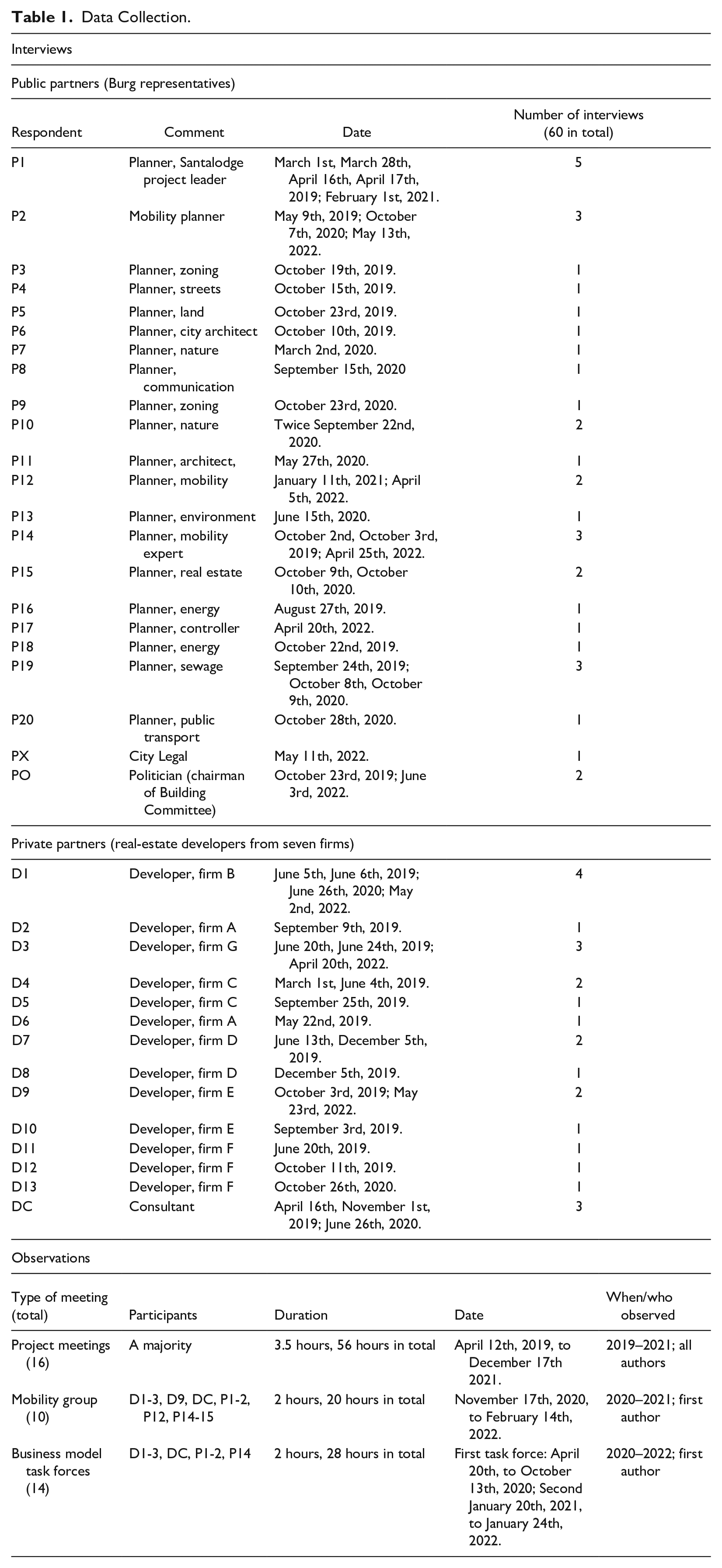
Data were collected via interviews (60—all semi-structured) and meeting observations (50). Meeting observations “zoomed in” (Jarzabkowski et al., 2019) on the actual developmental work, a laborious effort (for partners) that took more than four different types of groups and task forces, with meetings almost every third week for more than 3 years (2019–2022). Some interviews and observations, primarily those of the Santalodge project group (n = 16), allowed us to “zoom out” and consider circular transformation in the context of the entire Santalodge project. Moreover, we relied on our access to all Santalodge’s documents (e.g., PowerPoint presentations from meetings, timelines, drafts of documents; deposited at SharePoint) to verify our interpretations of what was going on (see Table 1). This was sometimes needed as meetings were filled with technical jargon and inconclusive speech, which were difficult to grasp immediately. Throughout the data collection, we intended to, and did, act as independent observers. We did not report our findings to respondents until after data had been collected, and we tried as much as possible to avoid interfering with the case. Nonetheless, as in all case research, there are slight research effects, but we perceived that as respondents became more used to us, they did not let our presence (e.g., during observations) interfere with what they were doing. Given that they were experts on planning and construction, and we were not, they were not that interested in hearing our thoughts on how to design hubs or to commission carpools.
Data Collection.
The second author conducted several interviews in English, while the first and third authors interviewed respondents hesitant to speak English in Swedish. In comparing and reflecting upon the interviews, we found no significant differences relating to the choice of language. All interviews were recorded and transcribed verbatim.
Meetings that exclusively dealt with transformation to CBMs (hubs) were of two different types: Mobility group meetings (n = 10, between 2020 and 2022) with 10 participants devoted to mobility broadly and three different smaller “business model taskforces” with fewer participants (n = 14). In total, these meetings amounted to 48 hours of observation. The task force consisted of two project leaders (Planners 1 and 2—hereinafter P1, P2), a mobility expert (P14), three developers (D1, D2, and D3), and DC, their coordinator (a consultant). Additional planners and developers attended the mobility group meetings (e.g., P12, P15, and D9). Depending on the nature of the meeting, external experts and guests appeared, such as representatives of Sweden’s only “hub company” or Burg’s legal expert (PX). The mobility and task force meetings were all observed by the first author, who transcribed these meetings verbatim.
In interviews (conducted from 2019 to 2022), respondents provided retrospective accounts of how ideas of mobility hubs came about as Santalodge’s sustainability policy was set in 2017. Moreover, our interviews in 2019 focused on a disagreement over where to locate hubs, which was, at the time, straining the collaboration. During this conflict, planning stopped, which lasted several months and affected the pace of Santalodge as a whole. As work resumed, activities were reorganized as a business model task force was set up, and the mobility group was paused. Nevertheless, later, the mobility group returned as the business model task force was paused instead, and finally (in 2020–2022), the two groups ran in parallel. Hence, organizing changed, with it also focus, meaning that a pattern emerged in how circular or linear elements dominated the collaboration over time. By observing meetings, we could note this in real time.
Data Analysis
Identifying the Four Phases
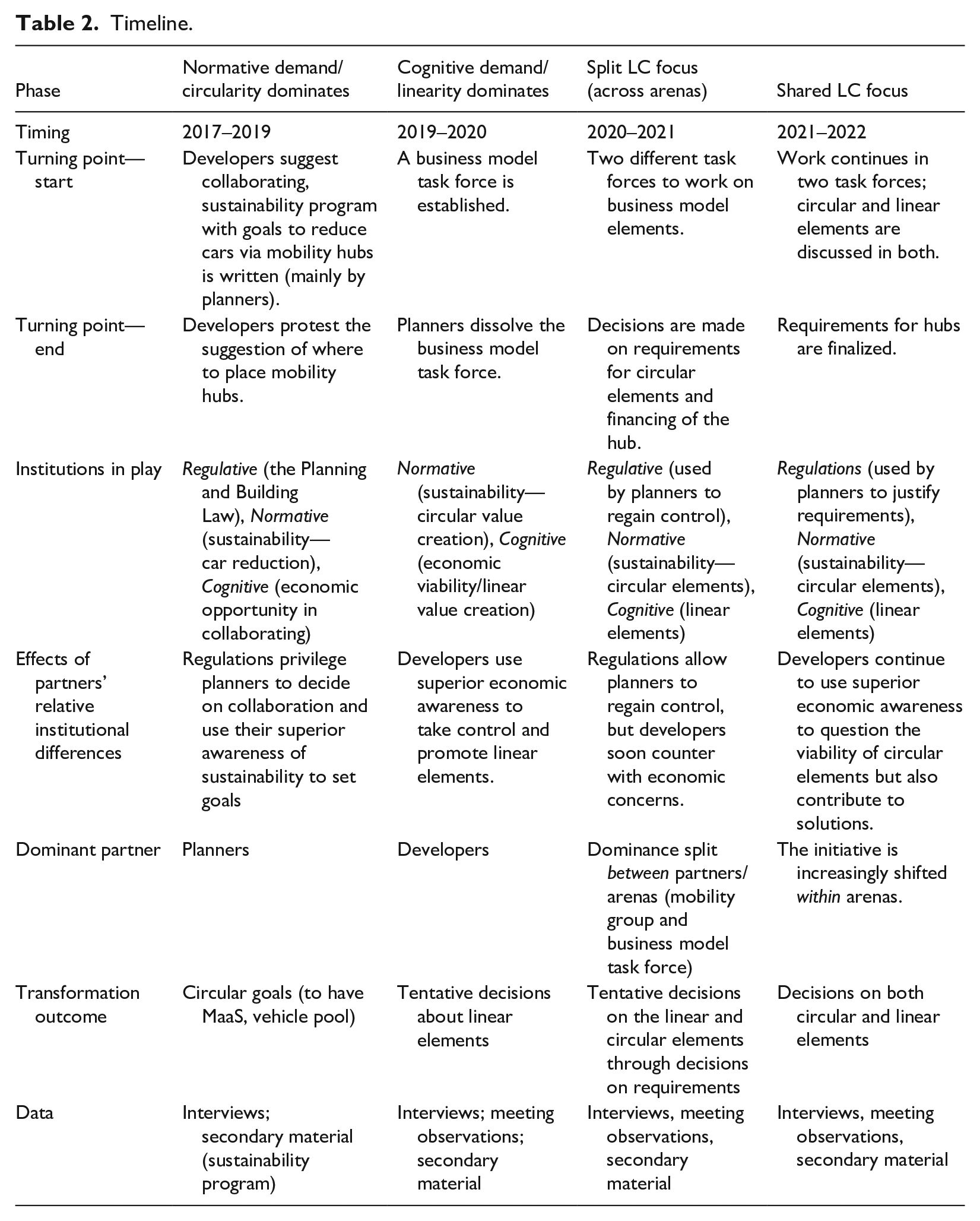
Following Langley (1999), we started by constructing a timeline of the case, indicating events and activities frequently reported in the interviews and our observations. One example was the work on Santalodge’s sustainability policy because the goal of having hubs (transform to CBM) was decided here. Later, a conflict over where to place hubs halted collaboration for almost 6 months. It marked a shift between the two phases because developers took over the agenda afterward, shifting focus from circular to linear elements. In our observational data and interviews with task force participants, we later identified additional shifts in focus, coinciding with whether public or private partners had dominated discussions.
Through these additional agenda shifts, we bracket the data temporally (Langley, 1999) into two additional phases, resulting in a first account of the process as occurring in four sequential phases. These phases partially answer our research question as they show that LC tensions result in partners switching back and forth between phases when they focus on circular elements and phases when they focus on linear elements. More precisely, first, public partners and circular elements dominate, and then private partners and linear elements take over. Then, there is a phase where both elements are dealt with in parallel but in different arenas. And then finally, there is a phase where partners begin to deal with both the circular and linear elements in the same arenas, which coincides with some important decisions made.
Applying the Institutional Perspective
To explain why this dynamic pattern emerged, we mobilized the institutional perspective. The first author coded the data for each phase (see Table 2) to identify the regulative, normative, and cognitive institutions in play and the institutional demands they raised upon partners. To identify institutions, demands, and effects, we examined how actors’ awareness, concerns, and privilege were expressed in the data (see Table 3 in Supplementary Material for links between quotes and codes). For instance, when planners fought (motivation) to reduce cars in Burg (an institutional demand), this showcased sustainability (the normative institution). Expressions of institutional demands were not evenly distributed between planners and developers: car reduction was a demand perceived by planners, as Burg had worked with it for years, but less so by developers. Developers’ somewhat lukewarm attitude to sustainability’s demands, in turn, contrasted markedly with how detailed and passionate they were regarding economic viability (another institutional demand), which planners understood the importance of but did not understand in detail.
Timeline.
Identifying Institutions
We interpreted developers’ repeated references to economic viability and reality as an institutional demand stemming from cognitive institutional elements, as they took on such a fact-like character for them and planners. Both partners agreed that economic realities ultimately decided what could, not merely should, be done (e.g., Hengst et al., 2020). On the other hand, it seemed clear that sustainability represented a normative institution for both partners, although planners mostly felt its institutional demands. Finally, while a great many different regulations put demands upon partners, no law was as important as the planning and building law because this law specifies the roles and responsibilities of planners and developers: that planners have a monopoly on planning and thus decide how the land can be used regardless of who owns it. This translated into a privilege to set requirements through legally binding maps and agreements.
Identifying Differences in Institutional Demands
By categorizing codes as belonging to representing regulative, normative, or cognitive institutions and matching this with whether they appeared in planners’ or developers’ claims, we could interpret partners’ relative awareness and motivation (institutional demands) of the three institutions, which lead us to identify how these institutional demands affected planners and developers (see Figure 1). It now became clear that institutional difference was relational in two ways: it resulted not merely from institution-actor contingencies but also from actor-actor ones; for instance, the planning and building law privileges planners in general but also privileges planners over developers, which explains why developers were so passive initially, while on the other hand, developers are highly versed in economic realities, but they are particularly so contrasted with planners. This relative dimension mattered because it motivated partners to care about different things and gave them the tools to promote their interests effectively.
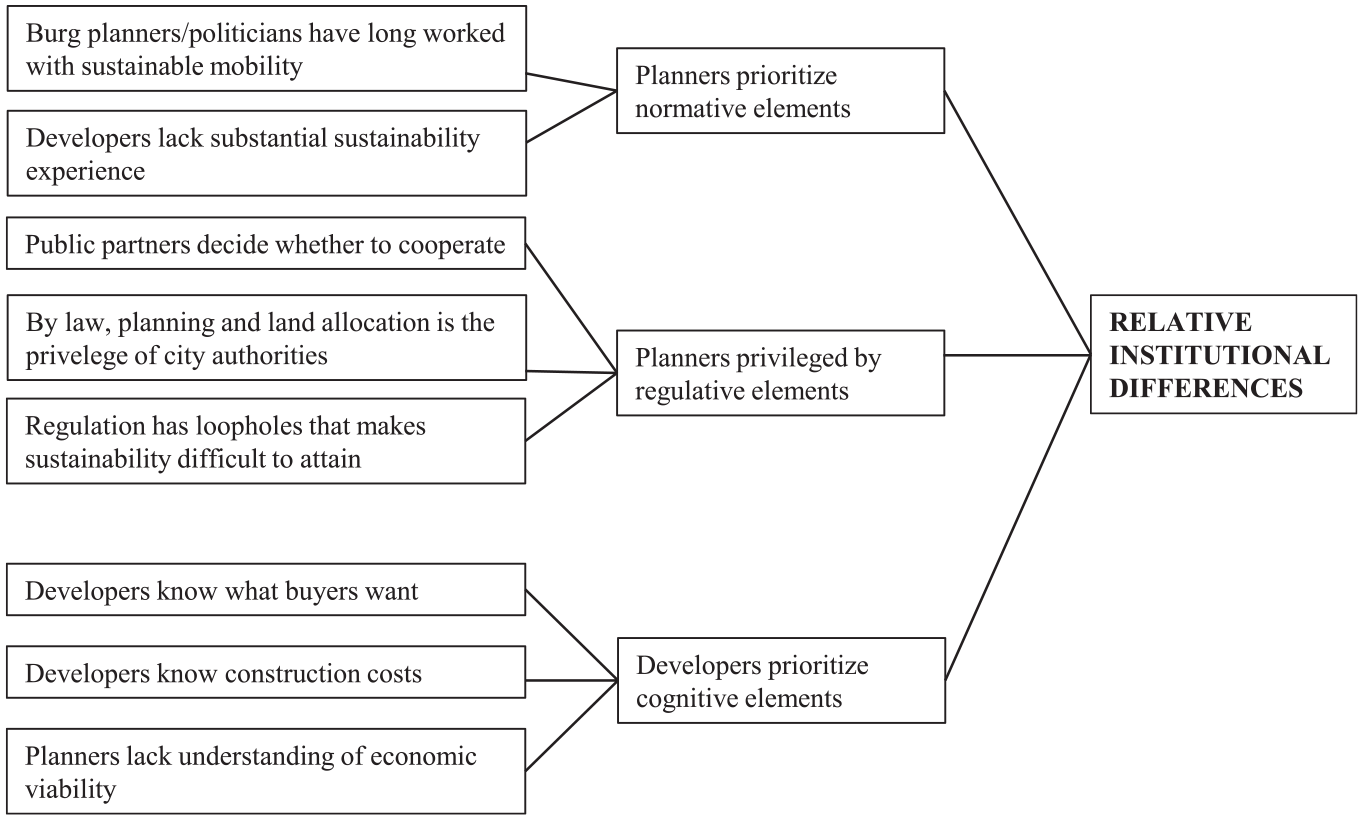
Coding Structure Relative Institutional Differences.
Explaining Dynamics
To further validate and flesh out these shifts between phases, the first author coded for and identified four additional constructs, namely public and private actors’ countermoves and the different ways that circular and linear elements were coupled to the institutional demands upon partners (see Figure 2; although the first author did coding, they were discussed and verified with the other authors as well). These constructs link partners’ relative experiences of institutional demands to the pattern of transformation to CBMs. In bringing together these analyses with the four phases identified above, we arrived at an overview that describes the case (Figure 3). It shows how institutional demands energize collaborative interactions (moves and countermoves), which in turn shifted focus between who (public or private partner) and what (circular or linear value elements) dominates. Thus, it provides a more elaborate answer to our research question.
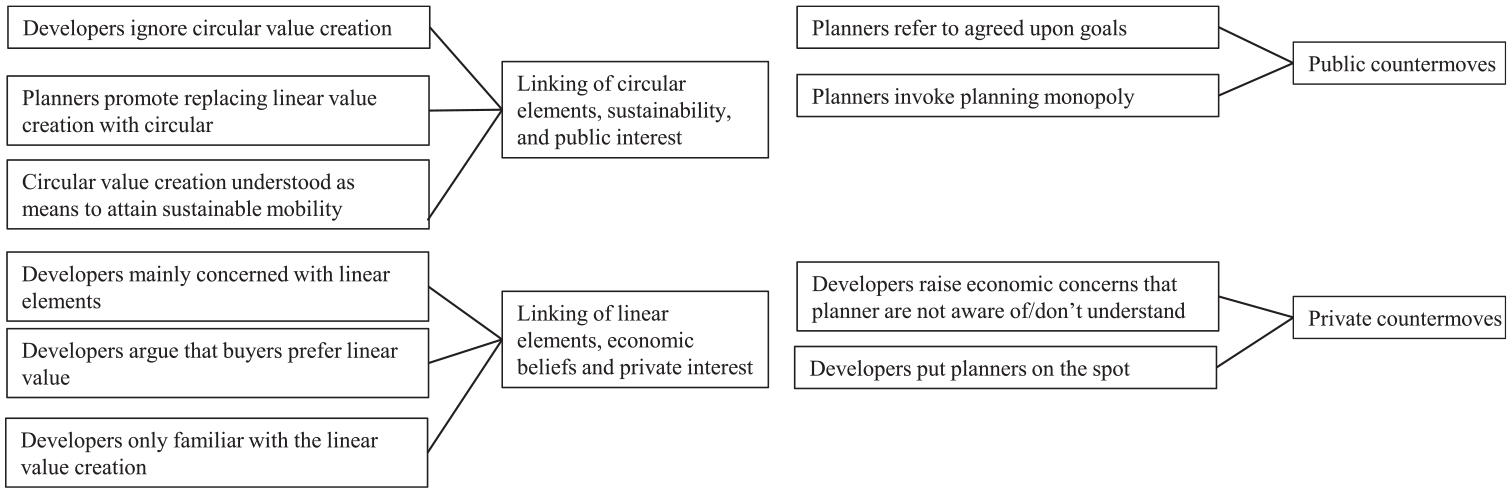
Coding Structure Interactions.
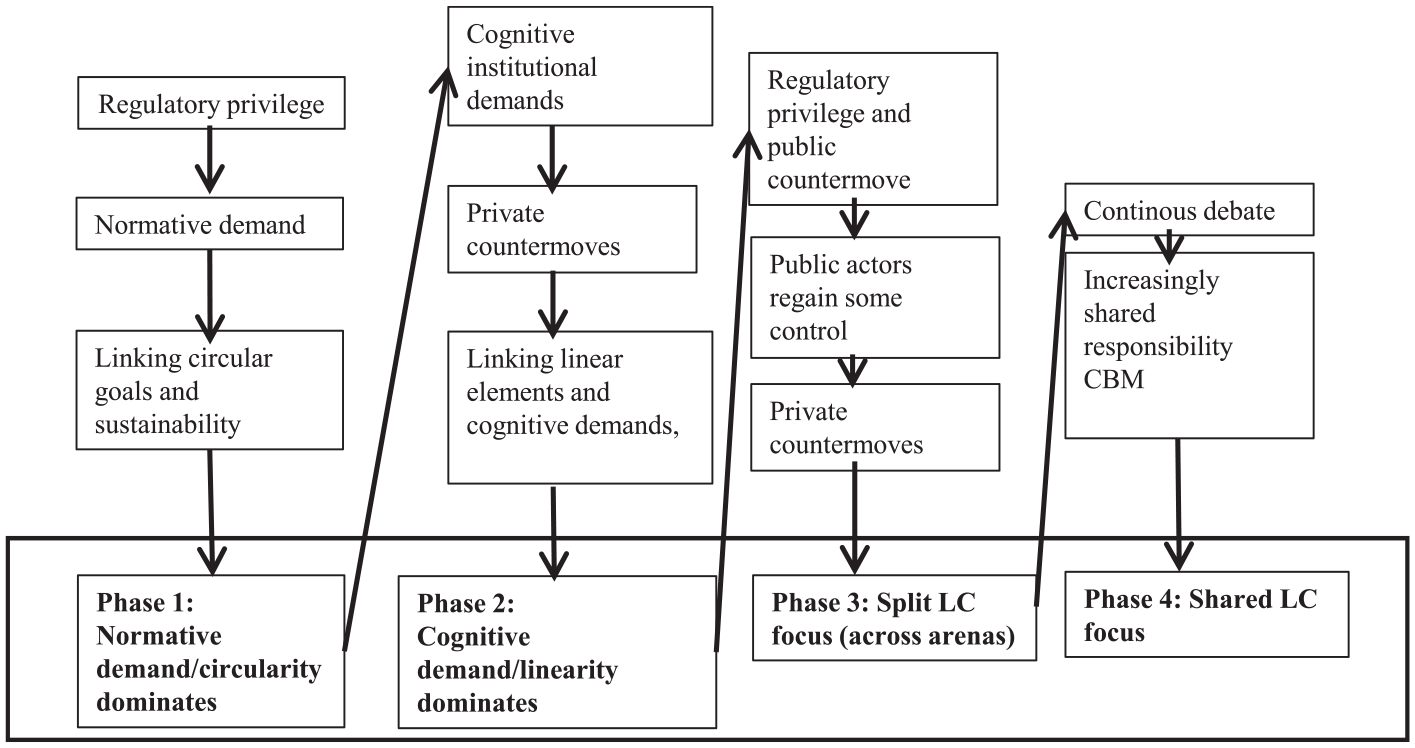
Case Overview.
Identifying a Dialectical Pattern
Nonetheless, it was apparent that the duration of circular and linear focus and the intensity of shifts also changed over time: In the initial phases, partners spent more time on either circular elements (Phase 1) or linear elements (Phase 2) than they did in subsequent phases. Moreover, the moves and countermoves that shifted phases got less conflicted with time. In later phases, focus shifted in less conflicted ways. While shifts suggest a dialectical process dynamic, this observation suggests synergy emerged (Langley et al., 2013). In our Discussion, we show this dialectical pattern, that is, our answer to our research question. The pattern shows how (a) institutional differences prompt contradictory institutional demands that (b) induce partners to first attend to either circular or linear elements but later work with both of them and (c) make decisions on how to mix circular and linear elements in the business model (the transformational outcome).
Findings
Phase 1: Normative Demands and Circularity
Initial Regulatory Privilege
Both planners and developers knew that regulatory institutions (primarily the Swedish Planning Building Law) gave them very different roles. This regulatory institution privileges city officials to determine what can be built: “It is a municipal concern to plan land; that is what the Planning and Building law says” (Po1). Moreover, a city that owns the land, as Burg did in Santalodge, can sell it to whomever it wants: “We can go to one company and give them everything. It might not look good, but it is not illegal” (P1). Developers, in turn, needed land, and the collaboration hinted at access to it without competing with all other developers in Burg. But collaboration also meant that developers might get the chance to shape planners’ requirements, to make the Santalodge plans aligned with developers’ housing products: “Normally [Burg] does the planning, and then they allocate the land, and you get this plot of land. That’s it. Period. But now we have been able to make our suggestions to the plan even if we do not get every change we want” (D9). Thus, developers were motivated to start the collaboration by suggesting to Burg’s politicians that they should develop Santalodge together and do something that “reached the sky” (D2) regarding sustainability.
Thus, developers’ economic self-interest (a cognitive institutional demand), also mixed with the awareness that sustainability was important, motivated developers to initiate the collaboration: “Of course, we also wanted to get more land to build on for our owners. And [Santalodge] is a way to ensure that” (D6).
Normative Demands
Burg’s planners were highly motivated and knowledgeable about sustainability in the shape of various issues (traffic, parks, waste, energy), which had been a recurrent concern for Burg’s planning for years. They had a firm grasp of multiple institutional demands that sustainability raised upon residential development. However, from previous projects, planners knew that requirements were not giving them the sustainability they wanted. Planners believed that to succeed, developers had to become truly committed; otherwise, plans could fail during construction, for instance, by developers protesting requirements in zoning plans and getting them revised: “[In another project] all developers but we got the zoning plan changed [. . .] with building rights and lot size and so on [. . .] we did not achieve anything together there at all” (D9). Hence, planners knew that developers’ sustainability motivation differed from theirs. This relative difference in awareness and motivation is exemplified in how Santalodge’s sustainability policy was determined because “three-fourths were written by civil servants” (P1).
Linking Circular Goals and Sustainability
Officials in Burg had worked for years to reduce private car ownership (a normative institutional demand), and planners were motivated to try this in Santalodge. However, it became clear that developers did not understand this institutional demand.
Thus, there were apparent differences between partners concerning (a) how car reduction (an institutional demand) from sustainability (normative institution) mattered and (b) how partners were privileged (institutional demand) by the Planning Building Law (the regulative institution). These relative differences gave planners a clear initiative in the first phase because sustainability goals aiming for “the sky” were formulated in this phase, and developers could not formulate such. This resulted in the goal of having a mobility hub (a transformation to CBM) to reduce cars. Goal setting went smoothly, with partners expressing great pride in how well they collaborated, as exemplified in P1’s statement, just 3 months before conflicts broke out: So we agreed from both sides: ‘We’re willing to put environmental and social sustainability first and find business models and win-win solutions later.’ But there are not many conflicting goals between companies and us, the municipality. Right now, at least, we have an agreement on what we want to achieve.
Mobility hubs were meant to show residents that they did not need to own cars, for example, by offering convenient carpools. Life without a car was not a radical idea for planners, but developers found it strange: In the beginning, many of the developers said, “If we can get residents to make do with one car, we have gotten far,” and I thought to myself, “Wait a minute, what are you talking about? Most residents in Burg do not even own a car.” I had to ask my statisticians to dig up numbers that showed that it is more common in Burg for families to have zero cars than to have two (P12).
Developers claimed that most buyers owned cars and were used to accommodating that by providing convenient parking. They knew little about providing circular elements: “To run the garage is no problem, it is the mobility services that are difficult” (D2). In other words, the uncertainty dimension of the LC tension came into play here. Moreover, the environment-economic dimension was also expressed as developers voiced fears that having too few linear elements (parking) would make it difficult to sell apartments: “Our typical customer wants to have parking close” (D9). Moreover, developers knew how to make money from parking spaces but did not believe in making money from circular elements. Thus, they feared that too much of the circular could crowd out profits from parking and their overall profits by making condos difficult to sell. In other words, the two dimensions of the LC tension surfaced as partners went from setting goals to working with them.
Phase 2: Cognitive Demands and Linearity Dominate
Now, an incident occurred that tipped the initiative in the favor of developers. Although regulative institutional demands privileged planners, this privilege turned out to have limits: developers were given unexpected support from Burg’s political leadership (the chairman of the building committee (Po1)) which intervened on developers’ behalf by replacing a high-ranked planner (P1’s boss) that opposed the collaboration: Maybe I was unusually involved initially because we wanted to test this, and we went against the administrative leadership of that time; they had to quit those that were most critical [. . .] But there we went against the ordinary way of doing things where [planners] think it is easier to have full control. (Po1)
Developers now realized that they had more influence than they first thought: [P]oliticians were excited about the collaboration between the private sector and the municipality. But the civil servant or actually their boss wasn’t excited about this. She wrote 23-page memo about how stupid it was [. . .], but then they got a new boss, and she was really excited about this. (D6)
Cognitive Institutional Demands
Developers increasingly began voicing critiques of things that planners thought they had already agreed upon. In raising concerns over economic viability, developers exposed planners’ limited awareness of what viability implied (cognitive institutional demand). Planners knew that economic viability was important for what could be built or not, but not its details. Planners then saw the initiative slip away; while they shared developers’ ontology regarding the taken-for-granted importance of economic viability, they did not know what this meant regarding actual costs or revenues. Thus, institutional demands positioned them as relatively weaker (compared to developers), the implications of this cognitive institution were beyond them: [Developers] know business models. They know how to calculate the costs for building, what revenues will be needed, and so on. (P2)
Developers now began finding fault with planners’ ideas by referring to what customer demand looked like and what things cost to build, explaining that it was the market that determined what kind of sustainability could be attained: If you want to buy a really good apartment with high sustainable quality, you go to the bank and the bank will say: “no, you’re not allowed to borrow so much money.” You can get that money in Stockholm but not in Burg because you will lose the money and the bank will lose the money. (D12)
Thus, a new aspect of collaborators’ institutional differences revealed itself: Developers understood economic viability (the demands of the cognitive institution) and could impose this demand on planners as well. Developers had the privilege of interpreting the economic reality, and planners had to take developers’ words for what was what.
Private Countermoves
This shift in initiative manifested itself through a major disagreement over where to put hubs: In 2019, planners suggested that all private cars should be parked quite far from residents, with pool vehicles much closer. Thus, circular elements (shared cars) were to be put before linear elements (parking for owned ones).
Developers now unanimously protested that this would make condos impossible to sell: “You cannot get away from the fact that people want parking right outside their door [. . .] Especially if it is a more expensive [condo] they ask: ‘Why are there not two parking places? I have one car, and my wife has one’” (D1). Thus, LC tensions were expressed through disagreement concerning convenience and distance; how far would residents have to walk to get to their cars? “And if we build in the far end of a corner and then parking is 500 meters through the woods, that will be difficult” (D9). These protests, in turn, made traffic planner P12 wonder: “And I had to ask them on one of the meetings, ‘But what did you mean when you said that you wanted to build the most sustainable urban district in the world?’ I mean, that is the goal . . .”
The disagreement halted planning for months as developers revealed that they were ready to jeopardize the entire project. In the end, planners’ proposal was dropped, a mobility planner was replaced (with P2), and the overarching goal for Santalodge was revised from becoming the “world’s most sustainable district” to merely “an international role model.”
Linking Linear Elements and Cognitive Demands
Developers now had the initiative and maintained it as a business model task force was formed to deal with economic concerns: D1 voiced the assumption that all collaborators, both public and private, now seemed animated by: “We have to focus on the economic sustainability, otherwise this all ends up as just fancy ideas.” The task force exclusively concentrated on how to make sure that the hub’s linear element (parking) was secured, as developers introduced a problem that planners were unaware of: how to coordinate investment when developers’ projects (and money) would be spread out over a time of 5 years. Developers also devised several solutions that seemed unfavorable to planners (and Burg), underpinned by economic arguments that planners had difficulty grasping (a consequence of relative institutional differences). In the task force, planners ended up between a rock and a hard place because either they (and Burg) would have to pay for the hub initially (invest), or they would have to accept that there would be no hub and instead parking on the ground for the first 3–4 years of Santalodge. The former meant the unattractive prospect (for P1) of having to go to his bosses and ask them for money to build something that was (by law) the responsibility of developers to fix. The second meant that the international role model Santalodge would initially show the world a massive parking lot filled with cars. Again, that planners and developers did not perceive institutional demands similarly became apparent.
Moreover, the dominance of cognitive institutional demands (economic viability) that justified the linear elements crowded out circular elements for almost 5 months. Thus, the task force arrived at tentative suggestions for linear elements, but nothing was decided on how to fix the circular ones.
Phase 3: Split LC Focus (Across Arenas)
Regulatory Privilege and Planners’ Countermove
Eventually, planners regained the initiative by invoking their legal right to set the requirements (regulatory privilege) that developers must meet to buy land. P2 took control of the agenda, and in doing so, she put the goals of the sustainability policy back into play. The policy (and sustainability) supported circular elements, which got back on the agenda, and the listing of mobility requirements commenced. “[The quality requirements] where we describe what kind of mobility solutions should be [there] for the inhabitants, for the travel and transport to lower the amount of parking in the area” (P2).
The mobility group reconvened for the first time in months to decide, for example, how many pool vehicles developers should provide residents with and how they should incentivize residents to use them. Now, the business model task force was paused.
Private Countermoves
Yet the process did not swing back fully as developers began voicing economic concerns again. D1 admitted that he was reading P2’s draft just as “the devil reads the bible,” warning that requirements were “tying our arm behind our back.” And D2 objected to anything that made it sound like the responsibility to run things would end up in his lap: “We developers cannot run a mobility-as-a-service!” Thus, LC tensions reappeared, and the more requirements planners added, the more developers complained that this was not economically viable. In response, planners reinstated the business model task force. The two groups began running in parallel; the mobility group continued focusing on circularity, and the business model task force dealt with developers’ economic worries.
Thus, a third phase emerged where the initiative (and LC focus) was split across two arenas: In the reconvened business model task force, developers led discussions over future revenue models and the ownership structure of the hub, trying to work out how to deal with economic uncertainties. Again, it was stressed that making money from circular elements was uncertain or impossible and that only linear elements (parking) would provide reliable income.
In the mobility group, the conversation instead centered on fashioning requirements out of Santalodge’s sustainability goals; in other words, normative institutional demands dominated. Yet, as both these groups ran in parallel, developers were no longer exclusively focused on linear matters but nevertheless continued to use their superior economic understanding to question the economic viability of circular elements. Nonetheless, with these elements back on the table and with people participating in both groups, the split in initiative allowed room for both normative and cognitive demands to be continuously expressed, and interactions proceeded without conflicts.
Phase 4: Shared LC Focus
Continuous Debate
Circular and linear concerns were now discussed in both groups and initiated by both planners and developers. Now focus could shift from linear to circular within the same meeting, even within the same conversation. These observations suggest a fourth phase in which initiative and focus are shared between partners, in other words, demands from both the normative and cognitive institutions are in play. In this phase, LC tensions began to be handled in a more integrated manner, and disagreements were less disruptive, playing out in a conversation where a joint vocabulary, jokes, and shared understanding emerged. Even if most partners stayed true to their institutional differences, for instance, D2 continued to question the profitability of circular elements, there were now examples of developers broadening their views, as when D3 proclaimed himself to be “a rabid hater of parking spaces” and began to cooperate with P2 on some circular concerns.
Increasingly Shared Responsibility for CBM
There were other signs of a synergy: After 2 years of mulling over tricky issues without getting anywhere, some difficult decisions were made: The thorny question of how to finance the parking house (the linear element) found its solution in D1’s suggestion to install a joint facility to be first owned by Burg and then taken over by Santalodge’s residents. P1, who had protested the idea of Burg owning, took this suggestion up his chain of command and came back with the news that his bosses had accepted. In parallel, developers accepted several requirements for circular elements.
Thus, while LC and PP tensions in the first two phases were dealt with by shifting focus over time, both these tensions now seemed more integrated and less conflicted. Institutional differences had not changed; developers continued to express their concern for economic viability, which made them favor linear elements, and planners continued to focus on sustainability (normative institutional demands), which they linked to circular elements and offers. Yet, these relative institutional differences were handled in a smoother way. It resulted in a list of requirements and decisions trading off the linear and circular elements.
Discussion
We asked how LC and PP tensions affect the transformation to CBMs and provide our answer in the form of a dialectical processual pattern (see Figure 4). Such a process description does not aim to show what conditions (e.g., tensions in our case) lead to what outcome (Langley et al., 2013) but to show how conditions (in our case, tensions) shape the processual pattern of a phenomenon (the transformation to CBMs). One often observed and ideal-typical processual pattern in transformation studies is the dialectical one (van de Ven & Poole, 1995). Dialectics assume the existence of colliding forces that take the form of thesis and anti-thesis and may result in synthesis; thus, they commonly occur in processes characterized by tensions (Langley et al., 2013). For instance, a transformation (e.g., to CBMs) may deal with demands that relate to the natural environment (thesis) in one phase, which may, for a time, suppress economic concerns (anti-thesis), only to have economic concerns return in the form of a conflict (as we observed). A synthesis emerges if conflicts are resolved, for example, through compromises or balancing acts (van de Ven & Poole, 1995).
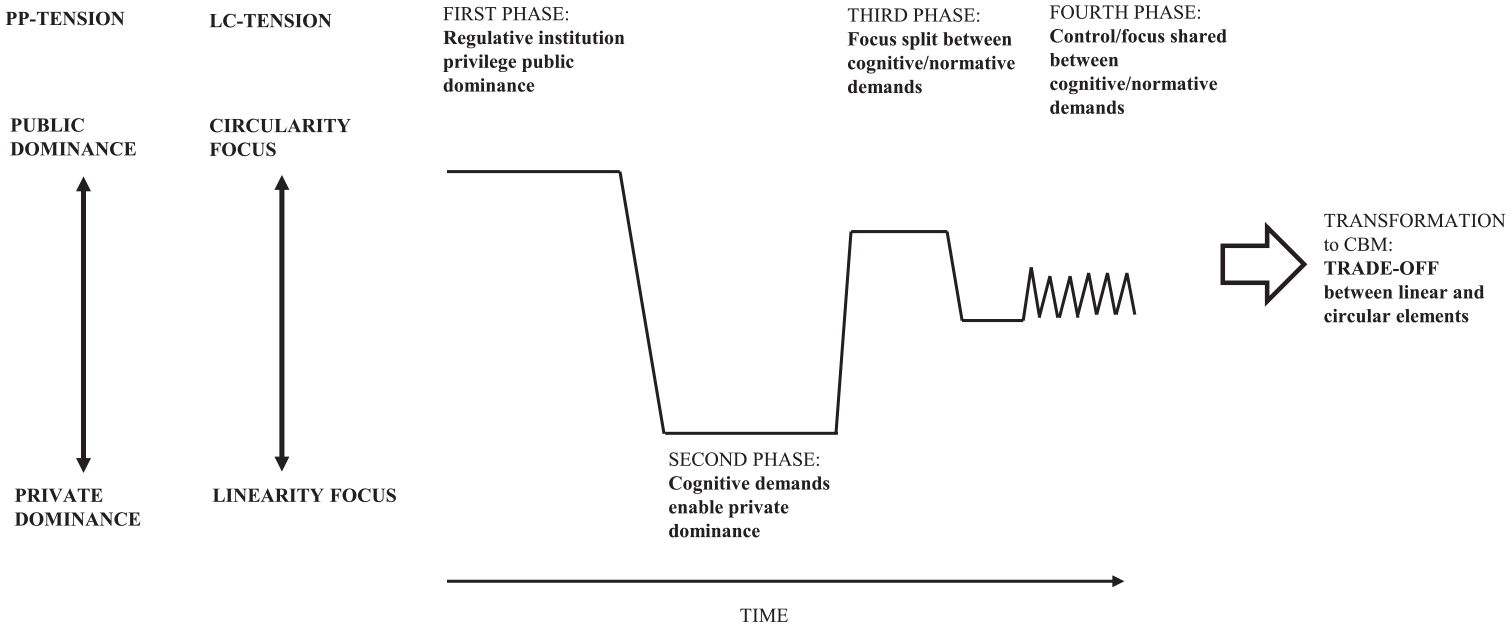
A Dialectical Pattern of the Transformation to CBM.
We suggest that a dialectical pattern is particularly likely to arise in a transformation to CBMs with PP collaboration: the existing LC tension gains additional force as institutional demands place partners in opposition to each other. Thus, each partner enacts tension and drives the dialectic, bringing forth disagreement and the dominance of either linear or circular elements (thesis and anti-thesis). Public partners are arguably, on average, more likely to perceive sustainability demands than private ones do, particularly in situations where the public has a responsibility that businesses lack, for example, in urban planning. It is also reasonable to expect private actors to guard economic viability and the linear pole of the LC tension, whereas public actors push for the opposite. The disagreements that generate dialectics could also be stronger in PP collaboration because they occur between rather than within actors.
Still, why cannot partners (jointly) accept and confront tensions immediately and set acceptable goals for both? The initial asymmetry where the regulatory institution privileges the public partner may explain why this does not occur and why tensions between partners drive the transformational process. In our case, even if planners and developers profess to collaborate, this cannot take away the fact that planners have the regulatory privilege to, at any time, kick developers out and replace them. Planners refrained from this privilege because developers espoused a commitment to sustainability, which meant committing to goals that developers could not deliver. This suggests that even if an underprivileged partner is skeptical of circular elements, it will hesitate to question them from the beginning. Because many PP (and other) collaborations may contain some form of privilege (regulatory or otherwise), one partner will likely dominate at the start of a process. Arguably, this makes it tempting to push for (too) ambitious goals that set the stage for dialectics. Once enough time has passed, two things could happen: hesitation wears off, and the tension between cognitive and normative institutional demands increases (e.g., the suggestion to place parking far away from apartments), which makes conflict unavoidable. Thus, a dialectical pattern, rather than a goal-driven one, seems reasonable. However, is it necessary for dialectics to lead to synthesis? van de Ven and Poole (1995) suggest that this is not the case, as the focus can continue to swing back and forth. An additional factor must be in play. Namely, that partner must have enough time and willingness to learn about their institutional differences to handle these in discussion and compromise rather than conflict.
This suggests that similar dialectical patterns should appear in collaborative transformations to CBMs where (a) one actor has a privilege (regulatory or otherwise) over its partner that (b) it usually uses. A case in point could be circular public procurement, especially when it refers to large contracts of great importance to firms. Procurement is seldom collaborative (Witjes & Lozano, 2016), so if collaboration is tried with a few firms, these may be hesitant to criticize procurers’ requirements initially. If the typical situation is one where one actor dominates, the underprivileged partner is likely hesitant to voice critique initially, up to the point where it perceives that it has nothing to lose. Nevertheless, two additional criteria must also be fulfilled, namely that there are (c) additional (institutional or other) important differences between partners that (d) align with opposing perceptions of circular and linear elements. Since these two elements are subject to the competing demands of the economy and the environment, and these demands typically are felt differently between businesses and other actors, not only PP but also cross-sectoral collaborations (with businesses) should apply. Moreover, institutional differences should be relatively significant or unknown because if partners understand each other quickly, it will mitigate the need for disagreements and the dialectics they generate. On the other hand, differences in interests could prevail in pure business settings as well because all firms (e.g., in an industrial ecosystem) do not perceive the same risks and rewards with CBM transformation (Parida et al., 2019).
Nevertheless, the relative importance and relevance of these four criteria need to be explored through more research focusing on transformation to CBMs with different constellations of partners and durations.
Contributions to Research into the Transformation to CBMs
First, we exemplify how the challenges emanating from the transformation to CBMs (DiVito et al., 2023; Kuhlmann et al., 2023) can be fruitfully framed as LC tensions. Although this framing needs further conceptual refinement, our study illustrates (a) How it can be of use to integrate findings of CBM challenges into one notion, which (b) then aids the analysis of more complex CBM processes, such as those that pertain to PP collaboration. In our analysis, LC tension allows us to trace a hierarchical relation among two types of tensions and their relative fixedness within CBM transformation. In short, the institutional differences between partners seem to determine their relative stance on the LC tension. We hope our analysis can help extant CBM research to integrate prior accounts and start sorting out at which analytical level different challenges operate, that is, what makes one actor perceive something as challenging and during what circumstances. Here, our contribution lies in taking a few steps toward synergizing across a somewhat fragmented research conversation. This conversation has yet to sift through generalized organization and management theory to develop its (own) arsenal of mid-range theories. Because the notion of tension is already rooted in a theoretical tradition (e.g., Hahn et al., 2015), it also points toward suggestions of how to manage CBM processes better, for example, to make them smoother by acknowledging, accepting, and embracing tensions (De Angelis, 2021). This, in turn, arguably increases the possibility for actors that pursue sustainability to attain what Gümüsay and Reinecke (2022) refer to as a “real utopia,” a change that is substantial yet achievable from the present because it does not demand an entirely different breed of actors to succeed.
Second, by exploring the effects of tensions over time, we contribute to the emergent conversation on the transformation to CBMs as a process (e.g., Kaipainen & Aarikka-Stenroos, 2022; Parida et al., 2019; van Loon et al., 2022) in two ways:
(1) As detailed earlier, there are likely collaborative CBM transformations where empirical process contingencies will make our processual pattern particularly applicable. Our pattern is not a conceptual model because the number of phases, their duration, and the type of shifts cannot be expected to be the same in other processes, even public-private ones. Still, it could serve as a starting point for conceptualization through additional theoretical grounding or phenomenon-based insight and knowledge development.
(2) We also see a contribution to understanding phenomena where the empirical contingencies are dissimilar, for example, no apparent institutional contrasts, asymmetries look different, or the process is wholly internal. For instance, differences in interest and initial initiative between an ecosystem leader and supplier firms in ecosystem orchestration may resemble partner relations in our setting. Parida et al. (2019) show how a prolonged ecosystem assessment possibly mitigates such differences. However, it could be suspected that such an assessment has its fair share of tensions and conflicting interests that shape outcomes.
Moreover, a few studies of CBM transformation processes focus on transformation within single firms; for instance, Kaipainen and Aarikka-Stenroos (2022) and van Loon et al. (2022). Here, transformation occurs through teleological stage models, which show a linear, sequential appearance of events driven by a goal. However, even within firms, disagreements and tensions could shape transformation more than the strategic goals set by management. For instance, different business units could position themselves and struggle over LC tension in contrasting ways. Thus, there may be actor tensions that are worthwhile to note, even within firms. When tensions and conflicts go unnoticed, it is tempting to portray transformation processes as teleological, whereby transformation gets depicted as overly sanitized and rationalized (Langley et al., 2013). This may seem odd given how challenging and time-consuming transformation seems to be. A dialectical account can better capture transformation’s challenging nature, as it understands conflicts and struggles, not goals, as what drives or hinders processes (van de Ven & Poole, 1995).
Given these observations, we see a contribution if our study illustrates and inspires transformation research to look for and unpack tensions and resulting dialectics and thus give more recognition to the conflicting nature of actors’ interests (Tapaninaho & Heikkinen, 2022). In short, the suggested contribution here is not that our pattern can be used to explain other transformations fully but in the hope that the dialectical thinking it exemplifies can inspire future CBM process research.
Finally, we see a contribution in exemplifying how to move beyond the so-called instrumental perspective and the business case thinking that pervades much of CBM research (Hahn et al., 2015). The institutional perspective allows the analyst not to side with one type of demand, that is, economic viability (van Loon et al., 2022) or environmental performance (Manninen et al., 2018). Thus, it offers “neutrality” to processual research, which is particularly important in cross-sectoral research. In CBM research, it is tempting to let analysis follow the imperative of business to see the solution to making CBMs more profitable (Linder & Williander, 2017). However, this unnecessarily restricts the potential of research to say something beyond what is arguably already in the business discourse. For one, it has the benefit of entertaining the possibility that environmental claims matter for business even if there is no win-win (Margolis & Walsh, 2003). At the beginning of the quest to understand transformation as a process, analytical options must remain open, and analysis cannot be foreclosed as the so-called instrumental perspective suggests. We hope our study can illustrate and inspire how that can be done.
Conclusion
In this article, we explored PP collaboration in the transformation to CBMs. We focused on the effects of two types of tensions indicated in extant research: LC and PP tensions. Through a case study of the collaboration between developers and planners, we found that tensions resulted in a dialectical pattern. This dialectical pattern should arise in other transformations to CBMS where (a) a collaborating actor has a privilege over its partner, (b) that it usually uses, and (c) there are additional (institutional or other) important differences that (d) align with opposing perceptions of circular and linear elements.
We followed our case for 4 years, but urban planning can take decades. Thus, a limitation is that our case concerns decisions on CBMs, not their execution. We could not follow the transformation to CBMs when hubs were built and users appeared on the scene. Still, our interest was in the PP dimension most salient during planning. As we witnessed a certain element of “closure” regarding decisions being made and inscribed into legally binding documents, we feel confident that we sufficiently captured the overarching pattern.
It may be difficult to avoid dialectics by setting better visions, having more trust, or more commitment. Nonetheless, managers could come to terms with institutional differences faster by embracing and accepting them right from the start and organizing accordingly. Too much focus on “win-win” can also stand in the way of collaborative transformation to CBMs. Collaboration needs room for disagreements because disagreements enable partners to learn about each other’s differences and to use those differences to increase the quality of decisions and coordination. Hopefully, such organizing will make the PP collaboration possible that the transformation to CBMs calls for both effective and mindful of differences.
Supplemental Material
sj-doc-1-oae-10.1177_10860266241304310 – Supplemental material for Agreeing to Disagree: Linear-Circular and Public-Private Tensions in the Transformation to Circular Business Models
Supplemental material, sj-doc-1-oae-10.1177_10860266241304310 for Agreeing to Disagree: Linear-Circular and Public-Private Tensions in the Transformation to Circular Business Models by Herman I. Stål, Siarhei Manzhynski and Maria Bengtsson in Organization & Environment
Footnotes
Declaration of Conflicting Interests
The author(s) declared no potential conflicts of interest with respect to the research, authorship, and/or publication of this article.
Funding
The author(s) disclosed receipt of the following financial support for the research, authorship, and/or publication of this article: Funding was received from Kamprad Family Foundation Entrepreneurship, Research, and Charity (Grant 20160063) and Sweden’s research council for sustainable development FORMAS (Grant 2019-00520; 2021-0005)
Research Involving Human Participants and/or Animals
This study involves humans (informants)—not animals. Ethical approval was not sought as this is not required for this type of research in Sweden (research that does not involve so-called sensitive information)
Informed Consent
Informed consent was not sought as this is not required/standard practice for this type of research in Sweden.

Supplemental Material
Supplemental material for this article is available online.
Author Biographies
References
Supplementary Material
Please find the following supplemental material available below.
For Open Access articles published under a Creative Commons License, all supplemental material carries the same license as the article it is associated with.
For non-Open Access articles published, all supplemental material carries a non-exclusive license, and permission requests for re-use of supplemental material or any part of supplemental material shall be sent directly to the copyright owner as specified in the copyright notice associated with the article.
