



Abstract
In this article, we tackle the lack of clarity in the conceptualization and substantive use of time in business sustainability research. We do so by means of an integrative review that synthesizes 172 papers published over the last 20 years across seven subject areas within business and management research. From our review, we developed a typology that highlights three primary categories that differentiate various conceptualizations and uses of time in business sustainability literature: (a) temporal resourcing, (b) temporal structuring, and (c) temporal prospecting for sustainability. The typology organizes a body of literature that remains scattered, provides conceptual clarity, and opens avenues for future empirical research and theorization in the space.
Keywords
Introduction
Research at the intersection of organizations and the environment has come a long way since the triple bottom line term was coined (Elkington, 1994). Facing the limitations of normative frameworks defining sustainability efforts based on their impact on the bottom line, Slawinski and Bansal (2015, p. 532) advanced the definition of business sustainability by combining present ambitions and future needs, that is, “the ability of firms to respond to their short-terms financial needs without compromising their (or others) ability to meet their future needs.” In their view, there was discontent with how conventional approaches to business sustainability discount the future (P. Bansal & DesJardine, 2014; P. Bansal & Knox-Hayes, 2013; A. Kim et al., 2019), which is essential as we try not to compromise “the ability of future generations to meet their own needs” (World Commission on Environment and Development [WCED], 1987).
Time is central in the above definition, introduced as a social contract between generations where each generation holds the planet in trust for the next (Weiss, 1984). Through this lens, business sustainability ought to keep its eyes on the present as well as in the future, always considering social equity, short- and long-term thinking, and the inevitable trade-offs between using resources now or later (P. Bansal, 2005). Time is thought to be unique to business sustainability (P. Bansal & Song, 2017) and considered to be instrumental to differentiating business sustainability from other related constructs such as CSR (P. Bansal & DesJardine, 2014), environmental management, shared value, and the triple bottom line.
Not surprisingly, research on time has been growing in the past decade (P. Bansal, Reinecke, et al., 2022; T. Bansal, Crilly, et al., 2022), across a wide range of settings and under different conceptions and uses of time. In business sustainability research, time has been considered in the examination of thinking modes, organizational goals, strategies, environmental performance, environmental ethics, financial returns, business models, sustainable venturing processes, and organizational responses to climate change, among others. Inevitably, conceptions of time vary across contexts and experiences, leading to different categories, types, and ways of rationalizing and operationalizing time in business sustainability. This leads to ambiguity, contradictions, and thus a lack of clarity in how time is conceptualized and used in business sustainability scholarship. To resolve this issue, in this article, we ask: How has time been conceptualized and utilized in business sustainability research? Answering this question is important because of its centrality in business sustainability scholarship and potential influence on future developments in the field. In its expansion, research on time in business sustainability will benefit from conceptual clarity and organization.
To answer this question, we set out to organize the literature using an integrative review that synthesizes 172 papers published over the last 20 years across seven subject areas within business and management research. Drawing on Ancona et al.’s (2001) work, we observed the data and organized our review using three anchors: conceptions of time, activities relating to time, and actors relating to time. From our review, we developed a typology that highlights three primary categories that differentiate various uses of time in business sustainability literature: (a) temporal resourcing, (b) temporal structuring, and (c) temporal prospecting for sustainability. These categories emerge from six dimensions that are salient in time and business sustainability literature, namely, assets, liabilities, process, pace, scope, and scale.
Our work offers three contributions to literature. First, we offer a typology of time in business sustainability, which allows for organizing the various uses of time in business sustainability research while offering a more holistic understanding of a multi-layered and plastic concept. By presenting time as resourcing, structuring, and prospecting, we provide clarification in a way that is sensitive to the past, present, and future use of time in business sustainability and the temporal overlaps between them. In this way, our typology organizes a so far scattered literature, provides clarity, and can guide future empirical research and theorization in the space. This typology stems from an observation of six salient dimensions involving continuums (e.g., less to more time resources and slow to fast pace), which shed light on key sources of ambiguities and tensions relating to time in business sustainability research, necessary as we move toward construct development and operationalization. Second, our stage-wise analyses allowed us to identify conceptions of time in business sustainability from an observation of actors and actions across organizational levels. This analysis offers the reader a way of mapping the three conceptions of time back into the life of organizations and the different organizational spaces in which time is used and affects sustainability decisions. Third, we offer an agenda for future research, comprising three overlapping avenues: (a) construct development and operationalization, (b) continuums, tensions, and temporal ambidexterity, and (c) temporal preferences in business sustainability.
Time and Business Sustainability: Promises and Shortcomings
Time is the piece that differentiates business sustainability from other related constructs such as CSR, corporate citizenship, and even the corporate triple bottom line (P. Bansal & DesJardine, 2014; P. Bansal & Song, 2017). In the spirit of the UN’s “Our Common Future,” business sustainability allows organizations to think about and make decisions about the present without compromising their and others’ ability to meet their future needs. It does become a central part of organizational ability, through which organizations can respond to their short-term financial ambitions without losing sight of long-term implications and needs (Slawinski & Bansal, 2015).
While CSR and corporate citizenship rely on moral imperatives and the firm ability to choose the more accepting decisions that balance the competing demands of various stakeholders, sustainability focuses on the balance between organizational and macrosystems over time without assuming individual moral responsibilities (P. Bansal & DesJardine, 2014). The triple bottom line is defined as the firm’s ability to manage its financial, social, and environmental goals, but it also looks solely into accountability and responsibility and thus neglects time (P. Bansal & DesJardine, 2014).
Research on time and sustainability has been growing over the past decades (e.g., DesJardine & Bansal, 2019; Hahn et al., 2015; Morales-Raya & Bansal, 2015; Sharma & Jaiswal, 2018; Slawinski & Bansal, 2012, 2015). Some studies have studied firms’ temporal perspectives on organizational responses to climate change (Slawinski & Bansal, 2012) and started to open a research conversation on the potential pervasive effects of organizational speed on organizational mishaps (Morales-Raya & Bansal, 2015). From here, other studies have focused on how firms attend to the temporal tension between alternative temporal options, such as short-term and long-term orientations. For example, Slawinski and Bansal (2015) found that firms that juxtapose the short-term and long-term also confront the tension between business and society. DesJardine and Bansal (2019) found that negative evaluations will shorten organizational time horizons more than positive evaluations will lengthen them.
Despite the advances, Good and Thorpe (2020) argue that sustainability management literature is fragmented, and time and temporality are at the core of the problem. Previous review research (see Appendix A) has brought some common understanding of the definitions, measures, and theories used to study sustainability (Montiel & Delgado-Ceballos, 2014). Scholars have also paid increasing attention to time in organizations and made efforts to bring coherence to the field. For example, Mosakowski and Earley (2000) examined the time assumptions in strategy research. Ancona et al. (2001) mapped the conceptions of time, the activities, and the actors relating to time. Berends and Antonacopoulou (2014) focused on the time dimensions of organizational learning, and Shipp and Jansen (2021) reviewed subjective time and how it is experienced in organizations.
Sustainability is a rich domain to develop time-based research (P. Bansal & DesJardine, 2014), yet there is a lack of theorization at the intersection of the two concepts, and none of the reviews above have compressively tackled the problem and developed a solid ground to conduct future research and theorization.
There have been repeated calls for more research at the intersection of time and business sustainability. In the context of operations and supply chain management, Klassen and Hajmohammad (2017) call to embrace the plasticity of time and argue that multiple perspectives of time are needed to advance research in this area, including temporal orientation (i.e., short-, medium- or long-term), temporality (i.e., time experienced as “clock time” or as “process-time”), and temporal conflict. P. Bansal, Reinecke, et al. (2022) share Klassen and Hajmohammad’s (2017) concerns. However, their call is also one of uniformity. They call for more research on the mechanisms that can help organizations to slow down, organizational metrics of success associated with macro socio-ecological systems (not only limited short-term capital markets), alternative temporalities that can overcome the short- and long-term dichotomy, and the analysis of means and mechanisms that realign the rhythms and temporalities of business systems with socioecological systems. In this article, we embrace these calls and seek to organize the literature and provide clarity around how time is conceptualized and used in business sustainability scholarship.
Research Methodology
Integrative Review Approach and Selection Procedure
The organization of time research in business sustainability requires synthesizing knowledge across sub-disciplines, which calls for an integrative review approach (Torraco, 2016). First, we run a search in the Web of Science (WoS) database from 2000 to 2022 1 based on 64 selected journals (3/4*) included in the Association of Business Schools’ Academic Journal Guide (ABS AJG, 2021). For our integrative review, we included journals across 12 domains (i.e., Entrepreneurship and Small Business Management, General Management, Ethics, and Social Responsibility, Human Resource Management, and Employment Studies, Innovation, International Business and Area Studies, Management Development and Education, Organization Studies, Psychology [Organizational], Regional Studies, Planning and Environment, Sector Studies, Operation Management, Strategy). Several recent integrative review studies have used the same selection procedure, for example, Gamble & Muñoz’s (2022) examination of value detraction among non-profit organizations, Redgrave et al.’s (2022) review of the relevance and impact of business schools, and Thomas and Tee’s (2022) integrative conceptual framework on generativity. The categories included in the ABS AJG list cover most of the research spectrum conducted by scholars involved in schools of business, management, or economics (Gamble & Muñoz, 2022). This list is broad, yet unique to business and management research. It allows us to include disciplines that might seem not relevant to the examination of time, such as management development and education. These disciplines are relevant, however, because they reveal whether and how time is incorporated into the sustainability paradigm underlying business school education. Similarly, tourism journals are relevant because of the impact of tourism activity on sustainability. They reveal whether and how time is incorporated into the sustainability paradigm dominating tourism. The ABS AJG is therefore an appropriate and relevant ranking of journals for our research purposes.
To identify relevant articles, we searched for the term “sustainab*” in combination with “time OR timing OR tempo* OR rhythm OR speed OR synchronicity.” The term “sustainab*” captures the various forms used to refer to sustainability such as “sustainability,” “sustainable development,” “sustainable strategies/ practices,” “business sustainability,” “environmental sustainability” (Montiel & Delgado-Ceballos, 2014) and “sustainability management.” We intentionally focused on sustainability and discarded certain terms, such as corporate social responsibility (CSR) and environmental management. Previous research has argued that although sustainability and CSR are related concepts, they are different and one of the differences relies on the notion of time that is embedded in the concept of sustainability (e.g., P. Bansal & DesJardine, 2014; P. Bansal & Song, 2017). The inclusion of CSR or environmental management would have expanded the scope of the review, potentially jeopardizing our chances to offer a structured representation of the literature. Our focus on sustainability is therefore an important boundary condition in our review.
The term “time” captures “time perceptions” and “time perspectives.” Since organizational time is a multidimensional construct, the term “tempo*” captures temporal dimensions such as temporal depth, temporal linearity, and temporal direction (Berends & Antonacopoulou, 2014) as well as temporal focus, temporal distance, temporality, and temporary. We also added the terms “rhythm,” “speed” and “synchronicity” (Berends & Antonacopoulou, 2014) to capture different aspects of time in relation to sustainability. Our selection of search terms for both time and business sustainability followed the identification of the most recurrent keywords used in both seminal and well-cited papers in the space. Particularly, the selection of “rhythm,” “speed,” and “synchronicity” stems from the fact that these concepts have been distinctively explored by relevant papers across disciplines (e.g., P. Bansal & DesJardine, 2014; P. Bansal & Knox-Hayes, 2013; Feola et al., 2015; Muñoz & Cohen, 2017; Pinto, 2016; Slawinski & Bansal, 2015). Judged by citation numbers, these concepts appear to be opening new conversations around time in business sustainability research. Collectively, the papers identified allowed us to pull a set of papers that is broad enough in terms of phenomena and bodies of literature and narrow enough in terms of their relevance to business sustainability research. At the same time, they set boundary conditions for our study. We stress that the interpretation of our findings should take into consideration our search strategy and criteria.
To further expand the horizons of our search, we explored alternative search terms. We used two new combinations “sustainab*urgency” and “sustainab*pace.” The search yielded two narrow sets of 26 and 35 papers, respectively. Only two 2 papers were relevant to our research question but were already captured by our search strategy above. These terms led to papers on power, legitimacy, and necessity, examining, for example, “The Urgency and Necessity of a Different Type of Market . . .,” which is not linked to a substantive use of time in business sustainability. In some cases, time is used as an expression or connector in abstracts, for example, “Over time, their vision of Fair Trade . . .” In others, it is used as an adjective to qualify a type of call for action, for example, “The Grand Challenge of Human Health: A Review and an Urgent Call for Business-Health Research.” Our search process yielded 1,053 results. In a subsequent step, we applied further inclusion and exclusion criteria, detailed in Figure 1.
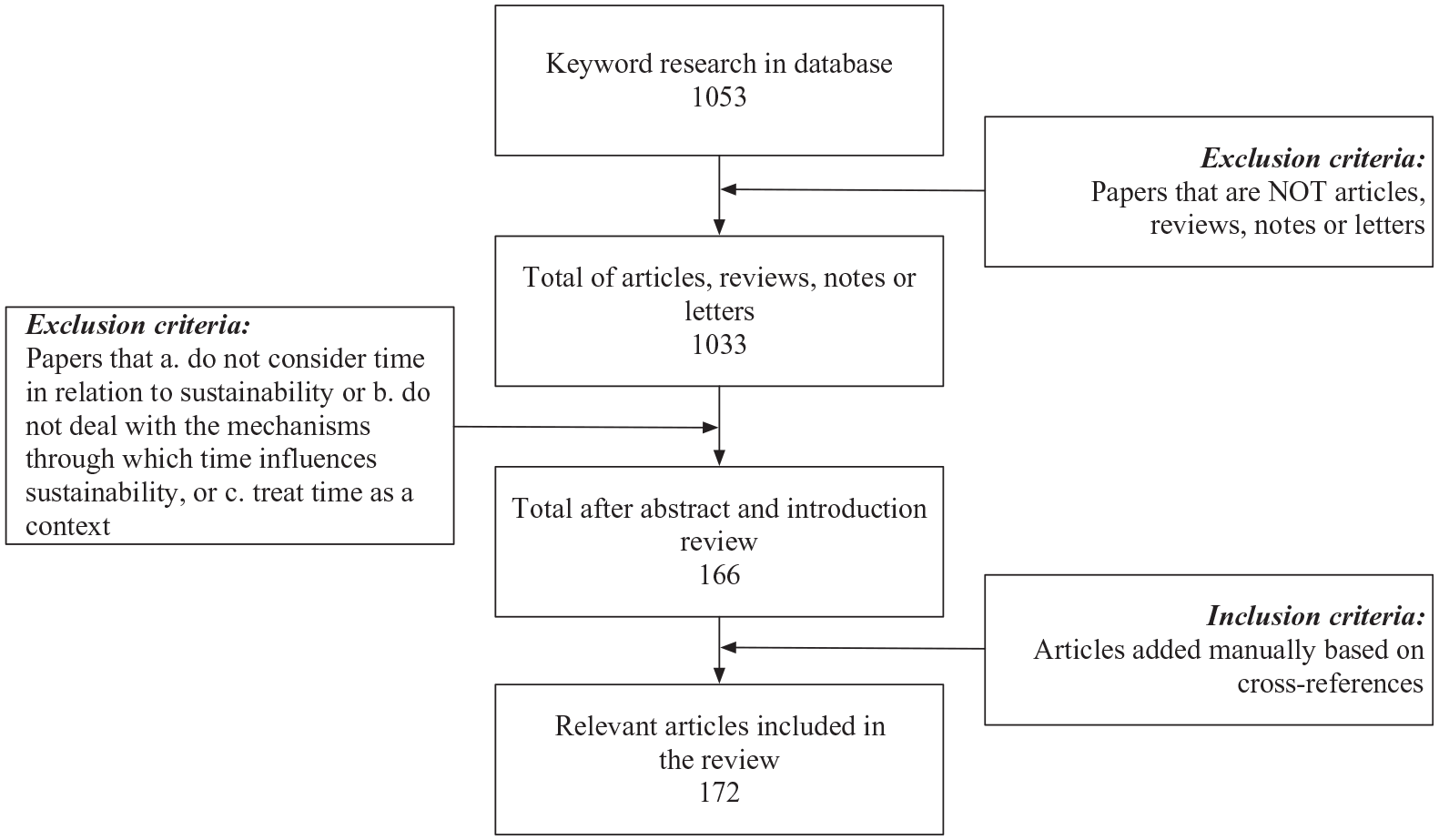
Review Process.
First, we filtered the results by the type of document focusing solely on “articles,” “reviews,” “notes” and “letters,” through which we reduced the sample to 972 articles. Second, we reviewed the abstract and introduction of each paper to make sure that the article selected explores both time and sustainability. We excluded papers that referred to time but did not analyze time in relation to sustainability or did not relate to the mechanisms through which time influences sustainability. We also excluded studies that referred to time as a context. This analytical process resulted in a sample of 166 papers. In the final stage, we conducted a manual search of relevant articles published in management journals and widely cited by the papers in our sample, which were not captured by the search procedure (i.e., P. Bansal & DesJardine, 2014; Hart & Milstein, 2003; Morales-Raya & Bansal, 2015; Ortiz-de-Mandojana & Bansal, 2016; Reinecke & Ansari, 2015; Slawinski & Bansal, 2012). This final step yielded a sample of 172 papers (Appendix B).
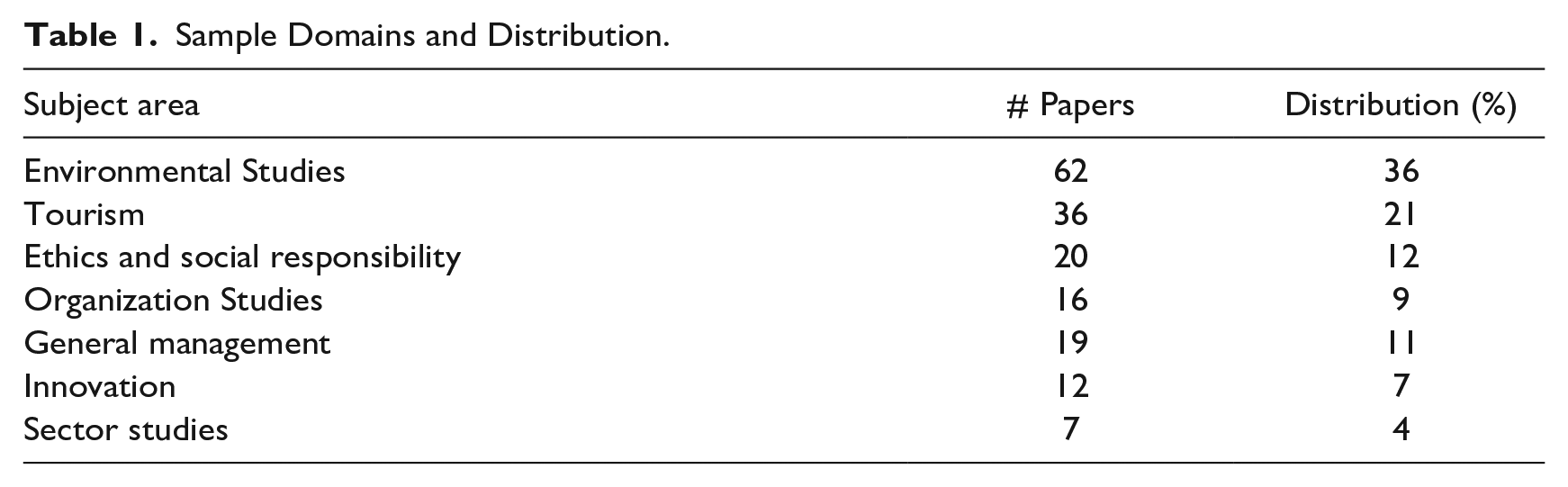
To guide our analyses, we group these papers into seven broad subject areas, following their classification in JCR: Environmental studies, tourism, ethics, and social responsibility, organization studies, general management, innovation, and sector studies. Our decision to recategorize the subject areas was based on the observed distribution of topics and journals. In the ABS AJG, Environmental Studies, and Tourism are not considered independent domains.
The number of studies published in these subject areas remained relatively stable for 10 years and then grew significantly from 2016 onward (see evolution in Figure 2). The spike in research interest from early 2014 (considering research and publication cycles) may be attributable to factors, such as (a) the maturity of business sustainability research as a field of research, which prompts a deeper conceptual and empirical engagement with difficult-to-grasp concepts; (b) the growth and recognition of specialized journals as leading outlets within business and management research, such as Organization & Environment and Business Strategy and the Environment; and 3. The international expansion of research organizations, for example, the Network for Business Sustainability, GRONEN, and AOM ONE, have actively promoted the need to engage with time and temporal tensions in business sustainability research and practice. 3 These factors are not only relevant from a methodological point of view but also shed light on the timeliness of the phenomenon under examination.
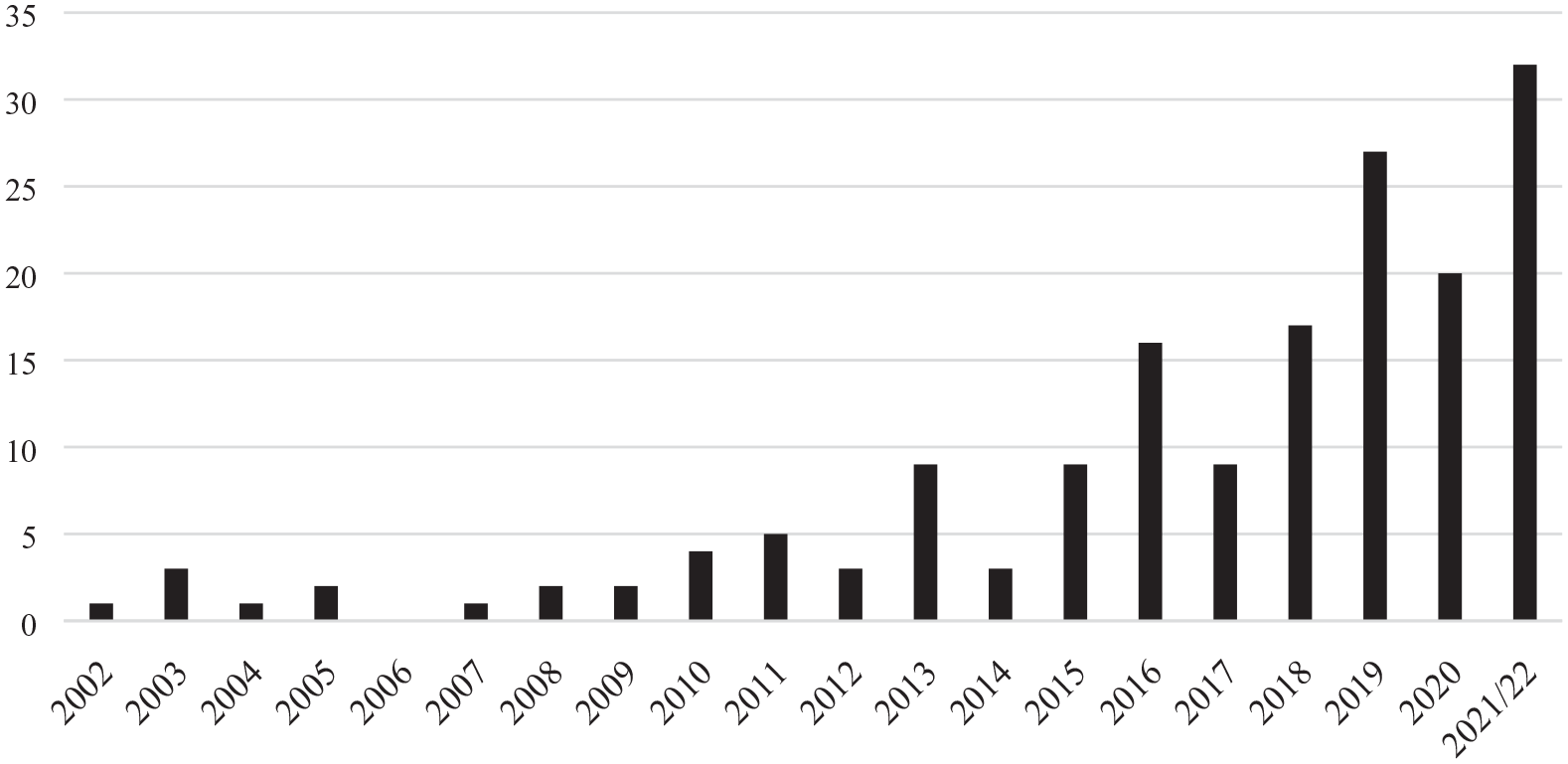
Evolution of Reviewed Literature (N = 172).
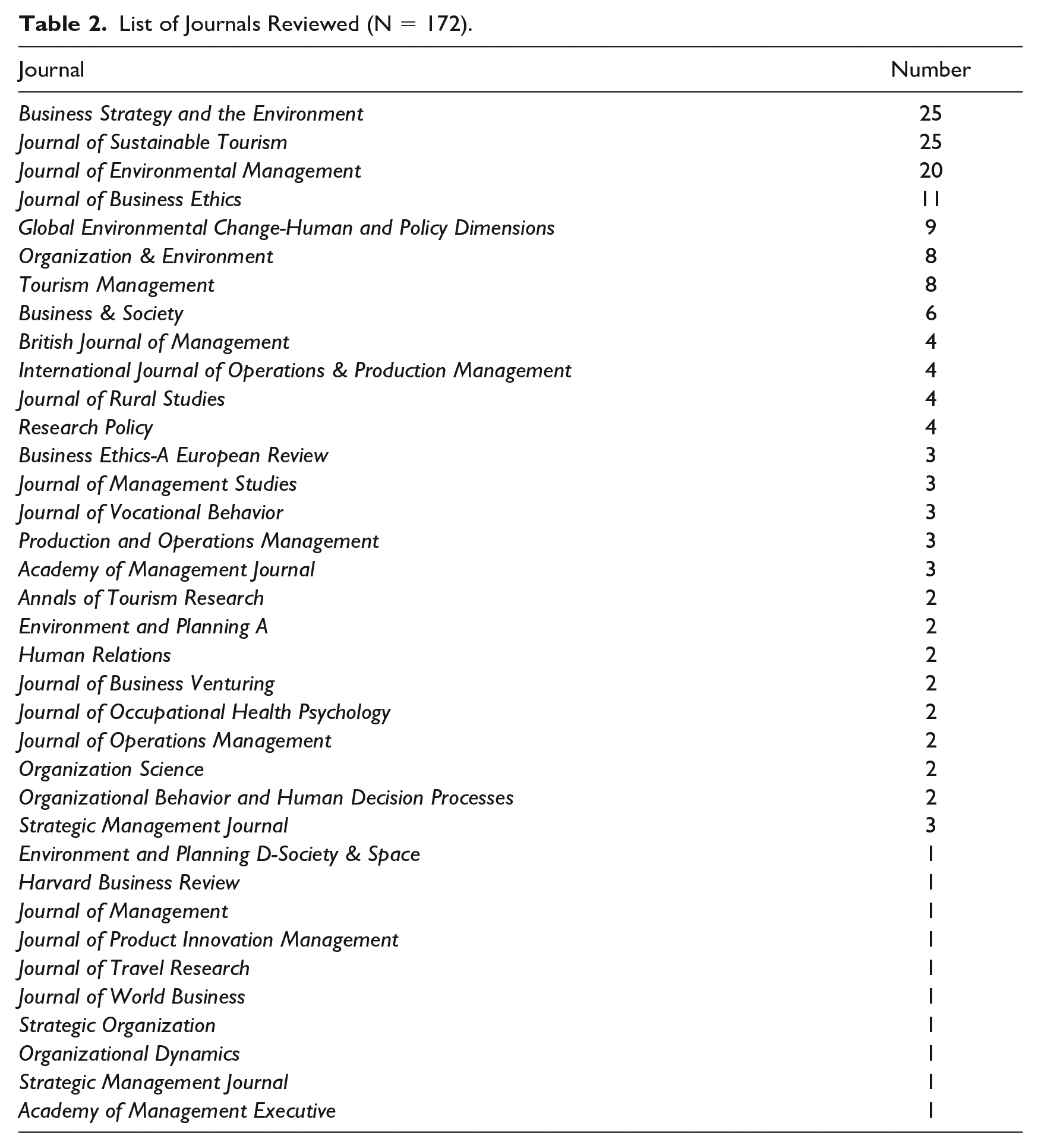
Out of the seven subject areas reported, four of them, that is, environmental studies, tourism, ethics, social responsibility, and organization studies account for 80% of the published papers in the 20 years. These are distinct subject areas, thus offering a well-balanced sample of papers. Tables 1 and 2 show the sample subject areas and distribution and the 32 journals included in this study. Four main journals (10+ papers) cover 50% of the sample: Business Strategy and the Environment (#25), Journal of Sustainable Tourism (#25), Journal of Environmental Management (#20), and Journal of Business Ethics (#11), which are representatives of the subject areas reported above. Organization & Environment appears as the sixth most important journal in the list, with eight papers published between 2013 and 2021, beginning with Bansal and Knox-Hayes ’s seminal work: The time and space of materiality in organizations and the natural environment.
Sample Domains and Distribution.
List of Journals Reviewed (N = 172).
Categorization and Prioritization
To retain its integrative nature, we decided not to drop any further papers from the final sample of 172 included in our review. Although some papers did not provide a strong theoretical connection between sustainability and time, they could potentially complement our examination and explanations. Therefore, instead of applying further exclusion criteria, we proceeded to categorize our sample using four prioritization criteria. We ranked the papers in a continuum from 1 to 4, with 1 being completely aligned with the topic of interest and 4 only tangentially aligned with the topic. Category 1 includes papers that explore and theorize time in business sustainability directly, for example, A. Kim et al.’s (2019) work on present-time perspective and sustainable development or P. Bansal and Knox-Hayes’s (2013) paper that explores intertemporal tensions in business sustainability. Category 2 includes papers whose findings are linked to some aspects of time such as short-term strategy, long-term investors, or short-term debt. Category 3 includes papers in which time is considered as either duration or timing, for example, the time it takes to adopt agroforestry in subsistence agriculture (Jerneck & Olsson, 2013). Papers in Category 4 include time and business sustainability, but the relationship between the two is not explicitly stated. While papers in Categories 3 and 4 do not explore time and business sustainability directly, they tackle related topics such as tensions, paradoxes, environmental performance, adoption of climate strategies, incentives, operational efficiencies, and consumer decision-making, which are useful to inform the development of a more complete picture of the problem space.
Data Analysis
For our analyses, we considered the papers within these four categories in tandem. Papers included in Categories 1 and 2 (#92) were considered first for the main analysis and data structuring. Papers in Categories 3 and 4 (#80) were considered as complementary material to help to make sense of and/or strengthen our findings and emerging argumentation. This sample prioritization step proved helpful on several occasions. For example, based on articles included in Category 1, we found studies that explored whether holding shares over time affects decision-making and governance for sustainability (Mio et al., 2020) and analyzed how “time as money” (time stocked through monetization) influences environmental decisions (Whillans & Dunn, 2015). As we explain below, time as a resource can enable action but also be a constraint to take action. Several papers in Category 3 allowed us to expand our explanation. They show that time constraints were one of the factors that prevented sustainability managers from acting upon environmental degradation (Kitsikopoulos et al., 2018) and constituted a barrier to the adoption of sustainable initiatives (Collins et al., 2010) and in the monitoring and evaluation of volunteer tourism organizations’ projects that could facilitate sustainable and responsible tourism planning (Steele et al., 2017).
Stage 1: Data Familiarization
We began our review by looking at Categories 1 and 2, which included a summary of key findings and reflections on key research insights. Here, we paid particular attention to empirical studies and meta-analyses focused, for example, on relationships between time and a range of organizational-level outcomes such as environmental performance, financial performance, and executive remuneration. We also looked at a range of conceptual papers discussing frameworks, models, and metrics for the inclusion of time in business sustainability activities, offering, for example, frameworks to think about and assess the role of short-termism and uncertainty avoidance in organizational inaction on climate change. Finally, we examined a selection of qualitative studies exploring issues such as future-oriented innovation strategies, organizational resilience, and cognitive frames.
Stage 2: Coding of Time Dimensions
In this stage, we used open and axial coding to explore how the literature depicts people’s and organizations’ understanding and use of time. This allowed us to break down the data into discrete parts and then draw connections between emerging descriptive codes. Using open coding, we noticed that time in sustainability is seen as a collection of conflicting aspirations and decisions, where time can be envisioned, planned, and experienced differently. Literature refers to time as something that can be stored and later used by organizational actors, enabling and constraining actions. Organizational activities can be performed rapidly or slowly and can be of short or long duration. The latter are salient in, for example, the pace of consumption (slow/fast) or length of visits in sustainable tourism (short/long). Time can be conceptualized linearly or circularly, as evident in, for example, the structuring of production and recycling initiatives. We also noticed alternative time horizons, for example, short-term and long-term, relevant to decision-making and organizational strategies.
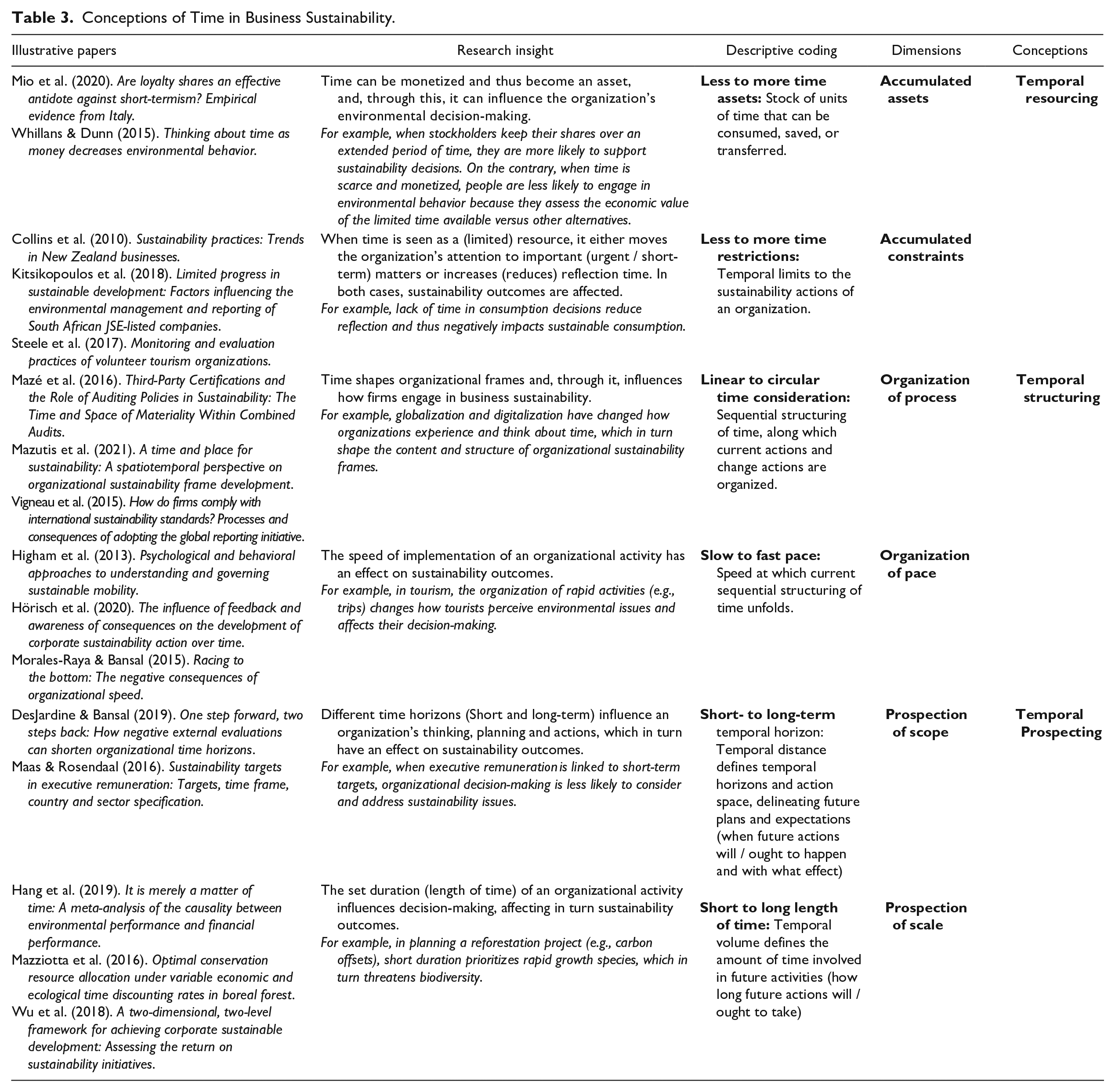
We then proceeded to use axial coding to connect and abstract these insights. For example, if time can be monetized and used as an asset, we understand that time is a resource that influences decision-making. Similarly, if the speed of implementation of a project shapes sustainability actions, we understand that the pace of a given activity structures how time is organized in the present, which in turn creates variance in sustainability outcomes. From here, we derived the following six dimensions of time in business sustainability.
Temporal assets refer to the stock of units of time that can be consumed, saved, or transferred. Mio et al. (2020) examine the stock of time through the lens of loyalty shares. They explore whether holding shares over time affects decision-making and governance for sustainability. Time can also be stocked through monetization. Here, Whillans and Dunn (2015) show how “time as money” influences environmental decisions. Temporal constraints involve the temporal limits facing organizations in relation to sustainability actions. Kitsikopoulos et al. (2018) found that time constraints were one of the factors that prevented sustainability managers in South Africa from further reduction of environmental degradation. Lack of time was also found to be a barrier to adopting sustainable initiatives in a sample of New Zealand businesses (Collins et al., 2010), to monitor and evaluate volunteer tourism organizations’ projects what could facilitate sustainable and responsible tourism planning (Steele et al., 2017), and to greening musical festivals in the events sector (Mair & Laing, 2012).
Process pertains to temporal organizing and refers to the structuring of time in the present, along which actions and change are organized. Mazé et al. (2016) emphasized the role of time structuring during combined audits when farmers are involved in several private agri-environmental certifications. Pace also pertains to temporal organization and refers to the speed of occurrence of actions in the present. Esteban and Dinar (2013), for example, showed that the time of implementation of policy interventions can play a crucial role in achieving sustainable groundwater management. While process and pace allow for organizing actions and decisions in the present, they equally create affordance for planning activities, which is what the next two dimensions deal with.
Scope refers to the distance of temporality, which delineates the temporal action space and sets expectations for the future. Temporal scope defines when future actions will or ought to happen and with what effects. Scale is equally future-oriented and refers to the volume of time allocated to future activities, which defines how long future actions will or ought to take, e.g., short vs. long duration. Scope and scale have implications for sustainability. Hang et al. (2019), for instance, found that the causality between environmental performance and financial performance depends on the time horizon. In that sense, Wu et al. (2018) demonstrated that to fully realize the potential related to sustainable practices firms need to be focused on the long term.
Stage 3: Conceptions of Time
In the third stage, we aggregated the six dimensions considering the role they play in the life of the organization while paying attention to when those aspects of time are situated. Resources and constraints are placed in the past and can either enable or constrain action. They represent the accumulated stock of time assets and liabilities that organizations have, facilitating and restricting what organizations can do. As such, we label this combination as Temporal resourcing for sustainability. Processes and pace refer to how businesses organize sustainability actions around time, in the present. We call these two dimensions Temporal structuring for sustainability. Finally, scope (temporal action-space) and scale (temporal horizons—short- and long-term) lay the ground for the envisioning and planning of future possibilities. We call this Temporal prospecting for sustainability. Combined, these three constructs constitute a typology that highlights three primary categories that differentiate various uses of time in business sustainability literature. We summarize our analytical process in Table 3, including illustrations from the literature, research insights, coding, dimensions, and conceptions.
Conceptions of Time in Business Sustainability.
Stage 4. Articulation of Conceptions of Time
To make sense of how the conceptions of time manifest in the literature and better structure the presentation of our findings, we followed Ancona et al. (2001) and looked at instances where time is considered in the life of the organization, including organizational actors, external stakeholders, and the actions they perform. There are four organizational spaces where literature on business sustainability engages with time. First, sustainability governance where time is analyzed, for example, as part of CEO incentives and the temporal orientation of the board of directors. Second, sustainability behavior, where we observe, for example, consumers making slow/fast consumption decisions or individuals with short/long investment mindsets. Third, sustainability assessment involves models and metrics that organizations use to, for example, evaluate adaptation strategies and climate change scenarios. Finally, sustainable innovation involves systems and components involved in e.g., new green product development. We use these four spaces for the sole purpose of guiding the articulation of our findings, which we argue offer organization scholars a more intuitive way of understanding the role that temporal resourcing, structuring, and prospecting play in the life of an organization.
Findings
Temporal Resourcing for Sustainability
Temporal resourcing for sustainability refers to the accumulated stock of time assets and constraints, which both enable and restrict sustainability decisions and actions across governance, behavior, assessment, and innovation.
As an accumulated asset, time influences the life of organizations as it pertains to sustainability. It affects leadership and managerial decision-making. Mio et al. (2020) looked at the effect of loyalty shares on short-termism [governance]. Loyalty shares award investors that hold the shares for a specified long period with grant extra dividends or voting rights. The authors found that loyalty shares decrease earnings management and then be considered as one corporate governance mechanism to reduce short-termism. Long-term-oriented shareholders could encourage firms to focus on the long term due to the weight of their shares. In this sense, time becomes an organizational resource that can be managed to contribute to sustainability [governance]. In this vein, for example, time as an asset has been found to positively affect creativity and efficiency [innovation], both linked to sustainability outcomes.
Tang (2010) argues that the allocation of sufficient time is a key factor in this direction [governance]. He offered an analogy around driving cars, arguing that driving sensibly and steadily, regulating the speed up or down hills, and maintaining the momentum takes more time but is crucial to fuel efficiency. The cumulative effect of people driving in this way could make a difference in reducing global warming. Similarly, developing creative ideas take time. Managers need to allocate unstructured time for creative thinking and innovation. Creativity also requires maintaining momentum to gather ideas and avoid interruptions and long, frequent, and large meetings. Under time pressure most people do not have time to think about gas efficiency and creative thinking is jeopardized. In the context of sustainability, the author posited that time to think and time to take action are common factors of success.
In family businesses, Olson et al. (2003) found that success relies on the role of time in strategies [governance]: Family processes and how the family reduces family tensions and responds to disturbances. They show that, during hectic times, the two strategies that were associated with higher revenues and higher levels of owners’ perceived success consist of sleeping less and reallocating that time to the business (instead of reallocating time from the family to the business) and hiring temporary help to manage additional demands. These strategies contribute to the sustainability of a family business which implies both business success and family functionality. Dou et al. (2019) found something similar in their analysis of a firm’s family ownership in China, having a positive effect on proactive environmental strategies.
Time as an asset also affects employees’ perceptions and actions [behavior]. In organizational settings, viewing time as money can influence environmental decisions. For example, people are less likely to engage in pro-environmental behaviors when they are paid by the hour (Whillans & Dunn, 2015), as this form of compensation makes the economic value of time noticeable so that people see their time as money and are more aware of the opportunity costs and trade-offs linked to environmental behavior. The monetization of time is particularly critical in consumer behavior. Landon et al. (2018) argue that the willingness to sacrifice monetized time to choose sustainable products is one of the dimensions that reflect the intent of people’s pro-sustainable behaviors. However, there is a downside to the monetization of time. When time is considered solely as a resource and integrated as performance, cost, or just-in-time, systems tend to produce short-termism in organizations (Klassen & Hajmohammad, 2017), thus affecting sustainability outcomes. As sustainability focuses on the long-term consequences, the authors argued that sustainability brings the necessity of considering time more broadly, not only clock time.
Time can also be a liability for sustainability. Tunn et al. (2021) found that the duration of use (i.e., stock of time available to use) influences the perceived importance of some service systems, preventing consumers from prioritizing businesses that decouple the satisfaction of consumers’ needs from environmental impacts [behavior]. Higham et al. (2022) show that time is malleable and affects sustainable consumption, showing how time was mobilized in airlines’ marketing communications to generate a sense of resource scarcity and urgency [governance]. The lack of time, however, can hinder sustainable organizational behaviors. In tourism, for example, the monitoring and evaluation [assessment] of projects support sustainable and responsible tourism planning [governance]. Similarly, in volunteer tourism organizations, the lack of time is an important barrier to engaging in monitoring and evaluating their projects (Steele et al., 2017). Time as a resource and constraint is regularly factored in the development of sustainability assessment frameworks and metrics [assessment]. In the assessment of sustainable tourism, for example, Torres-Delgado et al. (2021) argue that time constraints and limited human and technical resources are the main obstacles to including sustainability indicators in decision-making and planning.
The consequences of a lack of time can also question the sustainability of certain organizational actions and events because of their temporary or “pop-up” quality. This is vivid in the case of The Ice Hotel (Pinto, 2016), which is completely constructed of ice and snow. It is an example of a temporary organization that involves people working together on complex tasks for a limited period of time [governance]. Its construction takes place under time pressure because of the temperature required, which is determined by the season, and it thus has a short-term purpose. Due to time constraints, every Ice Hotel experiences a short cycle of birth-death-rebirth and it is thus considered a disposable-by-design organization [innovation]. Although it is argued that the melted ice has no negative impacts on the environment, the single-use nature of the Ice Hotel does indeed promote unsustainable behavior.
Whether an accumulated stock of time is an asset, or a liability depends on the temporal marker. Nyberg et al. (2018) examined the use of scales in environmental political contestation in the U.K. shale gas industry. They argued that climate change is a physical phenomenon that operates at a planetary scale while human responses are linked to national, regional, and organizational processes in which actors prioritize actions linked to short-term interests. The reference point chosen affects how people see time availability and thus fits shared interests across spatial (e.g., local vs. global) and temporal scales (e.g., short-term vs. long-term), which can result in prompt or delayed action on climate change. A similar temporal mismatch was captured by Mee et al. (2008) in their analysis of the UN’s Global Environment Facility. Here, economic activity and environmental change have different temporal markers in their contribution to sustainable development, hence the perception of having or not having sufficient time to tackle complex problems such as climate change, biodiversity, or the degradation of aquatic systems will largely depend on the marker chosen.
Temporal Structuring for Sustainability
Temporal structuring for sustainability pertains to how businesses organize sustainability actions around time, in the present. It combines process (i.e., sequential structuring of time, along which actions and change actions are organized) and pace (i.e., the speed at which sequential structuring unfolds), which lay the ground for current sustainability decisions and actions.
In terms of the organization of process, time provides structure to sustainability decisions, actions, and change. Time can be structured through cycles and timeframes in the firm, which influences sustainability. For example, Vigneau et al. (2015) studied the impact/ processes and consequences of compliance with the Global Reporting Initiative (GRI) standard on the firm’s sustainability practices [governance]. They found that substantive standard adoption of GRI [assessment] can have unintended consequences for sustainability management practices including the change in the temporal structuring of sustainability management. Their findings showed that reporting pressures from the annual reporting cycle shortened some projects and limited the capacity to create a plan for a long-term sustainability strategy [governance]. All changes together lead the firm to document and translate its sustainability activities into a report instead of assessing sustainability performance and improving sustainability activities. Similarly, in the cruise lines’ reporting behavior, De Grosbois (2016) found that failure to specify time frames and the source of information reported on websites negatively affect sustainability reports [assessment] in terms of how meaningful the assessments of their impacts or performance were.
Other studies have analyzed the role of time on how firms should engage in business sustainability through organizational frames 4 [governance]. For example, Mazutis et al. (2021) adopted a spatiotemporal perspective of organizational sustainability frames (OSFs) development. They explored how “sense of time” and “sense of place” in organizations -cultural assumptions that have been altered by globalization and digitalization- shape OSFs. The authors developed a typology of OSF development and theorized propositions on how an organization’s cultural differences in the sense of time and place interact to form these OSFs. They also argued that all types of OSFs are needed to address global sustainability challenges. Transactional OSFs provide quick solutions for specific sustainability issues but need to be combined and countered by organizations with Systems OSFs. Systems OSFs allow for addressing complex sustainability challenges that require considering the long-term impact of firms’ actions on the natural environment over time and space. The Communitarian OSF focuses on local sustainability issues of one community but overlooks global challenges. In contrast, the Cosmopolitan OSF does not consider the unique context of place but applies universal standards to sustainability challenges. DesJardine and Bansal (2019) took a cognitive perspective to evaluate how external evaluations organize the organizations’ time horizons and sustainability outcomes. They show that negative evaluations (“sell” recommendations from financial analysts) shortened organizational time horizons and that positive evaluations (“buy” recommendations) lengthened them but to a lesser extent. Interestingly, this relationship was moderated by other time-related variables including the timing of the downgrades, the sequencing of the evaluations, and short-term ownership.
The narrative plays a similar role to frames in the temporal structuring of sustainability. Vijay (2015) studied the temporality aspect of urban planning in the case of the 2012 Olympic Games in London. The author analyzed the discourse of planners, officials, consultants, and administrators about the benefits of hosting the Olympics. He identified three temporal concepts including legacy, sustainability, and regeneration. He argued that these concepts ignored the unsustainability of this giant 2-week sporting event. He further posited that the use of these concepts in the rhetoric simply attempted to mitigate the temporariness (poor temporal structuring) of the present through narratives of a neoliberal future. Language is at the core of the latter. Here, S. Kim and Filimonau (2017) investigated the effect of language on the pro-environmental attitudes of tourists. They identified Korean as a language that explicitly marks future events (strong future time reference or strong FTR language) in opposition to Mandarin (weak FTR language). They found that good knowledge of the environmental impacts of tourism did not translate into high pro-environmental attitudes for Korean speakers (strong FTR language) while it did for Mandarin (WTR language). This phenomenon is called language relativity. In sum, the right temporal structuring can have positive effects on sustainability. Barton (2011) emphasizes that if business leaders shift their organizations’ structure and incentives to focus on the long term, sustainable growth will begin to appear on the horizon.
The Organization of Pace
The speed at which sequential structuring unfolds is central to sustainability. In their examination of temporal developments of corporate sustainability [governance], Hörisch et al. (2020) found a relationship between the pace at which organizations engage in business sustainability and the feedback that the firm receives on sustainability issues. This influences the firm’s level of awareness of the consequences that environmentally and socially (un)sustainable development has for the firm. This is important as organizations do not achieve the same level of business sustainability at the same time and pace. Speed can also be problematic. Morales-Raya and Bansal (2015) studied the downsides of organizational speed. In an analysis of the beverage industry, the authors argue that greater speed could contribute to more mishaps because firms that move too fast tend to experience temporal myopia, miss the obvious, and stymie their learning [behavior]. In an assessment of how additive manufacturing (AM) impacts social sustainability in the mass apparel industry’s supply chains, Hohn and Durach (2021) found that retailers are expected to use the increased production speed and heightened market competition to enforce faster fashion cycles and lower purchasing prices [behavior]. This is unsustainable, providing a grim outlook for future working conditions at the production stage. They showed that new digital technologies can intensify speed rather than improve existing social-sustainability issues in the current production systems [management].
Speed also affects consumer behavior and business sustainability [behavior]. In looking at consumers’ willingness to pay for low-carbon products Liu et al. (2017) found that the willingness-to-pay behavior was influenced by the delivery speed consumers’ patience and the level of satisfaction. In short, customers will replace low-carbon products if they are not satisfied with the speed.
In tourism, sustainability outcomes are particularly sensitive to pace. Higham et al. (2013) emphasize that the psychology of travel speed/time can foster and impede change in behavior toward sustainable tourism [behavior]. In general, travelers prefer the fastest mode of transport and will consume greater distances depending on the speed that they can afford. Dickinson et al. (2013), for example, examined the role of time in travel behavior (rural campsites in the United Kingdom) and identified that the desire for time fluidity, daily and place-related rhythms, and the control of time influence pro-environmental travel behavior. Their findings showed that tourists face tensions with clock time as well as several competing forms of time that ultimately result in choices of modes of transport to travel that are less sustainable. As a consequence of the speed/time/distance landscape, more tourists travel further distances to visit more distant places and stay shorter periods of time [behavior].
To counter the above, Lumsdon and McGrath (2011) argue in favor of slow travel and provide an analytical framework [assessment] that shows the components of a slow travel holiday. The authors identify that slowness is one of the core attributes of slow travel, which relates to the perception and use of time. Slow travel alludes to slow down regarding travel, distances (shorter ones), and activities (enriching the travel experience) in route and at the destination. The authors concluded that slow travel is a mindset about travel that emphasized lack of speed than slowness itself.
Speed is also relevant in the management of socio-ecological systems (SES). Ferrara et al. (2016) argue that there is a time lag between policy development, implementation, and observable changes in natural capital and this is at the core of mismatches between temporal speeds and spatial scales, which in turn affects SES sustainability [governance]. To counter these issues, they propose a multiway approach to identify the central fast and slow variables in the evolution of a forest and shrubland [assessment]. These new variables are central to monitoring their interlinkages over time and space and providing a better understanding of resilience in these types of agroforestry systems. Slowness is also relevant for improving the outcomes of certification. Park and Cha (2019) found that firms that moved slowly to obtain the certification, decouple more because they looked for the symbolic benefits of signaling conformity and legitimization and were not motivated to engage in the actual implementation of that technology. On the contrary, a business that rushes to certify tends to overcommit to unachievable targets, affecting both financial and environmental performance (Muñoz et al., 2018).
In investment, there is an assumption that the acceleration in investing increases market revenues and in turn inflates costs. This is problematic as it triggers time compression and thus impacts sustainability outcomes. Hawk and Pacheco-de-Almeida (2018) studied the time-cost elasticities of compressing time in oil and gas global investment projects. Their findings do not negate the existence of time compression diseconomies 5 (TCDs) but indicate that TCDs are not an active constraint for most of the projects examined. TCDs are still expected to kick in for high levels of time compression; however, most firms insufficiently accelerate their investments and, thus, do not experience a time–cost tradeoff.
Speed has proven relevant to sustainable innovation. Juntunen et al. (2019) incorporated the notion of temporality in the acquisition and use of external knowledge into new product development [innovation] to boost sustainability performance. The authors found three stakeholder integration strategies leading to high sustainability performance [governance]. The timing of acquisition was at the core of all three. This also applies to the complex processes of industrial transformation [innovation], which can be affected by the rapid response of incumbents to windows of opportunity (Steen & Weaver, 2017). Here, speed is not necessarily harmful, as it positively contributes to sustainability transition processes.
Temporal Prospecting for Sustainability
Temporal prospecting for sustainability refers to the envisioning and planning of future possibilities for business sustainability. In its definition, it combines temporal scope and temporal scale. Whereas the former establishes the temporal horizons of future activity and its action space, the latter defines the amount of time involved in future activities. In envisioning and planning, the definition of when something will happen and how long things will take has a clear impact on sustainability outcomes.
In terms of the prospection of scope, time and long-term values are central elements to the notion of business sustainability (P. Bansal & DesJardine, 2014). Several studies have adopted a temporal view of leadership regarding aspects of sustainability. For example, Ortiz-de-Mandojana et al. (2019) analyzed CEO time perspectives [governance] and found that CEOs with a longer time perspective are more likely to invest in environmentally responsible technologies [innovation], which is fostered by shorter career horizons, higher organizational ownership, and less short-term compensation. Galbreath (2017) also adopted a temporal view of the board of directors and its effect on CSR [governance]. He argued that insiders of the board of directors have temporal orientations that are more short-term in nature because they experience short-term pressures to demonstrate financial results and advance in their careers which results in a lower likelihood to prioritize the longer-term time horizons needed for CSR decisions. This is consistent with Maas and Rosendaal’s (2016) study of CEOs’ executive compensation [governance], through which most of them end up pursuing short-term targets. Short-term targets harm a firm’s environmental and social voluntary initiatives, which can be, however, attenuated by forms of compensation linked to environmental and social metrics [assessment].
Overall, the variance between environmental performance and financial performance can be largely explained by the organization’s time horizon (Hang et al., 2019). Through a meta-analysis of 142 studies, Hang et al. (2019) show that, in the short run, financial resources can increase a firm’s environmental performance. However, the effects disappear in the long run. Conversely, increasing environmental performance has no short-term effect on corporate financial performance, whereas a firm significantly benefits in the long term. Paetzold and Busch (2014) focused on the decision-making process of private investors toward sustainable investing and found that one of the dominant barriers that prevent engagement in sustainable investing is a short investment time horizon in combination with the perception of high investment volatility.
Organizational time horizons have also a positive impact on investment horizons (DesJardine & Bansal, 2019) and innovativeness. In banks, for example, short- and long-term are constantly at odds since incentive structures oriented to short-term financial performance hinder the adoption of long-term socially responsible investment practices (Risi, 2020). The author found that short-term investment mindsets and habits that are distant from sustainability were the two mechanisms that hindered the adoption of proactive and reactive socially responsible investing (SRI) practices for both banks and insurance companies. Not surprisingly, the adoption of proactive SRI was also fostered by a long-term risk and investment mindset, long-term relationships with customers, and incentive structures oriented to sustainability. In terms of innovation, Longoni and Cagliano (2018) showed that an organization’s time perspective is critical in explaining the organization’s degree of sustainable innovativeness and improvement of the triple bottom line. Klassen and Hajmohammad (2017) and Pederneiras et al. (2022) discuss at length the implications of simultaneous short and long-term orientations in supply chain management. While a long-term perspective is desirable for sustainability, the uncertainties involved change the temporal horizon of organizations to focus on the short term instead. Slawinski and Bansal (2015) similarly recognized tensions between the short- and the long-term within business sustainability and tackled the question of how firms attend to this tension. They examined the responses to climate change of five oil and gas firms operating in Alberta’s oil sands. They found that firms that adopt practices focused on short-term efficiency to climate change, polarized the short term and the long term and eluded the intertemporal tension. They identified that the polarization of time led to temporal myopia through three mechanisms: commensuration of the climate change issue with economic tools, reduction of the attributes of the issue, and the narrowing of the solution space.
In response to the above, researchers have focused on time strategies to better manage business sustainability. For example, Hahn et al. (2015) argue that corporate sustainability tensions occur within a temporal and spatial context. The authors provide a framework [assessment] that allows managers to acknowledge those tensions and explore strategies to manage them. To specifically overcome the tension between the short- and long-term in corporate sustainability, the authors suggest adopting acceptance strategies, which involve complementary practices that are financially beneficial in the short term with practices that avoid detrimental economic, environmental, or social impacts in the long run.
To deal with the short-/long-term tension in practice, researchers have developed assessment frameworks, tools, and models that consider the long- and the short-term to evaluate sustainability practices and policies (e.g., Hafezi et al., 2021; Isley et al., 2015; Varela-Ortega et al., 2011). For example, Hafezi et al. (2021) developed an integrated dynamic assessment framework to evaluate coral reef conditions (continuously degraded by unsupervised and uncontrolled tourism) under different adaptation strategies and climate change scenarios, and their economic impacts. They argue that a sustainable intervention adaptation strategy was the best option to maintain coral reef ecosystems and secure the long-term economic benefits derived from coral reef services for the local communities. Although this strategy implied lower short-term economic returns because of high initial capital investments and income reduction due to fishing and tourism limitations, it was the best strategy considering both ecological and economic criteria over a long-term period.
Others have considered time horizons in the assessment of sustainable interventions. For example, Coleman et al. (2017) used time horizons for temporal categorization of a stakeholders’ intervention list [assessment] on adaptative solutions to address water pollution accentuated by climate change in the Lake Champlain Basin. The interventions were clustered as short-term, intermediate-term, and long-term depending on when they would be likely implemented. The authors observe that there was a prevalence of shorter-term implementation horizons and suggest that this could be explained by the difficulty in adaptation planning, as the longer the time horizons the higher the uncertainty and the perception that acting is urgent to resolve water quality issues. In the context of climate change, as seen in the case above, many businesses are not aware of intertemporality, more specifically how short- and long-term changes impact their business outcomes and they do not plan their response to changing climate conditions (Craig, 2019).
Public sector organizations seem to suffer from the same bias toward short-termism. Weddfelt et al. (2016) investigated the role of municipalities in managing environmental challenges in Sweden. They found differences in the way municipalities’ environmental visions were developed and implemented to address those challenges as well as in the concepts of an environmental strategy. One of the factors that explained these differences was the time horizon employed for their visions. Their findings showed that small municipalities tended to have a shorter time horizon than medium and large municipalities. The frequency for updating their environmental strategies also varied depending on the document and even within the same municipality.
The latter results in repeated calls to focus on the long term. In this vein, Barton (2011) warned about the dangers of the short-term approaches of quarterly capitalism and advocated for long-term capitalism, which implies a shift in how we view value and the role of business in society. P. Bansal, Reinecke, et al. (2022) echo this call stressing the need for alternative temporalities that overcome the short- and long-term dichotomy.
In terms of the prospection of scale, taking sufficient time to do something increases the likelihood of achieving sustainability outcomes. Mazziotta et al. (2016) investigated the optimal allocation of resources into alternative conservation actions in the boreal forest in Finland. They found that when a longer time perspective is adopted, unconventional decisions may make sense, such as allocating resources to an inexpensive conservation action that has the potential to produce high ecological value in the future.
In a different vein, Dengler (2008) studied the relationships between the time it takes to build social capital, political capital, and sustainability. He examined one type of collaboration in the Governor’s Commission for a Sustainable South Florida that can occur in an environmental governance regime: the inclusion of a consensus of powerful sectional interests through a collective action organization. The author found that the allowance of time for building social capital among stakeholder groups—facing litigations and competing priorities—was a key quality of the commission representatives to achieve a consensus position. Similarly, Rao-Nicholson et al. (2019) found that social strategies (i.e., engagement with policymakers via constituency building, sharing information and financial resources) and political strategies (i.e., ethical and responsible engagement with the business context) that take time better enable firms to improve performance and establish legitimacy. In contrast, faster political strategies that focus solely on improving firms’ performance have the inconvenience of being subject to political fluctuations.
Discussion
Time is a central element that allows us to differentiate the domain of business sustainability from other related areas, such as corporate social responsibility, shared value, and the triple bottom line. Present and future have become explicit in the definition of business sustainability as firms are required to respond to their short-term financial needs without compromising their (or others) ability to meet their future needs (Slawinski & Bansal, 2015). Not surprisingly, research on time has been growing in the past decade, with scholars looking at a range of issues, including for example, cognition, organizational goals, strategies, environmental performance, environmental ethics, financial returns, and business models.
Much has been learned from previous research on time and business sustainability, but this expansion has forged different conceptions of time, which vary across contexts and experiences. This prior research in turn has led to different categories, types, and ways of rationalizing and operationalizing time. The inevitable result is that time in business sustainability has become an elusive concept, which is common in emerging research areas where inconsistencies and contradictions in the conceptualization and use of a key concept are likely to surface.
To tackle this issue, we conducted an integrative review of time in business sustainability looking at 172 studies published over the last 20 years across seven subject areas. We focused on conceptions of time, as well as activities and actors relating to time. Through this lens, we identified six dimensions of time in business sustainability, which we grouped to develop a typology that highlights three primary categories that differentiate various uses of time in business sustainability literature: (a) Temporal resourcing, (b) Temporal structuring, and (c) Temporal prospecting for sustainability. We offer a summarized view in Table 4.
A Typology of Time in Business Sustainability.
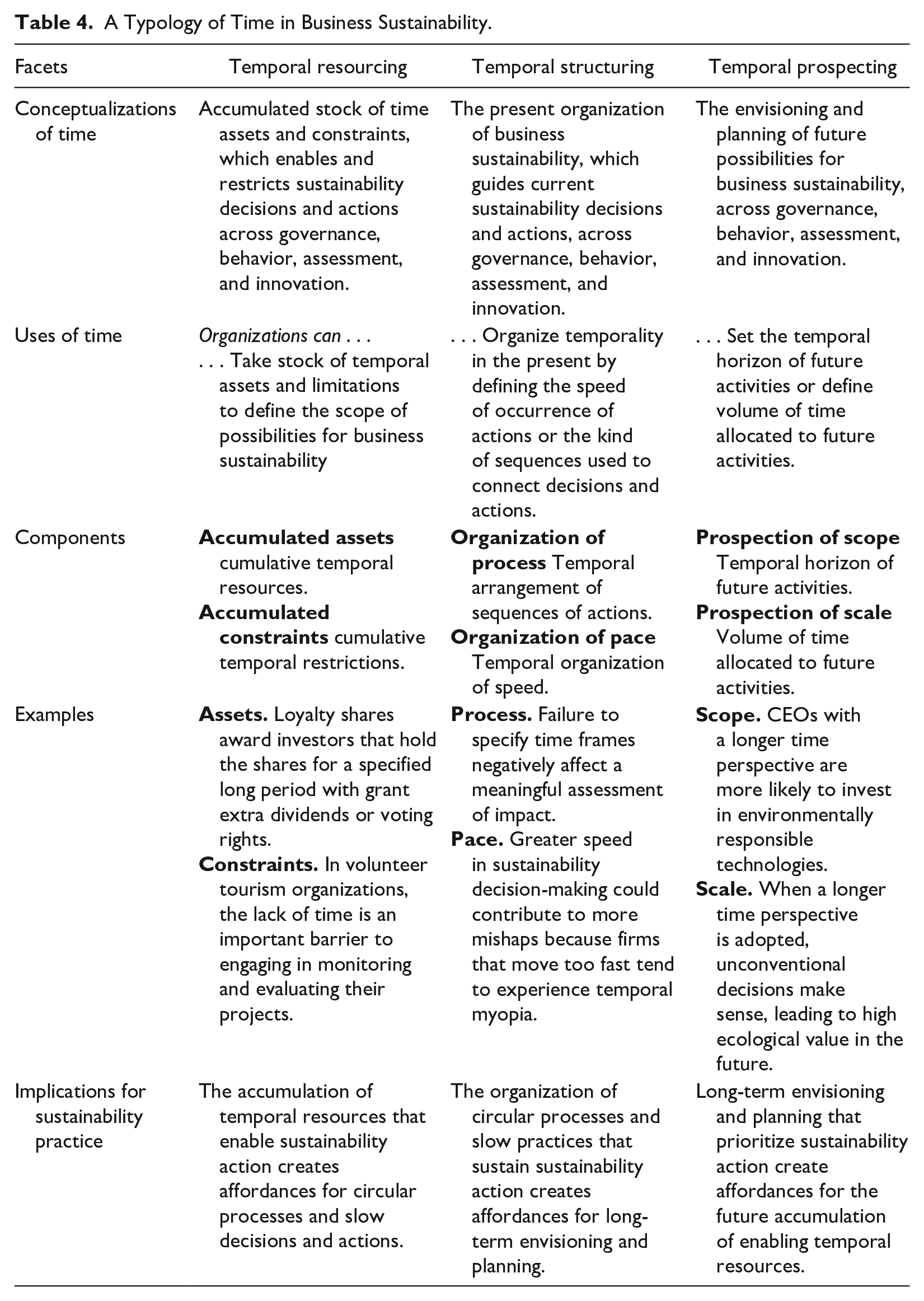
Our typology allows us to map out and provides clarity around the various conceptualizations and uses of time in business sustainability research while enabling a more holistic understanding of a multifaceted and plastic concept. By presenting time as resourcing, structuring, and prospecting, we offer clarification in a way that is sensitive to the past, present, and future use of time in business sustainability. Temporal resourcing refers to time assets and liabilities that facilitate and constrain sustainability actions. Temporal structuring shows how businesses can organize such sustainability actions around time, delineating processes and pace. Temporal prospecting delineates temporal action spaces and horizons to lay the ground for the envisioning and planning of future possibilities. In the presentation of the typology, we were able to identify actors and actions. This typology offers the reader a way of mapping the three constructs into organizational life and the different organizational areas that construct it, which can provide future research with more detailed guidance on how to use the constructs across levels.
We believe our review and typology open three interesting avenues for future research that could potentially bring further clarity to the conceptualization and use of time in business sustainability scholarship. A natural first step involves typological refinement, construct development, and operationalization, so that future research can substantially engage with the phenomenon across organizational spaces. Since each conception contains a unique continuum, a second step involves tackling the inherent tensions between the two sides of the continuums: short versus long, slow versus fast, and so on. Tensions between long-term and short-termism have been explored, but we are only scratching the surface of the other five dimensions. The continuums reveal contrasting time orientations and alternatives, which can be embraced by organizational actors. Organizations can decide to align remuneration to short-term targets or long-term goals or promote fast or slow consumption. Short/long and fast/slow are alternative time preferences, which are assumed to lead to alternative sustainability outcomes. Future research should explore these preferences and whether and under what circumstances those preferences that are assumed to enable sustainability (long, slow, circular, etc.) actually do. In the following section, we unpack our proposed agenda for future research.
Research Agenda to Advance Time in Business Sustainability Research
Construct Development and Operationalization
The first avenue for future research involves typological refinement, construct development, and operationalization. Our typology offers three conceptions of time in business sustainability, each exposing several continuums (see descriptive coding in Table 3). In the way the literature was organized, we believe temporal resourcing, structuring, and prospecting for sustainability should naturally evolve into constructs so that business sustainability can engage with the phenomenon substantively. These constructs can help us make sense of how time is used differently across organizations and explore how the different articulations of time and temporal preferences enable decision-making, more or less conducive to sustainability outcomes. Through the several continuums the typology contains (e.g., slow to fast, short to long), the conceptions can capture variance, which can be measured, and meet sufficient criteria for both convergent and discriminant validity. To make these future constructs useful for research, they need to be operationalized, which will require paying attention to the continuums they have emerged from and then the contexts and experiences where time in business sustainability is to be assessed. This is because different temporal, contextual, and experiential markers change the evaluation and use of time as it pertains to business sustainability decisions and actions. Construct development and operationalization can also assist organizations in their understanding of how different uses of time can affect sustainability strategies, planning, and outcomes. This can facilitate conversations and enable better decision-making.
Inevitably, there are temporal overlaps between conceptions. Temporal resourcing can create affordances for temporal structuring and the latter can create affordances for temporal prospecting. This is an interesting modeling opportunity, where three conceptions can be part of a broader model of time in business sustainability, with the affordances they create acting as connecting elements. Yet the points where one creates affordances for the other necessarily create fuzzy spaces in between constructs. More work will be needed to refine the delineation of constructs, especially if they are to be situated as part of a broader theoretical model.
Continuums, Tensions, and Temporal Ambidexterity
The second avenue for future research involves temporal tensions and tension reconciliation. Our research reveals several continuums, ranging from, for example, less to more time resources and slow to fast pace. Some of them exist in sharp contrast. Tensions are known, yet the capacity to reconcile short- and long-term tensions at once (e.g., Slawinski & Bansal, 2015) is still a nascent area of research. This capacity of reconciling time horizons is referred to as temporal ambidexterity, which we identify as a promising avenue for future research to explore how firms can harmonize the short- and the long-term in different cultural contexts and industries and identify strategies that firms can apply for this reconciliation.
Slawinski and Bansal (2015) identified firms capable of engaging in practices that support diverse temporal perspectives by juxtaposing short-term and long-term aspects of decision-making on climate change. In doing so, these organizations did confront the intertemporal tension. The mechanisms that contributed to temporal ambidexterity included the involvement of multidimensional data, preservation of issue attributes, and the broadening of the solution space to tackle these issues. Beckett et al. (2022) refer to this as ambitemporality, that is, the capacity to inhabit multiple temporalities at once. This approach enabled organizations to shift the temporal horizon of the communities they worked with from short-term to long-term, enabling both the community and the business to grow. For example, for tea producers in East Africa, the present time was seen as a “long present” rather than a moment in time (A. Kim et al., 2019). As a result, organizations did not perceive the present as a trade-off with the future but identified the present as an extended duration and recognized connections among processes. New evidence to advance knowledge on temporal ambidexterity will help managers overcome the dominant trade-off thinking in business sustainability and will offer firms further possibilities to move sustainable development forward.
From our typology, we identify two other spaces where temporal ambidexterity can be explored, at the level of process or speed. New research can explore how organizations combine linearity and circularity in decision-making and actions. Some authors suggest including learning cycles within the frame of the projects (Bell & Morse, 2005). On one hand, organizations that favor a cyclical time perspective develop broader responses to climate change in terms of the breadth and impact on stakeholders (Slawinski & Bansal, 2012). Heuer (2012) also tackled the linear versus nonlinearity challenge regarding ecosystem management in addressing environmental sustainability. He argued that organizational fields are interconnected because of the dynamic intertemporal and inter-spatial characteristics of the natural environment. These time and space characteristics influence the development of a circular approach to dealing with ecosystem management. However, the natural environment has no temporal delimitations and is not bounded while the organizations and actions contributing to sustainability are bounded and are required to be linear in time. Research has been very scarce in suggesting forms to overcome this mismatch (e.g., Bell & Morse, 2005). Future research would significantly benefit from studying the interconnectedness among natural and organizational processes so that both can be in alignment and support each other.
The duality of timing between slow and fast actions for sustainability has also been very present in the literature. Recent research has challenged the implicit idea that slow is best and shown that fast can be positive for sustainability in some cases (e.g., Porter et al., 2020; Walker et al., 2015). However, this evidence is still very limited. A fruitful area of research would be to study how these slow and fast qualities manifest and are reconciled within the firm (i.e., decision-making, internationalization, product development, CEO turnover, etc.) and the consequences thereof in terms of sustainability across industries. Future research would also benefit from the study of organizational speed and its outcomes for sustainability. Although there is some evidence of the downside of speed in relation to organizational mishaps (Morales-Raya & Bansal, 2015), organizational speed is still needed to prompt action facing climate change. Speed ambidexterity becomes a promising area of research.
Temporal Preferences in Business Sustainability
A third avenue for future research pertains to the apparent ideology and morality of time in business sustainability. The literature appears to take an ideological stance concerning time preferences in business sustainability. Literature tends to favor one temporal horizon over the other in business sustainability. Overall, long-term thinking and acting are deemed better for sustainability than short-term thinking and acting. In the Norwegian maritime sector, for example, Saether et al. (2021) stress the relevance of long-term orientation for green innovation. They found that a long-term orientation can lead to green innovations and green strategies, which are linked to emissions reduction. In terms of process, the literature suggests that there are conducive and non-conducive ways of structuring processes in business sustainability. A circular process is deemed to be better for sustainability than linear processes. Bell and Morse (2005), for example, focus on the contradiction between “linearity” (bounded temporality) and “circularity” (unbounded temporality). Sustainable development projects are time-bounded and tend to emphasize linearity using indicators to measure the achievement of defined goals, purpose, activities, and outputs at the end of the project. However, sustainability cannot be time-bounded as it is not a project and has no end, it thus implies “circularity.” In terms of pace, the literature suggests that there are correct and incorrect lapses of time to do something in business sustainability. Slow decisions and actions are better for sustainability than fast decisions and actions. This is evident in the cases of sustainable investment, sustainable tourism, and pro-environmental consumer behavior.
We argue that a more critical reflection is needed here because contradictions still exist in the literature. Evidence suggests that, in certain situations, fast action and linearity ought to be preferred for sustainability outcomes. Likewise, circularity implies an unbounded conception of time leading to uncertainty in the execution of projects. Linearity facilitates planning and the delivery of outputs. Finally, there are areas where fast action is better for sustainability than slow action. In their analysis of an environmental initiative “Save Our Oceans,” Porter et al. (2020) identified robust action as an approach to address grand challenges, as it allows diverse stakeholders to engage with novel ideas and provides structure to support stakeholders’ interactions, maintain diverse stakeholders’ views, and support stakeholders’ actions to create solutions that are flexible and adaptive to the changing environment. Walker et al. (2015) came to a similar conclusion in their analysis of temporal orientation and corporate environmental performance (CEP). They found that a short-term, sudden, and reactive approach was related to strong CEP.
Two separate research efforts will be needed. First, a critical reflection and conceptual development around the ideology of time in business sustainability. Second, an empirical effort to elucidate whether, when, and under what conditions are “slow, circular, and long” effectively better for sustainability than “fast, linear, and short.” But perhaps most interestingly, evidence showing when and under what conditions the opposite is true.
Footnotes
Appendix
List of Papers Included in the Review.

| Authors | Journal | Article Title | Year | Priority |
|---|---|---|---|---|
| Good, J; Thorpe, A | Organization & Environment | The nature of organizing: A relational approach to understanding business sustainability | 2020 | 1 |
| DesJardine, M; Bansal, P | Organization Science | One step forward, two steps back: How negative external evaluations can shorten organizational time horizons | 2019 | 1 |
| Hahn, K | Research Policy | Innovation in times of financialization: Do future-oriented innovation strategies suffer? Examples from German industry | 2019 | 1 |
| Kim, A; Bansal, P; Haugh, H | Academy of Management Journal | No time like the present: How a present time perspective can foster sustainable development | 2019 | 1 |
| Hang, M; Geyer-Klingeberg, J; Rathgeber, AW | Business Strategy and the Environment | It is merely a matter of time: A meta-analysis of the causality between environmental performance and financial performance | 2019 | 1 |
| Ortiz-de-Mandojana, N; Bansal, P; Aragon-Correa, JA | British Journal of Management | Older and wiser: How CEOs’ time perspective influences long-term investments in environmentally responsible technologies | 2019 | 1 |
| Wu, L; Subramanian, N; Gunasekaran, A; Abdulrahman, MDA; Pawar, KS; Doran, D | Business Strategy and the Environment | A two-dimensional, two-level framework for achieving corporate sustainable development: assessing the return on sustainability initiatives | 2018 | 1 |
| Longoni, A; Cagliano, R | Journal of Business Ethics | Sustainable innovativeness and the triple bottom line: the role of organizational time perspective | 2018 | 1 |
| Hawk, A; Pacheco-de-Almeida, G | Strategic Management Journal | Time compression (dis)economies: An empirical analysis | 2018 | 1 |
| Nyberg, D; Wright, C; Kirk, J | British Journal of Management | Dash for gas: Climate change, hegemony and the scalar politics of fracking in the UK | 2018 | 1 |
| Ashkenazy, A; Chebach, TC; Knickel, K; Peter, S; Horowitz, B; Offenbach, R | Journal of Rural Studies | Operationalising resilience in farms and rural regions—findings from fourteen case studies | 2018 | 1 |
| O’Reilly, D; Allen, S; Reedy, P | British Journal of Management | Reimagining the scales, dimensions and fields of socio-ecological sustainability | 2018 | 1 |
| Sharma, G; Jaiswal, AK | Journal of Business Ethics | Unsustainability of sustainability: Cognitive frames and tensions in bottom of the pyramid projects | 2018 | 1 |
| Corbett, J; Webster, J; Jenkin, TA | Journal of Business Ethics | Unmasking corporate sustainability at the project level: Exploring the influence of institutional logics and individual agency | 2018 | 1 |
| Coleman, S; Hurley, S; Koliba, C; Zia, A | Global Environmental Change-Human and Policy Dimensions | Crowdsourced Delphis: Designing solutions to complex environmental problems with broad stakeholder participation | 2017 | 1 |
| Galbreath, J | Business Strategy and the Environment | The impact of board structure on corporate social responsibility: A temporal view | 2017 | 1 |
| Slawinski, N; Pinkse, J; Busch, T; Banerjee, SB | Business & Society | The role of short-termism and uncertainty avoidance in organizational inaction on climate change: A multi-level framework | 2017 | 1 |
| Klassen, R; Hajmohammad, S | International Journal of Operations & Production Management | Multiple temporal perspectives extend sustainable competitiveness | 2017 | 1 |
| Mazziotta, A; Pouzols, FM; Monkkonen, M; Kotiaho, JS; Strandman, H; Moilanen, A | Journal of Environmental Management | Optimal conservation resource allocation under variable economic and ecological time discounting rates in boreal forest | 2016 | 1 |
| Maas, K; Rosendaal, S | Business Strategy and the Environment | Sustainability targets in executive remuneration: Targets, time frame, country and sector specification | 2016 | 1 |
| Faccioli, M; Hanley, N; Torres, C; Font, AR | Journal of Environmental Management | Do we care about sustainability? An analysis of time sensitivity of social preferences under environmental time-persistent effects | 2016 | 1 |
| Ferrara, A; Kelly, C; Wilson, GA; Nole, A; Mancino, G; Bajocco, S; Salvati, L | Journal of Environmental Management | Shaping the role of “fast” and “slow” drivers of change in forest-shrubland socio-ecological systems | 2016 | 1 |
| Delmas, MA; Nairn-Birch, N; Lim, JH | Organization & Environment | Dynamics of environmental and financial performance: The case of greenhouse gas emissions | 2015 | 1 |
| Isley, SC; Lempert, RJ; Popper, SW; Vardavas, R | Global Environmental Change-Human and Policy Dimensions | The effect of near-term policy choices on long-term greenhouse gas transformation pathways | 2015 | 1 |
| Feola, G; Lerner, AM; Jain, M; Montefrio, MJF; Nicholas, KA | Journal of Rural Studies | Researching farmer behavior in climate change adaptation and sustainable agriculture: Lessons learned from five case studies | 2015 | 1 |
| Whillans, AV; Dunn, EW | Organizational Behavior and Human Decision Processes | Thinking about time as money decreases environmental behavior | 2015 | 1 |
| Slawinski, N; Bansal, P | Organization Science | Short on time: Intertemporal tensions in business sustainability | 2015 | 1 |
| Walker, K; Ni, N; Dyck, B | Business Strategy and the Environment | Recipes for successful sustainability: Empirical organizational configurations for strong corporate environmental performance | 2015 | 1 |
| Paetzold, F; Busch, T | Organization & Environment | Unleashing the powerful few: Sustainable investing behavior of wealthy private investors | 2014 | 1 |
| Bansal, P; Knox-Hayes, J | Organization & Environment | The time and space of materiality in organizations and the natural environment | 2013 | 1 |
| Higham, J; Cohen, SA; Peeters, P; Gossling, S | Journal of Sustainable Tourism | Psychological and behavioral approaches to understanding and governing sustainable mobility | 2013 | 1 |
| Dickinson, JE; Filimonau, V; Cherrett, T; Davies, N; Norgate, S; Speed, C; Winstanley, C | Journal of Sustainable Tourism | Understanding temporal rhythms and travel behavior at destinations: potential ways to achieve more sustainable travel | 2013 | 1 |
| Guest, R | Journal of World Business | The economics of sustainability in the context of climate change: An overview | 2010 | 1 |
| Mee, LD; Dublin, HT; Eberhard, AA | Global Environmental Change-Human and Policy Dimensions | Evaluating the global environment facility: A goodwill gesture or a serious attempt to deliver global benefits? | 2008 | 1 |
| Bell, SM; Morse, S | Journal of Environmental Management | Delivering sustainability therapy in sustainable development projects | 2005 | 1 |
| Higham, J; Hanna, P; Hopkins, D; Cohen, S; Gossling, S; Cocolas, N | Journal of Travel Research | Reconfiguring aviation for a climate-safe future: Are airlines sending the wrong message? | 2021 | 1 |
| Tunn, VSC; Van den Hende, EA; Bocken, NMP; Schoormans, JPL | Business Strategy and the Environment |
Consumer adoption of access-based product-service systems: the influence of duration of use and type of product | 2021 | 1 |
| Saether, EA; Eide, AE; Bjorgum, O | Business Strategy and the Environment | Sustainability among Norwegian maritime firms: Green strategy and innovation as mediators of long-term orientation and emission reduction | 2021 | 1 |
| Bansal, P; Grewatsch, S; Sharma, G | Journal of Management Studies | How covid-19 informs business sustainability research: It’s time for a systems perspective | 2021 | 1 |
| Risi, D | Business & Society | Time and business sustainability: Socially responsible investing in Swiss banks and insurance companies | 2020 | 1 |
| Mazutis, D; Slawinski, N; Palazzo, G | Business & Society | A time and place for sustainability: A spatiotemporal perspective on organizational sustainability frame development | 2021 | 1 |
| Beckett, JR; Chmielewski, DA; Dembek, K | Business & Society | Taking the time to understand time at the bottom/base of the pyramid | 2022 | 1 |
| Mio, C; Zaro, ES; Fasan, M | Business Strategy and the Environment | Are loyalty shares an effective antidote against short-termism? Empirical evidence from Italy | 2020 | 1 |
| Bansal, P., DesJardine | Strategic Organization | Business sustainability: It is about time | 2014 | 1 |
| Slawinski, N., Bansal | Organization Studies | A matter of time: The temporal perspectives of organizational responses to climate change | 2012 | 1 |
| Morales-Raya, M., Bansal, P | Organizational Dynamics | Racing to the bottom: The negative consequences of organizational speed | 2015 | 1 |
| Ortiz-de-Mandojana, N., Bansal, P. | Strategic Management Journal | The long-term benefits of organizational resilience through sustainable business practices | 2016 | 1 |
| Hart, S. L., & Milstein, M. B. | Academy of Management Executive | Creating sustainable value | 2003 | 1 |
| Reinecke, J. Ansari | Academy of Management Journal | When times collide. Temporal brokerage at the intersection of markets and development | 2015 | 1 |
| Gundersen, V; Vistad, OI; Panzacchi, M; Strand, O; van Moorter, B | Tourism Management | Large-scale segregation of tourists and wild reindeer in three Norwegian national parks: Management implications | 2019 | 2 |
| Craig, CA | Tourism Management | The Weather-Proximity-Cognition (WPC) framework: A camping, weather, and climate change case | 2019 | 2 |
| Benlemlih, M; Cai, L | Business Ethics-A European Review | Corporate environmental performance and financing decisions | 2020 | 2 |
| van Hille, I; de Bakker, FGA; Groenewegen, P; Ferguson, JE | Organization & Environment | Strategizing nature in cross-sector partnerships: Can plantation revitalization enable living wages? | 2021 | 2 |
| Zhang, Y; Han, YL | Organizational Behavior and Human Decision Processes | Paradoxical leader behavior in long-term corporate development: Antecedents and consequences | 2019 | 2 |
| Horisch, J; Wulfsberg, I; Schaltegger, S | Business Strategy and the Environment | The influence of feedback and awareness of consequences on the development of corporate sustainability action over time | 2020 | 2 |
| Varin, M; Theau, J; Fournier, RA | Journal of Environmental Management | Mapping ecosystem services provided by wetlands at multiple spatiotemporal scales: A case study in Quebec, Canada | 2019 | 2 |
| Dou, JS; Su, E; Wang, S | Journal of Business Ethics | When does family ownership promote proactive environmental strategy? The role of the firm’s long-term orientation | 2019 | 2 |
| Porter, AJ; Tuertscher, P; Huysman, M | Journal of Management Studies | Saving our oceans: Scaling the impact of robust action through crowdsourcing | 2020 | 2 |
| Nepal, R; al Irsyad, MI; Nepal, SK | Tourism Management | Tourist arrivals, energy consumption and pollutant emissions in a developing economy-implications for sustainable tourism | 2019 | 2 |
| Peeters, P; Higham, J; Cohen, S; Eijgelaar, E; Gossling, S | Journal of Sustainable Tourism | Desirable tourism transport futures | 2019 | 2 |
| Crain, TL; Hammer, LB; Bodner, T; Olson, R; Kossek, EE; Moen, P; Buxton, OM | Journal of Occupational Health Psychology | Sustaining sleep: Results from the randomized controlled work, family, and health study | 2019 | 2 |
| Rao-Nicholson, R; Khan, Z; Marinova, S | Business Ethics-A European Review | Balancing social and political strategies in emerging markets: Evidence from India | 2019 | 2 |
| Landon, AC; Woosnam, KM; Boley, BB | Journal of Sustainable Tourism | Modeling the psychological antecedents to tourists’ pro-sustainable behaviors: An application of the value-belief-norm model | 2018 | 2 |
| Kim, S; Filimonau, V | Tourism Management | On linguistic relativity and pro-environmental attitudes in tourism | 2017 | 2 |
| Steen, M; Weaver, T | Research Policy | Incumbents’ diversification and cross-sectorial energy industry dynamics | 2017 | 2 |
| Weddfelt, E; Vaccari, M; Tudor, T | Journal of Environmental Management | The development of environmental visions and strategies at the municipal level: Case studies from the county of Ostergotland in Sweden | 2016 | 2 |
| Pinto, J | Human Relations | Wow! That’s so cool! The Icehotel as organizational trope | 2016 | 2 |
| Vigneau, L; Humphreys, M; Moon, J | Journal of Business Ethics | How do firms comply with international sustainability standards? Processes and consequences of adopting the global reporting initiative | 2015 | 2 |
| Vijay, A | Environment and Planning D-Society & Space | After the pop-up games: London’s never-ending regeneration | 2015 | 2 |
| Hahn, T; Pinkse, J; Preuss, L; Figge, F | Journal of Business Ethics | Tensions in corporate sustainability: Toward an integrative framework | 2015 | 2 |
| Bell, AR; Osgood, DE; Cook, BI; Anchukaitis, KJ; McCarney, GR; Greene, AM; Buckley, BM; Cook, ER | Global Environmental Change-Human and Policy Dimensions | Paleoclimate histories improve access and sustainability in index insurance programs | 2013 | 2 |
| Heuer, M | Business Strategy and the Environment | Sustainability governance across time and space: Connecting environmental stewardship in the firm with the global community | 2012 | 2 |
| Heuer, M | Business Strategy and the Environment | Ecosystem cross-sector collaboration: Conceptualizing an adaptive approach to sustainability governance | 2011 | 2 |
| Varela-Ortega, C; Blanco-Gutierrez, I; Swartz, CH; Downing, TE | Global Environmental Change-Human and Policy Dimensions | Balancing groundwater conservation and rural livelihoods under water and climate uncertainties: An integrated hydro-economic modeling framework | 2011 | 2 |
| Barton, D | Harvard Business Review | Capitalism for the long term | 2011 | 2 |
| Moeller, T; Dolnicar, S; Leisch, F | Journal of Sustainable Tourism | The sustainability-profitability trade-off in tourism: Can it be overcome? | 2011 | 2 |
| Lumsdon, LM; McGrath, P | Journal of Sustainable Tourism | Developing a conceptual framework for slow travel: A grounded theory approach | 2011 | 2 |
| Castellani, V; Sala, S | Tourism Management | Sustainable performance index for tourism policy development | 2010 | 2 |
| Ihlen, O | Business Strategy and the Environment | The oxymoron of “sustainable oil production”: The case of the Norwegian oil industry | 2009 | 2 |
| Dengler, M | Environment and Planning A | Finding the political “sweet spot”: Sectional interests, consensus power, and the everglades restudy (1992-2000) | 2008 | 2 |
| Vernon, J; Essex, S; Pinder, D; Curry, K | Annals of Tourism Research | Collaborative policymaking-local sustainable projects | 2005 | 2 |
| Small, A; Owen, A; Paavola, J | Business Strategy and the Environment | Organizational use of ecosystem service approaches: A critique from a systems theory perspective | 2022 | 2 |
| Pederneiras, YM; Meckenstock, J; Carvalho, AIC; Barbosa-Povoa, AP | Business Strategy and the Environment | The wicked problem of sustainable development in supply chains | 2022 | 2 |
| Hohn, MM; Durach, CF | International Journal of Operations & Production Management | Additive manufacturing in the apparel supply chain-impact on supply chain governance and social sustainability | 2021 | 2 |
| Torres-Delgado, A; Palomeque, FL; Sanz, BE; Urgell, XF | Journal of Sustainable Tourism | Monitoring sustainable management in local tourist destinations: Performance, drivers and barriers | 2021 | 2 |
| Brix-Asala, C; Seuring, S; Sauer, PC; Zehendner, A; Schilling, L | Business Strategy and the Environment | Resolving the base of the pyramid inclusion paradox through supplier development | 2021 | 2 |
| Bhan, M; Gingrich, S; Roux, N; Noe, JL; Kastner, T; Matej, S; Schwarzmueller, F; Erb, KH | Journal of Environmental Management | Quantifying and attributing land use-induced carbon emissions to biomass consumption: A critical assessment of existing approaches | 2021 | 2 |
| Hafezi, M; Stewart, RA; Sahin, O; Giffin, AL; Mackey, B | Journal of Environmental Management | Evaluating coral reef ecosystem services outcomes from climate change adaptation strategies using integrative system dynamics | 2021 | 2 |
| Nobre, FS; Morais-da-Silva, RL | Business & Society | Capabilities of bottom of the pyramid organizations | 2 | |
| Strambach, S; Pflitsch, G | Research Policy | Transition topology: Capturing institutional dynamics in regional development paths to sustainability | 2020 | 2 |
| Cherunya, PC; Ahlborg, H; Truffer, B | Research Policy | Anchoring innovations in oscillating domestic spaces: Why sanitation service offerings fail in informal settlements | 2020 | 2 |
| Richardson, J; McKenna, S | Journal of Vocational Behavior | An exploration of career sustainability in and after professional sport | 2020 | 2 |
| Park, S; Cha, H | Journal of Environmental Management | Institutional decoupling and the limited implementation of certified environmental technologies | 2019 | 3 |
| Shi, BQ; Bach, PM; Lintern, A; Zhang, KF; Coleman, RA; Metzeling, L; McCarthy, DT; Deletic, A | Journal of Environmental Management | Understanding spatiotemporal variability of in-stream water quality in urban environments—A case study of Melbourne, Australia | 2019 | 3 |
| Garcia, M; Koebele, E; Deslatte, A; Ernst, K; Manago, KF; Treuer, G | Global Environmental Change-Human and Policy Dimensions | Toward urban water sustainability: Analyzing management transitions in Miami, Las Vegas, and Los Angeles | 2019 | 3 |
| Durand, R; Paugam, L; Stolowy, H | Strategic Management Journal | Do investors actually value sustainability indices? Replication, development, and new evidence on CSR visibility | 2019 | 3 |
| Best, S; Myers, J | Journal of Rural Studies | Prudence or speed: Health and social care innovation in rural Wales | 2019 | 3 |
| Tetrault Sirsly, CA; Lvina, E | Business & Society | From doing good to looking even better: the dynamics of CSR and reputation | 2019 | 3 |
| Sebestyen, V; Bulla, M; Redey, A; Abonyi, J | Journal of Environmental Management | Network model-based analysis of the goals, targets and indicators of sustainable development for strategic environmental assessment | 2019 | 3 |
| Collins, A; Potoglou, D | Journal of Sustainable Tourism | Factors influencing visitor travel to festivals: Challenges in encouraging sustainable travel | 2019 | 3 |
| Juntunen, JK; Halme, M; Korsunova, A; Rajala, R | Journal of Product Innovation Management | Strategies for integrating stakeholders into sustainability innovation: A configurational perspective | 2019 | 3 |
| Morseletto, P | Global Environmental Change-Human and Policy Dimensions | Confronting the nitrogen challenge: Options for governance and target setting | 2019 | 3 |
| Kitsikopoulos, C; Schwaibold, U; Taylor, D | Business Strategy and the Environment | Limited progress in sustainable development: Factors influencing the environmental management and reporting of South African JSE-listed companies | 2018 | 3 |
| Brown, PJ; Bajada, C | Business Strategy and the Environment | An economic model of circular supply network dynamics: Toward an understanding of performance measurement in the context of multiple stakeholders | 2018 | 3 |
| Mellon, V; Bramwell, B | Annals of Tourism Research | The temporal evolution of tourism institutions | 2018 | 3 |
| Muñoz, P; Cacciotti, G; Cohen, B | Journal of Business Venturing | The double-edged sword of purpose-driven behavior in sustainable venturing | 2018 | 3 |
| Caldeira, AM; Kastenholz, E | Journal of Sustainable Tourism | It’s so hot: predicting climate change effects on urban tourists’ time-space experience | 2018 | 3 |
| Liu, Y; Yang, DW; Xu, HZ | Business Strategy and the Environment | Factors influencing consumer willingness to pay for low-carbon products: A simulation study in China | 2017 | 3 |
| Arbuthnott, K; Scerbe, A | Organization & Environment | How do money and time restrictions influence self-constraining behavior in polluting the commons? | 2017 | 3 |
| Steele, J; Dredge, D; Scherrer, P | Journal of Sustainable Tourism | Monitoring and evaluation practices of volunteer tourism organizations | 2017 | 3 |
| McIntyre, TM; McIntyre, SE; Barr, CD; Woodward, PS; Francis, DJ; Durand, AC; Mehta, P; Kamarck, TW | Journal of Occupational Health Psychology | longitudinal study of the feasibility of using ecological momentary assessment to study teacher stress: Objective and self-reported measures | 2016 | 3 |
| Mazé, A; Ait-Aissa, M; Mayer, S; Verjux, N | Organization & Environment | Third-party certifications and the role of auditing policies in sustainability: The time and space of materiality within combined audits | 2016 | 3 |
| Akhtar, F; Lodhi, SA; Khan, SS; Sarwar, F | Journal of Environmental Management | Incorporating permaculture and strategic management for sustainable ecological resource management | 2016 | 3 |
| Lee, J; Ingalls, M; Erickson, JD; Wollenberg, E | Global Environmental Change-Human and Policy Dimensions | Bridging organizations in agricultural carbon markets and poverty alleviation: An analysis of pro-poor carbon market projects in East Africa | 2016 | 3 |
| de Grosbois, D | Journal of Sustainable Tourism | Corporate social responsibility reporting in the cruise tourism industry: a performance evaluation using a new institutional theory based model | 2016 | 3 |
| Arana, JE; Leon, CJ | Journal of Sustainable Tourism | Are tourists animal spirits? Evidence from a field experiment exploring the use of non-market based interventions advocating sustainable tourism | 2016 | 3 |
| Calgaro, E; Lloyd, K; Dominey-Howes, D | Journal of Sustainable Tourism | From vulnerability to transformation: A framework for assessing the vulnerability and resilience of tourism destinations | 2014 | 3 |
| Salerno, F; Viviano, G; Manfredi, EC; Caroli, P; Thakuri, S; Tartari, G | Journal of Environmental Management | Multiple carrying capacities from a management-oriented perspective to operationalize sustainable tourism in protected areas | 2013 | 3 |
| Jerneck, A; Osson, L | Journal of Rural Studies | More than trees! Understanding the agroforestry adoption gap in subsistence agriculture: Insights from narrative walks in Kenya | 2013 | 3 |
| Akyol, DE; De Koster, RBM | Production and Operations Management | Non-dominated time-window policies in city distribution | 2013 | 3 |
| Esteban, E; Dinar, A | Journal of Environmental Management | Modeling sustainable groundwater management: Packaging and sequencing of policy interventions | 2013 | 3 |
| Ram, Y; Nawijn, J; Peeters, PM | Journal of Sustainable Tourism | Happiness and limits to sustainable tourism mobility: A new conceptual model | 2013 | 3 |
| Mair, J; Laing, J | Journal of Sustainable Tourism | The greening of music festivals: Motivations, barriers and outcomes. Applying the Mair and Jago model | 2012 | 3 |
| Collins, E; Roper, J; Lawrence, S | Business Strategy and the Environment | Sustainability practices: Trends in New Zealand businesses | 2010 | 3 |
| Tang, TLP | Journal of Business Ethics | From increasing gas efficiency to enhancing creativity: It pays to go green | 2010 | 3 |
| Pless, N; Maak, T | Journal of Business Ethics | Responsible leaders as agents of world benefit: learnings from project Ulysses | 2009 | 3 |
| Quak, HJ; de Koster, MBM | Journal of Operations Management | Exploring retailers’ sensitivity to local sustainability policies | 2007 | 3 |
| Frandberg, L; Vilhelmson, B | Environment and Planning A | Personal mobility: A corporeal dimension of transnationalization. The case of long-distance travel from Sweden | 2003 | 3 |
| Zwetsloot, GIJM | Journal of Business Ethics | From management systems to corporate social responsibility | 2003 | 3 |
| Wade-Benzoni, KA | Academy of Management Journal | A golden rule over time: Reciprocity in intergenerational allocation decisions | 2002 | 3 |
| Martins, R; Pereira, E; Rosado, A; Maroco, J; McCullough, B; Mascarenhas, M | Journal of Sustainable Tourism | Understanding spectator sustainable transportation intentions in international sport tourism events | 2021 | 3 |
| Bigerna, S; Bollino, CA; Polinori, P | Journal of Environmental Management | Convergence in renewable energy sources diffusion worldwide | 2021 | 3 |
| Acton, L; Gruby, RL; Nakachi, A | Journal of Environmental Management | Does polycentricity fit? Linking social fit with polycentric governance in a large-scale marine protected area | 2021 | 3 |
| Chen, YY; Chen, A; Mu, D | Tourism Management | Impact of walking speed on tourist carrying capacity: The case of Maiji Mountain Grottoes, China | 2021 | 3 |
| Kim, S; Chae, S | Journal of Business Ethics | Shareholder Value Effects of Ethical Sourcing: Comparing Reactive and Proactive Initiatives | 2022 | 3 |
| Agatz, N; Fan, YJ; Stam, D | Production and Operations Management | The impact of green labels on time slot choice and operational sustainability | 2021 | 3 |
| Meehan, J; Pinnington, BD | International Journal of Operations & Production Management | Modern slavery in supply chains: Insights through strategic ambiguity | 2021 | 3 |
| Hallin, A; Karrbom-Gustavsson, T; Dobers, P | Business Strategy and the Environment | Transition toward and of sustainability-understanding sustainability as performative | 2021 | 3 |
| Vu, HQ; Muskat, B; Li, G; Law, R | Journal of Sustainable Tourism | Improving the resident-tourist relationship in urban hotspots | 2021 | 3 |
| Umar, M; Ji, XF; Kirikkaleli, D; Xu, QH | Journal of Environmental Management | COP21 Roadmap: Do innovation, financial development, and transportation infrastructure matter for environmental sustainability in China? | 2020 | 3 |
| Buning, RJ; Lulla, V | Journal of Sustainable Tourism | Visitor bikeshare usage: Tracking visitor spatiotemporal behavior using big data | 2021 | 3 |
| Abouee-Mehrizi, H; Baron, O; Berman, O; Chen, D | Production and Operations Management | Adoption of electric vehicles in car sharing market | 2021 | 3 |
| Carter, CR; Kaufmann, L; Ketchen, DJ | International Journal of Operations & Production Management | Expect the unexpected: Toward a theory of the unintended consequences of sustainable supply chain management | 2020 | 3 |
| Bogacki, J; Letmathe, P | Business Strategy and the Environment | Representatives of future generations as promoters of sustainability in corporate decision processes | 2021 | 3 |
| Werner, K; Griese, KM; Bosse, C | Journal of Sustainable Tourism | The role of slow events for sustainable destination development: a conceptual and empirical review | 2021 | 3 |
| Farkic, J; Filep, S; Taylor, S | Journal of Sustainable Tourism | Shaping tourists’ wellbeing through guided slow adventures | 2020 | 3 |
| Zheng, DN; Liang, ZX; Ritchie, BW | Journal of Sustainable Tourism | Residents’ social dilemma in sustainable heritage tourism: The role of social emotion, efficacy beliefs and temporal concerns | 2020 | 3 |
| Sump, F; Yi, S | Organization & Environment | Different reasons for different responses: A review of incumbents’ adaptation in carbon-intensive industries | 2021 | 3 |
| Kelly, CM; Strauss, K; Arnold, J; Stride, C | Journal of Vocational Behavior | The relationship between leisure activities and psychological resources that support a sustainable career: The role of leisure seriousness and work-leisure similarity | 2020 | 3 |
| Ruan, WQ; Li, YQ; Zhang, SN; Liu, CH | Tourism Management | Evaluation and drive mechanism of tourism ecological security based on the DPSIR-DEA model | 2019 | 4 |
| Lozano-Oyola, M; Blancas, FJ; Gonzalez, M; Caballero, R | Journal of Environmental Management | Sustainable tourism tags to reward destination management | 2019 | 4 |
| Kim, S; Filimonau, V; Dickinson, JE | Journal of Sustainable Tourism | The technology-evoked time use rebound effect and its impact on pro-environmental consumer behavior in tourism | 2020 | 4 |
| Rafindadi, AA; Usman, O | Journal of Environmental Management | Globalization, energy use, and environmental degradation in South Africa: Startling empirical evidence from the Maki-cointegration test | 2019 | 4 |
| Goworek, H; Land, C; Burt, G; Zundel, M; Saren, M; Parker, M; Lambe, B | British Journal of Management | Scaling sustainability: Regulation and resilience in managerial responses to climate change | 2018 | 4 |
| Sun, YY; Lin, ZW | Journal of Sustainable Tourism | Move fast, travel slow: The influence of high-speed rail on tourism in Taiwan | 2018 | 4 |
| Gascoigne, C; Kelliher, C | Human Relations | The transition to part-time: How professionals negotiate reduced time and workload’ i-deals and craft their jobs | 2018 | 4 |
| Bai, XM; van der Leeuw, S; O’Brien, K; Berkhout, F; Biermann, F; Brondizio, ES; Cudennec, C; Dearing, J; Duraiappah, A; Glaser, M; Revkin, A; Steffen, W; Syvitski, J | Global Environmental Change-Human and Policy Dimensions | Plausible and desirable futures in the Anthropocene: A new research agenda | 2016 | 4 |
| Stephan, U; Patterson, M; Kelly, C; Mair, J | Journal of Management | Organizations driving positive social change: A review and an integrative framework of change processes | 2016 | 4 |
| Hunt, RA; Fund, BR | Journal of Management Studies | Intergenerational fairness and the crowding out effects of well-intended environmental policies | 2016 | 4 |
| Dunk, RM; Gillespie, SA; MacLeod, D | Journal of Sustainable Tourism | Participation and retention in a green tourism certification scheme | 2016 | 4 |
| Rutty, M; Matthews, L; Scott, D; Del Matto, T | Journal of Sustainable Tourism | Using vehicle monitoring technology and eco-driver training to reduce fuel use and emissions in tourism: A ski resort case study | 2014 | 4 |
| Parry, S | Business Ethics-A European Review | Going green: The evolution of micro-business environmental practices | 2012 | 4 |
| Valentine, PS; Birtles, A; Curnock, M; Arnold, P; Dunstan, A | Tourism Management | Getting closer to whales-passenger expectations and experiences, and the management of swim with dwarf minke whale interactions in the Great Barrier Reef | 2004 | 4 |
| Olson, PD; Zuiker, VS; Danes, SM; Stafford, K; Heck, RKZ; Duncan, KA | Journal of Business Venturing | The impact of the family and the business on family business sustainability | 2003 | 4 |
| Singh, RK; Mangla, SK; Bhatia, MS; Luthra, S | Business Strategy and the Environment | Integration of green and lean practices for sustainable business management | 2022 | 4 |
| Li, J; He, RY; deVoil, P; Wan, S | Journal of Environmental Management | Enhancing the application of organic fertilizers by members of agricultural cooperatives | 2021 | 4 |
| Wiengarten, F; Pagell, M; Durach, CF; Humphreys, P | Journal of Operations Management | Exploring the performance implications of precarious work | 2021 | 4 |
| Negri, M; Cagno, E; Colicchia, C; Sarkis, J | Business Strategy and the Environment | Integrating sustainability and resilience in the supply chain: A systematic literature review and a research agenda | 2021 | 4 |
| Shevchenko, A; Pan, XD; Calic, G | Business Strategy and the Environment | Exploring the effect of environmental orientation on financial decisions of businesses at the bottom of the pyramid: Evidence from the microlending context | 2020 | 4 |
| Falk, MT; Hagsten, E | Business Strategy and the Environment | Time for carbon neutrality and other emission reduction measures at European airports | 2020 | 4 |
| Prado, AM; Arce, R; Lopez, LE; Garcia, J; Pearson, AA | Journal of Business Ethics | Simulations versus case studies: Effectively teaching the premises of sustainable development in the classroom | 2020 | 4 |
| De Vos, A; Van der Heijden, BIJM; Akkermans, J | Journal of Vocational Behavior | Sustainable careers: Toward a conceptual model | 2020 | 4 |
Declaration of Conflicting Interests
The author(s) declared no potential conflicts of interest with respect to the research, authorship, and/or publication of this article.
Funding
The author(s) received no financial support for the research, authorship, and/or publication of this article.
