




Abstract
Digital platform technology enables circular business models that facilitate the reduction, reuse, and recycling of resources and materials across large ecosystems of platform actors. However, little is currently known about the inner workings of such platforms and how they are organized. Framing these platforms as meta-organizations, this study examines the orchestration mechanisms deployed by platform owners to facilitate economic value creation with a circular business model among a large group of actors. Building on an inductive analysis of 10 European platform organizations, this study identifies five meta-organizational orchestration mechanisms and develops an empirically grounded model that explains how the focal firm orchestrates value creation with a platform-based circular business model. This study advances the existing knowledge on orchestration mechanisms in platform-based meta-organizations in a circular economy context and highlights novel implications for theory and practice.
Keywords
Introduction
Circular economy (CE) promotes an economic system that reduces the negative environmental impacts of the linear model by reducing, reusing, recycling, and recovering resources and materials in the production–consumption cycle (Kirchherr et al., 2017, 2018; Korhonen et al., 2018). The shift toward a CE has gained momentum worldwide, driven by a growing number of international policies and support (e.g., Kirchherr et al., 2018; Schwanholz & Leipold, 2020). Simultaneously, markets are reconfigured as value creation increasingly gravitates toward ecosystems orchestrated on digital platforms (Konietzko et al., 2019, 2020; Parker et al., 2016, p. 47; Tiwana et al., 2010).
The platform-enabled circular business models are ecosystem-based market structures with a specific system-level goal managed by the focal firm, that is, the “orchestrator” (Autio, 2021; Cennamo & Santaló, 2019). The circular business models (CBMs) are based on the coordination and collaboration of actors who collectively create and capture value for sustainable development that generates both, economic and noneconomic benefits. We call this approach circular value creation, which is defined in this study as an effort to simultaneously address economic (e.g., profit and growth) and circularity objectives for a firm (e.g., Hansen & Revellio, 2020). Reaching such complex goals is challenging and we argue that digital platforms provide a distinct and potentially effective way to address such complexity by orchestrating the relevant actors, their activities, and resources.
We investigate platform-enabled CBMs as meta-organizations (Ciborra, 1996; Kretschmer et al., 2020), that is, organizations structured from a network of multiple legally autonomous entities such as firms or individuals without strict contractual obligations (Gulati et al., 2012). The literature to date does offer some understanding of the value creation and orchestration of these organizations (e.g., Bocken & Ritala, 2022; Lüdeke-Freund et al., 2019); however, the substance of the orchestration mechanisms at the meta-organizational level remains less understood. Because of the network and collaboration-related complexities, some even believe there is no single theory or literature that can explain value creation in a CBM (Ünal et al., 2019). Given the distinctive features of the CE as a new economic system (Kirchherr et al., 2018, 2017), a deeper understanding of the orchestration mechanisms, that is, the sets of strategic choices required to pursue the platform’s system-level goals, is needed. Therefore, we take a step toward that direction by investigating the orchestration of value creation within the platform-enabled CBMs.
The study will focus on the following research question: “What are the orchestration mechanisms used by platform orchestrators in meta-organizations pursuing circular value creation?” To answer the research question, 10 European digital platform orchestrators with a circular business model were interviewed. Based on an inductive analysis of the data, we developed an empirically grounded model of meta-organizational orchestration that captures (1) enabling mechanisms that create and expand the meta-organization and its identity and (2) realizing mechanisms that advance circular value creation. Our findings contribute to the literature by offering a novel view of the meta-organizational orchestration in platform-enabled CBMs and advance the scholarly and practical understanding of the mechanisms for enabling, realizing, and scaling up circular value creation.
Conceptual Background
Circular Economy Business Models and the Role of Digital Platforms
The CE has been characterized as a “new economic system that replaces the ‘end-of-life’ concept with reducing, alternatively reusing, recycling, and recovering materials in production/distribution and consumption processes. . . enabled by novel business models and responsible consumers” (Kirchherr et al., 2017, p. 229). This overarching definition explains circular value creation in terms of new processes of production and consumption, focusing on the efficient use of materials and resources and ultimately contributing to economic, social, and environmental sustainability (Geissdoerfer et al., 2017), including monetary and nonmonetary aspects (Ünal et al., 2019). This conceptualization highlights a fundamental change in how firms create, deliver, and capture value—that is, how they innovate their business models (Teece, 2010). The present study contributes to research on CBMs in the CE context, a substream of business model research that seeks to understand the different ways of structuring, designing, and operating business models in pursuit of CE-related principles, goals, and strategies (e.g., Bocken & Ritala, 2022; Geissdoerfer et al., 2018). As key enablers of the economic shift from a linear to a circular economic system (Henry et al., 2020), CBMs offer a useful lens through which to explore how firms can organize their activities in ways that are economically feasible while still adhering to CE principles.
Digital platforms can be defined as interfaces mediating transactions between actors that include networks of buyers and sellers or complementors and users (McIntyre & Srinivasan, 2017; Mukhopadhyay & Bouwman, 2019), and such platforms play an increasingly important role in the transition to the CE. The CBM literature has identified a range of business models that operate on CE principles (e.g., Bocken & Ritala, 2022; Lüdeke-Freund et al., 2019), and digital platforms have captured an important segment of this market. A recent typology identified 128 CBMs using platform-based resource marketplaces as one of the five main contemporary business models (Henry et al., 2020). Other platform-based CBMs focus on industrial symbiosis (Cutaia et al., 2015), the sharing economy (Schor & Fitzmaurice, 2015; Trabucchi et al., 2019), and product-service systems (Tukker, 2015; Tunn et al., 2020).
How can we explain the significant potential of digital platforms for CE-related businesses and the role of orchestration mechanisms in creating and realizing this potential? Digital platforms have been described as both the enabling technology (Teece, 2016) and the intermediary (Constantinides et al., 2018; Hagiu & Wright, 2015; Park et al., 2017) for effective value transactions (Cennamo, 2021). By reducing transaction costs for economic actors in multisided markets (Gawer, 2014; Wareham et al., 2014), these platforms facilitate value exchange such as economic transactions or services by employing orchestration mechanisms to match supply and demand and promote positive network effects (Cennamo, 2021; Tura et al., 2018). The role of network effects is the key aspect of value creation in platform-based markets (e.g., Cennamo, 2021; Rietveld & Schilling, 2021). Cross-side network effects are realized when the platform attracts complementors and complementary goods such as software applications; this process increases user demand and the converse is also true (Carnahan et al., 2015). Same-side network effects occur when the platform accumulates more users on the same side of the market; for example, an increase in the number of Facebook users creates the use-value of the whole platform. Network effects explain the winner-takes-all nature of platform dynamics (Rietveld & Schilling, 2021) and why many digital platforms have grown so rapidly (McIntyre et al., 2020; McIntyre & Subramaniam, 2009).
We contend that the above features, which are common to all digital platforms, explain much of their potential in the CE context. However, beyond the general benefits of digital platforms as enablers of CBMs, we are especially interested in how these platforms are organized, especially as CE is a “new economic system” (Kirchherr et al., 2017, p. 12). Some scholars have already begun to look beyond the generic features of platform markets to identify and theorize the role of platforms in circular value creation. For example, Ciulli et al. (2020) recently suggested that digital platforms play a focal role as “circularity brokers,” highlighting the orchestrator’s brokering role (see also Halevy et al., 2019) in helping actors match resource flows in ways that minimize waste and maximize resource value. Konietzko et al. (2020) identified a number of ways of enhancing CBMs based on modular technological architectures, platform openness, and platform control mechanisms. In this context, cross-side network effects are built due to complementors that provide circular and resource-efficient solutions for users on the other side of the platform (Konietzko et al., 2020), generating a dynamic in which an increase in complementors attracts more users. Furthermore, same-side network effects are witnessed on platforms relying on peer-to-peer (P2P) sharing (Sposato et al., 2017); the more actors share a resource such as excess food or idle vehicles, the more the platform’s value will increase for all users. In the following section, we go beyond these contributions by employing a meta-organizational lens to look in greater depth at orchestration mechanisms that digital platforms can use to boost circular value creation (e.g., Mukhopadhyay & Bouwman, 2019).
Circular Platforms as Meta-Organizations
Having established that digital platforms are an increasingly important organizing structure for CBMs, it is important to understand their nature as an organizational form. To understand any organization, it is useful to begin by examining its structure, processes, and actors and how they are coordinated (Puranam et al., 2014). In the case of digital platforms, the participating actors constitute a “platform ecosystem”; that is, a network of loosely connected or affiliated actors linked through the platform (Cennamo & Santaló, 2019; Shipilov & Gawer, 2020). These actors are variously known as platform participants (O’Mahony & Karp, 2020), users (Luciano et al., 2020), or agents (Puranam et al., 2014). More specific terms related to the platform side are used to describe actors’ typical contributions as producers and consumers (Sutherland & Jarrahi, 2018) or sellers and buyers (Stofberg et al., 2019); in the case of innovation platforms, producers are often described as complementors (Cennamo, 2021). For the sake of brevity, we use the term platform actors for all these roles. Platform ecosystems are typically governed by an orchestrator—an organizational entity that defines the structure, rules, and mechanisms that determine how platform actors transact and operate (Cennamo & Santaló, 2019; Thomas & Ritala, 2022). On that basis, we characterize CE-focused platforms as “meta-organizations.” Unlike traditional organizations based on a nexus-of-contracts structure, meta-organizations are “organizations of organizations,” incorporating individual and organizational actors as part of an overarching governance framework (Ahrne & Brunsson, 2005; Gulati et al., 2012; Mukhopadhyay & Bouwman, 2019).
As CE ecosystems, CE-related meta-organizations can take many forms (Aarikka-Stenroos et al., 2021), one of which is organized around a digital platform. Like other meta-organizations, digital platforms are loosely coupled (Netter et al., 2019); that is, they involve legally independent actors who become interdependent within the broader meta-organizational structure. Platforms can be distinguished from other types of meta-organizations by their technological organizing architecture (Thomas et al., 2014). According to Kretschmer et al. (2020), they are characterized by three distinct features: (1) authority and power are concentrated around the platform orchestrator, while activity-related authority resides mainly in the actors; (2) actor motivation is driven via different incentives that are moderated and curated by the platform orchestrator; and (3) governance and orchestration drive independent decisions within the platform’s rules and boundaries. We discuss these three meta-organizational features briefly below and situate them in relation to the CE and CBMs.
Regarding authority and power, the platform orchestrator (e.g., Cennamo & Santaló, 2019; Thomas & Ritala, 2022) sets the boundaries of and rules for participation and seeks to motivate the platform actors (e.g., Cennamo, 2021). While those actors remain in charge of their transactions and participation, the platform orchestrator provides incentives and structures to nudge their contributions in the desired direction (Kretschmer et al., 2020). This in turn relates to actor motivation, as the loosely coupled interdependencies among platform actors constitute both an opportunity and a challenge for the orchestrator. While specifying system-level goals that facilitate joint forward movement, the meta-organization must also allow some flexibility at the actor level (Gulati et al., 2012). Actors’ complementary inputs to the platform ecosystem enable goals to be framed as system-level value propositions (Jacobides et al., 2018; Thomas & Ritala, 2022), and different orchestration mechanisms can be used to incentivize actors (often by economic means) to generate inputs that align with the broader value creation goal. In the case of digital platforms for the CE, there is often an integrated logic that embeds CE principles in the value proposition (Ranta et al., 2020) while also addressing the concrete needs and motivations of different platform actors. While the system-level goal of a platform relates to circular value creation, it is important to note that different actors might join due to other motivations. For instance, consider the example of ResQ Club, a platform that enables transactions of leftover lunch food from restaurants; users buy that food at a discount to the regular price. While the overall goal of the platform and many of its users aligns with circular value creation, the motivations of the restaurants and users are also driven by economic motives. In relation to governance and orchestration, it is important to understand the market structure that a platform enables (Ciulli et al., 2020) and how the platform orchestrator sets up this structure to reap the benefits of network effects.
Digital platforms have traditionally been conceptualized in economic and technological terms as two- or multi-sided markets built on a technological architecture that intermediates transactions among platform actors (Gawer, 2014; Sun & Tse, 2009; Tura et al., 2018). According to the economics literature, a two-sided market (or platform) intermediates the exchange between two actors, whether individuals or organizations; in practice, market participants can occupy a single side, two sides, or multiple sides of a market (e.g., Huotari & Ritala, 2021). The same dynamics apply to platforms enabling a CBM, which must also find different ways of optimizing, regulating, and matching the excess supply of one resource as input for another actor’s value creation; for further details, see Konietzko et al. (2020). Digital platforms are the key enabling technology in overcoming barriers to CBM implementation (Khan & Rundle-Thiele, 2019). To sum up, with connectivity and data provided by the platforms, orchestrators can (ideally) generate new markets, match supply and demand, enable transactions, distribute resource information, and efficiently manage entire ecosystems toward circular value creation. The remaining sections of the present study examine the orchestration mechanisms needed to set up and operate digital platforms for CBM.
Method
Research Approach
To investigate different orchestration mechanisms associated with digital platforms for the CE, we employed a qualitative multiple-case study design (Eisenhardt & Graebner, 2007). As relatively little is known about the studied phenomenon, it was considered appropriate to adopt an inductive approach to develop theoretical insights from empirical observations (Corbin & Strauss, 2014). Our qualitative research strategy enabled us to elicit deep insights into the orchestration mechanisms employed on specific platforms (Yin, 2018), and a multiple case study logic enabled us to compare the emerging findings across cases to develop a holistic and more generalizable understanding of the focal phenomenon (Eisenhardt & Graebner, 2007).
Case Selection and Sampling Strategy
Our sampling procedure focused on platform companies whose CBM was either self-advertised or recognized by organizations like SITRA, the Finnish Innovation Fund, or the Ellen MacArthur Foundation. To identify cases that were empirically relevant, information-rich, and revelatory, we employed a three-phase purposive sampling logic (Patton, 2015) based on specified screening criteria. The pre-screening phase commenced in September 2020 with an extensive online search, focusing on the web pages and listings of various international CE-focused nonprofit organizations, such as the Ellen MacArthur Foundation, the Asia Global Institute, the One Planet Network, European Circular Economy Networks, and SITRA. At this stage, we used relatively broad criteria to capture as rich, diverse, and inclusive a sample as possible and to understand the scope and breadth of the available data. Thus, we focused on identifying all the digital platform firms with a circular resource strategy (e.g., reuse, reduce, recycle, recover) embedded in their business model. This process identified around 200 firms as potential participants. Interestingly, while we drew the prescreening sample from multiple nonprofit organizations on different continents (for example, we used four nonprofit organizations from Asia, five from America, six from Europe, and two from Oceania), more than 80% (N = 164) of the firms identified in the prescreening stage were from Europe. In the next phase, initial study group selection, we shortlisted the identified firms according to the extent and impact of their platform CBM. In practice, we only included companies that had an existing and viable platform-operated CBM, rejecting firms that had an underdeveloped platform, generated only a small revenue stream through the platform, and/or had a business model that did not contribute to resource value retention. This resulted in a shortlist of 46 Europe-based companies that derived a substantial portion of their business from a platform involved in operating a CBM. In October 2020, all these firms were invited to participate in the research process. Twenty-one firms agreed to participate for an uptake rate of 46%; we conducted semi-structured interviews with key decision makers in these firms between November 2020 and April 2021, enabling us to identify and analyze their central organizing mechanisms.
Following the interviews, the final case group selection phase involved a reevaluation of firms’ suitability for the study, based on the raw data about platform and business model type. Again, firms were excluded from the final sample if their platform technology-enabled CBM was underdeveloped or unfinished, if the platform revenue stream was small, or if the business model was not directly related to resource circulation. While some of the firms participate indirectly in the CE—for example, by offering consulting services or generating insights from customer data—we excluded them because their business model did not involve resource circulation. After this third phase was concluded, our final sample comprised 10 platform companies; their characteristics are summarized in Table 1.
Overview of the Case Study Sample.
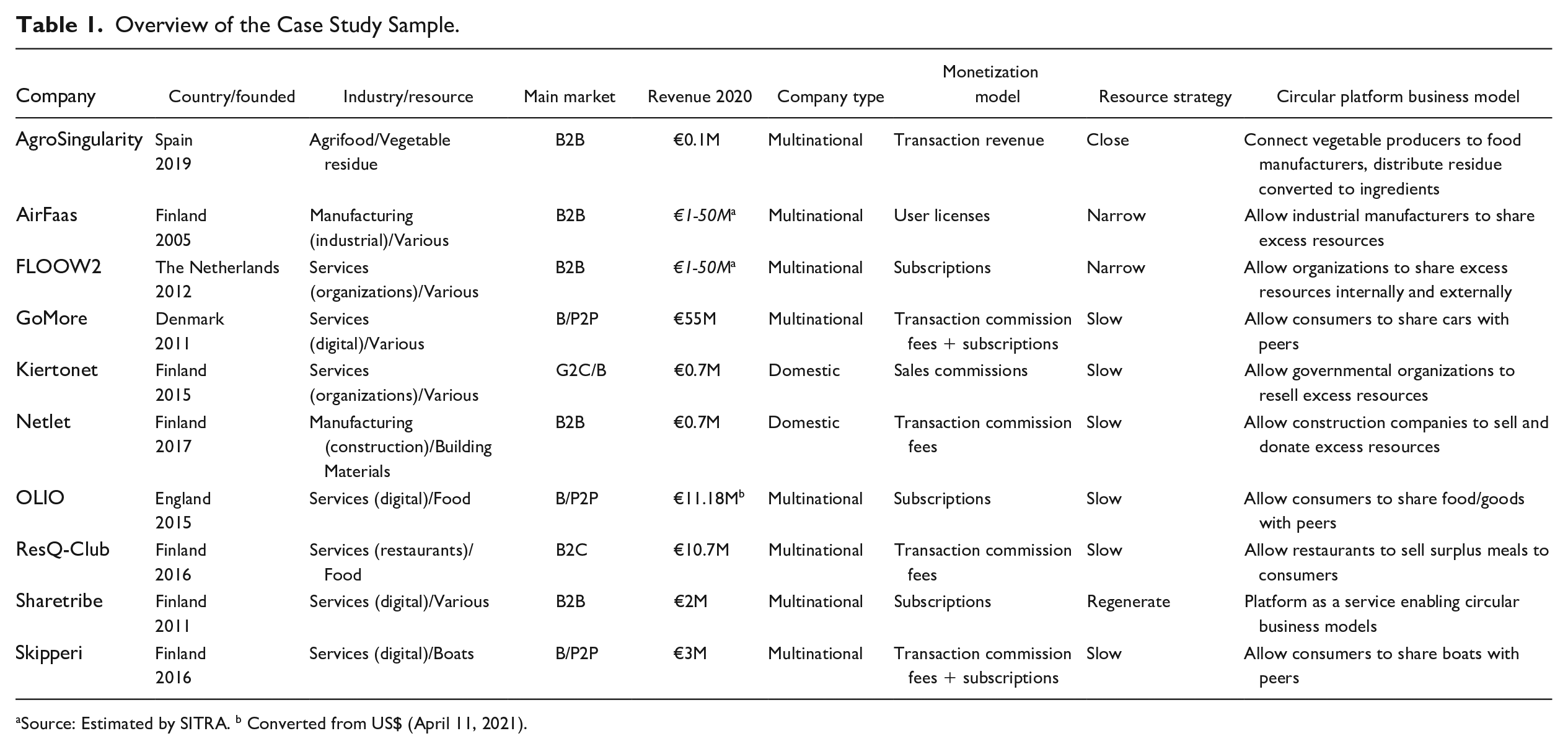
Source: Estimated by SITRA. b Converted from US$ (April 11, 2021).
Unlike previous platform studies focused on a single resource or industry (e.g., Ciulli et al., 2020; Konietzko et al., 2020), our sample enabled us to compile empirical insights across industries, thus increasing the diversity, richness, and potential novelty of the findings and emergent theory (Eisenhardt & Graebner, 2007).
Data Collection
In line with earlier inductive theory-building approaches (Corbin & Strauss, 2014), we collected data from multiple sources, including interviews, publicly available text documents, and direct observation, to enrich, triangulate, and validate our empirical findings in pursuit of a holistic and nuanced understanding of the studied phenomenon (Piekkari et al., 2010). Using in-depth interviews as our primary method of data collection (Kvale & Brinkmann, 2009), we interviewed founders, co-founders, and/or other top-level decisions makers in each case firm to gain a rich and holistic picture of strategic decisions that determined why and how these firms established and managed their circular platform business (see Table 1).
As part of our inductive research strategy, we developed a broad thematic interview guide, using semi-structured and open-ended questions to allow respondents to raise or elaborate on emerging or unqueried issues as naturally occurring data (Corbin & Strauss, 2014). The interview questions centered on their choice of business model, prerequisites for actor entry to the platform, orchestration, and the benefits and potential externalities generated by the platform (see interview guide in the appendix). All interviews were conducted online using Microsoft Teams and lasted an average of 60 min; they were digitally recorded and subsequently transcribed verbatim, yielding 169 single-spaced pages of text in the 12-point font for analysis.
As secondary data, we referred to the case company websites and externally documented case studies provided by SITRA and the Ellen MacArthur Foundation. During the interviews, it became clear that some of the firms used other social media platforms to interact with and attract more users. To understand this process better, we conducted a brief online search of various social media platforms (Facebook, Instagram, YouTube, and Twitter), an online trust platform (Trustpilot), and e-commerce platforms (Amazon, Tori.fi, and Huutokaupat.com). We also trialed nine of the publicly available P2P and business-to-customer (B2C) platforms to more fully understand exchange and transaction processes from the actors’ perspectives. Along with this rich and diverse sample of secondary data, observations helped us triangulate, verify, and validate the interview data and emerging findings. The data sources used in the study are listed in Table 2.
Overview of Data Collection.
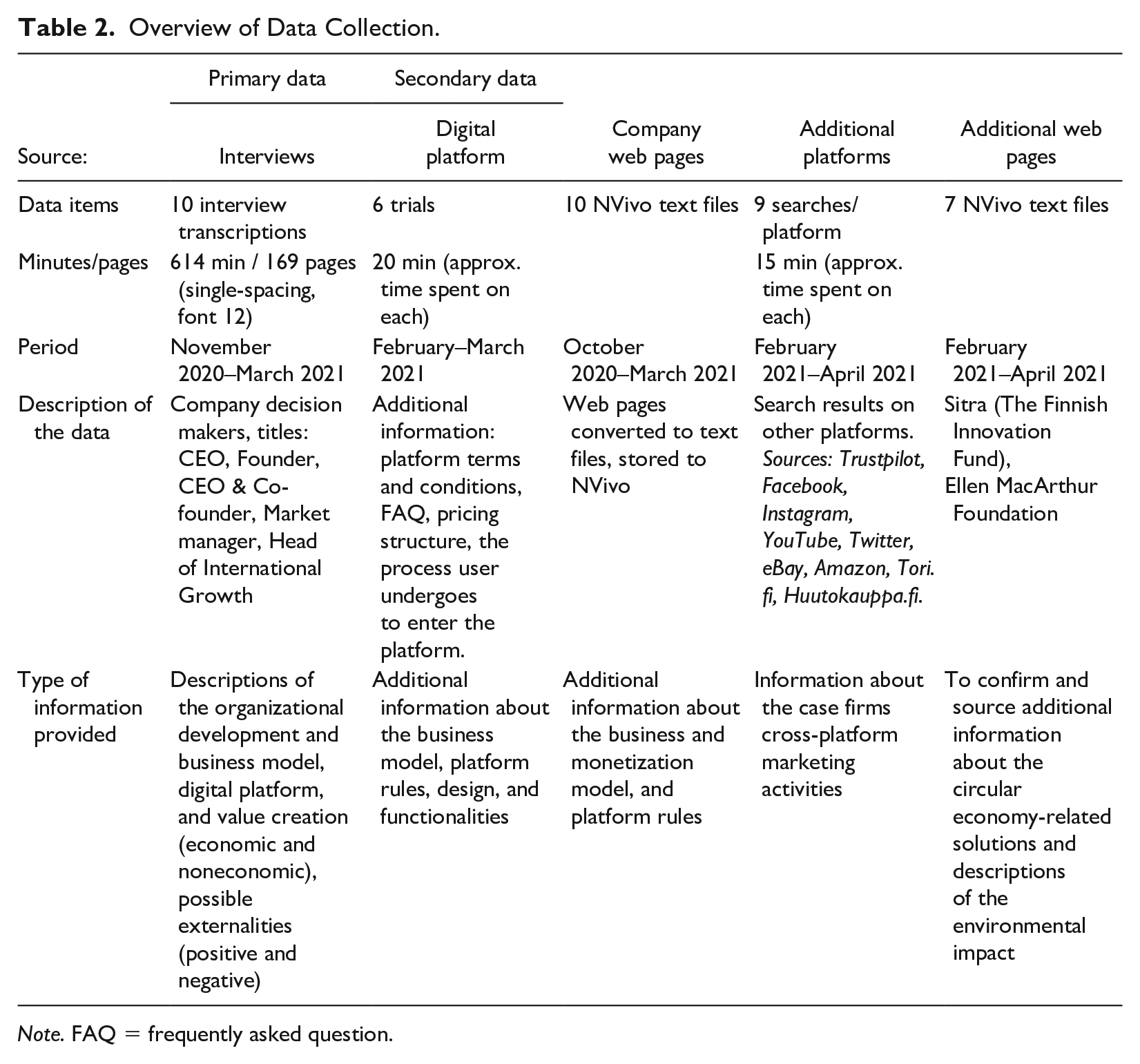
Note. FAQ = frequently asked question.
Data Analysis
In analyzing the data, we sought to capture evidence of any orchestration mechanisms involved in value creation on platforms. We used an inductive coding approach, which is appropriate when building theory from empirical data (Corbin & Strauss, 2014). Given the richness and diversity of our data, we used NVivo software to assist with the coding process, which proceeded in three iterative stages. In the first stage, we used open coding and within-case analysis (Eisenhardt & Graebner, 2007) to identify activities, strategies, and processes that each firm used to orchestrate actors in circular value creation. The first round of open coding yielded a wide-ranging set of initial codes that were then collapsed into first-order codes. Verbs focused on action or activity—that is, on doing something—to create value (Saldana, 2009) were explicitly used to specify the codes (e.g., localizing, matching, supporting). This stage yielded 46 first-order codes.
In the second stage, we used focused and axial coding to organize and group the first-order codes into second-order categories that shared similar characteristics and properties. The emerging second-order categories describe the orchestrators’ strategic choices to manage the business environment, such as bridging gaps in the market, lowering entry barriers, and activating actor participation. Iterative comparisons of the raw interview data, emerging findings, initial coding, relevant literature, secondary data sources, and our analytical memos continued until we were satisfied that we had reached theoretical saturation (Corbin & Strauss, 2014). To bolster our axial coding, we referred to secondary data in the form of company websites and memos of platform trials. Following repeated iterative coding using NVivo, we reduced the 46 first-order codes to a final set of 13 second-order categories.
After saturation was reached, the third stage involved the use of selective coding to systematically investigate the relationships between the emerging categories and their linkages to circular value creation (Saldana, 2009). Based on the 13 second-order categories, we abstracted five key mechanisms by examining the relationships between strategic choices linked directly or indirectly to circular value creation. Figure 1 indicates the final data structure following the selective coding phase.
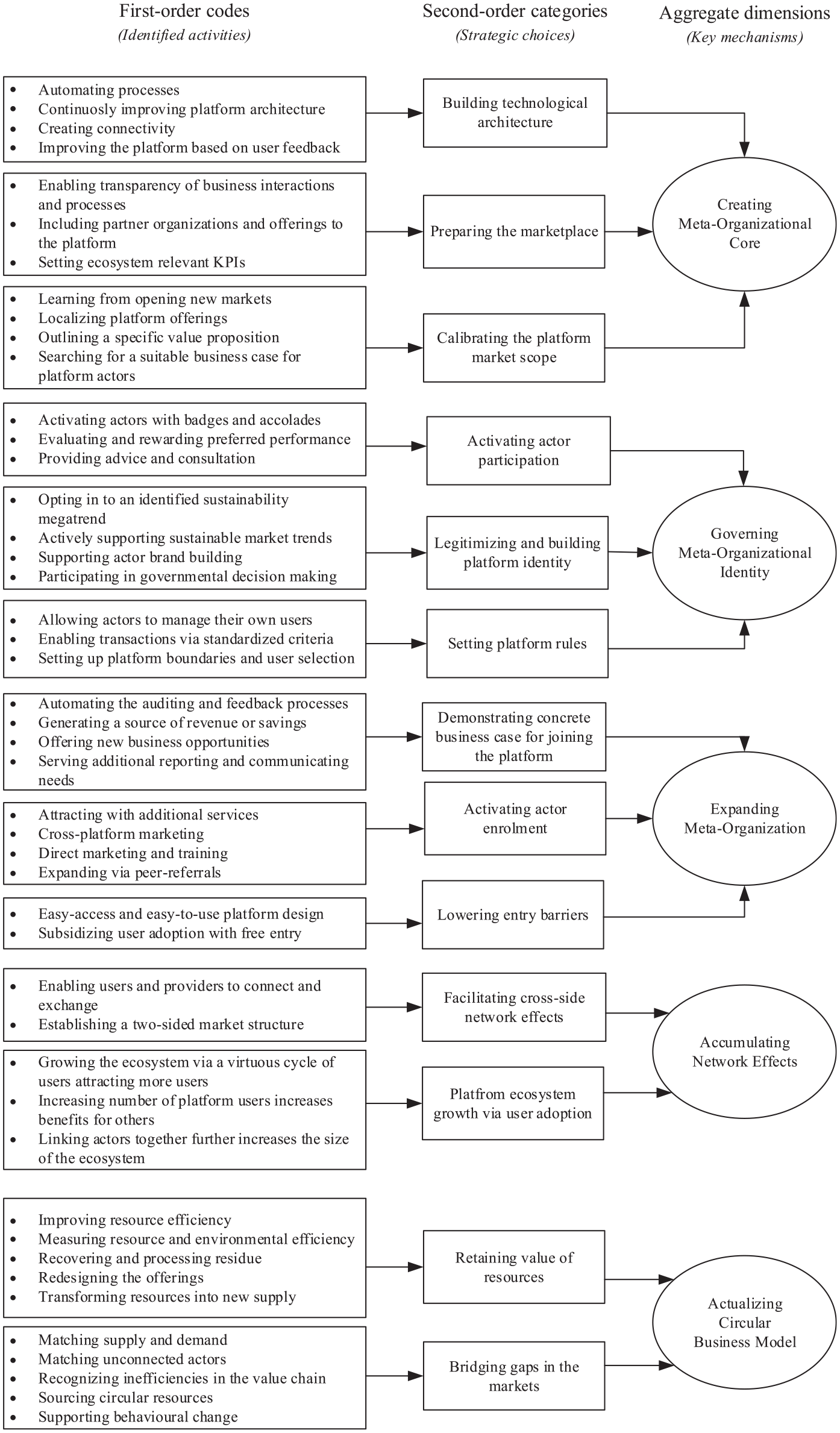
Final Data Structure.
Our memos show that we had already noted coherent connections between the categories and key mechanisms during the axial coding phase. These notes helped us develop a grounded model of meta-organizational orchestration mechanisms in circular value creation to explain the relationships between the five key mechanisms. The model was modified multiple times, debated, and discussed by the research group members and reflected against each case company to increase the trustworthiness of our findings.
Findings
The cases include platforms orchestrated by for-profit firms in sectors such as agri-foods, construction, and transportation. All interviewees mentioned that their strategy involves upscaling, which affects all decisions from business model development to technological architecture and orchestration methods. Our data analysis resulted in five key mechanisms that were used to develop an empirically grounded orchestration model of meta-organizational value creation in platform-enabled CBMs (Figure 2). The first three key orchestration mechanisms are characterized as enabling while the remaining two are described as realizing among the platform-enabled CBMs. The model also illustrates the role of dynamic feedback in enhancing positive network effects by improving and stabilizing circular value creation.
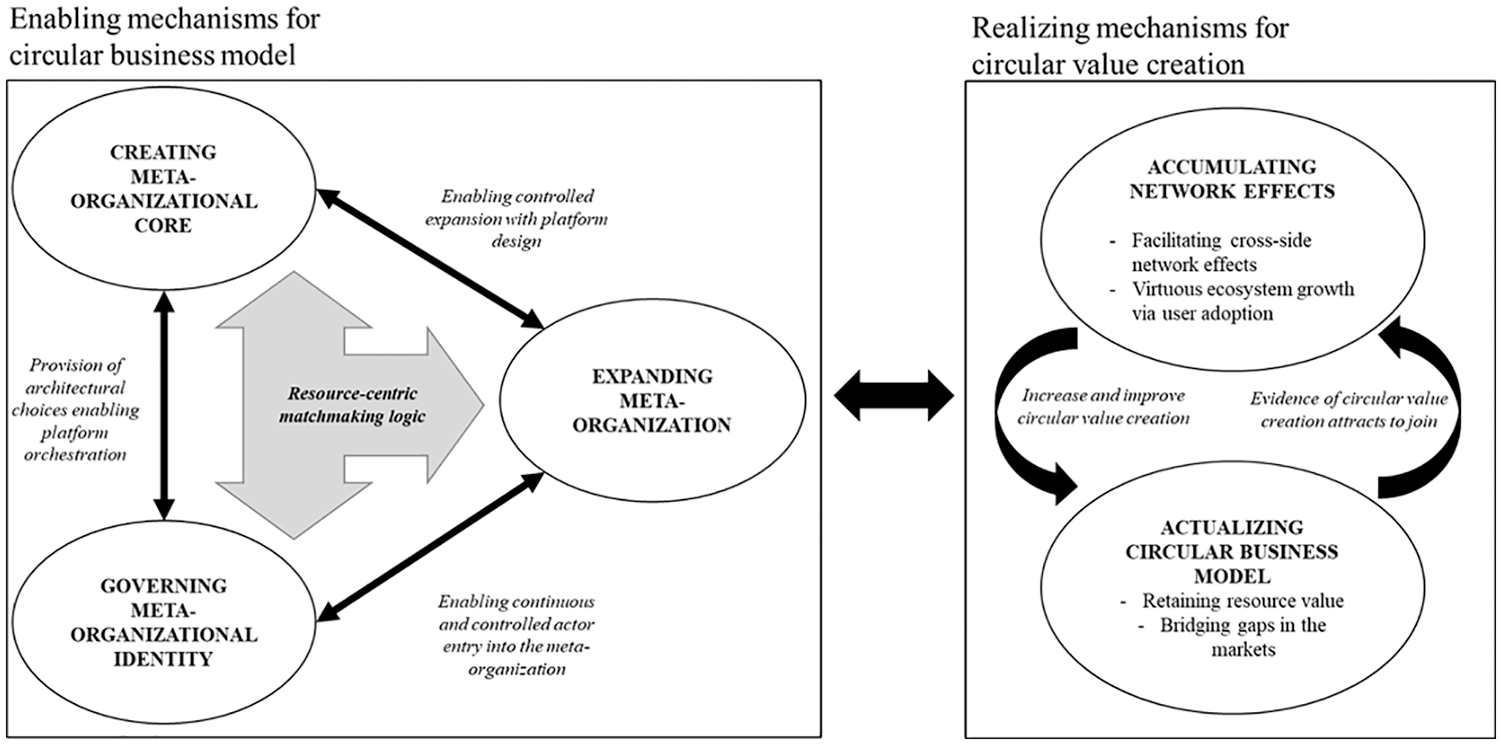
A Grounded Model of Meta-Organizational Orchestration Mechanisms Enabling Circular Value Creation.
Creating the Meta-Organizational Core
Creating the meta-organizational core refers to orchestrator-led activities that stabilize the meta-organization and—combined with other enabling activities—ensure controlled platform expansion and orchestration to enable circular value creation. To create the core, the orchestrator comprises a bundle of activities to establish the technological architecture, prepare the marketplace, and calibrate the platform’s market scope. These efforts facilitate economic and circular value creation. The platform orchestrator facilitates matching and frictionless transactions between the resource owner and markets by aligning the technological design with platform actors’ digital systems and business networks. This supports the orchestration and governance of elements such as supply and demand, monetary transactions, knowledge transfer, actor behavior, and upscaling (see Table 3 for selected quotes).
Selected Evidence: Creating Meta-Organizational Core.
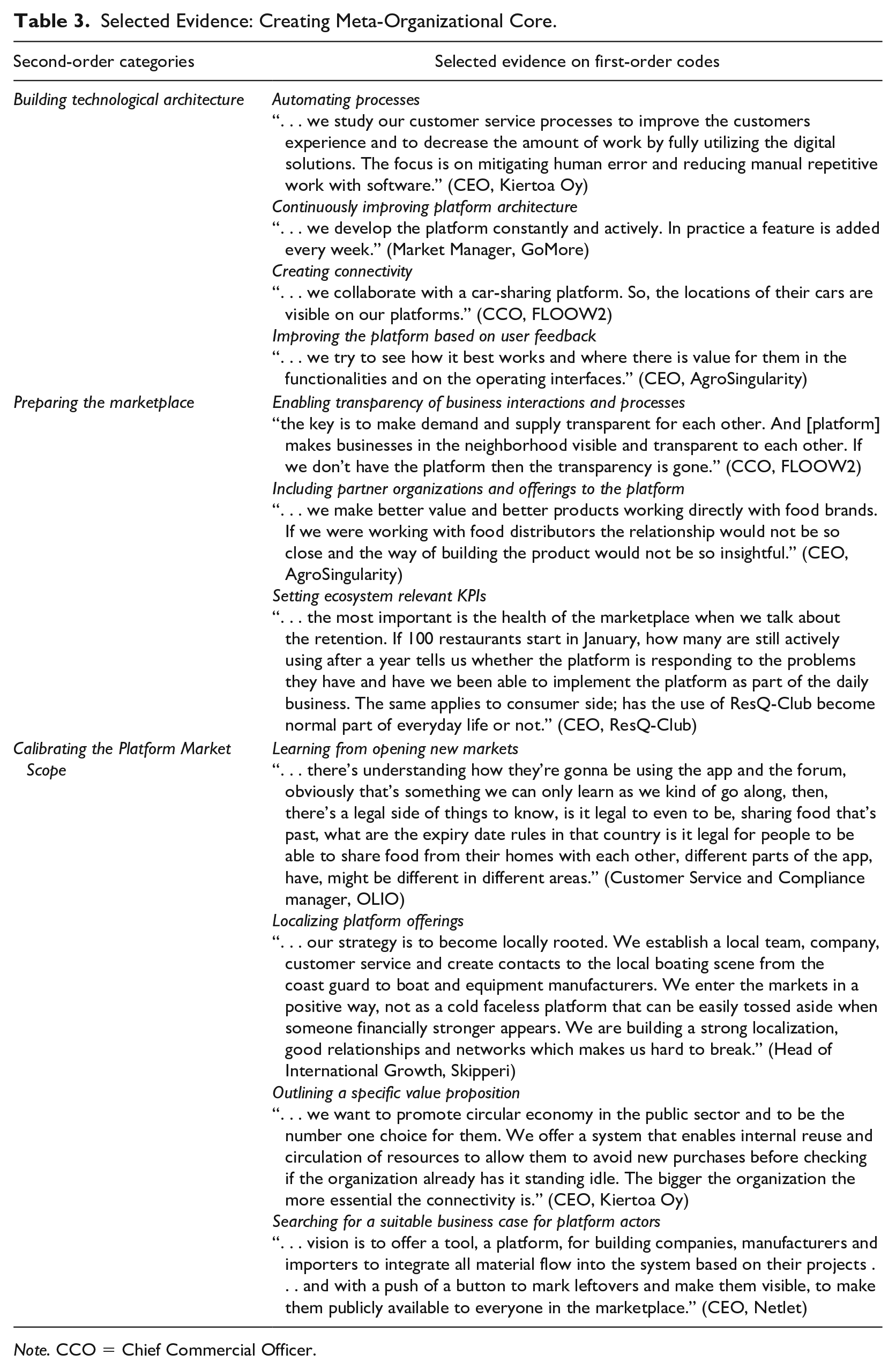
Note. CCO = Chief Commercial Officer.
Building the technological architecture is guided by the business model with continuous feedback and performance monitoring: “[Actors] can contact our customer service, customer experience and product teams online 24/7” (CEO, AgroSingularity). The rapidity of development and service response reflects a commitment to customer retention to stabilize the meta-organization. This sometimes requires adjusting and improving the architecture for new markets, as described by a market manager from GoMore: “In the first two months my role was to localize the platform.” Enabling constant and open accessibility requires automating processes and marketplace functions; it is particularly important to track supply and demand. All interviewees confirmed that their firm used various levels of automation for repetitive tasks to enable rapid transactions and high supply availability. Beyond basic marketplace functions such as viewing products and payments, automation is used to engage actors in providing a steady flow of supply—“logging [resource sharing reminders] onto [actors’] calendars makes it easier for them” (Customer Service and Compliance Manager, OLIO)—and to reduce friction in accessing the products and services: “We have an app to book the boat and you don’t need to see anyone” (Head of International Growth, Skipperi).
Preparing the Marketplace
To enable efficient markets, between-actor boundaries are delimited. This is facilitated by efficiently matching actors (i.e., supply and demand) that would not otherwise have any direct interaction: “Firms get to know each other because they start to share parking spaces, meeting rooms, or storage” (Chief Commercial Officer [CCO], FLOOW2). This controlled, low-barrier, between-actor transparency is constructed to benefit both sides and has already resulted in further collaboration “and innovation between organizations” (CCO, FLOOW2). In addition, the orchestrator facilitates information sharing to improve transparency and trust: “There are major opportunities regarding what [e.g., product information] can be introduced and made visible online” (CEO, ResQ Club). Transparency is expected and enabled by the meta-organization. Orchestrating P2P feedback and forms of reporting also includes tracking a number of market performance indicators: We invest heavily in marketing and following our platform performance. . . We investigate what activities are bringing back to us: what actors are doing on the site, where they are coming from, how much time they spend there, and whether their visit makes any money for us; . . . these performance indicators strongly guide us. (Head of International Growth, Skipperi).
Calibrating Platform Market Scope
This involves market-specific decisions related to transactions and exchange with specific circular resources. New market entries are orchestrated by localizing the platform and, in some cases, the entire business model. This facilitates engaged market adoption and reduces the risk of business withdrawal from markets. Orchestration mechanisms may include modification of the platform business model on a country-by-country basis (i.e., localizing) in line with various business model regulations: “We need to ultimately find out what the local rules are for selling food from your home” (Customer Service and Compliance Manager, OLIO).
Beyond its economic impact, localizing the platform may create a positive social impact that adds to the stickiness in the markets: “We reinforce local economies in terms of employment, not only in the agri-food industry but also in the canned foods industry” (CEO, AgroSingularity). Localization also forces development to overcome various internal and external challenges: “During the heavy international growth phase, we faced issues with our underdeveloped organizational structure and communication” (CEO, ResQ Club). Another interviewee agreed, “Just watching how people end up using the app, we found that . . . people were listing [and sharing] their pets, which is against our rules” (Customer Service and Compliance Manager, OLIO).
Governing Meta-Organizational Identity
Governing meta-organizational identity refers to the strategic choices platform orchestrator uses to activate participation, legitimize and build platform identity (Cennamo, 2021; Thomas & Ritala, 2022), and set relevant platform rules to enable circular value creation. In governing platform identity, the orchestrator deploys structural design to coordinate the meta-organization, based on system-level goals specific to the markets in which the platform operates (see Table 4 for selected quotes). The strategic choices in this key mechanism govern the platform and—with other enabling activities—ensure orchestration and continuous and controlled actor entry into the meta-organization.
Selected Evidence: Governing Meta-Organizational Identity.
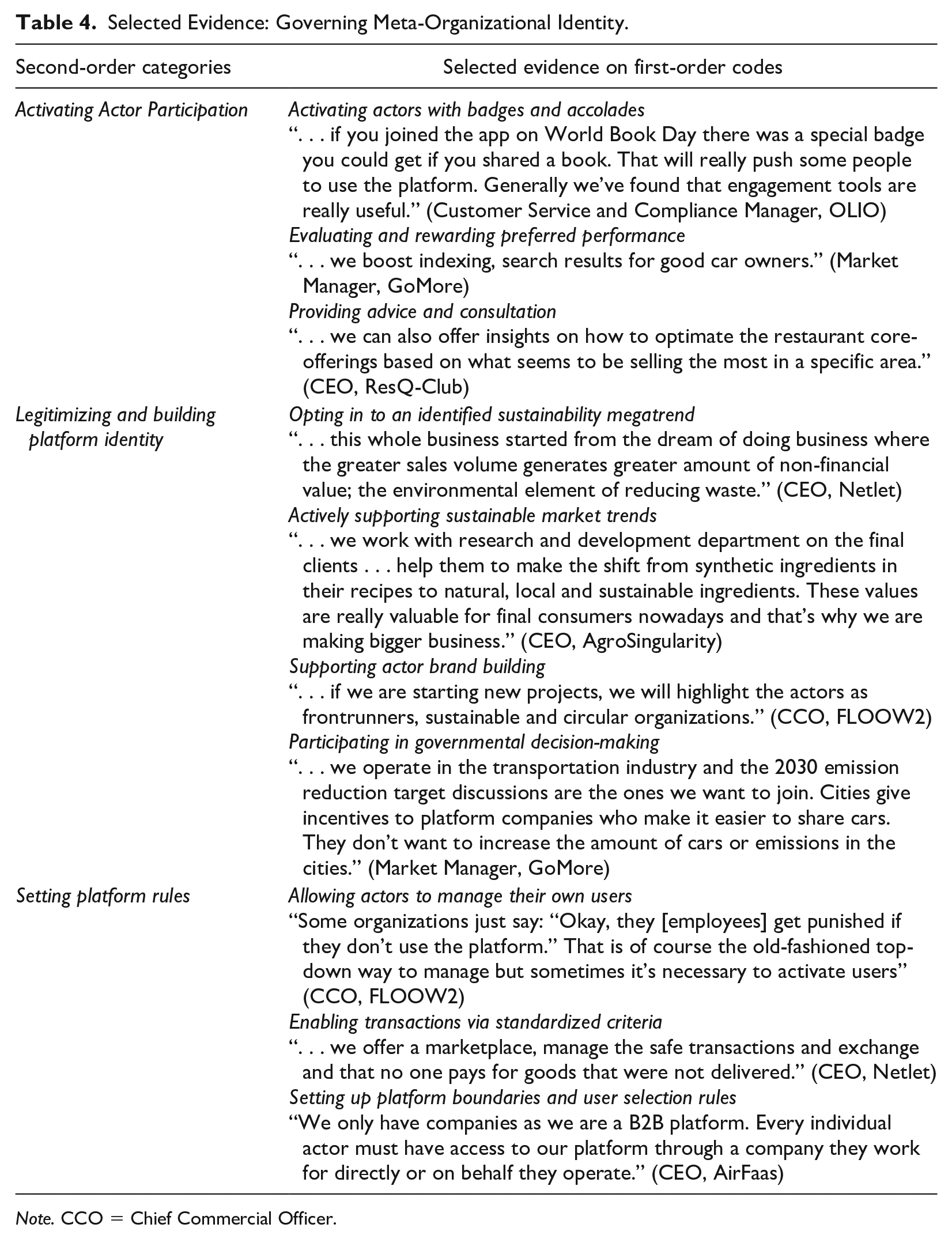
Note. CCO = Chief Commercial Officer.
Activating Actor Participation
The orchestrator seeks to motivate behaviors that improve the performance and reliability of exchange and transactions, the two main market activities facilitated by the platform (e.g., Henry et al., 2020). This involves tangible acknowledgments of valued actor behaviors but may also include penalties. One interviewee described “an internal sharing platform, and the director said. . . ‘you first need to use that if you need something new—or if something is standing idle or left in the closet, then you need to place it online.’ And if you don’t, you get fewer points” (CCO, FLOOW2). The orchestrator may also advise and consult on ways of enhancing an actor’s performance. Using platform data to generate insights and recommendations, the orchestrator’s intention is to nudge actors in the preferred direction regarding system-level goals. These mechanisms help to improve and maintain the desired level of platform performance, as, for instance, by identifying the optimal market price for the resource: “The owner decides the price, but we suggest a suitable price for the day based on a broad set of data we collect from the internet” (Market Manager, GoMore). This can also be achieved by directing more resources toward markets during periods of high demand by “encouraging them at the right moment. . . to make sure that somebody lists items” (Customer Service and Compliance Manager, OLIO) and by optimizing the actor’s offerings: “We inform actors how to optimize their offerings by comparing their products to what actually sells the most in the area [or within their organization]” (CEO, ResQ Club). Other mechanisms include educating during onboarding: “We consult [public sector] organizations on how they manage to circulate their resources” (CEO, Kiertoa Oy).
Legitimizing and building platform identity involves active exploitation of platform- and sustainability-related market trends to contribute to circular platform innovation. Regulatory changes indicate a growing demand for CBM innovation: “the circular economy is a rising trend and showing these types of concrete business cases leads to the constant emergence of new ideas around the world” (CEO, ResQ Club). Indeed, orchestrators monitor markets for innovation to attract new actors into the meta-organization. The platform’s identity is linked to how it activates transactions to reinforce actors’ own identities through sustainability branding. For example, AgroSingularity actively seeks to support food manufacturers’ brand development by enabling easy access to ingredients that are more affordable, circular, and natural rather than synthetic. In OLIO’s case, actors identify as sustainability advocates, so personal branding drives the same cause as in the B2B case: “For some people, the public acknowledgment will really push them to action and to use the platform” (Customer Service and Compliance Manager, OLIO). FLOOW2 takes things a step further by providing support for actors’ branding with content marketing services. These activities reinforce a meta-organization’s role in the markets, as decision makers drive sustainable development and are open to engaging with CBMs. The GoMore interviewee mentioned that cities incentivize firms committed to solving environmental problems. As well as becoming more influential, platforms may seek to expand by exploiting opportunities afforded by governmental networks: “We work together with the local municipality, and they help us to communicate to the businesses that there is a new platform” (CCO, FLOOW2).
Setting Platform Rules
As invisible internal and external regulatory boundaries, platform rules prohibit some activities and nudge toward purposeful ones, typically transactions. These rules serve various purposes, including limiting platform actors’ access to the meta-organization and its information, thus moderating and monitoring interactions and knowledge transfer. One interviewee said that “we have automated technology to evaluate the suitability of a specific person to make transactions on our platform” (Market Manager, GoMore). Some organizations add internal rules: “Organization leaders just say okay, our staff gets punished if they don’t use the platform” (CCO, FLOOW2). This relates to management practices within a hierarchical, contract-based organization to ensure, for instance, that employees act to reduce costs and meet specified recycling rates. Platform orchestrators impose restrictions such as denying entry or punishments like loss of reputation if platform rules are violated; the platform’s technological architecture and algorithmic management are typically designed to automatically detect, report, and prevent such activities (e.g., Möhlmann et al., 2020).
Expanding the Meta-Organization
Expanding the meta-organization refers to orchestrator-led activities in scaling up the platform size and the size of the overall ecosystem built on the platform. To expand the meta-organization, the orchestrator activates actor enrollment in a variety of ways, demonstrates concrete business cases for joining the platform, and pursues to lower the barriers to entry (see Table 5 for selected quotes). These strategic choices help scale up the meta-organization and, with the other two identified key enabling mechanisms, ensure continuous and controlled expansion and actor entry into the meta-organization, in the end contributing to circular value creation.
Selected Evidence: Expanding the Meta-Organization.
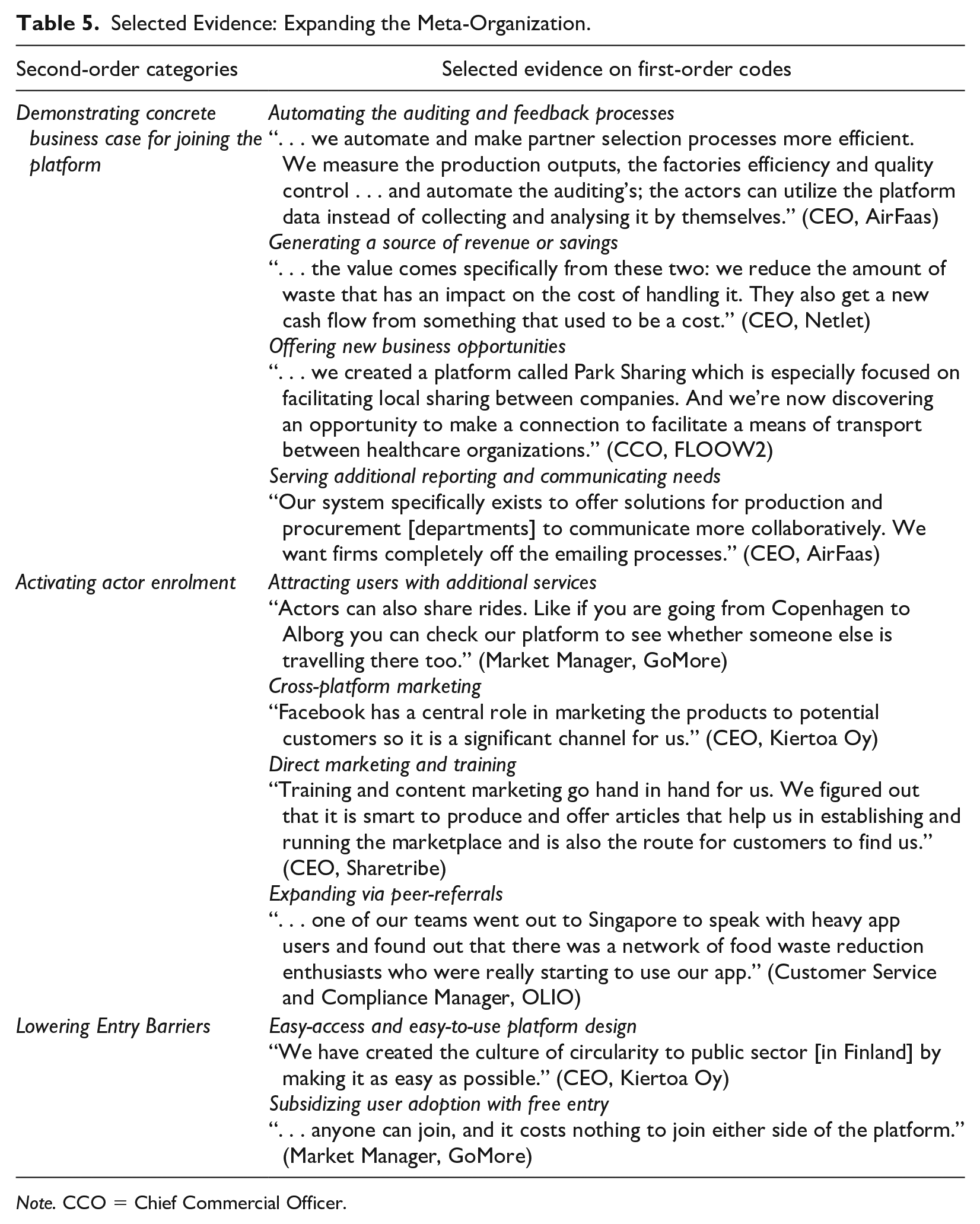
Note. CCO = Chief Commercial Officer.
Demonstrating a Concrete Business Case for Joining the Platform
Potential economic benefits that are often linked to resource efficiency are likely the most obvious reason for actors to join a platform. Economic incentives are typically available for all actors: “They can save costs because they don’t need to invest in new equipment. . . Or they can create additional turnover by sharing the forklift, the company van, or the parking spaces that are sitting idle” (CCO, FLOOW2). The resource-centric approach offers opportunities for a new business model and service development: “An external company handles the boat handover. . . A firm that developed mobile services takes care of the annual maintenance of the fleet” (Head of International Growth, Skipperi). Automated feedback and auditing processes enable the platform to establish its reliability, build internal trust, and stabilize growth. The orchestrator facilitates and automates knowledge and value transfer activities between actors, including generating insights for traceability—“We do the traceability for food security” (CEO, AgroSingularity)—managing the quality of platform resources and offerings—“In Finnish markets, a shared car can only be 15 years old and have been driven a maximum of 250,000 km” (Market Manager, GoMore), or helping actors to select preferred suppliers or partners: “The platform enables feedback flows as one important way of encouraging our actors to go to the right place” (CEO, ResQ Club). The orchestrator seeks to generate additional value with data used for actors’ reporting and communication needs: “One of our value propositions for actors’ internal use was to provide statistics of the circulation of used goods and shared rides to calculate the carbon dioxide reduction figure” (CEO, Sharetribe). Platform data are used for external reporting: “We plan to offer a reduced model of reporting when excess resources come through us” (CEO, Netlet).
Activating Actor Enrolment
Attracting more actors involves a variety of activities. One interviewee explained that some orchestrators may amplify the enrolment process: “They can purchase the resource photography and [platform] ad writing from us as a turnkey service” (CEO, Kiertoa Oy). Cross-platform marketing, as in the use of social media platforms, is a strategy used by B2C and P2P platforms: “We’ve always found Facebook marketing to be our most useful and probably the best value tool” (Customer Service and Compliance Manager, OLIO). Another interviewee highlighted how actors “ask questions and reply to each other, which saves time for our customer service” (Head of International Growth, Skipperi). Strictly B2B platforms, on the contrary, are more focused on direct contact and tailoring. One interviewee said that “we are often presenting at actors’ sites, remotely or on the phone” (CEO, AirFaas). Orchestrators seek to understand organizations’ needs; for example, some may require a closer, contract-based relationship with suitable technological architecture and organization-specific rules and boundaries. One of the most intensive enrolment activities is training, which one interviewee cited as a new business opportunity: “We have a new business model, an academy, providing us with a new stream of revenue” (Head of International Growth, Skipperi). Expanding by rewarding peer referrals is common practice: “By inviting your friend, you can earn ResQ credits which you can use to save leftover food” (CEO, ResQ Club). On the contrary, B2B platforms gain more by expanding through existing business networks; as one interviewee explained, “organizations can use the platform [to engage] with all their business network partners in addition to all other actors in the platform ecosystem” (CEO, AirFaas).
Lowering Entry Barriers
Easy access and usability and subsidized user adoption through free entry are commonly used mechanisms for lowering barriers to entry and facilitating platform growth. One such method involves integrating the platform with existing systems for efficiency because this means companies “can use a single sign-in. . . and when companies do the transactions through the platform, it also produces invoices that companies can use for their administration” (CCO, FLOOW2). Interviewees also mentioned ease of use and market access for excess resources: “With a couple of clicks, they can announce excess materials that need to be moved” (CEO, Netlet). Easy access is also important for the buyer or demand side of the platform and is enabled by automated processes: “You don’t need to see anyone; you can go when it pleases you. The easiness of boating has been taken to a level that makes the traditional renting process look very clumsy” (Head of International Growth, Skipperi). Depending on the strategy and meta-organizational growth phase, the orchestrator may decide to subsidize access to one or all sides of the platform. In B2B markets, the (actor) organization’s internal users may be granted free entry: “Those who come into the system only to perform given tasks. . . are granted free entry” (CEO, AirFaas). On consumer platforms, free entry for both sides is a common practice.
Accumulating Network Effects
Accumulating network effects refers to two groups of strategic choices facilitating same- and cross-side network effects and user adoption to expand the meta-organization. In an active meta-organization, network effects can affect the attainment of system-level goals by increasing the value offered by the platform; for example, a higher volume of supply may increase demand (Carnahan et al., 2015). In this way, accumulating network effects plays a specific role in the orchestrator’s efforts to realize circular value creation (see Table 6 for relevant quotes).
Selected Evidence: Accumulating Network Effects.
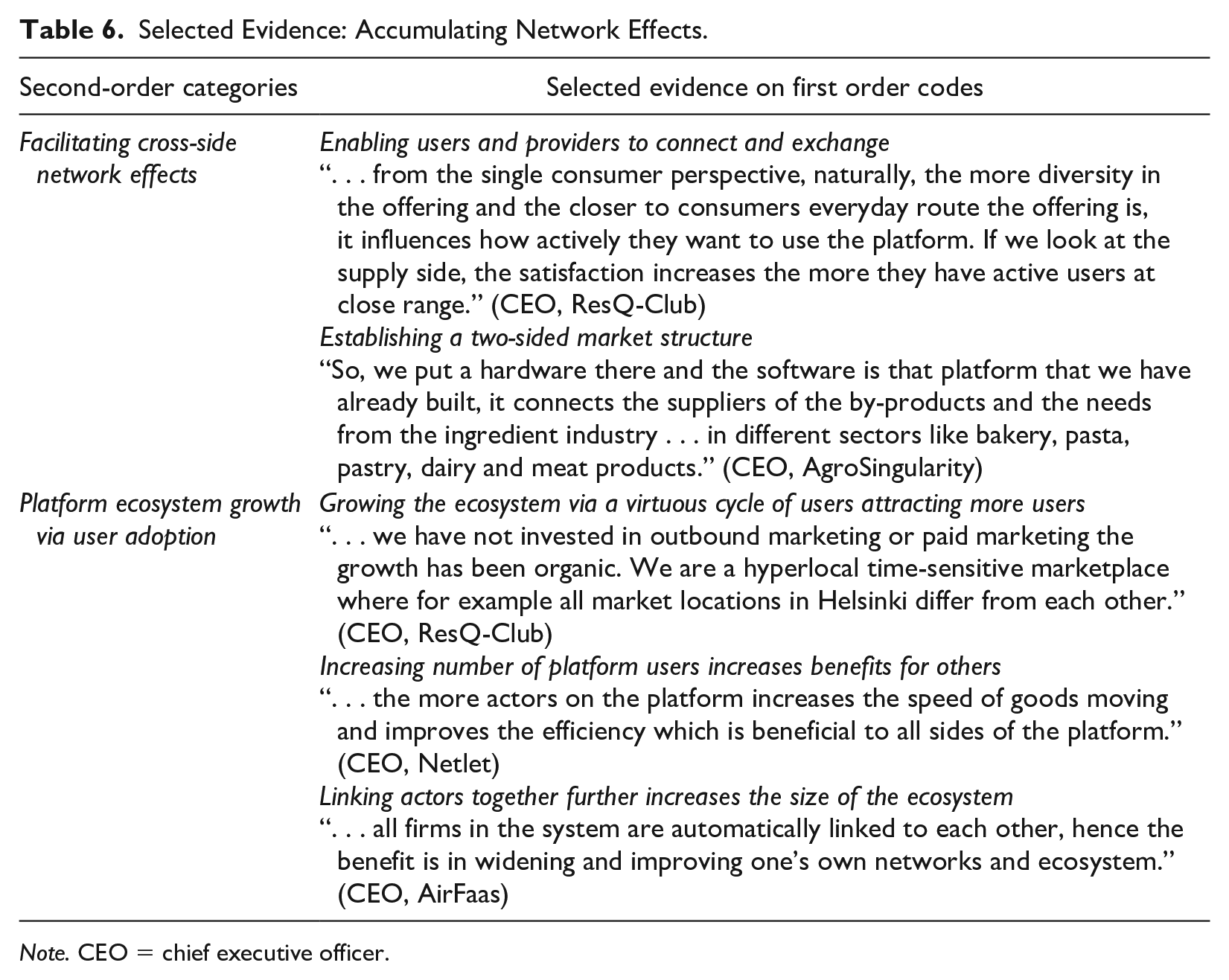
Note. CEO = chief executive officer.
Facilitating Cross-Side Network Effects
The orchestrator establishes a two-sided market structure that encourages diversity and volume of resource supply and increases the demand. In cases like AgroSingularity, the orchestrator first establishes the entire market in pursuit of positive cross-side network effects. In addition to finding new actors and activating enrollment, existing actors can take roles on both sides of the platform by securing the availability of supply and further activating the meta-organization: “They are both users and suppliers on the platform and can choose the role whether to rent someone else’s car or to rent out their own” (Market Manager, GoMore). When supply intake is uncertain because of an unsteady flow of resources to markets, the meta-organizational core may seek to encourage proactivity, as when “organizations can leave procurement notices on the platform in advance. That helps to find and match them with excess resource holders” (CEO, Netlet).
Platform Ecosystem Growth Via User Adoption
The virtuous cycle of more resources and users attracting more actors on the platform is driven by the network effects, whereas the meta-organizational design facilitates increased user adoption. Actors are also adopted from networks as the organizational actors typically operate in large business networks. The platform orchestrator may seek to facilitate growth by finding ways to connect and link (adopt) the network members in an organizations ecosystem: “You can use the platform with all your partners and all the firms inside the platform ecosystem are automatically linked to each other” (CEO, AirFaas). This potentially benefits the whole ecosystem in addition to growing the meta-organization in size.
Actualizing Circular Business Model
Actualizing CBM refers to an array of activities in the focal (meta-)organization’s business model that involves processes for retaining the value of resources (e.g., improving resource efficiency) and bridging gaps in the markets (e.g., matching supply and demand and supporting consumer behavioral change). The findings suggest that together with the accumulating network effects, it has a role in realizing and possibly increasing the circular value creation (see Table 7 for selected quotes).
Selected Evidence: Actualizing Circular Business Model.
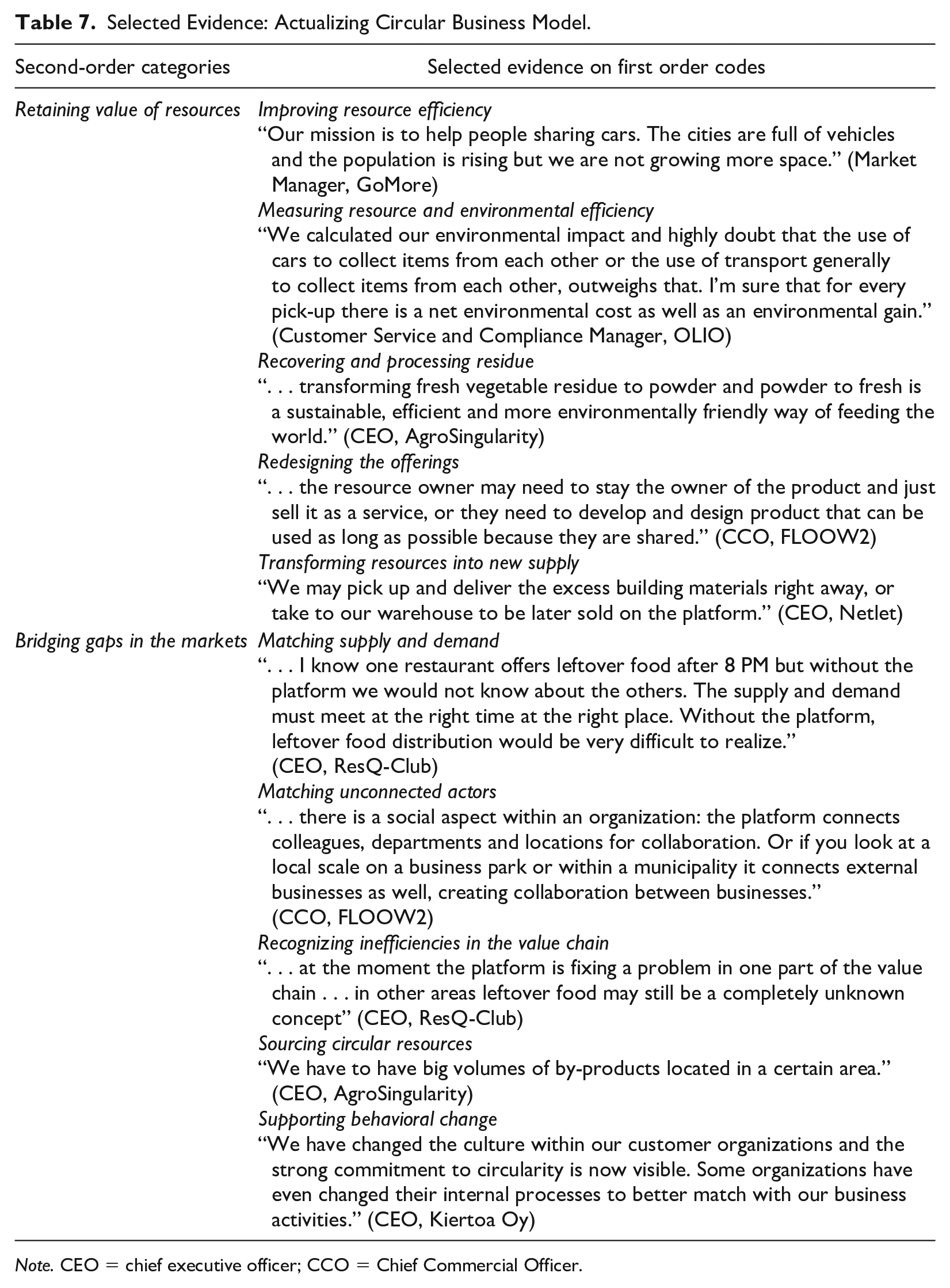
Note. CEO = chief executive officer; CCO = Chief Commercial Officer.
Retaining the Value of Resources
The platform-based CBMs facilitate transactions and exchanges of excess resources that are difficult to access or have little or no demand in the markets. Resources may also have quality or usability issues and, as a result, have very little or no value for the owner. Within our case firms, the circulated resources ranged from industrial process residue to food waste, from motorized vehicles standing idle, to manufactured products and services. Depending on the resource and the CBM, retaining the value may require additional industrial processing, redesigning, adding supply chains, and warehousing. For example, AgroSingularity transforms the vegetable industry’s residue into a new supply for food manufacturers. Also, new services might be added to complement the business model: GoMore improves private car efficiency by allowing sharing while offering invoicing and actor identification services and Netlet offers delivery services. Fundamentally, these additional processes and services help to further define the economic and noneconomic value resources produce and, in the end, help determine the viability of the CBM.
Across our cases, the platform orchestrator owns and manages the reprocessing and maintenance when the resource is provided as a service. In the case of the sharing-based CBMs, the platform does not seek the ownership of the resource but acts as a broker capturing its share of the value created during the transaction and exchange. The strategic position over resource ownership may evolve, for example, Skipperi started as a P2P boat sharing platform but has now a fleet of its own to meet the fast-growing demand.
Bridging Gaps in Markets
When sourcing potential supply for a platform-enabled CBM, the orchestrator typically seeks to identify inefficiencies in the supply chains, value networks, and markets. For example, the inefficiencies may relate to an underdeveloped waste handling processes in a specific industry. For example, identified excess resource may not have enough demand within their immediate operating area, but the platform enables matching of those resources within broader range of actors or within a broader geographical scope (like in the cases AgroSingularity and ResQ-Club). There may also be inefficiencies in the resource use and expensive vehicles standing idle long periods of time (like in the cases AirFaas, FLOOW2, and GoMore). After understanding the inefficiencies and mapping the excess resources and materials potential in the markets, the orchestrator can design the solution by using platform technology to bring the supply, demand, complementors, and other actors into an ecosystem.
CBMs may also seek to change organizational behavior to bridge the gaps. For example, Kiertoa Oy has had an impact on the public-sector organizations processes and organizational culture by introducing them a new source of value. For the Kiertoa Oy customers, a former waste and cost unit has become a new source of income and the organizations are modifying their systems to meet the technical requirements and setting rules to force circular behavior throughout their organization.
Discussion
A Grounded Model of Meta-Organizational Orchestration Mechanisms
In this section, we develop an empirically grounded model explaining how the focal firm orchestrates value creation with a platform-based circular business model. We do this by explaining the relationships between the five meta-organizational orchestration mechanisms (Figure 2). These mechanisms represent the shared, higher-order organizing mechanisms that were apparent in our case data, and for this reason, we use them as building blocks for the model, although specific activities and practices vary from case to case.
The established meta-organizational structure involves the focal orchestrator with a loosely coupled network of actors (Gulati et al., 2012; Netter et al., 2019) forming the meta-organizational identity of the platform ecosystem (Thomas & Ritala, 2022). The meta-organization is structured around the internal logic of the CBM, on which the orchestrator drives the overall ecosystem of platform actors.
Enabling Mechanisms for the Circular Business Model
The first three mechanisms create the meta-organizational core, expand the meta-organization, and govern the meta-organizational identity. The creation of a meta-organizational core involves setting up the platform architecture that allows matching and curating resources aligned with the circular resource strategy of a given CBM. A closely related mechanism, the expansion of the meta-organization, takes place through a variety of platform design choices enabling the CBM. Governing meta-organizational identity supports both processes by helping to make the architectural choices about the platform scope, such as which types of actors will be involved with the platform (Cennamo, 2021), and by enabling continuous and controlled actor entry into the meta-organization by making it attractive for new actors to join; again, identity plays an important role here. These three mechanisms involve elements like platform openness, control, and actor entry (e.g., Tura et al., 2018; Wareham et al., 2014) forming together the activities enabling the CBM.
This technology-controlled structure with an ecosystem-based identity is fundamentally built around a strategic logic that we call “resource-centric matchmaking,” in which the platform orchestrator makes deliberate choices about the core of the meta-organization, the mechanisms to expand it with new actors, and the identity of the meta-organization. The three orchestration mechanisms are based on this logic, with the platform orchestrator making deliberate choices about the core of the meta-organization, the mechanisms to expand it with new actors, and the identity of the meta-organization. As our cases demonstrate, matchmaking takes place in multiple ways, including brokering (Ciulli et al., 2020) and providing various means to facilitate reusing, reducing, or recycling resources among actors participating in the meta-organization.
Realizing Mechanisms for Circular Value Creation
The accumulation of cross-side network effects may increase the size of the meta-organization and attract more actors to join (Cennamo, 2021; Parker et al., 2016, p. 66). Simultaneously, actualizing CBM supports the economic and noneconomic value creation leading to resource value retention and market gap bridging (Ciulli et al., 2020). In a platform-based CBM, the focal firm creates economic value for itself by orchestrating a marketplace and an ecosystem of actors that allows the resource owner as well as the new customer benefit from the retained value of the resource.
Between the two mechanisms, accumulating network effects and actualizing CBM, we identified a self-perpetuating virtuous cycle that works as a feedback loop accelerating the growth and value creation of the meta-organization. In this study, the evidence from the selected platform-enabled CBMs indicates that network effects strengthen the platform’s market position by attracting more actors, thus potentially resulting in a greater value creation and circularity. As the platform grows and network effects accumulate, value creation opportunities may grow even stronger.
To summarize the model, we first identified platform-enabled CBMs’ resource-centric matchmaking logic, which is enabled by three key orchestration mechanisms. The meta-organizational core is structured around a chosen resource strategy, expansion around scaling up that strategy, and meta-organizational identity that is carefully governed to attract participants who will act in alignment with the strategy. Then, circular value creation is realized through an operational business model and growth of the meta-organization linked with the feedback loop. We argue that circular value creation may increase due to meta-organizational growth as the evidence of circular value creation attracts more actors to join the platform.
Research Implications
By adopting a meta-organizational perspective (Kretschmer et al., 2020), we can explain how and why digital platforms can generally be understood as a distinct form of organizing. The findings in the present study show how the new systemic logic introduced by CBMs and the CE reconfigures the expectations of platform orchestrators, challenging existing accounts focused solely on economic logic by calling for a more overarching approach to value creation (Ritala et al., 2021; Schaltegger et al., 2016). As a meta-organization, a CE-oriented platform involves a system-level goal (Gulati et al., 2012) that reduces resource use or retains resource value, as with ResQ Club and circulating leftover lunch food, while also addressing the economic and other motivations of platform users, as when ResQ Club members receive food at a discount and based on their preferences. A fuller understanding of these issues enables us to view platforms that operate on CE principles as both a distinct and new form of organizing (Puranam et al., 2014). The existing literature offers some preliminary evidence of this by discussing how digital platforms enable circularity brokering (Ciulli et al., 2020) and extend the range of CBMs (Bocken & Ritala, 2022; Konietzko et al., 2020). Against this background, we contend that digital platforms can facilitate new economic and technological architectures for organizing transactions and interactions in pursuit of greater circular value creation. Below, we discuss the implications of these findings, first in the light of platform literature and then from the perspective of the CBM literature.
While digital platforms, in general, facilitate coordination of actors and their economic interactions, platforms focusing on circular value creation need to provide additional organizational means of driving these interactions by retaining resource value in a variety of ways. Since digital platforms are focused on minimizing transaction costs and reducing friction in markets (Parker et al., 2016, p. 57), they often end up intensifying the use of resources by increasing economic exchange, as on marketplace platforms like Amazon or eBay. By contrast, platforms oriented toward circular value creation aim to decrease resource use while still addressing the platform users’ motivations and goals. Indeed, our findings from multiple cases suggest that added value is created in CE contexts by turning a resource-related cost into a source of revenue or even profit. This finding links directly to resource owners’ motivation to participate in such transactions. In a generic platform context, Evans and Schmalensee (2016, p. 210) defined platforms as “matchmakers” that enable parties to “productively interact.” While our findings support this view, we suggest that in the context of CBMs and the CE, the platform orchestrator is inevitably a resource-centric matchmaker, centering these productive interactions on efficient transactions in the exchange of excess resources or materials. Such matchmaking can be viewed not only as bridging structural holes in a network of resources (Ciulli et al., 2020) but also as a broader collection of meta-organizational mechanisms that help pursue circular value creation, as demonstrated in our grounded model (see Figure 2). Furthermore, complementing discussions of how platforms harness network effects to create value (Cennamo, 2021; Rietveld & Schilling, 2021), our findings indicate that circular value creation in a platform context is necessarily coupled with network effects. Since network effects act as a growth engine for economic interactions on platforms (McIntyre et al., 2020), they are also required to scale up circular value creation. Our study demonstrates that this scaling up requires the orchestration of both economic and resource interdependencies and flows.
Our findings also contribute to the growing literature on CBMs. Responding to calls in the sustainable business model literature for alternative conceptualizations that look beyond economic value creation (e.g., Bocken et al., 2014; Schaltegger et al., 2016), recent CBM research has addressed the question of how business models can be aligned with CE strategies of reusing, reducing, and recycling resources and closing, slowing, and narrowing loops (Bocken & Ritala, 2022; Geissdoerfer et al., 2018; Lüdeke-Freund et al., 2019). The various typologies, definitions, and categorizations invite further research to specify more exactly how digital platforms orchestrate and facilitate CBMs and circular value creation. For instance, Schwanholz and Leipold (2020) highlighted the neglect of circular value creation mechanisms in the literature on platform-enabled CBMs. Our study helps fill this research gap by addressing this issue and advances our understanding of the mechanisms deployed by platform orchestrators to establish platform ecosystems as self-supporting, meta-organizational structures. The proposed integrative model (Figure 2) offers a useful way of understanding the foundations of platform-based CE business models in relation to two groups of organizing mechanisms. First, the enabling mechanisms include creating the meta-organizational core and expanding the periphery (Rodon Modol & Eaton, 2021) and the crucial role of identity formation (Thomas & Ritala, 2022). Together, these three mechanisms, which are typically facilitated by the orchestrator (i.e., the entity owning or governing the platform), are bundled around the business model logic of resource-centric matchmaking. Among different possible CBMs, this logic aligns particularly well with coordinating resources across organizational boundaries (Bocken & Ritala, 2022; Ciulli et al., 2020). As the demands and ambition for the CE are on the rise, we expect digital platforms to play an increasingly important role in facilitating CBMs where different resources are matched and transacted among different parties. Second, the realizing mechanisms involve scaling up the network effects and circular value creation. These two processes are coupled in interactive feedback, where the network effects and network size enable increasing circular value creation (e.g., when more sources are providing excess resources to the users of the Netlet platform), while evidence of circular value creation attracts new users. Ideally, through such dynamics, digital platforms operating a CBM will be able to scale up the size of the network and thus maximize the potential for circular value creation.
Practical Implications
This study offers three important insights for managers and practitioners. First, the structural stratification of two-sided platforms facilitates the orchestration of lower-tier activities (Gulati et al., 2012). Our meta-organizational perspective will allow platform orchestrators to identify the key building blocks and mechanisms for the strategic construction and management of a functional CBM in the platform context.
Second, our findings show how digital platforms can unlock new CBMs. For example, as a meta-organization grows and expands, it offers new opportunities to develop support services such as maintenance and transportation around excess resources, although these are likely to become profitable only after the platform has attracted a sufficient number of actors. In addition, given that platform-enabled CBMs seek to identify and leverage excess resources and related value chain inefficiencies, the expansion of a meta-organization can help promote novel business models for harnessing and leveraging excess resources on a larger scale.
Third, platform orchestrators need to understand that it is not necessarily profitable or even desirable to attempt to provide all services as part of the platform core. Instead, we suggest that platform orchestrators focus on matching actors and facilitating safe transactions, delegating other noncore activities to other platform partners who can carry them out with greater cost efficiency. This frees the platform orchestrator to drive CBM innovation by actively seeking new actors, which is not directly profitable but enhances the platform core.
Limitations and Future Research
While the present study offers novel and important insights for contemporary CBM research, it has certain limitations that also indicate avenues for future studies. First, our findings regarding meta-organizational orchestration mechanisms are based on an inductive analysis of a limited number of platforms. Future research should extend data collection to complement these findings by identifying other orchestration mechanisms, along with antecedents, contingencies, and potential outcomes.
Second, to establish when, how, and under what conditions different meta-organizational orchestration mechanisms impact platform performance, future research should augment our qualitative approach with quantitative methods and cross-sectoral surveys. Alternatively, fsQCA and experimental methods may help identify key conditions and/or alternative causal pathways that explain when and how specific orchestration mechanisms or combinations enhance platform performance and circular value creation (cf. Salonen et al., 2021).
Third, as our data provide mainly retrospective and static insights, future research might adopt a more longitudinal approach to explore the evolution of meta-organizational orchestration mechanisms and their economic and environmental impacts and dynamics. Ethnographic methods (cf. Keränen & Prior, 2020) could also be used to explore how different orchestration mechanisms impact actor behaviors over time and what social, psychological, political, and/or symbolic orchestration mechanisms are deployed by platforms or orchestrators to manage platform actors. Similarly, qualitative ethnographic and in-depth methodologies might provide greater detail on how platform users and stakeholders perceive the organizational and ethical implications of circularity, and how this affects choices related to platform adoption, usage, and continuity.
Fourth, our study focuses on for-profit platform orchestrators operating a CBM. Future research could look in greater detail at the differences between different platform CBMs, such as how they differ in the aspects of market structure (one-sided, two-sided, or multi-sided), their profit focus (for-profit, non-profit, or hybrid), their organizational form (multi-sided platform, platform cooperative, or centralized or decentralized platform), or their distinct CBM approach (e.g., servitization, P2P sharing, or extending resource life).
Finally, the present study provides limited insights into the challenges and issues regarding CBMs operated with digital platforms, which are outside its scope. However, based on our results, we can see that platform orchestrators struggle with typical platform-based design issues such as user adoption, market growth, and monetization (Tura et al., 2018). These common challenges are coupled with the difficulties of demonstrating and achieving circular value creation. For instance, in most of our cases, there were difficulties in concretizing or systematically measuring the benefits of the platform for resource efficiency or waste reduction. Therefore, we could not reliably analyze or study, for instance, the negative environmental externalities caused by the platforms. To better understand such limitations and barriers to CBMs built on digital platforms, we invite further research on the tensions, challenges, and paradoxes inherent in this context as well as alternative research methods focusing specifically on both positive and negative environmental impacts. Furthermore, while the sharing economy literature, in particular, has acknowledged the challenges of environmental sustainability (Acquier et al., 2017; Geissinger et al., 2019), there is as yet no broader assessment of the “dark sides” and tensions of digital platforms in CE contexts. Although it was not possible in our study to exhaustively address systemic issues such as rebound effects, feedback loops, or overall resource and material use, future studies should employ the full range of available methodologies and approaches to dig more deeply into these important topics.
Footnotes
Appendix
Declaration of Conflicting Interests
The author(s) declared no potential conflicts of interest with respect to the research, authorship, and/or publication of this article.
Funding
The author(s) received no financial support for the research, authorship, and/or publication of this article.
