




Abstract
As climate change (CC)-related adversity has become more evident, physical CC impacts and the need to respond to it are now a prominent topic in the political agenda in multiple countries. Accordingly, businesses have begun to adopt strategies to seeking to respond to CC. Recently, strategy and general management scholars have produced a growing number of articles examining the factors that increase the adoption of CC strategies, and, in a few cases, the environmental and financial performance implications of these strategies. Our review indicates that: (a) business research tends to dismiss CC-related adversity, with much of the research on drivers of responses highlighting a clear anthropocentric bias; (b) many papers discuss either adaptation or mitigation without much examination of synergies and tradeoffs between strategies; and (c) we know little about what and how physical climate conditions affect firms and their ability to achieve and sustain a competitive advantage.
Keywords
Introduction
In recent years, the list of record-breaking natural disasters affecting multiple countries around the world continues to grow. This is part of a historic trend of worsening weather extremes that is now known to be in part exacerbated by climate change (CC) (Intergovernmental Panel on Climate Change [IPCC], 2012, 2014, 2021). Just in 2022, the world again endured unprecedented droughts (e.g., Western United States, Australia, and Somalia), historic wildfires (e.g., California, Australia, and Mediterranean Europe), record-breaking heatwaves (e.g., India and China), and catastrophic country-sized floods (e.g., Pakistan and Bangladesh) (Cappucci, 2022; Médecins Sans Frontières [MSF], 2022; United Nations High Commissioner for Refugees [UNHCR], 2022). In addition to extreme weather events, societies are now being confronted by a greater presence of slow onset nature adversity conditions generated by CC, such as warmer temperatures, desertification, rising oceans, declining glaciers, and biodiversity loss (IPCC, 2012, 2014, 2021).
How do businesses respond to slow-onset physical CC conditions and more severe weather extremes? Until about 2015, the top-ranked business management and strategy academic journals had very few articles (about 30 out of 23,000) focused on answering this question (Diaz-Rainey et al., 2017). Yet, knowing about the drivers of these responses and identifying the strategies that are the most effective at mitigating and adapting to CC is fundamental to sustain businesses’ performance. This knowledge is critical in strengthening the resilience and well-being of humanity, as it is increasingly confronted with more CC-related adversity.
Fortunately, the top business academic journals have begun to pay more attention to CC and its effects on business strategy. Since 2015, about 200 articles in the top 50 business management journals have directly addressed CC-related topics. Most of these articles, published since 2015, focus on how economic, political, social, and/or regulatory conditions affect CC adaptation and mitigation strategies by businesses. However, very little research has been conducted about how adverse biophysical 1 conditions affect business strategies for mitigation and adaptation to CC. This is quite surprising, given that one of the key messages of the vast natural sciences literature on CC repeatedly stresses that CC trends exacerbate nature adversity conditions.
Three previous literature reviews limited to the examination of business adaptation to CC were published by Frans Berkhout (2012), Martina Linnenluecke et al. (2013), and Peter Tashman et al. (2015). Overall, these previous reviews were restricted in that they were limited to cover the small number of articles published up to 2015, with most of the articles in non-financial times (FT)-50 journals. In addition, three other reviews examined narrower topics: carbon disclosure, theories used in CC studies, and a bibliometric analysis of authors and management journals publishing CC articles (Daddi et al., 2018; Díaz Tautiva et al., 2022; Hahn et al., 2015).
Our review extends these previous manuscripts by analyzing over 160 recent articles and comprehensively covering the full spectrum of business responses to CC and natural disasters exacerbated by CC. We will examine various strategic CC responses adopted by businesses to respond to physical CC conditions, both in the form of continuous nature’s stressors and natural disasters. Included among these strategic responses are measurement and disclosure, adaptation, mitigation, and resistance strategies. Our general goals are to review prior research on business strategy responses to CC-related impacts, integrate prior research to synthesize the findings, develop an overarching framework of the drivers and outcomes of the responses (see Figure 3), identify key strengths and weaknesses, and offer avenues for future research.
When reviewing prior research, we specifically aim to comprehensively review: first, the antecedents of a range of business response strategies to CC; second, the performance outcomes of both those antecedents and business strategies to respond to CC. In this review, we begin with explaining basic concepts foundational to CC research and the four categories of business response strategies. We then develop an integrative framework of the literature, and we highlight key strategic management themes related to how businesses respond to CC. These themes include: first, we examine how adverse physical CC conditions affect businesses’ strategy responses; second, we examine how pressures from nonphysical CC drivers (including but not limited to institutions, stakeholders, and firm-specific factors) affect business strategy responses to CC; third, we analyze how these drivers and business strategies influence firm environmental and financial performance and generate adaptation and mitigation gaps. As part of this thematic analysis and synthesis, we draw attention to some of the most influential seminal articles, provide a summary framework of the drivers and performance outcomes associated with business CC response strategies, and underline specific future theoretical and empirical research areas and topics.
CC and Business Response Strategies: Basic Concepts
Table 1 provides an overview of the main concepts and definitions. Physical CC conditions encompass both slow onset trends and extreme weather events and conditions, exacerbated by worsening climate conditions. We highlight this in contrast to other conditions that do not direct climate conditions (i.e., nonphysical CC conditions), such as institutions, stakeholders, social movements, or firm-specific factors.
Definitions of Main Concepts.
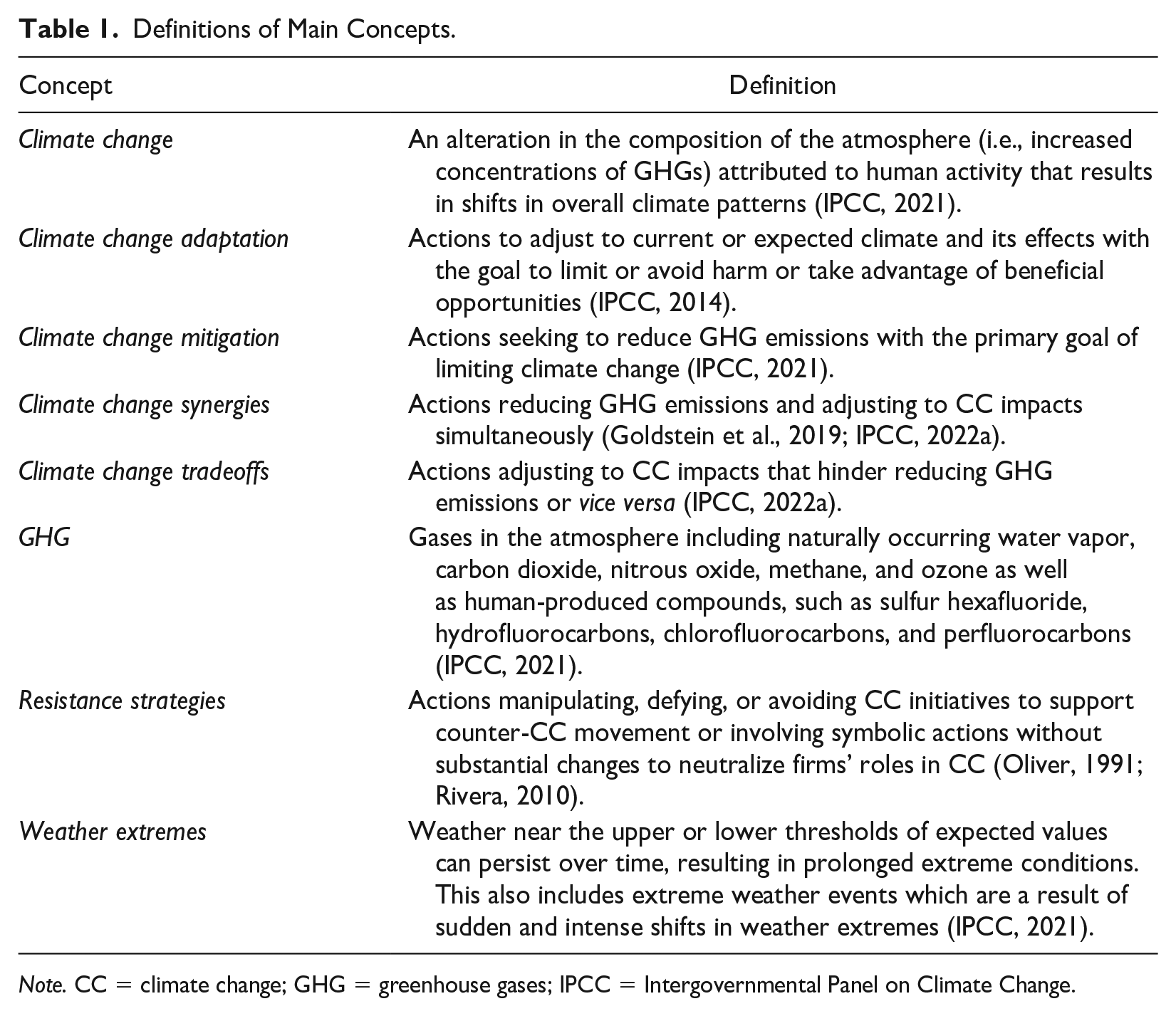
Note. CC = climate change; GHG = greenhouse gases; IPCC = Intergovernmental Panel on Climate Change.
CC is an alteration in the composition of the atmosphere (i.e., increased concentrations of greenhouse gases [GHG]) attributed to human activity that results in shifts in overall climate patterns (IPCC, 2021). The impacts of CC can include slow-onset conditions such as warming, shifts in precipitation patterns, melting of the polar ice caps and sea level rise. CC, although not necessarily the cause, can also exacerbate the frequency and intensity of weather extremes. Weather extremes can include instances of brief, severe conditions (e.g., high temperatures) or persist over time, resulting in unusual, acute weather events, such as heat waves, heavy precipitation, droughts, and hurricanes (IPCC, 2021; Schneider, 2011). At the most severe levels, multiple natural hazards can occur simultaneously, resulting in concurrent heatwaves and droughts, flooding, and/or wildfires. It is projected that changes in the patterns of these weather extremes are likely to continue growing, resulting in more frequent and severe weather-related disasters (IPCC, 2021).
Physical CC conditions create adverse conditions that impact businesses (Clement & Rivera, 2017; Unter, 2022). In response to these CC effects, businesses can engage in different CC strategies that can be broadly divided into generic categories, including measurement and disclosure, mitigation, adaptation, and resistance. The first type of strategy is measurement and disclosure of GHG emissions and CC risk. Most commonly, businesses will measure and disclose GHG emissions which encompass emissions directly generated by a business’ own activities (Scope 1 emissions), indirect emissions from buying energy sources (Scope 2), and emissions from the business’ supply chains (Scope 3). Importantly, measurement and disclosure strategies inform the other strategies.
CC mitigation involves strategies seeking to address the underlying causes of CC (IPCC, 2021), usually by reducing GHG emissions or increasing carbon sinks. Mitigation strategies can consist of actions or technological innovations to reduce GHG emissions. There are three types of mitigation by businesses: GHG reduction, carbon offsetting, and carbon independence. GHG reduction refers to improving existing production processes or designing a new product that reduces emissions of carbon dioxide, methane, nitrogen oxides, and fluorinated gases. Carbon offsetting means acquiring additional GHG emission capacity from other organizations by emission trading, such as cap-and-trade. Carbon independence means businesses have carbon-free production and make carbon-free products (Weinhofer & Hoffmann, 2010).
CC adaptation refers to firms’ efforts and strategies aimed at reducing vulnerability to CC or taking advantage of its potential opportunities (IPCC, 2014). Adaptation is essential since current actions for CC mitigation are insufficient to avert major future adverse natural conditions (Bansal, 2019; Bowen et al., 2012; IPCC, 2021; Nordhaus, 2018; Schneider, 2011). There are a wide range of adaptation responses, including proactive, anticipatory, reactive, routine, soft, hard, and so on. For instance, business responses to natural disasters can be categorized as anticipatory (e.g., identifying and mitigating threats) or reactive strategies (e.g., donating cash to the community) (McKnight & Linnenluecke, 2019). Other classifications of adaptation practices are soft and hard adaptation (Goldstein et al., 2019). Soft adaptation covers adapting the intangible side of organizations, such as strategies and decision-making processes, culture, and norms. Hard adaptation refers to changes in tangible assets or resources, such as capital investments in technology or infrastructure (Goldstein et al., 2019). Adaptation responses can also range from routine adaptation (e.g., risk assessment, technical solutions, risk shifting and sharing, and disaster relief and continuity) to non-routine adaptation (e.g., geographical relocation, portfolio diversification, and cooperation with stakeholders) (Pinkse & Gasbarro, 2019).
There can be synergies or tradeoffs between CC mitigation and adaptation strategies. CC synergies refer to actions reducing GHG emissions and adjusting to CC impacts simultaneously (Goldstein et al., 2019; IPCC, 2022a). CC tradeoffs are actions adjusting to CC impacts that hinder reducing GHG emissions or vice versa (reducing GHG emissions but inhibiting CC adaptation efforts) (IPCC, 2022a).
Finally, businesses can resist adopting substantive CC mitigation and/or adaptation through manipulating, defying, or avoiding (Oliver, 1991) CC strategies. Often, businesses adopt symbolic responses aimed at impression management. For example, some firms financially support astroturf organizations (a bogus grassroots organization) or climate contrarian organizations to produce counter-CC movement discourse via news media (Farrell, 2016) and/or to increase uncertainty and doubt about CC (Cho et al., 2011). In addition, firms can also engage in symbolic impression management and greenwashing to improve their reputation without initiating substantive actions to respond to CC (Delmas & Burbano, 2011; Rivera, 2010; Talbot & Boiral, 2015; van Halderen et al., 2016) and without engaging in adaptation and mitigation.
Method
Overview of Relevant Literature
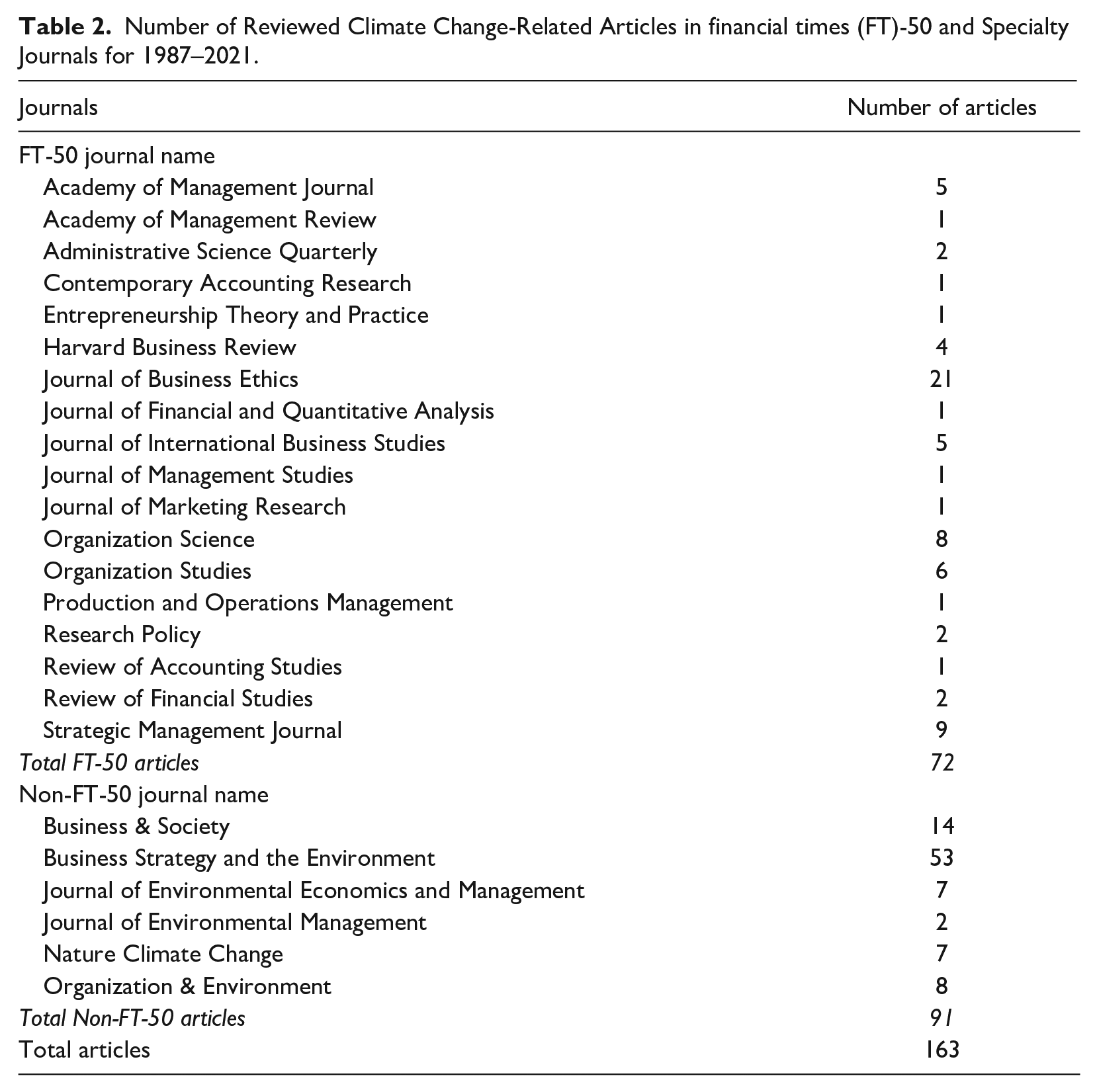
The articles in our review were published between 1987 through the end of 2021, with most of the relevant literature being published after 2010 (Figure 1). Table 2 shows a breakdown of the published articles by journal, including FT-50 journals as well as our list of specialty journals. Seventy-two the articles in our review were published in FT-50 journals, with the Journal of Business Ethics leading with 21 articles. The five most prestigious strategy and general management journals 2 account for 25 of these articles. Ninety-one were published in the specialty journals, with Business Strategy and the Environment leading with 53 articles. Of our key search terms, the most common match for our review sample was “climate change” (62.3% of articles), followed by “greenhouse gases” (11.3% of articles) (Figure 2).
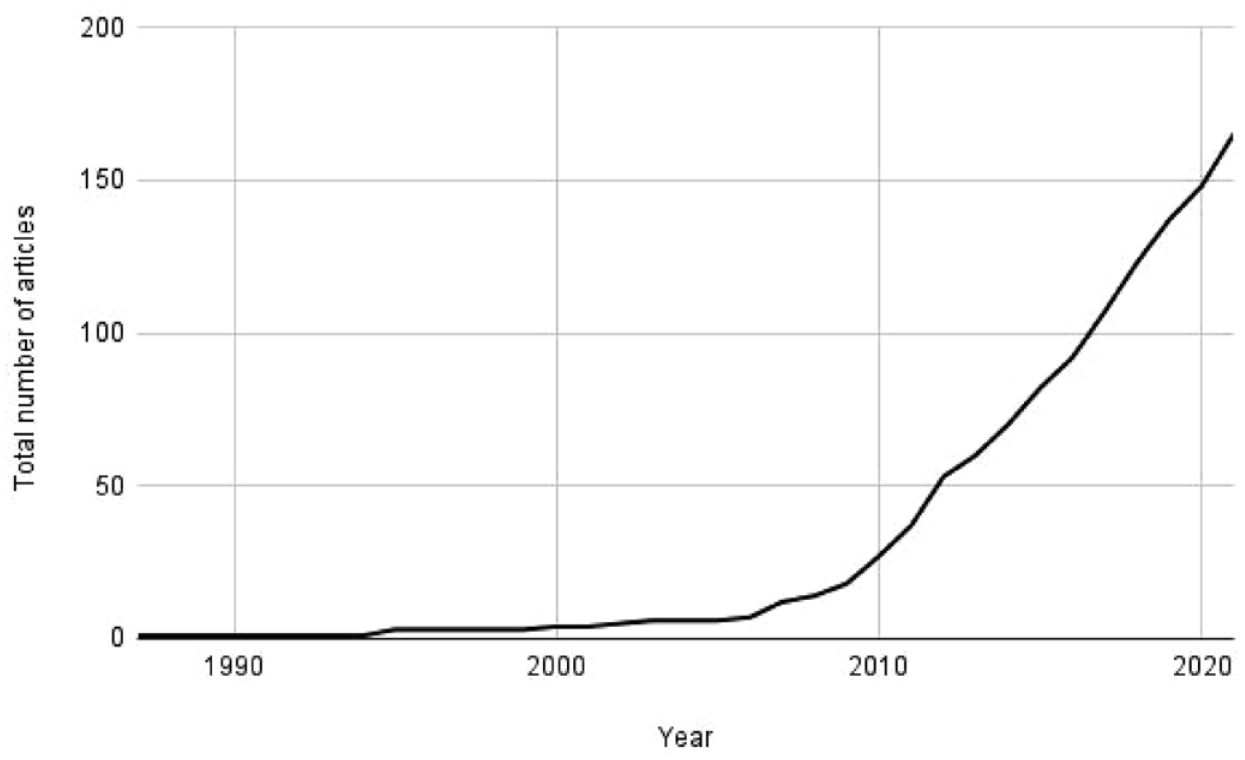
Cumulative Total of Reviewed Climate Change-Related Articles for the Years 1987–2021.
Number of Reviewed Climate Change-Related Articles in financial times (FT)-50 and Specialty Journals for 1987–2021.
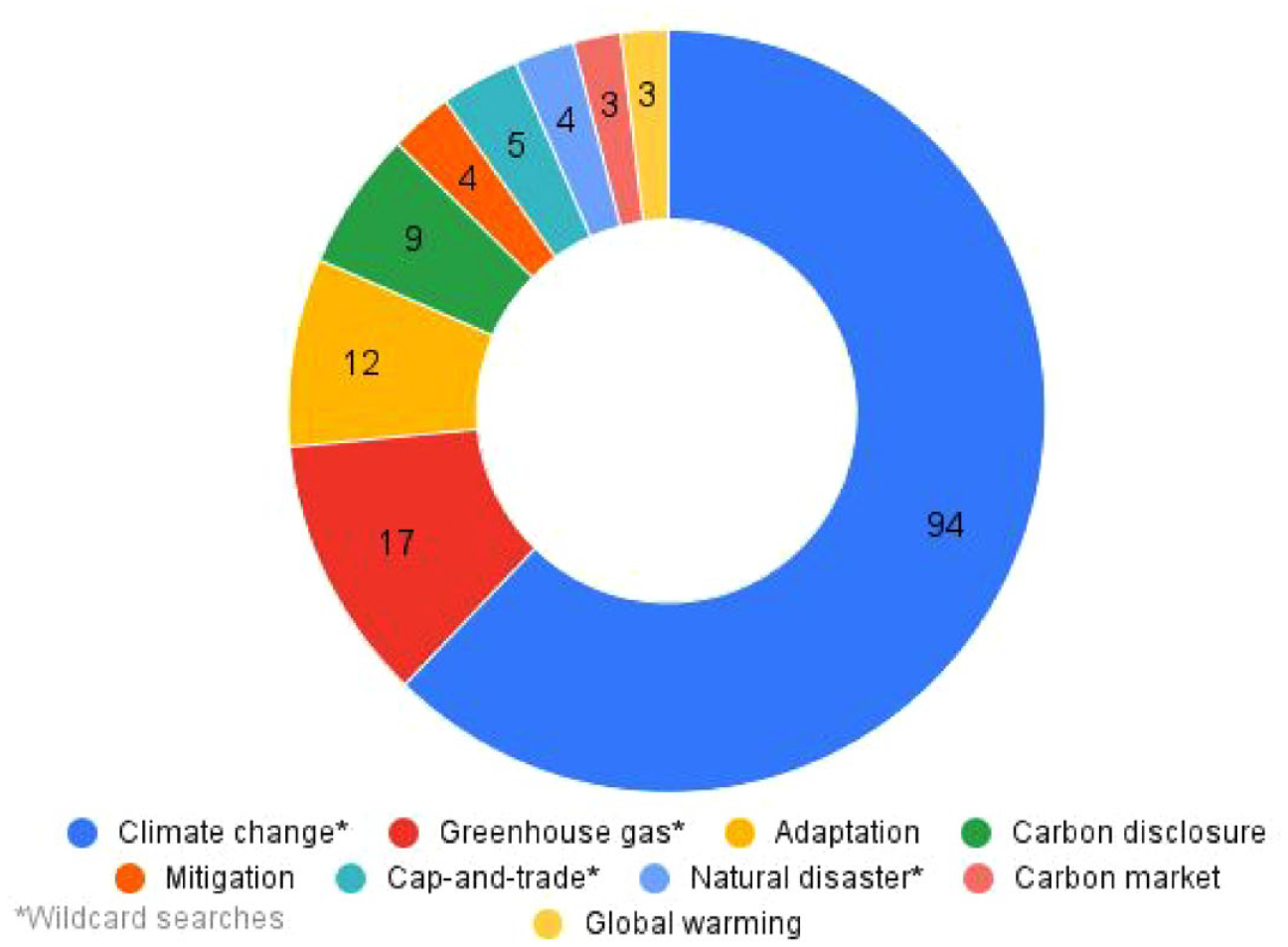
Breakdown of Search Term Results of Reviewed Climate Change-Related Articles in FT-50 and Specialty Journals for 1987–2021.
Identification and Categorization of Relevant Literature
First, we identified the inclusion and exclusion criteria for our sources needed to include all relevant literature to address the scope of our review (Aguinis et al., 2023). We implemented a combination of a journal-driven and database-driven search approach to ensure a comprehensive sample of relevant literature and to increase our chances of including relevant research and excluding unrelated research (Hiebl, 2021). To accomplish this, we identified a list of journals for our review. We included all FT-50 journals to cover research in major areas of business scholarship. We also included the leading journals covering corporate environmental management and social responsibility management—Organization & Environment, and Business and Society—and other specialty journals that frequently publish research articles on these topics. These other specialty journals include: Business Strategy and The Environment, Journal of Environmental Management, Journal of Environmental Economics and Management, and Nature Climate Change. For the database sources, we searched the Social Sciences Citation Index (Web of Science [WOS]) and the ProQuest ABI/INFORM Collection.
Second, we identified important search terminology to include all relevant articles examining how businesses respond to CC and natural disasters. We used the following search terms: climate change, greenhouse gas, adaptation, mitigation, natural disaster (excluding earthquakes, tsunamis, and volcano eruptions), carbon disclosure, global warming, carbon market, and cap and trade. We also identified business-relevant terms to specify a subset of research focused on businesses. The business-relevant terms include: business, firm, company, and corporate. This was especially important due to the inclusion of specialty journals, such as Nature Climate Change, which has published relevant research on our review topic, yet does not exclusively publish research in the business strategy management field. We then used Boolean logic to search for our CC-related terms in the title and business-relevant terms in the abstract through the end of 2021 (Supplemental Appendix A). There were 212 articles from ABI/INFORM and 238 articles from WOS.
Next, we dropped duplicates across both the ABI/INFORM and WOS lists, and any items that were not research articles, such as introductions to special issues, editorials, comments, replies, prior CC literature reviews, and book reviews. Most of the articles were on both lists, and 17 results were not research articles. Since “false positives” can occur in these types of online database searches, in conjunction with coded search terms, 3 we then read the titles, abstracts, and keywords to determine which articles did not meet the scope of our review. False positives included articles not about CC (e.g., the natural disaster was an event not exacerbated by CC, such as an earthquake, the disaster was mislabeled as “natural” in the keywords, organizational adaptation unrelated to CC, etc.) or organizations (e.g., “business-as-usual” scenarios, etc.). There were 120 false positives, and those identified articles were dropped (Linnenluecke et al., 2020). Since this review is specifically focused on strategic management research, we also identified which articles were not focused on strategy research (e.g., socio-psychological research, etc.) and dropped 2 additional articles. This process led to a total of 142 articles.
Finally, business research rarely makes direct references to CC, extreme weather, or natural disasters in the title or abstract (Patenaude, 2011). However, since business research can include research on the physical impacts of CC without containing these specific keywords in the title or abstract, we also conducted a manual search process in our selected list of journals for additional articles that meet our criteria for the review. This process added an additional 21 articles. The final sample of review literature totaled 163 articles.
Major Themes and Insights From the Literature
From our sample of reviewed research articles (see Supplemental Appendices for specific details about these papers), three key themes emerged. We organize these themes into an integrative framework that illustrates how physical CC conditions and nonphysical CC conditions—such as market and non-market economic/social factors, and firm characteristics—shape the adoption of CC response strategies, and their subsequent environmental and financial performance outcomes. Figure 3 shows the overview framework integrating research on business responses to CC. Following our integrative framework, we first focus on the seminal research that examines how adverse physical CC conditions drive businesses to respond to CC. Second, we highlight how nonphysical CC conditions—such as sociopolitical and economic, and firm-specific drivers—affect business responses to CC. These articles contrast with the first topic as they do not consider the direct physical impacts of CC on business. For research in both of these areas, we highlight how both physical CC conditions and nonphysical CC conditions drive response strategies in measurement and disclosure, adaptation, mitigation, and resistance. Third and finally, we examine the environmental and financial performance implications of physical CC conditions and the various CC response strategies.
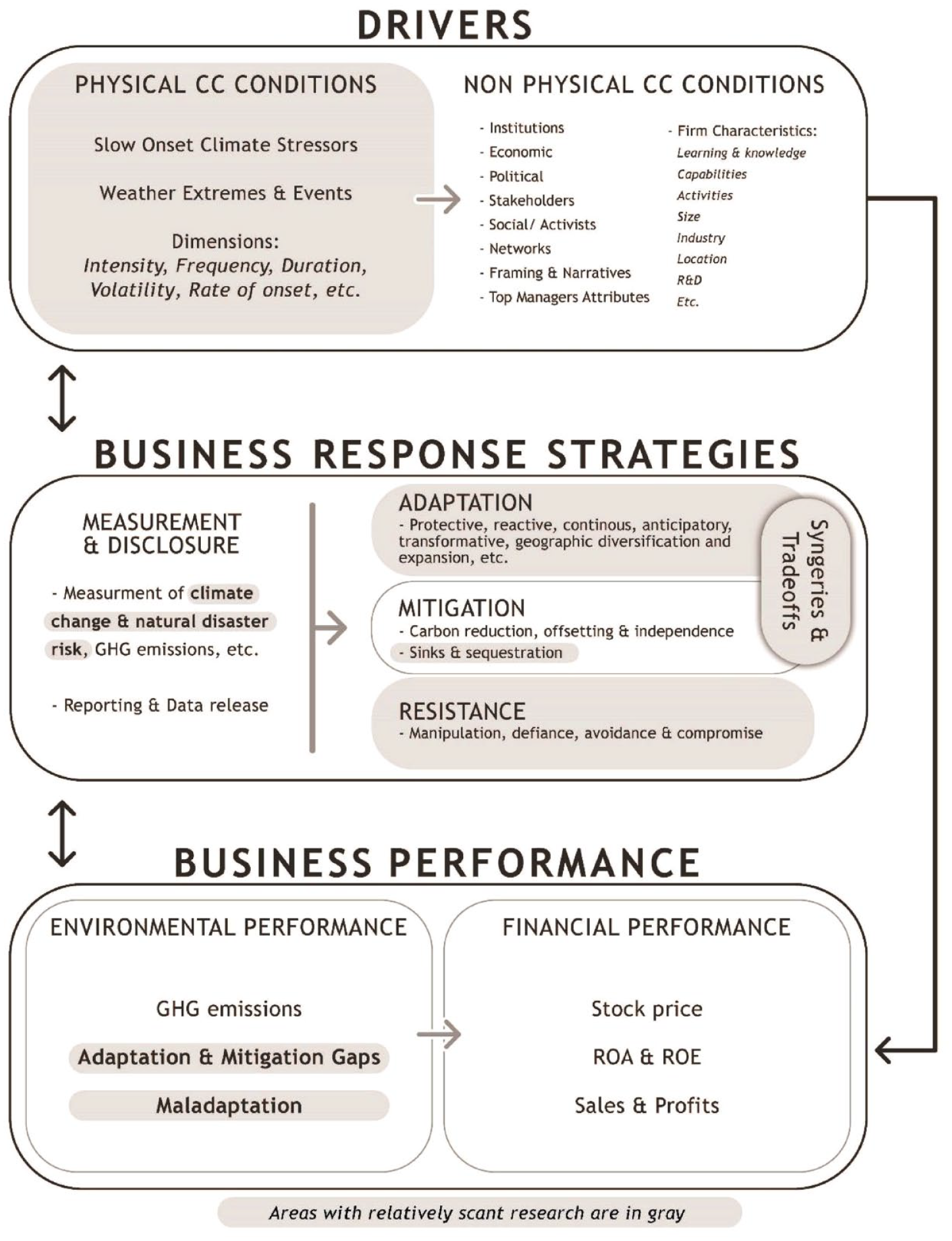
Integrative Framework Showing Relationship Between Drivers, Business Response Strategies, and Business Performance.
Physical CC Conditions and Business Response Strategies
We begin the discussion of factors that push companies to adopt response strategies with a focus on articles that examine the role of nature adversity conditions linked to CC. Our initial focus on physical CC conditions seeks to highlight the relevance of nature’s forces as a key component of the external context that drives business strategy choices. This emphasis is important because, in the strategy literature, the traditional external context has mostly reflected competitive, economic, and, to a lesser degree, social and political environments (Winn et al., 2011). Seldom is the natural environment given more than lip service, and in most cases, it is assumed away. Even the growing literature on corporate environmental management has focused on examining the impacts of firm strategies on the natural environment, but it has paid scant attention to the reverse relationship (Weinhofer & Busch, 2013; Winn et al., 2011).
Compared with other aspects of a firm’s external contexts, CC adversity conditions are considered to be more exogenous given their roots in planetary scale dynamics (Rockström et al., 2009; Winn et al., 2011). Firm managers tend to perceive these unfavorable CC conditions as out of their control (Linnenluecke et al., 2012; Slovic, 2000). In addition, in contrast to other traditional external context dimensions, the spatial and temporal scope and severity of CC adversity conditions are perceived as highly uncertain and more likely to occur in distant locations and time (Gasbarro et al., 2016; Weinhofer & Busch, 2013; Winn et al., 2011). Thus, firms find it more difficult to make sense of nature adversity even when its negative consequences are higher than those resulting from other external context dimensions traditionally considered by strategy scholars (Rivera & Clement, 2019; Oh & Oetzel, 2011).
Seminal Articles on CC and Business Response Strategies
Seminal work by a few business management scholars has begun to move scholarship to focus on the effects that nature adversity conditions may have on business strategies and behavior. Mark Starik (1995), Stuart Hart (1995), and Andrew King (1995) pioneered this stream of research by stressing the importance of nature’s conditions as an important driver or constraint of business strategic choices. Starik did this by arguing that stakeholder theory needed to consider nature as a primary stakeholder (Haigh & Griffiths, 2009; Starik, 1995). This point of view remains controversial among some of the supporters of stakeholder theory. Yet, the stubborn fact remains that nature’s conditions are indeed a driver of business strategy. This is the case, even if this reality challenges the logic and frameworks of some of the anthropocentric-focused theories most heavily used by strategic management scholars (Hart, 1995; King, 1995; Linnenluecke et al., 2012; Winn et al., 2011).
Monika Winn, Martina Linnenluecke, and Andrew Griffiths developed the seminal articles that laid out the conceptual foundation for understanding how adverse CC conditions and weather-related disasters can shape the strategies of businesses operating in vulnerable industries (Linnenluecke et al., 2012; Winn et al., 2011). They argue that CC can generate massive discontinuous change involving sudden, unpredictable, and highly disruptive adverse biophysical conditions across global ecological and socioeconomic systems. Their research leads the way in outlying eight key dimensions of CC adversity that are most likely to affect business strategy adaptation choices: severity, temporal and spatial scale, predictability, mode, immediacy, and the potential for accelerating trends and change of state (Linnenluecke et al., 2012; Linnenluecke & Griffiths, 2010; Winn et al., 2011). This CC-related adversity may involve chronic stress from gradual and persistent trends in physical conditions (e.g., rising oceans, or decreasing rain levels). In addition, CC adversity can also involve sudden weather extremes exacerbated by CC that result in natural disasters such as hurricanes, floods, wildfires, and heatwaves (Linnenluecke et al., 2012; Weinhofer & Busch, 2013).
Slow-Onset CC Stressors and Business Response Strategies
Noticing and Awareness Responses
How do firms become aware of emerging CC adversity, and how do awareness and perceived vulnerability affect the adoption of CC responses? Pinkse and Gasbarro’s (2019) qualitative study of oil and gas companies draws from theory ideas from the attention-based view (Ocasio, 1997, 2011) to posit that the top managers of firms exposed to CC slow onset conditions tend to notice them. Yet, they are likely to be unresponsive because: (a) they are perceived as not urgent and/or important enough to negatively affect their bottom line, (b) there is a lack of adequate answers or understanding to interpret and deal with this, or (c) the signals are uncertain and ambiguous and firms perceive them as occurring more frequently at far away locations and/or later in the future.
Pinkse and Gasbarro (2019) also argue that firms that are more frequently exposed to extreme physical CC conditions and suffer minor negative consequences tend to develop a sense of overconfidence that diminishes their perceived vulnerability. The higher the exposure to extreme conditions without suffering serious consequences, the less likely companies are to adapt due to the overconfidence that they have developed. They suggest that knowledge of local ecosystems may be at play here, diminishing the effect of vulnerability and perceived uncertainty. That is, the more knowledge you have of the local ecosystem, the more overconfident you may become about your sense of control over CC impacts, resulting in less responsiveness. An alternative logic proposed by Whiteman and Cooper (2011) suggests that if managers have high knowledge of local ecosystems, managers may be more able to quickly notice and adequately interpret emerging CC cues that point to the need to take proactive adaptation. In their model, Pinkse and Gasbarro (2019) also contribute to Linnenluecke et al.’s (2012) model of the CC adaptation process. Linnenluecke and colleagues emphasize the objective characteristics of climate events as a determinant of corporate adaptation. Pinkse and Gasbarro (2019) instead highlight that such characteristics play a role but only to the extent that they are noticed by firms and are not filtered out by a selection bias. Finally, complicating the process of noticing and understanding CC impacts, there is a limited understanding of how climate risk measurement is related to CC responses. As an exception, Blanco (2021) conducted an extensive study analyzing CC disclosures from the Carbon Disclosure Project (CDP), and he found that firms have shifted their disclosure practices to expand their assessment of climate risk across the entirety of the supply chain, instead of limiting disclosure practices to just GHG emissions. Yet, despite some initial efforts to measure and disclose CC risk, there is little known about this research area.
Adaptation Responses to the Uncertainty of Physical CC Conditions
It was not until 2016 that one of the top two strategy journals (SMJ and AMJ) published an article on the effects of physical CC conditions on business adaptation and mitigation. Tashman and Rivera’s (2016) article draws from resource dependence theory to examine how the uncertainty of CC physical conditions influences firm adaptation strategies. They found that ski areas in the western United States engage in more substitution (snowmaking) and greater buffering (expansion to higher elevations) strategies in response to uncertainty of long-term snowfall. It is notable that these response strategies to CC uncertainty are natural resource-intensive and generate negative environmental spillover effects. This is an interesting contribution because previous research suggests that uncertainty in institutional and environmental stakeholder pressures tends to push companies to adopt strategies that improve their environmental performance (Sharma & Henriques, 2005; Tashman, 2021).
Adaptation Responses to the Intensity of Physical CC Conditions
What about other dimensions of physical CC conditions such as intensity? Clement and Rivera (2017) provide a framework of analysis to illustrate how the intensity (i.e., magnitude) of slow-onset nature adversity generated by CC affects and limits business adaptation strategies. Their framework builds on resilience theory 4 ideas advanced by biologists and ecologists (Gunderson & Holling, 2002; Holling, 2001). It departs from the principle that, like natural ecosystems, businesses are open systems organizations that need to respond and adapt to external stimulus to survive (Winn et al., 2011).
They argue that vulnerable companies paying attention to the intensity of CC conditions focus on protective adaptation strategies: the quest to preserve the status quo of core business features. These protective adaptation strategies can include substitution of nature’s resources and services, buffering from negative conditions, government lobbying, and/or geographic and industry diversification (Clement & Rivera, 2017). Their framework seeks to contribute to the debate found in the strategic management literature on whether external adversity tends to be positively or negatively related to adaptation. They propose—and find empirical support for in a follow-up study of the western U.S. ski industry—an inverted U-shaped relationship between the intensity of physical CC adversity conditions and protective adaptation. These findings suggest that protective adaptation initially increases with higher levels of physical CC adversity until it reaches a pinnacle, and then decreases with greater physical CC adversity (Rivera & Clement, 2019). This curvilinear relationship finding for the intensity of physical CC conditions and adaptation complements the research indicating a positive linear link between uncertainty in physical CC adversity and adaptation (Tashman & Rivera, 2016). It highlights the importance of distinguishing how companies are likely to adopt different adaptation paths, which are dependent on the distinct dimensions of physical CC adversity and how they draw the attention of decision-makers within firms.
Extreme Weather Events and Business Response Strategies
During the last decade, the frequency and severity of weather-related disasters have increased around the world resulting in a significant number of fatalities and economic losses worldwide. During this time, natural scientists have accumulated strong evidence about how CC trends—although not the cause of—contribute to worsening weather extremes that result in natural disasters (IPCC, 2012, 2014). However, there is a tendency in the strategy literature to pay little attention to CC. In fact, most studies on business responses to natural disasters portray these events as “bad luck” exogenous shocks that companies are powerless to prevent. For example, strategy scholars have focused on examining post-disaster charitable giving. Firms appear to be more willing to increase their donations for high-profile social and political events (e.g., political conventions and the Olympics) than for severe natural disaster relief (Tilcsik & Marquis, 2013). These studies also suggest that charitable disaster relief from local firms arrives faster than post-disaster aid from government and nonprofit organizations (Ballesteros et al., 2017). Firms tend to donate directly in their local areas or through nonprofit organizations when natural disasters occur in developing countries where they lack a market presence (Ballesteros & Gatignon, 2019). Yet, these studies have not examined anticipatory preparedness strategies to manage the effects of probable future weather extremes.
A notable exception is the stream of articles from Jennifer Oetzel and Chang Hoon Oh (2011, 2014, 2021) that examine how large multinational corporations (MNCs) from Europe and the United States diversify their foreign subsidiary investment location and learn to prepare for different types of disasters around the world. Their studies reveal that MNC managers show a strong bias toward ignoring natural disasters. Yet, at the same time, MNCs are highly sensitive to terrorist attacks and industrial accidents that are caused by humans and perceived to be more controllable. The extent of this bias appears to be strong given that for the period of their studies, natural disaster-related deaths were 190 times higher than those of terrorist attacks, and 10 times greater than fatalities associated with industrial disasters (Oetzel & Oh, 2014; Oh & Oetzel, 2011). Their findings indicate that MNC foreign subsidiary investment is likely to decrease in response to more severe terrorist attacks or technological disasters, but not in response to more severe natural disasters (except for windstorms and related water surges, the deadliest weather-related natural disasters) (Oh & Oetzel, 2011).
Of greater interest is the question of whether firms have been able to learn from their experience with natural disasters. This ability to learn is critical because it can allow corporations to increase their foreign subsidiary investments in other areas likely to suffer similar natural disasters. Oetzel and Oh (2014, 2021) suggest that organizational experience with extreme natural disasters tends to increase preparedness for future natural hazards. For example, managers are more willing to learn and form partnerships with others (e.g., nonprofit organizations, industry associations, and government agencies) in locations that suffer from catastrophic natural disasters (Oetzel & Oh, 2021). However, their findings indicate that MNCs do not appear to be able to transfer natural disaster management experience across countries. Instead, their research suggests that experience with high-impact natural disasters is useful for increasing foreign subsidiary investment into an existing host country, but not for initial entry into other countries experiencing similar high-impact disasters (Oetzel & Oh, 2014). For increasing initial MNC subsidiary entry into a foreign country suffering severe disasters, it appears that MNC philanthropic giving and the host country’s regulatory enforcement quality are more likely to help mitigate the negative effects of disasters (Oh & Oetzel, 2011; Pek et al., 2018). Complimentary to this stream of research, Linnenluecke et al.’s (2012) framework emphasizes experience with weather extremes and managers’ sensemaking as key driver of adaptation to natural disasters exacerbated by CC. This framework also contributes by emphasizing the importance of considering—beyond economic, political, and social context conditions—the characteristics of natural disasters as important parts of the external context driving business strategies. Finally, another important issue to examine is how foreign firms consider natural disaster risk when expanding into a host country where they have already been operating. Oh, Oetzel, Rivera, and Lien’s (2020) study of Fortune 500 corporations’ foreign investments in China indicates that adjacent location to other compatriot subsidiaries or subsidiaries of same company facilitates expansion into Chinese provinces exposed to severe natural disasters.
Nonphysical CC Drivers of Business Response Strategies
The next theme among the literature focused on how a wide range of nonphysical CC drivers affect business strategy responses. These drivers encompass a range of factors that include—but are not limited to—institutions, stakeholders, and firm-specific factors that can influence how businesses respond to CC.
Institutions and Business Response Strategies
As impacts related to CC become more unavoidable and a greater concern, institutions generate pressures that push businesses to change strategies in response to CC issues to maintain legitimacy. Andrew Hoffman (1999) builds on institutional theory (DiMaggio & Powell, 1983) to highlight that organizational fields can form around central issues, such as environmentalism; these organizational fields and institutions coevolve with the occurrence of prominent events. Pinkse and Kolk (2012) and Wittneben et al. (2012) further extend this area by theorizing how institutions affect the CC responses of organizations. Pinkse and Kolk (2012) highlight the multinational enterprises’ need to balance several institutional factors across multiple countries to overcome liabilities and fill in institutional voids. Wittneben et al. (2012) contend that CC is more than an environmental problem that requires collaboration and contestation within the institutional field of CC across multiple organizations including firms, governments, industry associations, and nongovernmental organizations (NGOs).
Some studies examine how institutions create pressures driving businesses to adopt more measurement and disclosure strategies. Coercive, normative, and cultural institutional pressures can drive firms to increase the number of and/or quality of climate disclosures (Chithambo et al., 2020; Mateo-Márquez et al., 2021). Other studies instead examine how institutions push businesses to reduce GHG emissions through mitigation strategies. For example, Bryant et al. (2020) analyze the mitigation responses of public U.S. firms. They find that regulated businesses in CC sectors engage in more beyond-compliance actions encompassing reduced emissions, increased energy efficiency, reduced supply chain carbon emissions, and the reduction of CC risks.
Overall, there is more research on how institutions affect firm CC mitigation and disclosure strategies, especially regarding the role of regulatory pressures, as compared with how institutions affect adaptation strategies. However, some research goes beyond just examining mitigation and instead examines how both adaptation and mitigation strategies by businesses are simultaneously affected by institutions. Some businesses focus primarily on adaptation and only choose to adopt mitigation practices in the presence of higher regulatory and normative environmentalist pressures (Tashman & Rivera, 2016), but there can also be synergies between adaptation and mitigation (Thistlethwaite, 2012). Thistlethwaite (2012) details how this can occur in an extensive case study, finding that self-regulatory institutions—such as ClimateWise 5 —can reduce exposure to CC risks for participating firms, as well as drive firms to reduce the environmental impact of their operations.
Some research examines how businesses may instead resist the adoption of adaptation and mitigation strategies. For example, Levy and Egan (2003) highlight that institutional structures are challenged by CC issues and firms can either adjust their mitigation strategies to align with changing circumstances, or firms can resist change and uphold their prior resistance to implementing mitigation strategies. Firms can also influence the regulatory environment and policy-making process affecting how environmental regulations develop (Clark & Crawford, 2012; Eberlein & Matten, 2009; Kolk & Pinkse, 2007). Eberlein and Matten (2009) conduct a comparative case study of business responses across two signatories of the Kyoto Protocol: Canada and Germany. They find that large MNCs shape the regulations in their countries, and effective regulation requires the active involvement of large firms in their respective industries.
Other research finds that sometimes it is a lack of institutions or poorly implemented institutional structures that can create barriers for firms, limiting business adaptation and mitigation responses. Jeswani and his colleagues (2008) find that a lack of awareness, lack of financial resources, absence of policies, and lack of expertise can result in inadequate CC responses by firms in the United Kingdom and Pakistan. Ng and his colleagues (2018) qualitatively studied how the ports industry strategically plans for CC impacts by replacing structures, increasing land elevation, creating storm response plans, pumping drainage, building sea walls, and so on. They find that the institutional systems in port planning and operations can limit the ability of these organizations to adapt to climate-related impacts, such as sea-level rise, high winds, and storm surges.
Research in this area has culminated into a push to reframe how institutional theory scholars examine the natural environment in the era of the Anthropocene led by Andrew Hoffman and P. Devereaux Jennings (2018, 2021). They put forward three scenarios (Collapsing Systems, Market Rules, and Cultural Re-Enlightenment) in response to CC for an Anthropocene era and highlight the institutional elements across each of these scenarios. In each of these scenarios, they emphasize how disruptive events become the “new normal” and organizational fields, institutions and logics, and institutional entrepreneurs adjust in response to new norms. In stark contrast to the prior theme focusing on the direct impacts of physical CC conditions on business responses, Hoffman and Jennings contend that CC can be accounted for through socio-cultural, economic, and political channels without directly accounting for nature. In their perspective “‘Nature’ itself does not have voice” (Hoffman & Jennings, 2021, p. 64), and Hoffman and Jennings focus primarily on social constructs.
Stakeholders and Business Response Strategies
As stakeholders increasingly acknowledge the effects of CC on businesses, stakeholders are placing more pressure on businesses to respond. Building on stakeholder theory (Freeman, 1984) and corporate disclosure theories (e.g., voluntary disclosure theory; Deegan, 2002; Verrecchia, 1983), this stream of research mostly finds that stakeholder pressures increase disclosure of GHG emissions and CC risk (Bui et al., 2021; Chithambo et al., 2020; Flammer et al., 2021). For example, Flammer et al. (2021) examine one specific group of stakeholders: shareholders. Their study finds that pressures from environmental activist shareholders increase the voluntary disclosure of CC risks by U.S. public firms participating in the CDP.
There is also some research finding that stakeholder pressures increase mitigation strategies (Cadez et al., 2019; Littlewood et al., 2018). Littlewood and his colleagues (2018) find that stakeholder pressures in large combustion and chemical manufacturing facilities in Europe from a wide range of actors 6 increase corporate commitment to reduce GHG emissions in high emitting industries. Conversely, two papers find that there is no significant relationship between stakeholder pressures and mitigation strategies (Kraft, 2018; Sprengel & Busch, 2011). Sprengel and Busch (2011) surveyed companies across the Americas, Europe, and Asia Pacific to examine their strategies to reduce GHG emissions. They find that individual stakeholder groups similarly pressure the companies to reduce emissions, yet these companies have several different response strategies, ranging from intensively reducing GHG emissions to doing the bare minimum in reducing emissions. Closely connected to this, businesses can limit or manipulate the reporting and disclosure of GHG emissions (Callery & Perkins, 2021). As stakeholder pressures increase, businesses balance substantive mitigation actions with symbolic ones (van Halderen et al., 2016). Importantly, external stakeholders—such as major environmental NGOs, local legislative representatives, and government agencies—can place pressure on firms to limit greenwashing (Kim & Lyon, 2015).
Overall, the relationship between stakeholder pressures and mitigation strategies is mixed. This is further explored by several studies that examine a range of factors that interact with stakeholder pressures affecting whether stakeholders have an influence on mitigation and disclosure strategies. Both the role of markets (Kraft, 2018) and CEO attributes (Chithambo et al., 2020) can impact how effective stakeholders are in pressuring businesses to disclose GHG emissions. Kraft (2018) studies the disclosure reports of investor-owned utilities in the United States and finds that under greater market competition, firms are more likely to respond to stakeholder pressures to have substantive disclosures. In support of the mixed findings on the relationship between stakeholder pressures and mitigation strategies, some studies find that financial outcomes (Sullivan & Gouldson, 2017), investors (Blanco, 2021), and collaboration (Lopes de Sousa Jabbour et al., 2020) effect how successful stakeholders are in pressuring businesses to adopt mitigation strategies.
Research into the role of stakeholders has most extensively covered that stakeholder pressures from a wide range of actors increase the adoption of disclosure strategies, with more mixed results around the actual adoption of CC mitigation strategies. This is an important first step to understand what exactly firms may be doing and what they are reporting regarding GHG emissions and CC risks. Yet, there is a lack of research on how stakeholders may pressure firms to engage in adaptation strategies. So far, there is one study that indicates that environmentalist pressures can drive firms to decrease adaptation actions and instead prioritize mitigation strategies (Tashman & Rivera, 2016). Overlooking this in research limits our understanding of the role that stakeholders play in firms either adapting or failing to adapt to CC.
Firm Characteristics and Business Response Strategies
Some research touches upon how different firm characteristics affect business response strategies to CC-related impact. A wide range of factors are examined, including firm size (Eleftheriadis & Anagnostopoulou, 2015), firm knowledge assets (Kolk & Pinkse, 2008; Pinkse & Kolk, 2010), firm executive leadership (Hsueh, 2019), and firm origin country (Backman et al., 2017). The most common aspect examined is how firm knowledge, learning, and capabilities impact adaptation and mitigation strategies. These articles focus on how learning (Ansari et al., 2013; Lee & Klassen, 2016; Oetzel & Oh, 2021; Orsato et al., 2019), technological development (Pinkse & Kolk, 2010), and interpretation of information (Dahlmann & Roehrich, 2019) affect the types of responses that firms either develop or engage in. For example, Orsato and his colleagues (2019) find that social learning is central to the development of strategies to address CC challenges. This is achieved through participation, interaction through common artifacts, and sharing of challenges and potential solutions within communities of practice. Some of these articles instead examine what drives firm responses in innovation and technologies (Elia et al., 2020; Fawkes & Jacques, 1987; Galbreath et al., 2016; Penna & Geels, 2015), accessing information (Lemma et al., 2021), and sales of low emission products (Y. Chen et al., 2019). For example, Galbreath and his colleagues (2016) survey South Australian wineries to examine absorptive capacity and knowledge exchanges across clusters affecting CC innovations. They find that firm absorptive capacity is positively related to CC innovation and stimulates knowledge exchanges between firms within clusters. Research highlights that knowledge, learning, and experience of CC and sustainability issues result in firms being able to better develop and implement CC strategies. Researchers also study several different aspects of information, learning, and innovation with a more balanced approach to examining both adaptation and mitigation strategies.
Impacts of Physical CC Conditions and Business Response Strategies on Performance
The final theme in the literature explores how physical CC conditions and business responses to CC affect business’ financial and environmental performance.
Impact of Physical CC Conditions on Financial Performance
There are many news articles with anecdotal stories about the negative effects of CC conditions on business financial performance. Yet, there are very few large sample, longitudinal studies examining how adverse physical conditions, linked to CC, may affect business performance over time. A seminal study by Choi and his colleagues (2020) covering 74 stock market cities during 2001–2017 finds robust evidence that the stock price of carbon-intensive firms 7 tends to decline in the month when abnormally high local temperatures (in the top 20% warmest) are prevalent in a stock exchange city. This provides a glimpse of how carbon-intensive companies’ stock returns may suffer in a “new normal” CC future where more extreme nature adversity conditions are likely to be more prevalent.
There are also some indications that higher business sustainability performance is correlated to greater awareness of opportunities offered by physical CC effects. Elijido-Ten and Clarkson (2019) find that firms listed in the Global 100 Most Sustainable Corporations ranking by Corporate Knights appear to show higher perception of opportunities resulting from extreme weather events exacerbated by CC. Interestingly, greater sustainability performance in this ranking did not appear to be correlated with higher awareness of risks stemming from extreme weather events. 8
Impact of Business Response Strategies on Financial Performance
This stream of research examines the implications that measurement and disclosure, adaptation, and mitigation strategies have for business financial performance. The research on the effects of GHG emission disclosure on financial performance is mixed. Generally, voluntary disclosure is positively associated with financial performance (Alsaifi et al., 2020; Flammer et al., 2021), while mandated disclosure has more mixed or negative effects (Downar et al., 2021; Gerged et al., 2021). However, some studies found no relationship between firm CC strategies and financial performance (Damert & Baumgartner, 2018; Lee, 2012). Regarding the effect of CC adaptation on financial performance, there is one lone study that finds that CC adaptive innovations in the Australian wine industry can lead to improved financial performance (Galbreath et al., 2016).
Most of the research on how business response strategies to CC affect financial performance is focused on the impact of CC mitigation strategies. First, some research examines the role of cap-and-trade. The findings are very mixed, with one study finding that cap-and-trade can drive inefficient companies to improve their economic performance (Z. R. Chen & Nie, 2020), another study finding that cap-and-trade lowers financial performance (especially for coal generators) (Linn, 2010), and the final paper arguing that while cap-and-trade can improve environmental quality, it has no effect on firm profits (Anouliès, 2017).
Second, there are several studies findings that higher environmental performance via GHG emission reduction improves financial performance (Boiral et al., 2012; Choi et al., 2020; Engle et al., 2020; Gallego-Álvarez et al., 2014; Griffin et al., 2017; Hassan & Romilly, 2018; Huynh & Xia, 2021; Liesen, 2015; Nishitani & Kokubu, 2012; Russo et al., 2021). In support of this, Boiral and his colleagues (2012) find that a reduction in GHG emissions in Canadian manufacturing firms led to higher financial performance. However, one study finds that higher environmental performance worsens firm financial performance. Lei Wang and colleagues (2014) find that Australian firms that reported to the CDP and had higher GHG emissions had better financial performance across all industry sectors. Finally, according to other studies, whether GHG emission reductions affect financial performance depends on various factors (Delmas et al., 2015; Yagi & Managi, 2018). Delmas et al. (2015) find that a reduction in GHG emissions by U.S. corporations does not pay off in the short-term. However, in the long-term, reduced GHG emissions by these firms improve financial performance. Most research in this area supports that it “pays to be green” on the part of businesses, but some research highlights that it may depend on a range of factors whether good environmental performance is rewarded with higher financial performance.
Impact of Business Response Strategies on Environmental Performance
Research in this area indicates that the effect of carbon reporting and disclosure on firm environmental performance is mixed. On one hand, measuring and disclosing GHG emissions can lead to a reduction in emissions, mitigating CC. Downar and his colleagues (2021) study the impact of the GHG emission disclosure mandate in the U.K. on the environmental (and financial) performance of firms, and they found that mandated disclosure reduced the GHG emissions of European firms. On the other hand, Tang and Demeritt (2018) found that mandatory reporting had no significant effect on U.K. companies’ GHG emissions. In addition, they found that disclosure can also be used by companies to greenwash their environmental performance. In contrast to both studies, Kim and Lyon (2011) examined the role of voluntary disclosures. They found that U.S. firms voluntarily disclosing their GHG emissions were using it as a method for greenwashing and had worse environmental performance, as compared with those that did not voluntarily disclose their emissions. The research in this area is sparse, especially regarding how carbon reporting and disclosure affects environmental performance. Most of the disclosure research examines how or why firms disclose with little examination as to whether this disclosure results in reduced emissions. Recent work by Callery (2022) highlights that reporting in the CDP—and the subsequently assigned performance rating issued by the CDP—may not actually be representative of a firm’s climate performance. Furthermore, some businesses will go as far as to manipulate the reporting and rating process within the CDP by providing false claims (Callery & Perkins, 2021). This is concerning as we do not know much about if firm responses are addressing the underlying mitigation and adaptation challenges that exist.
Finally, there is also a range of studies that find several business responses including business cooperation (Baranchenko & Oglethorpe, 2012), CC mitigative innovations (Galbreath et al., 2016), substantive CC targets (Dahlmann et al., 2019), and cap-and-trade (Anouliès, 2017; Z. R. Chen & Nie, 2020) can result in improved environmental performance. Alternatively, Dahlmann, Branicki, and Brammer’s (2019) paper emphasizes that symbolic presence of CC targets without any substance does not appear likely to improve environmental performance.
Adaptation and Mitigation Gaps
There is some recent research that looks at both the firm adaptation or mitigation needs that arise from the physical impacts of CC and the business responses that either meet or fail to meet those needs. The mismatch between firm responses to CC-related conditions and actual physical impacts on the firm itself is alluded to in our review sample. While not explicit in examining how gaps between firm actions and firm needs arise, there is some research exploring how and why firm actions may not be aligned with the physical climate impacts experienced by firms, resulting in adaptation gaps. 9 Goldstein et al. (2019) highlight that firms underestimate CC risk resulting in insufficient strategies for responding to these risks; Pinkse and Gasbarro (2019) examine how different interpretations of climate stimuli can result in differing adaptation responses on the part of firms; MacKay and Munro (2012) highlight how information warfare can be used to spread misinformation about CC resulting in widespread inaction. Adaptation gaps result in inadequate CC responses and, subsequently, lower performance.
Beyond identifying where companies are failing to properly assess CC-related impacts, some research advances how to avoid this issue and align adaptation responses with CC-related impacts. This area is primarily focused on the perception, measurement, and acquisition of knowledge of CC science and impacts (Galbreath et al., 2014; Lefsrud & Meyer, 2012; Lei & Shcherbakova, 2015; Romilly, 2007). Some of this research also applies the proper measurement of climate risk for firms (Engle et al., 2020; Todaro et al., 2021). For example, Romilly (2007) assessed regional climate risk and impacts that affect firms. The measurement of actual physical CC-related impacts is essential for firm decision-making and engaging in the most effective adaptation strategies (Goldstein et al., 2019).
Complimenting this stream of research, there is also some research that assesses the mitigation needs of companies (Hayami & Nakamura, 2007; Krabbe et al., 2015). This area focuses primarily on accurately measuring the GHG emissions of firms, how firms can set targets for decarbonization, and the implications that this has for mitigation strategies. These few articles highlight the existence of mitigation gaps. 10 Compared with adaptation gaps, the formation of mitigation gaps is more straightforward: It is difficult for firms to profit off the nonexcludable, public good benefits of improved environmental quality enjoyed by all that arises from CC mitigation efforts (Hasson et al., 2010). Although there may be reputational benefits associated with mitigation, firms have been able to derive reputational benefits from symbolic actions rather than substantive actions aimed at reducing GHG emissions (Dahlmann et al., 2019). Like research on adaptation gaps, there is still little research, especially in the business field, about mitigation gaps. This newer area of research advances an important step in this field of business spanning climate-related impacts, business responses to these impacts, and the alignment between the needs of business and the actions of businesses.
Conclusion and Future Research Agenda
The literature on business and CC has recently shown a considerable rate of growth. Indeed, almost 60% of all the articles that we identified appeared in print since 2015. Our review of this growing literature revealed three major emerging research themes: first, the identification of physical CC conditions driving the adoption of business strategies to respond to CC; second, the nonphysical CC factors (e.g., sociopolitical, economic, firm-characteristics, etc.) driving the adoption of a range of response strategies, including measurement and disclosure, adaptation, mitigation, and resistance; and third, the evaluation of the environmental and financial impact of both the physical impacts of CC and of adopting CC response strategies.
We offer an integrative framework emerging from the reviewed articles (see Figure 3) that provides a model of the mechanisms that shape the adoption of CC strategy responses and their performance outcomes. With this model, we first emphasize the importance of highlighting—beyond traditional social and economic context factors—physical CC conditions as a driver of business strategy choices that have seldom been considered in the strategic management literature. Second, this overview framework indicates four basic types of business response strategies: measurement and disclosure, adaptation, mitigation, and resistance. Of these strategies, the literature suggests that businesses are more likely to engage in mitigation strategies and measurement and disclosure strategies. Adaptation and resistance strategies are still rare barring a few exemplary cases. Third, this framework highlights that both physical CC conditions and business response strategies may have implications for the environmental and financial performance of businesses. The implications of adopting these strategies and the direct physical impacts of CC cannot be ignored as they not only affect the health of the natural environment but also the financial success of the business. Several portions of the framework are highlighted in gray to emphasize areas that are lacking in research and need further development. To conclude, we propose a future research agenda organized around these major emerging themes. See Table 3 for an overview of future research questions.
Directions for Future Research in Business Responses to Climate Change.
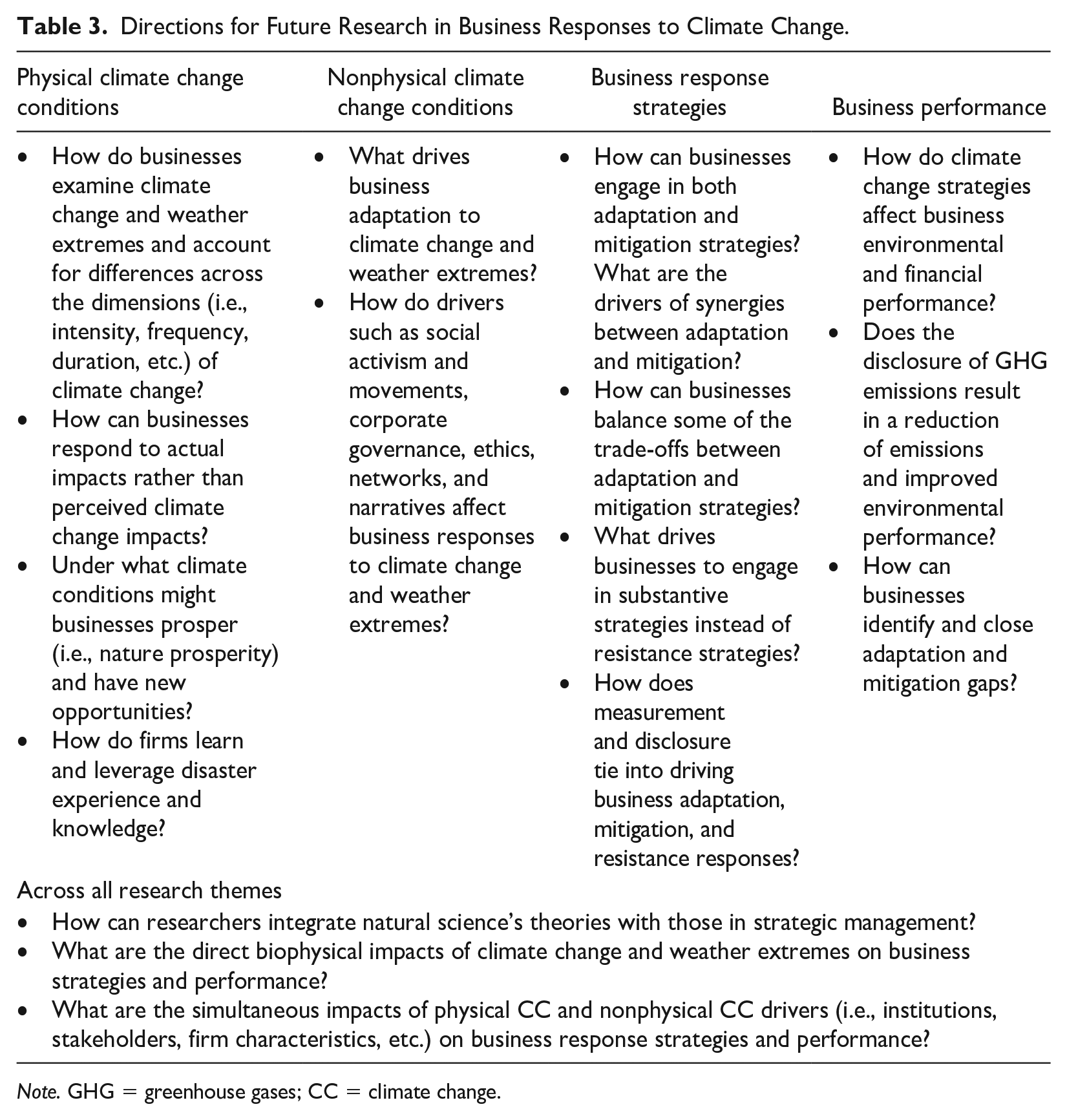
Note. GHG = greenhouse gases; CC = climate change.
Theories Used in CC Strategy Research
Multiple theories have been used to explain the logic behind different business strategy responses to CC. Table 4 provides an overview of the most commonly used theories in CC-related business strategy research. Socioecology’s resilience theory, resource dependence theory, and the attention-based view are the most prominent in the research examining how CC strategies are affected by physical CC conditions and extreme events (Linnenluecke et al., 2012; Linnenluecke & Griffiths, 2010; Pinkse & Gasbarro, 2019; Tashman, 2021). Research aimed at identifying how socioeconomic and political pressures from different actors shape CC response strategies relies predominantly on institutional theory, stakeholder theory, and disclosure theory (Daddi et al., 2018; Flammer et al., 2021; Haigh, 2019; Hoffman & Jennings, 2018; Pinkse & Kolk, 2012).
Theories in Climate Change-Related Business Strategy Research.
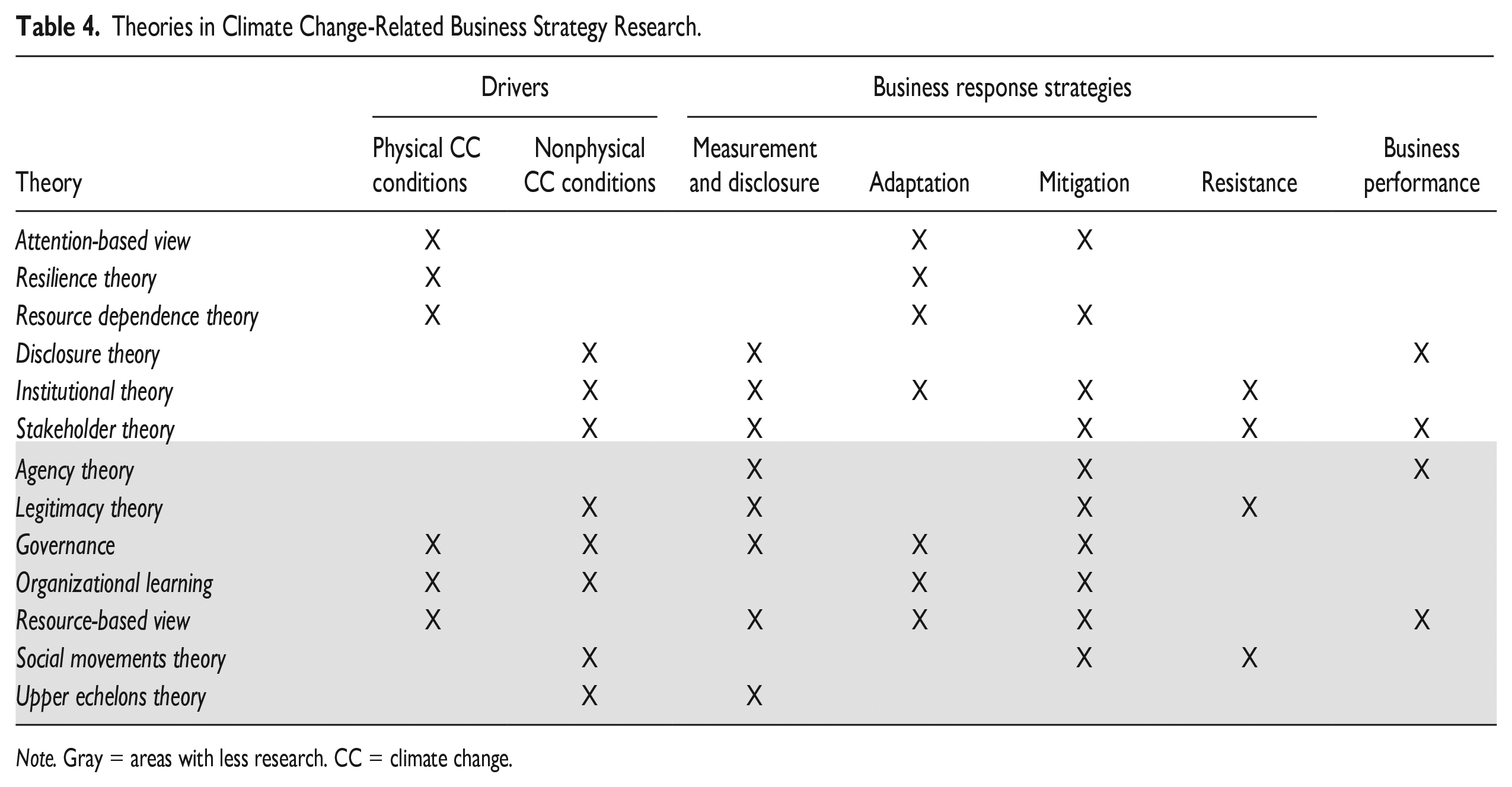
Note. Gray = areas with less research. CC = climate change.
Overall, the CC strategy literature shows a strong anthropocentric bias in its use of theories and empirical approaches. Presumably, companies are enacting strategies to respond to natural disturbances linked to CC. Yet, most of this scholarship offers a fragmented understanding of CC strategy. It continues to follow the typical strategic management approach that takes natural conditions for granted and instead focuses on how socioeconomic and political actors shape the responses to CC-related nature adversity. That is, strategists are mostly looking “under the lamppost” 11 of the anthropocentric theories they are most familiar with. A comprehensive understanding of the variation in CC business responses and outcomes requires interdisciplinary integration with theories from the natural sciences including ecology, atmospheric chemistry, geophysics, and meteorology. This interdisciplinary integration is particularly difficult because most strategy and management scholars lack deep expertise in the natural sciences. Accordingly, one of the most attractive opportunities to advance the CC strategy research involves trying to integrate natural science theories with those in strategic management. Natural scientists have done most of the research aimed at understanding, tracking, and forecasting CC. Seminal examples of this interdisciplinary work involve research drawing ideas, concepts, and frameworks from ecology and biology (King, 1995; Starik, 1995; Whiteman & Cooper, 2000, 2011; Wildavsky, 1988).
The recent research drawing from socioecology’s resilience theory (Gunderson & Holling, 2002; Holling, 1973; Holling, 2001) may offer the most promise in this area. Resilience theory emphasizes the interconnectedness of societies with natural ecosystems. For instance, integrating this more holistic open systems logic can help stakeholder and institutional theories to better explain how natural conditions interact with socioeconomic actors and the forces that shape business CC strategy responses (Clement & Rivera, 2017; Linnenluecke et al., 2012; Linnenluecke & Griffiths, 2010). In general, this integration enables a deeper understanding of the co-evolution between businesses, stakeholders, institutions, and social systems with the natural environment. It sheds light on how nature influences and is influenced by these entities and how societies and organizations adapt to natural disturbances, including those posed by CC.
Resilience theory highlights the importance of adaptive capacity (i.e., “the ability to respond and adjust to changes”) and learning to survive, maintain stability, and even thrive under adverse conditions (Gunderson & Holling, 2002; Holling, 1973; Holling, 2001). Applying this principle, strategy scholars can contribute to institutional theory by exploring how CC conditions and dynamics affect institutional persistence and change, including the ability to withstand extreme weather shocks. Resilience theory also introduces the concept of panarchy—“the interplay of adaptive cycles at multiple scales”—to understand major socioecological shifts (Gunderson & Holling, 2002; Holling, 2001). Integrating this concept into institutional and stakeholder theories can help strategy scholars identify, monitor, and forecast CC disturbance’s tipping points. Understanding CC tipping points is critical because they may trigger crucial shifts in market conditions and stakeholder preferences that yield new transformative regulatory frameworks and industry norms (Clement & Rivera, 2017). In sum, the combination of these theories can allow strategic management scholars to integrate the logic and principles from biology and ecology to formulate and implement more competitive strategies to respond to CC.
Beyond the prominent theories highlighted above, CC-related business strategy research relies on several other theories to a lesser extent. Agency theory, legitimacy theory, governance, organizational learning, the resource-based view, social movements theory, and upper echelons theory each have a handful of articles. Very broadly, the articles in our analysis touched upon how many of these theories affect mitigation strategies and disclosure. The resource-based view is used to examine the competitive benefits across several types of CC response strategies (Backman et al., 2017; Galbreath et al., 2016; Oetzel & Oh, 2014). Notably absent was the almost complete lack of how these theories can be used to explain CC adaptation strategies. Future research should continue to develop our understanding of how consideration of physical CC conditions highlights the boundary conditions of these theories. For example, research could examine how the direct physical impacts of CC can affect social movements pressuring firms to respond to CC. Finally, there are also a wide range of theories that are largely overlooked in business strategy research on CC and natural disasters. For example, theories such as imprinting theory (Fazlelahi & Burgers, 2018) or Theory of External Enablers (Davidsson et al., 2020; Kimjeon & Davidsson, 2022) could provide insight into how natural conditions are embedded into long-term strategic decision-making or how CC affects entrepreneurship, respectively. 12
Physical CC Conditions and Business Response Strategies
Since firms are facing increasing adverse natural conditions that impact firm operations, CC-related impacts can have important implications for firm competitiveness and performance (Tashman et al., 2015; Winn et al., 2011). First, biophysical environmental changes can impact the natural resources that are available to firms (Bowen et al., 2012). Although this might create new opportunities for firms, these changes can increase private costs to companies and require businesses to reallocate their assets to obtain important resources (IPCC, 2012, 2014). For example, natural disasters can interrupt electricity supply, cause material shortages, and deplete funds (Kahn, 2016; Oetzel & Oh, 2015), completely devastating a business if they are unable to absorb the financial losses (IPCC, 2012). Second, CC can impact the people and services upon which firm operations are reliant. For example, increased warming can improve labor productivity in colder areas, but too high temperatures and extreme heat can limit labor performance and productivity (Kahn, 2016). In addition, weather extremes can lead to disruptions in services, and the entirety of the supply chain can be interrupted (IPCC, 2012). These factors can not only impact the effectiveness of business strategies in response to adverse biophysical conditions but also directly impact firm performance (Elijido-Ten & Clarkson, 2019; Goldstein et al., 2019).
Given the worsening and more visible effects of CC around the world, we expected to find a higher number of articles studying how physical CC adversity conditions affect business strategy choices. Yet, the literature on examining business responses to physical CC conditions is still very limited. Management and strategy scholars can take advantage of this lack of attention to contribute to answering a fundamental question: How do adverse biophysical conditions and disaster events exacerbated by CC affect business strategies? That is, how do firms respond to different dimensions of nature adversity linked to CC?
To tackle these general questions, future research streams could focus on identifying the dimensions of CC-related nature adversity that have the potential to affect a firm’s core business. Conceptually, this may mean teasing out the type, timing, and intensity or magnitude of slow-onset nature adversity conditions and natural disasters. Other aspects of CC-related adversity may also be salient, such as its unpredictability and frequency. Empirically, this may mean establishing indicators of nature adversity that are both context-specific and traceable over time in industries that are or might become vulnerable. Comparative studies could also be undertaken across sectors and geographic regions with different biophysical and socioeconomic conditions. Current frontline industries that heavily depend on natural systems—either directly or indirectly through their supply chains—include agriculture, forestry, tourism, coastal industries, energy, or food and beverage industries, among others. Salient nature adversity indicators in these contexts can include changes in temperature, rainfall, or snowfall patterns, as well as changes in sea level. Future research could also track the incidence and severity of sudden extreme events—such as heat waves, floods, storms, and wildfires—to consider how the combination of gradual changes and sudden natural disaster events in firms’ natural context may change their strategy choices.
Alternatively, future research could work to identify if any nature prosperity conditions and events may be linked to CC and how this impacts business strategy. Nature prosperity is a change to the natural environment that can have positive consequences and benefit firm operations (Unter, 2022). An example of nature prosperity is gradual warming in colder regions due to CC, which can result in improved worker productivity, lower energy expenses, and higher crop yields. This is shown most clearly in a study by Galbreath (2014) that finds that managers in the Margaret River wine region in Australia are not very concerned about the negative effects of CC. Instead, the managers perceive that warmer temperatures may offer benefits that improve wine quality and increase grapevine productivity, and as a result, managers are not very motivated to respond to CC. Researchers could examine if these nature prosperity conditions offer competitive opportunities for certain industries and specific firms within vulnerable industries. Researchers could also examine the tension that exists when businesses benefit from CC impacts which have negative outcomes for the vast majority of the globe. This avenue could also model the effects on business performance of different types of CC adaptation and mitigation strategies (see performance section below). Building on this, the consequences of CC could lead to new opportunities for businesses. For example, businesses can move beyond managing CC risk and instead proactively look for opportunities in innovation, new products and services, and marketing strategies (Elijido-Ten, & Clarkson, 2019).
In relation to this, we know little about measurement and disclosure of CC risk by businesses. Some firms have expanded their measurement and disclosure strategies beyond just GHG emissions to include CC risks to the entirety of the supply chain (Blanco, 2021), but little research had been done about CC risk measurement and disclosure strategies and how they inform subsequent CC adaptation and/or mitigation strategies.
Future research also needs to probe more deeply into experiential learning to better understand what specific knowledge is obtained from managing in contexts with increasingly more severe natural disasters and/or worsening nature adversity conditions. A key question in this area is how disaster experience and learning are leveraged across facilities, industries, and countries. Are businesses that are exposed to natural disasters more successful in how they respond to similar events in the future? How can businesses that lack experience with disasters learn to manage disaster risk? What partnerships and collaboration strategies are the most helpful for firms with little to no disaster preparedness strategies in place? More generally, we also know very little about the most effective preparedness strategies adopted by businesses exposed to disasters.
Finally, other biophysical conditions, such as biodiversity, are closely interrelated with gradual and extreme shifts in climate. For example, warming temperatures exacerbate biodiversity loss (IPCC, 2022a). This has consequences for responding to not only CC impacts, but also for implementing adaptation and mitigation strategies that may act as a response for a range of environmental challenges including biodiversity preservation, resource depletion, and regenerating nature, to name a few. Importantly, nature-based solutions can simultaneously mitigate CC and address biodiversity loss (Unter et al., 2023). Nature-based solutions can enable businesses to protect, manage, and restore ecosystems to provide benefits for both biodiversity and human well-being (Seddon et al., 2021). What role does business strategy have in regenerating nature? Future research should aim to examine this including business measurement and disclosure of activities around nature regeneration and biodiversity management, the interconnectedness of CC adaptation, mitigation, and resistance responses to regenerating nature, and synergies that exist between CC responses and nature-based solutions.
Combination of Mitigation and Adaptation Strategies
Most researchers have examined what drives CC mitigation (via reduction of GHG emissions) or CC disclosures rather than CC adaptation responses. Although there is a growing stream of research on what drives adaptation responses, 13 more development in this area is needed. Furthermore, many papers on business responses to CC discuss either adaptation or mitigation without much integration. Although industries and NGOs are interested in the synergies and trade-offs between adaptation and mitigation (IPCC, 2021), we rarely see studies on the relationship between adaptation and mitigation strategies (as exceptions, see Galbreath, 2011, 2014). Future research needs to discuss the synergies and tradeoffs of adaptation and mitigation.
On the one hand, adaptation and mitigation can provide synergies. The synergy between adaptation and mitigation can be possible because many adaptation practices, such as environmental sustainability practices by firms, conserve and restore ecosystems while reducing GHG at the same time (Goldstein et al., 2019). Forest-based adaptation, agroforestry, biodiversity management, ecosystem connectivity, cropland management, and energy reliability are adaptation practices that provide strong synergies with mitigation practices (IPCC, 2022b).
For example, forest management activities aimed at adaptation can increase carbon storage. The restoration of mangroves can act as a safety net for coastal areas from tropical storms, floods, and soil erosion (Pramova et al., 2012). At the same time, mangroves forest can provide carbon sequestration potential (Alongi, 2011). Both adaptation and mitigation synergies exist in mangrove reforestation activities by businesses.
On the other hand, adaptation and mitigation can trade off with each other. Adaptation practices may go against mitigation by hindering GHG reduction. For example, Tashman and Rivera (2016) discuss the tradeoff that ski slope terrain expansion—which is nature-resource adaptation practice in ski resorts—harms mitigation efforts because it cuts down trees to expand the resort. Future research should examine the relationship between adaptation and mitigation to know how adaptation and mitigation practices affect each other and identify which strategies can help achieve both strategies or hinder the other strategy.
Impacts on Environmental and Financial Performance
Business research tends to focus on how environmental management initiatives affect environmental or firm performance, rather than examining the direct physical impacts of climate on firm performance. There are several areas of research that can be improved upon. First, firm performance is not often assessed in response to CC-related conditions. In particular, slow onset conditions and exacerbated weather extremes and events may result in both adverse and prosperous conditions for businesses (Galbreath, 2014; Rivera & Clement, 2019; Unter, 2022). However, we know little about what biophysical conditions firms are facing and how these conditions may affect their ability to achieve and sustain a competitive advantage. Future research should aim to assess the direct biophysical impacts on firm environmental and financial performance.
Second, there is some initial research examining how business responses to CC affect firms’ financial and environmental performance (Choi et al., 2020; Galbreath, 2014). However, not much additional research has been done in this area. In addition, this research area primarily focuses on how CC mitigation strategies affect financial performance with little consideration of the impacts of adaptation strategies. Further research is needed to develop a stronger understanding of the effects of not only mitigation but also adaptation response strategies on firm performance. Moving forward, research on CC mitigation and adaptation responses needs to further assess if these strategic responses are substantive or performative when it comes to improving firm environmental performance. Research in this area should further evaluate whether or not these different strategies generate both financial and environmental benefits.
This is particularly important when it comes to research on corporate carbon disclosure, as the research is very mixed as to whether GHG measurement and disclosure results in reduced emissions. Extant studies have explored how the types of measurement and disclosure can depend on the quality and content (i.e., emissions versus climate risk), emphasizing the differences between voluntary and mandatory disclosures. Scholars found that discrepancies between self-reported and verified emissions primarily weaken the disclosure quality (Depoers et al., 2016; Downie & Stubbs, 2012). This highlights an important research question: Do the strategies of firms in response to CC actually have an impact on environmental performance? A clear understanding of the types of measurement and disclosure strategies can be essential for preventing greenwashing or other symbolic CC strategies. Still, there is little research connecting measurement and disclosure to other CC strategies, such as adaptation or mitigation, and then assessing the outcomes of these strategies. Measurement and disclosure should be a starting point of CC strategies, with the goal being the successful implementation of mitigation and/or adaptation strategies. Importantly, measurement and disclosure are necessary for monitoring outcomes of implemented strategies. Future research should aim to address this limitation.
Adaptation and Mitigation Gaps
Part of our review highlights a recent, but increasingly important area of research: adaptation gaps. Little is still understood about adaptation gaps, including how to identify them, how and why they arise, and how to avoid or close these gaps. Future research should also aim to address the lack of research on adaptation gaps. This research is essential to understand how firms can align their adaptation strategies to meet the needs that arise from CC-related impacts.
Furthermore, incorrect adaptation can result in maladaptive actions. Maladaptation is when adaptation actions result in negative or undesirable outcomes that can harm the natural environment (Magnan et al., 2016). The consequences of maladaptation can further undermine or degrade natural ecosystems while simultaneously not addressing or worsening the underlying problems that drove the adaptation actions of the business in the first place (IPCC, 2021; Magnan et al., 2016). Tashman and Rivera (2016) highlight one example of maladaptation in their paper on adaptation in the U.S. ski industry, but research into this area is notably lacking. Extending this area of research can allow businesses to be better informed and have better CC adaptation responses while also avoiding maladaptation.
There can also be gaps between the needs for CC mitigation and the actions that firms take when they engage in mitigation responses. Some firms take part in substantive actions that reduce GHG emissions, while other firms only symbolically respond without any actual significant reduction in emissions (Besio & Pronzini, 2014; Dahlmann et al., 2019). Furthermore, even when facing additional pressures from media discourse, some firms still aim to maintain the status quo rather than make substantive mitigation responses (Besio & Pronzini, 2014). In business strategy and management journals, much of the research published is dedicated to examining the drivers of corporate carbon disclosure, yet very little research examines whether disclosure improves environmental performance. Connected to this, there is a lack of research into business strategies involving carbon sinks, such as carbon sequestration. This is likely due to the fact this strategy is very new and rarely adopted by businesses on a large scale. Most mitigation research focuses on the reduction of GHG emissions over the potential to remove GHG from the atmosphere. However, as highlighted by the IPCC (2021), both GHG reduction and sinks are key components of mitigation. Research is needed on how and why mitigation gaps arise, as well as how to prevent or close these gaps. This is especially important as we are still falling woefully short of taking sufficient action to meet goals to mitigate CC impacts to the 2°C outlined in international climate agreements (Bansal, 2019; Nordhaus, 2018).
Supplemental Material
sj-docx-1-oae-10.1177_10860266231202819 – Supplemental material for Business Response Strategies to Climate Change: An Integrative and Research Frontiers Outlook
Supplemental material, sj-docx-1-oae-10.1177_10860266231202819 for Business Response Strategies to Climate Change: An Integrative and Research Frontiers Outlook by Kerrigan Marie Machado Unter, Soolim Park and Jorge Rivera in Organization & Environment
Footnotes
Declaration of Conflicting Interests
The author(s) declared no potential conflicts of interest with respect to the research, authorship, and/or publication of this article.
Funding
The author(s) received no financial support for the research, authorship, and/or publication of this article.

Supplemental Material
Supplemental material for this article is available online.
Notes
Author Biographies
References
Supplementary Material
Please find the following supplemental material available below.
For Open Access articles published under a Creative Commons License, all supplemental material carries the same license as the article it is associated with.
For non-Open Access articles published, all supplemental material carries a non-exclusive license, and permission requests for re-use of supplemental material or any part of supplemental material shall be sent directly to the copyright owner as specified in the copyright notice associated with the article.
