




Abstract
Green product innovation (GPI) is a cornerstone of environmental management. Recent reviews on GPI have shown that research on GPI antecedents has mainly focused on identifying specific factors influencing the use of GPI. However, most studies lack a comprehensive theoretical explanation of the findings. In this study, which is based on a sample of 303 Swedish small manufacturing firms, antecedents to GPI are examined using the attention-based view of the firm. Two attentional perspectives, namely, entrepreneurial orientation and environmental sustainability orientation, were found to positively influence the use of GPI. Moreover, situated attention, in terms of competitive intensity, strengthens the relationship between entrepreneurial orientation and GPI. The study highlights the usefulness of an attention-based view on GPI and environmental management in small firms.
Keywords
Introduction
Environmental business practices such as pollution reduction and waste management often concern ongoing production processes and can be seen as somewhat reactive approaches to environmental management. However, by addressing environmental issues as early as in the product development stage, firms can adopt a more proactive environmental management strategy (Dost et al., 2019; Potrich et al., 2019). Thus, green product innovation (GPI) will result in products that, compared with other products, “reduce the negative impacts and risks to the environment, utilize less resources and prevent waste generation” (Lin et al., 2013, p. 103). As shown in many studies on GPI, or related concepts, 1 developing green new products can have a great impact on firms’ environmental performance (Chiou et al., 2011; Huang & Li, 2017; Long et al., 2017; Singh et al., 2020) as well as on their financial performance (Aguilera-Caracuel & Ortiz-de-Mandojana, 2013; Andersén, 2021; Y. Chen et al., 2006; Dangelico & Pujari, 2010; Marín-Vinuesa et al., 2020), and this highlights the importance of examining factors influencing the use of GPI.
As shown by the comprehensive review on GPI by Dangelico (2016), the resource-based view (RBV) of the firm (Barney, 1991; Peteraf, 1993; Wernerfelt, 1984) and the extension of the RBV into the natural RBV (Hart, 1995; Hart & Dowell, 2010) can be used to examine GPI, and the RBV has been applied frequently in more contemporary GPI research (Andersén, 2021; Cheng, 2020; D. Li et al., 2017; Xie et al., 2019). However, the RBV has been criticized for focusing too much on resource possession and for overlooking the role of managers (Lockett et al., 2009; Mahoney, 1995; Priem & Butler, 2001; Sirmon et al., 2007). Moreover, managing existing resources efficiently instead of acquiring and exploiting new resources is a cornerstone of environmental management (Callens & Tyteca, 1999). According to the behavioral view of the firm, managers are faced with a great number of ways of managing resources as well as numerous external opportunities (Cyert & March, 1963; Gavetti, 2012; McCann & Shinkle, 2020; Simon, 1947), and organizations are often more limited by managerial limitations than by a shortage of resources (Helfat & Peteraf, 2015; Penrose, 1959). Thus, although, for example, the RBV and the natural RBV explain how organizations should behave, behavioral approaches consider why organizations actually behave differently and how this can be explained by differences in managers’ cognition (Helfat & Peteraf, 2015; Yang et al., 2019). The attention-based view (ABV) of the firm is based on these notions, and the core premise of the ABV is that “what decision-makers do depends on what issues and answers they focus their attention on” (Ocasio, 1997, p. 187). This notion has gained ample empirical support, and attention has been found to affect several firm-level outcomes (Bouquet & Birkinshaw, 2011; Hoffman & Ocasio, 2001; Joseph & Wilson, 2018; Ocasio & Joseph, 2017), including product innovation (Q. Li et al., 2013; Vuori & Huy, 2016). However, although managerial attention is likely to be an important predictor for the use of GPI, the ABV has rarely been applied in studies on GPI.
According to the ABV, what managers focus their attention on, and consequently how firms behave, is to a great extent determined by managers’ attentional perspectives (Ocasio, 1997, 2011; Rerup, 2009; Yadav et al., 2007). A managerial perspective that has been found to be of particular importance for product innovation (Avlonitis & Salavou, 2007; Boso et al., 2013; Thoumrungroje & Racela, 2013; W. Y. Wu et al., 2008) is entrepreneurial orientation (EO) (Covin & Slevin, 1989, 1991; Lumpkin & Dess, 1996). As stated in the original definition of EO, “entrepreneurial firms are those in which the top managers have entrepreneurial top management styles,” and such managers are inclined to “take business-related risks, to favor change and innovation” and “to compete aggressively with other firms” (Covin & Slevin, 1989, p. 77). Whereas an attentional perspective characterized by an entrepreneurial mindset is a potential predictor for how managers exploit commercial opportunities in product innovation, GPI concerns an important altruistic dimension in terms of consideration for the ecological environment. Managers’ concerns for ecological environmental issues, henceforth referred to as environmental sustainability orientation (ESO), have been found to affect, and/or to moderate the effect of, various management practices (Shepherd et al., 2013), such as green purchasing (Andersén et al., 2020) and new product development (Claudy et al., 2016). Whereas the EO of managers is likely to influence GPI because of the possible commercial benefits, the ESO of managers could potentially influence GPI because of managers’ concern for the environmental effects.
Although managers’ EO and ESO should be two important predictors of organizations’ GPI practices, what issues managers focus their attention on is not only determined by their internal attentional perspectives but also by the situation. Ocasio (1997, p. 188) describes this as “situated attention” and argues that “what issues and answers decision-makers focus on, and what they do, depends on the particular context or situation they find themselves in.” Developing new products is generally more important in competitive and volatile markets (Calantone et al., 2003; Kandemir & Acur, 2012) and GPI has been found to be more important in markets characterized by high levels if competitive intensity (Chan et al., 2016; J. Chen & Liu, 2019). This makes it relevant to consider how the market situation affects managers’ inclination to focus their attention on GPI. Specifically, whereas EO and ESO reflect two types of internal attentional perspectives among managers, the level of competitive intensity (Lusch & Laczniak, 1987, 1989) should be an important attentional situational factor for GPI.
Not all firms are likely to be affected by specific managers’ attentional perspectives to the same extent. Research on upper echelons theory (Hambrick & Mason, 1984) has shown that top managers’ attentional perspectives can have a strong influence on firm behavior (Bromiley & Rau, 2016; Cho & Hambrick, 2006). However, smaller firms are not only indirectly influenced by the values of their CEOs; the CEOs generally also play a more active role in strategic and operational activities than their counterparts in larger firms (Delmar & Wiklund, 2008; Hsu et al., 2013; Wiklund et al., 2003). In addition, small firms are less likely to be targets of external pressures from nongovernmental organizations (NGOs) and others seeking to force firms to address environmental issues to retain legitimacy. Thus, small firms’ focus on environmental issues could be more influenced by the genuine values of the CEO. Moreover, whereas early research on environmental management focused on larger firms by, for example, addressing corporate social responsibility (Burke & Logsdon, 1996; Murillo & Lozano, 2006; Rondinelli & Berry, 2000), contemporary research has highlighted the importance of smaller manufacturing firms for achieving environmental sustainability (Halme & Korpela, 2014; Lepoutre & Heene, 2006; Noci & Verganti, 1999; Shepherd & Patzelt, 2011). Thus, addressing the attentional perspectives of top managers for GPI in small manufacturing firms should be a highly relevant area to examine. The aim of this study is, therefore, to offer an ABV on GPI by examining how GPI is influenced by managers’ attentional perspectives, in terms of managerial EO and ESO, in small manufacturing firms and how these relationships are affected by situated attention in terms of competitive intensity.
Theoretical Framework and Hypotheses
GPI: Antecedents and the Implications of Bounded Rationality
GPI is about environmental sustainability at the conception stage and it concerns the development of new products that utilize fewer resources, prevent waste, and result in an overall reduced impact on the natural environment (Dangelico, 2016). As highlighted in the reviews on GPI by Dangelico (2016) and De Medeiros et al. (2014), GPI is continuously gaining more attention in environmental and management research, and various antecedents to GPI have been identified. However, Dangelico (2016) found that few studies on GPI are grounded in solid theoretical frameworks, and most research on antecedents to GPI has focused on various rational reasons as to why firms choose to focus on GPI, for example, by seeking to improve the organization’s reputation (Dangelico & Pujari, 2010), to reduce costs (Liu et al., 2011), or to develop other competitive advantages (K. H. Lee & Kim, 2011). Perspectives and frameworks used to explain competitive advantage, such as the RBV (Barney, 1991; Peteraf, 1993; Wernerfelt, 1984), the extension of the RBV to the natural RBV (Hart, 1995; Hart & Dowell, 2010), and dynamic capabilities (Eisenhardt & Martin, 2000; Teece et al., 1997), can be useful for understanding the importance of GPI. Specifically, the RBV and the natural RBV can be, and have been (Andersén, 2021; Chang, 2018; Dangelico, 2016; Dangelico & Pujari, 2010; D. Li et al., 2017; Xie et al., 2019), used for explaining how and why GPI contributes to firm performance in more stable business environments, whereas the dynamic capability literature (Albort-Morant et al., 2016; Y. Chen & Chang, 2013; Dangelico et al., 2017; Huang & Li, 2017) provides answers to such questions in more dynamic environments. However, these three perspectives are limited to explaining firm behavior from what Simon (1947) refers to as an objective rationality approach. Thus, for example, the natural RBV concerns how firms can (and should) develop and utilize resources that are beneficial for environmental as well as financial performance (Hart & Dowell, 2010), but it does not offer explanations as to why firms act differently due to bounded rationality as addressed in detail in the behavioral theory of the firm.
The behavioral theory of the firm, as outlined in the Carnegie School (Cyert & March, 1963; Simon, 1947), suggests that there can be several rationales, economic as well as altruistic, for firms’ decisions on whether or not to implement GPI. Managers are faced with numerous different decisions and possibilities and, consequently, act under conditions of bounded rationality (Simon, 1947) and limited managerial capabilities (Helfat & Peteraf, 2015; Penrose, 1959). Several streams of management research, such as the resource orchestration framework (Sirmon et al., 2007, 2011), research on managerial capabilities (Helfat & Peteraf, 2015; Penrose, 1959), upper echelon theory (Hambrick & Mason, 1984), and value-belief-norm theory (Stern et al., 1999), have highlighted the importance of the values and perspectives of individual managers for firm behavior. This suggests that the extent to which an organization implements GPI is not only the result of their actual capabilities or resources but is also related to what managers (cognitively) select to focus their attention on.
The ABV: Attentional Perspectives and Situated Attention
The ABV concerns how the focus of attention guides action (Ocasio, 1997). As argued by, for example, Helfat and Peteraf (2015), attention is a key dimension of managerial cognitive capabilities. However, because of “limited information processing capacity and information overload, the human brain” (Ocasio, 2011, p. 1287) cannot pay attention to, and consequently address and manage (Ocasio, 1997), all issues to the same extent. Thus, focusing attention on one issue will detract attention from other issues (Ocasio, 1997, 2011; Yadav et al., 2007). How managers’ attention translates into action is based on the behavioral view of organizations, which argues that only issues and answers that catch decision-makers’ attention will result in concrete actions (Simon, 1947). The ABV offers a multilevel approach to attention, which describes two key mechanisms that explain how top managements’ attention is related to organizational behavior. First, especially in small firms, top managers are directly involved in operational activities, and their attention and ensuing actions will have a direct effect on various organizational processes (McCann & Shinkle, 2020; Tyler et al., 2020). Second, the attention of top managers will be distributed in procedural channels and communication channels, and this will influence what issues and answers other organizational members direct their attention to (Ocasio, 1997, 2012; Ocasio et al., 2018). Thus, the individual attentional perspectives of managers constitute one important element that determines organizational behavior (Ocasio, 2011), and much research on the ABV has highlighted how differences in attentional perspectives of managers can have a great impact on organizational outcomes (Barnett, 2008; B. Kim et al., 2016; J. Kim et al., 2017; Ocasio & Joseph, 2005; Vuori & Huy, 2016). Moreover, differences in individual attention have been found to specifically affect innovation in organizations (B. Kim et al., 2016; Rhee & Leonardi, 2018), and for example, Yadav et al. (2007) found that whether a CEO had an internal, external, or future-oriented attentional perspective affected innovation outcomes differently.
What issues managers (cognitively) select to focus their attention is determined not only by the attentional perspectives of the individual but also by the situation (Tuggle et al., 2010). In the ABV, this is referred to as situated attention (Ocasio, 1997). Thus, managerial decision-making does not take place in isolation and is instead often triggered (Ocasio, 1997) by different contextual factors, and such factors can be seen as a “master switch” for drawing attention to various issues (Tuggle et al., 2010, p. 950). The importance of situated attention has been validated in numerous studies on the ABV; the situation can concern, for example, uncertainty in the business environment (Cho & Hambrick, 2006), deviance in firm performance (Stevens et al., 2015; Tuggle et al., 2010), or the magnitude of the “newness” in a business opportunity (Shepherd et al., 2017).
The Relationship Between Entrepreneurially Oriented Attentional Perspectives and GPI
Several studies have integrated “green” elements into the EO construct and have developed new concepts, such as green EO (Guo et al., 2020; Jiang et al., 2018). However, because innovation is a core element of EO and environmental concerns are a key dimension of green EO, examining the relationship between green EO and GPI could risk being a highly tautological exercise. This makes it more relevant to examine EO and ESO separately and to thereby address the specific influence these two attentional perspectives have on GPI.
There are several conceptual arguments as well as empirical evidence to suggest that an entrepreneurially oriented attentional perspective is likely to be a key managerial antecedent to GPI. EO is a highly established construct in small business research, and as illustrated in several meta-analyses of EO studies (Miao et al., 2017; Rauch et al., 2009; Saeed et al., 2014), numerous studies have found EO to be an important predictor of several small firm activities and outcomes. As outlined in the seminal publications on EO, it refers to “entrepreneurial top management styles” (Covin & Slevin, 1989, p. 77), and using ABV terminology, EO concerns an attentional perspective characterized by innovativeness, risk-propensity, and proactiveness (D. Miller, 1983). These dimensions of EO are highly interrelated, and most studies have regarded EO as a unidimensional construct (Andersén, 2017; Covin & Wales, 2012; Rauch et al., 2009). Innovativeness refers to an openness to new ideas on, for example, product and process development (Covin & Slevin, 1989), and introducing these new ideas in the market requires firms to be proactive in relation to their competitors (Kerin et al., 1992). Moreover, such endeavors generally require managers to commit resources and thereby be willing to take risks (Wiklund & Shepherd, 2005).
The use of GPI has been found to positively influence small firm performance (Andersén, 2021; Noci & Verganti, 1999; Zhang & Walton, 2017) and could consequently be expected to direct entrepreneurially oriented managers to focus on GPI. However, other environmental management practices, such as waste management (Sahu et al., 2021; Zhu et al., 2008) and green purchasing (Namagembe et al., 2019; Yook et al., 2018), have also been found to yield economic benefits for small firms. According to the ABV, neither managers nor organizations can focus their attention and actions on all possible environmental practices, and there are several arguments to suggest that entrepreneurially oriented managers are more likely to focus on GPI above other environmental practices. Entrepreneurially oriented managers are, by definition, highly forward-looking (Dess & Lumpkin, 2005) in their efforts to identify and act upon new opportunities (Wiklund & Shepherd, 2003, 2005). Using the ABV, Yadav et al. (2007) found that firms with managers with future-oriented attentional perspectives outperformed firms with less future-oriented managers in the development of new products. This finding is supported by several studies on product innovation (Avlonitis & Salavou, 2007; Boso et al., 2013; Morgan et al., 2015; W. Y. Wu et al., 2008). Thus, managers with entrepreneurially oriented attentional perspectives could be expected to devote more attention to issues related to the future, such as innovating new green products, than to other more reactive or present-oriented environmental practices.
To summarize, firms that have managers with entrepreneurially oriented attention perspectives could be expected to focus their attention, and consequently, according to the ABV, their actions, on environmental business practices related to innovation, risk-taking, and proactivity, namely, GPI. Based on this discussion, the first hypothesis can be formulated as follows:
The Relationship Between Environmental-Sustainability-Oriented Attentional Perspectives and GPI
Managers’ attentional perspectives are a reflection of their values, and whereas managers with entrepreneurial attentional perspectives could be expected to focus on GPI because of the innovative and forward-looking dimensions of GPI, managers with an ESO are expected to focus on GPI because of their concern for the natural environment. Although ESO is sometimes defined as a firm-level construct (Danso et al., 2019; Roxas & Coetzer, 2012; Roxas et al., 2017), in the present article ESO is defined as an individual construct of managers, representing a specific attentional perspective. Thus, environmental-sustainability-oriented managers are individuals with a great concern for environmental issues and, for example, regard “environmental problems” as “one of the biggest challenges” for the society and think that companies are obliged to take a “leading role in the field of environmental protection” (Kuckertz & Wagner, 2010, p. 531). As described by Dangelico and Pujari (2010, p. 472), GPI “is a multi-faceted process wherein three key types of environmental focus—material, energy, and pollution—are highlighted” during the entire product life cycle. The financial benefits of environmental practices such as clean or green production processes (Kamande & Lokina, 2013; Wong et al., 2012) are quite straightforward because of the direct efficiency gains. However, the holistic nature of GPI should make the causality between GPI and performance more complex, and compared with other environmental practices, GPI is more likely to require a sincere commitment to environmental issues. Thus, managers who are genuinely concerned about environmental issues could be expected to focus their attention on practices that have substantial and long-term effects on the environmental impact of the company. According to the ABV, this focus of attention will influence the specific organizational activities in which the managers are directly involved, and it will also indirectly influence organizational actions by affecting the focus of attention of other organizational members through procedural and communication channels (Ocasio, 1997).
In addition to the theoretical arguments on why GPI is likely to be facilitated by managers with attentional perspectives characterized by ESO, there is empirical evidence to support this notion. GPI is an important dimension of environmental management, and several studies have highlighted the importance of top managers’ values and overall concern for the environment for firms to implement environmental management practices (Shepherd et al., 2013). These studies have all shown various factors related to ESO, such as managers’ environmental awareness (González-Benito & González-Benito, 2006), small and medium enterprise (SME) managers’ environmental engagement (Williams & Schaefer, 2013), managers’ environmental concerns (Todaro et al., 2019), and how managers value environmental protection (Fryxell & Lo, 2003), to influence the use of various environmental management practices. Moreover, some empirical studies (Cheng, 2020; Tang et al., 2018) have specifically shown how GPI is related to managers’ ESO.
The Moderating Role of Situated Attention in Terms of Competitive Intensity
Organizational behavior is the result of the interplay between external attentional stimuli (i.e., situated attention) and the attentional perspectives of the organization’s decision-makers (Ocasio, 2011; Shepherd et al., 2017; Tuggle et al., 2010). Innovating new products is a risk-taking endeavor that generally requires firms to commit considerable amount of resources (Alegre & Chiva, 2008; Amabile et al., 1996; Berends et al., 2014). Thus, without a strong incentive, or using ABV terminology, an attentional stimulus (Barnett, 2008; Ocasio, 1997), firms could be expected to be more reluctant to undertake GPI. The level of competitive intensity in the business environment has been identified as a key external factor for determining the level of generic product innovation (N. Kim & Atuahene-Gima, 2010; L. Wu et al., 2020) as well as GPI (Chan et al., 2016; J. Chen & Liu, 2019). Thus, high levels of competitive intensity, defined “as the strength of rivalrous activity in the competitive environment” (Lusch & Laczniak, 1989, p. 286), will trigger firms to innovate new products to gain or maintain market shares. Moreover, GPI specifically concerns the development of products that require less energy and materials (Zhu et al., 2008), and as argued in the natural RBV (Hart, 1995; Hart & Dowell, 2010), reduced emissions and waste can result in a low cost advantage. Thus, competitive intensity is likely to be an important attentional stimulus, and I will argue that this stimulus will affect the extent to which EO and ESO influence GPI.
Concerning how competitive intensity is expected to influence the relationship between EO and GPI, meta-analyses on EO have shown the importance of the characteristics of the business environment for EO to influence various firm performance outcomes (Rauch et al., 2009; Saeed et al., 2014). These meta-analyses have also shown that EO has a positive effect on firm performance, and this indicates that entrepreneurially oriented managers are better at adapting their business strategies to the conditions in the business environment. EO is a multifaceted concept, and entrepreneurially oriented managers are more inclined to both develop new products and identify new business opportunities in, for example, new markets (Covin & Slevin, 1989; Wiklund & Shepherd, 2011). The importance of competitive intensity for generic product innovation (Kettunen et al., 2015; Lyu et al., 2022) as well as GPI (J. Chen & Liu, 2019) has been highlighted in several studies, and for example, Chan et al. (2016, p. 386) found that “firms pursuing green product innovation are more likely to capture changing circumstances by improving the existing products and processes or developing new products and processes.” Thus, managers with entrepreneurially oriented attentional perspectives could be expected to focus more on GPI than nonentrepreneurial managers do when competition is more intense. However, in less competitive business environments, the financial benefits of GPI will diminish and entrepreneurially oriented managers could be expected to focus their attention on other entrepreneurial endeavors, such as entering new markets with existing products.
Concerning the relationship between competitive intensity, ESO, and GPI, environmental management involves several practices other than the practice addressed in the present study, namely, GPI. Examples include proactive waste reduction, recycling, remanufacturing (Montabon et al., 2007), waste management, green purchasing, and cooperation with green suppliers (Zhu & Sarkis, 2004). A key notion of the ABV is that managerial attention is limited (Hoffman & Ocasio, 2001; Ocasio, 2011), and regardless of their concern for environmental issues, managers cannot focus on all environmental practices to the same extent (Tyler et al., 2020). Many of the arguments on why competitive intensity moderates the relationship between EO and GPI should also be applicable for how competitive intensity will influence the ESO-GPI relationship. Thus, because GPI is more important in competitive business environments (Chan et al., 2016; J. Chen & Liu, 2019), environmentally concerned managers should be more likely to focus their attention on GPI to a greater extent in such business environments. Whereas less environmentally concerned managers could be expected to focus on more generic product innovation, managers with ESO attentional perspectives could be expected to implement this specific type of product innovation. However, when the attentional stimuli in terms of high competitive intensity are not present, managers with an ESO are more likely to direct their attention to other less innovation-oriented environmental business practices.
Method
Sample
The sample consists of Swedish manufacturing firms with 10–49 employees and with a turnover of <10 million Euros, which is the established European Union (EU) definition of small firms (European_Commission, 2016). The data are part of a larger data set on environmental practices of small firms, and the hypotheses examined in the present study have not been addressed in any previous publications. Using the database “Bisnode Infotorg Företag,” which lists Swedish firms, all small firms in the following six manufacturing industries were identified: Chemicals and chemical products (NACE code 20), rubber and plastic products (22), other nonmetallic mineral products (23), basic metal products (24), fabricated metal products (25), machinery and equipment (28). These industries can be defined as belonging to the traditional manufacturing industries that are not generally associated with clean/green manufacturing practices per se. Managers of manufacturing firms in industries specifically focusing on developing new green technology and products can be expected to focus their attention on entrepreneurial as well as environmental issues because such activities constitute the core of their business. In contrast to studies focusing on, for example, performance outcomes of GPI, the present study seeks to examine why some firms choose to focus on GPI. This makes it more relevant to examine industries in which managers and outcomes cannot be classified as being green or entrepreneurial by definition. The CEOs of 2,188 companies were contacted by email, followed by two reminders, and 303 of the companies provided sufficient information in an online survey. Thus, the response rate was 13.85%. Because the overall objective of the study is to examine the attention of managers, all subjective variables were collected from the CEOs.
Several actions were taken to ensure that the sample is representative of the population. First, as suggested by Armstrong and Overton (1977), early and late respondents can be compared to test for nonresponse bias because late respondents can be expected to “share similar qualities with non-respondents and could be used as proxies for the non-response group” (Mueller et al., 2017, p. 269). This approach has been used in several studies on small business (McKelvie et al., 2018; Mueller et al., 2017) and environmental (Panwar et al., 2015; Pertusa-Ortega et al., 2018) management research. Therefore, the 151 first respondents were compared with the 152 last respondents and no significant differences could be identified for any key variables: GPI, t(301) = 2.01, p > .1; EO, t(301) = 0.34, p > .1; ESO, t(301) = 0.25, p > .1. Second, two variables were examined to ensure that the sample reflects the population: profitability and board composition. Objective performance measures in terms of return on assets (ROA), from the year previous to the survey, from the companies were collected from annual reports. For each company, the ROA value was subtracted with the overall average ROA value for the industry (based on NACE classification). The average ROA for the sample was 0.22%, which is very close to zero, that is, the expected value when subtracting the ROA for an average firm with the value for the industry. Finally, the annual reports also include information about female and male board members; 27% of the companies had female board members, and the corresponding figure for the entire population of Swedish manufacturing firms is 29% (Almi, 2020).
Measurement Model
The dependent variable (GPI) and the independent variables (EO, ESO, and competitive intensity) were collected by the survey, and all control variables were collected from the database “Bisnode Infotorg Företag.” Seven-point Likert-type scales were used for all subjective variables. The items for all variables are presented in Table 1, which also includes key measures of a confirmatory factors analysis (CFA). The descriptive statistics and the correlations between the variables are presented in Table 2.
Results of Confirmatory Factor Analysis.
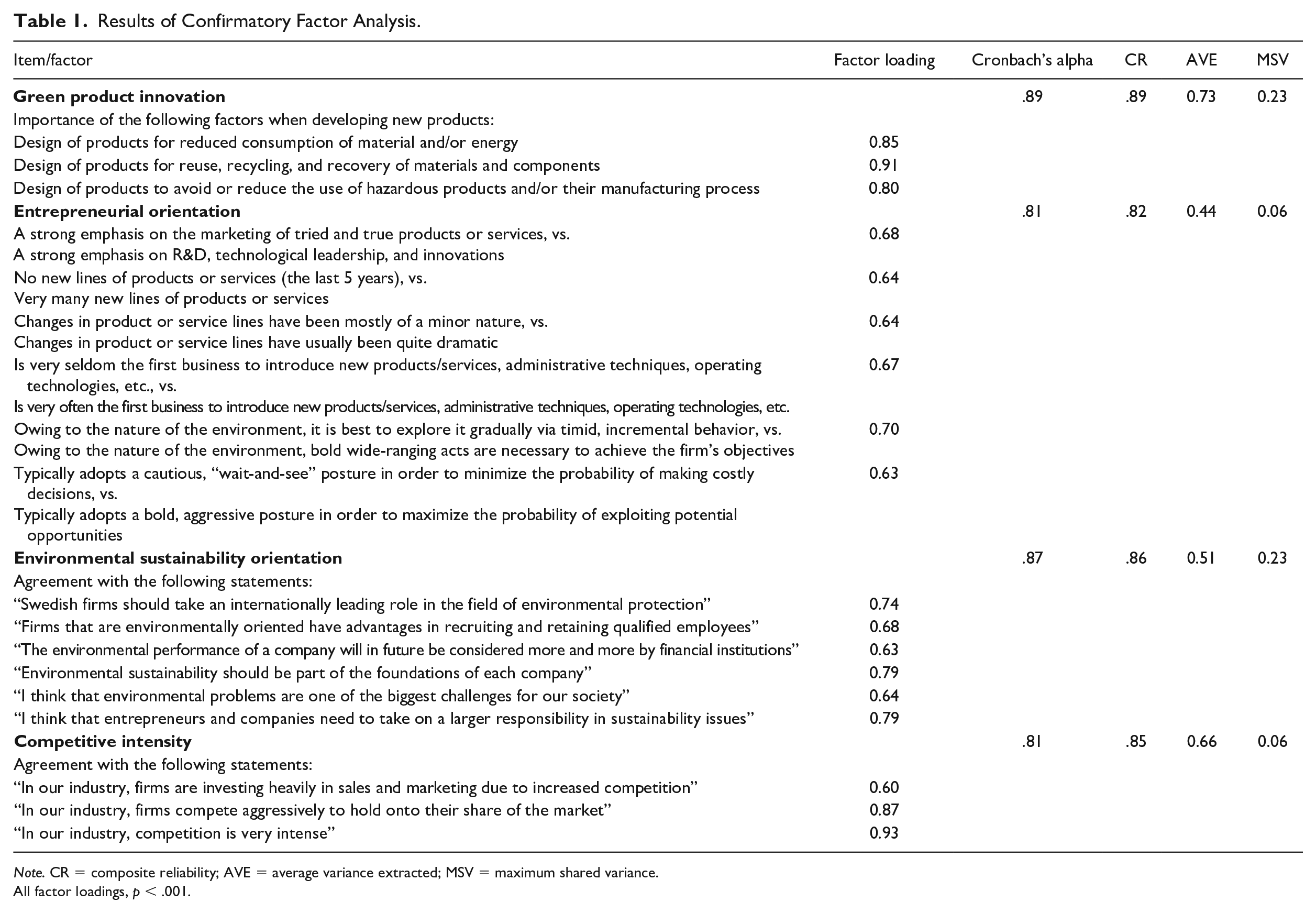
Note. CR = composite reliability; AVE = average variance extracted; MSV = maximum shared variance.
All factor loadings, p < .001.
Descriptive Statistics and Correlation Matrix.
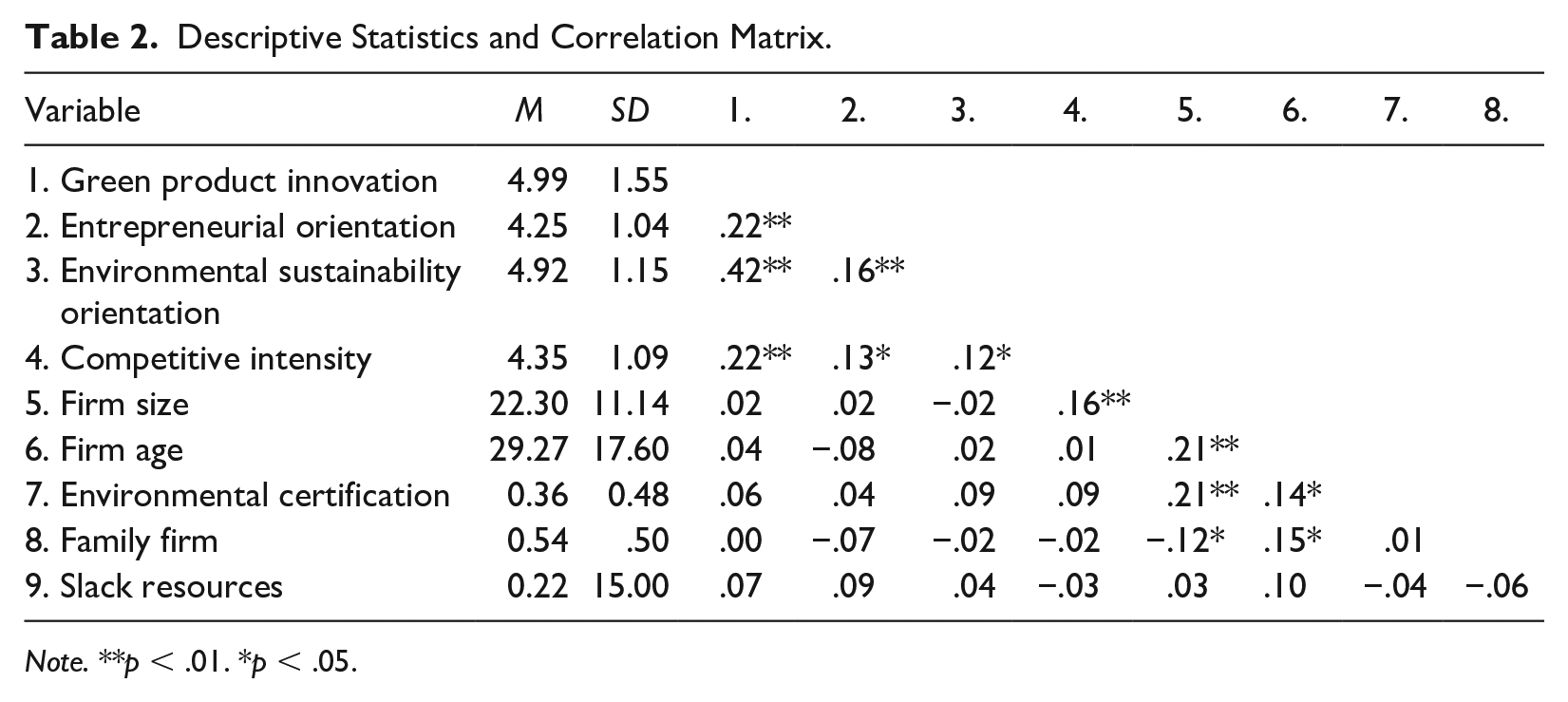
Note. **p < .01. *p < .05.
Measures
All subjective variables are based on established and previously validated scales. The three-item scale developed by Zhu et al. (2008) to measure eco-design was used to measure GPI. As shown by Zhu et al. (2008), this measurement is a robust measure of GPI, and the scale, or versions of the scale, has been used frequently in later studies (Diabat et al., 2013; Green Jr et al., 2012; S. M. Lee et al., 2012). In contrast to the other subjective variables, GPI concerns the assessment of a firm-level outcome and not the orientation of the CEO per se. To validate the accuracy of this assessment, the CEOs’ perceptions of profitability in terms of ROA were compared with objective ROAs collected from annual reports. These numbers were strongly correlated (β = 0.45, p < .001), and although the specific measure is not used in the analysis, this provides an indication of the accuracy of CEOs’ perceptions of firm-level outcomes such as GPI.
EO was measured by the scale developed by D. Miller (1983) and refined by Covin and Slevin (1989). This scale concerns nine items related to innovativeness, proactiveness, and risk-taking and is one of the most used scales in entrepreneurship and management research (Rauch et al., 2009; Saeed et al., 2014). As will be described in the next section, due to validity concerns the final scale to measure EO included six items (see Table 1 for the specific items).
ESO was measured using the scale on sustainability orientation developed by Kuckertz and Wagner (2010). The original scale was, however, not specifically designed for small firms, in which the “corporate social responsibility” concept is used less frequently. The statement “Corporate social responsibility should be part of the foundations of each company” was changed to “Environmental sustainability should be part of the foundations of each company.” Moreover, “German firms” was changed to “Swedish firms.”
The three-item scale developed by Lusch and Laczniak (1987) was used to measure competitive intensity. This scale is highly established in marketing (Lusch & Laczniak, 1989; Yi et al., 2012) and management research (Andersén et al., 2020; Mahapatra et al., 2012), and the items have proven to be useful proxies for the level of competitive intensity in an industry.
Six control variables are included in the analysis. Firm size and firm age were controlled for because it is plausible that larger firms and more established firms are focusing on environmental management as well as product management to a different extent than smaller firms. Both variables were transformed, using logarithmic transformation, to achieve normality. Industry could also be a confounding factor because, for example, product innovation is likely to differ between industries. Thus, industry was controlled for by using dummy variables. It is also possible that firms are implementing GPI and other green practices solely because customers require them to be environmentally certified. Moreover, the hypotheses are partly based on a notion that EO and ESO can influence additional environmental practices but that they are especially important for GPI. Thus, controlling for more generic environmental practices would strengthen the validity of potential identified relationships between EO/ESO and GPI. To consider this, Environmental certification, operationalized as a dummy variable of being ISO14001 certified or not, was used as a control variable. Whether or not a firm is a family firm has also been found to influence environmental management (Littunen, 2003; Uhlaner et al., 2012). Moreover, it is plausible that the attentional perspectives of the CEOs in owner-led firms have a greater impact on the companies’ activities and underlying culture. Firms that the respondents identified as entirely or mostly owned by a specific family and perceived by respondents as family firms were classified as such. Family-owned firms and non-family-owned firms were distinguished by using a dummy variable. Finally, managers of firms with limited resources and financial constraints are potentially more likely to direct their attention to short-term economic issues to ensure the survival of their firms, and this could divert their attention from environmental issues, for example. Sharfman et al. (1988) identified firm size and previous performance as key firm-level predictors of overall organizational slack. Thus, in addition to the firm size control variable previously described, slack resources, measured as objective ROA from the previous year (corrected for industry, as described in the sample description), was also used as a control variable. ROA and other indicators of previous performance have been used extensively in previous studies as proxies for the level of slack resources (Leyva-de la Hiz et al., 2019; K. D. Miller & Leiblein, 1996; Symeou et al., 2019).
Validation of the Measurement Model
CFA was conducted using IBM SPSS AMOS 27, and the overall fit was satisfactory concerning parsimonious fit (χ2/df ratio = 2.031), incremental fit (comparative fit index [CFI] = .948, Tucker–Lewis index [TLI] = .936), as well as absolute fit (root mean square error of approximation [RMSEA] = .058, standardized root mean residual [SRMR] = .048). Moreover, and as illustrated in Table 1, the reliability (the lowest composite reliability [CR] being .82) and the discriminant validity measures (maximum shared variance [MSV] < average variance extracted [AVE]) surpassed recommended thresholds (Hair et al., 2018). To further validate discriminant validity, the heterotrait-monotrait ratio of correlations (HTMT) (Henseler et al., 2015) test was conducted and the results are presented in Table 3.
Heterotrait-monotrait Ratio of Correlations.
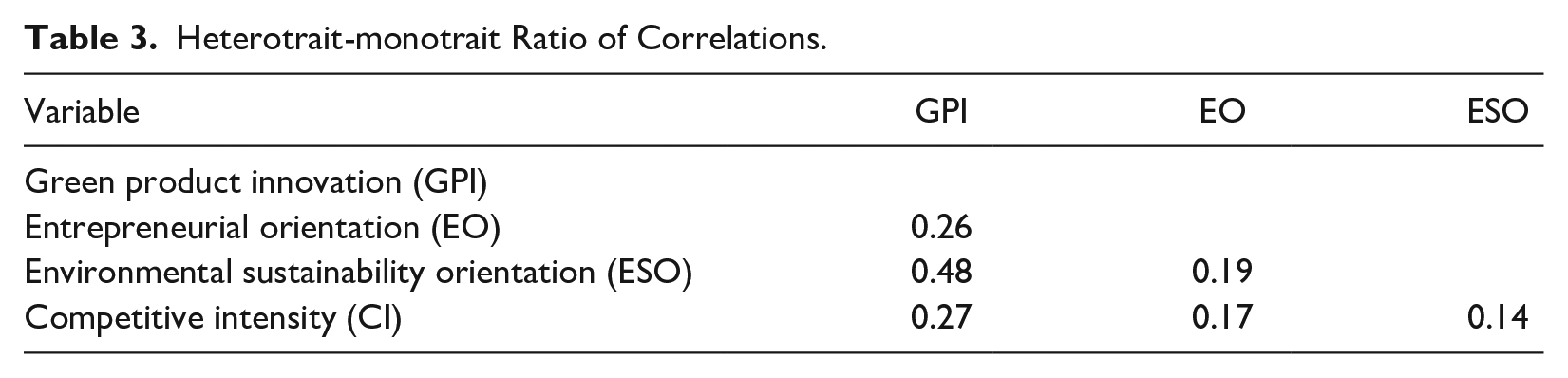
As depicted in Table 3, the highest HTMT value of 0.48 was between GPI and ESO and this value is clearly lower than the 0.85 threshold suggested by, for example, Henseler et al. (2015) and Franke and Sarstedt (2019).
Concerning convergent validity, three items related to EO had low factor loadings (<0.60) and were not included in the study. Thus, six items were used to measure EO and these items reflect the core dimensions of EO. All factor loadings were higher than 0.60, and for example, Hair et al. (2018, p. 663) specifically state that for CFA, “loading estimate should be 0.5 or higher, and ideally, 0.7 or higher, to indicate convergent validity.” Moreover, accepted values for factor loadings are highly dependent on sample size, and the sample size used in the present study is in the higher range in examples used by, for example, Hair et al. (2018, p. 133). The importance of sample size is supported by, for example, the CFA simulations by Ximénez (2006, 2009). Moreover, in those studies, low factor loadings in CFA were defined as factor loadings below 0.50, whereas all factor loadings in the present study exceed 0.60.
As illustrated in Table 2, AVE for GPI, ESO, and competitive intensity surpassed 0.50 and was 0.44 for EO. However, as suggested by Malhotra and Dash (2011), and as evidenced by several previous business (Digan et al., 2019; Lam, 2012) and environmental (Heuer & Lee, 2014; Ploum et al., 2018) management studies, a high level of CR can compensate for an AVE score below 0.50. Thus, as expressed by the scholars who developed the AVE method, “AVE is a more conservative measure than CR. On the basis of CR alone, the researcher may conclude that the convergent validity of the construct is adequate” (Fornell & Larcker, 1981, p. 44). Based on the fact that all factor loadings surpassed 0.60, the high levels of CR, and the closeness to 0.50 for the variable with the lowest AVE, convergent validity was deemed satisfactory.
Results
All variables were calculated as the average of the values of the items for each variable. As recommended by Dawson (2014) when examining interaction effects, with the exception of the industry dummy variables and the interaction terms, all variables were standardized. A series of linear multivariate regression analyses, using IBM SPSS 27, were run to test the hypotheses. The regression models were compared by examining significant changes of R2 values and by using various model selection techniques (Gayawan & Ipinyomi, 2009). The results of the regressions are presented in Table 4.
Regression Models.
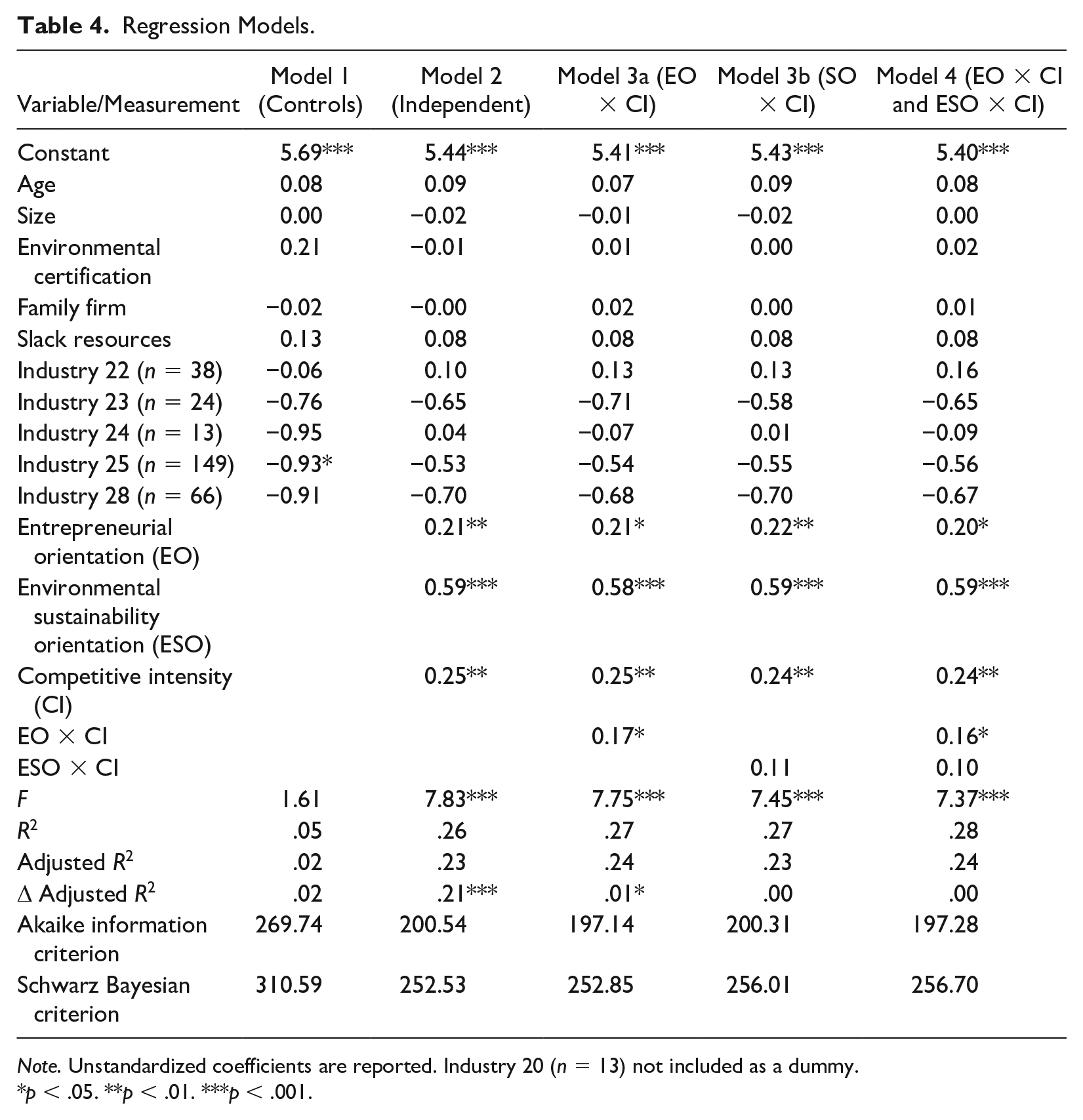
Note. Unstandardized coefficients are reported. Industry 20 (n = 13) not included as a dummy.
p < .05. **p < .01. ***p < .001.
Model 1 includes all control variables, and although no control variables related to the use of GPI are significant, the correlation matrix depicted in Table 2 indicates that family firms are significantly smaller and older than non-family firms in the sample. Moreover, as also indicated by the correlation matrix, larger and older firms are more likely to be environmentally certified.
In Model 2, the three independent variables are added, and this significantly (p < .001) increases the explained variance, defined as adjusted R2, from 2% to 23%. The results presented in Model 2 provide support for H1 and H2. H1 stipulates a positive relationship between EO and GPI and, as illustrated by the positive (β = 0.21) and statistically significant (p < .01) value of EO in Model 2, the hypothesis is supported. H2 concerns a positive relationship between ESO and GPI, and ESO is strongly and positively related to GPI (β = 0.59, p < .001). Thus, H2 is also supported.
In Model 3a, the combined effect of EO and competitive intensity on GPI stipulated in H3a is tested by adding the interaction term of EO and competitive intensity. The significant interaction effect (β = 0.17, p < .05) in Model 3a provides support for this hypothesis. Moreover, and as illustrated in Model 2, EO will still influence GPI when the competitive intensity variable is included. This shows that competitive intensity has a moderating effect (and not a fully mediating effect) (Baron & Kenny, 1986) on the relationship between EO and GPI. To examine the nature of the interaction effect of EO and competitive intensity on GPI, the method of plotting various high and low levels of the independent variable and the moderator suggested by Dawson (2014) were applied. The result is illustrated in Figure 1.
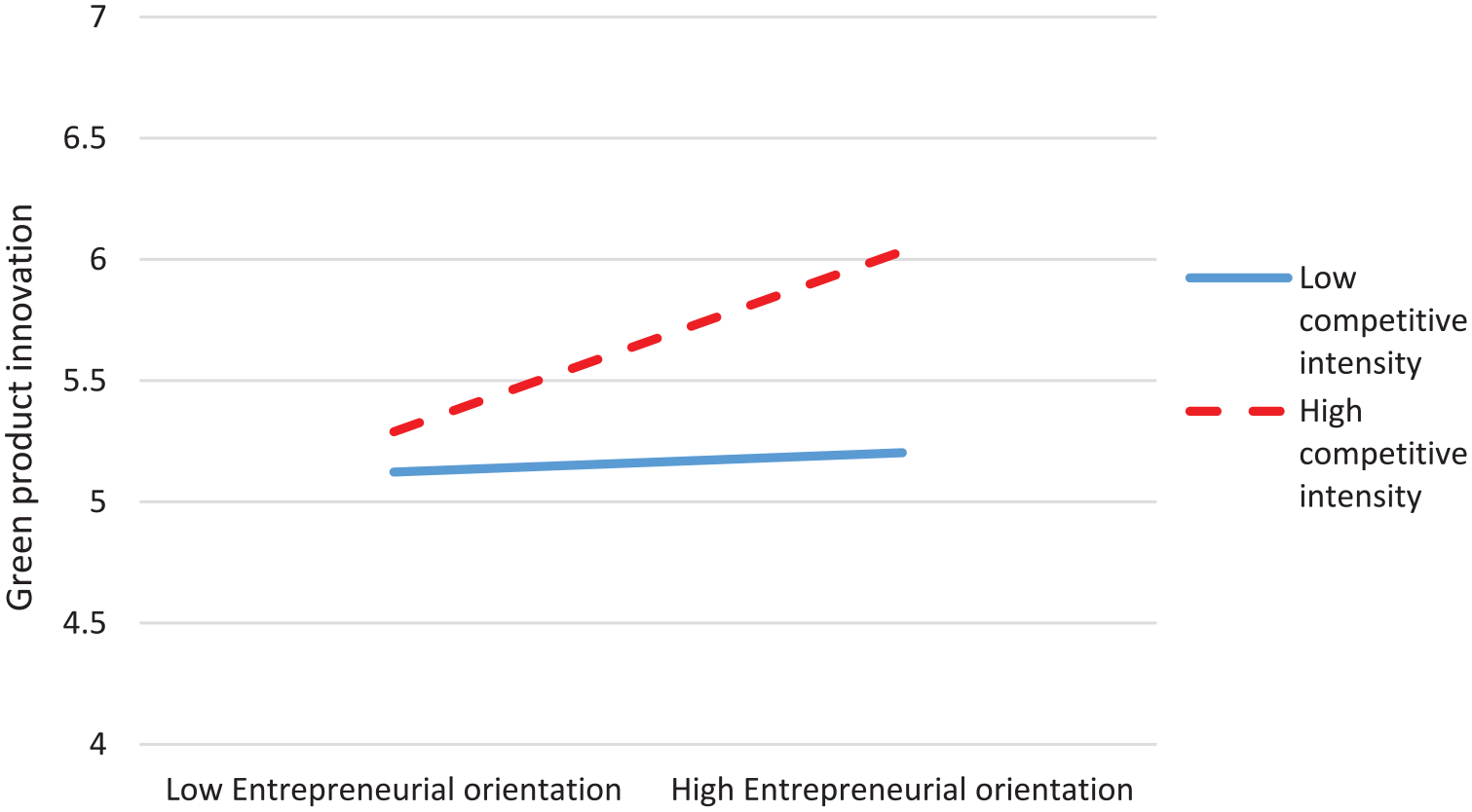
The Influence of Entrepreneurial Orientation and Competitive Intensity on Green Product Innovation.
Figure 1 illustrates how competitive intensity positively moderates the relationship between EO and GPI. Interestingly, the figure illustrates that EO has a very moderate effect in conditions of low competitive intensity.
In Model 3b, H3b on a positive moderation effect of competitive intensity on the relationship between ESO and GPI is tested by adding this interaction effect. As illustrated in Model 3b, the interaction effect of ESO and competitive intensity is not significant (β = 0.11, p > .05). Moreover, the change statistics are based on a comparison between Model 2 and Model 3b, and as illustrated by the identical adjusted R2 values, the inclusion of the interaction effect of ESO and competitive intensity does not increase the explained variance. To further validate this finding, Model 4 includes both interaction effects, and the significant change in the adjusted R2 value can solely be explained by the interaction effect of EO and competitive intensity. Moreover, all model selection criteria favor Model 3a over Model 3b and Model 4. Thus, H3b is not supported.
Robustness Checks
Some factors could potentially confound the results, and several steps were taken to ensure the validity of the results. Additional regressions in which the key variables (i.e., EO, ESO, and competitive intensity) were squared were conducted to check for possible nonlinear relationships. The squared terms were, however, nonsignificant, indicating linear relationships.
Significant changes of R2 values or adjusted R2 values do not necessarily reflect the best model. Various model selection estimations were, therefore, applied, and these provide additional support for the conclusion that Model 3a is the best model. Specifically, in addition to having the highest adjusted R2 value (.24), the Akaike information criterion (Akaike, 1974) provides support for this model. The Schwarz Bayesian criterion provides similar support for Model 2 and Model 3a, but when considering that this selection criterion can be “overambitious” in penalizing additional variables (Gayawan & Ipinyomi, 2009), and based on the other criteria presented, Model 3a should be the best model. This provides additional support for the overall findings, thus confirming H1, H2, and H3a and rejecting H3b.
Discussion
Considering the great impact GPI can have on financial as well as environmental performance, examining what influences the use of GPI in organizations is highly relevant to explore. Moreover, as shown by Dangelico (2016), most studies on GPI have focused on identifying specific factors influencing GPI without providing robust theoretical explanations for such findings. By examining how managers’ attentional perspectives and situated attention affect the use of GPI, the present study has demonstrated the usefulness of an ABV when studying and explaining antecedents to GPI.
As stipulated in the ABV, what managers focus their attention on is the result of the attentional perspectives of decision-makers and the situation. Managers with attentional perspectives characterized by EO and ESO will, as expected, focus more on GPI, and the importance of situated attention in terms of competitive intensity is supported by the confirmed interaction effect of EO and competitive intensity. Previous studies on EO have shown that entrepreneurial actions are most beneficial in competitive or uncertain business environments (Gupta & Batra, 2016; Martin & Javalgi, 2016; Wiklund & Shepherd, 2005), and the present study illustrates that it requires, at least, some kind of competitive intensity for entrepreneurial managers to focus more on GPI than nonentrepreneurial managers do.
Whereas the results discussed so far concern validation of the hypotheses developed in this study, the hypothesis on an interaction effect of ESO and competitive intensity could not be confirmed. However, managers’ ESO has a strong influence on the use of GPI, and the ABV could provide an explanation for the finding of a lack of an interaction effect. Managers with attentional perspectives characterized by a strong concern for environmental issues are, as confirmed by the present study, to a certain extent altruistic in the management of their firms and focus strongly on GPI regardless of situational stimuli such as competitive intensity. Thus, an important reason for the strong attentional focus on GPI of environmentally concerned managers could be that GPI is such a fundamental dimension of environmental management that managers with ESO focus on GPI, regardless of other attentional stimuli.
Theoretical Contributions
The key theoretical contribution of the present study is that it offers an ABV explanation for the use of GPI. The RBV can explain how and why GPI contributes to various performance outcomes (Dangelico, 2016; Dangelico & Pujari, 2010). However, the ABV can, as shown in this study, provide an explanation as to why firms differ in their use of GPI for other reasons than purely financial ones.
This study also contributes to research on specific antecedents to GPI. Several previous studies (Fryxell & Lo, 2003; González-Benito & González-Benito, 2006; Todaro et al., 2019; Williams & Schaefer, 2013) have shown how managers’ concern for environmental issues influences various organizational environmental practices, and the present study provides additional validation and empirical support for this notion in the context of GPI and small manufacturing firms. Moreover, and in contrast to previous research on antecedents to GPI, EO is identified as a predictor of firms’ GPI, and EO is an especially strong antecedent in competitive business environments. Whereas EO has been found to affect firm performance in numerous studies (Rauch et al., 2009; Saeed et al., 2014), most studies on how entrepreneurship affects environmental management have mainly examined constructs that concern environmental as well as entrepreneurial dimensions, such as ecopreneurship (Ljungkvist & Andersén, 2021; Magala et al., 2007; Schaltegger, 2002) and green EO (Jiang et al., 2018; Pratono et al., 2019). Nevertheless, some studies on environmental management practices other than GPI (Chavez et al., 2020; Hooi et al., 2016; Marshall et al., 2015) have indicated that EO per se can influence organizations’ environmental management, and the present study provides additional evidence that managers’ EO can influence environmental management in terms of GPI. However, the study also illustrates the importance of considering the nature of the business environment, and it indicates that entrepreneurial managers’ attentional focus on environmental management is more likely guided by business-related factors than by a concern for environmental issues.
The study also contributes to the ABV of the firm by illustrating the applicability of this theory on environmental management issues. Earlier studies on the ABV have found that whether managers have internally or externally oriented attentional perspectives will influence organizational innovative activities (Yadav et al., 2007), and the present study has shown the importance of additional attentional perspectives—EO and ESO—for a specific type of innovation, namely, GPI. In addition, the study provides additional empirical support for the importance of considering the interplay between attentional perspectives (Ocasio, 2011) and situated attention (Hoffman & Ocasio, 2001; Ocasio, 2012) to understand what decision-makers focus their attention on.
Managerial Implications
By adopting a behavioral theory of the firm, the present study mainly seeks to address why firms act in a certain way and not to provide guidance on how to act. Nevertheless, the study has some implications for practicing managers. Previous studies have shown that GPI is more beneficial in competitive and uncertain environments (Chan et al., 2016; J. Chen & Liu, 2019). Moreover, organizations with entrepreneurially oriented managers are usually more successful than other firms, and the strong relationship between high competitive intensity and the use of GPI among entrepreneurial managers, identified in the present study, should be a strong additional indicator that GPI is most useful in competitive business environments. However, managers with ESO focus their attention on GPI to the same extent, regardless of the conditions in the business environment. This could indicate an overly altruistic approach to environmental management. Thus, in less competitive business environments, other environmental business practices could be more viable to achieve ecological as well as economic sustainability. However, managers less concerned with the natural environment are much more reluctant to focus their attention on GPI, despite the potential economic benefits of this environmental management practice. Thus, the study illustrates the importance of considering the overall business environment when implementing various environmental management practices.
Limitations
The cross-sectional nature of this study is a limitation because it does not consider the long-term effects of attention on GPI. Although both EO and ESO are measured at the individual level and should be somewhat stable over time, future research is advised to conduct more longitudinal studies to examine short-term and long-term effects of attentional perspectives on GPI. Moreover, although the control variables are from other sources, the main variables examined are from the same sources, and future research could operationalize these variables in other ways to validate the findings of the present study. For example, research on the ABV has used content analysis of external communication to address various attentional perspectives (Tuggle et al., 2010; Yadav et al., 2007), and Kwieciński (2017) provides several suggestions on how to measure competitive intensity, using objective as well as subjective data.
Another limitation is that the sample is restricted to Swedish small manufacturing firms. Although examining a limited population reduces the risk that various contextual variables that could confound the results, the generalizability of the findings will be weaker, and I will now address potential limitations of studying a specific firm size and a specific country.
Concerning firm size, the aim of this study has specifically been to offer an ABV on GPI of small firms. Although meta-analysis studies on EO, for example, have shown that EO is equally important for small and large firms (Rauch et al., 2009), small firms and large corporations are likely to be affected differently by attentional perspectives and by situated attention. For example, large corporations are more likely to be influenced by environmental NGOs and to be more scrutinized by media concerning their environmental policies. Moreover, in small firms, CEOs are involved to a greater extent not only in strategic issues but also more operative processes, and the attentional perspectives of CEOs in smaller firms could potentially be expected to be a more important predictor for the use of GPI. However, although the specific findings of the present study might not be fully applicable to large corporations, the study does illustrate the usefulness of applying an ABV on firms’ environmental management practices, and future research is advised to identify and test the effects of additional attention-related variables on firms of various sizes.
Concerning the Swedish context, it is important to consider that firm behavior is affected by cultural factors. Although the relationship between EO and various performance outcomes (including innovation) can be moderated by national and cultural factors (Saeed et al., 2014), EO has a universally positive impact on firm performance (Rauch et al., 2009; Saeed et al., 2014). The national context can, however, have a greater influence on ESO and GPI. Sweden is renowned for strict environmental regulations and taxation, and Swedish environmental policies have been found to induce green innovation (Weiss & Anisimova, 2019). Moreover, in addition to the fact that being forced to focus on green innovation makes such practices more common in countries with “more stringent environmental regulations,” environmentally concerned countries will have a higher demand for green products (Aguilera-Caracuel & Ortiz-de-Mandojana, 2013 ). This could make GPI more profitable in Sweden, and it is possible that entrepreneurial managers in less environmentally oriented countries direct their attention to areas that are more profitable in their countries. Nevertheless, this would indicate the importance of regulations for small firm behavior, and replicating this study in other countries could generate relevant policy implications. Moreover, interest in the ecological environment is increasing and gaining more and more attention worldwide, and considering that Sweden is often regarded as being on the front line of environmental policies and practices, the results of studies on conditions in Sweden in the present could become more relevant for other countries in the future.
To summarize, there is some evidence to suggest that the findings of the present study should have some generalizability, in the present or in the near future, to firms outside the population examined in this study. Nevertheless, when referring to the present study, it is important to consider these potential limitations, and future research is advised to replicate the study in other contexts.
Future Research
In addition to validating and refining the results of the present study, the study highlights some interesting future research avenues. First, to further understand how managerial attention is related to GPI, additional attentional perspectives and attentional stimuli can be examined. GPI involves various internal processes but also has important external elements such as analysis of market demands and the impact on the external natural environment. Thus, whether managers have internal or external attentional perspectives could also be an important attentional antecedent to GPI. Also, situated attention such as a decline in performance (Tuggle et al., 2010), new situations (Shepherd et al., 2017), and environmental uncertainty (Cho & Hambrick, 2006) has been identified as important attentional triggers and could be important situational factors for future research on GPI to consider. Second, the present study has highlighted how the ABV can be used to study why organizations focus (or do not focus) on a specific environmental management practice, namely, GPI. An entrepreneurial attentional perspective could be, and in the present study has been shown to be, related to GPI. However, other attentional perspectives and types of situations, including those examined in this study, are likely to influence other environmental practices. Thus, future research is advised to examine, for example, waste management, green supply chain management (Zhu et al., 2008), and green process innovation (Y. Chen et al., 2006) from an ABV.
Conclusion
Previous research on antecedents to, as well as outcomes of, GPI has mainly been inductive and not grounded in any established theoretical frameworks or perspectives (Dangelico, 2016). Whereas the RBV can be used to address the outcomes of GPI, I have argued, and also shown, why and how the ABV can be used to identify and examine antecedents to GPI. This study can hopefully inspire future research to pay more attention to managerial attention when researching GPI, as well as other environmental management practices.
Footnotes
Declaration of Conflicting Interests
The author(s) declared no potential conflicts of interest with respect to the research, authorship, and/or publication of this article.
Funding
The author(s) disclosed receipt of the following financial support for the research, authorship, and/or publication of this article: This work was supported by generous grants from the Jan Wallanders och Tom Hedelius stiftelse samt Tore Browaldhs stiftelse and from The Kamprad Family Foundation for Entrepreneurship, Research & Charity.
