




Abstract
This article develops a framework for managerial conceptualization of corporate sustainability–stakeholder relationships (CS-SR) for paradoxical frames. The embedded nature of the business case frame for sustainability and aligned CS-SR, and a lack of insight into CS-SR for a paradoxical frame, may impede implementing a paradoxical frame for sustainability. Therefore, this article offers an understanding of structural differences in CS-SR in a business case versus a paradoxical frame for sustainability in terms of agency and communion. It then presents conceptual metaphorical mapping as the cognitive mechanism for managerial conceptualization of CS-SR for a paradoxical frame. Identifying nurturant parenting as an apt metaphorical domain with a conceptually similar relational structure to CS-SR of the paradoxical frame and dissimilar from the business case frame, it presents a model where juxtaposing nurturant parenting with sustainability enables sensebreaking of CS-SR of the business case frame and sensemaking of CS-SR of the paradoxical frame.
Keywords
Introduction
Corporate sustainability initiatives, defined as a firm’s voluntary initiatives to meet environmental and social goals along with financial goals (Meuer et al., 2020) often involve paradoxes where these goals are simultaneously and persistently inter-related but contradictory in nature (Schad et al., 2016). Managers may adopt a business case frame towards sustainability paradoxes, that is, a cognitive approach where sustainability initiatives are guided by the profit motive and are instruments to drive profits (Hahn et al., 2014). Such a frame is ubiquitous (Bondy et al., 2012; Djelic & Etchanchu, 2017; Epstein et al., 2015; Giuliani et al., 2021), and though it has advanced a sustainability agenda and increased its legitimacy in the corporate world (Hafenbrädl & Waeger, 2017; Van der Byle & Slawinski, 2015), the a priori emphasis on profits can compromise sustainability goals (Kaplan, 2020; Li & Wu, 2020; Raghunandan & Rajgopal, 2021). Alternately, managers may adopt a paradoxical frame, that is, a cognitive approach of simultaneous engagement with interrelated yet conflicting stakeholder goals (Hahn et al., 2014). Though not without limitations (e.g., Berti & Simpson, 2021; Calic & Hélie, 2018), simultaneous engagement with conflicting goals, and viewing sustainability goals as having intrinsic value at par with financial goals (rather than instrumental for financial goals) can advance a sustainability agenda in ways that a business case frame cannot (Hahn et al., 2018; Jay, 2013; Joseph et al., 2020; van Bommel, 2018; Walker et al., 2020; Wong et al., 2011).
However, managers enacting a paradoxical frame may struggle to conceptualize corporate sustainability–stakeholder relationships (CS-SR) aligned with such a frame. Unlike the unequivocal direction provided by the business case frame to prioritize profits and therefore relationships with economic stakeholders, a paradoxical frame, by emphasizing simultaneous engagement with conflicting stakeholders, requires CS-SR that is more emergent and flexible, where managers use different relational strategies in response to multi-stakeholder goals (Hahn et al., 2014, 2015). Such CS-SR is challenging and unfamiliar given the ubiquity of the business case frame. Managers struggle with enacting CS-SR in a paradoxical frame, with how they perceive themselves in their roles, and how they perceive and are perceived by stakeholders, internally and externally (e.g., Carollo & Guerci, 2018; Girschik, 2020; Sendlhofer, 2020; Soderstrom & Weber, 2020; Wickert & de Bakker, 2018; Wright et al., 2012), resulting in abandoning a paradoxical frame in favour of a business case frame (Daddi et al., 2018; Wright & Nyberg, 2017).
Drawing on conceptual metaphor theory (Lakoff & Johnson, 1980), I propose the use of metaphorical mapping as the cognitive mechanism for managerial sensemaking of CS-SR for a paradoxical frame and sensebreaking of CS-SR of the default business case frame. To initiate sensemaking and sensebreaking, metaphorical mapping requires juxtaposing a novel, challenging concept, such as CS-SR for a paradoxical frame, with a structurally similar but more familiar conceptual domain. Therefore, I present an understanding of the structure of CS-SR for the paradoxical frame in terms of managerial agency moderated by communion (Abele & Wojciszke, 2007), argue its structural similarity to Lakoff’s (2016) conceptual domain of nurturant parenting, and discuss how juxtaposing nurturant parenting cues with CS-SR will initiate sensemaking via the metaphor of CS-SR as nurturant parenting. Furthermore, I argue that because nurturant parenting contradicts CS-SR of the business case frame (which is defined by managerial agency and therefore is structurally similar to Lakoff’s strict fathering), juxtaposing nurturant parenting cues with CS-SR also initiates sensebreaking of CS-SR of the business case frame.
My primary contribution is a theoretically grounded understanding of how managers can conceptualize and engage with CS-SR aligned with a paradoxical instead of a business case frame. By examining the structure of CS-SR in each frame, I provide a nuanced understanding of the cognitive changes required to enable managerial functioning with a paradoxical frame. Using this understanding to develop a metaphorical mapping framework for sensebreaking of CS-SR of the business case frame and sensemaking of CS-SR of the paradoxical frame, I provide a testable, implementable tool to effect these cognitive changes. Managerial engagement with CS-SR for a paradoxical frame is one necessary step for successful enactment of a firm’s commitment to sustainability paradoxes, and as acknowledged by practitioners and academics, working with paradoxical frames is key to furthering a sustainability agenda (Business Roundtable, 2019; Glasgow Financial Alliance for Net Zero, 2021; Joseph et al., 2020; Walker et al., 2020).
I first discuss the challenges in adopting CS-SR for a paradoxical frame and then present conceptual metaphorical mapping as the cognitive mechanism for managerial adoption of CS-SR of the paradoxical frame. Following this, I discuss the structure of CS-SR in business case and paradoxical frames, identify nurturant parenting as an apt metaphor for CS-SR of a paradoxical frame, and present a framework for metaphorical mapping that enables sensebreaking of the former and sensemaking of the latter.
CS-SR in Paradoxical and Business Case Frames for Corporate Sustainability
Cognitive frames are mental constructions that hold an individual’s beliefs and associations about concepts (Cornelissen & Werner, 2014). These frames occur through an accretion of an individual’s experiences are composed of content (the attributes of the concept) and structure (the relationships among the attributes) and are used to comprehend incoming stimuli. When dealing with sustainability initiatives, managers may adopt a business case frame or a paradoxical frame, two exemplars of cognitive frames that are composed of multiple stakeholders (firm, environment, and society) and are structured differently (Hahn et al., 2014). The business case frame emphasizes a firm’s economic goals while the paradoxical frame eschews prioritizing a profit goal above all. This difference points to a difference in CS-SR too.
The structure of CS-SR in a business case frame is aligned with its prioritization of financial goals. Here, CS-SR is enacted via a hierarchical relational structure where the manager (as agent for a firm’s profit) focusses on the goals of economic shareholders, and on environmental and social stakeholders to the extent these drive economic goals. The relationship with these latter stakeholders is secondary to the relationship with financial shareholders (Smith & Rönnegard, 2016). This business case frame for sustainability and its associated CS-SR is deeply embedded in managerial practice. This is due to the long-term accretion of profit-focussed managerial experiences and the enabling institutional and organizational logics they work within (Hafenbrädl & Waeger, 2017). Profit and financial growth motives and managers as champions of these goals has historically dominated business activities, a dominance consistently communicated for more than a century through governmental, nongovernmental, corporate, and educational institutions (Djelic & Etchanchu, 2017; Moosmayer et al., 2019; Smith & Rönnegard, 2016). The predominance of the profit-focussed business case frame for sustainability and aligned CS-SR is evident in data indicating that sustainability managers are valued for competencies and outcomes aligned with this frame (Glavas, 2016; Gond & Moser, 2021; Osagie et al., 2019). Therefore, the business case frame for sustainability and its CS-SR has become the default frame, a “habit of mind” or standard operating procedure (Louis & Sutton, 1991).
CS-SR for a paradoxical frame, on the other hand, requires a multilateral nonhierarchical relational structure among the firm, environmental, and social stakeholders. Working with paradoxes in any context requires acknowledging and working with the contradictions and interdependence among all stakeholder goals, finding synergies among them such that the whole is greater than the sum of its parts (e.g., Hahn et al., 2014; Miron-Spektor et al., 2011; Schad et al., 2016; Zhang & Han, 2019). In the context of corporate sustainability, managers commit to an indivisibility of economic, environmental, and social stakeholder interests. They must manage multiple stakeholder relationships simultaneously, access and integrate information and perspectives from these stakeholders while decentring the firm’s economic goals (Hahn et al., 2014). Therefore, effective functioning with a paradox frame requires relational strategies that are flexible and are simultaneously responsive to different stakeholders.
Unlike the deeply embedded understanding and practice of CS-SR of the business case frame, CS-SR of the paradoxical frame is relatively novel, challenging, and not explicitly addressed in the literature (Girschik et al., 2020). In the absence of a conceptually grounded understanding of CS-SR for a paradoxical frame, sustainability managers may struggle to function with such a frame. Evidence indicates that when experiencing a conflict with economic goals, rather than adopting a multilateral approach, sustainability managers may develop a “sales” relationship with stakeholders, focussing only on the persuasive aspect of the relationship (Wickert & de Bakker, 2018; Wright & Nyberg, 2017). CS-SR for paradoxes appears to develop on an opportunistic basis rather than on a conceptual understanding of the nature of and requirements for these relationships.
In sum, when adopting a paradoxical frame for sustainability, managers are faced with, on one hand, the embedded nature of CS-SR for a business case frame and, on the other hand, the challenging, novel, and ambiguous CS-SR of a paradoxical frame. In the absence of an understanding of CS-SR of the paradoxical frame, managers gravitate towards the deeply embedded business case frame and associated CS-SR. For instance, the challenge of working with sustainability paradoxes led to the abandonment of the paradoxical frame and to the adoption of a business case frame in firms with explicitly stated sustainability commitments (Hestad et al., 2020; Wright & Nyberg, 2017). Similar patterns are reported from the Australian forestry and wood products industry (Joseph et al., 2020) and European companies committed to a circular economy (Daddi et al., 2018).
To engage with CS-SR of the paradoxical frame, managers must actively counter the default CS-SR of the business case frame and interpret and experiment with CS-SR for a paradoxical frame. This process of dislodging an embedded frame and conceptualizing CS-SR anew is challenging. Metaphorical mapping is a cognitive mechanism that can enable this conceptualization of CS-SR in terms of the paradoxical frame (Logemann et al., 2019; Maitlis & Christianson, 2014).
Theoretical Framework: Conceptual Metaphorical Theory
Conceptual metaphor theory holds that metaphors, frequently considered as linguistic tools, can function as cognitive tools, thinking devises, to structure our understanding or conceptualization of concepts, experiences, domains (Lakoff & Johnson, 1980; for a review and critique of the theory, see Gibbs, 2011; Kövecses, 2008). Conceptual metaphors occur when two conceptual domains are related through a series of mappings (Lakoff, 1992). A conceptual domain is any coherent organization of various embodied experiences (basic, preconceptual schemas). Of the two conceptual domains in a metaphorical relationship, one acts as a source domain and typically comprises schemas of frequently encountered experiences and concepts. The other is the target domain and typically relates to relatively abstract, intangible experiences and concepts.
Metaphorical mapping occurs when source and target domains are juxtaposed, and there is a selective, figurative projection of relationships, reasoning, and words from the source to interpret the target (Kövecses, 2020; Lakoff, 1992; Lakoff & Johnson, 1980). Therefore, there are ontological and epistemic correspondences between domains (Lakoff, 1992). For instance, the conceptual domain of war is a frequently used metaphor for business (Audebrand, 2010). War, the source domain with entities in a combative relationship trying to seize territory from the other, is mapped on to business, the target conceptual domain, resulting in business activities, such as “capturing market share,” “competitive intelligence,” and “target marketing.”
The source domain foregrounds certain aspects of the target and thereby guides how the target is perceived. Therefore, metaphorical mapping from the source to the target frames the target in terms of the source and enables selective interpretation of and potential responses to the target (Burgers et al., 2016; Cornelissen, 2005; Kövecses, 2010, 2020; Lakoff, 1992). For instance, Audebrand (2010) argues for stewardship as an alternative to the source domain of war. A metaphoric mapping from stewardship to business will frame business in terms of responsibility and care rather than in terms of competition and win–lose. Through framing, metaphors provide structure and meaning to new situations, new meaning and structure to established situations, and reduce equivocality (Cornelissen et al., 2011; Hill & Levenhagen, 1995; Maitlis & Christianson, 2014). This framing function is particularly useful when managers are required to perceive an established domain in a new way (Cornelissen et al., 2011).
Metaphors are a frequently used framing tool, for instance, in politics, public discourse, health (Burgers et al., 2016; Semino et al., 2018), and business (e.g., Audebrand, 2010; Tourish & Hargie, 2012). Sustainability work uses metaphors to frame inputs and outputs (e.g., natural capital, industrial ecology), well-being as wealth (Painter-Morland et al., 2017), nature as design (Jones, 2016), and organizations as water-keepers versus exploiters (Jermier & Forbes, 2016). Carollo and Guerci (2018) found that managers intuitively use metaphors to bridge and frame different identities they adopt for sustainability work (e.g., “activist in suit,” “virus in the organizational body,” “hyena”).
There is compelling empirical evidence supporting metaphorical mapping and its effects on attention, perception, attitudes, and behaviour (Fetterman et al., 2016; Landau et al., 2010). For instance, the metaphor of a nation (target domain) as a body (the source domain) increased anti-immigrant attitudes because experimental subjects likened immigrants to bacteria (foreign bodies) attacking their own physical bodies (Landau et al., 2009). The metaphor “crime is a virus” increased focus on root causes and recommendations for social reform solutions to inoculate against crime, while “crime is a beast” led to proposals to catch and jail criminals (Thibodeau & Boroditsky, 2011). Flu vaccine uptake increased with metaphorical messages (e.g., flu as a wild beast or an attacking army) rather than with facts (a “virus that infects the body”; Scherer et al., 2015). Describing the sun as an enemy and sun protection products as combat armour or super-heroes increased worry about the sun and sun-safe intentions than did a more factual description of sun damage (Landau et al., 2018). Metaphoric mapping is also reflected in the brain’s neural circuitry (Lakoff, 2014). Thus, juxtaposing apt source and target domains in a metaphorical relationship can frame the target in ways that lead to meaningful cognitive, emotional, and behavioural change that may not occur otherwise (Logemann et al., 2019).
Therefore, metaphorical mapping may help frame CS-SR for paradoxes than for the business case. This requires identifying an apt source domain to juxtapose with the target domain of CS-SR, such that, it presents a conceptualization of CS-SR for a paradoxical frame (and contradicts CS-SR of a business case frame). An apt source domain is one that is structurally similar to the target domain (Kövecses, 2010, 2020; Lakoff, 1992); That is, the relationship among the components of a source domain must be compatible with the relationships in the target domain. For instance, the source domain of a journey comprises a traveller and a destination. The relationship between the traveller and destination can be passive with the traveller being carried along (e.g., being driven in a vehicle), or active (e.g., traveller walking, driving). When the journey (the source domain) is juxtaposed with a student’s academic life (the target domain), it is the active relationship between the traveller and destination (rather than the passive relationship) that is structurally compatible with academic progress. Consequently, juxtaposing active travel with academic life increased student confidence in actions necessary for academic success, but a passive journey did not (Landau et al., 2014).
In sum, an apt source domain for metaphorical mapping can frame CS-SR to align with the paradoxical frame. An apt source domain is one that is structurally compatible with CS-SR of the paradoxical frame. Note that the contents of the two domains need not be similar. Rather, a similar relational structure is required. This relational similarity activates the projection of inferences from the source to the target domain and frames the target domain to align with the source domain. To identify such an apt source domain, we first need an understanding of the structure of CS-SR so that we can identify an apt source domain with a similar structure. The next section presents an understanding of the relational structure of CS-SR to enable identifying an apt source domain to initiate metaphoric mappings.
Relational Similarity Between CS-SR and Metaphoric Domains
Relational Structure of CS-SR
This article draws on the psychological dimensions of communion and agency to understand the structure of CS-SR. Considered the Big Two dimensions of social cognition, agency and communion have been empirically validated across cultures and time (Abele & Wojciszke, 2007). Agency-based interactions reflect power differentials among interactants where access to more resources allows dominance over others. Furthermore, agency also reflects an independent self-construal (i.e., the self is defined as independent of others: Markus & Kitayama, 1991) and a relational motivation of self-enhancement. Communion, on the other hand, relates to affiliation and co-enacted (shared) power among interactants. It reflects an interdependent self-construal (i.e., the self is defined as interdependent on others) and a relational motivation of mutual enhancement (multiple entities’ goals are met). These universally understood dimensions of social cognition reflect specific perceptions and behaviours defining interactional motivations, including managerial interactions (Abele & Wojciszke, 2007; Schaumberg & Flynn, 2017).
Agency and communion can explain the relational structure of CS-SR in the business case and paradoxical frames for sustainability. Specifically, because managers are considered inherently agentic and agency is a stereotypical managerial requirement (Duehr & Bono, 2006; Koenig et al., 2011), CS-SR in both the business case and paradoxical frames will be defined by managerial agency. The distinction in CS-SR of the two frames arises through the moderating effect of communion on CS-SR of paradoxical frames. The multilateral nature of goals and decision-making in the paradoxical frame speaks to a moderation of the inherently agentic nature of managers with managerial communion. Managers are tasked with ensuring the firm’s interests (agency) while also affiliating with and driving stakeholder interests (communion). This moderation of managerial agency with communion occurs when business leaders encounter paradoxical situations (Waldman & Bowen, 2016; Zhang & Han, 2019). Therefore, CS-SR in the business case and paradoxical frames are defined by agency and agency moderated by communion, respectively. Based on this structure, the next step is to identify an apt source domain, that is, one with a similar structure, to initiate metaphorical mapping.
Parenting as an Apt Source Domain
Parenting is an apt source domain for metaphoric mapping to CS-SR because it meets the primary criteria for effective mapping—its relational structure is compatible with that of CS-SR (Kövecses, 2010). Just as the relational structure of CS-SR can be explained in terms of agency and communion, the relational structure of the parenting domain can also be understood in terms of these two dimensions (Dunlop et al., 2017). While both agency and communion occur in parenting, the foregrounding of one dimension over the other activates specific parenting domains. Lakoff’s (2016) “strict fathering” is a domain where the parental figure has power and control over others in the unit. Strict fathering is therefore dominated by parental agency and is hence structurally compatible with CS-SR of the business case frame. Strict fathering with its hierarchical structure and power held by those with resources is the root metaphor for most profit- focussed business (Lakoff, 2016). Lakoff also identifies an alternative domain, “nurturant parenting,” that, despite a power differential among unit members, is based on affiliation. In nurturant parenting, communion moderates parental agency and, therefore, it is structurally compatible with CS-SR of the paradoxical frame.
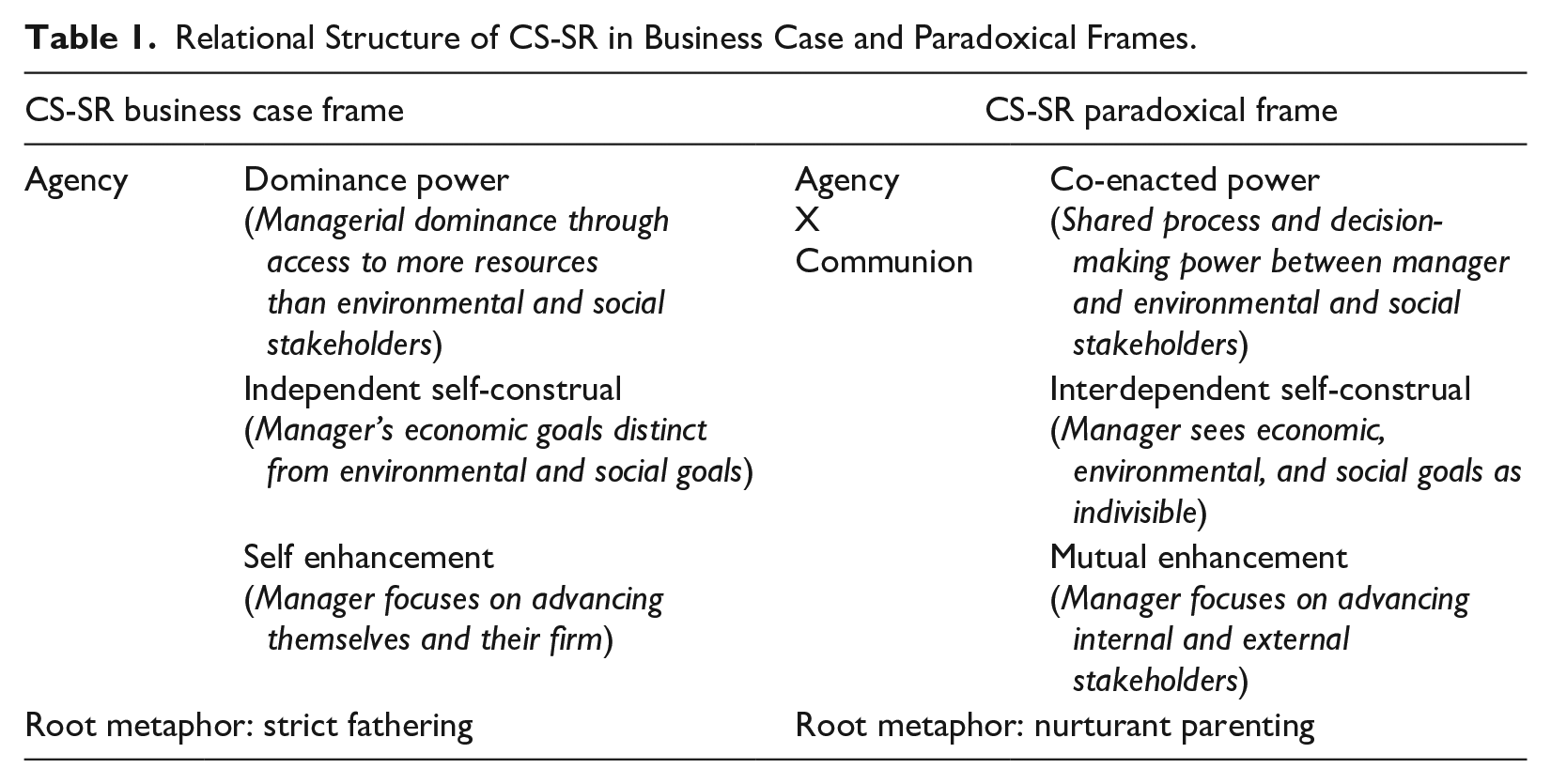
Parenting as a source domain also meets other criteria for effective metaphoric mapping for CS-SR. It is a culturally, socially, and personally familiar relational domain that is understood universally and intuitively. Such domains are particularly effective for metaphorical mapping (Giorgi, 2017; Holyoak & Stamenković, 2018). It models our earliest experiences of governance and the management of relationships (Etchanchu & Djelic, 2019; Lakoff, 2016). It appears as a metaphor across levels of society, from the most intimate family unit to a much broader national level (e.g., Mother/Fatherland). An entrepreneur’s relationship with their venture is likened to parenting (Cardon et al., 2005) and entrepreneurial and parental bonding having similar neural circuity (Lahti et al., 2019). “Parent firm” describes the relationship between a firm and its spin-offs and subsidiaries (Lange et al., 2009). Parenting metaphors have explained stakeholder relations in corporate sustainability (Etchanchu & Djelic, 2019; Haack & Scherer, 2014). Therefore, parenting is an apt source domain for metaphorical mapping. The next section provides a deeper discussion about the structural compatibilities of the parenting domains with CS-SR (Table 1).
Relational Structure of CS-SR in Business Case and Paradoxical Frames.
CS-SR as Strict Fathering: Managerial Agency in the Business Case Frame
Lakoff’s (2016) strict fathering occurs in a hierarchical structure where power is concentrated in the father figure, an entity that controls access to resources, determines, and enforces rules by which members function, knows a priori what each member needs, how much each gets, and what role each plays. Interactions are monologic in accordance with strict father figure’s rules. This position of dominance is not to be questioned by those lower in the hierarchy, that is, those with fewer resources. The father figure provides for the needs of those with fewer resources, and in return determines their rights and responsibilities. Thus, power is discharged in a way that reinforces and perpetuates the power hierarchy. Because agency is instantiated through a power–dominance relationship, strict fathering is a parenting domain that foregrounds agency over communion.
CS-SR in a business case frame also foregrounds agency and reflects a similar hierarchy. It prioritizes the profit motive, and therefore creates linear, unidirectional, hierarchical relationships in which sustainability managers (as agents responsible for a firm’s finances) are in a position of decision-making primacy vis-à-vis environmental and social stakeholders. As an agent of the firm, power tends to be concentrated in the manager’s hands, a concentration that is historically legitimized through the firm’s access to financial, labour, and market resources (Etchanchu & Djelic, 2019). Engagement with multiple stakeholders is contingent on how it benefits the firm financially (Schaltegger et al., 2019). For instance, philanthropy, a form of business case corporate sustainability, frequently occurs at the manager’s discretion, driven primarily by managerial utility concerns (Gautier & Pache, 2015).
In addition to dominance power, agency is also instantiated through an independent self-construal and a relational motivation of self-enhancement. These are evident in the strict fathering domain that valorises the pursuit of self-interest and independence as a moral obligation. An entity must use their “assets” to work towards their individual success, strive for self-enhancement, and accept responsibility for their own success and failures. Competition is key for individual development and fulfilment (Lakoff, 2016).
The business case frame for sustainability also emphasizes an independent self-construal and self-enhancement. Managers enact sustainability that furthers their firm’s competitive position and profit, thereby setting their firm apart from, and ahead of, external stakeholders. They focus on their firm’s financial agenda and strategically signal their commitment to external stakeholders to derive a competitive advantage from it (Bondy et al., 2012; Epstein et al., 2015; Wright & Nyberg, 2017). Sustainability is a tool to give their firm a branding advantage and financial returns (e.g., Vallaster et al., 2012). Thus, managerial actions are aligned with the drive to promote their firm above all, reflecting an independent self-construal and self-enhancement. An independent self-construal and self-enhancement also occurs when managers enact greater sustainability in response to incentives, such as organizational recognition and enhanced compensation for themselves (Derchi et al., 2021; Fabrizi et al., 2014). Thus, in firms with a business case frame for sustainability, managers demonstrate an independent self-construal and self enhancement as they enact sustainability to drive their own careers and compensation and to drive their firm’s financial goals over stakeholder goals. In sum, as in strict fathering, CS-SR in the business case frame is defined by agency—dominance power, an independent self-construal and self-enhancement.
CS-SR as Nurturant Parenting: Managerial Agency and Communion in the Paradoxical Frame
The relational structure of Lakoff’s (2016) nurturant parenting domain reflects an integration of agency and communion and is characterized by a co-enacted power structure, an interdependent self-construal, and relational motivations of mutual enhancement. In this domain, while the parental figure has more resources than other members of the unit and may have final decision-making authority, this authority does not equal dominance. The power structure is co-enacted and not hierarchical as in agency-dominated strict fathering. This co-enactment occurs through a sharing of resources and a sharing of both the process and outcome of decision-making. Decisions occur in consultation with stakeholders who have latitude to define their own goals. Interactions are dialogic with parental roles being that of enablers and nurturers. In contrast to strict fathering, a nurturant parent does not unilaterally determine the rights and responsibilities of the less powerful, but rather, enables them to assert their own agency in determining their roles. The nurturant parent shares their position of power to enhance the agency of the others, to enable them to be powerful in their own right, and to close the power gap.
A similar relational structure occurs in the paradoxical frame for sustainability. Because the paradoxical frame does not support an a priori hierarchy of goals and stakeholders, CS-SR occurs in multilinear, multidirectional forms (Hahn et al., 2014). A moderation of agency with communion in co-enactment of power occurs when managers approach paradoxes by communicating authority and nurturance, confidence in and responsibility for decision-making while ensuring and valuing others’ inputs, maintaining control and enabling autonomy (Waldman & Bowen, 2016; Zheng et al., 2018). Thus, co-enacted power resulting from a moderation of agency with communion in nurturant parenting parallels paradoxical corporate sustainability situations.
Furthermore, the integration of agency and communion in nurturant parenting reflects an interdependent self-construal and mutual enhancement. It values secure social attachments and achieving self-fulfilment through nurturance and cooperation. There is explicit understanding that over the long term, the well-being of every member impacts and is impacted by everyone else, and one person cannot flourish at another’s expense (Lakoff, 2016).
In parallel to the interdependent self-construal and mutual enhancement of nurturant parenting, the CS-SR of the paradoxical frame emphasizes “both/and” thinking over “either/or” thinking (Lewis & Smith, 2014; Van der Byle & Slawinski, 2015). Both/and thinking requires surfacing, nurturing, and integrating competing goals rather than focussing on one stakeholder goal over others. It makes explicit the integrated nature of stakeholders and the commitment to work for shared goal achievement. A food entrepreneur faced the paradox of store relocation to increase foot traffic, but thereby compromising her social goal to help revitalize the store’s current neighbourhood (Soderstrom & Heinze, 2021). Instead of choosing one goal over the other, she chose both/and by staying in the neighbourhood in need of revitalization and protecting her financial health by sharing space with another entrepreneur. Both/and thinking adopted by a shoe manufacturer facing paradoxical goals of making shoes that were profitable but nondurable and therefore an environmental burden led to creative ways to manage both the environment and financial goals (Vallaster et al., 2021). Patagonia’s (the outdoor clothing and gear company) struggles to eliminate chemicals that are environmentally harmful but increase the functionality and lifespan of their products led to aggressive investments in new technologies in search for alternatives that will retain product quality and life span without burdening the environment (Patagonia, 2021b). These examples feature an interdependent self-construal and mutual enhancement within a paradoxical frame for CS-SR.
Thus, conceptual similarity in the agency–communion relational structure of nurturant parenting and the paradoxical frame implies that nurturant parenting can provide cognitive and behavioural parameters to comprehend, adopt, and manage CS-SR for a paradoxical frame. Nurturant parenting also contrasts with strict fathering underlying the business case frame and so the metaphor of CS-SR as nurturant parenting can counter CS-SR of the business case frame. Having identified an apt metaphor, the next section describes the metaphorical mapping between nurturant parenting and CS-SR. This metaphorical mapping occurs through a process of sensebreaking and sensemaking embedded in this mapping (Figure 1).
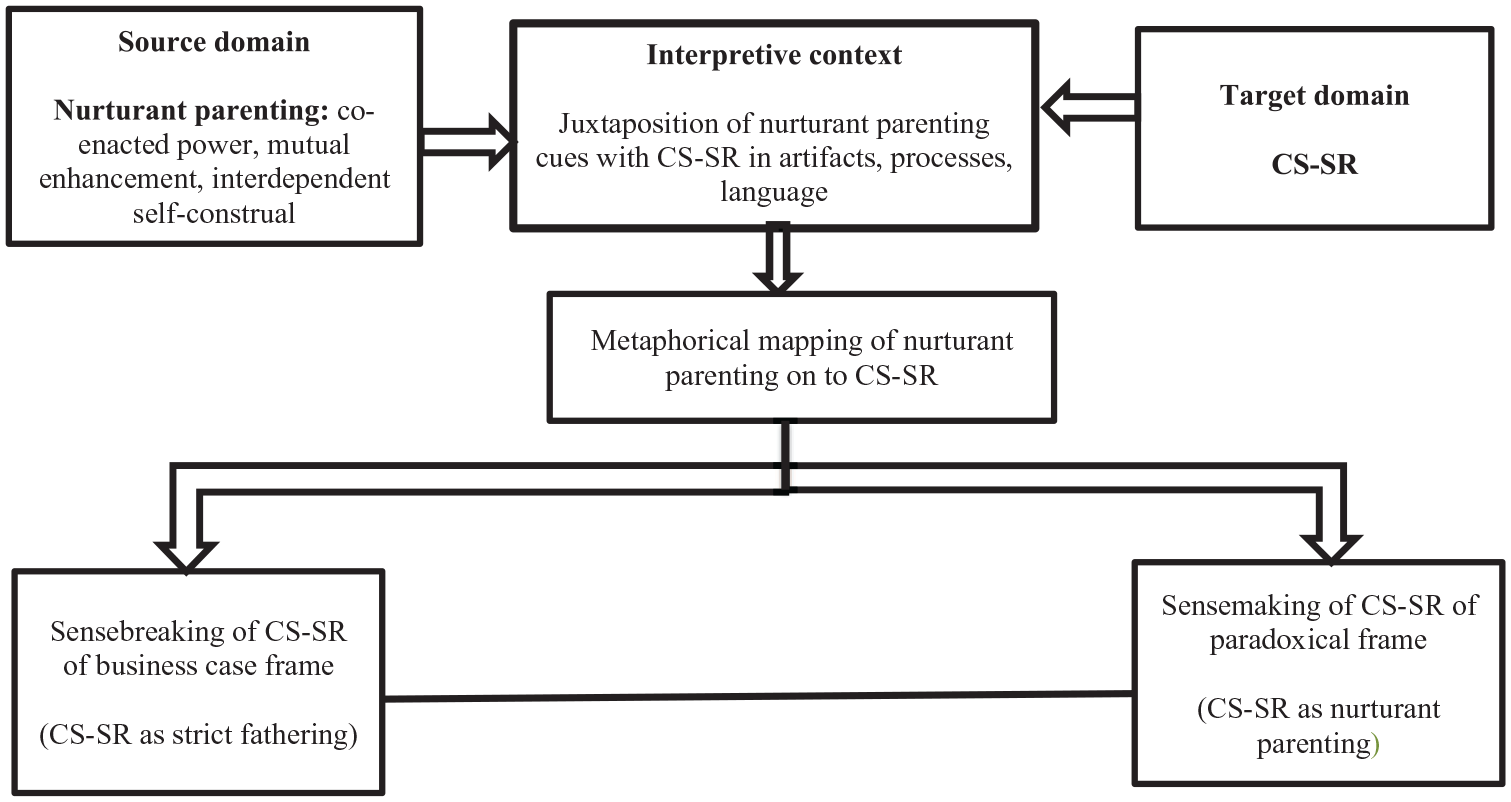
Metaphorical Mapping Between Nurturant Parenting and CS-SR: CS-SR as Nurturant Parenting.
Mapping Between Nurturant Parenting and CS-SR for the Paradoxical Frame
Metaphorical mapping occurs when the source and target domains are juxtaposed and aspects of the source domain are activated (Cornelissen, 2005; Holyoak & Stamenković, 2018; Landau et al., 2010). The activated aspects of the source domain are then mapped to the target domain, resulting in the target domain being framed in keeping with the activated aspects of the source. Therefore, to frame CS-SR in terms of co-enacted power, interdependent self-construal and mutual enhancement, these aspects of nurturant parenting must be activated. This can occur by juxtaposing these relevant aspects of nurturant parenting and CS-SR in an interpretive context. An interpretive context is one in which repeated and converging combinations of cues occur and direct attention to particular issues that motivate sensemaking (Cornelissen & Werner, 2014; Knight & Paroutis, 2017; Weber & Glynn, 2006). An assemblage of nurturant parenting cues of co-enacted power, interdependent self-construal and mutual enhancement embedded in CS-SR initiatives—in artefacts (e.g., documents), processes (e.g., hiring, promotions) and language (managerial rhetoric)—comprises the interpretive context.
Consider Patagonia, a company committed to multistakeholder goals. Nurturant parenting cues occur in their mission statement—“We’re in business to save our home planet” (Beer, 2018). This statement juxtaposes business (a stereotypically agentic context) with home, a context stereotypically associated with communion and with nurturance of something with inherent (rather than market) value (Lakoff, 2016). The statement also reflects mutually intertwined business and environmental goals—business and environmental interests are indivisible—and may be interpreted as cueing an interdependence with the environment (“our home”). They are not emphasizing one goal over the other and instead stress that each is necessary for the other. Nonlinguistic cues can also activate relevant domains (Lakoff, 2016). For example, Patagonia’s (2021a) employee benefits include on-site child-care at some locations as well as paid leave and health care for employees and their families, an anomaly in the United States. Employees speak of how these benefits are a constant reminder of community and of the larger impact of their work. Taken together, the mission statement, the benefits, and other cues embedded in various aspects of the business comprise an interpretive context that actives features of nurturant parenting.
Managers consider the activated relational features of nurturant parenting against their existing CS-SR—that is, against the default business case frame. The nurturant parenting cues contradict the CS-SR of the default business case frame (that reflects high agency) and therefore elicits dissonance. This dissonance initiates the process of sensebreaking where the default relational structure of CS-SR is taken apart and examined anew. While metaphorical mapping activates dissonance and sensebreaking, it can also initiate consonance through sensemaking. Nurturant parenting cues embedded in the interpretive context initiate a process of evaluating if and how its relational structure can inform CS-SR. If there is a fit, then through a process of sensemaking CS-SR begins to be reconceptualised to reflect a moderation of agency with communion, thereby moving managers towards a paradoxical frame. Thus, the mapping process initiates iterative sensebreaking and sensemaking of CS-SR.
Sensebreaking is the contradiction of existing frames, a loosening of established ways of doing business to enable new frames to take root (Pratt, 2000). It requires dismantling the assumptions and beliefs of existing frames and creating a drive for a new meaningful frame. Repeated exposure to the contradictions between the existing default CS-SR of the business case frame (with its dominant managerial agency) and nurturant parenting cues, together with actively encouraged oppositional thinking and questioning of assumptions of extant CS-SR initiates dissonance, and the default CS-SR for the business case frame may begin to be examined anew and dismantled (Lüscher & Lewis, 2008). Such deliberate sensebreaking is required to counter embedded default frames, such as the business case frame (Giuliani et al., 2021). Without sensebreaking, embedded frames filter out new, challenging information leading to a deflection of CS-SR of the paradoxical frame and perpetuation of the CS-SR of the business case frame.
Because sensebreaking of the hierarchical, linear decision-making of CS-SR of the business case frame occurs through cues of nurturant parenting and the moderation of agency with communion, it surfaces paradoxes that occur when multi-stakeholder goals are simultaneously considered. Paradoxes are complex and contradictory and can therefore cause tensions. While there are several types of tensions, the salience of tensions, that is, which tensions surface most significantly, is context-specific (Cunha & Putnam, 2019; Jarzabkowski et al., 2013). Given that sensebreaking for CS-SR for the business case frame focuses on the need to learn new ways to relate to stakeholders, learning and belonging paradoxes and associated tensions (Schad et al., 2016) are likely to be particularly relevant.
Cues of CS-SR as nurturant parenting can activate learning paradoxes and tensions between existing and new knowledge and ways of knowing. Co-enacted power, mutual enhancement and an interdependent self-construal in the paradoxical frame requires engagement with knowledge typically held by external stakeholders as well as the integration of internal and external stakeholder knowledge and goals. Managers need to learn “both/and” thinking. As discussed, extant managerial learning and practice focuses on “either/or” thinking, on expertise required to drive a firm’s financial objectives rather than environmental and social stakeholder objectives. Functioning within a paradoxical frame may position managers at the bottom of a steep, tension-filled learning curve. Cues of CS-SR as nurturant parenting may also activate belonging paradoxes and associated tensions about identity. CS-SR as nurturant parenting implies that managerial identity as steward of a firm’s financial goals is decentred, and managerial power and position vis-à-vis stakeholders is significantly redefined. The engagement is not hierarchical and sustainability managers face tensions between their identities in terms of a business or a values orientation, as “activists in suits,” “hippies on the third floor” (Carrollo & Guerci, 2018; Wright et al., 2012).
Therefore, managers experience sensebreaking, and learning and belonging tensions when they contend with CS-SR as nurturant parenting instead of the default CS-SR for a business case frame. This causes uncertainty and dissonance, and therefore potentially a paralysis in thought and action leading to a reversion to the familiar business case frame (Lewis & Dehler, 2000). Alternatively, managers may attempt to moderate the emphasis on the business case frame by adopting temporary measures, proselytize the win/win they assume happens with the business case frame, or resort to greenwashing actions that merely postpone or mask a resumption of the business case frame (Wright & Nyberg, 2017).
A more productive but challenging response to sensebreaking is to question and critically examine relevant knowledge structures and experiment with new meanings and solutions (Lewis, 2000). This search for ways to function with alternative frames (Cornelissen et al., 2011; Cornelissen & Werner, 2014) can motivate greater sensitivity to synergistic relationships between seemingly contradictory stimuli (Miron-Spektor et al., 2011). The metaphor of CS-SR as nurturant parenting contains the elements necessary to enable such a search for an altered way of thinking, of sensemaking of the paradoxical frame. It is therefore an exemplar of the dual nature of communication, that is, a mechanism to enable both sensebreaking and sensemaking. Such a metaphor initiates emancipatory sensebreaking by disturbing standard operating procedures and motivating consideration of, and acting on, alternative perspectives, leading to sensemaking of novel ways (Brook et al., 2016).
Sensemaking is the process of meaning construction (Weick et al., 2005). It narrows the gaps created by sensebreaking and is the process of understanding issues or events that are novel, ambiguous, confusing, or violate expectations (Maitlis & Christianson, 2014). Exposure to the assemblage of nurturant parenting cues in the interpretive context for CS-SR begins the enactment process of moving back and forth between questioning and interpreting the nurturant parenting domain and experimenting and reviewing its relevance for CS-SR of the paradoxical frame (Weick et al., 2005). By highlighting an integration of agency and communion the cues of co-enactment of power, interdependent self-construal, and mutual enhancement provide the parameters for questioning and experimentation, and for coping with paradoxical tensions of belonging and learning. This is a significant mechanism by which new or revised frames come to be. Active engagement with metaphoric mapping and sensemaking is more effective in enabling change that resonates with managers than merely providing them with strategies to enact (Logemann et al., 2019; Maitlis & Christianson, 2014).
Sensebreaking initiates belonging tensions about managerial identity and identity work is central to the ensuing sensemaking process (Brown et al., 2015; Carrollo & Guerci, 2018; Humphreys & Brown, 2008; Zheng et al., 2018). The paradoxical frame is an abstract, impersonal frame that does not provide a readily accessible identity to guide managerial sensemaking. Identity dissonance due to sustainability paradoxes may be deflected or dismissed by managers (Allen et al., 2015). However, nurturant parenting cues embedded in the interpretive context can potentially prevent this and guide identity work that redefines CS-SR. The integration of agency and communion in nurturant parenting is well suited for this identity work as these two dimensions organize naturally occurring adult autobiographical identity narratives (McAdams et al., 1996; McLean et al., 2020). Further to presenting a naturally occurring identity structure, nurturant parenting is also a bridging metaphor—an enabling, constructive metaphor that integrates opposing poles of identity, and presents the option of residing at the point of tension (Carollo & Guerci, 2018). Therefore, CS-SR as nurturant parenting can enable sensemaking of managerial identity reflecting agency and communion and aligned with the CS-SR required for paradoxical frames.
CS-SR as nurturant parenting also addresses learning paradoxes and associated tensions. Sensebreaking of CS-SR of the business case frame may highlight the inadequacy of managerial knowledge and the need to access and integrate new and alternative knowledge that originates outside the firm. These new learning goals can be demanding on managerial cognitive resources. Beyond cognitive overload, the co-occurrence of multiple concerns and goals may also create a perception of diminished managerial control over sustainability initiatives. These factors may compromise the depth of information search and innovativeness of responses, and consequently hinder sensemaking of the paradoxical frame (Hahn et al., 2014). The nurturant parenting metaphor can potentially address these concerns. Whereas information gathering and analysing can be challenging in a paradoxical frame, the affiliative structure of nurturant parenting suggests one possible way to address this challenge. By highlighting an integration of communion with agency, nurturant parenting points to the sharing of all these tasks and responsibilities across stakeholders according to their interest and expertise. It guides managers towards nonhierarchical, interactive knowledge gathering and decision-making in collaboration with external stakeholders. The manager is not required to be the repository of all knowledge or the sole or primary decision-maker or risk-taker. Nurturant parenting presents decreased managerial control of the paradoxical frame as desirable for enabling stakeholder autonomy. It stresses shared responsibility, power and control, and cues to this effect in the interpretive context may counter the tensions activated by learning paradoxes.
Therefore, the mapping process when managers function within an interpretive context that cues CS-SR of nurturant parenting can initiate sensebreaking of the established CS-SR of the business case frame by creating dissonance between the latter and the former. This results in learning and belonging paradoxical tensions. The cues of nurturant parenting can also enable sensemaking of the paradoxical frame because it guides managers through the learning and belonging tensions that may hinder sensemaking of the paradoxical frame.
Discussion
This article focusses on managerial conceptualization of CS-SR aligned with a paradoxical frame for corporate sustainability instead of the business case frame. It offers an understanding of key structural differences in CS-SR in a business case versus a paradoxical frame for sustainability and proposes a mechanism by which managers can adopt CS-SR for a paradoxical frame. CS-SR in the paradoxical frame is defined by a moderation of managerial agency with communion and contrasts with the managerial agency dominated CS-SR of the business case frame. Using the cognitive mechanism of metaphorical mapping, this article describes how to enable managerial transition to CS-SR of a paradoxical frame. It identifies nurturant parenting as an apt metaphoric domain with a relational structure conceptually similar to CS-SR of the paradoxical frame and dissimilar from CS-SR of the business case frame and presents a model where sensebreaking of the latter and sensemaking of the former are embedded in the process of metaphoric mapping.
There have been several calls for research on how CS-SR is conceptualized (Bridoux & Stoelhorst, 2016; Girschik, 2020; Girschik et al., 2020; Hörisch et al., 2014; Schaltegger et al., 2019). This article extends past research by explicating the frequently implicit nature of CS-SR. Understanding differences in the enactment of managerial agency and communion for sustainability is foundational to understanding how paradoxical and business case frames function and is an important complement to extant research on features and consequences of adopting a paradoxical frame for sustainability (e.g., Hahn et al., 2014; van Bommel, 2018). Previous literature has explained CS-SR in terms of care and control (Etchanchu & Djelic, 2019). While care and control are elements of communion and agency, communion and agency are theoretically and empirically validated dimensions that specify the relational motivations of care and control. For example, high agency reflects control through dominance, and also an independent self-construal and self-enhancement. Understanding CS-SR frames in terms of these dimensions provides insight into how these frames “come to be,” insight that can perhaps explain how other sustainability frames may be enacted (Schaltegger et al., 2019).
Embedding sensebreaking and sensemaking in a metaphoric mapping process enables a fluid perspective on CS-SR for frames. Rather than assuming frames as static and “given” (Raffaelli et al., 2019), this model shows how CS-SR for each frame may be activated by moving along dimensions of agency and communion (operationalized by power enactment, self-construal, enhancement motivations) through the process of metaphoric mapping. This prescriptive use of metaphors for deliberative frame change in a predetermined direction extends previous literature on the descriptive use of sustainability metaphors by managers (Carollo & Guerci, 2018; Etchanchu & Djelic, 2019; Haack & Scherer, 2014; Jones, 2016; Painter-Morland et al., 2017). Without an understanding of how to activate CS-SR for paradoxical frames, firms may be limited to hiring individuals with paradoxical thinking traits (Glavas, 2016; Miron-Spektor et al., 2011; Osagie et al., 2019; Zheng et al., 2018), thereby confining paradoxical frames to a subset of managers with those traits.
This article also extends past research on corporate sustainability sensemaking (e.g., Hahn et al., 2014) and highlights the need for deliberate sensebreaking to accompany sensemaking. While sensemaking may suffice when the proposed frame is a logical extension of the existing frame, it may not suffice when the new frame contradicts the existing frame and activates tensions (Carollo & Guerci, 2018; Giuliani et al., 2021). When faced with such contradictions, embedded frames, like CS-SR of the business case frame, can act as filters, hindering managerial movement towards the paradoxical frame (Cornelissen & Werner, 2014). This self-perpetuation of the business case frame may be interrupted via the introduction of cues that are discordant and unexpected and force an evaluation of “business as usual.” Nurturant parenting cues can serve this purposive sensebreaking, in addition to providing sensemaking guidance. Thus, this article stresses the need to couple sensemaking with sensebreaking when adopting CS-SR of a paradoxical frame, and the potential for the metaphor of nurturant parenting to do so.
Parenting metaphors can be criticized for promoting paternalism and different forms of firm control over stakeholders. Etchanchu and Djelic (2019) argue that even the most egalitarian parenting exercises control over the process of decision-making. Given the nature of contemporary economic systems and the concentration of resources in firms, CS-SR may unfortunately never be completely devoid of paternalism. While acknowledging the dangers of paternalistic corporate sustainability, Lakoff’s (2016) nurturant parenting, by directing attention to shared control of the process and outcome of decision-making, may be farther from paternalism than the models discussed by Etchanchu and Djelic (2019).
Three caveats are important when considering the parenting metaphor. One, Lakoff’s (2016) strict fathering and nurturant parenting are ideal-state domains. While such ideal-states enable clear conceptualization, in practice, these domains may manifest in more fuzzy ways. Two, though these two domains of parenting may evoke gender stereotypes, they are gender neutral (Lakoff, 2016). Strict fathering and nurturant parenting are the adoption of certain behaviours and attitudes that can be enacted by anyone. Three, while parenting is an apt metaphoric domain for this article, this does not preclude the possibilities of other relational domains being relevant to forms of CS-SR. This is particularly so because the parenting metaphor, as used here, is applicable only when the firm is in a parental role and has greater power/resources than the stakeholders. This parenting metaphor will not hold when this power differential is neutralized or reversed. For instance, nurturant parenting may not be an appropriate metaphor for CS-SR between a manager in a mid-sized firm and representatives from powerful environmental and social stakeholders, such as Greenpeace and Oxfam. Future research could explore the potential of other relational metaphors, such as metaphors of stewardship, friendship, or partnership.
Other fruitful avenues for future research include a linguistic analysis of parenting metaphors in CS-SR. Lakoff (2016) provides a rigorous discussion of such a linguistic analysis in several contexts, and his work together with the model presented here could be a springboard for such research. Also, while CS-SR aligned with a paradoxical frame is key to transitioning to a paradoxical frame, it is not sufficient. There are other challenges to this transition. Consider the issue of metrics. Economic metrics in the business case frame are metrics that managers are familiar with and that have institutional legitimacy. While there is a plethora of metrics for environmental and social goals, the lack of consensus about their quality and how to integrate them implies that managers may resort to metrics related to the business case (Eccles et al., 2020). In addition to CS-SR and metrics, research could identify other challenges to adopting a paradoxical frame and examine whether the metaphor of nurturant parenting can address these additional challenges.
For firms that commit to a paradoxical frame for sustainability, the conceptual model presented here provides a roadmap to enable their sustainability managers conceptualize CS-SR for paradoxical frames. The embedded nature of CS-SR of the business case frame and the challenges of a paradoxical frame stresses the need for a thoughtful approach to designing who participates in the mapping process, when and how. Research indicates that due to the cognitively and emotionally taxing nature of paradoxes, managers with certain traits and at certain levels in the organization may find it easier than others to participate in the process. For example, individuals with high levels of cognitive integrative abilities were less creative than those with intermediate abilities when responding to paradoxes (Calic & Hélie, 2018). Individual traits (e.g., cognitive flexibility, social embeddedness, culture; Keller et al., 2017, 2020; Miron-Spektor et al., 2018) and institutional factors (e.g., relevance of paradoxical thinking for firm and manager’s future, trust in leadership, transparency in the motivations for and implications of the change, identification with the organization, organizational structure, and learning orientation; Maitlis, 2005; Zheng et al., 2018) can all impact managerial readiness for metaphorical mapping. For instance, responding to paradoxes may be constrained by the power structure within which an employee functions (Berti & Simpson, 2021). Therefore, firms should pay attention to which managers participate in metaphorical mapping. One possibility is to adopt a staggered approach and to initiate the mapping process with managers possessing required traits and in organizational positions compatible with a paradoxical frame, before systematically including other managers.
Firms must also pay attention to how the metaphoric mapping process will occur. The mapping process requires an appropriate interpretive context, that is, a context that cues nurturant parenting. This context should be specific to the firm, sustainability managers should repeatedly experience it, and it should be compatible with their worldview (Kövecses, 2020). Given these factors and the fact that enacting metaphoric mapping occurs over time, practitioners and academics could collaborate in a participatory action research project (Lüscher & Lewis, 2008) to identify, implement, and measure the effectiveness of appropriate interpretive contexts. It is also important to consider how managers can be motivated to participate. Though financial compensation for managers can drive sustainability performance (Derchi et al., 2021; Fabrizi et al., 2014), such a link activates self-enhancement and could dampen the focus on greater communion. Perhaps, designing incentives for the group of stakeholders rather than for individual managers might more clearly reinforce communion.
While a paradoxical frame for corporate sustainability is not without limitations, it may further environmental and social goals. If firms commit to a paradoxical frame, they must equip managers to adopt such a frame. This article suggests a conceptually grounded understanding of adopting CS-SR that supports a paradoxical frame.
Footnotes
Acknowledgements
I am grateful for the constructive feedback provided by the review team, and am especially grateful to Deputy Editor Dr. Tobias Hahn for all the guidance and encouragement provided through the review process. I am deeply indebted to Mr. T.M.C. Menon who started me on this path.
Declaration of Conflicting Interests
The author(s) declared no potential conflicts of interest with respect to the research, authorship, and/or publication of this article.
Funding
The author(s) received no financial support for the research, authorship, and/or publication of this article.
