




Abstract
Business is a significant cause of various global sustainability challenges addressed by the Circular Economy (CE), making companies instrumental in the transition from a linear economic model to a circular one. While drivers and challenges in corporate CE implementation have been researched on an organisational level, a more detailed understanding is needed regarding their contextual nature and interplay with the evolution of CE implementation in a company. Utilising issue life cycle theory, this study contributes to the literature on CE implementation in business by displaying differences in corporate CE implementation drivers and challenges, relating to the time since starting, and the degree of corporate CE implementation. Moreover, it makes a significant contribution to issue life cycle theory by demonstrating how drivers and challenges can shape the progression of a corporate response to an issue. This understanding is crucial in identifying the right support mechanisms for companies in different phases of CE implementation.
Introduction
The Circular Economy (CE) is described as a global economic model striving to decouple economic growth from the consumption of finite resources (Ellen MacArthur Foundation, 2015a). It is envisioned to be pivotal in addressing numerous pressing sustainability challenges (Geissdoerfer et al., 2017; Korhonen, Nuurb, et al., 2018), especially the negative externalities of the current linear economic model of “take, make and dispose” (Ellen MacArthur Foundation, 2013a; Ghisellini et al., 2016; Korhonen, Nuurb, et al., 2018). The corporate sector is a significant cause of various global sustainability challenges addressed by CE (Dahlmann et al., 2019; Doda et al., 2016; Ellen MacArthur Foundation, 2013b), and it holds the power to enable sustainable consumer behaviour (McKinnon, 2010; World Business Council for Sustainable Development, 2008). Accordingly, companies play a key role in the transition from an inherently unsustainable, linear economic model to a circular one. Societal expectations are growing for companies to contribute to CE implementation through their products, processes, and business models (Ellen MacArthur Foundation, 2015b), referring to the rationale through which a company creates, delivers, and captures value (Teece, 2010).
The need to adjust corporate action to the emergence and evolution of societal issues is encapsulated by issue life cycle theory (Ackerman, 1973), a once-prevalent approach to examining corporate social responsiveness (Acquier et al., 2011). This theory takes up various “issues,” but typically, the issues have both societal and corporate implications and can be characterised as expectational gaps or controversies between a corporation and the public (Zyglidopoulos, 2003). Issue life cycle theory suggests that a company’s response to such an issue evolves through predictable stages, from the period where the issue has yet to be identified, through a period or periods of increasing awareness and into a final period where the solutions and practices for addressing the issue have been integrated into the company’s functioning (Ackerman, 1973; Mahon & Waddock, 1992; Näsi et al., 1997; Zyglidopoulos, 2003). This micro-level issue-specific trajectory (evolution through determined stages) of corporate performance can be considered in the context of a macro-level trajectory of societal expectations, where the issue evolves through similar stages from the pre-problem era of insignificance via issue identification to the era of increased societal awareness and potential conflict between societal expectations and available solutions, finally reaching the stage of resolution, where new methods and operating models addressing the issue are mainstreamed into society (Zyglidopoulos, 2003). In this study, the examined issue refers to corporate CE implementation, perceived by society as a necessary response to numerous sustainability challenges, including climate change and resource depletion. The degree of CE implementation in a company is determined by its stage on this specific corporate issue life cycle trajectory, evolving in the context of the macro-level trajectory of societal expectations.
Companies experience both drivers and challenges in their CE implementation activities. In the present study, these drivers and challenges are understood as any micro-level (internal) or macro-level (external) factor that have a positive (i.e., drivers) or a negative (i.e., challenges) influence on companies’ willingness or perceived ability to engage in corporate CE implementation activities. CE implementation drivers identified in previous research include perceived business potential, cost savings, and resilience against the changing business climate, whereas identified challenges include insufficiencies in regulation, technologies, and infrastructure, as well as a lack of information or support from the supply chain or governmental actors (e.g., Eikelenboom & de Jong, 2021; Kirchherr et al., 2018; Ranta et al., 2018). Although an established body of CE literature focuses on drivers and challenges as stable and universally applicable factors influencing corporate CE implementation, further research efforts are needed to understand their context-dependent nature in influencing CE implementation activities on a company level (Sarja et al., 2021). More refined approaches are also needed to classify the varying degrees of corporate CE implementation between companies (Urbinati et al., 2017).
The present study addresses these research needs by developing a more nuanced understanding of the degrees of corporate CE implementation and their relationship with the drivers and challenges companies experience in implementing CE. An issue life cycle approach and the primary research data collected for this study were first utilised to form a novel classification of companies based on their start time and degree of corporate CE implementation. This classification of four “issue life cycle categories” is then applied to examine CE implementation in the context of a sample of Finnish companies regarded as CE pioneers by various rankings and evaluations. Based on this premise, the two following research questions have been formulated:
This study reveals clear differences in the experienced corporate CE implementation drivers and challenges for companies in different positions relating to the micro- and macro-level trajectories of the issue life cycle. Furthermore, it shows that the drivers and challenges play an important role in shaping the micro-level issue life cycle trajectory of a company, revealing a complex and nuanced interplay between the drivers and challenges and the issue life cycle. This finding contributes significantly to issue life cycle theory, which has traditionally assumed a steady progression in corporate response (micro-level trajectory) and has consequently been criticised as oversimplified (Acquier et al., 2011; Näsi et al., 1997). The insights into the highly variable and contextual nature of drivers and challenges are an important contribution to CE implementation literature, which has typically considered drivers and challenges as relatively stable and universal. As a practical implication, understanding the types of drivers and challenges and their relation to the issue life cycle enables the development of customised and targeted support measures and incentives for corporate CE implementation, promoting the development of more effective CE policy.
The remainder of this article is structured as follows: “Theory” section briefly discusses CE in terms of corporate CE implementation and describes issue life cycle theory as an approach to CE research. “Research Sample and Methods” section elaborates on the research design; it discusses the selection of the research sample, provides an overview of the societal issue life cycle trajectory of CE implementation in Finland as a research context, outlines the interview process, and finally, describes the thematic analysis of the interview data. “Findings” section introduces the issue life cycle framework utilised in the present study and discusses the research findings, whereas “Discussion and Conclusion” section concludes the article, examining the value and limitations of the findings and making suggestions for CE implementation support measures and incentives, as well as further research. The article includes two appendices: Appendix A presents the details of the interviews, whereas Appendix B lists the actions taken to ensure the trustworthiness of the study.
Theory
CE Implementation in Companies
In perhaps the most famous (Geissdoerfer et al., 2017) characterisation, the Ellen MacArthur Foundation (2013a) has described CE as “an industrial economy that is restorative or regenerative by intention and design” (p. 14), with the pathways for its adoption encapsulated in the reduce, reuse, and recycle (3R) principles (Lieder & Rashid, 2016; Ranta et al., 2018). The modern concept of CE draws influence from numerous disciplines, such as ecological economics, environmental economics, and industrial ecology (Geissdoerfer et al., 2017; Ghisellini et al., 2016; Korhonen, Nuurb, et al., 2018), as well as more recent theories, including regenerative design, performance economy, cradle to cradle, and biomimicry (Ellen MacArthur Foundation, 2013a). The perceived need for CE implementation has gained momentum from ambitions relating to climate change mitigation and sustainable development (Korhonen, Nuurb, et al., 2018). With the mounting societal concern over global sustainability challenges (Broman & Robèrt, 2017), the pressure on the corporate sector to provide solutions is increasing (Bianchi et al., 2021).
While CE transition is a fundamental societal change requiring engagement and activity from a multitude of sectors and actors, the present article specifically explores CE implementation in relation to corporate activities. Corporate CE implementation—the “issue” in focus in the present study—encompasses all CE efforts made by individual companies (Prieto-Sandoval et al., 2018). In its most advanced form, corporate CE implementation is realised via a CE business model—a way of creating value while adhering to CE principles (Lüdeke-Freund et al., 2019). However, corporate CE implementation also entails efforts feasible in traditional, linear business models, including strategies, processes, operations, and products promoting CE.
While encouraging the still passive majority of companies to engage in corporate CE implementation is important (Holzer et al., 2021), CE implementation research has intuitively, even inevitably, focused on companies active in implementation efforts, namely pioneers and early adopters. Corporate CE implementation has been previously researched predominantly via literature reviews (e.g., Merli et al., 2018; Reike et al., 2018) and case studies (e.g., Sousa-Zomer et al., 2018; Stål & Corvellec, 2018). Previous research on CE implementation can be distinguished into three partly overlapping research streams. First, prior research has focused on discussing CE-based business models. This research stream has established that different CE implementation strategies flow from certain design choices (Palmié et al., 2021), identified different business model design options and patterns (Lüdeke-Freund et al., 2019), and underscored the importance of top management support (Salvador et al., 2020). The second research stream has contributed to elucidating CE implementation measures and strategies. For example, researchers have developed strategies for CE implementation based on combining environment, resource, and economic benefits (Lieder & Rashid, 2016). The state of the art of CE implementation, including its strategies and measures, has also been analysed (Kalmykova et al., 2018). The third research stream has identified different drivers and challenges businesses experience in CE implementation (Holzer et al., 2021; Ingemarsdotter et al., 2020; Sousa-Zomer et al., 2018) and has suggested means of overcoming barriers (Eikelenboom & de Jong, 2021).
The challenges in corporate CE implementation identified in the previously published literature include technological challenges, lack of regulation or support from governmental actors, burden of financial investments, and lack of infrastructure and customer demand (e.g., Kirchherr et al., 2018), as well as the lack of measures for monitoring or following up on CE actions, which makes implementing CE practices difficult (Stål & Corvellec, 2018). Lack of support in the supply chain, or lack of previous data and reference points to support managerial decisions in CE implementation, has also been identified as a challenge (Rizos et al., 2016), with resulting uncertainty causing insecurity towards transition.
Despite the numerous challenges, CE implementation appears appealing to many companies. Some of the identified drivers motivating companies to transition towards CE include business potential, product innovations, and cost savings and efficiencies (e.g., Ranta et al., 2018). Regulative changes, the perceived threat to business as usual, and the increased resilience resulting from CE implementation have also motivated CE implementation because such factors as scarce resources, competition, and the societal atmosphere create pressure for companies to demonstrate commitment to environmentally sound practices (e.g., Masi et al., 2017; Stål & Corvellec, 2018).
A recent systematic review on CE implementation in organisations identified multiple factors influencing CE implementation—namely catalysts, obstacles, and most significantly, ambivalent factors, which may have a hindering or supportive influence on CE implementation depending on the context (Sarja et al., 2021). These ambivalent factors include issues related to legislation, design and technical solutions, customer demand, and the lack of collaboration networks or an established CE-related knowledge base. These ambivalent factors demonstrate that while an extensive body of CE literature has focused on identifying factors acting as drivers and challenges in corporate CE implementation, the role a specific factor plays in influencing CE implementation is highly context dependent. Indeed, Author (year) called for a more contextual understanding of CE implementation in organisations, especially at the micro-level, which comprises the company and individual levels. Utilising an issue life cycle approach, this study aims to provide such a contextual understanding on an organisational level, specifically relating to the relationship that start time and the degree of CE implementation in a company have on the CE implementation drivers and challenges they experience. The macro-level issue life cycle trajectory of evolving societal expectations on corporate CE implementation forms the setting for micro-level, company-specific corporate CE implementation and is described in relation to Finnish society in subsection “Context and Research Data.”
Issue Life Cycle Theory in CE Research
Issue life cycle theory suggests that issues evolve through anticipatory stages. Although the number of recognised evolutionary stages varies between three or four in the literature (Sethi, 1979; Zyglidopoulos, 2003), the nature of the evolutionary path is similar, moving from insignificance to rising awareness and finally to a more established existence with institutionalised processes. In some cases, an issue fails to make an impact and fades away, yielding the platform to more pressing issues (Penna & Geels, 2012). Although issue life cycle theory has been criticised for being overly simplistic (Acquier et al., 2011; Näsi et al., 1997), and its suggested steady progression of corporate responsiveness has been described as susceptible to interruptions (e.g., because of economic hardship; Näsi et al., 1997), the theory offers a valuable approach to describing and predicting the progression of organisational change in the face of evolving societal expectations (Näsi et al., 1997; Zyglidopoulos, 2003).
Zyglidopoulos (2003) identified two simultaneously developing trajectories in the evolution of an issue life cycle—namely, the micro- and macro-level trajectories. The macro-level trajectory describes the issue evolution in the context of society and societal expectations relating to an issue, whereas the micro-level trajectory presents the same issue in the context of a corporation. Because an issue is considered an expectational gap between the public and corporate arenas (Zyglidopoulos, 2003), it is logical that macro- and micro-level trajectories interact and thus co-evolve. To ensure legitimacy, companies should stay within the limits determined by societal expectations because both lagging behind and being ahead of the curve notably place external pressure on the company (Zyglidopoulos, 2003).
The previous literature utilising issue life cycle theory follows two differing research streams. The first stream, issue management, aims to develop understanding and tools for companies on how to address the issue (e.g., Bridges, 2004), whereas the second stream focuses on the issue life cycle as a phenomenon. In the latter stream, the issue and its development over time are central, and the responses of different actors are examined. The scarce existing literature considering sustainability topics from the perspective of issue life cycle theory includes articles related to corporate social responsibility or sustainability reporting (Abd Rahman, 2014; Alrazi et al., 2009), multinational corporations’ responses to an issue (Eweje, 2006; Eweje & Wu, 2010) and framework development (Penna & Geels, 2012).
The literature combining issue development with sustainability topics suggests that the development of sustainability-related issues is driven by both the pressures stemming from the surrounding society and by companies’ different response strategies (Penna & Geels, 2012). The literature also describes companies in the face of issue development initially resisting change but being eventually forced to evolve accordingly, provided that the issue continues to evolve and attract accumulating attention. This change is difficult because of different lock-in mechanisms, but as awareness of the issue grows, companies failing to address it risk eventual economic losses. Companies and industries encounter multiple issues, not just sustainability-related ones. Therefore, companies can be conflicted about which issues to address (Penna & Geels, 2012).
Longitudinal studies on companies’ environmental reporting have shown that both the quantity and quality of reporting have increased significantly in recent decades. The findings support social issue life cycle theory and its ability to predict different issue stages in relation to rising environmental awareness and social pressures for companies to address the topic in their corporate communication (Abd Rahman, 2014; Alrazi et al., 2009). In addition to reporting, corporate responses have been examined in relation to ethical issues (Eweje, 2005; Eweje & Wu, 2010) and community development (Eweje, 2006). The literature shows that companies may initially lack the knowledge and understanding to address issues outside the conservative business arena. However, they can develop from noncompliant and unaware to proactive actors with processes and measures to deal with such topics. Indeed, the corporate learning process is heavily influenced by societal pressures from outside the company (Eweje, 2006; Eweje & Wu, 2010).
Although the aforementioned examples support the applicability of issue life cycle theory in the evolution of corporate responsibility and sustainability-related issues, literature utilising the theory in a sustainability context is relatively scarce and no research applying the theory in CE context was found in searches conducted for the present study. This apparent underutilisation of the theory in CE research is regrettable, as corporate CE implementation presents an interesting and seminal “issue” due to its growing importance in both public and corporate arenas. Indeed, societal expectations for corporate CE implementation are growing (Ellen MacArthur Foundation, 2015b; Smol et al., 2018), presenting a significant driver of CE implementation in companies (Smol et al., 2018). The present study’s use of issue life cycle trajectories in classifying companies based on their time since starting, and their degree of corporate CE implementation contributes significantly to the rapidly growing body of CE literature, which has been criticised for considering corporate CE implementation with an overly simplifying, binary “on-or-off approach” (Urbinati et al., 2017). This study adopts an important and novel approach to CE research in utilising issue life cycle theory to explore the relationship that the degree of CE implementation in a company has with the drivers and challenges they experience.
Research Sample and Methods
Context and Research Data
The ongoing era of increased societal awareness of CE implementation has seen the rise of numerous CE pioneer companies (Ellen MacArthur Foundation, 2013a), displaying anticipatory compliance and “social responsiveness” (Sethi, 1979) to meet or exceed society’s evolving expectations regarding CE implementation. While the public’s growing awareness and interest are major driving forces for the CE transition (Smol et al., 2018), in some industries, CE implementation is also motivated by the rising and volatile prices of natural resources and the insufficient demand for numerous consumer goods (Ellen MacArthur Foundation, 2013a).
CE pioneer companies were selected as the focus of the present study; having already engaged in CE implementation activities, they were considered best equipped to discuss the corporate CE implementation drivers and challenges. While further information is certainly also needed on the perspectives of companies that have yet to engage in CE implementation, they were excluded from the present study due to their lack of experience in CE implementation activities, and accordingly, a presumed lack of identified drivers of CE implementation. A research sample of CE pioneer companies was selected from Finland because of the interesting evolution of the Finnish societal issue life cycle trajectory of CE implementation. After persistently low levels of slowly increasing awareness, CE has seen dramatic developments in recent years, culminating in the country’s target of becoming a world leader in CE (Finnish Government, 2019).
Although it has been suggested that the concept of CE was first introduced in 1989 (see Geissdoerfer et al., 2017), the macro-level identification of the “issue” of corporate CE implementation in Finland occurred much later. As the interviewees in the present study consistently portrayed CE and related societal expectations as phenomena of the 2000s, the year 2000 was determined as the timing of issue identification in Finland. Accordingly, the period preceding 2000 is considered the pre-problem era of the Finnish societal issue life cycle trajectory.
The 2008 Waste Framework Directive of the European Union (EU, 2008) introduced a waste management hierarchy as the guiding principle of the waste legislation and policy of the EU Member States and effectively started the ongoing upsurge in CE-related EU regulation that Finland is subject to. The year 2010 marked a global escalation point in CE awareness with the founding of the Ellen MacArthur Foundation (2013a), a business and policy foundation with notable contributions to CE discourse that has engaged businesses, policymakers, academia, and society at large (Korhonen, Honkasalo, & Seppälä, 2018, Korhonen, Nuurb, et al., 2018). In 2015, the European CE package was introduced by the European Commission (2015), further accelerating the popularisation of CE in the EU (Smol et al., 2018) and contributing to the rise of CE awareness in Finland. In 2016, the Finnish Innovation Fund Sitra published the Finnish road map to a CE 2016–2025 (Sitra, 2016), an important cornerstone for CE discussions in Finland. CE awareness on plastics was boosted by the introduction of a European Strategy for Plastics in a CE by the European Commission (2018), which brought the much-debated Single-Use Plastic Directive in its wake (EU, 2019).
The year 2019 marked a significant milestone in the societal issue life cycle trajectory of CE implementation in Finland: In that year, the Finnish government published its ambitious target of making Finland the world leader in CE (Finnish Government, 2019). Furthermore, the European Green Deal, Europe’s agenda for sustainable growth, was introduced by the European Commission in December 2019 (European Commission, 2019), with the New CE Action Plan published under said agenda in March 2020 (European Commission, 2020). In 2021, the Finnish Government introduced its strategic programme promoting CE and striving towards Finland becoming a carbon-neutral CE by 2035 (Finnish Government, 2021). The recent, ambitious national government objectives—combined with the ever-increasing CE-related EU regulation that Finland must follow—have increased the pressure on Finnish companies to engage in corporate CE implementation. As described by one of the interviewees in the present study in reference to CE developments in Finland, “In the past year and a half or so, multiple times more has happened than in the preceding 15 years combined.”
Research Interviews
A sample of 25 Finnish CE pioneer companies was selected for the study. In the present study, pioneer companies were considered as organisations demonstrating exceptional initiative, innovation, or dedication in CE implementation in the context of their respective industries. The pioneering companies were identified from various national CE and environmental responsibility rankings, acknowledgements, and lists of pioneers.
The companies formed a diverse sample in terms of both size and industry, with the most prevalent ones being textile, plastic, and forest-based industries, as well as mobility and energy industries, all considered pivotal in the CE transition (Ellen MacArthur Foundation, 2019, 2020; Näyhä, 2019). In terms of internationalisation, five of the sample companies operated only in Finland and served national customers. Three companies operated only in Finland but shipped their products to international customers. The remaining 18 companies operated in various countries, one of which was Finland. Because of the guaranteed anonymity of the interviewees and their companies, the companies are presented under aliases.
For the interviews, the selected companies were contacted and asked to identify the person (or persons) working closest to the company’s CE implementation ambitions and activities. Apart from one company presenting two interviewees, companies were represented by a single interviewee, bringing the total number of interviewees from all 25 companies to 26. Out of the 26 interviewees, 11 were CEOs, six worked in sustainability or CE-related roles, and the other eight in managerial roles in sales, marketing, strategy, investment, and business development. In total, 11 interviewees were women, and 15 were men.
Semi-structured interviews were conducted with the appointed representatives. In terms of the interview format, the first section consisted of background questions regarding the interviewees’ job descriptions and the relevance of CE in their work. The second section focused on CE in the company that the interviewee represented, providing information on the micro-level issue life cycle trajectory of corporate CE implementation in each company. The questions explored the role of CE in the company and its operations; the company’s history with CE; and the challenges, drivers, and successes experienced in corporate CE implementation. The third section of the interview format focused on corporate CE implementation in a wider societal context, generating information on the macro-level issue life cycle trajectory of societal awareness and expectations regarding corporate CE implementation in Finland. The questions explored the interviewees’ perceptions of CE in their company’s respective industries and in Finland, their views on the greatest industry-specific CE initiatives in Finland, and their respective industry’s role in CE transition in Finland.
The interviews were conducted between October 29, 2019, and May 18, 2020, with 20 interviews taking place face to face and five online. The interviews lasted between 28 and 86 min. Details of the interviews are presented in a sample composition table in Appendix A (Table A1).
Analysis of the Interviews
Based on the interviews, a two-phase analysis was conducted. The first phase categorised the sample companies in accordance with the issue life cycle framework constructed for the purposes of the present study (Figure 1, subsection “Issue Life Cycle Framework for Corporate CE Implementation”). In the second phase, a thematic analysis approach by Gioia et al. (2013) was utilised to identify and group the CE implementation drivers and challenges experienced by the sample companies.
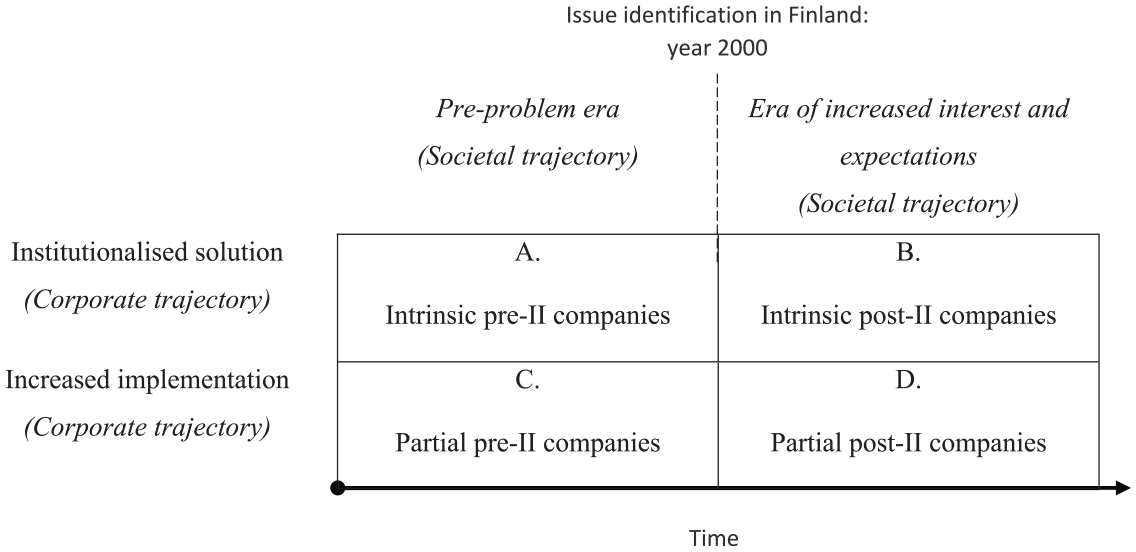
Issue Life Cycle Categories of Corporate CE Implementation Among CE Pioneer Companies.
In the first phase of the analysis, a novel classification of the sample companies into four categories based on their degree of CE implementation was created, utilising existing CE and issue life cycle literature, as well as the empirical findings of the present study. The classification was formed by combining the micro-level issue life cycle trajectory of corporate CE implementation with the related macro-level societal issue life cycle trajectory. Starting with the micro-level trajectory of corporate performance, sample companies were divided into two categories based on whether their degree of CE implementation, as they described it during their interview, more closely represented the issue life cycle stage of increased implementation or the final issue life cycle stage of established existence with institutionalised processes (see, for example, Sethi, 1979; Zyglidopoulos, 2003). Companies were considered to belong to the latter category if their CE implementation and business, as per their descriptions, were executed via a CE business model (Lüdeke-Freund et al., 2019). The sample companies belonging to this category were those operating with a product as a service business model or access model, those whose products were based on recycled waste, residues, or side streams, as well as renewable energy and environmental service companies. The other category consisted of the companies whose descriptions of their CE implementation activities corresponded to the issue life cycle stage of increased implementation, considered here as CE efforts taken in the context of a traditional, predominantly linear business model, such as strategies, processes, operations, and products promoting CE. For the sample companies, such CE implementation activities included the introduction of new CE projects or solutions within or alongside their existing, traditional business, or simply a gradual increase of CE-oriented products in their product portfolio.
On the macro-level trajectory of societal expectations of corporate CE implementation, the sample companies were also divided into two categories based on empirical findings from the conducted interviews. The first category consisted of the sample companies who, according to their description, had started their ongoing activities—considered in modern terms as corporate CE implementation—before the year 2000, representing the identified timing of the societal issue identification in Finland. In the terminology of issue life cycle theory (see Zyglidopoulos, 2003), these companies began their corporate CE implementation journey in the pre-problem era of the societal issue life cycle trajectory of corporate CE implementation. The second category consisted of the companies who, according to their description, had started their ongoing engagement with corporate CE implementation after societal issue identification in 2000, in the issue life cycle stage of increased societal interest and expectations. They had either done so by starting a new, CE-aligned business or by starting corporate CE implementation activities within an existing business. By combining the binary categorisation of the sample companies on the micro-level corporate issue life cycle trajectory with the binary categorisation of the sample companies on the macro-level societal issue life cycle trajectory, four CE issue life cycle categories of corporate CE implementation were formed (Figure 1, subsection “Issue Life Cycle Framework for Corporate CE Implementation”). While the aspect of categorising companies based on their micro-level trajectories of corporate performance arises from issue life cycle literature, the simultaneous categorisation of the companies based on their relationship with the macro-level trajectory—specifically societal issue identification in Finland—emerged from the interview data of the present study. The issue life cycle categorisation presented in Figure 1 is therefore an abductive finding (see Mantere & Ketokivi, 2013), while the assigning of the sample companies into said categories is an inductive finding, being solely based on the input from the interviewees.
The second phase of the analysis was the application of the three-stage thematic analysis approach described by Gioia et al. (2013). Before the analysis, the audio recordings of the 25 interviews were transcribed verbatim (Gibbs, 2007). Sections describing the drivers and challenges of CE implementation were then identified and edited into phrasal descriptors (i.e., first-order concepts summarising the sentiment of the interviewee while still striving to maintain their rhetoric; Gioia et al., 2013). There were 65 first-order concepts for CE implementation drivers identified and 84 identified first-order concepts for CE implementation challenges. In the second-order analysis, the recurring sentiments in the first-order concepts were categorised into overarching second-order themes, with nine second-order themes emerging from the 65 initial first-order concepts of drivers and 12 second-order themes emerging from the 84 initial first-order concepts of challenges. First-order concepts mentioned by only one interviewee were excluded from the analysis.
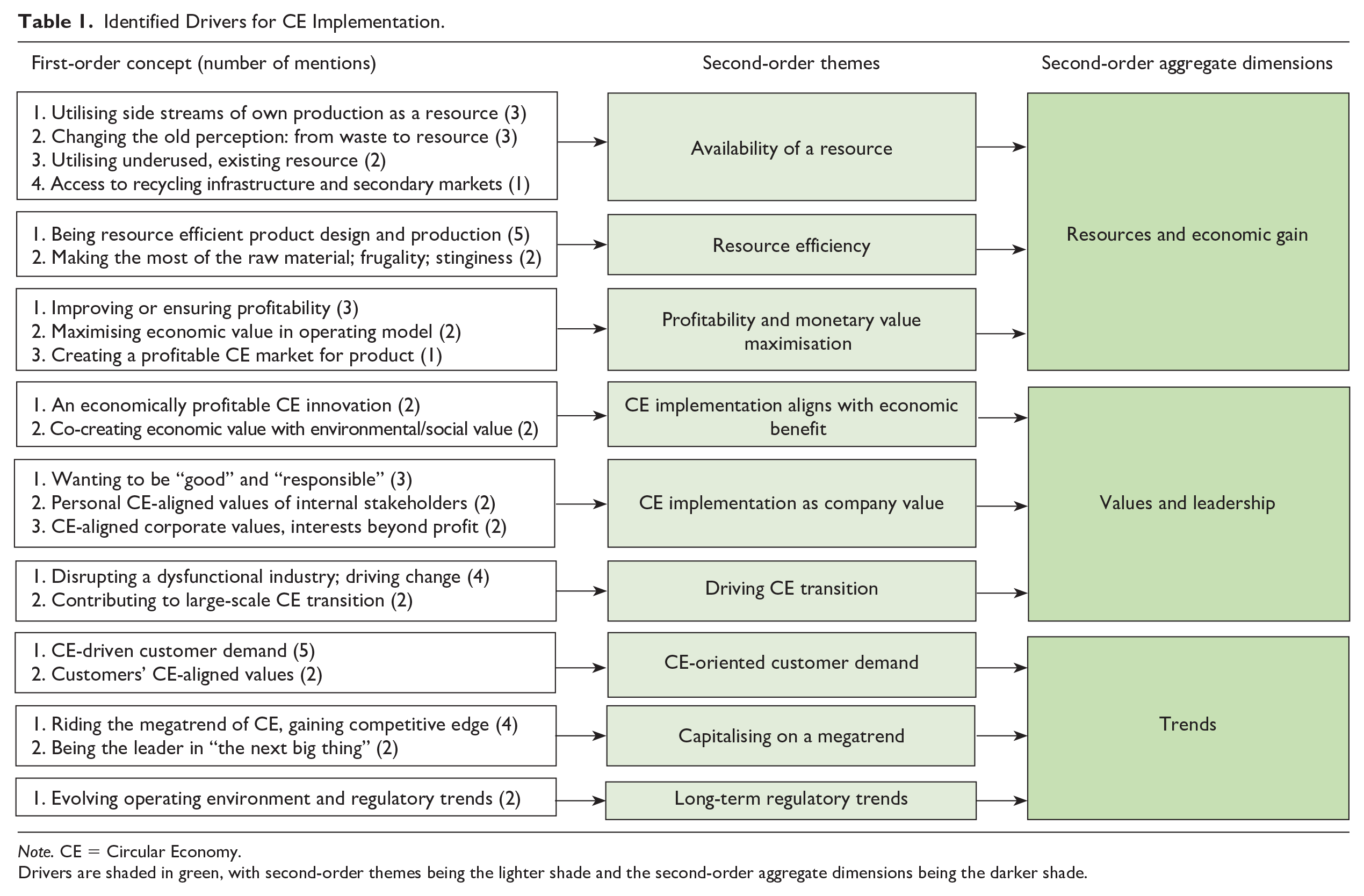
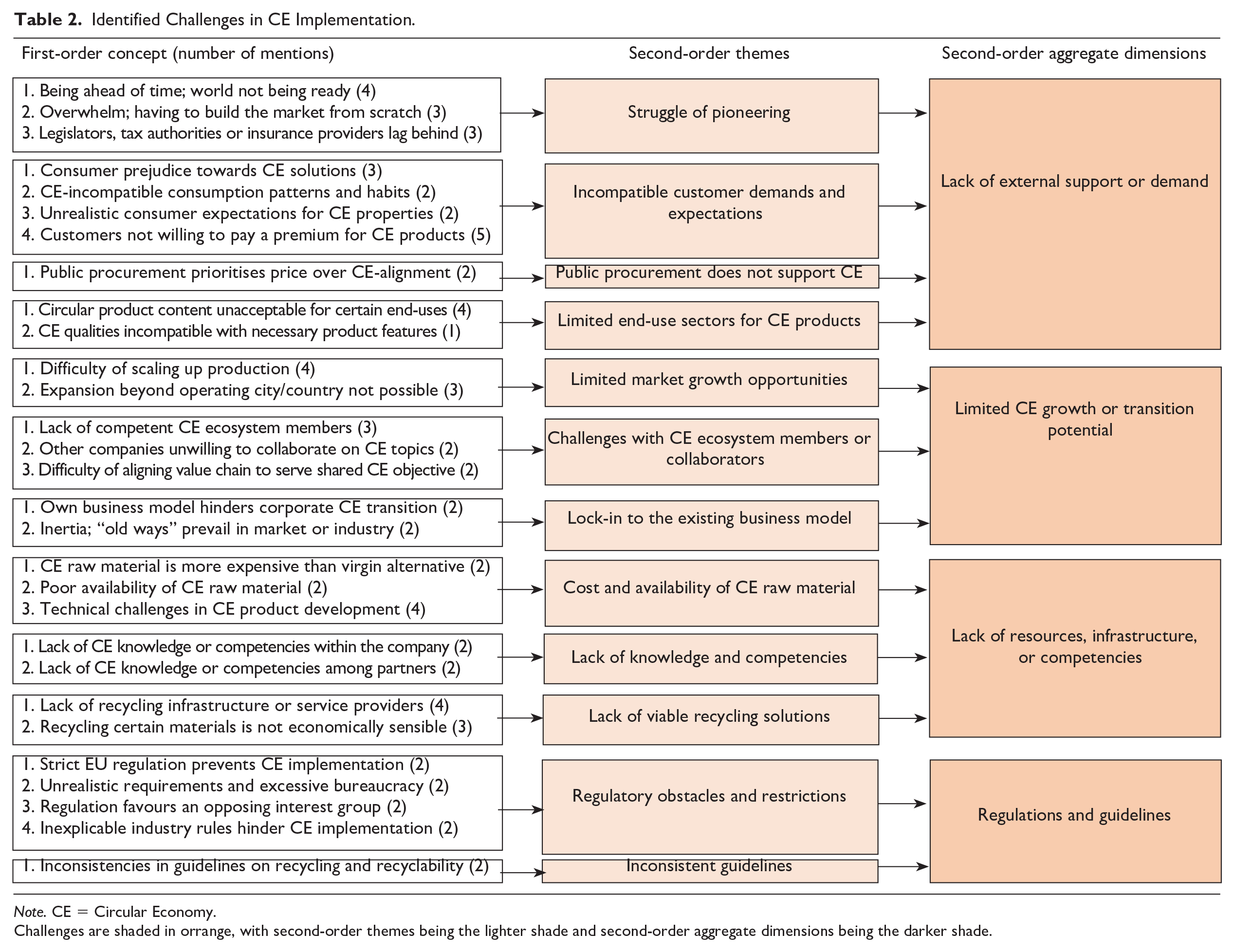
In the third stage, the second-order themes were further distilled into second-order aggregate dimensions, with the nine identified second-order themes of drivers organised into three broader second-order aggregate dimensions and the 12 identified second-order themes of challenges organised into four broader second-order aggregate dimensions. Following the directive of Gioia et al. (2013), the data structure of this second phase of the analysis, representing the progression from first-order concepts to second-order themes, and finally, second-order aggregate dimensions, is presented for the drivers in Table 1—subsection “Identified Drivers”—and for the challenges in Table 2—subsection “Identified Challenges.”
Identified Drivers for CE Implementation.
Note. CE = Circular Economy.
Drivers are shaded in green, with second-order themes being the lighter shade and the second-order aggregate dimensions being the darker shade.
Identified Challenges in CE Implementation.
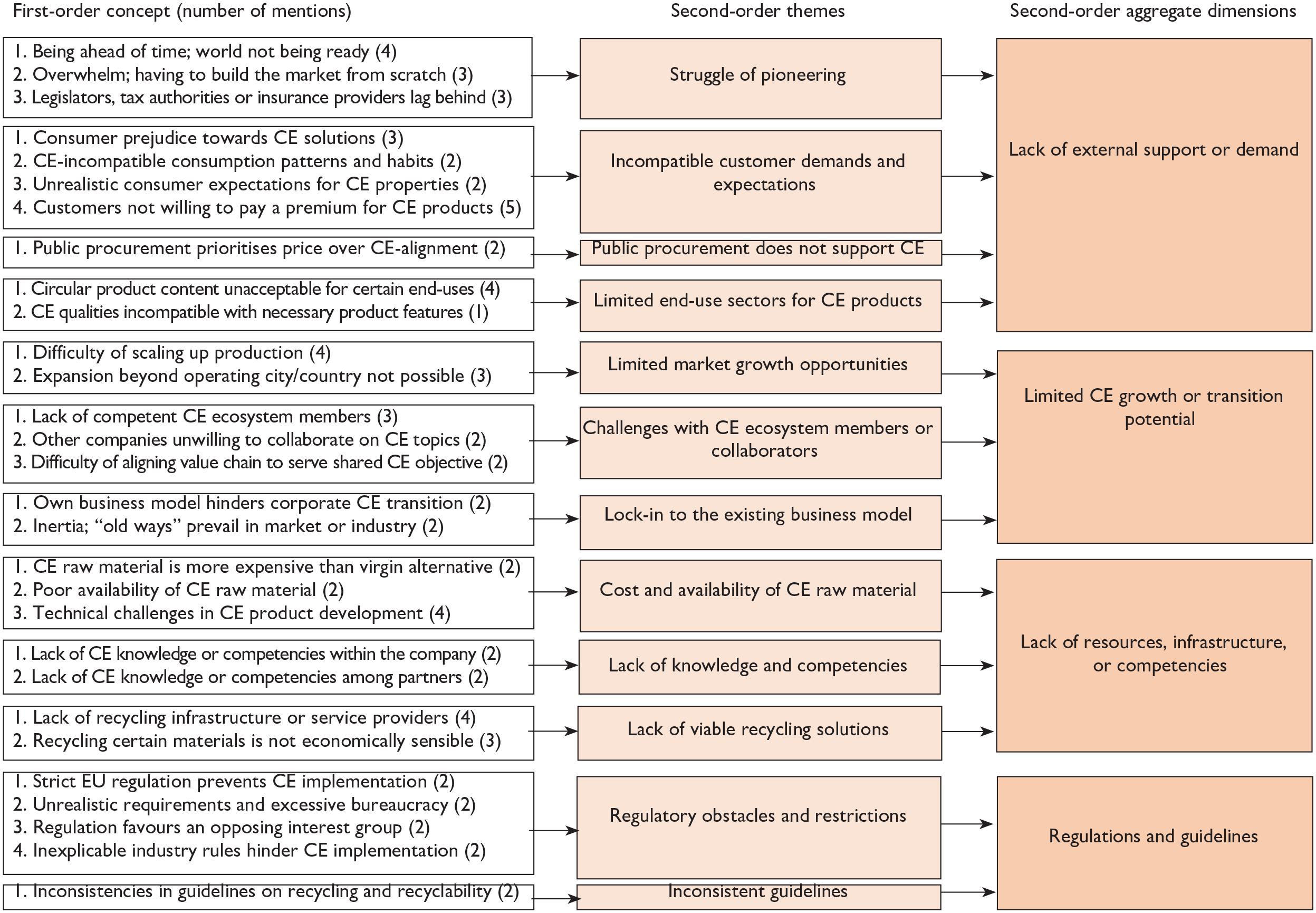
Note. CE = Circular Economy.
Challenges are shaded in orrange, with second-order themes being the lighter shade and second-order aggregate dimensions being the darker shade.
The second phase of the analysis, which consisted of three stages (Gioia et al., 2013), was considered in the context of the issue life cycle classification carried out in the first phase. The second-order themes of drivers and challenges in CE implementation were analysed in the context of the framework of the issue life cycle categories, and common themes and differences in identified drivers and challenges were explored between the categories.
An important part of qualitative research is ensuring the trustworthiness of the study. Prior literature (especially based on Lincoln & Guba, 1985) lists the components of trustworthiness as credibility, transferability, dependability, and confirmability. We took several actions to ensure the trustworthiness of our research, as described in detail in Appendix B (Table B1).
Findings
Issue Life Cycle Framework for Corporate CE Implementation
The results of the issue life cycle categorisation are summarised in Figure 1. Companies that began to operate with a CE business model (corporate trajectory) before issue identification in 2000 (societal trajectory) are referred to as intrinsic pre-issue identification (pre-II) companies (Category A), whereas companies that began to operate with a CE business model (corporate trajectory) after 2000 (societal trajectory) are referred to as intrinsic post-II companies (Category B). Companies that started the ongoing process of increasing CE implementation efforts in a traditional business model (corporate trajectory) before issue identification in 2000 (societal trajectory) are referred to as partial pre-II companies (Category C), whereas companies that started the ongoing process of increasing CE implementation efforts in a traditional business model (corporate trajectory) after 2000 (societal trajectory) are referred to as partial post-II companies (Category D).
The sample of 25 companies examined in the present study represents all four segments of the CE issue life cycle classification, with two identified as intrinsic pre-II companies, eight as intrinsic post-II companies, eight as partial pre-II companies, and seven as partial post-II companies. The meagre representation of intrinsic pre-II companies in the sample was considered to reflect the relatively small number of recognised, fully CE-aligned Finnish companies founded before 2000.
Identified Drivers
The present study identified three second-order aggregate dimensions of corporate CE implementation drivers: “Resources and economic gain,” “Values and leadership,” and “Trends” (Table 1). Each second-order aggregate dimension consisted of several second-order themes.
Resources and Economic Gain
The drivers constituting the second-order aggregate dimension of “Resources and economic gain” were predominantly identified by pre-II companies and related to the sentiment of CE implementation making sense in terms of efficiencies and economic gain. “Availability of a resource” was the driver most frequently named by the sample companies. While identified by companies from all four issue life cycle categories, this driver was most commonly referenced by interviewees from partial pre-II companies. “Availability of a resource” was described in terms of the profitable utilisation of the company’s own production waste or side streams, or the discovery and innovative utilisation of a valuable, external waste or recycling stream or an underused resource.
As opposed to “Availability of a resource,” referring to the identification and utilisation of often unexpectedly valuable internal or external resources, the related driver of “Resource efficiency” covered all approaches aiming for as efficient a utilisation of raw material as possible. “Resource efficiency” was a frequently identified driver among pre-II companies, and while often described as process and resource-use optimisation motivated by the minimisation of raw material costs, an instinctive resentment towards being wasteful, “old-fashioned frugality,” and “stinginess” was also depicted. “Resource efficiency” was a way of working that typically predated corporate responsibility and CE agendas, and it was described as something intrinsic and fundamental to the company’s mentality. As noted by an interviewee from a partial pre-II company, “Our way of working has always been to use material sparingly.”
The related driver of “Profitability or monetary value maximisation” was also more frequently identified by pre-II companies. Harnessing CE implementation as means of ensuring or improving profitability, or maximising economic value in the operating model, were considered key drivers of corporate CE implementation. “Our whole operating model is based on the fact that the value of our product is greater than its retail value,” explained one interviewee from an intrinsic pre-II company in reference to a product as a service business model.
Values and Leadership
In contrast to “Resources and economic gain,” corporate CE implementation drivers under the second-order aggregate dimension of “Values and leadership” were predominantly identified by post-II companies. These drivers were clearly the most frequently cited ones for intrinsic post-II companies and played a key role in their founding. While drivers under “Resources and economic gain” encompassed economically motivated actions that happened to also yield CE benefits, the driver of “CE implementation aligns with economic benefit” related to the reversed setting, where a predominantly value-driven CE solution was discovered to be also economically lucrative. “There are the environmental sustainability solutions, but I also see great business potential in this,” summarised one interviewee from a partial post-II company. “CE implementation as a company value” was typically described in terms of the rather unspecific objectives of wanting to be “good” or “responsible” and having corporate aspirations beyond mere profit. As described by an interviewee from an intrinsic post-II company, “We have to be a good company that does right by society and the environment.” The connected, although somewhat more action-oriented, driver of “Driving CE transition” was also identified by some post-II companies. This driver, while often rooted in feelings of disappointment and frustration towards the dysfunctional and unsustainable industry status quo, was still described in rather optimistic and defiant terms, as the conception of being a force for positive change held great intrinsic value to these companies. “I have a long history in this industry, and this company was founded to do things differently, to keep the material in circulation for as long as possible,” explained the founder and CEO of one intrinsic post-II company.
Trends
Drivers belonging to the second-order aggregate dimension of “Trends” were clearly most frequently identified by partial post-II companies. “CE-oriented customer demand” was commonly and exclusively identified as a driver for initial CE implementation by post-II companies, with partial post-II companies naming it more frequently than intrinsic post-II companies. “Some customers face regulatory mandates, many have similar change ambitions to ours, and . . . certainly there’s some green washing going on as well,” listed one interviewee from a partial post-II company as reasons for growing CE-oriented customer demand. Another related driver, identified solely by post-II companies, was “Capitalising on a megatrend.” Several post-II companies had identified CE implementation as the general direction of development with large-scale effects, a global megatrend of the ilk of digitalization, climate change, and urbanisation, and wanted to gain a competitive edge by seizing it. “We noticed that CE was a growing trend, and we wanted to seize it and see what could be done in the Finnish market, relating to this theme,” explained one interviewee from a partial post-II company. Two interviewees, one from a partial pre-II company and one from a partial post-II company, listed “Long-term regulatory trends” as a driver for CE implementation, referring particularly to increasing CE-related EU regulation. “Now that the Single-Use Plastic Directive has been prepared in Europe and there are Circular Economy targets, the wheels have really started turning,” noted the interviewee from a partial pre-II company.
Identified Challenges
This study identified four second-order aggregate dimensions of corporate CE implementation challenges as follows: “Lack of external support or demand”; “Limited CE growth or transition opportunities”; “Lack of resources, infrastructure, or competencies”; and “Regulations and guidelines” (Table 2). Each second-order aggregate dimension consisted of several second-order themes.
Lack of External Support or Demand
Out of the second-order aggregate dimensions of challenges, “Lack of external support or demand” was the most frequently cited one, with related challenges being identified by numerous intrinsic post-II companies, partial pre-II companies, and partial post-II companies. The distinction between pre- and post-II companies that had been prominent in the identified drivers did not manifest similarly in the identified challenges; nevertheless, the frequently cited challenge labelled “Struggle of pioneering” was nearly exclusively described by post-II companies. These struggles included the overwhelming burden of building a market from scratch, as well as the lack of precedence and resulting confusion with legislators, tax authorities, and insurance providers. However, the struggle most frequently described by the companies was simply “the world not being ready” or the company being “ahead of its time,” portrayed sarcastically by one intrinsic post-II company owner as having been in “‘the business of tomorrow’ for about 16 years now.”
Customer-related challenges in the downstream value chain were also frequently mentioned by the companies. “Incompatible customer demands and expectations” was commonly described in terms of consumer attachment to some unsustainable aspects of the linear economy, such as ownership rather than mere access or affordable quantity over sustainable quality. As noted by an interviewee from a partial pre-II company, “Trends change, and no one wants the recycled products that are ‘last season.’” On a nearly opposite note, the challenge also encompassed unrealistically high customer expectations for the CE properties of the products. Rather intuitively, the only companies not experiencing the challenge of “Incompatible customer demands and expectations” were partial post-II companies, for whom “CE-oriented customer demand” was the most frequently cited driver for corporate CE implementation. “Customers’ low willingness to pay” was also identified as a challenge by several companies; it was found that despite claiming to value sustainability, most customers were reluctant to bear the necessary price premium for CE-aligned solutions. “We always get back to the price question. In CE, the price increase is at least a hinderance, if not altogether prohibitive for business,” stated one interviewee from a partial post-II company. Two companies described this challenge specifically in relation to public sector customers, suggesting public procurement decision-making overlooked CE parameters, opting for the alternatives of lowest monetary cost. “Customers’ low willingness to pay” as a challenge was less prominent among pre-II companies, whose CE implementation was driven primarily by “Resources and economic gain.”
Limited CE Growth or Transition Potential
The problem of “Limited end-use sectors for CE products” was described by a few companies in terms of certain CE products being unacceptable, for example, to food or health care industries because of unattainable product parameters, potential contaminations, or insufficient raw material traceability. “It’s currently very hard to combine biodegradable and antibacterial properties in the same product. So there are industries where you have to make choices; the product may not be leading in CE, but the other feature is critical to the industry,” explained an interviewee from an intrinsic pre-II company. The connected challenge of “Limited market growth opportunities” was cited by numerous companies, which had found that the growth potential of their CE-aligned business was limited by the inability to scale up production; alternatively, it was sometimes found that the CE concept lacked suitability for geographic expansion beyond a certain city or beyond Finland because of such issues as a reliance on infrastructure that could not be found abroad.
The often-mentioned “Challenges with CE ecosystem members or collaborators” was also found to limit CE business growth; this was described in terms of a lack of competent CE ecosystem members or companies interested in CE collaboration. The difficulty of trying to align the value chain to deliver CE solutions was also cited. As described by an interviewee from a partial pre-II company, “The factories don’t always have the same definitions for recycled, they have some criteria of their own, so getting all the parts of the chain to play together is challenging.” While less frequently mentioned, “Lock-in to the existing business model,” created by either internal factors or a wider scale inertia within the market, was found to limit opportunities for CE transition and business growth in some post-II companies. “Transition from a fossil-based business takes time, we’re talking about decades here,” emphasised one interviewee from a partial post-II company.
Lack of Resources, Infrastructure, or Competencies
In the upstream value chain, “Cost and availability of CE raw material” was identified as a challenge by some companies; in addition to the often-limited market availability, CE raw materials were typically found to be pricier than their virgin alternatives. As summarised by an interviewee from a partial pre-II company, “It would require quite a bit of process development to be able to compete with virgin raw materials in many areas, as they are, given the circumstances, unfortunately too affordable.” With the exception of “Cost and availability of CE raw material,” challenges relating to the second-order aggregate dimension of “Lack of resources, infrastructure or competencies” were notably not experienced by intrinsic post-II companies, for whom the availability of relevant resources, infrastructure, and competencies were key considerations in the design and establishment of their CE business model. Several interviewees mentioned “Lack of knowledge and competencies” as a challenge, with some referring to their own company and others to potential business partners. While often described in rather generic terms of insufficient understanding or vision relating to CE implementation, very practical challenges with lacking skills and competencies in CE-oriented product development were also mentioned. “Lack of viable recycling solutions”—referring to the absence of available infrastructure or service providers or the unattainable cost of recycling certain material streams—was commonly cited among partial pre- and post-II companies as a challenge, leading to the undesirable disposal of a waste stream. As described by one interviewee from a partial pre-II company, “For an SME, the quantities [of waste] are so small that either no-one wants them, or the distances are so long it doesn’t make sense.” Among the intrinsic post-II companies, “Lack of viable recycling solutions” was not identified as a challenge, as waste and the related need for recycling solutions had been designed out of the CE business model.
Regulation and Guidelines
“Regulatory obstacles and restrictions” was the second most frequently cited challenge in CE implementation among the companies. Typically, this challenge was portrayed in terms of material reuse and recycling opportunities being hindered by the EU’s strict chemical and product safety requirements, excessive bureaucracy, regulatory favouritism, or arbitrary industry rules. “European product safety requirements are so strict that they don’t always enable utilisation of recycled products, or package re-use,” explained an interviewee from a partial pre-II company. While less frequently mentioned, some companies described “Inconsistent guidelines” as a challenge preventing their CE implementation activities. In particular, the absence of unanimous guidelines was found to be problematic in relation to recycling and recyclability.
Differences in Experienced Drivers and Challenges
Table 3 presents both drivers and challenges identified by the sample companies in different issue life cycle categories. The findings demonstrate key differences in the drivers of CE implementation identified by interviewees from pre-II and post-II companies. Interviewees from the former category identify resource efficiency, profitability, and practicality as motivations for CE-aligned business, predominantly naming drivers from the second-order aggregate dimension of “Resources and economic gain”; those from the latter category underscored drivers from the second-order aggregate dimensions of “Values and leadership” and “Trends.”
Identified Drivers and Challenges in the Sample Companies.
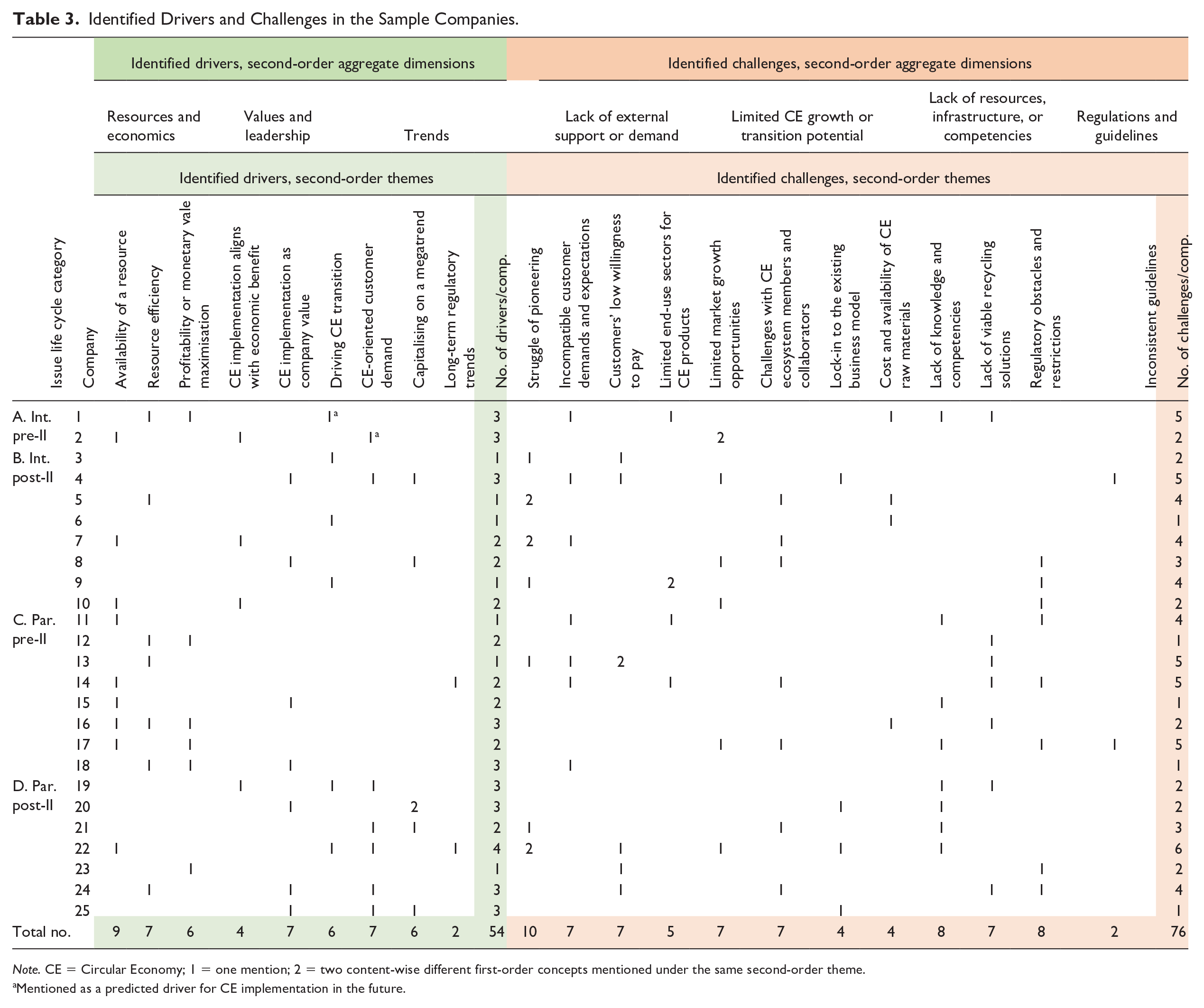
Note. CE = Circular Economy; 1 = one mention; 2 = two content-wise different first-order concepts mentioned under the same second-order theme.
Mentioned as a predicted driver for CE implementation in the future.
In contrast to the identified drivers, which demonstrated a rather straightforward distinction between pre- and post-II companies, the differences in identified challenges among the issue life cycle categories were more complex and nuanced. Indeed, while the second-order aggregate dimensions of corporate CE implementation challenges appear universal, differences between issue life cycle categories emerge from the second-order themes. It appears evident that both the micro- and macro-level trajectories of the issue life cycle of corporate CE implementation are linked to the challenges experienced by companies. For example, relating to the micro-level division into partial and intrinsic CE companies, “Lack of viable recycling solutions” experienced by partial pre- and post-II companies stem from the degree of corporate CE implementation, as said companies operate within the confounds of traditional, linear business models, which generate waste. At the same time, the negative influence this challenge has on the companies’ CE implementation activities is reflected in the micro-level issue life cycle trajectories of these companies. Meanwhile, in the context of the macro-level division into pre- and post-II companies, “Struggles of pioneering” were clearly more substantial among post-II companies. It is rational that such struggles, relating to being too far ahead of societal expectations and the market, are predominantly encountered by post-II companies where the CE implementation activities are motivated by idealistic value-based drivers and leadership ambitions as opposed to the pragmatic drivers relating to “Resources and economic gain.” The same phenomenon where a company’s issue-specific stance is too far removed from societal expectations, resulting in a lack of societal buy-in, was previously identified by Zyglidopoulos (2003). In some cases, the influence of corporate CE implementation drivers determining the experienced or avoided challenges appears to apply only to a single issue life cycle category. For example, “Incompatible customer demands and expectations” were not a challenge for partial post-II companies whose CE implementation activities were predominantly driven by the identified “CE-oriented customer demand.” The interactions identified between the issue life cycle and the corporate CE implementation drivers and challenges are illustrated in Figure 2.
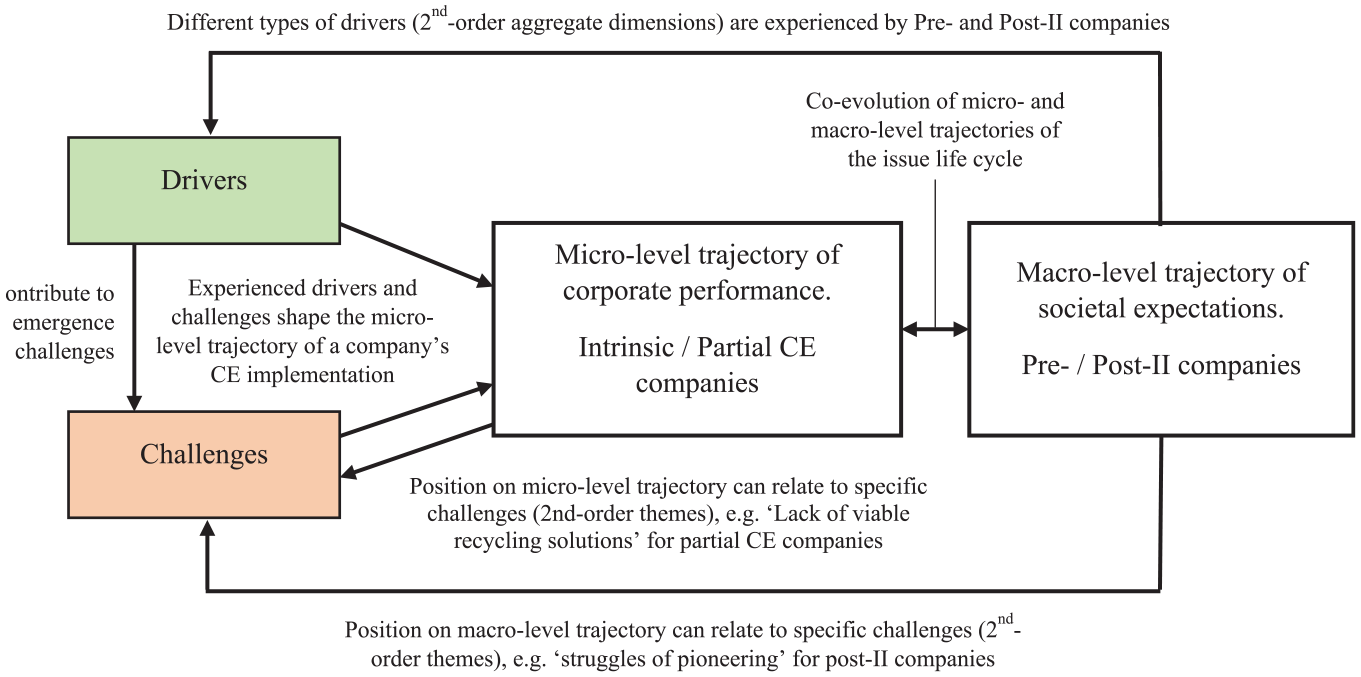
Identified Interactions Between Corporate CE Implementation Drivers and Challenges and the Issue Life Cycle.
Discussion and Conclusion
Applying an issue life cycle approach, the present study aims to identify the drivers and challenges that Finnish CE pioneer companies experience in corporate CE implementation. Furthermore, the study set out to increase contextual understanding of how said drivers and challenges influence corporate CE implementation in different issue life cycle categories, defined based on the start time and the degree of CE implementation in a company. The studied companies identified drivers for CE implementation belonging to the following overarching classes: “Resources and economic gain,” “Values and leadership,” and “Trends.” The pre-II companies emphasised the role of efficiency, profitability, and practicality as drivers, whereas the post-II companies underscored CE-aligned values and customer demand, emerging trends, and the aspirations of driving positive change. As challenges, the sample companies named issues relating to “Lack of external support or demand,” “Limited CE growth or transition potential,” “Lack of resources, infrastructure or competences,” and “Regulations and guidelines.” While these overarching classes of challenges were mostly universal, important differences among issue life cycle categories emerged in relation to individual challenges.
The drivers identified by the sample companies align largely with existing literature, although certain drivers have not been previously discussed in the specific context of corporate CE implementation. Drivers relating to “Resources and economic gain” and “Trends” have been recognised in earlier research as motivating CE implementation (e.g., Masi et al., 2017; Ranta et al., 2018). Drivers relating to “Values and leadership,” while previously described in relation to, for example, Sustainable Business Model Innovation (Bocken & Geradts, 2019), have so far received little attention in CE implementation literature beyond an occasional reference in the context of managerial commitment (e.g., Stål & Corvellec, 2018). This notion aligns with the evolution of corporate CE implementation as a recent “issue,” as companies currently face more societal expectations and pressure to engage in CE activities than ever before.
The challenges in corporate CE implementation identified in the present study are largely supported by previous research. In particular, challenges relating to “Lack of resources, infrastructure or competences” and “Regulation and guidelines” have been discussed in previous research (e.g., Bressanelli et al., 2018; Rizos et al., 2016). Similarly, challenges relating to “Lack of external support or demand” and “Limited CE growth or transitions potential” have been identified as barriers to CE implementation (Kirchherr et al., 2018; Sousa-Zomer et al., 2018). However, “Limited end-use sectors for CE products” and “Struggles of pioneering” have not been examined specifically in CE implementation literature, although notions relating to the struggles of pioneering have been discussed in the context of sustainability innovations (Smith & Raven, 2012). Given how frequently the post-II companies in the present study described such issues as “The world not being ready” and “Being ahead of their time,” the lack of previous research focusing on these experiences and other struggles of pioneering in a corporate CE implementation presents a notable need for further research.
While drivers and challenges in corporate CE implementation have typically been considered relatively stable and universal in previous research, the present study discovered them to be highly variable and contextual through complex interplay with both internal, corporate factors (micro-level), and external, societal factors (macro-level). The differences in drivers for CE implementation identified by pre-II and post-II companies clearly demonstrate that the drivers are linked to evolving societal awareness and expectations of corporate CE implementation—namely, evolution on the macro-level issue life cycle trajectory. Indeed, the phase of increased societal interest in CE implementation was reflected in the drivers identified by post-II companies of the present study, including “CE-oriented customer demand” and “Capitalising on a megatrend.” More complex and nuanced yet, the challenges identified by the companies were clearly linked to a company’s position in reference to both the micro- and macro-level issue life cycle trajectories. Evident connections could also be drawn between specific drivers and challenges, such as the typically coexisting value-based drivers and the struggles of pioneering.
The contextual understanding of corporate CE implementation drivers and challenges influencing and being influenced by internal (micro-level) and external (macro-level) factors is a valuable contribution to corporate CE implementation literature. Furthermore, clear practical implications for supporting corporate CE implementation can be derived from this contextual nature of the drivers and challenges companies experience. Most significantly, these practical implications relate to optimising incentives and support measures for corporate CE implementation to yield the best possible results. While certain support measures, such as encouragement of CE-aligned consumer behaviour, may be universally appreciated by CE pioneer companies, efficiency and desired influence of incentives and support measures could likely be increased by supporting determined issue life cycle categories via specifically promoting the drivers and alleviating the challenges most relevant to them. This suggestion, that corporate CE implementation would benefit from targeted and customised incentives and support measures, is further supported by the variation in the amount of hardship resulting from different challenges, as described by the sample companies. For example, “Struggles of pioneering” in intrinsic post-II companies were often experienced as particularly devastating and detrimental, suggesting special efforts should be dedicated to supporting intrinsic post-II companies in overcoming said struggles. The variance in the burden of different challenges also introduces a significant further research need in CE implementation research—namely, the study of the relative importance of the drivers and challenges experienced in corporate CE implementation.
This study makes an important contribution to the issue life cycle theory. Beyond the fundamental notion that corporate responsiveness is driven by societal expectations (Zyglidopoulos, 2003) and certain isolated observations—such as that corporate response to an issue is sometimes subject to disruptions related, for example, to economic hardship (Näsi et al., 1997)—previous issue life cycle literature has not explored the drivers and challenges companies experience in their issue-specific responses. Having focused on analysing how issues evolve and ought to be addressed by companies, issue life cycle theory lacks an understanding of internal and external influences in company-level issue implementation. The findings of the present study prove this to be a significant shortcoming, as the drivers and challenges experienced by sample companies in corporate CE implementation closely interacted with the micro- and macro-level trajectories of the issue life cycle and played a crucial role in the evolution of the company-specific issue life cycle trajectory. Introducing the highly contextual aspect of drivers and challenges guiding corporate responsiveness to issue life cycle theory, which has been criticised for being overly simplifying (Acquier et al., 2011; Näsi et al., 1997), is therefore a key contribution of the present study. As issue-specific drivers and challenges significantly influence the evolution of a company’s response to an issue, they are surely invaluable in explaining, and perhaps even predicting, the deviations in the steady progression of corporate responsiveness assumed by traditional issue life cycle theory. The present study therefore outlines a pathway for further development of issue life cycle theory into a more contextual and accurate approach in understanding corporate social responsiveness.
Certain identifiable patterns emerged from the interplay between the issue life cycle trajectories and the experienced drivers and challenges, to an extent where examples of characteristic issue life cycle trajectories of corporate CE implementation could be outlined in different issue life cycle categories. For example, a typical, unfortunate issue life cycle trajectory for an intrinsic post-II company would begin after societal issue identification with CE business model design and launching of a business, driven by CE-aligned values, the passion for doing good and the recognition of CE as a rising trend. Careful consideration of necessary resources, infrastructure, and competencies when designing the CE business model may help avoid related challenges, but society at large is not ready to embrace the CE-aligned solution or product. Because of resulting economic hardship, disappointment, and frustration, the micro-level issue life cycle trajectory of the intrinsic post-II company comes to an end as the business is shut down—or even regresses as the company attempts to pivot to a less CE-aligned business. Tailored and targeted support measures for corporate CE implementation will be crucial in future attempts to prevent such unfortunate cases.
From a business model perspective, it is rational that challenges in CE implementation have the potential of being particularly impactful and devastating for companies operating with a CE business model, that is, intrinsic CE companies. For such companies, the drivers behind the CE business model appear pivotal, as intrinsic pre-II companies, where CE implementation was predominantly economically driven, experience fewer devastating challenges than intrinsic post-II companies, where CE implementation was clearly more value driven. Although there were few intrinsic pre-II companies in the sample, the ones included were utilising a CE business model in a profitable and sustainable manner, enjoying the advantages of decades of experience and established operations, while intrinsic post-II companies faced often devastating “Struggles of pioneering.” Regardless of the start time of CE implementation, the impact of related challenges was naturally less dramatic in partial CE companies, where CE implementation is limited to the context of determined, CE promoting strategies, products, processes, or operations. The stronger the integration of CE implementation into a company and its business model, the more vulnerability a company has relating to challenges in CE implementation—an evident notion, underscoring the importance of solid economic rationale in CE business models.
The present study has certain limitations. It should be noted that certain aspects of the study are specific to Finland and Finnish society. Whereas the drivers and challenges identified in the present study are mostly supported by previous literature, and as such, they are applicable beyond Finland, the specific details, for example, of challenges closely tied to the Finnish market, infrastructure, or government are not. In addition, the timing of societal issue identification for corporate CE implementation was identified specifically for Finland based on the empirical research data of the present study. Therefore, it may not be suitable for other contexts, and if applied, the classification into issue life cycle categories should be reviewed and adjusted accordingly. It is also worth noting that the classification of the sample companies into issue life cycle categories was done solely based on the information obtained from the interviewees during the interview process, which has not been confirmed from other sources. Furthermore, while the classification of companies in accordance with the micro- and macro-level trajectories of issue life cycle theory applies to the research sample of CE pioneers, it provides no access point for examining companies that are still in the pre-problem phase of their issue-specific corporate trajectory—that is, companies that have yet to begin CE implementation activities. Therefore, no insights are provided regarding late adopters, the challenges they may experience or the drivers that may encourage them to engage in CE implementation. While beyond the scope of the issue life cycle framework of this study, the CE implementation drivers and challenges experienced by late-adopter companies merit further research efforts.
Regardless of its limitations, the pioneering of an issue life cycle approach in the context of CE research proved valuable in providing practical implications for more efficient CE policy and support measures for corporate CE implementation and in contributing to both corporate CE implementation literature and issue life cycle theory. With rapid evolution taking place in both societal macro-level and corporate micro-level issue life cycle trajectories of CE implementation, it is evident that further research is needed that applies issue life cycle theory in the CE implementation context. Vast and fascinating opportunities for further research are presented by the complex interplay between issue life cycle trajectories and the drivers and challenges experienced by companies in corporate CE implementation.
Footnotes
Appendix A
Interview Details.
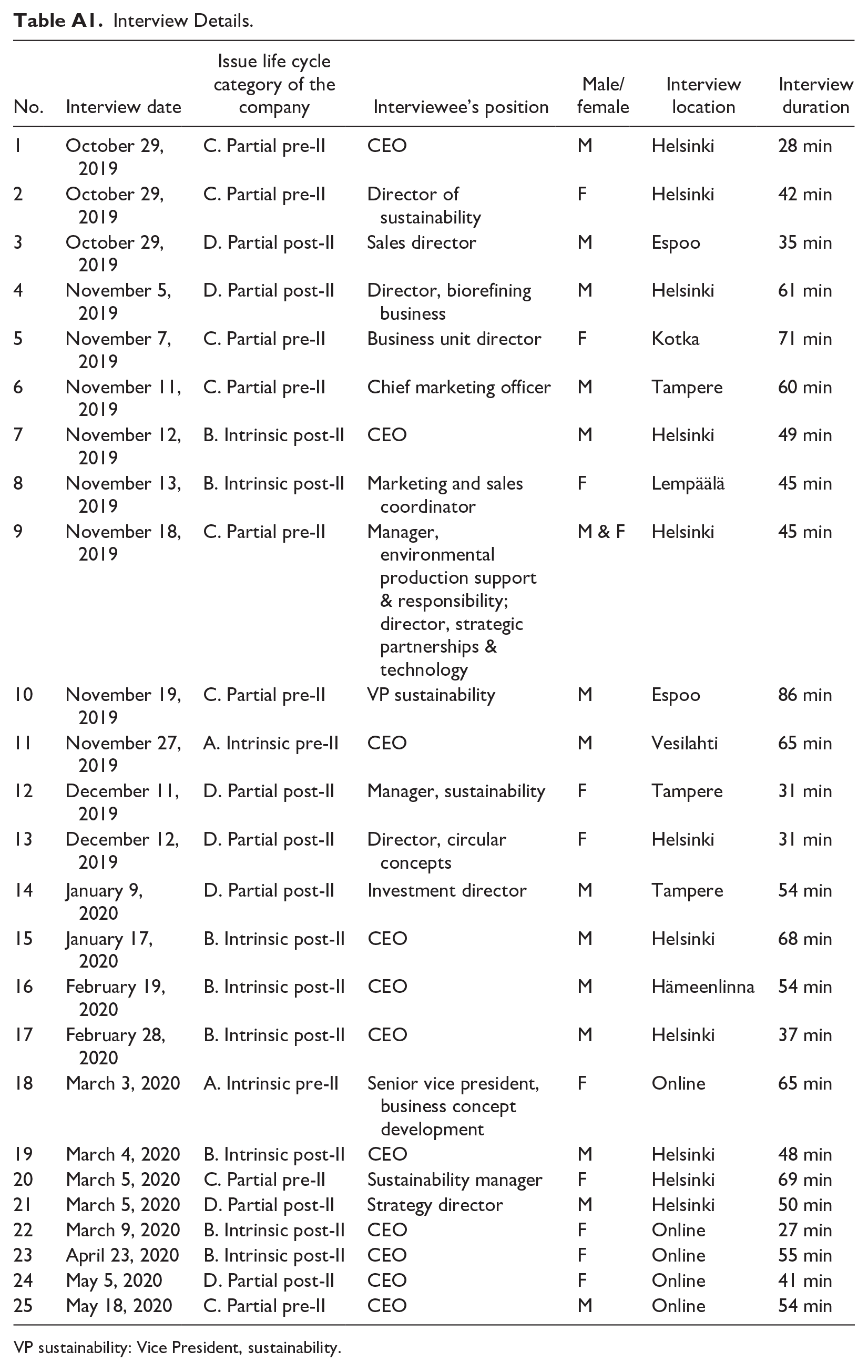
| No. | Interview date | Issue life cycle category of the company | Interviewee’s position | Male/female | Interview location | Interview duration |
|---|---|---|---|---|---|---|
| 1 | October 29, 2019 | C. Partial pre-II | CEO | M | Helsinki | 28 min |
| 2 | October 29, 2019 | C. Partial pre-II | Director of sustainability | F | Helsinki | 42 min |
| 3 | October 29, 2019 | D. Partial post-II | Sales director | M | Espoo | 35 min |
| 4 | November 5, 2019 | D. Partial post-II | Director, biorefining business | M | Helsinki | 61 min |
| 5 | November 7, 2019 | C. Partial pre-II | Business unit director | F | Kotka | 71 min |
| 6 | November 11, 2019 | C. Partial pre-II | Chief marketing officer | M | Tampere | 60 min |
| 7 | November 12, 2019 | B. Intrinsic post-II | CEO | M | Helsinki | 49 min |
| 8 | November 13, 2019 | B. Intrinsic post-II | Marketing and sales coordinator | F | Lempäälä | 45 min |
| 9 | November 18, 2019 | C. Partial pre-II | Manager, environmental production support & responsibility; director, strategic partnerships & technology | M & F | Helsinki | 45 min |
| 10 | November 19, 2019 | C. Partial pre-II | VP sustainability | M | Espoo | 86 min |
| 11 | November 27, 2019 | A. Intrinsic pre-II | CEO | M | Vesilahti | 65 min |
| 12 | December 11, 2019 | D. Partial post-II | Manager, sustainability | F | Tampere | 31 min |
| 13 | December 12, 2019 | D. Partial post-II | Director, circular concepts | F | Helsinki | 31 min |
| 14 | January 9, 2020 | D. Partial post-II | Investment director | M | Tampere | 54 min |
| 15 | January 17, 2020 | B. Intrinsic post-II | CEO | M | Helsinki | 68 min |
| 16 | February 19, 2020 | B. Intrinsic post-II | CEO | M | Hämeenlinna | 54 min |
| 17 | February 28, 2020 | B. Intrinsic post-II | CEO | M | Helsinki | 37 min |
| 18 | March 3, 2020 | A. Intrinsic pre-II | Senior vice president, business concept development | F | Online | 65 min |
| 19 | March 4, 2020 | B. Intrinsic post-II | CEO | M | Helsinki | 48 min |
| 20 | March 5, 2020 | C. Partial pre-II | Sustainability manager | F | Helsinki | 69 min |
| 21 | March 5, 2020 | D. Partial post-II | Strategy director | M | Helsinki | 50 min |
| 22 | March 9, 2020 | B. Intrinsic post-II | CEO | F | Online | 27 min |
| 23 | April 23, 2020 | B. Intrinsic post-II | CEO | F | Online | 55 min |
| 24 | May 5, 2020 | D. Partial post-II | CEO | F | Online | 41 min |
| 25 | May 18, 2020 | C. Partial pre-II | CEO | M | Online | 54 min |
VP sustainability: Vice President, sustainability.
Appendix B
Trustworthiness Criteria and Our Application of Them (based on Ciulli et al., 2020; Korstjens & Moser, 2018; Lincoln & Guba, 1985; Pratt et al., 2020; Shah & Corley, 2006).
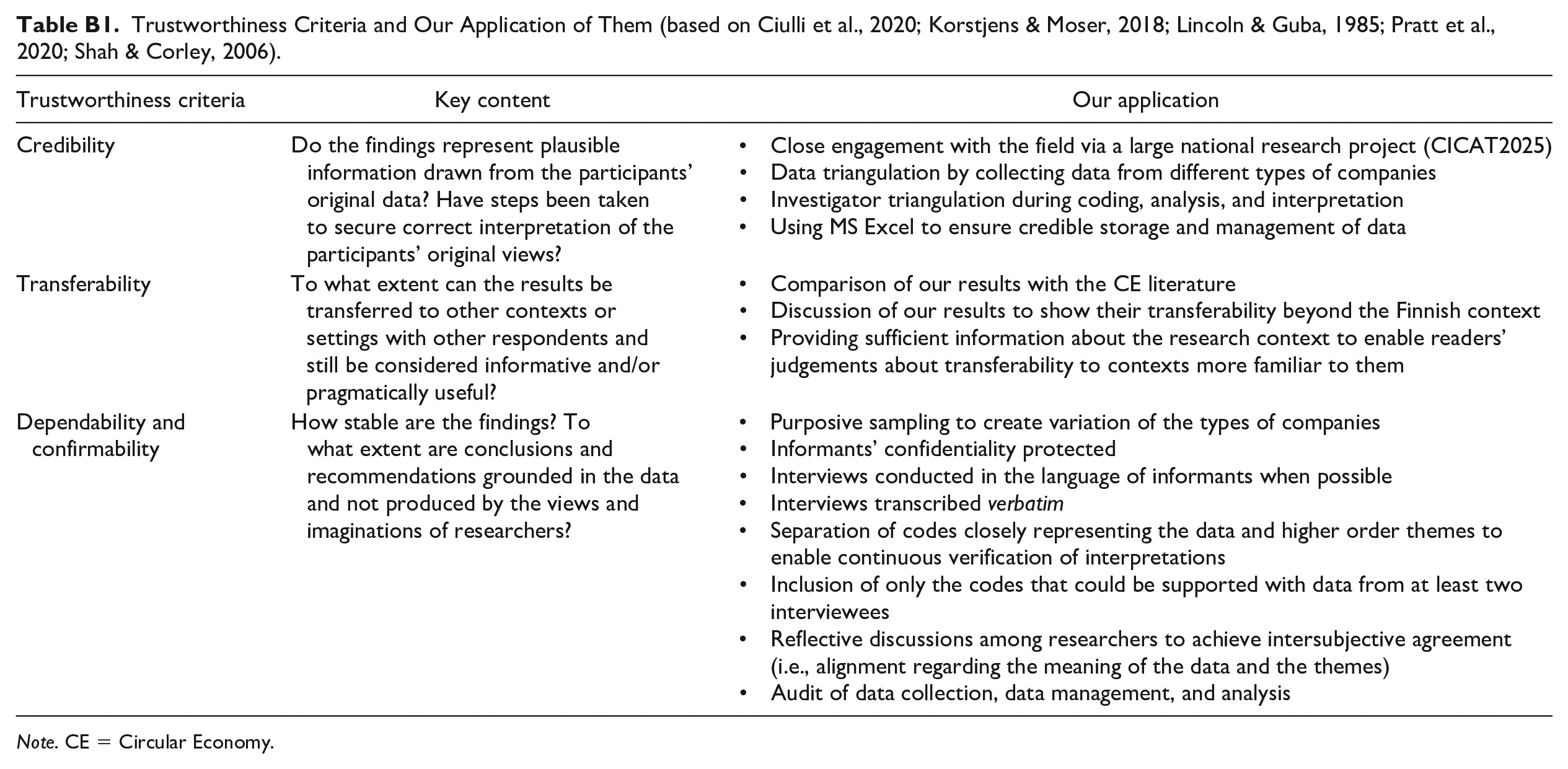
| Trustworthiness criteria | Key content | Our application |
|---|---|---|
| Credibility | Do the findings represent plausible information drawn from the participants’ original data? Have steps been taken to secure correct interpretation of the participants’ original views? | • Close engagement with the field via a large national research project (CICAT2025) • Data triangulation by collecting data from different types of companies • Investigator triangulation during coding, analysis, and interpretation • Using MS Excel to ensure credible storage and management of data |
| Transferability | To what extent can the results be transferred to other contexts or settings with other respondents and still be considered informative and/or pragmatically useful? | • Comparison of our results with the CE literature • Discussion of our results to show their transferability beyond the Finnish context • Providing sufficient information about the research context to enable readers’ judgements about transferability to contexts more familiar to them |
| Dependability and confirmability | How stable are the findings? To what extent are conclusions and recommendations grounded in the data and not produced by the views and imaginations of researchers? | • Purposive sampling to create variation of the types of companies • Informants’ confidentiality protected • Interviews conducted in the language of informants when possible • Interviews transcribed verbatim • Separation of codes closely representing the data and higher order themes to enable continuous verification of interpretations • Inclusion of only the codes that could be supported with data from at least two interviewees • Reflective discussions among researchers to achieve intersubjective agreement (i.e., alignment regarding the meaning of the data and the themes) • Audit of data collection, data management, and analysis |
Note. CE = Circular Economy.
Declaration of Conflicting Interests
The author(s) declared no potential conflicts of interest with respect to the research, authorship, and/or publication of this article.
Funding
The author(s) disclosed receipt of the following financial support for the research, authorship, and/or publication of this article: This work was supported by the Strategic Research Council at the Academy of Finland under grant 320205.
