



Abstract
This article analyzes the main neutralization techniques used in car manufacturers’ sustainability reports to disclose on the Dieselgate scandal. We conduct a conventional qualitative content analysis of 72 sustainability reports, covering the period 2013-2017, from 15 car manufacturers that were accused of unethical behaviors related to the measurement of diesel vehicle pollutant emissions. We then present a framework based on four configurations of neutralization techniques, namely, “head in the sand,” “self-proclaimed green leadership,” “wait and see,” and “start of a new era.” We describe that the manufacturers used heterogeneous neutralization techniques. Furthermore, the sustainability reports analyzed are relatively opaque and disconnected from the accusations made against the companies, which are widely reported by external sources. This article contributes to the emerging literature on the defensive impression management practices used to rationalize corporate misconduct in this area.
Keywords
Introductionf analysis of the results describes the main response patterns used
The Dieselgate case is often considered one of the worst corporate scandals in recent decades (Bowen et al., 2018; Cârstea, 2016; Jung et al., 2017; Mujkic & Klingner, 2019). This scandal is mainly associated with the misconduct of a particular car manufacturer, namely Volkswagen (VW), which installed cheating software aimed at artificially reducing the measurement of pollutant emissions from its diesel vehicles by a drastic degree; this practice was exposed in 2015 by various independent sources (Bowen et al., 2018; Jung et al., 2017; Nunes & Park, 2016; Siano et al., 2017). However, numerous investigations carried out since 2015 have shown that, in addition to VW, most car manufacturers have also made extensive use of similar cheating software in order to fraudulently respond to the increasingly stringent regulations to reduce the polluting emissions of their vehicles (Chapman, 2016; Eigruber & Wirl, 2020; Ewing & Granville, 2019; Schmitt, 2017). The ramifications of the Dieselgate scandal are therefore much broader than the VW case and raise fundamental questions about the corporate social responsibility (CSR) of the automotive sector as a whole.
More specifically, this scandal raises the question of the lack of transparency and reliability of information on corporate sustainability provided by car manufacturers. This type of information is disclosed in sustainability reports (SRs), which are supposed to give stakeholders a transparent and comprehensive picture of performance in this area (Hsu et al., 2013; Zsóka & Vajkai, 2018). In order to enhance stakeholder trust, most major companies—including car manufacturers—have adopted the Global Reporting Initiative standard, which is based on detailed guidelines, and some of them have their reports verified by external auditors (Fernandez-Feijoo et al., 2014; Manetti & Becatti, 2009). While the reliability of these reports has been widely criticized in the literature (e.g., Hahn & Lülfs, 2014; O’Dwyer, 2003; Smith et al., 2011), the way in which major corporate scandals such as Dieselgate are discussed in these reports remains understudied.
The main objective of this article is to analyze the major types of neutralization techniques used in car manufacturers’ SRs when they discuss the Dieselgate scandal, and how these techniques have evolved over time. Neutralization techniques consist in a form of defensive impression management strategy “used to rationalize, through socially acceptable arguments, the occurrence of unethical behavior or negative impacts” (Boiral, 2016, p. 752). This study aims to answer two main research questions:
This study makes two important contributions to the literature. First, it contributes to the literature on impression management theory. While research based on institutional theory has shown how companies faced with strong and similar institutional pressures tend to adopt nearly identical—or isomorphic—reporting practices (e.g., Amran & Haniffa, 2011; Higgins et al., 2018; Martínez-Ferrero & García-Sánchez, 2017), the strategies used to report on a major scandal in SRs are not necessarily isomorphic. However, the majority of previous research has been limited to describing different strategies in an independent and static manner (e.g., Boiral, 2016; Fooks et al., 2013; Meesters & Behagel, 2017). Our study goes further by proposing new configurations to group together the various techniques observed, and to examine how they interact with one another and how they may change over time. This approach responds to several researchers’ assertions about the importance of conducting studies to analyze the evolution of the mobilized strategies over time (Karidio & Talbot, 2020; Talbot & Boiral, 2018). Our study contributes to this literature by identifying various trajectories in the evolution of car manufacturers’ impression management strategies, which exist in a wide range despite the fact that these firms operate in a similar institutional and regulatory context.
Second, the very broad media coverage of Dieselgate makes it possible to verify the information disclosed by the companies concerned by comparing it with what was revealed by convergent sources not controlled by the organizations. This article thus contributes to the emerging literature on the counteraccounting of corporate sustainability, or the analysis of sustainability issues using external sources of information in order to confirm, complete or question the data on social and environmental responsibility disclosed by companies (Boiral, 2013; Gallhofer et al., 2006; Rodrigue, 2014; Tregidga, 2017).
The remainder of the article is structured as follows. First, the literature on Dieselgate and on neutralization techniques is analyzed. Second, the methodology of the study is detailed. Third, the analysis of the results describes the main response patterns used by car manufacturers in their SRs and the evolution of these responses over time. Last, the study’s contributions to the literature, as well as its implications and avenues for future research, are described.
The Dieselgate Scandal and the Opacity of Sustainability Disclosure
The Ins and Outs of One of the Biggest Scandals in Corporate History
The ins and outs of the Dieselgate case can be summarized in four main interrelated components. First, Dieselgate emerged within a historical, technological, and institutional context that facilitated the emergence of cheating behavior in the measurement of vehicle emissions (He & Jin, 2017; Walgren, 2000; Zhang et al., 2021). Thus, these behaviors are far from being new. For example, in 1995, the U.S. Environmental Protection Agency (EPA) required General Motors to pay a $45 million fine for installing software to minimize the recording of carbon monoxide emissions on Cadillac cars (Cushman, 1995; Walgren, 2000). Similarly, in 1998, Ford was fined $7.8 million by the EPA for installing software to cheat on recording the nitrogen oxide (NOX) emissions from its vans (Schaeffer, 1998). In the late 1990s, other car manufacturers, such as Honda and Volvo Truck, were subject to the same type of conviction (EPA, 1998; Schaeffer, 1998). Although the Dieselgate case received much more media coverage than the previous ones, due in particular to its scale, it echoes unethical behaviors which, in retrospect, seem recurrent or even endemic in the automotive sector.
Second, the Dieselgate case was triggered by the large-scale fraudulent behavior of VW—and also other car manufacturers—to downplay the impact of a certain type of vehicle (diesel), particularly during the period 2009-2015 (Huckabee, 2018; Mujkic & Klingner, 2019; Siano et al., 2017; M. Zhang et al., 2021). These behaviors were essentially based on the installation of new types of software which make it possible to falsify the evaluation of vehicles’ polluting emissions—in particular NOX—during homologation tests, and thus appear to meet the increasingly strict regulatory requirements, particularly on the North American market (Nunes & Park, 2016; Pries & Wäcken, 2020; Siano et al., 2017; Spapens, 2018; Zhang et al., 2021).
Third, from 2014 onward, the major discrepancies between officially reported and actual emissions from VW diesel vehicles have been highlighted in external audits carried out by various independent North American organizations, in particular the International Council on Clean Transportation (ICCT), the California Air Resources Board, and West Virginia University researchers (Bovens, 2016; Bowen et al., 2018; Mujkic & Klingner, 2019; Rea, 2017). The resulting investigations have led to multiple convictions of VW by U.S. courts, including, as of 2020, fines of nearly $30 billion, the recall of 580,000 diesel vehicles sold in the United States, and the imprisonment of several of the company’s executives and engineers for fraud (Eigruber & Wirl, 2020; Gaim et al., 2019; Jolly, 2019; Jung & Sharon, 2019; O’Kane, 2019). However, numerous lawsuits are still pending, including those brought by shareholders of the VW Group and by various countries where cars equipped with fraudulent software have been sold—more than 11 million cars, according to VW’s estimates (Euronews & Agence France-Presse, 2019; Gompertz, 2019; Holder, 2019).
Fourth, following the multiplication of international investigations carried out from 2015 onward by various bodies, the Dieselgate case has rapidly led to proceedings against other car manufacturers that have used processes similar to those used by VW. Thus, since 2015, the list of car manufacturers that have admitted to having falsified the measurements of their diesel vehicles’ polluting emissions or have been convicted for such practices (e.g., Fiat Chrysler Automobiles [FCA], GMC, Ford, BMW, Suzuki, Mazda, Subaru, Daimler, Porsche, Mitsubishi) has continued to grow (e.g., Allan & Kable, 2018; Atiyeh, 2019; Chapman, 2016; Eigruber & Wirl, 2020; Ewing & Granville, 2019; Schmitt, 2017). In this context, the Dieselgate case no longer concerns only VW but now extends to the vast majority of the main car manufacturers. This contagion effect is even more important in the case of other German/European or diesel car manufacturers (Bouzzine & Lueg, 2020; Jourdan et al., 2019). Numerous investigations have also raised the liability of Bosch, which supplied these car manufacturers with equipment—in particular emission control software—for facilitating cheating behavior (Contag et al., 2017; Shepardson, 2017; Shepardson & Schectman, 2016; Taylor, 2019). In general, recent revelations and ongoing investigations seem to indicate that Dieselgate could last for many more years, and spread to other actors, with considerable financial consequences.
The majority of research on the Dieselgate remains focused exclusively on the VW case, on the reasons that may explain the fraud perpetuated by this car manufacturer, and on the case’s implications (e.g., Aggeri & Saussois, 2017; Bovens, 2016; J. C. Jung & Sharon, 2019; Mujkic & Klingner, 2019). Some studies have focused on the strategic and economic issues that prompted VW to attempt to enter the U.S. market with inexpensive and seemingly clean diesel vehicles (Aggeri & Saussois, 2017; Bovens, 2016; Mujkic & Klingner, 2019; Siano et al., 2017; Zhang et al., 2021). Research has also highlighted the difficulties, if not the impossibility, of meeting American NOX standards at reasonable costs and without compromising the efficiency of diesel engines (Bovens, 2016; Gaim et al., 2019; Zachariadis, 2016). Studies also mention the unsuitability of environmental standards to manufacturers’ realities, the obsolescence of traditional methods of measuring emissions—based, until recently, on laboratory tests that did not reflect real driving conditions—and the ease of circumventing existing standards by means of cheating software (Bovens, 2016; Brand, 2016; Palmer, 2019; Skeete, 2017; Zachariadis, 2016). Other studies have tried to show the intraorganizational causes of the crisis, in particular the centralization of powers and the lack of communication within VW, the groupthink phenomenon linked to this manufacturer’s strong organizational culture, the search for unrealistic objectives, and the opposition between legal and managerial standards (Aggeri & Saussois, 2017; Aurand et al., 2018; Gaim et al., 2019; Glebovskiy, 2019; Pries & Wäcken, 2020; Siano et al., 2017). Studies also discuss the lack of ethics on the part of VW, its managers, or some of its staff (Bailey & Shantz, 2018; Bovens, 2016; Mačaitytė & Virbašiūtė, 2018; Siano et al., 2017).
However, the increasing number of car manufacturers involved in Dieselgate calls into question the exclusive focus on VW and the intraorganizational explanations for this scandal. Because of its scale and the number of car manufacturers involved, Dieselgate seems first and foremost linked to companies’ more general tendency to systematically downplay or conceal their environmental impacts, sometimes by unethical means, in order to artificially improve their image or performance in the eyes of stakeholders, including environmental agencies. Despite the specificities of Dieselgate, this tendency to conceal or downplay information on environmental impacts is far from new and has been highlighted in numerous studies on corporate impression management practices (e.g., Bozzolan et al., 2015; Diouf & Boiral, 2017; McKie, 2019; Talbot & Boiral, 2018).
Neutralizing the Impacts of Dieselgate on Corporate Image
The contradictions between the apparent corporate sustainability performance and the actual impacts of Dieselgate have been widely analyzed in the literature on CSR and sustainability disclosure (e.g., Boiral & Henri, 2017; Büyüközkan & Karabulut, 2018; Hahn & Lülfs, 2014; Parguel et al., 2011). The generic concept of greenwashing is often used to describe the transmission of misleading or false information about a company’s actual environmental commitment in order to improve its image and social legitimacy (Delmas & Burbano, 2011; Lyon & Montgomery, 2015; Nyilasy et al., 2014; Testa, Boiral, et al., 2018). The managerial capture of disclosed information and the importance of external pressures tend to reinforce the companies’ lack of transparency and the projection of a green image that is largely dissociated from reality (Boiral, 2013; O’Dwyer, 2003; Smith et al., 2011). According to the literature on impression management practices and corporate sustainability (Bozzolan et al., 2015; Cho et al., 2012; Diouf & Boiral, 2017; Talbot & Boiral, 2018), greenwashing behaviors can be based on strategies aimed at presenting an idealized image of the company (enhancement) or at concealing compromising information (obfuscation).
In the case of Dieselgate, manufacturers’ use of emission cheating software and their communication about their alleged “clean diesel” was used as an unethical obfuscation strategy aimed at systematizing the concealment of real environmental impacts, in particular NOX emissions. The widespread use of these cheating behaviors can be explained by the endemic trend toward corporate greenwashing (Aurand et al., 2018; Boiral, 2013; Bowen & Aragon-Correa, 2014; Delmas & Burbano, 2011; Siano et al., 2017), by growing institutional pressures to reduce the environmental impacts of organizations at a lower cost (Brønn & Vidaver-Cohen, 2009; Delmas & Toffel, 2004; Testa, Boiral, et al., 2018), and by the mimetic isomorphism—or the tendency to imitate the practices of other organizations exposed to similar institutional pressures—that characterizes disclosure practices in this area (Gürtürk & Hahn, 2016; Martínez-Ferrero & García-Sánchez, 2017; Smith et al., 2011). The economic considerations and competitive pressures associated with the promotion of diesel engines, which pollute but are less expensive to produce, have also encouraged the institutionalization of isomorphic unethical practices of obfuscation through the implementation of easy-to-install cheating software. Indeed, according to the numerous investigations conducted by judicial authorities since 2015-2016 (e.g., Allan & Kable, 2018; Atiyeh, 2019; Eigruber & Wirl, 2020; Rea, 2017; Schmitt, 2017), these practices had become the norm rather than the exception in the automotive industry by the time the Dieselgate scandal erupted.
Generally speaking, the difficulties in rigorously measuring the environmental performance of companies or their products, the lack of reliability and comparability of official indicators, and the tendency of companies to use these measurement problems to their advantage have been highlighted in various studies (Boiral & Henri, 2017; Capelle-Blancard & Petit, 2017; Palmer, 2019; Zsóka & Vajkai, 2018). However, one of the specific features of the Dieselgate case is the introduction and dissemination of independent verification tests, which the manufacturers apparently did not anticipate, and which led to reliable external benchmarks based on measurements in real driving conditions. These external benchmarks showed clearly and precisely the major discrepancies between the real vehicles’ pollutant emissions and those resulting from laboratory tests rigged by the manufacturers and used by them to promote alleged clean diesel technologies; emissions were up to 40 times higher than disclosed (Clemente & Gabbioneta, 2017; Markowitz et al., 2017; Mathiesen & Neslen, 2015).
Despite the seriousness of Dieselgate, empirical studies on this issue focus mainly on the case of VW, in particular the coverage of the scandal by various media and the perceptions of certain stakeholders on the subject. As such, the way in which Dieselgate was reported by VW and by stakeholders in various media, including social media, has been analyzed in several studies (Clemente & Gabbioneta, 2017; Jourdan et al., 2019; Jung et al., 2017; Siano et al., 2017; Stieglitz et al., 2019).
A few studies based on crisis communication through traditional and social media have shown that VW’s greenwashing practices in relation to diesel emissions led to irresponsible and fraudulent behaviors within the organization in order for VW to meet the unrealistic expectations conveyed by the corporate sustainability discourse (Gaim et al., 2019; Siano et al., 2017; Stieglitz et al., 2018). VW’s crisis communication, the scapegoating behavior of some of the company’s managers, and brand image rebuilding efforts have also been investigated, mainly from a legal and marketing perspective (Çınarlı, 2016; Pfarrer et al., 2008; Stieglitz et al., 2019; Zhang et al., 2016). Last, some studies have analyzed stakeholders’ perceptions of this crisis, in particular VW’s customers, as well as its legal implications and its impact on the organization’s performance (Aurand et al., 2018; Bowen et al., 2018; Dybus & Lemmen, 2017; Riehm & Lindner, 2017).
These various studies have shed more light on the gaps in VW’s communication and the way Dieselgate was covered by different media. However, the Dieselgate scandal does not only concern VW, and the cases of other car manufacturers have been largely neglected in the literature. Moreover, the SRs of the various manufacturers involved in this scandal have been overlooked in empirical studies on the subject, with the notable exception of the study by Holtbrügge and Conrad (2020), which compared SRs from VW and other car manufacturers from a linguistic perspective at the time the scandal erupted. Since SRs, in principle, aim to communicate information on corporate sustainability and to influence the perceptions of stakeholders (Boiral, 2013; Hahn & Lülfs, 2014; Smith et al., 2011; Talbot & Boiral, 2018), their analysis is relevant to better understanding the neutralization techniques used by car manufacturers in response to the accusations made against them in the wake of the Dieselgate scandal.
The concept of neutralization techniques was originally developed in the field of sociology to better understand how delinquents justify improper or deviant behavior (Maruna & Copes, 2005; Sykes & Matza, 1957). Delinquents tend to use a number of strategies, ranging from denial to appeal to higher loyalties. Over the decades, studies on neutralization techniques have proliferated in the field of criminology and social sciences. Several studies have expanded the scope of this theory, including the identification of new techniques to justify misconduct (e.g., Coleman, 1994; Conklin, 2007; Maruna & Copes, 2005). New techniques such as the “defense of necessity,” “victimization,” “appeal to good character,” and “the claim of normality” (Bryant et al., 2018; Coleman, 1994; Conklin, 2007) have been added to the five techniques originally identified by Sykes and Matza in 1957 (denial of responsibility, denial of injury, denial of victims, appeal to higher loyalties, and condemnation of condemners). Some researchers have also proposed integrative frameworks based on inventories of techniques identified in the scientific literature (e.g., Cheng et al., 2014; Kaptein & Van Helvoort, 2019). For example, Kaptein and Van Helvoort (2019) attempted to group nearly 60 neutralization sub-techniques into four broad categories of strategies (distorting the facts, negating the norm, blaming the circumstances, and hiding behind oneself). This study demonstrates the growing number of techniques mobilized in different contexts to justify ethically and socially reprehensible behavior. Recently, this analytical framework has been adapted and applied to many CSR issues, including tobacco companies’ practices in balancing private and public interests (Fooks et al., 2013), the justification of divergences between attitudes and behaviors in green consumption (Gruber & Schlegelmilch, 2014), the legitimization of small- and medium-sized enterprises’ (un)sustainability (Chassé & Boiral, 2017), companies’ responses to accusations of human rights violation (Maher et al., 2021), and climate information from energy sector companies (Talbot & Boiral, 2018). However, to our knowledge, this approach has not been used to analyze the different configurations of impression management strategies—that is, arrangements or patterns of response—implemented by various companies in order to neutralize the impacts of a crisis of the magnitude of Dieselgate. Likewise, the way in which these strategies evolve over time in response to external pressures and public disclosure concerning this type of crisis has not been the subject of in-depth studies. This study also responds to several researchers’ assertions concerning the importance of conducting studies to better understand the evolution of companies’ strategic responses over time (Kaptein & Van Helvoort, 2019; Karidio & Talbot, 2020; Talbot & Boiral, 2018).
Method
Given the exploratory nature of the research questions, a qualitative study was called for; as such, this study is based on conventional qualitative content analysis of SRs. According to the typology of qualitative content analysis proposed by Hsieh and Shannon (2005), this conventional approach is grounded in the data collected rather than on preconveived categories based on the literature and intended to propose or apply a specific theory. It can therefore be used to study a phenomenon by allowing categories to emerge from raw data and not from preexisting categories (Gephart, 2004; Hsieh & Shannon, 2005). This inductive categorization process is commonly used in various qualitative approaches, including grounded theory (Cho & Lee, 2014; Schreier, 2012). Overall, this qualitative approach is particularly useful for studying and better understanding new and emerging phenomena (Gephart, 2004; Hsieh & Shannon, 2005). SRs were deemed relevant for this study, as they directly reflect companies’ positioning. Furthermore, other research methods, such as interviews with managers and surveys sent to companies could not be used for this study due to the sensitivity of the subject and the numerous ongoing investigations and lawsuits following the Dieselgate scandal. These methods could also have been limited by social desirability bias (Chung & Monroe, 2003; Krumpal, 2013).
Data Collection
The first step of this study consisted of one member of the research team elaborating a timeline of the Dieselgate scandal. Even though various timelines already existed, particularly in media articles, this step allowed us to get the most comprehensive overview possible of this scandal. This chronology of events was established using media coverage and grey literature. Several keywords were used for this search, including, but not limited to, “Dieselgate,” “VW scandal,” “diesel emission scandal,” and so on. Overall, more than 250 documents were consulted to establish this timeline, which allowed the research team to better understand the extent and implications of this scandal. To be included in the timeline, an event had to be mentioned by at least two independent sources. This process also allowed the team to determine which car manufacturers were actually involved in 2015 when Dieselgate was first made public and to determine if and when formal investigations were launched against each of the car manufacturers involved. This information was retrieved by triangulating media articles reporting real driving tests conducted in 2014 and 2015 either by the ICCT (based in the United States) or the ADAC (Allgemeiner Deutscher Automobil-Club, the largest motoring organization in Europe), which prompted investigations and subsequent accusations in various countries. The final choice of companies was made during a meeting bringing together the four researchers participating in this study. The researchers employed a voting process requiring unanimity in order to include each company in the study population.
SRs of relevant companies were then retrieved from the Global Reporting Initiative database 1 or directly from each company’s website. Certain criteria were taken into account when selecting the car manufacturers for this study. For instance, the car manufacturer had to have been formally accused at the beginning of the Dieselgate scandal and to have published retrievable SRs in English over the 2015-2017 period. Consequently, some potentially interesting car manufacturers were excluded from this study, as they did not publish SRs regularly or they published them in another language and did not translate all of them into English (e.g., only one year out of two or three). At the end of this process, 15 car manufacturers were included in this study (see Table 1). SRs from these car manufacturers covering the period 2013-2017 were retrieved and subsequently analyzed, representing a total of 72 SRs. SRs from 2013 to 2014, prior to the first revelations regarding the Dieselgate scandal, were also analyzed to better understand how car manufacturers were addressing diesel emissions at that time. SRs from 2015 to 2017 were then used to analyze the responses and justifications given by car manufacturers regarding the Dieselgate scandal. This three-year period was chosen in order to analyze the evolution of the early response to this event. Furthermore, it is important to consider the time gap between the reference year covered by SR and its final publication, which can be one or even two years later for the version translated into English.
Car Manufacturers Included in the Study.
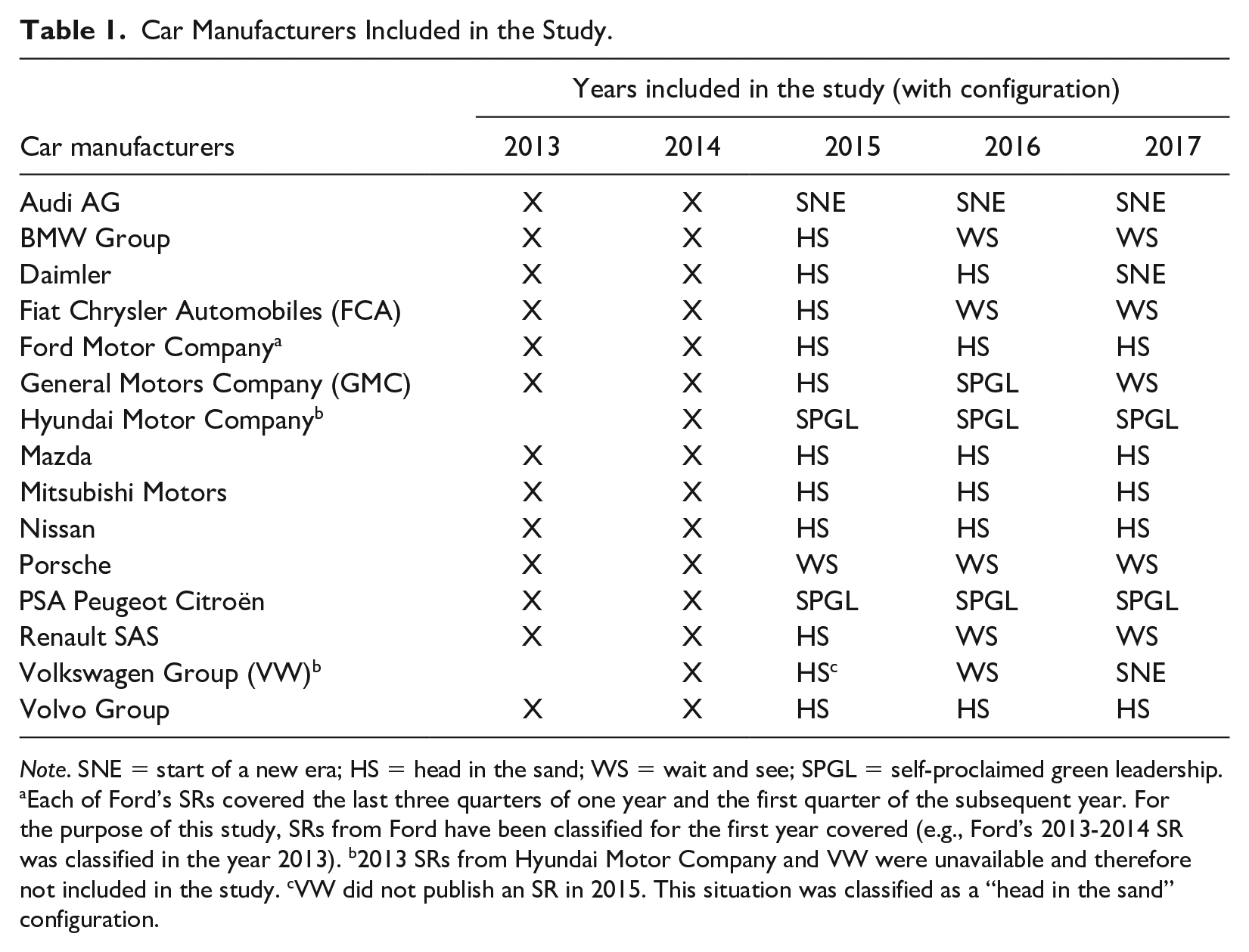
Note. SNE = start of a new era; HS = head in the sand; WS = wait and see; SPGL = self-proclaimed green leadership.
Each of Ford’s SRs covered the last three quarters of one year and the first quarter of the subsequent year. For the purpose of this study, SRs from Ford have been classified for the first year covered (e.g., Ford’s 2013-2014 SR was classified in the year 2013). b2013 SRs from Hyundai Motor Company and VW were unavailable and therefore not included in the study. cVW did not publish an SR in 2015. This situation was classified as a “head in the sand” configuration.
Following the retrieval of these SRs, the relevant content was extracted. In order to retrieve all the content related to the response to the Dieselgate scandal, very inclusive keywords such as “emission” and “diesel” were used. Following this step, the research team manually assessed the content retrieved from SRs (which represents 2,217 single-spaced pages in Microsoft Word) by reading it carefully to identify relevant passages. This method allowed the research team to gather all the information relevant to the Dieselgate scandal, even when this event was not explicitly mentioned in the SR, as well as the communication of diesel vehicle emissions by these manufacturers, notably for the SRs covering the period prior to the scandal. At the end of this process, 72 single-spaced pages containing 287 distinct passages were included in the analysis.
Data Analysis
Content retrieved from SRs prior to the Dieselgate event (2013 and 2014) focused largely on the promotion of the environmental performance of diesel vehicle models and was rather limited, as descriptive content was excluded. As this content was only used for comparative purposes and was not the main subject of our study, no specific coding process was performed. This information was mainly used to assess how the companies studied communicated about their diesel vehicle models at that time and how this communication evolved afterward.
The team analyzed relevant passages retrieved from car manufacturers’ 2015-2017 SRs using the conventional approach of qualitative content analysis in which “codes are defined during data analysis” and “derived from data” (Hsieh & Shannon, 2005, p. 1286). A preliminary coding tree grounded in the retrieved data was first created by reading the passages collected from SRs. Each passage was assigned manually to one category by a team of two independent coders. These coders conferred several times during the process to modify the coding tree according to the data collected, and according to the preestablished timeline of important events in the scandal. Disagreements between the coders during the process were resolved through discussion. Another member of the research team was also involved in validating the coding done by both coders. This dynamic coding process allowed the research team to draw a comprehensive picture of the evolution of the response over time for each car manufacturer studied. At the end of this process, 17 codes were grouped into four main configurations, namely “head in the sand,” “self-proclaimed green leadership,” “wait and see,” and “start of a new era” (see Figure 1), using axial coding. Each car manufacturer’s SR studied for the period 2015-2017 was assigned to one configuration according to the coded passages (see Table 1). These configurations reflect the main strategy adopted by the manufacturer for the reference year period of the SR. However, these categories are not mutually exclusive, and other minor configurations were also at times present to a lesser extent in a given SR.
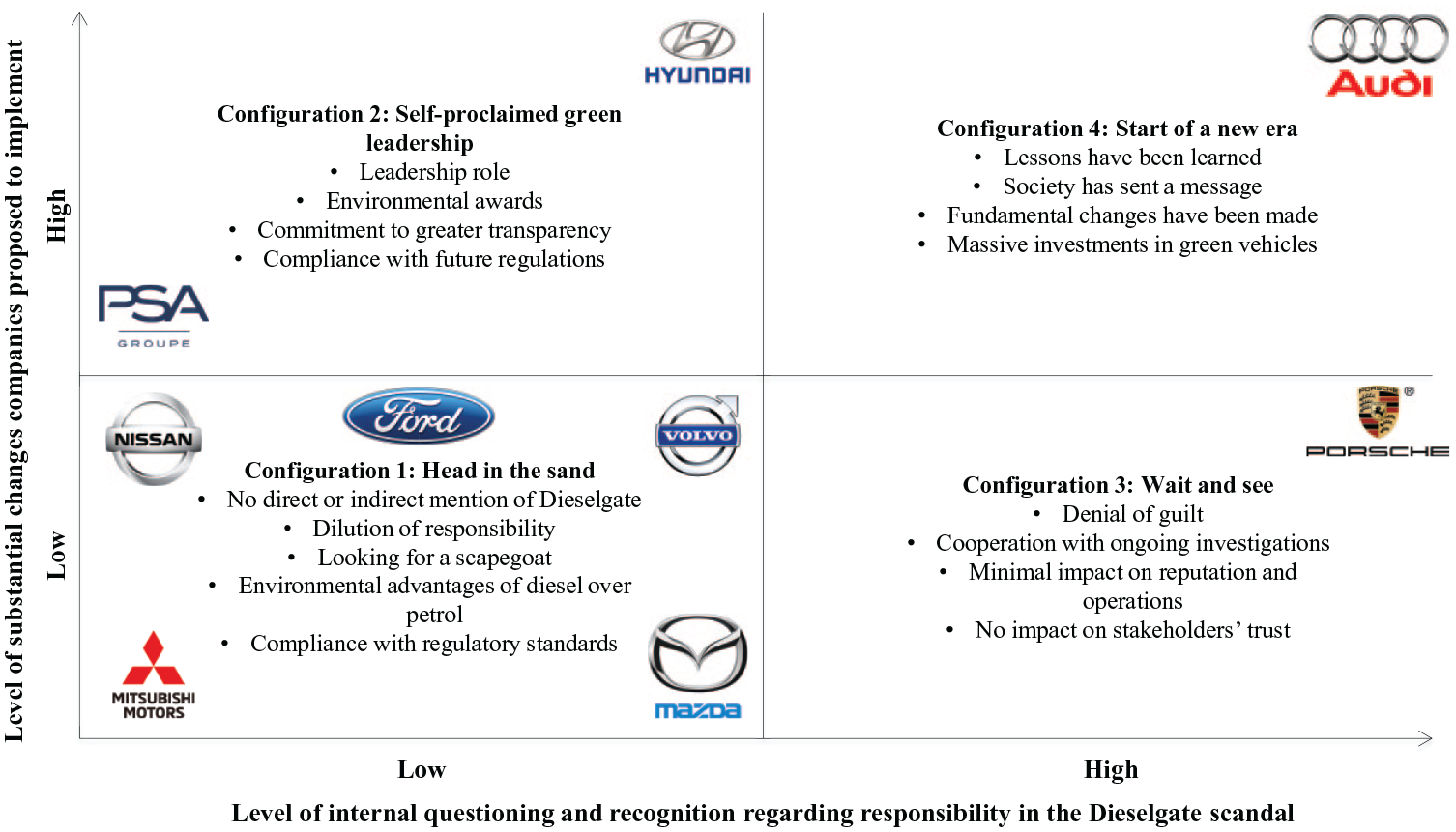
The four configurations of neutralization techniques in response to Dieselgate.
Modeling the Neutralization Techniques in Response to Dieselgate
Although the first speculations in connection with the Dieselgate affair slowly began to emerge in 2014, it was only in 2015, with the EPA’s formal accusation of VW, that the concept of Dieselgate spread very quickly in the media and that institutional pressure against car manufacturers took on considerable proportions. Before 2015, the majority of the companies analyzed (60%) were very optimistic about the environmental performance of diesel engines, and concepts such as “clean diesel” or “EcoDiesel” were used in their SRs (i.e., FCA, Ford, GMC, Hyundai, Mazda, Mitsubishi, Nissan, PSA, and Volvo). Surprisingly, all these companies continued, in one way or another, to promote the environmental benefits of their diesel models for the period 2015-2017, despite the Dieselgate scandal. The emphasis in SRs on each manufacturer’s alleged technological advances, recognition for producing so-called green diesel engines with exceptional performance, proactive strategy with respect to the most demanding environmental standards, and industry-wide recognized green leadership illustrate the importance of the environmental issues associated with diesel vehicles, at least from a marketing and communications viewpoint.
However, despite this optimistic rhetoric about the environmental superiority of their diesel models, in response to the pressures linked to the scandal, manufacturers adopted various neutralization techniques aimed at using apparently socially acceptable arguments to justify the integrity of their company and the legitimacy of their practices. Generally speaking, the neutralization techniques observed revolve around two main themes:
The recognition of the existence of external pressures or threats and the level of internal questioning in relation to the Dieselgate case;
The adoption of measures, substantial to varying degrees, to respond to external pressures and internal questioning.
The first theme concerns the recognition of the Dieselgate scandal and of the company’s possible involvement. While only a minority of car manufacturers explicitly mention the concept of Dieselgate—which is very widely used in the media—the SRs analyzed use various expressions from 2015 onward to refer indirectly to this case. Most of the time, these expressions tend to minimize the scale and seriousness of the ongoing scandal, reducing it to an essentially technical problem: “the diesel emissions issue” (Audi, 2015; VW, 2017), “the diesel issue” (Audi, 2015, 2016; Porsche, 2015; PSA, 2015; VW, 2016, 2017), the “emissions testing issue” (Ford, 2015-2016), the “diesel debate” (Daimler, 2017), the “alleged failure [of] emission control calibration” (FCA, 2017), the “alleged misreporting [of] diesel emissions” (GMC, 2017), the “‘emissions’ affair” (Renault, 2016, 2017), the “diesel engine exhaust emissions” (BMW, 2016, 2017), and so on.
The second theme concerns the announcement of internal changes, substantial or otherwise, in response to this affair and the resulting institutional pressures. While some manufacturers announce major changes, others adopt a detached or wait-and-see attitude with regard to a scandal that, on the surface, does not seem to concern them. The intersection of these two main themes makes it possible to describe four main configurations of neutralization techniques (see Figure). Each of these configurations reflects different strategies for legitimizing corporate behavior in connection with the Dieselgate scandal through various neutralization techniques. These legitimization strategies are not mutually exclusive but, rather, are complementary, and some manufacturers change strategies over time. Although several strategies are used in some SRs, the data analysis showed that there is one main strategy in each SR that is more strongly represented.
Legitimizing Sustainability Practices in the Wake of a Major Scandal
Configuration 1: “Head in the Sand”
The first configuration observed, “head in the sand,” is characterized both by little recognition of the pressures or threats to the company in connection with Dieselgate and by little or no questioning of internal practices in response to this scandal. This configuration, which predominates in 49% of the analyzed SRs (73% in 2015; 40% in 2016; 33% in 2017), is reflected in several neutralization techniques. The first is to remain silent and not to mention the existence of Dieselgate, even indirectly, nor to mention the implementation of measures to respond to the pressures brought on by this scandal throughout the 2015 to 2017 period (Mazda, Nissan, and Volvo). Another neutralization technique consists in acknowledging the existence of pressures in connection with Dieselgate while mentioning that they do not directly or explicitly concern the company. For example, some SRs (e.g., BMW, 2015; Renault, 2015; GMC, 2015) refer to the challenges posed by Dieselgate to the automotive industry as a whole or to society in general, while arguing, to varying degrees of explicitness, that this scandal does not directly affect the company. Other SRs (e.g., Ford, 2015-2016) point to one or more scapegoats by referring to the misconduct of competing manufacturers while reaffirming the company’s own integrity, which indirectly legitimizes the absence of a significant reaction to the scandal. Compliance with current regulatory standards on diesel engine emissions is also frequently highlighted in “head in the sand” SRs to assert the manufacturer’s integrity and thus, implicitly, its lack of connection with Dieselgate (e.g., FCA, 2015; Ford, 2015-2016, 2016-2017, 2017-2018; Mazda, 2015; Mitsubishi, 2016, 2017). The alleged environmental advantages of diesel engines compared to gasoline vehicles, particularly in terms of GHG emissions, are also mentioned in some SRs (e.g., FCA, 2015; Ford, 2015-2016, 2016-2017, 2017-2018; Volvo, 2015, 2016) to downplay the environmental and health implications of the Dieselgate scandal, which mainly concerns NOX emissions. The following passages are representative of the different neutralization techniques that characterize the “head in the sand” configuration: The year 2015 demonstrated that our society still faces major challenges. We firmly believe that intercultural understanding is one of the most important factors in overcoming these challenges, together. (BMW, 2015, p. 4) Our industry has come under severe scrutiny following the emissions scandal that surfaced in September, and cast a shadow of suspicion over the whole of the industry. (GMC, 2015, p. 17)
Configuration 2: “Self-Proclaimed Green Leadership”
The second configuration, “self-proclaimed green leadership,” which predominates in 16% of the SRs (13% in 2015; 20% in 2016; 13% in 2017), is characterized by little recognition of pressures or threats specifically targeting the company, but combined with the announcement of significant commitments in connection with the Dieselgate scandal and its implications for car manufacturers in general. The neutralization techniques associated with this configuration tend to put forward the company’s alleged leadership role in the changes to be put in place to respond to the problems raised by Dieselgate (i.e., lack of transparency on diesel vehicle emissions, environmental impacts of these vehicles) but without evoking any accusations against the company itself. In this context, “self-proclaimed green leadership” presents the company as a solution rather than a problem in relation to the ongoing scandal. The most common approach is to highlight the superior or even exceptional environmental performance of the manufacturer’s diesel engines and the measures taken to maintain its technological leadership at a time when the automobile industry is being heavily criticized, thereby diverting attention from the organization’s own possible involvement in the scandal (e.g., Hyundai, 2015, 2016, 2017; PSA, 2015, 2016, 2017). In the same vein, some manufacturers emphasize the environmental awards won by their diesel vehicles and therefore tend to present themselves as de facto role models that cannot be implicated in large-scale fraud (e.g., PSA, 2017). Commitments to provide greater transparency to stakeholders and to proactively comply with future regulatory standards—in particular the Euro 6 standard which is based on real driving conditions rather than laboratory tests—are also mentioned (e.g., GMC, 2016; Hyundai, 2015, 2016, 2017; PSA, 2015, 2016, 2017). For example, PSA claims in 2017 to be a recognized leader in the publication of real-world fuel consumption figures, similarly to other car manufacturers: In November 2015, amid media reports discrediting the automotive industry, Groupe PSA decided to take a uniquely transparent approach to customer communication, publishing the real-world fuel consumption figures for its cars. [ . . . ] In October 2017, the initiative was awarded the ECOBEST prize by an AUTOBEST panel of 28 representatives from the European media. (PSA, 2017, p. 58)
Configuration 3: “Wait and See”
The third configuration, “wait and see,” which is predominant in 24% of the SRs (7% in 2015; 33% in 2016; 33% in 2017), consists in recognizing that pressures directly targeting the company exist (e.g., fraud investigations, ongoing trials, convictions) in relation to the Dieselgate case while not making any announcement of substantial measures to address them. The manufacturers that employ this configuration mainly remain on the defensive and seem to be waiting for the results of the ongoing investigations before taking a position and making concrete commitments on this issue. The main neutralization technique associated with this configuration is the denial of the company’s guilt. This justification involves acknowledging the existence of allegations or ongoing prosecutions while asserting that they are unfounded or that the company has recently demonstrated its compliance and integrity following audits conducted by the authorities (e.g., BMW, 2016, 2017; FCA, 2016, 2017; GMC, 2017; Renault, 2016, 2017). Another technique used is to minimize the implications of the scandal for the company. Some SRs indicate that the effects on the company’s reputation and operations are minimal (e.g., Porsche, 2017), and that stakeholders still trust the company and believe that it is not affected by the scandal—even if in fact it is (e.g., Porsche, 2015, 2016, 2017). The final neutralization technique associated with the “wait and see” approach is to emphasize that the manufacturer is actively cooperating with the ongoing investigations and that every effort is being made to clarify the situation (e.g., BMW, 2016, 2017; FCA, 2016, 2017; Porsche, 2015; VW, 2016). This legally focused approach allows manufacturers to defend their social legitimacy by asserting that they support the work of environmental authorities or that management wishes to comply with regulations in this area, but without explicitly acknowledging or denying any corporate responsibility in the ongoing scandal: Renault contests the existence of any infringement and intends to prove its compliance with French and European regulations in the legal investigation. (Renault, 2016, p. 90) The complaint also alleges that certain of the software features bypass, defeat or render inoperative the vehicles’ emission control systems, causing the vehicles to emit higher levels of oxides of nitrogen (NOX) during certain normal real world driving conditions than during federal emissions tests. [ . . . ] Following this, we continued to work with the agencies on vehicle testing and refinements to these calibrations. (FCA, 2017, p. 72)
Configuration 4: “Start of a New Era”
The fourth configuration, “start of a new era,”
2
predominates in 11% of the SRs (7% in 2015; 7% in 2016; 20% in 2017), and is characterized both by the explicit acknowledgement of lawsuits and corporate responsibility for Dieselgate and by the announcement of substantial commitments to turn the page on this scandal by adopting much greener practices and vehicles. Neutralization techniques in connection with this configuration therefore aim to offset the company’s past unethical practices by implementing significant measures aimed at preventing this type of problem or even becoming an environmental role model. However, the extent of these measures and the details given on the subject vary greatly from one manufacturer to another. Some SRs mention the major challenges resulting from the scandal and announce massive investments in green vehicles, in particular electric cars (e.g., Audi, 2016, 2017; VW, 2017). Other SRs seem to be coping with the shock of Dieselgate and announce profound changes in company structures and processes but without necessarily giving specific details (Audi, 2015, 2016, 2017; Daimler, 2017; VW, 2017): It represents a clear break in our Company’s history and has triggered an important discussion at Audi about culture and values. We have learned from these events and have implemented various internal mechanisms to prevent something like this from happening again. (Audi, 2017, p. 3) We have not yet surmounted the diesel crisis for which we ourselves are responsible; its consequences will continue to weigh on us for the foreseeable future. We have taken significant steps to strengthen our internal processes and control mechanisms, and to refocus on compliance and integrity. (VW, 2017, p. 12)
Adapting To Increasing Pressures
The institutional pressures associated with Dieselgate (e.g., investigations, trials, convictions, judicial settlements) are not static, but have evolved quite rapidly. From 2015 onward, these pressures increased considerably and gradually spread to most car manufacturers. Despite this development, in the documents studied, the majority of the manufacturers (60%) maintain the same line of conduct with regard to the scandal regardless of the revelations, investigations, and trials directly concerning them. This approach, which is relatively impervious to external pressures, allows manufacturers to distance themselves from a high-profile scandal by adopting an attitude which, for the most part, amounts to denial.
SRs from Ford, Mazda, Mitsubishi, Nissan, and Volvo for the years 2015 to 2017 all reflect the “head in the sand” configuration. The Dieselgate case therefore does not change the main discourse in these SRs which, for the most part, do not mention the existence of threats against the manufacturer and do not announce any specific measures in connection with the scandal. In the case of Ford, several independent studies published from 2015 onward show that the group’s diesel vehicles far exceeded the authorized limits and that the manufacturer had used cheating software similar to that used by other manufacturers (Reuters, 2015; Schram, 2015; Wallace, 2017). However, Ford’s references to Dieselgate are limited to a scapegoating attitude concerning “illegal defeat devices” used by competitors (Ford, 2015-2016, p. 30-31). The manufacturer states that it is not concerned by this case and, for the most part, its SRs sell the merits of its diesel vehicles without announcing any substantial changes in connection with the scandal: “Our award-winning vehicles and engines meet all applicable emissions standards in Europe, and we proactively support the development of new emission regulations within the E.U.” (Ford 2015-2016, p. 28). The same type of denial about the growing scandal is found in SRs from Nissan, Volvo, Mitsubishi, and Mazda. Nissan was accused as early as 2015 in several countries, in particular in South Korea, for installing cheating software (BBC News, 2016; Jin, 2017). Volvo was also accused as early as 2015, in particular by the German authorities, for the same type of practice (Carrington, 2015; Reuters, 2015), and the CEO of Mitsubishi Motors, Tetsuro Aikawa, apologized in 2016, during a press conference, for the “improper conduct” of his company in the context of Dieselgate (Farrell, 2016). Last, investigations against Mazda date back to 2015 and the group admitted in 2018 that it had falsified antipollution controls (Carrington, 2015; Schram, 2015). Despite these revelations, which were widely covered in the international press, none of these manufacturers’ SRs directly mention the existence of Dieselgate or accusations against the company. For the most part, these reports appear to be impervious to pressures against the company and continue throughout the 2015-2017 period to stress their commitment to clean diesel production and their compliance with regulatory standards.
Hyundai and PSA adopt a position of “self-proclaimed green leadership” in all their SRs covering the period of 2015-2017. Unlike the “head in the sand” approach, these manufacturers do not ignore the scandal and even announce various types of measures supposedly in response to the Dieselgate scandal as early as 2015, but without acknowledging their direct responsibility. For example, Hyundai (2016) mentions “the Volkswagen emission gas scandal” (p. 79) and “‘Dieselgate’, one of the most troubling industry scandals” (p. 24), while underlining its leadership in the production of clean diesel engines in order to better respond to the growing pressures in this area. This optimistic discourse is maintained in the SRs analyzed, and the manufacturer does not mention its responsibility or the accusations it has been subject to from 2014 onward, in particular by the EPA, for having installed cheating software on its diesel vehicles (Shepardson, 2014). In the case of PSA, despite ongoing investigations and accusations, particularly in France, for installing cheating software on nearly two million vehicles (Mandard, 2017), threats against the manufacturer are never explicitly mentioned in their SRs. PSA maintains a fairly stable message, constantly highlighting its alleged technological leadership and transparency in the Dieselgate affair. For example, regarding the disclosure of information on pollutant emissions from their diesel vehicles, PSA (2016) mentions “an efficient monitoring system and ensure[s] a solid and uniform approval framework” (p. 247).
In contrast to the “business as usual” approach to external pressures, 40% of the car manufacturers studied (BMW, Daimler, FCA, GMC, Renault, and VW) significantly modified their neutralization techniques in relation to Dieselgate and the charges that have subsequently arisen (see Figure 2).
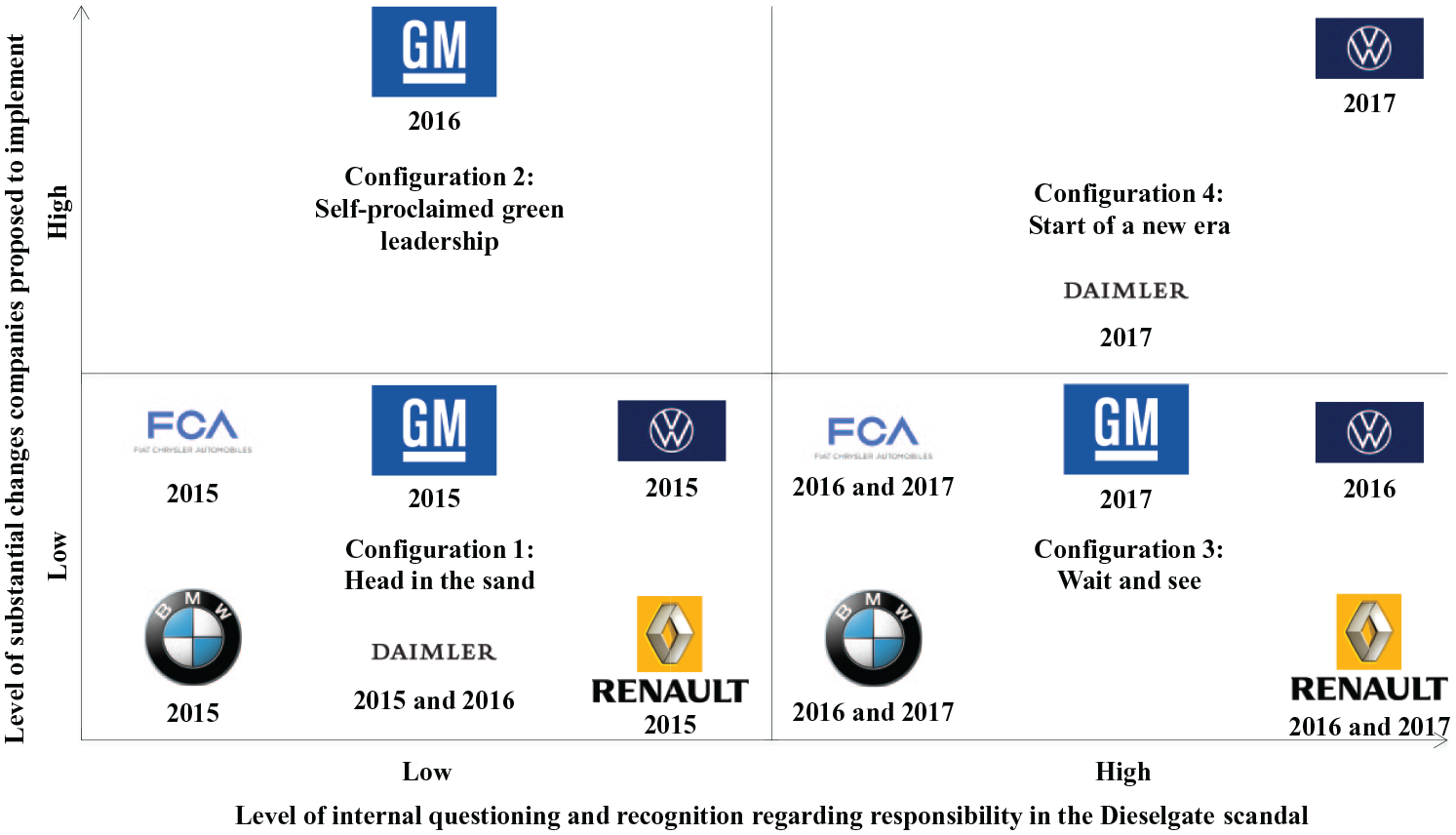
Adapting to external pressures: the “reactive” pattern.
The main changes observed during the 2015-2017 period are reflected in the adoption, especially from 2016 onward, of the “wait and see” and “start of a new era” configurations by manufacturers that had not previously mentioned their possible involvement in the scandal.
The shift to the “wait and see” configuration is the most frequent and reflects the recognition to a certain extent of the accusations made against manufacturers that have chosen, over a certain period of time, to simply mention this problem without admitting their responsibility or announcing substantial changes. This change in approach is particularly clear in the cases of FCA, BMW, and Renault which, prior to 2016, are instead in a “head in the sand” configuration. For FCA, the charges date back to 2015 and come from several governments, including the United State, German, French, and European justice systems (Mandard, 2017; Piscioneri & Flak, 2017; The Associated Press, 2017). FCA mentions the existence of these lawsuits in its 2016 and 2017 SRs, referring to “inquiries from several regulatory authorities” (FCA, 2016, p. 99) as the company “failed to disclose certain emissions control strategies” (FCA, 2016, p. 99), and a “civil lawsuit” (FCA, 2017, p. 72) in connection with the scandal. However, no substantial new measures other than the introduction of “modified emissions software calibrations” (FCA, 2017, p. 72) were announced as a substantial response to the ongoing scandal. In the case of BMW, the accusations date back to 2015 and state that the major German manufacturers allegedly colluded in the concerted installation of cheating software which, among other things, prevents them from competing on the environmental performance of their diesel engines (Knight, 2015; Neslen, 2019). From 2016 onward, BMW’s SRs mention the existence of allegations relating to certain data “manipulation” practices while stressing that “compliance with legal requirements, including local test requirements, has top priority” (BMW, 2016, p. 29) and that “not all companies [ . . . ] have understood that words alone are not enough” (BMW, 2017, p. 6). However, no substantial measures are announced to move from words to deeds, and the manufacturer seems to be waiting for new elements before adopting a clear strategy. In the case of Renault, the accusations arose in 2015 and were generally presented in the media at the same time as those against the other major French manufacturer (PSA): investigations highlighting major discrepancies between declared and actual emissions, the launch of legal investigation for fraud, accusations by the French authorities, and so forth (Carrington, 2017; Serafino & Benoit, 2016). After a 2015 SR which remains very evasive and does not clearly mention Dieselgate (“head in the sand”), Renault recognizes quite explicitly in its 2016 and 2017 SRs that it is the subject of accusations in the context of the “‘emissions’ affair” (Renault, 2016, p. 384; 2017, p. 391) but without announcing any significant changes in response to the scandal.
For GMC and Porsche, the adoption of a “wait and see” configuration takes place under very different conditions. For GMC, the 2015 SR is in a “head in the sand” logic and does not clearly mention Dieselgate. However, GMC’s 2016 SR uses the logic of “self-proclaimed green leadership” characterized by a strong commitment to meet regulations, particularly for its subsidiary Opel. Following a series of investigations and complaints (Boudette, 2015), the manufacturer subsequently adopts a very defensive, even aggressive position, particularly in 2017: “A list due to reputational risks related to charges of alleged misreporting diesel emissions for certain models in the U.S., which GM strongly disputes. These claims are baseless and we will vigorously defend ourselves” (GMC, 2017, p. 25).
Finally, VW and Daimler adopt a “start of a new era” position in 2017 after having gone through other configurations before. These manufacturers apparently wish to turn the page on a scandal in which their responsibility is now widely acknowledged in the public sphere. The case of VW, which is at the heart of the Dieselgate affair (Bowen et al., 2018; Nunes & Park, 2016; Siano et al., 2017), is quite revealing of these transitions. Despite the devastating investigation published in 2014 by the ICCT and specifically targeting VW (Thompson et al., 2014), VW chose not to publish an SR in 2015, which amounts to a form of “head in the sand” attitude, given the very high media profile of the scandal that same year. In 2016, VW’s SR announces, “now we are back on schedule, so to speak” (VW, 2016, p. 6). The 2016 SR predominantly reflects a “wait and see” configuration and minimally refers to the ongoing proceedings without mentioning VW’s guilt, which was already clearly established at that time: “We are cooperating with all the responsible authorities to clarify these matters completely and transparently” (VW, 2016, p. 28). Dieselgate is then evoked in rather evasive terms as the 2016 SR also tries, to a lesser extent, to promote the self-proclaimed green leadership of VW: We intend to become a world-leading provider of sustainable mobility. [ . . . ] We deeply regret the behavior that gave rise to the diesel crisis. Such misconduct runs contrary to all the values that Volkswagen stands for. [ . . . ] The Group has significantly expanded its voluntary commitment to act ethically and with integrity [ . . . ] our primary aim must be to become a role model for a modern, transparent and successful enterprise. [ . . . ] despite the diesel crisis, in 2016 we received a number of awards. (VW, 2016, p. 6, 27, 29, 47, 56)
In 2017, the manufacturer is more clearly committed to a “start of a new area” configuration. In this SR, VW seems to want to learn the lessons of Dieselgate and states that it is now committed to a series of measures, including in the area of HRM: Our human resources strategy also addresses the causes and consequences of the diesel emissions issue. Various initiatives for transforming our corporate culture are already in progress, aiming to establish flatter hierarchies, a more open form of collaboration and a more broadly entrepreneurial perspective across the Group’s divisions. (VW, 2017, p. 73)
In the case of Daimler, despite accusations against the manufacturer as early as 2015, Dieselgate is only mentioned in 2017, very discreetly and without a clear acknowledgement of the company’s responsibility. Prior to this period, the group’s communication is centered on a “head in the sand” approach which is essentially limited to mentioning the “positive impact of Mercedes-Benz’ latest diesel engine technologies on the air quality of inner cities” (Daimler, 2016, p. 48). The 2017 SR announces that they “have gotten the message” (Daimler, 2017, p. 34) and mentions an important change in attitude (“start of a new era”).
Discussion
The objective of this article is to shed more light on the different types of neutralization techniques employed by car manufacturers in the wake of the Dieselgate scandal, and how they have evolved over time. We describe that manufacturers involved in the scandal use four main types of neutralization techniques (“head in the sand,” “self-proclaimed green leadership,” “wait and see,” and “start of a new era”) to justify their behavior.
In general, despite the diversity of the observed neutralization techniques, they all reflect a clear mismatch between the intensity of the institutional pressures experienced by car manufacturers and the optimistic or even erroneous discourse of most of the SRs analyzed. This discrepancy is indicative of the tendency toward greenwashing (Delmas & Burbano, 2011; Lyon & Montgomery, 2015; Testa, Boiral, et al., 2018) and the obfuscation of negative events likely to alter corporate image (Fabrizio & Kim, 2019; Haller et al., 2018; Melloni et al., 2017; Talbot & Boiral, 2018). It is also indicative of the managerial capture of SRs, which reflect the companies’ interests and their control over the information disclosed rather than reflecting the interests of the stakeholders, particularly in terms of corporate sustainability information transparency (O’Dwyer, 2003; Smith et al., 2011). From this critical perspective, the management strategies observed in the SRs published after 2015 tend to appear as a continuation, in a more traditional and less sophisticated form, of the logic of information distortion and the obfuscation of real sustainability issues that led manufacturers to minimize the environmental impacts of diesel vehicles through the use of cheating software in the first place. Although some car manufacturers, in particular VW and Audi, are ostensibly seeking to turn the page on Dieselgate and to acknowledge, to some extent, certain errors of the past by adopting a “start of a new era” configuration, this strategy is not very transparent. The extent and financial implications of the fraud accusations are largely minimized in all the SRs analyzed, regardless of the year and the manufacturer considered.
The present study shows that, even when these unethical behaviors are clearly proven by independent investigations, corporate disclosure practices continue to be obscured by greenwashing tendencies and are not really used as a vehicle to recognize past wrongdoings or to present a more balanced image of sustainability performance. By analyzing press articles covering Dieselgate and comparing them with the information disclosed in SRs, this article is in line with the emerging literature on counter-accounting, which has shown the relevance of using independent, noncontrolled information to assess corporate sustainability and to analyze the level of transparency of the information corporations disclose (Boiral, 2013; Gallhofer et al., 2006; Rodrigue, 2014; Rowbottom & Lymer, 2009; Tregidga, 2017). This study is, to our knowledge, the first to combine an analysis of both the counter-accounting approach and impression management strategies in the context of a major scandal. Contrary to the hypothesis put forward by Talbot and Boiral (2018), the release of information regarding Dieselgate did not create sufficiently significant institutional pressure to improve the quality of information car manufacturers voluntarily disclose in this area. This study also discusses disclosure practices by demonstrating the existence of major discrepancies between the images promoted by companies and those conveyed in the media. Some authors have pointed out a growing opacity in disclosure practices in recent years (e.g., Boiral, 2016; Talbot & Boiral, 2018), whereas other authors have argued that the reporting quality has tended to increase due, in part, to extensive external scrutiny (e.g., Mahoney & Thorne, 2014; Uyar, 2017).
Contributions and Managerial Implications
This study has two main contributions to the literature. First, this article contributes to legitimacy theory and its possible application in the case of corporate scandals. Most studies on corporate sustainability based on institutional theory argue that companies adopt similar practices (isomorphism) to respond to institutional pressures and enhance their legitimacy (Brønn & Vidaver-Cohen, 2009; Cho et al., 2015; Delmas & Toffel, 2004; Hahn & Kühnen, 2013; Testa, Boiral, et al., 2018). Dieselgate shows that this isomorphism is not only about good practices but can also extend to major and fairly widespread fraudulent behaviors. Conversely, and contrary to expectations, when a scandal associated with such behavior occurs, the companies concerned do not seem to adopt isomorphic behavior in their own defense. The diversity of neutralization techniques observed rather indicates that this defense follows an “every man for himself” logic rather than adopting a common position. This study thus shows that the defensive strategies used by manufacturers are relatively heterogeneous. Moreover, despite the potential impact of such a scandal on car manufacturers’ social legitimacy and financial performance, these strategies are relatively diverse and not always in line with transparent disclosure approaches that might reasonably be expected. It is interesting to note that some manufacturers belonging to the same parent company (e.g., Audi and Porsche, which are subsidiaries of VW) have adopted different strategies despite the economic impact of the scandal for VW. Although the data collected do not make it possible to clarify the reasons underlying these differences, it is reasonable to assume that, due to their specificity and large size, the car manufacturers affiliated with the same group tend to adopt different and decentralized sustainability reporting practices. Those practices may also be influenced by broader strategic considerations in the aftermath of the Dieselgate scandal, including the shift toward electric mobility on the part of some manufacturers such as VW. Moreover, the isomorphic response of organizations exposed to institutional pressures has been largely criticized in the literature. Among other things, these responses can be heterogeneous due to the diversity of stakeholder expectations and the more or less symbolic measures implemented in each organization to address institutional pressures (e.g., Testa, Boiral, et al., 2018; Testa, Iraldo, et al., 2018; Yin & Schmeidler, 2009). According to Oliver (1991), in a situation where legitimacy may be compromised and the financial stakes are high, it would have been more predictable to observe acquiescence strategies. However, in the cases studied, more avoidance and manipulation strategies were observed (“start of a new era,” “head in the sand,” “wait and see,” and “self-proclaimed green leadership”). Some strategies, such as those of VW, are also very surprising, especially considering the factors proposed by Oliver (1991). According to Oliver’s framework, it was unlikely that this firm would attempt to reverse the situation, especially considering the uncertainty in which it was operating. These various elements raise important issues concerning the factors that may influence the adoption of a strategic response, especially in a crisis context. In addition, the disclosure of incomplete and poor-quality information is a widespread phenomenon among the companies studied. This lack of transparency can be explained by the legitimacy theory, as organizations with poor performance tend to use several tactics to influence public opinion rather than substantially changing their internal practices to significantly reduce their environmental impacts (Boiral, 2016; Deegan, 2002; Hummel & Schlick, 2016). According to this theory, car manufacturers tend to disclose incomplete and superficial information to cover up their actual performance. In this context, SRs become a communication tool rather than a document to present the company’s real performance. In contrast to many studies that have examined the links between environmental performance and disclosure practices (e.g., Hummel & Schlick, 2016; Khan et al., 2021), this study demonstrates the importance of focusing not only on quantitative indicators in reporting but also on the nature of the reporting process, more specifically the response to the criticisms and scandals that companies are exposed to.
Second, this article contributes to the literature on impression management practices and neutralization techniques in the field of corporate sustainability. With few exceptions (e.g., Boiral, 2016; Talbot & Boiral, 2018), the rationalizations of unethical behaviors in SRs remain little studied. Moreover, while some research on the subject has listed the types of neutralization techniques used by companies (Fooks et al., 2013; Karidio & Talbot, 2020; Talbot & Boiral, 2018), studies have not proposed an integrative model to account for the different approaches in this area and their evolution over time. The model presented in this article provides a global view of corporate defensive impression management when it comes to sustainability misconduct. This model can also be used to draw up a typology of greenwashing practices in the particular context of large-scale scandals. This study has highlighted strategies that are mentioned infrequently in the literature on neutralization techniques, notably active collaboration and the covering up of accusations. It also allows for novel groupings of techniques in configurations that combine defensive and assertive components. For example, in the “wait and see” configuration, there is a denial and minimization of impacts (defensive strategies) combined with an active collaboration in ongoing studies of the Dieselgate scandal (assertive strategy). These combinations point out interesting hybrids in the companies’ responses to criticisms of the practices of car manufacturers. Furthermore, the analysis used in this study makes it possible to show the changes in corporate impression management strategies over time and thus gives a more dynamic view of neutralization techniques, which are essentially described separately and statically in the current literature. Overall, our findings address the call for more phenomenon-driven rather than theory-driven models of organizational change (Schwarz & Stensaker, 2014).
Third, this article has important practical implications, particularly for governments, SRI practitioners, and other stakeholders interested in corporate sustainability. The Dieselgate case demonstrates the essential role of independent investigations and of external verification of corporate sustainability information. The results of the study show that the voluntary disclosure of corporate sustainability information is primarily a marketing tool and not a reliable source of information. These results therefore call into question the use of SRs by various stakeholders (e.g., nonfinancial agencies, institutional investors, academic researchers) to measure corporate performance and establish rankings. The development of alternative sources of information (e.g., investigations, stakeholder interviews, government data, press articles describing major incidents) appears essential to countering the opacity that characterizes voluntary disclosure of information in this field.
Limitations and Avenues for Future Research
This study has several limitations. First, this study is based on a qualitative analysis of secondary data covering a relatively limited period (2013-2017). The Dieselgate case is far from over and trials still ongoing in 2021 in different countries and with different stakeholders (e.g., shareholders, customers, governments) point to further convictions in the future. Future research could therefore analyze the different neutralization techniques used since 2017 in SRs in response to the increasing number of revelations on this case. However, given the time lag of one or two years between the year covered by the SRs and the year of their publication, such studies can hardly be implemented before 2021-2022. Interviews, case studies, and quantitative studies covering all companies involved in Dieselgate and exploring how similar fraudulent behavior has become widespread would also be relevant. This approach would be particularly appropriate considering that studies on Dieselgate (Aggeri & Saussois, 2017; Gaim et al., 2019; Siano et al., 2017) are still scarce and focus essentially on the VW case, which is far from being the only manufacturer concerned. It would also be important to better understand the factors that may explain the mobilization of different neutralization techniques. To do so, it might be relevant to draw on research conducted in the area of individual impression management strategies—a more mature field of research. Some of the measurement tools used could be easily adapted to study corporate behaviors (Bolino et al., 2016).
Second, this study does not cover certain key players in the Dieselgate case. The role of certain original equipment manufacturers, in particular Bosch, should be carefully examined. Given that most of the motor control software at the origin of the scandal was supplied by Bosch (Contag et al., 2017), it is reasonable to assume that this original equipment manufacturer did not play a passive role in the car manufacturers’ cheating behavior. After verification, Bosch’s SRs published between 2015 and 2018 do not contain any clear information on Dieselgate, with the notable exception of its 2016 SR, which mentions one civil claim settlement in the United States without acknowledging any liability. It would also be relevant to investigate the roles played by government agencies (e.g., the EPA) and the courts in order to better understand the substantial differences in the charges and penalties imposed on the various car manufacturers associated with this scandal. In particular, a study could examine the factors that may explain the significant variations in the penalties imposed on companies based on interviews with representatives of government agencies and the conclusions of legal investigations conducted in various countries from 2013 to the present.
Third, this study focuses on a very specific sustainability issue for car manufacturers, namely the pollutant emissions of diesel vehicles. As important as it is, the analysis of this issue does not necessarily give a comprehensive picture of the complexity and diversity of manufacturers’ sustainability impacts, such as emissions from other types of vehicles, impacts arising from subcontracting and vehicle assembly activities, and impacts associated with the development and lifecycle of electric vehicles. Future research could further investigate these different types of impacts to try to provide a more global picture of manufacturers’ sustainability commitments. However, such studies are likely to face the challenge created by the lack of reliable and independent data on these issues. Given that Dieselgate has highlighted the considerable discrepancies between the actual impacts of diesel vehicles and those reported, it is reasonable to assume that such discrepancies also exist for other types of issues that are just as important and for which, most of the time, there are no reliable external benchmarks.
Footnotes
Declaration of Conflicting Interests
The author(s) declared no potential conflicts of interest with respect to the research, authorship, and/or publication of this article.
Funding
The author(s) disclosed receipt of the following financial support for the research, authorship, and/or publication of this article: This project was supported by the Canada Research Chair in Internalization of Sustainability Practices and Organizational Accountability.
