



Abstract
This study aimed to develop industrial exposure assessment models to determine the contamination level of Bacillus cereus in soy-based beverages formulated from raw materials (soy flour and soy protein) decontaminated by using cold plasma technology. The assessment comprised two stages: i) cold plasma sanitization of raw materials and ii) subsequent storage under cold chain break conditions (20 °C) of beverages formulated by using the sanitized raw material. B. cereus spores were inoculated into the raw materials and treated with synthetic air plasma (0.80 mbar, 300 W) at varying exposure times. Inactivation curves were modeled using the Weibull distribution function. To assess the growth, the Baranyi and Roberts model was used incorporating data from previous studies. The modular industrial exposure assessment models were used to perform Monte Carlo simulations including different initial contamination levels (102 to 104 CFU/g) and two plasma performance criteria (1 and 2 log reductions). Although all units remained contaminated, plasma treatment prevented B. cereus from reaching the infective dose in the formulated beverages with sanitized raw material, in all evaluated scenarios. Conversely, drinks formulated with untreated raw materials exceeded that infective dose at the highest contamination level. Consequently, cold plasma was found to be useful for the sanitization of raw materials used for formulate beverages, maintaining a safe level of B. cereus under cold chain break conditions. Cold plasma could be integrated into a hurdle technology approach to enhance food safety standards.
Introduction
The global market for plant-based products is expanding rapidly, driven by a consumer shift toward sustainable dietary patterns, including vegetarian and vegan lifestyles. Consequently, plant-based dairy alternatives have gained significant prominence in modern diets. Among these, soy-based beverages are particularly favored due to their high-quality protein content, B vitamins, unsaturated fatty acids, and bioactive phytochemicals (Craig et al., 2023; Olías et al., 2023). Soy protein isolate (SPI) represents the most refined form of soybean protein, containing a minimum of 90% protein. Due to its high purity, SPI is extensively utilized in food manufacturing to improve both nutritional profiles and techno-functional properties. Furthermore, SPI is a critical component in infant formulas, serving as a primary alternative for infants with bovine milk protein intolerances (Astawan and Prayudani, 2020).
The presence of Bacillus cereus in soybean flour and derivative soy-based products, including soymilk and beverages formulated with soybean protein, represents a significant public health concern (Anjos et al., 2020; Ike et al., 2025). This is further evidenced by a contamination incident reported by the Food Safety Centre of Hong Kong, in which a soybean milk sample collected from a retail outlet following a consumer complaint exceeded acceptable levels of B. cereus and was consequently deemed unsatisfactory (Chong, 2021).
B. cereus is a Gram-positive, spore-forming bacterium capable of surviving diverse environmental stressors. Commonly soil-borne, this pathogen contaminates raw materials, and leads to two distinct foodborne illnesses: the diarrheal syndrome, caused by enterotoxins produced in the small intestine, during vegetative growth, and the emetic syndrome, resulting from the ingestion of preformed cereulide toxin in the food matrix, leading to vomiting. The heat-resistant nature of B. cereus spores allow them to persist through thermal processing, making them a primary focus for food safety interventions (Valdez-Narváez et al., 2024a, 2024b). In addition, thermal treatments such as UHT processing may compromise the nutritional quality and sensory properties of foods. As an alternative, low-temperature long-time (LTLT) pasteurization can be applied; however, it is insufficient to inactivate bacterial spores (Rabbani et al., 2025).
Attack bacterial spores and destroy them in raw material could be a reasonable measure to reduce the bacterial load and in consequence the chance that they growth over the infective dose level under temperature abuse. In that context, cold plasma has emerged as a promising non-thermal alternative to traditional decontamination methodologies to mitigate those risks (Pignata et al., 2017). Often described as the “fourth state of matter,” cold plasma is a partially ionized gas generated by applying electrical energy to carrier gases (such as air). This process produces a potent mixture of charged particles, UV light and reactive oxygen and nitrogen species (RONS), which synergistically destroy microorganisms (Mandal et al., 2018).
When evaluating such emerging technologies, it is essential to conduct industrial risk assessments. Microbiological risk assessment provides a systematic framework for evaluating the risks posed by biological hazards. Within an industrial context, the exposure assessment component is particularly critical; it quantifies the likelihood and magnitude of consumer exposure to microbiological hazards following specific processing interventions. This requires a comprehensive analysis of food processing parameters, storage protocols, handling, and consumption patterns to estimate microbial loads throughout the food chain (farm-to-fork). Crucially, it accounts for fluctuations in microbial populations from raw material sourcing through processing and preservation stages to the final point of consumption (Membré and Boué, 2018; Valdez-Narváez et al., 2024a, 2024b).
Ensuring food safety is a critical objective in food production systems. Beyond traditional hazard control approaches, such as Hazard Analysis and Critical Control Points (HACCP), the industrial exposure assessment has emerged as a key preventive strategy. Industrial exposure assessment involves the systematic identification, measurement, and analysis of biological agents present in the production environment that may compromise food safety (Latronico et al., 2017). o date, an industrial exposure assessment model for B. cereus in soy-based beverages formulated from plasma-treated raw materials has not been established. Therefore, the aim of this study was twofold: first, to assess the effectiveness of cold plasma in inactivating B. cereus spores in raw materials used for beverage formulation; and second, to develop and apply industrial exposure assessment models for B. cereus in soy-based beverages formulated with cold plasma-treated raw materials (soybean flour and SPI). This model was used as a quantitative tool to estimate the percentage of contaminated units and the spore levels in those units, providing relevant information for food safety risk prevention.
B. cereus strain and sporulation process
B. cereus strain CECT 148 was obtained from the Spanish Type Culture Collection (CECT; Valencia, Spain). For activation, the strain was cultured in nutrient broth (Scharlab, Barcelona, Spain) at 32 °C for 24 hours under constant shaking. Following activation, 0.5 mL of the vegetative cell suspension was inoculated into 20 Roux flasks (Fisher Scientific SL, Madrid, Spain) containing fortified nutrient agar prepared following the procedure of Fernández et al. (1999). The flasks were incubated at 30 °C until sporulation reached approximately 90%. Spores were then harvested by gently scraping the agar surface with a sterile Digralsky loop (Deltalab, Barcelona, Spain) and rinsing with double-distilled water. The resulting suspension was centrifuged at 2500 × g for 15 minutes at 4 °C using a Beckman Avanti J-26XP centrifuge equipped with a JLA-16.250 rotor (Beckman-Coulter, Palo Alto, USA). The supernatant was discarded, and the pellet was resuspended in 5 mL of double-distilled water. This washing procedure was repeated four times. The purified spore suspension was then stored in distilled water at 4 °C until further use. Prior to inoculation, spore suspensions were subjected to a heat treatment (70 °C for 10 minutes) to inactivate any remaining vegetative cells (Rodrigo et al., 2021).
Material and methods
Preparation and inoculation of soy matrices
Yellow soybeans (Glycine max L. Merrill) were sourced from a local market and milled into flour using an analytical mill (IKA A11 basic, IKA-Werke GmbH & Co., Staufen, Germany). SPI was obtained from HSN (Granada, Spain). For each soy matrix and subsequent plasma treatment, 4 g of the respective sample was weighed into borosilicate crystallizing dishes (6 cm diameter, 3.5 cm wall height). The matrices were sterilized via dry heat at 80 °C overnight. Following sterilization, the samples were inoculated with B. cereus spores to achieve a final concentration of 107 CFU/g.
Cold plasma treatment
Plasma treatments were performed using a low-pressure dielectric barrier discharge plasma reactor (Pico-AR-200-PCCE7, Diener GmbH, Ebhausen, Germany). Inoculated samples, contained in borosilicate crystallizing dishes, were positioned on a central support tray within the plasma chamber (dimensions: 134 mm diameter and 300 mm depth). The process gas consisted of synthetic air (80:20 ratio of N2:O2) maintained at an operating pressure of 0.80 mbar and an input power of 300 W. Exposure times were optimized based on the soy matrix: SPI was treated for durations up to 80 minutes, whereas soy flour was treated for up to 50 minutes. The shorter range for soy flour was selected because at extended times the difference in inactivation becomes negligible. All experimental conditions were conducted in triplicate to ensure reproducibility.
Microbiological analyses
Surviving B. cereus populations were quantified by performing serial tenfold dilutions of the samples in 0.1% (w/v) peptone water. Each dilution was plated in duplicate onto nutrient agar medium, supplemented with 1 g/L of starch (all from Scharlab). The plates were incubated at 30 °C for 18 to 24 hours to allow colony formation. Following incubation, colony-forming units (CFUs) were manually counted. The experimental results were expressed as the logarithm of the survival fraction, calculated using the following formula (Equation (1)):

Exposure assessment modeling
A modular exposure assessment model was developed for each soy matrix, integrating kinetic parameters derived from mathematical models of microbial inactivation and growth (Figure 1). This modular framework integrates the results of inactivation and growth models into a coherent and understandable exposure assessment framework. The exposure assessment models developed comprises two sequential process stages: (i) cold plasma treatment of the raw materials (soybean flour or SPI), and (ii) storage of the formulated soy-based beverages under cold chain break conditions.

Schematic overview of the study design.
Inactivation modeling of B. cereus spores in soybean flour and SPI
The Weibull model (equation (2)) was used to fit the B. cereus survival curves in soybean flour and SPI, offering the advantage of accurately describing non-linear inactivation kinetics, including both upward (convex) and downward (concave) curves (Mafart et al., 2002):

Modeling was performed using the Bioinactivation web application, a free tool designed for modeling microbial inactivation (Garre et al., 2019). The resulting kinetic parameters (δ and p) were subsequently incorporated into the exposure assessment model. Parameters were described using normal probability distributions, defined by the mean and standard deviation obtained (RiskNormal (mean; SD)).
The goodness-of-fit was evaluated using the root mean square error (RMSE), as defined in equation (3) (Huertas et al., 2021). Model validation was carried out with an independent experimental dataset not utilized during parameter estimation. The predictive performance of the model was quantified using the accuracy factor (Af) (equation (4)) and the bias factor (Bf) (equation (5)) (Ross, 1996):



Growth modeling of B. cereus in soy-based beverages
B. cereus growth data were sourced from Fernández-Felipe et al. (2025) and Fernández-Felipe et al. (2026), who investigated pathogen behavior in two types of soy-based beverages: one formulated with milled soybean flour and another with SPI. To simulate a cold chain break, growth was monitored at 20 °C. The dataset includes growth kinetics for beverages prepared from raw materials previously treated with synthetic air plasma (0.80 mbar, 300 W, 30 minutes) to reduce the initial spore load, as well as untreated controls for comparison. The authors modeled the growth kinetics using the Baranyi and Roberts approach (Baranyi and Roberts, 1994) modified by Garre et al. (2023):

Growth data of B. cereus in soy-based beverages (20 °C) based on previous studies (Fernández-Felipe et al., 2025, 2026).

\mu: maximum specific growth rate; \lambda: duration of the lag phase; Nmax: maximum population density.
Definition of model inputs and outputs and Monte Carlo analysis
Once the inactivation and growth models were defined, spreadsheets were developed using Microsoft Excel (Microsoft Corp., Redmond, WA) and input variables (Table 2) describing initial contamination levels of B. cereus, as well as processing and storage conditions were entered into the model. To combine the probability functions, the model was run using the Monte Carlo simulation approach (10,000 iterations), implemented via the Excel @Risk add-in (version 8.50.2, Palisade, Newfield, NY). For each step of the model, Monte Carlo simulations generated probability distributions of B. cereus contamination levels (model output), and estimated the percentage of contaminated portions (Table 3).
Model input variables for both soy matrices.

Derived variables and outputs of the exposure assessment models for both soy matrices.

*CFU25: number of B. cereus spores in a 25-g portion of raw material (before plasma treatment). The different initial contamination scenarios of B. cereus spores in the raw matter (N0, expressed as CFU g−1; Table 1) were used to calculate the corresponding number of CFU in 25 g.
Various hypothetical scenarios of initial concentration of B. cereus spores (N0) were considered for both soybean flour and SPI as input variables (Table 2). These scenarios were selected to represent realistic contamination levels reported in low–water activity foods, as experimental studies typically use higher inoculation levels to facilitate reliable detection and enumeration. According to Arafa et al. (2021), contamination levels of up to 3.6 log cycles have been observed in soybeans, corresponding to values ranging between 103 and 104 CFU/g. Therefore, “what-if” scenarios of 102, 103, and 104 CFU/g were included to cover a broader range of possible initial contamination levels. In addition, two performance criteria (PC) of 1- and 2-log reductions of spores (90% and 99% of the population, respectively) were considered, taking into account that sanitizers typically should achieve these reductions (Casteel et al., 2008; Sapers, 2014). The treatment times required to achieve these PCs were derived from the Weibull inactivation model fitted to the experimental data for air plasma treatments at 300 W, and were incorporated as input variables in the exposure assessment model.
After running the model, the spore concentration after plasma treatment (Nfp) for soybean flour and SPI was obtained as a model output (Table 3). In addition, the percentage of contaminated portions was estimated. A “portion” was defined as the amount of raw material required to prepare a single 250 mL soy-based drink, corresponding to 25 g of raw material according to the beverage formulation (1:10, w/v) described by Fernández-Felipe et al. (2025). Based on this definition, the different initial contamination scenarios of B. cereus spores in the raw material (N₀, expressed as CFU/g; Table 2) were used to calculate the number of CFUs present in one portion. This value was then used to estimate the number of surviving microorganisms per portion after cold plasma treatment, by using a Poisson-based probabilistic approach following the methodology proposed by Lerasle et al. (2014), as described in Table 3, allowing the determination of the percentage of contaminated portions.
For soy-based beverages prepared from plasma-treated raw materials, the initial B. cereus concentration in the beverage (t = 0) was determined by converting the estimated post-plasma spore concentration in the raw material (Nfp) to the corresponding concentration in the beverage, considering the previously established formulation (25 g of raw material per 250 mL of water; 1:10, w/v). This initial concentration served as the starting point, allowing the estimation of B. cereus concentration in the beverages after storage (Nfp + growth) under cold chain break conditions (20 °C, 12 hours) as a model output (Table 3). To estimate microbial growth in soy-based beverages prepared from raw materials not previously treated with plasma, the same initial contamination scenarios (N₀; Table 1) were considered. These values, originally expressed as CFU·g−1 in the raw material, were recalculated as CFU mL−1 upon beverage reconstitution, according to the formulation, and used as the initial population size (t = 0). Subsequently, the microorganism concentration after storage (Nf without treatment), was estimated (Table 3).
Results and discussion
Plasma inactivation of B. cereus spores in raw matter and survival curve modeling
In the present study, the efficacy of cold plasma for the inactivation of B. cereus spores was evaluated in soybean flour and SPI. Using synthetic air as the process gas at 300 W of input power and different exposure times. As shown in Figure 2(a), B. cereus spores in soybean flour were progressively inactivated with increasing exposure times, reaching a maximum reduction of 1.17 log cycles after 50 minutes. No further sampling points were evaluated beyond this duration, as the inactivation curve entered a prominent tailing region indicating a stabilization of the surviving population. By contrast, the inactivation of spores in SPI (Figure 2(b)), continued to progress at extended exposure times, achieving a maximum reduction of 3.08 log cycles after 80 minutes of treatment.

Survival curves for B. cereus spores in (a) soybean flour and (b) SPI, fitted with the Weibull model (dashed lines) for the average experimental results.
Previous research utilizing identical plasma parameters (synthetic air, 300 W) and a fixed 30-minute treatment reported B. cereus spore reductions of approximately 1-log cycle in both soy matrices (Fernández-Felipe et al., 2025). However, as that study lacked kinetic modeling, matrix-specific inactivation patterns remained undetected. By contrast, the kinetic approach employed here reveals distinct inactivation behavior between soybean flour and SPI, particularly regarding their response to extended exposure times.
The disparities between soybean flour and SPI are consistent with the established principle that cold plasma efficacy is strongly influenced by the composition and physical nature of the food matrix. For instance, De Baerdemaeker et al. (2022) reported that sunflower oil exerted a markedly stronger protective effect on Salmonella than casein, a kind of protein. While those authors did not elaborate on the mechanism, it is well established that vegetable oils–such as sunflower and soybean oils–are rich in endogenous antioxidants, including tocopherols, sterols, lipophilic polyphenols, and squalene. These compounds act as potent scavengers of RONS generated during plasma treatment (Ma et al., 2023), thereby diminishing the lethal oxidative effect on microorganisms.
Fernández-Felipe et al. (2025) reported marked compositional differences between the two soy matrices of interest. The SPI powder (HSN brand) contains only trace amounts of oil (0.17%), whereas the soybean flour obtained from milling contains approximately 20% oil along with other native grain components. Given that many antioxidant molecules naturally present in soy are associated with the lipid fraction (Martin-Rubio et al., 2020), it is reasonable to assume that their concentration is substantially lower in SPI than in soybean flour. In addition, soybeans contain bioactive compounds with recognized antioxidant activity, such as phenolic acids and isoflavones, which are naturally present in the whole grain (Kim et al., 2021; Setchell and Cole, 2003). These compositional disparities partially explain the lower inactivation efficacy observed in soybean flour. Indeed, the chemical complexity and heterogeneity of this matrix may have acted as a scavenger barrier, limiting the diffusion of RONS and shielding B. cereus spores from plasma exposure. Furthermore, variations in particle size between the two matrices may also influence plasma penetration (Ezzati et al., 2025), a factor that warrants further investigation to fully clarify the relationship between matrix physical properties and decontamination efficiency.
Mathematical modeling was performed to describe and predict spore inactivation in both soy matrices under the specified plasma processing conditions. The Weibull model was selected as a robust alternative to conventional first-order kinetics, as it successfully describe the non-linear nature of microbial survival, including convex and concave profiles. Numerous studies on non-thermal inactivation technologies have demonstrated that the Weibull model provides a superior goodness-of-fit when compared with linear models (Buzrul, 2022).
Figure 2 illustrates the Weibull-predicted survival curves overlaid with the mean experimental data for soybean flour and SPI. The corresponding parameters, goodness-of-fit indicators, and model validation results are presented in Table 4. The scale parameter (δ) indicates the characteristic time needed to obtain the initial 1-log reduction in the microbial population and the second parameter (p), is the shape factor. When p is <1, the curve displays an upward (concave) trend; values >1 result in a downward-curving profile; and p = 1 reflects a strictly first-order inactivation pattern (Mafart et al., 2002; Peleg, 2000).
Parameters, goodness-of-fit, and validation for the Weibull model used to describe the experimental data.

Estimated kinetic parameters are represented as mean ± standard error.
δ: scale parameter; p: shape parameter; RMSE: root mean square error; Af: accuracy factor; Bf: bias factor.
The model parameters reveal marked differences in the inactivation behavior of B. cereus spores between the two soy matrices. Soybean flour exhibited higher δ values (δ = 32.20 minutes) than SPI (δ = 29.28 minutes), indicating that longer treatment times were required to achieve the first log reduction in the soy flour matrix. In addition, the shape parameter was p < 1 (0.615) in soybean flour, yielding a concave upward curve characteristic of tailing behavior. By contrast, SPI displayed a p-value slightly above and much closer to 1 (1.145), suggesting inactivation kinetics that deviate only modestly from first-order behavior. This confirms that spores in SPI were inactivated in a more uniform and progressively efficient manner, whereas soybean flour contained a more resistant fraction. In previous studies addressing the inactivation of B. cereus vegetative cells in soybean flour, p values closer to unity were reported, indicating approximately log-linear inactivation rather than pronounced tailing behavior (Fernández-Felipe et al., 2024). However, those experiments were conducted using shorter processing times (up to 30 minutes) under synthetic air plasma conditions at 300 W and focused on vegetative cells rather than spores. The longer treatment times considered in the present study, together with the higher resistance of spores, likely contributed to the emergence of tailing behavior in soybean flour matrix.
On the other hand, the Weibull model showed a good fit in both cases, as reflected by the low RMSE values (close to 0). Model validation was further assessed through the accuracy (Af) and bias (Bf) factors, which were calculated using an independent dataset not used in parameter estimation. For Af, a value of 1 denotes an exact match between predicted and experimental results, whereas deviations from 1 reflect decreasing accuracy. Conversely, the Bf factor reveals the systematic tendency of the model: values >1 indicate a general overestimation of microbial survival, whereas values <1 point to an underestimation (Ross, 1996). The Af values obtained (1.060 for soybean flour and 1.064 for SPI) were close to 1, indicating a low error rate (6.0% and 6.4%, respectively). Similarly, the Bf values were also very close to 1 (0.986 for soybean flour and 0.975 for SPI). This slight deviation below 1 indicates a minimal underestimation of the inactivation achieved. Viewed from a food safety angle, this modest underestimation is desirable because it adds an additional safety margin. Overall, these findings suggest that the models used can accurately predict B. cereus inactivation by air plasma treatments in soybean flour and SPI.
Exposure assessment modeling and Monte Carlo simulation
Exposure assessment is a critical tool for evaluating how specific processing and storage conditions influence the final microbial load in food products. For example, Pina-Pérez et al. (2012) developed a stochastic exposure assessment model for B. cereus in a milk–egg–cocoa beverage treated by high-pressure processing, demonstrating its efficacy in estimating the final concentrations relative to infective dose thresholds. Following this methodological framework, the present study developed exposure assessment models for B. cereus, and the primary outputs—obtained through Monte Carlo simulations—are presented in Tables 5 and 6 for both soy matrices.
Summary of input variables and outputs generated by the exposure assessment model for the soybean flour-based matrix.

N0 and Nfp indicate B. cereus spore concentration in soybean flour before and after plasma exposure, respectively.
Nfp + growth indicates B. cereus concentration in beverages formulated with plasma-treated soybean flour, after 12 hours of cold chain break (20 °C).
Nf corresponds to B. cereus concentration in beverages without treatment of raw material, after 12 hours of cold chain break (20 °C).
Summary of input variables and outputs generated by the exposure assessment model for SPI-based matrix.
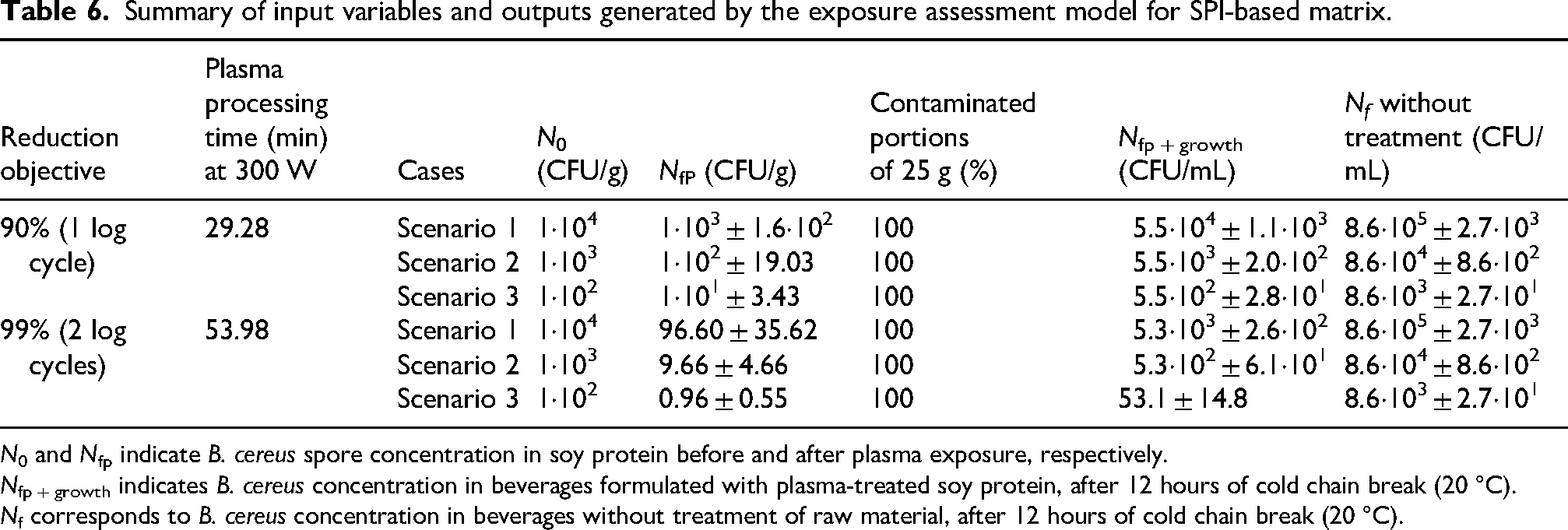
N0 and Nfp indicate B. cereus spore concentration in soy protein before and after plasma exposure, respectively.
Nfp + growth indicates B. cereus concentration in beverages formulated with plasma-treated soy protein, after 12 hours of cold chain break (20 °C).
Nf corresponds to B. cereus concentration in beverages without treatment of raw material, after 12 hours of cold chain break (20 °C).
A clear trend emerged from the simulations: the spore concentration in raw materials after plasma treatment (Nfp) decreased proportionally as the plasma reduction objective set increased and the initial B. cereus spore load (N0) decreased. However, across all evaluated scenarios, every portion of raw material required to formulate a single beverage unit remained contaminated.
While illness caused by B. cereus has occasionally been reported at lower concentrations, most documented foodborne outbreaks are associated with levels exceeding 5 log cycles (105 CFU/g or mL). Consequently, this threshold is generally considered as the infective dose (Allende et al., 2016; Berthold-Pluta et al., 2019; Kumari and Sarkar, 2016; Yang et al., 2023). Notably, despite 100% prevalence of contamination, the mean concentrations of B. cereus predicted by Monte Carlo simulations following a 12-h cold chain break at 20 °C (
Percentile analysis was performed under the worst-case initial contamination scenario (N0 = 104 CFU/g) and the minimum plasma reduction objective (1-log) (Table 7). The 50th percentile (median) reached 1.17 × 10⁴ CFU/mL for beverages prepared with soybean flour and 5.55 × 10⁴ CFU/mL for SPI-based beverages. At the 95th percentile, predicted concentrations reached 1.42 × 10⁴ CFU/mL and 7.55 × 10⁴ CFU/mL, respectively, indicating that 95% of the predicted values fall below these levels. These results reinforce that, even under the most unfavorable conditions evaluated, concentrations following a 12-h cold chain break do not reach the infective dose (105 CFU/mL). However, the predicted concentrations remained close to levels of concern, indicating that prolonged temperature abuse conditions could allow B. cereus to reach this dose response. Therefore, cold plasma may be most effective when integrated into a “hurdle technology” strategy. Similarly, other technologies such as high hydrostatic pressure (HHP) have been shown certain limitations when used as a standalone treatment: however, when combined with complementary preservation technologies, it becomes part of an effective hurdle strategy (Xia et al., 2022). In this context, plasma-based sanitization of raw materials should be considered as an additional step within integrated microbial control strategies. For instance, previous studies have combined plasma treatments with the application of a
Percentile values of predicted B. cereus concentrations in soy-based beverages (CFU/mL) for scenario 1 (N0 = 104 CFU/g in raw matter).

The plasma processing times required to achieve different spore reduction objectives in raw matter were also estimated (Tables 5 and 6). For soybean flour, a 1-log reduction (90% population decrease) required approximately 32 minutes of air plasma treatment at 300 W, while SPI reached the same in 29 minutes. While these durations are relatively long, they are comparable with traditional processes such as LTLT pasteurization (62.5 °C for 30 minutes), still used in the dairy and beverage industries (Lindsay et al., 2021), even though such treatments are not effective against bacterial spores. Considering to reach a 2-log reduction (99% population decrease) required longer processing times—99.85 minutes for soybean flour and 53.85 minutes for SPI—which may be impractical for industrial applications. Process optimization could be achieved by employing plasma systems operating with higher input power to enhance inactivation efficiency and reduce treatment times. Moreover, atmospheric-pressure plasma systems may facilitate scalability and industrial integration. Nevertheless, for powdered materials such as soybean flour or soy protein, appropriate reactor design is essential to avoid particle dispersion and ensure process stability.
Conclusions
While the present study demonstrates that synthetic air plasma inactivates B. cereus spores in both soybean flour and SPI, the extent of inactivation is highly matrix-dependent. The Weibull model provided an accurate fit for spore inactivation kinetics in both soy matrices, offering a reliable predictive tool. The development of this exposure assessment model represents a significant advancement over previous plasma studies, which often lacked a quantitative, risk-based component. Monte Carlo simulations revealed that while B. cereus remained present in all portions across hypothetical scenarios, plasma treatment consistently prevented the pathogen from reaching infective thresholds during a 12-hour cold chain break. By contrast, beverages prepared from untreated raw materials posed a higher risk, potentially exceeding the infective dose under elevated initial contamination levels. However, the predicted concentrations in beverages after plasma treatments remained close to levels of concern, suggesting that prolonged disruptions could lead B. cereus to approach the infective dose. Although cold plasma can be applied alone for the sanitization of raw materials used in beverage formulation, it may be more effective in enhancing food safety when integrated within a hurdle technology strategy, acting as a primary decontamination step. Finally, further research is needed to optimize plasma system design and processing parameters in order to reduce treatment times and translate cold plasma technology on site transformation of raw materials. Industrial exposure assessment is a powerful tool that complements traditional food safety systems. Its application enhances hazard identification, strengthens preventive controls, and ensures a higher level of protection against risks. Integrating exposure assessment into food safety management systems contributes to improved product safety, regulatory compliance, and operational efficiency.
Footnotes
Acknowledgments
This work was supported by MCIN/AEI/10.13039/501100011033, “ERDF A way of making Europe” and by the “European Union’’ [grants PID2023-149211OB-C32 and PRE-2021-098627]. The Instituto de Agroquímica y Tecnología de Alimentos-CSIC is an accredited Center of Excellence Severo Ochoa [CEX2021-001189-S], funded by MCIU/AEI/10.13039/501100011033.

Funding
The authors disclosed receipt of the following financial support for the research, authorship, and/or publication of this article: This work was supported by the MCIN/AEI/10.13039/501100011033, “ERDF A way of making Europe” and by the “European Union” (grant numbers PID2023-149211OB-C32, PRE-2021-098627).
Declaration of conflicting interests
The authors declared no potential conflicts of interest with respect to the research, authorship, and/or publication of this article.