




Abstract
Introduction
Motorcyclists are particularly vulnerable to injury when encountering large animals such as deer in the roadway. The frequency of these events, factors associated with their occurrence, and the extent of injuries sustained from such crashes are not yet well described.
Methods
A review of 10 years (2012–2021) of statewide motorcycle crash reports from a single state with a large deer population was performed to ascertain the frequency of deer-associated motorcycle crashes. Environmental and roadway conditions, as well as motorcyclist age, gender, and helmet usage, were identified to determine if associations exist with the severity of injuries sustained.
Results
Statewide, 8.5% of reported motorcycle crashes involved deer. Excluding the two most densely populated counties, this rose to 10.7%, with 24.1% of crashes occurring during non-daylight hours being deer related. Factors associated with increased frequency of more severe injury and death included not wearing a helmet, female gender, and rural county crash location. Death and severe injuries were reported in more than twice as many riders who were unhelmeted compared to those wearing helmets (36.1 vs 16.6%; p < 0.01).
Conclusion
In a single midwestern state, deer represent a significant danger to motorcyclists, especially in rural settings during non-daylight hours. A cautious approach to riding during this time, utilizing available safety precautions to minimize risk of severe injury and death, and further exploration of viable interventions to reduce the likelihood of these occurrences should be considered.
Introduction
Motorcyclists are at an increased risk of significant injury and death compared to passengers of enclosed four-wheel vehicles across a range of geographical settings.1,2 Despite safe driving behaviors, improved technology, and enhanced safety gear, there remains an inherent risk given the vulnerable and relatively unprotected nature of motorcycle riding. In 2021, per vehicle mile traveled in the United States, motorcyclists were noted to be 4 and 7 times as likely to suffer injury and 24 and 40 times as likely to be involved in fatal crashes compared to occupants of passenger cars and light trucks, respectively. 2 While motorcycles make up 3% of registered vehicles and compose just below 1% of the total vehicle miles traveled throughout the United States, they make up 14% of the annual fatalities among all motorized vehicles. 2
Even experienced motorcycle riders utilizing appropriate methods of risk mitigation remain at risk of accidents and serious injury. The majority of motorcycle crashes involve collisions or near misses with other motorized vehicles rather than single-vehicle accidents, with causation more commonly being a result of non-motorcyclist error.3,4 While single-vehicle crashes are less common, higher fatality rates in these accidents have been noted. 3 Factors related to single-vehicle motorcycle accidents and the increased severity of injury associated with these events are multiple. These include non-helmet use, excessive speed, alcohol and medication consumption, dry roads, advanced age, crashes occurring on roads located in the rural setting, and striking stationary roadside objects (ie, trees, poles).4–6 An additional and often unexpected contributing factor is the presence of animals in the roadway, with frequency strongly influenced by the location in which motorcyclists are riding.4,7
Approximately 1–2 million motorized vehicle crashes involving large animals are estimated to occur annually throughout the United States, the vast majority involving deer. 8 Given that the overwhelming majority of driven miles in the United States are from cars and trucks, it is not surprising that less than 5% of animal-related crashes involve human injury. 9 While the risk of injury is low in enclosed vehicles, the relative vulnerability inherent to motorcycle riding is associated with a disproportionately higher risk of significant injuries and even death. Twenty-eight percent of fatalities among vehicles striking or avoiding animals in the road occur among motorcyclists. 10
Specific data regarding the frequency of nonfatal motorcycle crashes involving deer and other large animals is not well reported. Remarkable differences would be expected to exist in the risk of these events occurring from state to state as there remains large variability in herd size and density of the human population, as well as the number of motorcyclists. A greater understanding of the scope of this occurrence and the recognition of significant dangers for motorcycle riding in particular geographical regions may lead to additional measures aimed at both educating motorcyclists and encouraging the development and implementation of effective interventions to reduce the likelihood of these encounters.
The purpose of the following study is two-fold. First, we aim to describe the frequency of motorcycle-involved deer crash occurrence in relation to non-deer-related motorcycle accidents over a 10-year time period in a single midwestern state that possesses a large deer population. Second, for those crashes in which deer were involved, we aim to convey the perceived severity of injuries reported by responding personnel and identify rider characteristics as well as road and environmental conditions associated with injuries of varying severity.
Methods
A search of all Michigan state police traffic crash reports (michigancrashfacts.org) was performed to ascertain specific information regarding motorcycle crashes involving deer over a 10-year study period (January 2012 to December 2021). This publicly accessible database is maintained by the Michigan State Police Office of Highway Safety Planning and the University of Michigan Transportation Research Institute (UMTRI) and includes all motor vehicle crashes in which a traffic report was generated throughout the state of Michigan.
To describe the frequency of deer-related crashes that occurred in relationship to time and location, database search criteria were used, including deer-related and non-deer-related motorcycle crashes, natural lighting conditions at the time of the crashes (daylight, dusk, dawn, or night), and the specific county in which the crash occurred. The state of Michigan is made up of 96 counties, with the two most heavily populated counties (Wayne and Oakland) making up just 4.2% of the total land mass of the state and 30.4% of the state's total population. 11 Given the highly urbanized nature of these two counties and relatively low deer population, study authors elected to report crash frequency for both the entire state as well as the entire state excluding these two most densely populated counties. Data was described in terms of individual crashes regardless of number of individuals on a single motorcycle.
For the portion of the study in which a specific variable was identified to ascertain association with severity of injuries among deer-related motorcycle crashes, individual crash reports were reviewed from crashes occurring over 9 years, from January 2012 to December 2020. Information recorded included age; gender; helmet use; conditions reported at the time of the crashes, including posted speed limit, weather, time, season (winter, spring, summer, fall), county density (urban or rural), and lighting condition (dawn, dusk, daylight, dark); and the reported severity of the injuries by the on-site responding police officer. Should two individuals be on a single motorcycle, two crash reports were recorded and included in the data analysis.
Per Michigan state police traffic accident reporting guidelines, injuries in the crash report were categorized as “no injury” (no indications of injury), “possible injury” (any possible injury that is reported or claimed), “minor injury” (any minor injury that is present to others at the scene), “severe injury” (any injury other than fatal, which prevents normal activities and generally requires hospitalization), or “death.” Counties were classified as urban if containing an urbanized area of at least 50,000 people or in an area adjacent to an urbanized area that has a substantial commuting interchange with a city of greater than 50,000 people.
This study was approved by the Sparrow Health System Institutional Review Board prior to data collection. A review of cases for statistical analysis was performed on largely (ie, over 90%) completed crash reports. All study data points were entered into Microsoft Excel and SPSS software for ease of data interpretation and statistical analysis.
Study outcomes were reported as deer-motorcycle crash occurrences. Initially, chi-square analyses were performed to determine the significance of difference between deer and non-deer-related crash occurrence in relationship to lighting conditions as well as high population density and less populated county location. For the second study portion, after generating a series of distributional graphs using cleaned data, a series of chi-square analyses was performed to examine for the initial significance of crosstabulation differences between the primary level of injury and crash subgroup characteristics (eg, whether helmet was worn, light at time of incident, etc). Next, a series of Pearson r bivariate correlations was performed to examine the degree to which selected study measures were correlated. These results were used to evaluate which study measures to include into final multivariate regression models.
For the final controlled analyses, a multivariate multinomial regression analysis was performed using most selected study measures possibly predictive of final severity-level outcomes. Using the reference category of “no injury,” the multivariate model results (ie, predictive significance of each potential crash influence) were determined generating odds ratios and confidence intervals observing a p-value of less than 0.05 to indicate statistical significance. The null hypothesis was that no statistically significant predictors of overall severity injury level would be present.
Results
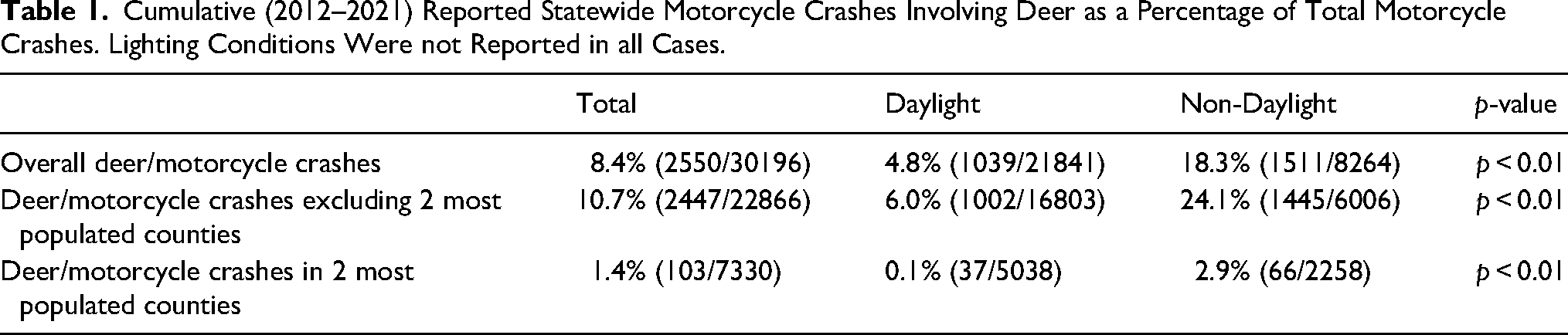
Over the 10-year study period, 30,196 individual motorcycle crashes occurred, 30,105 of which had lighting conditions reported. Overall, 8.5% of these crashes involved deer. The two most populated counties had a lower rate of deer-associated motorcycle crashes, 1.4% (103/7296), compared to 10.7% (2447/22,809) in all other counties combined (p < 0.01). When excluding the 2 most populated counties, 24.1% of all motorcycle crashes occurring during non-daylight lighting conditions were deer related (Table 1).
Cumulative (2012–2021) Reported Statewide Motorcycle Crashes Involving Deer as a Percentage of Total Motorcycle Crashes. Lighting Conditions Were not Reported in all Cases.
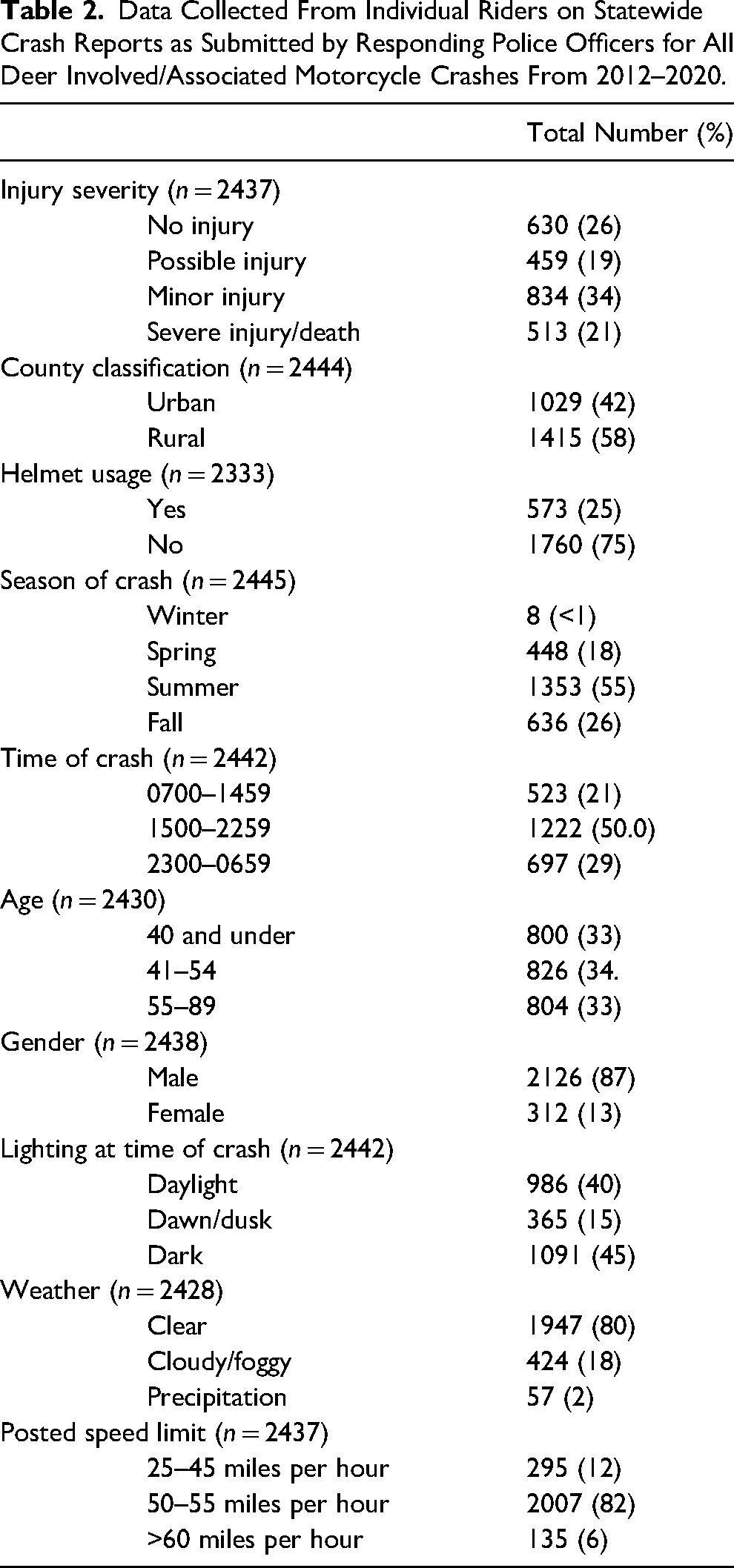
When evaluating individual crash reports and factors associated with increased severity of injury over the 9-year study period, there were 2445 motorcyclists and passengers involved in crashes involving deer. Of those crashes, the categorization of injury was found to be severe and/or resulting in death in 509 (20.8%) of the overall sample cases (Table 2). Overall, 573 (23.4%) crashes involved motorcyclists not wearing helmets per available crash data. In 115 (4.7%) of crashes, the presence of a helmet being worn was unknown. The rate of severe injury and death was over twice the rate of those not wearing helmets (n = 206, (36.1%) versus n = 292 (16.6%), p < 0.01). A total of 61 sample crash deaths occurred over the 9-year period, which represented 2.3% of all individuals in crashes recorded. The frequency of death in deer-involved motorcycle collisions was reported more frequently in those not wearing helmets compared to those wearing helmets [n = 37, (6.5%) versus n = 21(1.2%), (p < 0.01)]. In three crashes resulting in death, helmet usage was unknown.
Data Collected From Individual Riders on Statewide Crash Reports as Submitted by Responding Police Officers for All Deer Involved/Associated Motorcycle Crashes From 2012–2020.
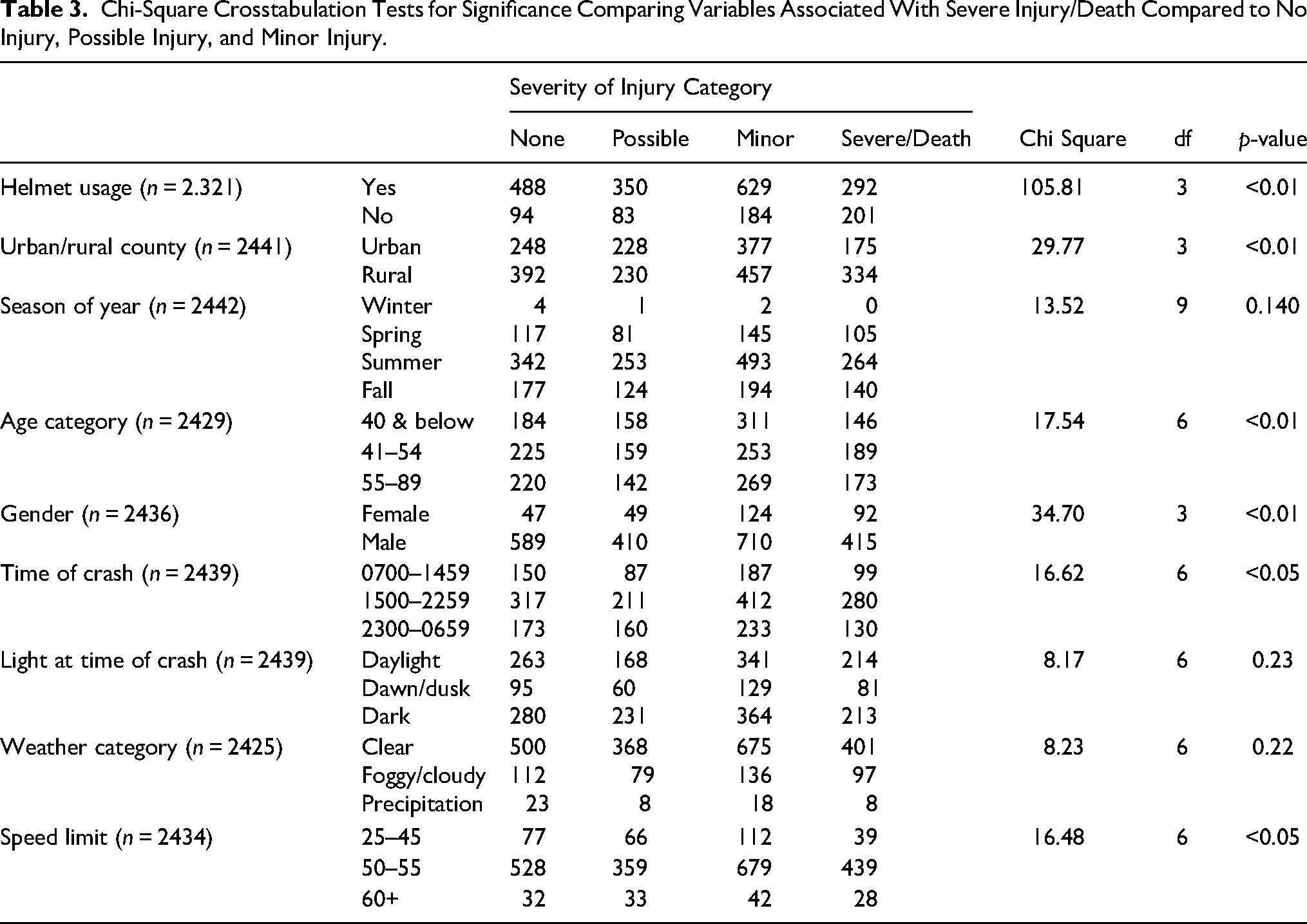
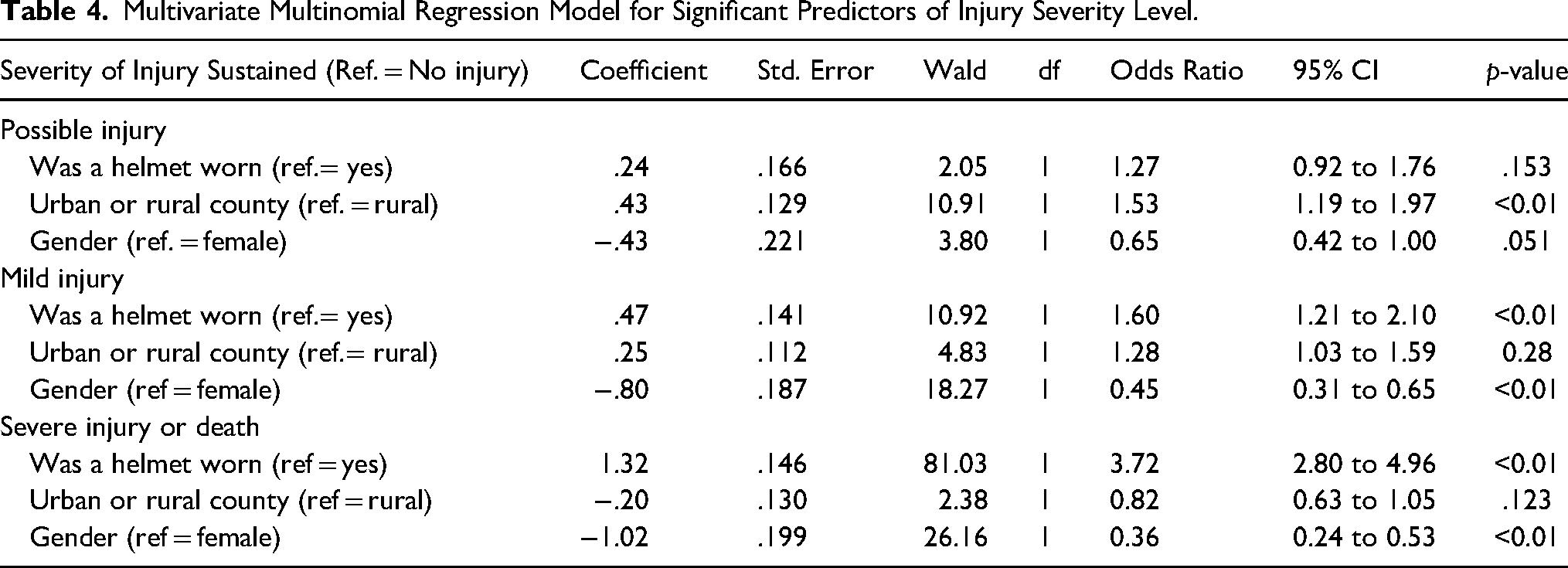
In addition to helmet usage, variables associated with higher rates of injury severity included accidents occurring in rural counties, female gender, timing of accidents occurring between 1500–2259 h, and a posted speed limit at the crash site of > 50 miles per hour (Table 3). When controlling for potential predictive influences on severity level category using multinomial regression models, it was found that not wearing a helmet and female gender was associated with a greater frequency of severe and deadly injuries occurring. Among those sustaining any reported injury, increasing injury severity occurred among those involved in collisions in rural counties (Table 4).
Chi-Square Crosstabulation Tests for Significance Comparing Variables Associated With Severe Injury/Death Compared to No Injury, Possible Injury, and Minor Injury.
Multivariate Multinomial Regression Model for Significant Predictors of Injury Severity Level.
Discussion
Determining causes of vehicular crashes is challenging and often multifactorial including driver and other motorist behaviors, road conditions, and environmental factors. We attempted to determine at a statewide level how a large deer population impacts the safety of motorcyclists. Additionally, we set out to identify variables associated with greater injury severity sustained in crashes when they occur. Our study suggests a predilection for deer-related motorcycle crashes occurring while riding in less densely populated counties during non-daylight hours. Nearly 1 in 4 motorcycle crashes occurring during dawn, dusk, and nighttime hours outside of the 2 most densely populated counties in Michigan are deer related. When crashes do occur, risk factors associated with more significant injury and death are multiple, including female gender and location of crashes (rural rather than urban) as well as motorcyclist behavior (no helmet usage).
Deer-associated motorcycle collision frequency, as well as deer population estimates, are not collected at a national level, leaving the true risk of such events unclear. Estimates utilizing various unique state-specific data collection sources place Michigan’s deer population as the second highest in the United States (second to Texas) at approximately 2 million. 12 The impact of deer and human population density differences between states results in large regional variability as reported by insurance carriers with regards to the risk of deer-related motor vehicle crash occurrence. This ranges from a high of 1 in 37 drivers in West Virginia filing a claim related to animal-related vehicular damage annually to a low of 1 in 770 drivers in the state of Nevada. 13 Results demonstrated in our study may be pertinent and generalizable to other states with sizeable deer populations that more frequently encounter motorcyclists.
There is a limited body of literature examining factors associated with deer-related motorcycle crashes, as well as descriptions of injuries that occur from these events. A retrospective review of motorcycle collisions involving white-tailed deer was performed by Nelson et al at a single trauma center in northern Wisconsin in which 55 patients were identified over a 10-year period. Among these patients, 71% were not wearing helmets, with all 7 deaths occurring in this non-helmeted population. Chest, head, and orthopedic injuries predominated, with 38% suffering from head injuries of which 90% were non-helmeted. Over half of all crashes occurred between 1800 and 2200 h, with June and July being peak months in which these events occurred. 14 A study in New York, a state in which helmets are mandatory, found fewer head injuries (15%) with more frequently identified thoracic (31%) and orthopedic injuries (31%), suggesting an association of helmet use in reducing head injury rates. 15
A single-center study in northern Minnesota reviewed 57 patients involved in deer-related motorcycle collisions over a 10-year study period. Again, a predilection was noted toward non-daytime accidents, with 80% of crashes occurring between the hours of 1700 and 0600. In contrast to previous studies, however, no association was found between higher injury severity scores (ISS) or head abbreviated injury scale (AIS) among the 73% of individuals who were not helmeted. 7 Utilizing a search of three consecutive years of statewide crash reporting database records in North Dakota, it was found that 6.3% (48 of 766) of motorcycle crashes were related to animal collisions, with 93% of these occurring on roads considered to be “rural.” While rates of crashes involving animals were consistent with our study, mortality rates were noted to be higher at 8%, with 67% of crashes occurring between 1800 and 0600 h. 16
Motor vehicle accidents involving deer occur with greater frequency during fall months in the midwestern United States associated with increased deer activity and movement during deer rutting season. 17 This peak overlaps, to some extent, with deer hunting season when deer behavior often becomes more erratic. One may speculate that a similar seasonal increase in motorcycle-related deer collisions was not seen in our study due to fewer motorcyclists riding during these colder months. A greater occurrence of motorcycle deer collisions occurring during non-daylight hours in our study, however, was found to be consistent with that reported in previous studies.7,14,16 The crepuscular nature of deer creates a particularly high-risk time for motorcyclists with increased deer activity around both sunrise and sunset coinciding with decreased visibility. When assessing all roadway vehicles deer collisions, Hothorn et al found a nearly 10 times greater likelihood of deer-related accidents occurring during non-daylight compared to daylight conditions. 18
In our review of variables associated with higher rates of severe injury and death, the use of helmets was found to be of greatest significance. Irrespective of the mechanism of motorcycle accidents, a large body of evidence supports their effectiveness. A Cochrane database review found that helmet use reduced the risk of death by 42% and head injury by 69% among patients presenting to trauma centers following motorcycle crashess. 19 An opportunity to evaluate the impact of helmet use occurred following Michigan's mandatory helmet law repeal in 2012 that allowed individual motorcyclists 21 years of age and older to ride without helmets. Consistently, approximately 25% of motorcyclists have been reported as not using helmets since this transition. 20 In the 12 months following the repeal of the mandatory helmet law, a 14% rise in the rate of head injuries was noted among hospitalized motorcyclists statewide. 21 A large single trauma center in western Michigan identified a 1.4-fold increase in the rate of traumatic brain injuries occurring in the 3 years following the repeal. Unhelmeted motorcyclists were noted to have a 1.7-fold risk of moderate to severe brain injury compared to their helmeted counterparts. 22 The unique nature of deer-related collisions, in which the roadway hazard is often of a lesser size than other roadway objects that might be directly impacted, such as cars and trucks, might suggest a lesser protective effect of helmets. Our study found, however, that unhelmeted motorcyclists experienced a significantly increased frequency of severe injury and death, independent of other measured variables, compared to those wearing helmets.
A false sense of security may occur in individuals riding in the low-traffic-density conditions typically found in rural settings where vehicle-related crashes would be thought to be less likely to occur. Greater awareness of the risk of deer-motorcycle conditions during non-daylight hours when deer activity is at its peak should be considered. 23 Unfortunately, motorcycle deer collisions occurring during this time period, off of major freeways, and in a rural setting have been found to directly correspond to circumstances where helmets are less frequently used. 20 Injuries occurring as a result of collisions in the rural setting may be susceptible to less favorable outcomes. Longer response times from prehospital medical providers, greater distances to emergency departments and dedicated trauma centers, and lack of cell phone coverage are circumstances unique to rural collision sites that may impact timely patient care.
A greater risk of severe injury and death was noted in women who were involved in deer-related motorcycle collisions in our study. While gender-associated injury severity has not been previously reported in deer-related motorcycle collisions, prior studies have found women motorcycle riders overall to be at a lower risk of severe injury and death compared to their male counterparts.24,25 Conclusions drawn from our results should be made cautiously, however. The injury severity among single riders on motorcycles and individuals carrying both a rider (driver) and passenger was not differentiated in our study. While women make up a minority of motorcycle riders, they make up a large majority of motorcycle passengers. 26 Data is conflicting regarding the severity of injury differences that occur among motorcycle riders and passengers involved in the same accident, with contributing influences relating to the extent of injury multifactorial.27,28
Strategies for motorcycle riders to reduce the likelihood of deer-related collision and injury should be considered as well. A staggered riding pattern for bikers traveling in a group is suggested so that multiple individuals are not injured due to a single deer encounter. 29 Should a deer present in the roadway with inadequate time to come to a full stop, it is recommended to swerve in the opposite direction the deer was heading and slow down. This evasive maneuver may lead to decreased rates of significant injury. 30 This recommendation contrasts with that provided to drivers of enclosed vehicles in which swerving to avoid the deer is generally considered ill-advised and places the driver at greater risk of striking other cars or immobile roadside structures.
Efforts to reduce the likelihood of animal-related collisions among all roadway vehicles remain challenging, with multiple modalities considered but many without clear evidence supporting their effectiveness. These include efforts to alter driver behaviors (warning signs, speed reduction zones, vehicular warning systems) and animal-focused interventions (deer whistles, roadside reflectors, odor repellents, wildlife crossings above and below roadways, and fence barriers).8,31 A combination of roadway fencing built in conjunction with wildlife overpasses or underpasses has demonstrated effectiveness in reducing the frequency of collisions among white-tailed deer in high-risk locations.32,33 Roadside animal detection systems using infrared, thermal, and motion-activated sensors have been successful in alerting drivers through flashing warning signs when large animals are a potential threat near the roadside.33,34 Vehicle-based infrared detectors have shown promising results in identifying deer in the setting of limited visibility yet are not routinely available outside of the high-end car market. Artificial intelligence using machine and deep-space learning to identify objects near roadways is a promising development that may lead to greater safety for both drivers and animals alike. 35
Deer populations are expanding in many areas of the United States. A decrease in the number of hunters and total deer taken has been widely recognized as a contributor to an overall increase in the deer herd size in the state of Michigan. 36 Efforts have been undertaken to encourage a greater number of deer taken by hunters, specifically female deer, during traditional and expanded hunting seasons. 37 The practice of wildlife culling, often by way of additional “harvesting” time periods, has been utilized by wildlife specialists in regions where deer overpopulation is considered to be both harmful to their environment and unsustainable. This practice is felt to promote the long-term viability and health of the deer herd with a potential additional benefit of a decreased occurrence of vehicular animal collisions. 38
Study limitations include a lack of defining features of what constitutes possible, minor, and severe injury patterns. Injury stratification was performed by reporting police officers who may have limited medical knowledge, potentially leading to a somewhat subjective definition of injury pattern types. This study did not review hospital records for severely injured motorcyclists or follow up on patients whose injuries were classified as nonsevere. This may have resulted in an underestimation in the number of crashes that would have more appropriately been categorized as severe injury or death cases.Recorded road and environmental conditions as well as motorcyclist description of events influences police reports, including the presence of deer, are susceptible to inaccuracies and bias. The dataset includes all crashes occurring on public roadways that result in fatal or nonfatal injuries or if property damage exceeds $1000. Crashes in a rural setting may be less likely to be reported, especially if injuries are nonexistent or minor, or if motorcycle damage does not exceed $1000. This may have resulted in our study reporting a falsely high percentage of all crashes considered of higher severity. Finally, controlled statistical analysis of all conceivable variable permutation combinations was not possible due to the varied frequency found across numerous multivariate cells. This finding represents the complexity of studying the numerous factors likely contributing to such crashes. Incomplete data reporting is an area of concern as well, with the status of helmet use being unknown in 4.7% of reported crashes.
Conclusions
Deer-related motorcycle collisions are a significant source of potential injury in states with high deer populations. Traveling during non-daylight hours in non-urban settings should be regarded as a period when this risk is greatest. Awareness of one's surroundings, as well as other methods of risk mitigation including, but not limited to, the use of a helmet, should be strongly considered. Given the rather extensive scope of this problem, further evaluation, and development of novel methods to reduce the likelihood of these encounters should be considered.
Footnotes
Author Contribution(s)
Declaration of Conflicting Interests
The author(s) declared no potential conflicts of interest with respect to the research, authorship, and/or publication of this article.
Funding
The author(s) received no financial support for the research, authorship, and/or publication of this article.