






Abstract
Objective
To examine differences in on-the-snow ski behavior between helmet wearers and nonwearers.
Methods
The data were collected using a survey. Several tourist agencies helped in administrating the survey to the skiers during the 2008–2009 and 2009–2010 seasons. The survey consisted of multiple-choice questions. The subjects were asked to choose answers most suitable for their skiing style and preferred skiing technique, volume of off-piste skiing, readiness to use time measuring systems on the slopes, and group-skiing preferences, such as leading the group, beside the group, away from the group, etc. The Risk Index was then calculated for each subject.
Results
The answers of 710 skiers (mean age 35.5, range 16–81 years) were analyzed. The predictive power for risk-taking behavior was tested for gender, age, educational level, level of skiing, years of skiing, and helmet usage. Younger age, male gender, higher skiing level, and helmet usage were used as independent predictors for the overall Risk Index (Power [1-β err prob] = 0.942). Significantly higher risk was assessed for the male helmet wearers while the results were not significant for the female helmet wearers. The male occasional helmet wearers were found to be the most prone to risky behavior. In female nonhelmet wearers, there was a significant decrease in risk-taking behavior with age but this was not true for female helmet wearers.
Conclusions
For males under 35 years of age, helmet use is one of the factors influencing risk-taking on the slopes. This is demonstrated for occasional helmet wearers in particular.
Keywords
Introduction
Of all ski injuries, the most dangerous occurring on the slopes are of the head. Therefore, it is understandable that wearing a ski helmet is widely recommended by many experts as effective protection against head injuries. 1 –4 Moreover, some experts have suggested that wearing a ski helmet on the slopes 5 should be mandatory, especially for children and juvenile skiers. 6
The amount of protection against traumatic brain injury provided by a ski helmet diminishes at higher speeds on an open slope. 7 It is also known that riskier skiing activities, usually occurring in terrain parks, are related to increasing risk of head injury, regardless of helmet use. 8
For the above-mentioned reasons, one may speculate that any skiing activity in which skiers push themselves beyond their abilities might lead to higher rates of injuries despite helmet usage. 9 It has also been observed that wearing a ski helmet does not reduce fatalities on the slopes, since 35% of skiers who have died were wearing a helmet, which is a much higher rate than the rate of helmet usage among the general population of skiers. 10 This statistic raises the following question: do helmet wearers take more risk on the slopes by overestimating the protection power of the ski helmet and, consequently, does that risky behavior decrease the protective characteristics of the ski helmet?
Some researchers introduced the term “risk compensation theory” and have tried to investigate its presence in helmeted skiers.11,12 It refers to the observation that some people tend to adjust their behavior in response to perceived changes in risk—for example, behaving less cautiously in situations where they feel “safer” or more protected. The findings of those studies were limited, since individual perception and psychological profile play a part in determining whether one would perceive his/her style of skiing as risky. That is why self-reported risk taking may not be a good indicator of actual risk behavior. In our opinion, a single direct question asking “Do you take more risk?” does not provide the best assessment of risky behavior. Following that reasoning, we have opted to test the risk compensation hypothesis by introducing more objective measures such as on-site exploration of skier behavior.
The objective of this study was to examine the differences in on-the-snow ski behavior between helmet wearers and nonwearers. The second goal was to determine the percentage of ski helmet usage and to explore reasons that contribute to the decision whether or not to wear a helmet.
Methods
Subjects
Data were collected using a survey administered to Croatian skiers during the 2008–2009 and 2009–2010 seasons with the help of several tourist agencies. The survey showed acceptable test-retest reliability across 30 days on a pilot sample of 50 skiers (r = 0.87, P < .001). The sample size calculations showed that, for the Power of 99% and Type I statistical error of 0.001, the sample in the control group (without helmets) should be over 393 and, in the experimental group (with helmets), over 192.
The subjects were not informed about the purpose of the study but were told that the survey aims to explore the skiing preferences and skiing style of Croatian skiers; helmet questions were placed at the end of the survey. The first part of the survey consisted of 5 multiple-choice questions that were filled in by all skiers. The participants were asked to choose answers most suitable for their skiing style regarding their preferred skiing technique, preferences regarding off-piste skiing, readiness to use time-measuring systems, and their behavior around a group of skiers (prefer skiing alone, leading the group, beside the group, and similar inquiries). Only consistent or occasional helmet wearers filled in the second part, consisting of 3 items. That part was comprised of questions regarding the reason for choosing a helmet, skiing behavior with a helmet, and questions about the feelings related to wearing a helmet. The general descriptive data of the sample like age, gender, level of skiing technique, number of skiing seasons in the past, as well as their level of education were also noted.
Data Management
Three independent judges from the Croatian Association of Snow Sports Instructors (HZUTS), all members of the HZUTS Educational and Scientific Committee (2 of them also being sports medicine MDs), independently ranked the answers for each item according to the risk involved. The reliability of the judges was calculated by means of interclass coefficient of correlation (ICC) and the result was more than satisfactory (ICC = 0.93). Numeric values representing the level of risk-taking behavior in each question were then attributed to the ranked answers, and those values were rated on the Risk Index (ranging from 6 [low] to 21 [high]).
The obtained data were analyzed by Statistica (Tulsa, OK, USA) for Windows 9.0. The Kolmogorov-Smirnoff test showed that the distribution of the data did not significantly differ from a normal distribution, and we proceeded with the parametric statistical techniques. The student t test for independent samples and analysis of variance (ANOVA) were used to search for differences between the groups, and the multiple regression analysis was used to identify factors that might have the predictive power for the Risk Indices. The P-value significance threshold was set at P < .05.
Results
The total number of subjects was 710, with average age of 35.5 ± 11.56 (range of 16–81 years; male = 494, female = 216). The sampled skiers were well educated: 0.88% finished only elementary school, 32.39% high school, 54.08% had a university degree, and 12.25% had a Master of Science or PhD degree. This sample is representative of the Croatian skiing population, which usually comes from higher socio-economic backgrounds. The mean number of skiing seasons was 18.26 ± 7.9, while their self-reported skiing knowledge average was 4.50 ± 1.52 on a scale from 1 (very poor or only 1 season of skiing) to 7 (ski teacher or ski demonstrator).
Out of the total sample (N = 710), 48% of the subjects did not wear a helmet, 15% wore one occasionally, and 37% reported that they always wore a helmet. No statistically significant differences were observed in helmet usage between the genders (Figure 1).
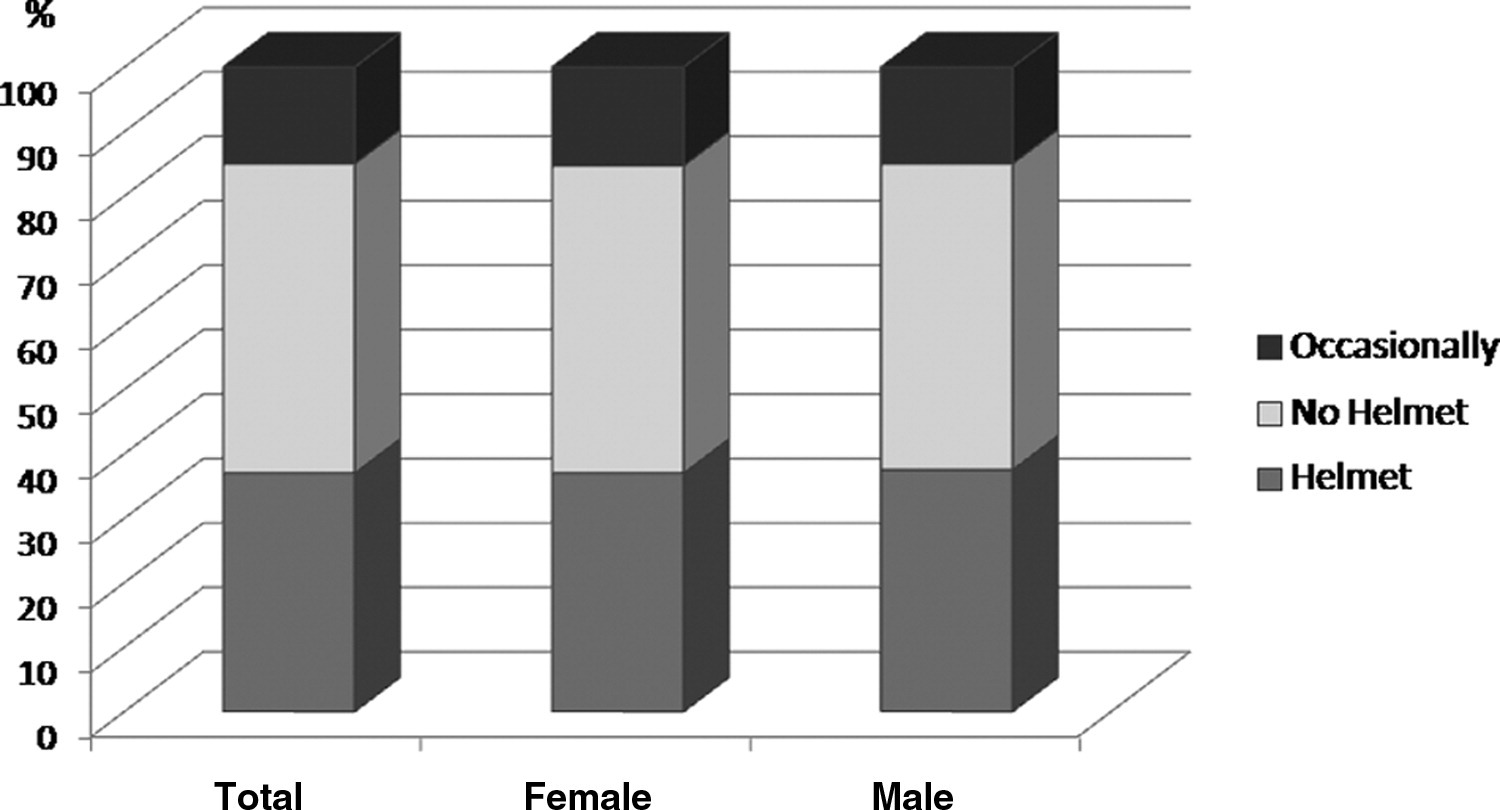
Percentage of helmet wearers, nonwearers, and occasional wearers according to gender.
The Risk Indices were then calculated. Prior to the calculation of the Risk Indices, the inter-rater reliability of the judges who evaluated the riskiness in answers was calculated by means of interclass coefficient of correlation and was more than satisfactory (ICC = 0.93). The Risk Index results showed a higher risk assessment in male helmet wearers that was not seen in the female population (13.43 ± 2.74 vs 12.43 ± 2.56; P < .001) (Table 1). When the sample was divided into 3 groups according to helmet usage, the occasional helmet wearers were found to be the most prone to risky behavior on the slopes (Figure 2).
The results of the Student t tests for independent samples comparing Risk Index between the helmet wearers and nonwearers (the occasional helmet wearers were added to the helmet wearers)
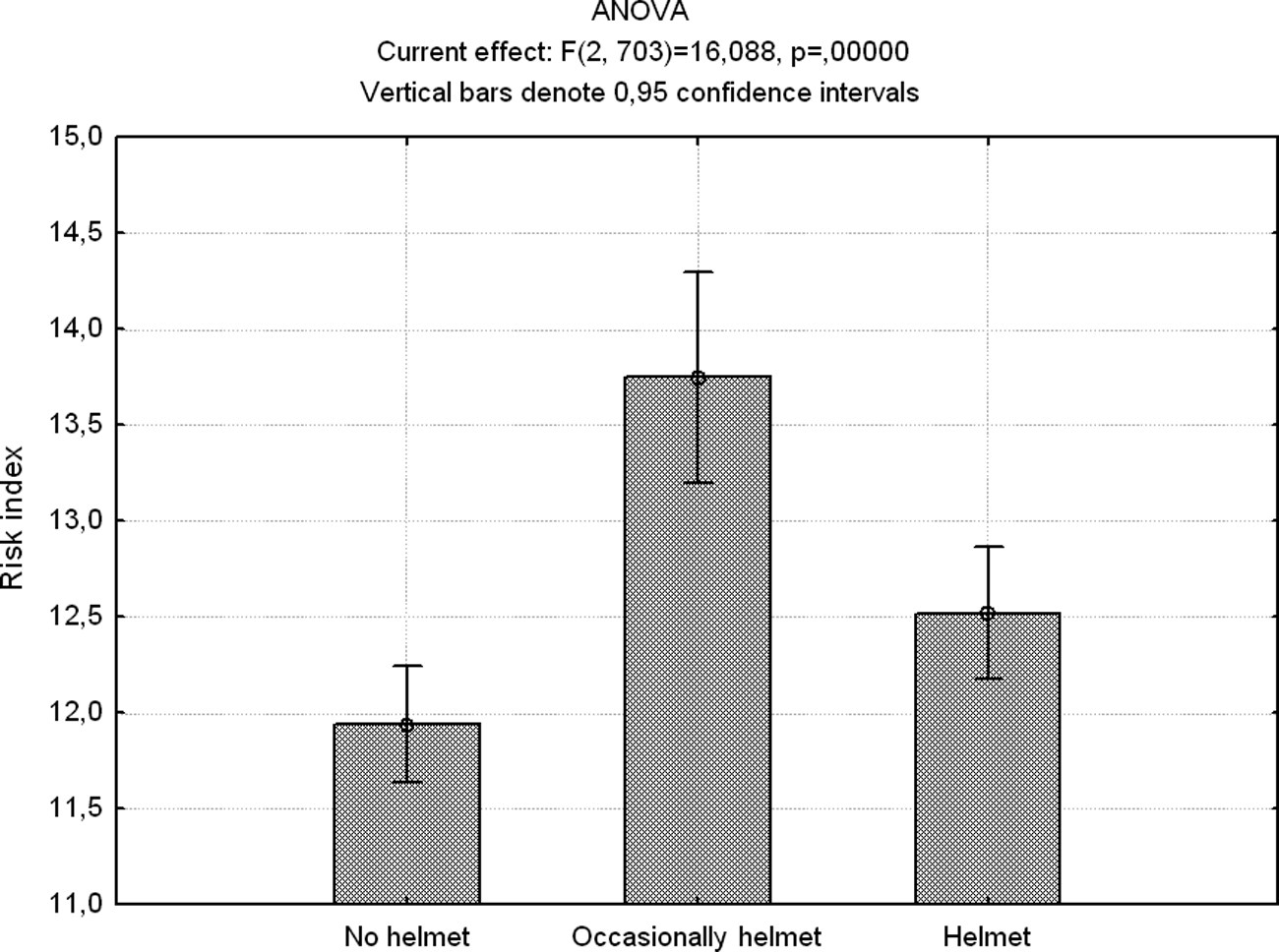
ANOVA results for the whole sample (P = .108) and post-hoc test among the groups (P < .05).
The predictive power for Risk Index was tested for several variables, including gender, age, educational level, level of skiing, years of skiing, and helmet usage. The regression analysis identified younger age, male gender, higher skiing level, and helmet usage as independent predictors for the overall Risk Index (effect size f2 = 0.02; Power [1- β err prob] = 0.942).
The more skilled skiers took more risk (r = .41, P < .001) but, interestingly, no significant negative correlation was found between skiing skills and experience and the helmet usage (r = −.08 and r = −.17 respectively). Based on that result, we may conclude that helmets are being used similarly by experienced and nonexperienced skiers, which excludes the possibility that the differences in Risk Indices between helmet wearers and nonwearers originates from better skiing skills in helmeted skiers.
In male helmeted skiers, the highest Risk Index was found in the age group below 35 years of age. One interesting observation was the lack of decline in Risk Index with age in helmeted female skiers, meaning older female skiers with helmets continued to take more risks on the slopes than their nonhelmeted counterparts (Figure 3a and 3b). That was not the case in male skiers (Figure 3c and 3d).
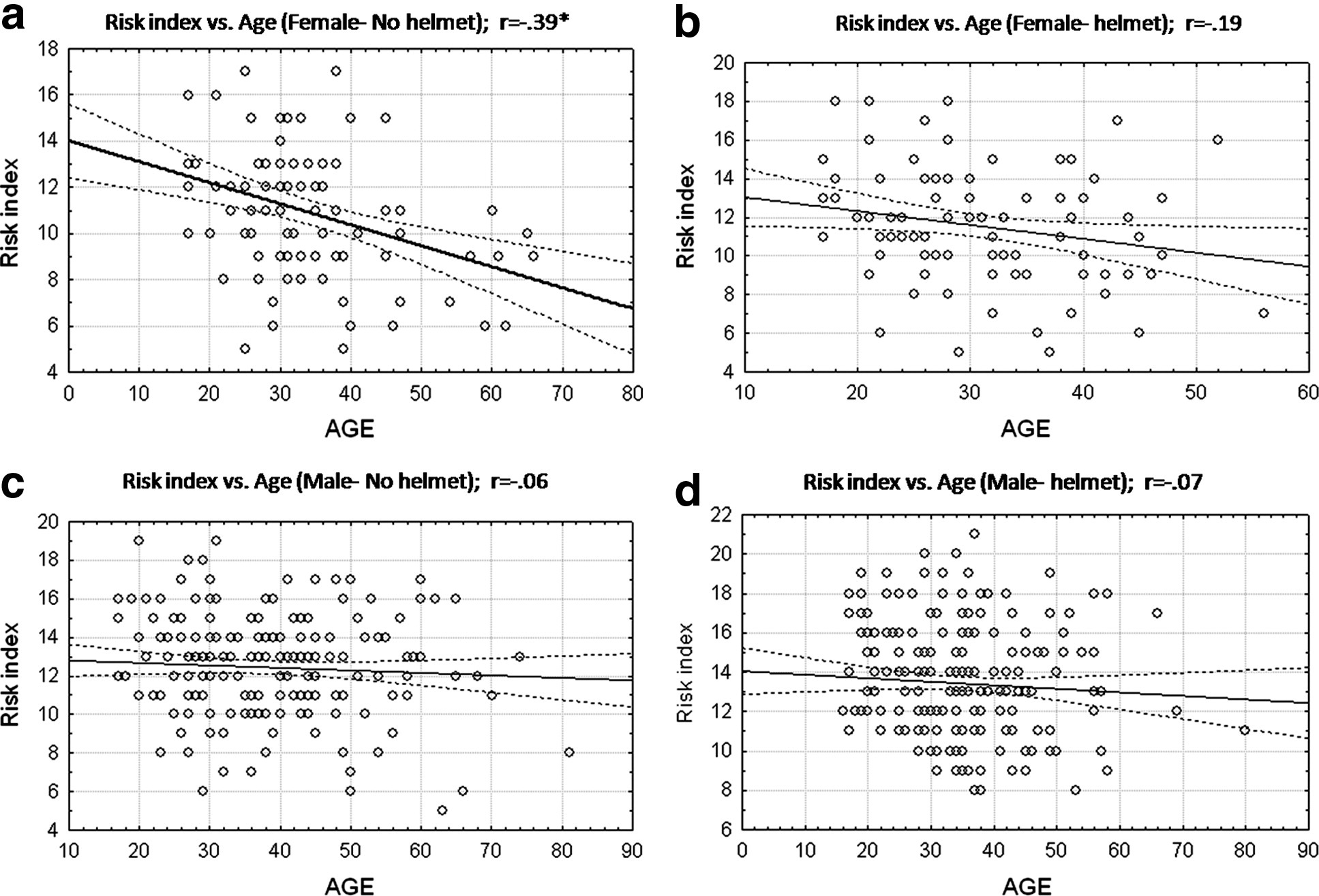
(a and b) Changes in Risk Index with age in female skiers. (c and d) Changes in Risk Index with age in male skiers.
As expected, there were significant variations in answers to individual items according to sex and age. Male skiers wearing helmets were significantly more prone to “carving” technique no matter the conditions of the slope and number of other skiers.
Younger male skiers with helmets expressed significantly higher interest in using the slopes with time-measuring systems as well as the possibility of jumping from moguls on the slope. Men under 35 years reported more often that they like to ski alone or lead the group and resented skiing in a group by following someone. Twenty-four percent of the helmet wearers reported the feeling of increased security and faster skiing with helmet usage and 75% claimed they skied the same as without a helmet. Thirty-six percent of subjects perceived skiing with a helmet as a lower death risk, and 27% reported reduced hearing abilities as well as visual impairment while wearing a helmet (10%).
Discussion
The main findings of this study indicate that the overall Risk Index is higher in helmeted skiers than nonhelmeted skiers. The population that contributes the most to the overall Risk Index value is male helmet wearers, signifying that male helmet wearers take more risks while skiing than others. It was previously known that male skiers generally take more risks than females on the slope
Our findings are not in concordance with the study of Scott et al 12 who concluded that there was no evidence of risk compensation among helmet wearers. The difference in results may lay in the design since, in their study, the amount of risk taking was self-reported whereas, in our study, it was estimated from a series of items analyzing the skiing style of skiers and was not self-reported. The skiers were not asked directly whether they took more or less risks but, instead, they were asked to present their habits and ski behavior in a few common situations on the slope, such as whether they were prone to “carving” technique regardless of snow conditions and the number of people on the slope, whether they exhibit higher interest for time-measuring devices, and whether they like to ski alone, with a group or, in some cases, only if they lead the group.
A recently published retrospective epidemiological study that involved more than 20 000 injured skiers (data was collected from 3 ski resorts in the western United States from 2000–2005 comparing head, neck, and face injuries between the helmet and nonhelmet users) reported that a ski helmet may provide limited protection from head injuries among youngsters involved in falls and collisions, but it appeared to offer little or no protection to people over the age of 25. Those facts might be explained by our findings indicating that the adult male population under the age of 35 exhibits the riskiest behavior. The subjects in our sample were over the age of 16 (range 16–81) and the riskiest behavior was demonstrated in younger male helmeted skiers, precisely the population of skiers more likely to sustain head injuries on the slope according to the above-mentioned study. 14
Furthermore, one of the interesting observations in our study was the lack of decline in Risk Index with age in helmeted female skiers (Figure 2a and 2b). This indicates that older helmeted female skiers continued to take more risk on the slopes than their nonhelmeted counterparts. Since a study by Mueller et al 14 found poor correlation regarding head injuries between helmeted and nonhelmeted female skiers, we may assume that the level of protection provided by a helmet in the female population is diminished, as they continue to take risks even at an older age, while the ones skiing without a helmet gradually tend to exhibit less risky behavior.
One subgroup of skiers, the occasional helmet wearers, had the highest Risk Indices. This may be of great practical importance, and it presumes that consistent helmet users adapt to ski helmet usage and do not consider skiing with a helmet as safer, as do the occasional helmet wearers.
This is of particular importance because it is known that helmet usage is of little protective value at higher speeds—especially during a collision with solid objects—and, therefore, risk-taking behavior could further decrease its purpose.7,8 So, if an occasional helmet wearer uses the helmet only when deciding to increase skiing speed (like carving all over the slope), the protective role of the helmet would, in all likelihood, be compromised. The risk compensation theory was not ruled out in a similar study on cyclists. 15
The occasional group is endangered for another reason as well. It was suggested that wearing the helmet might impair hearing and that the wearers might misinterpret the sounds of potentially dangerous situations on the slope.16,17 A skier who is not accustomed to wearing a helmet all the time may be especially prone to such misinterpretation.
Limitations of this study include the empirically noted differences between the American and European recreational skier. In Europe, more skiers use prepared slopes no matter what their skiing abilities. That may be due to the fact that the Alps offer less opportunity for off-piste skiing and usually have less deep snow in resorts around the prepared slopes. Since the subjects in this study were Croatian skiers who ski almost exclusively in Austrian, Italian, French, or Swiss resorts, findings are limited to the skiing style in the Alps. For example, the “carving” preferences question in this study does not refer to using carving skis only, but to the style of high speed skiing with wide turns, using a lot of the slope width, which would be quite common and dangerous if the slope is crowded. Snowboarders were not included because some of the questions regarding skiing style were not applicable to them and, since the terrain parks in the Alps are used much more by snowboarders, our study did not include questions regarding terrain parks.
Based on the presented results and the limitations of ski helmets already stated in other studies, it seems plausible that helmet producers should inform potential helmet buyers about the extent to which the helmet could provide real protection. In our opinion, there is a need for an appropriate educational program in ski stores or at ski resorts clearly stating that risk-taking behavior on the slopes could minimize the amount of protection a helmet could provide.
Footnotes
Preliminary data were presented at the Congress of International Society for Skiing Safety, April 26th-May 2nd 2009, Garmisch-Partenkircheim, Germany.