






Abstract
Objective
Deer hunting includes various stimuli resulting in augmented sympathetic activity, increased heart rate (HR) response, and rhythm changes. Collectively, these superimposed stresses may increase an individual’s risk for cardiovascular events. We undertook this study to evaluate HR and rhythm responses in multiple phases of deer hunting in men and women with and without cardiovascular disease (CVD).
Methods
Nineteen participants age 38.3 ± 13.8 years (mean ± SD) with body mass index 29.2 ± 6.9 kg/m2 followed their normal hunting routine. HR and rhythm were recorded continuously during the hunt using a small leadless electrocardiogram (ECG) patch monitor.
Results
Data were collected on 13 of 19 hunters while hiking. Three hunters recorded HR ≥85% of their age-predicted heart rate maximum (HRmax) for 1 to 2 minutes. Arrhythmias were detected in both participants with CVD and in 8 without CVD. Recorded rhythms included premature atrial, junctional, and ventricular complexes. Six hunters climbed a tree stand; 3 of them recorded HR ≥85% HRmax with sustained elevated HR response for 2 to 3 minutes with premature junctional contractions. Four of 19 participants dragged deer carcasses. During the drag, 1 male hunter recorded an HR of 91% HRmax, and another male hunter without CVD recorded an exercise-induced ischemic ECG. Fifteen of 19 hunters experienced “buck fever” (acute extreme excitation), with 7 reaching ≥85% HRmax for up to 1 minute. Ventricular bigeminy and trigeminy and ventricular couplets were observed in 1 subject during buck fever.
Conclusions
Men and women with and without CVD recorded substantial increases in HR and clinically relevant arrhythmias while deer hunting.
Introduction
According to the US Fish and Wildlife Service, approximately 14.6 million Americans engage in hunting each year, with a large majority of hunters pursuing deer. During the past decade, the number of women who hunt has risen dramatically, and now accounts for approximately 10% of all hunters. 1 Various physical hazards are associated with hunting activities, including falls from tree stands 2 –4 and gunshot wounds. 5 –7 However, acute cardiovascular events are often overlooked as a serious danger while hunting. Each year, hunting-related fatalities occur as the result of sudden cardiac events. During a 9-year span, Reishus 6 reported 229 hunters with nontraumatic medical emergency department visits, half of which were cardiac related. It was also reported that 7 hunters died as the result of a cardiac event, accounting for 78% of the fatalities. Specifically, 4 died in the emergency department and 3 while hunting in the field. 6
It is understood that deer hunting involves both strenuous physical activities 3 ,6,8–10 and psychological stimuli. 11 Haapaniemi et al 8 provided evidence that the high-intensity nature of deer hunting results in dangerous cardiac stresses and suggested fitness may influence a person’s relative risk. Stedman and Heberlein 11 examined a well-known phenomenon referred to as “buck fever,” wherein the psychological response of spotting the prey prompts an adrenaline release and subsequent increase in heart rate (HR) and cardiac stress. 11 Such external physical and psychological stimuli, either alone or in combination, may increase the likelihood of sudden cardiac death in the presence of structural or functional cardiovascular abnormalities. 12
The conclusions drawn from these studies suggest that there is a relationship and possible causal relationship between physical and emotional stimuli associated with the various hunting-related activities and cardiovascular risks and events. Given the popularity of deer hunting and the record of cardiovascular events, it would be valuable to have a better understanding of the cardiovascular demands associated with both the physiological and psychological responses of deer hunting-related activities. To date, no investigations have addressed the aforementioned aspects in combination. Accordingly, the purpose of this investigation is to evaluate the HR and rhythm response involved in multiple phases of deer hunting in both men and women with and without known heart disease.
Methods
Nineteen hunters (12 men, 7 women) participated in this study. All 19 participants purchased valid deer hunting licenses and planned to hunt during the rifle deer hunting season. A summary of participant demographics is displayed in Table 1, whereas individual participant information can be found in Table 2. Hunting experience (mean ± SD) was 23 ± 14 years. Six participants were considered overweight (defined as a body mass index of ≥ 25 kg/m2), and 7 were considered obese (defined as a body mass index of ≥ 30 kg/m2). Two men had a history of atrial fibrillation although they had neither been diagnosed with nor shown major signs and symptoms of cardiovascular disease (CVD). One underwent surgery to replace both the mitral and aortic valves, and the other had a pacemaker implanted. Four other participants were not diagnosed with disease, but presented with 1 or more CVD risk factors, such as cigarette smoking, hypertension, hypercholesterolemia, and family history (Table 2). Medications for cardiac conditions remained unchanged during data collection, and included β-blockers (in 1 subject), anticoagulants, aspirin, angiotensin-converting enzyme inhibitors, diuretics, and statins. Consumption of caffeinated coffee in the morning was reported, which was consistent with normal morning routines. Only 4 of 19 participants (2 men, 2 women) met the American College of Sports Medicine (ACSM) recommendation for moderate-intensity aerobic exercise per week (at least 5 days per week; 150 minutes total). 13 Before data collection, approval for the study was secured from the university’s institutional review board, and written informed consent was obtained from all participants.
Participant demographics
All participant demographic data reported as mean ± SD.
BMI, body mass index; HRmax, age predicted maximal heart rate (220 – age).
Individual participant information
Age-predicted maximal heart rate (HRmax) is reported as 220 minus age.
BMI, body mass index; Hunt Exp, years of deer hunting experience; PA, achieved American College of Sports Medicine recommendation of 150 minutes of physical activity per week; CVD Hx, cardiovascular disease medical history; A Fib, atrial fibrillation; PVC, premature ventricular contractions; HTN, hypertension; SVT, supraventricular tachycardia; F Hx, familial history of CVD; Hyp CH, hypercholesterolemia; A/M MechV, atrial and mitral mechanical valve replacement; MV Pro, mitral valve prolapse.
Typical hunting weather included average daily high temperatures of -5°C with bouts of snow flurries. Participants were instructed to follow their normal hunting routine and were provided a diary to document the phases of the hunt, which included hiking, climbing a tree stand, buck fever (collectively defined as sighting, sighting but not shooting, shooting and missing, shooting and hitting), and dragging a shot deer. In addition, HR and rhythm were recorded via a ZIO XT Patch (iRhythm, San Francisco, CA), a small, leadless electrocardiograph patch monitor affixed to the upper left quadrant of the chest (Figure). Participants were instructed to wear the patch continuously for up to 14 days (timeline of rifle hunting season and battery life of monitor) and press the event button on the patch for the above phases. Once hunting ended, by either a successful hunt or completion of the season, the ZIO XT Patch was sent to the iRhythm Clinical Centers (iCC) for processing and analysis. The data were then reviewed by a certified cardiographic technician, specialized in advanced arrhythmia detection, to help ensure high accuracy and quality of the report. Reports were provided to the investigators for further analysis with preliminary findings. Final report interpretation was performed by an exercise physiologist with expertise in ECG interpretation.
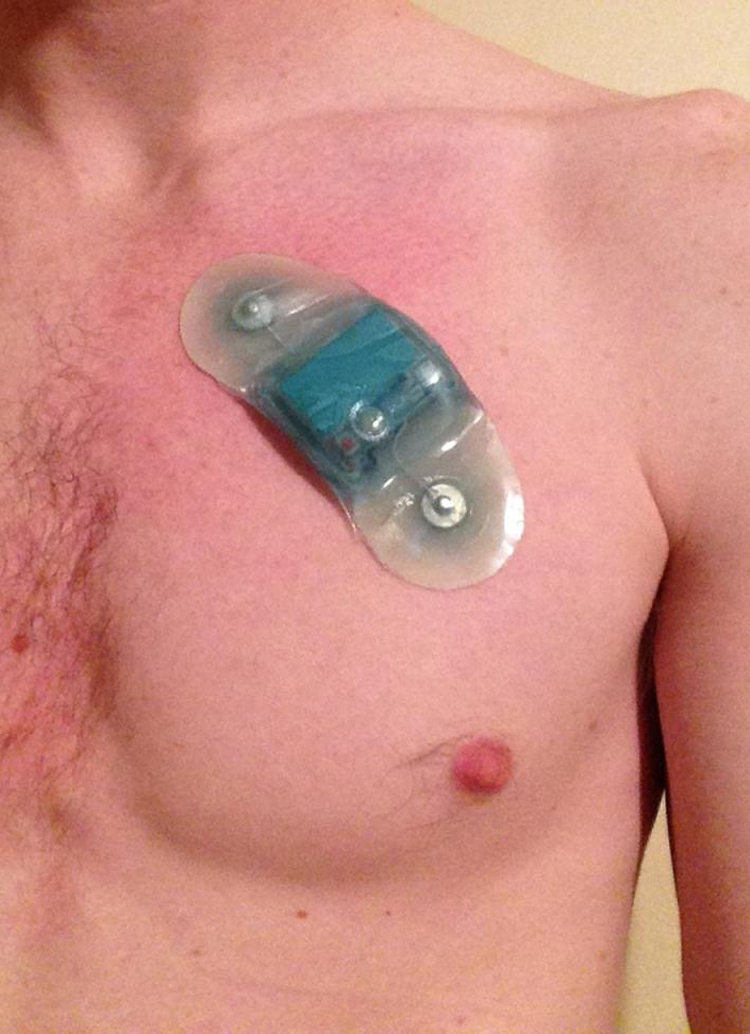
Zio XT Patch worn during data collection. The patch is affixed to the upper-left quadrant of the chest, inferior to the clavicle and lateral to the sternum. (Photo depicts a model wearing the patch.)
Results
Observations recorded via ZIO XT Patch monitoring throughout the various hunting-associated activities are summarized in Table 3 for the individual hunters for whom data were available. During hiking while deer hunting, 3 of 13 participants recorded HRs ≥85% of their age-predicted maximum heart rate (HRmax), which constitutes high-intensity physical activity. 14 Specifically, the duration of the observed high-intensity HR activity ranged from 1 to 2 minutes, with 1 participant achieving 98% HRmax. Arrhythmias were detected in 2 participants who reported CVD and 8 without CVD. Recorded rhythms included premature complexes and sinus arrhythmia. Atrial fibrillation was observed in 1 participant with a prediagnosed atrial fibrillation condition.
Descriptive summary of cardiac response to hunting related activities
All participant data are presented based on 4 hunting-related activities. Heart rate data are displayed as percentage of maximal heart rate (HRmax) recorded during the hunting activity. HR Hit describes the duration, in minutes, ≥85% HRmax. Rhythms shown are arrhythmic activities followed by frequency for complexes and duration for geminal episodes (in seconds).
PAC, premature atrial contraction; PJC, premature junctional contraction; PVC, premature ventricular contraction; A Fib, atrial fibrillation; Sinus A, sinus arrhythmia; BI, bigeminy; TRI, trigeminy; CPT, couplet; ISC, ischemia.
Women hunters.
New arrhythmia not previously noted.
Climbing a tree stand was observed in 6 of 19 participants and resulted in the highest HR noted in this study. Three hunters recorded HR ≥85% HRmax with sustained elevated HR response for 2 to 3 minutes. Moreover, 2 achieved ≥92% HRmax. Recorded arrhythmias resulting from climbing a tree stand included premature junctional contractions and atrial fibrillation (present under nonhunting conditions).
Only 4 of 19 participants had a successful hunt that resulted in dragging a deer. One male hunter, who met the ACSM physical activity recommendation, recorded an HR of 91% HRmax for 1 minute of his drag. Dragging also resulted in an exercise-induced ischemic ECG in 1 male hunter with a documented history of premature ventricular contractions.
Heart rate and rhythm were also recorded in response to buck fever, which occurred in 15 of 19 hunters. Although HR responses varied greatly among these hunters, 7 of 19 hunters, experienced HRs ≥85% HRmax, all of which lasted at least 1 minute. Rhythm changes occurred in 7 hunters; the most common changes recorded were atrial and ventricular complexes. Notably, ventricular bigeminy and trigeminy and ventricular couplets were observed in 1 subject with documented CVD.
In our study, 20 subjects wore the ZIO Patch monitor continuously during the deer hunt; however, 1 monitor was misplaced when being mailed to iRhythm for analysis, so data from 19 hunters were included for interpretation. The unobtrusive profile of the device resulted in high subject compliance and device adherence during all phases of the hunt. The HRs and ECG recordings had good signal quality for analysis.
Discussion
To our knowledge, this was the first study to examine HR and rhythm response in all phases of deer hunting in both men and women. Our findings are consistent with the limited evidence available from previous studies that suggest deer hunting is a high-intensity physical activity creating an increased demand on the cardiovascular system and potential risk for a cardiac event. 8 –10,15
In the current investigation, men and women with and without CVD recorded substantial increases in HR and clinically relevant arrhythmias while deer hunting. Hunting activities elicited HR responses ≥85% HRmax, demonstrating deer hunting includes high-intensity activity and increased cardiovascular demand. This exercise intensity may place individuals, particularly those with CVD, at risk for acute cardiac events. Hunting is considered a multifaceted sporting activity that includes climbing a tree stand or dragging a deer, both of which require muscular effort. In a prior investigation, we determined that it required 69 kg of force to drag a 56-kg fake deer through wooded terrain. In that study, the other tactics required less physical effort, such as hiking or sitting, and did not produce meaningful physiologic responses. 10
Of the various hunting tactics, climbing a tree stand elicited the greatest relative HR response, which is not surprising considering the physical exertion required to climb the stand. However, buck fever resulted in comparable HR responses and elicited arrhythmias, which is noteworthy given that the hunters were relatively motionless during this time. It is most likely that spotting the deer, and subsequently preparing to shoot, resulted in a large sympathetic nervous system response, causing a rapid elevation in HR, increased myocardial oxygen demand, increased cardiac irritability, and consequently arrhythmias.
Previous reports of hiking as part of a simulated hunt elicited HR responses below 85% HRmax,9,10 suggesting that hiking is not a high-intensity exercise. However, similar to previous research, our findings suggest that there is substantial variation in HR response while hiking during the hunt. For the men in the present study, the hike elicited relative HRs ranging from 38% to 98% of HRmax. This wide range of intensity during the hike is consistent with the male hunters studied by Haapaniemi et al, 8 who experienced relative HRs of 69% to 108% of graded exercise test HRmax. 8 It is likely that much of the variability is explained by terrain, weather conditions, and clothing. However, it is plausible that these differences may be explained, in part, by the absence of emotional arousal during a simulated hike. As hunters approach their designated hunting areas, it is common to have heightened awareness of their surroundings, whereas hiking in a simulated hunt may not involve the same anticipatory excitement. Stedman and Heberlein 11 reported significant differences in HRs in shooting and nonshooting situations when stalking prey.
Interestingly, the women in our study only experienced relative HRs of 23% to 63% HRmax while hiking. It is plausible that this lower relative HR response is attributed to the younger age of the women hunters in this study (26.7 ± 9.8 years) and subsequent potential for greater work capacity. However, because of our small sample size and the lack of data on women from any other study, it is not possible to confidently conclude that women’s HR response is different from men’s during the hiking phase of deer hunting. This is an area that deserves future study.
In the present study, only 4 hunters dragged a deer, so the physiologic data available for this hunting activity are limited. Only 1 of the 4 hunters achieved an HR indicative of high-intensity exercise (91% HRmax), which is in conflict with other published reports of both simulated 9 ,10,15 and actual 8 hunts. In our prior study, 14 of 15 young, healthy adults achieved an HR ≥85% HRmax while dragging a 56-kg fake deer. 10 Likewise, Peterson et al 9 concluded that dragging a 56.8-kg deer carcass during a simulated hunt constituted high-intensity exercise, as the mean relative HR was 89% HRmax. Moreover, Haapaniemi et al 8 reported ≥85% HRmax and ischemic changes in men with and without CVD during an actual hunt. In that study, hunters displayed ischemic episodes and abnormal ECGs (premature ventricular contractions, ventricular couplets, ventricular tachycardia, bigeminy and trigeminy) during hunting that were not revealed during a laboratory maximal graded exercise test. 8 Importantly, 1 of the 4 subjects in our study, who had previously diagnosed PVCs, displayed ischemic changes while dragging a deer, even though his HR was well below 85% HRmax during the drag. The observed differences in deer dragging between studies may be partly explained by differences in terrain, weight of the deer, and ground surface, which was not reported in any published study. No women in our study dragged a deer. Therefore, there are still no published data on the cardiac stress in women while dragging a deer during an actual hunt.
In the present study, 6 hunters used tree stands. The relative HRs ranged from 62% to 103% of HRmax while climbing a tree stand. HR during tree stand climbing was ≥85%HRmax in 3 of 6 hunters and remained elevated for 2 to 3 minutes, which was a longer duration than observed in all other tactics. Additionally, a junctional rhythm change that was not noted previously was detected in 1 of the participants during the climb. These findings are not surprising given the physical demand of climbing with clothes and gear. Previous data on the cardiac responses to tree stand climbing are limited. In the study conducted by Haapaniemi et al, 8 only 2 hunters climbed a tree stand. While climbing, no rhythmic changes were detected; however, relative HRs were reported as 74% and 89% HRmax. When examining results from both Haapaniemi et al 8 and our study collectively, data on cardiovascular responses to climbing a tree stand are available on only 8 participants, including 1 woman and 3 men with known CVD. These preliminary findings, albeit in a small sample, suggest that climbing a tree stand while hunting creates cardiac stress that is great enough to elicit high relative HRs and abnormal rhythms. Regardless of the small sample and relative lack of data, the occurrence of elevated HR in these subjects suggests that climbing a tree stand should be considered when examining the stress of deer hunting.
Anecdotal and popular press reports describe feelings of racing HR, heavy chest, breathlessness, and shakiness when spotting a deer and preparing to shoot (buck fever). The likely cause of this is the adrenergic response resulting from the psychological stimulus associated with this phase of the hunt. Stedman and Heberlein 11 reported an average increase in HR of 18 beats/min in 4 hunters who spotted a deer and suggested the observed response was the result of buck fever; however, heart rhythms were not included. 11 In the present study, changes to HR and rhythm during buck fever were explicitly examined. Buck fever resulted in elevated HR ≥85% HRmax in 3 women and 4 men and arrhythmias in both men and women similar to those observed during both the hike and tree stand climb.
Limitations
There are several limitations to our study. We did not conduct a maximal graded exercise test on our participants to determine HRmax. Instead, we estimated an age-predicted HRmax using the equation 220 minus age, which is one of the most commonly used methods to calculate HRmax in the absence of a maximal graded exercise test. 16 However, it is established that the standard error when using this method is ± 12 beats/min depending on age and fitness level of the individual. 17 –20 In our study, this could have resulted in an inaccurate calculation of high-intensity exercise (≥85% HRmax) and potential misclassification of the number of hunters who achieved, or did not achieve, high-intensity exercise during various phases of the hunt. Moreover, our subjects did not record specific weather conditions or terrain in their diaries during their respective hunts. Although previous research shows that dragging a deer in a controlled environment still produces HRs indicative of high-intensity exercise, 15 it could be valuable to examine the additional effect of differing weather conditions and terrain on all phases of the hunt. Finally, our small sample size led to limitations with regard to generalizability of our findings. Only 2 of our hunters had diagnosed CVD. Further, 1 hunter (participant 1) was taking a β-blocker medication that did not appear to affect his HR response (88% to 92% HRmax) while climbing a tree stand. As such, his HR data were included in the analysis as opposed to excluding him from analysis. In the future, there may be value in studying only those hunters with CVD to better examine the cardiovascular responses to hunting in this population. Although we were the first to publish data from women hunters, none dragged a deer. There are still no published data on all completed phases of the hunt in women, and this should be further explored given the increase in the number of women hunters.
Conclusions
In a relatively healthy sample, the vast majority of time deer hunting was spent at <85% HRmax and without new complex arrhythmias. However, several distinct deer hunting activities briefly elevated HR to near maximum and triggered nonnoteworthy arrhythmias at a wide range of HRs. Both climbing a tree stand and deer dragging are likely to prompt rapid and sustained increases in HR and, therefore, constitute the greatest likelihood for cardiac irritation. Indeed, >85% HRmax and arrhythmias were observed in our hunters, but there were no new complex arrhythmias during these hunting phases that would implicate them in a dangerous arrhythmia. Although buck fever elicits no physical effort, it was the only phase of the hunt in the present study that prompted a new complex arrhythmia (in 1 hunter).
In a small sample, women tended to have a lower relative HR than men during the hike, but their cardiovascular responses were similar to men during other hunting-related activities. None of the women studied exhibited noteworthy arrhythmias during any phase of hunting.
Although the likelihood of experiencing a cardiovascular event while deer hunting was not determined, it is known that risk can be lowered through consistent physical activity. In preparation for hunting, hunters should seek medical clearance from their primary care physician and consider a long-term physical activity program. Further, the cardiovascular risks of high-intensity physical activity can be referenced to hunters, especially those with CVD, by healthcare professionals.
Author Contributions: Study concept and design (SV, BJ, JL); obtaining funding (JL); acquisition of data (SV); analysis of data (SV, BJ, JL); drafting of manuscript (SV, BJ, JL); critical revision of manuscript (SV, BJ, JL); approval of final manuscript (SV, BJ, JL).
Financial/Material Support: The purchase of the ZIO XT patches was funded by the Department of Exercise and Rehabilitative Sciences, Slippery Rock University, Slippery Rock, PA.
Disclosures: None.
Footnotes
☆
Submitted for publication August 2015.
Accepted for publication March 2016.
This research was presented as a poster presentation at the American College of Sports Medicine Annual Conference, May 30, 2015, San Diego, CA.