



Abstract
Narrative inquiry focuses on gathering a comprehensive account of individuals’ life experiences and their life stories. This editorial is the third in a series titled “Focus on Qualitative Data Analysis.” The aim of this editorial is to provide researchers with guidance on choosing appropriate methods of analyses for undertaking narrative inquiry. Previous articles in this series addressed case studies and phenomenology. Future articles will focus on qualitative description and ethnography.
Keywords
This editorial is the third in a series titled “Focus on Qualitative Data Analysis.” The aim of this editorial is to provide researchers with guidance on choosing appropriate methods of analyses for undertaking narrative inquiry. Previous articles in this series addressed case studies and phenomenology. Future articles will focus on qualitative description and ethnography.
Narrative inquiry is a qualitative research methodology that focuses on understanding how individuals make sense of their life experiences through storytelling (Connelly & Clandinin, 1990; Riessman, 2008). While narrative inquiry is commonly used in the social sciences, its use in nursing is somewhat limited. Nevertheless, narrative inquiry is well suited to and is often used in research about Indigenous people because of its alignment with the fundamental aspects of Indigenous worldviews and knowledge systems, particularly the central role of storytelling (Barton, 2004; Rieger et al., 2023).
Exploring Individual Experiences
Narrative inquiry is concerned with in-depth exploration of individual experiences, examining them within what Clandinin and Connelly (2004) call a “three-dimensional narrative inquiry space.” This space encompasses three dimensions: temporality, sociality, and place.
Temporality
This dimension involves understanding how people connect their experiences by reflecting on their past, anticipating their future, and navigating the present moment.
Sociality
The sociality dimension recognizes that individuals constantly interact with themselves (intrapersonal), with others (interpersonal), and with broader societal influences within their specific contexts. This includes personal aspects such as hopes and beliefs, as well as external social conditions and environments.
Place
The third dimension, place, highlights that every interaction and experience occurs in a concrete, specific location and context. Therefore, researchers must pay close attention to these settings to fully grasp the meaning of individuals’ stories within their broader sociocultural environment.
Narrative Analyses
There is no single method for narrative analysis because narratives gathered from research participants can range from a brief anecdote to a full autobiography, a series of journal entries, an oral history, or even visual narratives like photo essays. Each of these forms presents different analytical challenges. Riessman (2008) noted that narrative analysis is a “family of methods for interpreting texts that have in common a storied form” (p. 11). A good starting point for narrative analysis is to understand Bruner's (1985) two distinctive modes of thought or cognition, paradigmatic and narrative, that shape how we perceive and know about the world and how we engage in narrative inquiry.
Paradigmatic Cognition
This mode involves identifying and placing specific things or events into established categories or concepts. These categories are defined by a set of shared characteristics that all their members possess (Bruner, 1985). It is about recognizing patterns and fitting individual cases into a predefined framework based on their shared traits (Bruner, 1985; Polkinghorne, 1995). For example, the concept of emotion may include categories such as anger and happiness. From a paradigmatic cognition standpoint, researchers are interested in identifying why a certain item such as furrowed brow and raised voice fits the category of anger and giggle and laughter fits happiness, and both happiness and anger could fit within the concept of emotion. Polkinghorne (1995) noted that “the power of paradigmatic thought is to bring order to experience by seeing individual things as belonging to a category” (p.10).
Narrative Cognition
The narrative mode of cognition is “concerned with the explication of human intentions in the context of action” (Bruner, 1985, p. 100). This mode directs our attention to the individual differences in how people behave in certain situations and to the complex interplay of various elements that make each situation distinctive. For example, when a researcher listens to an individual's story of surviving war, the researcher does not categorize the story or the experiences or the words under concepts or categories. Rather, the researcher is interested in specific details: how the individual describes the material and human loss, the feeling of impact, and their immediate thoughts about their family or their homeland.
Analytic Processes
Polkinghorne (1995) distinguishes analysis of narratives from narrative analysis. The first type, analysis of narratives, aligns with paradigmatic reasoning in which researchers collect stories as data and analyze them with paradigmatic processes. This process yields common themes found across the stories, or classifications of different story types, characters, or settings. In the second type, narrative analysis, researchers gather descriptions of events and happenings and synthesize them through a plot into a story (e.g., a case study or a biographic narrative). Simply, “analysis of narratives moves from stories to common elements, and narrative analysis moves from elements to stories” (Polkinghorne, 1995, p. 12).
Finally, Riessman (2008) outlined four types of narrative analysis: thematic, structural, dialogical/performance, and visual analysis. In our opinion, these four types of analysis are differentiated based on the type of outcome that researchers engaging in narrative inquiry desire. Therefore, drawing from the works of Bruner (1985), Polkinghorne (1995), and Riessman (2008), we provide an analytical choice tree for selecting method of analysis in narrative inquiry (Figure 1). This analytical choice tree should be considered one perspective (our perspective) on how to undertake narrative inquiry. We encourage readers to read the cited seminal works of other scholars to design and conduct robust and rigorous narrative analysis.
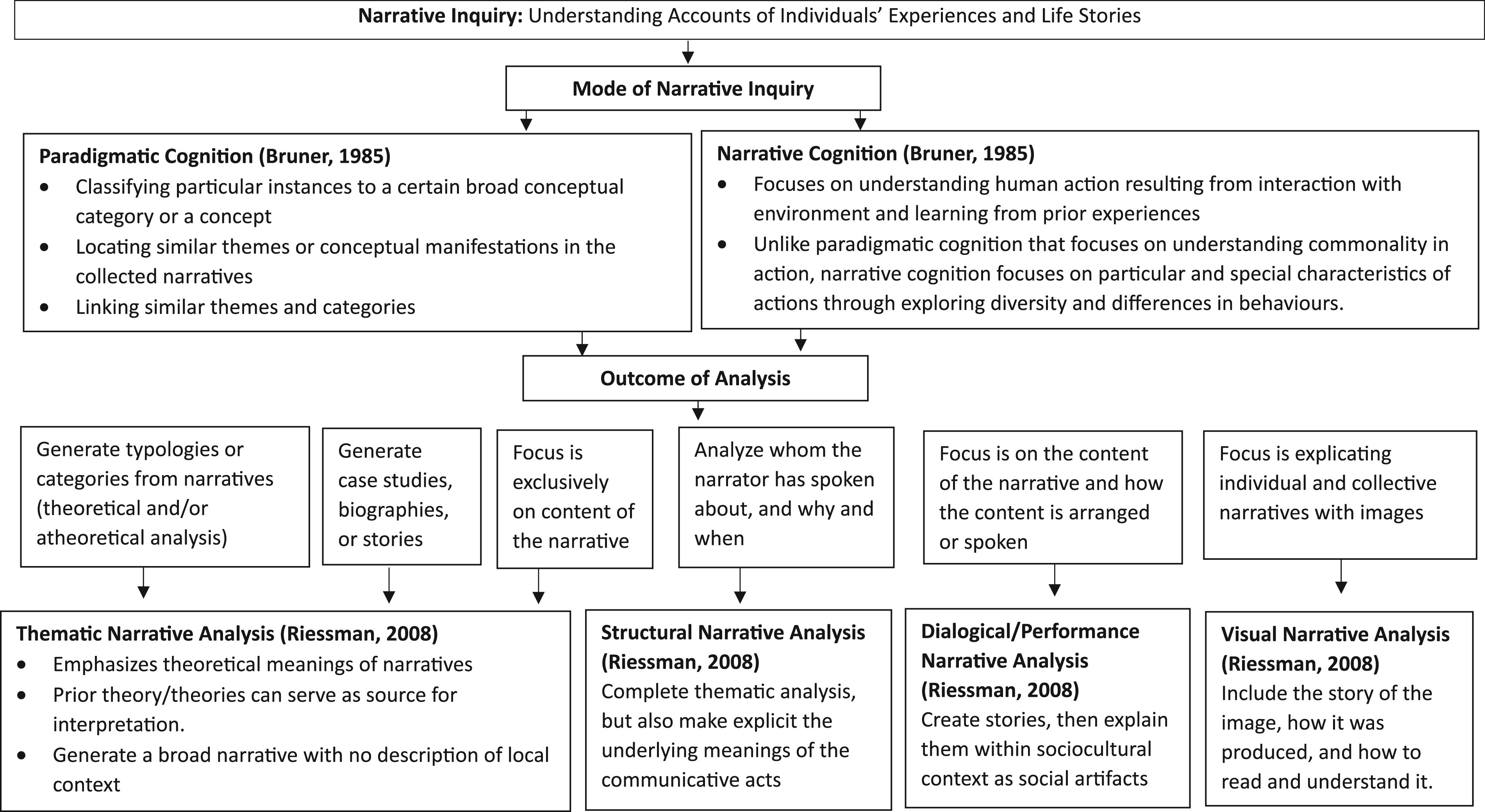
Narrative inquiry analysis choice tree.
Footnotes
Declaration of Conflicting Interests
The author(s) declared the following potential conflicts of interest with respect to the research, authorship, and/or publication of this article: Ahtisham Younas is Editor-in-Chief of Creative Nursing. Shahzad Inayat is a member of the Editorial Board of Creative Nursing.
Funding
The author(s) received no financial support for the research, authorship, and/or publication of this article.

Author Biographies