



Abstract
Phenomenology as a research methodology is based on Edmund Husserl's and Martin Heidegger's philosophy of phenomenology, which addresses the subject of human experience. It is one of the commonly used methodologies in health sciences research. This second editorial in the series titled “Focus on Qualitative Data Analysis” aims to provide researchers with guidance on how to choose appropriate methods of analysis among varied phenomenological approaches. We provide an analytical choice tree that presents our perspective on the methods of analysis in phenomenology. The previous article in this series addressed case study methodology. Future articles will address qualitative description, grounded theory, and narrative inquiry.
Phenomenology is one of the commonly used research methodologies in health sciences research. Despite ample information in the literature on designing and conducting rigorous phenomenological enquiries, we have observed that authors often fail to choose the correct method of data analysis for their phenomenological studies. The literature contains examples of phenomenological research using various types of thematic analysis, such as codebook, coding reliability, and reflexive, as well as content analysis being employed for data analysis in phenomenology. Using thematic and/or content analysis in phenomenological research is incorrect. The intention in phenomenological analysis is to explicate the unique lived experiences of individuals and to provide an overall thematic account of lived experiences across cases. Thematic analysis and/or content analysis focuses only on developing a wholistic account across cases, with different level of interpretation (Braun & Clarke, 2021). There are differences between thematic analysis and content analyses as well, and these differences will be discussed in another article in the series.
Experience and lived experience
The confusion of using thematic and/or content analysis in phenomenological research may arise when researchers fail to understand the purpose of inquiry and the essence of phenomenological research. Van Manen (2016) clearly noted that “phenomenological human science begins in lived experience and eventually turns back to it” (p. 35). However, researchers often struggle to understand the difference between lived experience and experience, and present their phenomenological studies as understanding the mere experiences of participants.
Experience is quite different from lived experience. The study of phenomenology arose from the philosophy of Immanuel Kant, Edmund Husserl, Martin Heidegger, and Hans-Georg Gadamer, who all wrote in the German language, which has distinct words for experience (Erfahrung) and lived experience (Erlebnis). Experience refers to being actively engaged in a task or activity or interaction and gaining knowledge from it as we conceptualize, categorize, and reflect on it. Lived experience is a tacit or a pre-reflective account of one's lifeworld, where lifeworld refers to the everyday concrete and subjectively experienced world. For a detailed understanding of these two terms, an excellent resource is “Phenomenology, Lived Experience: Taking a Measure of the Topic,” by Robert Burch (1990).
There are a wide range of phenomenological methods which are broadly categorized as Husserlian or Heideggerian (Rodriguez & Smith, 2018).
Husserlian phenomenological methods
Husserlian phenomenology is also called descriptive or transcendental phenomenology. The hallmark of this method is an attitude comprising “epoché (or ‘bracketing’) and the reduction, which refrains from positing the existence of whatever is given” (Giorgi, 2007, p. 64). Bracketing is the act of putting aside personal biases about the studied phenomenon, and reduction is the process of letting go any prior experiences or interpretations related to the studied phenomenon, in order to fully understand its essence. Kockelmans (1967), based on his interpretations of Husserl's texts, outlined five types of reduction in phenomenology: namely, phenomenological, philosophical, psychological, transcendental, and eidetic (Kockelmans, 1967). For a detailed account of these five types of reduction, refer to Kockelmans (1967). Here is a brief description of each type.
Heideggerian phenomenological methods
Heideggerian phenomenological methods are concerned with the hermeneutic circle, which signifies the idea that our understanding emerges not from fixed beliefs, but through a continuous process of re-examining and re-interpreting the underlying assumptions that shape our current understanding of a text, experience, or phenomenon (Grondin, 2016). It means that our understanding of someone's lived experience cannot be achieved without incorporating our prior experiences and interpretations about that experience. Therefore, bracketing and reduction should not be used in hermeneutical phenomenological methods. For detailed explanations of the differences between Husserlian and Heideggerian phenomenology, readers can refer to Laverty (2003), Rodriguez and Smith (2018), and Neubauer et al. (2019).
Given the differences among Husserlian and Heideggerian methods and a range of additional phenomenological approaches within each tradition, it is important to choose the most relevant type of phenomenological method for your enquiry and analysis. The choice tree in Figure 1 provides an overview of various types of phenomenological methods and characteristics.
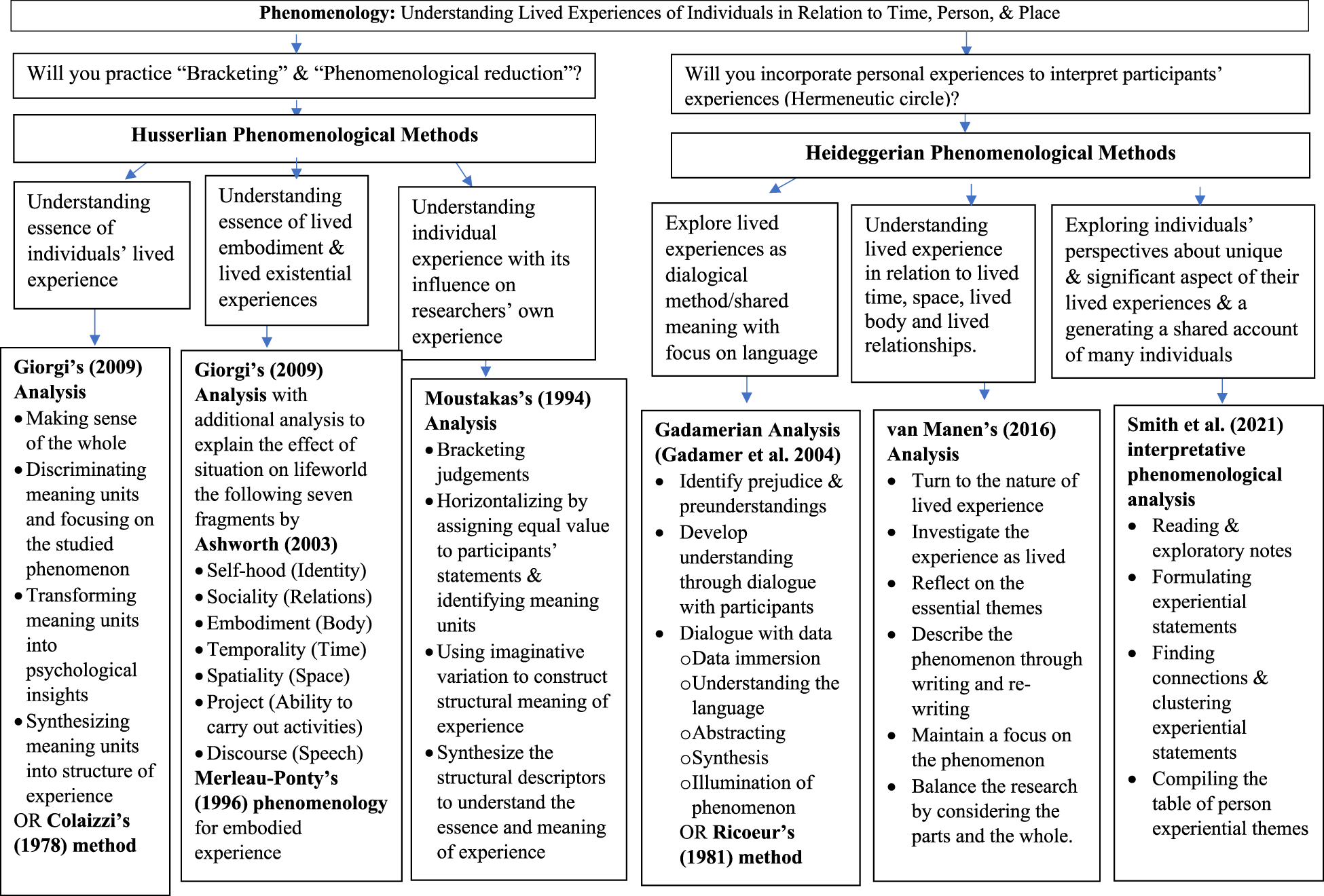
Phenomenological analytical1996 choice tree.
We encourage you to use this figure to choose your method, and read the original, seminal sources provided in the reference list, for designing and conducting rigorous phenomenological studies.
Footnotes
Declaration of Conflicting Interests
The authors declared the following potential conflicts of interest with respect to the research, authorship, and/or publication of this article: Ahtisham Younas is Editor-in-Chief of Creative Nursing. Shahzad Inayat is a member of the Editorial Board of Creative Nursing.
Funding
The authors received no financial support for the research, authorship, and/or publication of this article.

Author Biographies