




Abstract
Case study methodology is useful for generating a holistic understanding of a complex and context-bound case or phenomenon. This editorial is the first in a series titled “Focus on Qualitative Data Analysis.” It aims to help researchers choose appropriate methods for conducting rigorous qualitative analyses across varied approaches. Future articles will address qualitative description, phenomenology, grounded theory, and narrative inquiry.
This editorial is the first in a series titled “Focus on Qualitative Data Analysis.” It aims to help researchers choose appropriate methods for conducting rigorous qualitative analyses across varied approaches. Future articles will address qualitative description, phenomenology, grounded theory, and narrative inquiry.
Case study research is useful for generating in-depth exploration and understanding of complex, multifaceted yet unique health and social phenomena in real-life contexts (Crowe et al., 2011). Yin (2018) defined a case study as “an empirical method that investigates a contemporary phenomenon (the ‘case’) in depth and within its real-world context, especially when the boundaries between phenomenon and context may not be clearly evident” (p. 45). Case study research mainly focuses on studying unique cases. Stake (1995) noted that not every hypothetical scenario is considered a unique case for examination in case study research; a unique case is a bounded or integrated system intertwined with a context; hence it is an object, not a process.
A case-in-case study research can be an individual patient case, a hospital program evaluation, a community health intervention program, or a study of a high-risk population. An example of a unique case is studying a rural town with an outbreak of cholera (the town is the case), or a rare case of leprosy in North America (the individual with leprosy is the case). Tsubonouchi and Asano (2024) used a case study approach to illustrate allyship between patients with mental health issues and psychiatric nurses to inform health-care practice and reforms. They asked one patient (Kenji) to describe his life events and generated a patient-authored medical record (PAMR). The PAMR and follow-up meetings with Kenji helped him change his perception of his schizophrenia and improved his health and social life. In this study, both Kenji and the nurse–patient allyship/partnership approach can be considered the unique case.
A case cannot be considered unique when the interrelationship with the context is not made explicit. Teaching strategies used by a nurse educator and the process of developing a health-care policy in an organization are not unique cases because there may not be any stark differences from the general population. These cases could be made specific or unique by explicating the context—for example, the teaching strategies used by an educator to bridge the achievement–opportunity gap in an undergraduate nursing program, or a partnership with an underserved community (e.g., individuals experiencing homelessness) to develop health-care policy within an organization.
Case study research can be qualitative, quantitative, or mixed methods, with the key advantage of explaining understudied and/or poorly explored phenomena, yet case studies are often underutilized in nursing and other health-care research (Squires & Dorsen, 2018). In our opinion, case studies are underutilized for three reasons. First, scholars have limited understanding of the nuanced analyses that could be undertaken in case study research, and how it can add value to better understanding contextual nursing processes and social and organizational phenomena.
Second, scholars give greater emphasis on using other types of qualitative, quantitative, and mixed methods designs—particularly experimental designs, grounded theory, phenomenology, ethnography, and qualitative description, such that the added value of case study methodology to inform nursing inquiry is ignored.
Third, there is a misconception that case study research is less generalizable and transferable than other methodologies. In this editorial, we will focus on the issue of understanding the types of nuanced analyses that can be conducted within a case study, irrespective of the type (i.e., qualitative, quantitative, or mixed methods).
The origin of case study research can be traced to the work of French sociologist Frederic Le Play (Hamel et al., 1993). However, our current understanding of this methodology is mainly based on the work of Stake (1995) and Yin (1984, 2018). The key purposes of using case study research include: (a) to explore and understand an underexplored and unique case or multiple cases from a broader view, (b) to better understand how context, and the individuals within that context, can influence a case, and (c) to explore a situation or a phenomenon related to a case with a large number of variables rather than data points (i.e., assuming that each case is a data point) (Yin, 2018).
A wide range of data collection methods can be used, including interviews, observations, surveys, pieces of art, and documents. The analytical choices are somewhat ambiguous, and selecting a method of data analysis can be challenging. Drawing from the work of Stake (1995) and Yin (2018), we provide an analytical choice tree for selecting the most relevant method of data analysis in line with the purpose of the specific case study (see Figure 1). We would like to highlight that this analytical choice tree only captures one perspective (our perspective) on the analytical approaches; there could be many other sources that readers may find useful.
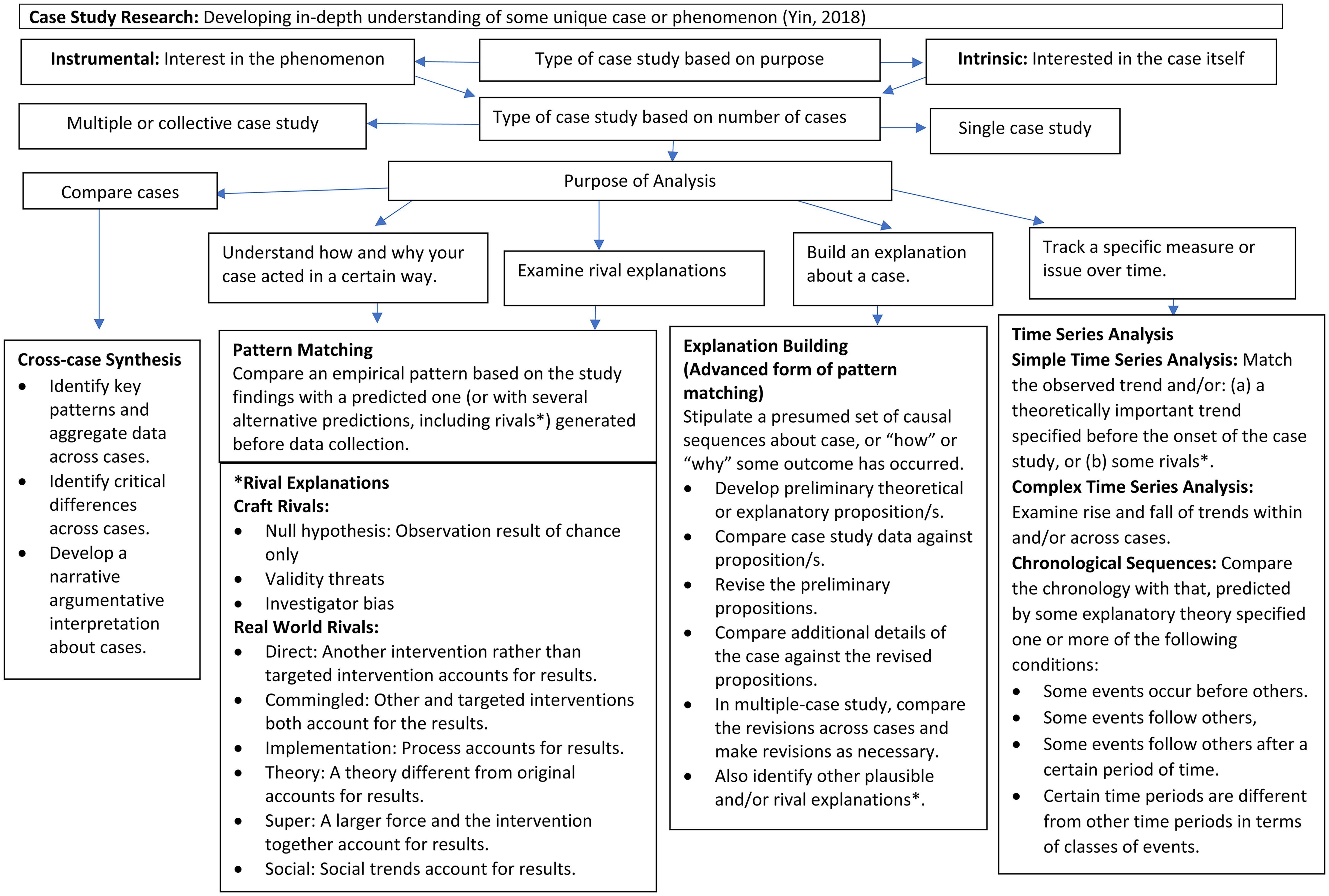
Case study research analytical choice tree.
Footnotes
Declaration of Conflicting Interests
The authors declared the following potential conflicts of interest with respect to the research, authorship, and/or publication of this article: Ahtisham Younas is Editor-in-Chief of Creative Nursing. Shahzad Inayat is a member of the Editorial Board of Creative Nursing.
Funding
The authors received no financial support for the research, authorship, and/or publication of this article.

Author Biographies