



Abstract
Qualitative descriptive studies are one of the most used methodologies across health and nursing research. This fourth editorial in the series titled “Focus on Qualitative Data Analysis” aims to provide researchers with guidance on how to choose appropriate methods of analysis when using qualitative descriptive studies. We provide an analytical choice tree that presents our perspective on the methods of analysis in qualitative descriptive. The previous article in this series addressed case study methodology, narrative inquiry, and phenomenology.
Qualitative description (QD) is a research approach that allows researchers to provide a comprehensive and straightforward description of experiences, events, and people's perceptions (Sandelowski, 2000). It is different from other well-known qualitative approaches, such as grounded theory, phenomenology, and ethnography, as the analysis and interpretation are closer to participants’ data, and focus on describing events rather than explaining why an event happens (Sandelowski, 2000, 2010). This makes QD particularly useful in applied fields such as nursing, other health sciences, and education, where clear and accessible findings are required for practice, policy, and decision-making (Polit & Beck, 2017). QD is also a suitable approach for the qualitative part of mixed methods research and is best for research studies in which the focus is on what, where, and why questions (Neergaard et al., 2009). Commonly used methods of data collection in QD studies include semi-structured interviews and focus group discussions (Neergaard et al., 2009; Sandelowski, 2000, 2010). QD uses a maximum variation sampling technique, which means that researchers recruit participants with diverse experiences or who can provide detailed information regarding the phenomenon under study.
In QD studies, data analytical approaches are used to identify specific content or generate meaningful themes from the data (Wong, 2008). Therefore, qualitative content and thematic analysis are the most widely used analytical approaches (Kim et al., 2017). Although ample literature is available on how to choose analytical methods in qualitative research, there is minimal guidance on how to decide which data analysis method should be used in qualitative descriptive studies; this guidance is needed particularly by novice researchers. Therefore, the purpose of this article is to provide comprehensive guidance for choosing an appropriate analytical approach in QD. Based on the specific purpose of the research, the decision tree presented in Figure 1 can be used to choose the best analytical method for QD.
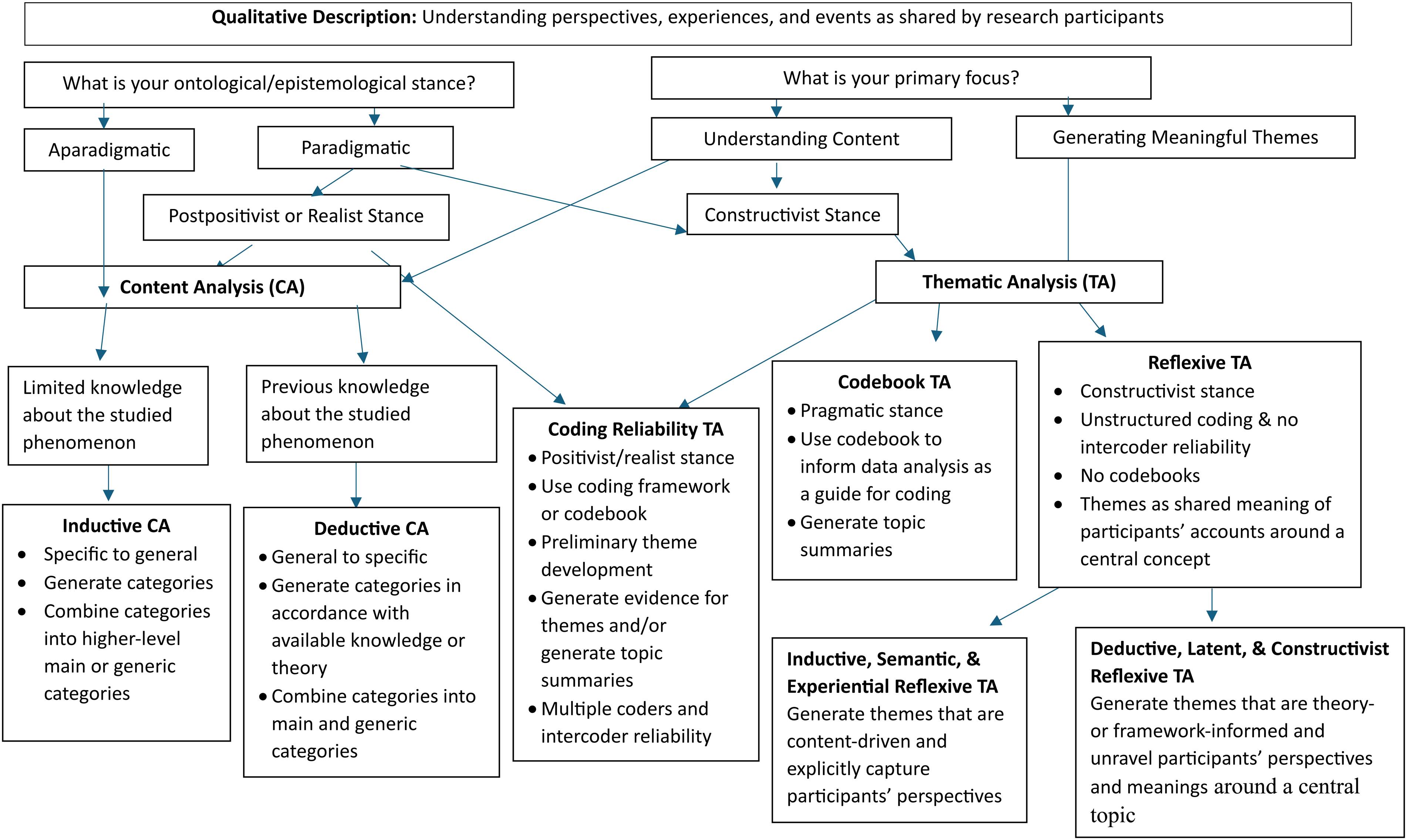
Descriptive Qualitative Analysis Choice Tree.
Footnotes
Declaration of Conflicting Interests
The authors declared the following potential conflicts of interest with respect to the research, authorship, and/or publication of this article: Ahtisham Younas is Editor-in-Chief of Creative Nursing. Shahzad Inayat is a member of the Editorial Board of Creative Nursing.
Funding
The authors received no financial support for the research, authorship, and/or publication of this article.
