




Abstract
Prior research reveals the interrelations between gentrification and policing, yet this paper introduces the unheard perspective of the of police on their role in gentrification. The study focuses on South Tel Aviv, which houses immigrants, drug addicts, prostitution and houselessness. It is undergoing massive urban renewal and has become the most policed area in the city. Methodology includes interviews with police officers (N-15), ethnography with urban police and spatial analysis of urban renewal. The paper argues that: 1. Gentrifying a high-crime neighborhood triggers a collision of urban forces and spatial negotiations amid users, institutions, and areas in the city. 2. Police play a significant role in this process and must operate intensive borderwork on various scales, with technology becoming a tool for internal, microgeographical social borderwork. 3. Policing gentrification raises reflexivity among officers regarding their profession, social obligation and position in urban politics. The paper concludes with the concept of policing temporality to describe the role of police in gentrification.
Numerous studies have shown how gentrification processes promote and are supported by an increase in policing in the changing environment (Laniyonu 2018; Sharp 2014; Laniyonu 2018; Bloch and Meyer 2019; Beck 2020; Cheshire, Fitzgerald and Liu 2018). However, the voices and reflections of police officers who operate in these transformative times and spaces have yet to be heard. Gentrification is a worldwide urban phenomenon that reshapes cities and produces multi-layered conflicts. Lawton (2020) suggests that gentrification can be understood as a particular manifestation of uneven development, where a group, by virtue of its class and wealth, comes to dominate a specific locale to the detriment of other social groups, particularly the working class (Lawton 2020: 268). Although the concept of gentrification has been criticized for being overly used (Maloutas 2012), it can characterize the spatial, demographic, social and urban transformation in which police operate. The literature on gentrification and policing highlights how gentrifying areas are subject to more intensive police presence, stop-and-arrest practices, aggressive police tactics and surveillance (Sharp 2014). These claims are raised by long-term residents who suffer from and witness intensified police presence in their neighborhoods (Freeman 2011; Fagan et al. 2009; Maharawal 2017; Parekh 2015; Newberry 2021), as evidenced by empirical data on 311 calls to police (Laniyonu 2018) and from qualitative studies with new residents who demand more policing (Bloch and Meyer 2019). Christensen and Albrecht (2020) suggest that urban policing should be examined as a bordering practice. Hence, policing gentrification, a process that reorders borders and sociospatial demarcations in a city, activates hyper-borderwork. Alternatively, as suggested by Ramírez (2020), gentrification can be understood as creating a borderland and warrants the use of borderland analytics, which emphasizes how gentrification is experienced, embodied, and materialized through policing practices and the everyday social and spatial borderwork of the police.
This study focuses on the perspective of police officers working in a high-crime neighborhood undergoing gentrification in South Tel Aviv. It is based on qualitative interviews with police officers and commanders (N-15), ethnographic work with urban police and a spatial analysis of urban renewal. Qualitative research regarding police and security at large contributes to the study of borders and security (Côté-Boucher, Infantino and Salter 2014). It sheds light on the practices and daily routines that construct and reinforce borders. Moreover, it reveals the interpretations and reflections of the actors. In this case, interviews with police strengthen the arguments of past research and confirm that police work intensifies under gentrification to include more order maintenance policing (Sharp 2014) and criminalization of incivilities in the designated areas (Peršak and Di Ronco 2018). However, beyond that, the results reveal the reflexive insights of the officers that arise from working in a complex environment of sociospatial transformation. Their reflections are divided into three levels: local, social and urban. On the local level, they question the effectiveness of police practices such as situational crime prevention (SCP) in dealing with drug users and those experiencing houselessness in the absence of long-term solutions. On the social level, they highlight the moral dilemmas that arise from policing a socially mixed neighborhood. Spaces undergoing gentrification become complicated environments where old and new residents live in physical proximity but demand that social distance and boundaries be maintained. This study shows how digital communication plays a significant role in the ways the police distinguish between populations. Digital platforms and communication become a means of internal borderwork in gentrified areas. The digitally skilled enjoy immediate, accessible police services at the expense of those who are not digitally connected. In south Tel Aviv, with its large population of immigrants and people with drug addiction and houselessness, the line between the connected and disconnected is conspicuous. The police who are determined to serve the community (Herbert 2009; Hughes 2006; Hughes and Rowe 2007) find themselves in uncharted territories of community-police relations mediated by digital platforms. They reflect upon their moral obligation to the various populations in the conflicted gentrified area. The broadest criticism from the police targets urban politics and illuminates an unspoken dynamic regarding the gentrification of high-crime neighborhoods where unwanted phenomena (such as prostitution, drug trafficking and houselessness) are centralized. This process, which undermines previous spatial arrangements that have economic, moral and functional value for the city, evokes conflicting desires and interests. Police are expected to reduce crime, displace unwanted populations, and make the area safer for newcomers. Simultaneously, they must prevent crime and incivilities from spreading into other areas. Therefore, their reflection exposes how the gentrification of a high-crime neighborhood incites political struggle and spatial negotiations. Maneuvering among the contradicting forces, police are wondering about their actual role in this space.
Hence, this paper makes three key arguments: 1. Gentrifying a high-crime neighborhood triggers a collision of urban forces and spatial negotiations amid users, institutions, and areas in the city. 2. Police play an important but complicated role in this process and must operate intensive borderwork on various scales, with technology becoming a tool for internal, microgeographical social borderwork. 3. Policing gentrification raises reflexivity among officers regarding their profession, social obligation and position in urban politics.
The final discussion suggests that the role of police in spaces undergoing gentrification is to
The paper continues as follows: Part 1 reviews the literature on gentrification and policing and the potential contributions from qualitative research conducted with police. Part 2 presents the empirical context of South Tel Aviv and presents data on urban renewal and policing. It also reviews the methodology of the study. Part 3 divides the findings into three parts: 3.1 Reflecting on police practices: situational crime prevention on the way to nowhere; 3.2 Reflecting on the social and moral obligations of the police: “Have we become the private police of the newcomers?” Digitalization and coalitions of power; 3.3 Reflecting on the police force's role in urban politics: “do they truly want a win here?” Part 4 concludes the paper by discussing the concept of policing temporality.
Part 1: Perspectives on the Intersection Between Gentrification and Policing
In the literature, it is widely claimed that police activity increases in spaces that are currently undergoing gentrification. Past research suggests various complementary explanations for this phenomenon: 1. Spaces that undergo urban renewal tend to displace populations, behaviors and uses that do not match the neoliberal standard of the renewed area, and the police are responsible for their displacement. 2. Newcomers, predominantly White and middle class, demand more police services and are therefore responsible for the intensification of policing 3. The authorities invest in policing to both signify and enable economic development.
These explanations differ in their focus. The first can be described as moral-economic, emphasizing the relation between the capitalization of urban spaces and normativity. Urban revitalization transforms previously diverse and complex urban areas into ordered or orderly urban realms (Hubbard 1999) that are well suited for capital investment, consumerism, tourism and the middle classes (Peršak and Di Ronco 2018). Those who are unable to cope with the demands of the market, fail to fit into the grand design, or are perceived as a threat or an obstacle find themselves marginalized (Aalbers 2011; Hubbard 1999; Bauman 1993). Members of the community considers the relegation of weaker groups to less desired environments for the advancement of capitalism as a virtuous action, which realizes a morally superior setup (Sibley 1995). The mixing of social groups and diverse activities in space carries the threat of contamination and a challenge to hegemonic values (Sibley 1995: 39). The state transforms its actions toward these groups from care into repression and transfers them from the hands of the social worker into the hands of police (Smith 1996). The second explanation focuses on the social dimension and emphasizes both the active and passive role of the new residents in the intensification of policing. Sharp's (2014) postindustrial policing hypothesis claims that the police tactics deployed in urban spaces that experience “revitalization” are aimed at adapting the living environment to populations with higher capital (tourists and residents). Adopting their racialized and class-based perceptions of crime, safety, and disorder (Laniyonu 2018; Sharp 2014; Peršak and Di Ronco 2018). The result is that order-maintenance policing focuses on social control rather than law enforcement functions (Sharp 2014; Neocleous 2000). Other researchers have empirically shown how new residents, mostly White and middle class, actively call the police more often, especially regarding quality-of-life offenses that are allegedly conducted by non-White people, such as disorderly conduct, property damage, and trespassing (Beck 2020; Bloch and Meyer 2019). Respectively, long-term residents report that they experience more stop-and-arrests by the police during gentrification (Freeman 2011; Newberry 2021; Maharawal 2017; Fagan et al. 2009). The third explanation, by Beck (2020), suggests a more political-economic understanding of the police-gentrification link. He turns the focus on city elites who pave the way for the real estate market by investing and expanding police activity in the designated areas. His thesis is that “development-directed policing” is aimed at “cleaning up” neighborhoods marked for upscaling through increased discretionary arrests like those for drug possession (Beck 2020: 251–252). Indeed, gentrification is driven by consumers, the state, the authorities, city elites, and new residents. It can be motivated by moral, economic, racial, or social concerns—either way, the process of gentrification is entangled with police involvement. Moreover, it reorients the police agenda to focus on particular behaviors and populations (Laniyonu 2018: 899).
Urban Policing as a Practice of Bordering and Gentrification as a Process of Borderwork
Another perspective on the interrelations between gentrification and policing views gentrification as a relational process that activates urban, spatial and social borderwork and sees urban policing as a practice of bordering. Instead of trying to explain the reasons for the intensification of police work in times of gentrification, this perspective focuses on how police produce, manage and reinforce social boundaries (e.g., racial, ethnic, gendered, class, civic) within the sociospatial dynamics known as gentrification. Urban policing is principally a practice of bordering informed by material and imaginary manifestations, Christensen and Albrecht (2020) argue. They observe the tensions between (de)territorialization and (de)stabilization as the vehicle and outcome, respectively, of the bordering practices of the police. More broadly, the concept of borders and bordering practices in the material, symbolic and imaginary senses, are considered constitutive to the city (Lazzarini, 2015 in Christensen and Albrecht 2020). Thus, gentrification can be seen as an accelerated borderwork since it produces ripples of change in the physical, social, and symbolic fields. Gentrification stretches and redefines the center and the margins, reorganizes the field of images and perceptions of places in the city and generates social mixing among different populations in particular spaces. It consolidates different socio-economic groups in their vision of city development and support for spatial governmentality (Peršak and Di Ronco 2018). Therefore, policework as a practice of bordering becomes more prominent, intense and complex in the context of gentrification. As suggested by Ramírez (2020), borderland analytics is a means to understand gentrification and urban redevelopment as bordering practices that create structural and cultural exclusion in city spaces (p.148). Borderlands are inherently relational and dynamic; they are spaces of ongoing conflict and negotiation, constantly undergoing a process of formation and counterformation through everyday practices (ibid). Borderland analytics can help us understand how borders are produced structurally, socially, and spatially, what the practices of bordering are, and which types of borderwork gentrification incites.
Qualitative Research on Police Perspectives
Examining borders through ethnographic studies and interviews with security personnel, policy implementers and street-level decision makers such as police officers can highlight and expose how borders are produced, contested and enforced in mundane ways. The “practice turn” has led research to scrutinize how institutions and ideas are manifested through everyday practices and how the actors act and give meaning to their actions (Côté-Boucher, Infantino and Salter 2014). Actor-centered policy perspectives illuminate the implementation and translation of policies as significant phases that generate, with every step and every new actor or scale, new spaces of contestation (Stepputat 2012:444). Moreover, security actors are seen as interpretive actors in their own right (Côté-Boucher, Infantino and Salter 2014). They can reflexively adopt (or not) dominant discourses in their field. In this case, police personnel can reflect on current intervention policing paradigms, such as hot spot policing (Eck and Weisburd 2015), community policing (Hughes 2006; Johnston 2005; Hughes and Rowe 2007), and situational crime prevention (Clarke 1995). Moreover, studying the perceptions of the police, who are directly engaged in the business of social control, can elucidate their decisions on whether to penalize a certain uncivil behavior or population (Peršak and Di Ronco 2018). Therefore, police ethnography reveals the technologies, enforcement techniques and administrative tools that the police employ as well as their meaning (Côté-Boucher, Infantino and Salter 2014). It emphasizes a bottom-up perspective on microdynamics and everyday practices of policing (Christensen and Albrecht 2020).
Additionally, police interviews can reveal the behind-the-scenes politics of gentrification processes, internal urban politics and the tension between the various levels of decision-makers. The literature on gentrification and policing presents the police as the executors of municipal interests. However, what is the relationship between the police and urban and state authorities? Do they have shared interests or conflicting interests and disagreements?
The literature on cities and policing is divided between studies from an urban perspective that scrutinize policing from the urban angle—how does it affect the city and particular spaces, how does it reinforce and construct racial, class, gendered and other divisions in the city? However, the police as actors, the effect of current policing paradigms and the institutional and organizational aspects of police and policing are neglected. Conversely, studies from a criminological perspective address urban locals from the perspective of place-based crime prevention paradigms (Andersen 2010; Eck and Weisburd 2015; Weisburd, Bruinsma and Bernasco 2009; Clarke 1995), which disregard questions of how they relate to and affect broader urban sociospatial processes (Atkinson and Millington 2020; Peršak and Tulumello 2020). In these studies, the city is approached as a background against which policing takes place, rather than an explicit object that is integral to reflection and analysis (Christensen and Albrecht 2020:386). Scholars who advocate for a new perspective of urban criminology claim that urbanization should be understood as a process that is constitutive of crime, of which gentrification is an example (Atkinson and Millington 2020; Peršak and Tulumello 2020; Peršak and Di Ronco 2018). Moreover, researching reflexivity and contradiction among police officers can contribute to the field of criminology and our understanding of the application of contemporary theories in policing (Young 2011:17). Therefore, the intended study, which introduces the perspective of the police as actors in the urban arena, can suggest a new understanding of the role of police in gentrification. Based on their reflection, the paper suggests that their role is to
Part 2: Empirical Context and Methodology
The southern area of Tel Aviv has been defined as disadvantaged throughout the history of the city. The north–south polarization in the city of Tel Aviv-Jaffa has ethnic, socioeconomic and spatial dimensions, which are rooted in the history of urban development and continues in present-day inequalities (Margalit and Vertes 2015; Hatuka 2010; Marom 2014; Cohen 2015). South Tel Aviv, especially the Neve Sha’anan neighborhood, is known as an area for drug trafficking, sex consumption and houselessness. These phenomena have existed there since the 1970s but intensified following waves of urban renewal in the city center in the 1980s and 1990s (Marom 2014; Zur 2021), when Tel Aviv grew to be a global city and Israel's center of business, culture and tourism (Schnell et al. 2005; Alfasi and Fenster 2005; Schipper 2015; Hatuka and Zur 2019). Neve Sha’anan is associated with violence, crime, danger and fear. Empirically, it has a higher average concentration of crime and the highest concentration of chronic crime hot spots (Weisburd and Amram 2014). Since the late 1980s, South Tel Aviv has been home to various immigrant groups(Kemp and Raijman 2008) Since 2008, it has experienced growth in asylum seekers and refugees from Africa settling there (Yacobi 2011; Sabar 2008). This process has increased tensions with local Israeli residents who have protested against the rise in crime, violence and insecurity (Shechory-Bitton and Soen 2016). These tensions have added to their critique of urban inequality and their sense that the southern neighborhood serves as the “backyard” of the city and the state, containing all the unwanted social phenomena (Cohen and Margalit 2015; Cohen 2015).
Since 2010, in response to the increase in the number of asylum seekers and claims of insecurity, the state and municipal authorities have invested in expanding police services in the neighborhood. Within the last decade, the area transformed from having no police station to being the most surveilled and policed area in the city, with 200 surveillance cameras and the largest national and municipal police force operating in the smallest geographical area (Figure 1). Today, the Sharet Police Station in South Tel Aviv is the premier station in the city and region in terms of number of officers, combat units, equipment, resources and technology. Geographically, Neve Sha’anan borders the city center (Figure 1) and is especially proximate to Rothschild Boulevard, the heart of Tel Aviv's financial district and the growing hub of young tech companies, alongside restaurants, hotels and leisure facilities.
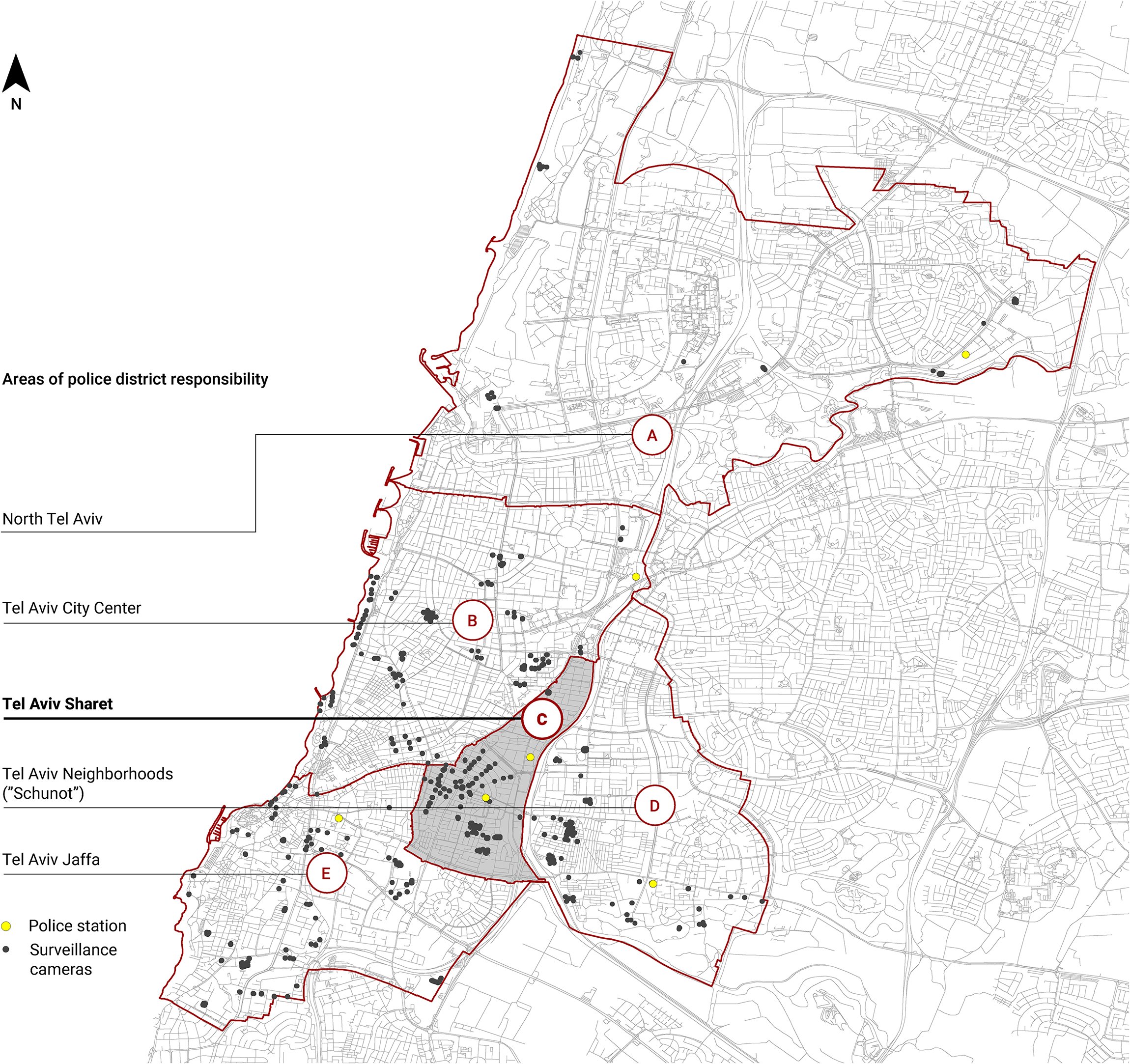
Areas of police district responsibility and surveillance camera distribution across the city.
In the last five years, urban renewal processes in the area have accelerated. Figure 2 shows Sharet Police district area with the locations of the surveillance cameras, police foot patrol area and the various stages of urban renewal for each building. There is an overlap between the camera locations and the clusters with the most active urban renewal: where new populations have settled. There are three clusters of urban renewal. The foot patrol is concentrated in one of those areas, which is defined by the police as “the polygon”: a hot spot of crime, bars and commercial areas for foreign workers and asylum seekers, violence, brawls, drug trafficking, prostitution and houselessness.
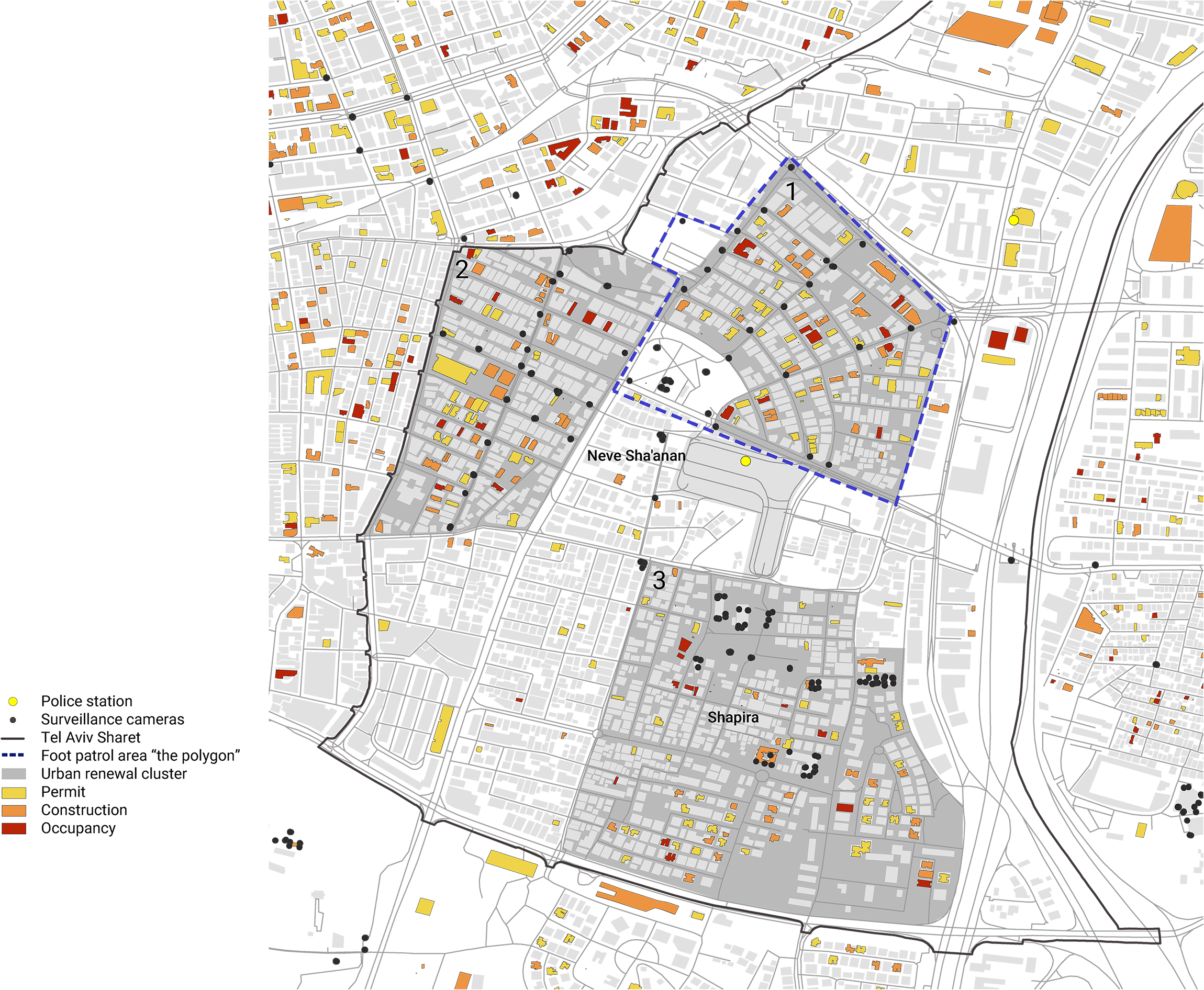
Clusters of urban renewal, surveillance cameras and police foot patrol areas in Sharet police district area.
To give another sense of how the area is changing, Figure 3 presents three projects of urban renewal in the neighborhood. The first shows a building that was a center for prostitution and drug trafficking and become a symbol for the prostitution industry. It was referred to as the “lowest place in Tel Aviv”. After the demolition, the renewed building has 53 small apartments for students and young people, a commercial floor and gated courtyard. The second project is an affordable housing project built by the Tel Aviv Municipality for middle-class young families and couples who did not previously live in the neighborhood. The project attempted to attract “good” new populations. Both of them are located in “the polygon”. The third project, which is located in the second cluster of urban renewal (see Figure 2), involved three buildings that offer higher-priced housing to middle-class populations. According to the Madlan real estate website, prices in the neighborhood have continuously risen in the past decade.
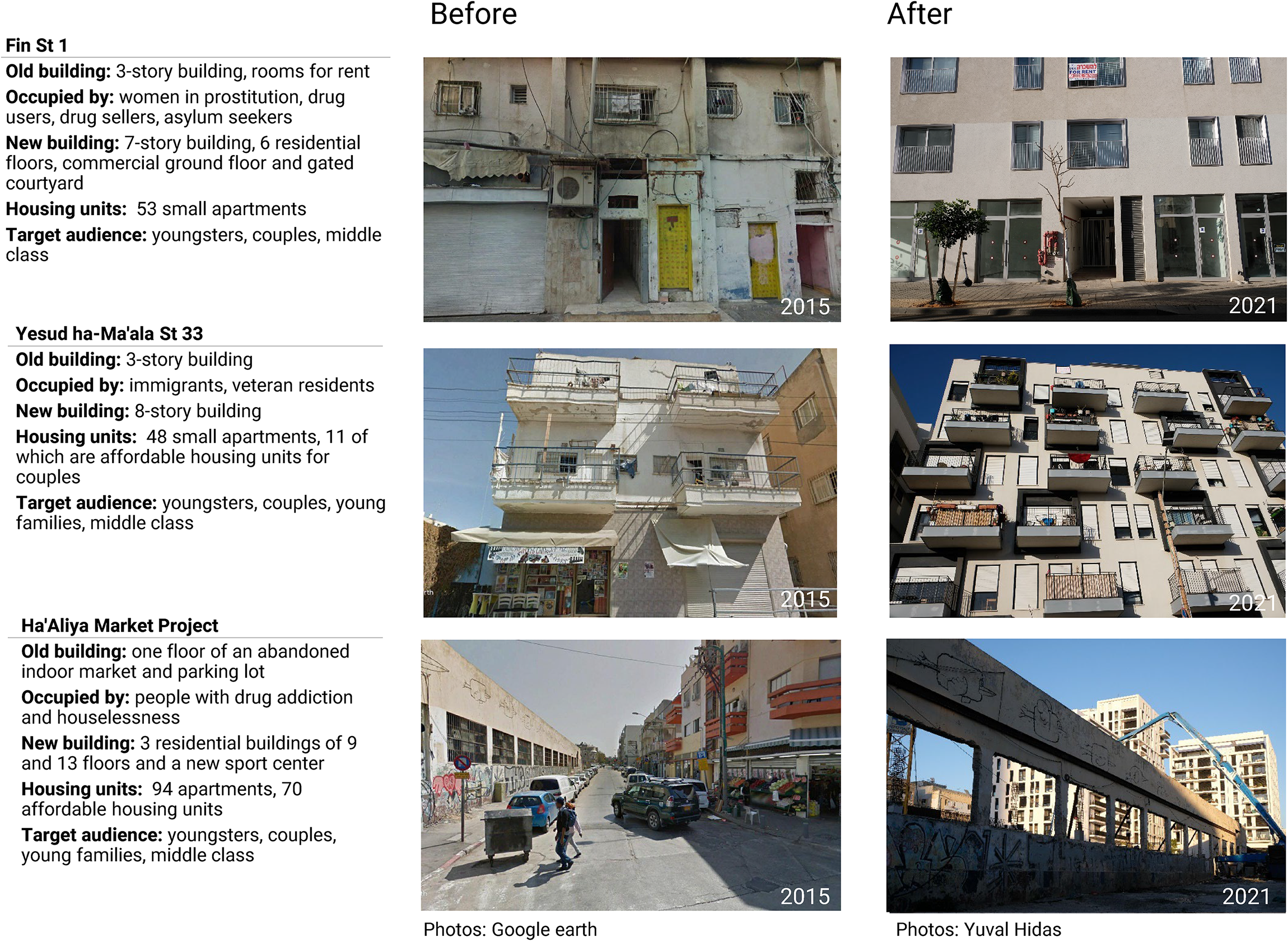
Sample of urban renewal projects that have changed the neighborhood.
Methodology
The paper is based on qualitative research methods, including interviews with police and urban police officers (N-15) and ethnographic work with “SELA”—Tel Aviv's urban police. The interviews with police were approved by the Department of Behavioral Sciences of the Israel Police. These were structured interviews on the topic of violence and policing in South Tel Aviv, particularly in the Sharet Police Station. The interviews were conducted between 2018 and 2020 at the station with the interviewee's consent to participate in the study. The sample consisted of 1 urban police commander, 1 Sharet Police Station commander, 3 community officers and 1 commander, 1 chief of patrol, 2 foot patrol chiefs, 1 chief of criminal investigation, 1 chief of technology, 1 special patrol unit chief, 2 patrol officers and 1 retired officer. Moreover, ethnographic work was carried out over 6 months with the urban police patrol units in Neve Sha’anan. This work included riding along in patrol cars, accompanying the police on joint foot patrol and meetings with the community. Spatial analysis of urban renewal processes was performed using the Tel Aviv GIS database, Madlan real estate website and field work. This activity was part of a broader study in which interviews were also conducted with old and new residents, care organizations and NGOs, people in prostitution, those with substance abuse issues and people experiencing houselessness. However, this article focuses on the reflections of police and their roles in the processes of gentrification.
Part 3: Findings
Reflecting on Police Practices: Situational Crime Prevention on the way to Nowhere
Situational crime prevention (SCP) consists of enacting measures to reduce criminal opportunities (Andersen 2010). It is composed of three main elements: an articulated theoretical framework, a standard methodology for tackling specific crime problems, and a set of techniques for reducing opportunities for crimes (Clarke 1995). It seeks to modify the environment in which crime occurs, making crime more difficult, riskier and less rewarding. Influenced by this theory and practice, the police in South Tel Aviv lead a number of operations aimed at changing the environment to prevent crime and restrict certain activities that are criminal or seen as generating crime and disorder. Hot spots of crime in public spaces are turned into playgrounds or parking lots; fences, barriers, and lighting are installed to prevent people from sleeping or loitering there. Buildings and apartments used for drug trafficking or informal places for the houseless are sealed and closed for safety or bureaucratic reasons based on a collaboration with the Licensing and Planning Department of the city. “This is what we call situational crime prevention to bring the area to a normal state. […] The aim is to keep out offenders. It's not the real estate that is changing the area, it's SCP”, explained one officer in 2018.
The most celebrated SCP act was the closing of a still unbuilt plot that was inhabited by dozens of drug users. The place was called the “death alley”. Police evacuated users and cleaned the area; grass was planted, a high fence was set up, and a police car was parked in front to prevent people from coming back. “Before” and “after” posters were proudly hung on the walls of the police station. Two years later, however, officers are skeptical about whether this was the right strategy for tackling drug use and houselessness. These practices, in addition to the accelerated construction of buildings that were previously empty and neglected, led to the dispersal of houseless people and drug users across the neighborhood. Thus, their visibility in public space increased significantly, and with that, public complaints from the growing community of new residents increased as well. According to the police, they found themselves moving around the houseless individuals and drug users from one place to another. They realized they have no real solutions to offer either the people in distress or the residents. The futility of their action provoked critiques of prevention strategies that do not offer satisfactory, genuine and long-term solutions. In retrospect, they questioned whether a confined model would be better for the police, welfare and care organizations, the normative residents and general public order. As described by Chief of Patrol: “At the time it was a success, but if you look at the long term, if you ask me, it's the balloon effect. (…) The patrol officers’ phone wouldn’t stop ringing with residents reporting on drug addicts below their windows. (…) It’s pointless, I just move them from here to here. In policing drug addicts, maybe it’s better if they are concentrated in one place”.
The balloon effect describes a phenomenon in which a police intervention moves the objectionable activity to another nearby location (Windle and Farrell 2012). After a while the officers developed a cynical attitude toward their own work. As one of the officers explains:
“It goes like this, we give a briefing: ‘Well guys, Hasharon Street is blown up by drug addicts, start moving them.’ They are looking at you, ‘Okay… We close Hasharon Street, and then what?’”
Police officers are frustrated with the lack of real tools and solutions in the face of complaints from residents and business owners on the one hand and with dealing with these populations in need on the other. In recent years, the police are influenced by the community policing paradigm that seeks to create partnerships with local organizations and widen the responsibility for security and informal control (Johnston 2005; Hughes 2006; Herbert 2009). Hence, they have strengthened their collaboration with local aid and care organizations working with people experiencing or involved in houselessness, prostitution and substance abuse. Lectures, daily work, round tables and joint operations have managed to induce a perceptual change among police officers regarding these populations in need. They are more aware of the victimization narrative of women in prostitution (Farley 2005) and perceive substance abuse and houselessness as driven by addiction, mental distress and traumatic experiences (8 out of 15 police officers expressed empathy toward this population, while the others did not address the issue explicitly). “They are poor people”, explains an officer, “It's people who have lost touch with their families, it's just them and the drugs”. They try to direct these individuals to shelters or welfare services. However, these facilities are few and ill equipped, especially in the era of austerity, privatization of care services, individualization of social problems and post-rehabilitation efforts (Feeley and Simon 1992; Garland 2019; Conradson 2003; Dickinson et al. 2012; Wacquant 2009). “We’ve got nothing to offer them… It's not the police who can solve this problem” says a foot patrol officer. Therefore, the police compromise their visibility in space by engaging in mobilization and dispersal. As one officer describes:
We don’t want them to sit in groups, our goal is to disperse, disperse, disperse. Make them find other corners or not to be together. it will not prevent them from using drugs, (…) it just makes the streets look cleaner, to help the residents.
Another officer shared an idea that they came up with in a workshop in which they participated to resolve conflicts between residents and people in need in a more humanistic and effective manner:
We had an idea—there are so many organizations working here, the Methadone Center, ‘Salit’ for women engaging in prostitution, the Lewinsky Clinic for sexual diseases, those who distribute sterile syringe—let’s take all of them and build a service center. But make it nice, inviting, so that we as the police will not have to push people there. They will want to come and use here, sleep here, shower, relax, everything will be here. If we collect all the resources spread between the municipal welfare services, the NGOs, and donations and put it all in one place… But make it inviting. This will also free up public spaces from these people.
The vision of the police officer is to create a rehabilitative space, which will resolve conflicts between the residents and at-risk populations by creating a spatial distinction that will prevent such conflicts in public spaces. Moreover, the police seek dignity and care for needy populations, believing that enforcement alone will never be a sufficient solution. Key to their idea is building a place that they can direct, not force, people to go to. This imaginary building is the opposite of the futile act of moving them around and around, getting nowhere.
Reflecting on the Police Force’s Social and Moral Obligations: “Have we Become the Private Police of the Newcomers?” Digitization and Coalitions of power
Digitization processes reshape police–community relations and create new coalitions of power in space. The gentrifiers who moved to Neve Sha'anan demanded order maintenance, hazard reduction, nuisance control and the overall improvement of the neighborhood. The police station commander explained that the new residents come with “a slightly different agenda”. Furthermore, they demand the quality of life found in North Tel Aviv, which is the richest part of the city, “But they want it now! he explains.” To satisfy the new residents, the police established a collaborative advisory committee with the community to set goals and priorities for police tasks in the neighborhood. Additionally, new platforms for digital communication (such as WhatsApp groups) were formed with residents and business owners to improve police services. Digital communication makes police services immediate, accessible, nonhierarchical, direct and limitless in terms of available hours, number of inquiries and data transformation. It eliminates the need for call centers and bureaucratic processes. Tech-based services are available only for those who possess digital means and digital skills. In an area where foreign workers, asylum seekers, people in prostitution, drug users and houseless individuals reside next to residents from diverse socioeconomic backgrounds, the line between those who have digital means and those who do not is crucial. Hence, digital systems benefit and automatically leverage the digitally connected populations (Hatuka and Zur 2019). The technological gap reinforces the tendency of police to serve normative, middle-class populations. The newcomers, who are mostly young, educated and digitally skilled, enjoy immediate access to personal and direct police services. By using digital platforms on a daily basis, sending requests, images, videos and complaints, these residents give police officers extensive exposure to their spatial experiences, problems, needs and nuisances. Digital communication gives the digitally connected an advantage in pursuing the sociospatial order they strive for.
A chief of community officer reflected on the new relationships formed with parts of the community and asked, “Have we become a private police force, or a private contractor of the “strong” communities? How can we be sure we are not violating the rights of others?” He recounted one case in a new residential building that raised this dilemma: It’s an affordable housing project run by the municipality that brought a strong normative population here. How normative? Super normative and also influential. Now, you bring a strong population and assure them that the area will change, but today I need to deal with the reality. I have to give them confidence and security, and they complain all the time: ‘Why are they breaking into the building? Why are there brawls in the streets, why is there noise and drunk people at night? Why and why and why…
Eventually, the police decided to form an advisory committee that involved only the building residents “because we [the police] understood that this is a population that needs to be treated personally”. Together with the residents they set five goals, and the police committed to making three-foot patrol visits per shift to increase the residents’ sense of security. As the officer noted, “They still flood me with messages, but I also explained to them, ‘With all due respect, I'm not a private security company either’”. This statement addresses two problems: first, the police are unable to provide services 24 hours a day. Second, morally and professionally, the police are aware of the risk of becoming “private contractors” in the service of normative residents at the expense of infringing on the rights of others. There is a danger that residents will complain on random people based on the degree of nuisance or visual discomfort experienced rather than criminal law and the existence of offenses. As the officer explained:
Imagine now that you're sitting at home and sending us a picture from your balcony—‘He’s bothering me.’ I come as a policeman, but that man doesn’t do anything harmful. After all, there is a basic law—everyone has the freedom of liberty. The drug addict who sits under the building also has the right to sit there, so why should I come and evict him? (…) We should be very careful, just because of the fear that we as a police force will become an execution contractor that makes mistakes.
To avoid this becoming the reality, officers instruct their teams to arrive at the scene, collect testimony, question the person and offer him or her shelter. However, if the person refuses, he or she has the right to stay there. The officer quoted above was concerned about the potential violation of rights and aimed to strike a balance among serving the community, upholding the rights of individuals, and adhering to the law. However, his remarks reveal the pressure placed on the police to deal with “disturbing” populations that experience more interactions with the police in the form of questioning, harassment, evacuations and fines. The officer confirmed the claims that under gentrification, the streets and the whole area have become more hostile toward certain populations in order to conform to the quality of life demanded by the new residents (Sharp 2014; Bloch and Meyer 2019; Newberry 2021; Fagan et al. 2009).
Spaces still transitioning through the phases of gentrification become, for a certain amount of time, a hyperheterogenic environment, with old and new buildings residing in close proximity, creating a mix of old residents and new residents, immigrants and veterans, and “normative” and “nonnormative” populations. The police maneuver between these populations via digital communication, which enables micro borderwork in a physically mixed environment. Digital communication becomes a bordering practice and a geometric layer on top of the built environment that enables the separation of and differentiation between populations in close proximity. Digital technology plays a significant role in the provision of police services that both highlight and increase divisions based on class, normativity, ethnicity and citizenship. Neighbors on the same street and even in the same building enjoy different relationships with the police based on their use of digital tools. Thus, digital coalitions of power are formed by the newcomers and the police.
Reflecting on the Police Force’s Role in Urban Politics: Do They Truly Want a Win Here?
Urban renewal of formerly neglected and marginalized areas in the city is a continuous part of city life. This activity has a certain periodicity and reflects the constant dynamics of the city and the relative dimension of urban spaces that are constantly being redefined. South Tel Aviv and Neva Sha’anan were especially troubled by social problems that were moved there during the urban renewal waves of the 1980s-1990s (Marom 2014; Schnell and Graicer 1993). At the time, street prostitution was pushed there from the city center (Zur 2021), drug trafficking and crime proliferated, and foreign workers settled in South Tel Aviv (Sabar 2008). The current wave of urban renewal that is sweeping South Tel Aviv undermines the spatial-moral order that has been in place for the last two to three decades in the city. Hence, it triggers conflicting interests and measures meant to serve those who seek to renew and “cleanse” the area on the one hand and those attempting to contain these problematic phenomena within this area on the other. As one of the officers wondered during an interview: Officer: We cannot beat this area alone as the police. This place requires bigger intervention. But first, there needs to be a blunt decision about whether they want to win this place or not.
Interviewer: Why? You think they don’t want to win this place?
Officer: Where do you live? (…) Let’s say I close everything here; are you willing to have this under your house? No. (…) So maybe someone from the high floors is seeing something that I'm not seeing from down here, maybe it's meant to be here. They’re telling you, ‘Deal with it! That’s what you’re being paid for’”.
He speculated about whether the expansion of the police force was meant to ‘solve the problem’ or to contain it so it would not bother or jeopardize the quality of life in other areas or the economic and touristic activities situated nearby. The head of the Addiction and Homelessness Department in Tel Aviv Municipality explained how he sees the area in terms of urban functionality:
South Tel Aviv in the last ten or fourteen years (…) has always been the backyard of Tel Aviv- Jaffa; in my eyes, it serves a function for the city and society. There is one place, they are all there and you can help them. They are relatively contained and not scattered throughout the city. And if every city should have this social section, then it is better for everyone that it will be in this area.
The officers were puzzled by the contradictory decisions of the municipality and national ministries. They criticized decisions that reinforce the concentration of drug trafficking and drug users in this area, such as the decision to establish another methadone center in the neighborhood. Meanwhile, to address residents’ complaints, the local authorities instruct the police to tighten their crackdown on prostitution and houselessness. This generates spatial negotiations between the various police stations in the city, as each station is determined to protect its territory.
The question today is who will get hit. It is very problematic for everyone right now; all stations are alerted […] but none of them has the forces we’ve got. Jaffa Station has already asked us to back up their forces for an operation to push the drug users back to us. It’s going to be like a ping-pong. […] The police station commanders are fighting each other […] Our commander says, ‘Why should the problem be in my area all the time? Why is it so obvious that they should be here?’
The comments of the chief of the community highlight the borderwork between various areas, users and institutions in the city sparked by gentrifying a high-crime neighborhood. With various gatekeepers protecting their territory. Police spatial negotiation indicates how spaces are relationally constituted (Fuller and Löw 2017) both metaphorically and physically and how police construct spaces, regulate moral and functional order and produce spatial distinctions.
However, the police expressed frustration about their position in decision-making processes: “We are unable to oppose the Ministry of Finance, the Ministry of Health or the mayor, because I am not allowed to speak politically”. While the community approaches the police officers as state representatives, the officers themselves see their limited influence and distance from decision-makers. From their perspective, the community is much more influential over their actions: “We tell the community, ‘We need you to bear this struggle and be our mouthpiece against the state and not the other way around’”. Being aware of their position, engaging in everyday interactions with the community, having limited tools to effect real change and being distant from decision-making, police officers question their role in the broader political game. Are they here to make a change, to win this place, or to preserve its borders?
Conclusion: Policing Temporality
Gentrification is identified as a “common thread in which landed power and financial power intersect to eke out exchange values from the city, (…) at the expense of those who inhabit space without the economic means” (Kallin et al. 2019, 36). However, the study of policing enriches our understanding of gentrification by exposing additional considerations that arise in the urban arena especially in regard to gentrifying a high-crime neighborhood. The gentrification of areas where incivilities are concentrated incites institutional and spatial contestation, produces spatial unrest and attracts contradicting forces and interests. High-crime neighborhoods play a functionally, morally, and economically significant role in the city by demarcating and concentrating undesirable phenomena and groups. Especially in global cities that function as financial and touristic nodes, this spatial mechanism grants other areas in the city social comfort and safety for residential, consumption, leisure activities and capital investment (Smith 1996; Hubbard 1998; Brands, van Aalst, and Schwanen 2015; Aalbers and Deinema 2012; Aalbers and Sabat 2012; Sibley 1995). Therefore, the gentrification of these areas is not a single-vector process of change but a state of negotiation and struggle between conflicting visions, values and solutions. It evokes intraurban and interurban tensions beyond the neighborhood scale among police stations, municipal authorities, residents and the people involved in those activities. The officers experience and expose these tensions from the ground up because they are the ones who manage the visibility and locality of these phenomena in public spaces. Influenced by the current paradigms in policing, such as SCP and community policing, they try to prevent or displace incivilities to respond to the nuisances of the normative population. Wacquant (2009) argues that in the neoliberal era, social problems are articulated as issues of security, danger, crime and violence. Therefore, policemen are at the forefront of dealing with social problems such as poverty, mental illness, distress, unemployment and delinquency, problems that stem from inequality, exclusion and reduction of welfare (Wacquant 2009). The officers experience the limitations and conflicts that derive from that paradigm. In their daily routines, they experience a lack of resources, tools and real solutions for the social problems that they encounter. Thus, they must maneuver the populations and uses from one corner to the other, which provokes a dynamic mix of repression, displacement and territorial pushback from different areas in the city. They become critical of police practices and are frustrated by the limitations of policing due to the lack of sustainable and substantial solutions to help the populations in distress. They strive for solutions that can benefit both parties, i.e., residents and populations in need, which can make the police action meaningful and purposeful instead of a futile effort of movement across space.
As this study shows, the role of police under gentrification is not to strive for a fundamental change but to
In terms of temporality in gentrification, it is crucial to think of it as processes that take a consecutive period of time (Sakizlioğlu 2014). Time is meaningful and effective to all people and parties involved, so the change in people's perceptions and representations with gentrification should be studied (Peršak and Di Ronco 2018). Thus, we need to ask how this process affects police officers and what behavioral patterns, insights and feelings it develops in them. Their position at the center of the conflict between new residents, old residents and populations in distress obliges them to deal with social tensions, moral dilemmas and intense emotions directed at them. For officers, policing temporality comes with a price—over time, it undermines their motivation and elicits feelings of indifference, alienation, and despair, as five officers testified about themselves and their subordinates. In front of the newcomers called “the community”, the officers feel that they are failing to keep their promise to eradicate crime and nuisances. Criticism and anger from disappointed residents reduce their motivation to serve the community. In front of populations in distress, the lack of social solutions and rehabilitation options and the routine cat-and-mouse games in public spaces ultimately undermine the police's empathy toward such populations—empathy that grew out of working together with aid and care organizations. The officers become cynical about their tasks. Their experience cripples their belief in intervention practices such as situational crime prevention, which operate in a microgeographical manner but fail to deal with problems on a wider scale (Atkinson and Millington 2020; Peršak and Tulumello 2020). In the end, the realization that their task is to bear the contradictions and tensions in space until urban renewal can take full effect, i.e., to police temporality, discourages the police, as the interviews indicated. Policing gentrification means intervening in a socially complex environment that clearly and prominently reflects how the police actively participate in the construction of urban space and urban borders (physical, symbolic) and how they reinforce social boundaries and inequality. Importantly, the officers’ interviews indicated that they themselves are aware of this issue at some level and are troubled by it. However, higher-ranking police officers, policy makers and criminologists can benefit from listening to the criticisms raised by the officers, which highlight the limitations of narrow place-based police intervention and neoliberal urban development policies devoid of welfare and long term solutions.
Footnotes
Declaration of Conflicting Interests
The author(s) declared no potential conflicts of interest with respect to the research, authorship, and/or publication of this article.
Funding
The author(s) received no financial support for the research, authorship, and/or publication of this article.
