




Abstract
This paper outlines the development of a Rural Digital Hub Guide. Digital hubs comprise one of a range of solutions that policymakers can implement in rural regions to promote digital engagement among communities and businesses. The guide was developed as part of an Interreg VB North Sea Europe Programme which focussed on testing innovative solutions to the Urban-rural digital divide by improving digital skills, services and infrastructure. This paper explains how the Rural Digital Hub Guide was researched and developed, the creation of a typology of digital hubs and the key steps that policymakers need to consider when establishing a digital hub in their region.
Introduction
The presence of a fast and reliable broadband network is of crucial importance to the economic and social development of an area. It is key to business competitiveness and social inclusion, providing access to a range of emerging technologies linked to business, public sector services, health and education. The Fourth Industrial Revolution is offering opportunities to transform the way we live and work, by providing a range of technological developments that have the potential to fundamentally change society, much in the same way that electricity and automation did during previous industrial revolutions (Cowie et al., 2020). However, there are still many reasons why people are not digitally connected, including a lack of access to digital devices, poor digital skills, affordability or simply a choice to stay unconnected. These issues are often magnified in rural areas where digital connectivity and internet services are poorest, thus reinforcing the urban–rural digital divide (Philip et al., 2017; Riddlesden and Singleton 2014; Warren 2007). Without policy intervention, there is a risk that rural ‘hard to reach’ communities and economies will continue to be left behind as residents are unable to access superfast Next Generation Access (NGA) digital networks or lack the skills to use them (Ashmore et al., 2017; Salemink and Strijker 2018; Townsend et al., 2013).
Digital hubs comprise one of a range of solutions that policymakers can implement in rural regions to promote digital engagement among communities and businesses. This paper outlines the development of a policy guide to rural digital hubs. It explains how the guide was researched and developed, the creation of a typology of digital hubs and the key steps that policymakers need to consider when establishing a digital hub.
The Rural Digital Hub Guide, Be Bold; Be Innovative; Be a Digital Hub (Ashmore et al., 2019), was developed as part of the CORA (COnnecting Remote Areas with digital infrastructure and skills) project, funded through the Interreg VB North Sea Europe Programme. The CORA project brought together 18 partner organisations, including municipalities, universities and SMEs, from seven EU member states to explore innovative solutions to the rural digital divide. CORA focussed on different aspects of the digital divide, specifically infrastructure, skills and services (such as e-government) and included testing of activities such as cross-border fibre sharing, inter-generational digital training and solutions to improve digital awareness. Alongside this, a key focus of the CORA project was to develop the concept of digital hubs and explore their potential as a route to digital engagement in rural areas.
Policy context
As part of its Digital Decade, the European Commission has set an ambitious target for all European households to be covered by a gigabit network by 2030 (European Commission, 2021a). Strong progress has been made in the deployment of the high capacity networks capable of delivering this with 59% of households now being covered (European Commission, 2021b). However, regional disparities still persist with just 28% of households in rural Europe having access to a gigabit network (European Commission, 2021b). In fact, 41% of rural European households are not covered by NGA broadband of at least 30Mbps and 10% do not currently have access to any fixed broadband network (European Commission, 2021b).
Despite this, the North Sea Region of Europe has some of the highest rates of broadband coverage, but national-level data conceal stark urban–rural differences. The large and sparsely populated nature of countries like Sweden has created challenges for rural broadband deployment and fewer than half of rural premises are connected to NGA broadband (European Commission, 2021b). Even in more densely populated countries like Denmark, where more than 96% of households have access to NGA broadband, only 71% of those living in rural areas have access (European Commission, 2021b). In the UK, the National Infrastructure Strategy recognises the importance of strong digital networks to support rural economies (HM Treasury, 2020), yet 19% of rural homes do not yet have access to NGA broadband and 8% (413,000 households) are unable to access download speeds of even 10Mbps (Ofcom, 2020). The UK Government also recently reduced its aim of having nationwide gigabit coverage by 2025 to a ‘minimum of 85% gigabit capable coverage’ which will disproportionately affect connectivity in rural areas (HM Treasury, 2020).
In addition to a lack of access to NGA broadband, residents in rural areas face greater barriers to developing digital skills. The population is generally older than in urban areas and therefore less likely to use digital technologies. There is often an out migration of (more digitally skilled) younger people and the distances required to travel to learn may be greater, which magnify the urban–rural digital divide (Eurostat, 2020; McCurdy, 2019).
In 2020, the EU reported that only 56% of the population had the most basic digital skills needed to interact online and consume digital goods (European Commission, 2021b). The European Pillar of Social Rights Action Plan (European Commission, 2021c) aims to increase this figure to 80% by 2030 with the European Commission stating that ‘access to education allowing the acquisition of basic digital skills should be a right for all EU citizens’ (European Commission, 2021a). In the UK, it was recently estimated that 11 million people (21%) were without the digital skills needed for everyday life (Lloyds Bank, 2021a) and despite the COVID-19 pandemic increasing the number of people using the internet, 2.6 million (5%) are still offline, and many still do not understand what they stand to gain from being online (Lloyds Bank, 2021b). The lack of digital skills affects economic growth across Europe, with 70% of employers stating this skills gap is an obstacle to investment (European Commission, 2021a). Lloyds Bank (2021a) estimates that 11.8 million people in the UK workforce lack the ‘essential digital skills’ required for work and 37% of employers state that their current workforce does not have the advanced digital skills they require (WorldSkills UK, 2021).
The European Commission has a number of initiatives aimed at improving digital skills, including the recently launched Digital Skills and Jobs Platform (European Commission, 2021d). This brings together national stakeholders to provide information and resources on digital skills and jobs to help citizens advance their knowledge. In the UK, six Digital Skills Partnerships have been established to tackle local digital skills challenges (DCMS, 2018), the Fast Track Digital Workforce Fund has been initiated in the North West to co-create training with local employers (DCMS, 2020), the Essential Digital Skills Qualification was launched during 2020 (DfE, 2019) and the Digital Lifeline fund is providing digital support to those with learning disabilities (DCMS, 2021). The UK Government’s Digital Strategy is also due to be updated during 2021 and it is likely that digital skills development will play a key role.
Alongside these initiatives, digital hubs can be implemented as a way to enhance the local digital environment. For rural areas, they offer a key policy approach for improving digital connectivity and supporting the development of digital skills. The presence of a space, within a community, where people and businesses can use and learn about digital technology can help rural areas become more connected and overcome issues of both physical and social isolation (Townsend et al., 2013). In turn, this can attract new businesses, create new employment and thus help boost the local economy.
The Rural Digital Hub Guide, Be Bold; Be Innovative; Be a Digital Hub, (Ashmore et al., 2019), has been developed to identify and describe different types of digital hub, the services they provide and how they have been implemented to support businesses and communities in rural areas. For rural areas, the development of digital hubs offers a key policy approach for improving digital connectivity and supporting the development of digital skills.
Research approach
The Rural Digital Hub Guide was developed using data gathered from a number of primary and secondary sources. Firstly, a systematic literature review was conducted to explore (i) existing definitions of digital hubs; (ii) the different types of hubs in operation, including their core aim and service, size and target audience; and (iii) current examples across Europe to provide a comprehensive picture and understand emerging trends in rural hub development.
Secondly, the two principal university partners in the CORA project, the University of Groningen and the University of Lincoln, developed and conducted two surveys. The first was undertaken online with 10 municipality partners in the CORA project to explore the current picture of broadband availability and uptake across each region, and to identify existing initiatives to support technology adoption and use, including digital hubs. A second, supplementary, qualitative survey focussed specifically on digital hubs, and received 14 responses from CORA partners and selected organisations involved in hub development across Europe.
Thirdly, the emerging findings from the research were discussed with policymakers from across North Sea Europe as part of the annual CORA Conference held in Kiel during November 2018. Three round-table discussions took place, at which participants were given a brief overview of digital hubs, and some examples of challenges and solutions. Participants were invited to give feedback on the preliminary research and share the experiences from their regions. The discussion was transcribed and analysed using thematic analysis to identify success factors for developing digital hubs.
Defining hubs
A review of the literature has shown there to be no universal concept for digital hubs. The term ‘hub’ has become ‘universal but slippery’ (Dovey et al., 2016), and may represent different shapes, sizes and agendas. Digital hubs encompass a range of functions, including coworking or networking spaces; innovation spaces in specific economic development contexts; spaces for emergent technology demonstration; or points for public broadband access (Afacan et al, 2013; Bouncken and Reuschl, 2018). They can include large scale interventions, such as the network of Digital Innovation Hubs (DIHs) introduced by the European Commission to help businesses respond to digital challenges (Kalpaka et al., 2020), or facilities for creative and digital communities, such as makerspaces, fablabs and hackerspaces (Tõnurist et al., 2017; Van Holm 2014). Many of the names for hubs are used interchangeably despite differences in their target user group. Rundel et al. (2020) outlined variation within rural digital hubs and classified them based on who the hub was aimed at – businesses, communities or both whilst Toivonen and Friederici (2015) identified four key features that defined the role of innovation hubs.
The Rural Digital Hub Guide includes a typology that considers both users and functions of digital hubs. The Guide aims to help policymakers and investors understand the role and benefits of such spaces and make informed decisions about how they could support broadband connectivity and innovation in their area. For the purpose of the Guide, digital hubs have been defined as: ‘spaces with access to superfast broadband, often alongside community and business focused services’. Such spaces can provide internet connectivity in areas which may otherwise be poorly served, support the development of digital skills and showcase emergent digital technology (Afacan et al, 2013; Price et al., 2018). The final typology is set out below together with 10 steps that policymakers may wish to consider when establishing a digital hub.
Typology of rural digital hubs
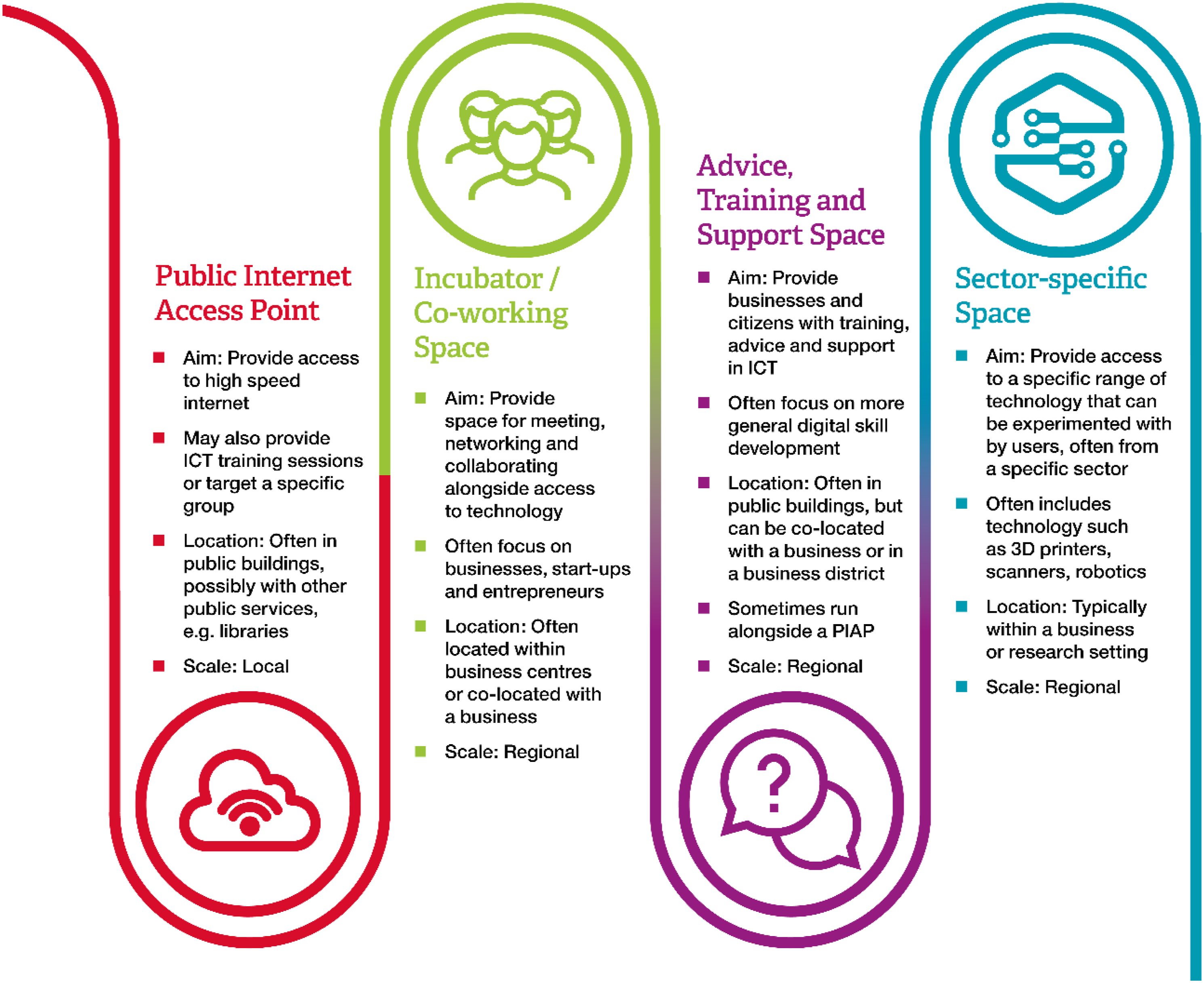
The typology sets out the most common functions of rural digital hubs, as identified in the literature and hub surveys. The four types of digital hubs can exist in isolation, but often overlap to offer a blend of services to businesses and communities (Figure 1): • Public Internet Access Points (PIAP), which offer access to high-speed internet, are the simplest form of digital hub. As broadband coverage in rural areas gradually improves, there is a reduced need for PIAPs in all but the most poorly served communities. • Incubator and Co-working Spaces provide meeting, desk and collaboration space for small rural businesses and remote workers. They can be located in a business centre or co-located with other businesses, such as pubs or cafes. • Advice, Training and Support Spaces focus on awareness raising and digital skills development of rural communities and businesses and are often located in accessible premises such as libraries or other public buildings. • Sector-specific Spaces support the technology needs of business sectors by offering access to specialist technology, such as 3D scanners, printers and robotics, often in a business park or research campus setting. Digital hub typologies (Ashmore et al., 2019).
Steps to setting up a digital hub
Alongside considering what type of hub is required in an area, the following steps set out the main factors that policymakers will need to consider when seeking to establish a rural digital hub. They include the key elements and success factors of digital hubs in rural areas, as identified from the literature and hub surveys and are exemplified with case studies where appropriate.
Source of funding
Digital hubs in this study were funded from a range of sources including private investment, regional development funds, national or local public funding and membership fees of hub tenants/users. Funding would be expected to cover the following elements: office space lease or purchase, specialist equipment and digital devices, staff time to design services and purchase relevant equipment, overheads and maintenance, staff to run the hub and advise hub users and branding and marketing to raise awareness of the digital hub and engage users.
A number of hubs (e.g. the Lincolnshire Technology Hubs in the UK) have drawn on regional development funding to part-fund equipment and to offer free business support and advice to SMEs. For incubator and co-working spaces, a fee-based system for tenants and users can cover or subside the cost of running the hub. Hub managers must consider what is affordable for users, however, and often a short-term or flexible fee-based system may be preferred by smaller rural businesses.
Strong leadership
The presence of a committed initiator or leader was identified as a key success factor for digital hubs. Whether from local government, businesses or a community group, their role is essential in ensuring that the concept of the hub is pushed forward and seen through to completion. The need for networking and facilitation to help engage with the target audience and promote the hub with stakeholder networks was emphasised by those running a hub.
This role was identified as particularly important for incubator/co-working spaces and Sector-specific Spaces, where networking could help embed the space within the business community, and foster linkages between hub users. For example, the Managing Director of C4DI, an incubator and co-working space in Hull, UK stated that ‘facilitation is probably the most important role of the hub’. While some businesses are good at networking, others benefit from strong leadership to bring them together to create more meaningful relationships. These can lead to the development of new ideas and collaboration on potential contracts and other project opportunities.
Service users
Engagement with service users was identified as critical in the planning and design of digital hubs. Without users’ views on potential services, there is the risk that the hub does not reflect or fulfil the needs of its target audience. This is particularly important when considering investment in equipment, as well as potential services such as training and 1:1 advice and guidance.
Early engagement with users, whether community groups, businesses or residents, was identified as important for securing buy-in. Co-creation of services helps to create a sense of ownership among potential users and improves potential for ongoing engagement. As an example, during the design of a new digital hub in the rural town of Give, Denmark, Vejle Library Service worked with a local meet-up group of digital experts to determine how the hub should be equipped. As a result, the Give Hub was equipped with 3D printing technology, photo-editing software, Virtual Reality equipment and raspberry pi’s. These are used by members of the digital meet-up group, who have raised awareness of the hub via their own personal networks, as well by the wider community and school groups.
Beyond engaged groups, there is a need to market the digital hub to potential service users across target groups. Here, the marketing message should be kept simple with a focus on the key benefits of the service to users, supported by case studies and testimonials. Open days and events were cited as ways to attract potential users to the hub, particularly those that are reluctant to engage with digital technology and therefore less likely to consider visiting a hub.
Stakeholders
Engagement with key stakeholders, including politicians, local and regional authorities and organisations that represent target groups (e.g. Chambers of Commerce, digital meet-ups, skills agencies and schools) was identified as important for raising the profile of the hub, as well as linking to further potential users. A number of hub leaders identified that being able to link the hub into the priorities of stakeholder organisations was important. For example, the Broadband Information Center in Winschoten in the Netherlands benefitted from the backing of the town’s Alderman, who championed it as a priority for the community and helped to push the project forward. It is therefore important to consider the benefits of the hub to stakeholders from a strategic perspective, for example, by highlighting how the hubs can contribute to digital inclusion in the region or enhance the local economy.
Scale
The great diversity of hub types and target groups means that hubs can be focussed on a single community, a local area or have a ‘regional’ remit covering a wider geographical area. When setting up a hub consideration needs to be given to the area users will be drawn from to ensure there is sufficient demand to support the hub. Public Internet Access Points are generally locally focussed and often found in the most rural areas where internet access would not otherwise be possible.
Other types of hubs are likely to draw users from a wider area, often around a cluster of villages or a market town. Co-working spaces, for example, may offer services to residents from a number of rural villages where broadband speeds may not be sufficient for effective home-working. An example of this is the Herdwork co-working space based in rural Cumbria, UK, which aims to reverse the rural exodus of talent by offering workspaces to rival those found in large cities. Sector-specific Spaces may also provide services to a wider area. The new C4DI digital hub, set up in the market town of Northallerton, focuses on emerging technology and co-working space for businesses in the agriculture and food processing sectors. It draws users from across rural areas of North Yorkshire, UK who would otherwise need to travel much further to access such technology.
There is a need to consider the number of potential users of the hub within the relevant community and how this translates into requirements for floorspace, number of rooms and space for technology. Here, working alongside potential users is key, as well as conducting feasibility studies that quantify the potential size of the target user group.
Space
Few of the hubs examined were hosted in purpose-built spaces, with most co-located in existing premises. Examples include libraries, city halls, university buildings, science parks, local businesses and office communities. This reduced the set-up costs of the hub and provided the opportunity to make use of under-utilised space. Shared staff costs and existing footfall to the host and neighbouring premises were other benefits of co-location. Co-location of hubs on university campuses and science parks can broaden access to technology that may already be available and in use by academics and students, thereby fostering university–industry linkages and facilitating innovation.
The size and specification of the hub space are particularly important for Incubator/Co-working Spaces which often include hot-desks and meeting rooms. Ensuring the facilities offered by these hubs are attractive to potential businesses is key, as is creating an environment that fosters networking and collaboration. Examples include access to a shared kitchen, unlimited tea and coffee and a series of events that bring hub users together. Co-working Spaces range from large innovation hubs, such as the Mansfield Innovation Hub in Nottinghamshire, UK, which features high-speed internet, a day nursery and café alongside meeting and desk space, to informal spaces such as Collingham co-working group which meets on a regular basis in an upstairs room of the village pub in rural Nottinghamshire.
A key consideration is the accessibility of the hub for the target audience. The location of the hub at the heart of the community, whether residential or business, is a key factor in its use. For the most remote communities, a mobile rather than fixed location hub may be the most appropriate solution. For example, in Syddjurs, Denmark, the municipality converted a library bus into a mobile digital hub which travels around remote communities to raise awareness of, and showcase, new technologies to residents and businesses. Other mobile models include ‘pop up’ hubs, such as A1 Community Works in North Yorkshire, UK which delivers digital training in various community spaces across a sparsely populated region, including pubs and village halls.
Services
While the services offered by the different types of digital hubs vary, they all provide a high-speed internet connection. This is particularly important for hubs in rural areas where broadband connection speeds lag those in urban areas, and the local community may rely on the hub as a PIAP.
For Advice, Training and Support hubs and Sector-specific Spaces, the technology hosted needs to reflect the needs of the service users. As outlined above, there are benefits in working alongside user groups in identifying the specification of technology. For some community-based hubs, the technology can comprise laptops, printers and scanners for use by residents with little support from staff. Whilst for Sector-specific Spaces which offer more advanced technology, such as 3D scanners and printers, Artificial Intelligence and CNC machines, access may be mediated by advisors and technicians. To ensure user groups can use and benefit from the technology, many hubs offer 1:1 advice and training workshops.
For Incubator/Co-working Spaces, the opportunity to be part of a community is arguably as important as access to high-speed internet and hot desks. Events such as networking lunches and training events can help bring co-workers together and build a community around the hub. The Impact Hub in Inverness, UK is an example of a small-scale flexible hub offering co-working space and informal gatherings to lone workers from across the Scottish Highlands. This hub enables rural workers to access training and be part of a working community despite their distribution across a wide hinterland. The co-location of other public services (e.g. parish council, business advice, public transport and delivery lockers) can build and consolidate the services of the hub and broaden its user base whilst locating Incubator/Co-working Spaces close to larger villages or towns offers users the opportunity to access other goods and services and help sustain the local economy. Hexham Enterprise Hub, UK, for example, provides self-contained pods, hot desk space and meeting rooms on the outskirts of the rural market town of Hexham, in the north of England, but within walking distance of the town centre and public transport.
Skills
Alongside internet access, improving digital skills is a core reason to create a digital hub. Hub leaders need to consider the nature of the skills gap within their target user group, and how the hub can help address that. Skills support can be provided in a variety of ways. Dedicated 1:1 support delivered by a technical advisor is effective for businesses seeking to use new technology, and a number of hubs have drawn on regional development funds to resource staff and/or consultancy time for this. Other approaches include workshops which focus on more generic uses of internet technology such as social media and website development. Many Advice, Training and Support Hubs provide training for residents with limited experience of digital technology and few digital skills. For example, the Rural Hub in County Cavan, Ireland is a not-for-profit organisation that provides e-learning and digital resources to address digital exclusion within the local area. It works specifically with disadvantaged groups to improve basic digital skills and community integration, with training and freely available online resources on issues such as online safety and digital literacy. Collaboration and peer learning are also important for skills development across all types of hubs, whether for businesses in Incubator/Co-working spaces or meet-ups of residents in community-based PIAPs. Other examples include inter-generational learning, where high school and university students provide advice and training to businesses and residents.
Staff
Staffing is a key area of resource for digital hubs. Staff roles include hub managers/facilitators, administrators and technical/business advisors and trainers. Finding staff with the right skills can be a challenge for hubs, particularly for those in rural areas. As previously discussed, co-location of hubs with libraries or businesses may create the opportunity for re-deployment or sharing of existing staff. Many smaller and community-based hubs have also utilised volunteers as a way of keeping staff costs down. For example, Horncastle Technology Hub in Lincolnshire, UK developed a programme of undergraduate internships (with interns knowns as ‘Hubbits’) to demonstrate use of equipment and offer technical advice to hub users. This was a mutually beneficial arrangement for the hub and the local university, with the hub able to offer advice and expertise at reduced cost, and students provided the opportunity for work experience.
Sustainability
Given the reliance of many hubs on (time-limited) regional development grant funding, a number identified the implications of this for their sustainability. For some hubs this is mitigated by other income streams such as membership fees, or in-kind contributions such as use of existing facilities or volunteer time. Depreciation of equipment, as well as its obsolescence over time, is another area of concern. Having invested significant sums in equipment (such as 3D printers, scanners and Virtual Reality goggles), there is a need to ensure that the digital hub is able to continue to offer current technology and fit with the future needs of its users. The Cocotte Numérique in the Murat Region of France is a hub that has moved beyond reliance on public funding. The hub, which offers high-speed internet, co-working space and digital and business training, was established in 2005 using a combination of European and local authority funding. Over time, and with income generated from training fees and rental of co-working space, the hub has become self-funding.
Within the rural context, a key aim of digital hubs is to improve access to, and use of, digital technology for residents and businesses, thereby making rural living a more viable proposition. For rural areas of Europe, particularly those experiencing population loss, some hubs have been established specifically to help retain and attract residents and businesses. An evaluation of the Cocotte Numerique, for example, identified that 43 entrepreneurs and 98 residents had been attracted to the area as a result of the hub (European Network for Rural Development, 2017). In this way, the presence of digital hubs can help to improve the sustainability of rural communities and economies.
Implications for digital hubs post-COVID-19
The COVID-19 pandemic has disrupted almost every part of society and the workplace, and the move to an online, digital economy has been accelerated. This period has demonstrated the importance of broadband internet for the continuation of everyday activities, such as schooling, office work and grocery shopping. As services increasingly move online, the consequences of the urban-rural digital divide become more apparent, with those unable to access or use broadband internet further disadvantaged (Townsend et al., 2013). Policy intervention is therefore required to find ways to improve both connectivity and the skills required to use digital technology.
The shift towards homeworking during the pandemic has increased demand for suburban and rural living, with many seeking larger properties to accommodate home-office and garden space. If the trend for home-based and flexible working continues beyond the period of COVID-19 recovery, there may be a longer-term redistribution of office-based work away from urban to more rural locations. The development of Co-working Spaces in rural areas could therefore play a pivotal role in facilitating this new distribution of labour, by providing access to broadband-enabled technology, and spaces where home-workers can co-work and collaborate. This potential shift in the location of work, from urban to rural areas, could help build new networks within local communities, support other local businesses and service providers, improve the vitality and attractiveness of an area and ultimately help develop the local economy (Hölzel and De Vries, 2021).
The need for policy interventions, such as digital hubs, to address digital exclusion is even more relevant in the post-pandemic period. Public Internet Access Points and associated services can ensure access to high-speed internet in the poorest served rural communities. The services provided by Advice, Training and Support Spaces will support rural residents to become more aware of the benefits of digital technology and engage in skills development. Support for key sectors to access and use specialist technologies, such as that provided by Sector-specific Spaces, will be important for rural businesses to engage in the process of digital transformation and realise the opportunities of the Fourth Industrial Revolution.
Conclusions
This paper has presented a Guide to Rural Digital Hubs which has been developed to support policymakers, communities and businesses that are seeking to improve their digital environment. It has set out a typology of four digital hubs, describing their broad functions and target groups. While these ‘types’ can exist in isolation, the paper demonstrates the great diversity of hubs that exist, and how the functions can overlap to offer a blend of services in different business and community settings.
The key steps, identified from research with a cross-section of hubs, outline the factors that need to be considered when planning and implementing a digital hub. A common theme, however, is collaboration. To succeed, digital hubs need to sit at the heart of a community, and engagement with target groups is key to ensuring that hub spaces and services meet the needs of their users. While a committed leader can champion and drive their development, hubs cannot simply be ‘imposed’ on a community. The success and sustainability of digital hubs rely heavily on the creation of linkages with users and stakeholders and the co-design of services.
Digital hubs should be seen as one of a range of solutions that can be implemented in rural areas to promote digital engagement among communities and businesses. Further investment across the EU and UK may eventually lead to NGA coverage across all except the most remote rural areas. However, the barriers faced by rural communities and businesses in adopting digital technology, even where available, suggest that the urban–rural digital divide will have an enduring legacy. The long-term relevance of digital hubs in supporting digital skills, showcasing technology, providing co-working space and facilitating collaboration across rural communities is clear.
Footnotes
Declaration of conflicting interests
The author(s) declared no potential conflicts of interest with respect to the research, authorship, and/or publication of this article.
Funding
The author(s) disclosed receipt of the following financial support for the research, authorship, and/or publication of this article: This work was supported in part by the European Commission and Interreg VB North Sea Europe Programme 2014–2020.
