




Abstract
In this article we consider and demonstrate the use of Generative AI (GenAI) in the design of qualitative futures research materials. We discuss how GenAI, and the speculative futures stories that it can be trained to generate, can be engaged to invoke people’s experiences and imaginaries of possible futures. We focus on how GenAI stories can be employed to enable a corrective perspective of anticipatory realism, to disrupt dominant narratives, illuminate the brokenness of possible futures, and invoke proposals for their possible repair. We draw on the example of research into automated and robotic work futures in Australia’s construction industry.
Keywords
Introduction
In this article we consider and demonstrate the use of Generative Artificial Intelligence (GenAI) in creating futures stories and their use for investigating possible futures. There is currently growing emphasis on futures research across academic disciplines (see Poli, 2024), focus on foresight among international organizations (Gluckman et al, 2024; World Economic Forum, 2023), and business proposals for integrating AI into strategic foresight (IF Insight & Foresight, 2024), whereas new approaches in design and futures anthropology investigate the experiential and everyday dimensions of possible futures (Pink, 2023; Pink et al., 2022; Pink & Salazar, 2017). Here we propose AI might be harnessed to aid investigation of everyday experience, values, knowledge and actions in relation to possible futures.
Our work addresses two recently identified qualitative research challenges: first of using AI for creative narrative approaches while keeping legitimately human emotion in focus (Chubb et al., 2021); and second of how to surpass research participants’ tendencies to concur with dominant societal narratives when asked to imagine possible futures (Markham, 2021). These challenges are set within the context of qualitative futures research, and our primary aim in this article is therefore to assess the status of the knowledge relating to possible futures that we were able to create using AI generated futures stories, and in doing so to demonstrate the possibilities of this method. Existing recent research concerning the use of GenAI in social science methods has taken a more technical tack (de Seta, 2024; Pilati et al., 2024) or focused on GenAI in “digital methods-led research” (Omena et al., 2024, p. 110) while our use of GenAI is design ethnographic methods-led.
To address the two challenges noted above we build on design anthropological practices of creating situations where participants focus on the sensorial and emotional “feel” of possible futures (in material, societal, political or climatic context) and which invoke usually unheard and unseen perspectives on futures (e.g., Akama et al., 2018; Pink et al., 2022). We suggest that engaging GenAI to support future focused methods can surface otherwise obscured futures narratives by presenting participants with “broken” accounts of futures (explained in the next section). We exemplify this by explaining how our research invoked the corrective perspective of anticipatory realism (Pink et al., 2025) which disrupts dominant visions of futures through experiential knowing. Our approach illuminates the brokenness of dominant future visions and invokes proposals for their possible repair. It exhibits a re-generative methodology designed to not only investigate the present but also to suggest ethical future possibilities.
To demonstrate our approach we draw on research undertaken as part of the AUTOWORK project, focused on the Australian construction industry and with the aim to respond to two of the project’s research questions: “how contemporary human workers impacted by, and responding to, the changes that automation, digitalization and robotization bring to their workplace?”; and “how workers envision the trajectory their sector is undergoing in terms of long-term meaningful employment and future perspectives?.” We discuss our use of GenAI to design materials to be used in design futures workshops, as part of a design ethnographic (Pink et al., 2022) research process. The workshops were intended to develop dialogues about automated and robotic work futures in the construction industry. They were employed in dialogue with the findings of academic (business and technology focused) and gray literature reviews which identified dominant societal narratives about work futures in the industry, and interviews and ethnography focused on industry professionals’ experiences. Our demonstration focuses on the example of the future of scaffolding work in construction, which is ideal as a method demonstrator because scaffolding is so central to the industry and all research participants had experience or knowledge of it. It was simultaneously an ideal case for us to use to examine in relation to our research agenda for two reasons: it is a contemporary specialized skill used across new builds, repair, renovation, decommissioning and demolition and essential to enable the work of other trades; scaffolding comes with a safety paradox, since it promotes worker safety when working at heights in providing safe work platforms but is itself a hazard (Safe Work Australia, n.d.). Together these two dimensions of scaffolding constitute a techno-solutionist (Morozov, 2013) “problem” in a context of worker shortages and safety that (as outlined later) technology focused industry and research experts often seek to “solve” through technology innovations in automation. Our broken futures narrative, supported by the concept of anticipatory realism seeks to offer an alternative vision.
Engaging GenAI in research delivers new outcomes, however we acknowledge the impossibility of asking how or what GenAI changes in research: we focus on an example where we used GenAI and we can never know what different outcomes would have emerged in an alterity where we may have applied a different approach. We seek to understand the status of the knowledge that our GenAI methods enabled, not what it changed. This knowledge we hope will inform future decisions regarding when it would be of interest to use it again in a similar or adapted way.
In what follows, we frame our discussion with a futures and design anthropology approach to anticipation and possibility and Science and Technology Studies (STS) approach to breakage and repair. We outline our engagement with GenAI, contextualized within our research design, and existing construction industry research. We then demonstrate our use of broken GenAI created stories, through the example of scaffolding, and put the knowledge we derived from this method in dialogue with ethnographic and literature analysis findings; finally, we consider the role of these methods in generating corrective futures visions, in the form of anticipatory realism.
Futures Anthropology and Anticipatory Realism
Futures anthropology (Pink, 2023; Pink & Salazar, 2017) focuses on the experiential and everyday dimensions of possible futures, often to contest dominant societal futures narratives. Anticipatory realism (Pink et al., 2025) refers to a corrective stance which emerges at the intersection between futures anthropological investigation and the ways participants in research draw from everyday life experience to suggest viable and realistic futures situations, circumstances or scenarios. Anticipatory realism is not intended to represent what people think about or enact in everyday situations; it does not exist independently in culture or society. Rather it is a conceptual category, constituted relationally, and generated as a facet of the futures anthropological encounter, as participants’ individual expertise or shared or collective knowledge encounter futures probes or speculative scenarios offered by researchers. For example, later in this article we elaborate how participants respond to a GenAI story relating to scaffolding work, to offer alternative and in their view realistic versions of the place of scaffolding in industry’s future.
Anticipatory realism thus critically deconstructs dominant anticipatory narratives about technology futures by introducing uncertainties, contingencies, and possibilities rooted in everyday knowledge and experience. Typically, dominant narratives about technology futures, ascribed to by government, industry and other sectors, favor techno-solutionist (Morozov, 2013) visions, whereby technological innovation would solve societal or industry problems through greater automation. Anticipatory realism is based on corrective narratives about such visions which are based on the experiential—sensory and affective—knowledges of participants in research. These corrective narratives suggest that techno-solutionist narratives are inevitably flawed, or represent seamless futures which will inevitably be fractured, as suggested by STS “broken world theory” (Jackson, 2014) and design researchers (Callén & Duque, 2023), breakage and repair are inevitable and generative elements of technology innovation in capitalist economies. Just as we might conceptualize a broken world (Jackson, 2014) we might similarly conceptualize broken futures as a mode of understanding how breakage will be inevitable to futures (rather than as a measurable empirical phenomenon that can be determined by metrics). The recently coined notion of “anticipatory repair” investigates “possible future breakages [and] . . .modes of repair?” (Ruckenstein et al., 2024, p. 8), and asks: “Can we envisage an optimistic pathway into the future, based on the concepts of breakage and repair?” (Pink, in Ruckenstein et al., 2024, p. 8). We suggest GenAI futures stories support the making of such visions. They can help us surface what we as researchers conceptualize as broken futures and can invite participants in research to take the stance of what we conceptualize as anticipatory realism.
As we demonstrate, when dominant future visions are reframed as sites of breakage and breakdown rather than places of improved efficiency, productivity, and safety, their trajectories imply the need for future repair and regeneration. Thus we engage the concept of anticipatory realism not simply as an attempt to foresight realistic futures, but as an anticipatory trouble-shooter. We seek to pre-empt the breakages that particular visions could lead to, while planning for messy futures where as yet unencountered breakages will be inevitable. Anticipatory realism is not the only analytical concept that might be derived from using GenAI in qualitative research; we engage it here to demonstrate both a use of GenAI, and to the possible qualitative research outcomes of engaging with a technology with GenAI’s characteristics.
Blended Practice
Our methods focus in this article is on the practice of using GenAI in story generation and the layers of knowledge it enabled us to generate; therefore, we provide a brief outline of our broader research design and methods to situate this use. Throughout our research we maintained a review of futures narratives, of 16 reports and consultancy articles published between 2016 and 2023 concerned with work futures in the Australian construction industry, engineering and business-focused research literature about automation and robotics in the construction industry. Between 2021 and 2022 we undertook 20 one-to-one conversational ethnographic interviews (Skinner, 2012) ranging between 30 mins and 2 hrs (some online during pandemic restrictions) and three in-person visits to companies once pandemic restrictions were lifted. We engaged 30 research participants in total, 10 participated in both the fieldwork and workshops and only nine in one of four workshops. Ethnography was undertaken during the workshops by Sarah while Hannah facilitated, involving conversational discussions with participants during the workshop activities. In this project we engaged and adapted short term ethnography methods (Pink & Morgan, 2013), which involve intensive and collaborative encounters with research participants over specific questions and issues. The Gen AI story scenarios—our focus here—were presented in the final stage of the workshops. Corresponding with the gendered nature of the industry, 25 participants were men and five were women. Most of the men had worked on construction sites in some capacity previously, bringing with them extensive expertise based on both their own and others’ physical and affective experiences of manual work in the industry. Collectively participants were trained across areas including in operational licenses and university degrees and often had extensive individual and business experience. They included (in their present positions) startup founders, a Chief Executive Officer (CEO), Chief Technology Officer (CTO), educators, suppliers, builders, entrepreneurs, safety professionals, (across a union, private company, advocacy organization, and startup), engineers, a public servant, academic experts, software developers, recruiters and administrators. All participants had the option of choosing if their own names would be used in publications and of approving mentions of them.
The interview and workshop materials were analyzed to respond to our research questions (noted earlier) and identify new themes by following “ethnographic hunches” (Pink, 2021) to pursue threads of emergent knowledge relevant to our investigation. This involved careful reading, viewing and listening to the interview transcripts and the workshop videos, transcription of key quotations and sorting the materials into themes in response to research questions and hunches.
Engaging With GenAI in Workshop Material Development
Design anthropological futures workshops create a “blended practice” (Akama et al., 2018) of anthropological and design approaches, harnessing design’s orientation toward futures alongside ethnographic attention to human experience. We built on existing approaches (Pink et al., 2022) with Hannah Korsmeyer’s design research workshop expertise and innovations with ChatGPT. We present an account of the process of preparing the workshop materials from a design research perspective, and of its outcomes from a design anthropological perspective. Thus, while we acknowledge that existing social science discussions of GenAI in social research have engaged with the technological possibilities and outputs of GenAI methods (Pilati et al., 2024), our emphasis lies elsewhere. We present an accessible account to demonstrate the process by which the stories were created and tested from a design perspective, rather than a detailed technical account.
In preparation for the workshops a set of condensed key findings and unknowns was developed based on the literature review fieldwork stage of the project undertaken by Sarah Pink and Ben Lyall, which informed the workshop development. A full account of our findings is available elsewhere (Pink et al., 2024). In figure 1 we compare a summary of generalized ethnographic findings with the dominant narratives.
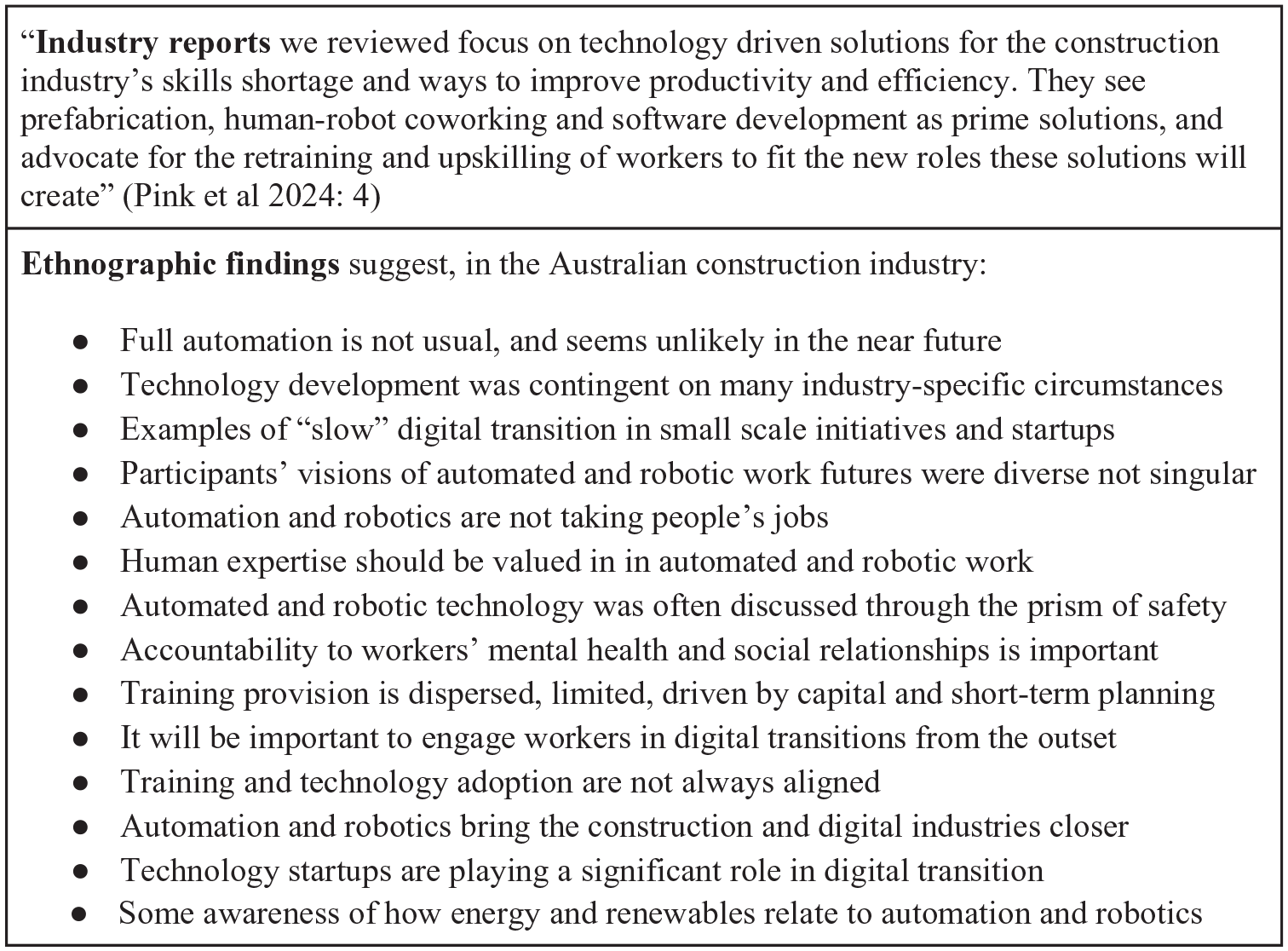
A Summary of the Key Generalized Findings From the Review, Interview and Ethnography Stage of the Research. Based on Research by Sarah Pink and Ben Lyall.
It has been argued that AI can valuably support human storytelling (Chubb et al., 2022, pp. 1452–1453) and our research engaged this principle by creating AI stories as supports through which participants corrected stories. In design anthropological research practice precise methods are not selected in advance but emerge situationally. This was the case when GenAI came into use. We wished to derive workshop materials from our ethnographic findings, thus ChatGPT was experimented with for this purpose, and the materials that Hannah generated (below) proved to be suitable for our research. Following design and futures anthropological principles, our discussion (later in this article) thus uses the concept of anticipatory realism to reflexively identify the status of the knowledge that was produced through this method. We next elaborate on the story generation process step-by-step to demonstrate how Hannah worked with GenAI to generate workshop materials. As our discussion shows, neither was GenAI neutral, nor were we neutral in our engagements with it; it was harnessed and trained for a particular purpose and its tendencies toward positive, techno-solutionist stories were evident during this process.
ChatGPT Prompts—Creating Contextual Memory for Futures Stories
An interview was conducted with ChatGPT(Version 3.5) as an intermediate step between the ethnographic findings and the futures workshops. The interview started with one of the overarching questions of the research project to create relevant contextual memory for the chat bot, “What will everyday work-life be like for Australian construction workers in the future? With digital and automated technologies.” Then, using the preliminary findings and future “unknowns,” ChatGPT was asked clarifying and deepening prompts for example, “Can you elaborate on number 6 above? What will training for construction workers look like in the future?” or “How will construction worker’s mental health be supported in the future? How is this likely to be different from today?” Pertinent macro trends (such as demographics shifts, climate change, etc.) were also introduced during the ChatGPT interview, for example, “Will mental health questions be different in relation to changing factors like: more people working from home; more gender and age diversity in the workforce; differently skilled workers in the construction industry?”
Story Generation
Following the contextual prompts to ChatGPT, stories were generated to condense the research themes into a more digestible format for group discussion in the workshops. Prompts were: “Can you tell me a short story about a future Australian construction worker?”; “Can you tell me another short story about a future Australian construction worker who struggles more than Mia to adapt to automated technologies in the industry?”; “Is there a future for an Australian construction worker who does not want to embrace automation?.”
Story [arc] Analysis
While different prompts were used to generate this initial set of short stories about possible future work-lives of Australian construction workers, the role of automated and digital technologies was largely consistent (positive). The stories were analyzed according to positive affect or negative affect within a standard story structure: “context/place,” “rising action/progressive complications,” “dilemma/challenge/climax,” “success/failure,” “falling action,” “resolution.” Moreover, despite prompts that increasingly challenged the ease of integration of digital and automated technologies, all three stories that were generated by ChatGPT conveyed a positive effect and positive experiences for future workers who embraced these technologies (or successfully overcame obstacles to embrace them) (Figure 2).
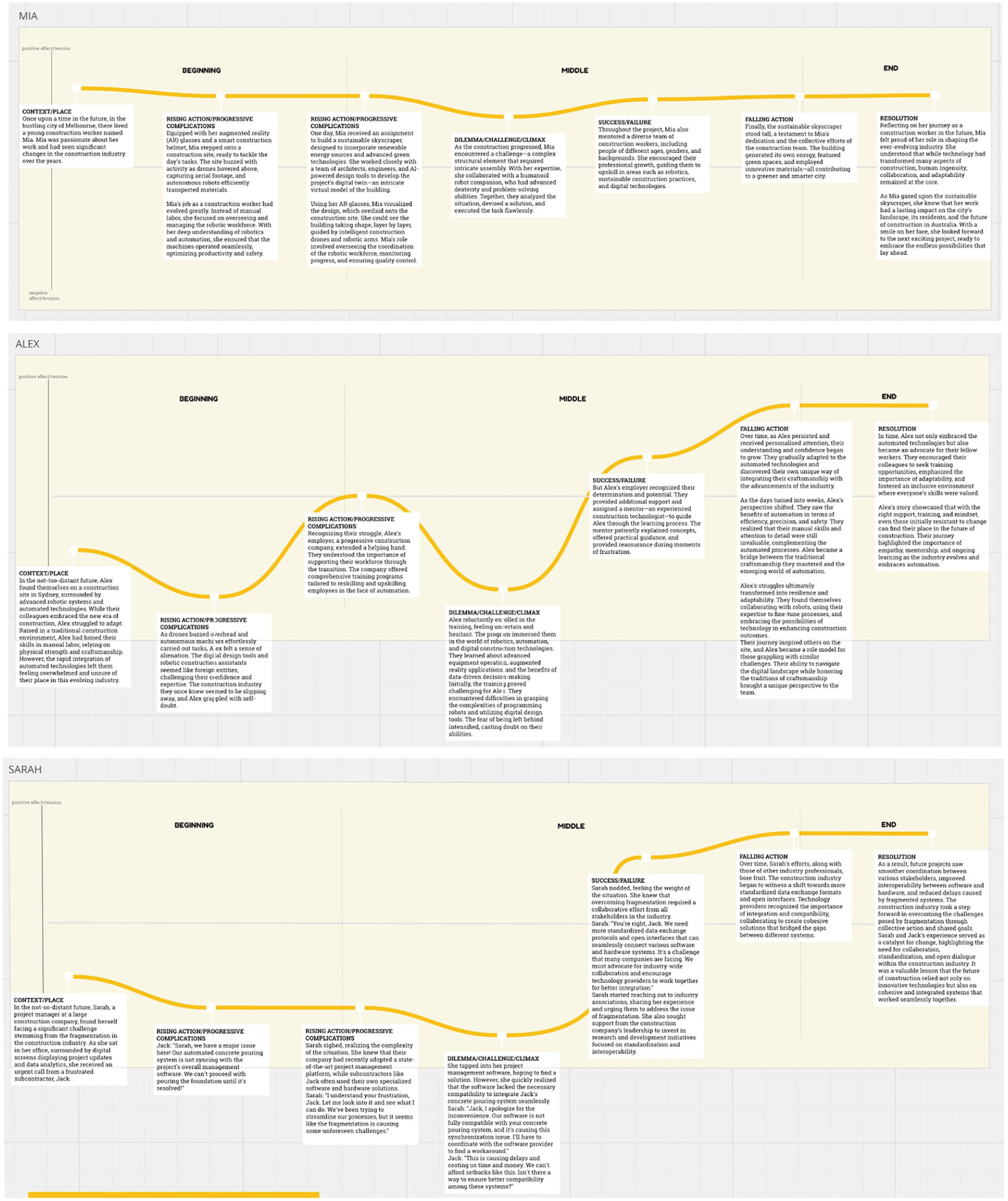
A Visualization of the AI-Generated Story Arcs and Timelines. These Are Presented to Give Readers an Overview Sense of How the Narratives “Looked” During Development and the Place of Visualization in This Process, Rather Than to Supply Detail of the Narratives. Images Created by Hannah Korsmeyer.
Story Selection and Illustration, Embracing the Uncanny
This somewhat realistic, yet uncanny, juxtaposition of overwhelming positivity with the real everyday life experiences of human workers engaging with emerging technologies was considered a useful tension for discussion in the workshop, so the final story prompts were further developed to emphasize the uncanny. Here, we use “uncanny” to reflect on feelings of dissonance associated with AI, whereby its stories appear familiar but are unsettling and to some extent mysterious (in the sense that they hold unsolved questions, or invite controversies), but we distance ourselves from other elements of the uncanny as supernatural. Indeed unlike problematizations and hypotheses stemming from the original “uncanny valley” concept (Mori et al., 2012), the uncanniness of narratives is based more in their lack of plausibility and the sense that they are “not quite right”.
AI-generated illustrations using DALL-E were also experimented with (see Figure 3 for example). Illustrations were then used in the story of a past Australian construction worker were developed (Figure 4) in the form of a typical day in the life that we expected most participants would be able to compare directly to their own lived experiences.
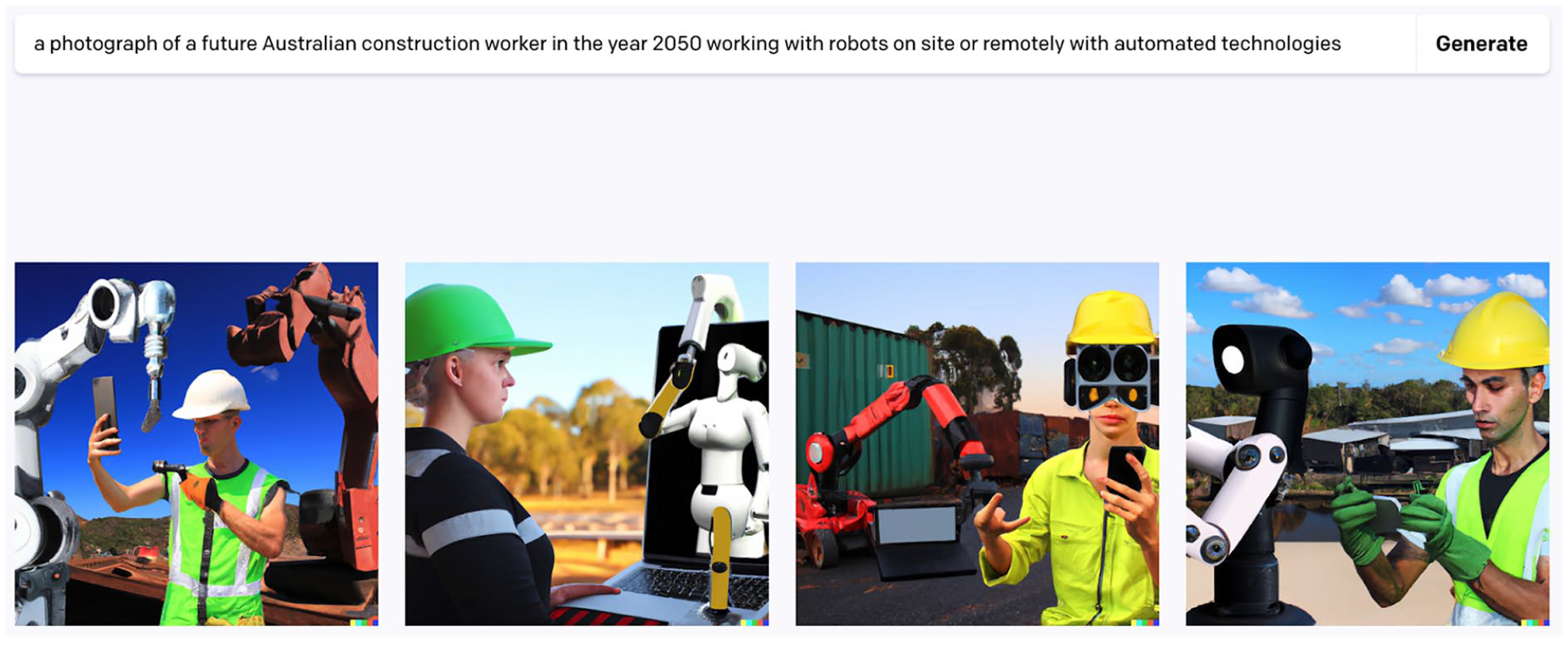
A Series of Four AI-Generated Images Which Depict Construction Workers Undertaking a Series of Work Tasks With Robotic Technologies.
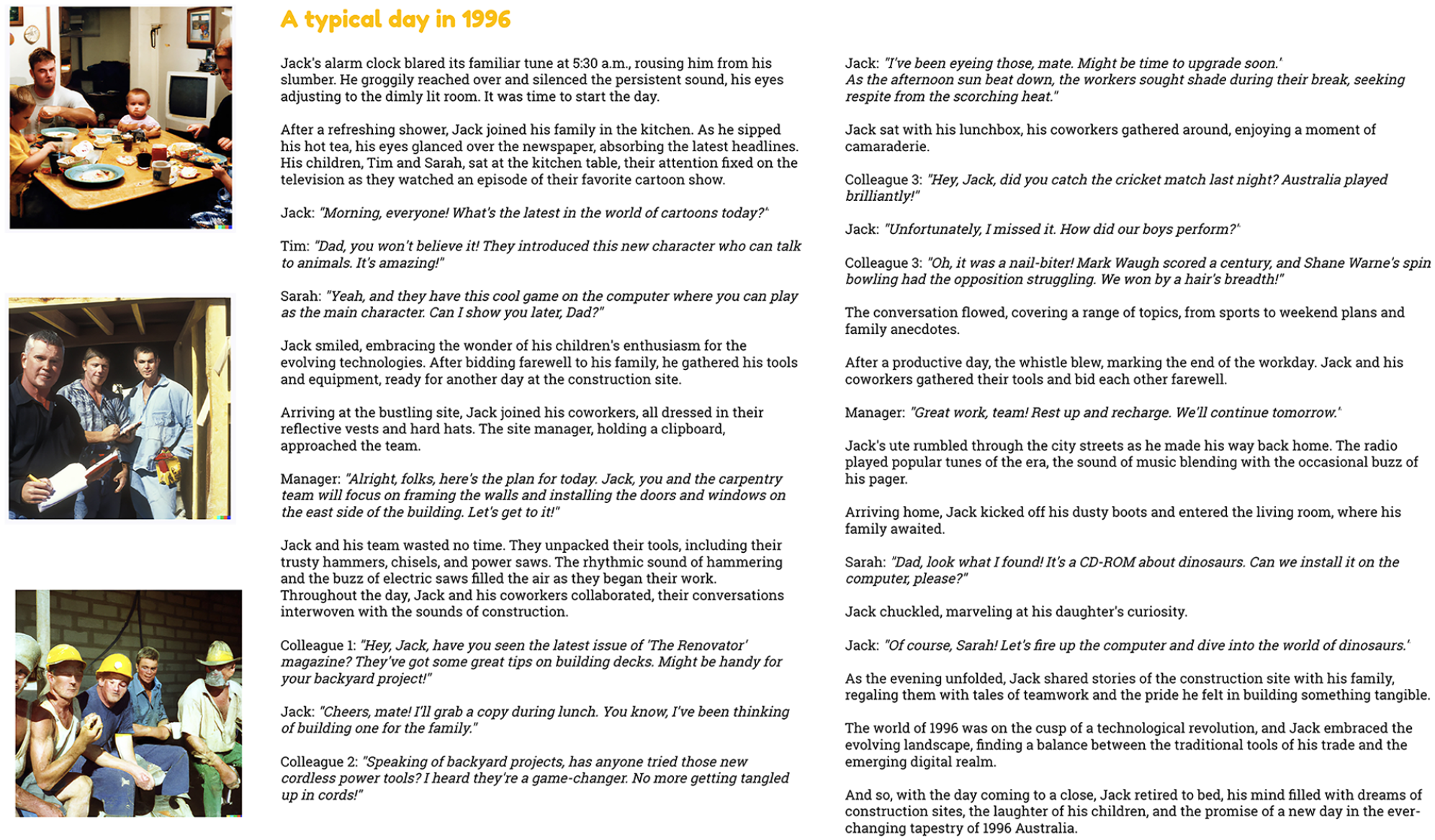
An AI-Generated Story of a Typical Day in 1996, Told With One Column of AI-Generated Images Showing a Worker’s Home and Work Life, and Two Columns of Text. The Image Is Presented to Demonstrate the Composition of the Text and Image Combination During the Development Process Rather Than to Deliver a Readable Narrative. Screenshot From our Miro Board Created by Hannah Korsmeyer.
Final Stories
Building on the above process and modes of experimentation, the final stories were crafted to address key themes from the preliminary research findings and to include mundane details of everyday life, such as dialogue with others, and the technologies used. Examples of prompts used were: “Can you tell me a story about the most
In workshops participants read and discussed at least one story. For documentation, post-its were placed on the Miro board by the facilitator in online discussions (Figure 5), while annotated printed versions (Figure 6). All workshops were video and audio recorded. The text reads as follows:
Jack’s life in 2050
In the not-too distant future, in a bustling city where skyscrapers reached for the stars, the construction industry had undergone a remarkable transformation. Advanced technologies and automation had become commonplace, revolutionizing the way buildings were erected. However, amid this wave of innovation, there were still jobs that were considered the most undesirable in the industry.
Meet Jack, a seasoned construction worker who had been in the industry for decades. He had seen the transition from manual labour to the integration of cutting-edge technology. As he approached retirement, he was assigned to one of the most undesirable tasks on the construction site—dismantling the outdated, manual scaffolding structures.
Jack: (Sighs) “I can’t believe they still use these old scaffolding systems! It feels like going back in time”
As he looked up at the towering skyscraper he marvelled at the efficient construction robots and drones buzzing around. Yet, he was stuck with the laborious and potentially dangerous job of manually taking down the heavy metal scaffolding. Jack’s coworker, Sofia, an enthusiastic young engineer, approached him with a sympathetic smile.
Sofia: “Hey, Jack, I know it’s not the most glamorous job, but we really need someone with your experience for this task. Once you’re done, they’ll replace it with automated assembly systems. You’re making way for the future!”
Jack: (Nods) “You’re right, Sofia. It’s just hard to watch all these incredible technologies at work while I’m still hauling these heavy pipes around. I suppose it’s a necessary step to make room for progress.”
As the days went by, Jack and his team diligently worked to dismantle the scaffolding. The rest of the construction site buzzed with activity, showcasing the latest advancements, from 3-D printed materials to autonomous cranes. However, Jack’s job remained a stark contrast, highlighting the few remnants of manual labour left in the industry.
One day, as Jack carefully disassembled a section of the scaffolding, a drone hovered nearby, capturing data for the automated assembly system that would soon take its place. Sofia approached Jack with an encouraging smile.
Sofia: “Jack, I just want you to know that your contribution to this project is invaluable. We need to document the current structure’s configuration to ensure the new system fits perfectly.”
Jack: (Smiles) “Thank you, Sofia. I guess even the least desirable tasks have their significance. It’s just hard to see it sometimes.”
As the weeks passed the team finally completed the dismantling process, making way for the cutting-edge automated assembly systems that would soon take over. Despite the challenges and the physically demanding work, Jack took pride in knowing that he played a crucial role in paving the way for a more efficient and safer future construction industry.
On the day of the transition, as the automated assembly system whizzed to life, Jack stood back and watched the marvel of technology take over. Sofia approached him once again, this time with a smile of appreciation.
Sofia: “Thank you Jack. Your expertise and hard work made this possible. We couldn’t have done it without you.”
Jack: (Smiles) “It was tough, but I’m glad to have been a part of this change. The future of construction is in good hands.”
As Jack stopped away from the construction site he knew that his days of manual labour were coming to an end. He looked forward to seeing how the construction industry would continue to evolve and embrace automation, making the once undesirable job a thing of the past.
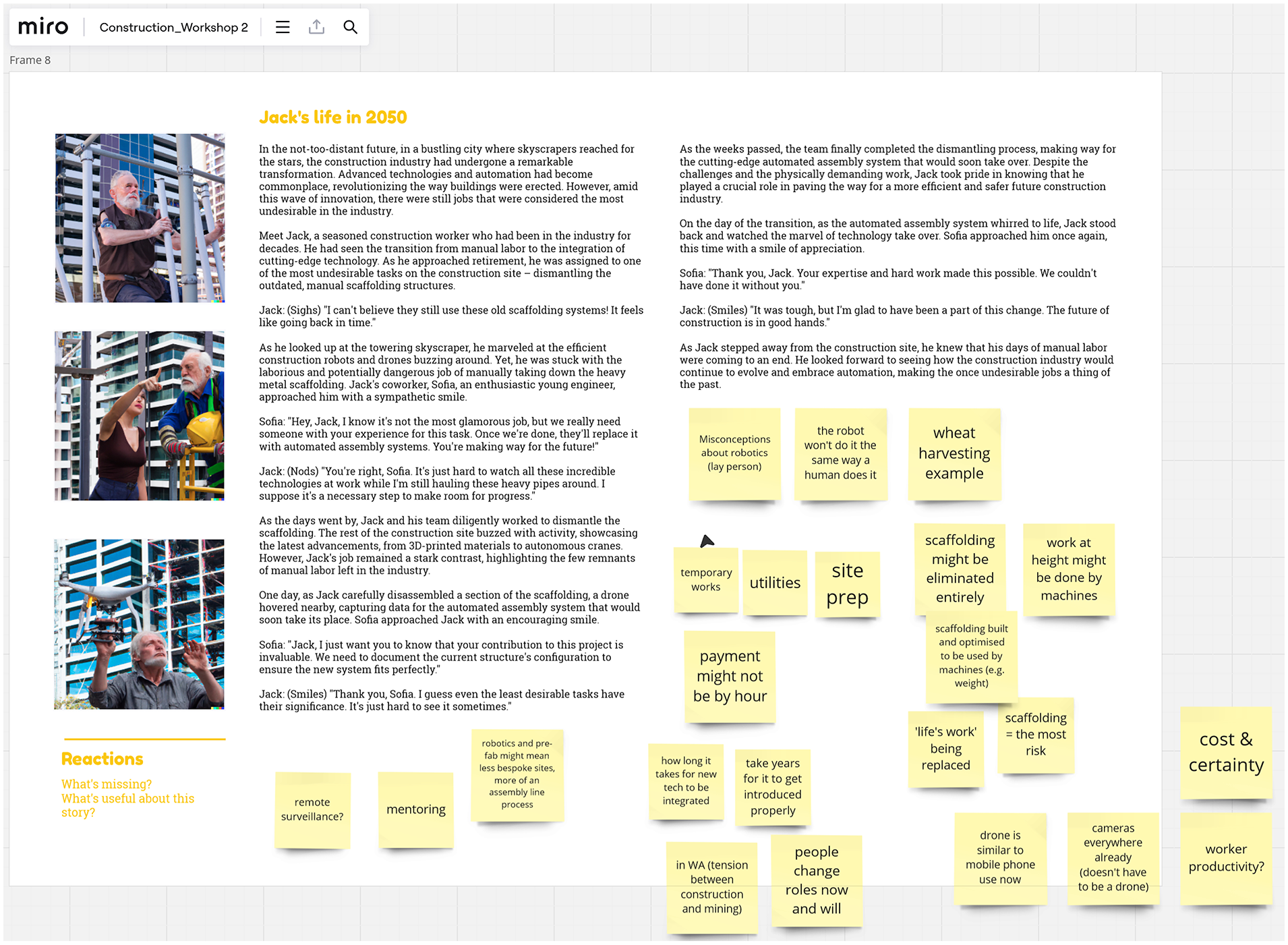
Screenshot From Our Miro Board of an Online Workshop Sheet Showing Jack’s Story. The Screenshot Demonstrates the Text and Image Combination and How Post-Its Were Contributed Through a Series of Three AI-Generated Images Depicting Jack’s Working Life and Two Columns of Text Which Tell the Story. Created by Hannah Korsmeyer. A Readable Version of the Story Is Supplied in the Main Text.
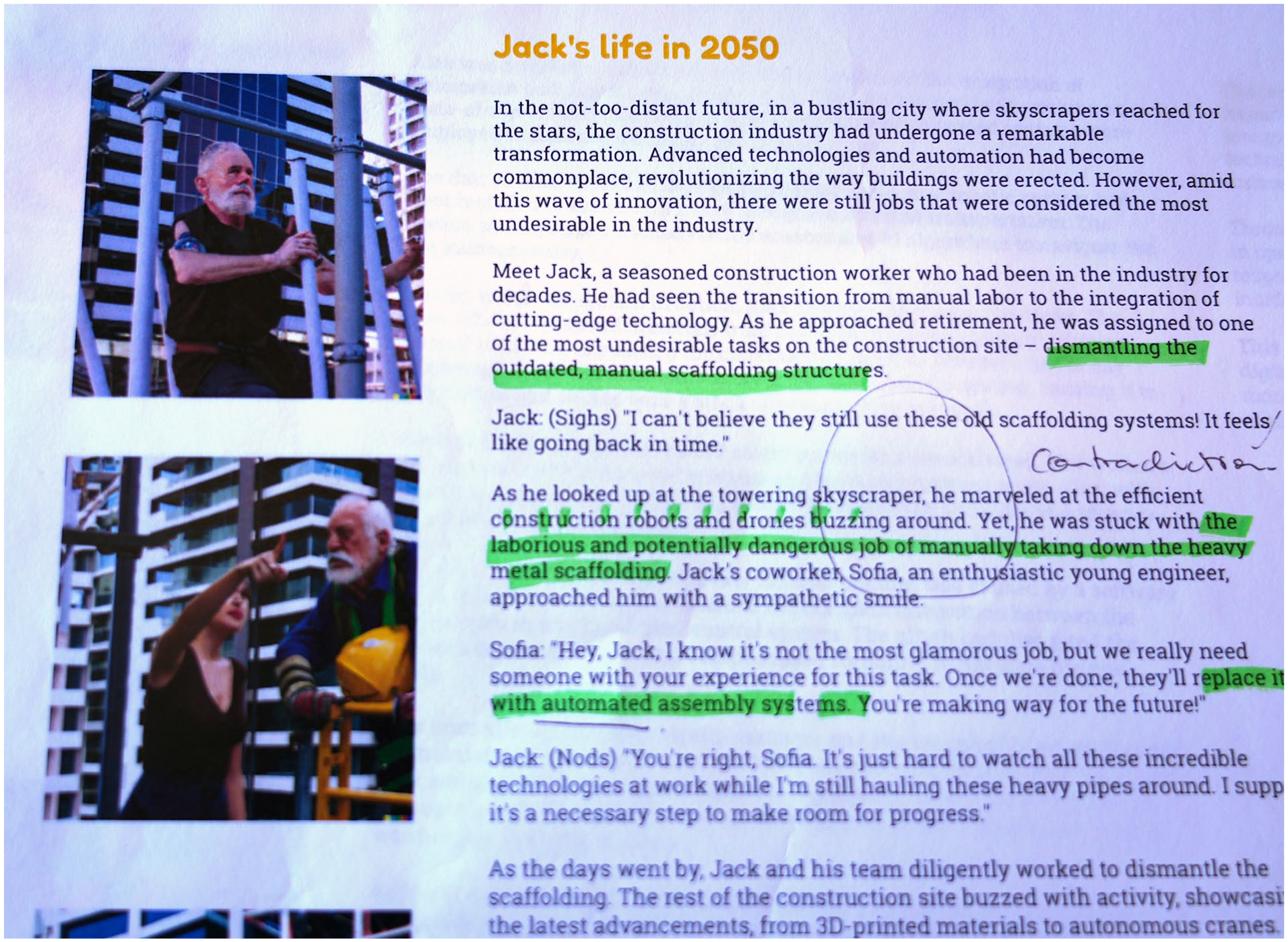
Jack’s Story as Annotated by Participants in an In-Person Workshop. Created by Hannah Korsmeyer, Photograph by Sarah Pink.
GenAI Stories and Corrective Knowing
In this section, we keep our focus on findings relating to Jack’s story described above (and see Figures 5 and 6) to demonstrate the possibilities of the method.
We emphasize that, resonating with our identification of the uncanniness of the stories noted above, participants found the technologies in the scenarios relevant to industry futures but not convincing. This included critiques of ChatGPT itself. Jack’s story was often met with a knowing laugh, grin, grimace or frown, and those with greater knowledge of the technical capabilities of AI offered deeper critiques. For example, Mark (Executive Director and CTO at FBR) commented that “it kind of reads like it was written by someone who’s never been on a construction site.” He found that, while as typical of large language models the text sounded as if it had been written by a person, however “the AI’s missed how long it takes for a new technology to transition in.” Mark suggested “the reality is the automated thing will come in and it won’t work properly. . . it’s a process where it will probably take years for it to be introduced properly.” Thus, the limitations of ChatGPT created opportunities to critique assumptions underpinning technological solutionism of the story. These reactions are moreover corrective responses to the dominant industry narratives about scaffolding discussed above. To demonstrate the layers of knowledge produced through this method we outline three elements of our findings.
First, participants corrected the ChatGPT vision of a future where traditional scaffolding was used on large new build construction sites. Regarding the future of scaffolding itself, participants indicated the AI had reflected a prescient safety concern, with scaffolders “often at the most risk” (Brett, Senior Manager Transport Infrastructure Projects), but they ultimately believed future prefabrication would see traditional scaffolding reserved for retrofit and bespoke purposes. They pointed to new modes of building where scaffolding would not be used, again suggesting that the GenAI story was incorrect, because scaffolding would either be performed robotically or become automated in the future. For instance: Karl-Heinz used the corrective position that “We should not talk about the scaffolding being replaced by an automated scaffolding, because we would miss the point, because scaffolding is not existing”; and Mark critiqued the GenAI story, as having “probably completely missed the point” to suggest that “scaffolding will be either completely eliminated like in many building sites where they use elevated work platforms or the work is designed in such a way that you don’t need scaffolding, or the work that was done at heights will be done by robots.” He suggested future scaffolding will be “built and optimised for machines to use.”
Second, participants were concerned about and interested in workers’ perspectives, and their readings of the story sought to critically reframe how Jack himself might have felt. John (HSEQ Manager) who worked alongside the trades on construction sites, immediately raised the question of Jack’s feelings, commenting that “here’s a scaffolder and they’ve just told him they’re putting a robot to replace his job and he’s not a scaffolder anymore.” John noted that “there’s a human element that’s not considered in this scripted storyline, it’s all pushed in a blinkered approach that technology is here to save the world and Jack, it’s saving you from doing scaffolding.” Andrew (consultant, previously senior public service) suggested that while the senior management might assume scaffolders like Jack would not want a job that involves manual labor and would thus seek to eliminate it in the future, there was a need to consider “people who have been doing that all their lives and find meaning in it.” David (technology startup Cofounder and CRO) concurred emphasizing that “we so underestimate the value of manual work.” David interpreted that “Jack’s putting on a brave face” and continued to point out the unlikeliness of “the fact that the engineer smiled at him [Jack] a couple of times” which he said was “unusual for an engineer, so it’s good the AI picked up on that bit.” David’s subsequent comments also explained how manual work was valued. In David’s experience “a lot of guys feel like they are disposable in our game and that’s why a lot of people won’t share their knowledge, because for a lot of people it’s their job security.” He emphasized the importance of ensuring workers’ “self-worth” was maintained, in a future where “people get their sense of being their sense of purpose through what they do.” David posed the question of how “to educate people to understand that it’s not what you do but who you are that’s valuable,” and saw the possible future represented in the GenAI story to be detrimental to achieving that outcome.
Third, participants raised questions of the future of knowledge and skills, proposing that by 2050 worker knowledge should be better valued, acknowledged and shared. John (HSEQ Manager) emphasized that “Jack was very skilled in scaffolding.” David suggested management should introduce options, such as asking Jack “what do you think you could contribute as we move to this new system? Your knowledge and expertise can help us with the new system.” Knowledge sharing was stressed by Daniel (WHS research, state government) who identified an issue concerning “occupational identity” across industries (including in other areas like transport and farming) and the potential for “psychosocial harm.” He told us that at present there was a focus on older workers’ mental health, and “one of the ways of supporting older workers’ health is actually getting them to work with younger workers on their problems [and] sharing their skills.” Brett (Senior Manager Transport Infrastructure Projects) was concerned about how new possibilities for learning and greater individual autonomy could maintain social ties across occupational identities. Karl-Heinz explained in detail the importance of sharing workers’ tacit and embodied knowledge about the relationship between the technical and material dimensions of scaffolding. He suggested that scaffolders are “putting up a temporary structure, which requires understanding the fundamentals of how a structure works” from both vertical and lateral perspectives, noting “these guys have got a pretty good idea about how structures work or temporary structures work.” Karl-Heinz moreover saw scaffolding as a “logistics challenge . . .a kit of parts” involving “vertical parts,” “braces” and “horizontal parts which keep up the scaffolding planks,” requiring “a methodology.” Thus, Karl-Heinz pointed to new modes of work that scaffolding skills could be applied to where “in 2050 . . . in the future it’s going to be about not performing of works on site other than assembly works, then Jack brings actually an interesting skills set as an assembler,” seeing a possible transition for workers from scaffolding to assembly skills.
While these findings are specific to our project, they demonstrate how the corrective stance of anticipatory realism that our participants took, enabled new visions of possible industry futures, which attend to the experiential elements of work.
Futures Ethnography and Anticipatory Realism
The findings of our GenAI design futures workshops and the anticipatory realism they generated additionally gave us the opportunity to reflect on the findings of our analysis of industry and technology driven visions of industry futures and the findings of our ethnographic interviews and site visits. This in turn enabled us to ground the anticipatory realism of the workshops in relation to everyday life and biographical accounts. Still concentrating on scaffolding, we briefly outline industry and technology focused futures visions, examine how these resonated with the ChatGPT vision of Jack’s story, discuss everyday life accounts from the ethnography and interviews, and then focus on the biographical experiences of one scaffolder.
We found that business, technology research and gray literature relating to scaffolding generally takes the techno-solutionist stance mentioned above. Construction industry researchers Melenbrink and colleagues (2020, p. 17) have called for attention to thus far neglected “auxiliary tasks like formwork and scaffolding” and to “new types of training opportunities . . . to prepare workers to operate in an industry that will become increasingly automated over the course of their careers.” Researchers suggest that in the future the need for scaffolding will decrease with increased off-site prefabrication (see also Zhang et al., 2022) including in retrofit and renovation projects (Deffner et al., 2022) while for older or heritage projects more difficult to automate, roboticise or prefabricate, bespoke scaffolding may be needed (Skejić et al., 2024). Engineers have sought to develop technologies to reduce costs and time spent on inspections or assessments, and improve worker safety, through “automatic scaffolding workface assessment” (Ying et al., 2021, p. 1) or automated methods to improve workers’ safety compliance, and “safety management through personalized worker training or notification during work” (Hong et al., 2023). A scaffolding company highlights: “lightweight, high-strength materials” enable easier transportation and durability; automation and robotics can “reduce labor costs, increase efficiency, and minimize the risk of accidents”; and “digital tools” to improve accuracy in scaffoldings system design (Southern Scaffolding, n.d.). These future visions represent technological possibility, but account less for the roles of workers themselves in engaging with or shaping, such futures. Jack’s story coincides with these narratives in two significant ways: it portrays a future where many work tasks are automated, including drone data capture devices, and where scaffolding work will be replaced by automated assembly systems; and it suggests these technological advances would deliver techno-solutions to two current problems, they would increase efficiency and in one of the most dangerous industries they would improve worker safety.
Our participants generally believed scaffolding would participate in construction work futures. However, everyday experience pointed to more nuanced or unaccounted for elements to the visions presented in the literature we reviewed. For instance, Darren (Site Manager) in a workshop, described how his team used a small robot in a small demolition task on the upper floors of a large building retrofit project. To transport the robot, they had needed to use an external lift constructed outside the building with scaffolding. Here using robotics made scaffolding a requirement whereas the industry visions discussed earlier assumed emerging technologies would make scaffolding more effective, safer and as in Jack’s story sometimes obsolete. Some participants’ past experiences indicated that changes in scaffolding technologies and practices would be incremental and uneven, rather than abrupt as in Jack’s story. For example, David (Co-founder and CRO of a technology startup) noted in one of the workshops that scaffolding has changed in the last 20 years to aluminum not steel, automatic clips not spanners, and takes half as long to put up. Gerry (a Union Occupational Health Safety and Environment Manager) discussed how in his experience technological change in scaffolding was scattered, giving the example of “craneable scaffolding,” which had been developed to increase productivity, because it could be lifted and moved by crane rather than having to be disassembled and reassembled. In his experience two scaffolding companies had taken this up, and “there was a bit of negativity from a lot of our traditional, older members” initially. He explained that such change was scattered since “that’s not necessary to say the job down the road will do that but that’s just part of what our industry is.” These examples suggest present and future uses of scaffolding in relation to emerging technologies is likely to be contingent (Darren’s example), uneven (Gerry’s example) and incremental (David’s example).
Our interviews also brought a focus on individual trajectories in the industry, which similarly imply more nuanced visions of possible future workers. Dan M was 45 at the time Ben interviewed him in 2022, and so by 2050 would be considered to be an aging worker like Jack in the story. Dan M was a registered Builder, originally trained as a carpenter but experienced across several trades and sectors. He described how he started rigging and scaffolding: “when I was 30 . . . some of my friends were scaffolding and rigging at a place . . .which produces gas. . . and they were doing a rotation of 2 weeks on and 2 weeks off, so since I’ve been 30, I’ve been working in the oil and gas sector as a rigger/scaffolder.” Noting the similarities between the trades he commented that “I know a number of carpenters who are riggers/scaffolders, because the principles are the same, it’s just like squares and triangles, just forward-thinking, solving. Just the different material: it’s just metal instead of timber.” Most recently Dan M had been working on urban house renovations with friends, before going back to scaffolding on a floating gas rig. He works on a rotating pattern of building projects at home with specialized scaffolding work offshore. Dan M led a working life in which, differently to Jack in the story, he was not singularly committed to a career in scaffolding but, like his peers, worked across different roles to which his skills could be applied, evidencing a similar strategy to Karl-Heinz’s point, mentioned earlier, that scaffolders have significant transferable logistics skills.
Thus, ethnographic findings can bring deeper first-person biographical accounts into dialogue with the third person accounts of GenAI, and the critical commentaries of our workshop participants. Each layer of knowledge enables a deeper understanding or endorsement of the others.
Sensing, Knowing and Fixing Possible Futures With GenAI
An emerging literature explores how automated and AI technologies might become collaborators in research, including using bots as assistants in data collection and administrative tasks (Rennie et al., 2022), and the notion of GenAI a creative “teammate” (Hwang, 2022). Keeping in mind that GenAI is an emerging technology (and Large Language Models [LLMs] and GenAI capacities are likely to change), at the time of our research GenAI was useful for making broken futures stories because it lacked capability in both accurately sourcing knowledge about and incorporating the possibilities of everyday work life and values. Indeed, its reputation went before it in preparing participants for the corrective narratives of anticipatory realism.
Workshop participants were asked to respond to GenAI stories as tangible examples, while containing flaws and biases in both inputs (training data, priming, role assignment) and outputs (image artifacts, errors, confabulations). This brokenness of the stories invited participants to engage with Jack’s story and offer corrective (but not complete) visions of possible futures. For example, they drew on their experience and knowledge to imagine and sense how Jack would feel in relation to his identity and self-worth and also explained the technical, embodied and material dimensions of his skills. Their diverse experiences in the industry informed a view that scaffolding involves a transferable skill and identity that will be needed for future complex and sustainable building practices. While this view is not necessarily incompatible with a vision where such skills will be engaged alongside the industry visions of smart or automated scaffolding as a technology solution to enhance productivity and safety, their emphasis is differently on embodied skill, identity, and emotion. Participants’ accounts created in response to Jack’s story tended to offer visions of possible futures that would repair what they believed was unethical and impractical in the techno-solutionist narratives represented in the stories. Their corrective stance on future work tasks and technology advances was framed with a confident uncertainty, while their understandings of contingent, incremental, and uneven change acknowledged the indeterminacy of futures. Their stance turns our attention as researchers, not to what might be solved, but to what might be repaired.
Our exercise in using GenAI stories illustrates the utility of broken futures stories in research. Even if GenAI becomes “better” at telling more plausible, or ethical futures stories, broken stories will still be useful to social researchers in invoking the corrective stance of anticipatory realism as a mode of repair. The anticipatory realism constituted through our workshops has two possible applications: as a possible pre-emptive device, against the ethical and practical slurs that participants detected in the GenAI stories; and as a generative device, for bringing together diverse but convergent views of the emotional, sensory, and embodied experiences of possible futures, as demonstrated by participants understandings about the future of scaffolding skills.
Conclusion
GenAI is not a technological solution to gaps in research methodology, but as we have shown in this article, a tool which when used contextually and reflexively creates new possibilities for qualitative researchers. We have shown how it can be effectively embedded in relation to other tested modes of investigating possible futures—including literature analysis, ethnography, interviewing and design futures workshops. There are no fixed criteria to determine when and if using GenAI to generate workshop materials within design ethnographic processes would be beneficial. We moreover do not—as always in ethnographic practice—offer a template to be copied, but rather we offer our account of the configuration of methods, concepts,and knowledge our work generated as an example that other researchers might build on in new ways. Working out if GenAI is useful in a design ethnographic research design was an iterative process of building on hunches, creating materials, identifying their connections to our literature reviews and ethnography. Through the example of scaffolding, we demonstrated the outcomes when this works well: scaffolding proved an excellent GenAI futures storyline, inspired by and connected to our materials and sufficiently prevalent to invoke futures-focused discussions with our participants.
To understand the possibilities offered by such uses of GenAI storytelling, we have introduced the concept of anticipatory realism. We suggest this offers a category through which to understand and analyze participants’ corrective perspectives on future visions generated with ChatGPT. As such it constitutes a mode of re-storying possible futures which builds on the notion of broken futures and calls on participants’ creativity to seek to repair narratives, lives and possibilities, toward futures that make sense to them, ethically, emotionally and through embodied experience. Anticipatory realism also offers a useful frame through which to correct techno-solutionist narratives, which tend to neglect the experiential dimensions of possible futures, or the value of human skills and expertise. We invite readers to join us in testing both GenAI methods and in developing modes of creating and mobilizing anticipatory realism across comparative research.
Footnotes
Acknowledgements
We thank the participants in our research, without whom this article would have been impossible and our AUTOWORK colleagues for their collegiality and discussions. The authors’ roles were Sarah Pink, lead in research design, literature review, ethnographic and workshop fieldwork, analysis, writing and conceptual development; Hannah Korsmeyer, design futures workshop development and facilitation, including creation of GenAI scenarios, analysis and writing; Ben Lyall, literature review, ethnographic fieldwork, analysis and writing.
Declaration of Conflicting Interests
The author(s) declared no potential conflicts of interest with respect to the research, authorship, and/or publication of this article.
Funding
The author(s) disclosed receipt of the following financial support for the research, authorship, and/or publication of this article: The AUTOWORK project was funded by the Research Council of Norway, 2020-2025. Project Number: 301088.
Ethical Approval
The research discussed was approved by Monash University’s Human Research Ethics Committee.
