




Abstract
This reflective essay focuses on the emotionality of children’s creations in the archives, particularly where children’s creations give insight into traumatic histories. I argue that history will be better placed when historians write more openly about the inherently distressing nature of the materials they consume. It is impossible to be unaffected by such material and acknowledging this will make our work more transparent by outlining to readers the context it was written in. The complex, emotive interpretive task historians face is demonstrated using two children’s drawings—one from the Spanish Civil War and the other from the Darfur Genocide.
Introduction
In May 2019, I was carrying out research for my PhD project at the California State Archives in Sacramento. One afternoon I left abruptly and did not return to the reading room for 48 hr. For a visiting graduate student from England this was far from ideal, but it was very necessary. I had been reading through inmate testimonies and essays from Whittier State School. Ultimately, my PhD thesis posits that a state-wide culture of “Californians and others” dictated children’s experiences in schools, health care settings, juvenile institutions, and accessing New Deal relief. One small part of it examined the state’s role in covering up the circumstances of 13-year-old Benjamin Moreno’s 1939 death in Whittier’s ominously named “Lost Privileges Cottage” (Hodgson, 2021b). Children’s testimonies make it very clear what type of place Whittier was. In September 1940, one boy testified anonymously at a public inquiry, “I have undergone, and I have seen other boys undergo many vicious punishments . . . but most cruel of all was the mock hangings.” Fifteen-year-old Albert Lupez escaped Whittier and when questioned explained “because I was beaten unmercifully. Not only that, I was frightened by the sex tortures” (San Francisco Examiner, September 14, 1940). After working through several folders of related material, I needed a break. As Ruth Lawlor (2020) reflected after researching the life and premature death of a rape victim, “To write about such violence is to do a particular kind of history: it is a physical and emotional endeavour, not merely an intellectual one” (n.p.). One methodological factor I failed to consider was how working with distressing records of trauma would affect me as a researcher and by extension my work. In this essay, I reflect upon the privilege and duty researchers have to unpack the emotions from children’s creations in the archives, and how the inherent emotionality of distressing materials fundamentally alters the scholarship we produce.
Children’s History
I have worked with significant amounts of distressing material at the California State Archives, during the wider course of my PhD and during my subsequent research career, because it was what I needed to do in the moment. I chose to do it because I think it necessary that the voices of children who suffered abuses in Californian institutions feature in the narrative of that state’s history. I research children’s history because I believe that young voices deserve to be heard and that our understanding of history is more accurate with youthful perspectives included.
Scholars working on the history of children and childhood have struggled to have others take their work seriously. Traditionally, historians were more interested in those who exercised power in society than they were in the masses of persons over whom power was exercised. These historians rarely treated children as important historical subjects except when they were part of larger stories (Hawes & Hiner, 2005, pp. 23–24). Having a desire to hear young people’s historical perspectives and actually being able to incorporate them into professional history writing is not the same thing. Early works relied upon sources and evidence produced by adults, and while they had concern for the treatment of children within Western society, their arguments related primarily to the social institutions which ascribed meaning to childhood (Musgrove et al., 2019, p. 3). These were histories of childhood but they were not children’s histories. As Hawes and Hiner (2005) write, “Childhood is an ideology or social construction, an experience, and a set of behaviors. Childhood as a social construction, that is, the ideals and expectations that adults establish for children, should not be confused with what children actually experience” (p. 24). Therefore, children’s creations recovered from the archives are crucial in allowing historians to construct a children’s history where they seek to understand historical children’s actual experiences and agency in the past rather than the history of the construct of childhood.
Even with historians being willing to recognize children as historical actors in their own right, reflecting this in scholarship has proven challenging in part due to the biases of the past. Children do not create the same types and volumes of written records as adults and the ones they do create are less likely to have been prioritized for archival preservation (Maynes, 2008). There is a debate as to the extent that children’s history suffers from a so-called “source problem,” but it is fair to declare that it will always be “constrained” at least to an extent by an absence of “firsthand sources” (Mintz, 2020, p. 1291). As such, historians have either relied on memoir, adult accounts, and observations of the young or else they relied on even less traditional historical sources. To compensate for this hindrance, I have sought out child-created sources including children’s poetry and artwork.
Interpreting Children’s Creations and Trauma in the Archives
Records existed in the California State Archives about the boys who were sent to Whittier State School because they were sent to a state institution. These institutional records often give the perspectives of the institution and the staff who worked there rather than the children themselves. For example, documentation about inmate Roul Miramontes labels him “one of the tougher small boys we have ever had in the institution.” After arriving at Whittier in October 1928 Miramontes escaped in September 1929, October 1929, and May 1930. These escapes were attributed to a “behavior problem” (Casey, 1933). Given what we know about widespread abuses at Whittier one must wonder who or what Miramontes may have been running away from, but his perspective is entirely absent in institutional records. With the exception of boys’ handwritten entrance statements, in which some were much more forthcoming than others, boys’ own testimonies were rare in official documentation. Given the typical absence of children’s perspectives within institutional records, historians must cast their net further afield. Regarding Whittier, the main source of boys’ perspectives featured in press coverage following the deaths of Moreno and another boy, Edward Levia.
In other cases, historians may turn to child-created objects in the archives. My research of children’s drawings from the Spanish Civil War (Hodgson, 2021a) was very much influenced by Nicholas Stargardt’s work using children’s drawings from the Holocaust (Stargardt, 1998, 2005). Stargardt’s works and the children’s art within can make distressing viewing. Likewise, my Spanish Civil War research involved looking at hundreds of children’s drawings of war, including some which depict significant bodily injury, and analyzing these traumatic scenes in-depth. Yet, there seems little opportunity to reflect on the potential impact of that type of research process within conventional academic history publishing.
Archival collections of children’s art present exciting opportunities to incorporate a greater number of children’s voices into the historical narrative. Drawings may survive after being created by children for whom we have no other accessible record. Illiterate children still drew pictures. Furthermore, from a researcher’s perspective, they transcend language barriers. Many large collections of historical children’s drawings tend to pertain to important historical events or atrocities (Kuecker, 2022, pp. 52–53). After all, there is usually some outside adult motivation behind the creation, preservation or publication, and archiving of these drawings. For example, the drawings I have worked with from the Spanish Civil War were drawn in Republican controlled Children’s colonias before being sent abroad to Britain and the United States to raise awareness of Spanish children’s situation. Undoubtedly, there is a propagandistic element to them, and a motivation to solicit either support for the Spanish Republican cause or assistance for the child victims of war.
Historians face a complex interpretive task working with children’s drawings. People working with children have long considered their drawings. Writing in 1934 in the journal Child Development, Hurlock and Thomson describe children’s drawing as a language and a means of expression (pp. 127–128). The International Criminal Court (ICC), for example, considers children’s drawings as reliable evidence. In 2007, it reviewed around 500 children’s drawings during its investigation of war crimes and crimes against humanity during the War in Darfur (2003–) (Tomsic, 2019, p. 143). Aid workers who worked with children who had survived the Rwandan Genocide used drawing as a therapeutic tool which allowed children to draw experiences which they were too traumatized to speak about. The drawings themselves are described as a “powerful subjective documentation” which “carry with them a level of authenticity which cameras of foreign journalists could not—cannot—capture” (Janzen & Janzen, 1999, pp. 593, 608).
However, jurists at the ICC, aid workers, and education professionals working with living children in legal, clinical, and emergency situations conduct different work to historians. They know the children, know the context of a drawing’s creation, and can follow up with questions. Those who do historical work on the other hand may work with a drawing created by a long-dead historical child where nothing is known about the specific context of its creation or about the artist themselves. Furthermore, we are not qualified to interpret aspects of children’s drawings in the same way trained professionals, like child psychologists, are. As Higonnet (2006) cautions, children’s drawings should not be automatically taken to present the “unmediated truth” (p. 1374). A drawing could be a reflective endeavor, be entirely imaginative, or something in-between the two, while the potential influence of supervising adults or a repressive institutional setting also needs to be considered (Hodgson, 2021a, p. 149).
Some may dismiss children’s drawings as a less valuable type of historical evidence because they offer less definite information than traditional written historical sources. As Rabb and Brown (1986) point out about art more generally, drawings do not provide precise quotable information like files of state papers or business accounts. But children’s drawings are a special category of historical evidence as subjective, creative, cultural expressions which can convey thoughts and feelings which, while less easy to quantify, cannot be dismissed in historical work (Hodgson, 2021a, p. 147). There is no way to skim read a child’s drawing for a useful morsel of information. You must ask probing questions and fully immerse yourself in the traumatic events which young artists have depicted. It is true that analysis and interpretations can often be speculative rather than definite, but as Natalie Zemon Davis reflects on the historian’s craft, “being speculative is better than to not do it at all” (Roitman & Fatah-Black, 2015, p. 3). I go further. The speculative is not merely better than nothing. The speculative is valuable for different reasons and is the window to the true richness of human experience.
Consider the following drawing entitled Guerra (War), which was drawn by 14-year-old Felix Sanchez del Amo in Valencia in November 1936 (Figure 1). Felix’s drawing is one of a large number which were brought to the United States in 1938 by Joseph A. Weissberger on behalf of the Spanish Child Welfare Association for the American Friends Service Committee (AFSC). They had been drawn by children who had been evacuated from war zones to colonias in safer parts of Spain and Southern France and subsequently collected by the Spanish Board of Education and the Carnegie Institute of Spain. Sixty drawings were published in the collection They Still Draw Pictures! alongside an introduction by the author Aldous Huxley, and others were reproduced as prints and sold for $1. The AFSC used the drawings to publicize the situation faced by children displaced in the conflict and to raise money to fund more evacuations as well as maintain the existing colonies. The role of any supervising adults in influencing the drawing is unclear but the wider collection includes drawings of football matches, dogs, and flowers as well as scenes of war, so it does seem like children had degrees of artistic autonomy. The possibility of children knowing that their drawings were to be collected and distributed outside of Spain raises the possibility of them willingly engaging in a Republican international propaganda campaign as their contribution to the war effort.
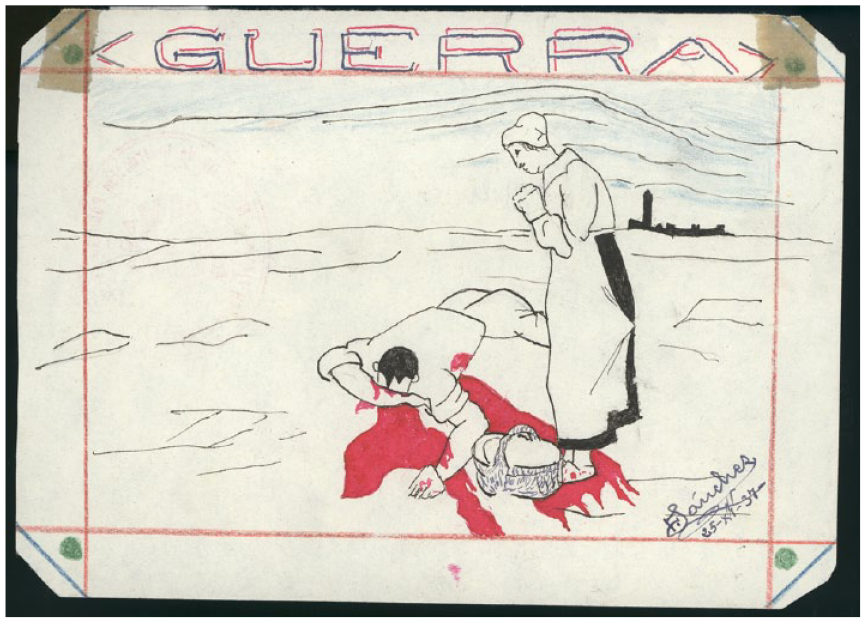
“Guerra” by Felix Sanchez del Amo, Age 14, Escuela Hogar, Antella, Spain, November 1936.
We do not know a great deal about Felix, other than he was 14 years old in November 1936 when he drew this picture in the municipality of Antella, in the province of Valencia, and that he had been evacuated to a children’s colony. If his drawing is entitled “War,” then a pertinent question is to ask what did war mean to Felix? War to Felix involved death, blood, and bodily injury. The foreground of the drawing is dominated by the slumped, face-down, body of a man who looks to recently have been killed, possibly after being shot in the head. The use of a large amount of vivid red amid a drawing that otherwise uses color sparsely immediately draws one’s eye to this brutal, graphic depiction of the ultimate bodily cost of war: traumatic deathly injury. War to Felix also meant grief; a woman is shown standing over the corpse of the man. It is unclear from her hand position if she is praying or if her hands are merely clasped. There is just enough detail in the side profile of her face to give insight into her emotions of grief, upset, and distress. As for the basket, could it contain a baby, food from the market, medical supplies? These are the specifics which cannot be answered. Felix’s drawing details the ripple effect of the tragedies of war, with each victim’s death affecting the people around them. Ultimately, it does not tell us anything specific about the precise history of the Spanish Civil War, but it is an insight into a 14-year-old boy’s experience and opinions of it. Felix had either been directly exposed to the violence, brutality, and emotional distress of modern mechanized warfare or had at the very least heard plenty about it from those around him. That being said, his drawing is relatively tame and simple in its focus when compared to other children’s drawings of warfare.
For example, consider this drawing (Figure 2) by an anonymous child which was submitted to the ICC as evidence of war crimes and crimes against humanity committed during the War in Darfur in the Sudan. It likely depicts multiple wartime experiences rather than a drawing of a single event. The drawing shows the violence and tools of modern mechanized warfare including guns, tanks, and aircraft and provides clear evidence of atrocities being committed against civilians including women and children. It does not provide us with any precise events or specific details in the War in Darfur or the Genocide of Darfuri people, but it presents a child’s-eye depiction of the atrocities that constituted vital evidence in a case where such atrocities were being denied.
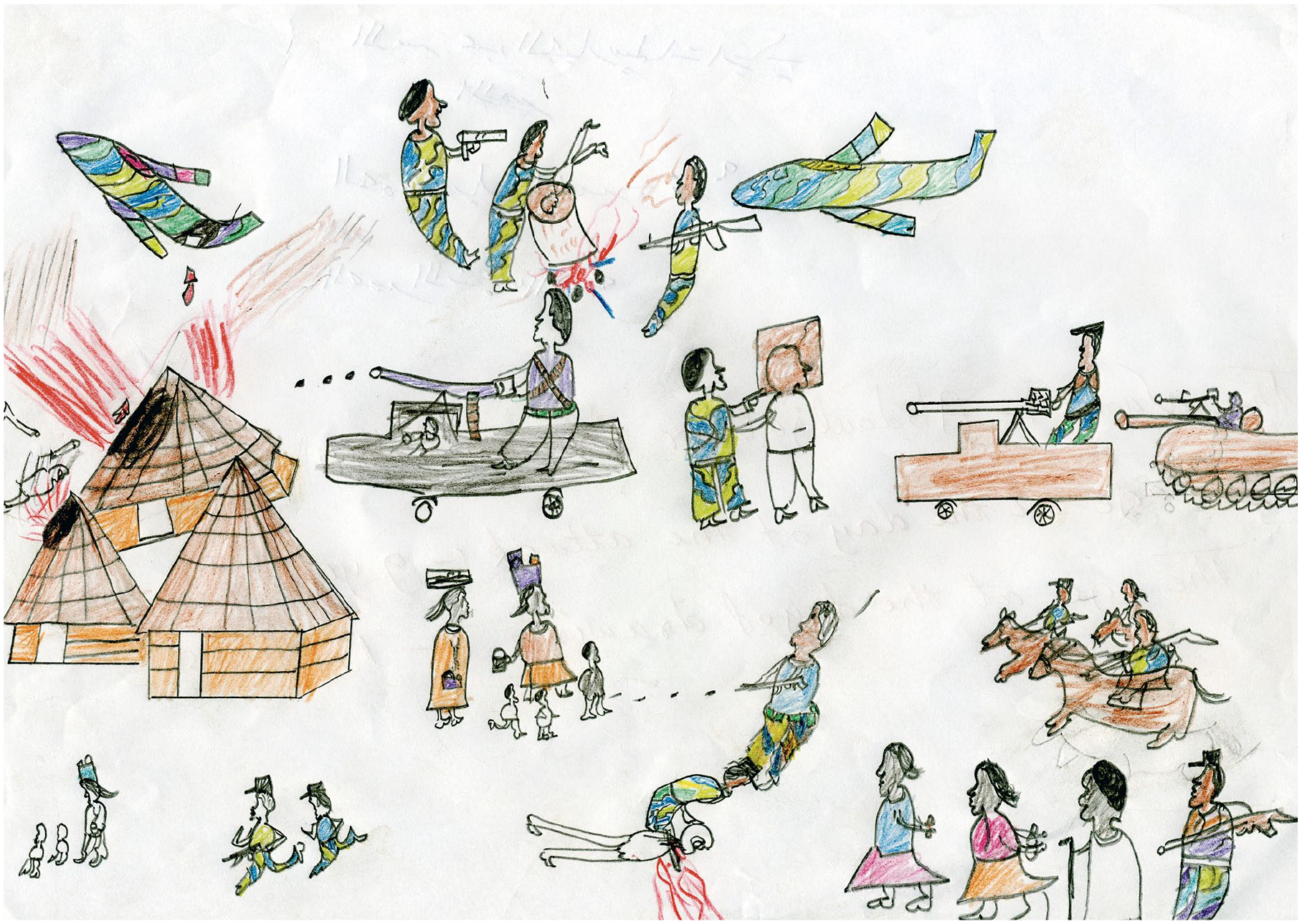
Un-named Child’s Drawing From the War in Darfur, circa. 2005.
Children are depicted as smaller figures, one pair in the bottom left of the picture and another alongside adults facing gunfire in the center. Houses are being destroyed from above, some appear to be on fire, and a victim of the aerial bombardment is represented by the outline of a corpse amid flames and falling missiles. Meanwhile in the foreground red blood streams from the corpse of a figure having just had its throat cut. The corpses stand out being totally colorless and devoid of detailing amid otherwise colored and detailed scenes. Interestingly, I noticed that in some children’s drawings from the Spanish Civil War, which were otherwise colored and highly detailed, dead bodies were depicted using a colorless outline and, like in this drawing, juxtaposed with the representation of the still-living people around them (Hodgson, 2021a, p. 154). Observable in drawings by children who experienced different conflicts on different continents many decades apart, perhaps this speaks to children’s collective response to trauma. Although detailed and gruesome in their overall construction, this represents a form of self-censorship where either out of reverence for the dead or to spare the artist from recounting the most horrific of details, bodily trauma on the dead is mostly implied rather than vividly depicted in full detail.
There are many other indicators of atrocity in this illustrated depiction. A figure is shown being held up against a board with a gun pointed at its head. A group of women in the bottom right of the picture are being forced to walk in-line by a uniformed gunman, one of the women appearing to have a walking stick and the other two in handcuffs. At the top of the drawing between two aircraft a figure is shown not only having a gun pointed at them but possibly being held upside down over a fire. This child’s drawing may not provide a precise quotable chronology of events that a traditional textual source may do, but it leaves anyone who views it in no doubt as to the traumata and violence which children witness and suffer in the ongoing conflict and systematic killing of ethnic Darfuri people in Western Sudan (Higonnet, 2006; Powers & Lewis, 2012; Prunier, 2008). The historian’s work at times is to analyze collections of hundreds or even thousands of drawings like these two, each of which depicts bodily injury, death, or suffering, giving insight into the traumatic experience. This also creates a potentially traumatic experience for the researcher.
Emotive Sources and Historians’ Work
Working with traumatic source material is not just the preserve of historians of children and childhood, but it is a particularly relevant issue for that subfield because so many children’s records and creations in the archives relate to traumatic difficult histories. In addition, for many people, working with such historical records when they do pertain to children adds to the emotional impact due to how we idealize children and childhood. A school shooting is its own category of mass shooting. In many criminal justice systems, perpetrators face more severe punishment for crimes committed against children than the same crime committed against an adult. There is something about trauma, abuse, or tragedy hurting the very young which can make it especially difficult to process. While many historians now dispute Lloyd de Mause’s 1974 statement that “the history of childhood is a nightmare from which we have only recently begun to awaken” (Tisdall, 2022, p. 949) it is true that many of the children’s histories we do examine are characterized by abuse, pain, and suffering. Therefore, working with distressing source material is a particular concern for historians of children and childhood.
It is remarkable that institutional research ethics forms and methodology statements for graduate theses and publications often ignore the inherently distressing nature of some types of historical research. How do we as humans deal with the repeated consumption and in-depth analysis of hordes of thoroughly distressing material? The truth is that academic ethics protocols are predicated to protect the institution and the researched, but they rarely consider the welfare of the researcher (Barke et al., 2021). This is something research institutions and funders need to change, especially recognizing institutional duties of care to students. How does the emotional burden on the researcher and the emotional impact of distressing source material shape our scholarship? Emotions can affect the research project in terms of what is studied, by whom and in what way, and certainly influence our interpretations and readings of sources (Widdowfield, 2000, p. 199). I will admit that parts of my PhD were written from positions of anger, perhaps even slight distress, after reading children’s testimonies of abuses at Whittier State School. To some, this may sound like a bias or issue with objectivity but not having those feelings would have been impossible, inhuman even.
Definitions of terms like bias and objectivity are not universal and like all language evolve over time. But if one were to term academic bias as allowing one’s own beliefs to shape their research, then I argue that bias is first unavoidable and second not always a bad thing. As Richard Cecil (1949) describes, professional historians developed elaborate critical methodologies in reaction to literary and romantic historians during the 19th century often in the hope of attaining scientific accuracy and objectivity but scholars such as Christopher Blake (1955) have long doubted if either are even possible. Philosophically, one may argue that we cannot have objective historical knowledge because we do not have access to a given past against which to judge a rival interpretation (Bevir, 1994). So why have many historians failed to recognize or at least failed to articulate in their published works the potential influence of emotions on their work? Conventions are powerful when we write and research. We try to adhere to them to make sure our work is taken seriously by others. Our careers can depend upon it. As Aleema Gray observes, many such conventions are based on “the idea that historians are blank canvases, who can recover aspects of the past through a rigorous objective methodology” but this has removed “some of the hidden transcripts that shape our historical work” (Barke et al., 2021, n.p.). Knowing how a researcher reached their conclusion can be as important as knowing what they have concluded. To acknowledge the emotionality of our source materials and the potential influence this has on the researcher and the scholarship they produce should not be seen as unprofessional, unwarranted, or as a sign of lacking objectivity. In fact, I argue that obscuring this reality and failing to acknowledge it denies the reader the necessary context to understand our work.
I believe that what happened to children at Whittier State School was horrific, morally wrong and that the state of California needs to formally acknowledge the harm it perpetrated on children. These beliefs shape the way I write. I believe that children and their perspectives are as important as those of adults, past and present. This must shape how I research children’s actions and influence on the past within what I believe was a structurally childist society. Like Steven Mintz (2005), I view children’s history as a “history from below” and believe that the field has an emancipatory effect by uplifting marginalized voices previously discounted owing to their youthfulness. These are my own beliefs about Californian history and on the value of young people as human beings with rights more generally. Many people may disagree with me. But surely it helps people engage with my scholarship if I am open about the perspective it was written from?
Detached unemotive prose is not essential for objectivity. As Behan McCullagh (2000) writes, a commitment to rational standards of enquiry and therefore avoiding bias does not demand detachment. Andrew Huebner (2014) is correct to asset that “We write about the most dramatic and poignant human experiences, yet too often we drain subjects of emotion” (n.p.). Evocative writing is inhibited by “quest for detachment,” “devotion to provable assertions,” and “desire to be taken seriously in the academy” (Huebner, 2014, n.p.). We can maintain scholarly standards and write with feeling, something which Aaron Sachs and John Demos’ (2020) Artful History hopes to emphasize. We are often taught that model scholars separate self from their work, pursuing “‘that noble dream’ (in Peter Novick’s phrase): truth outside the self” (Demos, 2002, p. 37). Like Demos (2002), I have found myself moving away from what I increasingly see as a grandiose “pose of self abnegation” (p. 37) and writing so as to “keep up appearances” with the conventions imposed on the discipline by people with whom I profoundly disagree with anyway. If we have evidence of emotion within our subjects, we should say so. It’s our job: evoking feeling does not have to distract from the goal of uncovering the character of human life in the past—in fact it helps us to achieve it. Our work will also be more trustworthy when it discloses the effects of the research process on us as authors and people.
Conclusion
In this essay, I have reflected upon my individual research experiences and on the inherent emotionality of many children’s creations in the archives, especially as so many archived children’s creations form collections of traumata. Using two children’s drawings—one from the Spanish Civil War and the other from the Darfur Genocide—I have demonstrated the potentially distressing nature of some children’s creations and the complex, nuanced, subjective task which face researchers working with non-logocentric sources. I have also discussed the profoundly disturbing materials I have worked with while researching historical Californian children’s institutions. Going forward, research institutions and funders need to proactively incorporate researcher welfare in their ethics processes. Furthermore, I have made the case that historians should be more forthcoming about the inherently emotive, traumatic, and distressing source materials that we work with. This is important for two reasons. First, the consumption, often at a significant scale, of traumatic materials can harm us as people. Second, working with distressing and traumatic materials must play into our research methodologies as the emotional toll of working with certain materials is bound to influence the scholarship we produce. We should incorporate this in our published works. Rather than displaying a bias or a lack of necessary objectivity, writing about this openly makes our scholarship, arguments, and interpretations more transparent within a discipline that is inherently subjective and rooted in extensive qualitative analysis.
Footnotes
Declaration of Conflicting Interests
The author(s) declared no potential conflicts of interest with respect to the research, authorship, and/or publication of this article.
Funding
The author(s) received no financial support for the research, authorship, and/or publication of this article.
