




Abstract
Autoethnographers write about culture and cultural practice by primarily writing about their own experience—about themselves. This article asks who—or what—the “self” is that autoethnographers engage with, study, and write about. It argues that the ethnographic self is not just the object and agent of the autoethnographic research process but also a product of it, particularly of autoethnographic writing. Doing autoethnography is less a matter of writing up, than of writing into existence the self that is the prerequisite of the research in the first place. Drawing on Mead’s distinction of a pre-reflexive “I” and a reflexive “Me” as oscillating phases of the social self, the article develops a typology for analytically distinguishing the multiple “I”s and “Me”s that make up the autoethnographic self: in the field, in fieldnotes, and in other types of ethnographic texts. Autoethnographic Positioning Analysis is applied to fieldnotes and analytical texts from an ongoing research project to illustrate how these different selves are produced and related to each other in a way that results in fieldnotes (or other texts) passing as accounts of “the” ethnographic self. This not only helps accomplish the shift between familiarization and alienation with the field (and one’s self) that is crucial for analytic and reflexive ethnography but can give insights into the social and moral structure of the field. Far from the notion of autoethnography as self-absorbed “mesearch,” this article argues that good autoethnography is indeed a methodical search for a reflexive “Me” in the field(-notes).
The [sic] Self of Autoethnography
Autoethnographers write about cultural practice by writing primarily about their own experience—about themselves. In this article, I ask who the “self” is that autoethnographers study and write about. Existing methodological literature regards the ethnographer as both the subject and object of study and as an instrument and medium of the autoethnographic process. While also using a wider range of methods and data, drawing on subjective thoughts, emotions, feelings, and experiences to “craft compelling narratives that attempt to evoke and capture the lived experiences of the researcher (and coparticipants, as applicable) in relation to the phenomena under study” (Poulos, 2021, p. 5) is the defining characteristic of autoethnography.
This methodological focus on the ethnographer’s self has faced critical scrutiny in several respects (cf. Eisenmann & Mitchell, 2022; Ellis et al., 2010). Without going into the details of this criticism of autoethnography, I argue here that its main problem is an essentialist conception of the self. Concepts like Anderson’s (2006) “Complete Member Researcher” (CMR) invoke an existentialist idea of fully belonging to a cultural group. Anderson speaks of an “opportunistic” CMR as the common kind of CMR, where group membership precedes the decision to conduct research. “Convert” CMRs, however, “become converted to complete immersion and membership” (Anderson, 2006, p. 379) through acculturation. Both notions of “completeness” refer to a specific kind and degree of considering oneself an exemplar of a social category. This membership, however, is always only one in a series of memberships, and especially in late modern societies membership to social groups or categories must be understood as multiple and the self as fragmented. The clear distinction between “the field” and “the researcher” is an idealization: The researcher is never only “the researcher,” but simultaneously participant of other practices and member of other social worlds and groups. The ethnographic self is one of those fragments.
In this article, I argue that the ethnographic self is not just the object and agent of the research process but also its product. Ethnography assumes a difference between researcher and field: The ethnographer is an outsider drawing on their strangeness in the field as a resource. The autoethnographer, in turn, is assumed to already be or become an insider, a specimen of the social group studied. In both cases, there is a presumed self of the ethnographer to be observed and analyzed. Rather than presupposing a given self beyond and behind the research process that moves between the phases and sites of research and whose essence is captured in ethnographic description and reflection, I understand the ethnographic self as multiple and aim to show how it is constituted through positionings in ethnographic writing. It emerges in the process of working with fieldnotes, analytical notes, memos, and “the ethnography” which attribute experiences to an autoethnographic self. Doing autoethnography, then, is not a matter of writing up, but of writing into existence the self that is the precondition of the research. I want to propose that ethnographic texts are the site where a pre-ethnographic self emerges and where the work of the ethnographic self leaves its traces and can be reconstructed.
Taking inspiration from Mead’s (1934/1972) distinction of a pre-reflexive “I” and a reflexive “Me” as phases of the social self, I aim to conceptualize the multiplicity of the ethnographic self by first examining the extent to which Mead’s distinction can be mapped onto the schematic distinction of two alternating phases of the (auto-)ethnographic research process, “going native” and “coming home” (section 1). I then analytically differentiate the multiple “I”s and “Me”s that make up the autoethnographic self and show how they are interconnected across phases of the research process (section 2).
These versions of the autoethnographic self are linked by and in ethnographic writing: in the work of different versions of the writing autoethnographer (section 3) and in the different types of texts they produce (section 4). In line with the framework of this special issue, I consider positioning analysis as developed by van Langenhove and Harré (1999) as a tool for autoethnographic inquiry that can productively build on these considerations (section 5). Applying positioning analysis to autoethnographic texts, I aim to show, can help look behind the autoethnographic account as a self-referential form of writing based on self-observation, by reconstructing how it produces multiple selves (and others) that are then related in ways that result in the fieldnote (or other text) passing as an account of “the” ethnographic self. I introduce fieldnotes and analytical writing from an ongoing study to illustrate this point (section 6). The ethnographic self is analyzed as constructed in a threefold way: through positionings in the field, through positionings in fieldnotes portraying these positionings, and in writing about these fieldnote-positionings in further texts. In the case of the study, this approach can not only help the ethnographer generate reflexive distance toward themself but also illuminate constructions of otherness as part of positionings occurring both in the field and in the fieldnotes and thus give insight into the moral orders of the field (section 7).
Autoethnographic positioning analysis, I conclude (section 8), helps accomplish the shift between familiarization and alienation with the field (and one’s self) that is necessary for analytic and reflexive ethnography. Far from ridiculing notions framing autoethnography as self-absorbed “mesearch” (cf. Eisenmann & Mitchell, 2022, p. 11), this article argues that good autoethnography is indeed a methodical search for a reflexive “Me” in the field(-notes).
The Ethnographer’s “I,” “Me,” and “Self”
In “Mind, Self, and Society” (Mead, 1934/1972), Mead develops an approach to understanding human individuality as socially embedded. He distinguishes two ways an individual can engage in social relations and relate to themselves: The individual as “I” is engaged in activity (the individual who acts). As “Me,” the individual looks at themselves and their actions from the viewpoint of others (the individual who reflects). The social self exists in the relation between these two phases and is constantly oscillating between them. When taking the attitude of others—or of a “generalized other” (Mead, 1934/1972, p. 154)—to their own (the “I”s) actions, the individual also reflects on potential moral judgments about them.
In what follows, I will draw on Mead’s distinction to conceptualize the multiplicity of the ethnographic self. A basic form of multiplicity is already inscribed in the logic of the ethnographic research process as an iteration of going back and forth between the field and the desk, of conducting a methodically controlled and gradual “going native,” followed by a corresponding “coming home.” A key element of ethnographic inquiry is the switch between these two phases as a change of perspectives, which also requires the researchers to slip into a different version of themselves in each case.
“Going native” is getting close to the practice and people under study and learning to see what they do from their perspective. This is achieved by participating in the studied practices from an engaged and active position in the field. Following Anderson (2006), the ideal in autoethnography is approximating the position of a “Complete Member Researcher” (CMR), either by becoming a “convert” CMR during extended participation in a field or by using an already given membership-status, social identity, and so on as an “opportunistic” CMR. Irrespective of how the CMR status is reached, the point is to make use of a full membership position in the field to gain firsthand insights and experiences.
A complementary “coming home” is crucial for what Anderson (2006) deems an “analytic autoethnography” (as opposed to the “evocative” approach proposed by Ellis and others; see Ellis et al., 2010): the active and intentional distancing from the field and taking a reflexive attitude toward oneself as a field member to enhance theoretical saturation (Anderson, 2006, p. 386). This may imply stepping back from beliefs the researcher shared with the field during fieldwork but also switching from the logic of practice to an analytical perspective.
Through Mead’s distinction as a lens, we might assume that the ethnographer is mostly tapping into their “I”-qualities in the field, while mostly engaging their “Me”-qualities during “coming home.” However, mapping Mead’s phases of the self onto the phases of the (auto-)ethnographic research process is not that straightforward. First, Mead’s model is concerned with a self in one societal context. The “Me” refers to the generalized other during socialization in this context. Ethnographic research is, however, concerned with at least two social contexts. Second, mapping Mead’s distinction onto the research phases would stretch the model’s temporal logic: Even in the field, where ethnographers primarily engage their “I”-qualities, they are social selves in the oscillating way Mead describes. Third and most importantly, the two phases of the research process themselves seem hard to distinguish clearly. For example, even while engaged in attention-intensive practices in the field, ethnographers may occasionally switch to an analytical perspective: The “Me” appears in the field, the “I”’s habitat. Conversely, field membership can become problematic during analysis. It is arguably essential that ethnographers bring insights and practical knowledge from the field to the analysis. However, if they cannot distance themselves from the participants’ point of view and “stay native,” they may not be able to look past the field’s interests and risk not seeing much of analytical interest.
A coincidence between “I” and “Me” must not be framed as always problematic, since it is the Meadian standard case: A social self is always both. This also applies to the self in ethnographic research, and necessarily so: Engaging an ethnographic “Me”—the ethnographer observing how others in the field watch him try to belong—is essential for becoming a competent member. Conversely, the analyzing ethnographer back at their desk acts as an “I” who takes a reflexive look at themself in the field, a former “I,” turning themself into a “Me.” This “I” may be part of another self of the ethnographer, as part of their personal life or the social world of academia which they are also part of.
The concept of the ethnographic self as a singular entity that moves between desk and field and emphasizes one of its facets depending on context is too simplistic. But so, I argue, is the idea that this self could become a “complete member” of a field. Greschke (2023) introduces the concept of “strategic” CMR and an approach to analytic autoethnography that is less grounded in the notion of full membership and more consistent with an understanding of fragmented, multiple selves. “Strategic membership” involves intentionally engaging in a field in different membership-positions in the course of the “positioning career” that is becoming a member. “Complete” or “full” membership is neither possible nor necessary in this approach. Instead, the ongoing process of becoming a member in different constellations with the field is carefully documented and reflexively analyzed. The aim is to explore the multiple perspectives, contradictions, and frictions within the studied social constellations.
I want to draw on Greschke’s concept and combine it with the distinction of “I” and “Me” to conceptualize the multiplicity of the ethnographic self and provide a methodology for a data-driven analysis of the ethnographic self. From the coincidence of the ethnographic “I” and “Me” both in the field and at the desk, it follows that we must think of the ethnographic self not as a combination of one “I” (in the field) and “Me” (at the desk), but rather multiple “I”s and “Me”s.
The Selves and Self-Relations of Autoethnography
At close glance, “the” autoethnographic self is a multiple and trans-situational object: As the ethnographer moves through the sites of field research, they become different versions of themself. There are (among others) the member in the field and participant in its practices during fieldwork, the author of fieldnotes and the character they appear as in them, and the academic researcher who analyzes and writes at their desk. At each stage, the ethnographer is engaged in a specific activity—a specific “I.”
Part of these “I”s activities is looking back at earlier versions of the ethnographer in earlier phases of the research: The researcher looks at the character in the fieldnotes who represents the participant in the field (i.e., is portrayed as such by the author of the fieldnote). In this process of retrospection, the ethnographer’s “I”s at the different stages of their research become “historical figures” (Mead, 1934/1972, p. 174) and are remembered as “Me”s. Thus, several “Me”s are produced and related to each other. Figure 1 presents an (admittedly highly simplified) diagram of typical contexts and settings of the autoethnographic research process, along with phases and versions of the ethnographer’s self.
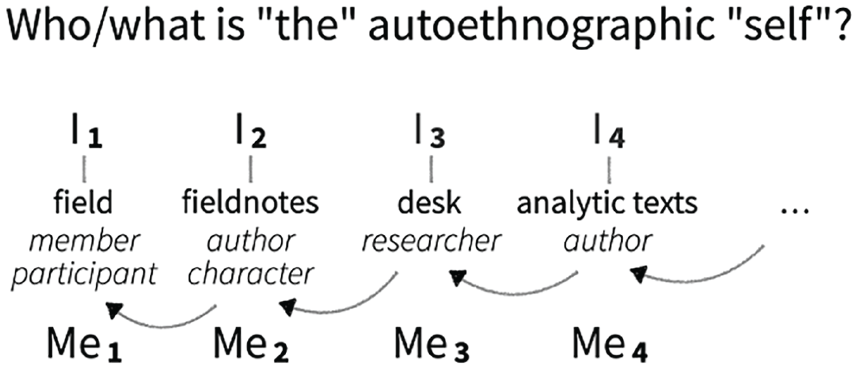
The Selves and Self-Relations of Auto-Ethnography.
The main site where the ethnographer’s multiple “I”s and “Me”s are produced and related to each other is in writing: autoethnographers turn their experiences and observations in the field, and hence themselves, into data by producing ethnographic fieldnotes and observation protocols in the form of (self-)narratives. These allow the ethnographer to revisit themself in the field, from maybe months or years ago, and to think and write about that self as they construct their ethnographic narrative. It also allows them to revisit their past ways of seeing and experiencing from an insider’s point of view. Autoethnographic fieldnotes, protocols, and analytic texts can then be seen as documentations of the ethnographer’s different selves and their production in writing, of their activities in the field and fieldnotes, and also of the relations between these selves.
The Selves of Autoethnographic Writing
Autoethnographic writing, as all ethnographic writing, is a way of collecting and generating data as well as a tool for reflection, analysis, and presentation (cf. Emerson et al., 1995). Auto-ethnographic writing specifically is a method of cultural inquiry through self-inquiry by writing about one’s subjective thoughts, emotions, and experiences. More creative, “evocative” styles (Ellis, 2004 as cited in Ellis et al., 2010) aim to produce aesthetic, engaging descriptions using elements of autobiography and storytelling. Another style of autoethnography is to empirically observe, closely describe and produce fieldnotes or (self-)observation protocols about one’s experiences in specific situations or as part of cultural practices. Autoethnographers can use their privileged access to subjective dimensions of social practices to achieve a certain degree of empirical richness. The ethnographer’s thoughts, emotions, experiences, and activities are turned into data for analytical purposes. I will deal mainly with this approach to autoethnographic writing since it lends itself to the kind of analytical autoethnography I am pursuing.
The different phases of autoethnographic research come with different forms of writing and ensuing text types (cf. Emerson et al., 1995). These also come with different selves as which the ethnographer is writing and appears as in the writing. During field work, writing is mostly a matter of writing up against forgetting and of extending the capacity of the ethnographer’s memory (Hirschauer, 2007, pp. 415–422). This is especially challenging since notetaking may get in the way of active engagement in the field. Quick jottings taken by the (ethnographer-as-)participant during fieldwork, as the “action” is still in progress, mostly function as “notes to a future self” that needs to remember what it experienced in the field and translate this into more extensive writing. The production of fieldnotes or protocols by the (ethnographer-as-)fieldnote-author is usually the point where a (ethnographer-as-)narrating self first appears. Fleeting memories and recollections, together with rudimentarily documented events are crafted into a narrative that introduces the character “I” (see next section), the (ethnographer-as-)narrated self, whose memories they then become. The ethnographer switches from a mostly “I”-oriented mode of participation to a more “Me”-oriented reflective stance while giving a past “I” a voice.
During analysis and already during writing, the author becomes the reader of their own account and encounters themself (their textually objectified self as participant) in their text and enters a conversation with themself as another. The “Me” produced by the fieldnote-author is now the object of another “I”s (the reader’s) observation, and also the fieldnote-author’s “I” may now be turned into a “Me”: The fieldnote portrays the way in which the fieldnote-author tells the story of the participant, its production, as well as the content of this story. This further reflection can then be the subject of analytical notes or memos, again written by another author-“I.” And even these, as I show below, can be read as accounts of a “Me” coming to terms with former versions of itself. These different “I”s and “Me”s at work in the stages and forms of autoethnographic writing stand alongside multiple selves in the texts as such.
The Selves in Autoethnographic Texts
In autoethnographic fieldnotes and protocols, there is usually one prominent character named “I.” On closer examination, this character proves to be multiple. The “I” in fieldnotes refers to the narrated self of the ethnographer as participant. It is who the ethnographer as fieldnote-author—the narrating self—was at the time that the protocol is about. The narrating self bears the same name, but it is more than the object of the fieldnote’s plot; it is who wrote the narrative and selected its characters, scenes, etc. It becomes visible in these selections and the style of the narrative. The narrated self, then, is who the ethnographer was in the field from the perspective of the narrating self. It is thus, despite what its name (“I”) suggests, a “Me” in the Meadian sense. When re-reading a protocol during analysis, the auto-ethnographer (as fieldnote-reader) encounters themself as a “Me” in the field. What appears as a “firsthand” account has, figuratively speaking, already passed through more than one pair of hands.
With every next analytical step from field work to the finished ethnographic account—usually another form of writing—another “I” becomes a “Me.” In this process, the ethnographer gets closer to themself as member or participant of the field, but at the same time, through repeated perspectivation, generates distance to themself and their subjective experience. Generating analytical distance by achieving a certain degree of alienation from one’s own everyday experience and knowledge is especially important in sociological ethnography which deals with what is all too familiar or taken for granted (Hirschauer, 1994), and is thus crucial for analytic autoethnography. Analytical distance can be achieved in different ways and more or less methodically. The core ethnographic activity of writing fieldnotes, of—to paraphrase an expression coined by Hirschauer (2007)—“putting one’s self into words” is already a way of generating distance. I want to suggest that in tracing the multiplication of the selves of the ethnographer in autoethnographic writing and their self-relations lies an opportunity for a systematic analysis of the ethnographer’s self-experience and of generating analytical distance. In the following section, I introduce positioning analysis as a means to this end.
Autoethnographic Positioning Analysis
Ethnographers craft stories in which the people they met in the field become an ensemble of characters. Especially in autoethnographic writing, the ethnographer is one of these characters. In their accounts, ethnographers position themselves and others, implicitly and explicitly, by the way they describe themself and others and by how they tell the story of what they witnessed and experienced as a participant.
Positioning Analysis, as introduced by van Langenhove and Harré (1999), is an analytical approach for reconstructing such positionings in narratives and social interactions. A position in van Langenhove/Harré’s sense is a bundle of rights and duties that regulates a person’s scope of action and encompasses the moral and personal attributes of a person as a speaker (van Langenhove & Harré, 1999, p. 17). This happens in “the discursive construction of personal stories that make a person’s actions intelligible and relatively determinate as social acts” (van Langenhove & Harré, 1999, p. 16). Social positionings are always double: by positioning someone, speakers always position themselves (at the very least as someone who can position others in the way they just did). The same goes for how people react to positionings by others. Self-positionings, like all positionings, can be tacit or intentional (van Langenhove & Harré, 1999, p. 22). It is, however, always the speaking self that does the self-positioning. Such self-positionings can occur in interactions, in interviews, in diaries or other ego-narratives.
I suggest that autoethnographic fieldnotes and observation protocols can be read as such narratives, in which the different selves of the ethnographer are involved in a “collective self-positioning.” Autoethnographic texts are both (a) accounts of positionings in the field as they were experienced by the ethnographer and (b) retrospective self-narratives in the sense of autobiographic interviews 1 and thus positionings themselves:
(a) Autoethnographic texts as documented positionings in the field. Ethnographic accounts are, of course, not mere documentary accounts, but “tales of the field” (van Maanen, 2011), crafted stories. However, they do contain information about what was going on in the situations they portray. They contain, firstly, the “local occasioning of narratives in interaction” (De Fina & Georgakopoulou, 2008, p. 379), talk in interaction. Secondly, they often describe the bodily activity of those talking. Participants may gesture and touch or position themselves in relation to each other spatially. Finally, positioning may not even be an activity of those involved in interactions and practices, but by their material-spatial arrangements or discursive framings. Autoethnographic positioning analysis can pay attention to both the ethnographer’s self-positionings and other-positionings as they navigate the social and moral structure of the field and engage with different counterparts.
(b) Autoethnographic texts as positionings. (Auto-)Ethnographic texts themselves perform narrative positionings: Jottings document the relevance structures of the participant-“I” in the field; fieldnotes/protocols as narratives about the participant’s experience produced by the fieldnote-author contain the documented self-positionings of the participant, but in addition, they contain and are other-positionings of the participant by the fieldnote-author, as well as self-positionings of the latter as narrator of the story; analytical notes and memos add another layer of positionings, in that the fieldnote-author’s implicit self-positionings can now become the object of an (ethnographer-as-)memo-author’s analysis—and so on.
Taking a methodically controlled reflexive stance toward oneself is a shift in perspective that is necessary in all kinds of ethnography, but for autoethnography it is crucial. Applying positioning analysis to autoethnographic texts allows to reconstruct how the multiple “I”s and “Me”s of the ethnographer are related to one another and made into one autoethnographic self. It can also shed light on reciprocal self- and otherpositionings between the ethnographer and others in the field. The following section will illustrate this approach using data and analyses from an ongoing study.
Meeting “My” Self (Selves) in the Field(-Notes)
As part of an ongoing study on programs of sex education and sexual assistance for people with disabilities in Germany, 2 I participated in a series of events called Touch Night, which brings together people with and without dis/abilities. The events provide an interactive space where participants can experience mutual physical touch and learn to reflect on and communicate their bodily and emotional “boundaries” in an educational setting. By enabling physical contact among and between people with and without disabilities, the aim of Touch Night is to also help reduce cultural barriers and “fear of contact” (Berührungsängste—lit.: fear of touch) on a societal level as a contribution to inclusivity.
This case lends itself to autoethnographic positioning analysis since Touch Night is a site where boundaries between social groups are simultaneously reflected on and re-produced. Positioning is linked to membership categorization, the doing and undoing of cultural differences (Hirschauer, 2021) and the categorization of humans (Dizdar et al., 2021). Positioning oneself or others can be locating them in culturally constructed categories of humans. Hence, positioning analysis can be used to analyze how differences such as gender, race, or dis/ability are reproduced through positionings. In my research, I became part and product of the activities taking place at Touch Night, where people, bodies, and activities are positioned in various categories but also in physical relations. I experienced both positioning others and being positioned by others firsthand.
To illustrate my argument, I draw on the following scene from a fieldnote. It portrays an interaction between me and another participant I call “Bernhard” 3 at Touch Night. At the point where the excerpt sets in, the evening has been going on for a while. “Jutta” and “Thorben,” the organizers, have welcomed the (about 10) participants; after warming-up with a meditation exercise everyone has introduced themselves going around in a circle. Thorben and Jutta then introduce us to the rules of conduct for the night. Thorben says that we should listen within ourselves if there is a “YES” when it comes to touching other participants or to being touched by them. “And if you feel a ‘YES’,” he continues, “then also say yes. And if you feel a ‘NO’, then say NO. And if you don’t know yet what you feel, then also say NO, because you don’t know yet if you want to say YES.” The evening unfolds over a series of exercises in which the participants get in various degrees of physical contact. Everyone remains fully clothed and certain body areas (the “bikini and swimming trunks zones”) are off limits, since “today is not about sex.” On the contrary, the aim is to experience “non-intentional touch” (absichtslose Berührung).
The term “non-intentional touch” is used in contexts like Tantra or Somatic Coaching to refer to a form of touch that is supposed to be intuitive and platonic, and explicitly not motivated by erotic or sexual desire or the aim to cause arousal. However, the term as used in the Tough Night context does not mean accidental touch either, since touch here must always be intentional since it must always be consensual.
For the following exercise, Jutta instructs everyone to line up in two concentric circles, facing each other in pairs. Those in the outer circle look toward the center of the circles, those in the inner circle look outward. The circles are then rotated so that everyone is partnered with a person they did not choose (or rather: they cannot be thought of as having intentionally picked as a partner). The exercise is to make “touch offers” to one’s partner by letting one’s own hand “hover” at a distance over a specific body part, whereupon the recipient of the offer is supposed to give their consent with a verbal or gestural signal before the hand actually touches the body. I am paired with Bernhard and standing in the outer circle, and it is my turn to make a “touch offer”: 4
I stand in front of Bernhard and make eye contact. His gaze is only briefly with me, then wanders down to the right. Thorben announces again: “You in the outer circle, feel inside yourself whether there is a touch impulse and whether you want to touch your counterpart. And if so, let your hand ‘hover’ about 15 cm above the spot.” Bernhard seems somehow absent; I think he doesn’t realize that I am being addressed. Bernhard puts his hand directly on my shoulder and starts petting me. I should have given my “okay” with a nod or some other sign, but so be it. Actually, it was my turn to make the offer in the first place. I hear him breathe and Thorben continues, one should now hold the hand next over the “heart center” of the counterpart and wait for approval whether they want to be touched. Bernhard’s hand moves to my breastbone (again wordlessly), back and forth, up and down. His fingertips briefly brush over my skin at the upper neckline of my sweater; then he strokes with flat fingers to the left over my pectoral muscle and over my nipple region, his gaze now fully on my chest area; I continue to look at (!) his eyes (I can’ t look into his eyes, his gaze remains fixed), keeping my body still, almost stiff (I don’t want to do anything that might make him think he’s done something wrong). Now he circles my nipple with his fingertips, his gaze firmly locked on it. The situation is super freaky. I don’t quite know what to do, I’m partly amused, partly massively irritated, this is weird, go away. I briefly look for Jutta or Thorben, but both are busy. When one of them talks about consent again, and that those who receive “touch offers” should show whether they accept them and give their okay, Bernhard nods and says thoughtfully to himself “okay” as he continues.
This fieldnote features several positionings performed by different parties, among them different versions of the ethnographic self. The fieldnote is narrated by “I,” the ethnographer in the situation, and it is narrated from “I”s position as participant of the scene: The opening, “I stand” (in present tense), constructs a participant-I as a narrating self, which is conflated with the fieldnote-author as someone who is or has been there (cf. van Maanen, 2011). In the course of the field note, the scene is narrated from a partly auctorial position. “I” shifts between himself-in-the-situation and himself-as-observer-narrator of that same situation.
The rules of the exercise and Thorben’s instructions create two possible positions for participants, ways of being in the situation, which come with specific limits to their possible actions: Everyone but Thorben and Jutta (who position themselves as “outside” the exercise) can either make or accept/decline touch offers, and consequently touch or be touched. These interactive positions are mirrored in the spatial positions in the circular arrangement of bodies but also in a moral order (cf. van Langenhove & Harré, 1999, p. 21), since touch is a highly negotiated activity at Touch Night: The act of touching someone, as configured by the sequential logic of Thorben’s instructions, coincides with the negotiation and establishment of consent to being touched. By their spatial self-positioning in the circles, the participants position themselves in spots where only those two options with their respective rights and duties are available to them, and at the same time subject themselves to the moral positioning they entail.
These exercise-specific positions of touch-offerer and touch-receiver are both installed in the situation by the instructions and negotiated in the participants’ practice. This moral order of positions is layered with other moral orders and positions, such as the course-specific positions of instructors and participants as well as gendered positions and positions of people with and without disabilities, which are located on a more global level but also related to the other orders and positions present in the situation and organize the practice. 5
“I,” the participant, being spatially positioned “in the outer circle,” perceives himself as “being addressed,” that is, positioned as someone who is supposed to and has the right to (offer) touch. Bernhard’s ensuing activity, however, positions the participant in the passive position of “being touched,” which “I” perceives as a forced positioning (van Langenhove & Harré, 1999, p. 26). This is expressed in the following second order positioning, which questions the positioning by Bernhard, and takes the form of a self-positioning by the participant as someone who is being touched, but not in the right way (“I should have given my ‘okay’”), as well as someone who should not be touched at all (“Actually, it was my turn”). This positioning is performed not for Bernhard in the situation, but for the reader(s) of the fieldnote, and it is also performed by a different ethnographic self: the fieldnote-author who presents a switch between the “I” and “Me” of the participant as part description of experiences, part internal monologue.
As the fieldnote progresses, however, the participant does not step out of his social-spatial position, but remains in it, observing-narrating what he simultaneously hears Thorben say and sees Bernhard do. He thereby engages in a deliberate positioning of Bernhard by re-actualizing the moral context (“wait for approval”) and situating Bernhard’s activities in it. “I”’s remaining in the position he felt forced into is thereby re-framed as an intentional “staying-put,” a self-positioning that performatively confirms the positioning by Bernhard’s touch in the situation, while discursively questioning it in the fieldnote. The narrating self, now part fieldnote-author, part participant-Me, then offers an explanation for this which is attributed to the thoughts of the narrated self (the participant-Me): “I don’t want to do anything that could make him think he’s done something wrong.” The fieldnote-author is, strictly speaking, neither observing nor documenting introspection at this point, but retrospectively making sense of the situation and thus positioning the participant-I to an implied audience of readers as someone who now holds a position of power in the situation portrayed. His activities (“do something”) could potentially force Bernhard into a moral self-positioning as someone who “has done something wrong.”
The passage “The situation is super freaky. I don’t quite know what to do, I’m partly amused, partly massively irritated, this is weird, go away” presents several shifts in positioning. The use of italics indicates a change of voice and speaking-position to the reader: “I” is now disclosing his thoughts and experiences in the situation (as the fieldnote-author remembered them occurring to the participant). The narrating self is shifting between the participant-I and participant-Me, sharing direct experiences of the situation (e.g., as “super freaky”) from the participant-I’s position and telling the reader (and himself) about reflections of these experiences by the participant-Me (“I’m partly amused, partly massively irritated”). Speaking in indicative present tense again (“this is weird”), he speaks directly from the participant-I’s experiencing position. “Go away,” finally, is a double positioning: The narrating self is now speaking from the participant-I’s position, yet with an “internal voice” that only the reader of the fieldnote is privy to “hearing.” The narrated self is addressing Bernhard (but not speaking to him) and hence positioning themself opposite of him and to an audience of readers as someone who is the object of a forced positioning by Bernhard.
What can we learn from this positioning analysis of the fieldnote excerpt? First, looking at the fieldnote as a description, we can reconstruct several positionings in the described situation. They happen verbally (both as spoken language and as internal monologue), gesturally, and physically. Participants are positioned in site-specific categories and in moral positions that endow them with rights and duties, through positioning them (or instructing them to self-position) in relational positions in space. Second, looking at the fieldnote as a self-narrative allows to reconstruct how the ethnographer positions not only others in the situated practice but also himself in its description by/thus creating multiple selves and self-relations among them. By creating these different selves and drawing on their insights and perspectives, the fieldnote-author not only re-constructs what was going on in the described situation, but he also constructs an (auto-)ethnographic self for the reader drawing on a dramatic ensemble of selves. While all of them go by the name “I,” they are in fact “Me”s—even if they are presented as speaking directly from an engaged participant position. An effect of the various positionings in the narrative of the fieldnote is the positioning of the fieldnote-author as someone to the implied audience of readers.
This “super-positioning” toward the audience may be organized by notions of “acceptable” behavior, as a notable ambivalence in the fieldnote suggests: “I” describes himself as being positioned against his will in the situation, but by/in this description in the fieldnote, positions himself as the one who is and stays in control of the situation—by intentionally doing nothing. Another ethnographic text from the same study may shed light on this. It is an analytical note to the fieldnote presented earlier, which was featured in a talk about the construction of vulnerability in fieldwork. After presenting the fieldnote in the talk, I went on to explain: 6
Bernhard is a participant with an intellectual disability. This is not explicitly stated in the protocol (at least not at this point), but interestingly it becomes visible anyway; namely in my behavior. In the scene described, Bernhard violates the rules several times: it is not his turn, he touches the body of his counterpart without being asked and without explicit consent, and then also in a way that is not provided for by the rules. Thus, in my (also: situationally calibrated) perception, he violates my physical and personal boundaries. On the one hand I am touched, although I should actually do the touching myself according to the interaction order. On the other hand, I am not touched in the correct way, but in my perception: groped. Bernhard, however, is not sanctioned by me. I propose to understand this as a construction of vulnerability. On the one hand, I protect Bernhard—and this is important: from my point of view as a participant in the situation—by not marking his deviation from the consensus ritual and the subjectively experienced violation of my boundaries. In doing so, however, I simultaneously engage in a construction of vulnerability that is also a form of Doing Disability—I situationally make Bernhard into someone who is not an equal counterpart, insofar as I want to protect him from his own reaction (or overreaction?) to my eventual rebuke, which I in turn impute to him. It is only through this consideration, the assertion of responsibility that Bernhard situationally emerges as a disabled person.
In this excerpt, we encounter further self-positionings by the autoethnographic self. There is the presenter-narrator giving the talk. He knows that “Bernhard is a participant with an intellectual disability.” He performs an indirect deliberate positioning of Bernhard (van Langenhove & Harré, 1999, p. 27) by reframing for the audience what they just heard and instructing them what to see in the scene between Bernhard and “I.” This “I” is a participant-Me as portrayed by the presenter-narrator of the talk. When the presenter-narrator says “I am touched” he draws a connection between his selves in the two situations of Touch Night and the talk. When he later states that “I protect Bernhard—and this is important: from my point of view as a participant in the situation—,” he marks a difference between the two. It was the participant-I who protected Bernhard or intended to do so. The presenter-narrator, however, knows more: He uncovers an implicit moral positioning of Bernhard in the participant’s behavior (“it is only through my [=his] assertion of responsibility that Bernhard situationally emerges as a disabled person”). As van Langenhove and Harré (1999, p. 27) note, both present and absent persons can be positioned in narratives. Bernhard is an absent person in the post hoc narrative of the fieldnote. But so is the participant. This allows the presenter-narrator to position both Bernhard and “himself,” that is, his self as participant, such that their positions make sense against a backdrop of the narrative of the analytical note as well as a moral landscape (see discussion section): by attributing the positioning of Bernhard to the participant-I, the presenter-narrator distances himself from it in the talk. From a positioning analysis perspective, however, the positioning of Bernhard as a member of the category “disabled person” is a joint positioning by the participant, the fieldnote-author, and the presenter-narrator.
Discussion
The analysis shows how autoethnographic writing constructs participants as identifiable persons and negotiates moral landscapes. Applying positioning analysis to these texts not only helps generate reflexive distance to the researcher’s experiences in the field but also allows for further analytical insight.
The study from the presented texts are drawn from investigates constructions of dis/ability, that is, the categorization of people along the difference of dis/ability. Its focus is on situated, interactive constructions of dis/ability which I participated in at Touch Night. Employing autoethnographic observation and writing allowed for an account of how this categorization is “done” not only through observable behavior but also in its absence or omission—through a deliberate not-doing accompanied by self- and other-positionings.
Applying positioning analysis to further texts allowed for a look beyond the situated interaction, at the coupling of the local social and spatial structure and moral landscape with moral landscapes on a larger scale. The difference between people with and without intellectual disabilities is never explicitly addressed by the organizers of Touch Night and not made an organizing principle of the activities and is hence not part of the social structure of Touch Night in a strong sense. However, participants enter the situation ready-positioned: Touch Night is advertised as an “evening of coming-together for people with and without disabilities” as which participants technically enter the event, even though this difference is not actualized as a structural condition. The unifying position of “participant” with equal rights and duties and the instructions given by the organizers aim at “overriding” the positioning as dis/abled, yet the situation remains informed by it: it is part of the moral landscape of Touch Night, as the analysis has shown. The difference between people with and without intellectual disabilities is present as a morally charged difference that participants must deal with. My framing of Bernhard as “disabled” is as much the result of my experience and behavior, as it is owed to this moral landscape, expressed in my self-positionings in it and the seemingly paradoxical tacit other-positioning of Bernhard by avoiding an explicit other-positioning. This continues in the further autoethnographic engagement with the fieldnote, when the presenter-narrator of the talk tackles a risk of accusations of invective misrepresentation (see Greschke, 2023), thereby invoking a moral landscape of (mis-)representation in the academic field.
Conclusion
This article explored autoethnographic positioning analysis as a methodology for analysis of the autoethnographer’s self-experience and for achieving analytic reflexivity by conceptualizing autoethnographic writing as the process and site where the ethnographic self is produced. Applying positioning analysis to different kinds of autoethnographic texts, I have shown that this approach can not only be used to investigate the social relations and interactions with the field and the tensions between self and other relations experienced by the researcher seeking strategic membership that other contributions in this issue focus on, but that autoethnographic positioning analysis can also be profitably applied to the ethnographer’s relationship with themself.
To this end, I developed a model and typology of the multiple autoethnographic self/-ves. I presented analyses of fieldnotes and analytical notes to illustrate the layered positionings between these ethnographic texts, in which the multiple “I”s, “Me”s, and selves of the autoethnographer are related to each other. In a way, this process continues in this very article, which is written by another “I” and from another position, and in which more (re-)positionings of earlier positionings and selves occur. For instance, look again at the introductory passage above the fieldnote excerpt. It portrays the same social situation as the fieldnote but employs a different stance—this “I,” the author of this article, claims a “this is how it was”-perspective which notably differs from the “this is how I experienced it”-perspective of the fieldnote. We might say that I (no quotation marks), the author of this article, use the shift in perspective between the introduction and the fieldnote as a self-positioning as someone who “has been there” but who has since gained a different perspective on what happened in the field, thus claiming the position of the author.
Yet: What do these multiple re-framings and layers of reflexivity leave us with when it comes to the epistemic status of (auto-)ethnographic writing and fieldnotes in particular? Are they just a string of words that can be reframed and re-constructed at will in analytic writing? No. My aim is not to create some sort of infinite reflexive loop and make the argument that the researcher can fit their data into almost any analytic narrative by adding enough additional levels of positioning analysis. Certainly, all ethnographic data, such as fieldnotes and perhaps especially auto-ethnographic accounts, have an innate constructive quality. Re-writing fieldnotes into analytical texts somewhat changes the account of what originally happened in the field. With each new layer of positioning analysis added in the paragraphs above, what happened between Bernhard and “I” appeared differently. Doing so will not lead to a definitive account of “what really happened.” It will, however, produce more or less convincing versions of events as they evolved and of the participants who evolved along with them, including the researcher. Using positioning analysis to dissect their multiple “I”s, “Me”s and Selves in the field and fieldnotes can lead to an understanding of what matters in the studied field and to the people involved in it.
The aim is to achieve an adequate balance of closeness and distance between the selves of the ethnographer and their contexts: the participant and the cultural codes of the field, the analyst and the professional codes of their field of work, and the study author and the literary codes and narrative conventions of ethnography (Poulos, 2021, p. 55). Successful autoethnography is then not only a matter of getting intimate with one’s self as member of a field. Rather, it is when autoethnographers distance themselves from themselves (as participants in the field) that they actually get the closest to themselves in terms of understanding what being part of a field is about.
Footnotes
Declaration of Conflicting Interests
The author(s) declared no potential conflicts of interest with respect to the research, authorship, and/or publication of this article.
Funding
The author(s) disclosed receipt of the following financial support for the research, authorship, and/or publication of this article: This article draws on data from an ongoing research project funded by the Deutsche Forschungsgemeinschaft (DFG, German Research Foundation): “Sexual Human Differentiation and Disability. The Construction of ‘Disabled Sexuality’ and ‘Sexual (Dis)Ability’” (Project-ID 442261292—SFB 1482).
