




Abstract
Attention has recently been given to the role of race in many aspects of the research process; however, minimal has been written to critique the role of race in qualitative fieldnotes. This gap creates potential conflicts about representation that can exclude marginalized communities and call into question findings when race is ignored in the research process. To successfully address potential investigator biases with a lens towards social justice and equity in healthcare, a critique of foundational methods is required. Here we posit that a qualitative health researchers’ primary tool is their fieldnotes because they contextualize findings and serve as a method to learn through systematic interpretation of local meanings revealed by participants. Here, we provide researchers guidance for teaching and writing fieldnotes that speak to current nuances of observations and interactions with participants. Definitions related to race and ethnicity, the importance of applying appropriate sensitizing frameworks, followed by a discussion of how to use fieldnotes in findings are covered. We include (1) a call for more preparation of novice researchers and a challenge for established researchers to update expertise for collecting and using fieldnotes in the research process, (2) guidance on negotiating difficult situations, and (3) the significance of language in creating credibility in findings when addressing race in qualitative research.
Fieldnotes are an essential part of any qualitative investigation. In short, what is written down in fieldnotes gives pause for iterative analysis. While attention has been drawn to the role of race in the qualitative research process, such as the subject interview and the use of reflexivity to lend the researcher credibility through self-reflection of positionality, minimal consideration has been given to the role of race within fieldnotes to address equity and parity in representation of participants’ local meanings (Holbrook et al., 2019). There is a dearth of information related to field notes and race in the extant literature. This is perplexing as fieldnotes are used to assist with recording, processing, and contextualizing data with observations, interviews, and journaling. If fieldnotes are to represent “the making of a more or less coherent representation of an observed cultural reality” (Clifford, 1993, p. 51) then race should be considered from the voice of the participant and re-articulated in a reflexive manner.
To address health disparities and prevent further structural inequities, all researchers must attend to the perspective of the participant. The importance of attending to race in our research processes and particularly our fieldnotes became evident to our team of authors when one was confronted by a situation she felt she was not well-trained to address: a participant of a different race expressed a racialized experience the author had previously been unaware of, which lead to a conversation among colleagues of “what have we missed?” and “how do we address race”. Were we guilty of self-censorship, self-denial, or simply blind to a participant’s racialized experience? Is race a global phenomenon or localized? If no one sees our fieldnotes, does it matter if or how race is addressed? In the societal rush to avoid offense in an age of polarizing censorship regarding race, such as the focus on so-called colorblind and egalite’ societies, while simultaneously living in a world where racial definitions determine outcomes, how can researchers remain true to our observant, reflexive, and honest selves? We propose that fieldnotes are the qualitative researcher’s primary tool to accomplish this task and make the influence of race knowable but found little guidance in literature. Given the shortage of recent considerations on how to write about race during the process of composing fieldnotes, we offer guidance. The purpose of this article is to provide a methodological critique of current ways in which fieldnotes are used to study race. Based in apropos thoughts on race, we address bias concerns, provide tools for writing fieldnotes, provide ways to perform analyses, thoughts on selecting different sensitizing frameworks, and offer considerations on the topic of race when composing and interpreting fieldnotes.
Race and Ethnicity as Social Constructs
Here, we address some of the reasons why health researchers, including experts and novices to the role, may need to reexamine definitions of race. While understanding of a racialized lived experience can only be revealed through the eyes and experiences of research participants, interpretation in the hands of the qualitative researcher as research tool warrants discussion as well. In doing this, we define some important concepts: race, ethnicity, and culture are explicated. We do recognize that the role of racial affiliation in society is complex and weighted, which is why some researchers may shy away from the issues of race when writing their fieldnotes. Few want to represent themselves in a negative light when working to support a cultural or racial/ethnic population. Considering the difficulties addressing this topic, we provide a reason to address racial observations in fieldnotes, and to provide a framework with examples that make trustworthy findings possible.
Given that race is a fluid concept used to group people according to various factors such as physical characteristics, ancestral background, and social identity (Flanagin et al., 2021), it is difficult to know if what a person observes in their studies meets current guidelines for observation. Race is used to group people that share a set of visible characteristics, such as skin color and facial features, but even this definition can vary by region or country. Indeed, the concept of race (though certainly not prejudice and tribalism) is considered a modern phenomenon emerging in the 17th century to justify stratification and even codify race into laws determining who and who could not hold power (Thompson et al., 2022). Race definition is unfixed, varies by locale, and may continually require reworking; therefore, scientific consensus is that race should be more accurately described as a social construct and not a biological one (Donovan et al., 2019). What then does this mean for an investigator who observes people of various racial backgrounds in their studies?
Health researchers have been known to consider race a postpositivist, independent variable, indicating a biological/physical characteristic, which may neglect to contextualize findings and further biases through misattribution of findings to race (Pinckney et al., 2019). For example, historically social-statistical methods focused on race to justify biological inferiority and were used in the eugenics movement (Zuberi, 2001). Currently, scientists are clear that race should not be based in biological essentialism and genetic determinism, which leads to faulty understanding of human diversity (Donovan et al., 2019).
In contrast an ethnic group refers to a human group that shares a culture, history and customs, and whose members are united by a conscious identity (Donovan et al., 2019). Ethnicity as a concept may be conflated with race in literature, yet the term ethnicity carries its own limitations as it is also an evolving social construct with no basis in biology (Flanagin et al., 2021). Nominally, there has been a shift from biological determination indicated by the term race to cultural specification through the term ethnicity, due to changing sociocultural realities and the awareness of racism in society (Flanagin et al., 2021). Social groups share a culture defined as a body of knowledge shared by a group of people who have a common history and take part in a social structure (Donovan et al., 2019).
Culture exists where historical, social, and economic forces intersect and is therefore continually reinvented leading to the lived experience as people interpret and act upon these shifting intersections (Woo, 2020). Yet culture is not a universal or concrete experience for people with these shared forces, therefore researchers need to remain open to “the possibility of being surprised and delighted by findings you didn’t’ know you were looking for” (Woo, 2020, p. 314). Shared culture does not guarantee or define ethnicity, and likewise ethnicity does not guarantee or define a culture; more work must be done by the researcher to understand individual experiences through interactions and interviews with participants and not rely on surface descriptors.
The two terms, ethnicity, and race are often used interchangeably and the use of ethnicity as a proxy for race can be viewed as allowing researchers “convenience and comfortableness” while simultaneously creating potential confusion and conflation (Pinckney et al., 2019, p. 352). The continued evolution and changing use of these terms over time adds to imprecision, confusion, and potential misattribution of findings, which further demonstrates the social and unfixed basis for the use of these terms (Flanagin et al., 2021). In 2021, The Journal of the American Medical Association “Updated guidance for reporting of race and ethnicity in medical and science journals” specifies that both terms, race and ethnicity, are social constructs with limited usefulness in designing and interpreting research, but also clarifies that the terms may be useful to contextualize racism, disparities and inequities in many areas such as health, healthcare, education, medical practice, research, and policy. (Flanagin et al., 2021, p. 622).
Race in Fieldnotes
The idea of a “post-racial”, “colorblind” society gained ground in the 1960s and 1970s, first in political spheres but also in some academic approaches, implying society had moved beyond race and should focus on other potential causes of inequality (Wimmer, 2015). This viewpoint has become pervasive throughout Western societies and creates the assumption of Whiteness as the “norm” to which all other races are compared (Graham et al., 2011). Though not isolated to Western societies, race is also used for social stratification in most global societies as seen in Middle Eastern and Australian treatment of migrant workers from Asia and Africa, the South Korean treatment of foreign students, and the Chinese, North African, and South Asian preference for light skin as exemplified in product advertisements (Kowner & Demel, 2015; Udah & Singh, 2019; Dos Santos, 2020; El Zein, 2021). Race is considered a social construction not based in biology, yet many researchers approach race as an ontological reality, often not adequately questioned or addressed in the qualitative process (Nayak, 2006). Unless the researcher explicitly asks or attends to the role of interpreted race based in local context, then these assumptions and comparisons may be perpetuated or dismissed.
So, why should researchers address race in their fieldnotes? After all, humans are 99.9% genetically identical (Donovan et al., 2019). In fact, a random sample of genes taken from different human populations reveals that human populations are too similar genetically to justify dividing humans into racial groups (Andreasen, 2000). Given that biological races in humans do not exist and genetic variations do, racial distinctions based on observable human traits are subjective judgments (Byeon et al., 2021). And here is the point: biophysical features of different populations conceptualized as race, which have become markers of social status, have become internalized as sources of individual and group identities and their differences (Smedley & Smedley, 2005). These manifest as non-medical factors which directly impact health outcomes known as social determinants of health (WHO, n.d). To provide healthcare for people who may suffer from poverty, illiteracy, poor environmental access to clean water, and many other factors, a choice is made to ensure best opportunity for health. There is no advantage to having any part of a society living in health-threatening levels of disorder. Before the social determinants of health can be addressed and health restored, researchers must give healthcare providers knowledge of the various clusters of meaning surrounding illness. These are to be addressed for the underlying health issue to resolve. A variable that has predictive power over humans needs understanding.
The problem arises for qualitative researchers: How are these terms used in the field? According to Banton (1988) ‘race’ is a categorical identification denoting “them”, based on physical or phenotypic characteristics, while ethnicity is the identification of a specific cultural group corresponding to “us”. Thus, ethnicity would be something voluntarily assumed by oneself, while racial identification is something imposed on the other by assumed biological characteristics. Researchers use the concept of ethnicity to study the ways social and cultural processes intersect when insiders and outsiders identify the group as ethnic groups (Pinckney et al., 2019). Thus, the term race is not able to comprehensively describe either biologically or culturally a person’s membership in any group. Moya and Markus (2010) recommend that ethnic comparisons must be made in tandem with racial comparisons to fully contextualize the differences in conceptual and material resources over time, which influence opportunity and privilege. In short, the only sure way to know how these terms are used and understood by people is to go study their affiliations, use of the terms, and understanding personal preference for identification.
Regardless, a healthcare system that segregates persists and we must learn to address this as qualitative health researchers. Race-based societies perceive designated racial groups as biologically discrete and exclusive, and certain physical characteristics (e.g., skin color, hair texture, eye shape, and other facial features) become markers of race status and order including economic, educational, and prestige (Smedley & Smedley, 2005; Thompson et al., 2022). Inequity is a fundamental aspect in the racial system. Groups assume that race has distinctive cultural behaviors linked to biology despite the absence of discernable biological markers (Smedley & Smedley, 2005). The means to study the health effects and solutions to harm based on racial division is through scientific observation, contextualization, and analysis of participant perspectives.
There are researchers that may not want the emotional and political risk associated with writing about race in their fieldnotes. In the work of Hale (1998), the construction of Whiteness and Blackness are historically detailed in opposition within American society from 1890 to 1940. The fears, crimes, and neglect, as well as the obligations, status, and responsibility known to exist were heaved upon vague attributes of the body over time. Hale’s work taught us that when we reformulated our relationships with others based on social position, race becomes our paternalistic index for privilege in society over time. In modern societies, this western approach to race has spread via colonialism and manifested in specific localized ways to reinforce social structures and grant powers to some while denying others based on outward appearance (Kowner & Demel, 2012). International researchers are now challenged to critique the representations given to people and received from people based upon their physicality and used as presentation of self in society. Along with that critique may come a flood of emotions that can hinder our ability as researchers to face the multi-generational biases we have lived.
In this context, what happens to researchers who belong to a racial group, do they identify themselves or is it a social imposition? Do researchers write on-going observations, dialogue, and interpretations to consider controversial racial issues that may be of significance as they move through the research process? Do researchers write about their observations of people’s bodies, including their skin color, when they do not see the connection when first entering the field? For most people, racial designation has not been a choice, instead a social group assignation based on their physical characteristics, such as hair, eye, and skin color (Jemal et al., 2019). The acceptance of characteristic belonging is known as perceived race, which manifest in two ways: the first is the race that is self-perceived and the second is the race that others perceive (Jemal et al., 2019). In this sense, society confers negative characteristics to certain “races” and more positive attributes to others, which ultimately have real-world, measurable effects in areas such as income, opportunities, and even life-stress experiences (Matsui et al., 2020). It is possible that qualitative approaches that use fieldnotes will guide the novice and experienced health researcher to understand cultural systems in a novel manner. They may become attuned to how race identity, both self-assigned and society-assigned, influences the complex structures and functions of that cultural system whether it is an explicit part of the researcher’s original question or not.
Samples of Fieldnotes Written During Different Research Studies With Diverse Samples*.

*All names are pseudonyms to protect anonymity.
Sensitizing Frameworks for Addressing Race in Qualitative Methodology
With what is known about the presence of race in all social systems, the lack of acknowledgement of race does not negate its presence nor does it fully account for the experience of people in the world. Race is rooted in the structure of society; however, it is within individual experiences that the societal basis of race is lived (Andreasen, 2000). How can the qualitative health researcher theoretically approach this issue to ensure credibility and validity of their methods that ultimately influence findings? Alasuutari (1995) points out that investigations in cultural studies using qualitative observations can be like a new love interest, with subtle signs coming from both parties that if misinterpreted can lead to detrimental outcomes for a couple’s ritual of dating or friendship. In this section, we point out sensitizing frameworks based in epistemological philosophies that can be of assistance when considering how to write ongoing fieldnotes that include race/ethnicity.
Qualitative research is considered inductive, using experience and observation to understand how specific experiences create the “larger” picture and can be used in theory production (Miles et al., 2019; Morgan, 2007). Therefore, qualitative research often occurs with an a priori selection of a sensitizing framework (or concepts) which influences the design, methods and philosophical approach but does not presuppose relationships to be tested (Miles et al., 2019; Morgan, 2007). As Brill Blumer (1954) identified, sensitizing frameworks are instruments which guide the qualitative researcher by suggesting directions in which to investigate as opposed to fixed and specific procedures for finding evidence. Per Charmaz (2003): “Sensitizing concepts offer ways of seeing, organizing, and understanding experience; they are embedded in our disciplinary emphases and perspectival proclivities. Although sensitizing concepts may deepen perception, they provide starting points for building analysis, not ending points for evading it. We may use sensitizing concepts only as points of departure from which to study the data. (p. 259)
Fieldnotes are written observations, clues that can be analyzed from any systematic perspective (Alasuutari, 1995). When informed by a philosophical or sensitized approach to observations and analyses, sensitizing frameworks guide health researchers on what to look at within the fieldnotes, including how race is accounted. We will critique and comment on several philosophical and theoretical approaches, which can be used to sensitize the researcher to the importance of race through qualitative design. Here we briefly review George H. Mead’s symbolic interactionism, Shalin’s social interactionism, and the collective of critical theories.
In the study of race, symbolic interactionism may not provide all the necessary tools. Society is maintained and can be found through the interactions between people, which when studied reveals subjective viewpoints and “how individuals make sense of their world from their unique perspective” (Carter & Fuller, 2016, p. 932). Per Van Maanen (2011) culture is not visible as an entity itself but is made visible through its interpretation and representation by its members. “George’s” dismissive use of the term “those ladies” exposed his disdain which “Pat” later revealed was rooted in racial differences, and she reciprocated with her use of the term “old coot”; powerful symbols of a racialized interaction (See Table 1). In the case of the gentleman from Texas (see Table 1), noting his shared origins with the researcher served as a proxy for worth and shared values rooted in culture. Without additional words, the mention of “Texas” was enough to put the participant at ease (See Table 1). Society is constructed through shared meanings made apparent through language. We as researchers are making culture visible, so we are responsible for the representation we provide to readers. While symbolic interactionism does not explicitly call on the researcher to address race, we propose it is implied that race as well as other identities should be considered to gain a holistic view of the participant’s world. Yet it is through this implicit assumption that symbolic interactionism is often insufficient to understand the current cultural system.
A widely cited group of theories that explicitly address the role of race in research are categorized as critical race theory (CRT) (Burton et al., 2010; Graham et al., 2011; Pinckney et al., 2019; Wimmer, 2015). CRT is one of several “critical theories” connected with various social movements from the larger meta-philosophy of
In CRT, race neutrality is directly questioned. It precludes a post-racial or colorblind approach- racism is central to understanding how society functions to reinforce dominant cultural norms and oppress the “other”. This theory has grown from its roots in legal theory, where it was used to explain how institutionalized racism causes the disparate enforcement of law based on race to further reproduce these systems, into educational theory and finally into the wider world of sociological research (Burton et al., 2010; Graham et al., 2011). It can be used on its own when the research question explicitly isolates racism as a focus, or in conjunction with other theories to influence methodological focus on the inherent role of race in society structure and function when the research question is not exclusively focused on racism but requires focus on equity. Similarly, using a CT philosophical frame when using other theories to sensitize methodological approaches could keep the idea of race, as well as other influential social factors such as gender and socioeconomic status, at the forefront in a qualitative design as it requires explicit “consciousness of our own relationships to the focus of research” (Benson & O’Reilly, 2020, p. 2).
Since the purpose of the theoretical sensitizing framework(s) or concepts(s) in qualitative research is to guide the researcher’s gaze, opening it to new potentials, it is reasonable to consider multiple conceptual and theoretical approaches during stages of qualitative design. Most qualitative researchers who use a sensitizing framework to understand the role of race and racism in a culture will need to attend to intersectionality of multiple participant identities. For example, in the mid-twentieth century, beginning with the dismantling of the dominance of European empires, a new consciousness arose regarding the value in native languages, meanings and worldviews in primacy, not just in relation or opposition to dominant European viewpoints, known as post-colonial theory. CRT has been criticized for its lack of attention to women’s role in the colonial and post-colonial era spawning the intersectional theory of post-colonial feminism. Like CRT, post-colonial feminism is also inspired by the philosophy of CT, in that it requires a critical appraisal of systems that oppress those of gender as well as racial and ethnic minority status. In fact, CRT itself is useful when combined with other critical theories as they intersect to understand a holistic view of culture and sensitize the researcher to be attuned to the influence of concepts or theories (Gillborn, 2015).
However, we do caution researchers to conscientiously combine sensitizing frameworks and concepts which compliment or demonstrate improvement to the research approach instead of confuse due to contradictory foci. Issues of race are potential confounders at all stages of qualitative research, from conception through implementation and finally during interpretation. A priori selection of sensitizing philosophies, frameworks, and concepts must be made thoughtfully with conscientious attention given to the role of race. These selections can then provide researchers with a foundation in which to guide application of fieldnotes and synthesis of findings to increase confidence in credibility and reduce the risk of furthering inequities.
The overwhelming question is: where do we start when selecting a sensitizing framework for the purpose of including race in a study? Consideration of the research question(s) will help guide choice and application of framework(s), but the influence of race and its definition should be a part of these considerations and addressed during the study within fieldnotes. However, even with an eye towards change agents, race may be insufficiently considered. By intentionally reading and familiarizing oneself with approaches and sensitizing frameworks which address race in qualitative methods, a researcher may be better able to expand participant observations and more intentionally interview participants to capture and consider how race influences experiences within fieldnotes.
Addressing Race in Fieldnotes
The role of fieldnotes is varied in social research, but universally accepted as a necessarily important process for analyzing and interpreting findings. Ideally, fieldnotes can be used to help alleviate the tension that comes from doing research that is observational in nature but interpretation that is interactional in nature. Some researchers proscribe rigid methodology to their fieldnotation process, while others may not compose fieldnotes for every interaction. Most social researchers are not taught how to take fieldnotes, and few have seen or analyzed fieldnotes prior to embarking on their own careers (Jackson, 1993; Sanjek, 1993). Fieldnotes may not be seen by anyone other than the original researcher(s) as they are often tucked away in a journal (or nowadays on a computer hard drive) never to be seen in their full narrative after publication of findings (Burkholder, 2016; Sanjek, 1993). Yet, there is an accepted tradition that fieldnotes are an integral part of the process in qualitative methodology.
If researchers are not taught how to take fieldnotes, how can they accomplish the challenging task of recording and analyzing difficult topics such as race and racism? To maintain credibility in our craft, qualitative researchers must address these concerns and learn to first be aware of their biases and address them in reflexive fieldnotations. Through imperfect yet intentional practice, researchers may build a vocabulary and interview style sufficient to address racial concerns.
In his essay “I am a Fieldnote”, the author Jackson (1993) interviewed anthropologists to identify how they defined and used fieldnotes in their practice. Along with a consensus that fieldnotes were important to provide context for observations and interviews, some sociologists noted that fieldnotes were a creative process, “creating it in the terms of bringing it out as fact” (Jackson, 1993, p. 15). Reflexivity is a vital part of this creative process for the researcher to address biases, preconceptions, and choices to increase validity in findings (Deggs & Hernandez, 2018). While journaling is often cited in the literature as an essential way for the researcher to address reflective practice, fieldnotes are potentially more useful. If the researcher creates real-time fieldnotes using reflective practices, it can help researchers generate meaning through check-back of findings and reveal thoughts as they occurred in present time (Deggs & Hernandez, 2018). As the researcher reveals thought processes and writes their fieldnotations, meaning is augmented, and validity of findings is reinforced. In this way we see that the qualitative researcher taking fieldnotes serves as the tool through which information is processed and synthesized into bigger findings reflexively: a synthesis rooted in the individual meanings and values participants express through actions and words. At a minimum, reflexive journaling relies in part on recollections that are recorded in real-time fieldnotes.
Research pragmatists may ask: How can race effects be identified and ascribed meaning by the participant then observed and attended to by the researcher? The researcher works to record and reflect on data regarding the question identified without ignoring the participants’ racial identity and racialized social positioning. The researcher works to make the assumed observable through written clues and participant voices that can be studied later. Value can be found in the disconnect between the participants identified meaning on race and the researcher’s reflective fieldnotes. As the researcher records observations in the form of fieldnotes, it is important to be attentive to what is said in contrast or in concert with what is observed by the researcher as well as what is not said or observed. In fact, in the case of “Grace” the interviewer noted a disconnect in what was observed and what “Grace” said, “I can’t fail”. Prior to this statement, the researcher hadn’t noted any racialized interactions but became aware of the value Grace put in her race and her work ethic which had gone uncommented on by others. Not all participants need to be queried about racial interactions, but the researcher must always be attuned to whether further investigation through questioning is warranted, and document this in fieldnotes. As Nayak (2006) notes, qualitative methods, such as ethnographies, are “delicate cultural constructions intricately interlaced through a diverse community of tellers, listeners, writers, and readers who in turn may unravel and string together these ‘truth regimes’ differently” (p.412). Who’s meaning takes primacy?
How to Use Fieldnotes.

aMethods derived from Emerson et al. (1995).
bExamples and recommendations derived from authors’ own research.
Recommendations for Addressing Fieldnotes
We have laid forward the importance of fieldnotes and the importance of addressing race by choosing sensitizing framework(s) that ensure the influence of race is acknowledged and considered in sound qualitative research design and application. In addition to these principles, to better inform current researchers and better prepare future researchers, we put forward three recommendations: practice your craft; embrace the difficult; and always attend to language.
Practice Your Craft
There are three fundamentals to be taught to novice researchers and considered by experienced researchers to increase comfort and practice. These include how to be reflexive, how to integrate into findings, and how to write thick description. As Jackson (1993) revealed in her survey of anthropologists, there is no one way to take fieldnotes, and there is a great variety in how they are used. Most concerning though, is her finding that researchers purported to not use fieldnotes and were never taught how to take, use, or consider fieldnotes during their research education. Given critique of research and scandals regarding reproducibility, creating a trail for other experts is essential (DuBois et al., 2018). In fact, Morgan (2007) recommends readdressing quantitative and qualitative research as less distinct methodologies and more of a continuum from discovery to confirmation. Therefore, there is value in teaching all research students the importance of fieldnotes, contextualizing findings for deeper understanding, learning to avoid implicit biases and misattribution to race, and seasoned researchers should ask if their use of the methods are sufficient to address these concerns.
If a researcher is not exposed to the process of recording their observations and thoughts in fieldnotes, they may not find comfort and confidence in its application. This may delay their ability to find a voice as a researcher- especially when it comes to uncomfortable and difficult to address situations like the role of race or racism in culture. In adult learning theory, adults use tasks or problem-centered learning to apply concepts for mastery (Knowles, 1996). By more intentionally including application opportunities for learners in all fields of research-focused programs, comfort will increase, and sound practices will result. Qualitative findings are foundational for explicating new and unexplored concepts, care must be given to how researchers create credibility through transparent processes. Fieldnotes are a vital part of this confidence-building process; practice is warranted.
How do researchers prevent fieldnotes from becoming a formality used only in triangulation or check-back validation processes? Cruz (2015) recommends that researchers develop a continuous and systematic method for creating reflective processes which include integration of fieldnotes to uncover the “implicit dimension” to become aware of one’s assumptions (p. 1ce733). Positionality refers to the acknowledgement that each individual brings diverse and particular experiences to their interpretation of the world which can become reality through implicit actions and interpretations (Kezar, 2002). Therefore researchers must be attuned to these specific positions and be mindful of the effects on all stages of the research process to avoid further marginalization of participants through overly subjective design (Cruz, 2015).
Epistemology, Sensitizing Frameworks, and Fieldnote Methods.
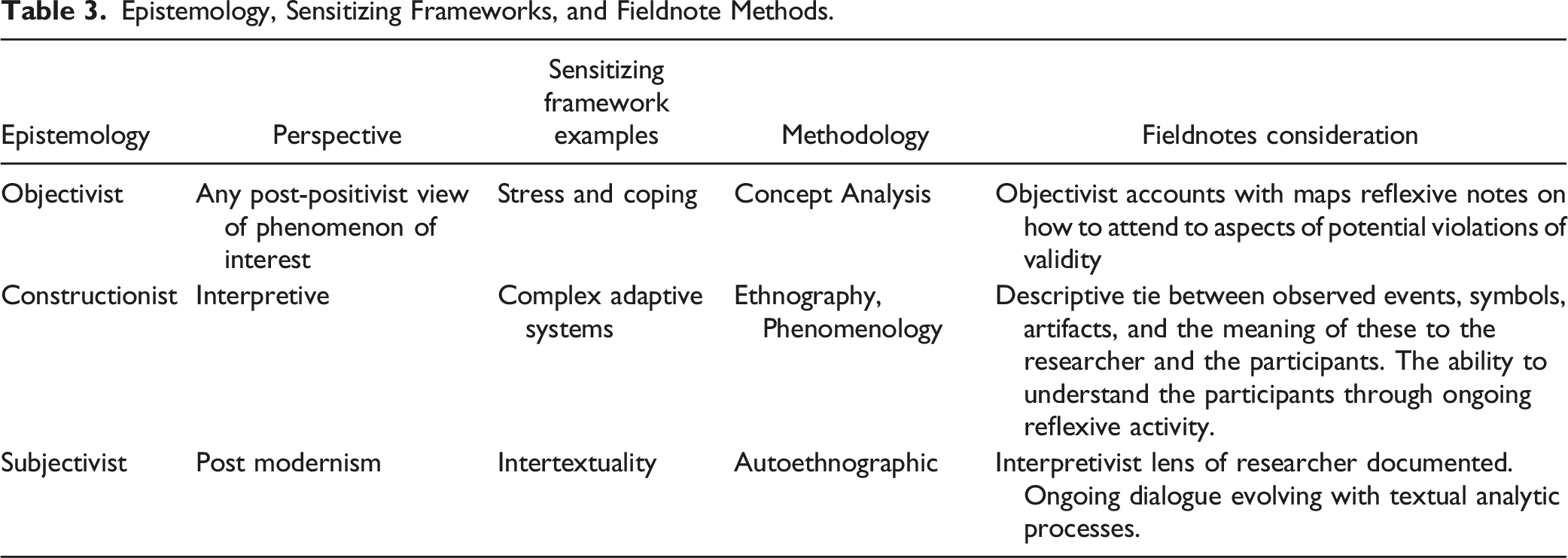
How can fieldnotes develop a richness and robustness of usability within findings? The way in which fieldnotes are taken and then used should also be addressed. Although few can reach the level of writing considered thick description writing fieldnotes while engaged in the research process, fieldnotes are an essential element necessary to obtaining it during analysis and write-up (Sanjek, 1993). Fieldnotes have traditionally been considered private and in the purview of the researcher only, and indeed there are questions of safety and participant harm if exposed. As Jackson (1993) notes in her essay “I Am a Fieldnote” confidentiality depends principally on the situation and type of research being conducted, may be shared with participants under some conditions, but shielded when words and opinions can be used for ill. But when rich descriptions and real-time information are recorded, they are immensely powerful research tools. There are indeed newer schools of thought focused on using fieldnotes when appropriate to engage participants and ensure appropriate representation (Murphy et al., 2021). With the growth of secondary analyses, metasyntheses, and the increased requirements from funders for data sharing and transparency, qualitative researchers must take note that fieldnotes are an essential part, not just of rigorous and ethical qualitative research, but also potentially reimagined analyses (Phillippi & Lauderdale, 2018). Though beyond the scope of this paper to debate, consideration must be given by researchers as to the purpose and final disposition of fieldnotes creating even more impetus for informed observations of racialized participant experiences and perspectives.
There are researchers who believe that writing fieldnotes pulls them away from their participants. Qualitative methodology rests upon the tenet of rapport formation, and the simple act of writing fieldnotes may pull the attention of the researcher away from the present interaction and threaten that bond (Clifford, 1993). These two seemingly disparate activities must be reconciled for researchers to form rapport which is vital to trustworthy findings (Guillemin & Heggen, 2009). Rapport formation is essential in both short encounters and in more prolonged participant observations and relies on ethics in context to remain flexible and responsive to participant boundaries (Guillemin & Gillam, 2004). This is difficult when dealing with race because in recording fieldnotes the researcher must remain attuned to the situation, record their own thoughts including potential sources of bias, but also remain engaged with participants to capture their worldview, which serves as entrée to their culture and racialized experiences (Guillemin & Heggen, 2009; Long & Wray, 2003).
The researcher can ensure their notes are reflective of the experience and be conscious of the mental work needed for the inductive process (Emerson et al., 1995). Though we offer no one-correct-way to accomplish this, awareness and practice with fieldnotation techniques should be included in training so researchers can discover procedures and develop comfort with how to balance the contrasting needs of rapport formation and note composition. Experienced researchers can also find opportunities for growth by analyzing their own processes and working to improve the dynamic push and pull of attention versus recording. A potentially valuable learning exercise could intentionally incorporate participant observation of a racially influenced experience that challenges learners to report and reflect upon not just the experience, but how they record the racialized experience via fieldnotes. Potential solutions can be to step away to dictate notes, create a shorthand for jotting notes, and sketching pictures with symbols. All can be followed upon at the end of the day to write reflective notes in an iterative process. Experienced researchers can benefit by intentionally reviewing existing fieldnotes with other experienced colleagues, or colleagues with different identified race who can provide guidance on language use and positioning.
Clifford (1993) warns that qualitative reports may gloss-over or “smooth (es) over the discursive mess – or richness” and “the cacophony or discursive contradictions” that can be found in fieldnotes (p. 59). This refinement process that is necessary to reduce large volumes of work into digestible and publishable pieces can threaten to diminish the variety and richness of culture, including race. Through application exercises and consultation with others including experienced research-instructors, researchers can become more adept at ensuring multiple voices are heard and that the overwhelming voice of the “dominant language” of the local environment does not crowd-out differing viewpoints and worldviews, such as those from different and multi-racial backgrounds (Long & Wray, 2003). Practice with these skills should be a necessary part of any researcher preparation program and ongoing reflexive growth processes. Advisors should regularly read the fieldnotes of their students while in the field to provide feedback and experienced researchers should continue to seek feedback from colleagues. Never requesting to read fieldnotes will ensure a lack of preparation.
Embrace the Difficult
In covering humans with all their fallibilities, researchers are bound to encounter uncomfortable and sometimes even confrontational situations. Both in the field and afterwards during reflexion around real-time fieldnotes, the researcher must address the difficult challenge of understanding the racialized experience through extended investments in time. Reflexivity and consideration of one’s fieldnotes is an important aspect of ethical mindfulness that allows for acknowledging and dealing with important moments that arise in daily practice and not letting them get lost in the busy juggling of the research process (Guillemin & Gillam, 2004). In fact, Ellis (2007) recommends that the researcher pay attention to uncomfortable moments as a cue to content that needs further exploration- don’t ignore it, attend to it.
Creating the time to reflect upon interactions with participants is critical to understanding boundaries. Logstrop (1997) refers to the boundary that humans set up to protect their “core of personality” as the “zone of invulnerability” (p.176). This zone is a somewhat fluid feature of what it means to be human from an individual perspective, and researchers should be attuned to these boundaries and learn to negotiate them based on the participant’s responses. Acknowledging these boundaries shows respect to the participant and fulfills our ethical obligation to not cause harm, but this could threaten discovery of new information or intent behind the words. Care in negotiating these situations to know how far to probe a participant is important, and fieldnotes are a good way to document the entire interaction, not just the participant’s words out of context. As Spradley (2016) recommends when establishing rapport, the researchers should be careful and conscientious in their processes. Creating a relationship when the researcher is an outsider both culturally and racially, each new interview will begin with apprehension until comfort is achieved. Through exploring the relationship together, the researcher and participant can reach a cooperative status where the risk of offense and misunderstanding is greatly reduced. Only then can a new dimension of true participation be reached with a heightened sense of camaraderie and full participation between outsider researcher and insider informant. Participant informers can then take on a more assertive role highlighting and helping the researcher to discover new patterns and realities about their racialized lived experience (Spradley, 2016).
As a researcher do you trust your interpretation, or do you fear your own views? There is the risk in taking fieldnotes that the researcher will self-censor or choose not to include information if it reflects poorly on either self or participants. The inability to fully document the interaction reduces the necessary information available to create valid conclusions through synthesis. If a subject is not addressed, how can it grow? It takes courage to open oneself to new ways of thinking instead of merely the technical procedures of research. The process of critical consciousness is a process where both the researcher and participants participate in reflection, meaning making, and emancipation (Friere, 1993). Critical consciousness provides the researcher with the ability to enable the participant to shift from a position of vulnerability or oppression to bringing in their own power and voice to identify their cultural and socio-political construction of self (Aluwihare-Samaranayake, 2012; Friere, 1993).
Steps to incorporating crucial consciousness in qualitative research can occur through use of emancipatory strategies such as dialogue, reflexive questioning and listening (Aluwihare-Samaranayake, 2012). Use of a process such as critical consciousness would ethically contribute to nonmaleficence and beneficence by engaging in a space where the participant is not vulnerable (Aluwihare-Samaranayake, 2012), and can voice their experiences, if any, with race, power, and oppression. Most cultural and racial themes remain tacit or below conscious level of knowledge, so people may not express these ideas freely (Spradley, 2016). Employing an interview style that allows the researcher to freely shift between friendly conversation and interview questions will allow for a natural and unforced flow that can only be achieved through practice and extended involvement with participants- too much too soon will threaten essential rapport. To ask questions regarding race, it can be valuable to acknowledge and seek out the presence of folk terms, which are important symbolic words that cause a visceral reaction and conjure up experiences, histories, and feelings all at once. Asking the participant how to use a folk term symbol as opposed to explicitly asking for its meaning (e.g. “What are some sentences in which you might use the term “colored ladies”, or “Can you describe some ways that you could “fail” at transitioning to practice”) can be more instructional and less confrontational as the informant can then reveal symbols/words in relation to others, exposing deeper meaning. Similarly, the researcher can apply this same technique to non-verbal symbols to understand how participants use symbols, words, and objects to reveal relationships including those influenced by race (Spradley, 2016).
Researchers should acknowledge biases and question their own beliefs, seeking out partners to help talk through these difficult and uncomfortable situations. In fact, researchers lacking cultural awareness are at risk for not understanding, failing to record, or misinterpreting the nuanced symbols that convey meaning in a culture being studied (Papadopoulos & Lees, 2002). Cultural integrity is recommended at all stages of research design and implementation requiring consultation with multiple people who have cultural wisdom, which can and should include fieldnotations (Pelzang & Hutchinson, 2018). Fellow research experts, participants, as well as community stakeholder groups can be invaluable sources of racial and cultural expertise to guide sound research design and should partner in informing social research (Pelzang & Hutchinson, 2018).
Remaining alert to the historical origins of researchers and participants allows a team to collectively work through issues such as censorship (including self-censorship), colonial, racial, and power differentials that appear in fieldnotes (Long & Wray, 2003). In the field, partnership with participants will allow for native meanings to be made evident more readily both through interviews and observations. In analysis, a collaborative team can scrutinize interpretations, critically review the fieldnotes and findings of others who are “positioned with different sympathies” (Long & Wray, 2003, p. 175). Participant’s words are valuable and can be enriched by context to uncover potential confounding or controversial racial attitudes that are only found in the difference between words and actions/interactions found in fieldnotes. We must name our biases to make them visible and available for scrutiny to allow disruption (Long & Wray, 2003). In her study of nurses, the primary author achieved this in several ways; first with open communications with participants about her positionality and asking for clarification to better understand their worldviews, but also in consultation with qualitative experts in her program to explore ideas of positionality, language, and representation of the oppressed. Though she did not share her fieldnotes with participants, their feedback of her analyses informed and refined her ability to report accurately and insightfully in future fieldnotations and interviews. Open communication gives us the ability to grow and learn from one another, furthering the genuine search for knowledge.
Always Attend to Language
As qualitative health researchers’ observations are written in the real time “heat of the moment”, how can we be assured that their use of language is appropriate and avoids unintentional biases? Attention to the social world occupied by our participants is essential to understand “meanings, symbols and motives” and we must struggle to capture this through the imperfections of language (Rock, 2001, p. 31). Our fieldnotes are chiefly a “means to an end”; the first attempts at interpretation and representation are raw kernels of growth allowing for evolution of thought and richer insights into the potential entwining effects of subtle disparities rooted in systemic, institutional, and structural racism (Van Maanen, 2011, p. 3).
Representation through language is ever-changing along with society and keeping abreast of these changes can be overwhelming for the already busy researcher (Flanagin et al., 2021). With growing awareness of the importance of language and position, guidance can be readily found and provided through professional organizations such as the American Medical Association (AMA), American Psychological Assocition (APA), and Centers for Disease Control and Prevention (CDC) (American Psychological Association, 2019; Centers for Disease Control and Prevention, 2020; Frey & Young, 2020). These sources are routinely updated with input from panels of experts, providing guidance based on consensus, contributing to up-to-date, evidence-based use of language in writing and reporting. Indeed, latest advice recommends avoiding terminology which leads to “othering” of peoples different than a presumed societal norm as this further exacerbates inequities and masks underlying social determinants of health (Powell & Menendian, 2016; Flanagin et al., 2021 ). Positionality is the researcher’s struggle to “unravel how their biographies intersect with their interpretations of field experiences” to continually audit all aspects of the research process from inception and design to analysis and reporting (Finlay, 2002, p. 210). Ideally by documenting this process, transparency is gained providing an accountability of the findings (Van Maanan, 2011). However, language can serve as a proxy for exclusion through creation of negative stereotypes and weighted words, its use intrinsically tied to positionality, whether conscious or unconscious (Udah & Singh, 2019). Words become a symbol of processes, structures, and conditions that exacerbate and cement marginality and inequality. Careless use of language can entrench qualitative findings in this world of marginality and othering, but careful analysis of positionality and how participants use language can reveal implicit structures, and processes, which manifest as social determinants of health (Powell & Menendian, 2016; Flanagin et al., 2021).
While the qualitative researcher cannot attend to perfection in the field through fieldnotes, they do retain a certain responsibility to be familiar with the everyday jargon used in the field and the scientific/social concepts used in the literature to avoid exacerbating inequities through language and position. This requires conscious effort on behalf of the researcher and speaks to the ethical struggle to reveal credibility through design, sufficient time in the field, fieldnotes, ongoing reflexive practices, and well-written, clear ideas (Guillemin, M., & Gillam, 2004; Aluwihare-Samaranayake, 2012). The researcher cannot substitute their own perspectives and language to supersede the symbols and language used by participants-but they can work to incorporate these symbols into a larger understanding of the society within which the individual participant is situated. The racialized experience can only be understood when perspectives and sought out and respected.
Conclusions
By critiquing methods used to conceive of research and make it real with fieldnotes, we hope researchers gain a new license to write knowledgeably, clearly, and reflexively about race when writing fieldnotes. Indeed, if we are to acknowledge that race is not biological, but instead a social construction, then we can and should explore race and racialized experiences using known qualitative techniques applied with culturally relevant and culturally humble methods. Without confidence and crisis, the trustworthiness of our findings will never be achieved. Bittner (1964) writes “the sociologist finds himself in the position of having borrowed a concept from those he seeks to study in order to describe what he observes about them” (p. 240). This borrowed concept becomes a significant problem when assumption is expected to do the “analytical work of theoretical concepts” (Bittner, 1964, p. 241). Words and phrases can serve as a troublesome proxy for beliefs, stereotypes, meanings associated with race and tribalism in the absence of critical analysis and reflexive representation. By holding ourselves accountable for our own practices and inner thoughts in fieldnotes, regardless of if others bear witness to them, we as ethical researchers can address the systemic and internalized racism in our global societies that lead to poor health. Only through bravery, humility, conscientious reflexion, and continuous qualitative methods improvement can we understand and speak to the lived human experience in all its nuances, including race.
Footnotes
Acknowledgments
We acknowledge the support of the Rapoport-King Thesis Scholarship and the Luci Baines Johnson Fellowship
Declaration of Conflicting Interests
The author(s) declared no potential conflicts of interest with respect to the research, authorship, and/or publication of this article.
Funding
The author(s) received no financial support for the research, authorship, and/or publication of this article.
