




Abstract
Adult literacy learners often survive on the periphery while holding burdens of invisible barriers. In this article, I explore the border between those in the mainstream and those seeking reintegration and community. Finding resonance with artography, I resist methodological enclosure just as the individuals I work with resist the boundaries that attempt to define them. Emboldened by critical arts-based research, I employ artography to examine my experiences as an adult literacy facilitator supporting formerly incarcerated women. Through metaphorical, poetic, and artful inquiry, I explore a border pedagogy, reaching for a shift in consciousness. Understanding borders as the barrier that separates formerly incarcerated learners from mainstream community, I have attempted a pulling of threads to unravel and then re-stitch an understanding (of) the lines that (no longer) blindly hem us in.
I am a female, White settler living and working on Treaty 3 Traditional territory of the Haudenosaunee Confederacy, comprising Mohawk, Oneida, Onondaga, Cayuga, and Seneca Nations. A career in the arts, and then special education and, later, adult literacy, has given me insight into the needs of those marginalized. I also hold the gaze of one who is differently abled. I acknowledge my positionality as I engage in research impacting those who struggle to reintegrate into communities, access housing, and rebuild their lives. These experiences and my positionality have led me to connect my training in the arts, my experience as a facilitator of poetic community events, and my practice as a literacy facilitator to researching symbolic barriers and invisible borders as markers that define learners deemed unacceptable (or inviable) despite intention or ability.
It is from this place and these experiences that I oppose Canada’s correctional system that correlates time served in punishment and deprivation with justice. Despite the efforts of nonprofit agencies and individuals who advocate for carceral processes that are not punitive, I despair that our society does not have the collective political will to implement restorative justice. My opposition, combined with professional relationships that allowed me to witness incarceration for convictions unrelated to public safety informs my worldview. Drawing on Mack (2010), I intuit (this) social policy as the outcome of illegitimate and oppressive factors determined by a neoliberal construct that upholds one person’s power bought at the cost of another’s privilege and freedom (Cohen et al., 2007).
My ontological perspective leads me to believe that personal agency is an expression of power rather than value or truth (Mack, 2010); I maintain that the responsibility to seek justice and respect for all persons lies with those who have social or political weight, agency, and ability. Within this critical lens, artographical lines of questioning call for a living in the borderlands (Lee, 2022). These borderlands call me to situate myself within the in-between; here, I find a third space of memory (my role and interactions), identity (my positionality in relationship), reflections (recall and reflexive attention), storytelling (recall, iteration, and craft), and interpretation (art, emotion; Irwin, 2003). A third space exploration of in-betweenness (Irwin, 2003; Lyle, 2018) may prompt deeper awareness of the boundaries that un/intentionally deny equal access and respect for all persons.
My career as a literacy facilitator has positioned me to hear the stories of learners who have experienced unequal access to possibilities and knowledges. Their stories are often absent from general sociological discourse, a discourse created within a colonial, capitalist, patriarchal framework that reinforces an unjust status quo (Wigginton & Lafrance, 2019). Typically, in Ontario, people reintegrate from incarceration without social support to re-establish themselves; thus, a search for belonging starts at the carceral exit gates. Exit from incarceration and transition to community carries a stigma complicated by an uncertainty akin to what Rogoff (2000) describes as the experience of forced emigration. Displaced or relocated people often embark on a search that leads to a sense of loss of earlier emplacement, followed by the insecurity of not having alternative spaces to inhabit.
Mindful of this stigma, and sensitive to the plights of displaced, impoverished people seeking acceptance and reintegration, I was compelled to pursue this research hoping to shed light on barriers to possibilities for moving through them. The enormous challenge of reintegration is only magnified for women in a culture that perpetuates a view of gender where women must seek to have their voices heard and presence validated (Solnit, 2020). It is undeniable that my lens is a feminist one, and this exploration of barriers facing women struggling to reintegrate is a dedication to the survival of these women.
Inquiry of Interest
As a facilitator, I have learned alongside paroled people who re-offend because the process of reintegration presents seemingly insurmountable barriers. Securing affordable housing, becoming familiar with an understanding of an often-unknown urban infrastructure, and the challenge of acquiring enough food for nourishment are often unachievable tasks. According to the most recent official government data (Correctional Services Canada [CSC], 2015), the average federal offender’s education level is below Grade 8. A lack of education may be the most common characteristic attributable to offenders; the many challenges they face require educators to be reflexive and aware of how biases and assumptions are often barriers to learner engagement. Inquiring this way allows me to uncover barriers between women who committed an offense (and have served time as reparation) and the educators who support them. Through a deepened understanding of the pedagogical relationship, I hope to identify ways educators can better support reintegration.
Hopeful Aim and Specific Curiosities
My experience as a literacy instructor of formerly incarcerated and marginalized learners guides me as I reconsider moments when learners resisted or committed, when they may (not) have felt able to be present to attend literacy programming. I am struck, at times, by the learners who achieved a sense of belonging in literacy, and I am also mindful of the instances where learners felt disconnected—when they could not attend or continue to move forward. Heidegger (2010) refers to this sense of being stuck as Dasein. He likens it “existentially [to] that which it is not yet in its potentiality of being” (Heidegger, 2010, p. 141). As a holistic concept, Dasein suggests that one can unravel to understand (Hodge, 2015). In this spirit, I attempt an unraveling, embracing living inquiry to search for a state of in-betweenness (Lyle, 2018), considering learner responses and my (own) interactions while occupying a third space: one between art and subjectivity (Pinar, 2011). The liminal third space of critical arts-based research (CABR) has enabled me to gain insight to shift the boundaries of my awareness of adult literacy practice with women in reintegration. Engaging artography as a methodology heightens my imaginative capacity to demonstrate how other lives (those on the periphery seeking reintegration) could really be our lives (Zwicky, 2014).
Considering reentry for learners transitioning from incarceration to community led me to wonder how artography can be used to examine the barriers affecting reintegration for formerly incarcerated women. From there, realizing this question is applicable to those beyond those formerly incarcerated, two specific curiosities emerged:
How could making and writing as inquiry identify educational barriers perpetuating the stigma that accompanies a criminal record?
As border pedagogy, how can writing and making expose social borders educators reinforce?
Theoretical Framework
Drawing on artography, I find resonance within CABR. Together, and with my emerging curiosity about border pedagogies, I found myself stitching together a theoretical framework to explore while resisting enclosure.
Critical Arts-Based Research
Emergent ex-convicts are living participants in the politics of belonging; they are individuals implicit in the complicated work of location in the making (Aoki et al., 2004)—a raw and unfolding urgent search for crossings and pathways that may lead to a safe place to reimagine ourselves. Language (dialogue) and gesture (actions) are metaphors that invite living inquiry. They are not a philosophy to be followed (Meyer, 2010); rather, they offer a trail of crumbs that may lead to insight(s). As such, I find ontological resonance with CABR. Artists as researchers use care and dignity as a relational way of being to become one with difference (Leavy, 2010); becoming one with difference is a necessity for reimagining a society where people emerge from incarceration and are welcomed with dialogue rather than homelessness, hunger, and recidivism. Thus, I use CABR as a form of resistance hoping that it could cause others to reconsider the borders that confine those unable to participate.
CABR is a pathway to combine my experience in writing and making with exploring our responsibility to understand more about how educators come to determine who matters enough to attempt a breakage of borders. As one who has been given a glimpse of the complexity of the physical, social, psychological, and emotional barriers that oppress women in reintegration, I seek a deeper understanding of the symbolic barriers that marginalize them. CABR involves suspending my assumptions to engage aesthetic awareness to explore possibilities: what makes a boundary; what components occupy the space on either side that obstruct a naturally occurring merge? CABR is to wonder, and the act of making within it demands a willingness to engage in the muck not only to search for something unseen, but also to pull it (fiercely) in (Lee, 2022; Solnit, 2005).
Artography
I value artography as living inquiry, a process to reimagine and find meaning(s) in the context of my lived and living experience (Lyle, 2018). Artography pays attention to the in-between, the spaces where meanings reside in the simultaneous use of language, images, materials, situations, space, and time (Springgay, 2008). To be immersed in the research of artography is to be inquiring through the process of making, writing, and exploring metaphor. Artographical research uses metaphor not to reinforce previously known conceptions; rather, it evokes unknown, possibly inconsistent, unrealized potentialities (Boulton et al., 2017). Visual metaphors are tools that not only compare dissimilar concepts, but they also can elicit knowledge through exercising the imagination. Artography involves the creation of a visual metaphor and engagement with the dialogue facilitated and developed by and from it (Boulton et al., 2017).
Springgay (2021), an artist and curator interested in the complicated relationship between contemporary art, pedagogy, artography, and inclusion, has informed and inspired my inquiry. She exposes the violence that contemporary pedagogy and research may project on women whose world views are not Western colonial perspectives. She commits to creating space and work that evokes consciousness within respected institutions. She urges other researchers to enter the warm, folded, porous, intimate spaces of learning. Springgay’s call to action—open, creative, nonlinear way(s) of knowing to make praxis—affirms that art can be an agent of developing potential for every human being.
Springgay’s (2021) work resonates with me as I seek to understand and dismantle the barriers facing formerly incarcerated women who voice intent and interest but are without agency to overcome the many obstacles in neoliberal linear educational curricula. Eliminating barriers requires understanding the fabric of the construct(ion). It requires deep knowledge of how fibers remain viable. It implores us to examine the contents of a line, a border, or a boundary. Removing boundaries necessitates an understanding of the purpose, function, and constitution of the lines drawn with the intent to divide the un|ruly (Rogoff, 2000). These lines do not, will not, shift once a learner has served time unless those who have agency seek to deconstruct them. Reimagining space (Leggo, in Springgay, 2008) through contravening convention to imagine access (housing and acceptance) for formerly incarcerated women may result in inclusion. Reimagining spaces (physical, intellectual, or symbolic) may enable women to imagine belonging and commitment to a community while they avoid the recidivism forced by isolation.
Border Pedagogy
In this exploration, I researched border pedagogy as it concerns stigma and blame to poetically reconceptualize the psychological, physical, and social barriers that assign individuals the status of Other (Finley, 2015). I explored relational ways of being one with difference. I sought research that evokes a restructuring of frontiers from boundaries meant to contain (Jardine, 1992, 2022; Wittgenstein, 1968). Drawing from Jardine (2017), I explored connections between borders and identity, a relationship apparent in the silence and marginalization imposed when identity enforces proximity, a forced distance from the norm (Jardine, 2017). Through critical artography, I attempted to understand Spivak’s (2010) work, a scholar who identifies the tragic irony that “all teaching attempts change, yet also assumes a shared scene” (p. 229). My interest in both Spivak’s and Jardine’s work relates to my dream of a breakage of shared boundaries, bias, or scene; exploring boundaries and identity for women is border work.
As a pedagogical tool analogous to Freire’s (1996) concept of conscientização, border pedagogy encourages educators to examine their assumptions to make the narratives of those othered more accessible (Kazanjian, 2011). Border crossing creates awareness through understanding how differences within and between disparate groups can expand the potential of human life (Giroux, 2005). Similar to conscientization (Freire, 1996), border crossing develops a heightened awareness that differential distributions of power deny justice and equity for all (Easton & Hewson, 2018). Examining border crossing within an artographic methodology builds metaphoric bridges that humanize; they become bridges that cross over the stigma that accompanies a criminal record.
Making | Sense
Rogoff (2000) suggests that the lines, borders, and boundaries between the un|ruly exist because of the constant invocation of policy and the current rule of law. The relationship between stigma and punishment is fundamental to the study of law, society, and punishment (Durkheim, 1947; Erikson, 1964; Goffman, 2014; Maruna, 2011; Mead, 1918). Drawing on Lageson and Maruna (2018), I perceive that the rapid and evolving changes in technology and social media make the issue of stigma an urgent crisis of social justice affecting all layers of society: mental health, addiction, housing, poverty, and education, all of which are affected by systemic racism. The untenable borders facing women in reintegration are further distressing as they are now not only instigated by the courts, but also by those given access through social media. Online records, court proceedings, and sentencing documentation follow women after they have served the duration of their carceral sentence. Despite time served, digital footprints haunt women as they seek to reintegrate, access education, and participate within communities.
Examining the Borders
Collaborating with women in reintegration is heartrending work. As a White woman with the privileges that accompany whiteness, I am aware my feelings of discomfort, anger, shame, and empathy influence and intertwine in my work with women often reintegrating after committing crimes relating to systemic racism, discrimination, and colonialism. Ahmed (2017) writes of emotions as enabling us to see the boundaries that distinguish inside from outside. I sit with this idea, the possibility emotions may not just enable me to develop rapport, but they may also extend to support research where I revisit experience to understand interaction and story as a layered, multivocal text (Lather, 2008; Wilson, 2015).
I explore the context again and situate myself. I think about my role, collaborating with educators in a school board where some educators cannot see the (insurmountable) barriers learners face. I think about human rights practices and responses to advocacy. I wonder about my desire to right the wrongs of settler-colonial society and how my intentions, as a White woman devoted to righting/writing the wrongs in my path, may be misguided or naive. I wonder when and whether help is welcome (Spivak, 2010). I wonder whether women in reintegration may not want to receive “help” from those naive of the circumstances that contributed to their stories. I rethink the notion of agency as responsibility to others (Spivak, 2010); this realization leads me to revisit what it means to assist. I reach (and hope for) a climate where caution is less of an urgency (of necessity) where care, openness, and consideration of every one’s responsibility (more than individual rights) is honored and celebrated.
Stitching Wholeness and Hope
Embarking on artographic research instills feelings of both anticipation and apprehension in me. I sense that research open to imagined possibilities is akin to the joy a fresh ream of paper brings to someone who draws; this feeling is tempered by not knowing the projected trajectory inherent to nonlinear theoretical frameworks such as artography. Artography relies on an awareness of the multiplicity of perceptions that textual, sensual, and aesthetic ways of knowing bring forth to uncover what lies (sometimes just) beneath (Springgay et al., 2005).
As I recalled encounters that expose my perception of the borders that influence my social and individual construct of identity, I sensed I would be more comfortable undertaking research that relies on interpreting the words of others, not mine. As a late-career woman who has struggled to garner the confidence to pursue academia, I swallow in defiance to the perception of invisibility that descends on me. Somewhere in my body, I understand and I intuit that my experience is relevant. The experience that forms my entry point occurred while I was a novice in my adult literacy role when one of the formerly incarcerated learners I worked with arrived at school with a package: a hanger and a garment. She said (as closely as I recall): This is for you, Lorie: you are the first high-class woman who has seen me. I may have said thank you; I do not remember. In my confusion and astonishment, I responded, Oh, but I am not high-class.
That exchange, and later upon realizing the dress did not fit (I put it aside and did not ask about alteration), led me to understand that what was said is far less relevant than what was unsaid (Yoo, 2019; Figure 1).
irregular weave
carefully crafted structure
striking obscures through
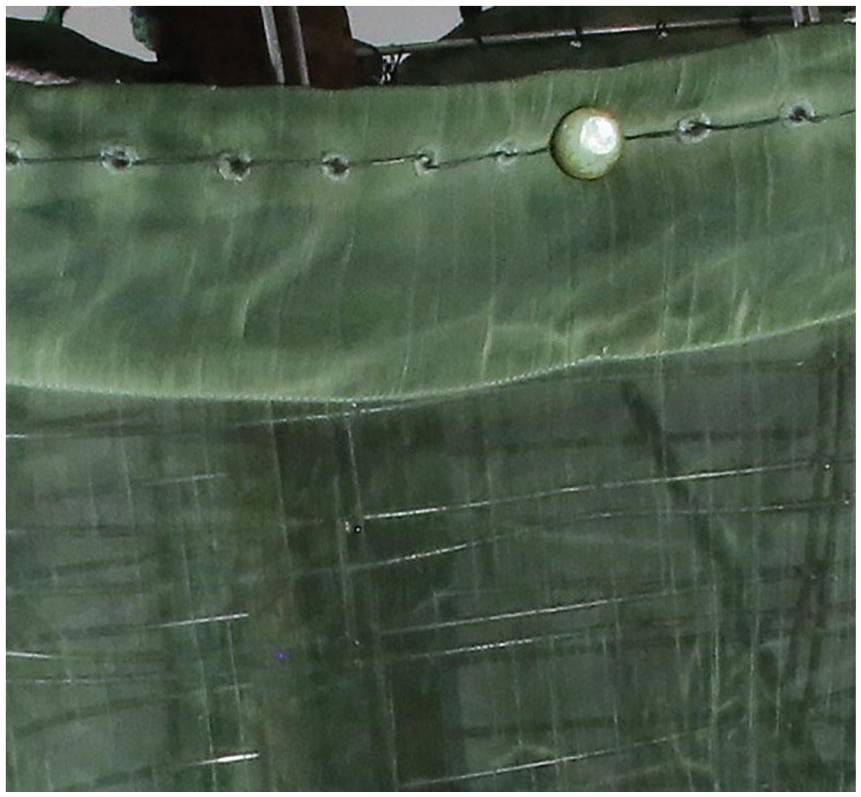
Reconstruction of a Dress.
Springgay et al. (2005) understand that engagement between scientific and intuitive ways of knowing is open and porous. I adopt this metaphor, the dress constructed from thrifted (but rich) materials, carefully crafted to appeal to my presentation, as imagined by a woman who offered her gifts to bridge the space between us. This space is the border between one employed within an institution that excludes those who have (publicly disclosed) histories of transgressions and one who suffers the vast impact and effects of the unending stigma afflicted on those who hold criminal records.
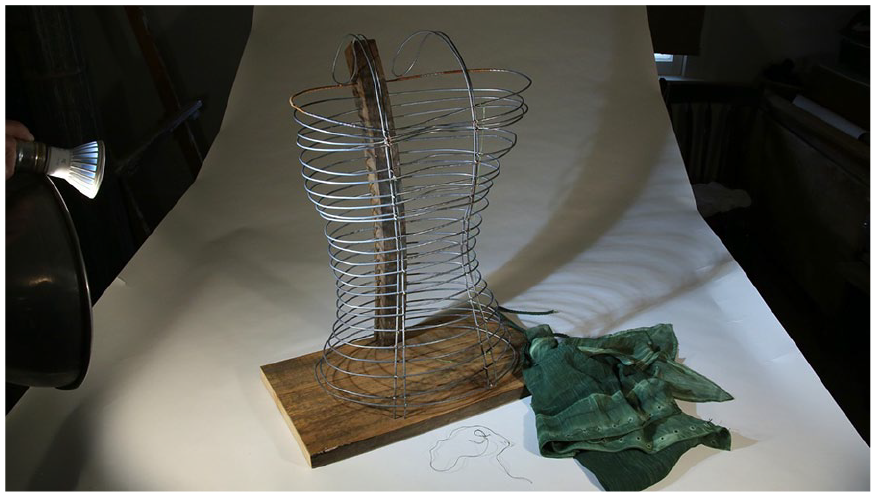
I pause to consider how afflictions can teach, remembering there is no absolute connection between experiencing affliction and learning (Jardine, 2016). I remember the terrible risk of maintaining proximity to—without falling for (Jardine, 2016)—as I am distracted by the possibility of creating a lush, brilliant image (of a dress) that erases the pain, marginalization, and yearning for connection expressed through the gift of a handsewn garment. The dress made for me sat in my mind for a decade. It is a nudge to bolster the courage to understand how we come to know through opening doors, not closing them. Solnit (2020) muses that threads, thereby dresses made of threads, are not the ideal metaphor for concepts that branch, fork, and lead in diverse directions. She expands and contradicts to suggest that the twisting of fibers, an unraveling of thread, may lead one to see individual strands, otherwise unnoticed or ignored. As I untwine embroidery thread to wrap the ribs of a former fence, now reshaped in dress form, I imagine a pulling of obscure data to assemble a picture to represent my interpretation of words women articulate to me, their facilitator within a formal institution (Figure 2).
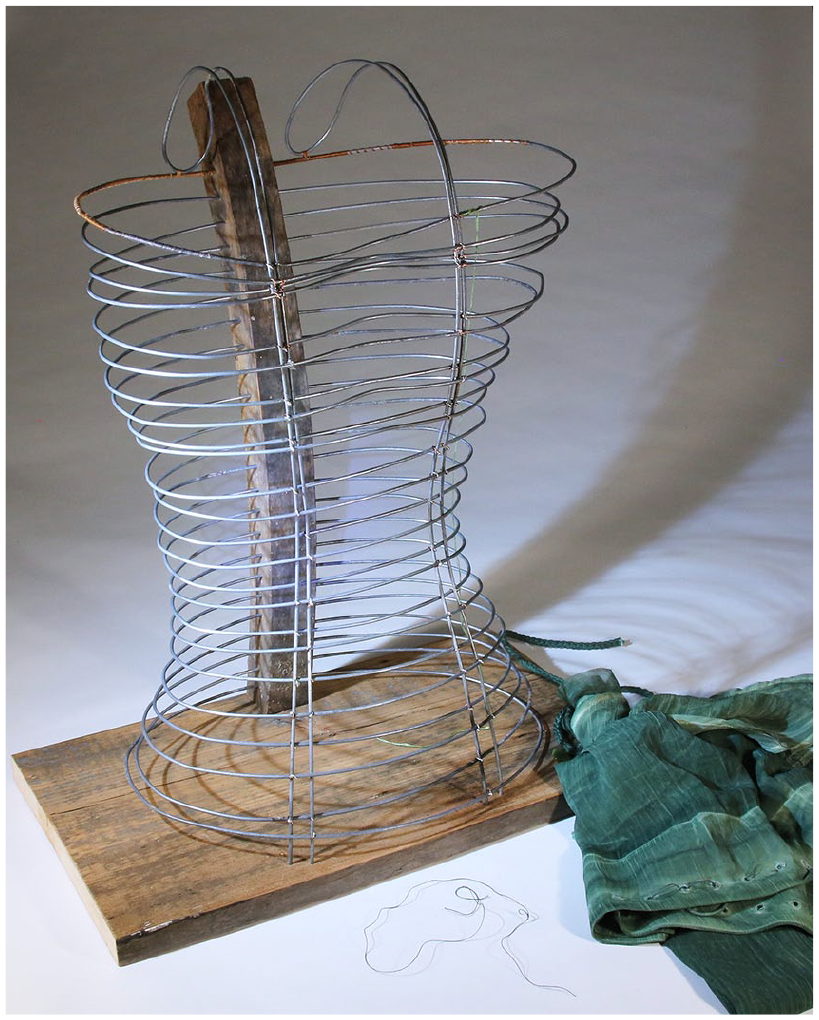
Torso, Scraps, and Thread.
On considering ethical ambitions for social justice in education, I latch on to the concept of radical openness. Chakrabarty (as cited in Cornell, 2010) describes radical openness through Heideggerian terms: “the capacity to hear that which one not does already understand” (p. 101). Radical openness aligns with a politics of care, a pedagogy that attempts to reimagine others as beings in-common; a condition Mbembe and Goldberg (as cited in Thompson, 2018) describe in conversation as becoming others of the living. A radical openness as a politics of care is to adopt a focus on the human condition, understanding that reparation is an everyday practice of action, of care, of being, alive (2018). They assert that engaging with others through radical openness is constitutive of the human condition. Radical openness refutes the tendencies of liberal democracies, the exclusion of the Other, which lies at the heart of postcolonial modernity (Thompson, 2018).
This concept, radical openness, aligns with my understanding of responsibility (in literacy): to hold an ideal of who each woman is, an openness that is blind to the social barriers they present. I imagine that my responsibility as a facilitator lies in holding a utopian ideal figure of each woman until the time comes when they have open arms to grasp this image for themselves (Figure 3).
Slender thread wraps round
gray bars that contain—surround,
encompass yearning
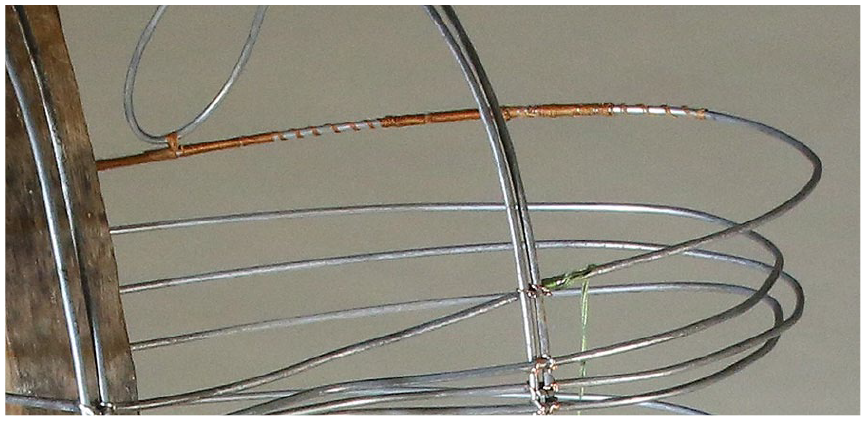
Wrapped Wires.
Symbolically, reintegration is transition. Prosser (1998) refers to transition as the in-between that threatens to dislocate our ties to identity. Unlike those that occur to learners who experience a degree of autonomy and sense of self through familial, professional, or personal experiences, many of the women who transition from incarceration express despair over the absence of security in place, habitation, and acceptance. I attach these pictures, these tied torsos, to represent life in-between as described to me by women seeking assimilation and community after incarceration (Figures 4 and 5).
Bricolage torso, a dress form A chronicle: transgression humiliation suffering silence Assiunptions scavenged, thrilled, adorned to converse to stitch dialogue a conjunction. Opposites? Conversation convergence of story, a dress. One representation identity Choose define/defy body, a form action that is possible
I expect we all
look better in light—(Un) dressed
shadows of unwelcome. (Figure 6)
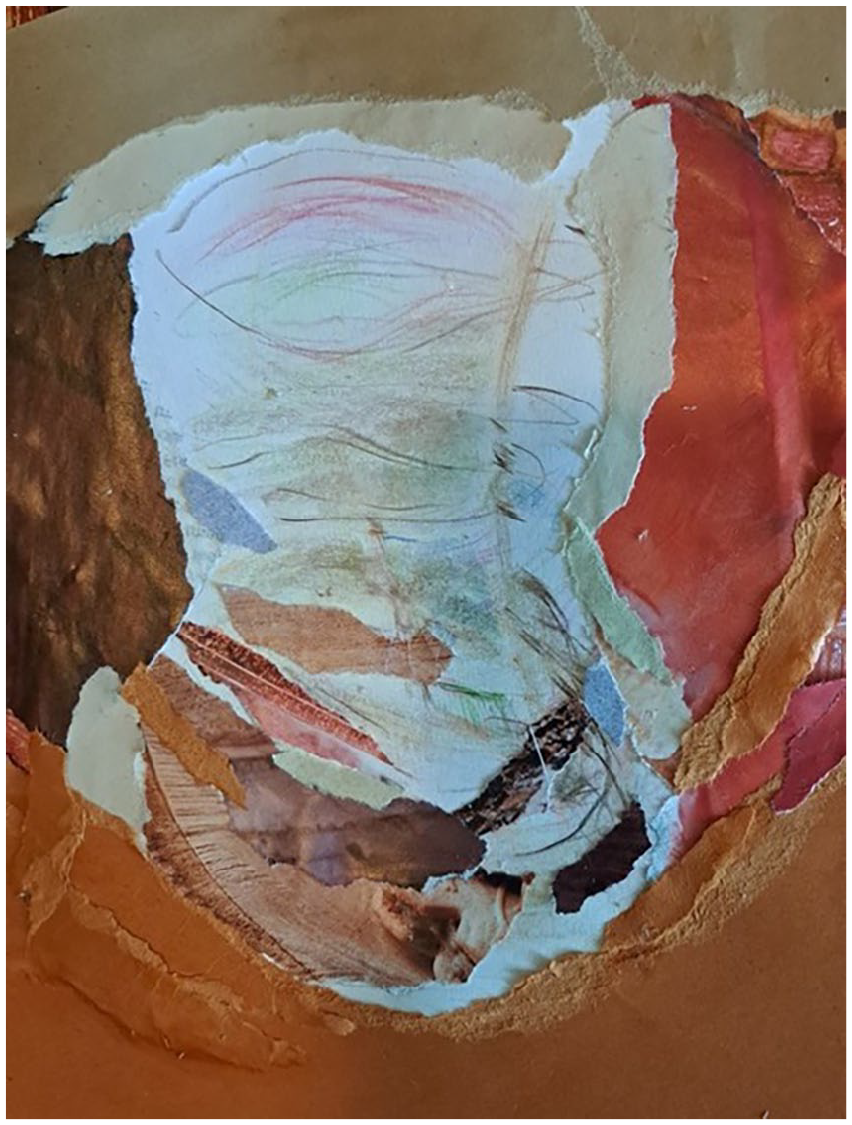
Bricolage inspired by Rebecca Solnit (2020).
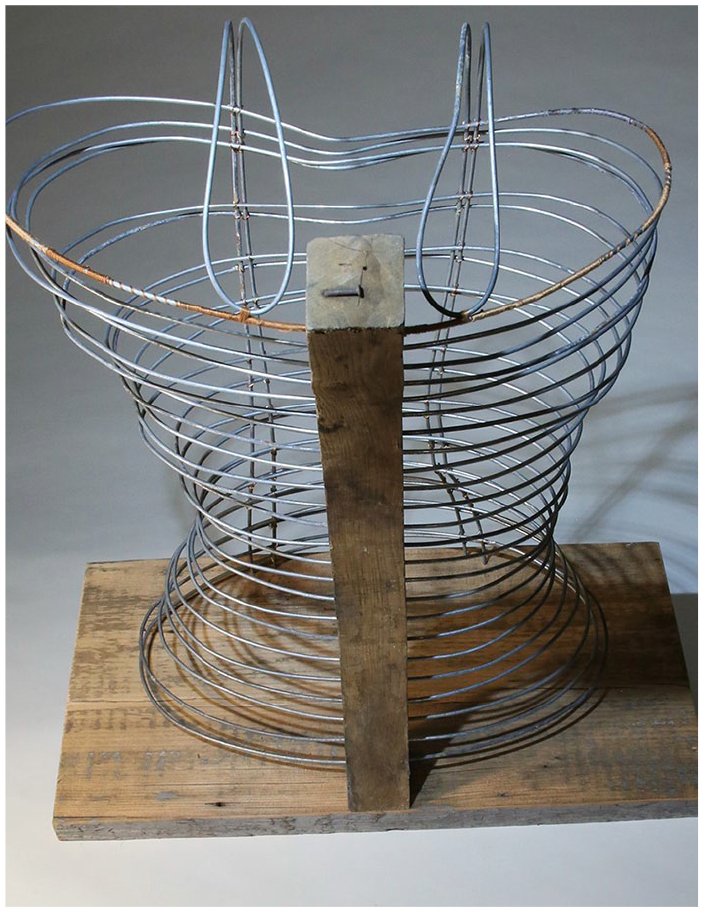
Fence Wire, Wood, Thread, and Nail.
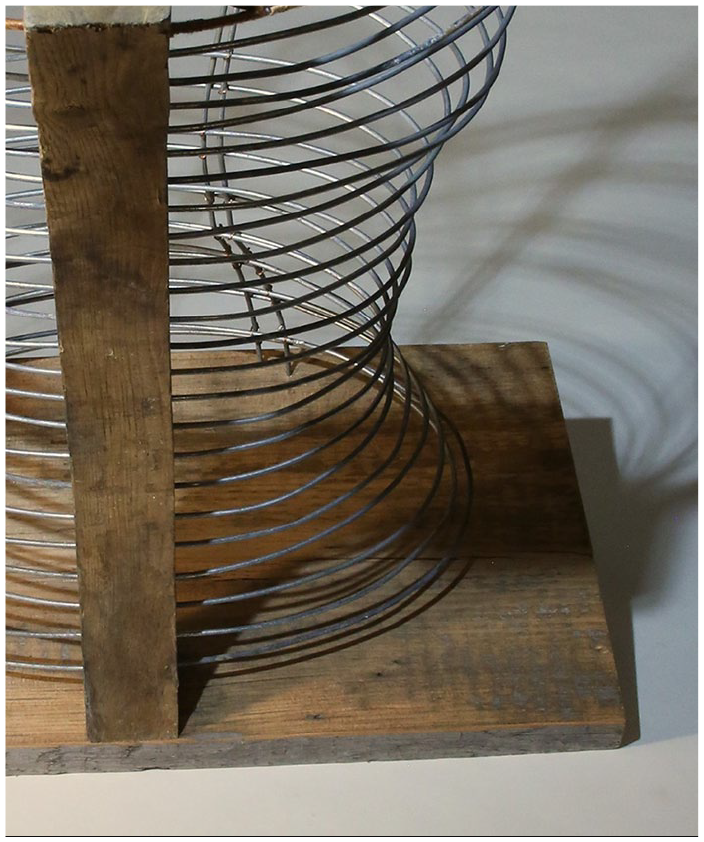
Shadow.
While exploring radical openness, I came upon Giroux (2018) who writes about an ethos of community—a pedagogy of education where students are encouraged and enabled to go forth holding hope and a sense of possibility. Green (2020) writes how an ethos of community counters the ideology of a postdigital climate with entrenched identity politics; instead, it favors a system of collective action. They assert that, to become part of a broader social movement that embodies promise for a communal life where/in people with differences live together, we must find new definitions for connections between languages, cultural meanings, everyday practices of living, and material relationships. Educators who enhance the capacities of learners to perceive identity as together may encourage a type of plural self-awareness of shared and active concern (Schmid, 2014).
According to Teilhard de Chardin (as cited in Dillard, 1999), “all that is really worthwhile is action” (p. 105). Raising public awareness and the collective political will necessary to consider the implications of reintegration of formerly incarcerated people in a digital age, focusing on the damage digital footprints and stigma perpetuates, are actions I imagine de Chardin would support. The following images and poems reflect my experience as a facilitator, hearing (while sometimes not listening fully) the experiences of women in transition—women who yearn for symbolic, physical, and spiritual reintegration (Figures 7–11).
One woman with a gift For making. crafted one hand-sewn dress for me. A dress to clothe another’s body One vibrant class-embodied cloth. An ad / dress threaded be-stowa1 stitched gift, sewn to clothe, sewn to confront the wall constructed to keep her out.
Reach with words across abyss achieve a just fit one dress stitched to reach feminist? opaque? mediated? This fit draws blood torso pedagogy a school of thread.
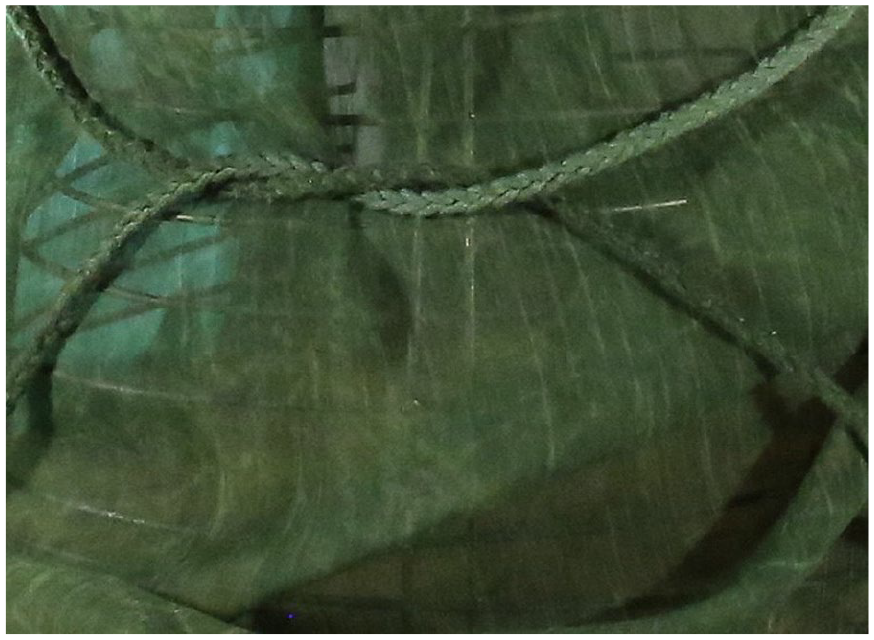
Plural.
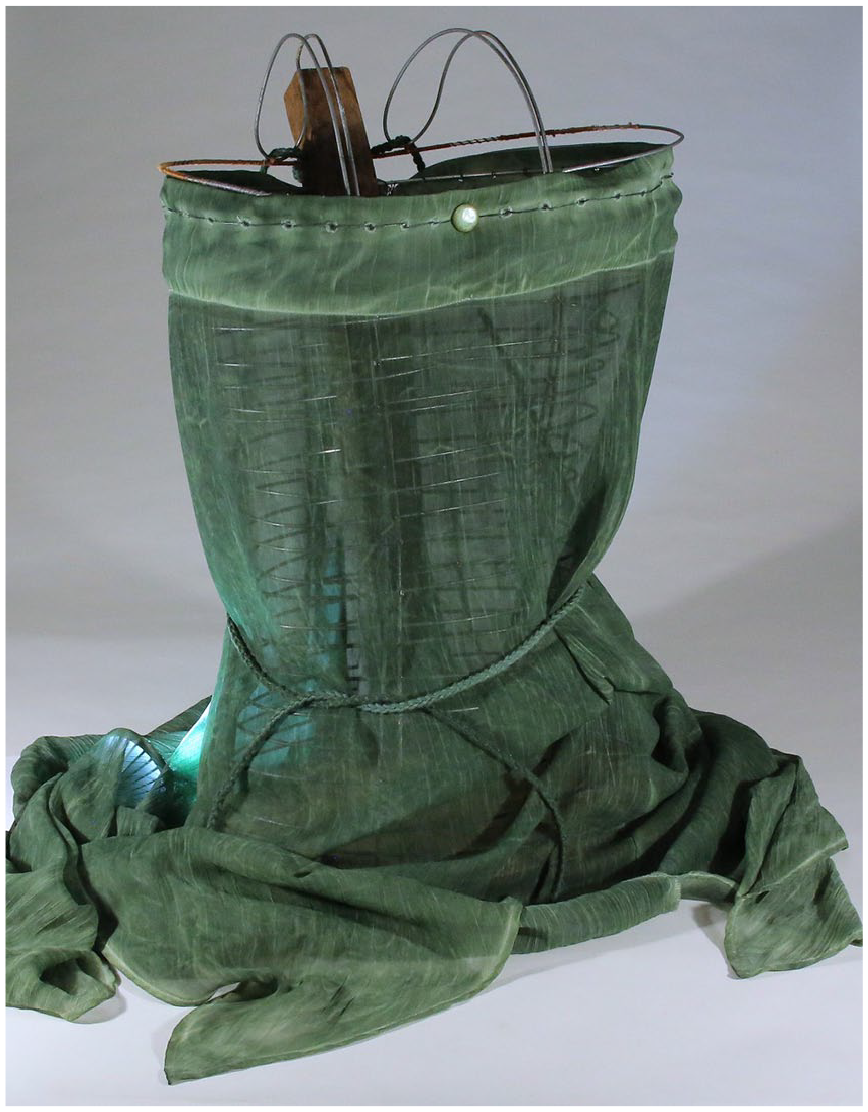
Replacing Other With an Other.
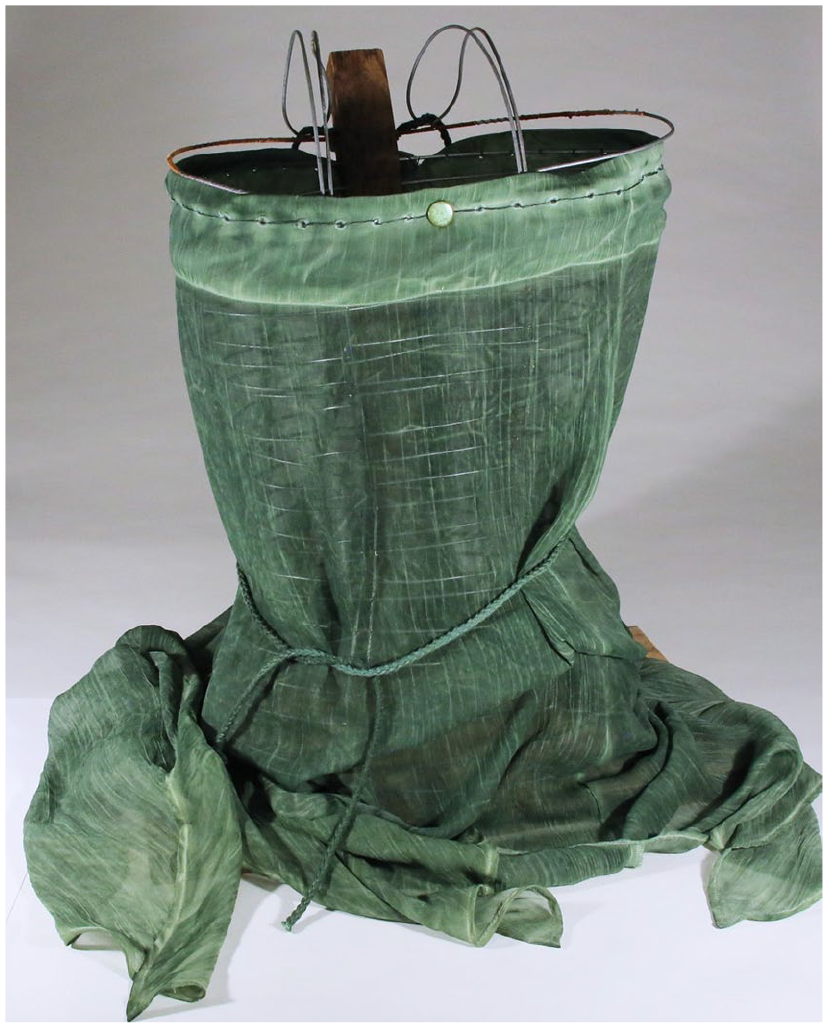
Green Dress Without Spotlight.
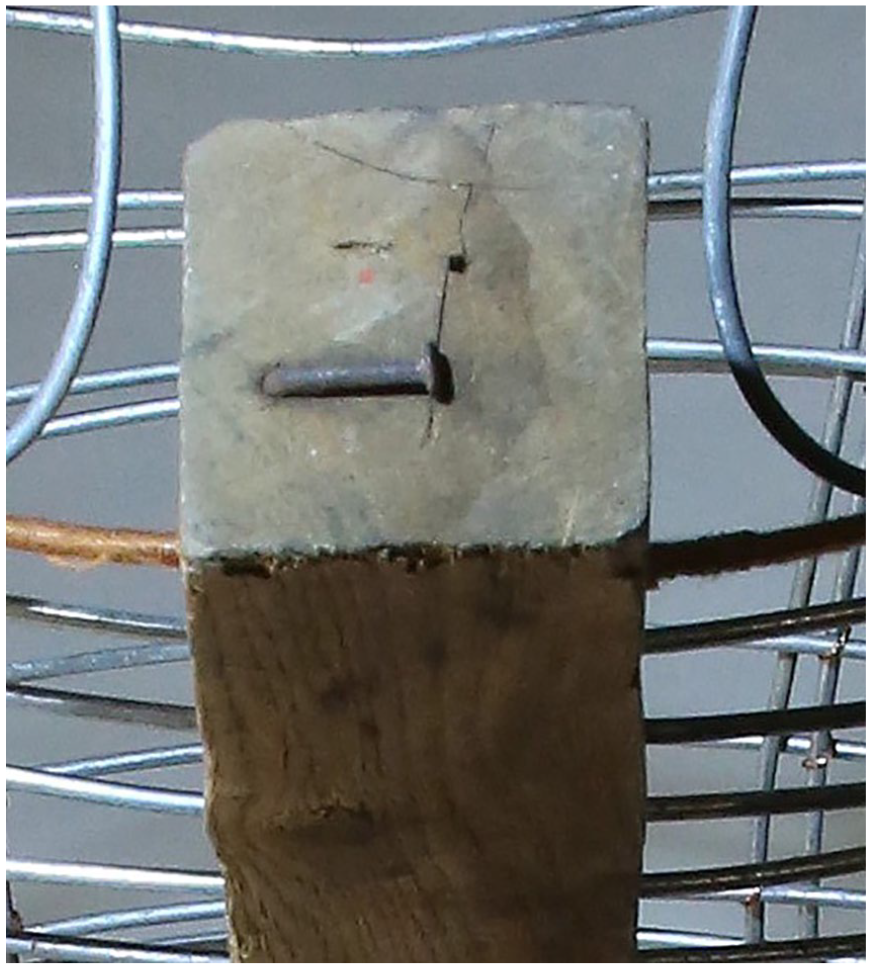
Cropped Spine.
Sculptural Threshold as Epilogue.
Knotting the Last Stitch (for Now . . .)
This research has led me to a language that communicates the urgency of barrier removal for formerly incarcerated women. Connecting visuals to text while engaging in the process of making—art and sense—is a daunting task. Art, poetry, and spoken word say more together than a word alone can communicate. Experimenting within CABR provided me a space to examine barriers to reintegration while exploring forms of poetry that open me up to things otherwise unknowable to me. The visual poems give my words form just as I hope my words might form a shift in consciousness. Haiku helped me minimalize what is important in content and message, both within and beyond shared perceptions. In that way, it “invites us into a relationship of being there” (Wiebe, 2017, p. 70). I hope these images, poems, and haikus, ignite an interest in reintegration so we, as a society, may perceive that time served (as delegated by courts of justice) instills a duty: upon reintegration, we should assume an individual has the opportunity, and is welcome, to participate without stigma.
This critical fibre gift threads me in ---- ward. Cloth. Gauze, hem, placket, dart. A seamed crossing suspends (my) reluctance: a gossamer guide female text stitched literacy dialogue, as critical alternate.
Footnotes
Acknowledgements
I am grateful for Dr. Ellyn Lyle’s confidence in me, her extraordinary generosity, and her courage to support academics in their pursuit of artistic ways of understanding. Her writing, scholarship, care, and encouragement have given me the courage to use art and poetry to listen deeply to explore past common sense ways of knowing. I am deeply grateful to Harlan House for his intuition, wisdom, and generosity in lending his skills to this research. Harlan is the artist, and friend, who crafted a brilliant form from a simple idea, a form to be wrapped and stitched to represent the experience of many women in the periphery.
Declaration of Conflicting Interests
The author(s) declared no potential conflicts of interest with respect to the research, authorship, and/or publication of this article.
Funding
The author(s) received no financial support for the research, authorship, and/or publication of this article.
