




Abstract
Guided by the work of bell hooks, this study uses her concept of ‘radical openness’ as an innovation for multi-party facilitation teams negotiating different roles, positionalities and understandings of youth participatory action research (YPAR). We explore the challenges we negotiated as facilitators in YPAR as they materialised in weekly reflections. We write as a team of two project leaders, three researchers and a project manager. Data comprised recordings of collaborative meetings, weekly reflections and focus groups. Two themes captured the challenges that we experienced and reflexively negotiated. First, we uncovered our own biases and assumptions through critical reflection and dialogue between comrades. Second, as a facilitation team we were able to negotiate authenticity and accountability in relation to project governance and reporting. Radical openness enabled us to identify and mitigate power relations as a team, collectively deepening our consciousness and research praxis. We all proved willing to acknowledge what we each did not know and use our imaginations to see things from each other’s perspectives. Based on our experiences, we suggest that multi-party facilitation teams consider how radical openness can help to cultivate spaces of dialogue between comrades to disrupt hegemonic and colonised views in YPAR.
Introduction
In my previous [YPAR] projects, I was always in everybody’s role. So, I was like the project leader, the project manager facilitating the sessions and the only researcher. I was by myself, so I didn’t have people to share ideas. In this collaborative project, I learn a lot due to the fact that we had people with different perspectives in different roles. Thinking about navigating external pressure in the university system, I learned a lot with Claire [project leader]. She was incredible. I learned a lot from Amy [project manager] and how she facilitated the sessions with youth. I always waited for Juliana’s [researcher] disagreement and the spaces it could create for us. Bill as a senior researcher taught me about humility: he was always there to learn. Sarah [project leader] taught me the power of informal spaces for social change. What a team! Thanks for inviting me to this journey (Carla [researcher], Final focus group).
This paper describes how we, as a multi-party facilitation team, negotiated our roles and positionalities and how we individually evolved our understandings of youth participatory action research (YPAR). As we describe in this paper, we negotiated our different roles, diverse experiences and understandings of YPAR as a facilitation team through radical openness that materialised in our weekly reflections. These reflections encouraged honest surfacing of sometimes divergent understandings of YPAR and, in doing so, helped us to map a collectively agreed course for the facilitation of the YPAR process. This paper illustrates how reflections and dialogue deepened our collective consciousness and research praxis.
As a facilitation team, we consider that issues of power and privilege should be critically reflected upon and confronted to create spaces for transformation in action research. We recognise and seek to embody the transformative power of action research 1 as a collaborative enterprise whereby researchers and stakeholders work together to co-create knowledge with the purpose of instigating social change that is conscious of the relational nature of life (Bradbury, 2015; Bradbury et al., 2019). This paper responds to the call for more transformative action research by showing how a reflection process fostered the ‘relational and emotional nature of [the] learners and a willingness to practice more mutually transformative power’ (Bradbury et al., 2019, p. 5). This paper offers an innovative approach to one of the critical ideas in AR: making critical reflection on participation central (Friedman et al., 2018). By bringing the concept of ‘radical openness’ to the facilitation team’s reflections, this paper illuminates experiences that have led to methodological and theoretical developments that reflect authentic voices. As we illustrate below, radical openness in a process of collective reflection enabled us to engage in a ‘triple-loop’ process of enquiry (Bradbury, 2022). This brought our biases and assumptions to the surface and enabled shifts in collective understandings of post-secondary transition, engagement and youth participation in the YPAR. Our negotiated understandings were contextualised to impacts of the COVID-19 pandemic in a location which had some of the longest strict lockdowns in the world (Vally & Bennett, 2021).
As a team engaged in YPAR, we advocate YPAR as a powerful tool for emancipatory education that can play an important role in addressing social injustices in educational systems (Call-Cummings et al., 2022; Carl & Ravitch, 2021; Embury et al., 2020; Gonell et al., 2021). For instance, we shared the aim of creating a dialogical and liberatory space with youth where we could challenge the injustices they face together and co-design possibilities for educational change (Cammarota & Fine, 2008; Freire, 1987; Mirra et al., 2016). However, this paper is not about the knowledge co-created with youth in YPAR (for youth data see Luguetti et al., 2023). Instead, in this paper we aim to highlight the challenges in power relations and our own conceptual and relational shifts as a team of facilitators. We provide an in-depth view of the team’s reflection process and explore the consequent emergence of radical openness. Our aim is to share some lessons that we learned in YPAR as a multi-party facilitation team interested in embarking on the incredibly important journey of collective inquiry and activism. Theoretically, this study is guided by the work of bell hooks, particularly her concept of ‘radical openness’.
bell hooks and radical openness
bell hooks (1989) argues that radical openness is a ‘dialogue between comrades that is a gesture of love’ (p. 16). For hooks, such dialogue happens when comrades challenge forms of injustice and it leads to a radical revision or the ability to re-imagine, re-define and re-present experiences and thoughts (Worthman, 2006). Radical openness is the ability to ‘set aside’ our own biases and assumptions during collaborative endeavours, guided by dialogue. More than open-mindedness, radical openness changes the ways in which critical thinkers relate to the world; creating a space open for subversive discussion aimed at freedom (Sewell, 2013). hooks proposes that (hooks, 1989, p. 19): Our living depends on our ability to conceptualize alternatives, often improvised. Theorizing about this experience aesthetically, critically is an agenda for radical cultural practice. For me this space of radical openness is a margin—a profound edge. Locating oneself there is difficult yet necessary. It is not a ‘safe’ place. One is always at risk. One needs a community of resistance.
Radical openness also contributes to disruption of hegemonic and colonised views. hooks considers radical openness as a call for ‘those of us who would participate in the formation of counter-hegemonic cultural practice to identify the spaces where we begin the process of re-vision’ (hooks, 1989, p. 16). For hooks, language is ‘a place of struggle’ (p. 15); it underlines the importance of the rhetorical investigations of marginalisation and oppression for the everyday resistance of people who suffer from the structural inequalities produced by the intersection of race, sex, class and colonisation. According to hooks, radical openness interrogates what conditions need to change to make a space for a form of knowledge or expression that has been silenced. Radical openness means making oneself vulnerable to the suffering of others while feeling one’s own vulnerability (Mahn et al., 2020). It implies a shift where ‘we are transformed, individually, collectively, as we make radical creative space which affirms and sustains our subjectivity, which gives us a new location from which to articulate our sense of the world’ (hooks, 1989, p. 23).
In later work, hooks (2009) explored the relationship between radical openness, dialogue and change. Writing with long-time collaborator, Ron Scapp, hooks (2009) commented how differences in positionality between herself and Scapp (due to class, gender and race) provided ‘an opportunity to move across boundaries and push past the obstacles which ordinarily preclude intimate intellectual bonding across differences’ (38). Driving this process was both parties’ willingness to engage in critical self-reflection, to ‘look realistically at the ways we inhabit a different world’ and, in the process, to also recognise what they held in common.
Even though hooks published her essay Choosing the margin as a space of radical openness in 1989, its critiques have since inspired generations of academics, particularly in critiquing higher education and academics (Mahn et al., 2020). For hooks (2009), a revolution in higher education is necessary ‘to restore life to a corrupt and dying academy’ (30). hooks argues that teacher educators and academics need to critically examine the traditional colonising view of the university in maintaining white supremacy, imperialism, sexism, and racism education hooks (1994). hooks’ critiques can also be used to disrupt power relations in research, particularly in YPAR. As she suggests (hooks, 2009, p. 88) in the context of learning and teaching, ‘by teaching students to value dissent and to treasure critical exchange, we prepare them to face reality’.
YPAR as a journey: Challenges and transformations
YPAR is considered a journey where researchers need to be open to changing themselves in order to negotiate the challenges that arise in the process (Cammarota & Fine, 2008; Mirra et al., 2016; Stapleton & Mayock, 2023). Researchers need to actively address power imbalances that could otherwise reinforce the inequitable structures that YPAR seeks to highlight and deconstruct (Cammarota & Fine, 2008; Stapleton & Mayock, 2023). There are many challenges that researchers might face when engaging in YPAR. These include challenging stereotypes and assumptions about students, learning to listen to and trust students as co-creators of knowledge, and disrupting traditional power relationships in research.
Challenging stereotypes and assumptions
Researchers must be prepared to engage in what can be a very personal struggle with their own stereotypes and assumptions about the people they are working with (McIntyre, 2003). For example, researchers working in socially vulnerable areas might believe that hard work and merit lead to success regardless of the social and cultural contexts (meritocracy). In that sense, young people might be seen as the recipients of knowledge. This “us” and “them” dichotomy—a binary position where a privileged researcher (us) believes that they need to “help” young people from socially vulnerable backgrounds (them) reifies the myth that the researchers are white knights whose mission is to “save” the poor and the downtrodden (McIntyre, 2003).
Trust is central in YPAR, particularly when adult researchers’ backgrounds differ from those of the young people they work with (Freire, 1987; Halilovich, 2013). YPAR work requires a safe and respectful space for dialogue between researchers and young people, and opportunities for youth to embrace varying perspectives and envision their community’s potential (Freire, 1987). As a facilitator team, by opening ourselves up to initiating safe spaces for growth and communication, we emphasise the relationality and potential for relationship-building and mutually transformative power identified by Bradbury and colleagues as key characteristics of action research (2019).
As discussed in our findings, through an inquiry process conducted as collective critical reflection, we developed the ‘relational co-creativity’ needed to successfully adapt the YPAR (Bradbury, 2022, p. 77).
Listening and trusting young people as co-creators of knowledge
Researchers need to learn to listen to young people and trust that they have valuable and important skills. Researchers need to learn how to talk with young people and find language to facilitate dialogue. For that, it is essential the presence of mutual respect and trust among researchers and young people hooks (1994). This mutual respect is time-consuming and requires a learning community to be created. Knowledge is created in the context of relationships, and relationship-building doesn’t happen overnight.
A strong and valid YPAR requires flexibility in the face of unpredictability and tends to reflect the complexity and messiness of the lives and contexts being researched (Call-Cummings et al., 2020; Carl & Ravitch, 2021). Considering the need for time and focusing on the process of YPAR allows researchers to engage with youth authentically; for example, by adjusting deadlines and goals to allow for the organic development and evolution of YPAR, or by challenging peer-reviewed publications as the only valid way of disseminating research (Bettencourt, 2020).
Disrupting traditional power relations
In conducting YPAR, researchers need to constantly examine power, privilege and knowledge production. As Doná (2007) emphasises, YPAR can potentially reinforce existing power hierarchies. Researchers are usually in positions of power and privilege, being highly educated, professionally trained and often white (Brigham & Kharbach, 2020). Merely involving individuals in knowledge production does not guarantee that power hierarchies are addressed, let alone eliminated (Stapleton & Mayock, 2023). Adult researchers and youth need to work in ‘contact zones’ (Torre & Fine, 2008) to actively engage dynamics of power and privilege as an impetus for learning (Bettencourt, 2020). Contact zones refer to ‘social spaces where cultures meet, clash and grapple with each other, often in contexts of highly asymmetrical relations of power’ (Pratt, 1991, p. 34). For Pratt, it is in those spaces that power is negotiated, and struggle occurs. These spaces occur in storytelling and in identifying with the ideas, interests, histories, and attitudes of others; experiments in transculturation and collaborative work; ground rules for communication across lines of difference and hierarchy that go beyond politeness but maintain mutual respect (Pratt, 1991). Framing YPAR as a contact zone ensures that researchers place issues of privilege and oppression at the centre of collaborations.
Understanding and negotiating those challenges is essential in implementing YPAR. Researchers should not just focus on trying to transform social structures “out there” and “the people”, they should be open to transforming themselves as educators in relationships with young people (Freire, 1987; hooks, 1994). There are a range of methods for reflective practice in YPAR, including journalling, memo writing, storytelling, and autobiographies (Bettencourt, 2020; Stapleton & Mayock, 2023; Zeller-Berkman, 2007). The majority of YPAR studies focus on the role of youth with only a few empirically evaluating the importance of facilitator reflection (Carl & Ravitch, 2021; Esposito & Evans-Winters, 2007; Pech et al., 2020; Zeller-Berkman, 2007). This paper explores the challenges and transformations facilitators faced in YPAR as they emerged through weekly reflections by addressing two research questions: 1. What challenges and transformations did facilitators from a multi-party team face in the YPAR? 2. How did radical openness assist facilitators to surface and negotiate challenges through the process of YPAR?
YPAR and reflections: The context
Description of the YPAR project phases.
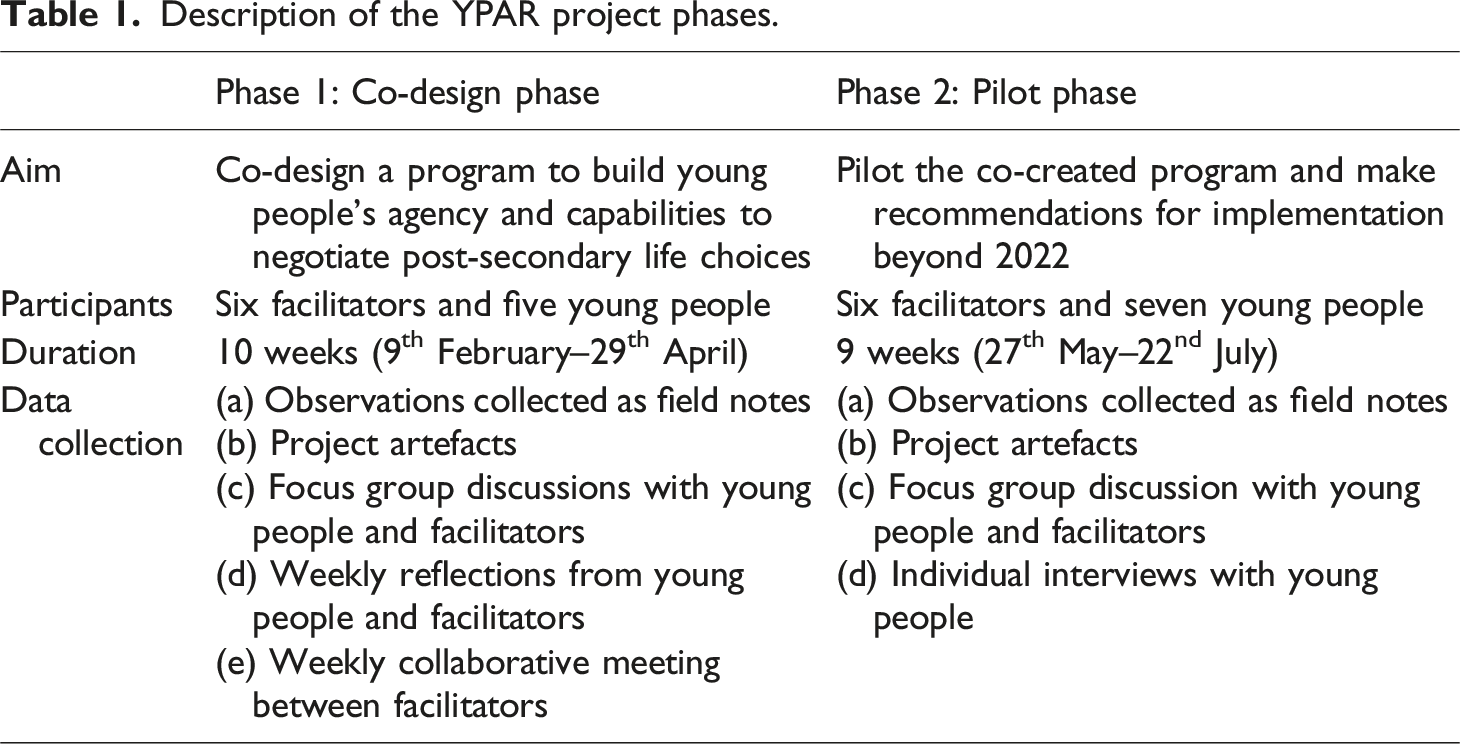
In previous publications the authors of this paper shared the results of the knowledge co-created with young people in both phases such as: (a) how young people and facilitators raised critical consciousness by collectively unpacking and critiquing the concept of transition; and (b) how young people and facilitators demonstrated what hooks describes as radical wholeness, by bringing their whole selves to the YPAR (for more information see Luguetti et al., 2023).
This paper focuses on the challenges and transformations that we faced as facilitators in YPAR as these surfaced in weekly reflections. Our multi-party facilitation team comprised two project leaders (Claire and Sarah), three researchers (Carla, Juliana and Bill) and a project manager (Amy). Carla is a middle-class Brazilian woman living in Australia with eight years’ experience using YPAR in a variety of sport programmes, in Brazil, the United States and Australia. While she had experience with YPAR and co-design, it was the first time she worked in the field of post-secondary transition. Juliana is a middle-class Australian woman with a varied professional background who came to academia mid-career. Her research includes diversity and inclusion policy and practice, social learning communities and educational transitions. Bill grew up on a small farm east of Ballarat in Victoria. He spent over a decade teaching in schools in metropolitan Melbourne and in Oregon, USA. His commitment to school-university and third-party partnerships has led to enhancements in learning and teaching across the education sector. Claire and Sarah were the project leaders and first conceptualised SG in 2020. Claire’s interests are teacher professional learning, improving the status and quality of teaching and learning, education policy, and initial teacher education. Sarah is the CEO and Head of Curation at the Hellenic Museum in Melbourne. Sarah’s passion for Hellenism stemmed from a profound interest in the intellectual and philosophical curiosity of the ancient Greeks. As project manager, Amy oversaw facilitation of all sessions between young people and facilitators. Amy is a middle-class Australian woman who had worked for eight years in the education sector, as a secondary school teacher, program manager and coordinator of community-based services and programs with schools and local government.
Ethics approval for this study was provided by the Victoria University Ethics Committee. All participants signed written consent forms at the beginning of their participation in the study, and their ongoing consent was negotiated orally at regular intervals during the study.
Reflection as a space for radical openness
Description of the co-design phase of the YPAR project.
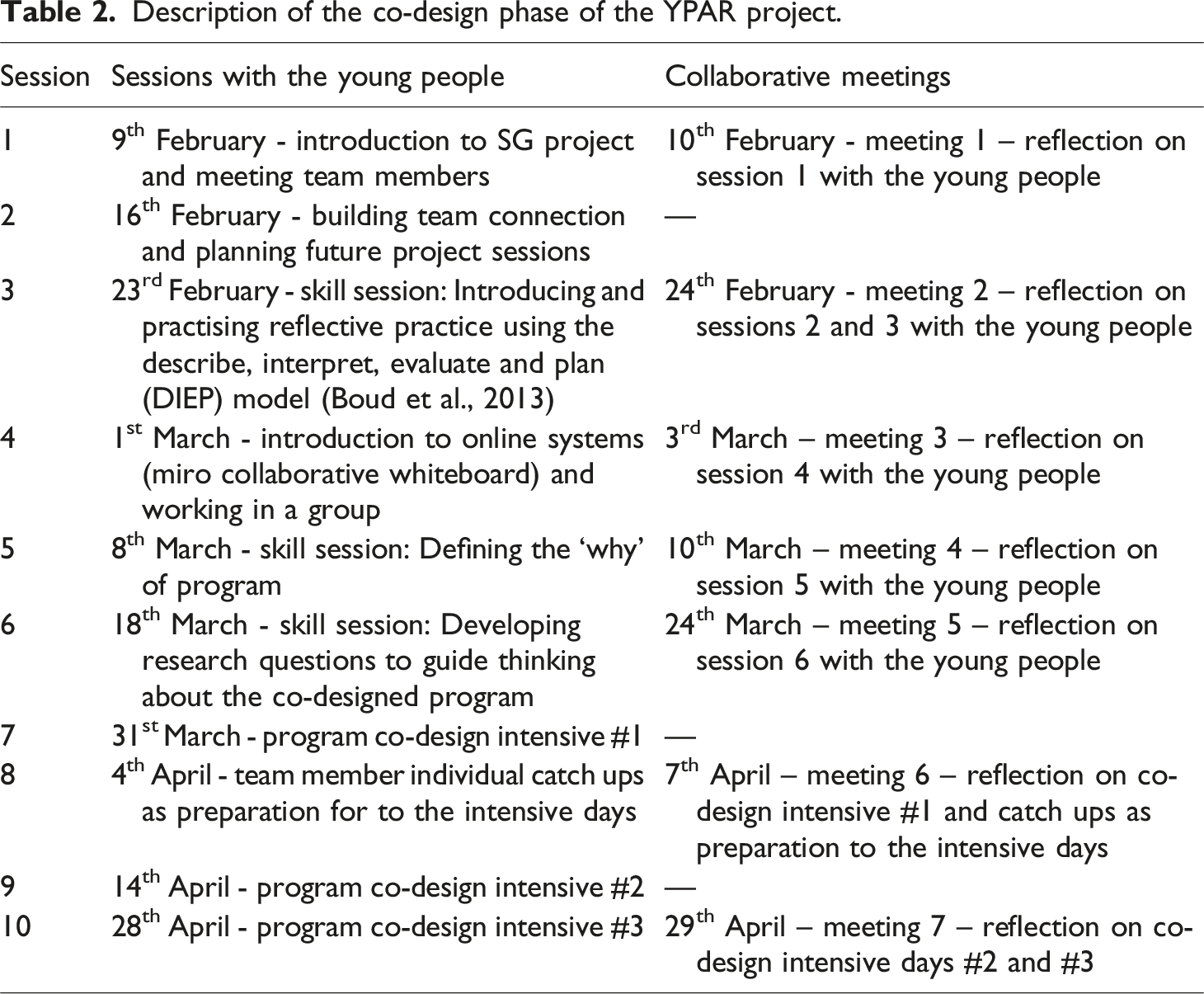
In this paper we analysed: (a) Facilitators’ weekly reflections. Facilitators wrote reflections after each session with the young people about their experiences in the co-design. They individually described the experience (e.g., What did you see? What happened?); interpreted the experience (e.g., what does the experience mean and why?); evaluated the experience (e.g., Was the experience valuable? Why/why not?), and planned future action (e.g., What will you do next based on what you learned?). The reflections were used to inform the collaborative meetings. (b) Recordings of collaborative meetings. The facilitators met seven times as a team to reflect on the YPAR. Those meetings served as a peer debriefer and assisted with progressive data analysis. (c) Focus group discussions. The facilitators were part of two focus groups to capture some of the transformations after the co-design and piloting phases. Focus group discussions aimed at exploring the barriers and enablers encountered in YPAR, emotions experienced, and learning throughout the process.
Data analysis
Reflexive thematic analysis was used to make sense of the data (Braun & Clarke, 2019, 2021). In reflexive thematic analysis, knowledge construction is understood as a situated and active process and researcher subjectivity is considered a ‘resource for knowledge production’ (Braun & Clarke, 2021, p. 343). Reflexive thematic analysis is ‘a creative and active process’ (Braun & Clarke, 2021, p. 343) that aims to generate multi-dimensional themes grouped around key concepts to tell insightful stories about data. Analysis involved several steps. First, Carla and Juliana individually read all the data and grouped statements and ideas into codes. The initial analysis was inductive. Carla and Juliana separately refined their codes by reading and re-reading data before using the refined codes to construct themes that they each illustrated with quotes. Second, Carla and Juliana compared their individual analyses and constructed common concerns. They met twice to discuss their interpretations and collectively develop insights into the themes. In those meetings, Carla and Juliana noted some connections between the themes and bell hooks’ concept of radical openness. Reflexive thematic analysis can be used with compatible guiding theory (Braun & Clarke, 2021). Consequently, the analysis progressed from inductive beginnings to become deductive, as the facilitator team used radical openness as a frame for co-constructing the findings.
Finally, the facilitator team collectively reviewed Carla and Juliana’s combined analysis and engaged in a process of double-checking the interpretations. We discussed the codes Carla and Juliana had identified in relation to the research questions and challenged some of the interpretations of the coded data, the construction of themes, and the narrative associated with the analysis. In this phase, multiple revisions were made to the analysis and paper until all authors felt that the analysis was reflective of their experience in YPAR.
Findings and discussion
Guided by the concept of radical openness (hooks, 1994, 2009), we constructed two main themes from our data: (a) challenging biases and assumptions through dialogue between comrades; (b) negotiating authenticity and accountability in relation to project governance and reporting.
Challenging biases and assumptions through dialogue between comrades
As a team of facilitators, we challenged our biases and assumptions through dialogue as comrades. Weekly collaborative meetings created a space where reflective dialogue led us to revise our experiences and thoughts. Our diverse roles, as project leaders, researchers and project manager, and our varied experiences in YPAR required radical openness so we could listen to, and make sense of, each other’s experiences. For example, to enable young people’s participation, and due to COVID-19 impacts, we had decided to move online in sessions three and four. Despite plenty of interactive activities, as a team of facilitators we collectively experienced session four as ‘the worst session ever’. We later discussed why the young people weren’t engaging in the session and tried to make sense of this as a team. Our reflective discussions surfaced some biases and assumptions about engagement and participation:
The dialogue in the collaborative meeting helped us, as a team, to question our own biases and assumptions about what participation looked like and to understand and work with different ways that young people participate. Juliana, with her background in situated learning theory, helped us reflect on the different levels of participation. Claire pointed out the uncertainty of the YPAR as an essential aspect of an emergent process. Carla emphasised how we should not judge everything based on one session.
During the collaborative meetings we surfaced another underlying assumption as we discussed whether the young people were ready for the co-design process: At 18, I was still very much in need of guidance, support and occasionally a push in one direction. I think it might be the same for our young people […] I’m struck with the thought that our young people really needed to experience our future program before they tried to build it, a paradox that hits at the heart of the co-design […] Our young people don’t know what they don’t know, and I wonder how many will slip into the student mindset when asked to offer new ideas, presenting traditional formats on learning or program design that they experienced during their schooling (Amy [Project Manager], reflection, session 5).
In her individual reflection Amy started to interrogate her own thinking about knowledge production. At our collaborative meeting we explored our assumptions about young people’s knowledge as a team:
We decided as a team that we would need intensive days to work with the young people. We hoped that the in-person intensives would enable co-design of the program without the communication challenges in online meetings, and with less time pressure. This decision was made by listening to youth collaborators' feedback in relation to the online meetings. For the youth collaborators, although the online meetings allowed them to be more frequently in the YPAR research (weekly), the challenges of communication online were mentioned as barriers for the co-design. As facilitators, we paired with young people to work together on research activities such as exploring different lived experiences and understandings of post-secondary transitions (for more information see Luguetti et al., 2023). These collaborative activities offered a further opportunity to build relationships and co-construct knowledge. Bill later reflected on changes in young people’s participation: Paige and Adut both were lacking confidence initially which internally frustrated me a bit you know I wanted them to … feel sufficiently comfortable to contribute early on. When we did that [learning journey] activity [at an intensive session], we were with Paige and Carla and I… and you know [Paige] came out of their shell and I think little activities like that gave them confidence within a smallish group and then that, that confidence, you know, Paige…was comfortable in talking to the bigger group later on… (Bill [researcher], Final focus group)
Just as we had to renegotiate, as a team, our expectations about how the young people would participate, we also used reflection to negotiate assumptions about success and failure: Sometimes we talk about wanting to hear young people and then just talk at them for air and give them the information that we think they should have. And we’re trying to make a space where they can find that information for themselves. And just trying to navigate participation numbers and who was coming at which sessions and then getting worried about well if they haven’t come to all the sessions are they getting? You know, is this then hitting their needs and how do I do that without them becoming prescriptive of saying all right well here you go here’s the answer? So, just trying to navigate that and I think our time with [co-design phase of project] definitely helped. It was great to sort of reflect back on that process and sort of remind myself around our youth collaborators again, so the discussions we’ve had around what engagement looks like for different people and in different situations and that probably helped (Amy [Project manager], Final focus group). A willingness to fail, ultimately, you know and whatever that whatever the outcome of that is just dealing with it, and I think that you know it’s anybody who can facilitate those kinds of things could definitely engage with this kind of program in a really meaningful way. Because it does have value, but ultimately, as you say, clear that the person who’s in this in the facilitation role needs to believe that it’s got value (Sarah [Project leader], Final focus group).
As Sarah stated, our collaboration on the YPAR was a process that requires a commitment to the value of YPAR and a willingness to fail. Rather than assuming that it is possible to create an environment free from power relations and assumptions, we tried, as a facilitator team, to work in ‘contact zones’ to actively engage dynamics of power and privilege by creating a learning laboratory (Torre & Fine, 2008) where we interrogated the ways that social and cultural contexts manifest on an individual level. This enabled us to create a dialogue between comrades. As a facilitator team we used reflective dialogue to surface and together challenge biases about what participation should involve or what success looks like. This allowed us to facilitate the YPAR adaptively and responsively.
Negotiating authenticity and accountability around project governance and reporting
The second theme relates to how, as a team of facilitators, we negotiated authenticity and accountability in relation to project governance and reporting. Power relations were also evident in the relationship between the project team and broader institutional project leadership. At times, the facilitator team had to negotiate institutional expectations that appeared to challenge authentic collaboration because of the time and space needed for co-design as an organic process. For example, we had to respond to an institutional priority for research products and requests for estimated timelines regarding project outcomes, before collaborative relationships and the co-design process had had a chance to begin (Bettencourt, 2020). One of the project leaders explained how she tried to negotiate this external pressure: One of my roles, in all seriousness, has been advocating for the project at senior university levels and making sure that […] Doing that by keeping abreast of what the projects doing without interfering, given the power dynamic that we’ve introduced that we identified early in the piece, but it’s been because of the complexity of the funding arrangement. There been so many layers of management and administration that part of my role has been to keep that away from the project team as much as possible, so you can just do the work, and we have been […] identification of roles and responsibilities, has been something we’ve done really well, whilst honouring The co design process […] But also the generosity of this team, the leadership team, the project team in working together and we didn’t know each other […] coming together to do this project, and I think that’s been a huge success in the way that we’ve embraced each other skills and genuinely enjoyed working together (Claire, focus group).
Claire described how she advocated to the external project leadership in her role as project leader and the importance of what she characterised as generosity in the team’s openness to learning from each other. In the pilot phase of the project, Claire decided to step back from the facilitator team to deal with issues of governance. In her perception, it would not be possible to stay in both roles without influencing the authenticity of the YPAR process. The university external requests clashed with the reality that YPAR is a messy process and adult researchers need to welcome flexibility to respond to its twists and turns (Call-Cummings et al., 2022). A tension between authenticity and accountability was evident as we negotiated project milestones and tried to authentically co-design a YPAR:
Carla had experience with other YPAR projects and understood the uncertainty in YPAR and the need to believe in the process as it unfolds. Nevertheless, the facilitator team had to collectively negotiate institutional power as manifested in project governance and reporting against milestones that did not align with the realities of the project’s lived experience. As a facilitator and the project manager, Amy was particularly conscious of navigating institutional requirements. Claire, as project lead, was central in negotiating the external pressures to finish the co-design by a set date in May, based on funding completion being due in December. These pressures included catering to desired project outcomes, created prior to the beginning of the project session, that no longer matched the guiding YPAR ethos. Carla individually reflected on the influence of a visit by institutional project leaders during one of the co-design intensives: In the second half of the intensive day, we had several outsiders arriving. […] Would the young people be comfortable with the outsiders? […] We had to explain the project to the outsiders […] I would rather prefer a panel of young people to judge our program. I would rather prefer young people’s suggestions/impressions. I would rather prefer to co-design this program in a community centre […] (Carla, reflection, session 8).
As well as having to pause discussions to explain the program to the executive team, young people and facilitators left the session at different times to attend media interviews. These activities took time away from our collaborative work. However, a suggestion by one of the institutional project leaders that parents should be part of the program led to one of the highlights of our YPAR. Sophie (young person) took the lead in responding that the program was being designed to support young people in taking control over their own lives and choices. Sophie clarified that the program focus was on young people, not their parents. Her apparent confidence and clarity were impressive as, before asking the question, an external project leader had shared their expectation as a parent that none of their children would take a non-linear post-secondary pathway (e.g., taking a year break or enrolling in a vocational educational course with the aim of preparing students with skills for work). This is a dominant point of view that we had problematised with the young people.
After the session several members of the facilitators’ team decided to add an additional intensive day to co-design the program: At the end of the session, when just Carla, Amy and I were present, we talked about the next steps of developing the program in light of the preceding session interaction. Our different perspectives and roles were apparent here. I am glad that we will have one more meeting to keep co-designing the program. For me this is an example of holding space for the process without disregarding accountabilities. I hope that everyone or, at least, the majority can make it to the next meeting (Juliana, reflection, session 8).
This discussion reflected how, as a team of facilitators we were able to bridge differences – in roles and responsibilities, perspectives and experiences of co-design – and, as Juliana put it, ‘hold’ some space for authentic co-design. This took generosity on the part of the wider team, a willingness to look beyond individual responsibilities and pressures to consider others’ perspectives. In a focus group after the pilot phase of the project, one of the project leaders reflected that: The way the researchers worked and were able to compromise, sometimes on what they wanted to do with co design and what was practical in the time that we had and the accountability that was hanging over our heads and again your [Juliana and Carla] your ability to compromise on that, hold the integrity of co-design yet fit within the constraints, it will be a challenge going forward. (Claire, Final focus group)
As a team, we did our best to disrupt some of the power relations and colonising view in research. However, the need to revolutionise the academy that hooks noted more than 30 years ago (1989) is, if anything, more pressing now than at the time of writing.
Reflection and the need for radical openness
This paper introduced radical openness as a methodological innovation for multi-party facilitation teams negotiating roles, positionalities and understandings of YPAR. The radical openness emerged in the weekly reflections that combined writing and sharing individual written reflections with dialogue after each meeting with young people. In seeking to think critically together, as a team of facilitators, we found the need for radical openness. As hooks (2009) describes, radical openness is a crucial requirement of critical thinking that calls on us, as researchers to be ‘open at all times’, and ‘willing to acknowledge what we [researchers] do not know’ (p.10). Radical openness allowed the team to enter into dialogue ‘to think long, hard, and critically; to unpack; to move beneath the surface; to work for knowledge’ (hooks, 2009, p. 10). In the process we used our imaginations to consider perspectives other than our own, increasing our awareness, consciousness, and learning. For instance, Amy shared an assumption that the young people must experience our future program before trying to build one, while Juliana and Claire respectfully challenged the belief that the young people lacked sufficient knowledge, which unconsciously denied the young people opportunities for agency (Bettencourt, 2020; Hall, 2020). Juliana noted that adults are also limited by not knowing what they don’t know. From sharing diverse perspectives and through radical openness we developed relational co-creativity (Bradbury, 2022). As a team this enabled us to create the collaborative activities between the facilitator team and young people and in-person intensive days that led to deeper understanding, better appreciation and contribution of the young people’s knowledge.
As a team we came from diverse positionalities (e.g., social status, gender and sexuality), research backgrounds (e.g., experienced/inexperienced in YPAR); and positions of power (e.g., project leaders, project managers and researchers). Our diverse positionalities contributed to surfacing and negotiating some of the challenges and tensions that we faced in YPAR. hooks (1989) emphasises the potential of radical openness combined with diverse positionalities to foster critical thinking, including self-critique. We relied on our diversities to brainstorm possibilities, such as, for instance, when negotiating the different levels of the young people’s participation. Here, openness to others’ perspectives was crucial to ensure a contact zone where we placed issues of privilege and oppression at the centre of our collaborations (Pratt, 1991). For example, Juliana reflected on the need for different levels of participation, while Claire and Carla pointed out the uncertainty involved in YPAR and the need to allow time in this process.
This paper illustrated the intentional use of reflection to deepen collective consciousness and research praxis (Freire, 1987; Zeller-Berkman, 2007). Our collective process of reflection emphasises the need for dialogue and interaction to encourage shifts in uneven power relations. This process enabled us to surface the relational and emotional nature of action research, creating a collective space where adult researchers could uncover assumptions and engage in self-awareness (Bradbury et al., 2019). Our process of reflection emphasised how action research is ‘also about changing ourselves and our mental models, and our relationships between the out there and the in here’ (Bradbury et al., 2019, p. 8).
It is hoped that this paper acts as a resource to guide future work or expand conversations about authentic collaboration in action research and the need for radical openness. While YPAR focuses on contributions to the research by youth, this paper has focused on the adult collaborators and the conflicting assumptions and contributions that can occur when adults aim to facilitate YPAR. These are also important to hear and acknowledge. It is hoped that researchers acknowledge the need for radical openness where they are not afraid to ‘give honest answers’ to each other (hooks, 1989), establishing and maintaining trust as a key element to dialogue and critical thinking. The collaborative effort to challenge and embrace each other in this study was an ongoing expression of critical resistance which helped us, as a team, to develop strategies that aimed to achieve transformative action research.
Footnotes
Declaration of conflicting interests
The author(s) declared no potential conflicts of interest with respect to the research, authorship, and/or publication of this article.
Funding
The author(s) disclosed receipt of the following financial support for the research, authorship, and/or publication of this article: This work was supported by VU RISE, Education Innovation Hub.
