



Abstract
This study, based on reliance on various types of media as well as the Gamson Hypothesis, investigates why people doggedly hang on to election fraud theories from the 2020 election. The results show that reliance on mainstream media and CNN negatively predicts belief in election conspiracy theories. In contrast, reliance on Fox News, hyperpartisan websites, conservative media, and text-based and video-based social media, positively predict belief in election conspiracy theories. Also, the Gamson Hypothesis positively moderates the relationship between reliance on Fox News, conservative media and video social media and belief in election conspiracy theories.
Keywords
While President Trump denounced what he claimed was a fraudulent 2020 election, such as Democrat officials sending out 80 million unsolicited ballots so they could “harvest” votes and software switching votes from Trump to Biden, the conservative media echoed and amplified his message, boosting its legitimacy among the public (Beam, 2020; Benkler et al., 2018; Eldridge, 2020). In reality, this voter fraud crusade was organized by the Trump campaign in concert with his Republican supporters, members of the Republican National Committee, and a cadre of conservative news organizations with the intent of swaying the public to believe that the election was stolen, and Trump was the true victor (Benkler et al., 2020).
While Trump and his supporters shouted their voter fraud conspiracy theories, Democrats whispered their own fears, such as that Trump would employ the Insurrection Act to declare martial law if he lost (Fichera, 2021) or simply refuse to leave office (Bradley, 2020). With the dearth of popular media outlets willing to challenge Trump, Democrats’ election concerns were largely ignored (Ghiotto, 2022).
Belief in election conspiracy theories is largely influenced by what media are relied on—whether mainstream, cable news, partisan, hyperpartisan, or social media (Peacock et al., 2021; Pompeo & Calderone, 2020; Theocharis et al., 2021), distrust in the government (Sutton & Douglas, 2020), and political efficacy (Ardèvol-Abreu et al., 2020; Swami et al., 2011). This study, thus, applies the Gamson Hypothesis (Gamson, 1968, 1971) to examine the combination of political trust and political self-efficacy as predictors of belief in 2020 election fraud conspiracy theories.
The Gamson Hypothesis is based on four classifications: Dissidents—High Efficacy/Low Trust; Subordinates—Low Efficacy/High Trust, Assureds—High Efficacy/High Trust, Alienateds—Low Efficacy/Low Trust. While this study explores the influence of all four groups, it focuses on Dissidents, who are unhappy about government actions and believe they have the power to bring about change (Gamson, 1968). Dissidents are heavily influenced by media (Gameel et al., 2017; Hollander, 1997; Johnson et al., 2010; Johnson & Kaye, 2013) and are more likely than other Gamson types to believe they have been exposed to conspiracy theories (Lee et al., 2022). Thus, this study zeros in on how being a Dissident and media reliance interact with belief in 2020 election conspiracy theories.
Understanding how media reliance and the combination of trust and political efficacy influenced belief in 2020 election conspiracy theories is important for several reasons—erosion of confidence in election outcomes, weakened faith in democracy, and increased political polarization (Albertson & Guiler, 2020; Benderly, 2021; Berlinski et al., 2021; Enders, Uscinski, Seelig, et al., 2021; Norris, 2019).
Gamson Hypothesis
William Gamson (1968, 1971) developed the Gamson Hypothesis to explain student protests in the 1960s. He demonstrated that university students who were high in self-efficacy but low in political trust (Dissidents) were highly likely to protest the Vietnam War because they opposed the government’s actions and believed their protests could end the war. Scholars who expanded Gamson’s work looked at the other three groups of the efficacy/trust typology (Subordinates, Assureds, Alienateds) to explain why citizens participated in traditional political activities or disengaged from politics (Paige, 1971; Sigelman & Feldman, 1983).
Dissidents (high efficacy/low trust) do not trust the government to work on the public’s behalf but believe their protests can change how it acts (Gamson, 1968, 1971). In contrast, Assureds (high efficacy/high trust) engage in activities such as campaigning on behalf of a candidate or cause because they support the government and believe they can effect change by working through the political system (Bandura, 1982; Paige, 1971; Sigelman & Feldman, 1983). Subordinates (low efficacy/high trust) do not participate in political activities because they put their trust in the government to resolve the nation’s problems (Bandura, 1982; Paige, 1971). The apathetic Alienateds are suspicious of the government and largely ignore politics because they do not think they can make a difference (Bandura, 1982; Sigelman & Feldman, 1983).
Conspiracy Theories
Conspiracy theories arise from the belief that groups of powerful individuals secretly meet to plan and achieve a malevolent goal (Bale, 2007; Douglas et al., 2019; van Prooijen & van Vugt, 2018). Conspiracy theories are always threatening, be it physical harm or endangering cultural values, and because they are shrouded in secrecy, they are difficult to prove false (van Prooijen & van Vugt, 2018). Also, belief in conspiracy theories in general—that is, having a conspiracy mindset—is a strong predictor of believing specific conspiracy theories such as election fraud (Calvillo et al., 2021; Douglas et al., 2019; van Prooijen & van Vugt, 2018).
Any type of crisis heightens personal threat and reduces the sense of control, which is why belief in conspiracy theories is strongest during times of crises, such as terrorist attacks or heated elections (Douglas, 2021; van Prooijen, 2020). Conspiracies offer simple solutions to complex problems and provide a false sense of security from perceived threats (Douglas et al., 2019; van Prooijen & Douglas, 2017). Conspiracy theorists tell their believers they are the only ones who can be trusted, and they use that trust to tell followers what to do and what to think.
While conspiracies about election fraud dominated the 2020 presidential race, they are common throughout U.S. history, going back at least to 1796 when Alexander Hamilton nefariously tried to swing votes away from John Adams so his running mate Charles Pinckney would become president instead (Heidenreich, 2011). As it was back in 1796, politics is high stakes, and partisans still suspect the other side is engaging in dishonest practices to secure an election win (Edelson et al., 2017). Three main conspiracy theories dominated the 2020 election: Mail-in voting led to widespread fraud; Voting machines transferred votes from Donald Trump to Joe Biden; and many voters cast their ballots in the names of dead people.
Trump’s strident declarations of election fraud and his refusal to concede the race produced several corrosive effects on democracy—85% of Trump supporters believe Biden did not fairly win the election (Frankovic, 2020), and aggrieved supporters stormed the capitol building on January 6, 2021 to stop the Senate from declaring Biden the official winner (Berlinski et al., 2021). More broadly, such voter fraud accusations undermine the public’s faith in the principles of democracy, such as trust in political parties and government, and satisfaction with democracy (Albertson & Guiler, 2020; Enders, Uscinski, Seelig, et al., 2021; Norris, 2019), particularly the nation’s ability to conduct elections fairly (Berlinski et al., 2021; Norris, 2019, 2021). At least 28 states have passed laws restricting voting under the guise of increasing voting integrity (Brennan Center, 2024). Moreover, trust between Congressional parties has further eroded as polarization has increased (Benderly, 2021).
Several political characteristics, such as political knowledge (Jardina & Traugott, 2019; Miller et al., 2016; Norris et al., 2020; Strömbäck et al., 2022), political interest (Kim, 2022), ideology and strength of party ties (Hollander, 2018; Sutton & Douglas, 2020) are also associated with belief in conspiracies, but the direction is unclear. Some scholars contend conservatives are more likely than liberals to believe conspiracy theories in general and election fraud conspiracy theories in particular (Calvillo et al., 2021; Jost et al., 2003). Others claim strong partisans, regardless of their party, tend to believe the other side is likely to commit election fraud (Albertson & Guiler, 2020; Enders, Uscinski, Klofstad, et al., 2021; Uscinski et al., 2016). Authoritarianism is also linked to conspiracy theories in general (Adorno et al., 2019; Bruder et al., 2013) and to election ones specifically (Dimaggio, 2022; Gounari, 2021).
Gamson Hypothesis and Conspiracy Theories
Political self-efficacy appears to be the primary driver between the Gamson Hypothesis and political and protest participation, as the willingness to engage politically hinges on whether citizens believe their actions make a difference (Klandermans, 1984). But strong political self-efficacy alone does not explain belief in conspiracy theories, as trust in the government is also a factor (Ognyanova et al., 2020). Dissidents, for example, might embrace a conspiracy theory to take on the distrusted government that is ignoring their grievances (Rottweiler & Gill, 2020).
Political trust, then, might be the key variable that explains the connection between political self-efficacy and belief in conspiracy theories (Sutton & Douglas, 2020; van Prooijen et al., 2022). Distrust of the government underlies most conspiracy theories during the 20th and 21st centuries (Sutton & Douglas, 2020), including the 2020 election fraud conspiracy theories (Ognyanova et al., 2020). Behind most conspiracy theories is the belief that small, powerful, and unaccountable elite groups shape world events and run political systems, and government institutions meant to provide democratic checks and balances are either ineffective against, or complicit in, conspiratorial behavior (Imhoff & Bruder, 2014; Sutton & Douglas, 2020).
Distrust of the government was particularly prevalent during Trump’s first presidency when he harnessed deep-seated anti-establishment attitudes and directed them as coordinated action, such as getting supporters out to vote and provoking them to storm the U.S. Capitol. Anti-establishment orientations, characterized by extreme distrust toward the political system, explain voter fraud conspiracy theories better than political ideology and polarization (Enders & Uscinski, 2021).
To understand the relationship between the Gamson categories and conspiracy theory belief, this study asks the following research question and hypothesis:
Media Reliance and Conspiracy Theories
Belief in conspiracy theories is driven, in part, by media reliance. Media reliance is measured as how strongly media consumers psychologically depend on a medium for information that illuminates their social, cultural, and political worlds (Becker & Whitney,1980; Miller & Reese, 1982). News consumers tend to trust the media they rely on most, and they rely on the media they find most trustworthy (Ball-Rokeach, 1985). Therefore, the type of media relied on influences attitudes toward politics and candidates, and conspiracy theories (Benkler et al., 2018; DiMaggio, 2022; Papakyriakopoulos et al., 2020; Pompeo & Calderone, 2020). Moreover, media reliance is more strongly related to attitudinal measures such as media credibility than behavioral measures of media use, such as frequency and amount of time (Rimmer & Weaver, 1987).
Mainstream Media Reliance
Reliance on mainstream media and belief in conspiracy theories are intertwined. Mainstream media journalism adheres to norms and values such as accuracy, balance, and fairness, and vets information more thoroughly than any other media type (Metzger & Flanagin, 2015; Yamamoto et al., 2016). Despite their best efforts to be truthful, mainstream media are often subjected to pressure to repeat falsehoods told by others, especially political elites who are often the purveyors of lies, in exchange for ratings. For example, President Trump enjoyed widespread coverage of his insistence that hydrochlorquine is a cure for the coronavirus, even though medical experts claimed that it was dangerous and had no curative effect (Pompeo & Calderone, 2020). Although mainstream media often push back against such inaccuracies (Jamieson & Albarracín, 2020; Romer & Jamieson, 2020), simply reporting misinformation, disinformation, or conspiracy theories might strengthen belief in them, as even debunking provides attention and an “illusion of truth” (Nyhan & Reifler, 2010). In general, however, news consumers who rely on traditional media are less likely to believe conspiracy theories than those who rely on partisan or social media (Habel, 2025; Strömbäck et al., 2023; Sunstein & Vermeule, 2009).
Because mainstream media reporters strive to present the news accurately and they tried to debunk 2020 election conspiracy theories (Jamieson & Albarracín, 2020; Romer & Jamieson, 2020), this study predicts:
Cable News Reliance
Cable news networks, such as Fox News, MSNBC, and CNN, powerfully influence belief in conspiracy theories (DiMaggio, 2022; Gil de Zúñiga et al., 2023; Habel, 2025; Hollander, 2018). With 24/7 news delivery and opinionated pundits, cable news is a compelling and entertaining source of a gamut of stories from factual tidbits to full-blown conspiracy theories, no matter how outrageous. In 2020, Fox News was at the head of the ratings pack, filling the screen with election conspiracies favoring the president, while MSNBC and CNN were busy trying to debunk the lies (DiMaggio, 2022). Viewers turn to the cable channels that share their ideology (Hollander, 2018), and in the case of the 2020 election conspiracies, it is likely that belief depended on what was being shouted on the favored channel; thus, this study offers the following hypotheses:
Liberal Media Reliance
The liberal media habitat centers on both mainstream media such as The New York Times, The Washington Post, and NPR, as well as liberal news sites such as HuffPost and Occupy Democrats (Benkler et al., 2018). Because liberal journalists pushed back against 2020 election conspiracy theories with some success (Beam, 2020; Kreiss, 2020), this study contends:
Conservative Media Reliance
Conservative media tend to spread conspiracy theories more eagerly than liberal sources, in part to satisfy their audience, who, in turn, rely largely on right-wing sources such as Fox News and conservative radio and television hosts, who not only repeat conspiracy theories but also are often the source (Benkler et al., 2018; Habel, 2025). During the 2020 election, Trump’s claims about voter fraud were regularly echoed by conservative media; thus, this study hypothesizes:
Hyperpartisan Media Reliance
The rise of Trump and other populist leaders has coincided with the increased influence of hyperpartisan political websites (Rae, 2021), which report with a clear partisan or ideological favoritism, eschew journalistic norms, and rely primarily on social media to propagate their messages (Peacock et al., 2021).
Hyperpartisan websites often originate conspiracy theories (Benkler et al., 2018; Rojecki & Meraz, 2016), focus on false and misleading information that favors a particular party, and engage their followers with their angry and fear-inducing tone (Peacock et al., 2021; Shaughnessy et al., 2024; Sturm Wilkerson et al., 2021), thus they strongly influence conspiratorial beliefs (Schemer et al., 2021; Strömbäck et al, 2023; Vogler et al., 2024), making hyper-liberal and hyper-conservative sites more alike than different. When specifically examining Facebook pages, both hyper-liberal and hyper-conservative ones often angrily attack the other side’s candidates and policies, rather than promoting their own ideals. Although they both set out to antagonize their opponents, they differ in their techniques and strategies. Hyper-liberal Facebook pages promote calls to action, using real-life testimonials to plead for their supporters to vote and take to the streets to protest or share online posts to benefit their cause. Conversely, hyper-conservative Facebook pages echo Trump’s lies and hyperbole such as “thousands and thousands of people were cheering as that building (The World Trade Center) was coming down, and that he was “the earliest to criticize the rush to war (in Iraq), and yes, even before the war ever started” (Sturm Wilkerson et al., 2021).
Hyper-conservative and hyper-liberal websites and Facebook pages, and their users, are similar in the tactics they wield against their perceived enemies. Strong partisans of both ilk trust their favored sources—those that espouse the same ideology and conspiracy theories that support their party and challenge those that do not (Meirick & Bessarabova, 2016). Further, extreme conservative and liberal partisans are more like each other and less like moderates of their own party because they rely on extreme sources, whether of their own or the opposition party (Peacock et al., 2021).
Because hyper-partisans, whether conservative or liberal, are more like each other than moderates of their party, and they rely on extreme sites from both sides, the influence of hyperpartisan sites on belief in conspiracy theories is not clear; therefore, this study asks:
Social Media Reliance
Social media users often flounder in a pool of misinformation, disinformation, and conspiracy theories. About 85% of stories promoting conspiracy theories originate from social media and other alternative sources (Papakyriakopoulos et al., 2020), and newsfeed algorithms present an abundance of misinformation and conspiracy theories that accord with their followers’ political beliefs (Enders, Uscinski, Seelig, et al., 2021; Stępińska et al., 2021). An abundance of mis- and disinformation coupled with low media literacy makes social media users more vulnerable to conspiracy theories than users of other media (Craft et al., 2017; Mitchell et al., 2020; Rao & Greve, 2024; Vraga et al., 2021).
Social media are not all the same, and thus have a different influence on their followers (Theocharis et al., 2021). For example, text-based social media (Facebook, Reddit, Twitter 1 ) have a different effect on followers than video-based social media (Instagram, Snapchat, TikTok, YouTube; Guess & Lyons, 2020). Text-based social media tend to downplay conspiracies. For instance, on Twitter, users can quickly flag and disavow disinformation, thus alerting readers to fraudulent content (Theocharis et al., 2021). Video-based social media, on the other hand, appear realistic and truthful and come from a wide variety of providers. Twitter’s algorithm recommends videos based on its followers’ interests, and thus they are more influential than text-based ones (Kaye & Johnson, 2017; Pentina et al., 2013). Further, the video comment sections are infrequently flagged for misinformation, leaving the unwitting viewer to believe the videos are true (Theocharis et al., 2021).
Because those who rely on social media are likely to be exposed to conspiracy theories, and might not be media literate enough to separate conspiracies from fact, this study predicts:
Gamson Dissidents as a Moderator Between Media Reliance and Conspiracy Theory Belief
Gamson Hypothesis researchers first began connecting media reliance to the efficacy/trust typology in the late 1990s (Hollander, 1997), with others following more recently (Fawzi et al., 2021; Friend & Singer, 2015; Gameel et al., 2017; Johnson et al., 2010; Johnson & Kaye, 2013). Low reliance on mainstream media is associated with a conspiracy mentality, as those who do not have faith in official sources of information seek alternative sources that promote conspiracy theories (Fawzi et al., 2021). Dissidents (high political efficacy/low trust), thus distrust mainstream media and therefore rely on alternative news sources such as talk radio, political blogs, partisan media, and hyperpartisan websites that challenge the government, attack social norms and the cultural status quo, and tend to ignore journalistic standards (Friend & Singer, 2015; Johnson et al., 2010). Assureds (high political efficacy/high trust) are politically interested and actively engage in mainstream political activities, such as voting and working for a political campaign. Assureds trust the government and believe they can influence its actions, and they rely on traditional media that they believe uphold journalistic principles and accurately reflect political policies, thus eschewing alternative sources that tout conspiracy theories (Fawzi et al., 2021; Johnson & Kaye, 2013).
Subordinates (low efficacy/high trust) and Alienateds (low efficacy/low trust) are not as politically ambitious as Dissidents and Assureds—their low political efficacy keeps them from wanting to take on the world. Subordinates and Alienateds are not very interested in politics, so they rarely participate in protests and marches, and consequently, they also pay little attention to mainstream and alternative news (Gameel et al., 2017).
Dissidents are the only Gamson type that is linked to belief in conspiracy theories as well as reliance on several types of media; therefore, this study asserts the following hypothesis:
Method
This study extends the Gamson Hypothesis in terms of reliance on media and belief in conspiracy theories with an author-created survey administered by the polling company, Dynata. November 23, 2020 through December 23, 2020, when conspiracy theories about how the election was stolen remained a frequent focus of news coverage. 2 Panel members were sent an email link to the survey and were compensated for participating. Quota sampling ensured that the respondents resembled the U.S. population in terms of age, gender, race, education, income, and political party affiliation.
Respondents had 266 variables to answer and were notified that the survey would take 15 to 20 min to complete. According to Dynata, respondents took an average of 12 min and 13 s to finish the survey. Records indicate that of the 1,790 people who attempted the survey, 1,106 were eliminated for straightlining (providing the same response for a list of questions), taking less than four minutes or longer than 60 min to complete the survey, completing less than 50% of the survey, or because quotas were reached, leaving 684 valid respondents.
Study Variables
Reliance on Media Sources
Respondents were asked to consider reliance as to how strongly they depend on various media. Reliance is assessed on a scale with zero indicating “do not rely” on 10 indicating “very strongly rely on” various media: CNN, MSNBC, Fox News, hyper-liberal websites (e.g., The Raw Story), and hyper-conservative websites (e.g., Breitbart News Network). Scales were created for (1) mainstream media—broadcast television and newspapers across the ideological spectrum (e.g., The New York Times, The Wall Street Journal; α = .804); (2) liberal media—news/talk radio that lean left (e.g., National Public Radio), liberal newsmagazines (e.g., The New Yorker), liberal websites (e.g., Huffington Post), and liberal blogs (e.g., Talking Points Memo; α = .927); (3) conservative media—right-leaning news/talk (e.g., The Sean Hannity Show), conservative newsmagazines (e.g., National Review), conservative websites (e.g., The DailyCaller), and conservative blogs (RealClearPolitics; α = .923); (4) video-based social media—Instagram, Snapchat, TikTok, YouTube (α = .931); (5) text-based social media—Facebook, Reddit, and Twitter (α = .891). The scales are averaged, so they all range from 0 to 10.
Belief in Conspiracy Theories
Belief in conspiracy theories is measured from (0) do not agree at all to (10) strongly agree with: “Mail-in voting led to widespread fraud in the 2020 election”; “Voting machines transferred votes from Donald Trump to Joe Biden”; “Thousands of voters cast their ballots under the names of dead people.” A conspiracy index was created of the three items. The index is averaged, so it ranges from 0 to 10.
Gamson Typology
Respondents are categorized into one of the four Gamson categories depending on agreement with statements assessing trust in the government and political self-efficacy. Trust: “Politicians never tell us what they really think”; “I don’t think public officials care much about what people like me think”; “The government is pretty much run by a few big interests looking out for themselves.” Political self-efficacy: “I consider myself well qualified to participate in politics”; “I feel I could do as good of a job in public office as most other people”; “I think that I am better informed about politics and government than most people”; “I have a pretty good understanding of the important political issues facing our country” (Craig et al., 1990).
For both trust and self-efficacy, the scales range from (0) strongly disagree to (10) strongly agree. The polarity was reversed for the three trust statements. The statements were then combined into a trust index and an efficacy index.
Following previous studies, which also had low mean scores for trust (Gameel et al., 2017; Lee et al., 2022), this study used mean scores to determine high and low trust and efficacy. That is, “high trust” represented respondents who scored equal to or higher than the mean score of 3.43, and “low trust” were ones below that. For self-efficacy, the mean (6.03) was used to categorize “high self-efficacy respondents” who scored equal to or higher than 6.03 and “low self-efficacy respondents” (scores < 6.03). The largest group of respondents are Dissidents—High Efficacy/Low Trust (n = 260, 38.01%); followed by Subordinates—Low Efficacy/High Trust (n = 145, 21.2%); Assureds—High Efficacy/High Trust (n = 83, 12.1%); and Alienateds—Low Efficacy/Low Trust (n = 110, 16.1%).
Political Characteristics
Political interest, election interest and self-assessed political knowledge and election knowledge, and strength of party ties were marked on a 0 to 10 scale. Political ideology is assessed as (1) extremely liberal, (2) liberal, (3) slightly liberal, (4) moderate, (5) slightly conservative, (6) conservative, and (7) extremely conservative.
Authoritarianism is measured by four statements ranging from (0) strongly disagree to (10) strongly agree, with 5 considered neutral: “The ‘old-fashioned ways’ and the ‘old-fashioned values’ still show the best way to live”; “What our country really needs is a strong, determined leader who will crush evil and take us back to our true path”; “This country would work a lot better if certain groups of troublemakers would just shut up and accept their group’s traditional place in society”; “Once our government leaders and the authorities condemn the dangerous elements in our society, it will be the duty of every patriotic citizen to help stomp out the rot that is poisoning our country from within.” These measures are taken from the Right-Wing Authoritarian Scale (Altemeyer, 1983). The statements were then combined into an authoritarian scale, which is averaged on a 0 to 10 scale.
Demographic Variable
Respondents selected their highest level of education from (1) Less than high school/high school graduate, (2) Some college, (3) Four-year college degree, and (4) Master’s degree/terminal degree (e.g., PhD, MD, and JD). Respondents also entered their estimated income for 2020, age as of their last birthday, gender (male, female, and other), and ethnicity: (1) Caucasian/White, (2) African American/Black, (3) American Indian/Eskimo Aleut, (4) Asian, (5) Pacific Islander, (6) Hispanic/Spanish/Latino, (7) Multi-race/ethnic, and (8) other. Responses are recoded as non-White and White.
Data Analysis
Means and frequencies were run on all the variables. One-way ANOVA with Tukey post hoc analysis compares the four Gamson groups on the study variables. To test the direct effects of media reliance on belief in conspiracy theories, a series of block regression analyses were run after controlling for demographics and political attitudes. The measures were entered as blocks in the order of demographics, political characteristics, and reliance on each media type. The study used the SPSS macro PROCESS (Hayes, 2013), applying 5,000 bootstrapped bias-corrected resamples, to create a regression-based moderation path model to test whether Dissident moderates the relationship between media reliance and belief in conspiracy theories.
To check the adequacy of the predictor variables, a Principal Component Analysis was conducted. The absolute values less than .50 were suppressed so that clarity between the factors is increased. 3 Results are featured in the Appendix.
Results
Respondent Profile
Respondents are not very reliant on the media under study. Mainstream media (M = 5.98, SD = 2.8, range 0–10) rates the highest, followed by CNN (M = 5.48, SD = 3.7), Fox News (M = 5.18, SD = 2.1), and MSNBC (M = 5.10, SD = 3.2), but these media are only moderately relied on. Liberal media (M = 4.61, SD = 3.3), conservative media (M = 4.50, SD = 3.3), hyper-conservative sites (M = 4.34, SD = 3.7) and hyper-liberal sites (M = 4.17, SD = 3.7) follow. Text-based social media (M = 3.68, SD = 3.5) and video social media (M = 3.41, SD = 3.6) are the two least relied on sources.
Compared to the other three groups, Dissidents are significantly more reliant on all the media types except video social media, on which they are more reliant than only the Alienateds. Dissidents hold both stronger conspiracy beliefs and support for authoritarianism than any other Gamson group. Dissidents are also more likely than other groups in the typology to express political and election interest as well as possess a higher level of political and election knowledge. Finally, Dissidents did not differ from any other groups in either the strength of party ties or ideology. Assureds ranked second behind Dissidents in nearly all media reliance and political measures. However, Assureds scored the second from the last of all four groups on belief in conspiracy theories and authoritarianism and did not differ from Subordinates on reliance on text and video social media (Table 1).
One-Way ANOVA. Dissidents, Subordinates, Assureds, Alienateds.
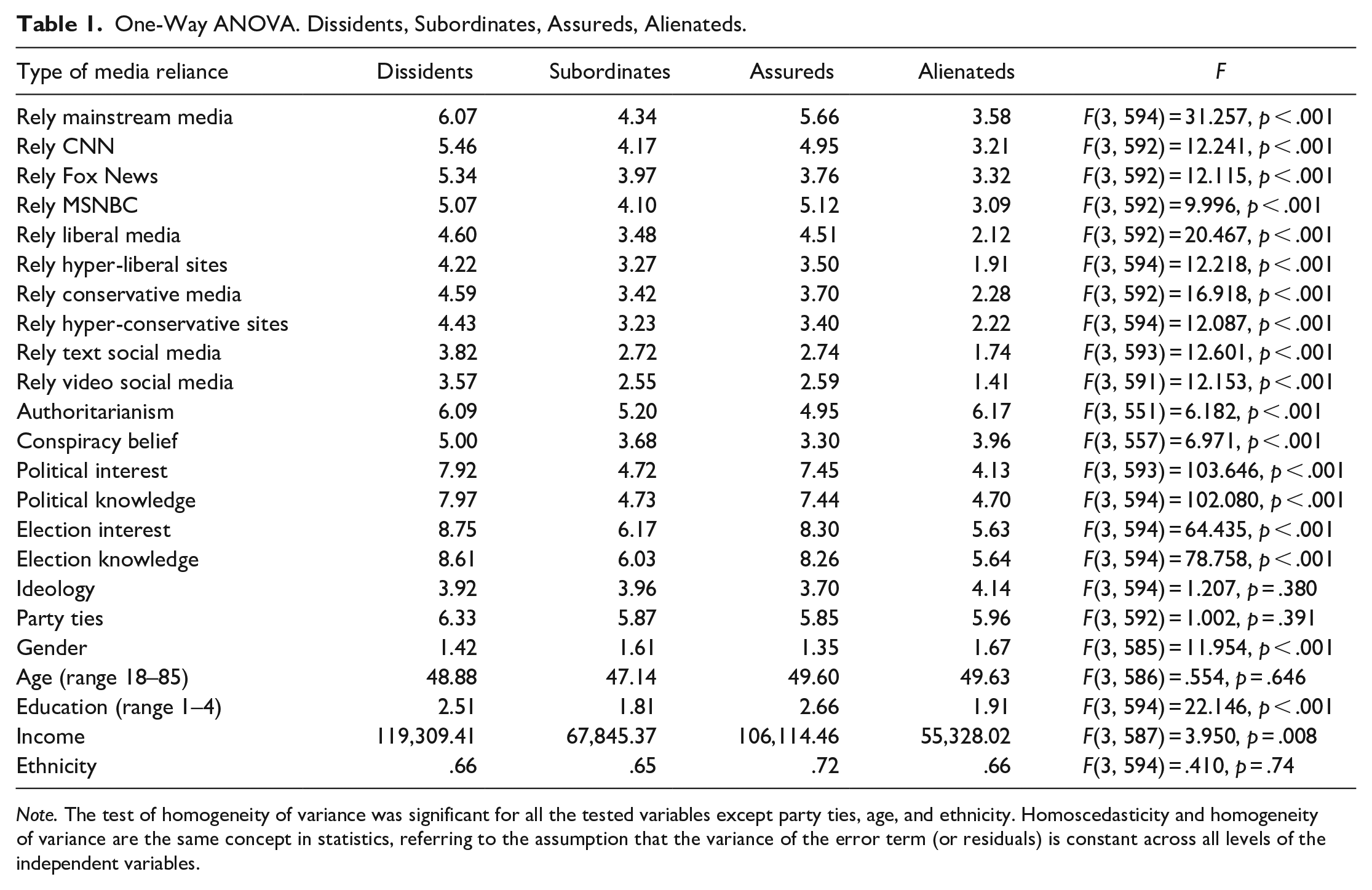
Note. The test of homogeneity of variance was significant for all the tested variables except party ties, age, and ethnicity. Homoscedasticity and homogeneity of variance are the same concept in statistics, referring to the assumption that the variance of the error term (or residuals) is constant across all levels of the independent variables.
Being a Dissident, Media Reliance, and Conspiracy Theories
This study’s first hypothesis is supported—being a Dissident positively predicts belief in conspiracy theories (β = .20, p < .05). None of the other three Gamson types predicted belief in conspiracy theories (Table 2).
Prediction of Belief in Election Conspiracy Theories.
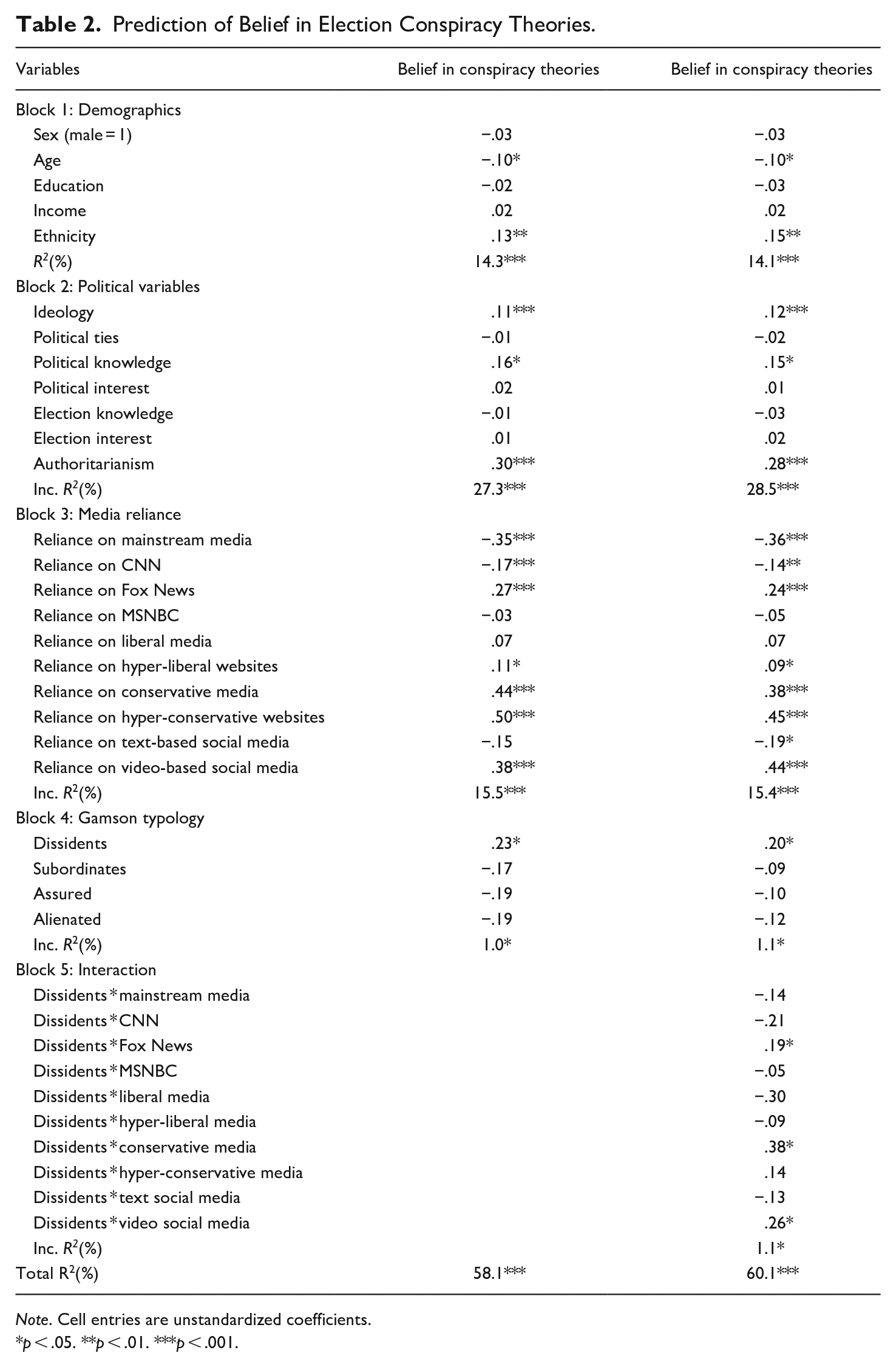
Note. Cell entries are unstandardized coefficients.
p < .05. **p < .01. ***p < .001.
Hypotheses 2, H3a, and H3b assert that mainstream media, CNN, and MSNBC are negative predictors of belief in conspiracies, while reliance on Fox News is a positive predictor. The results show that reliance on mainstream media is indeed a negative predictor of belief in conspiracy theories (β = −.36, p < .001), supporting H2. Reliance on CNN negatively predicts conspiracy theories as hypothesized (β = −.14, p < .01), but MSNBC does not predict belief in conspiracy theories (β = −.05), thus, H3a is partially supported. Fox News strongly influences belief in conspiracy theories (β = .24, p < .001), thus H3b is supported (Table 2).
H4 and H5 pertain to reliance on liberal and conservative media and belief in conspiracies. Reliance on liberal media has no significant link to conspiracy theories (β = .07), so H4 is not supported. Conservative media (β = .38, p < .001), however, is positively associated with belief in conspiracy theories, so H5 is supported (Table 2).
The second research question asks if reliance on hyper-liberal and hyper-conservative websites is associated with belief in conspiracies. Reliance on both hyper-liberal media (β = .09, p < .05) and hyper-conservative media (β = .45, p < .001) is positively linked to belief in conspiracy theories (Table 2).
Hypotheses 6a and 6b are both supported as reliance on text-based social media (β = −.19, p < .05) negatively supports belief in conspiracy theories, and video-based social media (β = .44, p < .001) positively predict belief in conspiracy theories (Table 2).
Moderating Effects of Being a Dissident
Hypothesis 7 explores the interaction effects between being a Dissident and media reliance, and how these variables affect belief in 2020 election conspiracy theories. Being a Dissident moderates the relationship between reliance on Fox News (β = .19, p < .05), conservative media (β = .38, p < .05), and video social media (β = .26, p < .05), and belief in election conspiracy theories. The directions are all positive, indicating that Dissidents who rely on Fox News, conservative media, or video-based social media are more likely to believe election conspiracy theories. All the other interaction effects are not significant (Table 2).
Discussion
Even though the 2020 election took place more than 4 years ago, Trump and his supporters are still litigating the results and continuing to advance false claims that Trump won the election. Even after years of investigation, 85% of Trump supporters still believed in the three prominent election conspiracy theories: “Mail-in voting led to widespread fraud in the 2020 election”; “Voting machines transferred votes from Donald Trump to Joe Biden”; and “Thousands of voters cast their ballots under the names of dead people” (Frankovic, 2020). Moreover, those who desired a position in the current Trump administration needed to say they believed the 2020 election was stolen (Nakashima & Strobel, 2025; Sanger et al., 2024). This article, thus, examines the influence of media reliance and the Gamson typology of four combinations of trust in the government and political self-efficacy and belief in the 2020 election conspiracy theories.
Based on the Gamson (1968, 1971) Hypothesis, this study classifies four groups of respondents: Dissidents—High Efficacy/Low Trust; Assureds—High Efficacy/High Trust; Subordinates—Low Efficacy/High Trust; Alienateds—Low Efficacy/Low Trust. The four Gamson categories are compared belief in conspiracy theories, controlling for demographics and political attributes. Reliance on mainstream, conservative, and liberal media, CNN, MSNBC, Fox News, text-based social media, video-based social media, and hyper-liberal and hyper-conservative websites is also examined as a possible direct influence on belief in conspiracies and indirectly through the Gamson groups.
Although the majority of Trump supporters still believe he won the presidency in 2020, this study’s respondents are generally dubious of Trump’s claims. Approximately one-half of the respondents reject the three main election conspiracies of 2020, ranging from 46.3% who reject the claim that widespread mail fraud exists to 49.4% who believe voting machines transferred votes from Biden to Trump. This finding is in line with similar surveys conducted at about the same time as this study in late 2020 (Blake, 2022; Crisp, 2021). Yet, about one-third of respondents hang on to the idea that the election was stolen, a percentage that meets the standard of a “widespread” conspiracy belief (Swami & Furnham, 2014; Uscinski et al., 2020).
Gamson Hypothesis and Conspiracy Beliefs
Researchers often explain belief in conspiracy theories in terms of time spent with different media rather than what sources media consumers rely on. For example, hyperpartisan and social media are considered breeding grounds for conspiracy theories (Benkler et al., 2018; Papakyriakopoulos et al., 2020; Rojecki & Meraz, 2016). In this study, Dissidents rely on hyperpartisan and social media more heavily than the other three groups, and they are the only group associated with belief in conspiracies. Even though Dissident’s reliance on any media type is moderate at best, they are still more heavily reliant on media than other Gamson groups, and thus have more exposure to conspiracy content. Presumably, media reliance equates with exposure to the election conspiracy theories, which leads to belief in the conspiracies.
Media Reliance and Conspiracy Theories
Liberals and conservatives live in different media ecosystems, and that split was revealed in this study by the difference in media reliance and belief in conspiracy theories. The more strongly respondents rely on broadcast television, newspapers, and CNN, the less likely they are to believe conspiracy theories, a finding in line with Sunstein and Vermeule (2009). Initially, mainstream media contributed to election disinformation by reporting Trump’s false election claims because he was the president, and what the president says is newsworthy (Benkler et al., 2020). When it became apparent that Trump’s election fraud claims were untrue, the mainstream press actively challenged his conspiracy theories and urged their followers to disregard them (Beam, 2020; Kreiss, 2020). Although mainstream media reliance is associated with low belief in election conspiracy theories, liberal media reliance did not affect conspiracy beliefs, possibly because these media are not relied on as strongly as the mainstream press.
Reliance on CNN for news consumption is negatively associated with belief in election conspiracy theories. This negative relationship is largely attributed to CNN’s consistent framing of the election as secure and its emphasis on fact-based reporting that actively counters misinformation and conspiracy narratives. Indeed, liberal news actively challenges Republican-serving misperceptions (Meirick & Bessarabova, 2016), and CNN is perceived to be more impartial than Fox News (Morris & Francia, 2010).
Conservative media and hyper-conservative websites amplified Trump’s claims of election fraud. Conservative news organizations worked with the Trump campaign and his supporters to promote Trump’s election conspiracy theories (Benkler et al., 2020). Not surprisingly, then, this study’s respondents who relied on conservative media and hyper-conservative websites believed the conspiracy theories that Trump and these media organizations were peddling.
The most unexpected result of this study is that reliance on hyper-liberal websites predicts belief rather than disbelief in election conspiracy theories. This finding, however, lends credence to other studies in which extreme partisans are more likely to believe conspiracy theories than weaker partisans, and reliance on both hyper-conservative and hyper-liberal sites influences belief in conspiracies (Schemer et al., 2021). Further, liberal extremists tend not to practice selective exposure but also visit hyper-conservative sites, perhaps being influenced by what they find there (Peacock et al., 2021). Extreme ideological intensity, regardless of direction, predicts a higher susceptibility to conspiratorial thinking because of a cognitive predisposition toward motivated reasoning and distrust of outgroup information (Van Prooijen et al., 2015). Exposure to fringe content on partisan sites can lead to belief reinforcement over time, especially when users fail to engage critically with contradictory information (Levendusky, 2013). These dynamics suggest that ideological extremity, not just ideological orientation, plays a central role in shaping individuals’ openness to conspiracy narratives.
This study is one of a few that explores differences between text-based and video-based social media. Reliance on both text- and video-based social media is also a predictor of conspiracy beliefs, but in much different ways. Reliance on text-based social media reduces belief in conspiracy theories, while reliance on video-based social media is the second strongest predictor of belief in election conspiracy theories, behind conservative media. The negative relationship between text-based social media use and belief in election conspiracy theories appears to defy reality as Trump used Twitter as his major device to broadcast his “Stop the Steal” messages to his base, and 70% of House Republicans heeded the president and tweeted at least one conspiracy theory (LaPlant et al., 2024; Ouyang et al., 2020). But recent research indicates that use of text-based social media platforms, such as Twitter and Reddit, is negatively associated with belief in conspiracy theories (e.g., Li et al., 2024), particularly when such use involves engagement with diverse viewpoints and credible information sources. Users who actively consume political content on these platforms and engage in deliberative discourse are more likely to encounter corrective information and develop resistance to misinformation (Chambers, 2021). Unlike algorithmically curated visual platforms like TikTok or Instagram, text-based platforms tend to host more fact-checking, expert commentary, and user-generated debunking of conspiratorial claims, which can reduce susceptibility to misinformation over time (Douglas et al., 2019; Uscinski, 2018). Furthermore, exposure to conflicting opinions and participatory news environments on social media has been linked to increased social capital (Gil de Zúñiga et al., 2012). These findings suggest that certain forms of social media use, especially text-based ones fostering information diversity and critical engagement, can serve as a protective factor against conspiracy theory belief (Pennycook & Rand, 2021; Swami et al., 2014).
Political Characteristics and Belief in Conspiracies
This study’s Dissidents believe they are highly knowledgeable and have a keen interest in politics, making them likely to seek election information and come across more election conspiracy theories in that process (Lee et al., 2022). This study demonstrates that Dissidents tend to believe in election conspiracy theories more than other Gamson groups, presumably to reaffirm their beliefs that an election was stolen, and armed with that information, they protested to try to get the results of the election overturned (Rottweiler & Gill, 2020).
Gamson researchers have argued that the low self-efficacy, low trust Alienateds are tuned out from politics (Paige, 1971; Sigelman & Feldman, 1983). Alienateds seem to be particularly vulnerable to conspiracy theories because of their generalized cynicism and disengagement from conventional political discourse (Silva, 2018). Alienateds in this study do not believe they are politically knowledgeable and express little interest in politics. They are not motivated to seek election information and, therefore, are less likely to rely on all media sources than Dissidents. Perhaps one reason Alienateds are less likely than Dissidents to believe conspiracy theories is that they are less likely to be exposed to them.
Assureds, who trust institutions and feel politically efficacious, show a low tendency toward conspiracy theory belief, as their worldview is anchored in institutional legitimacy and conventional sources of authority. Subordinates, who trust institutions but feel politically powerless, exhibit somewhat less susceptibility than Dissidents and Alienateds but still exhibit openness to conspiracy theories when they perceive exclusion from decision-making. Overall, Gamson’s typology helps explain how varying combinations of trust and efficacy shape openness to conspiratorial interpretations of political events.
Dissidents as Moderator with Media Variables Predicting Conspiracy Beliefs
While eight of the 10 media measures significantly influence levels of election conspiracy beliefs, the measures fell to two when “Dissident” was added as a moderator. However, that addition helped clarify the relationship between media reliance and belief in election conspiracy theories. Being a Dissident interacted with Fox News and conservative media to boost belief in election conspiracy theories. The interaction between being a Dissident, video-based social media, and mainstream media, CNN, MSNBC, liberal media, and hyper-liberal websites tended to reduce support for 2020 election conspiracy theories, although the relationships are not significant. These differences between the effects of liberal- and conservative-leaning media reinforce findings from the 2020 election concerning the media ecosystem and election conspiracy beliefs. Conservative sources such as Fox News and conservative radio and television pundits, as well as hyper-conservative websites, not only repeated Trump’s conspiracy theories, but sometimes were the source (Benkler et al., 2018).
Contributions of this Study
Overall, this study makes several contributions. Although many studies look at the connection between belief in conspiracy theories and reliance on a single medium, this one explored reliance on 10 media types and categorized social media into text-based and video-based sites for a more nuanced look at the effects of social media reliance on conspiracy theory belief. And while past studies have looked at the effects of political self-efficacy and government trust as separate predictors, this study looked at the combination of these measures as the Gamson Hypothesis and expanded the hypothesis into a new area of conspiracy theory belief.
Limitations and Future Research
This study is based on a one-time survey; a panel study would have allowed claims about cause and effect. While this study examined media reliance and Gamson measures on belief in election conspiracy theories, future studies might also want to look at the effects of conspiracy theories, such as support for, and engaging in, political violence, as studies have suggested a link (Enders et al., 2024). With Trump’s 2024 re-election, it is important to know if the fundamental nature of the Gamson typology has changed. Dissidents are typically seen as those challenging power (Gamson, 1968, 1971), but they might support Trump by believing they have the political clout to help him bring about changes he supports, while the Assureds (high efficacy/high trust) might be the ones challenging the Trump administration. This study focused on the 2020 election, but it is possible that this election served as an outlier. This study should be replicated for future comparison of the effect of belief in conspiracies on the presidential election outcomes, focusing on the media’s, especially social media’s, role in spreading mis- and disinformation, and the rise of hyperpartisan media and websites, as well as more partisan social media sites.
The media have been criticized as ineffective democratic gatekeepers in 2024 by not pushing back harder against Trump’s lies and conspiracy theories (Oates, 2024; Pickard, 2024; Reese, 2024). The social media ecosystem and its role in combating conspiracy theories changed tremendously from 2020 to 2024. Social media companies have reduced content moderation and other user trust protections, such as weakening platform policies for policing hate, harassment, and lies on their networks, allowing more untrue and offensive messages to reach the public (Benavidez, 2023).
Facebook and Elon Musk-owned Twitter/X are not thought to be as devoted as they were in 2020 to combating conspiracy theories in the 2024 election. With conspiracy theories, dis- and misinformation going largely unchecked, social media could strongly influence future election outcomes (Ellison, 2024; Lemmon, 2024), especially with the rise of hyperpartisan social media such as Gab and Truth Social on the right and Threads and Bluesky on the left, each side spreading its own spin on conspiracy theories (Beam et al., 2024; Napoli & Goodman, 2024).
Moreover, belief in election conspiracy theories threatens the democratic process, particularly free and fair elections (Berlinski et al., 2021; Norris, 2019, 2021), and can cast doubt on the legitimacy of future elections in the U.S. For example, if Trump had lost in 2024, it was largely believed he would have repeated voter fraud claims and conspiracy theories, which would again have resulted in recounts, lawsuits, political violence, and public skepticism about the election process (Kirshbaum et al., 2025; Ravitch, 2025; Silva, 2024).
Supplemental Material
sj-docx-1-jmq-10.1177_10776990251360688 – Supplemental material for Shouts and Whispers: The Gamson Hypothesis, Media Reliance, and Belief in 2020 Election Conspiracy Theories
Supplemental material, sj-docx-1-jmq-10.1177_10776990251360688 for Shouts and Whispers: The Gamson Hypothesis, Media Reliance, and Belief in 2020 Election Conspiracy Theories by Thomas J. Johnson, Barbara K. Kaye and Chang Sup Park in Journalism & Mass Communication Quarterly
Footnotes
Declaration of Conflicting Interests
The author(s) declared no potential conflicts of interest with respect to the research, authorship, and/or publication of this article.
Funding
The author(s) received no financial support for the research, authorship, and/or publication of this article.

Supplemental Material
Supplemental material for this article is available online.
Notes
Author Biographies
References
Supplementary Material
Please find the following supplemental material available below.
For Open Access articles published under a Creative Commons License, all supplemental material carries the same license as the article it is associated with.
For non-Open Access articles published, all supplemental material carries a non-exclusive license, and permission requests for re-use of supplemental material or any part of supplemental material shall be sent directly to the copyright owner as specified in the copyright notice associated with the article.
