



Abstract
Given the importance of negativity and conflict in political news, it is assumed that politicians strategically seek conflict or emphasize negativity to secure media coverage. Existing research investigating politicians’ self-mediatization relies on surveys or content analyses, and we have, therefore, little in-depth insight into how politicians navigate the news media’s strong focus on conflict and negativity. Addressing this gap, we conducted 31 interviews with Dutch MPs. Our findings reveal that while MPs recognize the media’s impact on the political realm and fellow politicians, their own adaptation to the media’s preference for negativity and conflict is a strategic and deliberate choice.
Political news often focuses on elements like political misconduct, conflicts between parties, or politicians not living up to voters’ expectations. Journalists, aiming to gain a broad audience in a competitive attention economy (Galtung & Ruge, 1965), and fulfilling a critical watchdog function (Bartholomé et al., 2015), exhibit a bias toward negativity in political reporting (Esser et al., 2016). A core element of this negativity bias is journalists’ tendency to report on political conflict, emphasizing disagreement between political actors and incompatibility between viewpoints (Bartholomé et al., 2015). Likewise, in politicians’ communication, negativity and conflict are often dominant elements (Klinger et al., 2022), potentially as a strategic anticipation of the media’s understanding of newsworthy news. As we know markedly little about how politicians perceive and navigate the news media’s strong focus on conflict and negativity, this paper aims to advance our understanding of politicians’ perspectives on the current media logic. We will do so by mapping perceptions among a diverse group of political actors, such as incumbent and opposition parties, including populist ones.
In today’s mediatized society, the logic of the media extends beyond the realm of journalism and is generally more central to political communication processes, including the self-presentation of politicians (Strömbäck, 2008). It is presumed that politicians must adapt their behavior to the logic of the media to be visible to voters, inform them about their policies and plans, and influence policy decisions (Strömbäck & Van Aelst, 2013). Consequently, politicians might (strategically) emphasize negativity and criticize opponents to suit journalistic news selection criteria—such as the newsworthiness of conflict and negativity—ensuring their presence in the news (Van Santen et al., 2015). In this paper, we seek to understand to what extent politicians are aware of the importance of conflict as a news value and journalists’ negativity bias, and how they respond to this in their tasks as political representatives by, for example, emphasizing conflict or using negative rhetoric to increase the newsworthiness of themselves, their party, or issues they want to raise. Understanding this is crucial because negativity and conflict can negatively impact voters by disengaging them from the political process and increasing political distrust (Ansolabehere et al., 1994; Lau & Rovner, 2009; Skytte, 2021). Therefore, it is important to investigate how politicians balance the opportunities and consequences of conflict and negativity.
Previous studies exploring politicians’ adaptation to media logic have either examined the relationship between politicians’ perceptions of media power and their strategic behavior or compared their communication to media content (e.g., see the articles by Haßler et al., 2014; Ketelaars & Van Aelst, 2021). These studies, however, relying on survey data and content analyses, are limited in uncovering the nuanced and underlying motives driving politicians to emphasize negativity and conflict. Given the complexity of media adaptation, especially in a digital age where politicians also need to adapt to the logic of social media’s affordances, a more in-depth approach is necessary. While surveys are essential for grasping general trends in politicians’ behavior, our research employs qualitative interviews to gain a detailed understanding of the reasons behind politicians’ decision-making. Rather than formulating pre-determined theoretical expectations, we seek to inductively explore the diversity of political actors’ experiences. To study the role of the media’s focus on negativity and conflict on politicians in all its facets, we look at how politicians perceive these media biases, how they influence their strategic behavior in parliament, and their online communication. While previous studies have considered a specific aspect of politicians’ behavior such as press releases (Ketelaars & Van Aelst, 2021) or reactions to media coverage (Helfer, 2016), we consider their behavior and communication in the broadest sense. Which can, for example, entail communication with journalist, activities in the parliament, or direct interactions with voters via social media. By relying on qualitative interviews, we gain insight into how politicians themselves understand which elements of their behavior are influenced. Although public communication is a key element of political actors’ behavior and strategies in general, we separate politicians’ behavior and communication in parliament from their online communication to understand whether they may be influenced by social versus traditional media logics in different ways. Our central question is: how are Members of Parliament (MPs) affected in their behavior by a media environment predominantly focused on negativity and political conflict, and do they adapt their communication strategies accordingly?
To answer our research question, we conducted 31 semi-structured interviews with Dutch MPs representing a diverse range of political parties across the political spectrum. This study enriches the literature on conflict framing, mediatization, and negativity through an in-depth exploration of the different strategies and motives employed by political actors in navigating the dominant media logic that prioritizes negativity and conflict.
Theoretical Framework
Mediatization of Politics
The concept of mediatization is crucial in understanding the relationship between politics and the media (e.g., Mazzoleni & Schulz, 1999; Strömbäck, 2008). Mediatization of politics refers to the process whereby the media’s importance and impact on political institutions, actors, and organizations have increased over time (Mazzoleni & Schulz, 1999; Strömbäck, 2008). Strömbäck (2008) outlines four phases of mediatization. Applied to politics, the first phase emerges when media become the primary source of political information, facilitating politicians’ communication with the public. The media become politically independent in the second phase. Subsequently, in the third phase, political coverage is predominantly guided by media logic, with journalists prioritizing their routines and rules over political considerations (i.e., political logic). In the fourth and final phase, the media’s influence is so profound that politicians must adapt to media norms and practices (Strömbäck, 2008). This paper examines the fourth phase of mediatization, recognizing the institutionalization of media within political processes.
While early mediatization literature predicted political actors being “governed” by media logic (Strömbäck, 2008), more recent perspectives challenge this notion and view the relationship as dynamic. The interaction between journalists and politicians is often described as a tango (Van Aelst & Vliegenthart, 2014): while journalists frequently take the lead, by setting the agenda and shaping the news according to their principles, politicians should not be seen as passive dance partners as they also influence the media and strategically use it to reach their goals (e.g., Ketelaars & Van Aelst, 2021). Current research refrains from assuming that politicians adapt to the media without question; instead, adaptation is viewed as a phenomenon requiring in-depth study. According to Marcinkowski and Steiner (2014), “mediatization denotes not so much the passive submission of other systems to media forces but the active utilization of media services” (p. 74). Since politicians know what the media are looking for, they can anticipate the media’s logic and adapt their communication tactics accordingly. This is referred to as self-mediatization and represents the active incorporation of news media principles and practices by political actors in their decisions and actions (Blumler & Esser, 2019). However, political actors may also resist conforming to media logic, prioritizing political considerations and instead following their own values or logic (Aalberg & Strömbäck, 2011). Against this backdrop, this study aims to understand the extent to which politicians perceive themselves as acting independently of media logic, feel pressured to adapt their communication according to this logic, or renegotiate it to make it fit their political goals.
Furthermore, recent perspectives on social media logic question traditional approaches to mediatization (Klinger & Svensson, 2015). In our current digitalized media environment, politicians can reach the public directly and are less dependent on journalists to get their message across. On social media, politicians can bypass journalists and produce their own content. Central to this production is not traditional media logic but, for instance, politicians’ sense of what will go “viral” and, thus, encourage voters’ engagement (Jost, 2023). However, politicians may also, in their online communication, focus on what is considered newsworthy by journalists as the traditional media, with their wide reach, may be more likely to report on politicians’ online messages if they align with the traditional media logic (Ekman & Widholm, 2015). As the need to adapt to traditional media logic may look different given the advantages of social media, we consider both the degrees and ways politicians adapt to traditional and social media logic. Accordingly, in the next section, we discuss first how politicians perceive the news environment before diving into how they adapt to the traditional and social media logic.
Politicians’ Perceptions of Conflict and Negativity in News Media
To understand whether politicians adapt to the media, it is first necessary to assess how politicians perceive the news and what news media tend to prioritize. It is argued that political news coverage is shaped by media logic. Media select and frame news items based on news values to attract and maximize the audience’s attention (Galtung & Ruge, 1965; Harcup & O’Neill, 2001). Consequently, certain aspects, notably negativity and conflict, have gained prominence in media coverage (Lengauer et al., 2012). The literature on negativity bias indicates that individuals display a stronger (unconscious) preference for negative information, showing greater attentiveness to negative than positive news (Soroka & McAdams, 2015). Negativity in political news encompasses news providing a pessimistic outlook on politics, focusing on the incapability of political actors, or negatively evaluating politics. A specific form of this negativity involves journalists framing politics in terms of conflict, emphasizing disagreements between political parties, incompatibility between viewpoints, and hostile politicians (Bartholomé et al., 2015). According to Lengauer et al. (2012), conflict frames are “more ‘marketable’ than positive news as it is more eye-catching, adds drama, stimulates interest, and is easy to understand even by uninformed audiences” (p. 182). Beyond their attention-grabbing potential, journalists incorporate negativity and conflict into their coverage to fulfill their journalistic roles as objective and critical reporters and watchdogs of the political system (Bartholomé et al., 2015). For instance, journalists tend to juxtapose the positions of political actors because it helps them to create balanced news stories in which voters are presented with two sides of a story (Bartholomé et al., 2015). Furthermore, by criticizing politicians, journalists can portray themselves as independent and autonomous political reporters that help to reveal political issues to the public (Lengauer et al., 2012). Before turning to the potential effect of the bias toward negativity and conflict in political news-making on politicians, it is essential to understand the extent to which politicians recognize and evaluate this biased media logic. Despite social media enabling the circumvention of media’s gatekeeping role, traditional media remain a crucial information source due to their large reach, resources, and role as sources of news content that other platforms pick up on (Langer & Gruber, 2021). Hence, the question arises, how do MPs perceive the media environment they operate in? Some evidence suggests that politicians perceive political content as strongly mediatized. Maurer and Pfetsch (2014), for instance, conducted a survey among MPs from eight European countries and show that they believe that the media simplify political debates, focus on tactics over substance, and increasingly portray politicians negatively. However, it remains unexplored how politicians view the focus on conflict in the news and how they evaluate mediatized news coverage. Given this, we ask:
Adapting to Traditional Media Logic
To explore whether politicians adapt to the media’s preferences for conflict and negativity, it is crucial to understand how and why politicians would adapt to the media logic. Existing studies considering mediatization have focused on how perceptions of media power influence politicians’ behavior, such as their media activities. These studies show that most politicians recognize the media’s significant influence on public opinion, election results, and policy outcomes (e.g., Van Aelst et al., 2008), and that this perceived influence drives politicians’ behavior to adapt to the media. However, survey research investigating this relationship yields conflicting findings. While Cohen et al. (2008) found that a stronger belief in the media’s power to influence public opinion correlates with media attention-seeking strategies, Ketelaars and Van Aelst (2021) did not find that perceptions of media importance translate into strategic communication efforts, such as press releases. Furthermore, studies have examined mediatization processes by comparing the content of political and journalistic discourse to assess their alignment, yet these results have also been inconsistent. While Bastien (2020) found evidence of politicians adapting to the media, employing strategic framing to gain attention, Haßler et al. (2014) did not observe parties consistently following news media logic, such as emphasizing negativity. Moreover, what is noticeably missing in the literature is an investigation into the strategic intents and underlying motives of politicians adapting (or not) to the media. By inductively mapping politicians’ direct perceptions of the influence of mediatization on their practices and perceptions, this study aims to advance our understanding of how politicians respond to news values allegedly dominant in the current media environment. Securing media attention is of central importance to politicians (Van Aelst & Walgrave, 2016). The media serve as powerful platforms for politicians to enhance electoral success (Hopmann et al., 2018), promote issues, and shape the political agenda (Walgrave et al., 2008). Politicians depend on the media to get their vision of politics across. However, adapting to media logic, particularly by emphasizing negativity and conflict, may pose challenges to other strategic objectives, such as increasing vote share, influencing policy, and attaining control over public office (Strömbäck & Van Aelst, 2013). Within consensus democracies, politicians need to decide between cooperation with other parties to influence policy outcomes and conflict to show the public how they differ from other parties, keep their promises to the electorate, and attract media attention (Moury & De Giorgi, 2015). This aligns with different incentives politicians have. From a vote-seeking perspective (Müller & Strøm, 1999), attacking opponents may be beneficial as it increases politicians’ visibility and shows voters that they stick to their promises and make no concessions. This is especially relevant for opposition parties, for example, as their role involves criticizing the government. As they are less likely to receive coverage than governing parties, they may need to stand out more with a conflict-oriented communication style (Bennett, 1990). Similarly, since the communication strategies of populist parties are inherently antagonistic (i.e., anti-establishment), and parties with extreme ideologies tend to have strong disagreement with others, populist parties are likely to value confrontation more (e.g., Maier & Nai, 2023; Nai, 2021). However, there is also a risk in seeking conflict, and it may, for example, hinder the potential for cooperation in future coalition governments. Therefore, from an office-seeking perspective (Müller & Strøm, 1999), it may be less effective as it may limit opportunities for governance.
Therefore, rather than blindly following media logic for attention, parties need to make careful choices about which goals to prioritize. An experiment by Philipps (2024) among German MPs reveals that politicians are willing to share information about parliamentary negotiations to attract media attention, even if it obstructs policy compromise. However, the experimental design employed by Philipps (2024) does not allow for an in-depth exploration of the underlying perceptions and considerations driving politicians’ decisions to disclose negotiation details to the media.
Finally, there is another way in which the news value of conflict and the negativity bias of journalists can impact politicians. Research shows that conflict frames and negativity moderate potential agenda-setting effects: They increase the relevance of the news item for politicians, which in turn impacts the likelihood that politicians will adopt the issue and bring this news item up in parliament and, for instance, ask parliamentary questions about it or use it to initiate bills (Sevenans & Vliegenthart, 2016; Thesen, 2013). Given the variety of ways in which the media’s preference for negativity and conflict could influence politicians’ strategic behaviors, understanding how politicians perceive this influence on their behavior is crucial.
Adapting to the Social Media Logic
In RQ2, MPs are asked about their perception of the need to adapt to the media’s focus on negativity and conflict, but the next question is whether they also use this logic to their advantage in their communication online. Hence, arguably, the traditional power relations between the media and political actors need revisiting considering social media that afford direct communication without the mediation of traditional gatekeepers. While politicians still need traditional media to connect with voters, politicians increasingly rely on online media to get their message across (Jungherr, 2016). On social media, politicians can control the content of their messages without journalists’ interference (Hong et al., 2019). In traditional media, journalists act as gatekeepers, selecting what content deserves attention, whereas online politicians themselves are in charge. Given that the relationship between politicians and journalists is complicated and characterized by cynicism and distrust (Brants et al., 2010; Soontjens et al., 2021), it is convenient for politicians to bypass journalists and use their online channels to avoid the risk of unfavorable coverage. Consequently, with the rise of social media, it is argued that politicians are no longer bound by traditional media logic but are instead influenced by “social media” or “networked” logics (Klinger & Svensson, 2015). In this context, mediatization refers to political actors adapting communication strategies to capture the attention of users on social media platforms and encourage interaction with the message (Jost, 2023). According to Klinger and Svensson (2015), an implication of this networked logic is that politicians use a personalized, emotional, as well as positive communication style in their online communication to reach as many people as possible. In addition, D’heer (2018) finds that to attract social media attention and to go viral, politicians tend to use a humorous tone. Alternatively, Klinger et al. (2022) show that negative messages attract user engagement online. However, online media are not only used to sidestep traditional media but also to attract journalists’ attention (Ekman & Widholm, 2015). To anticipate mass media coverage, politicians online tend to focus on conflict and negativity to appeal to journalists (D’heer, 2018). Politicians can emphasize conflict, use uncivil language, or attack other parties in their online messages, to ensure journalists cannot ignore them and will include them in their political coverage (Ekman & Widholm, 2015). Previous research, for instance, shows that negative campaign messages are more likely to get picked up by the media (Haselmayer et al., 2019). Provided that conflict and negativity can both be used to attract the attention and engagement of social media users as journalists, we ask to what extent the traditional media’s preference for conflict and negativity influences politicians’ online communication.
Method
Sample
To answer our research questions, we conducted 31 semi-structured interviews with Dutch MPs. The Netherlands offers an intriguing case for examining adaptation to a media environment focused on negativity and conflict, given its highly fragmented political landscape. At the time of the interviews, the parliament consisted of 150 MPs representing a total of 20 parties with significant differences in size and ideological background. This context allows us to investigate our research questions from diverse perspectives, which is crucial since the role of negativity varies across parties (Valli & Nai, 2020). For ideologically extreme parties, seeking conflict for media attention may have more desirable outcomes than for a government party that needs to defend the status quo. In addition, in a fragmented setting with numerous parties and a competitive attention economy, media visibility can be crucial for political parties’ electoral performance (Hopmann et al., 2018).
We invited Dutch politicians to participate in our research, focusing on national-level MPs (N = 150). Combining convenience and snowball sampling, our primary inclusion criterion was to ensure a maximum variety of perspectives related to mediatization. We aimed to include MPs from as many different political parties as possible. Contact was initiated with all politicians without any a priori selection in April 2022, through an email outlining the goals and procedure of the research. Appointments were scheduled 1 week after the email through phone calls to politicians’ party offices, followed by additional contact attempts via phone and email. MPs were also encouraged to refer other interested politicians. This process resulted in a sample of 31 MPs. While the response rate of almost 21% may not be high, we consider it satisfactory given the inherent difficulty of recruiting politicians for interviews in the Netherlands. Comparable studies have relied on similar sample sizes (e.g., see the study by Strikovic et al., 2020). We recruited a sufficiently diverse group of MPs: representing 14 different parties, 48% being a member of a government party, 16% being a populist party member, 55% being female, and 16% being a party leader. The average age was 47 (SD = 8), and on average, they have been in parliament for 5 years (SD = 3). We asked politicians to place themselves on a left-to-right scale (“1” denoting left, and “11” right), and their political leaning is around the midpoint of the scale (M = 5, SD = 2.48). Based on this variable, we calculated ideological extremity by folding the scale, that is, how much politicians deviated from the midpoint of the left-to-right scale (M = 0.81, SD = 0.56, Min = 0.06, Max = 2.44).
Data Collection
We held the interviews between May 2022 and September 2022. During the meeting, politicians first had to fill out a survey, and afterward, the semi-structured interviews took place. The meetings lasted on average for 45 minutes, with approximately 15 minutes dedicated to the specific questions of this paper. The recruitment of politicians and the interviews involved four researchers and four student assistants. We conducted 42% of the survey in-person, and 58% via Teams. In-person interviews predominantly took place in the Parliament itself. Given that the interviews were held in politicians’ private work settings and anonymity was guaranteed, they were encouraged to be honest. Interviews were conducted in Dutch, recorded, and transcribed using Teams’ software or a traditional recorder. Teams’ transcriptions were reviewed by a research member to ensure accuracy, while traditional recorder interviews were manually transcribed. 1 The research project received approval from the University of Amsterdam’s Ethical review board (ID: 2022-PCJ-14777).
The interview guide was structured along the three components of the main research question: (a) perception of media’s focus on negativity and conflict; (b) influence of media’s bias toward negativity and conflict on their behavior in parliament; and (c) its influence on online communication (see Supplementary Information file A for the full interview guide). We did not differentiate between different types of media in the interview guide but did specify that we were interested in mainstream media (newspapers, television, online news media). For the first component of the interview guide, we only focused on mainstream media and not yet on social media because the main aim of this study is to understand how much of the traditional media logic still affects politicians’ behavior. Only in the third part of the interview guide did we examine to what extent politicians are guided by social media logic, or whether traditional media logic still plays a role in shaping their online strategies.
Data Analysis
A step-by-step coding procedure was employed, utilizing the grounded theory framework of open, axial, and selective coding, and conducted in Atlas.ti (Corbin & Strauss, 1990). The analysis began with open coding, where descriptive labels (open codes) were assigned to words or sentences from the interview transcripts, summarizing the essence of relevant fragments. Open coding was guided by the research questions and sensitizing concepts including perceptions of negativity, conflict, and the general media logic and their effect on politicians’ behavior in parliament. Although these concepts drove the selection of relevant segments of text and the labeling during open coding, we stayed open to different perceptions of the media’s logic that were not pre-defined by our sensitizing concepts. This approach enabled the identification of potential new categories or themes emerging from the data. The second step involved axial coding, wherein different code groups were developed based on the relationships between the open codes. We merged codes and organized them into higher-order codes that detached the open codes from their context. For instance, initial open codes such as “critical reporting keeps politics sharp” and “negativity is not bad because MPs need to be held accountable” were grouped under the axial code “essential journalistic function,” as they collectively provided insights into the functionality of negativity in the news. In the third step, we used our research questions to guide selective coding. We investigated which axial categories relate to one another and clustered them under major themes. For example, two axial categories, “essential journalistic function” and “distorting citizens’ perception of politics,” both provided insights into the democratic implications of the focus on negativity and conflict and, thus, were combined under this overarching theme. To illustrate our results, only a small number of exemplary quotes will be presented in the following sections, and additional quotes are available in Supplementary Information file B. After analyzing the data along the lines of these three steps, the codes were re-inspected and sometimes reformulated for clarity, while maintaining their original meaning.
Findings
Overall, MPs agree that conflict and negativity are prominent in news reporting and that their dominance in the media environment has important democratic implications. While MPs argue that it is essential for journalists to report on conflict, they also worry that the excessive focus on conflict may cause a decline in media content quality, distort citizens’ perception of politics, and toughen the political climate (see Figure 1, RQ1). The extent to which MPs feel influenced by the media environment focused on conflict and negativity varies widely, with some adapting conditionally, while others resist or ignore the media logic. MPs also acknowledge the media’s power in shaping the political agenda and contributing to a mediatized political climate that they must navigate (see Figure 1, RQ2). Regarding online communication, MPs identify negativity and conflict as dominant values too. Some politicians strategically emphasize conflict, whereas others seek alternative and more positive communication strategies (see Figure 1, RQ3).
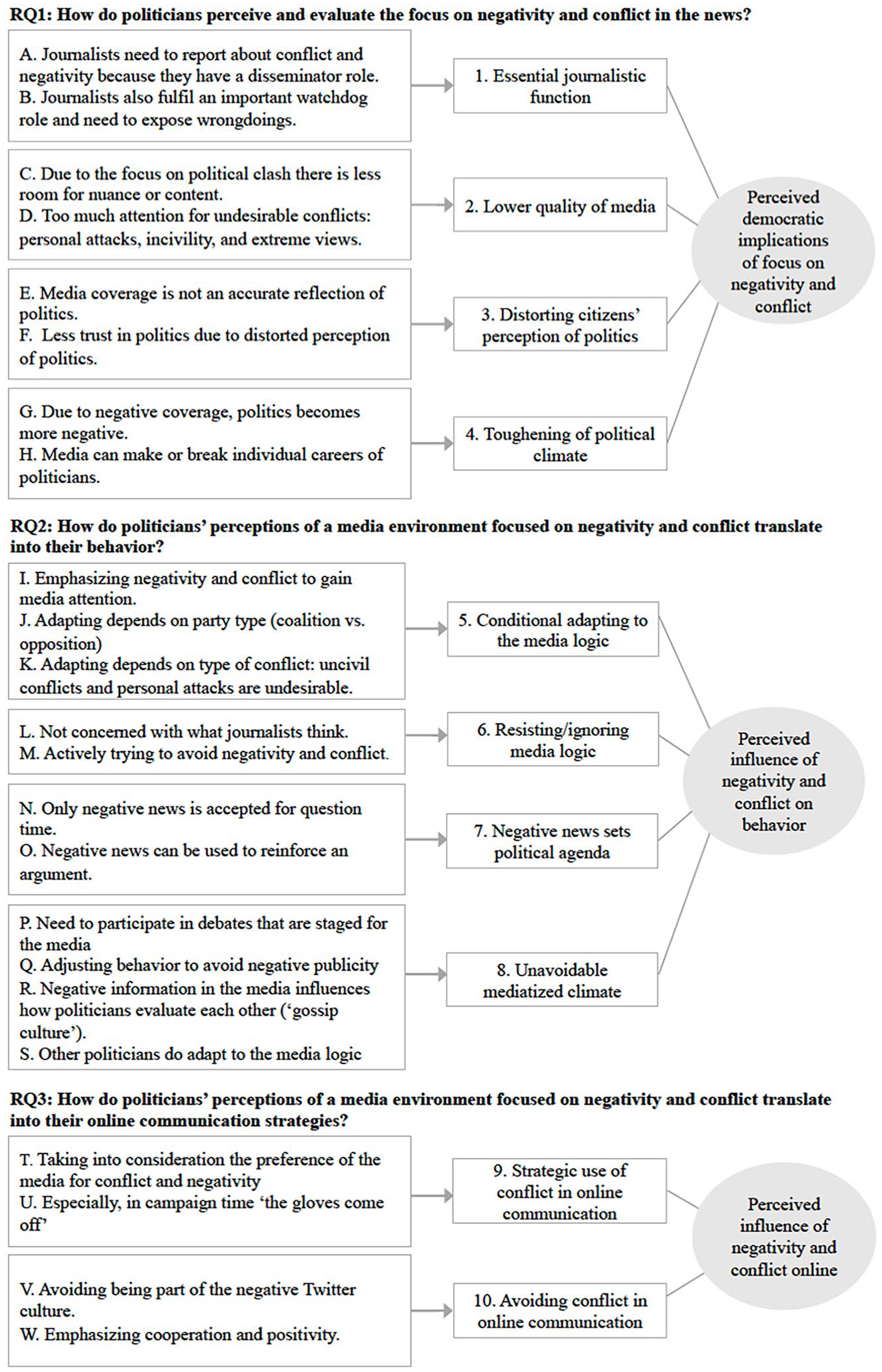
Data Structure.
Positive and Negative Democratic Implications of the Focus on Negativity and Conflict
First, we examined politicians’ perceptions and evaluations of the focus on negativity and conflict in the news. In all cases, MPs recognized the importance of negativity and conflict for news-making. Reflecting on this, they often used strong language to highlight the centrality of these elements: “I think it’s the news value. It’s really only about negativity, about things not working out, about things going wrong, about arguments, about conflicts, about burning each other down.” Since negative or conflictual news is the standard, positive news is overshadowed according to the interviewees, and harmonious debates rarely make headlines. Furthermore, MPs underscored that the media prioritizes commotion over substantive disagreement, thereby neglecting the complexity of situations or ideas. Hence, there is quite a clear understanding among MPs that the media has a bias toward negativity and that conflict is central to news-making, and thus, what politicians should emphasize to increase chances to attract attention. When questioned about the democratic implications of this journalistic focus, opinions varied, with some emphasizing its importance, and others expressing criticism. We divided their answers into four subcategories.
Essential Journalistic Function
As indicated by several MPs, the focus on negativity and conflict is not inherently alarming. They recognize journalists’ responsibility to accurately depict the political landscape and underline the importance of incorporating negativity and conflict into news reporting. In doing so, MPs refer to journalists’ watchdog role, emphasizing the need for them to criticize political actors and hold them accountable for their actions. So, news featuring conflict and negativity is deemed not just unavoidable but also necessary: “I don’t think negativity as such necessarily should be regulated. I think it’s an important, democratic, principle that journalists are also a thorn in the side and are critical.” Nevertheless, a collective frustration exists regarding the portrayal of politics. Most MPs express cynicism toward the media, highlighting potential negative consequences of the focus on negativity and conflict for media content, citizens’ trust, and the political culture. We organized these negative implications into the following three categories.
Lower Quality of the Media
Due to the predominant coverage of clashes and turmoil in the news, MPs observe limited space for discussing the complexities of issues or presenting nuanced and moderate perspectives. The media’s logic, according to MPs, oversimplifies the representation of political reality. In addition, a significant number of MPs distinguish between desirable and undesirable conflict types, with concerns raised about the focus on personal attacks rather than substantive differences: “While I don’t think it’s wrong to report on political conflict, I do think it would be good if that were specifically about substantive partisan differences, and less on personal attacks.” Some MPs express worry about incivility and extreme views garnering media attention, with one stating, “If I don’t insult someone, you don’t see it anywhere,” and another highlighting, “[T]here is a lot of room for especially the most polarized and most intense sides in the debate.”
Distorting Citizens’ Perception of Politics
MPs also voiced concern about the media’s portrayal of politics and felt compelled to correct it. One MP, for example, feels the need to clarify that numerous civil political meetings occur behind the scenes, challenging the prevailing media narrative that exaggerates the omnipresence of conflict. MPs argue that the media, with their emphasis on negativity and conflict, fails to provide an accurate reflection of political reality. This distorted view, they fear, contributes to a decline in citizens’ trust in politicians. One MP acknowledges the politicians’ role in this trust deficit but highlights the media’s amplification by misrepresenting politics, stating “If you just focus on arguing, like it’s a TV soap opera, we’re less often taken seriously, like we’re just toddlers, while there’re a few toddlers out of those 150 people, but not everyone.”
Toughening of Political Climate
Besides influencing voters and the media, MPs notice that the media’s focus on negativity and conflict toughens the political sphere. They argue that due to negative coverage, politics itself also moves in that direction and that politicians are behaving less appropriately, simply because they know they will get attention from the media: “I’m sure if things go wrong today at that nitrogen debate in the plenary hall. That’s where the cameras are on. That’s where the spotlight is. That also makes politicians behave less well just to attract attention.” Furthermore, several MPs highlighted the media’s considerable influence in shaping individual careers. The media hold the power to emphasize one scandal while disregarding another: “They can mention the same offense, mistake, or error of a minister repeatedly. Yes, and the other, they can downplay.” This awareness among politicians reflects a keen understanding of the media’s influential role in politics. In addressing RQ1, our results underscore politicians’ awareness of negativity and conflict as essential elements of political reporting. While MPs acknowledge the importance of conflict and negativity in political coverage, they share concerns about their potential downsides, such as declining news quality, distorting citizens’ views of politics, and toughening of the political climate.
Different Degrees of Adaptation to the Media’s Focus on Negativity and Conflict
In our second research question, we asked how politicians’ perceptions of a media environment focused on negativity and conflict translated into their behavior in parliament. Our findings revealed a spectrum of responses among MPs, reflecting varying degrees of adaptation to the media’s preference for conflict and negativity. The spectrum of adaptation ranges from politicians strategically amplifying conflict to attract media attention on one end to those who resist media logic by accentuating positive aspects on the other. Despite the varied nature of adaptation, we categorized the responses into two groups that represent the endpoints of the spectrum: MPs who partially embraced media logic (around 13 MPs) and those who either dismissed journalistic influence on their practices or actively strived to counteract it (around 18 MPs). We will elaborate on the two categories below. Furthermore, MPs highlighted additional ways in which the media hold power over politics. They emphasized the media’s noteworthy influence in shaping the political agenda and establishing a mediatized political environment that politicians must navigate. Following the examination of adapting and resisting media logic, we will reflect on the broader influence of the media on the political agenda and the overall political climate.
Adapting to the Media Logic
First, slightly less than half of the MPs disclose that they adapt their behavior to fit the media’s needs. Among those who adapt, many see it as a voluntary choice, believing they have the agency to decide when to do so. Only two politicians express that adapting feels unavoidable, recognizing the media’s influence over their behavior. Despite their reluctance to conform to the media’s preference for negativity and conflict, they feel compelled to adapt to convince colleagues of an issue’s importance or to enhance their effectiveness as parliamentarians. In addition, MPs highlight other ways in which the media exert influence over their behavior and that of their fellow parliamentarians, which we will reflect on later (see the Unavoidable Mediatized Climate section). The modes of adaptation vary, encompassing both active and passive strategies. Active adaptations may involve forceful interruptions or impactful quotes, while passive approaches may entail avoiding certain subjects or projecting unity off-camera. For example, one MP emphasizes friction and conflict: “It certainly influences your actions, because you know that’s how the media work. Because you know that you only come into the spotlight the moment you come up with something that chafes a little bit, that is interesting, that shows a conflict between the House of Representatives and the cabinet.” MPs offer several reasons for pro-actively adapting to media logic. One prominent motivator is the belief that visibility is crucial as representatives of the public. Seeking media attention is key for reaching voters, and MPs perceive that voters appreciate confrontations between politicians. When emphasizing conflict and negativity, MPs clarify that visibility is not an end goal but a strategic tool. Once a topic gains media coverage, it compels other politicians to take a stance, fostering debate: “The rationale is that you want publicity. You want to solve your problem, but then it must be made public first. So, then you do consider that how you present it makes it attractive for journalists to write about it.” Thus, seeking attention serves different strategic goals, with visibility never being the sole purpose. Politicians adapt because they want to influence both the media and political agenda on a topic or theme that they find important. Through the media, politicians aim to maximize their parliamentary influence, pressuring others to consider specific issues and enhancing voter support by being visible with their ideas. MPs themselves mention and observe that their adaptation is dependent on which party they belong to and the nature of the conflict. MPs from opposition parties argue that because they are in opposition, it is more common for them to seek conflict and criticize government parties. In contrast, MPs from government parties mention restrictions due to coalition agreements, discouraging them from engaging in media conflicts over these matters. In addition, MPs also comment on the behavior of other politicians. MPs from moderate parties argued that conflict is less beneficial for them than for politicians from more radical parties. Second, while MPs mention that they think it is more likely to grab media attention with incivility and personal attacks, they strive to distance themselves from such conflicts. Attacks should be substantive, not personal, and cursing is considered undesirable: “It does have to be about positions and arguments. So, I think a debate is fine, right? If you interpret conflict as debate and the exchange of views, I think it’s fine. If it’s about violence or threats. Then I think the line has been crossed.” Concerning the emphasis on fundamental differences, politicians either deliberately avoid it or seek ways to polarize the debate.
Resisting/Ignoring Media Logic
In contrast to the adaptation approach, more than half of the MPs actively chose to resist confirming to media logic. They prioritize the substantive party agenda over gaining media attention. While some MPs express nonchalance toward journalists, focusing on their job without much consideration for media dynamics, others adopt a proactive stance, actively resisting media logic. These politicians aim to avoid incivility, loaded terminology, and spinning, opting for a positive tone, emphasizing cooperation, and incorporating humor.
We said at the very beginning: what are we going to do? Are we going to make sure, in a very populist way, that the media sees us and is going to write about us to appeal to the electorate? Or are we going to see what substantive agenda we have and are we going to pursue that here and then no attention? And in the end, we all chose the latter.
Several MPs refused to adapt to media logic for distinct reasons. First, they considered such adaptation normatively unacceptable, as it would contribute to the toughening of the political climate and the erosion of citizens’ trust in politics—a situation they sought to avoid. Second, for these MPs, media presence was not viewed as an essential part of being a representative of the people; their primary focus was on serving the public’s interests rather than their own. Third, non-adapting MPs argued that conflict might hinder the achievement of political goals. Conflict was perceived as a distraction from substantive matters and counterproductive, especially considering the necessity of cooperating with other parties to pass a bill or motion: “If I want to be in the newspaper, then I say, ‘in this motion considering’ and then suddenly I’m also going to say ‘this asocial VVD minister . . .’ Yes, but then you have a problem and then I won’t get it passed. So, I’m not going to do that.” These results demonstrate that MPs weigh the multi-faceted consequences of their actions. MPs who refuse to adapt to media logic prioritize maximizing their parliamentary influence. While the media could offer a strategic channel for policy promotion and pressure other parties to think about them, aligning with the news value of conflict and journalists’ negativity bias is perceived as counterproductive. Finally, some MPs also mention that adapting to the media logic does not fit the personal style of the politician or the party’s image. Beyond weighing various goals connected to the parliamentary, electoral, and media arena, individual personality traits and the party’s image also emerge as influential factors.
Negative News Sets Political Agenda
While MPs differ in the extent to which they adapt to the media’s preferences, there is a shared feeling that negative news often determines the political agenda. Only negative news is accepted for question time, and negative news can be used to underscore the importance of an argument as it shows urgency. For example, when the media reports about something bad happening and this aligns with an issue that politicians are concerned about, they will bring this up during a debate. Almost all politicians recognize the influence of the media on the political agenda.
Unavoidable Mediatized Climate
Some MPs feel that the media’s focus changes the political culture, thereby influencing politicians’ behavior. One politician, for instance, mentioned the need to participate in debates that are staged for the media, often centered more on conflictual elements than substance. “I feel like I’m just trying to be concerned with the content, but sometimes you must participate in debates that we’ve collectively decided we should have, even though it’s mostly about conflicts. But you can’t avoid them either.” A widespread concern among politicians revolves around the media’s influence on individual careers. Politicians assert that they modify their behavior in response to media criticism or to avoid negative publicity. Furthermore, negative information about politicians in the media shapes how politicians perceive one another, fostering a “gossip culture.” Interestingly, although MPs often argued they do not consider media preferences, they noted other MPs did. These MPs alter their communication and operations, changing their tone, preparing interruptions in advance, and framing motions to provoke opposing parties. So, MPs are very aware that the media logic influences colleagues but deny its impact on themselves: “You also have Members of Parliament who, if they are not mentioned in a newspaper somewhere for two weeks, that they get physical withdrawal symptoms. Well, I’m not one of those.” The results indicate that while politics is undoubtedly mediatized, politicians feel they have agency in how much they adapt to it. There is a shared feeling that politics has become more negative, with negative news driving the political agenda, and other political actors adjusting their communication styles to align with media logic. Despite these observations, most politicians do not feel compelled to adhere to the news value of conflict or journalists’ negativity bias. Instead, they maintain the ability to strategically employ or avoid adapting to the media’s preferences for conflict and negativity for their benefit.
Strategically Emphasizing or Avoiding Conflict in the Online Environment
Finally, we asked how politicians’ perceptions of a media environment focused on negativity and conflict influenced their online communication strategies. In the context of online behavior, the importance of negativity and conflict played a similar role. Like their offline behavior, a dichotomy emerged among MPs: some actively sought to avoid conflict on these platforms, while others strategically emphasized it to engage the public and journalists. Interestingly, a notable portion of MPs refrain from using social media, particularly X, expressing strong sentiments about the platform. One MP describes it as “a negative medium with lots of trolls who are allowed to comment anonymously.” However, this strong negative sentiment seems to shift during campaign periods, when politicians recognize the utility of social media. They note that in the lead-up to elections, they find enjoyment in its usage.
Avoiding Conflict in Online Communication
Several MPs indicated deliberately avoiding negativity and conflict online because the online environment is already quite conflictual. Online conflict triggers nasty reactions and can hamper political goals. Instead, they use social media for self-promotion and connecting with the public. Some also feel the influence of the media, by deliberately trying to be positive, or carefully crafting their messages: “I’m incredibly careful with choosing my words when I tweet. Then I think about whether this is the right time. Is this the right message? Could it suggest something that might have a negative impact?”
Emphasizing Conflict in Online Communication
The politicians who strategically emphasize conflict do so not only to convey their political message and attract the attention of voters, but also to attract the attention of the media, which is of secondary interest compared to voters. So, MPs emphasize that conflict can help them to receive media attention, but that is not the primary goal. Both traditional media logic and social media logic seem to coincide here. Politicians are aware that negative messages increase engagement and reach more people, but they also know that the media are more likely to pick up on such content. Importantly, MPs argue that different rules apply in the campaign period. During this time, MPs mention that “the gloves come off,” and they observe that this is the case even among coalition parties. Politicians, together with their political partie, choose a political opponent whom they then attack on social media and they see the traditional media as more important during this period.
The goal of an election campaign is to make sure that you spread your point of view across as many channels as possible so that as many people as possible hear it. Mainstream media can help with that and then it helps to write something up in such a way, that it’s more likely to be picked up. And one of the ways to do that is to state something in a way that indeed shows conflict, opposition, but also negativity.
The results indicate that social media present additional challenges to the decision to adapt. Given the already conflictual nature of social media, politicians tend to be careful in choosing their words. However, during campaigns, this is less of an issue, as the MPs emphasize that they resort more to negativity during this period.
Discussion and Conclusion
This paper aims to investigate how a negative and conflict-focused media environment influences politicians’ behavior in parliament and their communication efforts online. Departing from the actor-centric approach to mediatization (Ketelaars & Van Aelst, 2021), we found that politicians vary in their adaptation to the media’s preferences. While widely acknowledging the profound impact of the media’s preference for negativity and conflict on the political realm and fellow politicians, MPs expressed that the extent to which they themselves adapt to the media is a strategic and deliberate choice.
Addressing our first research question regarding politicians’ perceptions of the media’s focus on negativity and conflict, our findings indicate that politicians indeed recognize the central role of conflict and negativity (Lengauer et al., 2012), overshadowing positive, nuanced, and complex information. As argued by Lippmann (1955), news values can distort truth by simplifying complex matters, a concern acknowledged by politicians. Furthermore, while MPs noted the potential democratic benefits of the journalistic focus on negativity and conflict, they also expressed concerns about the quality of the media, citizens’ perceptions of politics, and the political climate. This tension is also reflected in the literature: while it is argued that the media should function as a burglar alarm that informs people about important threats (Zaller, 1999), Bennett (2003) cautions against excessive negativity as the continuous ringing of the burglar alarm may distort reality. Recent research shows that politicians also frequently express their discontent with the quality of media online, using digital platforms to critique the media’s bias toward negativity (e.g., Gravesteijn et al., 2024).
Our second research question explored the degree to which politicians conform to media preferences in their behavior. We find that adaptation to the media is complex. In line with Blumler and Esser’s (2019) dual perspective on mediatization, the results of our paper indicate that mediatization is a combination of both pull and push factors: politicians’ self-mediatization functioning as a pull factor, and journalists’ power to actively shape political discourse as a push factor. Hence, for the quality of political communication and maintaining a balance between positive and negative information, both politicians and the media play a central role.
On the one hand, we find that politician’s adaptation to the media is strategic and deliberate. Prior research presented evidence of politicians both adhering to (Bastien, 2020; Cohen et al., 2008) and resisting media logic (Haßler et al., 2014; Ketelaars & Van Aelst, 2021). Our research contributes to this by revealing that politicians strategically decide to adapt to the media logic if it aligns with their political goals but also try to resist the media logic if it does not. Several factors seem to be influencing this decision including politicians’ goals connected to the parliamentary, electoral, and media arena, as well as their personality and party’s image. Furthermore, when adapting to conflict, politicians differentiate between types of conflict. While politicians understand that conflicts such as personal attacks, uncivil disputes, or polarized disagreements garner media attention, they sometimes actively avoid them because they might backfire on their effectiveness as MPs. In the literature, similar distinctions between types of elite conflicts have been identified (Nai & Maier, 2021; van der Goot et al., 2024). A central question in the literature has been to what extent the diverse types are desirable for the well-functioning of democracy, and the findings show that politicians themselves are also concerned with this.
On the other hand, while politicians experience agency in deciding to adapt to the media logic, they also recognize the powerful influence of the media on the political agenda and political climate. This perception aligns with findings from elite surveys across European countries (e.g., Van Dalen & Van Aelst, 2014). The agenda-setting literature seems to support politicians’ perception that negative news shapes the political agenda. Langer and Gruber (2021), for example, show that prolonged media attention to scandals pressures politicians to discuss this topic in parliament. In addition, Thesen (2013) finds that opposition parties tend to respond to negative news in parliament because this news reflects important social problems for which they can hold the government accountable. Interestingly, politicians also argued that the media have power in deciding to cover certain misconduct while ignoring others. As Entman (2012) has argued, due to the media’s limited resources, time, and commercial incentives, journalists cannot hold all politicians accountable for their misdeeds, and also often remain silent. Finally, MPs disclosed that while they themselves did not experience influence, they argued that the media did significantly influence the behavior of their fellow parliamentarians. This observation reflects a third-person effect (Davison, 1983), where politicians acknowledge the media’s influence on others but downplay its impact on themselves. This phenomenon, also identified in prior research on mediatization among local government public servants (Sandén & Turunen, 2020), can be attributed to individual motivational processes, driven by a desire to view oneself more positively than others.
Addressing our third research question about the influence of a conflict and negativity-focused media environment on politicians’ online communication, we uncover a noteworthy impact of social media logic, consistent with prior findings (Jost, 2023). Politicians are not only concerned about messages that attract attention from journalists but also about engaging the public. According to politicians, using conflictual language increases the likelihood of capturing public attention and expanding reach. However, some politicians intentionally avoid contributing to negativity due to the inherently conflictual nature of online media. Interestingly, quite a few politicians mentioned they refrained from using social media and used distinct communication strategies during election periods. While scholars suggest that politicians engage in a permanent campaign online and thus are constantly concerned with maintaining a positive image among the public and use the same strategies in non-electoral periods as electoral periods (Elmer et al., 2012; Larsson, 2016), our results challenge this notion. Our findings show that some politicians consciously decide not to use social media, and when they do use it, they acknowledge that their communication strategies are distinct during election periods.
Overall, our findings make an important contribution to the mediatization and conflict-framing literature by highlighting politicians’ perspectives on how to resist, negotiate, or adapt to the perceived influence of the media. Our findings reveal political actors experiencing agency, strategically employing media logic to their advantage when seeking political influence or attention. Politicians feel the freedom to selectively avoid media pressure when it is advantageous to their political goals or profile. The extent to which this avoidance is indeed advantageous for politicians to achieve their policy goals and helps restore citizens’ trust in politics should be further explored.
Despite the valuable insights gained, the study has limitations. Directly asking politicians about their adaptation to media preferences may have led to socially desirable answers. To mitigate this, we offered the politicians complete anonymity and conducted the interviews in private work settings. We also initiated discussions with questions about the media rather than the politicians themselves, allowing for critical perspectives on the media before delving into how it influences them. Variability in politicians’ responses suggests overall honesty, but we cannot be sure that their words will be reflected in their actions. Hence, follow-up studies could assess if politicians’ reflection on their online behavior indeed aligns with their posts on social media. In addition, while we did not ask politicians about their strategies on different social media, it may be that politicians adapt more to the traditional media logic on X than on Instagram or TikTok because journalists tend to include messages on X in their reporting (Oschatz et al., 2022). Hence, it could be interesting to assess in future research whether politicians’ adaption to the media logic differs across platforms.
Furthermore, while the sample size was relatively small, it included politicians from over 14 different parties, offering sufficient diversity in partisan backgrounds. Although politicians occasionally mentioned the influence of their party on their behavior, the qualitative nature of the study prevented the identification of patterns across parties or politicians. While we did not observe any clear trends with regards to, for example, the influence of gender on politicians’ decision to adapt to the media’s preference for conflict and negativity, our limited sample size does not allow us to draw any meaningful conclusions about this. Hence, we suggest that future research could explore these systematic differences between political parties and politicians using quantitative data. Furthermore, it would be interesting to assess how different degrees of adaptation to the media logic influence politicians’ media representation.
Moreover, the insights from our study are specific to the context of a multi-party setting that is highly fragmented, limiting the generalizability of our findings to countries with different media and political systems. For example, in a majoritarian system with partisan media, such as in the United States, politicians may find it easier to secure their presence in the news, potentially having less incentive to cater to the media’s selection criteria. In addition, in countries with partisan media, politicians may hold different perceptions of different types of media and see them as following different types of logic. At the same time, in a two-party system, negativity and conflict will likely be more pronounced because parties do not need to cooperate with each other to govern and thus have more incentive to engage in harsh attacks (Walter, 2014). Nonetheless, we expect that in systems without partisan media, where legacy media holds similar reach and influence, and where multiple parties compete for attention, similar dynamics are likely to be at play. In conclusion, our study shows that the media’s focus on negativity and conflict has shaped political culture, forcing politicians to strategically decide to either adapt to or resist it. This decision-making process is complex, influenced by considerations of voter impact, parliamentary responsibilities, and political goals. Politicians also discern between distinct types of conflicts, with uncivil behavior and personal attacks considered the most undesirable. Finally, timing emerges as a factor too. While MPs may circumvent conflict outside elections, when the campaign period starts, the gloves come off. Despite the media’s considerable influence, politicians experience agency in navigating this mediatized political landscape by ignoring, resisting, or using media logic to their advantage. More research is needed to understand how politicians’ strategic choices affect media coverage, politicians’ representation, and voter’s perception of politics.
Supplemental Material
sj-docx-1-jmq-10.1177_10776990241312150 – Supplemental material for Do Politicians Knowingly Create Conflict to Gain Media Attention?: How Politicians Navigate a Mediatized Environment Characterized by Negativity and Conflict
Supplemental material, sj-docx-1-jmq-10.1177_10776990241312150 for Do Politicians Knowingly Create Conflict to Gain Media Attention?: How Politicians Navigate a Mediatized Environment Characterized by Negativity and Conflict by Emma Sarah van der Goot, Toni G. L. A. van der Meer, Michael Hameleers and Rens Vliegenthart in Journalism & Mass Communication Quarterly
Footnotes
Acknowledgements
The authors would like to thank Carmen van Alebeek, Rijk van den Broek, Nikki Dekker, Sophie Duvekot, and Marc van de Wardt for their valuable assistance in conducting the interviews for this research project.
Declaration of Conflicting Interests
The author(s) declared no potential conflicts of interest with respect to the research, authorship, and/or publication of this article.
Funding
The author(s) disclosed receipt of the following financial support for the research, authorship, and/or publication of this article: This work was supported by the Nederlandse Organisatie voor Wetenschappelijk Onderzoek (grant number 406.DI.19.055) and is connected to the POLPOP2 project, which is led by Stefaan Walgrave (University of Antwerp).

Supplemental Material
Supplemental material for this article is available online.
Notes
Author Biographies
References
Supplementary Material
Please find the following supplemental material available below.
For Open Access articles published under a Creative Commons License, all supplemental material carries the same license as the article it is associated with.
For non-Open Access articles published, all supplemental material carries a non-exclusive license, and permission requests for re-use of supplemental material or any part of supplemental material shall be sent directly to the copyright owner as specified in the copyright notice associated with the article.
