




Abstract
This study aims to explore the most critical factors that derived the political behaviors of Algeria and Morocco in their consistent conflicts. Using a corpus-based discursive news values analysis, the study identifies the dominant news values constructed in media discourse and the justifications used by both countries to support their diplomatic positions. The findings reveal that both Algerian and Moroccan media rely on quotes from domestic and international political leaders to validate their actions. The main difference is that while the Algerian media focused on defining Morocco as an invader by dredging up Morocco’s disreputable history as an invader, the Moroccan media highlighted the inhumanity of Algeria by portraying refugees’ miserable lives in the Tindouf camps. These justifications have been central to the conflict, and the study argues that addressing and overturning these narratives could provide a critical breakthrough in resolving the dispute. To help ease tensions between Algeria and Morocco, the study recommends improving humanitarian conditions in the Tindouf camps and encouraging Morocco to strengthen its peace-oriented international image. This research offers new insights into the role of media in sustaining diplomatic hostility and proposes specific strategies for conflict resolution, filling a gap left by previous studies.
Plain Language Summary
This study analyzes how the media in Algeria and Morocco explain and support their countries’ actions in their ongoing conflict. By analyzing how news stories are shaped, the study shows that both countries use statements from political leaders to justify their positions. Algerian media portrays Morocco as an invader, while Moroccan media focuses on the suffering of refugees in Algeria’s Tindouf camps. The study suggests that changing these narratives could be key to resolving the conflict. It provides new insights into how media shapes political conflicts and offers ideas for how to help end the dispute.
Introduction
Algeria and Morocco have long been in conflict over the Western Sahara, and this has attracted increasing attention from scholars, who mostly focus their research on diplomatic and political factor analysis. The conflict between Algeria and Morocco has lasted for half a century, and the hostility toward each other has developed from and infiltrated various aspects of the two societies. Thus, this conflict is not simply a diplomatic or political event but rather a complicated social event. Unlike mainstream politics-centered research, a sociological analysis can reveal the social attitudes/behaviors of the Algerian and Moroccan societies regarding the conflict and provide a fuller and deeper view of this complicated event.
News coverage is socially and culturally shaped, so news reporting analysis can be used to reveal the social powers and values that drove Algeria and Morocco to engage in conflict. This study focused on the recent diplomatic break between Algeria and Morocco (in 2021) and adopted a discursive news values analysis (DNVA) approach to examine and compare all of the news communication methods of the Algerian and Moroccan media, including the news reporting methods of diplomatic breaks by the media, the news values that dominated the reporting methods, and the social structures that influenced the news values (Zhang & Caple, 2021). In this way, the complicated social structures that indicate the attitudes and values of the Algerian and Moroccan societies connected to the conflict can be fully revealed.
In addition, previous politics-centered research has focused on dissecting and revealing the complicated and comprehensive causes of the Algeria-Morocco conflict both domestically and internationally, historically and currently (Ben Hounet, 2021; De Larramendi, 2019; Lu, 2023). These studies provided a full view of the conflict situation but were limited in sorting and displaying the intricate factors and phenomena of the conflict in a logical way, failing to target the most critical factor that decided the development of the Algeria-Morocco conflict or to find a breakthrough point to ease or resolve the long-term tensions. Addressing this gap, the present study adopts a corpus-based discourse analysis to extract the most prominent news values constructed by Algerian and Moroccan media—discursive indicators of prevailing social values in each society. This approach enables the identification of the core justifications used by both sides to legitimize their positions in the conflict. To this end, Discursive News Values Analysis (DNVA) is employed to systematically examine how newsworthiness is constructed through both language and visuals in media reporting (Bednarek & Caple, 2012a), providing a sociological perspective that goes beyond traditional political-diplomatic analyses.
Justification has been defined as the moral ground that drives a country to provoke or intervene in a diplomatic conflict (Cox & Sisk, 2017). Thus, by revealing the most fundamental justification that led to the Algerian and Moroccan societies taking a hardline stance in the conflict, this study reveals the breakthrough points to overturn this justification and proposes some strategies for easing and ending the long-term tension.
Literature Review
Studies of Diplomatic Conflict Between Algeria and Morocco
As outlined in the preceding Introduction, existing studies on the diplomatic conflict between Algeria and Morocco have primarily concentrated on analyzing the political and diplomatic structures that contributed to the deterioration of bilateral relations. Only a limited number of scholars have explored the historical roots and border disputes underlying the conflict. For instance, James (1990) analyzed diplomatic records from the 1963 Sand War, examining how colonial-era border demarcations and ideological differences between the newly independent states contributed to the onset of hostilities. Similarly, Olivero and López (2019) investigated the evolving role of Mauritania and the shifting political dynamics surrounding the Saharan conflict, shedding light on Algeria and Morocco’s entangled positions in the broader historical context.
A major strand of literature has focused on the Western Sahara conflict and its impact on modern Algerian-Moroccan relations. Ben Hounet (2021), for example, examined the “reconciliation” policies pursued by both nations in the 21st century and argued that these efforts have become increasingly ineffective due to shifting perceptions of suffering, trauma, and national identity. De Larramendi (2019) analyzed the persistent bilateral rivalry, noting that ongoing political tensions have undermined opportunities for cooperation on regional issues. Lefèvre (2016) further explored this geopolitical rivalry by comparing the countries’ diplomatic and military strategies, emphasizing how their competitive stances have fueled long-term instability.
Another group of scholars has addressed the continuity of the Algerian-Moroccan conflict, tracing its development from historical disputes to present-day diplomatic challenges. For example, Sour (2022) investigated both historical and contemporary dimensions of the conflict, with particular emphasis on how the Western Sahara issue continues to shape diplomatic relations between the two states.
In addition, several scholars have explored the broader regional consequences of the Algerian-Moroccan rivalry, particularly its impact on Maghrebi cooperation and integration. Lounnas and Messari (2018), for example, examined how the persistent tensions between the two countries have undermined the effectiveness of regional institutions such as the Arab Maghreb Union, impeding efforts to establish a cohesive geopolitical framework across North Africa. Similarly, Salem Abdi (2021) investigated Algeria’s involvement in the Western Sahara conflict from both historical and political perspectives, arguing that its sustained engagement has significantly influenced the trajectory of the dispute and continues to hinder prospects for regional development and unity in the Maghreb.
These previous studies deeply interpreted the diplomatic and political situations of Algeria and Morocco related to their conflict, but this diplomacy and politics-centered lens is limited and cannot reveal a full view of the comprehensive social structures that create and drive the hostility between these two countries. Therefore, this study adopts a media perspective to examine the social structures of Algeria and Morocco that drive diplomatic conflict.
On the other hand, the existing research has mainly arrived at conclusions by summarizing the selected viewpoints and interpretations put forward by the previous literature. It is difficult for researchers to avoid personal subjectivity in literature selection and political interpretation, so the conclusions of these studies are usually influenced by the authors’ positions and values. For example, by analyzing a group of selected policy terms and implemented strategies, Ben Hounet (2021) summarized that the “reconciliation” policy is not sufficient for solving the Algeria-Morocco conflict. Similarly, James (1990) examined diplomatic records from the 1963 Sand War and identified deep-rooted ideological divergences between the two nations, which continue to inform their strained relations. To reduce the impact of subjectivity on this study, we adopted a corpus-based news discourse analysis method to quantitatively reveal the power of social structures conceived in the news discourse. A corpus-based analysis method involves extracting the most salient discourse features from large quantities of news texts in terms of the event, providing objective data support for news value analysis and social structure analysis (Liu & Chen, 2024). Compared with the methods adopted by previous studies, the corpus-based analysis approach is more objective and can produce more credible results.
Finally, as mentioned in the Introduction section, previous diplomacy/politics-centered research has focused on demonstrating a full view of the various factors that lead to the Algeria-Morocco conflict, has limitations in targeting the most critical factors of the conflict and has failed to uncover a breakthrough point for conflict solutions. For example, Lu (2023) performed a comprehensive analysis of the mutual construction of the behavioral existence/environment of Algeria and Morocco in their long-term conflict but did not identify ways to address this conflict. To overcome this limitation of previous studies, we adopted a corpus-based news discourse analysis to extract the news values in saliency constructed by Algerian and Moroccan media, which indicate the most fundamental social values held by the two societies to justify their nation’s stance in the conflict, and to help us find the breakthrough point to end the tension.
Studies of News Coverage on Diplomatic Conflicts
The interactive relationships between news coverage and diplomatic conflicts have been fully explored by previous scholars in two main research areas. First, news reporting has been interpreted as exerting powerful influences on public perceptions of conflict events, but few existing studies have explored the influence of news reporting on diplomatic conflict development. For example, O’Connell (2023) presented three case studies of diplomats’ orations printed in news coverage in Italy and revealed a reciprocal relationship between the evolution of news print and diplomacy. Similarly, Kim and Zhou (2020) investigated the impact of news framing on political conflict, showing that exposure to conflict-related news frames can momentarily heighten individuals’ political identity salience through party identification mechanisms. Touri (2009) examined the role of news blogs in contexts of political conflict and war, arguing that such platforms can redistribute framing power, shifting it away from traditional media sources and offering alternative perspectives on conflict narratives.
Second, the social powers involved in diplomatic conflicts have been understood as dominating the ways in which conflict events are reported, and many previous studies have focused on revealing social powers by deconstructing news discourse. For example, Cawley (2021) analyzed news discourse and examined how British media framed Irish political interventions in the U.K.’s EU referendum. Bowdler and Weduwen (2024) compared the content of the news provided in diplomatic dispatches with that publicly available in commercial newspapers of the Republic and disclosed broader diplomatic networks in Europe. Lams (2022) compared different interpretations of the diplomatic compromise words “We are very sorry” in the Chinese and US mainstream news coverage and revealed the different diplomatic positions of the two countries. A smaller group of scholars has investigated the shifting influence of political power on news construction. For example, Wilkes (2016) traced changes in headlines and captions to show how visual and textual elements evolved over time, finding that conflict imagery increasingly favored the non-Indigenous side and reflected a crystallization of political framing.
These previous studies focused on exploring the direct link between news coverage and social structure. For example, O’Connell (2023) examined the relationship between the evolution of newsprint and diplomacy, and Lams (2022) analyzed the connection between news coverage and diplomatic positions. However, news discourse analysts frequently claim that news coverage and society have different natures and cannot be linked directly (van Dijk, 2021). Social power can only realize its control of news reporting structure through news values, which make up journalists’ mental model in selecting and writing news reports (Bednarek & Caple, 2012a). From this point of view, previous studies that interpreted the direct link between news coverage and social structure are logically weak. This study adopts a DNVA approach to examine the whole news communication process of the Algerian and Morocco media in reporting diplomatic conflict, including the way in which the news discourse was constructed, the news values and the social backgrounds. The DNVA approach will be introduced in detail in the next section.
A Discursive News Values Analysis Approach and Its Adaptation to This Study
The concept of “news value” originated in journalism and communication and was defined as the key driver in the selection process of news content (story/event; Conley & Lamble, 2006). For example, Yang (2002) proposed that news value influences news writers in choosing news subjects. On the other hand, linguists such asBaker et al. (2013), Bell (1991), Richardson (2007), and van Dijk (2016) broke through the level of news content and explored news value in the context of discourse construction. For example, Bell (1991, 1995) suggested that news values dominate news discourse construction methods, while news discourse can also highlight news values.
In light of these various interpretations of news value by journalism and linguistics scholars, Bednarek and Caple (2012a, 2012b, 2013, 2014) proposed a DNVA approach, which has developed in terms of systematically constructing news value through discourse and identifying and revealing news values by analyzing multimodal news resources.
To help scholars more easily identify news values through news discourse, the definitions of the most commonly occurring news values and their construction strategies, including Aesthetic Appeal, Consonance, Eliteness, Impact, Negativity, Positivity, Personalization, Proximity, Superlativeness, Timeliness, and Unexpectedness, have been summarized and illustrated (Bednarek & Caple, 2017). In addition, a cross-cultural perspective has been incorporated into these DNVA definitions through the interpretation of news values regarding the timing of news releases and target audiences (Bednarek et al., 2021; Caple et al., 2020).
At the same time, as the corpus-based discourse analysis method helps objectively and efficiently extract discourse features in saliency from a large volume of news texts, it has been frequently used in DNVA research, especially in terms of cross-cultural comparative studies. For example, by adopting corpus linguistic methods and the DNVA approach, Liu and Chen (2024) examined news values through an analysis of news discourse in Spanish and U.S. media to analyze how they constructed the monkeypox pandemic in their news reporting, sold it to the public, and exacerbated the pandemic in the two societies.
In light of the limitations of previous research on the Algeria-Morocco diplomatic conflict, which largely centers on political and diplomatic narratives, there is a need for a more systematic and objective approach to uncover the deeper social structures driving the conflict. Existing studies often rely on interpretive analyses shaped by authorial subjectivity, with limited methodological tools to mitigate bias. Moreover, diplomacy-focused research tends to present broad overviews without identifying the underlying societal values that sustain hostility or point to actionable solutions. While some scholars have examined the interplay between media and diplomacy, they frequently overlook the indirect yet powerful role of news values in shaping public discourse. As news discourse does not directly reflect social structures but instead mediates them through values embedded in journalistic practices, a DNVA approach offers a more nuanced and logically consistent framework. By using corpus-based methods to uncover salient news values in Algerian and Moroccan media, this study aims to objectively trace how each society justifies its stance in the conflict, thereby identifying potential pathways toward resolution.
Theoretical and Conceptual Framework
This study is grounded in the theoretical premise that news discourse both reflects and constructs the social values, identities and political positions of a given society. Drawing on the discursive news values analysis (DNVA) framework (Bednarek & Caple, 2012a, 2014, 2017), this study views news values not simply as passive journalistic criteria, but as ideologically and culturally embedded resources that shape how diplomatic conflicts are perceived and represented. This theoretical foundation aligns with van Dijk’s (1998, 2016) critical discourse analysis, which suggests that discourse plays an active role in reproducing social power, dominance, and inequality.
The central hypothesis developed from this framework is that Algerian and Moroccan media selectively construct news values to legitimize national positions, reinforce collective identity, and sustain public narratives about the diplomatic conflict. Prior research has shown that news discourse serves national interests through framing strategies in political and international reporting (Chouliaraki, 2006; Cottle, 2006; Lams, 2022), and that these constructions often reflect deeper value-laden ideologies embedded in journalistic routines (Hanitzsch, 2007). These news constructions are not neutral but reflect deeper ideological orientations and value systems within each society. Therefore, the study hypothesizes that cross-national differences in the representation of the conflict are driven by culturally embedded journalistic practices and national interests, which manifest in the prioritization and framing of specific news values (e.g., Negativity, Eliteness, Proximity, Personalization, etc.).
By situating this hypothesis within the DNVA framework and operationalizing it through corpus-based discourse analysis, this study provides empirical insights while also advancing theoretical understanding of how media discourse contributes to the construction of international diplomatic narratives.
This study follows a qualitative comparative case study design, integrating corpus-based discourse analysis and multimodal analysis. This design allows for an in-depth, context-sensitive exploration of how national stances were constructed and communicated through news reporting in both Algeria and Morocco.
Empirically, we answer the following three research questions:
In what ways was the Algeria-Morocco diplomatic break defined and described in Algerian and Moroccan news reports?
What news values were constructed by these definitions and descriptions of diplomatic conflict?
What social values and cognition dominated and derived these news values in the two countries?
Data and Methods
Data
This study intentionally relies on media discourse as its primary data source, as the aim is not to provide a comprehensive account of the diplomatic conflict itself, but rather to explore how popular social attitudes and national stances are constructed and communicated through mainstream media. Media texts and images serve as valuable reflections of public discourse and collective sentiment, especially in highly mediated political contexts. By focusing on widely circulated outlets, the study captures influential narratives that shape and mirror public opinion, making this approach appropriate for analyzing the social framing of international relations.
Media outlets were selected based on their representativeness and influence within the national media landscape, as well as the availability of consistent and accessible online archives. News reports were collected from widely circulated French-language mainstream media platforms in Algeria (including Le Soir d’Algérie, Le Jeune Indépendant, and El Moudjahid) and Morocco (including Al Bayane, Aujourd’hui Le Maroc, Le Matin, Les Inspirations eco, and L’Opinion), as these outlets are among the most prominent and influential in their respective countries. We used the French words “romptre,”“relations,”“Algérie,” and “Macro” as the combined search terms to collect news reports related to the Algeria-Morocco diplomatic break event. To ensure that the collected reports were relevant to the topic of the diplomatic break (not just mentioned), we manually read and selected them to exclude irrelevant or weakly relevant passages or paragraphs.
To capture the most recent social discourse on this event, we collected news articles published from August 24, 2021, when the Algeria-Morocco diplomatic break occurred, to December 18, 2022, when this study commenced. The maximum number of news reports we could find in the Algerian media was 70, and that in the Moroccan media was 105. To ensure comparability between the two corpora, a quota sampling method was employed. Given that the maximum number of news reports available from Algerian media was 70, we selected an equal number from the Moroccan corpus to maintain balance. The 70 Moroccan news reports were sampled proportionally across each month of the study period, representing approximately 67% of the total available. This approach ensured temporal consistency and minimized potential bias arising from uneven data distribution. To help readers better understand the news values conveyed in the reporting, Supplemental Appendix 1 provides a summary of the French sample reports from each media outlet.
Due to the unequal number of words in each news text and the difference between the two comparative corpora in total word counts, the analysis in this study was mainly based on percentages (instead of numbers). The imbalance in the number of news texts and images collected from Algeria and Morocco reflects differences in media accessibility, publication frequency, and the prevalence of visuals in online reporting across the two countries. To address potential bias, the analysis focused on qualitative depth and comparative framing, rather than strictly adhering to quantitative balance. This approach ensures that the findings are rooted in significant patterns and recurring themes within each national media context, maintaining the validity of the comparative analysis.
In addition to the news texts, this study also focused on news images. A total of 48 news photographs from the Algerian media and 51 news photographs from the Moroccan media were collected (see Table 1). The results of the image analysis are also presented as percentages due to the different numbers of news photographs collected from the two media outlets.
The News Corpora of Algerian Media and Moroccan Media.

Methods
In this study, a quantitative corpus analysis method and the DNVA approach were adopted, and a news discourse analysis on the following three aspects was conducted: (1) analyzing keywords and their associated contexts to reveal the focus of news reports (Baker, 2006); (2) identifying the identities of the speakers of news quotations and examining their frequencies to reveal the power of speech constructed by media in news reporting (Bell, 1995); and (3) examining the content and techniques of the news photographs to reveal how the diplomatic conflict has been visually displayed (Kress & van Leeuwen, 2006). The first and second aspects involved a textual focus and were examined with a corpus-based discourse analysis, and the third aspect had an image focus, which was analyzed manually. The detailed research methods are as follows:
First, the corpus analysis tool AntConc 3.5.8w 1 was used to obtain the keywords of the Algerian and Moroccan news corpora. The Algerian and Moroccan news corpora were used as each other’s reference corpora to help indicate the different ways in which they used keywords (Bednarek & Caple, 2014). We set the frequency and keyness as the display options in the AntConc 3.5.8w system and set the threshold value as the top 10. Moreover, to identify keywords with clear semantic indications, we deleted grammatically functional words, including “is,”“did,” and “but,” from the keyword list.
Second, through manual selection, both direct and indirect quotes were extracted and collected from the news reports. The identities of the speakers of these quotes were identified and classified based on the social status and functions of these identities. The category of the specific speaker identity that occurred most frequently in the news reporting indicated the tendency of the media to increase the power of speech for this specific social group (Kuo, 2007; van Dijk, 1991). In this way, the power of speech in Algerian and Moroccan news reports can be revealed.
Third, we analyzed the news photographs manually in terms of two aspects: visual content and camera technique. The visual content includes the characters in the event, their activities, and the environment (Kress & van Leeuwen, 2006), while the camera technique includes the focal length, lens, colors, and angle (Bednarek & Caple, 2012b).
Based on the definitions illustrated in Supplemental Appendix 2, the news values and their construction methods were identified from these multimodal discourse features revealed by the three steps. In this way, we can uncover how the media of these two countries portrayed and justified their national positions in news reporting. Furthermore, the social structures of the two countries that drove the diplomatic conflicts were discussed and inferred from the news values to help us find a breakthrough point to ease the long-term conflict.
While this study adopts a rigorous and systematic approach through corpus-based and multimodal discourse analysis, certain limitations remain. First, the scope of data is constrained by the availability of relevant news texts and images from selected mainstream media outlets, which may not fully capture the diversity of perspectives within Algerian and Moroccan societies. Second, although corpus tools enhance objectivity, interpretative steps still involve a degree of researcher judgment, which may introduce bias. Finally, the cross-national comparison relies on comparable sample sizes but not on equal word counts, necessitating the use of percentages, which could obscure finer textual nuances.
Results
Keywords and Their Constructed News Values
The corpus analysis tool AntConc3.3.4w was used to extract two keyword lists from the Algerian and Moroccan news corpora, indicating the different focuses on the diplomatic break event between the two media outlets. These keywords were classified based on the types of news values that they constructed (see Table 2).
Keywords in Algerian and Moroccan Media Reporting in Terms of the Algerian-Moroccan Diplomatic Break.

As the news texts we collected are in French, to help the readers understand better, the English translation, frequency and keyness value of each keyword are listed in brackets following the French keywords. For example, “makhzen (the name given to the Moroccan government during the colonial period, 50/41.73)” indicates that the English translation of the French keyword “makhzen” is a name that was given to the Moroccan government during the French colonial period; this word occurred 50 times in the Algerian news corpus and has a keyness value of 41.73.
The two corpora are similar because they both contain a keyword contributing to the construction of the news value of “Elitism.” For the Algerian media, the keyword Nationale (National, 79/29.73) combines with various instances to indicate domestic institutions, organizations, and political leaders in Algeria, such as “l’Armée nationale populaire (the National People’s Army),”“la société nationale Sonatrach (the national company Sonatrach),” and “ministre de la Défense nationale (Minister of National Defense).” The concordance lines further show that these Algerian national institutions and leaders powerfully support the national position of Algeria. For instance, Example 1 demonstrates that the Algerian government’s diplomatic break decision was defined by the National Assembly of People’s Deputies as “wise, reasonable and objective”; Example 2 shows that Foreign Minister Ramtane Lamamra criticized Morocco as keeping silent facing the query from the Algerian Foreign Ministry. In this way, the identities of Algerian national institutions and leadership were highlighted, and support from authorities was used to emphasize the justice of Algeria; naturally, the news value of Eliteness has been established. Simultaneously, with these institutions and leaders situated within the country of Algerian, the news reporting simultaneously closed the geographical and cultural distance with the domestic audiences, thereby constructing the news value of Proximity.
In contrast, in Moroccan reporting, the keyword “Hilale (the name of the Ambassador of Morocco to the United Nations, 32/60.75)” indicates the specific sociopolitical character of Hilale. The concordance lines further demonstrate that Hilale has been depicted as the political representative of Morocco in defending national interests. For instance, Example 3 demonstrates the reason proposed by Hilale to justify the decision of Morocco; Example 4 shows Hilale’s declaration of the rationality of Morocco to protect its territorial integrity. It is evident that Omar Hilale served as the focal point of the diplomatic break in Morocco. With the high social status of Hilale, the news value of Eliteness was correspondingly constructed. At the same time, Hilale’s identity as the protector of the Moroccan national interest tended to be accepted and advocated by the Moroccan readers, thus also constructing the news value of Proximity.
The differences in the keywords used in Algerian and Moroccan news reporting can be easily found in Table 2. The Algerian media employed a variety of keywords to denigrate Morocco by dredging up Moroccan disreputable history as invaders. These keywords included “makhzen (the name given to the Moroccan government during its colonial period),” which was frequently used by Algerian reporting to refer to the history in which Morocco obtained jurisdiction over the Western Sahara through the power of its colonists (see Example 5); “Sioniste (Zionism) 2 ” and commonly occurred with another keyword, “entité (entity).” This was used to form the derogatory term “entité sioniste (Zionist entity)” to indicate Morocco’s selfish behaviors in pursuing its own interests (see Example 6); “Provocations (Provocations),” which defined Morocco’s consistent hostile behaviors toward Algeria (see Example 7); and “Occupidental (Western),” which was always used in the expression “souveraineté du Maroc sur le Sahara Occidental” to deny and ridicule Morocco’s past occupation and control of the Sahara (see Example 8). With these degrading nominations and statements, the news value of Negativity was prominently established. Additionally, the concordance lines further show that these negative keywords always occurred together with the statements for rationalizing Algeria’s decision and behavior in the diplomatic break event. For instance, the word “makhzen” in Example 9 was used to criticize Morocco’s interference in Algeria’s internal affairs, which was closely followed by the argument supporting the legitimacy of Algeria’s decision to break off diplomatic relations with Morocco (see the underlined part of Example 9). In this way, the news value of Negativity constructed by descriptions of denigrating Morocco was established to highlight the righteous position of Algeria.
In contrast, the majority of the keywords in Moroccan news reports focus on indicating ordinary refugees in the Tindouf camps 3 in Algeria. For example, the keyword “Camp (Camp),” which was frequently used in the fixed phrase “les camps de Tindouf,” portrayed the tragic experience of the refugees (see Example 10); “Homme (human),” which was commonly employed in the structure “des droits de l’Homme,” indicated the violation of the refugees’ personal rights by Algeria (see Example 11); and “Humanitaire (Humanitarian)” occurred with high frequency to demonstrate the various humanitarian problems suffered by refugees (see Example 12). At the same time, the concordance lines (see Examples 10–12) further reveal that these keywords are consistently accompanied by abundant negative descriptions of the refugees’ miserable living conditions, including “la situation inacceptable (the unacceptable situation),”“s’aggravent (get worse),”“torture (torture),” etc. (see the underlined parts of Examples 10, 11, and 12). In this way, the news value of Personalization (constructed by identities of the ordinary refugees) and Negativity (constructed by the description of the refugees’ miserable life) were simultaneously construed in Moroccan news reports.
At the same time, by observing the longer discourses in which these keywords occurred, we found that the descriptions of the refugees’ miserable lives frequently co-occurred with arguments to support Morocco’s position as the innocent and justified party in the diplomatic break event (see the underlined part of Example 13). This reveals that the Personalization and Negativity constructed by the Moroccan media were used to reinforce the justified national position of Morocco. This reporting method is very similar to that used by the Algerian media, as discussed above.
In summary, the keyword analysis of the news reports showed that both the Algerian and Moroccan media justified their national positions by degrading the opposite country but in different ways: the Algerian media defined Morocco as an invader mainly by dredging up Morocco’s disreputable invasion history, and the Moroccan media highlighted the inhumanity of Algeria dominantly by portraying the refugees’ miserable lives in the Tindouf camps.
(Le Soir d’Algérie, 2021-8-26)
(Le Soir d’Algérie, 2021-8-25)
(L’opinion, 2021-8-24)
(AL Bayane, 2021-11-31)
(Le Jeune Indépendant, 2021-11-22)
(Le Jeune Indépendant, 2021-11-30)
(El Moudjahid, 2021-11-30)
(El Moudjahid, 2021-8-27)
(Le Jeune Indépendant, 2021-9-12)
(AL Bayane, 2021-10-7)
(Aujourd’hui le Morac, 2021-8-25)
(Le Matin, 2021-10-6)
During this general debate, the Moroccan delegation reaffirmed Morocco’s commitment as a pioneer in international humanitarian action under the leadership of His Majesty King Mohammed VI. The delegation emphasized Morocco’s dedication to continuing contributions to the collective efforts of solidarity and cooperation for the benefit of refugees, displaced persons, and vulnerable groups. It stressed that, to mitigate the impact on host countries and achieve fair and equitable burden-sharing, Morocco continues to provide humanitarian assistance and support to respond to crises and alleviate the suffering of displaced persons in its regional environment.
(AL Bayene, 2021-10-7)
Right to Speech in News Reporting
By manually identifying and analyzing the speakers of the news quotations in both the Algerian and Moroccan media, we listed three categories of the speakers’ identities, including “domestic social elites/organizations,”“international social elites/organizations,” and “ordinary people” (see Tables 3 and 4).
The Identities of the News Quotation Speakers in Algerian and Moroccan Media Reports (Due to Space Limitations, Only Five Examples of Each Identity Type Are Listed in the Table).

Type and Frequency of Identity of Quoted Speakers Appearing in Algerian and Moroccan Media Reports.
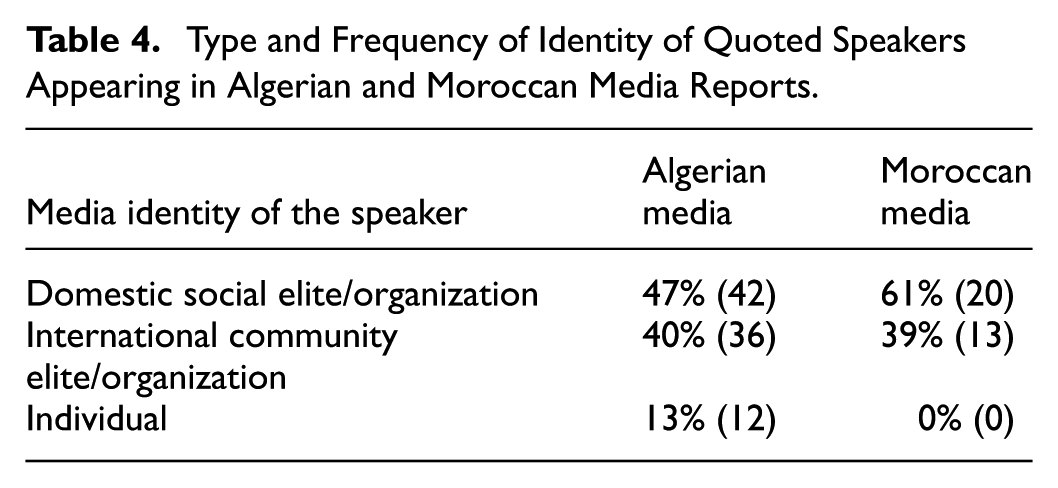
Table 4 shows that the identities of “domestic social elites/organizations” (47% for Algerian media; 61% for Moroccan media) and “international social elites/organizations” (40% for Algerian media; 39% for Moroccan media) were both frequently cited by the media of both countries. The term “domestic social elites/organizations” indicates the social, political and professional authorities within Algeria or Morocco (e.g., “expert of energy,”“foreign minister”), constructing the news value of Eliteness. Simultaneously, as “domestic social elites/organizations” are geographically and culturally close to the domestic audience (e.g., the Algerian news reporting quoted the comments by Algerian Foreign Minister “Ramtane Lamamra”), this identity also established the news value of “Proximity.” Notably, a high percentage of the “domestic social elites/organizations” quoted in the Moroccan media were defined as having both national and international elite identities (41% of the total number of quoted identities), such as “Omar Hilale (Permanent Representative of Morocco to the United Nations),”“Omar Zniber (Permanent Representative of Morocco to Geneva),” and “Mohammed Maelaïnin,” former Moroccan Ambassador to several countries and diplomat.
The term “international social elites/organizations” refers to political leaders and professionals working in foreign or international institutes, which also reflects the news value of Eliteness. Moreover, although these leaders were geographically and culturally distant from domestic audiences (e.g., the French “Conseil Constitutionnel” quoted in Algerian news and “Abdallah Labidi,” a former Tunisian diplomat), they still spoke for the country that the media represented. For instance, in Example 14, the Algerian media quoted the Chilean international analyst “Esteban Silva” to show that Algeria’s decision to sever diplomatic relations has received the support of the international community.
The identity of “ordinary people” only appeared in the Algerian news coverage (see Table 4), which featured ordinary speakers, including the citizen “Feraoun Belhadj” and the teacher “Saoudi Mohamed.” By showcasing the statements, opinions, and emotions of ordinary individuals in society, the Algerian news prominently established the news value of Personalization.
The concordance lines further show that these three types of speakers were all quoted by news reports for degrading the image of the other country and defending their own national position. For instance, in Example 15, the Moroccan media quoted the leader of the Moroccan Progressive and Socialist Party “Mohamed Nabil benabdallah,” who criticized Algeria’s hasty decision to break off diplomatic relations; in this way, Morocco’s innocent position was highlighted. In Example 16, the Algerian media quoted the comment by the ordinary Algerian citizen, indicating that Algeria’s decision to sever diplomatic relations received substantial support from the domestic public. Consequently, these various quotations ultimately constructed the legitimate position of the country that the media represented.
The above analysis demonstrates that the three types of speakers quoted in the news reports reflect the news values of Eliteness, Proximity and Personalization. Scollon (1998) claimed that media filters social viewpoints and control rights of speech in news reporting by selecting and presenting social quotations, which actually convey the media’s position and views. The news quotation analysis revealed that the Algerian media demonstrated the verbal support of domestic and international authorities and domestic ordinary people to justify the national position of Algeria, while Moroccan media only used the quotes of domestic and international authorities as its main support.
(El Moudjahid, 2021-8-27)
(AL Bayene, 2021-8-29)
(El Moudjahid, 2021-8-25)
News Photographs
We examined the visual content and camera techniques of the news photographs and identified the news values constructed by features of these two aspects in saliency. The news values and their frequencies constructed by each media are listed in the bar graph (see Figure 1). The sampled news photographs analyzed in this section are available via the DOI link. 4

News value of news photo constructs and their frequency of occurrence in Algerian and Moroccan media.
Both Algerian and Moroccan media established prominent news values of Eliteness (82% for Algerian media and 81% for Moroccan media) and Aesthetic Appeals (100% for both media). Eliteness was dominantly constructed by portrayal of domestic and international political leaders. For example, The figures (Le Soir d’Algérie, 2021-8-25; 2021-8-26) display the images of Algerian President Abdelmadjid Tebboune and Algerian Foreign Minister Ramtane Lamamra; the figures (Le Jeune Indépendant, 2021-11-28; 2021-11-30) depict the Director of the Centre for Arab Political Studies and Analysis in Geneva Riadh Sidaoui and the former Tunisian diplomat Abdallah Labidi; the figures (Le Matin, 2021-10-6; 2021-11-3) display Ambassador Omar Hilale, the Permanent Representative of Morocco to the UN in New York, and Ambassador Omar Zniber, the Permanent Representative of Morocco in Geneva; the figures (AL Bayene, 2021-10-5; 2021-11-2) show the UN Secretary General Antonio Guterres and Josep Borrell Frontelles, the Spanish politician, EU High Representative for Foreign Affairs, and President of the European Commission. The pictures of domestic political elites showed domestic audiences’ familiar figures and thus also constructed a high frequency of Proximity.
In all the pictures displayed by the two media platforms, various camera techniques were adopted to reinforce the news values constructed by visual content and simultaneously construct the news value of Aesthetic Appeal. For example, a close-up lens was commonly used by both the Algerian and Moroccan media to depict political leaders, which highlights the central position of the figures with a limited visual frame and more clearly demonstrates the condescending expressions/gestures/settings of the political leaders, reinforcing the news value of Eliteness (Bednarek & Caple, 2012a). For example, the figure (Le Soir d’Algérie, 2021-8-25) features the Algerian President Abdelmadjid Tebboune, whose serious expression, official suit, and Algerian national flag as the background are all clearly displayed, highlighting the high national status of the figure depicted. The figure (Le Matin, 2021-10-6) depicts Ambassador Omar Hilale (Permanent Representative of Morocco to the UN in New York); his elegant gesture and countenance while delivering a speech, the microphone and platform in front of him, and a group of national flags of different countries all construct his decisive role in the international community.
The Moroccan media differed from the Algerian media in illustrating a substantial portion of photographs depicting refugees and their appalling living environment in Tindouf camps. Their worn garments, tumbledown houses and tents, and deserted backgrounds all establish the news value of Negativity. In addition, a long-lens technique that compresses as many visual elements as possible into a smaller visual space was used for most of these photographs (Kress & van Leeuwen, 2006). In this way, more negative visual elements were added into the image, the miserable sense was greatly intensified, and the news value of Negativity was reinforced. For example, in the figure (Aujourd’hui le Morac, 2021-10-12), the dirty and barefoot child, his rough toys, the crumbling walls, and the desert as the distant background were all compressed to appear much denser than they actually were, which increases the degree of Negativity delivered by the visual content.
Simultaneously, a few photographs presented by the Moroccan media juxtapose the Algerian national flag and the Moroccan national flag (e.g., the figure published by Le Matin, 2021-08-25), demonstrating the stark contrast of red and green colors and creating a strong visual impact that indicates the status quo of the two countries (Bell, 1991). In this way, the news value of Negativity is reinforced.
Overall, the visual content of the news photographs echoes the keywords used by the two media outlets. The Algerian media focused on demonstrating the Eliteness constructed by the images of domestic and international political elites. Comparatively, the Moroccan media concentrated on not only demonstrating Eliteness constructed in the same way as the Algerian media but also displaying Negativity as established by the miserable lives of refugees in the Tindouf camps. Camera techniques were utilized effectively to show Aesthetic Appeal and, more importantly, reinforce the news values of Eliteness and Negativity established by the visual content.
Discussion
Through a systematic examination of multimodal news discourse resources, this corpus-based news value analysis revealed the similarities and differences in the ways in which the Algerian and Moroccan media justified their nation’s stance on the diplomatic break event. The two media outlets are similar in that they both utilize supportive comments from domestic and international political leaders to support their decisions and actions in the conflict. The main difference is that while the Algerian media focused on defining Morocco as an invader by dredging up Morocco’s disreputable history as an invader, the Moroccan media highlighted the inhumanity of Algeria dominantly by portraying refugees’ miserable lives in the Tindouf camps (in Algeria).
News reporting is influenced by both society and culture, and the news values constructed by media reflect the cognition and values of a society toward news events (van Djik, 2021). Therefore, the results of this news value analysis indicate that the main focuses of Algerian and Moroccan societies regarding their diplomatic conflict event involve criticizing and attacking each other. Uncovering the shortcomings of the opposing party in the conflict was taken as the ground for Algeria/Morocco to demonstrate their nation’s stance as justifiable. Algerian media reporting mirrored the justification of Algerian society to confront Morocco in the conflict because of Morocco’s historically vicious identity as an invader. The Moroccan media reporting reflected the justification that supported the ability of Moroccan society to combat Algeria, that of the inhumanity conducted by Algeria in the Tindouf camps. Previous research has shown that justification is the main point at which a country initiates or intervenes in conflict, and a loss of justification causes adversaries to lose their ground to participate or intervene in conflict (Cox & Sisk, 2017; Nalbandov, 2009). Therefore, it can be inferred that the breakthrough point to end the conflict between the two societies is to overturn the justifications supporting Algeria and Morocco’s decisions and actions to attack each other.
These findings offer concrete pathways or “breakthrough points” for de-escalating the Algeria-Morocco conflict. First, addressing Morocco’s core grievance against Algeria may require tangible improvements in humanitarian conditions within the Tindouf camps, facilitated by international monitoring, targeted humanitarian assistance, and sustained multilateral dialog. Second, Morocco could bolster its image as a peace-oriented nation by actively participating in international peacekeeping operations and engaging more deeply in regional diplomatic efforts. These actions would reduce Algeria’s ability to frame Morocco as a threat based on historical narratives.
The results of this study also reveal that international authorities were frequently adopted as supporters by both the Algerian and Moroccan media, so the transformation of the positions of the foreign countries and international elites in clearing themselves in the Algeria-Morocco conflict will help alleviate and end the tension; this may include these leaders making efforts to mediate the dispute, instead of taking a unilateral position to further aggravate the conflict.
Of course, considerable effort is needed from both Algeria and Morocco and the international community to act upon these breakthrough points. For example, improving the inhumane conditions in Tindouf camps requires the financial support and administrative capacity of Algeria; establishing Morocco’s international peace-promoting image requires the active participation of Morocco.
The findings of the present study should also be understood within the broader geopolitical landscape of the Maghreb, where historical legacies, territorial disputes, and regional rivalries have long shaped the diplomatic trajectories of Algeria and Morocco. As argued byWillis (2014) and Zoubir and Benabdallah-Gambier (2005) the Western Sahara conflict remains a pivotal issue underpinning the antagonism between the two states, fueling persistent tensions and shaping national narratives. The media discourses identified in this study—Algeria’s focus on Morocco’s historical acts of aggression and Morocco’s portrayal of the humanitarian crisis in the Tindouf camps—serve not only to legitimize each country’s political position, but also to reinforce national identity by framing the opposing nation as a hostile “Other.” These discursive strategies align with what Lynch (2013) describes as the “informational battles” of authoritarian and semi-authoritarian regimes in the region, where state-aligned media play a key role in projecting political narratives both domestically and internationally. By foregrounding justifications that are deeply rooted in national memory and humanitarian appeals, both Algeria and Morocco engage in a form of symbolic warfare that perpetuates polarization and impedes conflict resolution. This highlights how media discourse does not merely echo political positions but actively participates in the regional power dynamics and ideological contestations that define North African geopolitics.
Given that the Algeria-Morocco rivalry is embedded in broader regional dynamics, including competition for influence in the Maghreb, the Western Sahara dispute, and shifting alliances with global powers, foreign countries and international elites are expected to express mediatorial comments about the Algeria-Morocco conflict, instead of taking sides based on their own geopolitical and economic interests.
The most significant contribution of this study is that we have revealed the justifications that are mostly utilized by the two countries to attack each other in the conflict and provided a clear and specific breakthrough point for finding conflict solutions. The findings of this study help extract the most critical factors from a variety of complicated factors that uphold the Algeria-Morocco conflict, which has not and could not be reached by all the previous studies focusing on comprehensively analyzing the factors of the Algeria-Morocco conflict (e.g., Ben Hounet, 2021; Lu, 2023). Comparatively, the results of this study are more helpful for finding a way to alleviate and end this tension.
Second, by analyzing the media discourses in the Algerian and Moroccan societies, this study examined the social cognition and values related to the conflict between the two countries. Compared with mainstream research centered on diplomatic and political analyses, this study offers a fuller view of the social factors that drive and uphold the Algerian–Moroccan conflict. In this way, the results of this study are more supported by fuller examinations and thus are more objective.
Third, the corpus-based DNVA approach adopted in this study represents a quantitative analysis method for objectively examining and interpreting conflict. Compared with the conclusions of previous research based on selected viewpoints and interpretations put forward by the previous literature, the methodology used in this study can not only help reduce researchers’ subjective impact but also help them focus on the most significant determinant by extracting the most salient factor from various factors. Therefore, this study provides a new and effective sociological analysis method for scholars who are interested in conflict research.
Finally, the findings of this study offer theoretical implications for media research, particularly in relation to how discourse constructs social realities across different cultural and political contexts. Building on previous scholarship such as Bednarek and Caple’s (2017) work on news values and media linguistics, this study reinforces the idea that media texts are not merely vehicles of information transmission but are central to the construction and negotiation of meaning within society. The results align with and extend the frameworks proposed by previous scholars like Fairclough (1995) and van Dijk (1998), who emphasize the ideological and socio-cognitive dimensions of media discourse. More importantly, the cross-cultural dimension of this analysis enriches ongoing discussions on media globalization and localization (Hallin & Mancini, 2012; Thompson, 1995), by illustrating how national media systems reshape global narratives to align with local epistemologies and construct national identities.
Conclusion
Summary of Findings and Contributions
This corpus-based DNVA revealed the predominant ways in which the Algerian and Moroccan media portrayed the Algeria-Morocco diplomatic break event and justified their nation’s stance in reporting the conflict. Keyword analysis shows that both media justified national positions by discrediting the other side—Algerian media framed Morocco as an invader using historical narratives, while Moroccan media emphasized Algeria’s inhumanity by spotlighting the suffering of refugees in the Tindouf camps. Quotation analysis revealed that Algerian reports featured a broader range of voices, including domestic citizens as well as international and national elites. In contrast, Moroccan media primarily relied on elite sources—both domestic and international—to legitimize its position. Visual content further reinforced these narratives. Algerian media focused on political elites to construct Eliteness, while Moroccan media combined elite imagery with scenes of refugee hardship to evoke Negativity. Together, these linguistic and visual strategies illustrate how each country’s media strategically framed the event to support national perspectives and shape public understanding.
These results reflect the most fundamental justifications that supported the Algerian and Moroccan societies in the long-term Algeria-Morocco conflict and indicate a breakthrough point to alleviate or end the conflict. Such a breakthrough point can guide more targeted and effective strategies to promote reconciliation between Algeria and Morocco. To help ease tensions, this study recommends improving humanitarian conditions in the Tindouf camps and encouraging Morocco to strengthen its peace-oriented international image. In addition, international actors should play a more neutral and mediating role rather than reinforcing one-sided narratives, thereby offering pathways for constructive dialog and conflict resolution.
Compared with previous studies of the Algeria-Morocco conflict, this study developed methods for identifying the most critical factors among the many that have driven and upheld the conflicting actions of Algeria and Morocco. By highlighting a specific breakthrough point, it provides research directions for scholars who are interested in exploring conflict resolution and promoting peace in the Sahara Occidental area. The corpus-based DNVA approach utilized in this study also offers a transferable methodology for analyzing conflicts in other contexts, enabling researchers to uncover the most critical discursive justifications and to identify entry points for effective strategies.
Limitations and Future Directions
Despite these contributions, several limitations should be acknowledged. First, regarding the framework, DNVA has proven effective in uncovering the discursive construction of news values and in revealing the underlying social and cultural rationales of conflict narratives. However, as applied here, the framework focuses primarily on media texts and images, and therefore provides only an indirect account of the broader historical and geopolitical context in which the Algeria-Morocco conflict is embedded. Second, with respect to the methods, the study relies on a corpus of mainstream French-language media; while these outlets are influential, they do not capture the full diversity of voices within Algerian and Moroccan societies, such as regional, minority, or digital media perspectives. In addition, the imbalance in word counts between the two corpora required reliance on percentages, which may obscure finer textual nuances. Third, concerning the findings, the focus on a single diplomatic break event limits the generalizability of results to other conflicts or to different phases of Algeria-Morocco relations. Finally, in terms of interpretation, although systematic procedures were followed, the analysis of both keywords and visual content inevitably involves a degree of researcher judgment; further studies could benefit from triangulating these results with audience reception data, interviews with journalists, or expanded multimodal corpora.
Future research could address these limitations by incorporating additional media types, extending the temporal scope and combining discourse analysis with ethnographic or survey-based approaches to examine audience reception. Comparative studies across other regional conflicts would also allow researchers to test the transferability of the proposed framework and to refine our understanding of how media discourses construct justifications in international disputes.
Supplemental Material
sj-doc-1-sgo-10.1177_21582440251382486 – Supplemental material for How Algerian and Moroccan Media Framed Their Nation’s Stance in Reporting the Algeria-Morocco Diplomatic Break: A Corpus-Based News Values Analysis of Political Narratives
Supplemental material, sj-doc-1-sgo-10.1177_21582440251382486 for How Algerian and Moroccan Media Framed Their Nation’s Stance in Reporting the Algeria-Morocco Diplomatic Break: A Corpus-Based News Values Analysis of Political Narratives by Renping Liu, Jianwei Chen and Cheng Chen in SAGE Open
Supplemental Material
sj-doc-2-sgo-10.1177_21582440251382486 – Supplemental material for How Algerian and Moroccan Media Framed Their Nation’s Stance in Reporting the Algeria-Morocco Diplomatic Break: A Corpus-Based News Values Analysis of Political Narratives
Supplemental material, sj-doc-2-sgo-10.1177_21582440251382486 for How Algerian and Moroccan Media Framed Their Nation’s Stance in Reporting the Algeria-Morocco Diplomatic Break: A Corpus-Based News Values Analysis of Political Narratives by Renping Liu, Jianwei Chen and Cheng Chen in SAGE Open
Footnotes

Ethical Considerations
This article does not contain any studies with human participants performed by any of the authors.
Author Contributions
Renping Liu contributed to Conceptualization, Methodology, Formal analysis and Writing—Original draft preparation. Jianwei Chen contributed to Methodology and Formal analysis. Cheng Chen contributed to Resources, Formal analysis, Software, Writing—Reviewing and editing, Funding acquisition.
Funding
The authors disclosed receipt of the following financial support for the research, authorship, and/or publication of this article: This work was partially supported by the National Science Foundation of China (Grant No. 62272311).
Declaration of Conflicting Interests
The authors declared no potential conflicts of interest with respect to the research, authorship, and/or publication of this article.
Data Availability Statement
The data that support the findings of this study are available from the corresponding author, upon reasonable request.
Supplemental Material
Supplemental material for this article is available online.
Notes
References
Supplementary Material
Please find the following supplemental material available below.
For Open Access articles published under a Creative Commons License, all supplemental material carries the same license as the article it is associated with.
For non-Open Access articles published, all supplemental material carries a non-exclusive license, and permission requests for re-use of supplemental material or any part of supplemental material shall be sent directly to the copyright owner as specified in the copyright notice associated with the article.
