



Abstract
This study tests the Reinforcing Spirals Model (RSM) using a Swedish three-wave panel study (N = 1,376) during the COVID-19 pandemic. It contributes to the literature by studying whether ideological news use affects citizens’ perceptions about how Sweden managed the pandemic. The results exhibit how perceptions are dependent on ideological predisposition, which is mediated by news use, and how right-wing ideology initiates a reinforcing spiral between selective news use and perceptions. Ideological as well as news use asymmetries are displayed here: Alternative news reinforces negative perceptions, whereas traditional news has no effect. The findings are discussed in light of the RSM.
The Reinforcing Spirals Model (RSM) has become an important model for studying dynamics and mechanisms behind the relationship between (selective) news use and effects associated with political and societal perceptions (Dahlgren et al., 2019; Ohme, 2021; Schumann et al., 2021; Slater, 2015). The RSM proposes that attitudes and beliefs are maintained and reinforced through consistent news use (Slater, 2007; Slater, 2015), and it has been indicated that the vast increase of news media outlets make news users more selective and inclined to use sources and information that confirm their attitudes and beliefs (Prior, 2007; Stroud, 2017). This should, according to the RSM, be especially true in times of threat and uncertainty, such as during an election campaign or a societal crisis where salience of rivaling ideologies is triggered. When uncertain situations occur, citizens engage in selective exposure to strengthen their attitudes and opinions about political issues (Slater, 2015) while avoiding other realities (Bennett & Iyengar, 2008; Stroud, 2010, 2017). This process could potentially initiate a spiral beyond maintaining attitudes and beliefs. Instead, people reinforce their attitudes and beliefs until they feel that they have reached a satisfactory equilibrium where threats are diminished (Slater, 2015). Studies investigating ideological media use notes that use of belief-congruent outlets can strengthen one’s own perceptions about political issues (Levendusky, 2013) and could by extension contribute to a widening gap of ideological or societal perceptions between citizens (Stroud, 2010).
A gap in the RSM research is that few studies have examined the implications of the model during crises where societal strain and uncertainty become present as a crisis unfolds. The assumptions of the RSM build on such situations as societal strain and uncertainty over a longer period of time (Slater, 2007, 2015); it is therefore, imperative to examine the model during such circumstances, which this study sets out to do. It tests the RSM by focusing on ideological predispositions and societal perceptions, studying the dynamic relationships over time between news use and people’s perceptions about how Sweden managed during the COVID-19 pandemic. To understand whether perceptions about the pandemic influence people to engage in a reinforcing process is in line with the assumption of the RSM. This article also adds to the literature by extending previous work on the RSM and the role of news use in the development and reinforcement of societal perceptions during societal strain.
Recent findings indicate that reinforcing processes are ideologically asymmetric (Hmielowski et al., 2020). Using liberal and conservative media sources and ideologically polarized issues, Hmielowski et al. (2020) find symmetric effects of partisan media on political beliefs for both ideological groups; however, their study reveals asymmetries with more and stronger relationships between conservative beliefs and conservative media use. This study take these findings into account by examining left–right ideological (a-)symmetries in both people’s news use and their perceptions of how Sweden managed during the pandemic.
Internationally, the Swedish strategy to combat COVID-19 diverged from the strategy of most other countries. Sweden did not enforce face masks, nor were massive lockdowns implemented (Johansson & Vigsø, 2021; Johansson, Sohlberg, et al., 2021). In the early stages, all political parties and the media rallied around the strategy (Johansson, Hopmann, & Shehata, 2021). However, as the number of deceased grew, a loud debate was initiated in both the national and international media, in which politicians, academics, physicians, and journalists disagreed on how Sweden was managing the pandemic (see Savage, 2020; Wolodarski, 2020). The uniqueness of the Swedish case produces a well-fitting context where the assumptions of the RSM are highly relevant to test. In doing this, the study relies on a three-wave panel survey (N = 1,379) conducted during a timeframe capturing a rally “round the flag” period and a movement toward a more polarizing period (Johansson, Hopmann, & Shehata, 2021; Johansson, Sohlberg, et al., 2021).
Reinforcing Spirals Model, Ideology, and News Media
Reinforcing Spirals
The RSM has become a prominent framework to explain the role of ideology and selective news use in the development, maintenance, and reinforcement of attitudes and values (see Dahlgren et al., 2019; Hmielowski et al., 2020; Ohme, 2021; Schumann et al., 2021). The RSM focuses on understanding these mutually reinforcing effects over time by arguing that social identity explains the use and effect of media, which strengthens one’s beliefs in a reciprocal and dynamic way over time (Slater, 2007, 2015; Slater et al., 2020). Thus, perceptions and ideological leaning are likely to influence subsequent news selection, resulting in selective exposure, which affects people’s perceptions. In turn, these perceptions influence future news consumption toward news use associated with ideology and societal perceptions in a reinforcing process over time (Slater, 2007).
In this study, societal perception is conceptualized as people’s perceptions of how Sweden managed during the COVID-19 pandemic. Following the RSM, the development of these perceptions should be dependent on prior ideological preferences and news use (Druckman & McGrath, 2019; Slater, 2015; Stroud, 2010). It is also argued that exogenous variables, such as social change, conflict, or social strain, play an important role in the reinforcing process by triggering rival ideologies to become salient, which influences a sense of threat that can strengthen collective beliefs or perceptions. One way for people to do this is by turning to belief- or perception-consistent selective media use, which should increase until a homeostasis or satisfactory equilibrium is reached. According to the RSM when an equilibrium is reached and the sense of threat is diminished, selective exposure and reinforcing processes may then be reduced (Slater, 2015). An equilibrium or homeostasis in this context means a balance when ideology-relevant COVID-19 perceptions are sufficiently maintained, when coming across rivaling ideologies or COVID-19 perceptions.
Ideology
Regarding ideological preferences, left–right ideology is a foundational dimension within political and societal contexts. Ideology helps citizens to navigate both societal events (Jost et al., 2008, 2009) and the media environment (Stroud, 2017). As political issues become salient and subject to dispute among political and elite actors, it stimulates ideological cleavages that energize opposing perceptions about issues among citizens (Slater, 2015). Ideology then affects which news citizens are inclined to consume (Stroud, 2010, 2017), which in turn shapes their perceptions (Slater, 2015). Although some scholars have argued that uncertain circumstances sometimes promote consideration of opposing viewpoints rather than defending your own (MacKuen et al., 2010), there are examples focusing on identity threat. For instance, Ohme (2021) suggests that during the influx of refugees to Europe in 2015, congruent news consumption through algorithmic filtering in social media initiated a spiral that reinforced negative and positive attitudes toward immigration over time. However, the focus in the study is not on ideological news exposure but rather on algorithmic media choice, which lacks the direct component of people’s news choice. Long et al. (2019) investigates partisan media selectivity and ideological belief, operationalizing threat within a geographic context where democrats are outnumbered by republicans, demonstrating that democrats feel more threatened, which in turn makes their ideology more salient and provides support for the connection to partisan media selectivity, especially for strong partisans (Long et al., 2019).
In line with the RSM, citizens’ selective use of ideology-consistent content should increase and reinforce their positive or negative perceptions about how Sweden managed during the pandemic until a satisfactory equilibrium is reached (Slater, 2015). For example, Dahlgren et al. (2019) examine how ideological selective exposure influences political attitudes. Although ideological selective exposure may be generally low in their case, people with an ideological belief seek out consistent news (Dahlgren et al., 2019). Studies examining the theoretical and empirical implications of the RSM, specifically concerning the mutual influence of ideology and news use on people’s reinforcement (e.g., Dahlgren et al., 2019; Long et al., 2019; Ohme, 2021; Schumann et al., 2021; Stroud, 2010), suggest that these reinforcing effects of selective news use are symmetric across the ideological scale. However, Hmielowski et al. (2020) have found an asymmetry within a politically polarized context when it comes to ideology predicting news use. Their findings indicate that ideology is symmetric in predicting political beliefs when effects of partisan news use are present both for liberal and for conservative people. Nevertheless, conservative ideology seems to a greater extent lead to reinforced right-wing news use, compared with liberal ideology predicting left-wing media use (Hmielowski et al., 2020). It is still unclear whether such dynamics are implied by the RSM, and these results may emerge in a context going from politically nonpolarized to polarized, making the COVID-19 pandemic in Sweden a relevant case. Building on Hmielowski et al.’s (2020) findings, there should be similar asymmetric processes within the RSM framework in this study, not only regarding ideological differences but also concerning selective news consumption.
Traditional and Alternative News Media
The current high-choice media environment provides extensive opportunities for citizens to select from a variety of media sources to meet their demand for news and commentary (Bennett & Iyengar, 2008; Prior, 2007), making selective exposure to ideological-congruent content easier (Iyengar & Hahn, 2009; Stroud, 2017). As a consequence, citizen’s media preferences are increasingly important for media consumption (Stroud, 2017), thus making news use more individualized and fragmented (Valkenburg & Oliver, 2019; Van Aelst et al., 2017). The emergence of alternative news has significantly amplified the prospect for citizens to engage in ideological selective exposure (Holt et al., 2019). To examine the opportunity structures for ideological news exposure, this study separates between traditional and alternative news.
Traditional news is specified as traditional press with ideological affiliations, but with publishing routines and organized structures, which enables public discussion by reporting on topics of general interest and separates political views from news reporting to fulfill its societal obligation of informing the citizenry (Holt et al., 2019; Steindl et al., 2017). In their study, Iyengar and Hahn (2009) find that people tend to prefer news from outlets in line with their ideological views and avoid opposing outlets. Even if ideological content is scarce in traditional papers, and the news section is professionalized, people do, to some extent, prefer media sources affiliated with a congruent ideological leaning.
Apart from the traditional press, various ideologically alternative media provide distinct political perspectives on the news of the day online (Holt, 2018). Alternative news, sometimes called hyperpartisan media, is situated on both the ideologically left side, characterized by a radical leftist political agenda closely tied to social justice movements (Holt et al., 2019), and on the right side, characterized by a reactionary far-right political agenda focusing on political ideas seen as “unacceptable” in a mainstream setting, such as white nationalism and social conservatism (Holt, 2018). What distinguishes alternative news from traditional news is that “alternative news media position themselves as correctives of the traditional news media, (. . .) and/or are perceived as such by their audiences or third-parties” (Holt et al., 2019, p. 860). These left-wing and right-wing alternative outlets serve as extreme opposites to each other, with strong ideological profiles, and anti-system and anti-elite attitudes (Holt, 2018). They represent strong ideological news media choices for citizens outside the realm of public broadcast and traditional news.
In times of crisis and societal uncertainty, citizens generally exhibit higher levels of news consumption (Westlund & Ghersetti, 2015), a pattern also observed during the stages of the COVID-19 pandemic (Van Aelst et al., 2021). This study tests whether using different types of news use in exposure to political or societal information has different effects on the development of COVID-19 perceptions over time. In this context, and against the background of the RSM, the study argues that as the prolonged crisis continuously unfolded, the context changed, and political differences emerged about how Sweden was managing the pandemic. This should also bring with it a change in demand for news sources, whereby citizens who see themselves as ideologically left and right should be more inclined to consume news media in line with their leanings (see Long et al., 2019). The consumption of ideological alternative media should relate to a higher degree of reinforcement of prior COVID-19 perceptions compared with the consumption of traditional news (Dahlgren et al., 2019; Slater, 2015).
The Swedish Case
Sweden’s strategy to combat the COVID-19 pandemic differed from other countries relying on advice and recommendations from the Public Health Agency of Sweden (PHAS). Individuals were advised to practice frequent handwashing and to minimize social interactions, particularly in indoor settings to mitigate spreading of the virus. However, there were no massive lockdowns enforced; citizens were instead encouraged to work from home, not to stop the virus but to contain the spread to keep the numbers of hospitalized patients down (Johansson & Vigsø, 2021; Johansson, Sohlberg, et al., 2021). However, at an early stage, political parties both opposing and supporting the government, as well as the media, rallied around the government’s pandemic strategy. As the number of deceased increased, the public debate changed toward a struggle between elite actors, arguing that Sweden should be perceived as managing the situation in either a successful or an unsuccessful way (e.g., Johansson & Vigsø, 2021; Johansson, Hopmann, & Shehata, 2021; Johansson, Sohlberg, et al., 2021). For example, the center-left government and PHAS implemented bans on concerts, public meetings, and sport events, whereas restaurants, supermarkets, and shopping malls were allowed to stay open. This initiated a loud debate both in national and in international media in which politicians, academics, physicians, and journalists disagreed on how Sweden was managing the pandemic (see Savage, 2020; Wolodarski, 2020).
In other countries such as Germany, the United Kingdom, and the United States, a more lenient strategy combating COVID-19 was supported by the political right. However, in Sweden this was advocated by the left, in line with the center-left government’s stance. The political right opposed the strategy and called for stricter rules (Andersson & Aylott, 2020). Moreover, it was found that there was an ideological difference between left- and right-wing people regarding the wearing of face masks. The PHAS did not recommend the wearing of face masks, arguing that masks did not protect you from being infected and that if handled in an incorrect way mask wearing could lead to increased spreading of the diseases. Right-wing ideology and low trust in the center-left government increased the likelihood of wearing face masks. At the same time, left-wing ideology and higher trust in the government reduced the likelihood of wearing a mask (Johansson, Sohlberg, et al., 2021). Perceptions differed between people, and an ideological difference emerged between left-wing people, trusting the government and the PHAS strategy, and right-wing people putting less trust in the center-left government and advocating stricter rules.
The restrictions implemented to reduce the spread of the virus, however lenient in comparison with other countries they may have seemed, put considerable social strain on people’s everyday lives, leaving citizens uncertain about the consequences of the crisis on society and themselves. As the pandemic developed, the rally ‘round the flag effect diminished and an ideological polarization emerged. People to the right criticized the center-left government’s lenient strategy in handling the pandemic and left-wing people stayed loyal and defended the government’s strategy (Andersson & Aylott, 2020; Johansson, Hopmann, & Shehata, 2021).
The COVID-19 pandemic was an extraordinary event that dominated the media agendum internationally (Jeong et al., 2023), and in Sweden the news media played a crucial role when citizens tried to make sense of the crisis (Andersson, 2020). The Swedish media system is characterized as a typical democratic-corporatist system, dominated by a strong mass press, journalistic professionalism—and politically nonpartisan public broadcasting institutions (Hallin & Mancini, 2004; Nord & Grusell, 2021). Through both radio and television, the Swedish public broadcasters, flanked by the commercial broadcaster TV4, have a catch-all profile cutting through ideological and social divisions, even reaching large shares of audiences unconcerned with news (Aalberg & Curran, 2012; Shehata et al., 2015). These broadcasters are required to be impartial and fair on political and societal matters (Soroka et al., 2013) and played an important part in relaying information during the pandemic (Andersson, 2019, 2020). Although the focus of this article is ideological opportunity structures, the Swedish media system is strongly dominated by politically neutral Public Broadcasting (PBS), and therefore this article also controls for the usage of PBS in studying left–right media choices.
The three leading newspapers identify themselves ideologically but are today dominated by journalistic professionalism aimed at impartial reporting of the news (Nord & Grusell, 2021). Nevertheless, ideological content aimed at opinion building does still exist on the editorial pages (Weibull, 2013), allowing ideological opportunity structures for people to expose themselves to outlets with anticipated ideological agreement (Skovsgaard et al., 2016). Aftonbladet is a tabloid newspaper identifying as independent social democratic, whereas Expressen is a tabloid and Dagens Nyheter is a broadsheet newspaper, both identifying as independent liberal. These three traditional newspapers are the second most used news sources after the broadcast news (Andersson, 2019, 2020). The newspapers are important to this study as they reach such a large portion of the Swedish news users, conveying news and ideologically founded opinions on their editorial pages about COVID-19 (Andersson, 2019, 2020; Weibull, 2013).
Alternative news outlets are mostly found online, publishing ideological content both on the editorial pages and in news articles. Two well-known examples of alternative news outlets are Dagens ETC (left wing) and Fria Tider (right wing) (all outlets are found under Measures). Alternative news outlets try to influence public opinion on political issues by publishing more ideological content, sometimes linked to specific political parties’ agendas (Dahlgren et al., 2019; Weibull et al., 2018). Alternative outlets are important in this study as they represent the clearest opportunity for ideological news consumption within the Swedish media system.
Research Questions and Hypotheses
Based on the previous research outlined above, the assumptions of the RSM framework in times of uncertainty and social strain, ideology should play a key role by influencing people’s perceptions. Accordingly, the occurrence of ideology-consistent selective exposure should relate to ideology-consistent COVID-19 perception spirals that are maintained and reinforced over time (Slater, 2015). However, knowing little about this influence in the case of COVID-19, a number of hypotheses and research questions are posed to test the relation.
As mentioned above, there has been a process during the pandemic moving from a “rally ‘round the flag”-period to a polarizing period where left-wing people seem to support the government’s strategy and right-wing people are more critical. Therefore, it can be assumed that right-wing people are more likely to have negative perceptions about how Sweden managed during the pandemic, whereas left-wing people presumably would have positive perceptions:
Ideological leaning should influence news use, which in turn should affect people’s perceptions about how Sweden managed during the COVID-19 pandemic. Therefore, media news use should, according to the RSM (Slater, 2007, 2015), explain the process through which ideology and COVID-19 perceptions are related, that is, the relation mediated through their news consumption:
If perceptions are mediated through news use, during uncertain societal conditions, a reciprocal relationship between news consumption and COVID-19 perceptions should occur (Slater, 2007, 2015). Not only should perceptions be affected by selective media exposure but should also exert an influence on subsequent news selection through a spiraling process. Therefore, the last hypothesis reads,
Focusing on reinforcing processes, drawing on the findings of Hmielowski et al. (2020), indicating an asymmetry of ideological reinforcement of news exposure, the following research question is posed:
A similar reinforcing asymmetry should be possible, in regard to what type of news people consume, as the differences in ideological opportunity structures (Skovsgaard et al., 2016) vary between traditional (Weibull, 2013) and alternative news (Holt et al., 2019). Therefore, a second research question is posed:
Method
To examine the expectations outlined above, the study relies on a three-wave panel survey from Sweden, collected during the outbreak and development of the COVID-19 pandemic. The period covers a rally “round the flag”-period and a polarization period. By using three waves, it is possible to conduct a test of the full reinforcing process measuring reciprocity between news use and perceptions (Slater, 2007, 2015).
Data
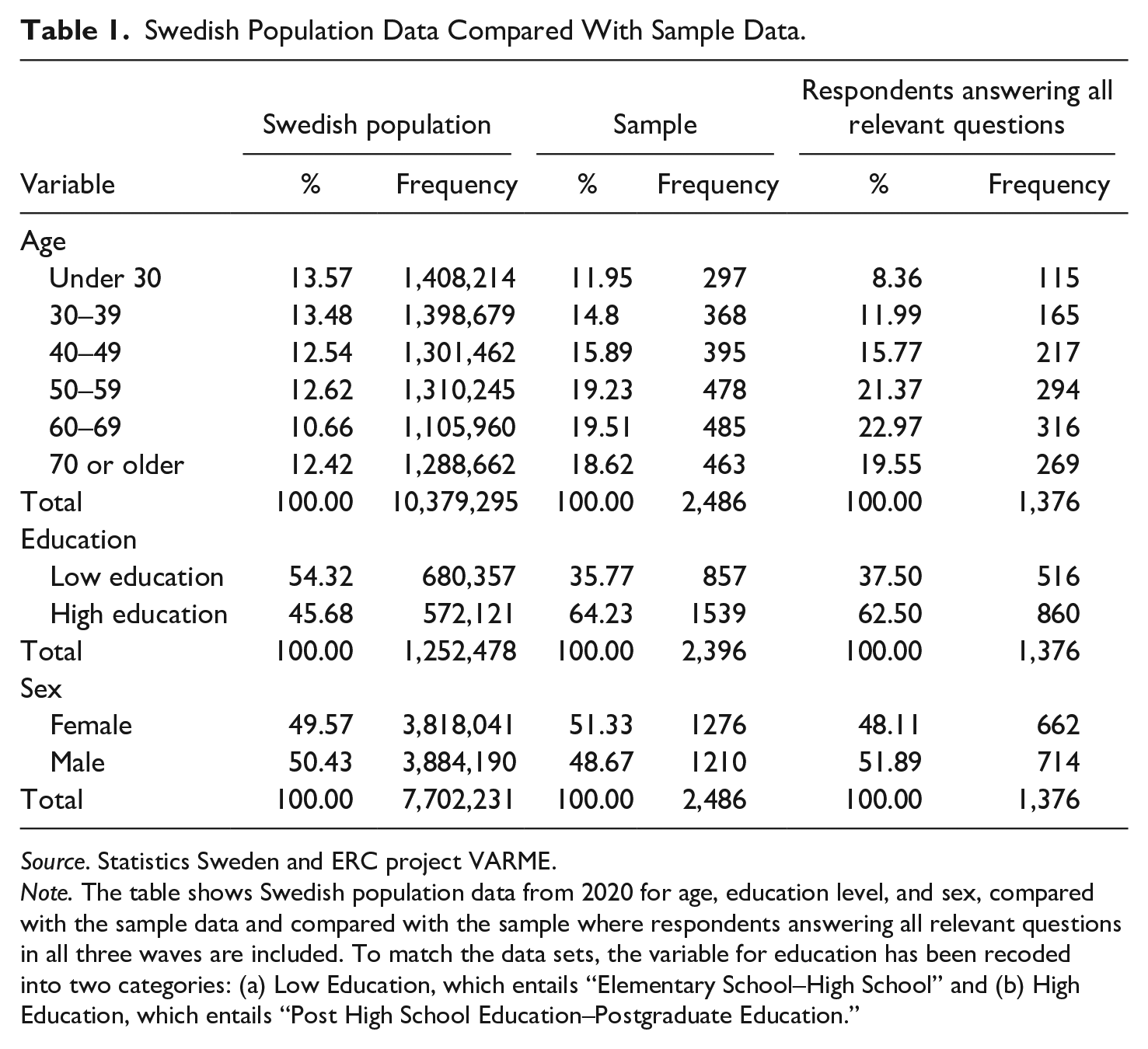
The three-wave panel survey was collected between April and September 2020. Wave 1 was collected between April 1 and May 8, Wave 2 between June 9 and July 1, and Wave 3 between August 17 and September 9. The data collection was conducted by LORE 1 using a probability sample of 4,000 individuals. In a panel like this, the respondents tend to be older, have a higher education, and be more interested in politics and news than your average Swede; however, the sample was stratified on gender, age, and education to ensure as small deviance as possible from a representative sample of the Swedish population. Table 1 presents a comparison between the study sample collected and the Swedish population.
Swedish Population Data Compared With Sample Data.
Source. Statistics Sweden and ERC project VARME.
Note. The table shows Swedish population data from 2020 for age, education level, and sex, compared with the sample data and compared with the sample where respondents answering all relevant questions in all three waves are included. To match the data sets, the variable for education has been recoded into two categories: (a) Low Education, which entails “Elementary School–High School” and (b) High Education, which entails “Post High School Education–Postgraduate Education.”
The data collection was conducted online, The response rate is calculated in line with American Association for Public Opinion Research (AAPOR) Standard Definitions 2011, specifically Response Rate 5 (those who answered more than 80% of the questions are viewed as complete responses): W1: 2,376 (59%), W2: 2,107 (54%), and W3: 2,029 (53%). In this study, only respondents who have answered all relevant items are considered giving a total of 1,379 respondents in each wave. In Table 2, a descriptive summary is found, describing all variables utilized in this study.
Summarizing Statistics.
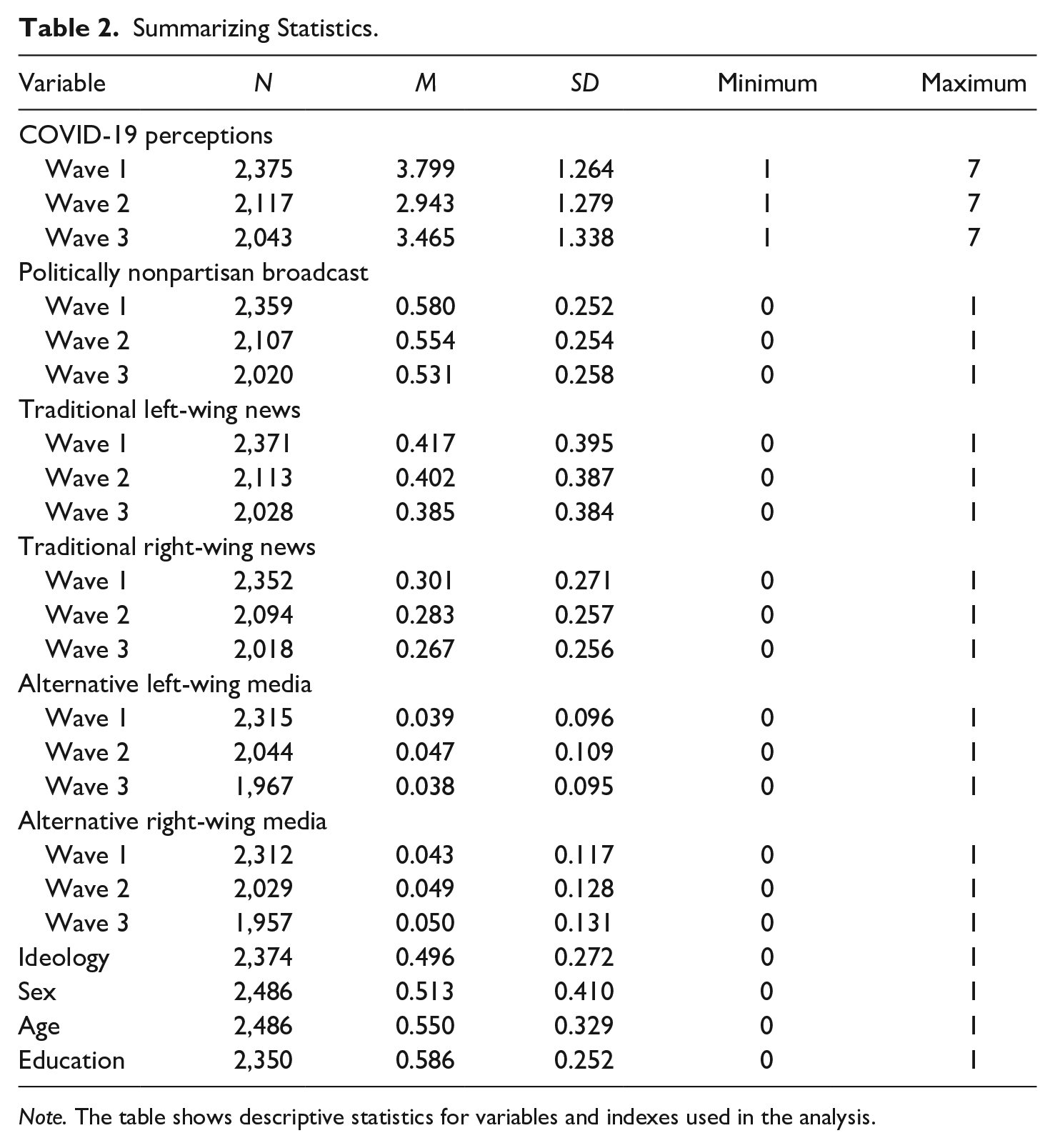
Note. The table shows descriptive statistics for variables and indexes used in the analysis.
Measures
News Media Use
Before explaining the exposure measure, it is worth mentioning that media coverage during the pandemic, regardless of ideological leaning, was predominantly negative and neutral across the mentioned outlets (see Figure A2, Online Supplement Materials). In addition, alternative news platforms have been more critical, less praising, and more alarmist in their coverage of the COVID-19 pandemic compared with traditional news sources (Golinski, 2022). Turning to the measures: exposure to a range of the relevant news outlets is measured by asking the respondents how often they have used different outlets in the past month, with response scales including 1 (daily), 2 (5–6 days per week), 3 (3–4 days per week), 4 (1–2 days per week), 5 (more seldom), and 6 (never). Included outlets covering traditional and alternative news are presented in Table 3, where both the political leaning and the format of the outlet are accounted for. Traditional left–right political leaning among the outlets has been classified based on previous research (Shehata et al., 2024; Tsfati et al., 2023).
Political Leaning and Format of Outlets.
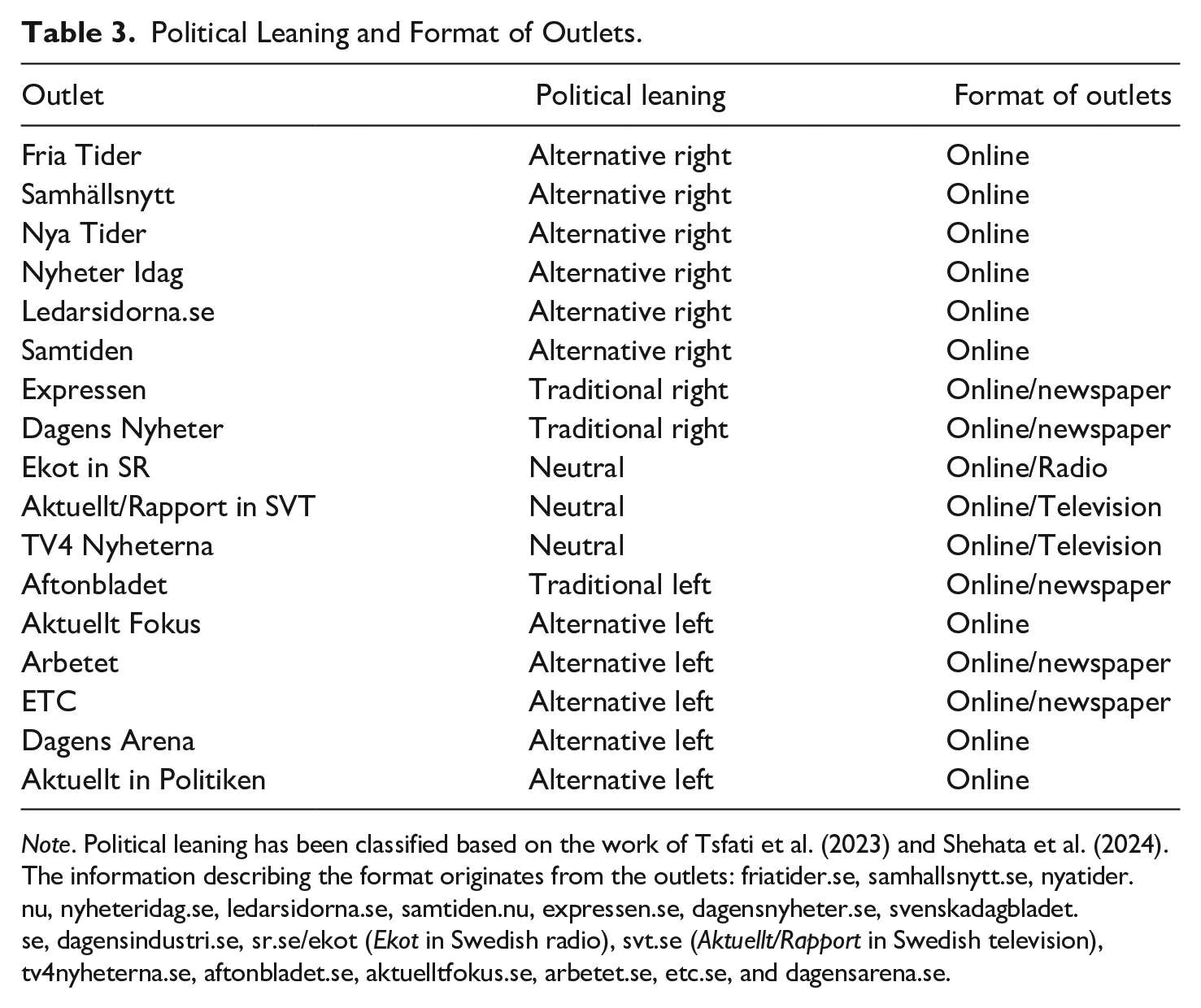
Note. Political leaning has been classified based on the work of Tsfati et al. (2023) and Shehata et al. (2024). The information describing the format originates from the outlets: friatider.se, samhallsnytt.se, nyatider.nu, nyheteridag.se, ledarsidorna.se, samtiden.nu, expressen.se, dagensnyheter.se, svenskadagbladet.se, dagensindustri.se, sr.se/ekot (Ekot in Swedish radio), svt.se (Aktuellt/Rapport in Swedish television), tv4nyheterna.se, aftonbladet.se, aktuelltfokus.se, arbetet.se, etc.se, and dagensarena.se.
To measure ideological bias in people’s media diet, left-wing and right-wing indexes are constructed for traditional and alternative news use, reaching between 0 (low consumption) and 1 (high consumption). Aftonbladet is the only left-leaning traditional national newspaper, so the variable is recoded to match the other indexes (0–1). In total, there are four news use variables: traditional left-wing news, traditional right-wing news, alternative left-wing news, and alternative right-wing news (Table 2).
Ideology
To measure people’s political ideology, the study uses the classic scale of self-placement, ranging from 0 (“far to the left”), 5 (“neither to the left nor to the right”), and 10 (“far to the right”), posing the question: “It is sometimes said that political opinions can be placed on a left–right scale. Where would you place yourself on the political left–right scale?” (see Table 2).
COVID-19 Perceptions
In constructing the index for perceptions of how Sweden managed during the COVID-19 pandemic, a battery of seven items is used: “To what extent do you agree with the following statements?” followed by seven statements about the COVID-19 pandemic. The answers are given on a 7-point scale ranging from 1 (not true at all) to 7 (completely true). The statements are presented in Table 4.
Statements About COVID-19 in the Public Debate.
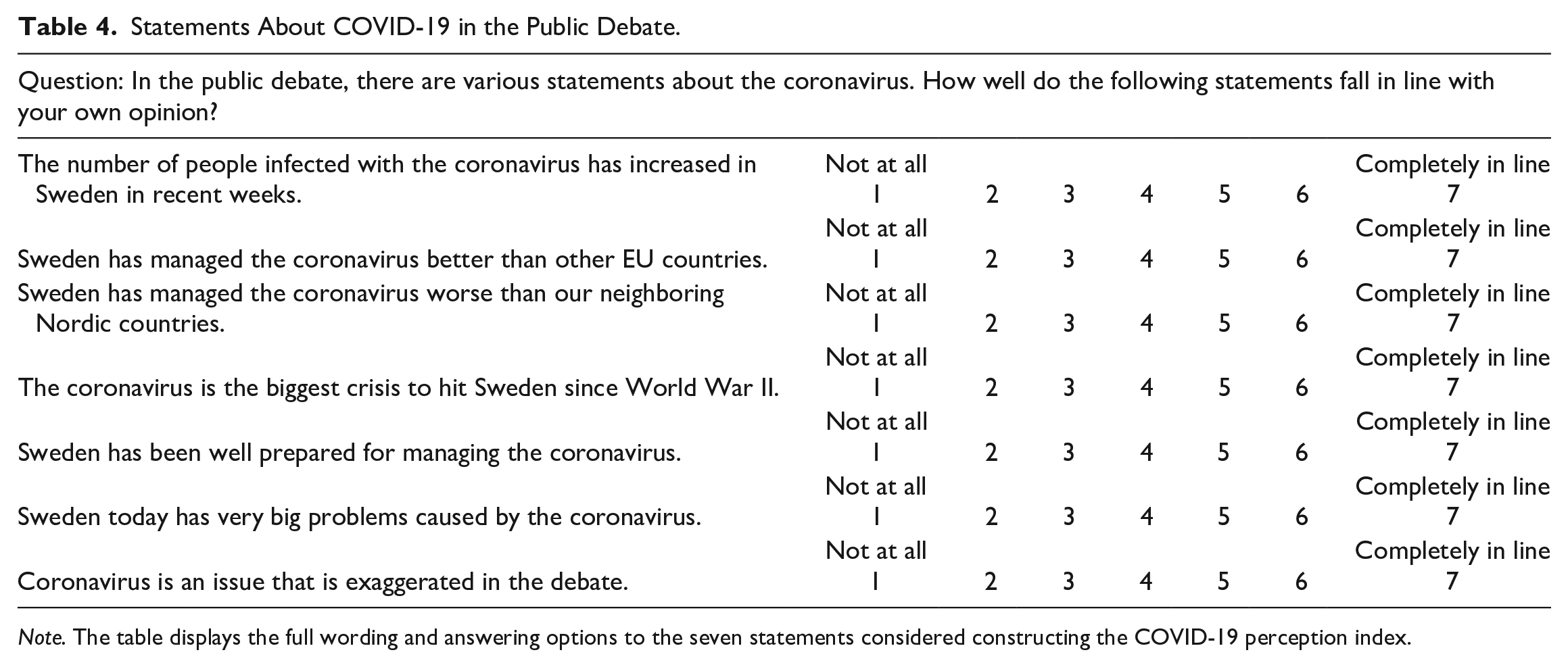
Note. The table displays the full wording and answering options to the seven statements considered constructing the COVID-19 perception index.
The literature advocates conducting a Kaiser–Meyer–Olkin (KMO) test to determine the appropriateness of a factor analysis (results found in Table A1.2, Online Supplement Materials), which in this case displayed a result of .663. An average result, however, according to the literature a factor analysis is appropriate in this case (Atan & Kasmin, 2018; Dziuban & Shirkey, 1974). Two dimensions were identified after conducting a factor analysis and the rotated factor loadings are presented in Table 5 (initial values found in Table A1.1, Online Supplement Materials).
Rotated Factor Loadings Using Principal Component Factors.
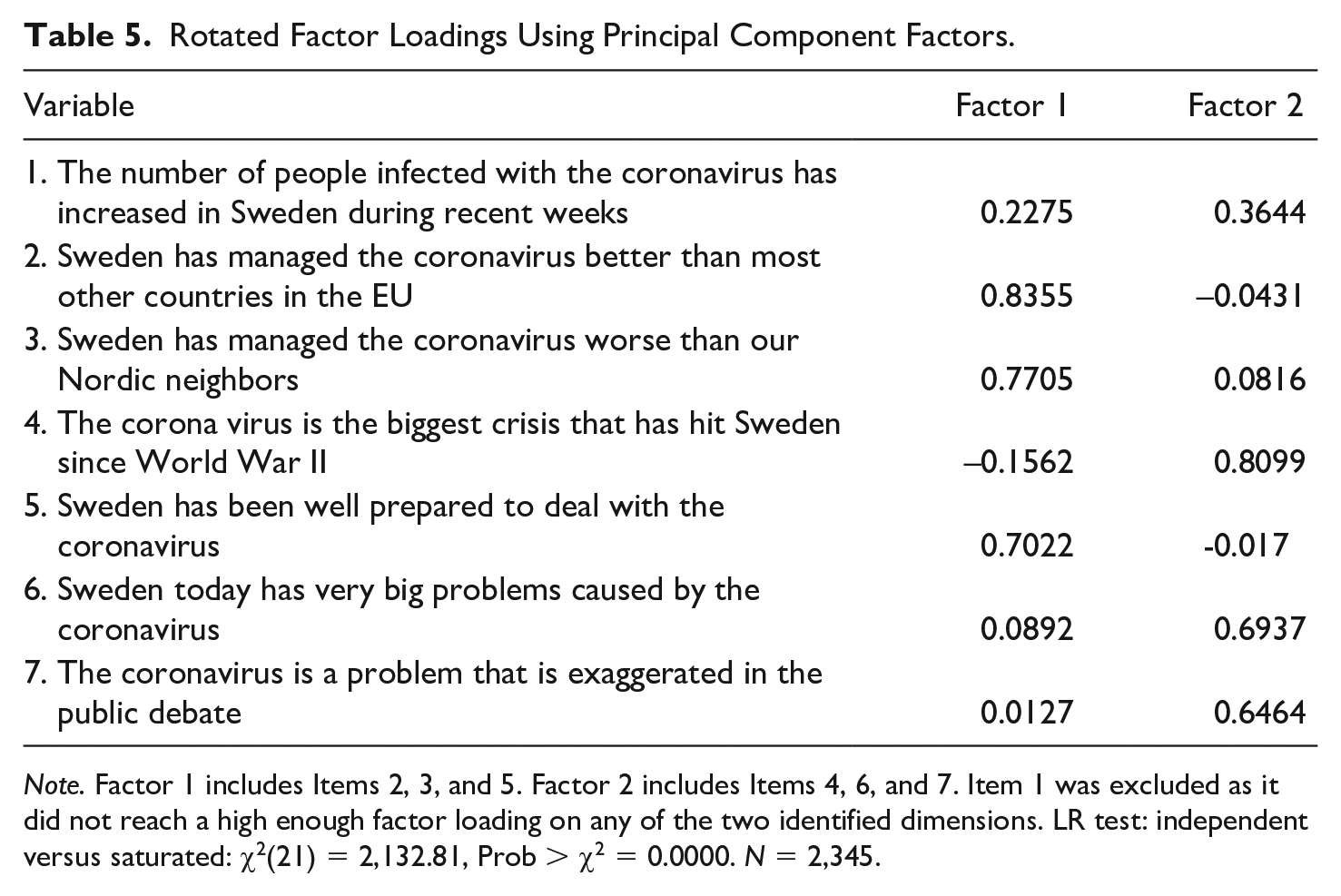
Note. Factor 1 includes Items 2, 3, and 5. Factor 2 includes Items 4, 6, and 7. Item 1 was excluded as it did not reach a high enough factor loading on any of the two identified dimensions. LR test: independent versus saturated: χ2(21) = 2,132.81, Prob > χ2 = 0.0000. N = 2,345.
Factor 1 identified how Sweden managed during the pandemic and Factor 2 identified the magnitude of Covid as a societal problem. Factor 1 demonstrated a better fit to address the aims of this study, leaving Factor 2 out of the analysis. Three survey items loaded on the first Factor 2, 3, and 5. Item 3 was reversed to match the direction of Items 2 and 5. Cronbach’s alpha was conducted for each wave to examine the reliability coefficient (W1 = .67; W2 = .71; W3 = .71), before constructing the index. The constructed index ranges from 1, indicating a negative perception of how Sweden managed during the COVID-19 pandemic, to 7, indicating a positive perception (see Table 2).
Control Variables
This study controls for the consumption of PBS news bulletins, Aktuellt, Rapport, Ekot, and TV4 Nyheterna. As mentioned, these are central news sources for the Swedish population. The index for broadcasting builds on the same type of question as the other news use measures, reaching from 0 (low consumption) to 1 (high consumption). Regarding political issues and attitudes in Sweden, there is a gap between men and women, whereby women are more likely to support left-wing parties, while men are more prone to right-wing parties (Oskarson & Wängnerud, 2013). In turn, the ideological differences between men and women will most probably influence the respondents’ news use and perceptions. The variable for sex is coded 0 (“male”) and 1 (“female”). As there have been more restrictions for senior citizens during the pandemic, age may have an impact on perceptions. Age is known to be important both for ideology (Oscarsson & Holmberg, 2016) and for news use (Holt et al., 2013). Education is known for influencing both political behavior (Persson, 2015) and news use (Kwak, 1999). The variables for age and education are rescaled to range between 0 and 1. Age ranges in six steps from 0 (below 30) to 1 (above 70) and education ranges in nine steps from 0 (“no education”) to 1 (“degree from postgraduate education”) (Table 2).
Analytic Approach
To test the RSM framework over time, a modified cross-lagged panel model is estimated using structural equation modeling (SEM). Figure 1 depicts the theoretical model.
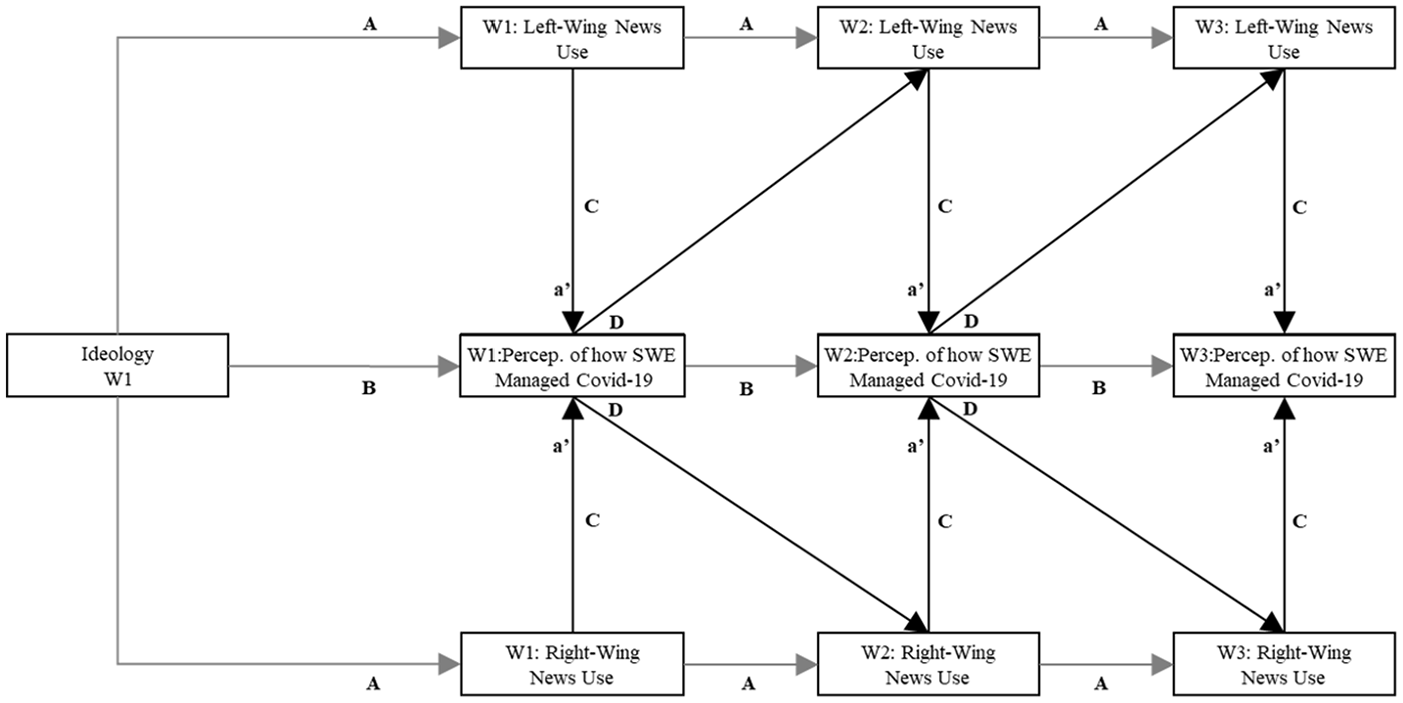
Theoretical Model.
The SEM approach will make it possible to observe the results of both ideology on news use and ideology on COVID-19 perceptions as well as on how news use affects COVID-19 perceptions and any prescribed reciprocal effect of perceptions on news use over the three waves (Acock, 2013). In Path A, ideological selective exposure is investigated, and in Path B direct ideological effects on COVID-19 perceptions are assessed. Path C measures the direct effect of news use on perceptions, and Path D measures previous COVID-19 perceptions on news use. Path a’ represents the mediated effect of ideology through news use on COVID-19 perceptions. In a conventional cross-lagged model, the mediation would start at Path A, going from ideology to news use in Wave 1, and Path a’ would go from news use to COVID-19 perceptions in Wave 2. However, in this model, the mediation effect is done within waves, as depicted in Figure 1. This is because the news use variable examines how often the respondent has used the respective outlet during the past month. Following the implications of the RSM, that earlier news use affects future perceptions; the mediation needs to be measured within waves to capture previous news use. Furthermore, the mediation explaining people’s perception of COVID-19 are then, through path D, influencing news use in the next wave (Slater, 2015). Nevertheless, news use in earlier waves is controlled for throughout the model.
In this study, an adjusted version of the Baron and Kenny approach is used to fit a structural equation setting (for a more detailed overview see Mehmetoglu, 2018). There are three possible outcomes of the mediation test: (a) no mediation, (b) partial mediation, and (c) full mediation. (a) There is no mediating effect of news use if both mediation chains are not statistically significant (X → M and M → Y). Thus, for a mediation effect to be present, both of the path coefficients of ideology to news use and news use to COVID-19 perceptions must be significant. (b) The model can achieve partial mediation either when both the Sobel’s z-test and the path from ideology to perceptions are statistically significant, or if only the path between ideology and perceptions is significant. If neither are significant, there is still a partial mediation. (c) For the model to achieve complete mediation, the Sobel’s z-test needs to be significant, and the path ideology to COVID-19 perceptions should not be significant, thus producing a complete mediation (Mehmetoglu, 2018).
Results
Formally testing
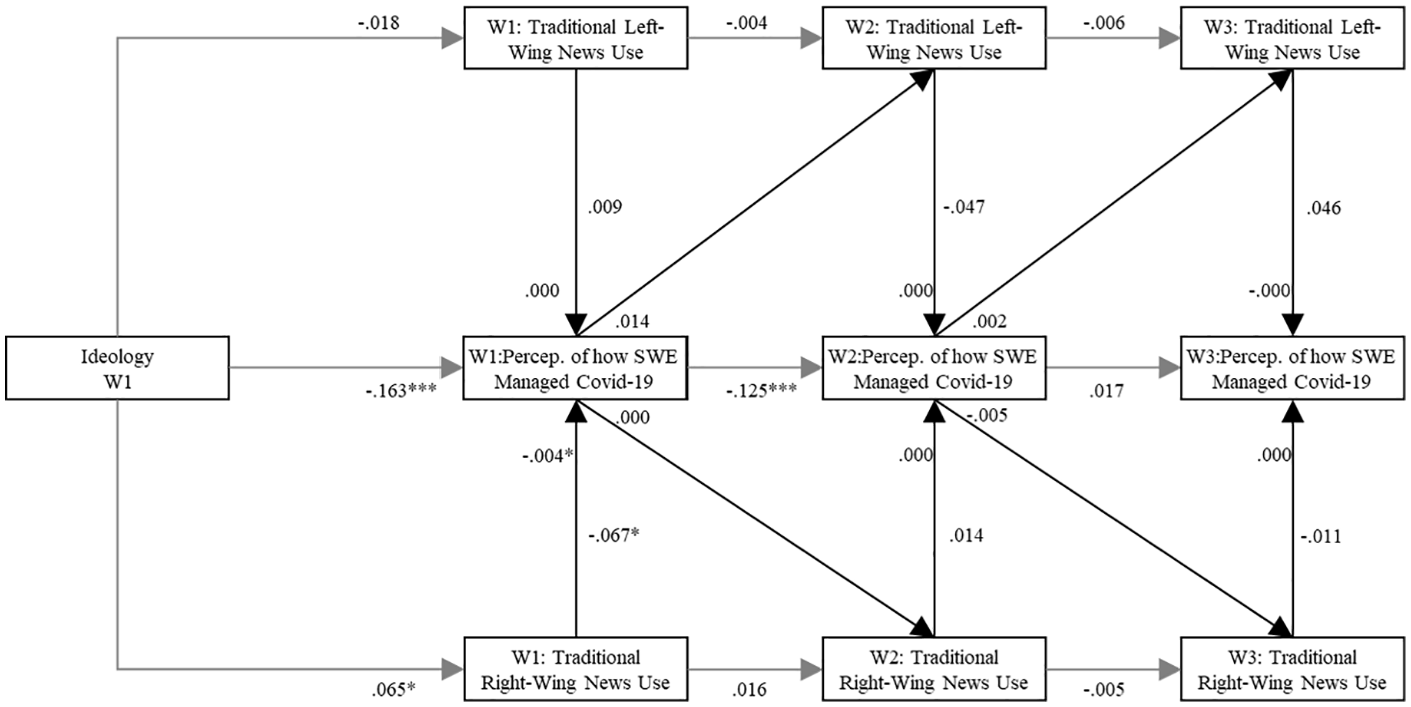
Structural Equation Model Analysis of Ideology on Traditional News Use and Perceptions of COVID-19 Management.
To investigate
Throughout the three waves, the results do not reveal any significant effects of ideology relating to exposure of left-wing traditional news. However, ideology has a small positive and significant effect on using traditional right-wing news in Wave 1 (b = .065, p = .016). Regarding mediating effects for traditional news use, there is one partial mediation effect in Wave 1 for users of traditional right-wing news (indirect effect: b = –.004, p = .020). Continuing with results for alternative news use, the analysis is presented in Figure 3.
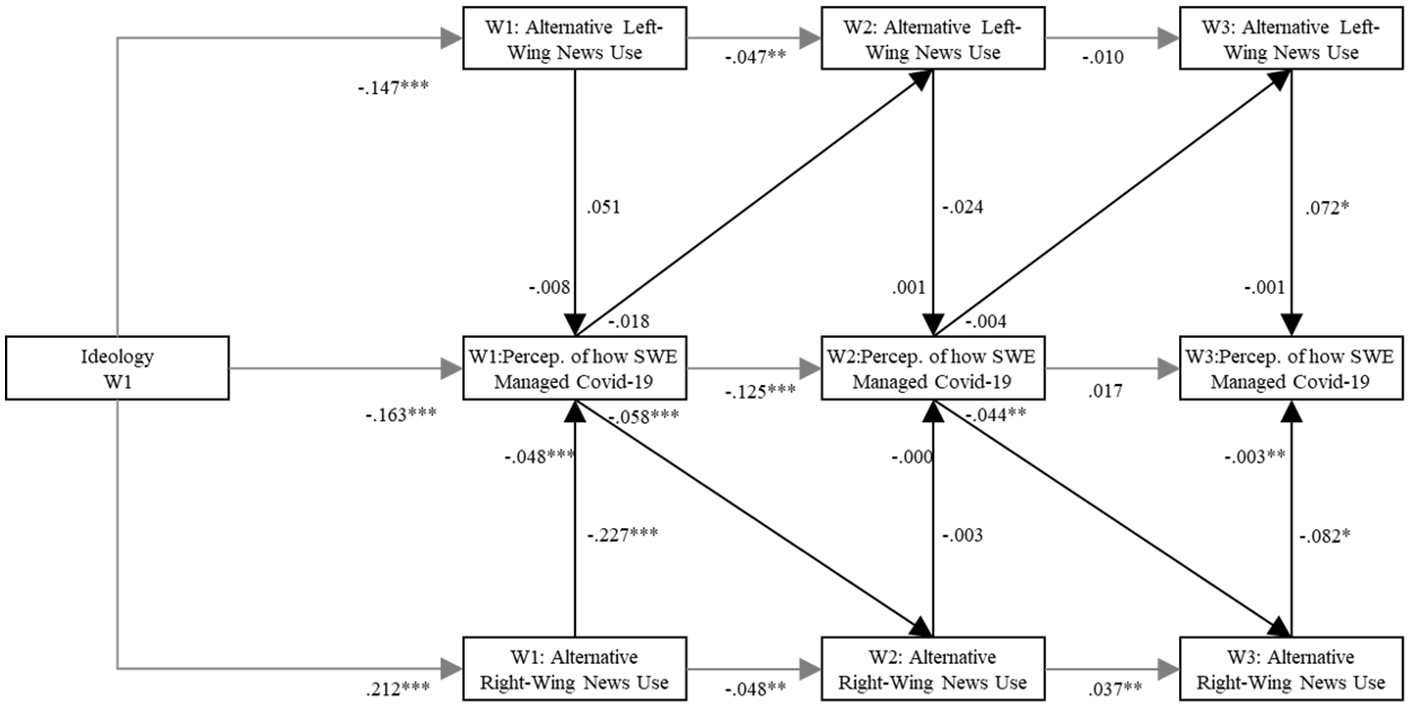
Structural Equation Model Analysis of Ideology on Alternative News Use and Perceptions of COVID-19 Management.
Findings suggest that ideology matters for alternative left- and right-wing media exposure. In the case of left-wing alternative news use, significant negative effects are found in Waves 1 (b = –.147, p < .001) and 2 (b = –.047, p = .008), meaning that left-wing ideology is related to left-wing alternative news exposure. Similar results are found for right-wing alternative media, where right-wing ideology is associated with right-wing alternative news exposure throughout the three waves (W1: b = .212, p < .001; W2: b = .048, p = .001; W3: b = .037, p = .004). Partial mediating effects are found in Waves 1 and 3 for users of alternative right-wing news (indirect effects: W1: b = –.048, p < .001; W3: b = –.003, p = .044). The mediating effects are smaller than the direct effects between ideology and perceptions but statistically significant. This means that the direct effect between ideology and perceptions is partially mediated by right-wing news consumption.
Results indicate a mediation process running from ideology through right-wing news use to perceptions of how Sweden has managed during the COVID-19 pandemic. The results also partially support the assumptions of
Discussion
Results from this study indicate that the reinforcing spiral cannot be found among all respondents; instead, it is dependent on traditional or alternative news consumption. For instance, ideology plays almost no part in selecting traditional news; instead, ideology is associated with alternative news consumptions. It is shown that the reinforcing process is conditioned by ideology, where little or no indications are found that left-wing ideology influences the reinforcing process. These results offer some explanation for
This study contributes to existing research in two ways. First, it strengthens the theoretical framework of the RSM, testing Slater’s (2015) assumptions regarding threat, uncertainty, and societal strain. By applying a three-wave panel, making it possible to test the full extent of the RSM, the results show that threat, uncertainty, and societal strain set in motion a reinforcing spiral between ideology, news use, and societal perception. This tells us that selective exposure should be seen as more than one component of a larger dynamic process by which ideology and societal perceptions are maintained (Slater, 2007, 2015) The results partially support the argument that news use works as both a predictor and an outcome variable that changes over time. Second, the results exhibit that the RSM process and choice of news type are conditioned by ideology. The findings support the notion that the reinforcing spiral is an asymmetric process dependent on ideology, more specifically right-wing ideology. Right-wing ideology initiates a reinforcing spiral, influencing both media consumption and COVID-19 perceptions. Ideology conditions the dynamic relationship, in which COVID-19 perceptions influence subsequent news choices: More pessimistic perceptions translate into more right-wing news use over time. If ideologically right-wing, you are more likely to consume news media in line with your ideology and reinforce your prior perceptions.
These asymmetrical discoveries are in line with earlier findings by Hmielowski et al. (2020), in which the effect of ideology is stronger among conservative voters, and conservative ideology drives a reinforcing process. The results not only show us that right-wing ideology is more likely to initiate a reinforcing spiral but also that right-wing people are prone to consume alternative media to a greater extent than left-wing people. This could also explain the asymmetric spirals because as right-wing people consume alternative news, they expose themselves to outlets containing more ideologically congruent information compared with traditional news. These asymmetries could also be explained by the theoretical assumption that right-wing people felt more threatened than left-wing people during the COVID-19 pandemic, as the Swedish center-left government’s strategy diverged from that of other countries (Slater, 2015). In line with Slater’s (2015) theory, right-wing people then have a stronger ideological incentive to engage in ideological selective exposure than left-wing people, resulting in reinforcing spirals.
A three-wave panel provides an opportunity to investigate the full reciprocal development of societal perceptions ascribed by the RSM; however, using observational data always has its limitations. It is still warranted to be cautious in making any strong causal claims, as it is not possible to control for all relevant third variables. A limitation of the panel is also that it could have been fielded earlier given a better opportunity to measure people’s formation of perceptions about the COVID-19 crisis. It is also important to mention that self-reported survey items, as used in this study, always pose a limitation as it may be subject to bias and errors. Meanwhile, self-reported data may provide valuable subjective information about a person’s media exposure (Scharkow, 2019). Finally, it should be noted that even if the left–right dimension is still the prevailing ideological dimension within the Swedish context (Oscarsson et al., 2021), the fact that other ideological dimensions, such as the GAL/TAN-dimension (e.g., Hooghe et al., 2002), have received growing attention within the field makes it important to consider other ideological dimensions in future studies.
Despite these limitations, the findings uncover important implications and contribute to research on the RSM, specifically through analyzing the dynamic relationship between ideology, news use, and societal perceptions, putting the assumptions made by the RSM to a longitudinal test. This study demonstrates that during uncertainty or threat, supporting evidence implies a mediated effects over time from ideology through news use on COVID-19 perceptions, resulting in reinforcing negative perceptions of how Sweden managed during the pandemic. However, these processes are ideologically asymmetric, where the results apply only to people who identify themselves as right wing.
Supplemental Material
sj-docx-1-jmq-10.1177_10776990241261721 – Supplemental material for Reinforcing Influence of Ideology on News Selection and Societal Perceptions: The COVID Pandemic in Sweden
Supplemental material, sj-docx-1-jmq-10.1177_10776990241261721 for Reinforcing Influence of Ideology on News Selection and Societal Perceptions: The COVID Pandemic in Sweden by Dennis Andersson in Journalism & Mass Communication Quarterly
Footnotes
Declaration of Conflicting Interests
The author(s) declared no potential conflicts of interest with respect to the research, authorship, and/or publication of this article.
Funding
The author(s) disclosed receipt of the following financial support for the research, authorship, and/or publication of this article: This work was supported by the European Research Council (ERC) under the European Union’s Horizon 2020 under grant agreement no. 804662. Any opinions, findings, and conclusions or recommendations expressed in this article are those of the author and do not necessarily reflect the views of the ERC.
Ethical Approval
The study was approved by the Swedish Ethical Review Authority (Dnr 2019-05436).
Data Set
It is not the first time this datum has been used. Known to me, the other articles that have utilized the same datum as I have are:
Andersen, K., Shehata, A., Skovsgaard, M., & Strömbäck, J. (2024). Selective news avoidance: Consistency and temporality. Communication Research. Advance online publication. 
Johansson, B., Hopmann, D. N., & Shehata, A. (2021). When the rally-around-the-flag effect disappears, or: When the COVID-19 pandemic becomes “normalized.” Journal of Elections, Public Opinion and Parties, 31(Suppl. 1), 321–334.
Shehata, A., Glogger, I., & Andersen, K. (2021). The Swedish way: How ideology and media use influenced the formation, maintenance and change of beliefs about the coronavirus. In P. Van Aelst & J. G. Blumler (Eds.), Political communication in the time of coronavirus (pp. 209–223). Taylor & Francis.
Supplemental Material
Supplemental material for this article is available online.
Notes
Author Biography
References
Supplementary Material
Please find the following supplemental material available below.
For Open Access articles published under a Creative Commons License, all supplemental material carries the same license as the article it is associated with.
For non-Open Access articles published, all supplemental material carries a non-exclusive license, and permission requests for re-use of supplemental material or any part of supplemental material shall be sent directly to the copyright owner as specified in the copyright notice associated with the article.
