




Abstract
Female journalists worldwide still struggle for adequate representation in leadership positions. This study contributes to the (mainly Western) scholarship on gender barriers in journalism by exploring the mechanism of vertical gender segregation in the journalistic profession in the Czech Republic, a non-Western country with the legacy of a women’s emancipation project sponsored by the former communist regime. Semi-structured interviews (N = 17) with female journalists in leadership positions revealed five main barriers: overall gender inequality in the Czech society; family and household responsibilities; lower self-esteem and ambition in women; sexism and sexual harassment; and masculine newsroom culture and “old boys’ clubs.”
Even if journalism is by no means a male domain anymore, female journalists around the globe still struggle to reach leadership positions at the same rate as their male colleagues (Byerly, 2011). According to the Global Report on the Status of Women in the News Media, which covers 59 nations, women hold 36% of the rank-and-file news-gathering positions, while they occupy 27% of the top management jobs (Byerly, 2011). Also, in a sample of 240 major news outlets in 12 countries across 5 continents, women make up an average of 40% of journalists, but just 21% of the top editors (Eddy et al., 2023). Thus, vertical gender segregation—the concentration of women in the lower echelons of the journalistic profession—describes newsrooms throughout the international industry.
In the last two decades, empirical research has moved beyond “the body count approach” (de Bruin, 2014) and explored not only the proportion of women at each step of the career ladder but also the barriers they face. Traditionally, Western scholarship dominates this field (see, e.g., Grubb and Billiot [2010]; Hardin and Whiteside [2009] for the United States; Freeman [2016]; Smith [2015] for Canada; Delano [2003]; Ross [2001] for the United Kingdom; Nilsson [2010] for Sweden; Torkkola and Ruoho [2009] for Finland; De Vuyst and Raeymaeckers [2019] for Belgium; and Lobo et al. [2017] for Portugal), even though, in recent years, an increasing number of studies zeroed in on African (e.g., see Rodny-Gumede [2015] and Daniels et al. [2018] for Republic of South Africa) and Asian countries (Melki and Hitti [2021]; Melki and Mallat [2016] for Lebanon and the Arab world; Lachover and Lemish [2018] for Israel; Safa and Akter [2015] for Bangladesh; Tsui and Lee [2012] for Hong Kong; Simorangkir [2020a] for Indonesia; or Rao and Rodny-Gumede [2020] for the comparison of India and Republic of South Africa). Interestingly, for explanations as to the barriers that prevent female journalists from advancement into leadership positions, the countries of Central and Eastern Europe (CEE), with their specific historical legacy of a state-sponsored women’s emancipation project from the communist era, remain a blank spot on the map. This paper fills that gap.
Using the Czech Republic, a CEE country and a member of the former Eastern Bloc, as a case study, this contribution explores the mechanism of vertical gender segregation in journalism in a non-Western region. Previous research mostly focused on general barriers and obstacles that female journalists faced in their profession. However, as noted by Byerly (2011), the problem is not so much an exclusion from the profession but rather marginalization and limited mobility. We therefore specifically zero in on the barriers to career progression. Via 17 semi-structured interviews with female journalists in leadership positions, we draw on the perspectives of those who have firsthand personal experience with the obstacles to career advancement and have managed to overcome them. This is the second contribution of the paper, because, to the best of our knowledge, research on vertical gender segregation based on the perspective of those who were able to overcome it is surprisingly rare (for an exception, see the Finnish study of Torkkola and Ruoho [2009], and the Portuguese study of Cunha and Martins [2023]). Third, the Czech case is intriguing because the relatively high representation of women in journalism does not translate into their representation in leadership positions. Globally, countries with large percentages of women in the journalistic profession have the largest percentages of women in senior-level decision-making positions (Byerly & McGraw, 2020). However, while women in Czech journalism have almost reached parity with men, representing 45% of all journalists (Volek & Urbániková, 2017), only 2 of the 28 major Czech news outlets (7%) have a female editor-in-chief. 1 How do female journalists who are now in decision-making positions and have the power to change organizational culture think about gender? How do they perceive the barriers that hinder women’s career progression? And how have they themselves dealt with those barriers?
Our study suggests that even in countries with a relatively long history of a women’s emancipation project, where the share of female journalists has long been almost equal to that of men, such as in the Czech Republic, several obstacles effectively prevent them from advancing to leadership positions. In addition to those identified in previous research (overall gender inequality in society; family and household responsibilities; lower self-esteem and career ambition in women; the masculine newsroom culture and the existence of “old boys’ clubs”), this study suggests that overtly sexist attitudes and sexual harassment are more pressing barriers for female Czech journalists compared with their Western colleagues. Furthermore, this study identified online violence against female journalists as an additional barrier to their career advancement. Our findings also indicate that critical mass theory—positing that, when women’s representation in a profession reaches a high enough share, women will be able to form alliances and spur organizational change (Dahlerup, 1988; Kanter, 1977), which should lead to higher representation in leadership positions—does not work in countries where the high representation of women is not itself accompanied by a strong feminist consciousness. Deeper changes in societal gender norms and in the social-support system are needed to improve the career prospects of women in journalism in the CEE region.
Literature Review: Women, Gender, and Journalism
Critical Mass Theory and Women in Journalism
The quantitative representation of women in journalism, and the changes that a higher proportion of women is expected to bring, have been the subject of debate for several decades. One of the most influential theories is critical mass theory, which claims that a few token women cannot achieve significant organizational changes but, once women reach “critical mass” (a term borrowed from nuclear physics), their standing will change to full group membership. They will subsequently be able to form alliances and coalitions, offer new visions, and create a new group culture, as suggested by Dahlerup (1988) in her analysis of Scandinavian politics and Kanter (1977) in her analysis of large industrial corporations in the United States. Estimates of the critical mass threshold typically range between 30% and 35% (Byerly & McGraw, 2020). Reaching this threshold is expected to result in greater and more accurate coverage of women in media content (Byerly & McGraw, 2020), but it can also be assumed that such change in organizational culture will bring about a more female-friendly environment and a higher representation of women in leadership positions.
Some scholars consider critical mass theory to be a failed theory (Steiner, 2012) and propose a change in perspective. Instead of searching for a quantitative tipping point, they suggest focusing on critical women actors and the critical acts they take to make a difference (Childs & Krook, 2008; Dahlerup, 2006). However, based on robust international data, Byerly and McGraw (2020) found empirical support for a critical mass effect in journalism. They show that, after senior-level women reporters reach 45%, there is a marked increase in the number of women in news stories and as sources. They also found a strong relationship between the proportion of trained female journalists in a country and their proportion in both junior and senior levels of reporting. Byerly and McGraw (2020) note that this may have two explanations that may coexist in practice: First, more women in entry-level positions may mean that more women can be mentored and encouraged to advance in their careers, and, second, more women in senior positions may allow them to push for the hiring of more women in junior reporter positions.
Barriers and Obstacles Faced by Female Journalists
Following quantitative research projects on the representation of women in journalism and their structural position in the profession (see, e.g., Byerly, 2011; Gallagher, 1995), a number of qualitative studies that investigated gender barriers and obstacles emerged (Chen et al., 2020; Daniels et al., 2018; De Vuyst & Raeymaeckers, 2019; Lachover & Lemish, 2018; Lobo et al., 2017; Melki & Hitti, 2021; Melki & Mallat, 2016; North, 2016c; Rodny-Gumede, 2015; Safa & Akter, 2015; Simorangkir, 2020a). Based on these studies, four main barriers can be identified: the incompatibility of journalism and family; gender stereotypes, prejudice, and discrimination; a masculine newsroom culture and “old boys clubs”; and sexual harassment. These obstacles make women’s careers in journalism more challenging, hinder their career growth, and can even lead to their leaving the profession (Reinardy, 2009; Safa & Akter, 2015; Tsui & Lee, 2012).
First, one of the major barriers for female journalists lies in the family and household responsibilities that fall disproportionately on women (De Vuyst & Raeymaeckers, 2019; Lachover & Lemish, 2018; Lobo et al., 2017; Melki & Hitti, 2021; North, 2016c; Simorangkir, 2020a; Torkkola & Ruoho, 2009). In line with traditional gender roles, it is still typical that the woman bears the burden of childcare and household care, which limits her career. Even though the management of family and work is a universal barrier that disadvantages women throughout the labor market, the balance of work and family life is particularly challenging in journalism due to its excessive and irregular work hours and the demand for “total availability” (De Vuyst & Raeymaeckers, 2019; Hardin & Whiteside, 2009).
Second, women’s careers in journalism are hindered by gender stereotypes and prejudice. Female journalists experience sexism and patriarchal attitudes (Rodny-Gumede, 2015), and outright discrimination (Melki & Mallat, 2016; Phalen, 2000). They have to contend with a lack of confidence in their skills and they have to prove their capabilities in a way not expected of their male colleagues (Grubb & Billiot, 2010). They may also struggle with being taken seriously in the newsroom (Melki & Mallat, 2016). Gender stereotypes and prejudice also permeate the division of labor, including news story assignments (Melki & Mallat, 2016; North, 2016b; Rodny-Gumede, 2015). Sometimes female journalists are pigeonholed into less prestigious topics with fewer opportunities to stand out and get promoted (Miller & Miller, 1995; Rodny-Gumede, 2015). In addition, female journalists in several studies complained of discriminatory hiring and promotion practices that were based on physical appearance (Grubb & Billiot, 2010; Melki & Mallat, 2016).
Third, despite the growing proportion of women in journalism, newsroom cultures are still predominantly masculine, especially in the higher echelons (De Vuyst & Raeymaeckers, 2019; Phalen, 2000). Interviews with female journalists around the world suggest that journalism is a highly competitive profession where one needs to have sharp elbows, high self-confidence, indifference to conflict, and self-promotion skills (De Vuyst & Raeymaeckers, 2019; Nilsson, 2010; Phalen, 2000; Smith, 2015; Torkkola & Ruoho, 2009). However, some women may not feel comfortable in such a culture, not to mention that these qualities are perceived as predominantly masculine and not appropriate or desirable for women. Rather than adopting what is considered a masculine management style (Phalen, 2000), some female journalists prefer to relinquish interest in leadership positions or fear being a “bad” (means: soft) leader (De Vuyst & Raeymaeckers, 2019; Phalen, 2000).
Masculine culture also includes the formation of “old boys’ clubs,” which are informal networks that are maintained and strengthened with after-work meetings in pubs, bars, on golf courses, or in saunas (Daniels et al., 2018; De Vuyst & Raeymaeckers, 2019; Torkkola & Ruoho, 2009). These gendered networks provide valuable social capital, information, recommendations, and job offers. Access to these networks is difficult because women may simply not be invited. Also, those with families have less time to network due to childcare and household responsibilities, not to mention that attempts to get into a male network may be considered socially improper and wrong (Torkkola & Ruoho, 2009).
Fourth, sexual harassment is a barrier that can come from supervisors, colleagues, professional contacts, sources, and audiences (Chen et al., 2020; Grubb & Billiot, 2010; North, 2016a; Phalen, 2000; Simorangkir, 2020b). This includes sexist language, inappropriate jokes, pressure to appear sexually attractive, sexual innuendos, unsolicited proposals, stalking, unsolicited physical contact, and even physical attacks. In addition, online harassment and violence against women, which is often sexualized, is a widespread problem (Barton & Storm, 2014; Posetti et al., 2020; Yeon Lee & Park, 2024). According to studies from the United States (Walsh-Childers et al., 1996) and Australia (North, 2016a), up to two-thirds of female journalists have personal experience with sexual harassment. More expansive research with respondents from around the world suggests that this affects roughly half of female journalists (Barton & Storm, 2014). These studies also conclude that the perpetrators of sexual harassment are mostly male colleagues and supervisors, and that most incidents are not addressed or reported. As a result, sexual harassment reduces job satisfaction among female journalists, and affects their mental health, sense of security, and reputation. It may also lead to a silencing effect (i.e., the avoidance of certain topics, self-censorship, avoidance of interaction with the audience) or even to departure from the profession (Barton & Storm, 2014; Melki & Mallat, 2016; North, 2016a; Posetti et al., 2020).
The main findings of studies that are based on interviews with female journalists are strikingly consistent. These four barriers seem to be universal, regardless of the country or continent. This, of course, does not mean that the extent or severity of these barriers—and the capacities for tackling them—do not differ internationally. With the necessary amount of generalization, it seems that studies from non-Western countries more often point to gender stereotypes, discrimination, and sexual harassment as widespread barriers (see, e.g., Melki & Mallat, 2016; Rodny-Gumede, 2015; Safa & Akter, 2015; Simorangkir, 2020b). This raises the question of where the CEE region stands in this regard.
Gender and Journalism in the CEE Region and the Czech Republic
The countries of the CEE region differ from Western Europe in their unique historical development. As members of the former Eastern bloc, they inherited the legacy of state-sponsored “women’s emancipation,” which was proclaimed in the late 1940s. During communism, women’s equality in society and marriage was guaranteed by law. Both men and women were required to obtain an education and join the labor market. In fact, the communist regimes aimed for the full employment of women in paid work (Funk & Mueller, 1993). That explains why in the CEE region, female journalists outnumber their male colleagues (Worlds of Journalism Study [WJS], 2016) and, in general, the media systems of the CEE countries exhibit “strong tendencies towards gender egalitarianism” (Byerly, 2011, p. 269).
The women’s emancipation initiative proclaimed by the communist countries focused on work life and left private and family life largely untouched. This meant that women were equal to men in terms of work and civic duties, but, unlike men, they had to carry the burden of the household and childcare. Thus, somewhat paradoxically, the proclamations of gender equality and the requirement to participate in the labor market for both sexes coexisted with traditional gender norms based on patriarchal principles (Jezerska, 2003), including the unequal division of unpaid labor in the households (S. Nastasia & Nastasia, 2013). In addition, due to the intellectual isolation, women were not able to engage with international feminism and could not organize in civil society without state oversight (Metcalfe & Afanassieva, 2005).
The undercurrents of gender inequality are evident to this day. The overall level of gender equality in the CEE countries, as measured by the Gender Equality Index, is below the EU average (European Institute for Gender Equality, 2021). It is therefore not surprising that, despite the overall high representation of women in journalism in the CEE countries, they are, similar to other regions, underrepresented in leadership positions (Byerly, 2013; D. I. Nastasia et al., 2013; S. Nastasia & Nastasia, 2013; WJS, 2016). Moreover, gender insensitivity is traditionally entrenched in most countries of the CEE region (Jezerska, 2003). Feminism as a movement and as an ideology is only slowly gaining ground, and it remains stigmatized (Forest, 2006).
Regarding gender equality, the Czech Republic suffers from all of the abovementioned shortcomings. Czech society still holds traditional views for male and female roles, according to which women are natural caregivers and men are the natural breadwinners (Centrum pro výzkum veřejného mínění, 2020). While women spend, on average, 5 hours less per week on paid work than men, and they spend up to 14 hours more per week on unpaid domestic work (European Commission, 2017). Women almost exclusively bear the brunt of childcare because they are 98% of the parental benefit recipients (Czech Statistical Office, 2021). The combination of a potential long paid parental leave (up to 4 years), limited early institutional childcare, and the deep-rooted social norm that a good mother should stay at home and personally care for her child until the age of 3 years, leads to a considerable “motherhood penalty” in the labor market (Bičáková & Kalíšková, 2016).
The structural gender inequality present in the labor market is also apparent in journalism. Women have almost reached parity with men, representing 45% of all journalists (Volek & Urbániková, 2017), which exceeds the threshold usually set by the critical mass theory as necessary for a change in an organization (Byerly & McGraw, 2020) and organizational culture (Dahlerup, 1988; Kanter, 1977). However, female journalists are much less likely to reach management positions, even though they spend almost the same number of hours at work as their male colleagues (48 and 49 hours, respectively; Urbániková, 2020) and have a higher education than their male colleagues (77% of female journalists and 61% of male journalists have a university degree; Urbániková, 2020). Of the 28 major Czech news outlets (i.e., daily newspapers; news and economic weeklies; news websites; TV and radio stations; and news agencies), only two have a female editor-in-chief, which means that women make up only 7% of editors-in-chiefs for key news media (see Note 1). How can we explain that such a high representation of women in the journalism profession does not translate to higher representation in leadership positions?
Data and Method
To learn more about the mechanism of vertical gender segregation in Czech journalism and its perception by female journalists, this paper explores the perspectives of those who have firsthand personal experience with the obstacles to career advancement and still managed to reach leadership positions. We pose two research questions: (a) How do women in leadership positions perceive and reflect upon the barriers to career advancement for female journalists? (b) What tactics and strategies did they use to overcome these obstacles throughout their careers?
To answer these questions, we opted for a qualitative approach and the technique of semi-structured interviews, “a qualitative data collection strategy in which the researcher asks informants a series of predetermined but open-ended questions” (Ayres, 2008, p. 810). We interviewed 17 female journalists in leadership positions which we define as any position that involves the management of subordinates and having responsibility for someone else’s work.
A maximum variety sampling method was used to select the research participants. As the first step, out of more than 60 news media outlets in the Czech Republic, we selected 15 leading outlets so that all types of media are represented in the sample in the following respects: (a) media type (i.e., print/TV/radio/online media); (b) ownership (i.e., public service media/commercial media); (c) reach (i.e., national/regional media); and (d) size (i.e., from small to large newsrooms). Potential participants were approached through contacts, which in most cases were listed on the media outlet’s website; if this was not the case, the secretariat of the newsroom was contacted and asked to pass on the contact details of the female journalists in leadership positions.
Out of 32 female journalists who were invited to participate, 17 accepted (another 14 did not respond and 1 declined due to time constraints). We can only speculate as to the reason for the relatively high number of journalists who did not respond; it was probably a combination of time constraints and the lack of interest in the topic. In any case, during the interviews, it became clear that the participants in the research sample hold different views and that the attitudes and opinions of some of them certainly cannot be described as feminist. This leads us to assume that the possible effect of the self-selection of those who, for example, hold strongly feminist views, is rather limited, although it cannot be completely ruled out.
The participants hold the positions of editors-in-chief, newsroom directors, section heads, editors, and deputies. They work for a total of 13 media organizations (by a media organization, we mean an entity engaged in disseminating information to the general public), ranging from small (with just a few employees) to large organizations (with hundreds of employees). Four participants work in the press (daily newspapers, weekly and monthly magazines), three in radio, one in television (a participant in another category also has extensive work experience in television), and nine in online media (typically online sections of print media). Most of the participants (14 out of 17) work in national media, and the other three work in regional media. Four of the 17 participants work for public service media, and the rest work for commercial media. As for socio-demographic characteristics, 4 participants represent the younger generation (between 20 and 30 years old), 10 belong to the middle-age generation (31–50 years old), and 3 belong to a more senior generation (more than 50 years old). The length of professional experience ranges from 6 to 38 years, with an average of 18 years. Less than a half of the participants (7 out of 17) have children.
All of the interviews were conducted by one of the authors from September to November 2021. The participants were informed in advance about the topic and the objectives of the study, and their informed consent was obtained. 2 Since the data collection took place during the COVID-19 pandemic, most of the interviews were held online (via a video call) for precautionary reasons. Three participants preferred a personal meeting; in these cases, the interviews were conducted in their offices or a nearby café. The interviews ranged from 30 to 120 minutes, with an average length of 1 hour. None of the participants exercised their right not to answer a sensitive question or to withdraw from the study.
The interviews were recorded, transcribed verbatim, and analyzed with the Atlas.ti software kit. Thematic analysis, “a method for identifying, analyzing and reporting patterns (themes) within data” (Braun & Clarke, 2006, p. 79), was used as the method to organize and describe the data set. Coding and data analysis were performed in two steps to increase the consistency of the findings. The authors first coded the interviews independently of each other, developed a final code structure, and then consolidated the codes into several content domains.
To ensure anonymity, due to the relatively small number of women in the top echelons of Czech journalism, only limited information about the participants is provided, including their age group (i.e., younger/middle-age/higher-age generation) and their position based on the level of leadership (i.e., low/middle/top-level leadership position). Each participant was assigned a pseudonym.
Results
We first analyze the perceived barriers that, in the experience of the female journalists in leadership positions, hinder women’s advancement to the upper echelons of journalism. This is followed by an analysis of the tactics and strategies that the participants used throughout their careers to overcome these obstacles.
Perceived Barriers and Obstacles: The Many Shades of Sexism
Based on their experience, the participants identified five main barriers that make it difficult for women to advance into positions of power in Czech media organizations (Figure 1): (1) overall gender inequality in Czech society (a systemic societal barrier from which other specific barriers stem); (2) family and household responsibilities; (3) lower self-esteem and career ambition in women; (4) sexism and sexual harassment; and (5) masculine newsroom culture and “old boys’ clubs.”
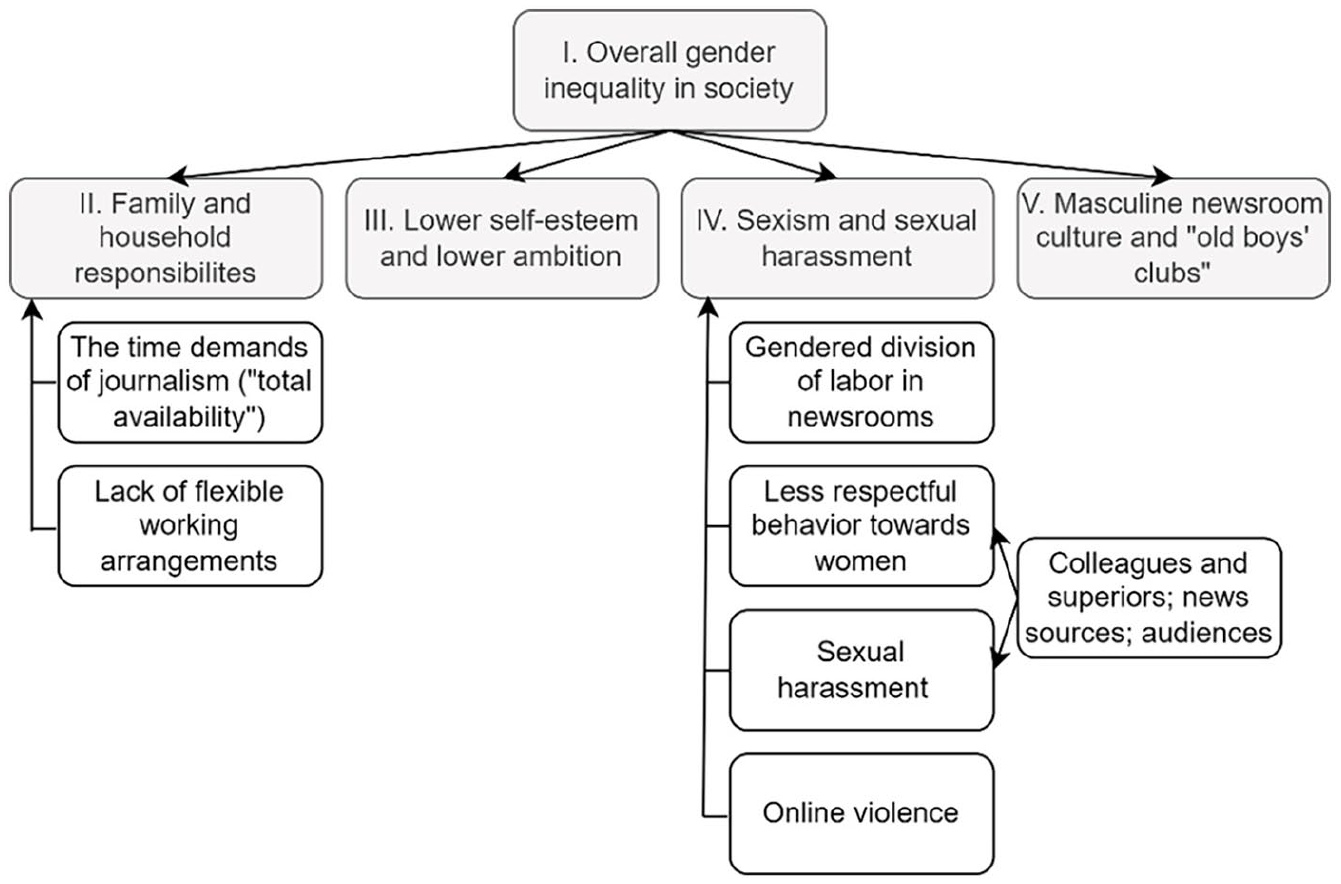
Perceived barriers and obstacles to women’s advancement to leadership positions.
Overall Gender Inequality in Society
First, all but two participants said that the low proportion of female journalists in leadership positions is a consequence of the overall gender inequality that is prevalent in Czech society. As one of them summarized, “the playing field is simply set for men” (Iris; low-level leadership position; middle-age generation). The participants pointed out that women are prevented from advancement by visible and invisible barriers that stem from traditional gender norms that are reproduced by upbringing and socialization. They interpreted these norms as unfair. In their view, the most serious manifestation is the unequal division of (largely) unpaid work in households, but this broader social setting and traditional gender norms also permeate all of the remaining barriers. Somewhat surprisingly, however, none of the participants called for structural changes. Several listed a plethora of barriers they face, only to later reject the idea of quotas for women (although we did not ask about that directly), as though they needed to define themselves against what is perceived as “radical feminism” in the Czech Republic.
While all the participants agreed that it is more difficult for women than men to make a career in journalism and while all were able to name a number of difficulties they face, two participants (both in the oldest age category of over 50) did not see these as gender barriers. They explained that the low representation of women in the top echelons of Czech journalism was a lack of interest and a consequence of free choice (and not of structural conditions). They stressed that nothing prevents women from pursuing a career in journalism.
One participant openly said that she prefers male colleagues and a male collective because she herself had “more masculine than feminine behavior.” She emphasized her distance from other women and described how, out of two equally qualified job applicants, a woman and a man, she chose the man because of his gender, thereby admitting to sex-based discrimination: I don’t really know what to talk to them [women] about, because I’m not going to be like talking to them about clothing and kids and family and stuff like that. I don’t like it and I don’t understand it. And it’s clear that there are more conflicts between women than between men. I even once had the choice between an equally qualified woman and a man, and I chose the guy. Lucy, top-level leadership position; higher-age generation
Such statements are a reminder that women are not a homogeneous group and should not be viewed as proxies for feminism. Women in leadership positions certainly cannot be automatically expected to create better conditions for other women.
Family and Household Responsibilities
Second, almost all the participants (15 out of 17) talked extensively about the negative effects of family and household responsibilities on women’s careers. Given the gendered distribution of childcare, having a child typically means a career break of several years (women typically stay at home with their children for 2-3 years), during which women lose touch with their profession, and they must endure a career slowdown until the child goes to school. Meanwhile, women are passed over by male colleagues who can devote themselves entirely to their careers. Several participants stressed that promotions in Czech media are often based on the amount of experience and seniority: Another thing is that, unfortunately, women often really lose those crucial years that their colleagues in the same roles had at their disposal. [The women] don’t have time to grow into those management positions, because those positions are filled by men in the meantime. Anna (top-level leadership position; middle-age generation)
In addition, flexible working arrangements to balance work and family are often unavailable or insufficient. There is a general lack of affordable institutional care facilities for children under 3, and public kindergartens (for children over 3) often have inconvenient hours. Only 1 of the 13 media organizations for which the participants worked had established a corporate childcare facility, although this option had become increasingly common among Czech employers in both the public and private sectors. The participants strongly criticized this shortcoming. As Veronica (middle-level leadership position; middle-age generation) remarked, “If this TV station can broadcast into space, I don’t see how it can’t run a kindergarten.” Several participants also pointed out that media organizations are reluctant to offer part-time jobs (some have been denied this opportunity in the past), and when they do, women often end up working more hours than agreed.
The combination of the unequal division of household labor and child care and the lack of flexible work arrangements means that some participants perceived the conflict between family and journalism as unresolvable. In their view, reconciling the two is a myth and, in reality, women have to choose one or the other. Others admitted that if they had children, they would not have reached a senior position or that the birth of their children would have cost them their current position in the future.
Lower Self-Esteem and Lower Ambition
Third, most participants (15 out of 17) also mentioned low self-esteem, low ambition, and different life priorities as barriers for female career advancement. At the same time, most reflect that these are socially constructed. Several participants mentioned that women internalize gender stereotypes and prejudices during their upbringing and education and, as a result, they are less ambitious, less assertive, and less self-confident than men. In their experience, men are better at self-promotion, have less self-doubt, and, unlike women, are not afraid to apply for a job even if they do not fully meet the conditions. They argue that these qualities are great advantages in the competitive environment of journalism: My experience is that men only need to know maybe 50% of what is asked of them and apply for the selection procedure. A woman knows 70% and still says “it’s not enough yet, maybe next year,” and then waits another year, and another year. Nora (middle-level leadership position; middle-age generation)
Sexism and Sexual Harassment
The fourth barrier, again identified by almost all the participants (15 out of 17), is sexism and sexual harassment. One of the perceived manifestations of sexism in newsrooms is the gendered division of labor. According to the observations of some participants, women are often hard workers who do a lot of small and less visible, yet important, work. On the contrary, men are more often assigned more prestigious tasks (such as foreign business trips) and positions (such as foreign correspondent) in which they can stand out.
Besides, the participants complained that some colleagues, news sources, and members of the audience show them less respect than men. In the case of fellow journalists, this includes the reluctance to respect the instructions of a female superior (sometimes it is necessary to have them repeated by a male superior). It also includes giving less importance to tasks assigned by women and showing signs of disrespect in newsroom meetings (e.g., taking ideas without giving credit; interrupting). Some women described being addressed less formally by colleagues, superiors, and news sources: They were addressed by their first name or a diminutive form of it, yet men were addressed as “sir” and their surnames. Female journalists also encounter gender stereotypes and prejudices. For example, it is not uncommon to be accused of getting a promotion because of a sexual relationship with a male superior. These incidents consistently follow the same sexist pattern and remind women that they are not quite equal and as valued as men, which can further affect their self-esteem and ambition.
The participants also shared numerous personal experiences of various types of sexual harassment by colleagues, superiors, news sources, and audiences. Softer forms involve chauvinistic language, sexist humor, inappropriate sexist innuendos, comments, and remarks: I’ve encountered it, I think, like most female journalists . . . It’s comments on how you look, comments on how you hold the microphone, for example. That was a favorite pastime of the cameramen at [the name of the television station], where they would make allusions to what else you’re holding like that . . . if your skirt is too long or too short and . . . if this subject is too difficult for you . . . if you really want to take the lead story of the day for the evening news program and burden your little head with it. Sophia (middle-level leadership position; middle-age generation)
Other manifestations involve unsolicited contacts, gifts, propositions, invitations, and advances (by colleagues, news sources, and members of the audience), and, in worse cases, unsolicited photographs of intimate male body parts, sexual coercion, the intrusion of intimate space, and unsolicited attempts at kissing and touching various body parts (e.g., thighs, shoulders, breasts, and buttocks). 3 These incidents usually took place before the women were promoted to management positions and involved male colleagues and superiors and, in some cases, even prominent news sources (mostly senior male politicians).
Sexism and sexual harassment can also be expressed online by the public. While online violence affects all journalists, it is more personal and sexualized for women (Posetti et al., 2021). The participants recounted that members of the public attacked their appearance, belittled their abilities, and even threatened them with sexual violence. Such sexist attacks take an emotional toll on female journalists; they are a source of stress and lower their self-confidence. They also force women to change their behavior and consider in advance how to avoid criticism (e.g., what to wear and do in order to not be provocative), how to restrict their public activities and interaction with audience members, and even consider quitting their career in journalism: And so I looked at the discussion . . . well, when I read about the 50th comment that I was ugly, fat, disgusting, no one would ever want to harass me in my life because I was just . . . that I should lose weight, how I looked, that I was old, what my relationship with my parents was like, if I had a man, if I had kids, that I was frustrated and . . . like unbelievable . . . And when I read about the 60th, 70th comment, I . . . like I started crying. It just made me cry. It just destroyed me . . . And at that point I was like, I can’t read this, it’s just devastating to my mental health. Barbara (low-level leadership position; middle-age generation)
According to the participants, these attacks have been exacerbated by the rise of social media and the intensity grows as a woman’s public visibility increases. As leadership positions are more publicly exposed, this phenomenon may discourage women from seeking them.
Masculine Newsroom Culture and “Old Boys’ Clubs”
The last barrier to women’s advancement to leadership positions is the masculine newsroom culture and the existence of “old boys’ clubs” (this was noted by 10 of the 17 participants). In the participants’ view, masculine culture prevails in Czech newsrooms. This includes unpleasant hostile behavior, an overly competitive spirit, harsh comments (including sexist and racist ones), and vulgar language. Some men in senior positions shout at their subordinates, have an authoritarian leadership style, and have “egos as big as skyscrapers.” Women may not be comfortable with this style of management, which may undermine their motivation to become part of the top echelons and give them the impression that they would not make good leaders.
In addition, several participants pointed out that male career advancement is facilitated by the existence of “old boys’ clubs.” As described by the participants, women are aware of them they do not penetrate them because they are usually not invited or do not have time, possibly due to family responsibilities. In these networks, essential contacts are made and valuable information is shared. This is particularly important in journalism because leadership positions are usually filled by promoting a specific person rather than going through an open selection process; for instance, 14 out of 17 participants were promoted in this way.
Overcoming Barriers: Flexible Work Arrangements, Courage, and Self-Confidence
The participants mentioned several tactics and strategies they used to deal with the barriers they encountered throughout their careers. Most of them were related to the reconciliation of work and family, which is not surprising because this was one of the main identified barriers.
Female journalists use different strategies to combine work and childcare, and their success depends on the support of those around them. As there is a lack of institutional childcare facilities for small children in Czechia, and it is not customary to hire nannies, most of the participants with children had to arrange care through their families. Most were helped by their mothers or their partners’ mothers, a smaller number shared caregiving with their partners, and only one hired a childcare provider.
Also, to combine work and care, female journalists use flexible work forms: They work part-time, they work from home, and they negotiate flexible work hours. As pointed out by several participants, the COVID-19 pandemic helped in this respect because media organizations got used to online meetings. According to the participants’ experience, although the situation has improved in recent years, these options are not universally available and they have to be negotiated individually with management, and several women reported that their employer had refused to accommodate them in the past. They therefore called for better conditions for reconciling work and family, in particular the better availability of part-time jobs, the establishment of corporate childcare facilities by the media organizations, and, in general, a fairer division of labor in households.
When it comes to sexual harassment, the participants take different approaches. In the case of online sexist attacks by audience members, they typically choose an avoidance strategy: They deliberately do not read online discussions and block harassing users. In the case of incidents with colleagues, superiors, and news sources, they try to ignore them so as not to appear narrow-minded, and some also change their behavior (including the way they dress) so as not to provide fodder for harassment. Their accounts suggest that, even though these incidents are mentally challenging, they accept it to some extent as a necessary tax to pay if they want to pursue a career in a profession where masculine culture prevails. They only decide to speak up in the most serious cases (and sometimes not even then). In this respect, women would appreciate more support from colleagues and management.
In terms of the other identified barriers (low self-esteem and lower ambition in women; masculine newsroom culture and “old boys’ clubs”), the participants did not mention specific strategies and tactics that they themselves used to deal with them. They did, however, put forward several ideas that could be helpful. Besides calling for more management support and establishing gender as part of the agenda in newsrooms, these were not so much suggestions for major structural changes, but rather for smaller measures that would help women better manage the status quo: training courses for women after parental leave (i.e., focus on the latest trends in the profession, increase self-esteem); mentoring programs and more female role models; and more peer support for women. Similarly, when asked what career advice they would give female journalists who aspire to leadership positions, participants almost unanimously responded that they should be self-confident, assertive, and courageous. This suggests that, although women in leadership positions are aware of the structural inequality that women face in Czech journalism, they focus mainly on how they themselves can better manage the negative consequences of this situation rather than on changing it.
Concluding Remarks
Proportionate representation of female journalists in leadership positions matters because gender equality, non-discrimination, and freedom of expression are fundamental human rights and values and because women’s presence and position in newsrooms can have an impact on media content (e.g., Everbach, 2006; Leiva & Kimber, 2020; Rodgers & Thorson, 2003). This study demonstrates that, even in countries where the proportion of female journalists has long been almost equal to that of men, such as the Czech Republic, several barriers prevent them from advancing to the top positions. From the perspectives of 17 female journalists in leadership positions who were interviewed for this study, five main barriers hinder the career advancement of women in Czech media: overall gender inequality in Czech society; family and household responsibilities; lower self-esteem and career ambition in women; sexism and sexual harassment; and the masculine newsroom culture and the existence of “old boys’ clubs.”
Although these obstacles are certainly not new and have been identified in previous studies on different continents and different countries (e.g., De Vuyst & Raeymaeckers, 2019; Lobo et al., 2017; Melki & Mallat, 2016; Rodny-Gumede, 2015; Simorangkir, 2020a; Torkkola & Ruoho, 2009), female Czech journalists, compared with their Western colleagues, seem to more often mention overtly sexist attitudes and sexual harassment as barriers to career advancement. This may be because, in Western countries, these overt expressions of sexism are less socially acceptable and easier to defend against legally. At the same time, unlike previous research, this study identified online violence against female journalists as an additional barrier to their career advancement. The online attacks are mainly directed at journalists in publicly visible roles, which may lead women to restrict their public activities and interaction with the audience (which plays a role in career development) and can discourage them from trying to advance into leadership positions.
How can we explain that, in the Czech case, although women have reached near parity with men and represent 45% of all journalists (Volek & Urbániková, 2017)—which exceeds the threshold usually set by critical mass theory as necessary for a change in an organization (Byerly & McGraw, 2020) and organizational culture (Dahlerup, 1988; Kanter, 1977)—this does not translate into their higher representation in leadership positions? First, we assume that the cause lies in the historical legacy. Rather than being a result of a grassroots feminist movement, the high proportion of female journalists is a historical remnant of the state-sponsored women’s emancipation project that began under the communist regime. The concept of women’s emancipation sought the high participation of women in the labor market, but, at the same time, coexisted with traditional gender norms and maintained the traditional idea that women are natural caregivers and homemakers. In short, the issue of gender equality was framed primarily as a question about the equal role of women and men in economic production, not as a question of individual rights (Pascall & Kwak, 2010).
The second and related reason could be the relatively low popularity of feminist thinking in the Czech society and the journalistic community, which results in a lack of pressure for change. In general, gender insensitivity is traditionally ingrained in most countries of the CEE region (Jezerska, 2003). Feminism is slowly gaining ground, and remains stigmatized (Forest, 2006). If gender equality is perceived in accordance with its conception under the communist regime (i.e., simply in terms of the ability to engage in paid work), it is not surprising that some female journalists believe that equality has been achieved and that women do not face any gender barriers. While they noted that it is more difficult for women to establish a career in journalism, they attributed this to their free choice and their lack of interest in decision-making positions. Here, it should be stressed that only a small proportion of the participants (2 out of 17) hold this view, and both were from the oldest age group, which may indicate a gradual generational change. These cases, however few in number, remind us that women’s leadership is not synonymous with feminist leadership.
Most of the participants, though, show relatively high reflexivity and see the roots of the career obstacles in broader social norms and in the structural gender inequality that prevails in Czech society. Thus, they do not seem to exhibit gender blindness, a phenomenon identified in previous Western studies (Hardin & Whiteside, 2009; Nilsson, 2010; Ross, 2001; Steiner, 2008) and, more than a decade ago, among Czech journalists as well (Vochocová, 2019). However, the position of the participants could be best labeled as “tamed feminism” (Ross, 2004). They are very well able to identify a plethora of barriers, yet they focus on how they themselves can better manage the negative consequences of this situation (i.e., flexible working arrangements and institutionalized childcare), but they neither challenge the rules and principles of the existing social order nor call for structural changes. Thus, they focus on their practical gender interests rather than the strategic ones (Molyneux, 1985).
In short, vertical gender segregation is not a phenomenon that will naturally disappear as more women enter the field of journalism. The high representation of women in journalism alone is not enough unless it is accompanied by a general will and ability of women to improve the situation for themselves and other women (Dahlerup, 1988) and gender equality practices in general (Bajdo & Dickson, 2002).
What needs to change to bring women’s representation in leadership positions more in line with their representation in journalism as a whole? The situation in Czech journalism (and elsewhere in the CEE region) will not improve without major social changes, especially the fairer distribution of largely unpaid work in households and the reconfiguration of the social-support system to help both parents who want to personally care for their children for several years and those who want to combine care with work. Media organizations need to take gender issues more seriously, actively target female talent, support women in their career development, and make promotion processes more transparent. They should also pay increased attention to protecting journalists from online violence and to preventing and addressing sexual harassment, because the participants revealed that, although the experience of sexual harassment in the workplace is not uncommon, women generally do not report these incidents. Last, but not least, pressure from below is crucial. Symptomatic of the fact that gender is not considered to be an important issue in Czech journalism is the absence of a women’s journalism association, or at least a dedicated section within the Syndicate of Journalists, the central Czech professional journalism organization.
A certain limitation of this study is that, like most studies on gender barriers in journalism, the interviews were exclusively conducted with women. Exploring the perspectives of men—who typically hold power in journalism—would open up an important research avenue. Gaining a deeper insight into how male journalists perceive gender relations in the newsroom may be useful in future considerations on how to bring about change.
Footnotes
Acknowledgements
The authors would like to sincerely thank the research participants for sharing their perspectives and giving their valuable time to contribute to this research. The authors also wish to thank the three anonymous reviewers for their careful reading and constructive comments, which have greatly enhanced the quality of the paper.
Declaration of Conflicting Interests
The author(s) declared no potential conflicts of interest with respect to the research, authorship, and/or publication of this article.
Funding
The author(s) disclosed receipt of the following financial support for the research, authorship, and/or publication of this article: This work was supported by Masaryk University (grant number MUNI/A/1379/2020).
