




Abstract
This study examines the effect of personal and work-related factors on job satisfaction based on a sample from the Czech Republic. The study, which was based on a questionnaire survey of 1,776 respondents in organizations in the Czech Republic, proposed a number of hypotheses related to demographic and organizational variables and tests using ANOVA. Results of the data analysis revealed similarities to findings in Western countries, in which men show higher job satisfaction than women. Age does not seem to have a significant effect on job satisfaction. There is low job satisfaction in public/governmental organizations and among young people entering the job market. It is suggested that it is necessary to develop a human resources strategy for the public/governmental sector that will not only increase its social prestige but also increase positive feelings among its employees. The need to better prepare undergraduates for the demands of the job market is also discussed.
Keywords
Introduction
Job satisfaction has received attention from studies of organizational behavior, which have examined job satisfaction as antecedents of improved leadership capabilities and human resource management. Generally, constructs and measurement instruments have been developed in Western countries. Consequently, job satisfaction has been studied extensively in Western Europe and the United States. However, empirical studies indicate that these studies cannot be directly applied to the analysis of organizational behavior in the Czech Republic (e.g., Lukášová, Franková, & Surynek, 2006).
In the past decade, there have been a number of studies involving non-Western cultures, including studies from Taiwan (e.g., Chen & Silverthorne, 2008; Cheung & Scherling, 1999; Lu, Tseng, & Cooper, 1999; Silverthorne, 2004), China (e.g., Lau, Tse, & Zhou, 2002; Leung, Smith, Wang, & Sun, 1996; Liu, Tang, & Zhu, 2008; Loscocco & Bose, 1998; Scott, Bishop, & Chen, 2003), and Russia (Linz, 2003). Recently, investigations of the Middle East have also been undertaken (e.g., Abdulla, Djebarni, & Mellahi, 2011; Tlaiss, 2013; Yousef, 2001). Nonetheless, there remains a paucity of empirical data from transient post-Communist economies from Central and Eastern Europe (CEE), which includes the Czech Republic. Little is known about the factors that influence job satisfaction in post-Communist countries as they change their behavioral patterns during the transition from a centrally planned economy to a market economy (Lange, 2009). The importance of understanding the organizational behavior of people from CEE countries has emerged from the fact that some features of the recent socioeconomic development of those countries are very specific and differ from both Western and Eastern countries. Moreover, life under Communist regimes had long-term impacts on CEE citizens’ values and beliefs (Inglehart & Baker, 2000).
Studies in some CEE countries have been based on smaller samples and focused on specific professions—for example, public relations practitioners in Bulgaria (Karadjov, Kim, & Karavasilev, 2000) hospital staff (Kaarna, Põlluste, Lepnurm, & Thetloff, 2004) and family doctors (Kalda, Maaroos, & Lember, 2000) in Estonia, managers (Alonderiene, 2010) and dentists in Lithuania (Puriene, Petrauskiene, Janulyte, & Balciuniene, 2007), salespersons in Poland (Brashear, Lepkowska-White, & Chelariu, 2003), and nurses in Slovakia (Gurková, Čáp, Žiaková, & Ďurišková, 2012) and Slovenia (Lorber & Skela Savič, 2012). Medical workers have received a great deal of attention.
Haraszti (1977) has argued that Soviet-style labor relations produced demotivated, demoralized, and unsatisfied workers. Although it is quite difficult to make such generalized statements about all European Communist countries, it is known that during the last decade of Communist rule (1980s), job dissatisfaction commonly existed in the Czech Republic (known until 1992 as Czechoslovakia), which was caused by insufficient work organization, bad workplace relations, incompetent superordinates, inefficient reward systems, and limited opportunities for career advancement (typically, formal political activity was required). Consequently, low job satisfaction was associated with low job performance, which resulted in the economy’s overall poor performance (e.g., Možný, 1999). In public and official communications, however, these negative phenomena were hidden. For this reason, there are no empirical data describing job satisfaction in organizations during that period. However, following the collapse of the Communist political and centrally planned economic systems in CEE countries, the last two decades have been characterized by a very rapid socioeconomic and political transition. The extent and field of the recent institutional changes in the transition economies of CEE countries have been quite unusual (Peng, 2003). Despite initial difficulties, most of these countries now have market economies that are more stable than before (Olson et al., 2006). However, there is a question of whether the legacies of Communist industrial relations still influence Czech employees’ organizational behavior. Unfortunately, our knowledge about changes in organizational behavior during this period of transition is still quite limited.
The first empirical data about job satisfaction in the Czech Republic are available from 1997 from the International Social Survey Program (ISSP), which focuses on registering work orientation. Several studies based on those data have been published (Medgyesi & Róbert, 2003; Sousa-Poza & Sousa-Poza, 2000; Večerník, 2003). The data showed that levels of job satisfaction in CEE countries were quite low compared with Western and Northern Europe. Four CEE countries (Hungary, Slovenia, Bulgaria, and the Czech Republic) are among the eight countries with the lowest job-satisfaction levels. A subsequent survey conducted in 2005 (see http://www.issp.org) showed that job-satisfaction levels in the Czech Republic are still one of the lowest among the 21 Organisation for Economic Co-operation and Development (OECD) countries. The study, based on data obtained from 1999 to 2002 in both Western and Eastern European countries from a sample of 20,000 employed respondents, again confirmed that job-satisfaction levels were considerably higher in Western European countries than in Eastern European countries (Borooah, 2009). Data from the European Employee Index collected in 2008 and 2009 in 22 countries showed that the Czech Republic ranked second-to-last in job satisfaction (see Eskildsen, Kristensen, & Antvor, 2010). Determinants of job satisfaction in Western and Eastern European countries have been analyzed by Fargher et al. (2008) and Lange (2009). Unfortunately, differences between particular CEE countries were not examined in these studies.
All of these studies have shown that during the past two decades, the level of job satisfaction in the Czech Republic has been quite low. To understand this situation, we need more information about the impact of particular factors that influence job satisfaction. Thus, the objective of this study was to examine sociodemographic and organizational factors that determine job satisfaction in a sample from the Czech Republic and to compare them with findings from developed Western countries. This study continues our previous research on a smaller sample (Franěk & Večeřa, 2008), which primarily focused on the personal correlates of job satisfaction. The aim of this study is to investigate relationships between job satisfaction and sociodemographic and personal characteristics (gender, education, age, and occupational level), along with relationships between job satisfaction and some work-related situational factors (organization size, organization ownership, and organizational culture).
Review of the literature
A classic definition describes job satisfaction as a pleasurable or positive emotional state resulting from the appraisal of one’s job or job experience (Locke, 1976). Measurements of job satisfaction include both intrinsic and extrinsic satisfaction (e.g., Ryan & Deci, 2000). Typically, intrinsic satisfaction includes achievement, responsibility, recognition, and dependence, whereas extrinsic satisfaction is composed of salary, additional bonuses, relationships with coworkers, and working conditions. Job satisfaction plays a role in job performance (e.g., Judge et al., 2001). Job satisfaction is considered a cause of turnover and absenteeism, along with their associated costs (e.g., Mobley, 1982; Staw, 1984). Moreover, job satisfaction is associated with general life satisfaction (Drobnič, Beham, & Präg, 2010; Judge & Watanabe, 1993).
Many factors can affect the level of job satisfaction. The literature often distinguishes between the situational and personal characteristics of job satisfaction (e.g., Spector, 1997). Whereas situational characteristics represent job characteristics (organizational, work-related factors), personal characteristics represent an individual’s personal (e.g., age, gender, education) and dispositional (e.g., personality traits) features.
Age is an employee characteristic that is often thought to influence job satisfaction. Several decades ago, Rhodes (1983) conducted a meta-analytic study based on a review of more than 185 studies and concluded that job satisfaction is positively and linearly linked with age. Older employees are more satisfied than younger employees with their jobs. Later, Clark, Oswald, and Warr (1996) noted that many older people have succeeded in moving into occupations with characteristics that are more desirable. They have expectations of their jobs that are more realistic, and their mental structures change with ageing. Interestingly, some of the differences between age groups might be accounted by different rates of labor-force participation—typically, approximately 90% of young people are economically active, whereas the rate of employment is lower among older people (Clark et al., 1996).
In the 1990s, new insight into this association was provided by Clark et al. (1996) in a study sampling 5,000 U.K. employees. Their investigation provides strong evidence for a U-shaped relationship between job satisfaction and age, meaning that younger and older employees are more satisfied than middle-aged employees. Specifically, overall job satisfaction is at its lowest at age 36 and increases thereafter. This finding was confirmed in later research by Gazioglu and Tansel (2006) on a sample of more than 28,000 British employees. Fargher et al. (2008) have conducted a study on data from European countries (Austria, Belgium, Denmark, Finland, France, Germany, Ireland, Italy, Luxembourg, The Netherlands, Sweden, and the United Kingdom) collected in 1999-2000 and have replicated the U-shaped distribution of job satisfaction as a function of age in a Western European subsample. In a CEE subsample (Czech Republic, Estonia, Hungary, Latvia, Lithuania, Poland, Slovakia, and Slovenia), however, the U-shaped pattern was visible but not statistically significant. In contrast, Eskildsen, Kristensen, and Westlund (2003), in a survey conducted in the Nordic countries (Denmark, Finland, Norway, and Sweden), have reported that job satisfaction increases linearly with age. Interestingly, a study by Luthans and Thomas (1989), conducted in the United States, has found that workers older than 40 years of age become less satisfied with their jobs. An explanation for this may involve both processes of resignation and pressure from modern technologies, high work overload, and the increasing focus on productivity.
The labor market in the Czech Republic is dissimilar to markets in the above-mentioned Western countries. Unfortunately, there are no investigations available that describe relationships between job satisfaction and age in the Czech Republic and other transient economies of CEE beginning in the early 1990s. As stated above, very rapid political, social, and economic changes imposed great pressures, primarily on middle-aged and older generations of employees. Organizations’ transition processes were characterized by rapid technological changes, internationalization developments, privatization, and pressure for higher quality products and higher work productivity. In addition, during that period, older employees suffered from age discrimination. All of these phenomena caused the middle and the older generations to feel threatened and distressed. Our previous research, conducted in 2007 (Franěk & Večeřa, 2008), showed that job satisfaction during that period slightly significantly decreased with age (r = −.17). However, we assume that later, around the 2010s, people who have recently become members of the middle and the older generations would have become more adapted to changes due to generational shift.
Education is an additional factor often found to cause differences in the level of job satisfaction. However, the evidence of an association between job satisfaction and education is contradictory. Studies from the 1970s reported a positive association between job satisfaction and education (e.g., Weaver, 1980). However, in their meta-analysis involving 21 studies and more than 10,000 employees, Brush, Moch, and Pooyan (1987) found that the correlation between job satisfaction and education does not differ significantly from zero because patterns of associations differ by organizational type. In studies conducted in the United Kingdom beginning in 1990, Clark et al. (1996) found that job satisfaction decreases with increasing educational levels. The explanation is that education that does not result in extrinsic rewards (e.g., money, prestige, autonomy) leads to dissatisfaction. A subsequent study by Clark and Oswald (1996) has provided empirical support for this proposal: Their analyses initially found a positive effect of education on job satisfaction. However, this positive effect disappeared when the effect of income was controlled.
Lange (2009) did not find any significant associations between education and job satisfaction in data for 1999-2000 from CEE countries. A study by Franěk and Večeřa (2008) in the Czech Republic found a very weak positive association between job satisfaction and education. Significant differences were seen only between employees with an educational level of “skilled worker” and those who completed secondary school or are working and currently engaged in university-level studies (distance learning).
Numerous studies have investigated gender differences in reported levels of job satisfaction. In terms of associations between job satisfaction and education, their findings are also contradictory in some respects. Some researchers have found women to be more satisfied than men (Clark, 1997; Murray & Atkinson, 1981; Wharton, Rotolo, & Bird, 2000). Others have reported men to be more satisfied than women (Forgionne & Peeters, 1982; Weaver, 1974). A large body of studies has reported that there are no significant gender differences (Brief, Rose, & Aldag, 1977; Eskildsen et al., 2003; Weaver, 1978). In contrast, there is evidence of gender bias in CEE countries. There are substantial differences between male and female employees, and it seems that some of those differences reflect the surviving influence of the Communist gender order (Lange, 2008; Pook, Füstös, & Marian, 2003). These influences result in male employees having higher levels of job satisfaction.
In view of the above literature, we have the following expectations:
Next, we focus on work-related factors that influence job satisfaction. There is evidence that job satisfaction is also influenced by an employee’s position in an organization. Robie, Ryan, Schmieder, Parra, and Smith (1998) performed a meta-analysis of the relationship between job level and job satisfaction, analyzing data from 35 independent studies involving more than 18,000 employees. They found that job satisfaction increases with the level of one’s job position. In general, managers report higher levels of job satisfaction than do regular employees (Eskildsen et al., 2003). Huang and Vliert (2004) analyzed data from a multinational company survey of more than 129,000 respondents from 39 countries. They reported that job level is associated with job satisfaction in individualistic countries but not in collectivistic countries. In addition, they found a positive relationship between job level and job satisfaction only for jobs that provide opportunities for individuals to use their professional skills and abilities, that is, in individualistic countries.
Earlier research has revealed that job satisfaction is influenced in some way by organization size (e.g., Ingham, 1970; Talacchi, 1957). Moreover, frequently it has been observed that large companies pay more than small firms (i.e., the employer size-wage effect, for example, Brown & Medoff, 1989; Green, Machin, & Manning, 1996; Troske, 1999). Lang and Johnson (1994) proposed that the balance of intrinsic and extrinsic values moderates organization size and job satisfaction. Investigations from the United Kingdom (Clark, 1996; Gazioglu & Tansel, 2006) and the United States (Idson, 1990) that are more recent indicate lower levels of satisfaction in larger organizations. Idson (1990) proposed that lower levels of satisfaction in larger organizations can be explained by those organizations’ inflexible work environments. Ritter and Anker (2002) reported that the smallest employers (up to 10 employees) generate the lowest job satisfaction in Latin America but the highest job satisfaction in Hungary and Ukraine. Their explanation relates to the fact that in transition economies, small companies are more dynamic in contrast to the previously state-run enterprises, which are rigid.
Investigations of Western countries do not show systematic differences in job satisfaction between the government and the private sector (e.g., Kankaanranta et al., 2007). Patterns of employment in public organizations differ from those of private or semipublic systems. In most countries, compared with the private sector, public sector salaries are lower, promotion is slower, and rewards are not always related to work performance (Rainey, 1991). In contrast, the public sector usually offers a stable work environment and higher job security. During the Czech Republic’s process of economic transition, government employees suffered from low incomes and a bureaucratic organizational culture. Franěk and Večeřa (2008) found the highest level of overall job satisfaction in international corporations, followed by organizations with foreign owners, organizations with Czech owners, and public/governmental organizations.
Based on previous evidence, we hypothesize as follows:
Research method
Sample
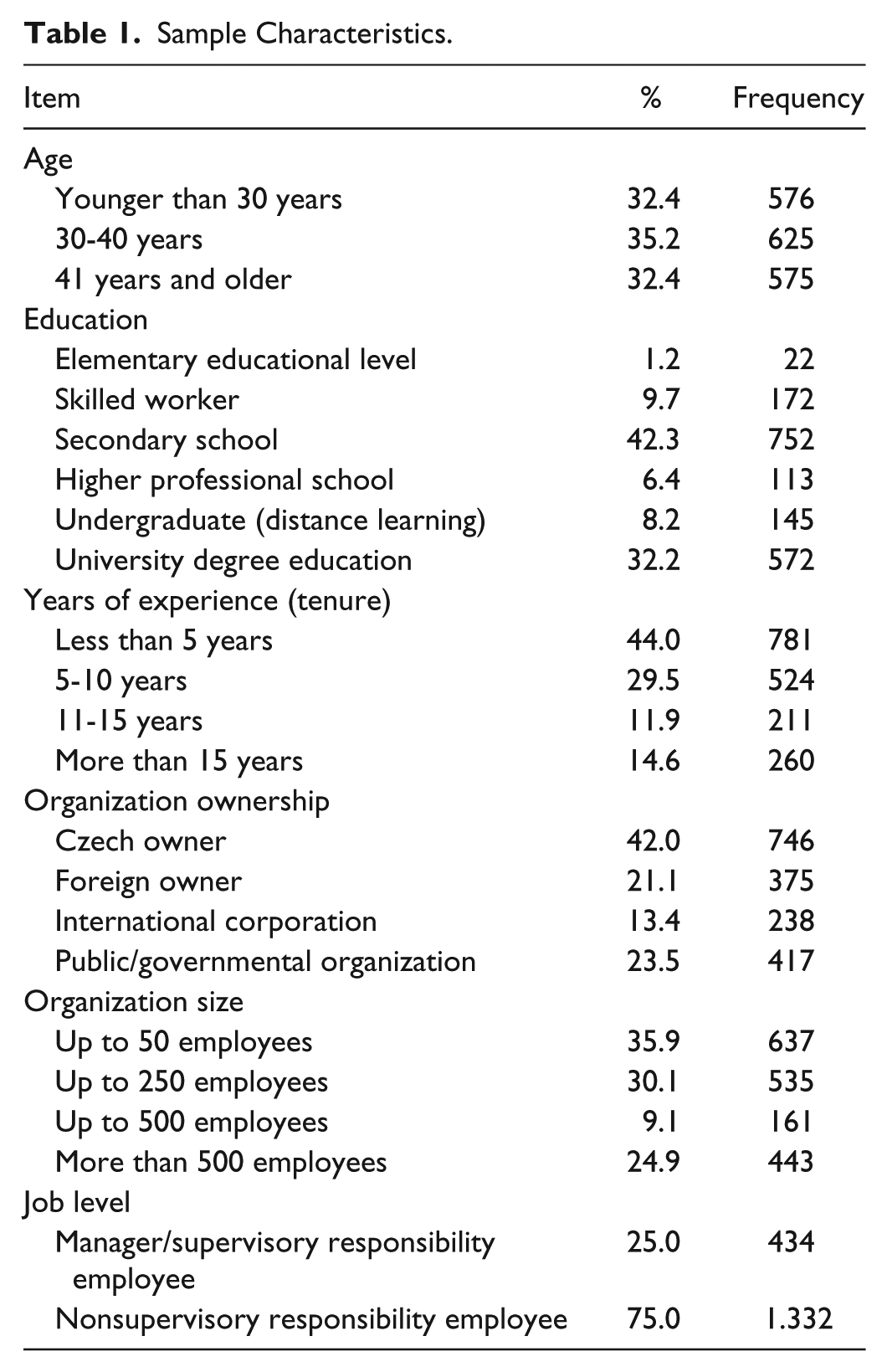
A sample of 1,776 respondents participated in the study. Respondents ranged from 17 to 74 years of age. Their mean age was 36.3 years (SD = 10.80). The sample consisted of 762 men and 1,014 women who lived mostly in the Northeastern regions of the Czech Republic—Hradec Králové, Pardubice, and (partially) Vysočina. Table 1 shows the characteristics of the employees and organizations surveyed. The respondents worked in various occupations covering a wide spectrum of activities (for details, see Table 2).
Sample Characteristics.
Sample Characteristics: Types of Working Activities.
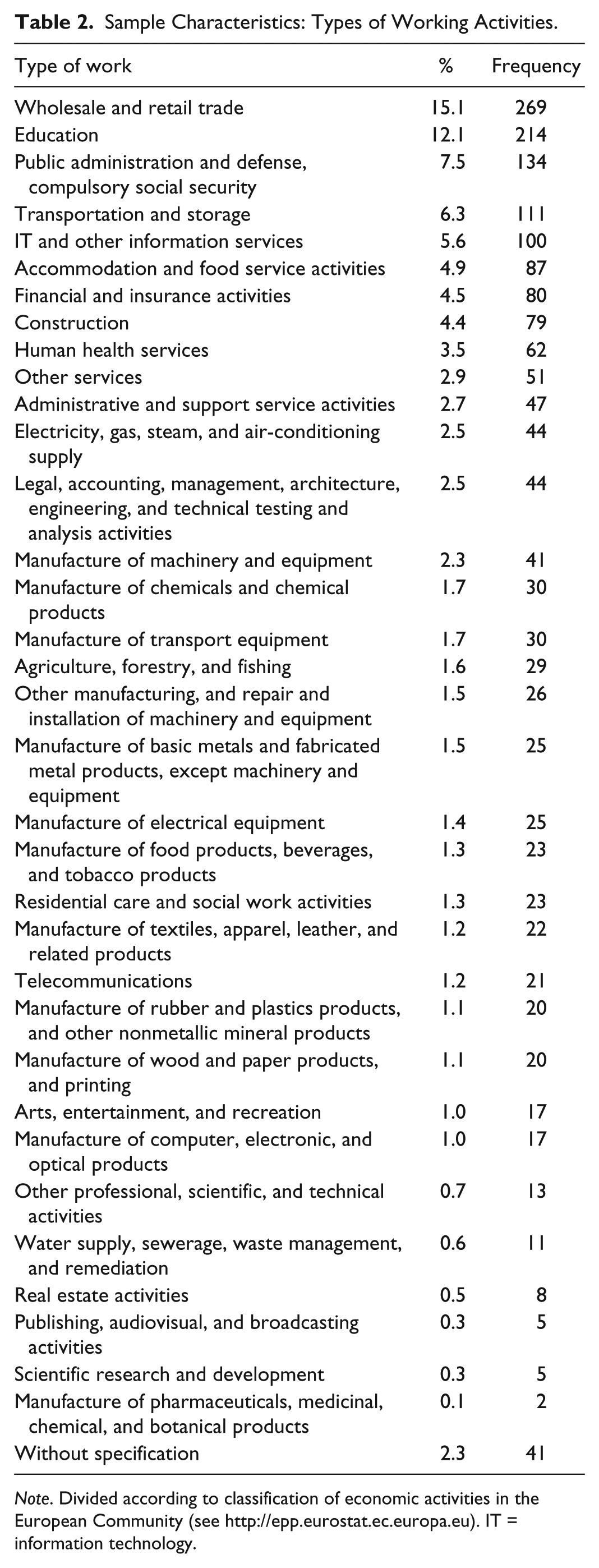
Note. Divided according to classification of economic activities in the European Community (see http://epp.eurostat.ec.europa.eu). IT = information technology.
Measurements
The survey questionnaire consisted of three sections. The first section contained three demographic questions: gender, age, and educational level. The second section contained five questions concerning the characteristics of the respondents’ organizations: ownership (Czech ownership, foreign ownership, international corporation, or public/governmental organization), size (up to 50 employees, up to 250 employees, up to 500 employees, and more than 500 employees), respondents’ job levels (manager/supervisory responsibility, nonsupervisory responsibility), and type of business.
The third section included the 36-item scale “Job Satisfaction Survey,” which was developed by Spector (1985). This scale was used to measure the respondents’ perceived level of job satisfaction. Because the original version is in English, the scale was translated to Czech. The method of parallel translation was used. Two people independently translated the scale from English to Czech, and discussions between the translators resolved discrepancies. The full text of the Czech version of the scale is available on the web page of the original version’s author (see http://shell.cas.usf.edu/~pspector/scales/jsstranslate.html).
The scale was composed of nine subscales describing various facets of job satisfaction: Pay (Cronbach’s α = .85), Promotion (Cronbach’s α = .84), Supervision (Cronbach’s α = .76), Fringe Benefits (Cronbach’s α = .73), Contingent Rewards (Cronbach’s α = .82), Operating Conditions (Cronbach’s α = .64), Coworkers (Cronbach’s α = .70), Nature of the Work (Cronbach’s α = .80), and Communication (Cronbach’s α = .77). The Cronbach’s alpha for total satisfaction was .93. Respondents were instructed to indicate the extent of their agreement with each item on a 6-point scale ranging from strongly disagree (1) to strongly agree (6).
Procedures
We attempted to create a sample of employees from various fields in the business and nonprofit sectors. The data were collected by part-time undergraduate students. Typically, the University of Hradec Králové’s part-time undergraduates are from the Northeastern regions of the Czech Republic. Thus, we collected data from the Hradec Králové and Pardubice regions, along with part of the Vysočina region. Given that the data were collected by part-time students of different ages, working in various types of organizations, who had miscellaneous reasons for studying while they worked, we did not assume any systematic selection bias in the data set. The data used in this study were collected in January and February 2013. Part-time undergraduate students enrolled in management or psychology courses at the University of Hradec Králové’s Faculty of Informatics and Management were invited to administer paper-and-pencil questionnaires in the companies and organizations where they worked. Typically, each undergraduate collected approximately 20 questionnaires. To achieve high statistical power, we made an effort to obtain a sample of approximately 2,000 participants. Ultimately, 1,950 respondents participated in the study; 174 questionnaires were excluded due to various errors and missing values.
Statistical analyses were conducted using Statistica 8 software (Statsoft, Inc.).
Research findings
Table 3 shows the average scores on overall job satisfaction, as well as the average scores on particular facets of job satisfaction. The first hypothesis proposed that there are no significant differences among particular age groups with respect to the level of job satisfaction. One-way ANOVA was used to test this hypothesis by comparing the means of the three age groups. ANOVA did not indicate a significant effect of age on the level of overall job satisfaction, F(1, 1773) = 2.159, p = .116. Moreover, Pearson’s correlation indicated that correlation between age and overall job satisfaction was about zero (r = .03, p = .138).
Average Scores of Overall Job Satisfaction and Particular Facets of Job Satisfaction.

In the next step, we looked for age differences in particular facets of job satisfaction. In most of them, except for promotion, supervision, and operating conditions, we did not find significant differences among the scores for particular age groups. The results revealed significant differences in satisfaction with promotion, F(2, 1773) = 6.98, p < .01, η2 = 0.007, among the age groups. The Tukey Honestly Significant Difference (HSD) post hoc test yielded significant differences in satisfaction with promotion between the youngest and oldest age groups. Older employees were less satisfied than younger ones. Moreover, we found significant differences in satisfaction with supervision, F(2, 1773) = 5.29, p < .01, η2 = 0.010. The Tukey HSD post hoc test yielded significant differences in satisfaction with supervision between the middle and oldest age groups—that is, that older employees are less satisfied. Finally, the results revealed significant differences in satisfaction with operating conditions, F(2, 1773) = 8.80, p < .001, η2 = 0.010. The Tukey HSD post hoc test yielded significant differences between the younger age group and the other age groups. Young employees were more satisfied with operating conditions. In conclusion, we find that the oldest employees were less satisfied with respect to some facets of job satisfaction. With respect to other facets, however, there were no significant differences among the age groups. Thus, H1 was partially confirmed.
The second hypothesis proposed no significant differences between education and level of job satisfaction. One-way ANOVA was used to test this hypothesis by comparing the means of the six levels of education. The ANOVA did not indicate a significant effect of education on the level of overall job satisfaction, F(1, 1770) = 2.066, p = .075. In the next step, we looked for an effect of education on particular facets of job satisfaction. The ANOVA revealed a significant effect of education on satisfaction with supervision, F(2, 1773) = 4.632, p < .001, η2 = 0.013; operating conditions, F(2, 1773) = 6.182, p < .001, η2 = 0.017; coworkers, F(2, 1773) = 4.010, p < .01, η2 = 0. 011; and nature of the work, F(2, 1773) = 3.190, p < 0.01, η2 = 0.009. The Tukey HSD post hoc test showed that differences in the satisfaction of skilled workers versus working undergraduates were mostly significant. Clearly, these analyses confirmed a lower level of job satisfaction among less-educated employees (skilled workers), but did not reveal some type of linear association between level of education and job satisfaction. Thus, H2 was partially confirmed.
The third hypothesis proposed that males are more satisfied with their jobs than are females. The t test for independent samples indicated significant differences between the average scores of overall job satisfaction for males and females (t = 3.143, p < .01). Males were more satisfied than females. However, the effect size was small (Cohen’s d = 0.138). In a subsequent analysis, we checked gender differences for particular facets of job satisfaction. The results revealed that males are significantly more satisfied than females with pay (t = 5.649, p < .001, Cohen’s d = 0.274), promotion (t = 6.752, p < .001, Cohen’s d = 0.326), fringe benefits (t = 2.971, p < .01, Cohen’s d = 0.144), and contingent rewards (t = 3.750, p < .001, Cohen’s d = 0.180). Conversely, females are significantly more satisfied than males with communication (t = 2.171, p < .05, Cohen’s d = 0.131). Thus, H3 was confirmed.
The fourth hypothesis proposed that managers are more satisfied with their jobs than are employees without supervisory responsibility. The t test for independent samples indicated significant differences in overall job satisfaction between managers and nonsupervisory employees (t = 5.779, p < .001). Managers are more satisfied than nonsupervisory employees, with the effect size being moderate (Cohen’s d = 0.311). Furthermore, analysis of particular facets of job satisfaction indicates that managers are significantly more satisfied than are nonsupervisory employees with pay (t = 7.176, p < .001, Cohen’s d = −0.388), promotion (t = 7.663, p < .001, Cohen’s d = 0.697), fringe benefits (t = 5230, p < .001, Cohen’s d = −0.288), contingent rewards (t = 5.506, p < .001, Cohen’s d = 0.296), operating conditions (t = 2.508, p < .05, Cohen’s d = 0.138), nature of the work (t = 6.499, p < .001, Cohen’s d = 0.367), and communication (t = 3.664, p < .001, Cohen’s d = 0.200). The differences were not significant for supervision and coworkers. Thus, H4 was confirmed.
The fifth hypothesis proposed that the highest level of job satisfaction is found in the smallest organizations. One-way ANOVA was used to test this hypothesis by comparing the means of overall job-satisfaction scores in four types of organizations divided by size. The ANOVA revealed the significant effect of organization size on overall job satisfaction, F(3, 1772) = 2.770, p < .01, η2 = 0.004. The Tukey HSD post hoc test showed statistically significant differences only between the smallest organizations of up to 50 employees and organizations with 50 to 250 employees (means of 3.79 vs. 3.68). The effect size was small (Cohen’s d = 0.149).
To clarify the nature of these differences, analyses of particular facets of job satisfaction were performed. The results revealed that satisfaction with pay, F(3, 1772) = 3.641, p < .01, η2 = 0.006, and fringe benefits, F(3, 1772) = 5.528, p < .001, η2 = 0.009, is highest in larger organizations and smallest in organizations with 50 to 250 employees. In contrast, the smallest organizations have the highest satisfaction with contingent rewards, F(3, 1772) = 3.323, p < .05, η2 = 0.006; the nature of the work, F(3, 1772) = 9,045, p < .001, η2 = 0.015; and coworkers, F(3, 1772) = 4,446, p < .01, η2 = 0.007. The smallest organizations also have the highest level of job satisfaction with operating conditions, whereas larger organizations have the lowest, F(3, 1772) = 13.843, p < .001, η2 = 0.023. Finally, the smallest organizations have the highest level of job satisfaction with communication compared with satisfaction levels in larger organizations and organizations with 50 to 250 employees, F(3, 1772) = 8,424, p < .001, η2 = 0.014. Thus, H5 was partly confirmed.
The final hypothesis proposed that public/governmental organizations have the lowest level of job satisfaction. The ANOVA revealed the significant effect of type of organization ownership on overall job satisfaction, F(3, 1772) = 12.71, p < .001, η2 = 0.021. Table 2 shows that overall job satisfaction in public/governmental organizations is lower, whereas in other types of organizations, the level of overall job satisfaction is nearly equal. The Tukey HSD post hoc test only showed statistically significant differences between job satisfaction in public/governmental organizations and other types of organizations. Furthermore, analysis of particular facets of job satisfaction indicates that public/governmental employees are the least satisfied with pay, F(3, 1772) = 29.46, p < .001, η2 = 0.048; fringe benefits, F(3, 1772) = 25.19, p < .001, η2 = 0.041; contingent rewards, F(3, 1772) = 13.00, p < .001, η2 = 0.022; promotion opportunities, F(3, 1772) = 39.52, p < .001, η2 = 0.063; and operating conditions, F(3, 1772) = 28.56, p < .001, η2 = 0.046. Thus, H6 was confirmed.
Discussion and Conclusion
In this study, we aimed to extend our knowledge about the impact of selected personal and work-related factors on job satisfaction in the Czech Republic. We were interested in finding out whether the patterns of associations between particular personal and work-related determinants and job satisfaction in the Czech Republic are similar to those in Western countries. Our data reveal patterns of associations similar to those observed in Western countries. However, some differences were found.
A different pattern of association was found for age. Some Western European countries showed a U-shaped pattern of job satisfaction with age, whereas the Nordic countries showed a linear increase. Although our older data from 2007 (Franěk & Večeřa, 2008) revealed a slightly significant decrease of job satisfaction with age, in the current data, overall job satisfaction was not affected by age. A significant negative correlation with age was found only in the three facets of job satisfaction, namely, promotion, supervision, and operating conditions. Clearly, this finding supports our assumption that newly middle-aged and older employees in the Czech Republic have become relatively adapted to the organizational changes that primarily occurred in the 1990s. The positive message of this outcome is that the level of overall job satisfaction of the older age group did not tend to decline. Conversely, there is a negative message in that the youngest group of Czech employees have a low level of satisfaction compared with the U-shaped relationship between age and job satisfaction observed in some Western European countries.
Because of the paucity of further relevant data, we can offer only a relatively speculative explanation. First, Czech employers often complain that graduates of various types of schools lack appropriate preparation for job requirements (Doucek, Maryška, & Novotný, 2013; Kalousková & Vojtěch, 2008). According to this critique, Czech schools, colleges, and universities do not appropriately educate their graduates for the potential demands of the job market. Employers argue that education often suffers from a lack of practical skill and experience training (e.g., communication, team work, and trustworthiness). It might be that because of inappropriate preparation by the Czech schools, entry-level employment is unpleasant or even stressful for young employees, resulting in a lower level of perceived job satisfaction. Second, it has often been reported (Kalousková & Vojtěch, 2008) that young Czech graduates have unrealistic expectations about high wages or possibilities of rapid promotion, which also can lead to perceived job dissatisfaction. These unrealistic expectations may also be a manifestation of naive hopes that emerged at the beginning of the period of the socioeconomic transition. In the Czech Republic, the younger generation did not always have realistic hopes about the rapidity of success in the new “capitalist” society (e.g., Kvapil, 2013). Interestingly, Olson et al. (2006) have compared young adults’ ideals about future jobs in post-Communist CEE countries and the United States, finding that wanting a well-paying job is associated with poorer economic conditions, whereas preference for career success is associated with better economic conditions.
It was observed that the associations between educational degree and the level of job satisfaction in the Czech Republic are similar to the patterns of those associations observed in Western countries. More specifically, a higher degree of education does not mean a higher level of job satisfaction. The detailed analysis of our data revealed significant differences between the job satisfaction of skilled workers and that of employees with higher educational levels. Unfortunately, the category of employees with an elementary-level education was almost missing in our sample. Thus, the data did not enable a precise analysis of the patterns of those associations in groups of employees with lower educational levels. Conversely, no increase in job satisfaction for workers with higher educational levels was observed. As already stated, education that does not result in a higher salary, promotion, or prestige tends to lead to dissatisfaction. In the Czech Republic, the situation is similar to that in Western Europe, where the rate of bachelor’s or master’s degree holders is gradually increasing (Koucký, 2009). Conversely, the number of prestigious, well-paid jobs is limited.
As we predicted, a higher overall job satisfaction was found in men. It turned out that men were overall more satisfied than women with pay, promotion, fringe benefits, and contingent rewards. Males’ higher job satisfaction with these job facets is consistent with the well-established fact that, on average, in the Czech Republic women are paid less than men. Women also have fewer possibilities for promotion (e.g., Večerník, 2001).
Furthermore, it was confirmed that organizational size and type also affect job satisfaction. Consistent with the above-mentioned findings, the highest overall job satisfaction score was found in the smallest organizations (i.e., those with up to 50 employees). In small organizations, employees are satisfied with contingent rewards, the nature of the work, operating conditions, coworkers, and communication. In contrast, employees in the largest organizations are satisfied with pay and fringe benefits (employer size-wage effect). The lowest level of job satisfaction is found in organizations of approximately 50 to 250 employees, which cannot offer monetary rewards similar to those offered by large companies or (conversely) a level of flexibility and informal relationships similar to those offered by the smallest organizations.
We observed a low level of overall job satisfaction in public/governmental organizations that was not observed in public organizations in the West. Generally, the public sector offers lower pay and benefits than the private sector, along with fewer and slower career advancement opportunities (Rainey, 1991). This was confirmed by our data. Moreover, dissatisfaction with working conditions was also identified, which most likely reflects the poor equipment and facilities that are quite often typical of Czech public/governmental organizations. Whereas lower salaries in the public sector are typically compensated by job security or some form of social prestige, in the Czech Republic, public employees do not enjoy such advantages. Because of political instability, government organizations are periodically restructured and suffer from budget cuts. Moreover, according to public opinion, government employees are often perceived as parasitic on the private sector.
Finally, there is the question of the reason for the often-reported low level of job satisfaction in the Czech Republic. Our analysis of the determinants that influence job satisfaction did not satisfactorily clarify this phenomenon because patterns of associations between particular determinants and job-satisfaction levels showed many similarities with findings obtained in Western countries. Thus, any explanation should utilize generally known facts and associations. It is very likely that a crucial factor influencing the overall low level of job satisfaction in the Czech Republic is the level of general satisfaction with life. In the Czech Republic, life satisfaction levels are substantially lower than in economically developed Western countries (e.g., Böhnke, 2008). As stated above, job satisfaction is correlated with life satisfaction (e.g., Judge & Watanabe, 1993). Recently, Georgellis and Lange (2012) analyzed associations between life satisfaction and job satisfaction using data from the European Values Survey. The results showed that the Czech Republic is one of the countries with the strongest link between life satisfaction and job satisfaction.
In addition, we assume that the low level of overall job satisfaction in the Czech Republic has some link to rapid and substantial processes of economic transition, which in the 1990s elicited much pressure on both employees and society as a whole. These processes eroded the level of general life satisfaction in the Czech Republic, which in turn affected the level of job satisfaction.
This study has several implications. As noted, our data revealed the low satisfaction levels among public employees. Because this sector is crucial for the effective functioning of both various public services and governmental administration, the implications of this study indicate the need for a human resources strategy that will improve public employees’ positive feelings in the workplace. Whereas the budget in this sector is always limited, one of the recommendations may involve an improvement in operating conditions along with (at a minimum) the establishment of fair methods of recognition, promotion, and rewards. Moreover, another way to increase public employees’ level of job satisfaction would be to increase the social prestige of the public/governmental sector by changing public perceptions of public organizations.
Next, on the assumption that the lower level of job satisfaction among young people is due to inappropriate preparation by the schools, educational authorities should implement additional approaches. Although universities have broader goals than preparing their graduates for work, it would be quite reasonable to change one aspect of the Czech university. In their complaints about the educational process, employers often note that Czech universities are much more liberal institutions than Western universities in terms of demands on the students. There are no strict demands with respect to deadlines, the precision of student work, or requirements for obtaining credits (Špíka, 2008). We believe that focusing on these deficiencies would be beneficial not only for employers and young, first-time employees but also for the schools themselves.
Limitations
Our research had several limitations. Respondent selection is the first limitation. As we have explained, the data were primarily collected from two regions of the Czech Republic—Hradec Králové and Pardubice. However, this deficiency is somewhat ameliorated by the fact that the Czech Republic has a socioeconomic composition that is relatively homogeneous. The country consists of 14 regions. The region of the capital city of Prague is a bit different (e.g., it has the highest salaries and the lowest rate of unemployment; moreover, the prevalent political orientation is right-wing). Also different are two regions that in the past had a great deal of heavy industry but now suffer a higher rate of unemployment (i.e., the Moravskoslezský and Ústecký regions). The Hradec Králové and Pardubice regions have relatively higher living standards and a lower rate of unemployment. Thus, the data gathered here can be applied to the greater Czech Republic.
A further limitation is that the category of employees with lower educational levels was underrepresented in our sample. Another possible limitation is the method of data collection by part-time students. However, this disadvantage is partially compensated for by the diversity of those students’ jobs because they were working in different areas of the private and public/governmental sectors. The last limitation of this study is that this research did not analyze all work-related factors. Income, which is often assumed to affect employee performance, was not examined. In the Czech Republic, it is not common to inform others about the level of one’s own salary because quite often, people are afraid of the envy of their colleagues. Thus, had we asked our respondents this question, they might have refused to complete the questionnaire or would have left the item blank. Despite these limitations, we believe that our data provide results that enlarge our findings on job satisfaction in CEE countries.
Footnotes
Declaration of Conflicting Interests
The author(s) declared no potential conflicts of interest with respect to the research, authorship, and/or publication of this article.
Funding
The author(s) disclosed receipt of the following financial support for the research and/or authorship of this article: The work was supported by a research grant from the Faculty of Informatics and Management at the University of Hradec Králové (FIM UHK Grant No. 2211/2012). The funders had no role in the study design, the data collection and analysis, the decision to publish, or the preparation of the manuscript.