




Abstract
This study investigated how visual framing influences discrete emotional responses, empathy, behavioral intentions, and efficacy in reaction to visual solutions journalism. A 2 (story topic: drug addiction, homelessness) × 4 (visual frame condition: no photo, solution-only, problem-only, combination) mixed design experiment revealed that images showing only social problems elicited the lowest levels of compassion in viewers, challenging long-held assumptions about the utility of social problem imagery. Image pairs showing both problems and solutions were revealed to be effective at eliciting moderate levels of emotional response, including hope, compassion, and empathy.
One of the aims of photojournalism is to evoke empathy for people in need and to inspire audience engagement with social issues. Generations of photojournalists have photographed people in the midst of suffering to foster concern (Chapnick, 1994). Although such pictures of hardship are considered by many photojournalists to be the most effective at arousing compassion, they are the source of extensive ethical debate about traumatizing audiences with disturbing content (Emmett, 2010). Another worry is that news coverage of social ills can lead to compassion fatigue, whereby audiences become so overwhelmed or hopeless that they disengage from coverage of crucial issues (Moeller, 1999).
Solutions journalism approaches have recently tried to combat pessimistic and avoidant responses in audiences by producing stories about social issues that also focus on attempts to solve the problems. The Solutions Journalism Network, an organization dedicated to studying and understanding social issue coverage, contends that solutions journalism may increase feelings of efficacy, optimism, and engagement in news consumers (Curry et al., 2016; Curry & Hammonds, 2014), although the peer-reviewed literature is less definitive (Dahmen et al., 2019; McIntyre, 2019). A key question is whether a visual approach to solutions journalism might be more effective at generating concern, while also minimizing discomfort and retaining audience interest, compared with photojournalism of suffering alone. Although scholarship on visuals in solutions journalism has lagged behind research about text, some studies have shown that visual framing emphasizing solutions leads to higher levels of narrative engagement and behavioral intentions (Dahmen et al., 2019) and lower levels of negative affect (McIntyre et al., 2018) than visual framing emphasizing problems.
Considering that one of the key tenets of solutions journalism is the inclusion of both a problem and a potential solution in a story, it follows that visual solutions journalism should also depict both of these important aspects (Midberry & Dahmen, 2020). In addition, while a solution photograph can lead to more positive affective responses, a problem picture may be necessary to spur empathy and compassion (Midberry & Dahmen, 2020). Therefore, it is important to explore whether a combination of problem and solution photographs leads to different affective responses than problem or solution photos alone or a story without any pictures at all. Using a 2 (story topic: drug addiction, homelessness) × 4 (visual frame condition: no photo, solution-only, problem-only, combination) mixed design experiment, this study investigated whether visual framing arouses a beneficial mix of affective responses to leave people concerned and interested in solutions journalism stories.
Literature Review
Solutions Journalism and Audiences
Solutions journalism stories investigate the core causes of social issues, paired with detailed reporting on responses to these problems (Bansal & Martin, 2015). While some reporting might make brief mention of ways to address problems, solutions journalism stories focus substantially on possible solutions (McIntyre & Lough, 2019). It also includes information about ground-level efforts to solve social problems in addition to top-level policy solutions (Bansal & Martin, 2015). Fundamentally, solutions journalism is about creating a holistic picture of social issues to inform audiences and to offer ideas to other communities dealing with similar issues.
The argument for a different approach to reporting on challenges facing communities, with an emphasis on social action, is not new. Proponents of civic journalism, also called public journalism, called for news producers to go beyond the mere provision of information about issues, to promote public participation in the democratic process (Merritt, 1995). In this framework, journalists remain objective in their coverage but the goal of reporting is to encourage civic engagement. The 1990s saw the rise of peace journalism, an approach that actively emphasized more reporting on efforts to resolve conflict and incorporate on-the-ground voices into stories (Hanitzsch, 2004). Advocacy journalism scholars have argued that journalists should actively promote perspectives that are under- or misrepresented to address imbalances in societal power (Waisbord, 2009). Solutions journalism can be conceptualized as a type of constructive journalism, “an umbrella term that encompasses several ways to practice socially responsible journalism” (Lough & McIntyre, 2021, p. 13).
A central goal of solutions journalism is to increase public discourse, understanding, and engagement with social issues (Bansal & Martin, 2015). In a series of studies conducted by The Solutions Journalism Network and the Engaging News Project, audiences indicated they would be slightly more likely to read stories with solutions-oriented headlines (Curry & Stroud, 2016), they stayed on pages longer when reading solutions stories compared with problem-only stories (Curry et al., 2016), and they reported greater optimism and efficacy when reading solutions journalism stories compared with problem-only stories (Curry & Hammonds, 2014). In addition, public discourse on the topic of poverty appeared to increase in one community after a series of solutions articles ran in the local newspaper (McGregor & Stroud, 2016). Another of the group’s studies found that focus group participants from an underserved community reported feeling more inclined to seek information and become involved in an issue when it was covered with a solutions approach (Wenzel et al., 2016).
The peer-reviewed literature supporting these findings is growing. An experiment on constructive journalism in children’s news demonstrated that child participants experienced lower levels of anger, sadness, and fear and higher levels of joy when they viewed stories emphasizing solutions as opposed to ones that focused on problems (Kleemans et al., 2017). Yet, the story frame did not affect participants’ behavioral intentions (Kleemans et al., 2017). Another experiment (McIntyre, 2019) found that solutions stories increased positive affect when the topic was personally relevant, and overall reduced readers’ negative feelings compared with traditional stories. However, once again, these affective responses were not shown to translate into behaviors. On the contrary, in a constructive journalism experiment that compared a solutions and a catastrophic frame, participants in the solutions condition reported higher levels of positive affect and behavioral intentions to engage in prosocial actions (Baden et al., 2019).
Framing Effects of Visual Solutions Journalism
Only select solutions journalism studies have examined visual approaches (Dahmen et al., 2019; Lough & McIntyre, 2018; McIntyre et al., 2018; Midberry & Dahmen, 2020). Audiences respond to pictures differently than text, and the inclusion of news photographs can increase the amount of time readers spend with articles and help them retain information (Zillmann et al., 2001). Pictures elicit emotion more effectively than text alone and some visual frames tap into specific emotions (Iyer & Oldmeadow, 2006), particularly compassion (Höijer, 2004; Midberry, 2020). Images can influence political attitudes (Aday, 2010), empathy (Höijer, 2004; Midberry, 2020), and ethical reasoning (Coleman, 2006).
One significant way images and other media artifacts affect people is through the process of framing. Framing of any media text involves selecting certain elements of a narrative and making them more salient to audiences (Entman, 1993). When it comes to social issues, framing can perform four functions: define problems, diagnose causes, convey moral judgments, and offer potential remedies (Entman, 1993). Unless individuals actively contest these messages in a text, they are likely to accept the dominant meaning conveyed through framing (Entman, 1993; Kahneman & Tversky, 1984). However, just as much of solutions journalism has focused on texts instead of visuals, so too has framing scholarship.
For visuals, framing involves the choices of image content and composition, which can affect the interpretation of the message (Fahmy & Alkazemi, 2017). In relation to text, visual frames are often less noticeable to audiences, and the influence of visual frames operates under the surface (Coleman, 2010; Messaris & Abraham, 2001). Visual and textual frames also work together to provide a comprehensive message that has been underexplored and critiqued in framing research (D’Angelo et al., 2019). Answering calls to further framing theory while also connecting its tenets with solutions journalism research, a key question for this study is whether the aims of solutions journalism are best achieved with or without images and, if images prove to more effectively engage audiences than text alone, whether visual framing that emphasizes problems, solutions, or a combination is optimal.
Several projects have shed light on the differing affective, attitudinal, and behavioral effects produced by problem versus solution visual frames. McIntyre et al. (2018) explored the effects of story-photo congruency in solutions and conflict news stories. Participants who read a solutions journalism story about recidivism experienced higher levels of negative affect when seeing a problem image, compared with a solution or neutral image; however, there was no effect of the visual frame on positive affect. McIntyre et al. (2018) also found that a neutral picture led to significantly more interest than a problem picture. The visual framing did not influence efficacy, behavioral intentions, or actual behavior.
Another study revealed that participants who read a solutions journalism article paired with a solution picture experienced higher levels of behavioral intentions and narrative engagement with the story, but only for participants who read a story about addiction, not stories about homelessness or climate change (Dahmen et al., 2019). There was no influence of the visual frame condition on levels of efficacy or interest. Dahmen et al. (2019) also found that solutions visual framing predicted narrative engagement, and narrative engagement predicted interest, efficacy, and behavioral intentions but only for the addiction and climate change stories.
A pair of studies on reactions to imagery about climate change offer relevant insights for visual solutions journalism. In a Q-sort study, participants rated images of climate change damage as high for being attention-grabbing and important but low in terms of evoking feelings of efficacy (O’Neill et al., 2013). Pictures representing various solutions were not rated highly as attention-grabbing but were rated the highest for efficacy. Hart and Feldman (2016) reported participants who viewed a picture of solar panels responded with higher levels of hope than those who saw a picture of a flood and those who saw no photo. The flood image led to higher levels of anger than images of the solar panels and of an environmental support march. Feelings of hope and fear were also related to positive attitudes toward climate protection policies, but anger was not.
Moving Theory Forward: Additional Frames, Discrete Emotions, and Empathy
Although past research has measured the varying influence of problem-only versus solution-only visual frames, there are no studies that have investigated differing effects between these two frames and a combination visual frame and the absence of images. This makes sense, as most solutions journalism stories show only images that depict the problem or the solution (Lough & McIntyre, 2018; Midberry & Dahmen, 2020). Yet, in a proposed set of best practices for visual solutions journalism, Midberry and Dahmen (2020) argued visual stories should provide comprehensive coverage of the social issue being reported by depicting both. They claimed that a visual combination best reflects the solutions journalism aim because pictures depicting a problem would evoke the greatest empathy and compassion, while pictures of a solution would facilitate hope, efficacy, and intentions of future engagement. The present study aimed to test this notion and to explore the effects of not including pictures in solutions stories.
In previous experiments on this topic, Dahmen et al. (2019) and McIntyre et al. (2018) employed positive and negative valence as outcome variables, which shed light on the general direction of affective responses to various visual frames in solutions journalism stories. Measuring valence is an approach derived from a dimensional model of emotion that views emotion as a generalized motivational state that can be understood by assessing levels of arousal and valence (Nabi, 2010). In contrast, the discrete emotion paradigm examines specific emotional states to understand the particular action tendencies associated with them (Nabi, 2010). Hart and Feldman (2016) measured levels of the discrete emotions hope, anger, and fear in response to images of environmental challenges and their solutions. The current study similarly used discrete emotions as outcome variables, exploring the effects of problem and solution visuals on participants’ levels of sadness, anger, fear, disgust, happiness, hope, and compassion.
Discrete emotions have specific action tendencies (Lazarus, 1991), and understanding how these are affected by different visual frames might shed light on audience engagement with stories about social issues. Sadness largely causes people to withdraw and enter a state of inaction; however, it can also prompt a contemplative state conducive to attitude change (Lazarus, 1991; Nabi, 2002). Anger typically induces a desire to take action against the source, which can productively focus one’s attention on a solution or counterproductively lead to impulsive responses (Nabi, 2002). Fear usually motivates people to distance themselves from what is threatening, primarily leading to avoidance behaviors (Lazarus, 1991; Nabi, 2002). When people feel disgusted, they often turn away and reject the source (Nabi, 2002). Both happiness and hope have approach tendencies, with happiness leaving people feeling more open and trusting and hope helping to alleviate feelings of distress (Nabi, 2002).
Compassion elicits concern for another’s pain, and it can prompt people to attempt to reduce hardship (Lazarus, 1991; Nabi, 2002). Compassion is usually experienced as unpleasant or as a combination of positive and negative feelings (Goetz et al., 2010). Although compassion and empathy are often used interchangeably, we adopt the view that empathy is not an emotion but “the capacity to understand and respond to the unique affective experiences of another person,” which can encompass both positive and negative mental states (Decety & Jackson, 2006, p. 54).
Compassion and empathy are essential concepts to examine in terms of visual solutions journalism, as photojournalists have long argued that images of social problems are the most effective way to generate concern in audiences (Kennedy, 2019). The justification for publishing and venerating disturbing images is based on the assumption that they are needed to arouse compassion and empathy that will lead to action (Emmett, 2010). Building on these industry arguments, Midberry and Dahmen (2020) asserted that problem images are necessary for visual solutions journalism to cause compassion and empathy responses.
Based on this theoretical background, these hypotheses and research questions were posed:
Method
To explore these hypotheses, an online 2 (story topic: drug addiction, homelessness) × 4 (visual frame condition: no photo, solution-only, problem-only, combination) mixed design experiment was conducted with participants from Mechanical Turk (MTurk) living in the United States. Story topic was within-subjects, and photo condition was between-subjects. So, all participants received stories about both topics but saw only one of the four photo conditions. This enabled exploration of the effect of visual frames across two different types of story content. This study received institutional review board approval. Our experiment focused on the topics of drug addiction and homelessness because these are two significant public health issues that affect communities in all regions of the United States. These issues have been covered substantially with a solutions journalism approach, enabling a wide selection of textual and visual reporting to use for authentic stimulus material.
Photography Pilot Test
Researchers conducted a pilot test to ensure the images in the visual frame conditions best represented problems and solutions. One hundred thirty participants on MTurk rated 30 pictures in exchange for US$1.00. Two participants failed to respond to a majority of the questions, leaving 128 participants. The sample was 50% male, 49% female, and 1% nonbinary. Ages ranged between 21 and 70 years old, with a median of 35 (M = 37.59, Mdn = 35), and 78.9% identified as non-Hispanic White, 7% Hispanic/Latinx, 7.1% Asian/Asian American, 4.7% Black/African American, and 2.3% Multiracial. Participants held slightly more liberal (9 = very liberal) than conservative (1 = very conservative) political ideologies (M = 5.97, SD = 2.426). More than half (55.5%) earned a BA or graduate degree.
The images and measures were presented to MTurk participants via Qualtrics. Half of the participants viewed news photographs about homelessness and half photographs about drug addiction. In each story topic, 15 pictures were intended to represent solutions and the other 15 were intended to represent problems. Using 9-point semantic differential scales, participants rated each of the images according to whether they: best represented a problem or a solution; evoked positive and negative feelings; were interesting or uninteresting; and were realistic or unrealistic. The pictures were presented in randomized order, one at a time, with caption information below the images.
The results of the pilot test were analyzed and used to guide the selection of eight final pictures for the experiment. Photos with mean scores of 7.00 and above were interpreted as clearly presenting solutions and ones with mean scores of 3.00 and below as clearly presenting problems. Images with mean scores in the midrange were not considered. Mean scores for positive and negative valence were evaluated for preliminary insight into the general direction of affective responses to the pictures. As anticipated, images rated as problem photos evoked higher levels of negative valence and lower levels of positive valence, and this was reversed for the solution photos. All the images selected had mean ratings of 6.70 and above for being realistic. Median ratings of interestingness were examined to ensure that photos across conditions had homogeneous variability in this measure.
Main Study Procedure
MTurk participants took part in the study, using the Qualtrics platform, in exchange for US$1.50. They first reported demographic information. Then they read one article about drug addiction or homelessness, displayed in randomized order. The stories were presented on an individual Qualtrics page, with the headlines at the top in bold, followed by a byline for Associated Press, and the story below. After reading the text, participants were randomly assigned to a condition where they either saw no photos, two problem photos, two solution photos, or a combination of one problem and one solution photo. In the two-photo conditions, images were presented one at a time, in randomized order, with caption information and Associated Press bylines underneath. After stimuli presentation, participants answered a series of 9-point Likert-type scale questions measuring the dependent variables. Then they were presented with the second story topic with the same image condition as the first article.
Participants
There were 346 MTurk participants in the main study. MTurk workers have been found to be viable participants, displaying similar biases and following directions just as well as traditional participants (Paolacci et al., 2010). Those who participated in the pilot study and took the main study were compensated, but they were removed from the data. Three attention check questions asked participants to select a specific number answer for scale ratings. Six participants failed by missing two or three of the attention checks, and their data were discarded. 1 This left 340 participants used in the analysis. An a priori power analysis conducted using G*Power 3.1.9.6 (Faul et al., 2007) determined the minimum sample size to reach 95% power for detecting a large effect of .40 (Cohen, 1988) with a significance level of α = .05 was N = 112 for our planned two-way mixed analysis of variance (ANOVA) analysis. Therefore, our sample size was more than adequate.
Participants were 50.6% male, 48.9% female, and 0.6% non-binary. Ages ranged from 19 to 73-years-old (M = 39.26, Mdn = 36). Most participants identified as non-Hispanic White (75.6%) followed by, 7.3% Hispanic/Latinx, 5.6% Asian/Asian American, 5.6% Black/African American, 4.1% Multiracial, 1.5% American Indian/Alaska Native, and 0.3% other. Participants held slightly more liberal (9 = very liberal) than conservative (1 = very conservative) political ideologies (M = 6.02, SD = 2.270). A majority of participants, 58.2%, earned a BA or graduate degree.
Stimulus Materials
To maximize ecological validity, stimulus articles and photographs were drawn from actual news sources. Text and image captions were modified to fit the parameters of the experiment and eliminate potential confounds. Actual names were replaced with popular first and last names in the United States to prevent uncommon names from activating biases. The stimulus articles and photographs used in the experiment can be viewed in Online Appendix 1.
Stimulus articles
The articles were retrieved from the Solutions Journalism Network Story Tracker, an online archive of articles exemplifying solutions journalism. The article about drug addiction came from NPR and the homelessness story from the Christian Science Monitor. Each was edited to approximately 500 words, with similar story structures, and presented as being from the Associated Press.
Stimulus photographs
Pictures were gathered from various news sources: Associated Press, Getty Images, NPR, The New York Times, and The Seattle Times. Captions were edited to one short sentence that included subjects’ edited names and a basic description of the action depicted. Images were carefully selected to minimize potential confounds. Only White subjects were depicted. All shots were medium or medium-long shots; subjects’ faces were always at least partially shown.
Outcome Variables
Discrete emotions
Following Nabi (2010), participants rated from 1 (did not feel [target emotion] at all) to 9 (felt extremely [target emotion]) the extent to which they felt each emotion. Composite measures were constructed as follows: happiness averaged responses for “happy,” “joyful,” and “cheerful” (α = .903); hope averaged responses for “hopeful,” “optimistic,” and “encouraged” (α = .919); compassion averaged responses for “compassionate” and “sympathetic” (α = .886); sadness averaged responses for “sad,” “disheartened,” and “upset” (α = .805); anger averaged responses for “angry,” “annoyed,” and “irritated” (α = .899); fear averaged responses for “fearful” and “scared” (α = .805); and disgust averaged responses for “disgusted” and “sickened” (α = .859).
Empathy
Participants rated from 1 (not at all) to 9 (very much) the extent to which they: “Thought about how you would feel if you were in this situation”; “Felt emotions similar to what the people in this situation might have felt”; and “Thought about how the people in this situation felt.” These questions were modified from Levy and Freitas (2002). Responses were averaged to create a composite variable (α = .861) for empathy.
Efficacy
Participants rated from 1 (strongly disagree) to 9 (strongly agree) the extent to which they agreed with questions modified from Curry and Hammonds (2014) and McIntyre et al. (2018): “There are ways to effectively address the problem presented in the story,” “Nonprofit organizations can find effective solutions to the problem presented in the story,” “The government can find effective solutions to the problem presented in the story,” “I think I could contribute to a solution to the problem presented in the story,” “I think I understand the issue better after reading the story,” and “I think I could explain the issue presented in the story to someone else.” Responses were averaged to create a composite variable (α = .797) for efficacy.
Behavioral measures
Participants rated from 1 (not at all) to 9 (extremely) how likely they would: seek out media about the issue presented, try to learn more about the issue presented. Participants were also asked, assuming the story appeared as a post in their social media feed, how likely (1 = not at all; 9 = extremely) they would be to: share the post, comment on the post, and click the like button or upvote the post. Responses were averaged to create a composite variable (α = .932) for behavioral intentions, guided in part by McIntyre et al. (2018) and Dahmen et al. (2019).
Results
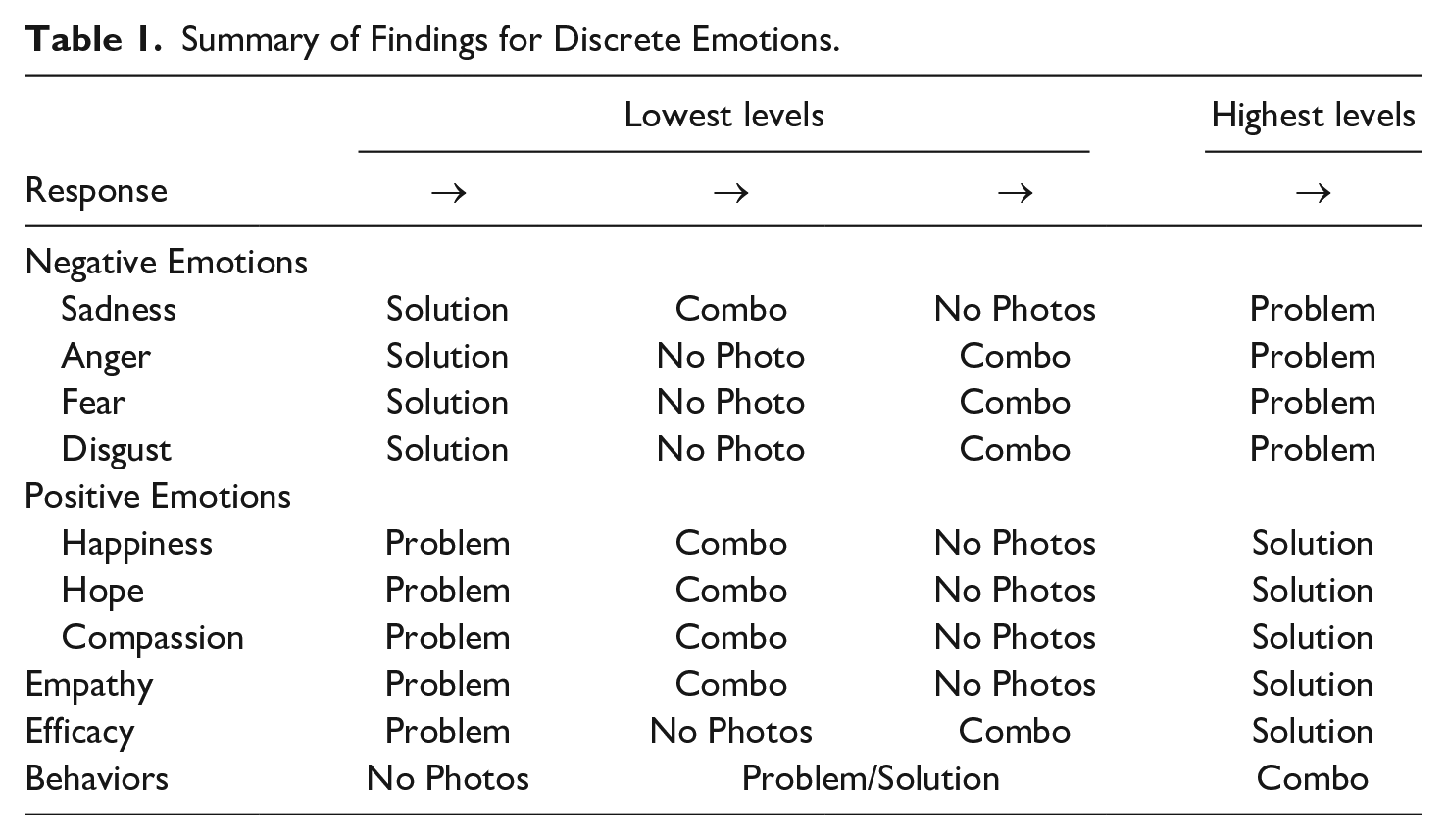
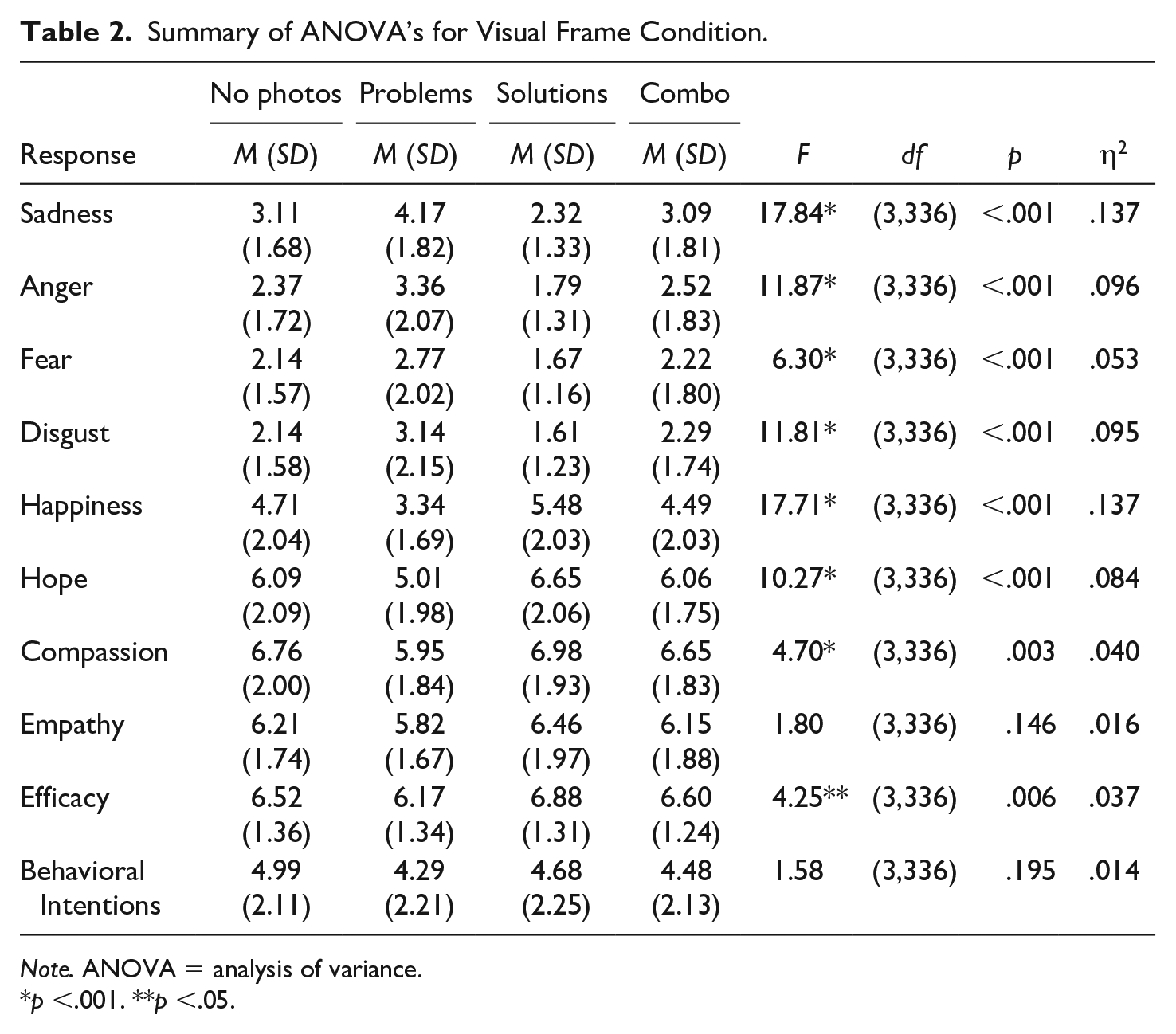
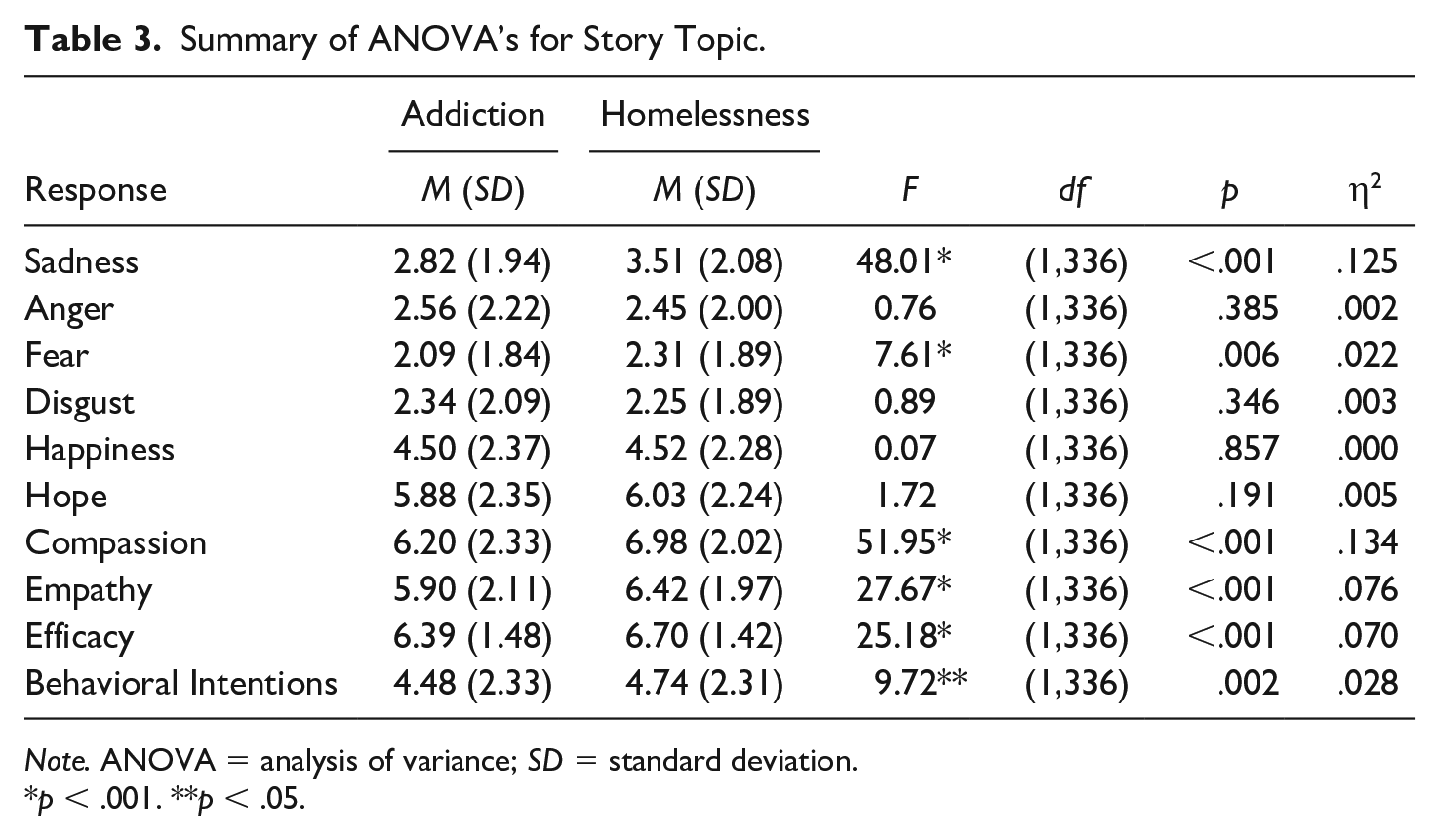
The hypotheses focused on the effects of visual frames on discrete emotional responses to solutions stories. To isolate the effects of the visual frames, the analysis assessed whether effects were also driven by story topics or interactions. A series of two-way mixed ANOVA’s were conducted to determine the effects of visual frame condition, story topic condition, and interactions on the seven discrete emotions, empathy, efficacy, and behavioral intentions. No significant interaction effects were found. The main effects of the visual frame were present for all discrete emotions and efficacy but not for empathy or behavioral intentions. Results are summarized in Tables 1 and 2. There were main effects of the story topic on sadness, fear, compassion, empathy, efficacy, and behavioral intentions (see Table 3). Bonferroni post hoc comparisons pinpointed significant differences (α = .05) between condition groups, which are explained below.
Summary of Findings for Discrete Emotions.
Summary of ANOVA’s for Visual Frame Condition.
Note. ANOVA = analysis of variance.
p <.001. **p <.05.
Summary of ANOVA’s for Story Topic.
Note. ANOVA = analysis of variance; SD = standard deviation.
p < .001. **p < .05.
Previous research has shown that viewers respond more empathically to images depicting only one person (Slovic, 2007). Therefore, the problem and solution image sets for both story topics included a picture of one person and another with two people. In the combination visual frame condition, half the participants viewed only pictures with one subject and the other half saw ones with two people. As there were no significant differences in mean scores of the outcome variables based on the number of people depicted, the responses from all the participants in the combination condition were collapsed.
Discrete Emotions and Empathy
Happiness and hope
Happiness
Participants in the problem-only condition reported significantly lower levels of happiness (M = 3.34, SD = 1.69) than in the combination (M = 4.49, SD = 2.03), no photos (M = 4.71, SD = 2.04), and solution-only (M = 5.48, SD = 2.03) conditions. The solution-only photos yielded significantly higher levels of happiness than the combination photos.
Hope
Those in the problem-only photo condition reported significantly lower levels of hope (M = 5.01, SD = 1.98) than participants in the combination-photo (M = 6.06, SD = 1.75), no photos (M = 6.09, SD = 2.09), and solution-only (M = 6.65, SD = 2.06) conditions.
H1 & RQ1
Based on these results, partial support was found for
Sadness, anger, fear, and disgust
Sadness
There were significantly higher levels of reported sadness in the problem-only photo condition (M = 4.17, SD = 1.82), compared with the no photos (M = 3.11, SD = 1.68), combination photo (M = 3.09, SD = 1.81), and solution-only (M = 2.32, SD = 1.33) conditions.
Anger
Participants in the problem-only photo condition indicated feeling significantly higher levels of anger (M = 3.36, SD = 2.07) than in the combination photo (M = 2.52, SD = 1.83), no photos (M = 2.37, SD = 1.72), and solution-only (M = 1.79, SD = 1.31) conditions. In addition, seeing a combination of photos led to significantly higher levels of reported anger than seeing just solution photos.
Fear
The problem-only photo condition produced significantly higher levels of stated fear (M = 2.77, SD = 2.02) than the solution-only (M = 1.67, SD = 1.16) photo condition.
Disgust
Participants in the problem-only photo condition reported significantly higher levels of disgust (M = 3.14, SD = 2.15) than in the combination (M = 2.29, SD = 1.74), no photos (M = 2.14, SD = 1.58), and solution-only (M = 1.61, SD = 1.23) photo conditions. Also, people who viewed a combination of photos experienced significantly greater disgust than those who saw solution-only photos.
H2 and RQ2
It was predicted that problem-only photos would lead to the highest levels of negative discrete emotions and solution-only pictures would yield the lowest. The results provided partial support. For sadness, anger, and disgust, the problem-only condition evoked significantly higher responses than the other three conditions, and the solution-only condition led to significantly lower levels of these emotions compared with the problem-only and combination conditions. In the case of sadness, the solution-only condition also piqued lower levels in relation to the no photos condition. There were no significant differences in sadness, anger, or disgust between the no photos and combination conditions. For fear, the only significant differences were between the problem-only and solution-only conditions, with the problem-only images evoking more fear.
Compassion and empathy
Compassion
People in the problem-only photo condition experienced significantly lower levels of compassion (M = 5.95, SD = 1.84) than in the no photos (M = 6.76, SD = 2.00) and solution-only (M = 6.98, SD = 1.93) photo conditions.
Empathy
Photo condition had no significant effect on empathy, F(3, 336) = 1.80, p = .146, η2p = .016.
H3 and RQ3
This hypothesis proposed that problem-only photos would lead to the highest levels of compassion and empathy. Reported empathy was not affected by photo condition but compassion was. Contrary to
Efficacy
Solution-only photos evoked significantly higher levels of efficacy (M = 6.88, SD = 1.31) than problem-only photos (M = 6.17, SD = 1.34). Therefore
Behavioral Intentions
There was no main effect of photo condition, F(3, 336) = 1.58, p = .195,
Story Topic
Although the visual frame condition did not affect levels of empathy or behavioral intentions, the story topic did (see Table 3). Participants reported higher levels of empathy in the homelessness story condition (M = 6.42, SD = 1.97) than in the addiction story condition (M = 5.90, SD = 2.11). Higher levels of behavioral intentions were also noted in the homelessness story condition (M = 4.74, SD = 2.31), compared with the addiction story condition (M = 4.48, SD = 2.33). These results indicate that the subject matter might play more of a role in empathic processing and desires to become involved in an issue than the visual framing of a solutions story.
Story topic also influenced some affective reactions and efficacy. Participants reported significantly higher levels of sadness in the homelessness story condition (M = 3.51, SD = 2.08) compared with the addiction story condition (M = 2.82, SD = 1.94). Similarly, the homelessness story condition evoked significantly higher levels of fear (M = 2.31, SD = 1.89) than the addiction story condition (M = 2.09, SD = 1.84). Participants also reported higher levels of compassion in the homelessness story condition (M = 6.98, SD = 2.02) compared with the addiction story condition (M = 6.20, SD = 2.33). Finally, story topic also influenced efficacy. Participants experienced higher levels of efficacy after interacting with the homelessness story (M = 6.70, SD = 1.42) compared with the addiction story (M = 6.39, SD = 1.48). This demonstrates that both story topic and visual frame condition can affect these variables.
Discussion
The aim of this study was to explore which visual frames, in terms of emphasizing problems and solutions, would be best suited for visual solutions journalism. Therefore, the discussion begins with a summary of what the results mean for each of the four visual frames.
No Photographs
Although previous studies investigated affective and behavioral responses to problem-only versus solution-only visuals (Dahmen et al., 2019) or neutral visual frames (McIntyre et al., 2018), no study examined differences between these frames and the absence of images. In this study, the text presented without pictures yielded lower levels of sadness, anger, and disgust and higher levels of happiness, hope, and compassion than images of problem-only. Levels of fear and efficacy were not significantly different. Stories without photos elicited higher levels of sadness compared with photographs of just solutions. There were no significant differences between the no photos and combination conditions.
Solution-Only
The results supported previous research that found solutions visual frames led to lower levels of negative emotions and higher levels of positive ones, more optimism, and more efficacy than problem visual frames. In this study, participants who saw solution images reported more happiness, hope, compassion, and efficacy and less sadness, anger, fear, and disgust than those who looked at just problem pictures. Lower levels of sadness were reported in the solutions-only condition than in the no photos condition. In relation to a combination of problem and solution pictures, solution-only images left people happier and less sad, angry, disgusted. Levels of fear, hope, efficacy, and compassion were not significantly different.
Problem-Only
The most surprising result in this study was that problem-only visual framing did not lead to the highest levels of compassion, as predicted. In fact, it generated the lowest levels. This challenges the long-held assumption in photojournalism practice that images of human suffering are the most effective at generating concern in audiences. As explained earlier, problem-only photos elicited higher levels of negative emotions and lower levels of positive emotions and efficacy. Reactions in the problem-only condition were more sad, angry, disgusted and less happy, hopeful, and compassionate than in the no photos condition. There were no notable differences in levels of fear and efficacy. Participants who viewed problem-only photos also reported higher levels of sadness, anger, and disgust and lower levels of happiness, and hope than those who saw a problem and a solution photo. No significant differences were noted in fear, efficacy, and compassion between these two conditions.
Combination
The combination condition was theorized in previous research (Midberry & Dahmen, 2020) to yield high levels of positive emotions and efficacy and lower levels of negative emotions than problem-only photos. Results demonstrated that participants in the no photos condition responded similarly to those in the combination condition, with no significant differences. Compared with reactions from the problem-only condition, the combination condition evoked more happiness and hope and less sadness, anger, and disgust (with no difference in levels of fear, efficacy, or compassion). Levels of sadness, anger, and disgust were higher in the combination condition than in the happiness condition, and there were no notable differences in the positive emotions, fear, or efficacy.
Implications
The aim of solutions journalism is to convey the gravity of social problems while also reporting on ways to address them. Proponents argue that in addition to providing more holistic coverage, solutions journalism fosters empathy, optimism, efficacy, and engagement in audiences. Yet, a template for visuals that reliably strikes the complicated balance of touching audiences without overwhelming them has been elusive. Midberry and Dahmen (2020) argued that a visual solutions journalism approach that includes both imagery of a social problem and an attempt at ameliorating it might be such a framework. They asserted that pictures of human suffering are essential for generating empathy, and tandem photographs of solutions offer audiences much-needed hope. This study centers and tests that framework, analyzing the effect that variations in visual solution and problem frames have on media consumers’ emotional, empathic, and behavioral responses.
This study makes several theoretical contributions to an understanding of how visuals in solutions reporting influence audiences. Previous research examined how problem-only, solution-only, and neutral visual frames influence media consumers’ reactions (Dahmen et al., 2019; McIntyre et al., 2018). This is the first peer-reviewed experiment that investigates how problem-only and solution-only visual frames compare with combination and no photos conditions. Furthermore, we expanded a definition of emotion beyond the dimensions of valence and arousal, introducing discrete emotions as outcome variables.
Results demonstrated that there were no significant differences in any outcome measure between the combination and no photos conditions. There were, however, notable differences in reported discrete emotions between the combination and both the problem-only and solution-only conditions. Furthermore, there were differences in reported emotional response between the no photos and both the problem-only and solution-only conditions. These findings expand the range of empirical data on visual frames in a solutions journalism context.
For example, in the case of the problem-only images, low levels of happiness are likely to reduce people’s openness to new ideas proposed in solutions reporting. High levels of fear and disgust make people inclined to avoid the content presented to them. Feeling sadness in response to problem images may induce people to turn inward. On the contrary, high levels of anger could spur action. Yet, when the low levels of hope are factored in, that seems unlikely. Most noteworthy, the low levels of compassion in reaction to problem pictures implies little motivation to help those suffering in the ways depicted. This is just one illustration of how we can use the study results to theorize about the interplay of these various, overlapping emotions and their influence on attitudinal and behavioral responses.
Another important implication for visual communication and journalism theory comes from the surprising compassion results. Anecdotally, images of human suffering have been touted as possessing a unique capacity for evoking empathy and compassion. A majority of winning images in the most prestigious photojournalism contests depict dramatic and often graphic scenes of anguish (Moeller, 1999). The rationale for elevating such work as the pinnacle of photojournalism and the justification for publishing such disturbing scenes rests on the argument that they cause audiences to care. Yet, our results demonstrated that participants responded to pictures of social problems alone with significantly less compassion than to photographs of solutions alone, to the combination of problem and solution pictures, and even to no images at all. These findings are of consequence, as they cast doubt on whether photographs of others’ pain are the most effective way to pique concern.
A related finding was that empathy was not influenced by visual frame but by story topic. Participants responded with significantly higher levels of empathy to news about homelessness than to news about addiction. In fact, participants also reported higher levels of behavioral intentions, efficacy, sadness, fear, and compassion for the homelessness conditions. One reason may be that in U.S. society there is still a significant stigma associated with substance abuse disorder, and it is widely viewed as being something that people bring on themselves through bad choices (Volkow, 2020). Furthermore, people struggling with addiction engage in threatening behaviors which “are transgressions of social norms that make it hard even for their loved ones to show them compassion, so it is easy to see why strangers or health care workers may be rejecting or unsympathetic” (Volkow, 2020, p. 1289). Participants may have attributed substance use disorder to personal failings but homelessness to external circumstances. While data from this study cannot speak to this possibility, it does suggest that the story topic is an important factor in the way audiences respond to solutions visuals.
In addition to advancing theoretical understanding of the effects of visual solutions journalism, this study offers practical applications for photojournalism. The results can inform photographers and photo editors in the creation and editing of visual solutions stories. Decisions must be made based on many competing and complex factors, but this study points toward general guidelines on how visual frames might provoke reactions of affect and efficacy.
There are crucial advantages to including visuals; they grab attention and are processed faster than text (Graber, 1996), they elicit more emotion than written material alone (Iyer & Oldmeadow, 2006), and they contribute to moral reasoning (Coleman, 2006). So, in many instances, it will be preferable to run photographs. An exception to this might be when the only options are to publish exclusively problem-oriented photos versus none at all. Because a written solutions story without any pictures appears to lead to substantially lower levels of negative emotions and higher levels of positive emotions (but similar levels of fear and efficacy) than an article with photos of only problems, a responsible choice for journalists aiming to reduce discomfort would be to not include any imagery. The traditional rationale for using pictures of human suffering has been that they generate the most compassion. Yet, as this study calls that notion into question for solutions stories, that justification is not compelling.
On the contrary, solutions-only pictures would be a viable editorial choice over not running photographs on occasions when journalists desire to reduce sadness and/or leverage the benefits of visuals. Furthermore, as solutions-only photographs can reduce levels of negative emotions and evoke greater levels of positive emotions, efficacy, and optimism compared with problem-only photographs, there is a clear advantage to opting for solutions-only imagery. Dampening negative affective responses while still reporting on serious social issues in a solutions format may be an effective approach to fending off compassion fatigue (Moeller, 1999).
Yet, the way audiences feel in response to news images is not the only factor that goes into selecting the most appropriate visuals in a story. The primary goal of reporting is to inform the public (Society of Professional Journalists, 2014, September 6), which might necessitate publishing photographs portraying social ills. A way to fulfill that duty while minimizing discomfort and guarding against compassion fatigue is to balance pictures of problems with ones focused on solutions. This combination visual frame led to less sadness, anger, and disgust and more happiness and hope than the problem-only visual frame. So, the presence of a solution photograph appears to mitigate some of the negative effects of an image of a problem. The combination visual frame led to effects similar to the no photos condition, so there is no reason, in terms of likely affective audience responses, to forgoing photos instead of the combination approach. It must be acknowledged that the combination condition generated greater levels of sadness, anger, and disgust than the solution-only condition. So, these effects must be taken into consideration when deciding between a combination and solution-only frame.
It may be that for many solutions stories the levels of sadness, anger, and disgust from a combination visual frame (which are lower than the problem-only frame, but higher than the solution-only frame) may be acceptable because levels of happiness, hope, compassion, fear, and efficacy are comparably as high as in the solution-only frame. The moderate level of the three negative emotions may be justified to inform the public and provide comprehensive visual coverage of an issue. The results of this study contradict Midberry and Dahmen’s (2020) assertion that photographs of problems are essential for generating compassion and empathy. However, the overall findings do support their suggestion that combining problem and solution images is an effective way to meet the solutions journalism aims of providing comprehensive coverage, encouraging hope, efficacy, and compassion and dampening negative affect.
Limitations and Contributions
This study was rigorous in terms of testing two story topics instead of a singular issue. The results demonstrated that story topic independently drove differences in empathy and behavioral intentions, which are two key variables for solutions journalism theorists and practitioners. Story topic also affected variations in levels of efficacy, sadness, fear, and compassion, independent of visual frame condition. Because story topic played such a primary role in these important variables, the findings of this study cannot be universally applied to all story topics. Future research should employ additional story topics in an attempt to parse which effects hold across solutions stories and which effects are specific to particular issues.
This study sacrificed some ecological validity to guard against potential confounds in the presentation of the stimulus material. Participants did not engage with the article and images in a format that mimicked an online news webpage. To present the text with two photographs on one mock-up news page would have introduced the additional variable of layout placement of the visuals, which may have affected the outcome measures. The decision to prioritize a cleaner experimental design resulted in less authentic interaction with the stimulus materials, and this should be considered in the interpretation of the results. It should also be addressed in future experimental designs in this area of inquiry.
The scope of this project was constrained to the influence of images in the specific context of solutions journalism. The finding that pictures of suffering evoked lower levels of compassion than the other visual frame conditions is surprising because it contradicts a long-held assumption in visual communication theory and photojournalism practice. It begs the question of whether the results would be similar outside the context of solutions journalism. It would be beneficial to conduct research that investigates whether pictures of social problems accompanied by written stories without a solutions approach would also yield lower levels of compassion than pictures of solutions, a combination, or no photographs.
Despite these limitations, this study contributes to the field in terms of theory and practice. Adding to theory about how framing in visual solutions journalism influences affective and attitudinal responses, the results reveal that the discrete emotions of happiness, hope, compassion, sadness, anger, fear, and disgust are influenced by visual frames, along with efficacy. On the contrary, empathy and behavioral intentions were not affected by visual frame but were dependent on the story topic. One of the most important findings of this experiment for both visual communication theory and photojournalism practice was that, despite anecdotes about the power of images of human suffering to move audiences, such pictures actually elicited the lowest levels of compassion. Another key takeaway from this work is that displaying a combination of problem and solution photographs appears to be the ideal way to evoke a moderate level of negative emotions, high levels of happiness, hope, compassion, and efficacy, all while fulfilling the solutions journalism aim of comprehensive coverage.
Supplemental Material
sj-docx-1-jmq-10.1177_10776990221109235 – Supplemental material for The Influence of Visual Frame Combinations in Solutions Journalism Stories
Supplemental material, sj-docx-1-jmq-10.1177_10776990221109235 for The Influence of Visual Frame Combinations in Solutions Journalism Stories by Jennifer Midberry, Danielle K. Brown, Robert F. Potter and Ryan N. Comfort in Journalism & Mass Communication Quarterly
Supplemental Material
sj-docx-2-jmq-10.1177_10776990221109235 – Supplemental material for The Influence of Visual Frame Combinations in Solutions Journalism Stories
Supplemental material, sj-docx-2-jmq-10.1177_10776990221109235 for The Influence of Visual Frame Combinations in Solutions Journalism Stories by Jennifer Midberry, Danielle K. Brown, Robert F. Potter and Ryan N. Comfort in Journalism & Mass Communication Quarterly
Footnotes
Declaration of Conflicting Interests
The author(s) declared no potential conflicts of interest with respect to the research, authorship, and/or publication of this article.
Funding
The author(s) disclosed receipt of the following financial support for the research, authorship, and/or publication of this article: I actually did receive a $2,000 grant from the Indiana University Center of Excellence for Women in Technology that supported this project.

Supplemental Material
Supplemental material for this article is available online.
Notes
Author Biographies
References
Supplementary Material
Please find the following supplemental material available below.
For Open Access articles published under a Creative Commons License, all supplemental material carries the same license as the article it is associated with.
For non-Open Access articles published, all supplemental material carries a non-exclusive license, and permission requests for re-use of supplemental material or any part of supplemental material shall be sent directly to the copyright owner as specified in the copyright notice associated with the article.
