




Abstract
Background
Research on the prognosis of lower extremity arteriosclerosis obliterans (LEASO) is expanding. This bibliometric analysis maps the current research landscape, identifies key contributors and influential literature, and explores existing research hotspots and emerging frontiers in this field.
Methods
Publications indexed in the Science Citation Index Expanded within the Web of Science Core Collection, covering the period from 1942 to 2025, were extracted on March 5, 2025. The analysis utilized the Bibliometrix package in R (version 4.3.3), VOSviewer (version 1.6.20), and CiteSpace (version 6.3.R1) to visualize research trends.
Results
A total of 858 publications related to the prognosis of LEASO were included in the analysis. The leading contributors in this field were the USA (510), Japan (415), and China (303). Erasmus University Rotterdam (77) emerged as the institution with the highest output of publications. The most prolific author was Poldermans D, with a total of 23 publications, the highest H-index (16), g-index (23), m-index (0.8), and a cumulative total of 1109 citations. The most productive journal was the Journal of Vascular Surgery (39), while the most cited journal was Circulation, with 2160 citations. Keyword analysis identified three principal research hotspots: biomarker-driven prognostic predictors, multiorgan atherosclerotic comorbidities, and advancements in endovascular therapy.
Conclusion
This preliminary bibliometric analysis of the prognosis of LEASO highlights the importance of social determinants of health and epidemiological disparities. Future research should focus on integrating multidisciplinary methodologies, including artificial intelligence, nanotechnology, equitable healthcare strategies, and targeting systemic inflammation pathways.
Introduction
Lower extremity arteriosclerosis obliterans (LEASO), the most prevalent form of peripheral arterial disease (PAD), is a chronic, progressive disorder characterized by the narrowing and occlusion of arteries supplying the lower extremities. 1 LEASO manifests clinically through symptoms such as intermittent claudication (exercise-induced leg pain), ischemic rest pain, and, in advanced cases, critical limb ischemia, which may result in tissue necrosis or ulceration. 2 The global incidence of LEASO remains substantial, with reported rates of approximately 20% in Western countries and 15.91% in China.3,4 This high prevalence translates into a significant public health burden, as limb ischemia due to LEASO markedly increases disability and mortality rates, thus adversely affecting patient prognosis. 5
The impact of LEASO extends beyond limb loss from arterial occlusion and gangrene; its systemic atherosclerotic burden also elevates the risk of coronary, cerebral, and renal complications, which can be fatal. Previous studies have estimated the one-year amputation and mortality rates after diagnosis to be as high as 25%. 6 While advancements in medical devices and treatment have reduced both mortality and amputation rates, 7 adverse outcomes, including cardiovascular events, limb loss, and death, remain prominent challenges. 8 LEASO frequently coexists with comorbidities such as hypertension, diabetes mellitus, and severe lower limb ulcers, further increasing the risk of adverse outcomes. 9 Notably, older adults and socioeconomically disadvantaged populations face a higher risk of poor prognosis due to limited access to timely diagnosis, advanced therapies, and follow-up care, resulting in pronounced global disparities in disease outcomes. 1 Socioeconomic factors, including income, education, healthcare infrastructure, and insurance coverage, significantly influence both the prevalence and prognosis of LEASO, particularly in developing regions and rural areas where access to vascular care remains constrained.
Prognostic assessment in LEASO is complicated by the heterogeneity of patient populations and variability in clinical practice across countries. Current prognostic tools include clinical scoring systems, imaging modalities, and laboratory biomarkers, such as C-reactive protein (CRP), endothelin-1 (ET-1), and composite indices like the ankle-brachial index (ABI). However, these tools often lack standardization and may not fully capture the multifactorial nature of LEASO progression. There remains a critical need for research that integrates novel biomarkers, advanced imaging, and artificial intelligence-driven predictive models to enhance prognostic accuracy and guide personalized management strategies.
Despite the growing body of prognostic research on LEASO, the literature remains fragmented, with inconsistent outcome measures and limited comprehensive syntheses. Bibliometric analysis offers a robust method to map research trends, identify influential contributors, and reveal knowledge gaps within this domain. 10 Although bibliometric approaches have been applied to broader vascular topics,11–13 a systematic mapping specifically targeting LEASO prognosis is lacking. For instance, Choinski et al ranked the most-cited PAD management articles, 12 but similar analyses focused on LEASO remain absent. Therefore, this study utilizes bibliometric techniques to comprehensively analyze the LEASO prognosis literature, delineate key contributors and thematic emphases, and explore emerging research trajectories to inform future priorities.
Methods
Search Strategies and Data Collection
The Web of Science Core Collection (WoSCC) searched (1942-2025) with terms: ((TS = (“lower extremity arteriosclerosis obliterans” OR “arteriosclerosis obliterans” OR “lower extremity atherosclerotic occlusive disease” OR “arteriosclerosis obliterans of lower extremities” OR “peripheral arterial disease” OR “lower limb arteriosclerosis obliterans” OR “arteriosclerosis obliterans of lower limbs” OR “low extremity arteriosclerosis disease” OR “arteriosclerosis obliteran*”)) AND (TS = (prognos))). The initial search yielded a total of 1224 publications. After removal of duplicate records, the following exclusion criteria were applied: review articles (n = 177), meeting abstracts (n = 48), early access articles (n = 16), editorial materials (n = 10), proceedings papers (n = 32), letters (n = 3), corrections (n = 1), book chapters (n = 3), retracted publications (n = 2), notes (n = 3), articles not available in full text (n = 25), and non-English articles (n = 21). Only original articles published in English were included. After applying these criteria, a total of 858 studies were included in the final bibliometric analysis. The detailed selection process, including types and quantities of excluded literature at each stage, is illustrated in Figure 1A.

LEASO prognosis publication trends. A. Flow diagram of the bibliographic retrieval process in prognosis of LEASO. B. Number of publications per year and the cumulative number in prognosis of LEASO.
Statistical Analysis and Visualization
Bibliometric analysis used VOSviewer (v1.6.20) to build collaboration, co-citation and co-occurrence networks for countries, institutions, authors and keywords.14,15 CiteSpace (v6.3.R1) to visualise keyword bursts and frontiers; and the bibliometrix R package (v4.3.3) for thematic evolution and global distribution mapping.16,17 Author H-indices were obtained from WoSCC, and G-index was calculated as the largest number of papers with ≥H citations. 18 In network plots, node size reflects publication volume, line thickness connection strength, and node colour clusters or timeframes. Journal Impact Factor (IF) and quartiles were taken from the 2024 Journal Citation Reports (JCR).
Results
Quantitative Analysis of Publications in Prognosis of LEASO
A total of 858 relevant articles concerning the prognosis of LEASO were included in this study (Figure 1A). The annual publication volume exhibited an increasing trend, although characterized by certain fluctuations (Figure 1B). The research progression revealed three phases: an initial phase (1942-2002) with sparse publications; a steady development phase (2003-2010), spurred by the 2005 AHA guidelines; and a rapid growth phase (2011-2024). 19
Analysis of Countries/Regions in Prognosis of LEASO
As demonstrated in Supplementary Table 1, the highest number of published studies originated from the USA, Japan, and China, accounting for 14.0%, 12.2%, and 10.6% of the total reports, respectively. The analysis of single-country publications (SCP) and multiple-country publications (MCP) presented in Figure 2A indicates that all research among the top 20 countries consists of single-country studies, with MCP comprising less than 50%. Figure 2B illustrates that Germany primarily collaborated with Finland, Sweden, Switzerland, and Austria, while the United States closely partnered with the Netherlands, France, and Canada.

Countries/regions analysis of LEASO prognosis. A. Top 20 productive countries/regions in prognosis of LEASO. B. Visualization networks of countries in prognosis of LEASO.
Analysis of Institutions in Prognosis of LEASO
Erasmus University Rotterdam emerged as the leading institution in research output, with 77 papers, closely followed by Erasmus Medisch Centrum (76 papers) and the Institut National de la Santé et de la Recherche Médicale from France (57 papers) (Figure 3A). Among the 106 institutions involved in international collaborations with at least four articles (Figure 3B), Brigham and Women's Hospital and Kansai Rosai Hospital both recorded the highest number of collaborations (34), followed by Kokura Memorial Hospital (33).

Institutions of LEASO prognosis. A. Top ten institutions by article count and rank in prognosis of LEASO. B. Visualization networks of institution collaborations in prognosis of LEASO.
Analysis of Authors in Prognosis of LEASO
According to Supplementary Table 2, the most prolific author was Poldermans D (TP = 23), followed by Bax JJ (TP = 16) and Hoeks SE (TP = 14). Poldermans D also possessed the highest H-index (17), g-index (24), m-index (1.55), and total citations (1109). Among the 217 authors engaged in international collaborations with at least two articles (Figure 4), Poldermans D had the greatest number of collaborations (101), followed by Bax JJ (70) and Hoeks SE (56).

Visualization networks of author collaborations in prognosis of LEASO.
Analysis of Journals in Prognosis of LEASO
Supplementary Table 3 shows that the Journal of Vascular Surgery, European Journal of Vascular and Endovascular Surgery, Atherosclerosis and Circulation lead in output and all rank in JCR Q1.
The journal co-occurrence network included 109 journals, with the Journal of the American College of Cardiology showing the highest link strength (89) (Figure 5A). The coupling networks of journals contained 126 journals with at least two connections (Figure 5B), with the three key journals having the highest total link strength being the Journal of Vascular Surgery (4960), European Journal of Vascular and Endovascular Surgery (4272), and Atherosclerosis (4211).

Journal analysis of LEASO prognosis. A. Visualization networks of journal collaborations in prognosis of LEASO. B. Visualization coupling networks of journal collaborations in prognosis of LEASO.
Analysis of Research Hotspots and Frontier in Prognosis of LEASO
As presented in Supplementary Table 4, frequently utilized keywords in this study included “peripheral arterial disease,” “mortality,” “prevalence,” “risk factors,” “risk,” “association,” and “management”. The keyword co-occurrence network graph (Figure 6A) illustrates that thicker connections between nodes indicate a higher frequency of co-occurrence.
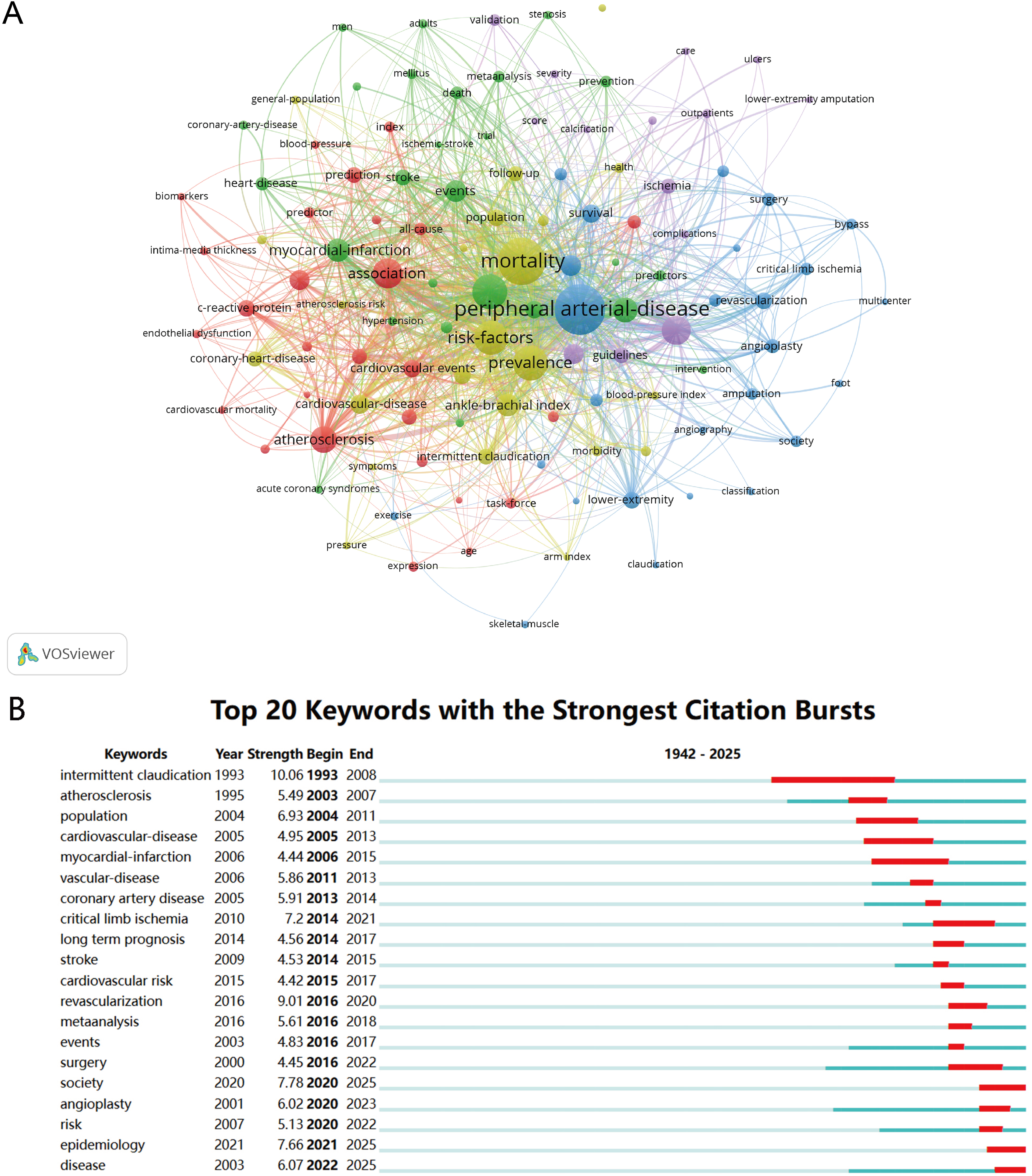
Keywords analysis of LEASO prognosis. A. Visual analysis of keywords co-occurrence network analysis in prognosis of LEASO. B. Top 20 Keywords with the strongest citation bursts in prognosis of LEASO.
The top 20 keywords with the strongest citation bursts in LEASO prognosis are illustrated in Figure 6B. Keywords from 2005–2013 included “cardiovascular disease,” “myocardial infarction,” and “vascular disease.” In 2014 and 2015, prominent keywords were “long-term prognosis” and “cardiovascular risk.” In 2020 and 2021, key terms included “society” and “epidemiology.” Notably, “intermittent” (10.06) exhibited the strongest citation burst, followed by “revascularization” (9.01), “society” (7.78), “epidemiology” (7.66), and “critical limb” (7.2). Furthermore, “society,” “epidemiology,” and “disease” represent current research frontiers in LEASO prognosis, indicating a period of rapid growth in these domains.
Discussion
This bibliometric review delineates three stages of LEASO prognosis research. The initial period (1942-2002) was dominated by case reports, constrained by limited angiographic techniques and low disease awareness; however, 1996 saw a six-fold surge following the clinical introduction of vascular stents. The steady development phase (2003-2010) was catalysed by the 2005 AHA PAD guidelines and the widespread adoption of endoluminal technology, which standardised research methods and accelerated progress. 19 Subsequently, the rapid expansion stage (2011-2025) has been marked by an increase in remote-monitoring studies during the COVID-19 pandemic and the emergence of data-driven approaches such as artificial intelligence (AI) predictive modelling and real-world data research as new growth vectors.
Our findings highlight that the USA, Japan, and China lead in LEASO prognosis publications. The USA, the UK, and Germany maintain the strongest international collaborative networks, with the USA consolidating its leadership in both volume and network strength. The high prevalence of PAD in the US population, particularly among older adults, 20 has driven substantial investment in cost-effective prognostic research. Japan and China have made notable advances, but longer-term outcome data and broader international collaboration remain areas for growth. As global ageing accelerates, research output from additional countries is expected to increase, although US advantages in innovation and scale are likely to persist. Among the top publishing institutions, the Netherlands stands out, with four of the top ten institutions, led by Erasmus University Rotterdam. This institution's large clinical volume, biobank resources, and global database have helped propel it to the forefront. In the US, broad institutional collaboration exemplified by Brigham and Women's Hospital demonstrates how partnerships can enhance research competitiveness, especially under resource constraints.
Analysis of prolific authors, such as Poldermans D, Bax JJ, and Hoeks SE, underscores the role of individual leadership and focused research in advancing LEASO prognosis. Poldermans D's work on the prognostic significance of polyvascular disease 21 and the psychological burden of PAD symptoms 22 exemplifies how targeted, patient-centered research can inform both clinical understanding and guideline development.
Regarding journals, our results show that high-impact journals such as the Journal of Vascular Surgery and Circulation attract the majority of LEASO prognosis research. Notably, Asian publishers remain underrepresented among the top-ranked journals, suggesting a need for greater internationalization and regional journal development to facilitate broader dissemination of Asian research findings.
Hotspots and Frontiers
This study employed key co-occurrence analysis to identify principal directions and hotspots in LEASO prognosis. Our keyword co-occurrence and burst analyses revealed distinct thematic clusters, with recent years showing increased attention to epidemiology, social determinants, and advances in prognostic modeling. Predictors of LEASO's prognosis.
The red cluster centers on prognostic biomarkers, notably C-reactive protein (CRP) and endothelin-1 (ET-1), 23 which are increasingly assessed for their predictive validity in LEASO.24–27 Neutrophil–lymphocyte ratio (NLR) and platelet–lymphocyte ratio (PLR) also serve as readily available prognostic indices. 3 Recent keyword burst analysis indicated that terms such as “risk factors”, “CRP”, and “prognostic indicators” remain active research hotspots.28,29
Although our results identified “artificial intelligence” as an emerging topic, its frequency remains relatively low compared to established clinical and laboratory prognostic markers. The burst strength and timing of “artificial intelligence” and related terms suggest a growing, but still nascent, research frontier in LEASO prognosis. 30
Prognosis of LEASO Related Diseases
Atherosclerosis in LEASO often coexists with coronary artery disease, leading to heightened mortality risk.31,32 Hypertension is the most common comorbidity and an independent risk factor for PAD. 33 These comorbidities are frequently reflected in keyword clusters centered on “comorbidity”, “coronary disease”, and “mortality”, supporting their ongoing relevance in the literature.
Treatment of LEASO
Endovascular therapy, including balloon angioplasty, drug-coated balloons, and atherectomy, represents the current standard of care.34–36 Rotational atherectomy plus DCB clears obstructive plaque or hyperplastic intima without mandatory stent placement, 37 preserving the native arterial architecture. Should secondary endovascular revision or elective bypass become necessary, the absence of a permanent implant simplifies re-access and reduces procedural risk and patient discomfort. 38 Consequently, the combined plaque-excision and DCB approach may improve limb-salvage rates and facilitate future revascularisations. 39
Health Social Determinants of LEASO's Prognosis
Socioeconomic and geographic disparities in LEASO prognosis are supported by frequent keywords such as “epidemiology”, “society”, and “health disparities”. Evidence shows that income, education, and access to care significantly influence outcomes.40,41 LEAD is more common in low-income groups, where higher smoking rates, suboptimal glycaemic control, and untreated hypertension cluster. 40 Rural patients face lower revascularisation rates and weaker follow-up adherence than their urban peers. 41 These findings emphasize the need for policy reforms and community-based interventions to address inequities.
Epidemiology of LEASO's Prognosis
Epidemiological research is a prominent theme in LEASO literature, as indicated by the high frequency and recent burst of the keyword “epidemiology”. Global prevalence, regional variations, and persistently high rates of amputation and mortality underscore the urgent need for improved prognostic strategies. 42 The prevalence of LEASO exhibits significant regional variation, reaching 20% in Western nations while remaining slightly lower at 15.91% in China.3,4 As LEASO manifests locally as systemic atherosclerosis in the lower limb arteries, it can precipitate amputations due to arterial occlusion and gangrene, as well as multiple organ pathologies stemming from atherosclerosis in coronary, cerebral, or renal arteries, potentially resulting in mortality. Reports indicate that the one-year amputation rate is approximately 25%, with a similar one-year mortality rate. 40 MEDICARE data reveal that 54% of the 20 464 critical limb ischemia (CLI) amputations in the United States did not involve any vascular procedures, such as angiography and revascularization, prior to amputation. 43 The prognosis for LEASO patients remains poor, making it imperative to address the urgent clinical challenge of reducing amputation and mortality rates.
Future Directions
Our analysis suggests that future research should prioritize the integration of novel biomarkers, advanced imaging, and AI-driven predictive models, while also addressing health disparities and fostering multidisciplinary collaboration. While keywords related to “artificial intelligence” and “machine learning” are not yet among the most frequent, their recent appearance in burst analyses indicates a growing research frontier. Policy initiatives supporting global data sharing and equitable healthcare access will be essential for driving advances in personalized LEASO management.
Limitations
This study has four main limitations. First, restricting the search to the WOSCC may have excluded relevant records available in Scopus, PubMed, or regional databases, thereby reducing comprehensiveness. Second, although CiteSpace and VOSviewer are established bibliometric tools, they do not substitute for a formal systematic review, so some nuances in the literature may have been missed. Third, limiting the corpus to English-language articles and excluding conference abstracts, book chapters, and grey literature could under-represent contributions from non-English-speaking regions and from fields that favour alternative dissemination formats. Finally, citation-based metrics inherently favour older publications; consequently, very recent studies with limited citation counts may appear less influential than they will become. Despite these constraints, the overall trends and insights identified in this analysis are unlikely to be fundamentally altered.
Conclusion
To the best of our knowledge, this is the first comprehensive bibliometric analysis of LEASO prognosis. We examined publication years, countries, institutions, authors, journals and keywords, and highlighted future priorities: prognostic biomarkers, LEASO-related comorbidities, therapeutic innovations, social determinants of health, and epidemiological trends. These findings provide a roadmap for advancing LEASO prognosis research.
Supplemental Material
sj-docx-1-cat-10.1177_10760296251415380 - Supplemental material for A Visualization Analysis of Global Research Trends in Studies of Lower Extremity Arteriosclerosis Obliterans Prognosis (1942–2025)
Supplemental material, sj-docx-1-cat-10.1177_10760296251415380 for A Visualization Analysis of Global Research Trends in Studies of Lower Extremity Arteriosclerosis Obliterans Prognosis (1942–2025) by Shengyu Li and Sen Yang in Clinical and Applied Thrombosis/Hemostasis
Footnotes
Acknowledgements
Not applicable.

Ethical Considerations
Not applicable.
Consent to Participate
Not applicable.
Consent for Publication
Not applicable.
Author Contributions
(I) Conception and design: Shengyu Li (II) Administrative support: Sen Yang (III) Data analysis and interpretation: Shengyu Li (IV) Manuscript writing: All authors (V) Final approval of manuscript: All authors
Funding
The authors received no financial support for the research, authorship, and/or publication of this article.
Declaration of Conflicting Interests
The authors declared no potential conflicts of interest with respect to the research, authorship, and/or publication of this article.
Data Availability
All data generated or analysed during this study are included in this published article.
Supplemental Material
Supplemental material for this article is available online.
References
Supplementary Material
Please find the following supplemental material available below.
For Open Access articles published under a Creative Commons License, all supplemental material carries the same license as the article it is associated with.
For non-Open Access articles published, all supplemental material carries a non-exclusive license, and permission requests for re-use of supplemental material or any part of supplemental material shall be sent directly to the copyright owner as specified in the copyright notice associated with the article.
