



Abstract
To assess individual participants’ baseline thrombosis risk calculated by Caprini Risk Score (CRS) before injury, illness, or hospitalization occur, to increase the awareness of venous thromboembolism (VTE) by viewing 2 short videos. A cross-sectional study was conducted online between August 2022 and January 2023 in the USA, UK, and India to assess the risk of thrombosis of individuals as a baseline. One nursing practitioner and 4 high school students were on the research team. Descriptive statistical methods were used in data analysis. A total of 928 usable completed questionnaires from 945 participants were analyzed. The mean CRS was 4.93 ± 3.175; 0 to 4 (N = 460, 49.6%), 5 to 8 (N = 394, 42.5%), and 9 (N = 74: 8.0%). History of blood clots (N = 247, 26.6%), <40 years old (N = 133, 52.6%); women on oral contraceptives (N = 324, 34.9%), history of smoking (30%), diabetes (26%), and inflammatory bowel disease (IBD; 17.3%). Top-level findings: High incidence of family history of thrombosis (26.6%), smoking, diabetes, contraceptives, and IBD. The average CRS (7.9) in patients over 75 years indicates that even a minor surgical procedure may be associated with significant VTE risk. We achieved an important goal by increasing awareness of VTE using this unique method involving high school students and a nurse working with friends and families to complete the CRS assessment. Encouraging the respondents to share information with their personal physicians prior to the event and keep these data in their medical file is a potential valuable source of saving time. This study emphasizes the importance of individuals collecting baseline information prior to illness or hospitalization.
Introduction
Venous thromboembolism (VTE) is a condition in which blood clots develop and frequently result in serious morbidity and mortality. Venous thromboembolism is a continuum, including deep vein thrombosis (DVT) and pulmonary embolism (PE). Frequently, a blood clot develops in the legs, arms, or abdomen and eventually, a part of the thrombus may break off and travels to the lungs resulting in a serious or fatal PE.
Venous thromboembolism is a worldwide public health and medical care problem due to high morbidity, high mortality, and high rate of missed diagnosis, but at the same time, is also considered as the most likely preventable fatality.1,2 It is estimated that an estimated number of 375 000 to 425 000 cases of VTE diagnosis and treatment cost the US medical system $7 to $10 billion a year. 3 However, the awareness of VTE in the general population is found to be very low. “While majority were aware of other medical conditions like a heart attack (96.1%), stroke (97.2%), diabetes (98.2%), HIV/AIDS (98.6%), cancer (97.2%) and malaria (98.2), a minority of the subjects were aware of thrombosis (41.5%) and DVT (33.8%).” 4 Many organizations, associations, alliances, foundations, networks, consortia, and interest groups concerned with thrombosis commit considerable resources to educate the public, patients, and health care providers about thrombosis and improve health care services, research, public policy, and advocacy. 5 It is generally an accepted fact that VTE prevention strategies must be specific and tailored to each patient's individual level of risk. Education of the public regarding VTE and individual personal risk levels is important goals for the medical care team and the community. One of the methods to determine the level of risk is to perform a thorough risk assessment using the 40-element Caprini Risk Score (CRS). 6
When the CRS score is obtained ahead of time, we feel it is far better than the often cursory and hasty risk assessment made during emergency or urgent hospital admission, which could result in not properly defining the level of risk. Important variables collected ahead of time, including family history of thrombosis, can result in a better estimation of a patient's risk and be very valuable to the treating physician in managing the patient. Previous research has demonstrated the value of gathering this information prior to getting ill. 7
Aims of the Study
This study assessed the value of collecting an individual baseline CRS before injury, illness, or hospitalization occurs. Another study’s purpose was to increase awareness of VTE in the community by educating the respondents using 2 short videos.
Methods
Design
This study was a quantitative prospective study, nonexperimental in design, involving cross-sectional survey methodology, and convenience sample.
Setting and participants between August 2022 and January 2023 letters were distributed by the investigators (1 nurse and 4 students) to their families and friends describing this project. This letter directed them to log in to the website, www.capriniriskscore.org, and click on the research button. They were asked to enter a password provided in the introductory letter. The next screen listed step-by-step instructions to view 2 short videos and complete a demographic and CRS questionnaire. The data were collected anonymously and set to a secure database at DePaul University. Ethical approval to perform this study was obtained from the Institutional Review Board of DePaul University (Approval ID: IRB-2022-703). Participants tested on their own electronic devices (smartphone, laptop, etc.), and the research team was blinded to the identity of the participants.
The criteria for inclusion included individuals ages 18 and above who were able to follow the instructions for inclusion criteria and use the website and their computer to complete the required tasks. Exclusion criteria included any person not capable of completing these tasks. Individuals with serious mental illness or physical problems or limited survival were excluded. The participants were encouraged to download the results of their score and share it with their health care providers and place them in their medical record.
Ethical Considerations
The study protocol was approved by the Institutional Review Board of DePaul University. Participation in the study was voluntary, and no personal identifiers were used. None of the participants was linked to the participant's names or contact information directly. Participants did not receive any direct benefit from this survey study other than learning their CRS ahead of time and increasing their knowledge of VTE. The research team members had access only to survey data to ensure the privacy of participants. All the research team members completed human subjects training under the Cooperative Institution Training Initiative program. There were no physical risks associated with this study.
Data Analysis
Descriptive statistics (i.e., mean, frequency, and percentage) were used to characterize the participants.
Results
Participant Characteristics
Of the total of 945 participants, 928 participants completed questionnaires that were used for data analysis. Incomplete questionnaires from the 17 participants were not analyzed. The demographic data are presented in Table 1. The average BMI was 21.62 ± 2.63 and was not adjusted for age (Table 1).
Participants’ Demographics (n = 928).

In this study, a sizeable number (N = 247, 26.6%) of participants reported they had a family history of blood clots (Figure 1), which was a key finding. One hundred thirty of these participants (52.6%) were less than 40 years old (Figure 2). We did not further break down the age of those subjects less than 40 years of age since they would all have a risk score of 0.

Caprini Risk Scores (CRSs): family members with a history of blood clot.
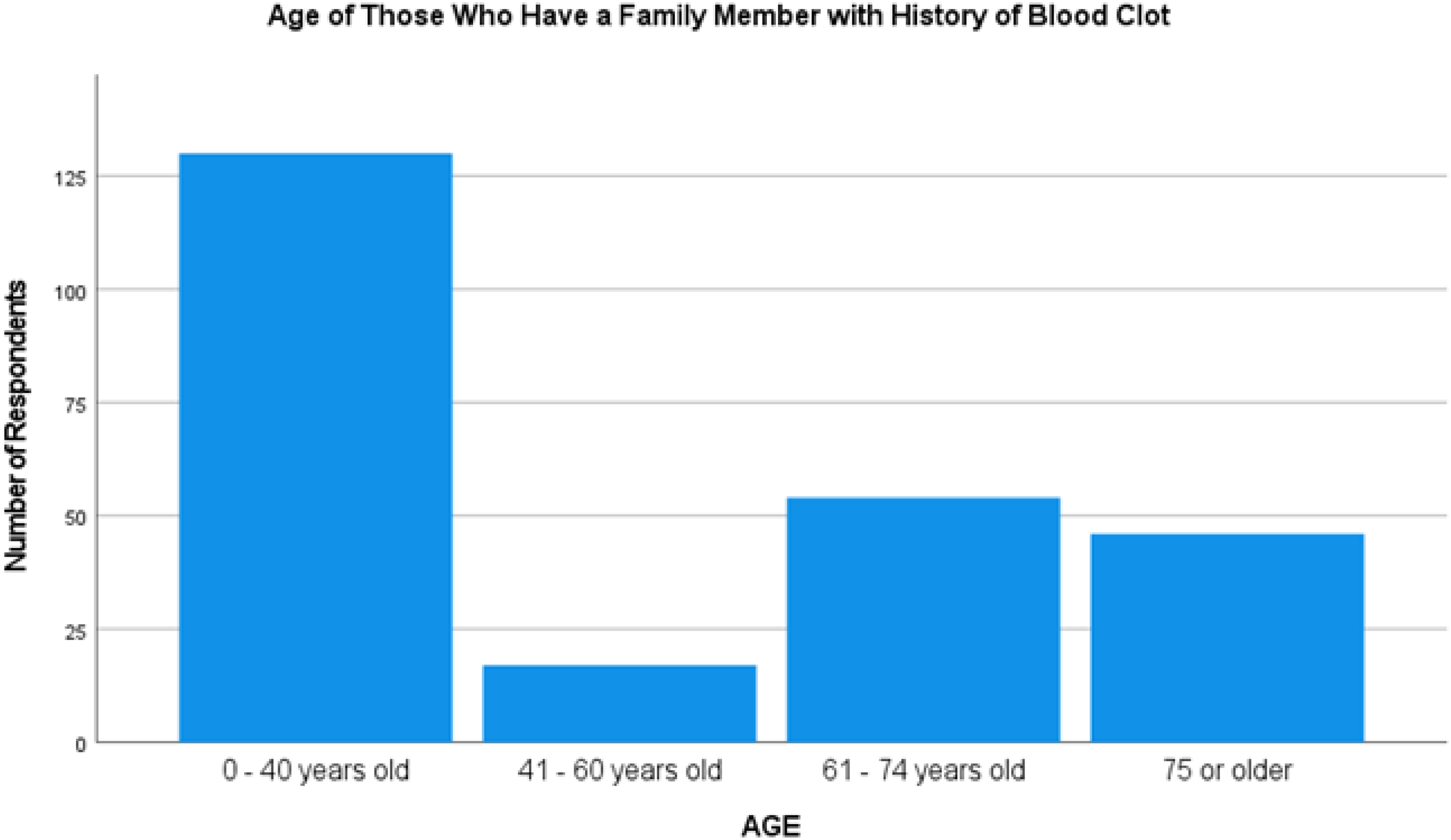
Age of those who have a family member with history of blood clot Caprini Risk Score (CRS).
The average CRS was 4.93 ± 3.17. The CRS was 0 to 4 for 460 participants (49.6%), 5 to 8 for 394 participants (42.5%), and 9 and more for 74 (8.0%). Score versus age groups are seen in Figure 3.

Caprini Score versus age group.
Discussion
Venous thromboembolism is a condition that includes DVT and PE.6,8 Deep vein thrombosis results when a blood clot forms in the deep veins, usually in the upper or lower leg, thigh, arm, or pelvis. Pulmonary embolism occurs when a blood clot breaks off from one of these locations traveling through the bloodstream back as an embolus to the lungs. This has been seen with some frequency as a part of COVID-19 infection. 9 The blood clots can then obstruct pulmonary circulation leading to severe disability and or death.
Fatal PE is the number one preventable cause of death postoperatively or after hospitalization. Sadly, these deaths are increasing despite modern thrombosis prophylaxis efforts. 10 One of the most frequently missed risk factors is a family history of thrombosis. Most risk assessment tools do not even include this information. A family history of thrombosis is a powerful risk factor that increases a person's risk of thrombosis that is critical when illness, injury, or surgery occurs. The National Surgical Quality Improvement Program does not include this parameter despite over 6 million patients having been enrolled in this American College of Surgeons program. 11 When illness, emergency surgery, or traumatic events occur it is unlikely that a careful detailed family history will be collected. Most studies involving COVID-19 do not include any individual risk information, particularly family history of thrombosis. The unique feature of this program is having high school students huddle together with their families to capture thorough information from their relatives and ancestors. The high yield of information represents a promising way to capture this vital data, and this technique ought to be used in the future for such data collection. The respondents were encouraged to share this information with their personal physicians and keep these data in their medical file. Another important goal addressed by this project was to increase awareness of VTE among the public.
Venous thromboembolism is a worldwide public health and medical problem due to its high incidence rate, high mortality, and high missed diagnosis rate. In this study, we learned the baseline CRS before the occurrence of injury, disease, or hospitalization, thus improving the respondents’ awareness of the risks related to thrombosis. Family history of blood clots, the high scores of those age 75+, women's use of birth control, diabetes, smoking, and inflammatory bowel disease (IBD) are critical issues affecting the incidence of VTE.
These findings confirm and extend previous observations about VTE risk level and factors in the community. 7 Our results revealed that a total of 247 (26.6%) participants reported they had family blood clot history, and 130 (52.6%) participants were less than 40 years old. Family history is an important risk factor to predict VTE in those without a personal history of thrombosis having surgery. 12 Family history of thrombosis, obstetrical complications, are often not collected at the time of hospitalization, and illness, injury, or surgery. Having these data in the patient chart ahead of an illness is ideal.
We recommend that knowing your CRS and risk factors ahead of time is one of the best ways to lower the incidence of fatal PE events by including these critical factors, especially family history of blood clots in relatives.13,14 The high average CRS in those over 75 years of age would indicate the need for anticoagulant prophylaxis following surgery in almost all of these individuals unless a significant bleeding risk was present. Even a simple operation on such a patient would represent a significant risk since the score would be 10. 15
Our current study shows that a large proportion of female respondents (34.9%) took contraceptives. This is a sign of the times, but this fact also has an impact on prevention, including increasing the risk to patients. If they stop taking birth control one month before surgery, and eventually become pregnant, this is even more risk of thrombosis than being on birth control. Diabetes and IBD are major implications for thrombosis. In this study, 17.3% of respondents report IBD, and 26% of the respondents report a history of diabetes. Also, 30% of the group reported smoking, which is double the national average. The data also showed that most Caucasians, African American, and Latinos were smokers, and the majority of Asians had diabetes. In this study, 53.7% were younger people indicating that this group may be susceptible to thrombotic risk. It is time for government and health providers to do something to benefit community health. From the author's point of view, even though many factors contribute to IBD, diabetes, and smoking, programs of stress reduction, and basic medical knowledge in community settings should be popularized.
Swelling, redness, and pain are some symptoms of DVT although the patient may be asymptomatic despite the presence of a significant blood clot. Pulmonary embolism can cause sudden chest pain and shortness of breath but like DVT, many times little or no symptoms may occur prior to sudden death. Venous thromboembolism is very common, especially among the elderly. It is associated with reduced survival rate, large medical and health care costs, and high recurrence rate. 16 Sometimes VTE is totally asymptomatic. In the United States, it is estimated up to 900,000 people may be affected by DVT or PE every year, and 10% to 30% of people will die within one month of diagnosis. Yearly deaths from PE are estimated to involve 60 000 to 100 000 in the United States. One-third to half of patients suffering DVT will have long-term complications (post-thrombotic syndrome), including limb swelling, pain, discoloration, or leg ulcers; One-third of VTE patients will relapse within 10 years. 17 The treatment of acute VTE is on average associated with an increase in direct medical costs of $12 000 to $15 000 for survivors in the first year. A conservative estimate is that subsequent complications will increase the cumulative cost of each case to $18 000 to $23 000. Another conservative estimate reports that 375 000 to 425 000 newly diagnosed and medically treated sudden VTE events cause a loss of $7 billion to $10 billion to the US medical system every year. 3
Compounding the high morbidity, mortality, and costs is the low awareness of VTE among the public and the medical establishment, which lags other common conditions.8,18 About 68 out of 100 people were aware of VTE, 44 out of 100 people were aware of DVT, and 54 out of 100 people were aware of PE; this proportion is lower than the awareness of other thrombotic diseases. This includes heart disease and stroke (88% and 85%, respectively), and health conditions, such as hypertension, breast cancer, prostate cancer, and AIDS (awareness at 90%, 85%, 82%, and 87%, respectively). 18 Similar surveys were conducted in other countries with low awareness.19,20 Government activities in some countries have begun to support activities to raise public and health care providers’ awareness of VTE with the aim of reducing incidence and mortality rates. Many organizations, associations, alliances, foundations, networks, consortia, and interest groups concerned with thrombosis exist, such as Venous Disease Coalition, American Thrombosis and Hemostasis Network, National Hemophilia Foundation, North American Thrombosis Forum, the Global Thrombosis Forum, among others. 5 The goal of these organizations is to educate the public, patients, and health care providers about thrombosis and improve health care services, research, public policy, and advocacy. People want to understand the symptoms, risk factors, prevention, and complications of VTE, with an emphasis on harm. 21 Although participants are willing to use various methods of learning, most people prefer to receive education in a provider–patient contact environment, followed by video and paper educational materials. 21 The literature on how to help community residents know their risk of VTE in advance of the event has not been found.
Education of the public regarding VTE, and individuals’ personal risk level are important goals. Once this information is obtained it can be used when a person encounters an accident or emergency or even planned surgery. The approach to preventing this complication is greatly enhanced knowing the baseline information is contained in their medical record. Knowing their baseline CRS can better prepare individuals to discuss with their provider the approach to preventing a serious or fatal blood clot when an accident, illness, or surgical procedure occurs. Knowing the baseline risk of the patient is critical since much of this information is not obtained when patient presents urgently in the emergency department with life-threatening situations including severe trauma.
Relevance to Clinical Practice and Future Research
Based on the results of this study, nurses and other health professionals should focus on people with a family history of blood clots, women on birth control, and age older than 70 years. It is also necessary to develop and apply strategies and interventions to increase public awareness of the dangers and prevalence of VTE. Expansion of this initiative to other nursing programs would represent a valuable public service. The prevention of fatal blood clots begins with all these efforts.
Limitations
Our analysis has strengths and limitations. This study collected data from the community instead of hospital to evaluate the risk level of VTE, although it will increase the awareness of self-health. In this study, we found identifying family history of blood clots plays a vital role in increasing VTE community awareness. Health providers and the population should realize the older persons and women on birth control present significant blood clot risks. The study was conducted among nursing, college, and high school students in a few communities, and among Asians 49.1%, participants who are younger than 41 years old 52.7%. Also, the young group of responders may not have a good understanding of medical terms and be unfamiliar with the family medical history. Networking with family members may minimize this problem. Future studies should be carried out to assess the accuracy of family history data collection.
Conclusions
The most significant finding was the high incidence of family history of thrombosis (26.6%). Smoking, diabetes, contraceptives, and IBD were also important findings. The average CRS (7.9) in patients over 75 years indicates that even a minor surgical procedure is associated with significant VTE risk. We achieved an important goal by increasing awareness of VTE using this unique method involving high school students and a nurse working with their friends and families to complete the CRS assessment. This represents a promising way to capture such vital data. Encouraging the respondents to share information with their personal physicians prior to the event and keep these data in their medical file is a potential valuable source of saving time. This study emphasizes the importance of individuals collecting baseline information prior to illness or hospitalization.
Footnotes
Authors’ Note
Ethical approval to report this case was obtained from the Institutional Review Board of DePaul University (Approval ID: IRB-2022-703).
Declaration of Conflicting Interests
The author(s) declared no potential conflicts of interest with respect to the research, authorship, and/or publication of this article.
Funding
The author(s) received no financial support for the research, authorship, and/or publication of this article.
