



Abstract
The apolipoprotein (Apo) B gene (APOB) is a susceptible gene for dyslipidemia. The purpose of this investigation was to explore the relationship between the APOB rs1042034 single-nucleotide polymorphism (SNP) and serum lipid levels in the Maonan and Han populations. A total of 598 Maonan participants and 609 Han participants were genotyped by polymerase chain reaction and restriction fragment length polymorphism, and the genotypes were also verified by sequencing. There were no differences in genotype and allele frequencies between the 2 ethnic groups or between males and females. The levels of triglyceride (TG) in Maonans were higher and high-density lipoprotein cholesterol was lower in the A allele carriers than the A allele noncarriers; the A allele carriers in Hans had higher TG levels and lower ApoA1/ApoB ratio than the A allele noncarriers (P < .05 for all). Subgroup analysis showed that the A allele carriers in Maonan females had higher TG levels and the A allele carriers in Han females had higher TG levels and lower ApoA1/ApoB ratio than the A allele noncarriers (P < .05 for all). In our study populations, there may be ethnicity- and/or sex-specific associations between the APOB rs1042034 SNP and serum lipid levels.
Introduction
Worldwide, cardiovascular disease (CVD) is the leading cause of death and has created a considerable global public health burden. 1,2 High cholesterol, smoking, and high blood pressure are key risk factors for CVD. 3 Genome-wide association studies (GWASs) have identified many genetic loci associated with blood lipid levels, and the susceptible apolipoprotein B gene (APOB) is one of the research hot spots. 4 –7 APOB is located on chromosome 2 and plays a key role in lipoprotein metabolism, which is closely related to the occurrence and development of hyperlipidemia. 8,9 Studies have confirmed that multiple single-nucleotide polymorphisms (SNPs) in APOB are associated with dyslipidemia. 10,11
China is a multiethnic country comprising Han Chinese, which accounts for the majority, and 55 ethnic minorities. The Maonan ethnic group is one of the ethnic minorities living in the mountainous region, which has a small population. In the sixth national census, the total population of Maonans was 101 192 (ranked 37). 12 Maonans mainly live in the northwest area of Guangxi Zhuang Autonomous Region. Maonans have a long history and unique culture. Because their customs and eating habits differ from those of the Han Chinese, the characteristics and genotypes of the lipid metabolism genes in this group may be different from those of the Han population. Although the rs1042034 is a functional SNP that has already been known to be associated with blood lipid levels in some populations, the association of the APOB rs1042034 SNP and serum lipid levels has never been reported in Maonans. Thus, the intention of this study was to evaluate the effect of the APOB rs1042034 SNP on blood lipid levels in the Maonan and Han populations in Guangxi.
Methods
Study Participants
All samples were randomly selected from our previous specimen pools. 13 The study participants range from 20 to 92 years old. All participants were basically healthy; did not have chronic diseases such as thyroid disease, diabetes, heart disease, or stroke; and did not take drugs that affect blood lipid metabolism. All selected persons provided informed consent. This study was approved by the ethics committee of the First Affiliated Hospital of Guangxi Medical University (No. Lunshen-2014-KY-Guoji-001, March 7, 2014).
Epidemiological Investigation
Epidemiological investigation was conducted using international standardized methods in accordance with the general protocol. 14 Standardized questionnaires were used to collect and record lifestyle habits and general conditions, including height, weight, body mass index (BMI), waist circumference, and blood pressure measurements. Alcohol consumption was categorized into 3 groups (0, ≤25 g/d, >25 g/d) and smoking habit was divided into 3 categories (0, ≤20 cigarettes/day, >20 cigarettes/day), respectively.
Biochemical Measurements
After fasting for 12 hours, a sample of 5 mL venous blood was collected. One part was used to determine serum lipid levels, including the levels of total cholesterol (TC), triglycerides (TGs), low-density lipoprotein cholesterol (LDL-C), high-density lipoprotein cholesterol (HDL-C), and apolipoprotein (Apo) A1 and ApoB. Another part of the sample was used to extract genomic DNA by the phenol–chloroform method.
Genotyping and Sequencing
The genotypes of the APOB rs1042034 SNP were determined by polymerase chain reaction–restriction fragment length polymorphism (PCR-RFLP). The specific reaction conditions are shown in Supplemental Table 1. After electrophoresis on a 2.0% agarose gel containing 0.5 μg/mL ethidium bromide, the results were observed under a gel imaging analyzer. The results of the electrophoresis of the PCR products and the genotyping of the SNP are shown in Figure 1A and B. Two PCR products of the GG, GA, and AA genotypes were randomly selected for sequencing to confirm the genotypes obtained by PCR-RFLP (ABI Prism 3100 by Shanghai Sangon Biological Engineering Technology & Services Co, Ltd, Shanghai, China; Figure 1C).
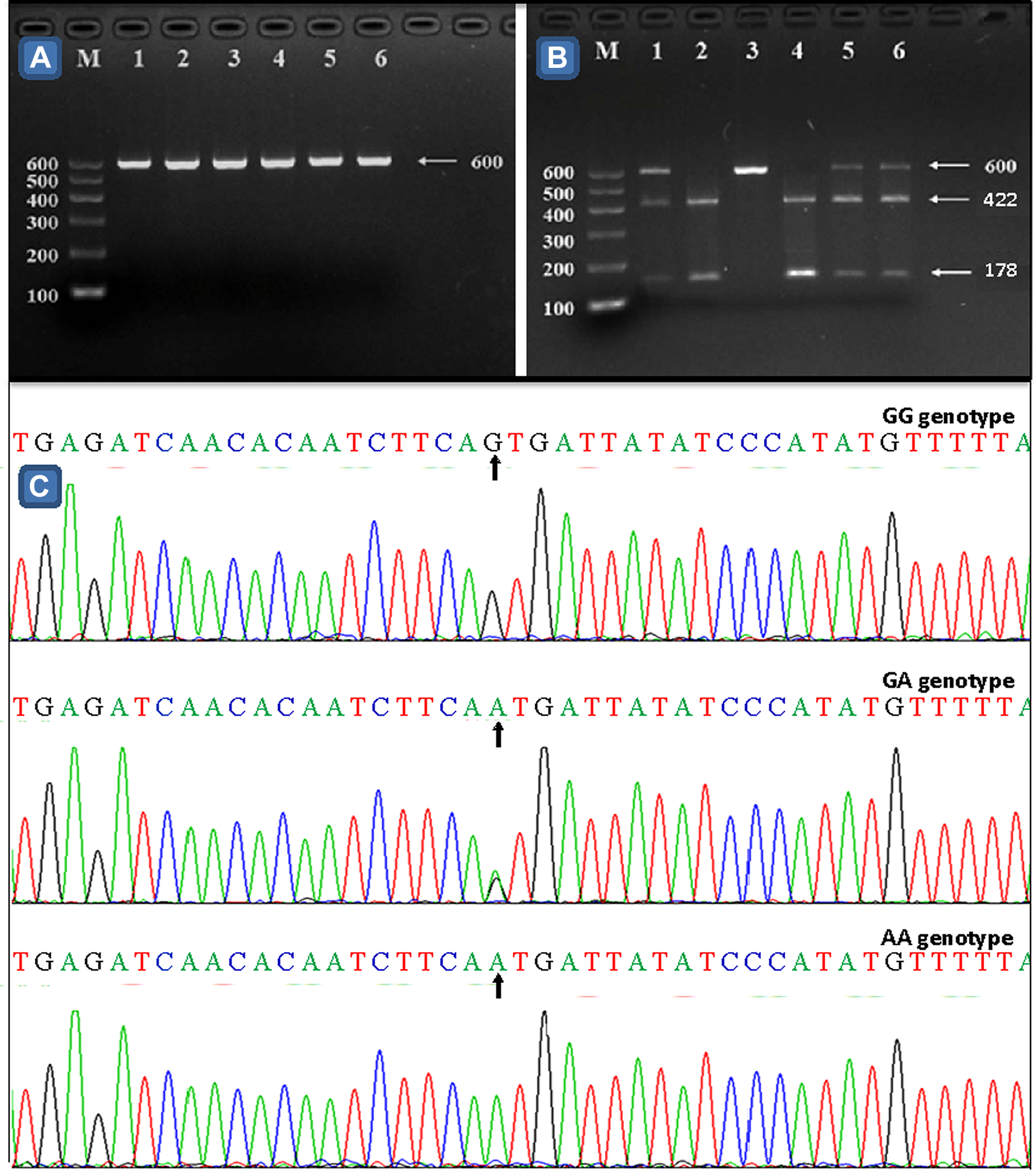
Results of electrophoresis, genotyping, and sequencing. A, Results of electrophoresis (Lane M: 100-600 bp marker ladder; lanes 1-6: 600 bp target genes). B, Results of genotyping (GG genotype, lanes 2 and 4; GA genotype, lanes 1, 5, and 6; and AA genotype, lane 3). C, Results of sequencing (GG, GA, and AA genotypes).
Statistical Analysis
Continuous variables were expressed as the mean ± SD (serum TG levels were expressed as the median and interquartile range [IQR, which is quartile 3 to quartile 1]). The count data were expressed as a percentage (%), and the categorical variables were analyzed by the χ2 test. A standard goodness-of-fit test was used to verify the Hardy-Weinberg equilibrium (HWE). Independent sample t tests and Mann-Whitney U tests were used for comparisons between the 2 groups. The association between genotypes and serum lipid levels was analyzed by analysis of covariance with BMI, age, blood pressure, blood glucose, smoking, and drinking as covariates. The effects of genotypes (GG genotype = 0, GA/AA genotypes = 1) and environmental factors on blood lipid levels were analyzed using stepwise multiple linear regression. Two-sided P values <.05 were considered significant. All data were analyzed using SPSS software (version 23.0).
Results
General Characteristics
As shown in Table 1, there were a total of 598 Maonan participants (mean age: 55.82 ± 14.71 years) and 609 Han participants (mean age: 54.30 ± 15.13 years). The 2 ethnic groups were matched for age and sex. The waist circumference, systolic blood pressure, pulse pressure, and TG levels were higher in the Maonan than in the Han participants; the HDL-C levels were lower in the Maonan than in the Han participants (P < .05).
The General Characteristics and Serum Lipid Levels Between Maonan and Han Populations.a

Abbreviations: Apo, apolipoprotein; HDL-C, high-density lipoprotein cholesterol; LDL-C, low-density lipoprotein cholesterol.
a The value of triglyceride was presented as the median and interquartile range (IQR, which is quartile 3 to quartile 1). The categorical variables were analyzed by the χ2 test. Independent sample t tests and Mann-Whitney U tests were used for comparisons between the 2 groups.
Genotypes and Serum Lipid Profile
The frequencies of the GG, GA, and AA genotypes were 46.15%, 43.98%, and 9.87% in the Maonan group and 44.01%, 47.13%, and 8.86% in the Han group (P > .05), respectively. The genotype distribution of the rs1042034 SNP was complied with the HWE in both ethnic groups or both sexes (The values of P HWE were .751 in Maonan, .063 in Han, .998 in Maonan male, .683 in Maonan female, .460 in Han male, and .075 Han female, respectively; Figure 2A). The A allele frequency of rs1042034 SNP was 31.86% and 32.43% in the Maonan and Han groups (P > .05; Figure 2B), respectively. Among the Maonan population, the levels of TG were higher and HDL-C were lower in the A allele carriers than the A allele noncarriers; for the Han population, the A allele carriers had higher TG levels and lower ApoA1/ApoB ratio than the A allele noncarriers (P < .05 for all; Figure 2C and Table 2). Sex subgroup analysis showed that the A allele carriers in Maonan females had higher TG levels than the A allele noncarriers (Figure 2D) and the A allele carriers in Han females had higher TG levels and lower ApoA1/ApoB ratio than the A allele noncarriers (P < .05 for all; Figure 2E).
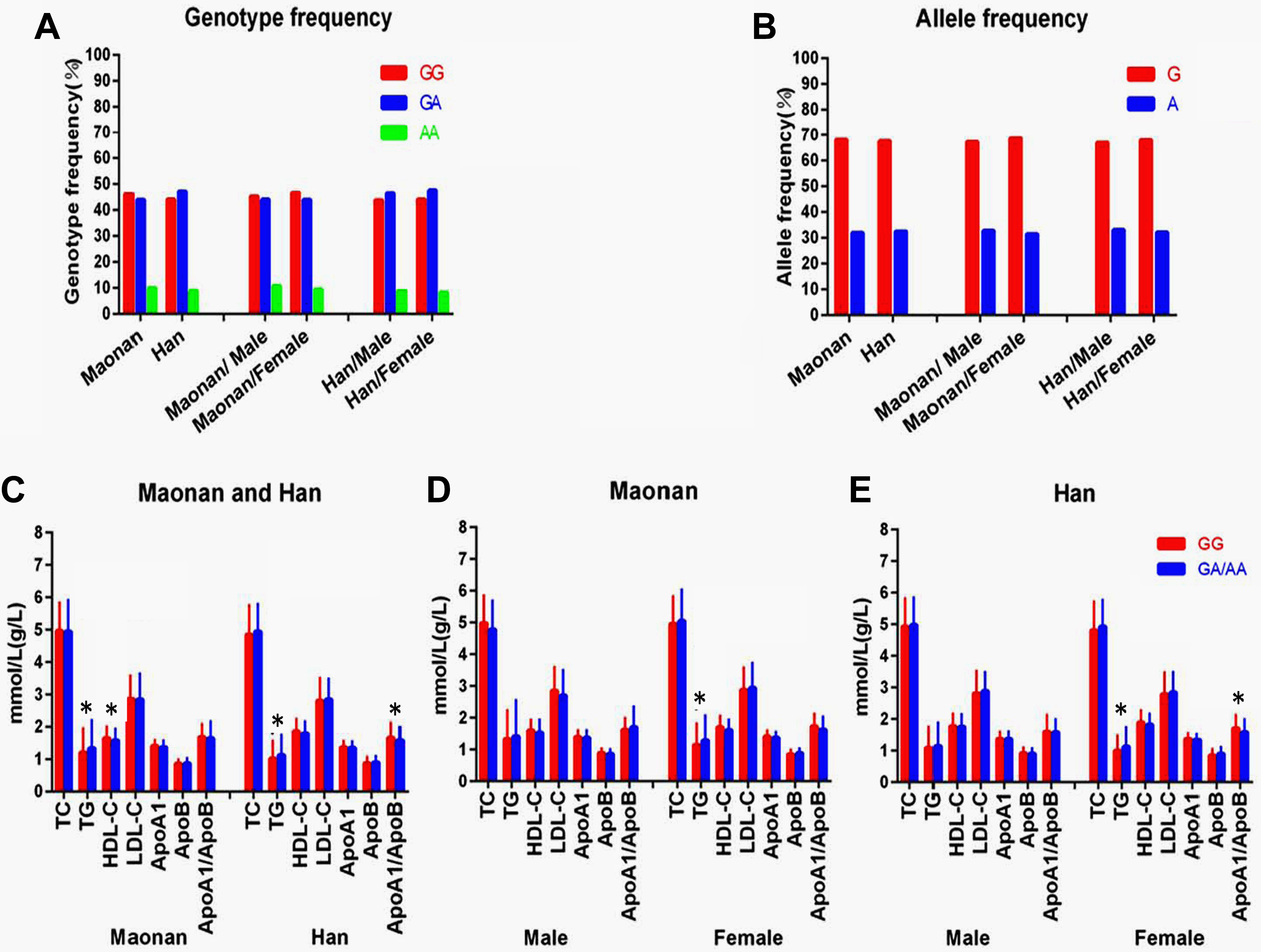
Genotypic and allelic frequencies, genotypes, and serum lipid levels. (A) Genotypic frequencies; (B) allelic frequencies; and (C) to (E) genotypes and serum lipid levels in Maonan and Han (C), Maonan males and females (D), and Han males and females (E), respectively. Serum TG levels were expressed as the median and IQR (which was quartile 3 to quartile 1), and the difference was determined by the Wilcoxon-Mann-Whitney U test. The remaining lipid parameters were expressed as the mean ± SD and were analyzed by ANCOVA with body mass index, age, blood pressure, blood glucose, smoking, and drinking as covariates. *P < .05. ANCOVA indicates analysis of covariance; Apo, apolipoprotein; HDL-C, high-density lipoprotein cholesterol; IQR, interquartile range; LDL-C, low-density lipoprotein cholesterol; SD, standard deviation; TC, total cholesterol; TG, triglyceride.
Association Between the Genotypes of the APOB rs1042034 SNP and Serum Lipid Profiles in the Maonan and Han Populations.a

Abbreviations: Apo, apolipoprotein; APOB, apolipoprotein B gene; HDL-C, high-density lipoprotein cholesterol; LDL-C, low-density lipoprotein cholesterol; SD, standard deviation; SNP, single-nucleotide polymorphism; TC, total cholesterol; TG, triglyceride.
a Serum TG levels were expressed as the median and interquartile range (IQR, which was quartile 3 to quartile 1), the difference was determined by the Kruskal-Wallis test or the Wilcoxon-Mann-Whitney U test. The remaining lipid parameters were expressed as the mean ± SD and were analyzed by analysis of covariance (ANCOVA) with body mass index, age, blood pressure, blood glucose, smoking, and drinking as covariates.
Factors Related to Serum Lipid Parameters
Multiple linear regression analysis showed that serum TG and HDL-C levels were associated with the APOB rs1042034 genotypes in all participants (P < .05; Supplemental Table 2). Serum HDL-C levels in the Maonan group and the ApoA1/ApoB ratio in Han females were related to the genotypes (P < .05; Supplemental Tables 2 and 3). A variety of other factors were also associated with serum lipid profiles (P < .05 for all; Supplemental Tables 2 and 3).
Discussion
In this study, we found that the waist circumference, systolic blood pressure, pulse pressure, and serum TG levels in the Maonan people were higher than those in the Han population, while the HDL-C levels were lower in the Maonan than the Han population. A previous study reported that the dietary fat, cholesterol, and energy intake in the Maonan people were significantly higher than those in the Han population. 15 This is consistent with previous research. Dyslipidemia is affected by the genetic and environmental factors. 16 –18 People of different ethnicities, from different regions, and with different living conditions have different genetic backgrounds. 19 –22 The Maonan ethnic group is one of the ethnic minorities in China, and they mainly live in Southwestern China. They primarily eat Maonan rice and corn, in addition to rice, sweet potatoes, pumpkins, and so on, and they also like to make various foods with staples and miscellaneous grains. Sour food is one of the most prominent characteristics of their diet, and they generally like half-cooked dishes. Alcohol consumption is also common. The Maonan family is monogamous, and marriage is mainly dictated by the parents. The different lifestyles, eating habits, and genetic backgrounds of the 2 ethnic groups may be the main causes of differences in blood lipid levels.
ApoB is considered to be one of the most important atherogenic lipoproteins. 22 The product of APOB is the major apolipoprotein of chylomicrons and low-density lipoproteins. It is synthesized in the plasma and has 2 major isoforms, ApoB-48 and ApoB-100: the former is synthesized only in the intestine, and the latter is synthesized in the liver. 23,24 APOB rs1042034 is a missense SNP that causes Ser4338Asn. 25 Genome-wide association study reported that the rs1042034 SNP was associated with the blood lipids TC, LDL-C, and HDL-C. 10 In our study, the frequencies of the GG, GA, and AA genotypes were 46.15%, 43.98%, and 9.87% in the Maonan population, and 44.01%, 47.13%, and 8.86% in the Han population, respectively. The A allele frequencies of APOB rs1042034 SNP were 31.86% and 32.43% in the Maonan and Han populations, respectively. There were no significant differences in genotype and allele frequencies between the Maonan and Han ethnic groups.
There are significant differences in blood lipid parameters among different populations and among different individuals in the population. These differences may be related to genetic and/or environmental interactions and genetic susceptibility. 26,27 The effects of polymorphisms on serum lipid levels may look different among the ethnic groups due to complex haplotype relationships between tested genetic markers and functional variants. 28,29 Regarding the relationship between the APOB rs1042034 SNP and blood lipid levels, some articles reported that the rs1042034 polymorphism was associated with TG and HDL levels in European populations. Other studies found that the rs1042034 SNP was associated with TC and LDL-C levels in Hispanic populations. 30 –32 In a study of gene-by-environment interactions, the rs1042034 SNP was found to be associated with serum TC levels. 33 In addition, the rs1042034 T allele increased the risk of ischemic stroke in Chinese Han males, the LDL-C levels of the AA genotype carriers were lower than those of the non-AA genotype carriers, and the TG levels were higher than those of the non-AA genotype carriers. 34,35 However, Kulminski et al found that the rs1042034 CC genotype promoted CVD through lipid metabolism. 36 Our study reported that in the Maonan ethnic group, the levels of TG were higher and HDL-C were lower in the A allele carriers than the A allele noncarriers. In the Han population, the A allele carriers had higher TG levels and lower ApoA1/ApoB ratio than the A allele noncarriers. Subgroup analysis according to sex showed that the A allele carriers in Maonan females had higher TG levels than the A allele noncarriers and the A allele carriers in Han females had higher TG levels and lower ApoA1/ApoB ratio than the A allele noncarriers. These results indicate that the association of the APOB rs1042034 SNP with serum lipid levels may have racial/ethnic and/or sex specificity.
In the multiple linear regression analysis, blood lipid levels were also related to a variety of environmental factors. Dyslipidemia is characterized by changes in lipid concentrations in the bloodstream and the accumulation of one or more lipoproteins. Studies have shown that changes in eating habits, such as limiting saturated fat and cholesterol products and reducing salt intake, can reduce the risk of CVD. 37 –39 Moreover, gene–dietary interactions had effects on blood lipid levels in an Inuit population study. 40 Differences in eating habits may also affect blood lipid levels between the 2 ethnic groups.
Our research has some limitations. First, the research population was relatively small. In the process of the statistical analysis, we could not reduce the impact of diet and several environmental factors and could not eliminate other unknown or unmeasured confounding factors. Second, the gene–gene, gene–environment, and environment–environment interactions on serum lipid levels have not yet been studied. In this study, we only investigated the association between the APOB rs1042034 SNP and 7 serum lipid traits in the Maonan and Han populations in China. There are many SNPs located in the APOB. Other polymorphisms in the APOB, for example, tagSNPs, and their haplotypes can interact with the APOB rs1042034 SNP to interfere blood lipid metabolism. Thus, detection of multiple linked SNPs in the APOB might provide more valuable genetic information than a single SNP. 41,42
Conclusions
This study showed that the genotype and allele frequencies of the APOB rs1042034 SNP were not different between males and females within the Maonan and Han ethnic groups or between the 2 ethnic groups, but the association between the APOB rs1042034 SNP and blood lipid levels was different. In our study population, there may be ethnicity- and/or sex-specific associations between APOB rs1042034 SNP and serum lipid levels.
Supplemental Material
Supplemental Material, AJE - Correlation Between the APOB rs1042034 SNP and Blood Lipid Characteristics of 2 Ethnic Groups in China
Supplemental Material, AJE for Correlation Between the APOB rs1042034 SNP and Blood Lipid Characteristics of 2 Ethnic Groups in China by Fen-Han Zhang, Rui-Xing Yin, Li-Mei Yao, Rong-Qin Yan, Li Lu and Yuan Su in Clinical and Applied Thrombosis/Hemostasis
Supplemental Material
Supplemental Material, Supplemental_Tables_1_to_3 - Correlation Between the APOB rs1042034 SNP and Blood Lipid Characteristics of 2 Ethnic Groups in China
Supplemental Material, Supplemental_Tables_1_to_3 for Correlation Between the APOB rs1042034 SNP and Blood Lipid Characteristics of 2 Ethnic Groups in China by Fen-Han Zhang, Rui-Xing Yin, Li-Mei Yao, Rong-Qin Yan, Li Lu and Yuan Su in Clinical and Applied Thrombosis/Hemostasis
Footnotes
Authors’ Note
F-.H.Z. conceived the study, participated in the design, undertook genotyping, performed the statistical analyses, and drafted the manuscript. R-.X.Y. conceived the study, participated in the design, carried out the epidemiological survey, collected the samples, and helped to draft the manuscript. L-.M.Y., R-.Q.Y., L.L., and Y.S. carried out the epidemiological survey and collected the samples. All authors read and approved the final manuscript.
Acknowledgments
The authors would like to acknowledge all the participants of this study and the staff from the Guangxi Key Laboratory Base of Precision Medicine in Cardio-Cerebrovascular Disease Control and Prevention.
Declaration of Conflicting Interests
The author(s) declared no potential conflicts of interest with respect to the research, authorship, and/or publication of this article.
Funding
The author(s) disclosed receipt of the following financial support for the research, authorship, and/or publication of this article: This study was supported by the National Natural Science Foundation of China (No: 81460169). There was no role of the funding body in the design of the study and collection, analysis, and interpretation of data and in writing the manuscript.

Supplemental Material
Supplemental material for this article is available online.
References
Supplementary Material
Please find the following supplemental material available below.
For Open Access articles published under a Creative Commons License, all supplemental material carries the same license as the article it is associated with.
For non-Open Access articles published, all supplemental material carries a non-exclusive license, and permission requests for re-use of supplemental material or any part of supplemental material shall be sent directly to the copyright owner as specified in the copyright notice associated with the article.
