




Abstract
Ankaferd Blood Stopper (ABS) is a novel topical hemostatic agent with pleiotropic actions indicated in clinical hemorrhages. Protease-activated receptor 1 (PAR-1) is located in the crossroads of hemostasis, inflammation, infection, apoptosis and tumorigenesis. ABS-induced formation of the protein network with vital erythroid aggregation covers the entire physiological hemostatic process. The aim of this study is to assess the effects of ABS on PAR-1 in the Human Umbilical Vein Endothelial Cells (HUVEC) model, in relation to the “ipopolysaccharides (LPS)-challenge” to endothelium. For this purpose, ABS 10 μL and 100 μL, had been applied to HUVEC within the time periods of 5 minutes (min), 25 min, 50 min, 6 hours (h) and 24 h. The cells have lifted from the plastic surface and adhered to each other during theABSapplication to the HUVECs. After 24 hours the cells returned to normal baseline level. We observed dose-dependent reversible PAR-1 down-regulation mediated by ABS inside the human umbilical vein endothelial cells. ABS-induced sustained PAR-1 down-regulation in the presence of LPS. Those findings indicated that ABS hemostatic agent may act as a topical biological response modifier by acting on PAR-1 at the vascular endothelial and cellular level.
Keywords
Introduction
Protease-activated receptor 1 (PAR-1), activated by the action of serine proteases such as thrombin, enables cells to detect, and therefore respond, to proteases present in the local microenvironment.1–3 Endothelial PARs have pleiotropic actions contributing to the hemostasis, coagulation, pro-inflammatory responses and participating in the regulation of vascular dynamics, contraction, cellular proliferation, hypertrophy, angiogenesis, and neoplasia.1,4–10
Ankaferd blood stopper (ABS), a novel topical hemostatic agent, is indicated in clinical hemorrhages, when the conventional control of bleeding by ligature and/or conventional hemostatic measures is ineffective.11–15 Ankaferd blood stopper-induced formation of the protein network with vital erythroid aggregation covers the entire physiological hemostatic process.16–18 Erythroid aggregation in relation to the topical ABS application takes place with the spectrin and ankrin receptors on the surface of red blood cells. Those erythroid proteins and the required ATP bioenergy are included in the ABS protein library. 19 Ankaferd also upregulates GATA/FOG transcription system affecting erythroid functions. 20 Urotensin II is also an essential component of Ankaferd and represents the link between injured vascular endothelium, adhesive proteins, and active erythroid cells.18,19,21,22 Three ABS phase III studies with ABS11,13,14 performed in vascular port insertion bleedings, anterior epistaxis, and post-tonsillectomy hemorrhages have lead to its approval as a hemostatic agent in Turkey and Bosnia-Herzeginova. Bleeding control by ABS in the settings of gastrointestinal disorders23–33 and mediastinal bleedings12,34 shed further light on its hemostatic efficacy. Ankaferd blood stopper also has pleiotropic cellular actions,17,22 acting on anti-infective,35,36 wound-healing,21,30,33,37 vascular dynamics, 38 and apoptotic processes. 39
We have previously investigated the effects of ABS on 2 important endothelial hemostatic molecules, endothelial protein C receptor (EPCR) and plasminogen activator inhibitor-1 (PAI-1). 23 We observed that ABS has dual diverse dynamic reversible actions on EPCR and PAI-1 inside vascular endothelial cells in the model of human umbilical vein endothelial cells (HUVEC). Immediate enhanced expression of pro-hemostatic PAI-1 and downregulated anti-coagulant EPCR upon the exposure of ABS were compatible with the sudden anti-hemorrhagic efficacy of Ankaferd. Lipopolysaccharides (LPS), large molecules acting as endotoxins and elicit strong immune responses, application to HUVEC caused ABS-induced upregulations in the expressions of EPCR and PAI-1 indicating that ABS could act as a topical biological response modifier. 23 Endothelial protein C receptor 8 and PAI-1 1 molecules are considered as the associates of PAR-1 in numerous pathobiological occasions.
The aim of this study is to assess the effects of ABS on PAR-1 in the HUVEC model, in relation to the “LPS-challenge” to endothelium. Protease-activated receptor 1 is located in the crossroads of hemostasis, inflammation, infection, apoptosis, and tumorigenesis.1,4,6,40–45 The hypothesis of the study, therefore, was that pleiotropic profile of ABS could be ascribed to ABS actions on the pleiotropic molecule PAR-1.
Materials and Methods
In this study, the effects of ABS over PAR-1 inside the human umbilical vein endothelium with the presence and absence of “LPS-challenge” have been examined. For this purpose, ABS 10 μL and 100 μL had been applied to the human umbilical vein endothelial cells, HUVEC (in 75 cm 2 ; ~75% fullness) within the time periods of 5 minutes, 25 minutes, 50 minutes, 6 hours, and 24 hours. Nucleus isolated from HUVECs and then the expression levels of PAR-1 mRNA were determined (Roche Light Cycler 1.5, Basel, Swiss). For the expression analysis, fluorescent labeled probe for PAR-1 were used. The water with a pH of 2, which was likely to be a similar pH of ABS, was used as a control.
Furthermore, to observe the effects of “LPS challenge” on HUVEC and ABS-effects on HUVEC, 10 μg/mL LPS (Sigma, Germany) has been added for 1 hour to the test platform. Then, the cells have been administered ABS for the time period of 5 minutes, 25 minutes, 50 minutes, 6 hours and 24 hours to assess ABS-induced PAR-1 expressions in relation to LPS. All experiments were repeated at least 2 times.
Statistical analyses of the results were performed with 2-way analysis of variance (ANOVA) test, via using the GraphPad Prism version 5.00; GraphPad Software, San Diego California USA,http://www.graphpad.com.
Results
Consequently, it is microscopically observed that the cells arise from the plastic surface and adhere to each other, during the ABS application to the HUVECs. It is observed that after 24 hours cells returned to normal growth and function suggesting that adhesive cellular functions of ABS are reversible and could turn to baseline upon a given passed time after its exposure.
The effects of ABS on PAR-1 inside the human umbilical vein endothelium without and with “LPS-challenge” were depicted in Figures 1 and 2. Low dose ABS, 10 µL, had negative effect on PAR-1 mRNA expression. However within 24 hours, PAR-1 recovered to the baseline level in this setting (Figure 1A). The same PAR-1 downregulatory effect existed with relatively high dose of ABS, 100 µL (Figure 1B). Decrements in the PAR-1 expression were prominent with this dose of ABS. Moreover, PAR-1 mRNA downregulation was not fully recovered within 24 hours.
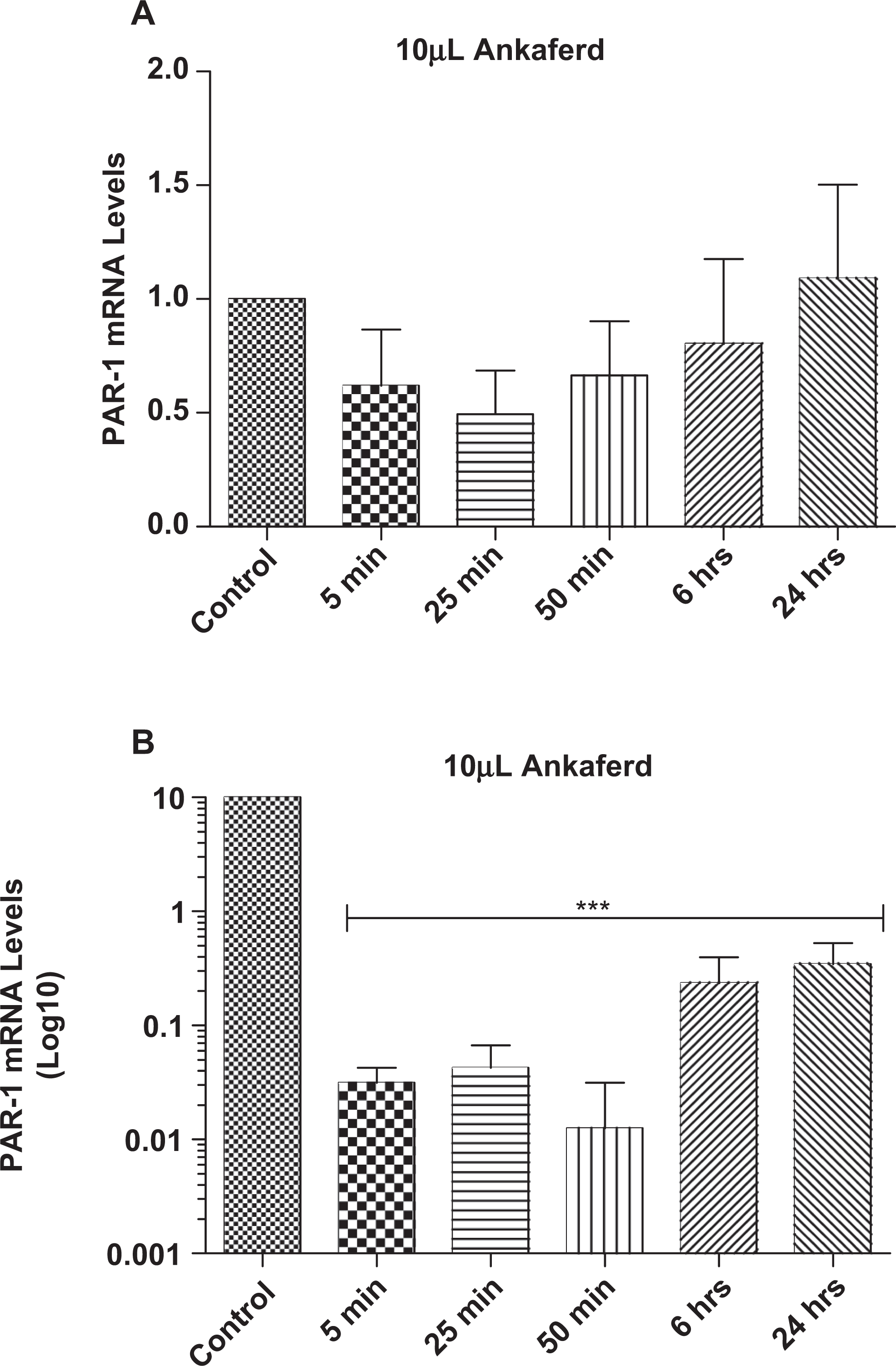
Effects of 10 μL and 100 μL Ankaferd on protease-activated receptor 1 (PAR-1) mRNA expressions in human umbilical vein endothelial cells (HUVEC) after 5 minutes, 25 minutes, 50 minutes, 6 hours, and 24 hours (***P < .001).
When LPS and 10 µL ABS were simultaneously applied to HUVEC, PAR-1 expressions were also decreased by time (Figure 2). However, when LPS and 100 µL ABS were given together, PAR-1 expressions were lower during the first hour and at the end of 24 hours. The PAR-1 expressions upon exposure of ABS more significantly decreased with LPS plus high dose ABS, in comparison to LPS plus 10 µL ABS experiment (Figure 2).
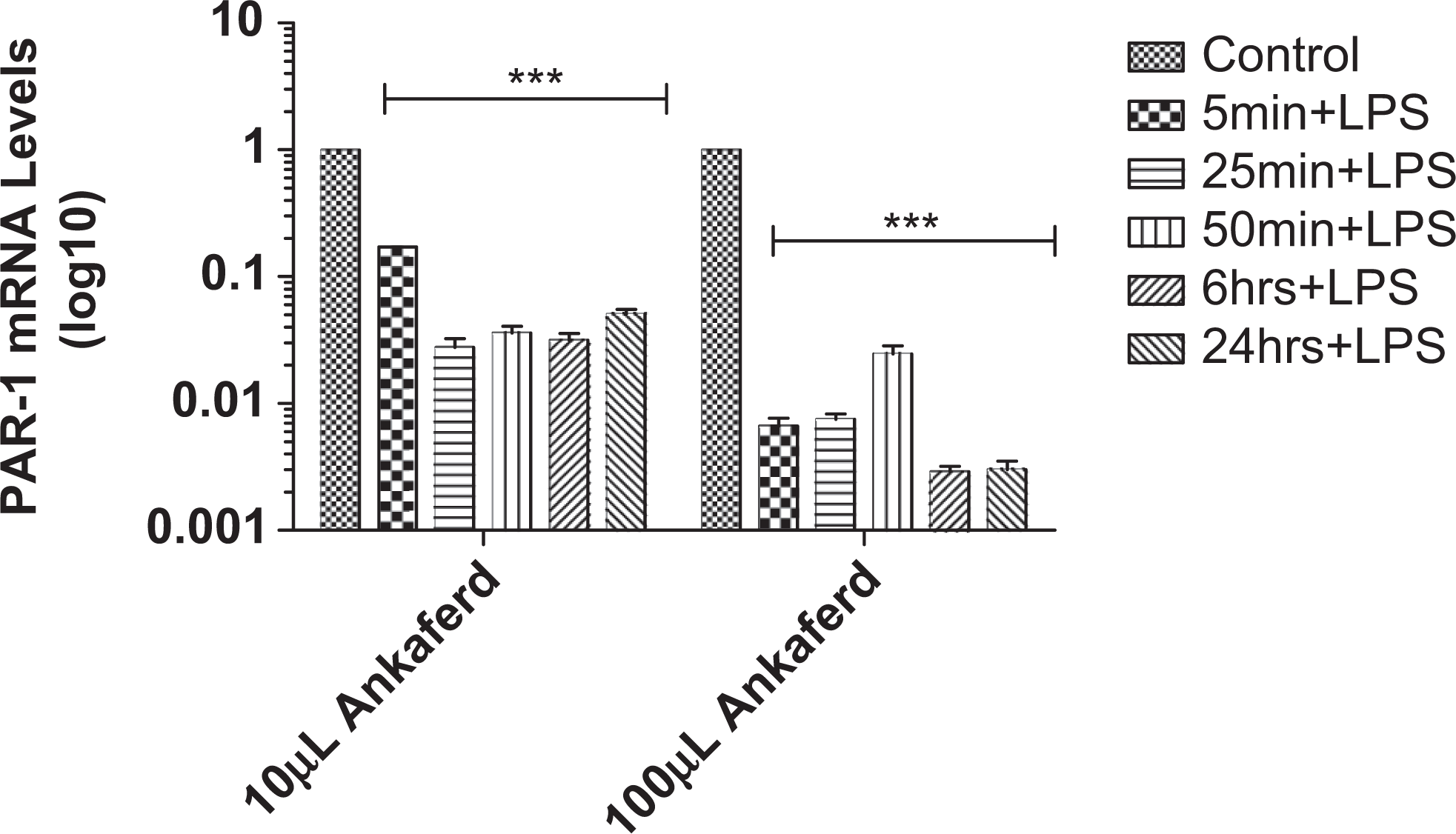
Effects of 10 mL and 100 mL Ankaferd on protease-activated receptor 1 (PAR-1) mRNA expressions in human umbilical vein endothelial cells (HUVEC) following the lipopolysaccharides (LPS) application after 5 minutes, 25 minutes, 50 minutes, 6 hours, and 24 hours (***P < .001).
Discussion
In this study, we observed dose-dependent reversible PAR-1 downregulation mediated by ABS inside the human umbilical vein endothelial cells. Ankaferd blood stopper induced sustained PAR-1 downregulation in the presence of LPS. Those findings are compatible with our previous investigation focusing on the endothelial hemostatic molecules, EPCR, and PAI-1. 23 Ankaferd blood stopper had dual diverse dynamic reversible actions on EPCR and PAI-1 inside vascular endothelial cells also in the model of HUVEC. We had explained sudden antihemorrhagic efficacy of ABS via immediate enhanced expression of prohemostatic PAI-1 and downregulated anticoagulant EPCR upon the exposure of ABS. 23 Hemostatic function of PAR-1 is mainly prothrombotic. Thrombin signaling through PARs can cause platelet activation, intimal hyperplasia, inflammation, and maintenance of vascular barrier function. 4 Protease-activated receptor 1 downregulation is considered a therapeutic tool in thrombosis, 46 inflammation, 7 sepsis, 41 and neoplastic disordes. 47 Significant PAR-1 downregulation mediated by ABS demonstrated in this study indicates that ABS has balanced effects on global hemostasis. Coagulation proteins, namely factors II, V, VII, VIII, IX, X, XI, and XIII were not affected in vitro individually by ABS. 17 Likewise, prothrombin time (PT) and activated partial thromboplastin time (aPTT) were normal via the application of ABS. However, prolonged thrombin time (TT) was evident. 17 Since PAR-1 is the most important thrombin receptor, our major finding in this study, depression of PAR-1 with ABS, could explain the prolonged TT due to ABS. Ankaferd blood stopper is clinically effective in bleeding individuals with normal hemostatic parameters and in patients with deficient primary hemostasis and/or secondary hemostasis.11–14,21,23–33,48–55 However, thrombosis due to ABS has not been observed during the preclinical16,38,56–60 and clinical11–14,21,23–33,48–55 investigations with ABS. Hence, dose-dependent reversible PAR-1 downregulation mediated by ABS could serve for this balanced hemostatic effect, that is, controlling the topical bleeding but not leading to thrombosis and tissue necrosis.
We suggested that ABS could act as a topical biological response modifier via demonstrating diverse actions of ABS in the presence of LPS. “LPS challenge” refer to the process of exposing a biological environment to an LPS, which may act as a toxin to test immunological and hemostatic responses.20,23 Lipopolysaccharides application to HUVEC caused ABS-induced additional sustained significant downregulations in the expressions of PAR-1 mRNA in this study (Figure 2). Endothelial protein C receptor 8 and PAI-1 1 molecules, also modulated by ABS in the presence of LPS, 22 are considered the partners of PAR-1 in the regulation of vascular dynamics, contraction, cellular proliferation, hypertrophy, angiogenesis, and neoplasia. Therefore, there are molecular links underlying ABS-pleiotropic cellular actions17,22 acting on anti-infective,35,36 wound-healing,21,30,33,37 vascular dynamics, 38 and apoptotic processes. 39 Sustained significant PAR-1 downregulation mediated by ABS in the presence of LPS seems to have a protective role against endothelial injury.
There are distinct important molecular components of the ABS-induced hemostatic network involving vascular endothelium, proteins, and blood cells. The concept of ABS-induced hemostatic network has been developed via MALDI-TOF proteomic molecular analyses, cytometric arrays, transciption analysis, and SEM ultrastructural examinations as well as numerous investigations interacting with in vitro and in vivo research settings.18–20,22,23 Essential erythroid proteins (Ankryn recurrent and FYVE bundle containing protein 1, Spectrin alpha, Actin-depolimerisation factor, Actin-depolimerizing factor, LIM bundle and actine binding subunit 1 isoform a, LIM bundle and actine binding subunit 1 isoform b, NADP-dependent malic enzyme, NADH dehydrogenase [Ubiquinone] 1 alpha subcomplex, mitochondrial NADP (+) dependent malic enzyme 3, ribulose bisphosphatecarbocsilase large chain, Maturase K) and the required ATP bioenergy (ATP synthase, ATP synthase beta subunit, ATP synthase alpha subunit, ATP-binding protein C12, TP synthase H+ transporter protein, ADF, alpha-1,2-glycosyltransferase ALG10-A) are included in the protein library of ABS. Ankaferd blood stopper also upregulates GATA/FOG transcription system affecting erythroid functions and urotensin II.19,20 Further experimental search is needed to find out the molecules inside the ABS protein library leading to the ABS effect of PAR-1 downregulation.
Protease-activated receptor 1 modulates programmed cell death, apoptosis. Activation of PAR-1 can induce or paradoxically inhibit apoptosis in endothelial cells, fibroblasts, and tumor cells depending on the dosage of its physiological agonist thrombin. 61 Ankaferd blood stopper has been shown to affect renal tubular apoptosis based on the level of hemorrhage in a previous study. 39 When the bleeding associated with the surgery of partial nephrectomy is mild or moderate, ABS can initially increase renal tubular apoptosis. On the contrary; during the increased amount of massive bleeding from the kidney tissue, ABS decreases apoptosis in renal tubular cells. 39 Therefore, ABS modulates the cellular apoptotic responses to hemorrhagic stress as well as its hemostatic hemodynamic activity. The finding of ABS-induced PAR-1 downregulation gives an additional clue on the possible mechanism of ABS-associated apoptosis modulation at the tissue level. Preliminary findings focusing on in vitro antineoplastic effects62,63 of ABS also prompt to begin for searching the ABS effects at the cellular level.
The possible significance of PAR-1 activation for the pathogenesis of infectious disease was also established.61,64 Ankaferd, besides its hemostatic activity, may also inhibit the growth of bacteria.35,65,66 Anti-infectious activity of Ankaferd may represent an advantage over its current clinical use, since it inhibits the growth of bacteria in the area used mainly for its hemostatic activity such as traumatic infected wounds. The antimicrobial activity of Ankaferd was tested against many bacterial pathogens. The isolates included A baumannii, E coli, K pneumonia, P aeruginosa, Enterobacter species, Stenotrophomonas maltophilia, methicillin resistant coagulase negative Staphylococcus, vancomycin-susceptible Enterococcus, and vancomycin-resistant Enterococcus (VRE)35,36,65,66 Protease-activated receptor 1, as an important regulator of endothelial barrier function and blood coagulation, is involved in the lethal sequelae of sepsis. 67 On the other hand, the coagulant and inflammatory exacerbation in sepsis is counterbalanced by the protective protein C pathway. Activated PC (APC) was shown to use the EPCR as a coreceptor for cleavage of PAR-1 on endothelial cells. 68 Protease-activated receptor 1 is, therefore, the target for EPCR-dependent APC signaling, suggesting a role for this receptor cascade in protection from sepsis. 68 The mechanism of action regarding the anti-infective effects of ABS is currently unknown. In this study, we observed that ABS downregulates the expressions of PAR-1 in the presence of “LPS challenge.” Anti-infective actions of ABS may be related to its hemostatic functions acting on PAR-1, EPCR, and PAI-1, 22 affecting distinct steps of coagulation and vascular endothelium.
Ankaferd blood stopper-induced acceleration in the healing rate at the early phase of the complicated wound healing process has been shown in radiation colitis,30,33 infected dental areas,18,21,69 rectal ulcers, 37 or gastrointestinal neoplastic lesions.25,28,49,55 Protease-activated receptor 1 and thrombin could affect for preserving the tissue and wound repair.5,8,70–73 Downregulated PAR-1 upon the exposure of ABS in our present study represents an initial clue to set further experiments to search the importance of endothelial regulators in the biological effects of ABS. Protease-activated receptor 1 is also involved in tumor responses.1,6,10,43,45,47,74 In a case series, ABS has topically inhibited tumor angiogenesis, 55 angiogenic effects of PAR-1 in this respect shall also be further searched based on the observations in our present study.
In summary, ABS caused dose-dependent reversible PAR-1 downregulation in HUVEC cellular model. “LPS challenge” to HUVEC enhanced ABS-induced sustained downregulations in the expressions of PAR-1. Those findings indicated that ABS may act as a topical biological response modifier. Since ABS is currently being developed in basic and clinical grounds, those novel observations cast future studies focusing on the pleiotropic effects of this unique novel hemostatic agent.
Footnotes
Acknowledgements
Ankaferd blood stopper vials were supplied from the firm, Ankaferd Drug Inc., Istanbul-Turkey.
The author(s) declared no conflicts of interest with respect to the authorship and/or publication of this article.
The author(s) received no financial support for the research and/or authorship of this article.