



Abstract
Communication regarding COVID-19 vaccines requires evidence-based strategies. We present findings from a quantitative survey measuring participants’ understanding, trust, and decision-making in response to information conveying low or high uncertainty regarding the vaccine. Communication conveying high uncertainty led to lower self-assessed understanding but higher actual understanding of possible outcomes. Communication conveying low uncertainty increased vaccine acceptance by those who previously opposed vaccines. This indicates that communicating uncertainty may have different effects over time and that adjusting messaging depending on audiences’ prior vaccine attitudes might be important. These findings support the need for further investigation of how uncertainty communication influences vaccine acceptance.
COVID-19 vaccinations present a unique challenge for science and health communication. Encouraging broad public acceptance of any vaccine is difficult (Jarrett et al., 2015), requiring parents and patients to understand the science of vaccines and trust providers (Larson et al., 2015), but discussing newly licensed vaccines for an emerging and uncertain disease is especially challenging. While the current literature on communication about uncertainty examines diverse effects, our study is focused mainly on investigating the impact of uncertainty communication on understanding of science, trust in science, and behavioral decision-making process (including both perceptions of the vaccine and intent to receive the vaccine). This study is unique and important for many reasons: current information about the effects of exposure to uncertain information does not intricately examine public understanding as an outcome measure; most of the studies conducted so far in risk communication are not based on health issues, whereas our study is about a currently relevant health topic; and we are examining an issue that has been politicized, which impacts how people perceive uncertainty (Kreps & Kriner, 2020). In this note, we present prior research on communication of risk and uncertainty as well as communication regarding infectious diseases, including COVID-19, and vaccines. We then present in our study a quantitative survey to further explore how adults respond to different methods of communicating low versus high degrees of uncertainty about the COVID-19 vaccine. Findings from our study have important implications for further research to help inform health communication.
Communication of Scientific Uncertainty
Risk and uncertainty communication is complex, and extensive research has been undertaken in this area (Fischhoff & Davis, 2014). In particular, perceptions of risk can be biased. Individuals may accept risks that are seen as voluntary or naturally occurring, while they are less likely to accept risks that are seen as imposed or man-made (Noar & Austin, 2020; Tumpey et al., 2019). Individuals also overestimate risk when the activity or event is associated with high levels of dread or of being unknown (Slovic, 1987). In the case of COVID-19, the vaccine is new and thus unknown, man-made, and potentially mandated by employers or the government, so individuals may perceive the risk of the vaccine as very high. This prompts the need for highly nuanced communication regarding the risks and uncertainties of the vaccine.
The degree of uncertainty presented by scientists impacts how non-scientists react to findings (Corner et al., 2012; Hunt et al., 2018; Jensen et al., 2017; Steijaert et al., 2020). Previous studies have examined how communication of scientific uncertainty in different ways affects attitudes, interest, trust, and behavioral decision-making on the part of the audience. A study of public attitudes toward different food hazards revealed that individuals perceive the seriousness of risks to be greater for certain foods or food contaminants, especially where people felt a lack of control over the risk (Miles & Frewer, 2003). Another study showed that communicating uncertainty about nanotechnology in media reports led to no change in trust in scientists and slightly increased interest in new technologies (Retzbach & Maier, 2015). In another study, words and numerical ranges were used to communicate uncertainty in news article–like texts regarding contested topics like climate change. People’s prior belief about topics was the main factor influencing their trust in scientific facts. Communicating uncertainty verbally (but not numerically) slightly decreased trust in scientific data (van der Bles et al., 2020). These two studies had disparate results regarding whether the communication of scientific uncertainty affected audience trust in science. They also suggest that the topic of communication, and whether it is a contentious or politicized issue (with climate change being more contentious than nanotechnology), may have a significant influence on public perceptions of communication about uncertain science. In addition, the type of uncertainty that is discussed can influence public trust: operationalizing uncertainty as disagreement within the scientific community has negative effects while uncertainty in the form of quantified probabilities had positive or null effects (Gustafson & Rice, 2020). Interestingly, the extent to which individuals’ trust of uncertain science influences their decision-making depends on that individual’s preferred style of reasoning through problems (Hendriks & Jucks, 2020).
Importantly, individuals without scientific training may rely more on their original perceptions about an issue than on the information communicated (Fernandez Branson, 2013; Nyhan et al., 2014; van der Bles et al., 2020), and political ideology influences the perception of scientific uncertainty (Broomell & Kane, 2017), highlighting the need to understand and target specific audiences who hold diverse preexisting views. It is important to analyze whether there are ways of communicating about uncertain scientific topics that can help audiences with preexisting hesitancies toward science/scientists begin to accept the message.
In our analysis of the literature, we found that much of the risk communication literature focuses on environmental or technological issues and not public health issues (Holmes, 2008), critically emphasizing the need for more studies on risk and uncertainty communication in the midst of public health crises. According to the World Health Organization’s (WHO, 2017) guideline handbook for emergency risk communication, recent health emergencies such as Ebola, Zika, and yellow fever outbreaks in different parts of the world have laid bare the gaps in how risk is communicated during health emergencies. The handbook calls for increased guidance on the best way to design messages during similar public health emergencies. In addition, many of the outcome measures of current studies in this area do not include explicit measurements of understanding of the science. Thus, in our study, we aimed to measure how individuals responded to scientific uncertainty regarding the pertinent health topic of COVID-19 vaccines, measuring understanding in diverse ways in addition to more commonly assessed outcome measures like trust and decision-making process (including the perception of the vaccine and intent to receive the vaccine).
Communication About COVID-19 and Vaccines
This work adds to the growing body of literature regarding communications during COVID-19 (Nan & Thompson, 2021; Ratzan et al., 2020). A previous survey of participants’ responses to communication about COVID-19 uncertainty found that downplaying uncertainty can raise trust in the short term but lead to distrust in the future as diverse outcomes occur (Kreps & Kriner, 2020). This highlights the ethical challenges in choosing how much uncertainty to convey regarding COVID-19 (Guttman & Lev, 2021). Importantly, the political party of the communicator or audience affected these responses; in this case, a Democratic politician criticizing the accuracy of the science carried more weight than a Republican politician’s critique (Kreps & Kriner, 2020). This is important because news articles about COVID-19 have been very politicized (Hart et al., 2020).
In particular, social media has been a key venue for communication regarding COVID-19 by government and public health agencies, news organizations, and individuals, with both positive and negative effects (Mheidly & Fares, 2020; Ngai et al., 2020; Wang et al., 2021). Social media not only allows experts to communicate true information about hazards but also allows individuals to spread information that fosters unhelpful outrage (Malecki et al., 2021). News articles communicating about purported COVID-19 treatments like hydroxychloroquine often lacked communication of complexity and uncertainty, leading to the spread of misinformation, confusion, and mistrust (Saitz & Schwitzer, 2020). Communicating recommendations for behavior change, such as masking, based on uncertain and changing scientific data, are especially challenging (Finset et al., 2020). However, transparency about uncertainty and promoting autonomy is critical for sustainable behavior change (Porat et al., 2020).
As scientists, public health organizations, and clinicians move from communicating about the science of COVID-19 and behavioral mitigation like social distancing and masking to communicating about the COVID-19 vaccine, there are additional communication challenges. In general, vaccinations represent a known area of public mistrust of science and medical professionals (Funk, 2017, 2020). Both individuals’ trust in public health organizations and scientists and their proximity to a disease outbreak can influence their opinion of vaccinations (Justwan et al., 2019). Extensive research has been undertaken to understand how providers can communicate with parents to encourage them to vaccinate their children (Lewin et al., 2011). It is known that it is critical to actually listen to patients and parents during this communication (Holt et al., 2016; Leask et al., 2012), as shared decision-making between parents and the doctor can support parents’ willingness to vaccinate their children (Fadda et al., 2015). However, the newness of the COVID-19 vaccine, coupled with the fact that the whole population, not just children, need the vaccine, may present additional challenges. In addition, the spread of anti-vaccine information on social media, which affected the response to previous outbreaks such as measles, is growing in response to the current COVID-19 pandemic (Ball, 2020). The Pew Research Center found that in general, the U.S. public is divided about whether to receive the coronavirus vaccine. Both concerns about health care costs and politics affected the results, as did race/ethnicity (Tyson et al., 2020). Based on the previous research of vaccines, a person’s nationality and religious beliefs can affect their acceptance of vaccines in general (Figueiredo et al., 2020). Having completed more education and receiving a medical provider’s recommendation increase individuals’ intent to receive the COVID-19 vaccine (Head et al., 2020). A key question is how uncertainties regarding the newly licensed COVID-19 vaccines may influence individuals’ intent to receive a vaccine.
Overall, in this study, we aimed to answer the following research questions:
Research Question 1 (RQ1): How does conveying uncertainty impact individuals’ understanding of the science of COVID-19 vaccines?
Research Question 2 (RQ2): How does conveying uncertainty impact individuals’ trust in the science of COVID-19 vaccines?
Research Question 3 (RQ3): How does conveying uncertainty impact individuals’ perception of COVID-19 vaccines?
Research Question 4 (RQ4): How does conveying uncertainty impact individuals’ intent to receive the COVID-19 vaccine?
Method
Participants
Undergraduate students at a large university in Colorado participated in the study between December 4 and 11, 2020. The first vaccine in Colorado was administered on December 14, 2020. There were N = 117 participants, 56% of whom were female. The average age of the participants was 19 (SD = 3.05) with a minimum age of 18 and a maximum age of 40. Regarding race/ethnicity, 68.1% identified as Caucasian, 14.7% as Hispanic, 6.9% as Asian, and 2.6% as African American.
Research Design and Procedure
An experimental study was conducted in which participants were randomly assigned to an intervention in the form of communication regarding the COVID-19 vaccine in language with a low or high degree of uncertainty. The study was approved by the Institutional Review Board of the authors’ institution, and participants indicated their consent before beginning the study. Participants completed several pre-intervention measures to assess trust in science (Nadelson et al., 2014), support for vaccines, and likelihood to take the COVID-19 vaccine if offered that day (see https://osf.io/5ud8q/ for exact wording of survey). Participants were then told to read the information regarding the COVID-19 vaccine, which had either low or high uncertainty (see Table 1 for wording of the intervention). The post-intervention measures included self-rated understanding of the information. Participants were then given four scenarios and asked to rate their surprise at the outcome described in each (see Table 1). We operationalized actual understanding as their surprise regarding these more or less likely scenarios. There is a range of possible outcomes with various likelihoods that can occur following COVID vaccination (Polack et al., 2020). We reasoned that people who understood that unlikely events were still possible would express less surprise at their occurrence compared with people with less understanding of the possible events. Thus, by rating their surprise at various occurrences, participants showed us how complex and nuanced their actual understanding of COVID vaccination was. Participants then rated their trust in the information and in the hypothetical person who produced the vaccine information (Steijaert et al., 2020), their perceptions of the vaccine (measured as their agreement that the vaccine is safe, effective, necessary, and should be taken), and their intent to take the vaccine if offered that day. Finally, they completed a demographics questionnaire.
Text for Survey Intervention and Post-Intervention Scenarios.
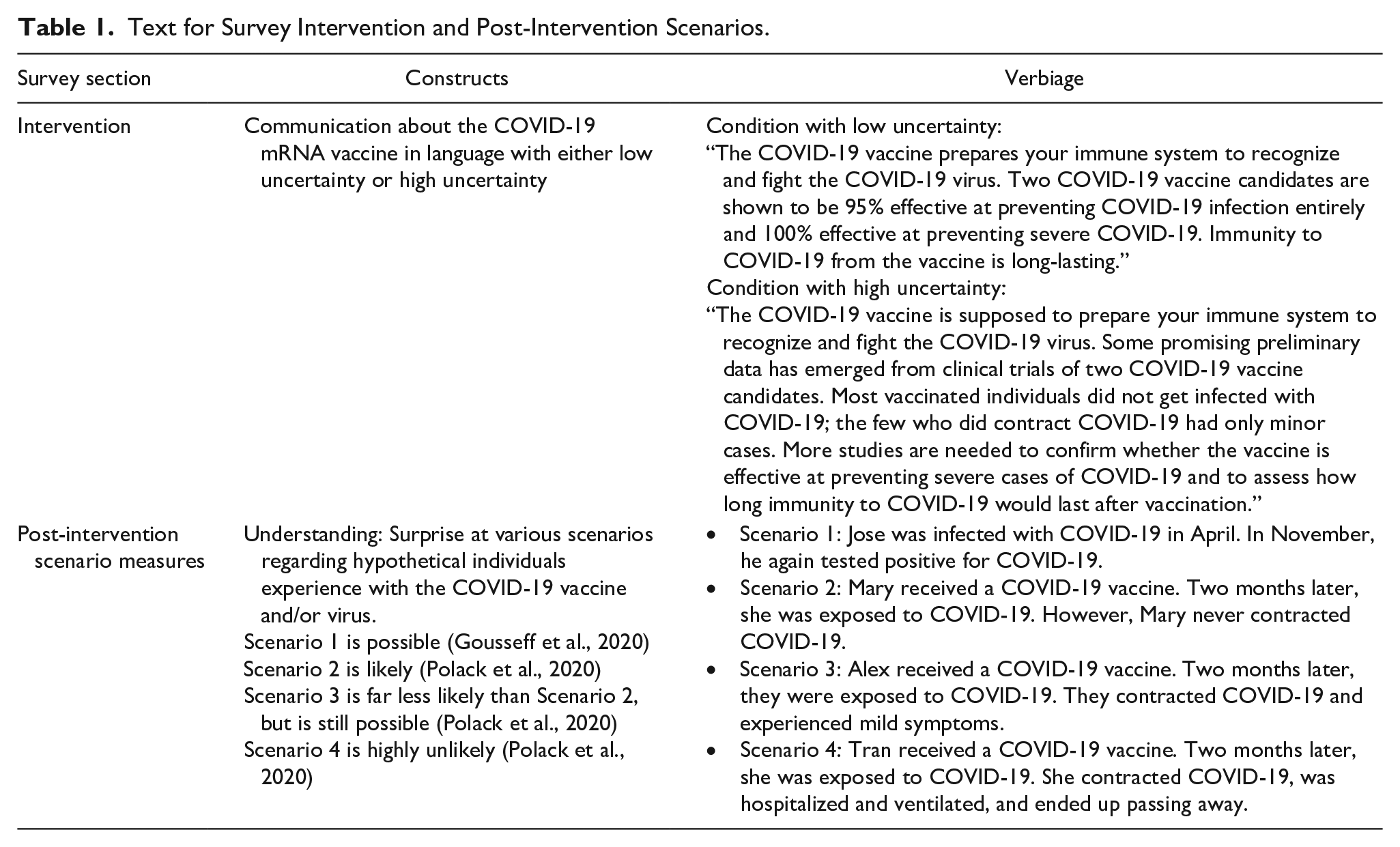
Analyses
Data analysis was conducted in R (R Core Team, 2019). For Likert-type data, we used the non-parametric Mann–Whitney test. This statistic (U) is the number out of all combinations of cross-group pairs for which the participant in the low uncertainty condition had a higher rating than the participant in the high uncertainty condition. The total number of pairs was 3,420 (57 × 60). The effect size was also presented as a proportion (f = U / number of pairs; 50% means no difference) and as the rank-biserial correlation (r). For continuous data, we used linear regressions.
Results
Understanding: Higher Uncertainty Decreased Individuals’ Self-Assessment of Understanding But Increased Individuals’ Actual Understanding of Possible Scientific Outcomes (RQ1)
The Mann–Whitney test indicated that self-assessed understanding was lower for the high uncertainty group than for the low uncertainty group, U = 2,023, p = .057, r = .18, f = 59% (see Table 2). In contrast, participants in the high uncertainty condition had greater actual understanding that scenarios with lower likelihoods could occur. The critical scenario was one for which a person who had the vaccine still got COVID-19 with mild symptoms (Scenario 3). This scenario is unlikely but still possible, and recognizing its possibility can be crucial so people with vaccine hesitancy do not use these cases as evidence the vaccine is ineffective. The Mann–Whitney test indicated that surprise ratings on this scenario were lower for the high uncertainty group than for the low uncertainty group, U = 2,150, p = .013, r = .26, f = 63% (see Table 2).
Number of Participants in Each Group Giving Each Response on the 1 to 5 Likert-type Scales for Each Outcome Measure.
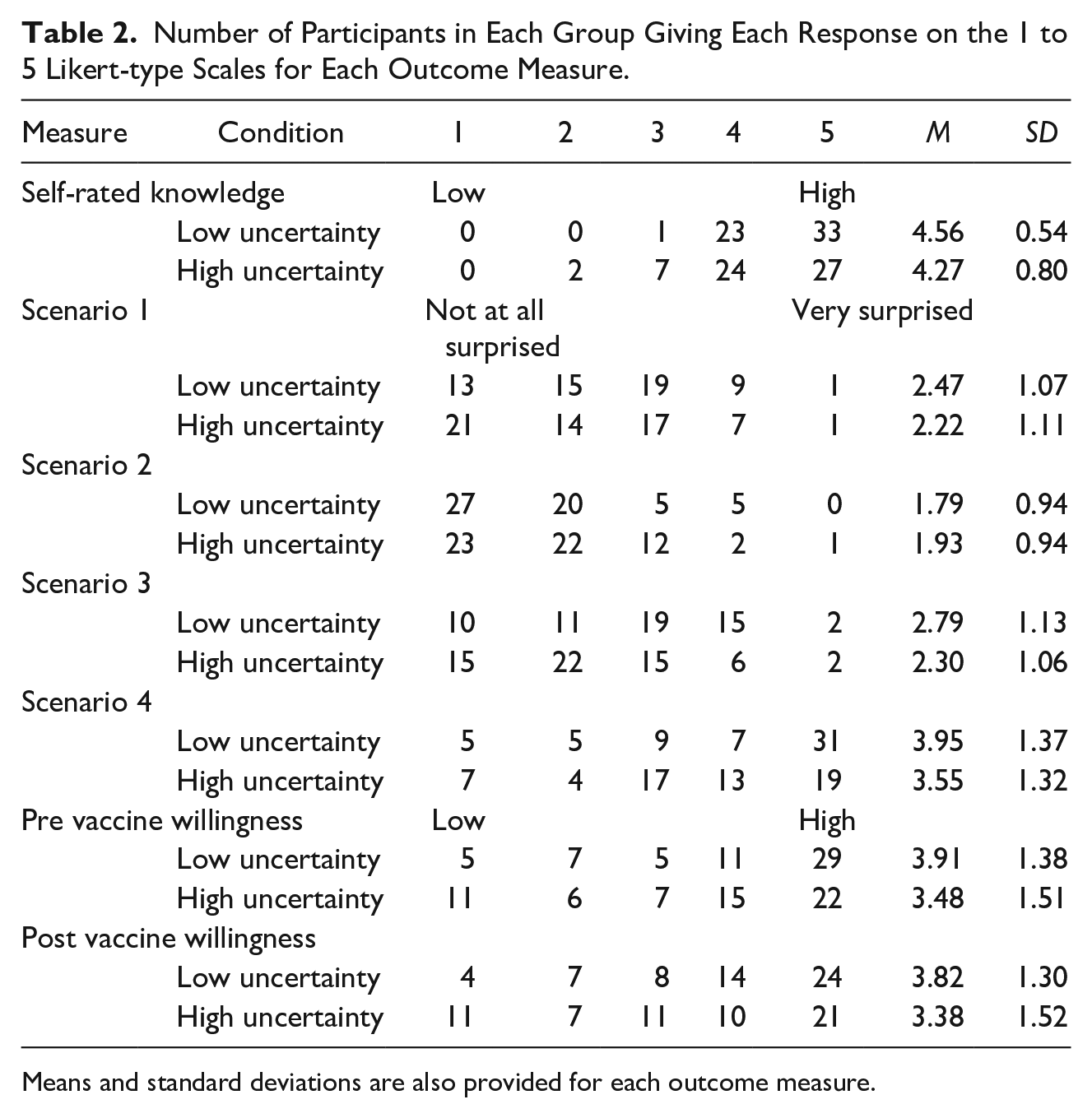
Means and standard deviations are also provided for each outcome measure.
To verify that participants in the higher uncertainty condition were not simply less surprised by all outcomes, we explored the responses to the scenario that did not involve the vaccine (Scenario 1), which should have been equally unsurprising to both groups. Indeed, this was the case, U = 1,942, p = .19, r = .14, f = 57%. Participants in the two conditions were also similarly unsurprised by the most likely reaction to the vaccine (Scenario 2), in which a vaccinated person was exposed to but did not contract COVID-19, U = 1,536, p = .31, r = –.10, f = 45%. In Scenario 4, which presented the unlikely event that a vaccinated person would contract COVID-19 and die, surprise ratings were higher in the low uncertainty condition than in the high uncertainty condition, U = 2,045, p = .055, r = .20, f = 60%.
Trust: Degree of Uncertainty Did Not Impact Trust in the COVID-19 Vaccine (RQ2)
We also looked at the impact of inclusion of uncertainty information on trust. Trust of information was calculated as the mean rating across the questions about whether the information can be trusted, is accurate, and is grounded in facts. We performed a linear regression with trust as the dependent factor. The independent factors were the uncertainty conditions and scores on trust in the science scale. Pre-intervention trust in science predicted trust in this information, t = 3.74, p < .001, estimate = 0.49, SE = 0.13. However, uncertainty conditions did not impact trust, t = 1.08, p = .28, estimate = 0.16, SE = 0.15 (low uncertainty: M = 3.37, SE = 0.10; high uncertainty: M = 3.53, SE = 0.10). A similar pattern was found with ratings of trust in the person who produced the information. Pre-intervention trust in science predicted trust, t = 3.39, p < .001, estimate = 0.45, SE = 0.13, but uncertainty conditions had little to no influence, t = 0.18, p = .86, estimate = 0.03, SE = 0.15 (low uncertainty: M = 3.32, SE = 0.11; high uncertainty: M = 3.34, SE = 0.10). Uncertainty conditions did not impact trust of the information or trust of the person who produced the information.
Behavioral Decision-Making: Communication of a Low Degree of Uncertainty Increased Perceptions of the COVID-19 Vaccine as Safe and Effective and Increased Initially Unwilling Individuals’ Intent to Take the Vaccine (RQ3 and RQ4)
We analyzed how low uncertainty versus high uncertainty language influenced behavioral intentions, including perceptions of the COVID-19 vaccine and intent to receive the COVID-19 vaccine. We performed a linear regression. The dependent measure was the mean rating on agreement with statements that the COVID-19 vaccine is safe, effective, necessary, and should be taken by people in the community (which we collectively termed “perceptions of the vaccine”). The independent factors were the certainty conditions and mean attitudes toward childhood and annual flu vaccines. General vaccine attitudes influenced the perceptions of the COVID-19 vaccine, t = 9.64, p < .001, estimate = 0.66, SE = 0.07. Uncertainty conditions also affected the perceptions of the COVID-19 vaccine, t = −2.36, p = .020, estimate = −0.30, SE = 0.13 (low uncertainty: M = 3.92, SE = 0.09; high uncertainty: M = 3.62, SE = 0.09). Participants who saw the information presented with high uncertainty had worse perceptions of the vaccine than participants who saw the information presented with low uncertainty.
We also assessed the impact of certainty conditions on willingness to take the vaccine. The Mann–Whitney test indicated that the difference in post- minus pre-willingness to take the vaccine was similar for the two groups, U = 1,662, p = .73, r = −.03, f = 49% (see Table 2). However, if we just consider participants who have a low willingness (very unlikely or unlikely) to take the COVID-19 vaccine at the pre-intervention stage, participants in the low uncertainty condition (n = 12) expressed higher willingness to take the vaccine than participants in the high uncertainty condition (n = 17), U = 137, p = .089, r = .34, f = 67%. This result suggests that the low uncertainty text could be more effective than the high uncertainty text for increasing willingness to take the vaccine for people who are already unlikely to take it.
Discussion
In our survey, we found the following answers to our research questions:
Research Question 1 (RQ1): Individuals who read information with low uncertainty self-assessed higher understanding, but individuals who read information with high uncertainty had higher actual understanding of possible outcomes.
Research Question 2 (RQ2): Degree of uncertainty in communication did not impact trust in the science or scientist producing the information; rather, pre-intervention trust in science was a predictor.
Research Question 3 (RQ3): Individuals who read information with low uncertainty ranked the safety and efficacy of the COVID-19 vaccine higher.
Research Question 4 (RQ4): For those individuals with low prior vaccine acceptance, reading the information with low uncertainty led to higher intent to receive the COVID-19 vaccine.
To summarize the findings, using high or low uncertainty language had dissociating effects. After reading the low uncertainty language, participants felt they understood the information better, had more positive perceptions of the vaccine, and, for those who were initially unlikely to take it, had greater willingness to take the vaccine. However, they were less prepared to encounter outcomes that are likely to occur with the COVID-19 vaccine, such as some individuals still getting COVID-19 after vaccination. Thus, there seemed to be trade-offs in the benefits and costs of presenting information about uncertainty.
These findings contribute to the theoretical underpinnings of scientific uncertainty communication. For instance, Fischhoff and Davis (2014) outline the literature regarding how to characterize, assess, and convey uncertainty for decisions with fixed options. This applies to our study, in which participants have to choose whether or not they intend to take the COVID-19 vaccine. While Fischhoff and Davis present findings similar to ours, such as the fact that observers may misinterpret uncertainty measures and be confidently wrong, they studied experts—such as climate change experts—as the decision-makers rather than individuals without expert training. Our work thus complements theirs, providing more indication of how non-expert individuals make a fixed decision in light of differing degrees of uncertainty information.
These preliminary results are provocative and could lead to important implications for science communication practice, but further research would need to be done. For example, the order of post-intervention measures could have affected how participants responded; for instance, participants’ trust ranking may have been affected by their interpretation of the preceding scenarios. Adjusting the order of these survey items could ensure this effect is not occurring. In addition, this study was limited to a sample of college students and is thus not nationally representative. Future work should include both larger and more diverse sample sizes. Should these results generalize beyond college students, they would have important implications for health communication.
While much research on scientific uncertainty communication, including during COVID-19, measures public trust of science and intent to comply with certain behaviors, our study highlights a unique result regarding public understanding of science, including both self-assessed and actual understanding. Further research to explore how to reconcile an individual’s feeling of understanding versus their actual conceptualization of the science is critical.
The low uncertainty communication seemed to be more effective in terms of the factors affecting decision-making regarding the vaccine—including perceiving the vaccine as safe and effective—and the intent to take the vaccine. However, it would be critical to know whether intent to take the COVID-19 vaccine translates to taking the vaccine; future research should assess how uncertainty communication impacts the actual behavior of taking the vaccine. Our pilot experiment showed a trend toward the finding that for people with very low acceptance of vaccine pre-intervention (scoring 1–2 out of 5), exposure to a message with high uncertainty language about the COVID-19 vaccine did not change their acceptance of the COVID-19 vaccine, but exposure to a message that has low uncertainty about the COVID-19 vaccine increased their acceptance of the COVID-19 vaccine by 0.4. This 20% to 40% increase in vaccination acceptance, multiplied across a large audience population, could have a drastic effect on the number of people choosing to take the COVID-19 vaccine. Based on these results, blanket public health communication strategies about the COVID-19 vaccine that do not target specific audiences may not be effective. Conversely, a nuanced communication strategy that targets individuals with different levels of prior vaccine acceptance may be most useful for broad acceptance of the vaccine. Future research is warranted to analyze whether targeting certain types of communication to different audiences affects vaccine acceptance rates.
Another implication of our findings is short- versus long-term trust. While scientists, clinicians, and science journalists obviously want to nurture understanding of and confidence in science, not presenting uncertainties and limitations can lead to a lack of trust in the long run. For example, presenting more certain information may make the audience feel more confident in their understanding of science, but if a less-likely-but-still-possible outcome were to occur, this audience may be surprised and begin to lose trust in scientific predictions (Kreps & Kriner, 2020). Emphasis on uncertainty highlights that many outcomes could occur, making the audience more prepared to handle these diverse outcomes. Our data indicate a potential trade-off between short-term and long-term understanding and trust. This finding should be explored further, taking into account the ethics involved in the need to disclose the limitations and uncertainty of science to patients.
This study provides important information on how individuals respond to communication of uncertainty regarding the COVID-19 vaccine. The results of the present study suggest that providing more certain information leads to better self-assessment of understanding and attitudes toward the vaccine among the audience. However, presenting the information with less uncertainty can also leave individuals unprepared for the range of possible outcomes that may follow vaccination.
Footnotes

Declaration of Conflicting Interests
The author(s) declared no potential conflicts of interest with respect to the research, authorship, and/or publication of this article.
Funding
The author(s) disclosed receipt of the following financial support for the research, authorship, and/or publication of this article: This work was supported by start-up funds provided by Colorado State University to NCK and by grants from the National Science Foundation (BCS-1632222 and SES-2030059) to JKW.