



Abstract
The study examines how framing, psychological uncertainty, and agency type influence campaign effectiveness in promoting coronavirus disease 2019 (COVID-19) vaccines. A 2 (gain vs. loss frame) × 2 (high vs. low uncertainty) × 2 (national vs. local agency) between-subjects experiment was conducted among Houston residents (N = 382). Findings revealed that a loss frame was more effective among participants primed with high uncertainty through a thought-listing task; however, it was less persuasive under conditions of low uncertainty due to increased psychological reactance. Moreover, there was an interaction effect between uncertainty and agency type on vaccine beliefs. The study contributes to the framing literature by identifying psychological uncertainty as a moderator and provides useful suggestions for vaccine message design.
As of September 2021, the death toll of the coronavirus disease 2019 (COVID-19) pandemic has reached 4.55 million worldwide (Centers for Disease Control and Prevention [CDC], 2021). In the meanwhile, newly invented messenger RNA (mRNA) vaccines have demonstrated over 90% efficacy at preventing the symptoms of COVID-19 in clinical trials. Vaccination is recommended as the best practice to curb the rapid spread of the pandemic (SteelFisher et al., 2021). However, like other mass vaccination programs, significant barriers exist when it comes to public acceptance. Compared with the long-existing flu or measles vaccines, the novelty of coronavirus has fueled greater public uncertainty about the safety and efficacy of its vaccines, coupled with conspiracy beliefs that further reinforce vaccine hesitancy (Hornsey et al., 2018).
The question of how to use different message strategies to enhance campaign effectiveness has been an important topic in communication research (Rothman et al., 2006). Among various strategies, message framing has been one of the most prolific areas. Although a meta-analysis revealed no overall difference in the relative persuasiveness of gain–loss frames in vaccine promotion (O’Keefe & Nan, 2012), persuasion scholars have proposed an integrative framework, suggesting that framing effects are contingent on the manner of information processing (Nan et al., 2018). Guided by this framework, this study investigates psychological uncertainty as a qualifier of the framing impact. As a self-perception of confidence in one’s knowledge or judgments, uncertainty often determines whether campaign messages are processed systemically or heuristically (Vaughn & Weary, 2003). Empirically testing the joint effects of psychological uncertainty and framing can advance the theoretical understanding of the boundary conditions of framing effects. Practically, it is a pressing question to investigate how uncertainty qualifies campaign effectiveness, as the experience of uncertainty is prevalent during the COVID-19 pandemic, especially when it comes to making vaccine decisions (SteelFisher et al., 2021).
Moreover, it is important to understand how public health agencies as a message source influence campaign effectiveness, as they are the primary sources of vaccination information and promotion programs (Nan et al., 2017). As individuals increasingly turn to social media for health information (Lee & Jin, 2019), both national and local agencies have maintained an active voice on social media to encourage the uptake of COVID-19 vaccines. Will individuals perceive campaign messages on social media differently depending on the involved public agency? Will national versus local agencies qualify the impact of message frames or uncertainty due to varying perceptions of psychological distance? This study will explore these questions through a simulated social media campaign among Houston residents, with Houston being one of the epicenters of the COVID-19 pandemic (Dougherty, 2020).
The goal of this experimental study is twofold. First, it examines psychological uncertainty as a qualifier of framing effects and investigates the psychological mechanisms. Second, it explores the effects of national versus local agencies as a message source in promoting COVID-19 vaccination on social media and how it interacts with message frames and psychological uncertainty. As misinformation and uncertainty have infiltrated the public space, this study aims to provide useful knowledge for public agencies about how to communicate effectively with the public to wade through “noises” and maximize campaign effectiveness.
Literature Review
Gain Versus Loss Frames for Encouraging Vaccination
Framing research investigates how different strategies of message construction influence individuals’ cognitions, attitudes, and behaviors (O’Keefe & Jensen, 2009). Equivalency framing, which compares the persuasive effects of presenting factually equivalent information in terms of “gain” versus “loss,” has received much scholarly attention in the past (e.g., Nan, 2007a; O’Keefe & Jensen, 2009; Rothman et al., 2006). The research on gain–loss frames was motivated by the postulate of the prospect theory (Tversky & Kahneman, 1981). It suggests that individuals are more likely to take risks when considering the possible losses associated with a decision, yet they tend to be risk-averse when the provided information emphasizes potential gains.
The extant literature has identified two distinct psychological mechanisms underlying the relative effects of gain–loss frames. On one hand, the notion of negativity bias suggests that negative information enjoys several cognitive advantages in information processing (Ito et al., 1998). Past research has shown that individuals experience losses and gains differently (Tversky & Kahneman, 1981). When the two conditions are objectively equivalent, the subjective experience of losses is often stronger than that of gains. Consequently, individuals tend to allocate more attention to negative information, better memorize it, make stronger causal inferences, and place more weight on it during decision-making (Unkelbach et al., 2020).
On the other hand, the psychological reactance theory underscores the potential shortcomings of loss-framed appeals in persuasion (Nan et al., 2018). The theory posits that individuals tend to protect their freedom to choose (Brehm, 1966). By advocating a particular behavioral choice, persuasive messages may be perceived as a threat to freedom and elicit psychological reactance, typically in the form of counterarguing against the persuasive attempts and anger (Dan & Dixon, 2021; Dillard & Shen, 2005). Messages containing forceful language and threatening tones are especially likely to increase psychological reactance, which may significantly attenuate the effects of persuasive messages or even backfire. For example, Ma et al. (2019) found that psychological reactance to climate change messaging led to backfiring effects on outcomes such as individuals’ climate change beliefs. Considering that a loss-framed message often emphasizes the negative outcomes of noncompliance, it may trigger greater perceived threat to freedom and reactance than a gain-framed message. Prior research has suggested two reasons for this (H. Cho & Sands, 2011; Shen, 2015). First, a loss frame often features controlling and intense language to underscore the negative consequences, thus making its persuasive intent more salient. The loss frame is also more often perceived as a command that must be obeyed. Second, a loss frame often arouses strong negative emotions such as fear, thus being considered manipulative. Consistent with the reasoning, empirical evidence has shown that loss-framed messages are associated with greater perceived threat, counterarguments, and experienced anger compared with gain-framed messages (Zhao & Nan, 2010). Therefore, we propose the following:
Hypothesis 1 (H1): A loss-framed message will elicit greater (a) perceived threat to freedom, (b) counterarguing, and (c) anger than a gain-framed message.
Taken together, the literature has presented two competing hypotheses regarding the relative effectiveness of gain–loss frames. While part of empirical evidence speaks to the persuasive appeal of loss frames among target audiences (e.g., H. J. Kim, 2012; Meyerowitz & Chaiken, 1987), other studies have supported the advantages of gain frames (e.g., J. Cho et al., 2018; Zhao & Nan, 2010). Researchers suggested that framing effects might be conditioned by different types of health behaviors (O’Keefe & Jensen, 2009), particularly between detection and prevention behaviors. Detection behaviors, such as disease screening, often serve to detect health problems and are considered risky, whereas prevention behaviors, such as vaccination, are about maintaining or promoting one’s health status and are perceived relatively safe. As the prospect theory postulates that loss frames lead to risk seeking and that gain frames make individuals more risk-averse, loss frames are likely more effective in encouraging detection behaviors, whereas gain frames would be more persuasive in promoting prevention behaviors.
As vaccination is a prevention behavior, a gain-framed message is thus more likely to be effective in encouraging vaccination. The empirical evidence, however, has been mixed. H. M. Kim et al. (2020), for instance, found that a gain-framed message elicited a more favorable attitude toward human papillomavirus vaccine (HPV) vaccination when participants were prompted to consider their future. However, in a campaign promoting measles, mumps, and rubella (MMR) vaccination, Abhyankar et al. (2008) demonstrated that a loss-framed message led to a greater vaccination intention and increased beliefs about vaccine efficacy. A meta-analysis revealed no substantial difference between message frames in persuasiveness concerning vaccination (O’Keefe & Nan, 2012). The mixed findings may be explained by the conceptual murkiness in the framing literature, particularly that frames in the original prospect theory are combined with options containing probabilistic information (e.g., 200 people will be saved vs. a one-third chance that 600 people will be saved and a two-third chance that no people will be saved); however, most persuasion studies did not consider frames in relation to probabilities (Shen, 2015). Moreover, Nan et al. (2018) suggested that the relative effects of gain–loss frames likely depend on the degree to which the concerns about vaccine safety are salient. For some, vaccination may no longer be seen as a relatively safe action compared with other prevention behaviors (e.g., dental hygiene, smoking cessation, and exercise), as a result of the growing anti-vaccine sentiment and misbeliefs (Blume, 2006). As theories and meta-analytic evidence suggest that beliefs are strongly associated with behavioral intentions (Carpenter, 2010; Fishbein & Ajzen, 2010; Hunter & Kim, 1993), we ask whether message framing would make a difference in individuals’ vaccine beliefs and the vaccination intention:
Research Question 1 (RQ1): Will the gain- and loss-framed message have a significant main effect on (a) the positive beliefs about COVID-19 vaccines and (b) vaccination intention?
Moderating Effects of Psychological Uncertainty
The mixed empirical findings have motivated scholars to pursue the second-generation framing research—exploring the moderators that determine the best usage of message frames (Jensen et al., 2018). Nan et al. (2018) proposed an integrative framework that called special attention to the mode of information processing. Guided by this framework, psychological uncertainty, a concept centering around information experience (Huang & Yang, 2020), may be particularly relevant to understanding how individuals process framed messages promoting COVID-19 vaccination.
Psychological uncertainty refers to a state of insecurity in one’s state of knowledge (Brashers, 2001). It is a self-perception that individuals generate about their cognitions or ability to make judgments when exposed to information that is insufficient, ambiguous, complex, or inconsistent. Despite the relatively robust effectiveness and safety data of the available COVID-19 vaccines in clinical trials, the experience of psychological uncertainty about vaccines is prevalent due to the still-evolving scientific knowledge of the novel coronavirus, the rampant misinformation, and the growing public outcries of general vaccine safety over the years (SteelFisher et al., 2021).
Different levels of experienced uncertainty will likely determine how individuals process information about COVID-19 vaccination. The literature has substantiated a significant association between uncertainty and information motivation (Kuang & Wilson, 2017). However, its direction can go either way. The uncertainty-reduction theory predicts that individuals experiencing high levels of uncertainty are more motivated to seek and process information (Bradac, 2001). The uncertainty-management theory adds that individuals may avoid information to maintain the state of uncertainty in certain scenarios if uncertainty is linked to positive emotions (Brashers, 2001). Notably, information avoidance often occurs to those who have already been involved in an illness or high risks. For example, Brashers et al. (2004) revealed that some participants with HIV had avoided information about HIV testing or lab results to maintain hope. Differently, in contexts involving fewer risks such as disease prevention or vaccination, several studies have suggested that psychological uncertainty is generally indicative of a strong information motivation (Fung et al., 2018; Jin et al., 2020).
As uncertainty motivates individuals to seek information to reduce the state of insecurity in their knowledge and judgments, it will activate an accuracy-driven mindset during information processing (Tiedens & Linton, 2001). Consequently, systematic processing is more likely to occur among those experiencing high levels of uncertainty, whereas individuals who feel more certain tend to engage in heuristic processing. Through two experiments, Vaughn and Weary (2003) demonstrated that priming uncertainty about one’s judgments triggered a more careful approach to information processing and judgment correction. In an advertising context, Faraji-Rad and Pham (2017) showed that psychological uncertainty reduced the influence of heuristic cues on product evaluations, suggesting an occurrence of systematic processing.
Given the possible links between uncertainty and the mode of information processing, uncertainty may condition the effectiveness of gain–loss frames. In particular, individuals experiencing low levels of uncertainty are more likely to process campaign messages in a heuristic manner. Under conditions of limited cognitive efforts, individuals may consider the valence of frames as heuristic cues and use them for simple inferences (Nan et al., 2018). They are more attracted by the positive cues in gain frames and more likely to be repelled by the negative tones of loss frames. Therefore, a loss-framed message may generate an increased perception of persuasive threat and psychological reactance, which in turn reduces persuasion (Reinhart et al., 2007).
Differently, individuals experiencing heightened uncertainty are more likely to be accuracy-driven and engage in systematic processing. Under this circumstance, loss-framed messages may be more persuasive than gain-framed messages. This is because negative information often carries more weight than objectively equivalent positive information during deliberate and effortful decision-making (Nan et al., 2018). Empirical findings in social psychology have lent support to this prediction. Fiske (1980), for instance, found that negative attributes consistently received preferential weighting when participants were directed to carefully evaluate the likability of strangers. As negative information presented in loss frames is contemplated as a piece of evidence instead of being superficially processed as an offensive tone, it will less likely trigger perceived threat to freedom or generate psychological reactance.
Although the interaction effect between gain–loss frames and psychological uncertainty has not been empirically tested, prior research has provided indirect evidence. Maheswaran and Meyers-Levy (1990), for example, found that gain- versus loss-framed messages about heart disease prevention generated differential effects among participants with varying levels of issue involvement. High involvement amplified the advantage of loss frames, yet gain frames were more effective among those with low issue involvement. As issue involvement is a critical antecedent to cognitive efforts during message processing (Chaiken, 1980), the researchers suggested that the difference made by issue involvement was related to whether participants processed the campaign message in a heuristic or systematic manner. Given the possible influence of psychological uncertainty on the mode of information processing (Tiedens & Linton, 2001), we propose the following:
Hypothesis 2 (H2): Psychological uncertainty will moderate the effects of gain–loss frames on (a) vaccine-related beliefs and (b) vaccination intention, such that for those with high levels of uncertainty, the loss-framed message would be more effective; for those with low levels of uncertainty, the gain-framed message would be more effective.
Hypothesis 3 (H3): The interaction between gain–loss frames and uncertainty on vaccine-related beliefs will be mediated by (a) perceived threat to freedom, (b) counterarguing, and (c) anger.
Hypothesis 4 (H4): The interaction between gain–loss frames and psychological uncertainty on vaccination intention will be mediated by (a) perceived threat to freedom, (b) counterarguing, and (c) anger.
Local Versus National Health Agency as a Message Source
As prior literature has revealed the profound impact of message source on persuasion outcomes (Chaiken, 1980; Huang & Sundar, 2020), this study will also explore whether the source of vaccine messages will influence campaign effectiveness.
Public health agencies are the primary sources for vaccination information and public education (Nan et al., 2017). As individuals increasingly turn to social media for health information, particularly during emerging health crises, social media have become a key front for public agencies to communicate vaccine-related information (Lee & Jin, 2019). Agencies at different levels—from the CDC to local public health departments—all maintain an active presence during the COVID-19 pandemic (Liu et al., 2021). It is thus important to investigate whether responses to vaccine messages vary when individuals encounter them on social media from different agencies.
Research on the impact of message source has primarily focused on constructs such as source credibility and likability (Chaiken, 1980; Huang & Sundar, 2020). The psychological effects of national versus local agencies as a source for health-campaign messages, however, have been underexplored. Guided by the construal-level theory (Trope & Liberman, 2010), we expect that individuals may react to vaccine messages from a national agency and a local agency differently due to varied perceptions of psychological distance. Psychological distance is an egocentric experience that an object is close to or far away from oneself in terms of time, space, social relations, or hypotheticality (Trope & Liberman, 2010). These different dimensions of distances are often interrelated and can impact how information is mentally processed. Research has shown that psychological distance is negatively associated with perceived message relevance (Zhao & Peterson, 2017). Being geographically closer, a local health agency may be perceived as a proximal source and make the campaign message appear more relevant to individuals compared with a national agency. Perceived relevance is critical in the formation of health judgments and prevention behaviors (Rothman & Schwarz, 1998). The more relevant individuals perceive an issue, the more likely they would adopt risk-mitigation measures (Carvalho et al., 2008). Therefore, it is plausible that a COVID-19 vaccination message coming from local agencies may achieve better promotional outcomes than that from national agencies by amplifying perceived message relevance. As empirical testing of national versus local agencies as a message source is limited, we propose the following research question:
Research Question 2 (RQ2): Will the message from a local agency be more effective in enhancing (a) positive vaccine-related beliefs and (b) vaccination intention than the message from a national agency by increasing perceived message relevance.
An important premise of the construal-level theory is that psychological distance dictates the level of mental construal (Trope & Liberman, 2010). Distant objects are often construed at high levels, which involve more abstraction; proximal objects are construed at low levels, which consist of more details and specificity. Empirical evidence has revealed that framing effects differed as a function of mental construal (Nan, 2007b), such that gain frames are more compatible with high levels of construal, whereas loss frames are more compatible with low levels of construal. Given the possible difference in psychological distance, national versus local agencies as a message source may make a difference in individuals’ reactions to gain–loss frames. Therefore, we propose the following research question:
Research Question 3 (RQ3): Is there any two-way interaction effect between gain–loss frames and agency type on (a) vaccine-related beliefs and (b) vaccination intention? Specifically, a gain frame would be more effective when the message is from a national agency, whereas a loss frame would be more effective when the message is from a local agency.
Moreover, different levels of psychological uncertainty may qualify the effect of public agencies. As previously discussed, individuals experiencing low uncertainty tend to process campaign messages heuristically, thus being more prone to the relevance cue provided by local agencies. Differently, individuals feeling high uncertainty may focus more on the details of message content, hence being less affected by the difference in message source (Chaiken, 1980). Given the above reasoning, we propose the following research question:
Research Question 4 (RQ4): Is there any two-way interaction effect between psychological uncertainty and agency type on (a) vaccine-related beliefs and (b) vaccination intention? Specifically, a message from a local agency would be more effective than the same message from a national agency under conditions of low uncertainty; however, the difference across agency types would disappear under conditions of high uncertainty.
Method
Study Context: COVID-19 Vaccine Hesitancy
Vaccine hesitancy has long presented itself as a public health challenge as early as when vaccines first became available (Schwartz, 2012). The past decade has witnessed a resurgence of vaccine hesitancy, fueled by the anti-vaccination movements, online misinformation, and an increasingly polarized public (Dubé et al., 2015). Research on vaccine hesitancy has identified a wide range of factors contributing to this phenomenon, ranging from historic, political, and sociocultural context, communication and media influences, to public health vaccine policies (see Dubé et al., 2013, for a comprehensive review).
While the promotion of COVID-19 vaccines shares many of the challenges with other routine vaccines, there are several unique features worth considering. First, together with the pandemic, COVID-19 vaccines have been heavily politicized (Hart et al., 2020). An ideological divide is present since the onset of the pandemic, where conservatives and liberals exhibit stark differences in their risk perceptions, trust in science and government responses, and the general attitudes toward COVID-19 vaccines (Kerr et al., 2021). Second, there is more pronounced race-based vaccination disparity in the context of COVID-19 vaccines, although minority groups have long been documented to exhibit greater vaccine hesitancy in general (Khan et al., 2021). The fact that political conservatives and racial minorities may be more resistant to taking COVID-19 vaccines has informed our sampling and participant recruitment as detailed below.
Design and Participants
A 2 (gain vs. loss frame) × 2 (high vs. low uncertainty) × 2 (CDC vs. Houston Health Department) between-subjects online experiment was conducted. Participants were recruited from Qualtrics, a professional survey service company. To explore the agency effects, only adults who had lived in the greater Houston area since March 2020 were invited. Moreover, a screening question filtered out participants who had been involved in any trials related to COVID-19 vaccines, so that eligible participants had not demonstrated a clear vaccination intention. The data were collected in mid-December 2020, around the time the first two COVID-19 vaccines were approved by FDA under Emergency Use Authorization in the United States (Lovelace, 2020).
A total of 408 participants completed the study. Among them, 6.4% indicated that they had been diagnosed with COVID-19 or were waiting for their test results. Given the influence of COVID-19 infection status on the intention to get vaccinated (i.e., infections create natural immunity), these participants were excluded from data analyses. The final sample included 382 participants (55.2% females). Age ranged from 18 to 81 years (M = 38.08, SD = 14.49). Half of the participants identified themselves as Caucasians (52.4%), followed by 20.2% Hispanics/Latinos, 19.4% African Americans, 6.5% Asians and Pacific Islanders, and 1.6% multiracials or others. Participants indicated their political orientation, ranging from 1 (very conservative) to 7 (very liberal). The mean was around the midpoint of the scale (M = 3.94, SD = 1.74).
Stimuli and Manipulations
The stimuli included four versions of a simulated tweet (see Figure 1). The tweet described the efficacy of the first two COVID-19 vaccines in the United States in clinical trials and the possible timeline of their availability. It also discussed the benefits of vaccination or the harms of not being vaccinated. The format, design, information, and social media metrics (i.e., number of likes, comments, and retweets) of the tweet were maintained the same across conditions except for the experimental manipulations.
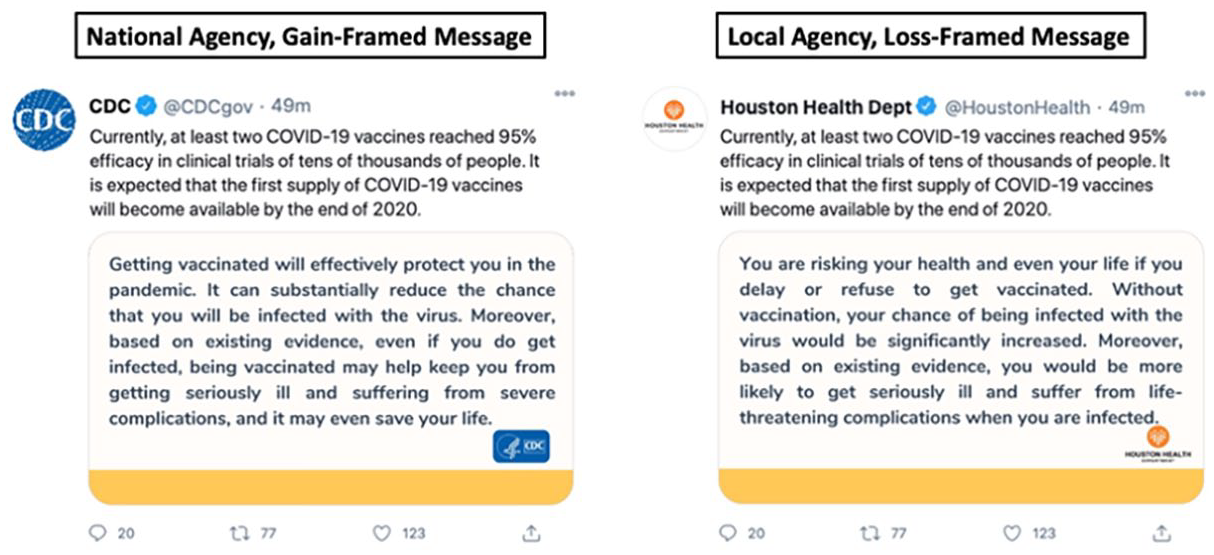
Samples of experimental stimuli.
Gain–loss frames were operationalized by emphasizing either the positive outcomes of vaccination (i.e., substantially reduced chances of infection and severe complications) or the negative consequences of not being vaccinated (i.e., significantly increased chances of infection and severe complications) to individuals. Although vaccination could also be driven by the collective good, there is a trend for modern vaccine promotion programs to focus on individual benefits (Poland et al., 2014). Therefore, the stimuli emphasized the consequences of vaccines to individual health. The exact messages were presented in Figure 1.
A thought-listing task primed psychological uncertainty. The manipulation followed a previous procedure (Faraji-Rad & Pham, 2017). Prior to stimulus exposure, participants were asked to write about things they felt most uncertain or certain about COVID-19 vaccines. To avoid sensitizing participants in the main study, the effectiveness of uncertainty manipulation was examined through a pretest. Participants of the pretest were recruited from Mechanical Turk (n = 116). After completing the thought-listing task, participants were asked how they felt about the effectiveness, distribution, and development of COVID-19 vaccines (ranging from 1 = completely certain to 7 = completely uncertain; Cronbach’s α = .92, M = 4.35, SD = 1.72). To rule out the possible influence of uncertainty manipulation on emotions, emotional valence was measured by asking how they felt at the moment (ranging from 1 = extremely negative to 7 = extremely positive; M = 5.59, SD = 0.97). Results indicated that participants who responded to the uncertainty task experienced significantly higher levels of uncertainty about COVID-19 vaccines (M = 4.82, SD = 1.55) than those who responded to the certainty task (M = 3.89, SD = 1.78), t(114) = 2.99, p = .003. Uncertainty manipulation did not significantly affect emotional valence, t(114) = 0.10, p = .92. Participants’ open-ended responses in the pretest and the main study also indicated that uncertainty/certainty did not necessarily correspond to negative/positive thoughts about the vaccine. For example, in the certainty task, some participants wrote, “it can help people,” “life saving,” while others wrote, “vaccines were rushed,” “it is not safe.” For uncertainty, some wrote, “side effects,” “long term problems,” while others wrote “availability,” “how soon i get it.”
Agency type was manipulated by varying the source of the tweet. In the national-agency condition, the message was tweeted from the CDC; in the local-agency condition, the message was tweeted from the Houston Health Department.
Measurement
Vaccine beliefs were measured using eight items on a 7-point Likert-type scale adapted from Sarathchandra et al. (2018). Participants indicated their agreement with statements including “the COVID-19 vaccines are effective in protecting against the virus,” “the risk of side effects outweighs the protective benefits of the COVID-19 vaccines” (reverse-coded), and “vaccination helps stop the spread of the coronavirus” (Cronbach’s α = .84, M = 4.55, SD = 1.26).
Vaccine intention was measured using one item on a 7-point Likert-type scale. Participants indicated the extent to which they agreed that they were willing to put effort into COVID-19 vaccination (M = 4.19, SD = 2.16).
Perceived threat to freedom was measured using four items on a 7-point Likert-type scale (Dillard & Shen, 2005). Participants indicated how much they agreed that the message threatened their freedom to choose, tried to make a decision for them, tried to manipulate them, and pressured them (Cronbach’s α = .93, M = 3.57, SD = 1.94).
Psychological reactance was operationalized in terms of counterarguing and anger. Counterarguing was measured on a 7-point Likert-type scale with the following items (Moyer-Gusé & Nabi, 2010): “I found myself disagreeing with the message,” “I was looking for flaws in the arguments,” and “it was easy to disagree with the arguments made in the message” (Cronbach’s α = .84, M = 3.62, SD = 1.73). Anger was measured by asking how much the message made them feel “irritated,” “angry,” and “annoyed” (Dillard & Shen, 2005), ranging from 1 (none of this feeling) to 7 (a great deal of this feeling) (Cronbach’s α = .94, M = 2.78, SD = 1.95).
Perceived message relevance was measured by asking participants on a 7-point Likert-type scale (Yoon & La Ferle, 2018) how much they agreed that the message was “involving,” “interesting,” and “relevant” to them (Cronbach’s α = .91, M = 4.76, SD = 1.70).
Randomization checks and control variables: Participants indicated whether they had medical conditions that were at increased risk of severe illnesses from the coronavirus (22.8% “yes,” 70.9% “no,” and 6.3% “don’t know”). Participants’ prior attitude toward COVID-19 vaccines was assessed by asking how positive they felt about COVID-19 vaccines (M = 4.39, SD = 2.11). This attitude measure was administered at the beginning of the experiment and was masked by other nine health issues including e-cigarettes, genetically modified food, and so on. Randomization checks revealed that participants’ demographic distribution (age, gender, race, and political orientation), health risk for COVID-19, and prior attitudes toward the vaccines did not differ across experimental conditions. The effects of these variables on vaccine beliefs and vaccination intention were also assessed through multiple regressions. Results suggested that only political orientation (βbeliefs = .17, pbeliefs <.001; βintention = .08, pintention =.05) and prior attitudes toward the vaccines (βbeliefs = .64, pbeliefs <001; βintention = .67, pintention <.001) were significant predictors. Thus, these two variables were controlled in all data analyses.
Procedure
After indicating their consent, eligible participants were randomly assigned to one of the experimental conditions. Their attitudes toward a few health issues were measured along with several demographic variables. Then, depending on the experimental condition, they completed the writing task priming different levels of psychological uncertainty and viewed the simulated Twitter message. Following the message exposure, they responded to measures assessing the variables of interest and answered questions about whether they have contracted COVID-19 and whether they were at high risk for severe illness. Finally, participants were debriefed and compensated. The experimental session took about 10 to 15 minutes.
Results
Manipulation Effectiveness
An independent-samples t test was conducted to examine the effectiveness of the manipulation for gain–loss frames. Results indicated that participants who viewed the gain-framed message (M = 5.57, SD = 1.61) were significantly more likely to indicate that the message emphasized the benefits of being vaccinated against COVID-19 instead of the harms of not being vaccinated than their counterparts who viewed the loss-framed message (M = 2.91, SD = 1.91), t(380) = 14.79, p < .001. Besides, a chi-square test revealed that participants who viewed the message from CDC were significantly more likely to agree that the message was tweeted by CDC (98.1%) than those who viewed the message from the Houston Health Department (24.0%), χ2 = 227.90, p < .001, Cramer’s V = .77. Therefore, both experimental treatments were effective.
Hypothesis Testing
To test H1, a three-way analysis of covariance (ANCOVA) revealed a significant main effect of gain–loss frames on perceived threat to freedom, F(1, 372) = 29.75, p < .001,
RQ1 asked whether message framing would have a significant main effect on vaccine beliefs and vaccination intention. Three-way ANCOVAs showed that the main effect of gain–loss frames was not significant on vaccine-related beliefs, F(1, 372) = 0.11, p = .74, or vaccination intention, F(1, 372) = 1.35, p = .25.
To test H2, analyses revealed a significant interaction effect between gain–loss frames and psychological uncertainty on vaccine-related beliefs, F(1, 372) = 6.62, p = .01,
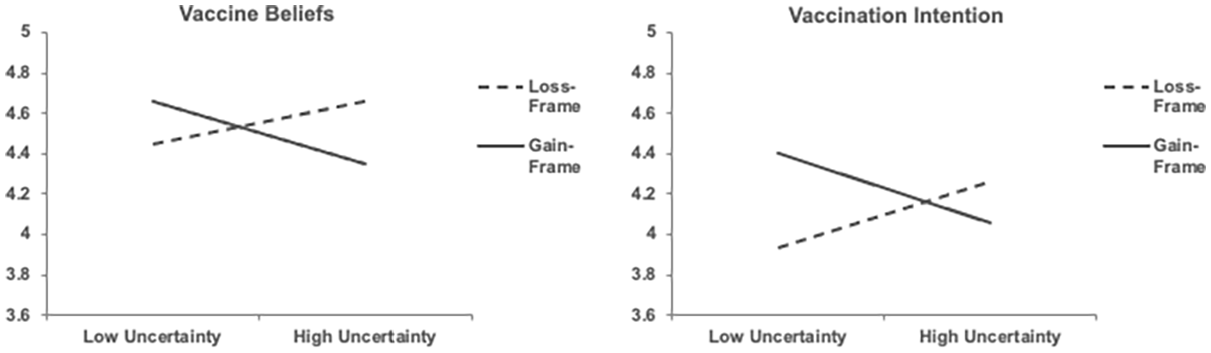
The interaction effect between gain–loss frames and psychological uncertainty on vaccine beliefs and vaccination intention.
Hayes’s (2018) PROCESS Macro (Model 8) with 5,000 bootstrap samples and 95% bias-adjusted confidence intervals (CIs) was used to test the proposed moderated mediations in H3. Analyses revealed that perceived threat to freedom, B = .06, SE = .04, 95% CI = [.003, .133], counterarguing, B = .23, SE = .08, 95% CI = [.090, .410], and anger, B = .08, SE = .04, 95% CI = [.012, .186], were significant mediators for the interaction effect on vaccine-related beliefs. As illustrated in Figure 3, for those with low levels of uncertainty, the loss-framed message reduced positive vaccine-related beliefs indirectly by increasing perceived threat to freedom, B = −.09, SE = .05, 95% CI = [−.184, −.002], counterarguing, B = −.17, SE = .06, 95% CI = [−.290, −.065], and experienced anger, B = −.11, SE = .04, 95% CI = [−.202, −.027]. For participants with high levels of uncertainty, the indirect paths were nonsignificant through perceived threat to freedom, B = −.04, SE = .03, 95% CI = [−.094, .002], counterarguing, B = .07, SE = .05, 95% CI = [−.033, .177], or anger, B = −.02, SE = .02, 95% CI = [−.072, .021]. After considering these indirect effects, the direct effect of gain–loss frames on vaccine beliefs was nonsignificant for those with low levels of uncertainty, B = .17, SE = .11, 95% CI = [−.056, .389]. However, the direct effect was significant for those with high levels of uncertainty, B = .26, SE = .11, 95% CI = [.051, .476], such that the loss-framed message directly increased positive beliefs about vaccines. Therefore, H3a to H3c were supported.
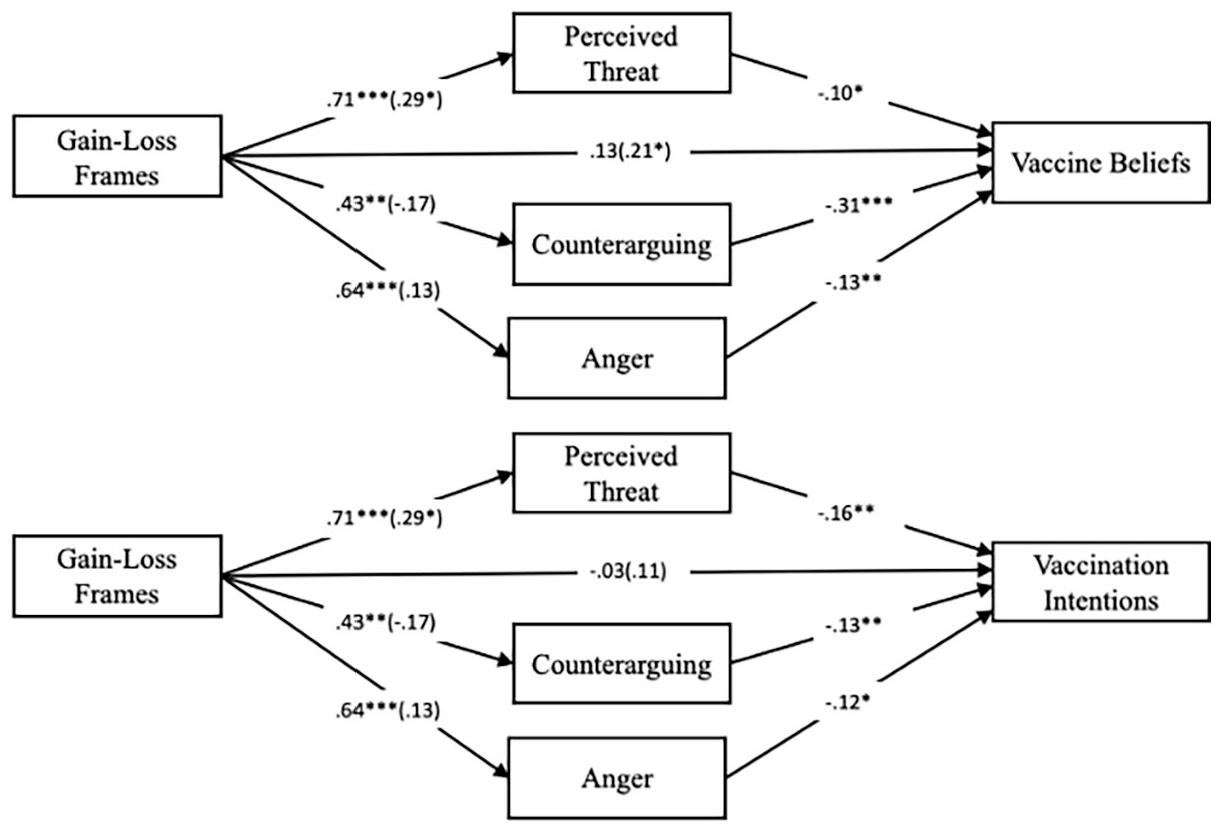
Statistical diagram of the moderated mediations.
Regarding H4, analyses revealed that the interaction significantly affected vaccination intention indirectly through perceived threat to freedom, B = .19, SE = .10, 95% CI = [.026, .407], counterarguing, B = .16, SE = .08, 95% CI = [.033, .341], and anger, B = .22, SE = .10, 95% CI = [.057, .432]. As Figure 3 shows, for participants with low levels of uncertainty, the loss-framed message reduced vaccination intention indirectly by increasing perceived threat to freedom, B = −.32, SE = .09, 95% CI = [−.524, −.164], counterarguing, B = −.12, SE = .06, 95% CI = [−.243, −.025], and experienced anger, B = −.27, SE = .09, 95% CI = [−.477, −.119]. For those with high levels of uncertainty, the indirect paths were nonsignificant through counterarguing, B = .05, SE = .04, 95% CI = [−.026, .143], or anger, B = −.06, SE = .06, 95% CI = [−.184, .048]. The loss-framed message still negatively affected vaccination intention indirectly by increasing perceived threat to freedom, B = −.14, SE = .07, 95% CI = [−.280, −.012], but the effect was much smaller than that for those with low levels of uncertainty. While taking the indirect effects into account, the direct effect of gain–loss frames on vaccination intention was nonsignificant for those with low levels of uncertainty, B = −.06, SE = .23, 95% CI = [−.509, .389], or those with high levels of uncertainty, B = .23, SE = .22, 95% CI = [−.197, .663]. Therefore, H4a to H4c were supported.
Regarding RQ2, ANCOVAs revealed that the main effect of agency type was nonsignificant on perceived personal relevance, F(1, 372) = 0.18, p = .67, vaccine-related beliefs, F(1, 372) = 1.47, p = .23, or vaccination intention, F(1, 397) = 0.82, p = .37.
To answer RQ3, analyses indicated that the two-way interaction between agency type and gain–loss frames was not significant on vaccine-related beliefs, F(1, 372) = 0.11, p = .75, or vaccination intention, F(1, 372) = 0.09, p = .77. However, regarding RQ4, analyses showed that the two-way interaction effect between agency type and psychological uncertainty was significant on vaccine-related beliefs, F(1, 372) = 3.67, p = .05,
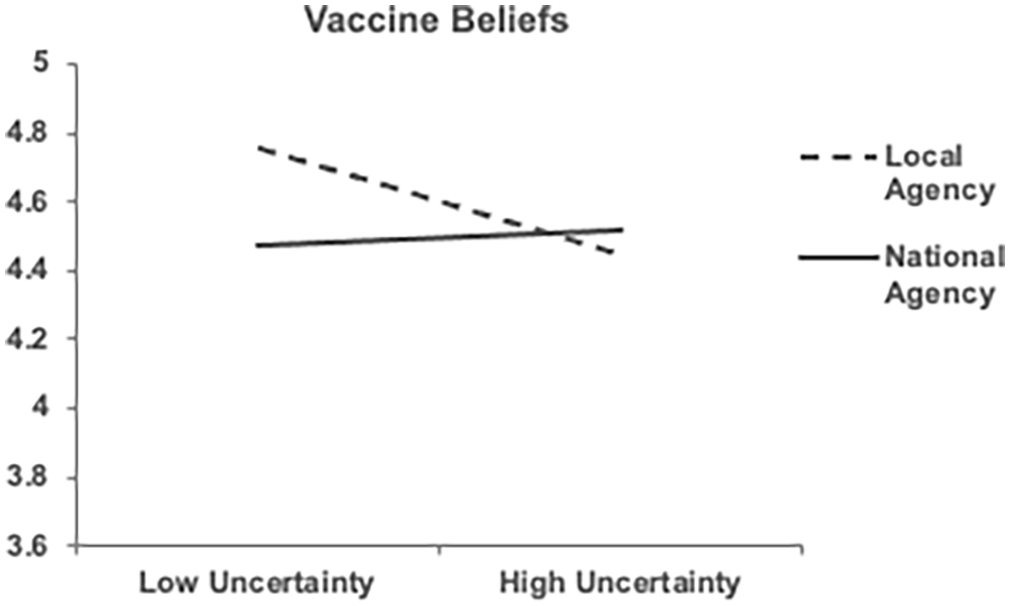
The interaction effect between psychological uncertainty and public agency on vaccine beliefs.
Discussion
This study contributes to the framing literature by identifying psychological uncertainty as a qualifier of gain–loss framing effects and uncovering the theoretical pathways underlying their joint influence. Consistent with prior literature (Reinhart et al., 2007), our study shows that the loss-framed message generates a stronger perception of threat to freedom and stronger psychological reactance than the gain-framed message. However, this effect does not necessarily translate into unfavorable persuasion outcomes. Rather, it should be understood in the context of the interaction between framing and psychological uncertainty. Consistent with the predictions from the integrative framework (Nan et al., 2018), the gain-framed message is more effective under conditions of low uncertainty, whereas the loss-framed message is more persuasive under conditions of high uncertainty.
As expected, the negative effects of the loss frame for participants primed with low uncertainty through the thought-listing task can be explained by increased perceived threat and psychological reactance. But for participants primed with high levels of uncertainty, their generated anger or counterarguing does not differ significantly depending on the type of frame. Although the loss-framed message negatively affects vaccine intention indirectly through perceived threat to freedom, the effect size of this indirect path is much smaller than that among participants experiencing low uncertainty. In other words, although participants are more aware of the persuasive attempt of the loss-framed message, they are less affected by it when they made judgments about COVID-19 vaccines under conditions of high uncertainty. Moreover, the significant direct effects of the loss-framed message on the persuasion outcomes suggest the existence of another positive pathway that prevails during the persuasion process.
Although the study did not provide direct evidence regarding cognitive elaboration, these findings may be explained by the possible influence of psychological uncertainty on the manner of information processing (Tiedens & Linton, 2001; Vaughn & Weary, 2003). Different levels of uncertainty may prompt participants to process framed campaign messages in distinct ways. Experiencing low uncertainty, participants are more likely to engage in heuristic processing. Their judgments are therefore more swayed by message valence and their reactance elicited by the negative tone of the loss frame. Differently, high levels of uncertainty may trigger a more deliberate way of message processing. Participants’ decision-making relies less on peripheral cues such as message tones, but depends more on a systematic consideration of the provided information. Under this circumstance, negative information outweighs positive information due to the occurrence of negativity bias (Unkelbach et al., 2020).
These patterns may provide empirical support to the propositions of the integrative framework regarding the relative persuasiveness of gain–loss frames during heuristic and systematic processing with an accuracy-driven goal (Nan et al., 2018). As the framework suggests, distinguishing different ways of information processing and identifying their antecedents may be crucial to further our understanding of framing effects. Consistent with the framework’s predictions, our findings suggest that negativity bias and psychological reactance are not two competing explanations of framing effects. Rather, they may occur under different modes of information processing. The inconsistent findings in the literature regarding gain–loss frames may be a manifestation of contextual factors involved in different experiment executions. Considering how the experience of information processing and related contextual factors condition framing effects could be valuable to decipher the mixed empirical findings. In addition, our findings extend the integrative framework by uncovering psychological uncertainty as a qualifier of framing effects, possibly through its influence on the mode of information processing.
Contrary to our prediction, the study fails to support the main effects of agency type. The expected interaction between agency type and gain–loss frames does not occur, either. Despite these null findings, we find an interaction effect between psychological uncertainty and agency type on vaccine beliefs. The local agency, as an information source, does lead to more positive beliefs toward COVID-19 vaccines under conditions of low uncertainty than the national agency. Such an advantage, however, disappears for participants primed with high uncertainty. This finding may provide further evidence for the connection between psychological uncertainty and the mode of information processing (Tiedens & Linton, 2001). Consistent with the prediction of the dual-processing models (Chaiken, 1980), the characteristics of message source as a peripheral cue are more influential when participants are primed with low uncertainty—they process the message in a more heuristic manner and are more likely to comply with the message when it is from a proximal source (i.e., local agencies); high uncertainty, in comparison, may encourage systematic processing that values message quality and is less swayed by the characteristics of a message source, such as proximity. This may explain why we do not find the main effects of agency type.
This study provides important practical implications for vaccine promotion. First, health practitioners need to consider public uncertainty when constructing campaign frames. For example, as vaccines for emergency use may trigger a higher level of uncertainty, it would be more effective to employ loss-oriented frames. By contrast, when it comes to routine vaccine administration, such as flu or measles vaccines, gain frames may work better. Variables that may be indicative of vaccine uncertainty—such as education or prior vaccine records—can also be used to segment the audience and tailor messages. Second, although national and local agencies are both primary sources of risk information during emerging health crises (Kapucu et al., 2010), local agencies may be more effective in promoting risk-mitigation measures such as vaccine uptake when the public holds more certain beliefs or is less motivated to process campaign messages. Under these scenarios, health campaigns should further leverage the communication capacity of local public agencies to better reach the community served.
It is important to address the potential limitations of this study. Notably, the hypotheses are tested on a single issue and we use a geographically confined sample. These are decisions made given our interests in promoting COVID-19 vaccines and in the differential effects of national versus local agency. Future research may employ the study design on a different health issue and use a more representative sample to see whether the patterns of framing effects are replicable.
Moreover, although we believe that our findings evidence the connection between levels of uncertainty and the mode of information processing, regrettably, we do not measure systematic and heuristic processing to further substantiate the link. Future research could consider incorporating the measures of the two variables or cognitive elaboration to test this intervening process.
The null findings regarding agency type point to the possibility that the contrast between CDC and the Houston Health Department is not strong enough to induce varied perceptions of message relevance. The large-scale influence of COVID-19 has made CDC an important day-to-day source of information for all Americans directly or indirectly through news media (Pew Research Center, 2020). Consequently, CDC as a source might not make the message appear less relevant. The contrast between national and local agencies may be more salient when it comes to a local or short-term health crisis. Future research may explore whether the type of health crisis qualifies the impact of national versus local agency in health promotion. In addition, agency type would likely make a difference under conditions of low uncertainty due to different levels of public trust toward the agency rather than proximity. We minimize possible partisanship biases at play by controlling for individuals’ political orientation. Random assignment of participants could minimize the influence of various preexisting attitudes toward the agencies. It would be beneficial for future research to further test the effect of source proximity while ruling out the influence of agency trust or reputation. Moreover, as this study focuses on social media messages, future research may test whether medium type (e.g., newspaper vs. social media) makes a difference in how individuals react to different agencies.
In addition, the gain-/loss-framed messages used in the experiment might not be fully equivalent in the use of controlling language. Although some researchers believe that forceful language is an innate feature of loss frames (H. Cho & Sands, 2011; Shen, 2015), others argue that it is a confound for framing effects (e.g., Bensley & Wu, 1991). Given this concern, future research may employ a loss-framed message with a gentler tone and see whether the patterns can be replicated.
Finally, future research may test whether optimistic bias moderates the interaction between framing and uncertainty. Optimistic bias refers to the tendency of individuals to judge themselves as less likely than others to experience negative events (Weinstein, 1980) such as contracting the coronavirus. It is plausible that gain frames are particularly appealing to individuals with high levels of optimistic bias under conditions of low uncertainty, whereas loss frames may appear more acceptable to optimists when they experience high levels of uncertainty. Future investigations may explore whether high levels of optimistic bias may make the interaction effect between uncertainty and framing more pronounced.
In conclusion, this study contributes to the “second-generation framing research” (Jensen et al., 2018) by identifying psychological uncertainty as a moderator of framing effects. It may also suggest the value of considering the mode of information processing in understanding how different frames affect cognitions and persuasion outcomes (Nan et al., 2018). Clearly, as a fundamental message feature, gain–loss frames are consequential to persuasion. But their relative effects are contingent on contextual factors such as psychological uncertainty. More research is needed to elucidate the various “nuances” of framing effects.
Footnotes
Declaration of Conflicting Interests
The author(s) declared no potential conflicts of interest with respect to the research, authorship, and/or publication of this article.
Funding
The author(s) disclosed receipt of the following financial support for the research, authorship, and/or publication of this article: The study is funded by the Enhance Research on COVID-19 and the Pandemic Grant from the University of Houston.
